




Abstract
Introduction
Handwashing is the most effective preventive behavior for coronavirus disease-19 (COVID-19) infection. However, research has shown the lower handwashing behaviors among Korean adults.
Objectives
This study aims to analyze factors associated with handwashing as a preventive behavior for COVID-19 infection based on the health belief model (HBM) and the theory of planned behavior (TPB) behavioral theories.
Methods
This secondary data analysis utilized the Community Health Survey developed by Disease Control and Prevention Agency conducted in 2020. Sampling method was stratified and targeted 900 people living in the territory of each community public health center. In total, 228,344 cases were used in the analysis. Handwashing behavior, perceived susceptibility, perceived severity, subjective norm, and influenza vaccine uptake were used in the analysis. Regression analysis using weighing strategy by stratification and domain analysis was used.
Results
Less washing hand was associated with older age (B = 0.01, p < .001), males (B = 0.42, p < .001), not receiving an influenza vaccine (B = 0.09, p < .001), perceived susceptibility (B = 0.12, p < .001), subjective norm (B = 0.05, p < .001), and perceived severity (B = −0.04, p < .001).
Conclusion
While perceived susceptibility and social norm had positive association, perceived severity had a negative association with handwashing. Considering the Korean culture, creating a shared norm for frequent handwashing could be beneficial to promote handwashing rather than emphasizing the disease and its consequences.
Keywords
Background
The global coronavirus disease-19 (COVID-19) pandemic was declared in March 2020 and lasted more than 3 years. The most common symptoms of COVID-19 infection are cough, fever, and fatigue (Struyf et al., 2022). Since the COVID-19 infection is transmitted by droplet or tiny particles called aerosols, the importance of handwashing has been emphasized (Alzyood et al., 2020; Jang & Hwang, 2022; Jung et al., 2022).
Handwashing is known to be effective preventive behavior for respiratory tract infections (Little et al., 2015). However, research has shown that the frequency of handwashing among the Korean public is low. Specifically, about 29.5% of adults wash their hands after using a public restroom and only 41.3% use soap while washing their hands (Lee et al., 2015). Likewise, in the study of Korean undergraduate students, only 5.1% answered that they wash their hands very frequently, and 38.1% answered that they washed their hands frequently (Choi et al., 2014). Most people described their handwashing as ordinary (44.9%) or rare (11.9%, Choi et al., 2014). Respiratory infectious disease outbreaks impact handwashing behavior. The public's handwashing behavior was higher during the H1N1 pandemic in 2009 compared with a non-outbreak era; specifically, the percentage of handwashing after using public restrooms was lower after the H1N1 pandemic (2009: 35.6%, 2014: 29.5%, Lee et al., 2015).
Review of Literature
In general, handwashing is influenced by some behavioral factors as well as the infrastructure such as knowledge, risk, or infrastructure (White et al., 2020). Behavioral theories have guided many research-related COVID-19 preventive measures that focus on the public's behavior. The health belief model (HBM) is used by many public health leaders to explain behaviors that affect health-related conditions. HBM was first developed in the 1950s by the US Public Health Service for preventing and detecting diseases. It was later expanded in the 1970s to include people's responses to symptoms and adherence to medical regimens (Champion & Skinner, 2008). Some core concepts of the HBM are widely used to explain why people adopt certain behaviors to prevent, screen, or control the illness conditions (Champion & Skinner, 2008). These concepts help explain handwashing behaviors during the COVID-19 pandemic in the United States, Mexico, Hong Kong, and Taiwan population (Hsing et al., 2021). Perceived susceptibility is the belief of some individuals that they can get a disease or experience symptoms. Perceived severity is the individual's perception of the clinical consequences of having an illness (Champion & Skinner, 2008). The group with high perceived susceptibility and high perceived severity has been shown to have high anxiety, which may motivate them to comply with preventive measures for COVID-19 (Eichenberg et al., 2021). Moreover, the study in Italy during the COVID-19 pandemic indicates that perceived severity and susceptibility are significantly associated with COVID-19 vaccine intention (Graffigna et al., 2020).
The theory of planned behavior (TPB) is a second behavioral theory that has been used to explain health-related behaviors. One of the major concepts of the TPB is the subjective norm, which is widely used to explain motivations for handwashing. TPB suggests that peer pressure and the perceived social norm are key for maintaining handwashing behavior, even among healthcare workers (Ay et al., 2019). Among the concepts of the TPB, social norm has been associated with having an impact in handwashing behaviors. In a 2021 study in Indonesia during the COVID-19 pandemic, researchers discovered that the social norm that is exhibited by individuals’ families or friends was an important factor in a person's compliance with proper handwashing behavior (Dwipayanti et al., 2021). In addition, the study in the United States also indicates that social norm has a significant association with handwashing behaviors (Mackert et al., 2013).
A 2021 study that examined preventive behaviors among adolescents in Korea during the COVID-19 pandemic used a combination model of the HBM and TPB (Park & Oh, 2021). The combination model suggests that behavior is determined by intention and perceived behavioral control, and behavioral intention is determined by attitude, subjective norm, and perceived behavioral control. Perceived susceptibility and perceived severity are the factors that affect the three concepts to determine behavioral intention.
Vaccine uptake such as influenza vaccination is one of the preventive behaviors of the infectious diseases. However in Korea, the influenza vaccine is not free for everyone. It is free for specific groups of people including people older than 62 years old, pregnant women, and children and adolescents. This leads to a lower influenza vaccine uptake among adults from 19 to 64 in Korea, which was 27.3% in 2018, compared to the vaccination rate among adults over 65 years old, which was 85.1% in 2018 (Korean Statistical Information Service, 2020). Influenza vaccination was emphasized in 2020 due to its indistinguishable clinical manifestations (Solomon et al., 2020). During the pandemic, influenza vaccination was increased from 41.9% in 2019 to 47.1% in 2021 in Korean population (Korea Disease Control and Prevention Agency [DCA], n.d.-a). Therefore, it can be assumed that people who receive the influenza vaccine take a strong interest in their health and they have willingness to follow the preventive behaviors of the COVID-19 such as handwashing.
Both the HBM and the TPB aim to predict the individual's health behavior and behavioral intention. Studies using HBM and TPB regarding Covid-19 vaccination intention have been conducted in countries such as the United States, Vietnam, or Israel (An et al., 2021; Badr et al., 2021; Shmueli, 2021). Some studies focused on the handwashing behavior but was not based on the behavioral theories (Al-Wutayd, 2021; Anderson-Carpenter & Tacy, 2022; Olapeju et al., 2021; Szczuka et al., 2021). Among the studies conducted in Korea, there are some studies focused on the mask mandate policy during the COVID-19 pandemic (Chung et al., 2022; Song & Choi, 2022) and a few studies focused on the importance of handwashing as a preventive measure for the transmission of the COVID-19 (Jung et al., 2022). However, no studies focused on the behavioral theory on handwashing during the COVID-19 pandemic. Investigating the preventive behaviors using the behavioral theories during the pandemic could be beneficial not only for a future pandemic, but also for promoting preventive measures of community-based infectious disease transmission. Therefore, this study aims to analyze the factors associated with handwashing as a preventive behavior for COVID-19 infection based on the HBM and TPB behavioral theories. Figure 1 shows the theoretical framework of this study.
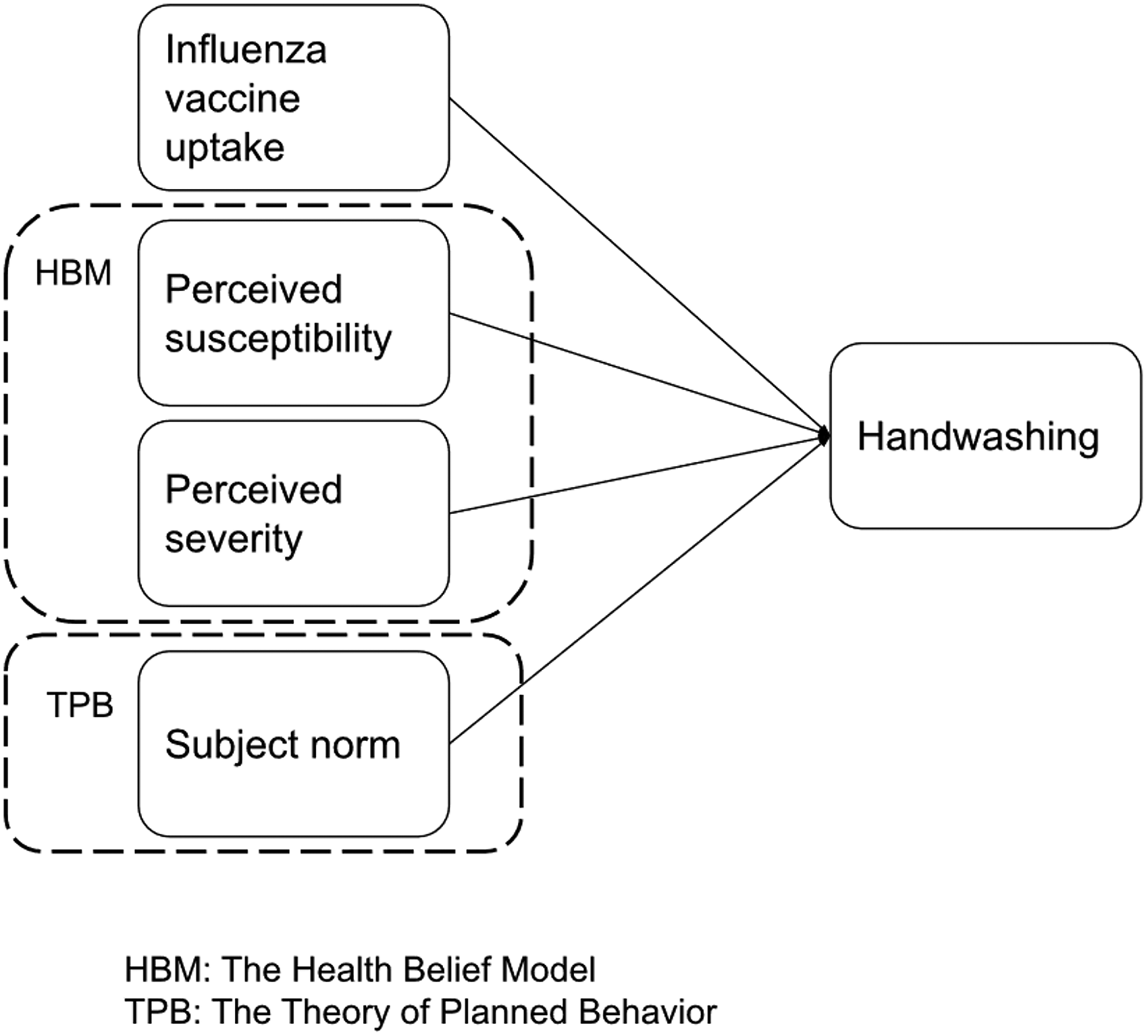
Theoretical framework of this study.
Methods
Design
This secondary data analysis utilized the Community Health Survey (CHS) developed by the Korea Disease Control and Prevention Agency (DCA). The CHS is a nationally representative survey that produces health-related statistics based on the provinces of Korea, that evaluates health-related policies, and that evaluates the public's health status (DCA, n.d.-b).
Research Question
The research questions of this study are: R1: Are people with higher perceived susceptibility more likely to frequently wash their hands?
R2: Are people with higher perceived severity more likely to frequently wash their hands?
R3: Are people with higher subjective norm more likely to frequently wash their hands?
R4: Are people who received an influenza vaccine more likely to frequently wash their hands?
Sample and Inclusion Criteria
The CHS targets adults older than 19 years who are living in Korea. It is stratified by the provinces and metropolitan cities. The recruitment was based on random 900 persons from 253 community public health center. The 2020 CHS was conducted by visiting the participants’ houses and conducting a computer-assisted personal interview from August 16 through October 31, 2020. A total of 142 questions were asked in 18 different provinces and metropolitan areas. This secondary data analysis utilized data collected during the 2020 survey that generated 229,269 responses.
Measurements
Handwashing behavior was evaluated using three questions: “How often do you wash your hands (a) before eating; (b) after using the restroom; and (c) after returning home during the recent week.” Responses were measured using a 4-point Likert scale (1: always, 2: frequently, 3: sometimes, 4: rarely). The three answers were summed for a possible total score from 3 to 12, where a lower score means more handwashing behaviors.
Perceived susceptibility was measured using the question, “I am worried about being infected with COVID-19.” Perceived severity was measured using the question, “I am worried about dying if I become infected with COVID-19.” Subjective norm was measured using the question, “I am worried about being criticized or being blamed by my social network and my work colleagues if I become infected with COVID-19.” These three questions were measured using a 5-point Likert scale (1: very likely, 3: neutral. 5: not at all). A lower score indicates high perceived susceptibility, severity, or subjective norm.
Influenza vaccine uptake was measured using the question, “Have you received the influenza vaccine during the last year?” Possible answers were yes or no.
Statistical Analysis
Regression analysis was used to examine the association of handwashing behavior with perceived susceptibility, perceived severity, and subjective norm including demographic characteristics (having an influenza vaccination and respondents’ gender). All analyses used a weighing strategy by stratification and domain analysis. The missing rate was 0.4% in the total proportion of values. This study used the complete cases analysis with the 228,344 sample. All statistical analyses were performed using SAS software, version 9.4.
Results
Sample Characteristics
Table 1 shows the demographic characteristics of the study respondents. Total sample was 228,344, and weighted sample was 43,376,888. Half of the respondents were male (50.29%). Mean age was 48.76 (S.E.: 0.05). Half of the total respondents had received the influenza vaccine (50.34%). Mean score of handwashing behavior was 3.82 (S.E.: 0.00), perceived susceptibility was 2.12 (S.E.: 0.00), perceived severity was 2.87 (S.E.: 0.00), and subjective norm was 2.09 (S.E.: 0.00).
Demographic Characteristics of the Sample.

S.E. = standard error.
Research Question Results
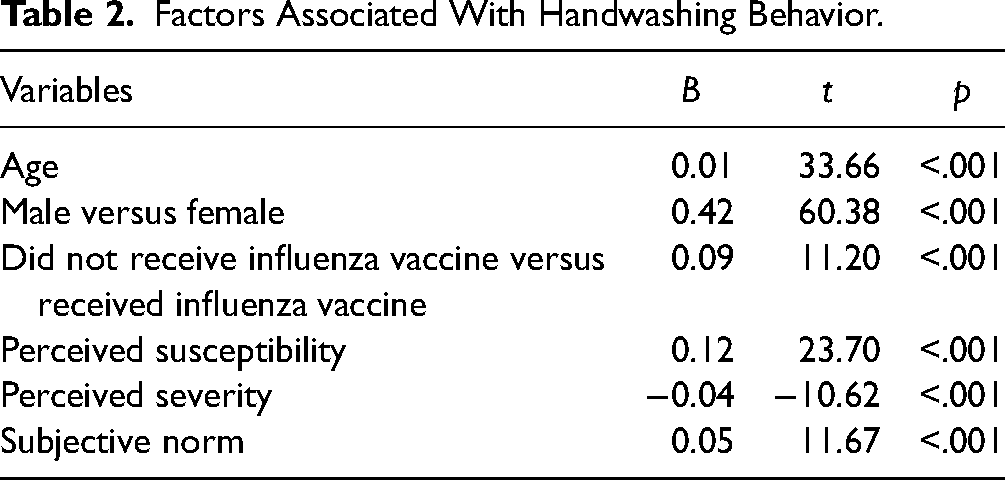
Table 2 shows the regression results. The regression model accounted for 3.56% of variance in handwashing behavior (F = 985.98, p < .001). All variables included in the model were significantly associated with handwashing behavior. Age was the significant factor with small effect (B = 0.01, p < .001). Males reported washing their hands slightly less often than females (B = 0.42, p < .001). People who did not receive an influenza vaccine also washed their hands less often, but there was a small difference when compared with people who received an influenza vaccine (B = 0.09, p < .001). Perceived susceptibility (B = 0.12, p < .001) is positively associated with handwashing behavior, indicating that people who are worried about COVID-19 infection are more likely to wash their hands. Subjective norm was also positively associated with handwashing behavior (B = 0.05, p < .001), indicating that people who are worried about being criticized if they infect others with COVID-19 are more likely to wash their hands. Perceived severity was negatively associated with handwashing, which is opposite to our hypothesis, indicating that people who are not worried about dying if they become infected with COVID-19 are more likely to wash their hands (B = −0.04, p < .001).
Factors Associated With Handwashing Behavior.
Discussion
This study examined the factors associated with handwashing behavior during the COVID-19 pandemic based on a combination model of the HBM and the TPB. Influenza vaccination was added in the analysis due to its influence on the public's heath behaviors during the COVID-19 pandemic. Perceived susceptibility and subjective norm were positively associated with handwashing behavior. People who received an influenza vaccination, who are younger, and who are female were shown to wash their hands more often. The results of this study provide some insights on how to promote handwashing behavior to prevent mass transmission in the respiratory infectious diseases outbreak in the future.
First, the result indicating perceived susceptibility is an important factor for promoting handwashing behaviors, which aligns with previous studies during the COVID-19 pandemic. Perceived susceptibility was positively associated with handwashing behavior during the COVID-19 pandemic in China (Wu et al., 2021) and in India (Kumar et al., 2021). Perceived susceptibility is also shown to be a significant factor for COVID-19 vaccine behavior (Graffigna et al., 2020). However, a previous study conducted before the disease outbreak indicated that perceived susceptibility was not significantly associated with handwashing behavior or intentions regarding norovirus outbreak simulation situations in adults (Fisher et al., 2018). Considering that handwashing behavior increased during the H1N1 outbreak in Korea (Lee et al., 2015), perceived susceptibility could impact handwashing behavior only if there is an uncertain situation that includes emerging disease outbreaks instead of usual life. This emphasizes the importance of a handwashing campaign in an emerging disease outbreak that highlights the fact that people are more susceptible to being infected by the disease when they do not practice proper handwashing.
Subjective norm was also shown to be significant. The concept of social norm itself is not directly related to one's own health. In this study this variable is more about the consequences when people have become infected with COVID-19. This means that people care about the surrounding people such as neighbors, friends, or co-workers more than whether they are infected. Social norm turned out significant factor for the COVID-19 preventive behaviors in the previous studies. Subjective norm was significantly associated with handwashing behavior during the COVID-19 pandemic among US adults (Aschwanden et al., 2021) and with behavioral intention to follow the preventive behaviors for COVID-19 in Korea (Park & Oh, 2021). During an infectious disease outbreak, it is difficult to prevent disease dissemination without the cooperation of the community and the population. Korean culture emphasizes group networking, which includes a cultural practice to skillfully sense the feelings of others, and an ability to recognize another person's intent, desires, feelings, and attitudes without relying on an explicit verbal message (Kim, 2003). Koreans can be especially sensitive to the community's tacit rules and make a special effort to follow them (Park & An, 2019). This cultural aspect could enhance the social norm as an important factor for handwashing behavior.
Influenza vaccine uptake was also shown to be a significant factor. The percentage of people who were vaccinated for influenza was low, only about 50%. However, influenza vaccine uptake is significantly associated with the handwashing behavior. Like our hypothesis, the people who wash their hands more often are also aware of other preventive behaviors for respiratory tract infections, including the influenza vaccine. Because the clinical manifestations of influenza and COVID-19 are relatively indistinguishable (Solomon et al., 2020), the government is continuing its efforts to encourage people to receive an influenza vaccine. Based on the results of this study, it is suggested that healthcare leaders promote the influenza vaccine more widely to people who are not willing to practice preventive behaviors for COVID-19.
Finally, contrary to the author's hypothesis, perceived severity has a negative association with handwashing behavior. The study from China also showed the surprising negative association between perceived severity and sanitization practices during the COVID-19 pandemic (Wu et al., 2021). It is reasonable to expect that in most cases, perceived severity would be a motivation for positive health behaviors. However, in a pandemic situation, the perceived severity of the disease may discourage healthy behaviors because the perceived severity of the disease discourages hope among members of the public that their behaviors can keep them healthy. From the literature, perceived severity was negatively associated with the hope appraisal (Huang & Yang, 2020). This suggests that in uncertain situations like the COVID-19 pandemic, people with high perceived severity lack hope that they can control their health, and they lose motivation to act in ways that are consistent with positive health behaviors.
As a conclusion, the relationships among social norm, perceived susceptibility, and perceived severity suggest that promoting handwashing as a shared norm in the community could be the most effective strategy to promote handwashing as a positive health behavior that can prevent infectious disease instead of a strategy that emphasizes the severity of symptoms if a person becomes infected. Koreans’ handwashing behavior is low (Choi et al., 2014; Lee et al., 2015) so emphasizing handwashing as a shared norm could be beneficial at all times, not only during infectious disease outbreaks. Strong efforts to make proper handwashing a habitual behavior are needed since many Koreans report that they do not wash their hands because it is not one of their regularly practiced behaviors (Choi et al., 2014).
Strengths and Limitations
This study has several strengths. First, this study provides more generalized knowledge about the Korean population and handwashing behavior. Most handwashing-related research studies are based on a small survey sample. However, this study utilized a large public dataset, which was recruited based on stratification. These recruiting strategies and the number of individuals in the sample support generalizing based on our study. Another strength of this study is utilization of behavioral theories. Most studies on handwashing behavior with a large sample number are not based on behavioral theories. Based on the behavioral theories, this study provides more in-depth understanding of handwashing behavior and the possible strategies for future intervention/public health policy. Next, this study is timely because it was conducted during the COVID-19 pandemic. Similar respiratory infectious disease outbreaks continue to occur. Previously there was the H1N1 and the SARS pandemic. Based on the results of this study, it is possible to prepare for future emerging disease outbreaks.
There are limitations associated with this study. First, because this study is a secondary data analysis, it was not based on the author's design. Some key variables from the TPB and HBM such as perceived benefits, perceived barriers, cues to action, perceived behavior control, or behavioral attitude are not included. Future studies with other components of the theories are suggested to examine how behavioral components are related to handwashing behavior. A second limitation is that handwashing behavior was based on respondents’ self-report. Recent research has used handwashing monitoring devices (Piras et al., 2018). As technologies develop, it may be possible to evaluate handwashing behavior more objectively. Future studies could utilize technical devices for evaluation of handwashing behavior to obtain more precise and objective results. Third, this study is a cross-sectional study, so it is difficult to infer a causal relationship. Future studies are encouraged to examine a longitudinal model with the theories to investigate how handwashing behavior changed before and after COVID-19.
Implications for Practice
This study examined how perceived susceptibility, perceived severity, subjective norm, and influenza vaccine uptake were associated with handwashing behavior during the COVID-19 pandemic. One result of this study is a recommendation that healthcare professionals and the government make an effort to create a shared norm for handwashing as part of the effort to inform the public about how easily COVID-19 is transmitted and how effective handwashing can be for preventing COVID-19 transmission. Creating a social norm in the community to increase habitual handwashing could be beneficial for the health of the community at all times, not just if there is a threat of a pandemic.
Conclusions
This theory-based secondary data analysis examined the associated factors on handwashing behavior in Korean population during the COVID-19 pandemic. The results of this study suggested creating a social norm in the community to increase individuals’ handwashing behavior. The results of this study can contribute to strategies for limiting a future pandemic and also to strategies for promoting community-based preventive measures associated with infectious disease transmission.
Footnotes
List of Abbreviations
Acknowledgments
Data used in this study were derived from the Korea Disease Control and Prevention Agency.
Declaration of Conflicting Interests
The authors declared no potential conflicts of interest with respect to the research, authorship, and/or publication of this article.
Funding
The authors received no financial support for the research, authorship, and/or publication of this article.
