




Abstract
Introduction
In the healthcare system, nurse managers’ participation in decision-making was invaluable in preserving cost-effective service and safe patient care. Despite the fact that nurse managers have the power to ensure optimal health care service, their involvement in decision-making has not been well studied.
Objectives
To assess nurse managers’ decision-making involvement and associated factors working in selected governmental hospitals in Addis Ababa, Ethiopia 2021.
Methods
A cross-sectional study was conducted among 176 nurse managers from government hospitals in Addis Ababa, with a response rate of 168 (95.5%). The total sample size is assigned in proportion. The technique of systematic random sampling was used. A structured, self-administered questionnaire was used to collect data, which was then checked, cleaned, entered into EPI Info version 7.2, and exported to SPSS software version 25 for analysis. In a binary logistic regression model analysis, a p-value < .25 was used as the cut-off point to consider variables as candidates for multivariable analysis. A p-value of .05 was used to determine the predictor variables with a 95% confidence interval.
Result
The mean age and standard deviation of the 168 respondents were 34.9 ± 4.1 years. More than half, 97 (57.7%), were excluded from general decision-making. Nurse managers in matron positions were 10 times more likely to participate in decision-making than head nurses (AOR = 10.00, 95% CI: 1.14–87.72, p = .038). Nurse managers who received managerial support were five times more likely to participate in good decision-making than nurse managers who did not receive managerial support (AOR = 5.29, 95% CI: 1.208–23.158, p = .027). Nurse managers who received feedback on their decision-making involvement had 7.7 times more good decision-making involvement than those who did not (AOR = 7.70, 95% CI: 2.482–23.911, p = .000).
Conclusion
According to the findings of the study, the majority of nurse managers were not involved in decision-making.
Background
Healthcare decision-making is concerned with making the best choices for how to allocate resources or which treatments to use, as well as medical triaging and selecting affordable interventions (Glaize et al., 2019). It is decision-making in the context of diverse public bodies’ wide-ranging social relationships. Healthcare decisions take into account clients’ active participation in decision-making, as well as their recognition and respect for health, healthcare, and life (Gray et al., 2019). The process of weighing the benefits and costs of interventions in health care is known as “decision-making in health care” (Metlay & Armstrong, 2020). Decision-making in the healthcare system necessitates distinct competencies in planning, directing, supervising, and creating a peaceful environment for both the health team and clients (Munyewende et al., 2016).
The involvement of nurse managers in decision-making has a limitless impact on nurses’ attitudes and beliefs by guiding and inspiring them to achieve organizational as well as professional goals, and it is an essential component for effective and efficient health care provision as well as future professional development and advancement as needed (Pishgooie et al., 2019).
Review of Literature
Nurses’ active involvement in decision-making is crucial in modern healthcare facilities (Moghaddam et al., 2019). The independent and active involvement of nurse managers in decision-making plays a central role in providing an integrated, quality, and cost-effective nursing service (Almutairi et al., 2017; Pishgooie et al., 2019).
Visionary nurse managers are the driving force for understanding the internal image of the profession and overcoming influences from various directions and bodies (Riley et al., 2016). For the delivery of excellent patient care and the reduction of medical error, the nurse manager is the critical individual who can lead and direct the nursing service department and ensure quality service delivery (Chitsulo et al., 2014).
Nurses are the most numerous other professionals (Shariff, 2014; Tørstad & Bjørk, 2007), but a lack of opportunity in decision-making involvement at various levels, a lack of supportive structure, a negative image, seeing the profession as incompetent, and work overload all have a significant impact on health care decision-making participation (Ahmed & El-Hosany, 2018). Inadequate resources and manpower are factors that have a significant impact on nursing managers’ administrative decision-making involvement and result in little administrative decision-making participation (Chitsulo et al., 2014). In developing countries, the healthcare system is not advanced because nurse managers do not participate in decision-making. Despite good managerial and leadership skills, there are professional inequalities that impede decision-making participation (Almutairi et al., 2017).
Active participation in decision-making by nurses is critical in modern healthcare facilities (Morphet et al., 2019). Positive and negative factors influence nurse managers’ decision-making involvement. Negative factors lead to poor managerial decision-making involvement (Ahmed & El-Hosany, 2018; Tørstad & Bjørk, 2007). Nurse managers’ lack of involvement in decision-making has negative consequences for nursing care, including high turnover, heavy workload, professional burnout, and low-quality health services (Shariff, 2014).
According to a national cross-sectional survey of nurse managers in Australia, 74.3% of clinical nurse managers are involved in a variety of activities. Lower scores indicate that organizational nurse managers highlight the shift to strategy-focused activities that occurs as nurses advance up the management tree (Bayliss-Pratt et al., 2020).
A systematic review of quantitative and qualitative studies conducted in Thailand discovered that educational level, age, and work experience all had a positive and strong relationship with decision-making involvement (67.5%), but there was no relationship with gender (Regan & Rodriguez, 2011).
In a descriptive comparative study conducted in Egypt, involvement 91%, support 84%, knowledge and skill 87%, and enabling structure 83% were identified as positive factors for decision-making involvement among nurse managers, while inadequate resources 88.5%, a lack of knowledge, skill, and support 67%, a lack of participation 65.5%, and a negative image of nursing 54.5% were identified as negative factors for nurse managers’ decision-making involvement (Ahmed & El-Hosany, 2018). In a descriptive correlational study of Egyptian nurse managers, 76.5% attended a management training course, and the availability of management training programs was found to have a significant relationship with decision-making involvement (Nibbelink & Brewer, 2018).
A survey of nurse leaders in three east African countries (Kenya, 43.2%; Uganda, 16.2%; and Tanzania, 40.6%) revealed that a lack of recognition of nurses’ contributions, as well as inadequate representation of nurse leaders in health policy development forums, are barriers to decision-making participation (Shariff, 2014).
Unfairness in the health-care system, a lack of consideration for burden-benefit distribution, a high level of professional migration, and a lack of attention to nurses’ voices, interests, and value are all indicators of a low level of decision-making participation among nurse managers, as well as a lack of the right personal representative for nursing (Keshk et al., 2018).
One of the most common arguments for the study of nurse managers’ involvement in decision-making is the potential benefit for the patient and advancement of nursing practice, as well as professional independence (Glaize et al., 2019; Guo, 2020; Ugur et al., 2017). Even though nurse managers’ involvement in decision-making is influenced by a variety of factors, currently in Ethiopia, no published research reflects on nurse managers’ involvement in decision-making. Therefore, this study helps to bridge the gap regarding nurse managers’ involvement in decision-making in different hospital settings. The result of this study provides basic and vital information about the level of decision-making involvement among nurse managers and a common understanding of factors that affect nurse managers’ involvement in decision-making. In addition, the findings of this study are input for the development of the nursing profession because one of the characteristic features of a profession is that professionals have power over the practice of their discipline, which is often considered professional autonomy. So, this study aimed to assess nurse managers’ decision-making involvement and associated factors working in Addis Ababa, Ethiopia 2021.
Methods and Materials
Study Design, Period, and Area
An institutional-based cross-sectional study design was conducted from February 15 to March 15, 2021. The purpose of this study was to assess nurse managers’ decision-making involvement and associated factors in selected government hospitals in Addis Ababa, Ethiopia, in 2021. In the city, there are 14 governmental hospitals; five of the hospitals were chosen, and the total number of nurse managers in these hospitals is 271.
Source and Study Population
All nurse managers who are working in the government hospitals in Addis Ababa are part of the source population, while nurse managers who are working in selected government hospitals in Addis Ababa are part of the study population.
Eligibility Criteria
All nurse managers with work experience above 6 months in the selected government hospitals in Addis Ababa were included, whereas nurse managers who were on annual leave, unavailable during data collection, or not in a managerial position at the time of the study were excluded.
Sample Size
The actual sample size for the study was determined using the formula of single population proportion, that is,

To determine the sample size, the following assumption was used. Because no previous studies on nurse managers’ involvement in decision-making and associated factors had been conducted in Ethiopia, a prevalence level that estimated the maximum sample size (50%) was considered. The margin of error (d) at 95% confidence interval is 0.05, Z/2 = 1.96, and P = 50%.


By considering 10% non-response rate, the final sample size was 176.
Operational Definition
Nurses in various levels of managerial positions in hospitals, such as matrons, supervisors, and head nurses, are referred to as “nurse managers” in this study. Nurse managers are nurses who contribute to the nursing profession by directing and coordinating the work of staff nurses in a clinical setting (Chitsulo et al., 2014; Riley et al., 2016).
Nurse managers: Nurses in hospital management positions such as matron, head nurse, and supervisors. Involvement in decision-making: It is defined as participation in a mental process that results in the selection of a belief or course of action from among various possible alternative options; it can be rational or irrational (Palmer & Harmell, 2016). Good involvement in decision-making: It indicates a higher-than-average response rate of participants to decision-making involvement (Bacon et al., 2019). Poor involvement in decision-making: It indicates that the participation rate in decision-making is lower than the mean value (Bacon et al., 2019). Regular exercise and physical activities: Identify those who exercise three or more times per week or who take a 30-min fast walk or ride a bicycle every day (Glaize et al., 2019).
Data Collection Tool and Procedures
By reviewing various works of literature, well-structured and pre-tested self-administered questionnaires were prepared, designed, and developed in a way that meets the objectives of the study (Chitsulo et al., 2014; Duffield et al., 2019; Girvin et al., 2016; Regan & Rodriguez, 2011). The questionnaire includes all of the variables that contribute to the study's goal. The questionnaire had three components (11 items for socio-demographic characteristics, 10 items for involvement in decision-making, and 15 items for associated factors related to nurse managers’ involvement in decision-making) and was used as a data collection tool. The internal consistency (Cronbach's alpha) was 0.80. Those who chose extremely poor = 1, poor = 2, neutral = 3, good = 4, and extremely good = 5. Finally, those who score higher than the mean was considered to have good decision-making involvement. To reduce bias, four BSc nurses were chosen and assigned as data collectors from outside study hospitals, and general orientation and training were provided to make them familiar with each question and the data collection process for a 01-day. Standard precautions for coronavirus disease were also taken in 2019 (COVID 19). The supervisors keep an eye on the data collection process.
Study Variables
The study variable was nurse managers’ decision-making involvement. Sociodemographic variables (age, sex, marital status, educational level, work experience, salary, exercise, and physical activity) and organizational variables (lack of time, lack of resources, workload, organizational structure, managerial support, professional value, training programs on management and leadership) were predictable variables of the study.
Ethical Approval and Consent to Participate
The Addis Ababa University College of Health Science ethical review board granted ethical clearance and approval letters with protocol number 30/21/SNM, and the Addis Ababa Public Health Research and Emergency Management Directorate granted permission. Each study participant provided written informed consent. The Helsinki Declaration ensured the privacy and confidentiality of the participants’ information.
Data Quality Control
To ensure data quality, 10% of the questionnaire was pre-tested 2 weeks before data collection began at Yekatit 12 Hospital. It aids in the clarification of ambiguous statements. Data collectors received one day of training. Clarity, completeness, and missing values were checked and evaluated in the questionnaires. Incomplete questionnaires were removed from consideration and analysis. Internal reliability (alpha Cronbach's 0.79) was determined for the tools used to assess decision-making involvement. Every day and before data entry, the collected data was reviewed and checked for completeness. Supervisors oversee data collection and data verification.
Data Processing and Analysis
The collected data was visually checked for completeness. Data was cleaned, coded, and entered into Windows EPi-Info version 7.1 before being exported to Statistical Package for Social Science (SPSS) version 25 for data analysis. A p-value < .25 cut-off point was used to consider variables into multivariable from bivariable in a binary logistic regression model using bivariable and multivariable analysis methods. A p-value of .05 was used to determine the predictor variables between variables with a 95% confidence interval. The model was checked by Hosmer-Lemeshow goodness of test and the value (0.575) was obtained which indicate that the model fitness was fulfilled. Also, multicollinearity was tested by using collinearity statistics, in which tolerance and variance inflation factor were (0.14–0.79) and (1.4–7.89), respectively. The frequencies and percentages were presented using descriptive statistics and statistical tables.
Results
Socio-Demographic Characteristics
A total of 176 nurse managers participated in the study, with a response rate of 168 (95.5%). The mean age and standard deviation of the 168 respondents were 34.9 ± 4.1 years. Ninety-five (56.5%) of the total study participants were females. Approximately 88 (52.4%) of them were married. More than half of the study participants, 90 (53.6%), were BSc graduates. In terms of the type of nurse manager position, 115 (68.5%) were head nurses. Seventy-nine (47%) of the study participants had 6–10 years of work experience as nurse managers. In terms of monthly salary, 52 (31%) of the total respondents earn between 115.44 and 149.44 US dollar per month, and 32 (19%) work in OPD. Among all respondents, 117 (69.6%) engage in physical activities and exercise, with 73 (62.4%) doing so on a regular basis (Table 1).
Socio-Demographic Characteristics of Nurse Managers in Selected Government Hospitals, Addis Ababa, Ethiopia, 2021 (n = 168).

Nurse Managers’ Involvement in Decision-Making
More than half of the total respondents, 97 (57.7%), had poor decision-making involvement.
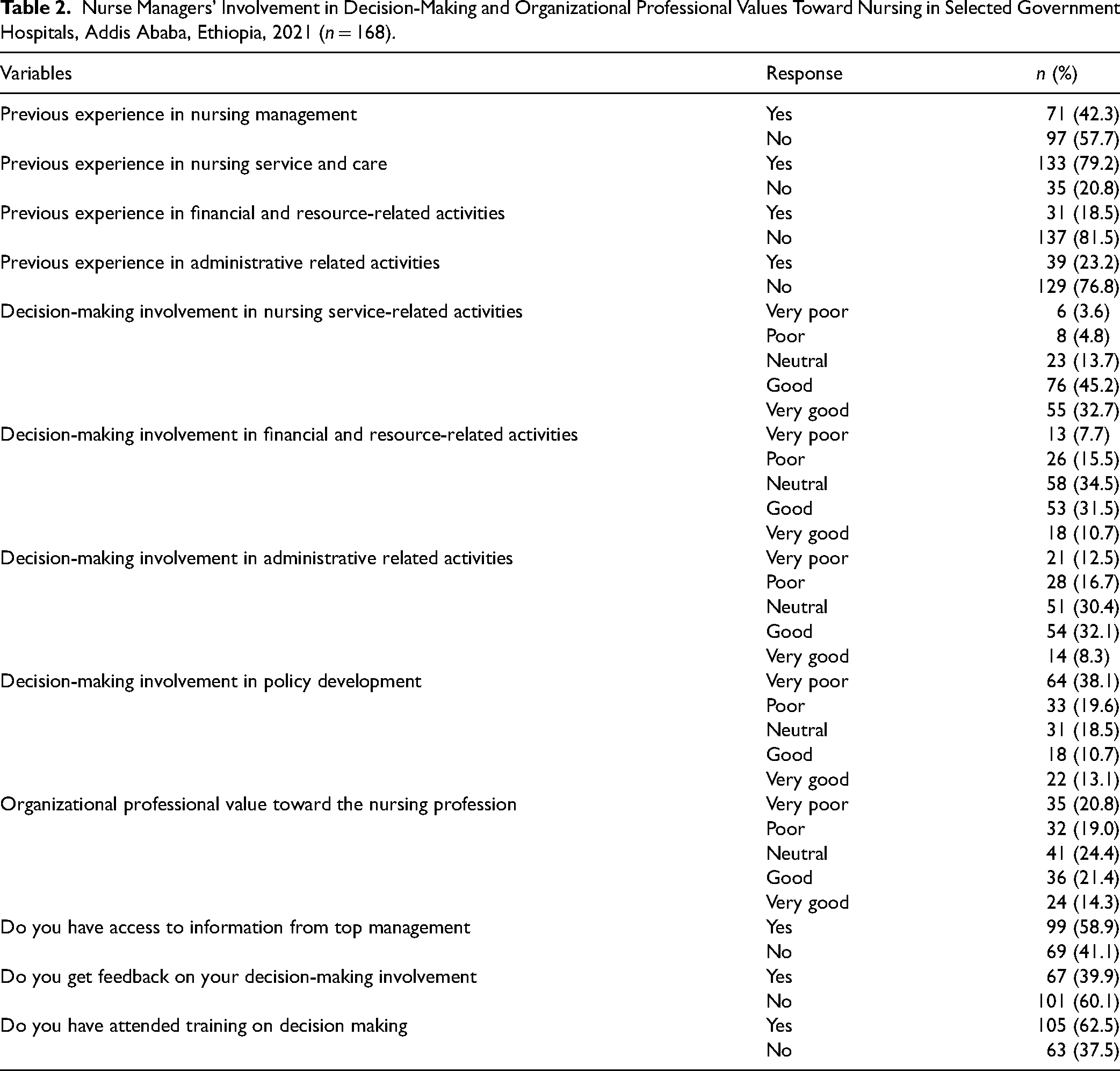
Less than half of the study participants, 71 (42.3%), have prior experience in nursing management, and 133 (79.2%) have prior experience in nursing service and care. Only 31 (18.5%) of the total respondents have involvement in financial and resource-related decision-making, while 39 (23.2%) have involvement in administrative-related decision-making. In nursing service-related activities, 76 (45.2%) of the total respondents had good decision-making involvement.
Out of the total number of respondents, 53 (31.5%) were involved in financial and resource-related decision-making activities. Fifty-four (32.1%) of the total study participants had good decision-making involvement in administrative-related activities. Eighteen (10.7%) of the total study respondents have good decision-making involvement in policy development. Forty-one (24.4%) of participants said their organizational professional value toward nursing was neutral, while only 36 (21.4%) said their organizational professional value toward nursing was good. The majority of respondents, 99 (58.9%), had access to information from top management, while the majority of respondents, 101 (60.1%), did not receive feedback on their involvement in decision-making. One-hundred five (62.5%) of the total respondents had received management training (Table 2).
Nurse Managers’ Involvement in Decision-Making and Organizational Professional Values Toward Nursing in Selected Government Hospitals, Addis Ababa, Ethiopia, 2021 (n = 168).
Factors Associated With Nurse Managers’ Involvement in Decision-Making
Bivariable Analysis
Bivariate logistic regression analysis showed that the common socio-demographic characteristics such as marital status, working unit, working position, work experience, monthly salary, and participation in exercise and physical activities, and organizational factors such as lack of time, workload, poor organizational value towards the profession, lack of resources, lack of feedback for decision-making involvement, and lack of managerial support were found to be significantly associated with nurse managers decision-making involvement (Table 3).
Multivariate Logistic Regression Analysis Factors Associated With Nurse Managers’ Involvement in Decision-Making at Selected Government Hospitals Addis Ababa, Ethiopia, 2021 (n = 168).

Note. COR = crude odd ratio; AOR = adjusted odd ratio.
* p < .05
** p < .001.
Multivariable Analysis
Working position, lack of managerial support, and lack of feedback for decision-making involvement were all associated with nurse managers’ decision-making involvement in the multivariate analysis. Nurse managers in matron positions were 10 times more likely to participate in decision-making than head nurses (AOR = 10.0, 95% CI: 1.1–87.72, p = .04). Nurse managers who received managerial support were 5 times more likely to participate in good decision-making than nurse managers who did not receive managerial support (AOR = 5.29, 95% CI: 1.21–23.16, p = .03). Nurse managers who received feedback on their decision-making involvement had 7.7 times more good decision-making involvement than those who did not (AOR = 7.70, 95% CI: 2.48–23.91, p = .00) (Table 3).
Discussion
The study attempted to address issues concerning the involvement of nurse managers in decision-making and associated factors in selected government hospitals of Addis Ababa, Ethiopia. Effective nursing management and leadership are required for the delivery of desired and high-quality patient care, which will help any country's health indicators improve (Glaize et al., 2019; Metlay & Armstrong, 2020). The nurse manager is an important person who has a direct influence on nursing services and ensures that the desired quality of nursing services is achieved (Munyewende et al., 2016; Patali et al., 2018).
In the current study, 71 (42.3%) of total respondents had good decision-making involvement, which is lower than in Egypt, 91% (Ahmed & El-Hosany, 2018), Australia, 74.3% (Bayliss-Pratt et al., 2020), and Thailand, 67.5% (Regan & Rodriguez, 2011). This could be due to differences in management support, enabling structure, organizational professional value, and differences in health policy and hospital setup. The finding indicates that the environment is less likely to be encouraging and conducive to nurses’ participation in decision-making, which decreases the nurses’ role in the active involvement for quality of health care delivery system.
Of the total respondent more than half, 97 (57.7%), had poor decision-making involvement, which is in line with the study conducted in Finland (Zahednezhad et al., 2018), and Southeastern United States (Moghaddam et al., 2019). This poor involvement may be due to nurse managers’ most frequent emphasis on patient care, lack of managerial support, and high levels of engagement in assorted activities. Even, including developed country, the value for nurse profession focuses on care rather than encouraging them to be involved in decision-making for planning and implementing of the health care delivery system.
The findings of this study also revealed that nurse managers who work as matron have ten times more good decision-making involvement than nurse managers who work as head nurses. The findings of this study were consistent with those of studies conducted in Egypt (Nibbelink & Brewer, 2018) and Sweden (Elrais, 2017). This could be a result of the fact that while head nurses spend their time on non-management technical tasks, matrons get to take part in a variety of meetings with senior and middle-level managers, which helps them become good decision-makers.
In this study, nurse managers who received managerial support had five times more good decision-making involvement than nurse managers who did not receive managerial support. This finding was supported by a prior study conducted in Thailand (Regan & Rodriguez, 2011) and Egypt (Ahmed & El-Hosany, 2018). This demonstrates that the nurses who received support had access to skill development, information from top management, and empowerment.
Additionally, this study discovered that nurse managers who received feedback on their decision-making involvement had eight times as much positive involvement in decision-making as nurse managers who did not receive feedback; this finding was confirmed by research from North California (Duffield et al., 2019) and East Africa (Shariff, 2014). Feedback allows for the correction of a gap or weakness and self-improvement, as well as for the learning from mistakes.
In this study, sociodemographic characteristics of the participants such as work experience, educational level, and age had no association with the nurse manager's decision-making involvement, whereas previous studies in Egypt (Ahmed & El-Hosany, 2018), Canada (Almutairi et al., 2017), Thailand, and South Korea (Chisengantambu-Winters et al., 2020) found a significant association between socio-demographic characteristics and the nurse manager's decision-making involvement. This might be caused by disparities in socioeconomic status and health policies, a range of nurse managers’ activities, contrasting professional values, and a lack of empowerment from a higher position.
The fact that regular exercise and physical activity participation was unrelated to decision-making involvement was another finding of this study. One-hundred seventeen (69.6%) of the total respondents engaged in physical activity and exercise. This result is different from that of an earlier Iranian study (KARIMIAN et al., 2016). This disparity could be attributed to socioeconomic and cultural differences.
In this study, more than half of respondents (n = 101, 60.1%) did not receive feedback for their participation in decision-making, and the majority of respondents (n = 118, 70.2%) lacked managerial support. A prospective study on health workers conducted in Sweden served as the study's main source of data, and it revealed that low managerial support from top managers is unfavorably associated with low decision-making involvement in healthcare managers (Fallman et al., 2019).
Similar to the findings in Egypt and Sweden (Ahmed & El-Hosany, 2018; Fallman et al., 2019), another finding in this study is that a lack of managerial support affects nurse managers’ involvement in decision-making. This is because a lack of managerial support affects the accessibility of training and information.
Conclusion
According to the findings of this study, more than half of the respondents, 97 (57.7%), were not involved in decision-making. From the sociodemographic characteristics working position as well as from the organizational factors lack of feedback and lack of managerial support considered as factors that significantly associated with decision-making involvement of nurses.
Limitation of the Study
The cross-sectional design of the study, which does not establish a temporal connection between the outcome and predicable variables, as well as the paucity of literature in Ethiopia for comparison, are both limitations of this study.
Implications for Practice
According to the study's findings, head nurses and nurse managers in matron positions who received managerial support and feedback on their decision-making involvement experienced positive results. The ability of nurse managers to participate in decision-making had a huge impact on preserving an advanced and economical healthcare system.
It might be necessary for Ethiopia's Ministry of Health and hospital administrators to assist those who do not have managerial support and offer feedback in order to increase the involvement of nurse managers in decision-making for higher-quality nursing and medical care.
The participation of nurse managers in policy development and planning should be considered in every hospital regulation in Ethiopia. To achieve professional independence, Ethiopian Nursing Association should emphasize nurse managers’ empowerment.
Footnotes
List of Abbreviations/Acronyms
Acknowledgments
The researchers would like to thank Addis Ababa University, College of Health Science, and Tikur Anbessa Specialized Hospital for providing funding for this research study, as well as all study participants for providing valuable information.
Author Contributions
All authors (CT, TM, and AB) contributed significantly to the work reported, whether in the conception, study design, execution, data acquisition, analysis, and interpretation, or in all of these areas; participated in drafting, revising, or critically reviewing the article; gave final approval of the version to be published; agreed on the journal to which the article was submitted; and agree to be accountable for all aspects of the work.
Declaration of Conflicting Interests
The author(s) declared no potential conflicts of interest with respect to the research, authorship, and/or publication of this article.
Funding
The author(s) received no financial support for the research, authorship, and/or publication of this article.
