




Abstract
Introduction
Innovative work behavior of nurses is essential to deliver affordable quality healthcare services. Diversity climate and job crafting are a few of the supportive managerial strategies that can be applied to cultivate the innovative capacity of nurses.
Objective
Aim for the current study is to: (a) examine the role of diversity climate in cultivating innovative work behavior of nurses directly; and (b) indirectly through job crafting.
Methods
For this study data was collected through cross-sectional design employing simple random sampling using structured questionnaires from 283 nurses. Data was analyzed using SPSS.Amos.21.
Results
Results revealed the positive influence of diversity climate on innovative work behavior directly (γ = 0.51, p < .001) and indirectly through job crafting (ρ = 0.235, p < .001).
Conclusion
The current study revealed that diversity climate significantly influences the innovative work behavior of employees directly and indirectly through Job crafting. Healthcare management can integrate diversity management policies and job crafting techniques in their strategies to foster innovative work behavior of nurses.
Introduction
Innovation is a viable factor for the survival and sustainable competitive advantage of health sector in today's highly sensitive and contemporary world (Akhtar et al., 2020; Carlucci et al., 2020). At an individual level, employee's innovative potential and creative thoughts have always been recognized as the root of the organizational innovation process (Yasir & Majid, 2019). Individuals being primary and fundamental actors in cultivating innovation do not only present creative ideas but also exert efforts to implement them, referred to as innovative work behavior (IWB) (Slåtten et al., 2020). Innovative work behavior (IWB) is intentional behavior that is beneficial not only for individuals but also for organizations (Shih & Susanto, 2017) that's why organizations eagerly seek ways to cultivate IWB of employees (Afsar, 2016). The discussion and application of IWB have been virtually addressed in various fields like technology, engineering, business management, and even education. Nonetheless, the same phenomenon is not deeply discussed in the healthcare sector (Weintraub & McKee, 2019) even though the growth of healthcare organizations is largely dependent on the IWB of their employees (Yasir & Majid, 2019). Healthcare professionals specifically nurses need to exhibit innovative behavior for multiple reasons such as they have to respond to changing disease burden (i.e. finding ways to control infectious disease (Weintraub & McKee, 2019) such as Coronavirus 2019 (COVID-19) (Slåtten et al., 2020), rapid change in technology (i.e. diagnosis and treatment of patients by introducing new and better methods), new data processing techniques and communication methods, new models for care, (Weintraub & McKee, 2019) promoting health and avoiding disease, extending safety factors, and improving the treatment procedures (Ahmed et al., 2019; Asurakkody & Shin, 2018; Li, 2014). Based on previous studies it is found that doctors exhibit knowledge gathering skills whereas nurses demonstrate the new idea generation skills which is more important for innovative behavior (Asurakkody & Shin, 2018). Nurses have been acknowledged as backbone of the health sector (Hussain et al., 2020) as they play fundamental role in taking care of patients and providing round the clock services (Othman & Nasurdin, 2019; Scherr et al., 2021). Nurses provide up to 80% of main care in the healthcare scheme and expected to do more with less to respond the frequently changing needs of health sector thus nurses are well-positioned to contribute to the area of innovations in practice (Ahmed et al., 2019; Shih & Susanto, 2017). Precisely, cultivating innovative behavior among nurses is essential for reliable, advance, and affordable quality health care services (Ahmed et al., 2019; Li, 2014; Sørly et al., 2019; Yasir & Majid, 2019). Innovative work behavior of nurses can be defined as “practical application of new ideas in an effective manner’ in conformity with organizational objectives” (Xerri & Reid, 2018) or for the better performance of newly created work-related requirements (Yasir & Majid, 2019) (e.g. managing computerized medical record, specialized care settings like arranging and maintaining beds for particular disease) (Carlucci et al., 2020). It can be incremental or radical; incremental innovative behavior refers to the activities targeted at minor improvement in quality services and radical innovative behavior focused on introducing entirely novel techniques of providing quality services (Slåtten et al., 2020).
The Healthcare sector in Pakistan is generally free and accessible to all Pakistanis, but access to quality healthcare services, particularly in the public health sector remains a challenge. It lacks badly the facilities for quality treatment and management of patients (Ittefaq & Iqbal, 2018; Kumar & Bano, 2017). Despite the extensive and spanning infrastructure of the health system throughout the country, it is ironical that most of the public sector healthcare facilities lack quality services health management information system (HMIS), (Hussain et al., 2020; Khalid & Abbasi, 2018; Policy & Note, 2018; Shaikh et al., 2019). Nevertheless, the private sector is providing advanced health facilities as compared to the public sector but relatively at a higher cost which the majority of the population cannot afford (Khalid & Abbasi, 2018). Therefore, to deliver affordable quality health services, IWB of healthcare professionals (both working in public and private hospitals) is imperative (Khan et al., 2016; Moreira et al., 2017). Moreover, the health sector of Pakistan scored 0.0 index as per Global Health Security Index 2019, in various aspects including emergency preparedness, response planning, infection control practices, and availability of equipment, etc (Atif & Malik, 2020). Even though the current situation of COVID-19 (infectious disease) has highlighted the inadequate preparedness of the health sector for treating pandemics and enlightened the need of IWB to control this infectious disease (Noreen et al., 2020) as innovation is regarded as an imperative factor in critical times for survival of organizations (Darwish et al., 2020).
Numerous factors play a significant role in fostering innovative work behavior (IWB), nonetheless, diversity management (Jankelová et al., 2020) and job crafting are those supportive managerial strategies which can be applied to cultivate the innovative capacity of nurses specifically in the time of COVID-19 (Irfan & Qadeer, 2020). Diversity alludes to notable differences among people in terms of culture, religion, demographics, color, and work-related behavior (Hofhuis et al., 2016). Though diversity affords the base for employee creativity and innovation to translate diversity into optimistic contributions, it entails a climate where employees could perceive that irrespective of their diverse backgrounds they are being honored and valued (Luu, 2019). Diversity climate (DC) is one of such climate/environments where employees perceive that they are being treated fairly and equitably (Hofhuis et al., 2016) through organizational practices and procedures regardless of their diversified backgrounds (Luu, 2019). Diversity climate appreciates individual differences that in turn bring positive outcomes at the micro as well as macro-level (individual, group, and organizational level) (Hofhuis et al., 2016). One of the significant individual-level outcome of diversity climate is innovative work behavior (Qi et al., 2019).
Likewise, job characteristics are equally important for an individual's innovativeness (De Spiegelaere et al., 2012). During the last decade, an organization's perspective regarding job design has been changed (Demerouti et al., 2015; Tims & Bakker, 2010). In the early concept of job design, organizations were engaged in a top-down approach where top management was not only responsible for creating the job but also set guidelines for employees for execution of the task (Demerouti et al., 2015; Wrzesniewski et al., 2013). Unfortunately, these top-down approaches failed to bring about the outcomes as desired by organizations and thus proven to be less effective (Biron & Murray, 2012). Given that the organizations, practitioners, and researchers acknowledged a bottom-up approach in which employees can modify or customize their jobs to improve their performance (Demerouti et al., 2015). One of these dynamic work practices that is considered by utilizing a bottom-up approach has picked up its underlying foundations from job design, is job crafting (JC) (Grant & Parker, 2009). This explicit form of proactive behavior allows individuals to make self-initiated variations in their job and build up better relations with other employees (Petrou et al., 2018). Good job crafters not only modify the job idea but also job duties and behaviors (Dubbelt et al., 2019) necessary to cultivate IWB.
Diversity climate (DC) that cultivates shared impression of reasonable and unbiased practices towards diverse workforce (Gelfand et al., 2005) is probably affect employee's Job crafting (JC) attitude (Ingusci, 2018) and such JC may have an impact on IWB (Bindl et al., 2019; O’Connor, 2017). Since the relationship of diversity climate and innovative work behavior is not well-delineated and require further explanation. Likewise, job crafting as mediator between the association of diversity climate and innovative work behavior is not yet explored. Therefore current study intends to: (a) examine the role of diversity climate in cultivating innovative work behavior of nurses directly and; (b) indirectly through job crafting in response to the call of Luu (2019) and Carlucci et al. (2020).
Review of Literature
Diversity Climate (DC) and Innovative Work Behavior (IWB)
Diversity climate (DC) is a subjective construct where employees perceive that they are being treated fairly and equitably (Hofhuis et al., 2016) through organizational practices and procedures regardless of their diversified backgrounds (Luu, 2019). Other characteristics of DC include acceptance of others, the atmosphere of respect, and the assumption of integration (Goyal & Shrivastava, 2013). In this study DC refers to “the extent to which employees perceive that the organization values and promotes diversity” (Sliter et al., 2014). Innovative work behavior (IWB) focuses on a broad range of behaviors related to idea generation, idea promotion, and making its implementation possible (Afsar et al., 2020; Jong & Hartog, 2010). In the health sector IWB refers to seeking improved ways of healthcare processes, services, and products or looking for novel methods to solve the existing problems (Carlucci et al., 2020; Dan et al., 2018; Kessel et al., 2012). Different antecedents of IWB have been revealed by researchers such as leader-member exchange, organizational support, employee perception regarding organizational climate (Dhar, 2017), supervisor support (Haq et al., 2017), servant leadership (Khan et al., 2020), and cultural intelligence (Afsar et al., 2020). Besides these diversity climate is considered as one of the prominent antecedents of IWB (Luu, 2019).
Diversity climate (DC) affords employees equal opportunities for growth and development which builds trust between employees and employers (Agarwal, 2014). Trust is a crucial element for organizational success as it influences the behavior of employees and yields a positive perception about an organization that its practices and policies are supportive and justified towards all employees (Cropanzano et al., 2017; Luu, 2019). DC where support and justice prevail, promotes positive perception among employees and builds social exchange relationships between employees & organization (Luu, 2019). In such an environment, employees get motivated to reciprocate with positive behavior and according to Agarwal (2014), innovative work behavior (IWB) is one of those reciprocal behaviors. A favorable DC is likely to provide resources for personal growth and endeavor employees to involve cognitively, emotionally, and physically in their work (Holmes et al., 2021; Sliter et al., 2014). Further, DC fosters discussion between ideas of diversified groups (Bogilović et al., 2020) and the heterogeneous groups usually results in higher quality decisions and a high level of creativity specifically when the tasks are cognitively demanding such as of health care professionals (Clinton et al., 2004). Therefore it can be asserted that DC has enough potential to improve the attitude of employees and to facilitate them to in exhibiting IWB (Luu, 2019). Therefore, it is postulated that:
H1: Diversity climate (DC) has a significant impact on innovative work behavior (IWB)
Diversity Climate (DC) and Job Crafting (JC)
Job crafting (JC) refers to the change initiated by an employee in the task, cognitive and relational boundaries of the job. It allows the employee to choose how to conceptualize and operationalized their tasks (Tims & Bakker, 2010). Job crafter's behaviors can be classified into three categories; seeking resources, seeking challenges, and reducing demands (Afsar et al., 2019; Tims & Bakker, 2010). Seeking resources is concerned with looking for more job autonomy and feedback from supervisors. Seeking challenges is concerned with looking for opportunities for personal growth. While reducing job demands refers to decreasing all job elements which are related to mental, physical, and emotional exhaustion (Ingusci, 2018). JC allows employees to reshape their tasks and work environment so they can cope easily with a task in novel ways (Petrou et al., 2018). As opposed to the top-down approach where job characteristics are defined by supervisors, JC is a flexible approach through which employees get autonomy to reshape their duties and assignment (Menachery, 2018; Peng, 2018). Existing literature shows two basic categories of job crafting antecedents; individual and organizational (Peng, 2018). Previously most of the studies focused on individual-level and task-level predictors of JC such as self-efficacy, cognitive ability, and task interdependence (Kim et al., 2018). Thus, the current study focused on diversity climate an organizational level driver of job crafting. Diversity climate triggers job crafting behavior of employees (Ingusci, 2018) as when employees feel they are being treated fairly and their efforts are being recognized regardless of their diverse backgrounds, they demonstrate a more productive and ardent attitude towards their jobs (Hofhuis et al., 2016) which encourages them to effectively craft their jobs. Through JC employees are motivated to pursue resources and challenges and simultaneously lessen their job demands to have a greater impact on their work-related tasks. Therefore organizations that cultivate a diverse climate (DC) successfully induce the employee to improve job crafting behavior (Ingusci, 2018).
Thus, in the light of the above reasoning, it is proposed that:
H2: Diversity climate (DC) has a significant impact on job crafting (JC)
Job Crafting (JC) and Innovative Work Behavior (IWB)
Analysis of existing studies revealed that Job crafting (JC) yields positive outcomes not only for the individual but also for the organization. Few of these outcomes are positive attitude towards work, employee satisfaction, organizational commitment, enhanced loyalty (Tims & Bakker, 2010), employee well-being (Peng, 2018), job creativity (Rizwan et al., 2016), adaptive behavior (Baik et al., 2018), proactive behavior (Menachery, 2018), and innovative work behavior (IWB) (Khan et al., 2020).
IWB is a multidimensional construct that involves various stages and each of these stages requires different skills and abilities. Such as idea generation requires more cognitive abilities while idea promotion and implementation needs sociopolitical skills (Khan et al., 2020). Every individual is different in terms of their needs and capabilities, and it does not seem feasible for the organization to design optimal jobs for every individual to cultivate their extra-role behavior (IWB). In this scenario, JC serves as an opportunity for employees to redesign their jobs for utilizing their strengths optimally and to exhibit IWB (Khan et al., 2020; Rizwan et al., 2016). Through JC individuals alter their tasks, endeavor to develop more resources, and decrease hindrance demands. They can build resources in terms of asking for more autonomy (Setoodegan et al., 2019) and feedback; can seek challenges by initiating a new project and can lessen job demands by reducing taxing aspects of their jobs to create a fit between their abilities and their tasks (Afsar et al., 2019; Villajos et al., 2019). Job crafting facilitates change and motivates the employee to find novel means of performing tasks (Uen et al., 2021). Changing work methods increases involvement and decreases the level of boredom, frustration, and emotional exhaustion (Afsar et al., 2019). Therefore employees feel enthusiastic and energetic which stimulates the creation of new ideas (Supriyanto et al., 2020). Considerably when employees have more resources like autonomy in redesigning their jobs they do not feel stuck and proactively engage in generating, promoting, and implementing new ideas (Afsar et al., 2019). Furthermore, Job crafting being a strategic resource enhances one's resources and positive emotions. It is usually believed that a resourceful person is more capable of initiating and implementing novel ideas (Afsar et al., 2019; De Spiegelaere et al., 2012; Tian et al., 2021). In the same way, positive emotions help individuals in cognitive and sociopolitical processes needed for creating new ideas and their promotion and allow individuals to build relationship within the organization to win support from all stakeholders for successful implementation of the new idea (Afsar et al., 2019). Hence, Job crafting through its ability to germinate positive emotions and resource augmentation triggers employee to pursue IWB (Khan et al., 2020, 2021). Thus, it is postulated that:
H3: Job crafting has a significant impact on innovative work behavior.
Job Crafting (JC) as a Mediator Between Diversity Climate (DC) and Innovative Work Behavior (IWB)
The indirect association between DC and IWB is not empirically delineated earlier and requires explanation. Diversity climate is a strategic resource that facilitates the employee to engage in JC behavior (Ingusci, 2018). JC is an approach that supports employees in seeking more resources and challenging tasks while reducing job demands (Afsar et al., 2019) that results in enhanced IWB (Demerouti et al., 2015). IWB is a complex and multidimensional phenomenon that requires various skills (i.e. cognitive and sociopolitical) for idea creation and promotion (Khan et al., 2020) and additional resources for implementing those ideas (Škerlavaj et al., 2014). JC germinates positive emotions and enhances individual's resources that are required for indulging in IWB (Khan et al., 2020). Positive emotions facilitate employees in cognitive and sociopolitical processes needed for creating and promoting novel ideas respectively. As in presence of positive emotions individuals can introduce and promote their ideas more effectively through enhanced thought-action repertoire (Khan et al., 2020). Additionally, JC enhances individual resources that help in implementing ideas (Demerouti et al., 2015; Khan et al., 2020, 2021). Therefore, in the light of aforementioned rationale, it is proposed that
H4: Job crafting (JC) mediates the relationship between diversity climate (DC) and innovative work behavior (IWB).
The aforementioned arguments and hypothesis based on research objectives can be supported by the Conservation of Resource (COR) theory, which revolves around the tenet that individuals endeavor to retain, gain and protect the resources they value. The resource investment principle of COR theory explicates that some resources can be a source of resource gain or resource accumulation (Hobfoll et al., 2018) which provides support to the claims of the current study. Diversity climate (DC) is a contextual resource that creates a conducive environment for resource generation and accumulation. Such an environment motivates employees to invest their existing resources (i.e., time, energy) to build new resources like more autonomy, more feedback, and more challenges through crafting their jobs. Resultantly individuals gain enough resources to exhibit IWB. Exhibiting IWB may further yield valuable outcomes for employees like promotion and recognition and thus creates a “gain spiral” process. Hence, individuals endeavor to capitalize on the resources stimulated through diversity climate and job crafting by engaging in innovative work behavior. Overall objectives of the study include:
To investigate to relationship between diversity climate and innovative work behavior To examine the relationship between diversity climate and job crafting To measure the relationship between job crafting and innovative work behavior To determine the mediating role of job crafting between the relationship of diversity climate and innovative work behavior (Figure 1)
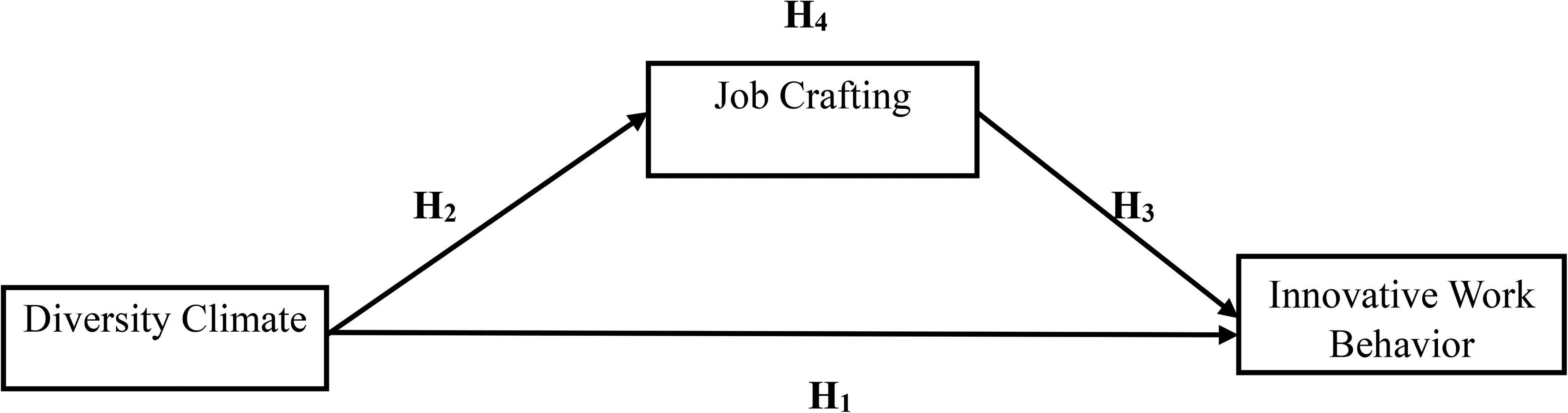
Theoretical framework.
Methods
Design
Drawing on the ontological (the nature of realities one encounters in research) and epistemological (what comprises valid, acceptable, and legitimate knowledge) assumptions (Saunders et al., 2007) the current study is objective and perceptual. Further, hypotheses of current study are derived from literature and based on existing theory for that reason positivist approach is used (Saunders et al., 2007, 2019). Moreover, mono method (quantitative method) research is employed in this study rather than mix method (both quantitative and qualitative method) since emphasis of this study is theory testing and verification rather than theory generation or theory modification (Saunders et al., 2019).
Research Questions
Does diversity climate relate to innovative work behavior?
Does diversity climate relate to job crafting?
Does job crafting relate to innovative work behavior?
Does job crafting mediate the relationship between diversity climate and innovative work behavior?
Sample
Setting
Health system of Pakistan along with many other low and middle income countries is stressed, due to absence of basic facilities, insufficient number of healthcare professionals, and inadequate preparedness for treating pandemics. The researchers have enlightened the accelerated need of IWB of healthcare professionals (Asurakkody & Shin, 2018; Weintraub & McKee, 2019) specifically of nurses (Ahmed et al., 2019) to promote and improve the quality of the healthcare system (Yasir & Majid, 2019). Among health sector employees, nurses (the frontline employees) are considered to be one of the key pillars supporting the health sector given that they spend the longest time with patients and take care of them (Mohammed et al., 2021; Santos et al., 2019; Wibowo & Mochklas, 2020; Zhang et al., 2020). Undoubtedly, innovative work behavior is crucial for healthcare professionals to respond health care needs in effective and efficient way, nevertheless IWB of nurses is most relevant and essential as they provide up to 80% of main care in the healthcare scheme (Ahmed et al., 2019). For this reason study population is limited to nurses only.
Sample
There are total 22 tertiary hospitals in twin cities. Out of which 6 hospitals (Pakistan Institute of Medical Sciences Islamabad (PIMS), Federal government services hospital Islamabad (Polyclinic), Military hospital, Rawalpindi, Holy family hospital Rawalpindi, Benazir Bhutto hospital Rawalpindi, and DHQ Hospital Rawalpindi) were selected due to the availability of maximum in-patients beds services (more than 500 beds).
After deciding upon the target population (nurses), the questionnaires were distributed to the nurses based on simple random sampling. They were contacted personally and concerns regarding purpose and confidentiality were addressed before the collection of data. Most of the respondents filled the questionnaire in the presence of the researcher, while others returned the questionnaire after a few days.
For current study total 350 questionnaires were distributed (on the basis of number of nurses dealing with COVID-19 patients, 100 questionnaires in PIMS and 50 in other 5 hospitals) out of which 283 were collected back and found fit for analysis. According to Uma Sekaran (2016) this sample size is adequate for analysis.
Inclusion/Exclusion Criteria
In light of current situation of healthcare system in Pakistan, this study is based on health sector of Pakistan (particularly public and private hospitals of twin cities; Rawalpindi & Islamabad). Tertiary hospitals of twin cities were included in this study as tertiary hospitals are the largest health care unit where highly specialized services are delivered. These hospitals were selected due to the availability of maximum in-patients beds services for COVID-19 patients. In current study primary data was collected from 283 registered nurses who were directly interacting with COVID-19 patients, since data was collected during the period of COVID-19 pandemic.
Ethical Consideration
Study ethics have been kept on the top priority during the course of conducting current study. The selected hospitals have been approached following an ethical process of taking prior permission by providing questionnaire which included informed consent of the respondents and purpose of the study. The issue regarding confidentiality of data was also assured. Further informed consent of participants was obtained by including paragraph in the beginning of questionnaire indicating that your participation is voluntary and if you agree to participate in the study you can proceed further.
Statistical Analysis
In this study quantitative data was analyzed using SPSS.21 and AMOS.21. Initially data was explored for demographic information of respondents, mean and standard deviation. Then, the adequacy of the measurement model was examined for unidimensionality, reliability, and validity. In the last hypothesis were tested through Structural equation modeling (SEM). In the current study, the significance level was set at 0.1% (p ≤ .001).
Measures
In the current study 5-point, Likert scale; ranging from 1 (strongly disagree) to 5 (strongly agree) is used.
Diversity climate (DC) was measured using a 4-items scale which is previously used by Luu, (2019) and McKay et al. (2011). Sample items include “I trust the company to treat me fairly” and “The organization maintains a diversity-friendly work environment”. Cronbach alpha (α) of original tool of diversity climate (DC) was 0.82 McKay et al. (2011) and for current study is 0.793.
For measuring Job crafting (JC), a 13-item scale was used adopted from Petrou et al. (2018). Sample items include “I ask colleagues for advice” and, “I ask for more responsibilities”. Cronbach alpha (α) of original three dimensions of job crafting; seeking resources, seeking challenge and reducing demands was 0.70, 0.76, and 0.69 respectively Petrou et al. (2012). For current study Cronbach's alpha (α) of three dimensions is 0.859, 0.795 and 0.853 respectively, while 0.919 for whole construct.
Innovative work behavior (IWB) focuses on a broad range of behaviors related to ideas generation, idea promotion, and making its implementation possible (Jong & Hartog, 2010). Innovative work behavior (IWB) was assessed by 9 items scale of Janssen, (2000) currently used by Suseno et al. (2020). Sample items include “I create new ideas for difficult issues” and “I generate creative solutions for problems”. Original tool's Cronbach alpha was 0.95 Janssen (2000) and for current study α = 0.896.
In order to examine the adequacy of instrument in health industry pilot study was conducted. Total 106 nurses had completed the questionnaire. The reliability of the instrument was examined by Cronbach alpha (α) and found to be satisfactory to precede further (data collection). The Cronbach alpha (α) of Diversity climate, Job crafting and innovative work behavior was 0.759, 0.713 and 0.737 respectively.
Results
Sample Characteristics
The descriptive analysis demonstrated that 64% (181/283) of the data was gathered from public hospitals and 26% (102/283) were from private hospitals. Whereas 81% (230/283) of the respondents were female nurses while 19% (53/283) were males, the number of male nurses is very low as compared to female nurses around the globe. Since globally there are 9 out of 10 nurses are females (Catton & Iro, 2021). The sample distribution regarding age level is as follows: 145 respondents (51%) were 25 to 30 years old; 75 respondents (27%) were 31 to 35 years old; 54 respondents (19%) were 36 to 40 years old; 9 respondents (3%) were 40 and above years old (see Table 1). It shows that the majority of nurse's age lies between 25–30 years. Mean (M), standard deviation (SD), and inter-correlation of variables included in the study are mentioned in Table 2.
Demographic Characteristics.

Reliability, Validity, Mean, STD Deviation, and Inter-Correlations of Study Variables.
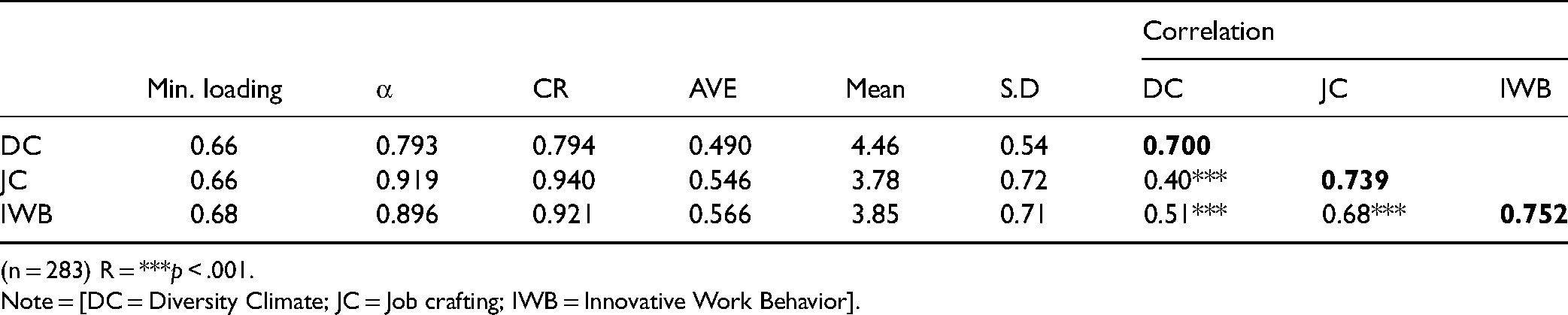
(n = 283) R = ***p < .001.
Note = [DC = Diversity Climate; JC = Job crafting; IWB = Innovative Work Behavior].
Analyzing first-order correlation showed that diversity climate has moderate association with job crafting (r = 0.40, p < .001) and innovative work behavior (r = 0.51, p < .001). First-order correlation also show that nurses who are highly engage in job crafting behavior are more inclined to exhibit the innovative work behavior (r = 0.68, p < .001). In the current study, the significance level was 0.1% and all values of correlations were statistically significant at p < .001 (0.1% significance level) suggesting that results are highly significant.
Data were analyzed using SPSS.Amos.21. In the first step, the adequacy of the measurement model was examined for unidimensionality, reliability, and validity. Unidimensionality was assessed through three-factor model. The three-factor model was assessed and ensured by assigning factors to their corresponding latent variables, as factor loading of all items was greater than 0.6 (see Figure 2). The inter-item consistency and composite reliability (CR) of the instrument were tested. To establish the reliability required value of Cronbach alpha (α) and CR is at least 0.7 (Ursachi et al., 2015). The value of α and CR of all variables was greater than 0.7 (see Table 2), therefore, all scales used in this study were reliable and all items accurately measured their respective constructs. Convergent validity was assessed and established through average variance extracted (AVE). The minimum required value of AVE for each construct is 0.5 (Awang, 2015) and analysis revealed that all constructs achieved this minimum level and have good convergent validity. AVE value of diversity climate is 0.49 which is too close to 0.5 therefore it is also acceptable (see Table 2). The discriminant validity was assessed by comparing the square root of AVE of all constructs to their respective correlations and found to be greater than their respective correlations which depict that constructs are different from each other (Awang, 2015) (see Table 2).

Factor loadings of constructs.
Lastly, construct validity was assured through fitness indexes for the measurement model and found to achieve the required level as suggested by (Awang, 2015) [χ2 (290) = 431, p < .001; Root Mean Square Error of Approximation (RMSEA) = 0.042; Standardized Root Mean Square Residual (SRMR) = 0.049; Comparative Fit Index (CFI) = 0.960, and PClose = 0.959.
In this research, response on all variables was obtained from a single source due to which dependent variable may be influenced by common method bias. To examine the intensity of common method bias (CMB) the Harman's single factor test was carried out. If more than 50% of the variance is explained by one factor, CMV is likely to be a problem for analysis (Podsakoff & Organ, 1986). An unrotated factor analysis explained 37.649% of the total variance, therefore CMB was not a serious concern for analysis.
Research Questions Results
Table 3 below shows the result of simple and serial mediation (also see Figure 3 for direct paths only) of data collected from public and private hospitals of twin cities. Structural equation modeling (SEM) was used to analyze the research hypothesis as this multivariate technique considers measurement error while statistically analyzing the data unlike the traditional techniques (Jourdain & Chênevert, 2010). Further, a 95% confidence interval (CI) for the indirect effects was constructed and based on 2000 bootstrap samples.

Structural model. Note = [DC = Diversity Climate; JC = Job crafting; IB = Innovative Work Behavior; IG = Idea Generation; IP = Idea promotion; II = Idea Implementation].
Structural Model.
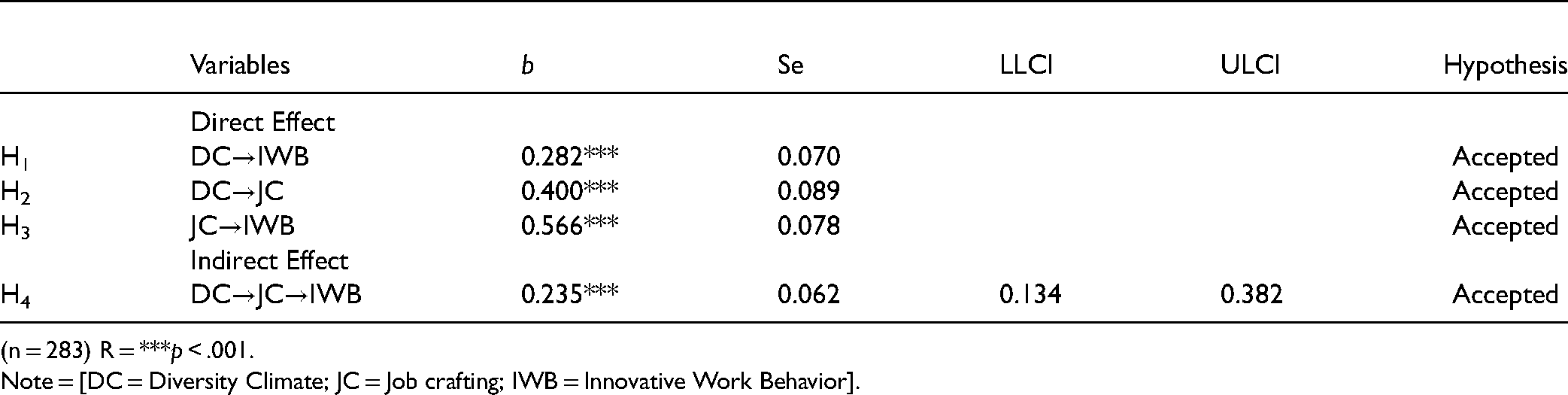
(n = 283) R = ***p < .001.
Note = [DC = Diversity Climate; JC = Job crafting; IWB = Innovative Work Behavior].
Hypothesis 1 predicted that diversity climate (DC) has a positive effect on innovative work behavior (IWB). The results show that the direct effect of DC on IWB was significant and positive (γ = 0.282, p < .001), supporting H1.
Hypothesis 2 predicted that diversity climate (DC) has a significant effect on Job crafting (JC). The results show that the direct effect of DC on JC was significant and positive (γ = 0.400, p < .001), supporting H2.
Hypothesis 3 predicted that Job crafting (JC) has a significant effect on innovative work behavior (IWB). The results show that the direct effect was significant and positive (γ = 0.566, p < .001), supporting H3.
Hypothesis 4 predicted that there is a positive indirect effect of DC on IWB through JC. The results show the positive and significant indirect effect of DC on IWB through JC (ρ = 0.235, p < .001, 95% CI = [0.134. 0.382]) supporting H4.
In the current study, the significance level was 0.1% and all the regression weights for study relationships were significantly different from zero at the p ≤ .001 (0.1% significance level) which means that results are highly significant.
Discussion
The current research was aimed to examine the association between diversity climate and innovative work behavior through mediating role of Job crafting. The findings of the current study provide evidence for the significant positive relationship between diversity climate and innovative work behavior and provide empirical support to the findings of Luu (2019). Results suggest that in hospitals where diversity is managed effectively and employees perceive that they are being treated equitably and fairly they are inclined to demonstrate more innovative behavior towards their jobs. The association between diversity climate with job crafting was also proved as previously ascertained by Ingusci (2018). Findings advocate that impartial practices in organizations influence employees to redesign their jobs according to their needs and capabilities. Besides, the relationship between job crafting and innovative behavior was also significant confirming the studies of Afsar et al. (2019); Khan et al. (2020, 2021). When employees get the opportunity to craft their roles and jobs they can perform better and could find improved and innovative ways for accomplishing their tasks. The findings of this study also supports the argument outlined in diversity literature of health sector and the premise of this study, that an hospital, which manages diversity well and is perceived by their workers as fair to all parts of the workforce, will experience positive outcomes (Jankelová et al., 2020). In health industry it was experienced that nurses who perceived better diversity climate are more innovative (Gomez & Bernet, 2019). As creating the proper environment in which nurses can develop to their fullest potential and providing a conducive work environment is essential for enhancing nurse innovation (Mahgoub et al., 2019).
Strengths and Limitations
Current study has validated the role of Job crafting as a mediator between the relationship of diversity climate and innovative work behavior. An environment where diversified workforce experience equitable treatment regardless of their diversified backgrounds tend to have a positive relationship with their colleagues and supervisors and have an opportunity to redesign their tasks which ultimately fosters innovative work behavior. Therefore current study provides empirical evidence for mediating the role of Job crafting between the relationship of diversity climate and innovative work behavior as suggested by Luu (2019) and added a new dimension in the literature of nurses.
Few limitations are surmounted regarding this study. Firstly, in this study data was collected in one-wave due to time constrain, while the model that involves mediator, two-wave process for collection of data is more appropriate. Secondly, cross-sectional data is collected using a single method (self-administered survey) that may result in common method bias. Thus, this limitation can be addressed by conducting a longitudinal study that is more rigorous in unfolding causal relationships. This study focused on examining the mediating role of Job crafting between diversity climate and innovative behavior further study may also incorporate knowledge sharing behavior as a mediator since it has the potential to influence the innovative work behavior of employees (Afsar et al., 2019). Further, in the current study, we did not examine any moderator therefore in the future scholars can incorporate various moderators. Such a role of leader (leadership style) as a moderator between the relationship of Job crafting and innovative work behavior can be assessed. As employees may avoid crafting their jobs due to the fear of failure and in this scenario, a leader can play a vital role (Khan et al., 2020). Likewise, age as a moderator can be examined between the relationship of diversity climate and Job crafting as employees with different age groups may have an assorted attitude towards Job crafting (Ingusci, 2018).
Implications for Practice
The findings of the current study can significantly assist healthcare organizations in managing diversity management and improving innovative behavior of nurses. This research complements the previous study that diversity management enables an organization to take maximum advantage of the expertise of diverse workgroups and cultivate innovative behavior amongst its employees. Though diversity climate has a significant impact on the innovative behavior of employees in the service industry specifically healthcare, and innovative behavior is of great interest to both academics and practitioners because of globalization and intense competition (Kim & Lee, 2013) thus findings of this study can be assistive for practitioners and academia in creating awareness and developing policies regarding diversity climate to cultivate innovative work behavior.
The findings of this study add a novel mediator, Job crafting between the relationship of diversity climate and innovative work behavior. Previously diversity climate and leadership were taken as triggering factors of innovative work behavior directly (Dhar, 2017). Job crafting is considered as an opportunity for employees to change their jobs and such autonomy motivates employees to find better ways of performing their tasks through optimal utilization of resources and turn out to be more creative and innovative at their workplace. Thus, job crafting can be used as a motivational tool for employees to perform their tasks innovatively for their comfort and have a greater impact on organizational performance.
Conclusively healthcare management should integrate job crafting techniques and diversity management policies in their strategy. They should communicate and motivate employees through their constructive and fair, practices and policies that how diversity climate and Job crafting can assist in fostering innovative behavior which is crucial not only for organizational advancement but also for individual growth.
Conclusion
The current study revealed that diversity climate significantly influences the innovative work behavior of employees directly and indirectly through Job crafting. Suggesting that employees who are more comfortable and pessimist towards diversity at their workplaces are good job crafters and likely to demonstrate innovative work behavior. Therefore, the management of healthcare organizations should create a diversity climate and employ Job crafting approach to cultivate employee's innovative work behavior.
Footnotes
Declaration of Conflicting Interests
The author(s) declared no potential conflicts of interest with respect to the research, authorship, and/or publication of this article.
Funding
The author(s) received no financial support for the research, authorship, and/or publication of this article.
