




Abstract
Introduction
Younger professional nurses are the future of the nursing profession and they receive the baton from older and retired nurses to continue the profession in good light. Ubuntu is an African philosophy that is embedded in caring ethics and it is viewed as a core value of the nursing profession and is highly valued by older nurses.
Objective
We explored the perceptions of retired nurses on factors that prevent younger professional nurses from applying the ethos of Ubuntu in professional care.
Methods
In this study, we explored the factors that prevent younger professional nurses from applying the ethos of Ubuntu in professional care. In this qualitative explorative study, data were collected during focus group discussions in a workshop held with 40 retired nurses in a province in South Africa. The transcripts were analyzed following the six steps outlined by Braun and Clarke (2006).
Results
Based on the perceptions of the retired nurses two main themes emerged as factors that prevent the younger professional nurses from applying the ethos of Ubuntu in their professional practice; 1) Motivation to practice Ubuntu in nursing, 2) Lack of political will to recognize nursing.
Conclusion
Retired nurses felt that Ubuntu could be applied in nursing care if these factors are addressed by both nurses and stakeholders.
Introduction and Background
The retired nurses in South Africa were called to service around 2006 due to staff shortages that were experienced in the clinics and hospitals. The recall was a national initiative from the Department of Health (SANews, 2012). This initiative was successful in improving the mentoring of young professional nurses towards rendering quality care (Mulaudzi et al., 2009). Unfortunately, conflicts also arose between retired and young professional nurses, who complained about each other's work ethics (Mokoka et al., 2010). Older nurses complained that young professional nurses lacked ethics of care and professionalism, which they felt damaged the image of the profession and compromised nursing care (Koesnell et al., 2019). Retired nurses summarized the lack of ethics and professionalism as a “lack of Ubuntu”. Subsequently, we conducted this study to explore the views of retired nurses on factors that prevent young nurses from applying the ethos of Ubuntu in their professional care.
Literature Review
When entering into service, the newly qualified nurses are socialized in the nursing profession. Socialization is usually done by older nurses who are a valuable source of knowledge and experience (Gan, 2020; Mulaudzi et al., 2009). The socialization process, transfer values, skills and knowledge to newly qualified nurses from generation to generation (Gan, 2020). In nursing practice, the different generations from the silent generation to the present generation Z practice side by side in many cases (Moore et al., 2016). It is therefore easy to pass down values from generation to generation. Each of these generations exhibit different work ethics (Stevanin et al., 2019). Table 1 highlights the different generations, how they are grouped and their uniqueness.
Characteristics of the Generations.
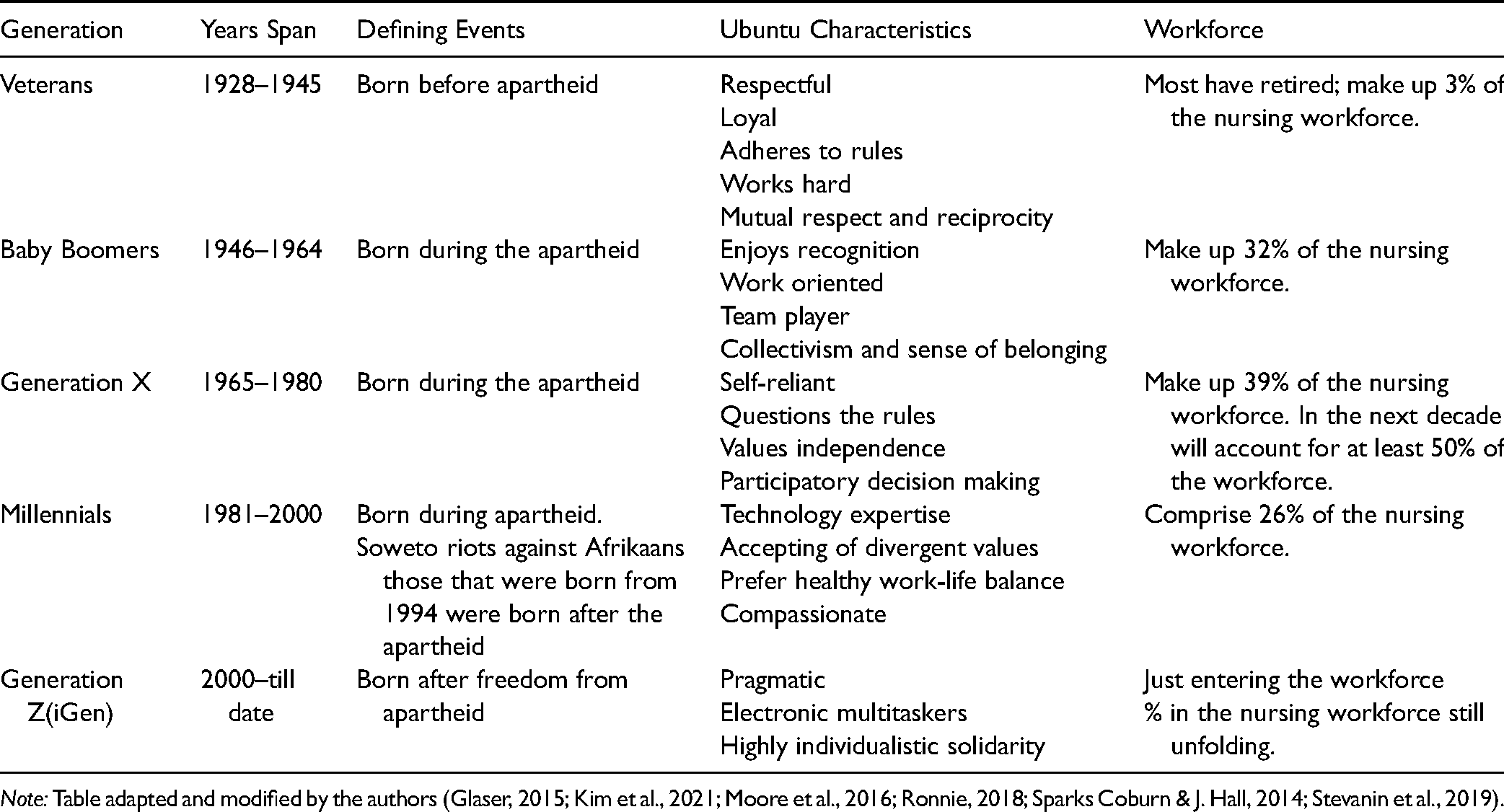
Note: Table adapted and modified by the authors (Glaser, 2015; Kim et al., 2021; Moore et al., 2016; Ronnie, 2018; Sparks Coburn & J. Hall, 2014; Stevanin et al., 2019).
Mossburg (2018) indicates that older and retired nurses belong to the baby boomer generation. The baby boomer generation in nursing is described as having excellent working skills and good work ethics (Mokoka et al., 2010; Mossburg, 2018). Additionally, older nurses value generosity, compassion and are good team players. The aforementioned values are similar to the values of Ubuntu as embedded in the African culture. On the other hand, the newer generations to the baby boomers have more self-reliant and individualistic characteristics which may clash with that of the baby boomer generation.
Ubuntu is viewed as a caring ethic in African culture (Chisale, 2018). People who practice Ubuntu possess caring qualities such as mutual respect, recognition, and relational and reciprocity; values that nurses also possess (Nolte & Downing, 2019). Nurses should display values such as compassion, honesty, trust, and commitment which are also reflected in Ubuntu (Mulaudzi et al., 2018). Albertina Sisulu an icon in the nursing profession in South Africa exemplified the Ubuntu core values in her nursing practice. As a nurse, her professional life was full of compassion and selflessness towards the care of her patients. The philosophy of Ubuntu was first described in a Zulu aphorism which says ‘Umuntu ngumuntu ngabantu’: a person is a person through other people (Geber & Keane, 2017). The Ubuntu philosophy is shared in other African countries, especially those south of the Sahara. For example, in Zimbabwe, Ubuntu is referred to as ‘huhnu’ while in Swahili countries, such as Cameroon, Kenya, and Tanzania, Ubuntu is referred to as ‘utu’ whereas the Baganda in Uganda viewed Ubuntu as Obuntu bulamu. Through Ubuntu, African children are raised and socialized according to moral ideals and ethics that are valued in society at large (Muzingili & Chikoko, 2019).
Ubuntu is about I am because you are, you are because I am and I can only be a person because of other persons (Geber & Keane, 2017). This aphorism resonates with the ethics of care described by Paul Ricouer when he says: “care is about being with the other and for them” as cited in (Maio, 2018). Both Ubuntu and Ricouer's ethics of care describe the value of reciprocity. There is a reciprocal relationship between the caregiver and the recipient of care (Maio, 2018). Within a reciprocal relationship, the recipient of care can verbalize his or her needs in a safe environment where he or she is not judged. Ubuntu goes further and emphasizes the importance of co-existence between individuals (Makhubu et al., 2018). In South Africa, Ubuntu has been used in different professions solely to promote humanness and solidarity (Downing & Hastings-Tolsma, 2016). Ubuntu in nursing enables the nurses to improve and master how to care for patients. Both Ubuntu and nursing express compassion, advocate for well-being, and display altruistic behavior (Ewuoso & Hall, 2019). In addition to the values displayed by ubuntu and the nursing profession, the International Council of Nursing (ICN) code of ethics includes respect, dignity, and advocacy for the patient (ICN, 2020; Stievano & Tschudin, 2019). We, therefore, expect that patients in African communities would expect nurses to embody the ethics of Ubuntu in their care. Furthermore, the provision of quality healthcare is a priority of the South African government (Maphumulo & Bhengu, 2019). Unfortunately, many patients when in hospital, and other health facilities report care that is below professional nursing standards and unethical which lacks Ubuntu (Williams, 2018).
Nursing has always been viewed as a noble profession with good values (Mulaudzi et al., 2018). However, currently, it seems the principles of Ubuntu and the values of caring are no longer upheld therefore the ethics and image of the nursing profession are affected. Many patients view nurses as rude, uncaring, and uncompassionate, whereas few patients perceived them as being caring and compassionate (Nesengani et al., 2019). Patients often base their expectations of care on Ubuntu cultural values. Negative reports on nursing care that lacks Ubuntu create a gap in the caring relationship between nurses and patients.
Restoring a positive public image of nursing care is thus important for the nursing profession. It means reinstating an ethos of Ubuntu and nursing ethic into professional care. This warrants an understanding of the factors that enable the practice of Ubuntu in nursing. We believe that the nurses of yesteryear have a wealth of experience and may be able to shed light on the factors that prevent younger professional nurses from applying the ethos of Ubuntu in professional care in South Africa. In this paper, a qualitative research approach was used to explore the perceptions of retired nurses on factors that prevent younger professional nurses from applying the ethos of Ubuntu in professional care.
Methods
Study design
This qualitative exploratory study used a workshop as a data collection method. Qualitative exploratory design is often used when researchers have little or no knowledge about the research problem. There is paucity of data on factors preventing younger generations from applying the ethos of Ubuntu in their practice. Furthermore, the researchers believe that knowledge resides with the participants and varies from person to person. Hence, the researchers, chose the qualitative exploratory design to explore the views of the retired nurses. The research was conducted according to the guidelines of the consolidated criteria for reporting qualitative research (COREQ) (Buus & Perron, 2020). In research, the use of workshops allows researchers to achieve the dual purpose of knowledge dissemination and obtaining perspectives from participants on the subject of discussion (Ørngreen & Levinsen, 2017). On profiling workshops in research, the participants ought to have similar characteristics.
Research Question
What are the perceptions of retired nurses on factors that prevent younger professional nurses from applying the ethos of Ubuntu in professional care.
Sampling
Likewise, in this study, all the participants were retired nurses (n = 40). They were recruited using snowball and purposive sampling techniques. The delimitation of retired nurses was to only those from the research setting required the use of a snowballing sampling technique in identifying the retired nurses. One of the researchers contacted a retired nurse in the research community. This retired nurse became the gatekeeper in the community and contacted other retired nurses.
Inclusion and Exclusion Criteria
The researchers included only nurses from the community who had served in government-owned clinics and hospitals. Those who were members of the community but served in a private sector were excluded from participating in the study. The age of the retired nurses ranged from 63–67 years (M = 65). All the participants were Christians and all worked in the public sector before their retirement.
Setting
The workshop was conducted in March 2020 at a central location in a district in Gauteng Province of South Africa. South Africa is divided into 9 provinces. The Gauteng province has three metropolitan municipalities and two district municipalities. The communities are divided into urban, peri-urban and rural based on the economic status of the people living in the community. The research setting is a peri urban community with mainly black and middle class people in one of the metropolitan municipalities in Gauteng. This community was established during the apartheid government. Current residents of the community are about 85,000. The community has a shopping mall, a bakery, a civic center and several tuck shops. The main language of communication is Afrikaans
Ethical Considerations
This study was approved by the Faculty of Health Sciences Research Ethics Committee at the University of Pretoria with Ethical Clearance number 192/2020. Each participant signed an informed consent form at the beginning of the workshop after the researchers explained the purpose of the research and participation was voluntary. The researchers explained to the participants their right to withdraw from the research without the fear of being victimized. The participants were voluntarily chose to participate and were not enticed with any form of renumeration.
Data Collection
At the beginning of the workshop, the purpose was outlined to the participants. The participants were divided into four focused discussion groups to have meaningful and interactive participation. The four researchers served as facilitators of each focus group. Each focus group discussion had ten participants and a researcher. The discussions in the four groups were structured in two sessions and guided by the same questions which were: “What is Ubuntu?” This was the question that was explored in the first session of the discussion to ensure that we all understand or share the same sentiments on what we view as Ubuntu, and in the second session a question on: “How is the ethos of Ubuntu applied and reflected in the current nursing care?” was posed to the participants for further exploration of the factors that affect the application of Ubuntu in professional care. At the end of each session the groups presented to everyone and the points were captured on flipcharts. Furthermore, all the discussions in the groups were audio-taped with the permission of the participants.
After the presentations, all the charts were collected and data from the flip charts were analyzed in conjunction with data from the recordings.
Rigor
The steps outlined by Korstjens and Moser (2018) to ensure trustworthiness was maintained throughout the research. The researchers ensured credibility by having prolonged engagement with the participants during the workshop whereby they spend three hours with them. In addition, the researchers used two sources of data collection -the focus group recordings and the flipcharts. This was done to ensure that there is consistency in the data from the participants. At the end of the workshop after the transcription one of the researchers did member checking with the retired nurses to ensure that what was brought out as the themes from their discussions was exactly what they intended to say. Conformability and dependability were ensured by making sure that every member of the team engaged in the process of analysis and coding (Elo et al., 2014; Nikpeyma et al., 2021). The notes were then checked for similarities.
Data Analysis
During the workshop, four different group discussions were recorded. These recordings were transcribed verbatim. The transcripts as well as the data from the flip charts were analyzed following the six steps as outlined by Braun and Clarke (2006). Each researcher coded the transcripts separately. Researchers familiarized themselves with the transcripts by reading and rereading them. Once transcripts were understood, initial codes were generated. Similar codes were then grouped to form initial themes. The initial themes were reviewed for further similarities and main themes were formed. The researcher shared their findings and agreed on the final themes.
Findings
Findings revealed the following themes and sub-themes. See the table below:
Theme one: Motivation to Practice Ubuntu in Nursing
Retired nurses expressed that young professional nurses need positive motivation to be able to serve with pride and embody the philosophy and ethos of Ubuntu. The sub-theme is identified as
All the participants agreed that younger professional nurses are motivated to join the nursing profession for different reasons. However, in their case as retired nurses, they highlighted that for them they chose the nursing profession because they regarded nursing as a calling. Unlike nowadays where it is viewed as a profession rather than a calling. “Nursing is a calling and that is why people have respect for nurses like the teachers. Teachers may be teaching the next president, [As a nurse] you could be nursing the next president, so nursing is a calling” (FG1P)
Nursing was also viewed as a noble profession with good social standing in society. It is also linked to Christianity. This was supported by the other participant who said:
“Patients saw nurses as angels sent from God.”(FG1P)
They would like to believe that some of the young professional nurses were attracted to the profession because of finance and not necessarily because they viewed nursing as a calling.
As alluded by one of the participants: “Nurses these days are there for the sake of money they want bread for their families and this leads to lack of passion for the profession (FG2P).”
Theme Two: Political Will to Recognize Nursing
The second theme that emerged was political will to recognize nursing. The sub-themes that emanated from this theme were factors that prevented young professional nurses to render professional care and upholding the ethos of ubuntu and caring. The sub-themes such as lack of continuous professional development, shortages of both human and material resources, increased workload, and poor remuneration for nurses are directly related to the lack of political will to invest in the health care sector.
Sub-Theme one: Lack of Continuous Professional Development
Participants felt that the employer must offer support to the younger professional nurses by providing programs such as continuous professional developments. Lack of continuous professional development negatively affects the delivery of optimal care which ultimately affects the competency of professional nurses. Therefore their ability to ensure compassion and commitments in their work thus is affected the application of the values of Ubuntu negatively. The retired nurses expressed that during their active years they kept themselves abreast with new knowledge through in-service training and continuing education activities. They indicated that young professional nurses are experiencing more challenges as clients and patients have more access to information through online platforms such as Google. They, therefore, check the signs and symptoms of their diseases before they even come to the hospital.
The following excerpts were identified in the transcripts: “When a nurse does not move with trends and update herself to the current practice how will she be able to speak the language of the patients or attend to patients that have googled their conditions before coming to the hospital?” FG4P.”
Another participant from the focused group said: “To stay relevant and maintain the role of advocacy in the community, a nurse needs to have more knowledge than the patient who is on google trying to figure out his condition.” (FG4P)
Subtheme two: Shortages of Both Human and Material Resources
Participants revealed that younger professional nurses are working in an environment that lacks resources. They highlighted that poor resources influence provision of quality of care. “Health facilities often do not have enough equipment to allow the nurses to practice [Ubuntu] “ as in certain hospitals they don't even have linen to make beds for their patients (FG2P) From the focus groups one participant said:
“… if there are no resources you become worried about what you are to provide care with for example bathing patients often become a challenge when there are no relevant resources” (FG2P)
Participants felt that staff shortages adversely affected how younger professional nurses behave towards their patients. They often feel negative and frustrated due to fatigue and anxiety caused by work overload. One participant indicated this by saying: “In some cases, a nurse has to assess 60 patients on the queue, check vital signs and dispense medicines. All these activities cascade to burnout which undermines Ubuntu principles” (FGD2).
Another participant said: “clinics are always overcrowded as they are the only point of entry to the healthcare system however they are under-staffed.” (FG2P).
Participants further mentioned that younger professional nurses had to fulfill multiple roles, including that of nurse and record manager. This prevented them from displaying the values of Ubuntu philosophy in nursing practice. The following was said: “In health care, we work as a multidisciplinary team, however in case of mishaps nurses are often blamed. For example, when patients’ files get lost nurses are blamed” (FG1P). “Nurses are willing to serve however because of lack of resources and shortage of staff they tend to be irritable and unapproachable.” This prevents them to display virtues of Ubuntu when caring”. (FG4P)
The other participant supported this when stating that: “Burnout is linked to the shortage of staff and resources.” (FG3P)
Sub-Them Three: Increased Workload
According to the findings, the increased workload was seen as an obstacle to offer Ubuntu-related care. Participants believed that the focus in the delivery of care should be on quality rather than quantity, as explained below: “We focus on quantity and not on quality care. We have one nurse for thirty-five to forty patients. How can I give quality care if I have to see thirty-five to forty patients?” (FG1P)
Another participant said: “……It is not possible to practice Ubuntu and be kind in a 60-bedded ward when you are alone, there is a need to relook at human resource policies if we need quality patient care which displays Ubuntu” (FG3P).
Sub-Theme Four: Poor Remuneration of Nurses
Another factor that emerged as preventing the younger nurses from practicing the ethos of Ubuntu is the poor renumeration of nurses. The retired nurses believed that nurses were not remunerated like the other professions in the healthcare. One of the participants felt that nurses deserve to receive better salaries and that would encourage them to be kind and compassionate. The following was echoed: “Nurses would feel more appreciated and valued if they received appropriate salaries” (FG2P)
Another participant supported this by saying: “The government must help us to revise the nurse's salary”. human resources must consider new salaries and benefits for nurses. “They moonlight because they are not paid enough money. When on duty they are tired and cannot practice Ubuntu” (FG1P)
Discussion
In this study, we explored the perceptions of retired nurses regarding the factors that affect younger professional nurses from applying the ethos of Ubuntu in professional care.
We assumed that retired nurses have a wealth of experience and knowledge to guide young professional nurses on how to practice Ubuntu philosophy.
In nursing, a caring attitude transcends any other benefit that comes with being a nurse. The life of a professional nurse entails daily selflessness and commitment to serve patients with Ubuntu (Feo et al., 2017). Retired nurses have been socialized in the values of Ubuntu and have worked in clinical settings for many years. It is for this reason that they can identify the philosophy of Ubuntu which is lacking among young professional nurses who view nursing as a profession rather than a call (Havenga et al., 2018; Mulaudzi et al., 2009). Hence, they advocate for the recognition of nursing as a profession like other professions (Scott & Scott, 2020; Simon et al., 2010 Thoma & Waite, 2018).
A caring profession such as nursing requires intense motivation to care for patients; that warrant continuous professional development. Among the factors that enhance competence in caring for patients is continuous development. Continuous development consequently influences the improvement of the quality of patient care (Van Heerden et al., 2019). Retired nurses in this study also mentioned that lack of continuous professional development was a barrier to staying relevant in the nursing profession and delivering high-quality patient care. The importance of continuous professional development in nursing is alluded to, by (Kasine et al., 2018; King et al., 2020; Madan, 2020) who cite that optimizing patient care requires new skills and up-to-date knowledge. In addition, these factors are to be considered important and useful in advocating for patients’ rights and welfare (Madan, 2020).
Optimizing patient care can only happen in a conducive environment. A conducive environment is considered to be one of the factors that are essential to facilitate patient rights and welfare. Lack of resources hinders ethos of care and Ubuntu during caring. Nurses are unable to deliver optimal care to their patients if they are working in an environment with limited resources. This was emphasized by the retired nurses in this study who felt that limited resources hindered the practice of Ubuntu during nursing care. Of importance is that limited resources are amongst the factors that lead to burnout and alienation for nurses (Gjesdal et al., 2019). Additionally, limited resources reduce the work output of nurses and undermine their efforts to achieve patients’ outcomes (Morton et al., 2020).
In this study, retired nurses mentioned that increased workload limits the ability of young professional nurses to display the ethos of Ubuntu during caring. Increased workload has been identified as another factor that leads to burnout among nurses, (Lahana et al., 2017; Liu et al., 2018; Liu & Aungsuroch, 2019; Muriithi & Kariuki, 2020). Nurses who experience burnout also show reduced work productivity and may provide poor-quality patient care (Lahana et al., 2017). The nurses who have burnout often display signs of anger, not completing allocated tasks, and may appear incompetent in caring (Dall’Ora & Saville, 2021). Patients may perceive these actions as departing from the values of the ethos of caring and compassion in the Ubuntu philosophy.
Low salaries are another factor identified by the retired nurses in the study as a factor contributing to the lack of Ubuntu in caring. The retired nurses mentioned that remuneration should not be the primary reason for choosing nursing as a career, but not being paid enough can frustrate younger professional nurses to leave the profession. Low salaries for nurses may lead to moonlighting (dual employment) (Engelbrecht et al., 2020) which further contributes to burnout among nurses (Rezaei et al., 2018).
Strength and Limitations
The small size of the study is a limitation in terms of transferability and generalization. However, the use of the retired nurses’ population in the study to explore the factors preventing the younger professional nurses from applying the ethos of Ubuntu in professional care is a strength in the study because the retired nurses have been through the practice and it is presumed that they have a better understanding of nursing profession. They can therefore give their perception from their body of experience.
Implications for Nursing
This study highlights barriers to the practice of Ubuntu among younger nurses. Retired nurses feel that younger nurses are deviating from African norms, but this behavior may be driven by factors beyond their control. Addressing these factors may help to restore the public image of the nursing profession. Improving the public image of nursing as a profession may also encourage more young secondary school graduates to choose nursing because they are motivated by patient care rather than money or other gains. Nursing administrators can seek to improve remuneration, staffing, and resources to improve the quality of patient care.
Conclusion
In conclusion, we explored retired nurses’ views on the practice of Ubuntu amongst younger nurses. Ubuntu seems to be lacking in the nursing profession, which may be due to various factors identified by retired nurses. Retired nurses felt that Ubuntu could be promoted in nursing care if these factors can be addressed by both nurses and stakeholders.
Footnotes
Acknowledgments
We would like to thank our participants for their valuable contributions.
Declaration of Conflicting Interests
The author(s) declared no potential conflicts of interest with respect to the research, authorship, and/or publication of this article.
Funding
The author(s) disclosed receipt of the following financial support for the research, authorship, and/or publication of this article: This work was supported by the National Research Foundation, (grant number 120441).

| Themes | Sub-themes |
|---|---|
| Motivation to practice Ubuntu in nursing | Nursing as a calling to serve |
| Lack of political will to recognize nursing | Lack of continuous professional development |
| Shortages of both human and material resources | |
| Increased workload and | |
| Poor remuneration of nurses |
