




Abstract
Introduction
Novel approaches to address the most vexing problems facing patients and vulnerable populations are needed. The purpose of this project was to establish an innovative research Center based on the principles of transformational organizations.
Methods
A new Center formed included faculty members with expertise in cancer, serious illness, and population health. Applying Sinek’s “why, how, and what” framework, members developed and refined a purpose statement and strategic objectives. The Center now includes members representing diverse disciplines. Year 1 accomplishments included a refined mission and vision statement, two funded research proposals, one submitted training grant, one administrative hire, and active recruitment of two-research faculty to support Center activities.
Conclusions
The newly-formed Center for Improving Patient and Population Health has enabled scholars within a research-intensive school of nursing to forge new partnerships to compete successfully for larger, complicated grant proposals on shorter deadlines. Opportunities exist to integrate students and research staff more fully into Center operations.
Introduction
The United States health care system is plagued by formidable challenges: patient safety threats, multi-drug resistant infectious organisms, increased health care costs, and unequal access to high-quality care. These vexing problems are persistent, pernicious, and beyond the curative abilities of any single organization or profession. Novel approaches must be implemented to address the most worrisome health care problems facing patients and vulnerable populations. In addition to traditional individual-based interventions, systems-level approaches are needed to provide infrastructure and support for scientific collaborations that span disciplines and promote team science. Such approaches serve to accelerate specialized science, expand research capacity, and provide training and professional development opportunities (Dunbar-Jacob et al., 2014; Grady, 2009). Establishing a Research Center is one systems-level strategy to accelerate discovery and use of knowledge to address these problems.
Research Center formations are based on two key assumptions. First, a Research Center should be problem- and opportunity-driven and address strategically defined health issues. A second assumption is that Research Centers embrace team science principles to promote innovative discoveries. Team science, defined as the creation and support of interdisciplinary investigative teams with common scientific interests, enables each investigator to contribute unique expertise. Team science approaches are essential to accelerate scientific progress toward addressing complex health care problems (Dorsey et al., 2014).
Partnerships with community organizations, including health care agencies and community services, enable Research Center investigators to leverage their expertise in deeply understanding the problems to be addressed and the nature of discoveries to address these issues (Kumar, 2017). All too often, research teams develop proposals that may not be feasible in external agencies and thus never get translated into health care delivery to improve health outcomes. As Research Centers test innovative approaches to vexing health care issues, they must do so with a focus on rigor, relevance, and actionable implications (Kumar, 2017). Designing studies with a critical eye toward dissemination and implementation requires interdisciplinary participants on investigative teams.
Cross-fertilization of ideas, approaches, and analyses is a hallmark of successful Research Centers. The level and depth of collaborations may vary and be influenced by the Center’s developmental trajectory. Common across Centers is the provision of infrastructures and processes to promote synergistic collaboration among outstanding scientists, new investigators, visiting scholars, doctoral students, and community partners (Dorsey et al., 2014; Kumar, 2017). Therefore, the objectives, methods and processes, and outcomes of developing and sustaining an innovative Research Center were based on the principles of transformative organizations, to advance cutting-edge discoveries in patient and population health.
The purpose of this paper is to outline the unique approaches used to form the Center for Improving Patient and Population Health at the University of Michigan School of Nursing. The Center’s conceptual framework, the processes undertaken to establish the Center, emerging results, and future directions are outlined. The authors hope to share this pathway with academic nursing leaders as they consider opportunities to build research communities.
Conceptual Framework
To form the Research Center, the leadership team and investigators adopted an intentional approach, informed by seminal concepts from the Positive Organizational Scholarship (POS) literature. The concepts from POS take an approach that focuses on enhancing strengths, affirming human potential and a positive orientation toward what is right (Cameron et al., 2003).
The Center’s conceptual framework was the Golden Circle model by Simon Sinek (2009). Sinek developed the model to explain how legendary leaders such as the Wright brothers and Martin Luther King Jr. were able to achieve what others, who were just as capable and often had more resources, were not. In this model, Sinek focuses on starting with “Why”– the motivation for the initiative – which differs notably from the traditional approach of starting with the product, or” What”. Sinek contends that starting with “Why” is not the only way to be successful, but he believes it is the way to support lasting success, innovation, and creativity.
Sinek’s “Why, How, What” framework challenges groups to start with “Why”. “Why” as Sinek describes it as the core, is what motivates, drives, and inspires the Center members. For example, Why does the Center exist? Once there is clarity on a group’s “Why”, they can proceed to define their “How” and “What”. “How” includes the ingredients needed to excel, the team’s strengths, and those characteristics that distinguish the team positively from others.” What” in the framework is the last area that is developed. This describes the work done by the team, such as the research studies, products, or services provided. Sinek also describes the framework as the clarity of “Why”, the discipline of “How”, and the consistency of “What”. This framework guided the work as the Center was developed and continues to grow and move forward. Applying the framework consistently enables Center members to align with the shared core beliefs, or the Center members’ “Why”.
Brief Review/Discussion
Center Formation
The Center originated from the desire to assemble a team of faculty with shared research interests. Interested faculty members expressed a desire to “do things differently” and form the Center with a deliberate purpose, to maximize potential impact and sustainability. To achieve these goals, the Center director retained an executive coach. The coach had experience in supporting diverse, high-functioning clinical and research teams. This coach worked to increase the self-awareness of members and the organization, and facilitated assessment and intentional decision-making, which led to informed choices and insertion of mindfulness into practices.
The coach worked with the Center’s director for nine months to assess leadership strengths and opportunities, share examples of promising practices for the Research Center formation, and to assess progress. During this time, membership interest continued to grow as the Center director encouraged faculty to attend the Center planning meetings.
Development of Center’s Mission and Application of Sinek’s Framework
The executive coach facilitated two half-day retreats: one in October 2017 to establish the Center’s organizing framework and develop team-building skills, and a second in June 2018 to evaluate the first year of progress, address key challenges, and reinforce key lessons. At the first retreat, proposed Center faculty and members of respective research teams completed two computer-adapted individual assessments through web-based questionnaires: the Talent Insights from Target Training International (Bell et al., 2012; Gehrig & Bonnstetter, 2017) and the Thomas-Kilman Conflict Mode Instrument (TKI) (Thomas & Kilmann, 2008).
Talent Insights assesses an individual’s driving forces, or positive motivations for the work they conduct. Informed by the seminal work of psychologist Eduard Spranger (1928), the tool measures individuals across 16 categories of intrinsic workplace motivators. The Thomas Kilman Conflict Mode Instrument (TKI) assess a person’s behavioral approach to conflict situations. The instrument generates individual profiles for preferred conflict styles across two broad domains: assertiveness and cooperativeness. Individuals are classified into one primary category based on subdomain scores; competing (assertive and uncooperative), avoiding (unassertive and uncooperative), collaborating (assertive and cooperative), accommodating (unassertive and cooperative), and compromising (hybrid approach of cooperation and assertiveness). The instrument developers reinforce that no one approach is superior and that individuals often adopt multiple strategies (Khatri et al., 2010).
Both Talent Insights and the TKI provide respondents with individualized reports and graphical representations of groups. These displays enable Center members to identify their motivators and conflict management styles and compare with other Center members, and assess the distribution of strengths and styles within the Center. Facilitated discussion at the retreat identified opportunities to apply these findings to routine interactions and during conflict resolution. Following analysis of these data, the Center’s director considered individuals’ motivating forces and approaches to conflict when forming workgroups. The awareness of individual members’ strengths and differences enable the Center to form effective teams and manage workloads with more intention. Work done recently with a rural grant utilized this information to inform the team development that was responsible for the development of innovative strategies for pilot proposals.
Following the individual assessments and data analysis, Center members engaged in facilitated discussion to establish the mission, vision, and goals. Sinek’s (2009) novel framework of “Why, How, What” was applied to describe the shared purpose, strategies for success, and deliverables (see Figure 1). This discussion generated a series of statements that capture the diverse perspectives of the Center members. For example, two of the core “Why” statements are, “We believe we are stronger together”, and “Valuing diverse perspectives, we apply a nursing lens to discover and disseminate novel solutions to the most vexing problems facing patients and vulnerable populations.”

Center for Patient and Population Health Golden Circle.
After the first retreat, Center members agreed to twice-monthly science meetings, where faculty and members of their research teams shared work in progress, outlined new concepts for development, and addressed major decision points for the business of the Center. With guiding principles of leading each meeting with science and maintaining a nimble organizational posture, Center members may bring emerging ideas with brief notice. Science meetings always offer virtual/telephone access to maximize participation. To take full advantage of discussion time, the Center’s administrative assistant communicates routine matters in meeting minutes or emails.
After new initiatives are presented and endorsed for further development, small workgroups meet to advance the project and provide periodic updates at science meetings. The Center’s part-time administrative assistant supports team scheduling, disseminates minutes and notices, and provides additional ad hoc support to workgroups as needed. Center-related documents and resources are stored digitally in a secure location so members have access at all times.
From a logistics perspective, Center members identified the need for engaging, collaborative space. With support from the School, a room was repurposed to serve as the Center’s conference space, and outfitted with a large whiteboard, video conferencing capability, and touch-down cubicles. The School of Nursing also supported the hire of research-track faculty to build the research capacity in the Center. At the second retreat (June, 2018), the Center members, including faculty and members of their research teams assessed progress to date, identified current and potential challenges, and outlined future work plans. The results of this retreat are in the Results section of this paper.
Expenses associated with Center formation were accrued from a variety of sources. Start-up expenses included protected time for the inaugural Center director, space renovations, an administrative assistant and an organizational coach. To support sustainability, the School provides partial indirect cost recovery (for member grants with indirect cost recovery) to the Center.
Center members have also budgeted effort for the Center for Improving Patient and Population Health (CIPPH) members and personnel in subsequent grant proposals.
Conclusion
The Center operates around five principle objectives that drive the strategic work:
To support and foster scientific collaborations among diverse disciplines for development of cross-disciplinary investigative teams that conduct cutting-edge research to address vexing health care issues of vulnerable populations. To build an infrastructure and research capacity for the use of novel research methods in addressing patient and population health. To provide resources, expertise, training and professional development for Center members aimed toward conduct of research that address challenging issues in patient and population health. To provide timely feedback to investigative teams on external grant applications and scholarly papers. To work in collaboration with community partners to conduct, disseminate, and implement research findings in real-world settings.
During the first year, the CIPPH team worked to complete the mission and vision statement and develop the “Why, How, What” statement. The core beliefs (“Why”) became visible as all faculty, staff, and students were included in the meetings, members worked towards ensuring everyone felt included. Additionally, a deliberate effort was made to make staff feel part of the team. The Center director brought all major decisions to the Center team.
The “How” then became how the Center acted on those beliefs. Included in those statements were: ‘members will participate fully’, ‘we will address challenges transparently as a group’, and ‘we embrace nimbleness and agility to respond to emerging opportunities’. This nimbleness was demonstrated when the Center was able to convene a work group to submit a proposal for a late-breaking special call for funding applications. That work resulted in success in obtaining one of those highly coveted grants.
The Center’s “What” included monthly meetings, collaborative space, administrative support, and faculty resources in addition to others. Figure 1 shows the CIPPH Golden Circle with the full list of the “Why, How, What” statements developed at our research retreats.
The CIPPH was established in 2017, and had a total of 13 core and 7 affiliate members. Core members included three full professors, two associate professors, one assistant professor in the tenure track, one clinical associate professor, one clinical assistant professor, one research professor, one project manager, one research coordinator, one research associate, and one doctoral student. Affiliate members included faculty members from the University of XXX and other research-intensive institutions with content and/or methodological expertise. Membership represented diverse disciplines, with research interests focusing on patients with cancer, patients with complex needs, and vulnerable communities, and with expertise in data analytics, mHealth, survey research, simulation, complex interventions, and implementation science.
Assessment Results
The Talent Insights’ individual assessments increased the understanding of the team’s makeup and potentials. Assessments focused on two distinct areas: behaviors and driving forces. Figure 2 shows the behavioral composition of the CIPPH Center team, represented as percentage in each of segments of the Dominance (D), Influence (I), Steadiness (S), and Compliance (C).
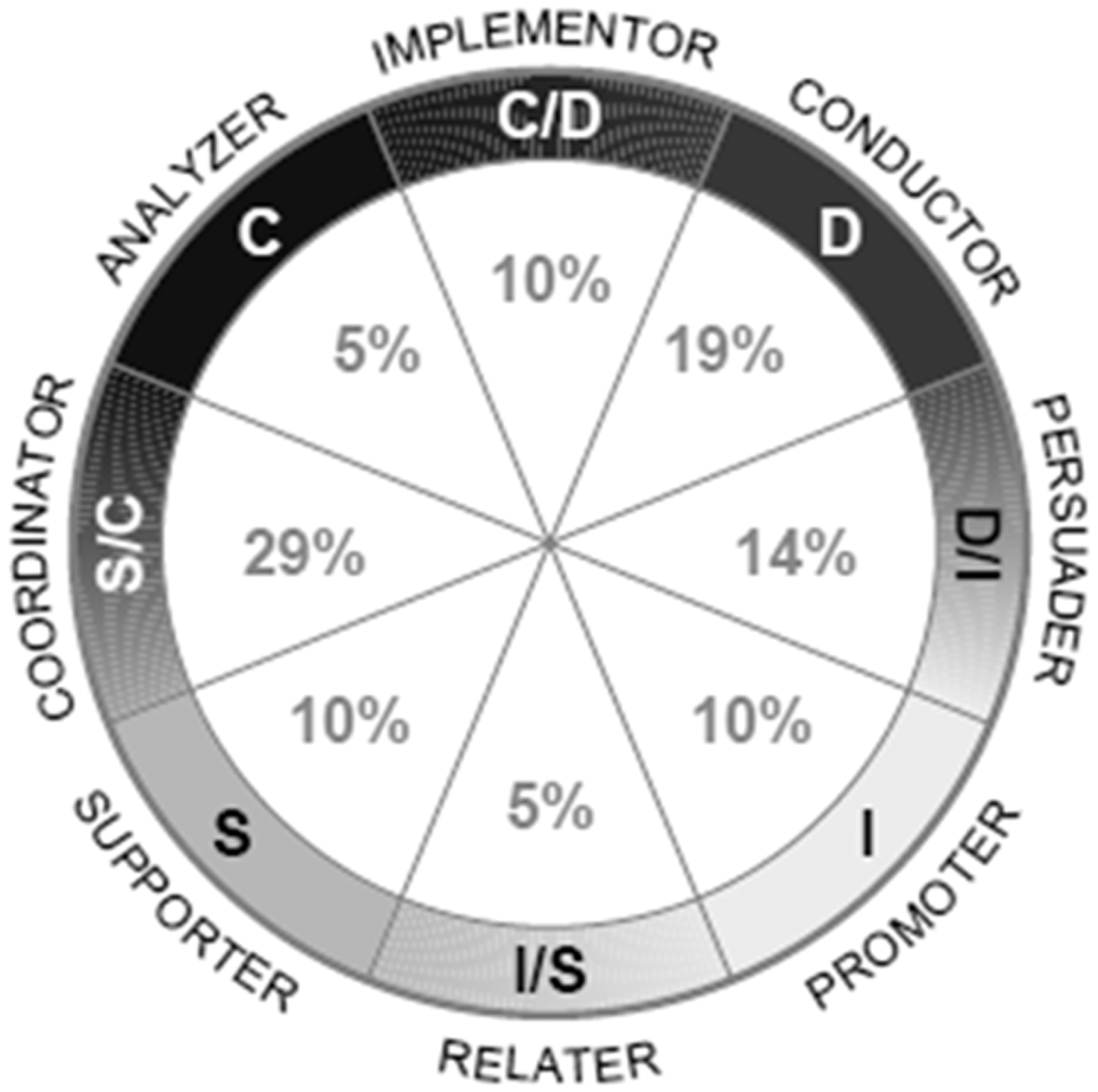
Individual Styles Inventory.
The driving force assessment focused on the understanding of why people do what they do. There are 12 common driving forces, defining Knowledge (intellectual vs. instinctive), Utility (Resourceful vs. Selfless), Surroundings (Harmonious vs. Objective), Others (Altruistic vs. Intentional), Power (Commanding vs. Collaborative), and Methodologies (Structured vs. Receptive).
The TKI assessments indicated the team had significantly different preferred conflict styles among individuals. In an averaged 64th percentile, accommodating ranked as the top one style, indicating that the team tended to be more cooperative and less assertive. Correspondingly, competing (assertive and uncooperative) ranked as least preferred conflict style (25th percentile). Compromising, as the hybrid approach of cooperation and assertiveness, ranked as No. 3 with the 55th percentile, which was the similar percentile with avoiding (unassertive and uncooperative, 57th) and collaborating (assertive and cooperative, 54th).
Goal Achievements
An important step in the process was to develop the initial strategic plan and objectives. One of the objectives was the development of this paper. Other goals included submitting a training grant, engaging with industry, philanthropy and thought leaders in collaborative projects, and holding an open house to attract new members and showcase the work of the CIPPH members. The CIPPH also supported the funding of two research proposals by providing peer feedback during the grant submission process. Recruitment efforts resulted in the hiring of one administrative assistant and the ongoing active search for two research-track faculty to support CIPPH activities. Members embraced novel approaches to collaborative work. For example, the authors of this manuscript participated in a paper “sprint” to facilitate rapid-cycle, collaborative writing projects (Sinha et al., 2018). Paper sprints enable authors to convene for focused time to iteratively write and edit work in progress.
Importance to the Nursing Profession
Challenges
As the Center was developed, several challenges presented themselves that the team needed to work through. One challenge was the application of the Sinek Framework. This framework was unknown to many faculty and was an unconventional approach to development and planning of a Research Center. Many faculty were accustomed to beginning Research Centers from the focus of “What” rather than “Why”. To explore if they wanted to participate in the Center, Faculty were inquisitive regarding “what is this Center about?” or “what is the focus of the research in this Center?” faculty with expertise in National Institutes of Health (NIH) funded Research Centers (e.g. P30; P50) were accustomed to defining/describing a focal area of science – the “What” rather than the “Why”. This challenge of using an unfamiliar approach was addressed in two ways. The first was education of potential participants about this approach through presentations by the Center leader, guided readings, and small group discussions. Secondly, as faculty continued to ask the “What” is this Center about prior to addressing the “why”, the Center Director and executive coach continuously reiterated during the retreats the importance of first addressing the “why”. As a result of education and the ongoing reemphasis of “Why”, faculty were willing to try this innovative approach and to trust the process.
A second challenge was engaging faculty in use of the Talent Insights and TKI as an assessment approach. Traditionally, faculty are engaged in Research Centers because of their research expertise. Faculty had various experiences and perceptions about these types of assessments – some positive and others negative. For example, some faculty asked about the purpose of each type of assessment, and how data would be shared and with whom. This challenge was addressed at the first retreat by a thorough description of the process and by the Center director sharing their personal results from the surveys (TKI and Talent Insights) first with everyone.
Although development of the mission and vision of the Center was perceived as fun and innovative, the challenge was to keep both brief, meaningful, and contemporary. This was addressed through multiple iterations of the documents over email, and discussions at science meetings.
Lessons Learned
The team learned many lessons as the Center was developed. One lesson was the importance of half-day retreats and use of the executive coach in leading these retreats. This gave faculty time and mental space to reflect on the Why, How and What of the Center and to appreciate the unique talents and conflict resolution styles of each member. The retreats were perceived as a “safe space” to discuss the assessments in general and to exchange self-reflection about working in the Center. As the Center matures and adds additional members, it will be important to use the assessment data for filling in talent areas in which there is a gap, and to offer periodic opportunities to discuss the results of these assessments as a group in making future decisions.
A second lesson is to periodically revisit the core principles and purpose of the Center to evaluate the need for modification. It is acknowledged the Center is in a continual state of evolution. Periodic evaluation of the Center by individual members and overall as Center is important to assess if the Center is meeting the Why, How and What components as illustrated in Figure 1. A third lesson was the integration of new members over time. How members are invited to join and their self-reflection and mindfulness of their talent and conflict resolution styles are warranted.
The primary aim of CIPPH was to accelerate discovery and use of knowledge to address vexing health issues through creating infrastructures and processes to promote synergistic collaborations. The newly-formed Center has provided unique infrastructure and support for team research and other scholarly collaborations across multiple disciplines. Throughout the short tenure of the CIPPH, several cross-disciplinary teams were established and supported, resulting in scholarly productivity. Notably the training grant proposal, intramural funding, and this manuscript are evidence. This was possible through the support of the members and the School, which included opportunities for expert feedback on study design/methodology, financial and administrative support through shared resources, and space for collaborative work.
The composition of the CIPPH members, which included complementary expertise and synergistic behavior styles, also contributed to the success. Group members are driven primarily by the discovery of new knowledge and information, with behavioral characteristics associated with adherence to proven methods of work and creativity and skill in troubleshooting. This is not surprising as the CIPPH is located in a research-intensive academic setting with members focused on research. Gaining insight into the diversity of styles of the members allowed for a better understanding of each other’s strengths and formation of diverse teams to address challenging projects. While this approach may not appeal to all groups as they develop into a Center, it has worked well for CIPPH. The Talent Insights and TKI were done for the initial Center members; however this is an area where this may need to become part of onboarding process for new members to help leverage everyone’s unique contributions.
To promote the Center and its members, Open House events were conducted and new members are continuing to join. Early success with grant reviews have resulted in many more review sessions for both internal and external funding opportunities. Educational sessions for faculty and other members were held in areas of interest such as qualitative and mixed methods research. The CIPPH director meets with faculty applicants to review the Center’s mission, vision, and goals. At the bimonthly meetings CIPPH members are given time to highlight their current work and this has resulted in new collaborations between members both within CIPPH and with affiliate members.
Center members continue to work towards attainment of the principle objectives set forward at its inception and in living the “Why”. Work to date provides evidence of meeting these objectives, but CIPPH members continue to strive towards elevating the science through broad dissemination and engagement. Additional resources, expertise and training opportunities are being explored for future growth. Continued engagement of CIPPH members and inclusion of research staff are future priorities. This supports a continuous drive towards the Center mottos: “We believe we are stronger together” and “the valuing of diverse perspectives”. Development of the CIPPH continues as members strive to optimize collaboration and improve patient and population health.
Footnotes
Acknowledgements
The authors would like to thank Katie Davis for her support to facilitate the Paper Sprint process and the support to Center in during our workshops. We would also like to thank the Center for Improving Patient and Population Health, the University of Michigan Biosciences Initiative and the T-32 CA-236621 (Friese).
Declaration of Conflicting Interests
The author(s) declared no potential conflicts of interest with respect to the research, authorship, and/or publication of this article.
Funding
The author(s) received no financial support for the research, authorship, and/or publication of this article.
