




Abstract
Patient satisfaction and the willingness to recommend a hospital are critical for healthcare quality improvement. This study focuses on orthopedic patients, recognizing their unique healthcare experiences. We aimed to explore factors influencing orthopedic patients’ willingness to recommend the hospital, considering various demographic and clinical variables. A cross-sectional survey of 200 orthopedic patients hospitalized between July and December 2023 in north-central Israel was conducted. Results revealed a positive association between age and willingness to recommend (odds ratio [OR] = 2.44), while emergency department stay length showed a negative association (OR = 0.58). Satisfaction with hospital care positively influenced the willingness to recommend (OR = 1.96). Gender, comorbidities, and hospital stay length did not significantly impact willingness to recommend. The study highlights the role of satisfaction and the impact of extended emergency department stays, emphasizing the need for nuanced strategies to optimize orthopedic patient experiences. Valuable insights are offered for healthcare providers and policymakers.
Introduction
Patient satisfaction with care is considered as a key dimension of healthcare quality, positively associated with clinical effectiveness and patient safety. 1 It significantly impacts customer loyalty (revisit intention).2–5 Therefore, patient satisfaction is crucial for the reputation and financial status of healthcare organizations. 6
Assessing patient satisfaction with hospital care is essential for evaluating healthcare quality. Monitoring patient satisfaction provides valuable feedback for continuous improvement, enabling healthcare organizations to enhance the overall patient experience. 7 Hospitals worldwide now extensively use patient satisfaction surveys to assess care quality. 8 Although some may view patient experience surveys as capturing subjective feelings, research consistently shows that well-constructed surveys reflect the quality of care provided. 9
One aspect of patient satisfaction with care is the patient willingness to recommend a hospital. This concept serves as a behavioral intention metric. That is, it not only indicates the patient's perception of the quality of care but also acts as a predictor of their intention to revisit the hospital in the future. 10
The literature suggests that patient satisfaction can predict patient willingness to recommend the hospital,2,6,11 although some studies revealed that specific aspects of the patient experience predict this willingness.12,13 Notably, studies indicate that patient satisfaction and the willingness to recommend a hospital may not be strongly correlated, suggesting the independent nature of these measures.10,14,15 Therefore, it is imperative to conduct a focused examination of the “willingness to recommend” concept as a distinct entity.
Beyond patient satisfaction, various patient characteristics have been found associated with patient willingness to recommend the hospital. For instance, older patients are more willingness to recommend, possibly due to familiarity with hospital systems and realistic expectations. 16 However, some studies show conflicting findings. 16 Conflicting findings exist in other studies, failing to establish such associations.11,17 Conflicting findings also exist regarding gender and willingness to recommend.6,11,13,17 Length of hospital stay (LOS) is another factor, with longer stays generally correlating with lower odds of satisfaction and recommendations.16–18 This trend, related to patient frustration and care provider fatigue, extends to the emergency department (ED), where shorter stays correlate with higher satisfaction. 12 However, Park et al. 6 found no association between LOS and willingness to recommend.
The present study focuses on orthopedic patients due to their distinct experiences compared to individuals in general medical or surgical settings. The various phases of orthopedic care pathways, encompassing preoperative, perioperative, and postoperative phases, pose unique challenges and offer specific opportunities for enhancing patient satisfaction and overall outcomes. 19
The aim of this study is to investigate the factors associated with orthopedic patients’ willingness to recommend the hospital, considering various patient demographic and clinical variables. The findings of this study can serve as a basis for developing an intervention plan aimed at improving the quality of service for patients admitted to the orthopedic department.
Methods
Study Design
A descriptive and cross-sectional survey was conducted among patients admitted to orthopedic departments within a major hospital located in the north-central region of Israel.
Sample and Procedure
This study utilized a convenience sample comprising 200 patients from orthopedic departments. Inclusion criteria encompassed individuals aged 18 and older, hospitalized for at least one complete day. Patients with dementia and those discharged against medical advice were excluded. Data were collected between July and December 2023, with 250 eligible patients invited to participate. Ultimately, 200 patients agreed to take part, yielding an 80% response rate. Among the 50 nonrespondents, reasons for nonparticipation included refusal to participate (30 patients), and early discharge (20 patients). The nonrespondents were similar in age, gender, and LOS to the respondents, minimizing potential response bias.
Instrument
The study utilized a survey instrument adapted from the Israeli Ministry of Health patient satisfaction survey, 20 comprising 16 items that addressed various facets of the patient experience (eg, “To what extent did the nurses/doctors treat you with courtesy and respect?”). Participants were asked to rate these aspects using a Likert scale, ranging from 1 (not at all) to 5 (very high). Among these items were 2 items specifically focused on patient willingness to recommend the hospital (eg, “Would you recommend this hospital to your friends and family?”). Participants were asked to rate their response on a Likert scale, ranging from 1 (definitely no) to 5 (definitely yes). Estimated time for completion of the questionnaire was about 20 min, reliability (Cronbach's α = 0.8).
In addition, relevant medical information, such as number of comorbidities, LOS (days), length of stay in the ED (h), whether the patient underwent a surgical procedure, time from admission to surgery, whether the patient experienced an infection during hospitalization, and whether the patient experienced any adverse events, were collected from the patients’ medical records.
Data Analysis
Statistical analysis employed IBM Statistical Package for the Social Sciences (SPSS) Statistics software version 29.0, encompassing descriptive measures such as frequencies, means, standard deviations, and percentages. Subsequently, associations among study variables were explored through various tests such as Chi-square tests, t-tests for independent samples, Mann-Whitney U test, and Pearson or Spearman correlations, tailored to data distribution characteristics. Finally, the variable “willingness to recommend the hospital” underwent transformation, resulting in a new variable labeled “willingness to recommend the hospital,” comprising 2 values: low and high willingness to recommend the hospital. Specifically, values ranging from 1 to 3 of the variable “willingness to recommend the hospital” were categorized as “low,” while values of 4 to 5 were designated as “high.” Multivariate logistic regression analysis was employed to pinpoint factors associated with willingness to recommend the hospital. A 2-sided P value < .05 was considered statistically significant.
Ethics Approval
The study received IRB approval. Participants were briefed on the research objectives, with explicit assurances of confidentiality. Emphasis was placed on the voluntary nature of participation. Each participant furnished both verbal and written informed consent individually before engaging in the study. In the survey, participants provided their ID numbers, which were later used to gather additional information from their medical records. To safeguard confidentiality, a secure coding system was employed to link the questionnaire responses with the medical records without directly revealing patients’ identities.
Results
Patient Characteristics
A total of 200 questionnaires were completed. The patients’ sociodemographic characteristics are presented in Table 1. The patients’ mean age was 54.5 years (SD = 20.42, range 18-94). The majority of them were male (59.6%), married (66%), Jewish (74%), and identified themselves as secular (84%) (Table 1).
Patient Sociodemographic Characteristics (N = 200).

Table 2 presents patients’ medical characteristics. In terms of reasons for admission, 42% of patients were admitted for elective surgery, 37% for trauma-related reasons, and 21% due to pain. On average, patients presented with 1.44 comorbidities (SD = 1.43, range 0-6). The patients stayed in the ED for an average 5.35 h (SD = 1.93, range 2-12), while the mean LOS was 4.23 days (SD = 3.4, range 1-23). Surgical procedures were conducted for 86% of the patients, with an average time from admission to surgery being 4.43 days (SD = 0.84, range 1-5). Only 5% of patients experienced infections during hospitalization, and none of the patients experienced any adverse event.
The Patients’ Medical Characteristics (N = 200).

Patients expressed a moderate level of satisfaction with hospital care (M = 3.71, SD = 1.2, range 1.95-5). Moreover, patients expressed a moderate willingness to recommend the hospital (M = 3.80, SD = 1.1, range 2-5).
A positive association was found between patient age and their willingness to recommend the hospital (rsp = 0.37, P < .01), indicating that as age increases, so does the willingness to recommend the hospital. Similarly, the number of comorbidities exhibited a positive association with patients’ willingness to recommend (rsp = 0.29, P < .01), suggesting that as number of comorbidities increases, patients express higher willingness to recommend the hospital. Gender disparities were also evident [t(df = 1) = 2.8, P < .01], with female patients expressing a significantly higher willingness to recommend (4.67 ± 0.7) compared to their male (4.07 ± 1.1) counterparts. In contrast, no substantial variation was found between Jewish and Arab patients in their willingness to recommend.
In this study, a positive association was found between patient LOS and their willingness to recommend the hospital (rsp = 0.21, P < .05), indicating that as LOS increases, so does the willingness to recommend the hospital. In contrast, a negative association was found between patient length of stay in the ED and their willingness to recommend the hospital (rsp = −0.39, P < .01), suggesting that as the length of stay in the ED increases, patients express less willingness to recommend the hospital.
Finally, a positive association was found between patient satisfaction with hospital care and their willingness to recommend the hospital (rsp = 0.29, P < .01). That is, as satisfaction with hospital care increases, patients tend to express higher willingness to recommend the hospital.
The multivariable logistic regression model was employed to delve into the intricate interplay between various patient characteristics and willingness to recommend the hospital. Patient characteristics that were found associated with willingness to recommend the hospital, were entered into a multivariable logistic regression model featuring the willingness to recommend the hospital (low vs high) as the dependent variable.
Table 3 presents the results of the regression model. Age exhibited a significant association with a higher willingness to recommend the hospital, represented by an odds ratio (OR) of 2.44 (95% confidence interval [CI]: 1.49-4.00). This suggests that as age increases, there is a corresponding increase in the willingness of patients to recommend the hospital. Additionally, length of stay in the ED was negatively associated with the willingness to recommend the hospital, indicated by an OR of 0.58 (95% CI: 0.46-0.72). This implies that longer ED stays are associated with a notable decrease in patients’ willingness to recommend the hospital.
Multivariable Logistic Regression Model of Patient Characteristics (Independent Variables) and Willingness to Recommend the Hospital (Dependent Variable).
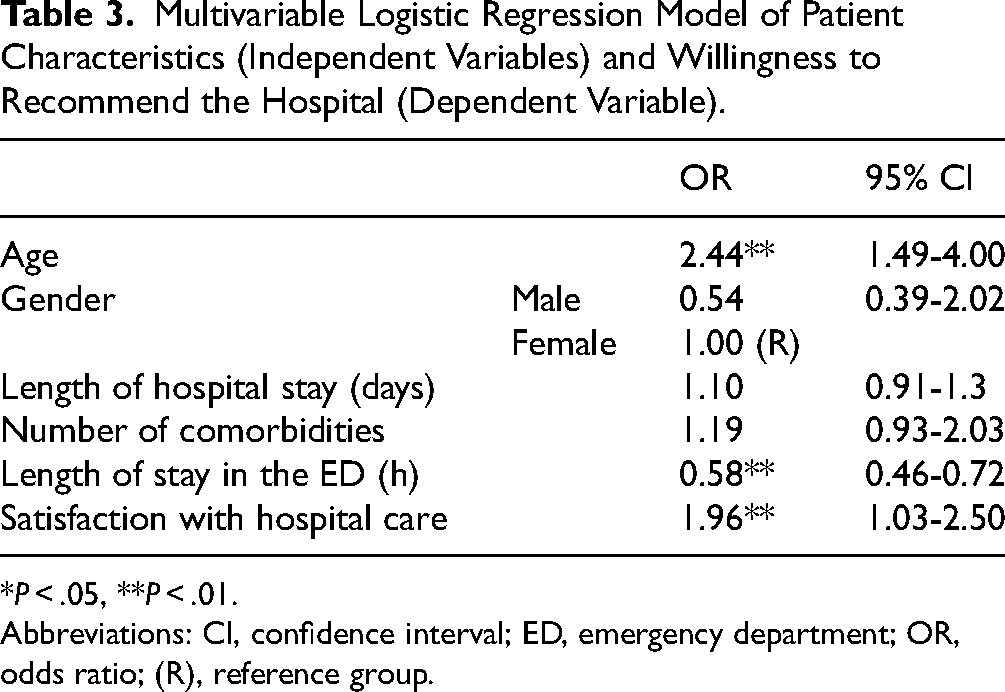
*P < .05, **P < .01.
Abbreviations: CI, confidence interval; ED, emergency department; OR, odds ratio; (R), reference group.
In contrast, the LOS did not show a significant impact on the willingness to recommend the hospital (P > .05). Satisfaction with hospital care was positively associated with the willingness to recommend the hospital, with an OR of 1.96 (95% CI: 1.03-2.50). This means that higher satisfaction levels are linked to an increased willingness of patients recommending the hospital.
Regarding patient gender and the number of comorbidities, these factors did not demonstrate a statistically significant association with the willingness to recommend the hospital. The regression model achieved statistical significance (P < .01) and explained approximately 30% of the variance in the willingness to recommend the hospital.
Discussion
The present study aimed to investigate the factors associated with orthopedic patients’ willingness to recommend the hospital, considering various demographic and clinical variables. The findings revealed several noteworthy associations and nuances related to patient willingness to recommend.
The association between patient satisfaction and the willingness to recommend the hospital highlights the pivotal role that the overall satisfaction of patients plays in shaping their perceptions and subsequent behaviors. Likewise, satisfied patients are more likely to perceive the care they received as comprehensive, effective, and aligned with their expectations. This positive perception creates a sense of trust and confidence in the hospital's ability to deliver quality healthcare services. As a result, these patients are more inclined to share their positive experiences by recommending the hospital to friends, family, or others in their community. 2
We observed a negative correlation between the length of stay in the ED and patients’ willingness to recommend the hospital. Essentially, as the length of stay in the ED increased, there was a corresponding reduction in the willingness of patients recommending the hospital to others. This finding aligns with previous research. 12 The negative association between length of stay in the ED and patients’ willingness to recommend may be attributed to extended wait times, fostering dissatisfaction and frustration. 21 Prolonged stays could signal inefficiencies in healthcare delivery, such as resource constraints or understaffing, impacting patients’ perception of the hospital's ability to provide timely and effective care. 22 Given the ED's pivotal role as the initial contact point, our findings suggest that experiences during this phase significantly influence overall hospital perception, potentially overshadowing positive experiences in subsequent care stages. 21
In addition, our study revealed a positive association between patient age and the willingness of recommending the hospital, indicating that older patients tend to exhibit a higher willingness to recommend. This observation aligns with prior suggestions proposing that older patients may possess greater familiarity with hospital systems, potentially leading to more realistic expectations. 16
In the present study, patient gender and the number of comorbidities were not found associated with the willingness of recommending the hospital. This suggests that in the context of this study, these factors may not be substantial determinants of patients’ inclination to recommend the hospital. This underscores the need for a nuanced understanding of the diverse array of factors influencing patients’ recommendations, as gender and health condition alone may not capture the complexity of patient experiences and preferences in shaping their perceptions of healthcare quality.
Similarly, patient LOS was not found associated with the willingness of recommending the hospital. This finding is not consistent with previous studies, where longer LOS is usually associated with lower patient willingness to recommend the hospital.16–18 The absence of an association between patient LOS and the willingness of recommending the hospital in our study suggests that individual perceptions of a positive or negative hospital experience may extend beyond the duration of stay. Factors such as the effectiveness of treatment, interactions with staff, and the overall environment of care may carry more weight in shaping patients’ impressions and influencing their willingness to recommend the hospital. This underscores the intricate and multifaceted nature of patient experiences, emphasizing the importance of considering a diverse array of dimensions when assessing the factors that contribute to patients’ willingness to recommend a hospital.
Limitations
This study has several limitations. First, the study utilized a convenience sample from a single institution, which limits the generalizability of the findings to the broader patient population. A convenience sample may not fully represent the diverse patient demographics across different healthcare settings. Future research could benefit from using random sampling methods to obtain a more representative sample of the patient population.
Additionally, while our study considered several demographic and clinical variables, it did not include factors such as socioeconomic status, education level, and previous hospital experiences, which could provide a more comprehensive understanding of the factors influencing patient recommendations. Future research should incorporate these additional variables to enhance the robustness and applicability of the findings.
The study also acknowledges the potential influence of social desirability bias, where participants may provide responses they perceive as socially favorable. To address these limitations, future research endeavors could benefit from adopting a longitudinal design, allowing for the exploration of temporal relationships and a more comprehensive understanding of patient experiences.
Conclusion
This study delved into the factors influencing orthopedic patients’ willingness to recommend a hospital, revealing significant associations and nuances. Patient satisfaction emerged as a crucial determinant, with higher satisfaction levels positively influencing the willingness of recommending the hospital. Notably, the negative correlation between the length of stay in the ED and patients’ willingness to recommend highlighted the impact of extended wait times on overall satisfaction. The positive association between patient age and recommendation willingness suggests that older patients may possess a more realistic understanding of hospital systems. Conversely, patient gender, number of comorbidities, and length of stay in the hospital were not found to be substantial determinants in this context. These findings underscore the complexity of patient experiences and preferences, emphasizing the need for a nuanced understanding when assessing factors influencing patients’ willingness to recommend a hospital.
The implications of this study extend to healthcare providers and policymakers aiming to enhance orthopedic patient experience. Our findings emphasize the critical importance of prioritizing and enhancing patient satisfaction in orthopedic healthcare settings, as it serves as a key driver for positive word-of-mouth recommendations, contributing to the overall reputation and success of the hospital. In addition, addressing issues related to extended ED stays is crucial, as our findings highlight their negative impact on patient willingness to recommend. Moreover, understanding the influence of patient age underscores the importance of tailored communication strategies for different demographic groups. However, the nonsignificant associations with gender, comorbidities, and LOS suggest that a one-size-fits-all approach may not be effective. Future research and quality improvement initiatives should consider a diverse array of factors and adopt a longitudinal design to capture the dynamic nature of patient experiences, contributing to a more comprehensive understanding of factors shaping patients’ recommendations in the orthopedic healthcare context.
Footnotes
Declaration of Conflicting Interests
The authors declared no potential conflicts of interest with respect to the research, authorship, and/or publication of this article.
Ethical Details
The study received IRB approval (No. 0103-23-HYMC). Each participant furnished both verbal and written informed consent individually before engaging in the study.
Funding
The authors received no financial support for the research, authorship, and/or publication of this article.
