




Abstract
Health workers’ awareness can affect hospital fall prevention success. Enhancing awareness can be achieved by exploring their perspectives on the phenomenon. This study aims to explore health workers’ perceptions regarding fall risk prevention in hospitals. This study employed qualitative methods using photovoice. The participants were 20 health workers. The data collection was done within several steps, such as (1) The photographs of fall prevention were collected at 5 different hospitals within 3 months; (2) 20 photos were selected to be shown in the photo exhibition; (3) Participants were asked to reflect on the meaning of the photographs during photo exhibition, individually through Google Form and interview using SHOWED guidelines. This study identified 4 themes, including (1) the importance of fall risk identification, including environmental and physiological identification and the use of the appropriate assessment instrument based on age range; (2) the role of family and patient education, but does not guarantee that those who are educated have better attention; (3) involvement of nonhealthcare workers, such as security guide's contribution to identify patients; (4) application of fall protection and signs is crucial stuff to be applied in an appropriate way to prevent patients from falls. Health workers encountered both positive and negative aspects related to fall prevention strategies in hospital settings. Health workers’ perspectives can be considered by stakeholders to help improve hospital fall prevention regulations.
Introduction
Health care should be seen as a fundamental human right. Given that health care is primarily a service, it is always coproduced with patients. To provide safe treatment, not only health workers but also patients must be fully participated, informed, and regarded as partners in their own care. In many regions of the globe, this occurs far less frequently than it should. 1 The goal of patient safety practice is to eliminate any potential for harm to patients as a result of receiving medical treatment. One of the components of patient safety is fall prevention. Many factors can influence the successful implementation of fall prevention, including the professionalism of healthcare providers, patient engagement, and social, organizational, political, and economic factors. Collaboration between medical disciplines, healthcare facilities, and other stakeholders is crucial for successful and sustained implementation of fall prevention.2,3
In order to maintain engagement in fall preventive action, hospitals should establish incentive programs to enhance health workers’ attitudes that are based on their subjective standards and suited to each hospital's unique circumstances. 4 Health workers as the one who provides education toward patient and family should be well trained. Health workers must realize the significance, value, and utility of existing solutions and incorporate them into daily practice as patient safety improvement. 5 Providing education among hospital stuff regarding the effectiveness and the importance of fall prevention is essential to engage the compliance for implementing fall prevention. 6 Fall intervention which is consistently provided in hospitals can reduce fall incidents. 7 . Providing education related to fall prevention among patients and staff can reduce the incidence of falls in hospitals. 8 It is important for all health workers, managers, and leaders to have the same standard of knowledge regarding patient safety. Education and training of health workers are underutilized and underrated as critical instruments for solving the issues of improving patient safety as known today. 1
Improving health workers awareness regarding implementation of fall risk prevention is important for determining their attitude to prevent falls in hospital. 9 Improving awareness can be done by exploring their perspective regarding the phenomenon. There are several strategies to explore people's perspective, one of them is through the photovoice method. Photovoice is a participative research method that reflects people's life experiences and perceptions by combining photos and narration.10,11 Several studies proved that the photovoice method is one of the effective ways of exploring untold perceptions for further improved knowledge.12–14 This study aimed to explore health workers’ perceptions regarding fall risk prevention through photovoice methods.
Method
This study was a qualitative study using the photovoice method. Participants were selected through purposive sampling. Criteria included health workers representing each unit in a private hospital in Central Java. The participants involved were 20 health workers. This study has gained an ethical approval, and the informed consent had been provided directly to the participants, including health workers and the patient who appeared on the photographs. The informed consent among patients has done before the photo was taken, and all the patients have stated their willingness to be captured on the photos. It is also performed among health workers, the informed consent among health workers have done before the data have been collected, and all health workers have stated their willingness to be involved in this study.
Data were collected in several steps, as illustrated in Figure 1. The photographs of fall prevention were collected at 5 different Hospitals within 3 months.
20 photos were selected to be shown in the photo exhibition. The photos were selected by researchers based on several criteria such as: (a) Photos that tell an interesting story or show a sequence of events linked to avoiding falls; (b) Photos should possess a distinct instructional message or lesson that can be readily comprehended by the audience; (c) Engaging photographs that are likely to stimulate thoughtful contemplation and provoke meaningful conversation among participants The photo exhibition was performed at one of private hospital in Central Java. Participants who attended the photo exhibition were asked to reflect on the meaning of the photographs which were considered to be interesting. The photographs were shown in 2 sections. First, the participants viewed the photos through the standing banner and reflected the meaning of the photos through Google Forms. Second, the photos provided through the video which has been narrated by researchers, and participants were interviewed by researchers using SHOWED guidelines. SHOWED questions includes (1) What do you see?; (2) What is really happening here?; (3) How does this relate to ourself?; (4) why this happen?; (5) How this image educate?
The photovoice mnemonic, known as SHOWED, serves as a framework to support group talks by providing a standardized set of questions.
15
This stage of the photovoice process is crucial, since research has demonstrated that the combination of photographs with captions yields significantly more impact compared to photos presented in isolation. Due to the emphasis on critical thinking and communication skills, it is probable that those engaging in the process will enhance their proficiency in writing and communication.
15

Data collection flowchart.
This study was analyzed using NVivo assistance, consisting several stages. First stage, coding the data which have been collected through interview using SHOWED guidelines. The second stage, grouped the data which has the same meaning into categories. The third stage, developed the themes according the categories. Before formulating the themes, researchers participated in collaborative discussions to ensure that the themes revealed in the manuscript are a result of consensus among all researchers.
Results
Table 1 shows that most of the respondents’ gender is female (85%) and most of the respondents’ age is in a range of 31 to 40 years (75%). The majority of participants were nurses (85%), and the most represented unit was the inpatient room (30%).
Participant Characteristics.

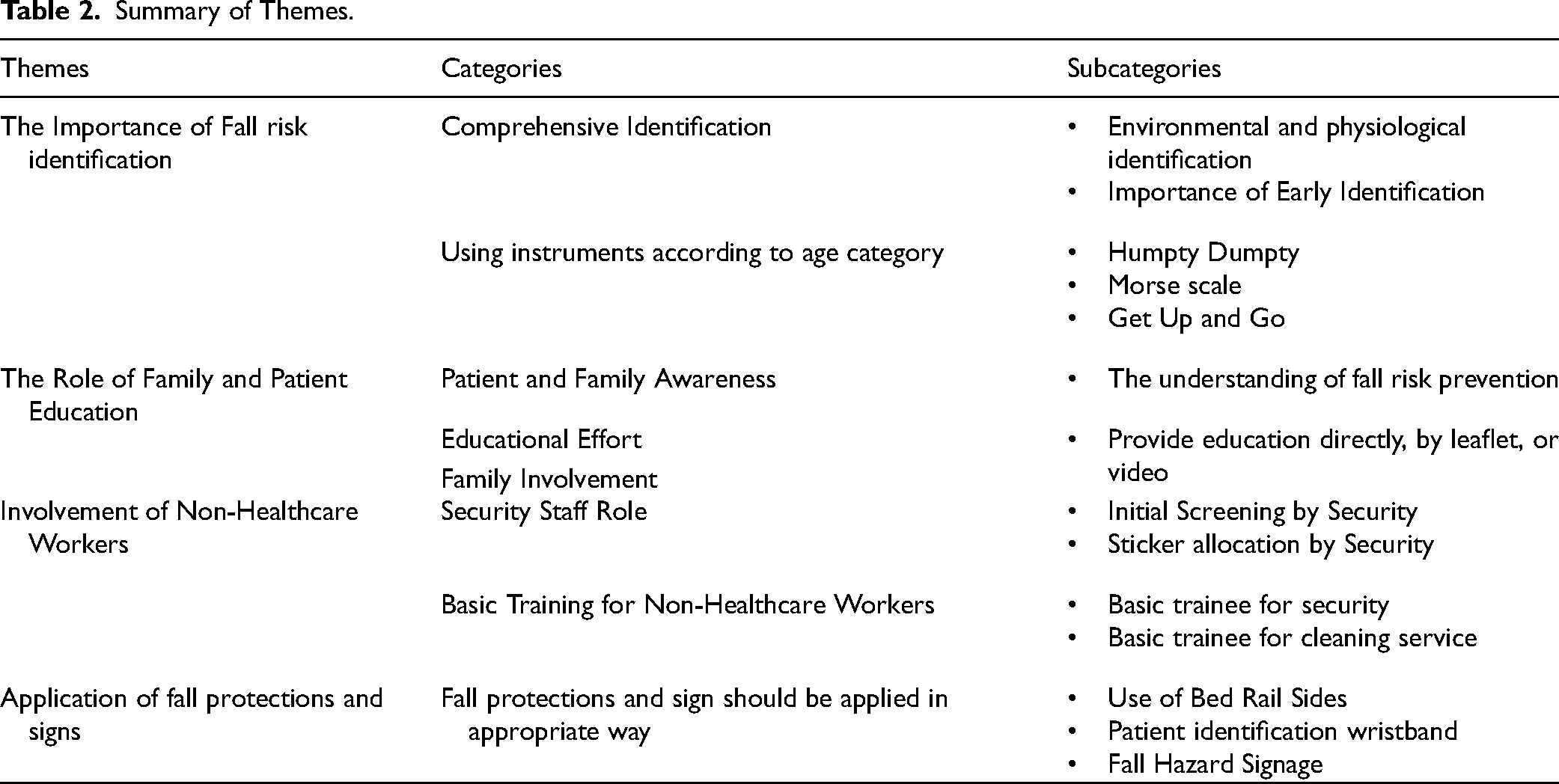
The Table 2 shows that study identified 4 themes, as follow
1. Fall Risk Identification a. Comprehensive identification “in general, fall risk patients are caused by environmental factors and/or their physiological factors, that's why patient identifications were need to be done from the first place” (informant 1) “The risk of fall can be prevented if the health-workers had done the identification early when patient comes” (informant 11)
According to the participants’ perspective, fall risk identification is a crucial term to be done immediately the moment patient comes in the hospital. Fall risk identification is crucial for determining the next intervention.
The participants said that the fall risks among patients are caused by environmental and physiological factors, and it is need to be identified early for determining the next intervention.
Summary of Themes.
The identification not only for the physiological factors but also for the environmental factor. The environment must be safety and suited for the patient, especially for pediatric, elderly and patient with chronic or acute illness.
b. Using instruments according to age category “we use Morse scale to identify the fall risk, it based on their age range, in paediatric inpatient we use Humpty Dumpty scale, and get up and go for the elderly” (informant 4) “we use the commonly instruments for the fall risk identification, such as Humpty Dumpty, Morse, Get Up and Go” (informant 1)
The participants said that the common instruments which have been used in the hospitals are Humpty Dumpty Scale, Get Up and Go, and Morse scale. Each instrument has different function. Humpty Dumpty Scale provides for pediatric inpatient, Get Up and Go for the elderly, and Morse scale for adults.
The participants are agreed that fall risk identification using accurate instruments will reduce fall incident. Fall risk identification is the first important step during hospitalized, hence it should be provided early before the next intervention.
2. The Role of Family and Patient Education a. The role of family “there are patients with fall risk indication accompanied by family as a caretaker. The role of family is important to improve patient safety intervention…” (informant 16)
Awareness of patent and families was contributed to prevent falls among patient in hospital. The participants found in several times that both patients and families were unaware with their condition, even though the health workers have provided the education as the patient has a fall risk and how to prevent.
Family or the guardian of the patient are essential to be involved, as they are the one who accompanied the patient during hospitalized.
The successful of patient fall prevention inseparable from the role of family as a caretaker. Not only health workers but also the family will take part of the responsibilities of the patient safety
b. Awareness of patient and families “there is a photo that show a paediatric inpatient accompanied by his parents but the bed rail side was not being applied, we also found it in several times in our hospitals, even though we have provided the education” (informant 16)
In several times, the participants found that the bed-rail-side not being applied among inpatient which has fall risk. It makes the effort of fall prevention were not going through as well as the expected.
However, the participants also found the patients and families which compliance to apply the bed rail side among patient with fall risk. “there is patient with family, they applied the bed rail side, there is a fall risk sticker either, which is they compliance to apply the fall prevention” (informant 4)
Setting up the prevention tools such as bedrail side among patient and families such an essential thing to do, even though the health-workers have been provided the education if the patient or the families have the lack of an awareness it will not going through as well as expected.
c. Educational Effort “…the education for patient and family can be provided directly by health workers through leaflet or video” (Informant 8) “….the role of family in reducing the fall risk is very important, it makes we should provide the education among family either, not only among patient, as the family was the one who accompany the patient” (informant 16)
The participants thought that the role of family in preventing patient from a fall is such an essential thing, hence, the education should be given to the family members either to improve their awareness. The education can be provided directly, by leaflet, or video.
Awareness among patients and families should be suited for improving the intervention of fall risk management. As the patients are the main object to be protected and the family is the one who always be with the patient, hence education should be provided among patient and family to improve their awareness.
3. Involvement of Nonhealthcare Workers a. Security guard identified the patient “the screening also have been conducted by the security in the front office the moment patient came and provided the sticker for patient with a fall risk……” (informant 12) “It's such an interesting thing, the moment security could identify the patients either, it might just a basic and didn’t comprehensive but still important, the first one who meets patient could identify early before the patients come in to the healthcare facilities, so the implementation of fall prevention could be done early” (informant 17) b. Basic Training for Nonhealthcare Workers “…basic trainee of fall prevention should be conducted among non-health workers such as security and cleaning services” (Informant 17)
The fall prevention not only comes from the health workers but it also comes from nonhealth workers and family. The contribution from nonhealth workers and family gives a positive impact for undertaking the fall prevention.
Security involved to identify when the patient comes in front office and give the fall risk sticker. The action taken by security could help health workers for the further identify.
This also proved that involvement of supporting staff such as security guard can gives a positive impact to improve fall prevention implementation. Furthermore, basic trainee regarding fall risk should be carried out among nonhealth workers either.
4. Application of fall protections and signs
a. Fall protections and sign should be applied in appropriate way
The fall protection and sign such as bed rail side, patient identification wristband, fall hazard, and wet floor sign should be applied to prevent the patient from falls. “in the photo…. there is a baby didn’t even use the patient identification wristband, I don’t know if it haven’t been captured or actually didn’t use, and the bed rail side not being applied…. And there's no fall hazard…. Those tools are the crucial tools which should be applied for the paediatric patients” (informant 14) “the wet floor sign is also available in Indonesian language so it makes easier for the patient which don’t understand English” (informant 15)
Fall protections are the crucial stuff to be applied to prevent patient from falls, especially for the patient with the highest risk. The signs of fall risk either, it should be applied to get to know if the patients are in the risk of fall, so the health workers and the other hospital staff can provide more protections. So, both fall protections and signs should be applied in appropriate way.
The Figure 2 shows the 4 samples of 20 photos that appeared in photo exhibition. The participants exhibited the highest level of reflection toward these photographs. Figure 2A, there was a baby accompanied by her mother. Figure 2B, there was the sign indicated for wet floor. Figure 2C, there was elderly patient using wheelchair. Figure 2D, there was a patient with fall risk sign on the bed. Figure 2E, there was a security guide applied the fall risk sticker for elderly patient.

Sample photo which appeared in photo exhibitions.
Discussion
Participants agreed that factors increasing fall risk in hospitals include both environmental and physiological factors. There are several factors which influencing falls in hospital, one of them are environmental hazards such as the lack of lighting, uneven flooring, and chair/bed heights were not appropriate, transferring hazards. 16 The hospital environment is such a crucial tool for providing ideal safety setting, as the patients unassisted or assisted in ambulating the environment setting is still crucial to be considered. Hence, the design of environment in hospital especially in patients’ room should be considered according to the patients’ safety. 17 Another study had proved that environmental hazard is a potential factor which influencing fall risk beside physiological factors such as fall history, walking problem, urinary incontinence, osteoporosis, acute sickness, delirium, recovery from surgery, prolonged immobility, or bed rest.16,18,19 Hence, patient identifications are crucial to be done early the moment patient comes at the hospital. Validated risk assessment techniques may be necessary for effective falls interventions for early detection of risk factors for falls in all patients. 20
There are several tools of fall risk identification which commonly used among participants for identifying patients, such as Humpty Dumpty Scale, Morse Scale, and Get Up and Go scale. The education should be provided by health workers to all patients (pediatric, adult, and elderly) and families during hospitalization using the right assessment tools. The Humpty Dumpty falls scale was the commonly tool used among children. 21 The Morse Fall Scale is a simple and quick tool for determining a patient's risk of falling. Its origins can be traced back to the acute care, rehabilitation, and nursing home sectors. This assessment tool does not look into sensory impairments or drug use, which may take a role in the origin of falls and hence increase the risk of injury. 22 Any age is vulnerable to the occurrence of a fall, but the elderly is at a higher risk. The physical, perceptual, and cognitive changes as the aging and it is combined with an inappropriate environmental it will improve the fall risk.23,24 A fall risk is multifaceted, hence, there is no ideal tool that can be applied universally or can measure it perfectly. 22 Importantly, the use of fall risk assessment methods for inpatients is insufficient to avoid falls 16 it needs further intervention.
According to the result, the participants have the point of view that awareness of patients and families were also contributed to prevent falls among patient in hospital. It is crucial for ensuring patients’ awareness and the facility to access safety tools for reducing the fall risk. 1 Increasing the awareness making individuals aware of their personal susceptibility to falls such as medication or environmental hazard factors. 16 The education regarding fall risk and prevention should be given by the health workers toward patients and families. Providing education regarding fall risk and prevention among patient can help to reduce fall incidence. 25 Both patient and family can help to reduce the risk of falling during hospitalization if they are provided with appropriate educational program, it will improve their knowledge and self-perception of danger. 25 Exercise programs that emphasize balance and strength training can help reduce the risk of falls, and examining a standard set of risk factors for falls and addressing modifiable ones can help reduce the risk of falls among people who are at high risk. 26 Fall prevention programs typically favor the creation and implementation of a clinically led plan. The focus of all assessment should move from the health workers to the patient. In order to make a better intervention, health workers have to take the time to explore the patients’ perspectives to know their needs. 27
Situational assessment of fall prevention can be done by safety and security officer, with the help of a safety product and a properly educated personnel. 16 Supporting staff, including security, cleaning, and catering services, are also targeted to provide education regarding how to improve the patient safety, such as decreasing stuff that prevents to handrails, using brakes on wheeled machinery, turn on the night light, and keep the floor clean and dry. 16 In order to build a positive attitude toward patient safety, it is important to identify the potential hazard area early by frontline staff in the hospital. 28
A fall risk signs such as yellow wristband, yellow magnet door, yellow socks are crucial method of communication between hospital staff to get to know that patients are in the risk of fall. 29 Inaccurate and inconsistent of fall risk assessments were contributed to fall incidence in hospital. Appropriate of bedrails side application was one of the factors was influenced fall incidence. 30 Another study had proved that among older inpatient which used bedrail side were less of experienced falls rather than inpatient without bedrail side. 31
Conclusion
This study concluded that successful prevention of falls in hospitals depends on promptly and accurately identifying risks using the right instruments, in addition to providing ongoing education for patients and their families. Nonhealthcare personnel, such as security officers, make a substantial contribution by performing initial screenings and assigning fall risk stickers, underscoring the need of their fundamental training. It is crucial to utilize fall protection items correctly, such as bed rail sides, patient identification wristbands, and warning signs. In order to achieve successful fall prevention, it is crucial to prioritize continual education, include staff members, and consistently implement preventive measures.
Footnotes
Authors’ Note
Research Ethics and Informed Consent: This study has gained an ethical approval from Health Research Ethics Committee Universitas Muhammadiyah Yogyakarta with the number No. 089/EC-KEPK FKIK UMY/I/2023. The informed consent had been provided directly to the participants, including health workers and the patient who appeared on the photographs.
Acknowledgment
Acknowledgment to the Research and Innovation Institute, Universitas Muhammadiyah Yogyakarta, which had funded the entire process of this research activity, and for all hospitals and participants which had contributed to this research.
Declaration of Conflicting Interests
The author(s) declared no potential conflicts of interest with respect to the research, authorship, and/or publication of this article.
Funding
The author(s) disclosed receipt of the following financial support for the research, authorship, and/or publication of this article: This work was supported by the Universitas Muhammadiyah Yogyakarta, (grant number 546/PEN-LP3M/I/2021).
