




Abstract
Non-communicable diseases are increasing, but detection and control are inadequate. Active involvement of community pharmacies in their management can improve the situation. This is an exploratory study to unearth the perceptions and expectations of customers of services offered by community pharmacies. A cross-sectional study was conducted in two regions of Ghana. A total of 535 clients participated. Counseling was the most patronized (71.0%) service with medication review (38.5%) being the least. The most readily available service was sale of prescription medications (63.7%). Proximity (72.1%) was the most influential factor for selecting a pharmacy to visit. Clients perceived the dispensing of medications (64.3%) as the principal role of the pharmacists. The presence of a pharmacist and good and quick customer service were of statistical significance to customer satisfaction. Customers visited facilities mostly for blood pressure monitoring and to refill their medications, and counseling was the most patronized service. These call for planning multifaceted approaches to improve the care of patients with chronic disease.
Key Points
The role of community pharmacists in monitoring disease progression and medication review was largely unrecognized by participants.
Customers prefer counseling services at the community pharmacy.
There are opportunities for community pharmacies to provide services that aid the prevention and management of chronic disease.
Customers are satisfied by the quality of services offered by community pharmacies.
Introduction
Community pharmacies are an important aspect of the pharmaceutical sector and play a vital role in healthcare delivery. They are considered the first port of call for primary healthcare due to their proximity to the community. They are also the most frequently visited healthcare facilities.1,2 Many of these facilities have long opening hours and do not require an appointment for consultation. Hence, they are considered more accessible than other healthcare facilities and are in a unique position to contribute immensely to healthcare delivery. 3 On the basis of availability, access, convenience, and cost, some have suggested that using community pharmacies for the treatment of minor ailments can help optimize healthcare resources by reducing the demand for costlier healthcare options such as appointments with general practitioners.4–6 The pharmacy users’ perception of community pharmacy has a bearing on their satisfaction and use of facilities at the pharmacy. 7
Consumer perceptions on services received influences the extent to which services are valued and patronized. One of the integral components that push the quality of primary healthcare delivery is customer satisfaction. Customer satisfaction increases the existing customer loyalty and re-purchasing process and prevents customers from being affected by competitive enterprises. 8
A study conducted among type 2 diabetes patients in Leeds established that there is an association between patient satisfaction and improved outcome. 9 Satisfied patients are likely to adhere to their treatment and cooperate with their healthcare providers. 10 This enhances pharmaceutical care and promotes efficient clinical outcomes and medication adherence. Therefore, there is a need for the community pharmacist to realize the necessity of studying and understanding the various experiences of patients which might help in the provision of effective healthcare. 11
In Ghana, non-communicable diseases especially hypertension and diabetes are on the rise and the detection and control levels of these conditions are also low. 12
Communities and individuals in many sub-Saharan African countries often face limited access to healthcare. Regardless of where one lives improving access to healthcare services is crucial. In Ghana, although several attempts have been made to improve access to healthcare, efforts have largely remained ineffective.13,14 Similar to other developing African countries, concentration of essential healthcare facilities in urban centers and transportation issues, among others, have been cited as some of the causes of healthcare inaccessibility.15,16 However, the widespread and heavy distribution of community pharmacies in almost all conners of Ghana can be utilized to ameliorate the situation. In Africa, less than 30% of people living with hypertension are on treatment. A study revealed that there is a significant unmet need for diagnoses and treatment of non-communicable diseases such as hypertension and diabetes in Ghana. 17 Active involvement of the community pharmacists in the management of these conditions often leads to improvement in the control of the condition, adherence, and resolutions of pharmaceutical care issues. 18
This study sought to unearth the perceptions and expectations of customers about the services offered by the community pharmacy in the management of chronic diseases especially diabetes and hypertension.
Method
Study Settings and Site
This was a cross-sectional study conducted within the Greater Accra and Ashanti regions of Ghana. These regions are the two most populous regions in Ghana. In all, 42 community pharmacies were used for this study, 28 in Accra and 14 in Kumasi. The study was conducted from September to December 2020.
Sample and Sampling
The appropriate study sample size was estimated to be 312 using the Cochran formula. 19 The estimation was done with a population of 1654 pharmacies in both cities, confidence interval of 95% (Z = 1.96), margin of error of 5%, and a sample proportion of 0.1. Inclusion criteria for the study were individuals of both sexes aged 18 years and older, with confirmed diagnosis of hypertension, diabetes, and hypertension with comorbid diabetes and were on medications for the management of their conditions. The convenience sampling method was adopted in attaining the sample size, by selecting the first 10 patients from each of the identified community pharmacies. Clients whose medical history could not be ascertained by the pharmacy staff were not included in the study.
Development and Validation of Questionnaire
The main instruments used to collect information for the study were semi-structured questionnaire. A modified SERVQUAL questionnaire was developed from literature.20,21
The SERVQUAL model measures the gap between expected service and perceived service. From this model, data on the expectations and perceptions of consumers can be collected which helps provide answers how consumers perceive service quality and what dimensions consumers are satisfied with. The SERVQUAL model is used to assess service quality and customer satisfaction. Customer satisfaction can be measured using the various service quality dimensions. These five dimensions were tangibility, reliability, responsiveness, assurance, and empathy as developed by Parasuraman et al. 22
The questionnaire was in two parts; the first part gathered data on customers’ demographics, services obtained, reasons for visiting the pharmacy, and factors influencing customers’ preference. The second part of the questionnaire comprised 19 questions aimed at finding the respondents’ opinions pertaining to the expectations and perceptions of service quality in the community pharmacy. These were statements that sought to describe how the state of services in the community pharmacy should look like. The statements were stated in such a way that they express a desire of the respondents for a particular attribute of service quality. These were also statements that provided a description of particular service attributes in the community pharmacy for which respondents are expected to rate these statements according to how far they think these statements apply to the pharmacy from their experience. The original questionnaire was modified to suit our purpose.
Pretesting of questionnaires was conducted among 50 participants with chronic disease in community pharmacies in a different city with comparable patient characteristics to validate the survey tools. The purpose was to establish clarity of questions asked, appropriateness of the order of questions, adequacy of response options provided, and the need for additional or removal of existing questions to ensure that relevant data is collected. After pretesting, the questionnaire was restructured with the aim of increasing the response rate by reducing the number of questions. All inconsistencies encountered were also amended to help respondents understand the questions and to respond appropriately. The variables of interest were gender, age group, health status, and number of years they have been with the condition, location, and the type of insurance used to access healthcare. The preference of diabetic and hypertensive patients for one community pharmacy over another, reasons why patients with diabetes and hypertension visit the community pharmacy, the kind of services diabetic and hypertensive patients obtain from the community pharmacy, and whether they are beneficial was also recorded. These variables influence consumer satisfaction on the quality of services delivered. 23
Data Collection
Study respondents were selected based on their willingness to participate in the study. Walk-in customers of the sampled community pharmacies who were known hypertensives or diabetics were identified from their records by the pharmacy staff on duty and referred to the data collection personnel for administration of the questionnaire. Informed consent was obtained from each participant prior to the administration of the questionnaire. Only consenting individuals were included in the study. Questionnaires were administered to participants in a face-to-face interview by the data collection personnel in the pharmacist's office. It was translated to a local dialect convenient for participants who had difficulty understanding the English language. All data was collected by trained personnel between the hours 4pm and 7pm each day, the peak business hours for community pharmacies.
Data Analysis
The data was entered into SPSS version 24 for analysis. Frequency tables were used in compiling the frequencies and percentages. Multiple regression analysis was to determine factors that influenced clients’ preferences for a community pharmacy. Cramer's V was used to determine if the association between level of client satisfaction and client-related factors were strong or weak. The level of significance was set at p-values less than 0.05 at 95% confidence interval. Gap scores were calculated for service quality dimensions by subtracting perception score from expectation score. A positive score indicates that clients were satisfied with the dimension measured.
Results
Demographic Characteristics
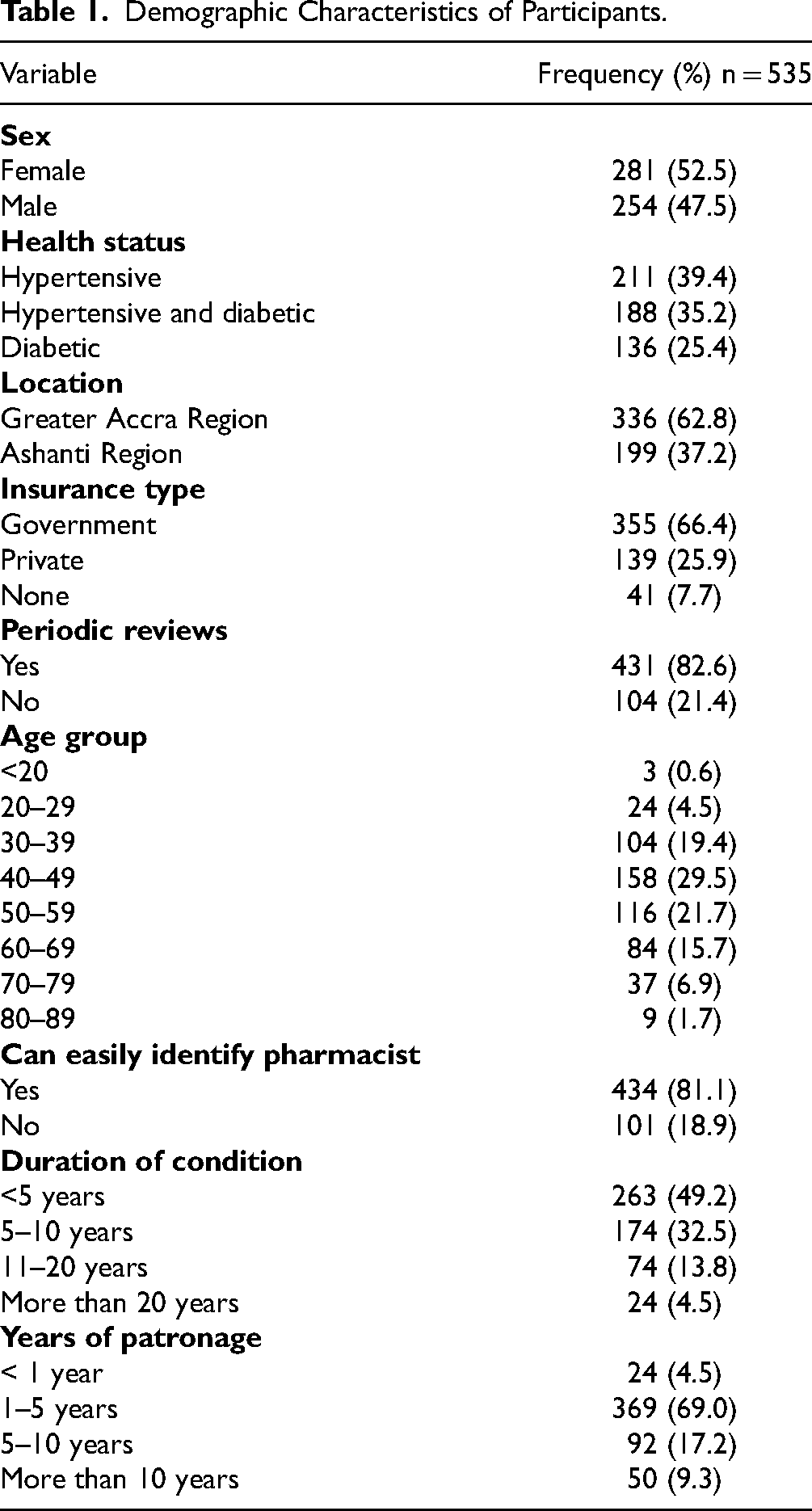
A total of 535 clients participated in the study of which 281 (52.5%) were females. The maximum and minimum age were 87 and 19 years, respectively, with a mean of 49 ± 13.28. Twenty-four (4.5%) participants had the condition for more than 20 years (Table 1).
Demographic Characteristics of Participants.
Services Obtained and Reasons for Visiting the Pharmacy
Counseling on medication (n = 380, 71.0%) was the most patronized service by clients and the least was medication review (n = 206, 38.5%) (Table 2). Reasons for the most recent visit included counseling on medication (393, 73.5%), drug refill (n = 338, 63.2%), and counseling on diet (217, 40.6%) (Table 3).
Services Often Obtained from the Pharmacy.

Reasons for Most Recent Visit.

Factors Influencing Preference for a Community Pharmacy
Good consumer service (p < 0.0001) and quick services offered by the pharmacy (p = 0.006) were factors that significantly influenced preferences for a community pharmacy (Table 4).
Factors Influencing Preference for one Community Pharmacy.

Perceptions on the Roles of the Community Pharmacist in the Management of Their Condition
Clients opined that the principal role of the pharmacist was to dispense their medications (n = 344, 64.3%), provide medicine information (n = 332, 62.1%), and provide advice on the treatment of minor ailment, for example, malaria, headache, heartburn, constipation, muscle pain, and minor skin problems (n = 296, 55.3%). Clients least expected community pharmacists to monitor health progress to ensure optimum control of their condition (n = 180, 33.6%) and perform effective screening and monitoring for other health conditions (n = 193, 36.1%).
Satisfaction and Challenges with Services Provided by the Community Pharmacist
Two hundred and seventy-three (51.0%) of customers were strongly satisfied, satisfied (214, 40.0%), averagely satisfied (n = 47, 8.8%), and not satisfied (n = 1, 0.2%) with the services they received from the pharmacy. However, clients expressed worry about the fact that lack of privacy (n = 345,64.5%) and the attitude of pharmacists (n = 265,49.5%) mostly prevented them from asking questions during their visit to the community pharmacy. Other challenges that prevented smooth patronage of the pharmacy by clients include busy nature of the pharmacy (n = 211,39.4%), lack of knowledge by the pharmacist in their opinion (n = 126,23.6%), and the perception that doctors are more trustworthy than pharmacists (n = 75,14.0%).
Service Quality
A positive gap was recorded for all five dimensions measured. Tangibility and reliability recorded the highest gap scores (0.23) with assurance recording the least (0.02). Although the average gap scores for all dimensions were positive, the score for “behaviour of employees in the community pharmacy instils confidence in you” was negative (Supplementary Table 2).
Ethical Considerations
The Committee on Human Research, Publications and Ethics, Kwame Nkrumah University of Science and Technology (CHRPE/AP/260/20) approved the study prior to its commencement. All participating pharmacies also gave the necessary permissions to conduct the study. Informed consent was obtained from all clients before participating in the study.
Discussion
The study aimed at unearthing the expectations and perceptions of customers on services offered by community pharmacies. By understanding the expectations and perceptions of community pharmacy clients, it is expected that the future of community pharmacy practice could be tweaked to optimize primary healthcare and the attainment of therapeutic outcomes especially among clients with chronic diseases.
Males slightly outnumber females in Ghana; 24 there were more females than males in this study. This may be as a result of a better health-seeking behavior among females. Also, females are more likely to look after not only their own but the health of the entire family and particularly children. 25 This implies that a lot more females may visit the pharmacy. The number of hypertensive clients in this study were more than diabetics which is in unison with available evidence that the prevalence of hypertension is higher than diabetes in Ghana. 26 However, comorbidity analysis in hypertension reveals diabetes as one of the top two comorbid conditions associated with hypertension in several populations. 27 It is therefore not uncommon that a high proportion of respondents in this study had both hypertension and diabetes. Most of the participants visited the hospital for periodic reviews where their management was evaluated. Although those who did not go for the reviews belong to the minority, it is essential that the importance of regular reviews is emphasized whenever patients with hypertension or diabetes visit the hospital. Periodic health evaluation or reviews have been shown to improve patient outcome and therapeutic goals. 28 Majority of the participants had been diagnosed with the condition for less than 5 years. This may be due to the increased awareness and screening campaigns carried out in recent years. A significant majority of the participants had also patronized the facilities for 1–5 year (Table 1).
The most patronized service from the pharmacy was counseling on medication. Counseling services offered by community pharmacists are free of charge, the proximity of the community pharmacies to clients, and the ease with which clients can identify pharmacists may enhance patronage. Medication review was the least patronized service although blood pressure and sugar monitoring tests were well patronized and could be capitalized as avenues to monitor patients’ therapies. Community pharmacies in developing settings could be used as medication monitoring and review centers for clients with chronic diseases. Community pharmacies are primary healthcare facilities and are often easily accessible with shorter waiting times. A systematic review of randomized control trials involving hypertensive patients revealed that interventions by community pharmacists can significantly reduce blood pressure and are useful in improving clinical management of hypertension.18,29 Currently, medication use review services offered by Ghanaian community pharmacists are often advertised and offered free of charge. It is not mandatory that every community pharmacist should offer these services, and there are no policies and standard operating procedures outlined by the Pharmaceutical Society of Ghana on how these services should be offered. Furthermore, community pharmacies in Ghana are private for-profit organizations that also like to offer and advertise services that generate income. Most community pharmacies are likely to advertise and offer medicine use review services if they were reimbursed for offering these services. In the United Kingdom where Medicine Use Review (MUR) services have been implemented for several years, the NHS is responsible for reimbursing community pharmacies who offer these services. 30
The single most cited factor influencing clients’ preference for a community pharmacy was its proximity to their residence; however, it was not statistically significant. Factors that significantly influenced customers preference for a community pharmacy were the presence of a pharmacist (p = 0.04) and good and quick customer service (p = 0.00). This suggests clients appreciate the role of community pharmacists in the healthcare delivery system. Patrons look beyond the mere aesthetics or prices of drugs in a community pharmacy. The community pharmacy is not seen as a place to purchase drugs only but also as a place where pharmaceutical care is provided. This finding is similar to that of a study conducted in the Ga West District of Ghana. 31 Overall, clients were satisfied with services provided by community pharmacists. This is positive for the provision and access to healthcare in low resourced settings such as Ghana and may be utilized in improving the management of chronic conditions. Similar studies in India and Kuwait established otherwise in their setting. 32 The commonest duties of community pharmacist as perceived by the customers were dispensing of medications, providing medicine information, and treating illnesses of common occurrence. The least perceived role of the community pharmacist was to monitor health progress to ensure safe and effective use of medicines; this is similar to a study conducted in Kuwait to determine public perception of community pharmacists. 32 Community pharmacists should be encouraged to follow up and monitor the therapy of clients with chronic diseases. Monitoring the health progress is very essential in optimizing therapy among patients with chronic diseases. The review period of these patients is often long hence it is very important that follow-ups are conducted to identify and resolve any pharmaceutical care issues. Screening for chronic conditions was also one of the least perceived roles of the community pharmacists. Non-communicable diseases such as hypertension and diabetes are on the increase in most countries in sub-Saharan African. 33 Awareness and detection of hypertension is often low; hence, there is the need for interventions that would lead to early detection and adoption of healthy lifestyles for the prevention. 34 The community pharmacy could be an ideal place to create awareness, screen the populace for hypertension, and offer education on healthy lifestyles. 18
Clients were most concerned about the lack of privacy in the pharmacy; this is consistent with finding consumer perception of community pharmacists in Malta and Saudi Arabia.35,36 Privacy management in the community pharmacy can be challenging. However, community pharmacy practice continues to evolve with increasing unique privacy requirements. There is a need for a proactive approach in pharmacy planning and guideline development to ensure client privacy. The attitude of the pharmacists was also a subject of concern for some clients. A Saudi Arabian study underscores the need for authorities to implement the code of ethics governing community pharmacy practice. 37 Attitudinal change on the path of community pharmacists would encourage clients to engage pharmacists in the community as realized from this study. It is therefore recommended that the code of ethics as stipulated by the Pharmaceutical Society of Ghana be enforced to the latter. Pharmacists are expected to pay particular attention to issues of patients’ confidentiality, privacy, and their general conduct at the pharmacy as well as that of their support staff. Clients were more likely to consult a community pharmacist when suspecting malaria. In Ghana, malaria is a disease of common occurrence that can easily be diagnosed and managed in a community pharmacy. 38 However, the community pharmacy is underutilized in the management of conditions of common occurrence such as malaria, cough, constipation, and diarrhea. Only about half of our study participants perceived the community pharmacist as a healthcare provider who can make recommendations on illness of common occurrences. A significant proportion of customers perceived the primary role of the community pharmacist to be the dispensing of prescribed medications. More sensitization is needed to inform the populace of the existing roles of the community pharmacist to ensure that their services are optimized to enhance healthcare delivery in developing settings. These sensitizations and/or awareness programs could also be used to correct the erroneous view that some community pharmacists are not knowledgeable and may not be trustworthy. Furthermore, social media, community seminars, and collaboration with local health authorities could improve visibility of pharmacists as accessible healthcare providers.
There is also the need to implement regular feedback mechanisms where patients can share their experiences and satisfaction levels directly with the pharmacy. This data can be used to improve service delivery.
Gap scores for all five dimensions measured were positive indicating that customers were generally satisfied with the services they received from the community pharmacy (Supplementary Table 2). This means that customers’ perceptions exceeded their expectations; although there is a need for improvement, services received were appreciated. In a similar study in Nigeria, significant negative gaps existed between customer expectations and perceptions. 39 In this study, the variable with the highest expectation score was “Employees of the community pharmacy are consistently courteous with customers”; the gap score for this variable was however zero indicating that customers were neutral about the courtesy of the pharmacy staff. “The behaviour of employees in the community pharmacy instils confidence in you” had a negative gap score, implying that customers did not have confidence in the employees; these same perceptions were found in Kuwait study. 32 Assurance had the least gap score among all the five measured dimensions. Much work needs to be done to provide assurance for community pharmacy customers for all the services offered. Assurance sets clear standards and maintains quality in order to improve customer experience. However, the highest perception score was with regards to the community pharmacy being beneficial in the management of customers’ conditions. The highest level of satisfaction (highest gap score) was recorded for community pharmacies having state-of-the-art equipment. Customer satisfaction with the equipment in the community pharmacy can be capitalized in carrying out screening activities and monitoring for several conditions, especially chronic illness such as hypertension and diabetes. These may also be beneficial in other developing countries.
Implications on Practice
Blood pressure and blood glucose control is a major concern among most hypertensive and diabetic patients, respectively, and in a developing setting where the public healthcare settings are overburdened. The community pharmacist is well positioned to offer pharmaceutical care services to improve the care of such patients. However, pharmaceutical services such as medicine use review are less patronized by clients with chronic diseases such as hypertension and diabetes. There is the need for specific guidelines, policies, and standard procedures on how these services should be implemented as currently there are none. Again, it will be appropriate to give community pharmacists orientation on ways to promote the services available in the pharmacy to promote pharmaceutical care. This could be achieved by the implementation of specialized training sessions that cover various therapeutic areas, with a focus on those pharmacists feel least confident. As part of efforts to lessen the load on an already overburdened healthcare system, the populace should be encouraged to seek management of common illnesses such as malaria, constipation, and diarrhea in the community pharmacy.
Limitation of the Study
The study was conducted in only two of the 16 regions in Ghana. Though these regions are the most populous, this may limit the generalizability of the results.
Strength of the Study
Using a semi-structured questionnaire enabled us to use both close- and open-ended questions to explore patients’ preferences, perception, and expectations of the services offered by the community pharmacy. The SERVQUAL model used also enabled us to determine the differences between customers’ satisfaction in terms of assessing their perceptions and expectations about service quality. This also allowed making distinctions and providing basis for more precise estimates of degree of relationship between variables. This gives the research findings high reliability and validity.
Conclusion
Customers had an overall positive perception of community pharmacists, with services provided generally above their expectations. Customers were also satisfied with services they received from the community pharmacy. The presence of a pharmacist and good and quick customer service were of statistical significance to customer satisfaction. Although customers mostly visited the facilities for blood pressure monitoring and to refill their medications, counseling was the most patronized service. The proximity of a community pharmacy to the client was the most decisive factor influencing their choice. Lack of privacy and the attitude of pharmacists prevented some customers from asking questions. These findings highlight the need for planning multifaceted approaches to improve the care of patients with chronic disease.
Supplemental Material
sj-docx-1-jpx-10.1177_23743735241261237 - Supplemental material for Perspectives and Satisfaction of Consumers with Hypertension and Diabetes on Services Provided by Community Pharmacy
Supplemental material, sj-docx-1-jpx-10.1177_23743735241261237 for Perspectives and Satisfaction of Consumers with Hypertension and Diabetes on Services Provided by Community Pharmacy by Ivan Eduku Mozu, Afia Frimpomaa Asare Marfo, Mercy Opare-Addo, Nana Ofori Adomako and Pauline Boachie-Ansah, Joseph Attakorah, John Abeeku Graham-Bannerman in Journal of Patient Experience
Footnotes
Ethics and Consent Statements
Ethical clearance was granted by the Committee on Human Research Publications and Ethics -KNUST (CHRPE/AP/260/20) for the study to be carried out. Written informed consent was also provided by all participants.
Funding
The authors received no financial support for the research, authorship, and/or publication of this article.

Supplemental Material
Supplemental material for this article is available online.
References
Supplementary Material
Please find the following supplemental material available below.
For Open Access articles published under a Creative Commons License, all supplemental material carries the same license as the article it is associated with.
For non-Open Access articles published, all supplemental material carries a non-exclusive license, and permission requests for re-use of supplemental material or any part of supplemental material shall be sent directly to the copyright owner as specified in the copyright notice associated with the article.
