




Abstract
Evaluating stroke campaigns and associated behavioural changes is crucial to assess intervention effectiveness and inform future strategies. We aimed to evaluate patient's and bystanders’ foreknowledge of stroke signs and symptoms and their response at stroke onset. We interviewed stroke patients using a validated questionnaire or their bystanders if the stroke patient had disabling stroke. The questionnaire was administered to 165 participants, 142 (86.1%) stroke patients and 23 (13.9%) bystanders. The mean age was 52.6 (SD = 11.7), and male–female ratio was 7:1. Among the participants, 33 (20.1%) had foreknowledge of stroke signs, and of these, 27 (16.5%) were aware of the stroke campaign in Qatar. The behavioural responses at stroke onset included; activating Emergency Medical Services (EMS) (n = 55, 33.3%), calling friends/relatives (n = 69, 41.8%), driving to hospital (n = 33, 20%), waiting for improvement in condition (n = 21, 12.7%). There was no association of ethnicity, marital status, or campaign awareness with EMS activation. Despite limited community awareness of stroke signs and campaign, help-seeking behaviour through EMS activation was generally high, underscoring the need for focused educational efforts and public health interventions.
Introduction
Stroke is a major cause of morbidity and the second leading cause of mortality worldwide.1,2 According to the WHO (World Health Organization) Global Burden of Disease data and the leading cause of death report, 6.1 million deaths were recorded due to stroke in 2019.2–4 The incidence of stroke is increasing in developing countries owing to the increase in prevalent risk factors such as hypertension and diabetes. Qatar's population and age at stroke presentation is younger as compared to European and North American countries.5,6 The indigenous population has undergone significant changes such as urbanisation, increasing tobacco consumption, dietary changes and a sedentary lifestyle, contributing to an increased prevalence of vascular diseases.7–10 The prevalence of vascular risk factors, including diabetes and obesity, is comparatively higher in Qatar compared to Western countries.6,8,11 The management of acute stroke is time-dependent; therefore, early recognition of the symptoms and rapid transfer to the hospital may reduce subsequent disability and mortality. 12
Several regional and international reports have consistently highlighted a general lack of awareness regarding stroke.13–15 Considering this widespread lack of awareness, mass media campaigns are conducted globally focusing on improving community awareness about the signs, symptoms and appropriate response to stroke. The ‘Act FAST’ (Face, Arm, Speech, Time) stroke campaign is one of the major internationally established stroke awareness programs highlighting the key symptoms of stroke and the urgency in responding to them. Studies conducted to assess its effectiveness and outcomes have reported variable success rates.16–22 In the UK (United Kingdom), the campaign was effective in creating an impact on stroke awareness and recognition and in reducing pre-hospital delays in stroke patients.19,23 Studies from Australia also demonstrated an increase in emergency calls and ambulance dispatches for stroke post-campaign; however, they could not provide evidence of whether the calls were true stroke and transient ischemic attacks, or other stroke mimics.18,20,21
The cultural and linguistic diversity of Qatar's population presents particular challenges in developing public health campaigns. The first ‘Act FAST’ national stroke awareness campaign was launched in May 2015 in Qatar. 24 The campaign ran on television, newspaper, social media and billboard advertisements in multiple languages, targeting the general population. There is no prior published study assessing the effectiveness and impact of this stroke awareness campaign in Qatar, offering valuable insights to inform future development and intervention strategies.
The aim of this study was to assess the foreknowledge of patients and bystanders, of stroke signs and symptoms and their response at stroke onset. A secondary objective was to determine if the ‘Act FAST’ stroke campaign in Qatar contributed to their foreknowledge.
Methods
This prospective study was conducted in the national tertiary care hospital in Qatar. The study was reviewed and approved by the Medical Research Center (MRC) and the Institutional Review Board (IRB) of Hamad Medical Corporation (MRC/0765/2015). A verbal informed consent was obtained from the participants prior to their inclusion in the study.
Setting and Study Population
Qatar is one of the six Middle Eastern GCC (Gulf Cooperation Council) countries on the Arabian Peninsula's northeastern coast. Qatar has an ethnically diverse population of approximately 2.7 million, with about 88% being short-term immigrants from various countries.25,26 The local Qatari population constitutes only around 12% of the total, while South-East Asians (approx. 60%), Non-Qatari Arabs (approx. 13%), people from the Far-East (approx. 10%) and minority groups from various other countries (approx. 5%) form the major part of this society.25–27 Despite Arabic being the official language of Qatar and English being widely spoken, more than 65% of the non-Qatari population does not speak Arabic or English. In addition, the majority of this population were manual workers with limited education.28,29
All stroke patients admitted to the stroke unit between November 2015 till February 2016 were screened for participation utilising the stroke team's daily admissions log. Eligible participants were adults (≥18 years) with neuro-imaging confirmed stroke, as assessed by the neurology team. Including stroke patients allowed us to capture a patient-centred insight and first-hand experience of the participants, from recognising their symptoms to their decision-making process during the stroke onset using their awareness and knowledge of stroke warning signs. In cases when the patient had a disabling stroke that prevented self-reporting, patient relatives or witnesses/bystanders who were present at the onset of the stroke event, witnessed the event and were available and willing to participate were approached and invited to participate in the study allowing for valuable insight into public awareness and community response in the event of a stroke. Excluded participants were <18 years old, clinically unstable, and/or unfit for an interview without a witness/bystander, unable to understand verbal communication and/or diagnosis other than the stroke.
Data Collection
A validated questionnaire was the primary data collection tool and was modified to our local setting and population. 30 The questionnaire, provided in both English and Arabic, focused on capturing information relevant to the local demographics, including nationality, marital status, education and occupation, for both patients and bystanders. The questionnaires focused on assessing awareness and knowledge of the ‘Act FAST’ stroke campaign in Qatar, awareness of stroke signs and symptoms, participant responses at the onset of a stroke and understanding their knowledge regarding calling National Emergency Medical Services contact (999) at stroke onset. The assessment of campaign penetration and perception among the general population was further explored through their understanding of each component of FAST as represented in the campaign. The participants were approached within 48 hours of admission to the stroke unit and were screened for eligibility. Verbal consent was obtained from all eligible participants, and trained research team members conducted a structured interview in English or Arabic. A qualified, organisationally approved translator was utilised if the participant did not speak conversational English or Arabic. The response of each participant was recorded verbatim during the interview.
Variables and Data Points
The study questionnaire contained closed-ended questions with pre-defined options and open-ended questions recording verbatim statements describing the FAST campaign, signs and symptoms of stroke and participants’ behaviour at stroke onset. The closed-ended questions included awareness of stroke campaigns, awareness of the Act FAST stroke campaign in Qatar, knowledge of the signs and symptoms of stroke as depicted in the stroke campaign, the most common effective mediums used for the awareness campaigns, severity of different symptoms at stroke onset, behavioural response at symptom onset (with and without stroke recognition) and conclusive analysis of how effective the awareness campaign was and how much it affected patients behavioural response at the onset of stroke symptoms (Appendix 1).
The participant's understanding of the Act FAST campaign acronym was defined as satisfactory if the participants were able to identify three or more components of the ‘FAST’ acronym. Similarly, the participants’ knowledge and awareness of stroke signs and symptoms was defined as satisfactory if the participant was able to describe two or more signs and symptoms included in the Act FAST campaign. The campaign's effect on evoking an appropriate behavioural response at the onset of symptoms was defined as the immediate activation of the emergency medical services (EMS).
Outcome Measures
The study's primary endpoint was awareness and knowledge of Qatar's stroke awareness and Act FAST campaign. Secondary endpoints were association of demographics and patient characteristics with stroke awareness and knowledge and EMS activation at stroke onset.
Statistical Analysis
The descriptive analysis was reported as mean and standard deviation (SD) for all parametric continuous variables. All categorical variables were reported as numbers and percentages (n, %). We compared the proportion of all categorical data for sex, nationality, level of education, occupation, symptoms at stroke onset and behavioural response using Pearson’s Chi-squared test or Fisher exact test as appropriate. We also made comparisons using student's t-test (means), with a p-value of <0.05 considered statistically significant. All statistical analysis was conducted using STATA (quad-core 15MP, StataCorp, College Station, TX).
Results
The questionnaire was administered to 165 participants, 142 (86.1%) stroke patients and 23 (13.9%) stroke bystanders (where the patient was unable to communicate). The mean age of our study population was 52.6 (SD = 11.7) years and sex (male–female) ratio of 7:1. The ethnic mix of the population was South Asian (n = 101, 62.2%), Far Eastern (n = 26, 15.8%), African (n = 16, 9.7%), Middle Eastern (n = 14, 8.5%) and Others (n = 8, 4.9%). Graduate level education was reported in 40% (n = 66) of the participants, while the remainder of the participants were either primary level (4.9%), secondary level (16.5%), high school level (32.9%) or uneducated (5.5%).
Among those interviewed, 33 (20.1%) participants knew about the signs and symptoms of stroke, 27 (16.5%) participants were aware of the ‘Act FAST’ stroke awareness campaign, and 7 (4.8%) were able to recall the campaign acronyms and the message conveyed by the campaign
Comparison of Demographics of the Population and its Effect in Knowledge Perception of Act FAST.

Participants provided multiple responses for the provided options for their multiple experiences or observations at the onset of stroke.
Twenty-one (14.5%) of the male participants (n = 144) were aware of the Act FAST stroke awareness campaign as compared to six (28.5%) of the female participants (n = 21) reported to know about the campaign before having stroke symptoms. The majority (59.3%) of the participants from the campaign-aware group (n = 27) had a graduate-level education, whereas 36.2% of the participants from the campaign-unaware group (n = 50) had a graduate-level education. A significant proportion of the witnesses/bystanders were aware of the campaign (n = 10/23, 43.5%) and activated EMS (n = 12, 52.2%) as compared to the awareness (n = 17/142, 11.9%) and EMS activation (43, 30.3%) by the rest of the participants.
The participants from the campaign-aware group compared to the campaign-unaware group who responded by activating EMS were 13 (48.2%) and 42 (30.4%), respectively. Seeking help by only calling friends or relatives was reported by 8 (29.6%) from the aware group compared to 41 (29.7%). The participants from the campaign-aware group compared to the campaign-unaware group who did not seek help and waited to see if the symptoms resolved were 3 (11.1%) and 26 (18.8%), respectively.
The most significant campaign awareness among the participants stemmed from paper-based advertising. The majority of the participants acquired stroke campaign knowledge from billboards (11.52%, n = 19), hospitals (2.4%, n = 4), posters/leaflets (2.4%, n = 4), workplace (1.8%, n = 3) and posters at malls/cinemas (1.2%, n = 2).
Electronic-based advertising was less successful among the participants [television (5.45%, n = 9), internet (1.8%, n = 3), radio (1.8%, n = 3)] and social media the least successful (Facebook, Twitter, YouTube) reaching only 1.2% (n = 2).
Discussion
In this study, the awareness of the Act FAST stroke campaign and the foreknowledge of stroke signs and symptoms was low, posing a significant challenge to the patient experience in Qatar. Although the campaign ran through multiple communication mediums throughout Qatar, there was a limited level of awareness (16.5%) regarding the Act FAST campaign. Most participants (>50%) belonged to the less educated craft and manual workers, who have limited communication skills in English and Arabic languages, and many lack access to commercial media running the Act FAST campaign. 28 Previous research has highlighted the significant predictive influence of the key components of the theory of planned behaviour (TPB) – specifically, attitude, subjective norms and perceived behaviour – on stroke awareness behaviour. 31 Considering the TPB, the low level of awareness may be attributed to unfavourable attitudes and perceptions towards public health interventions, influenced by limited language proficiency and restricted access to media, along with factors such as subjective norms within the population contributing to a negative patient experience. Future public health interventions could benefit significantly from the construct components of TPB and patient experience imperatives, considering the unique characteristics of the participant demographic and socioeconomic factors, crucial for optimising the impact of public health interventions.
Several studies have been conducted to assess the impact of mass media stroke campaigns on the behavioural response of the targeted population, aiming to improve patient outcomes.16–22 The effect of similar campaigns in the UK and North America on stroke awareness, recognition and behavioural response was significant. However, our study reveals a notable disparity in the public awareness of the campaign (16.5%) within our study population compared to the UK (70%) and North America (49.3%).19,32,33 Despite this, the activation of EMS at the onset of stroke (33%) was comparable to rates reported in Germany (33%) and Austria (34%). Nonetheless, it is essential to acknowledge that this finding remains significantly lower than reported regionally and in other Western countries.33–36 These findings suggest that apart from awareness and knowledge, the behavioural response at stroke onset is multifactorial and may vary from person to person. Future health interventions can benefit significantly by utilising the health belief model (HBM) in identifying these psychological factors, such as perception of susceptibility, severity of disease, benefits of appropriate behavioural response and self-efficacy and designing targeted interventions to improve stroke awareness and the appropriate response among focused population groups and consequently contributing to an improved patient experience.
Previous research indicated that the Act FAST stroke awareness campaign has achieved remarkable success in increasing the proportion of bystanders/witnesses seeking immediate medical attention upon recognising stroke signs and symptoms. 23 Our data further aligns with this evidence, considering 43.5% (10/23) of the bystanders/witnesses in our study group were aware of the Stroke Act FAST campaign and 70% (7/10) of the aware bystanders promptly sought medical attention by activating EMS.
Since media has become a significant source of information for the general population, the clarity and impact of mass media interventions in changing behavioural responses and overall patient experience require careful evaluation. 37 Studies in Australia have concluded that ambulance dispatches for stroke, as well as the awareness of the general population for stroke warning signs, significantly increased following their ‘Act FAST’ stroke awareness campaign. The studies also suggested the campaigns were more effective in increasing ambulance dispatches when the knowledge of FAST symptoms was linked to calling an ambulance at symptom onset.20,21 The association between knowledge of FAST symptoms and the decision to call an ambulance at symptom onset highlights a critical aspect of patient experience, i.e., empowering individuals with the information and confidence to take immediate action. This association emphasises the need for comprehensive public health interventions that raise awareness and provide individuals with the tools and understanding to make informed decisions during a critical health event.
The Act FAST stroke campaign in Qatar focused on disseminating stroke awareness using pictorial representations of FAST components, strongly emphasising calling EMS immediately (Figure 1). The education level of the target population and the language of communication used for the campaign have a significant role in message penetration among the general population.38–40 Most participants in our study were non-native speakers of Arabic or English. We believe the population's education level, the language of mass media communication, and the access to advertising channels were unmeasured factors that could explain the difference observed between our study results and the results reported from Australian and UK campaigns. Further studies on the factors mentioned above will inform public strategies focused on reducing pre-hospital delays and improving outcomes for stroke patients using the ‘Act FAST’ campaign in Qatar.
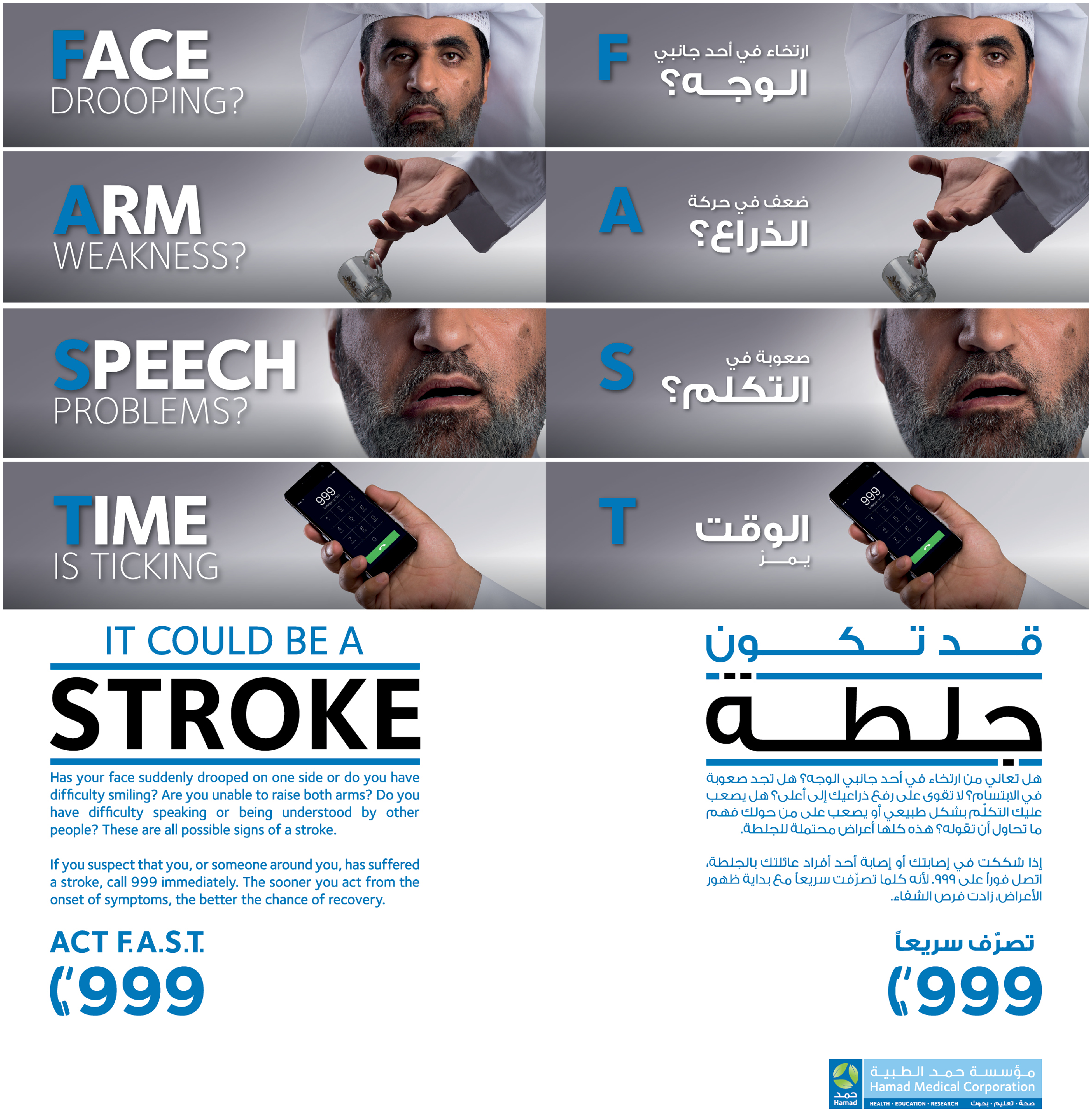
The ACT FAST advertisement from the National Stroke Awareness Campaign in Qatar in 2015.
Strengths and Limitations
This study is one of the first studies in Qatar to conduct detailed interviews of stroke patients, including bystanders, after a national stroke awareness campaign. It included a sample size comprising stroke patients and bystanders, enhancing the study's generalisability and providing a comprehensive understanding of patient-centred and public behavioural responses during stroke onset. The ethnic diversity of the study population, representing various ethnic backgrounds, added to the external validity of the findings. Although our study described the perception, awareness and response evoked by the campaign among the target population, including bystanders, our study has some limitations. Firstly, the inability to document participants’ language proficiency and health literacy limits understanding, which is crucial in a population where language barriers are prevalent. Secondly, we had a limited sample of participants, with the majority of the participants belonging to the South-Asian region. Thirdly, the interviews relied on the participants’ recall, introducing potential recall bias. Fourthly, the study was executed after the second wave of the campaign, and the participant's perception and recall of the campaign may have evolved over the course of the study. Finally, the type of stroke and severity were not defined for participants in our study to assess severity perception and its association with behavioural response. Future research may significantly benefit from implementing robust strategies that may include assessment of health literacy, language barriers, social determinants, stroke severity perception affecting patient experience, and cross-verification of responses through the involvement of witnesses coupled with the integration of structured and cognitive interview techniques to minimise recall bias. Assessments conducted at varying intervals will further ensure a comprehensive understanding of the enduring effectiveness of such interventions, informing targeted strategies for sustained impact.
Conclusions
The awareness and knowledge of stroke presentations following the stroke ‘Act FAST’ campaign in patients with a confirmed stroke and their bystanders were low in the study population. The study revealed limited awareness of the Act FAST campaign, underscoring the need for improved stroke educational interventions. Furthermore, understanding and improving the reach of these mass media educational interventions can help disseminate the message more effectively. Despite the limited awareness of the campaign, there was a remarkable trend of seeking help by activating EMS at stroke onset in the study population. These results emphasise the importance of targeted educational efforts that extend past conventional methods to enhance public knowledge of stroke symptoms, evoke appropriate behavioural responses and improve overall patient experience. Future interventions should focus on increasing campaign awareness and fostering a community-wide understanding of the disease and the urgency in activating EMS at stroke onset.
Supplemental Material
sj-docx-1-jpx-10.1177_23743735241242717 - Supplemental material for Assessing Stroke Awareness and Behavioural Response Following the National ‘Act Fast’ Stroke Awareness Campaign – Insights from a Cross-Sectional Survey in Qatar
Supplemental material, sj-docx-1-jpx-10.1177_23743735241242717 for Assessing Stroke Awareness and Behavioural Response Following the National ‘Act Fast’ Stroke Awareness Campaign – Insights from a Cross-Sectional Survey in Qatar by Zain A. Bhutta, Sameer A. Pathan, Tuukka Puolakka, Naveed Akhtar and Stephen H. Thomas, Tim Harris, Ashfaq Shuaib, Peter A. Cameron, Maaret Castren in Journal of Patient Experience
Supplemental Material
sj-docx-2-jpx-10.1177_23743735241242717 - Supplemental material for Assessing Stroke Awareness and Behavioural Response Following the National ‘Act Fast’ Stroke Awareness Campaign – Insights from a Cross-Sectional Survey in Qatar
Supplemental material, sj-docx-2-jpx-10.1177_23743735241242717 for Assessing Stroke Awareness and Behavioural Response Following the National ‘Act Fast’ Stroke Awareness Campaign – Insights from a Cross-Sectional Survey in Qatar by Zain A. Bhutta, Sameer A. Pathan, Tuukka Puolakka, Naveed Akhtar and Stephen H. Thomas, Tim Harris, Ashfaq Shuaib, Peter A. Cameron, Maaret Castren in Journal of Patient Experience
Footnotes
Abbreviations
Availability of Data and Materials
The data that support the findings of this study are available from Hamad Medical Corporation. Data is available from the authors upon reasonable request and with permission of Hamad Medical Corporation.
Declaration of Conflicting Interests
The authors declared no potential conflicts of interest with respect to the research, authorship and/or publication of this article.
Ethics Approval
This study was reviewed and was granted ethical approval by the Institutional Review Board (IRB) and the Medical Research Center (MRC) at Hamad Medical Corporation (HMC), Doha, Qatar (Reference number: MRC/0765/2015; Protocol number: 15238/15).
Funding
The authors disclosed receipt of the following financial support for the research, authorship and/or publication of this article: The research project was supported by the Health Service Research Investigator Initiated Grant (HSRIIG) cycle by the Medical Research Center at Hamad Medical Corporation, Doha, Qatar [MRC/1606/2017]. There was no role of the study sponsor/funder, if any, in the study conception, study design, data collection, data analysis and interpretation of data, manuscript writing and the decision to publish the manuscript.

Statement of Informed Consent
Verbal informed consent was obtained from the participants for their anonymised information to be published in this article.
Statement of Human and Animal Rights
All procedures in this study were conducted in accordance with the Institutional Review Board (IRB) and the Medical Research Center (MRC) at Hamad Medical Corporation (HMC), Doha, Qatar (Reference number: MRC/0765/2015; Protocol number: 15238/15) approved protocols.
Supplemental Material
Supplemental material for this article is available online.
References
Supplementary Material
Please find the following supplemental material available below.
For Open Access articles published under a Creative Commons License, all supplemental material carries the same license as the article it is associated with.
For non-Open Access articles published, all supplemental material carries a non-exclusive license, and permission requests for re-use of supplemental material or any part of supplemental material shall be sent directly to the copyright owner as specified in the copyright notice associated with the article.
