




Abstract
Patient satisfaction is essential to the patient-centered approach in health services delivery, but little is known about satisfaction with physiotherapy services in Afghanistan. This study evaluated patients’ satisfaction with physiotherapy services and related factors in this country. This study was conducted on 420 recipients of a physiotherapy center in Afghanistan. A questionnaire was used to collect data that measured satisfaction in 4 dimensions: treatment process, logistics, organizational factors, and overall. The scale of the questionnaire was 5-point Likert. The highest possible score was 100. Statistics methods included Spearman's correlation coefficient, Mann-Whitney and Kruskal-Wallis tests for univariate analysis, and Linear Regression for multivariate analysis. The average overall satisfaction score was 84.82 ± 13.24. Among the demographic variables, the relationship between education level and overall satisfaction score was significant. The findings of the linear regression model showed that the 3 dimensions of satisfaction, including the treatment process, logistics, and organizational factors, had statistically significant relationships with overall satisfaction. The level of satisfaction was high in all dimensions. To maximize satisfaction, reducing waiting time and better communication with patients, as components of logistics and organizational factors, are suggested. Patients also need to receive feedback from physiotherapists that are an essential components of the treatment process dimension.
Introduction
Patient satisfaction has always been one of the most important concerns of service providers, including rehabilitation and physiotherapy facilities.1,2 Patient satisfaction is considered one of the dimensions and important components of service quality, accreditation, and evaluation of health services 3 . Its impact on the technical results of care is paramount, as several studies have shown relationships between patient satisfaction and compliance with treatment, returns, and treatment outcomes. Satisfied patients comply more with the prescribed treatments, return less to the health facility, and recover faster.4,5 Satisfaction with rehabilitation services is more important since obtaining treatment results requires better interaction and communication with the therapist and compliance with the given prescriptions in long term. 6 The study by Hatamizadeh et al, which compared clients’ satisfaction with public and private rehabilitation centers, showed that dissatisfaction negatively influence the continuity of rehabilitation programs. 7
So far, some studies have examined satisfaction with rehabilitation services and related factors. Osei and his colleagues evaluated the determinants of patient satisfaction with physiotherapy services in several rehabilitation service centers in Ghana. They showed that almost all (96%) study participants were satisfied with the services they received. A statistically significant relationship was observed between age and satisfaction score (P ≤ .05). 8 Endawoke and his colleagues evaluated patient satisfaction with the physiotherapy services provided by several specialized hospitals in the northwest Ethiopia. 9 They showed that half of the study participants were satisfied with the services. The chance of being satisfied among people over 55 was 1.75 times more than the younger. 9
The International Committee of the Red Cross is the main rehabilitation service provider in Afghanistan. Despite the numerous studies being conducted in different countries, the researchers found no study investigating patient satisfaction with the rehabilitation services of Red Cross centers and related factors in Afghanistan. To fill the knowledge gap, and considering the importance of satisfaction in obtaining health results, this study aimed to determine the level of patient satisfaction with the physiotherapy services provided by Red Cross rehabilitation service centers in Afghanistan. The study's findings can help the practitioners and managers of rehabilitation centers in designing and implementing strategies to increase patient satisfaction.
Methods
This descriptive-analytical study has a cross-sectional design.
Setting and Participants
The target group of this study was the patients received services from the Red Cross Physical Rehabilitation Center in Herat, Afghanistan. This country is located at the crossroads of South and Central Asia. With a per capita GDP of 1971$, Afghanistan is ranked as a low-income country. 10 It has been involved in civil war and external aggression for 40 years. 11 Herat is the second most populous city in Afghanistan and the capital of Herat Province. Considering the size of the city, the large number of traffic and occupational accidents, and long-term wars with high casualties, this city has a high population of disabled people in need of physical rehabilitation and physiotherapy services. 12 The physical rehabilitation center of the Red Cross is the only rehabilitation center that provides rehabilitation services to Herat citizens and disabled people coming from other cities and provinces of Afghanistan.
Sample Size and Sampling Method
Considering the lack of a similar study in Afghanistan, the sample size was calculated by error N1 equal to 0.05 (z = 1.96), and the population size (N: the number of visitors to the center per year) at 20,000, and the satisfaction ratio with rehabilitation services (p) equal to 0.5 (to reach the maximum study power) and using the following formula at 377. Considering 10% loss of samples, the final sample size was determined as 420:

Data Collection Tool
The tool for data collection was a questionnaire that measured the satisfaction of physiotherapy service recipients. Its validity and reliability were proven in the study of Ampiah et al. 13 In order to localize the questionnaire, it was translated into Dari by a member of the research team. The validity of its content was measured by 15 experts in this field. In order to evaluate the face validity, the questionnaire was given to 5 experts fluent in English and Dari. After obtaining their opinions and making the appropriate corrections, the internal consistency of the questionnaire was assessed by Cronbach's alpha. According to the value of coefficient α (0.81), the internal reliability of the tool was approved. Also, the reliability of the questionnaire was measured by the test–retest method on 30 people from the sample. The intraclass correlation coefficient was estimated at 0.94, indicating the tool's reproducibility.
The questionnaire had 2 parts; the first part was related to the demographic characteristics of the study participants. The second part measured the level of satisfaction with physiotherapy services, which includes 20 questions in 3 main dimensions, including (1) treatment process (11 questions), (2) logistics (3 questions), (3) organizational factors (3 questions), and (4) overall satisfaction (3 questions). The respondents were asked to declare their satisfaction level using a 5-point Likert scale (including completely satisfied = 1, satisfied = 2, I have no opinion = 3, somewhat dissatisfied = 4, and completely dissatisfied = 5). The total score of each dimension was transformed to a 20- to 100-point scale, with 100 indicating the highest satisfaction.
Data Analysis
Descriptive and analytical statistics were used to analyze the data. Descriptive statistics methods included mean, standard deviation, and percentage. According to the results of the Kolmogorov-Smirnov test, which indicated non-normal distribution of data, analytical statistics methods (univariate) included Spearman's correlation coefficient, Mann-Whitney, and Kruskal-Wallis tests. Linear regression was used to investigate the simultaneous relationship of variables with a P value less than .2 in univariate analysis (education level, dimensions of satisfaction, and overall satisfaction). A significance level of less than .05 was considered, and analyses was performed using SPSS version 20.
Results
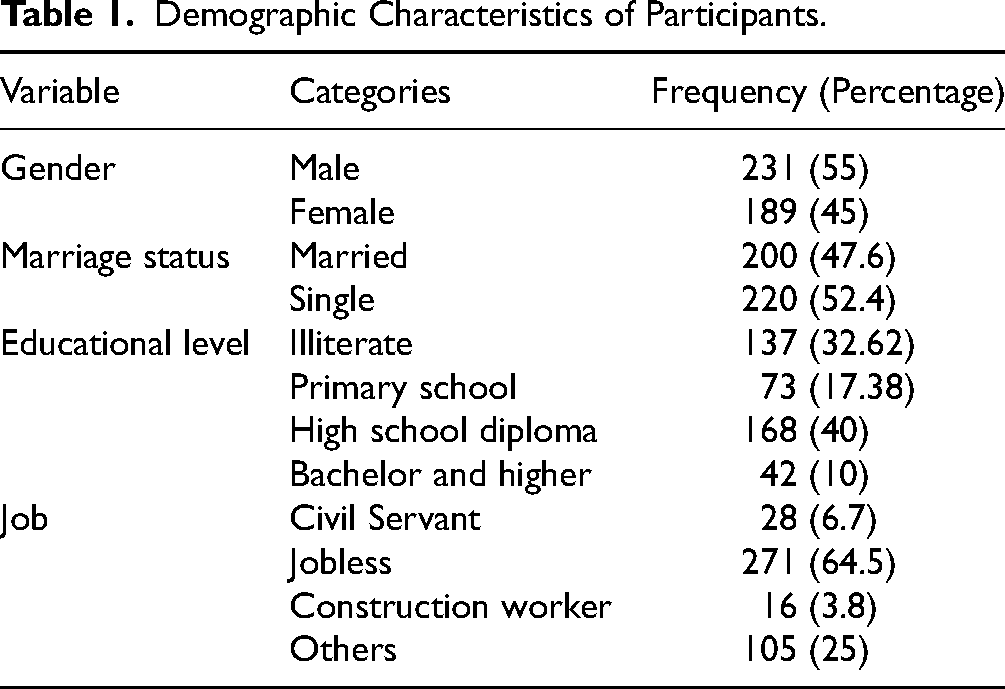
The average age of the study participants was 29.64 ± 11.32. Most of the participants were male and single. Most participants had high school diplomas, and few had academic degrees. In terms of employment status, most of the study participants were unemployed (Table 1).
Demographic Characteristics of Participants.
The average scores and median of satisfaction and its dimensions separated by demographic variables, and the results of the univariate relationship tests are shown in Table 2.
Mean and Median Scores of Satisfaction by Demographic Characteristics and the Results of the Univariate Relationship.

Abbreviation: IQR, interquartile range.
Spearman test
Correlation Coefficient
Mann-Whitney test.
Kruskal-Wallis test.
Regarding descriptive findings, Table 2 shows that the highest satisfaction score was for the treatment process, and the lowest was for organizational factors. Also, women's satisfaction was higher than men's in the treatment process, organizational factors, and overall satisfaction. The satisfaction score regarding treatment process and the overall was higher among married people. Regarding logistics and organizational factors, people with elementary school education were most satisfied, and illiterate people had the least satisfaction level. The lowest overall satisfaction score was for illiterate participants and the highest for participants with university degrees. However, only the difference in the overall satisfaction scores between some educational levels was significant (P ≤ .05). The results of paired comparisons of overall satisfaction scores in different education levels showed a statistically significant difference between illiterate people and those who had primary education or academic degrees (P ≤ .05).
Table 3 shows the results of the Linear Regression analysis. The overall satisfaction score was considered a dependent variable, and the R2 coefficient was determined as 0.606.
Results of Linear Regression.

Table 3 shows that in the multivariate analysis, 3 dimensions of satisfaction, including the treatment process, logistics, and organizational factors, had a statistically significant relationship with overall satisfaction. The share of the treatment process in the overall satisfaction score was higher, so with one point increase in the satisfaction score with the treatment process, the overall satisfaction score would increase by 0.42.
Discussion
The satisfaction in all 3 dimensions and overall was high (more than 80 out of 100). In this respect, the findings of the present study are consistent with other studies conducted on the clients of physiotherapy and rehabilitation centers in other countries, including the United States, Italy, and Ghana.13–15 It seems that regardless of the context and the country, the satisfaction of the recipients of physiotherapy and rehabilitation services is high.
According to this study, no statistically significant relationship existed between the demographic variables, including age, gender, marital status, employment, and the level of satisfaction that is consistent with other studies, including the study of Dastgheib et al, which evaluated patient satisfaction with physiotherapy services in Shiraz, Iran. 16 In the present study, education level was the only demographic variable with a statistically significant inverse relationship with satisfaction that is in agreement with the findings of Odumodu et al. 17 They determined the satisfaction with physiotherapy outpatient services in a tertiary care hospital in Nigeria. Their cross-sectional study on 284 patients showed that most patients were satisfied with the physiotherapy services they received, and there was a statistically significant negative relationship between the level of education and satisfaction. Hence, people with higher education had a lower level of satisfaction. 17 The reason might be that the level of awareness and knowledge of people with higher education about the different dimensions and aspects of service quality is higher than those with less education, which leads to higher expectations among the first group. Therefore, even at the same level of service quality, people with higher education will be less satisfied. The proof of this claim is the findings of Jonkisz et al. 18 In their systematic review and meta-analysis, which aimed at evaluating the quality of services in selected Asian countries, they stated that regardless of the country studied, people with a higher level of education were more concerned about the quality of services and judged the quality of the services more objectively. 18
Based on the multivariate analysis, 3 dimensions of satisfaction, that is, treatment process, logistics, and organizational factors, had statistically significant relationships with overall satisfaction, among which the treatment process dimension was the most robust predictor (Coefficient β = 0.42). In this sense, the findings of the present study are in agreement with the results of Plewnia et al study. 19 They aimed to investigate the effect of patient-centered care programs on patient satisfaction and treatment results. Their study was conducted on 1033 people from 9 rehabilitation centers in Germany. In the regression model used to estimate patient satisfaction (as a dependent variable), the patient participation in decision-making and communication was the strongest predictive variable (Coefficient β = 0.34) of satisfaction. 19 Our study showed that the treatment process, communication with the therapist and paying attention to the patient's questions and comments, which can be summarized as communication and collaborative decision-making, is vital in achieving desirable and quality treatment results (technical quality) as the most important aspect of satisfaction compared to logistics or organizational factors.
Study Limitations
Some of the study participants were illiterate and could not complete the questionnaire independently. Trained interviewers were employed to read the questions for them and enter the answers in the questionnaire. However, there is always a chance of different understanding between the interviewer and interviewee. At the beginning of the interviews, the purpose of the study, dimensions of satisfaction, and the questions were explained to the participants to overcome this problem.
Conclusion
Satisfaction of patients (overall and, in all dimensions) with rehabilitation services was high. The treatment process constituted the most important aspect of satisfaction. To maintain and improve the situation, empowering patients and recipients of rehabilitation services and therapists can be helpful. Moreover, organizational factors that scored lower than other satisfaction aspects need improvement. Adopting measures to reduce the waiting time, better communication with the patients, and providing feedback from physiotherapists will increase satisfaction levels.
Footnotes
Acknowledgments
The authors would like to thank the administrators and staff of the Red Cross Physical Rehabilitation Center in Herat, Afghanistan, for participating in this study.
Authors’ Note
Ethical Approval: This research was approved by the Research Ethics committee of the Mashhad University of Medical Sciences (Code: IR.MUMS.FHMPM.REC.1401.162.). Consent Statements: All participants filled a consent statement form which declared participation in the study was voluntarily and the patient could refuse to answer questions and could withdraw from the study at any time. Moreover, the personal information/identity of participants would be kept completely confidential.
Declaration of Conflicting Interests
The author(s) declared no potential conflicts of interest with respect to the research, authorship, and/or publication of this article.
Funding
The author(s) disclosed receipt of the following financial support for the research, authorship, and/or publication of this article: This work was supported by the Mashhad University of Medical Sciences, (grant number 4011514).
