



Abstract
This article attempts to measure the state of satisfaction of patients over the quality of health care as well as identify the crucial factors that affect the patients’ satisfaction in Upazila Health Complex (UHC). The quantitative approach was used following a structured questionnaire survey method. Four hundred visitors of 2 UHCs in Meherpur district were randomly selected as respondents for the study. The Statistical Package for Social Science IBM version 24 and R software (version 4.0.2) were used to run descriptive statistics, χ2 test, confirmatory factor analysis, and principal component analysis for quantitative data analysis. The data reveal that the overall satisfaction score is (2.75 ± 0.943). A 3-dimension model of service quality is found to have a significant relationship with patients’ satisfaction at the rural level. Care providers’ attitude and responsiveness in service delivery are found to be the most vital factor, while the tangibles and accessibility factors moderately influence the patient’s satisfaction on the service quality at UHCs.
Keywords
Introduction
Health is a fundamental human need, which is universally regarded as an index of human development (1). Nevertheless, at least 50% of the world’s population are unable to access the basic health service, and in the future, this situation will worsen due to the shortfall of 18 million health care workers by 2030 (2). Bangladesh has obtained much improvement in health indicators than other Asian countries. Still, the public health services of Bangladesh were not client-focused, need-based, and within reach of the poorest (3). That is why a significant part of the population in our country is deprived of access to basic health care (4). Andaleeb (5) pointed out that only 30% of the population of our country has access to primary health care. Additionally, there are huge disparities in the distribution of health service providers between urban and rural areas. A recent study showed that only 16% of qualified doctors practice in rural areas (6). In 2011, National Health Policy was adopted to ensure an effective health care system for a healthy nation. To materialize the effectiveness of this policy, the government of Bangladesh promotes Upazila Health Complex (UHC) as the primary health care hub at the subdistrict level for reaching the rural with quality health care. There are 413 UHCs in Bangladesh, each with 31 to 50 beds and some diagnostic, x-ray, and ambulance facility (7,8).
However, the public health care facilities in rural areas are having the lack of quality health care for patients’ satisfaction (1,9). The identification and measurement of the service quality are needed for improvement of patient satisfaction. In this regard, Parasuraman et al (10) proposed separately 10 dimensions for measuring the service quality of different sectors, which were later modified into 5 key components, namely, care givers attitude and responsiveness, assurance, tangibility, empathy and reliability specially designed for the health sector (10 –12). However, this model is criticized and argued to be context based (13). To fit the model in the context in Bangladesh, assurance dimensions were replaced with accessibility dimension with attributes such as physical accessibility and convenience (14,15).
As a response, this study measured the patient’s satisfaction over the service quality of UHC and also identified the most significant factors of service quality, which affect the patient’s satisfaction on the UHC in Bangladesh to help the policy makers improve the condition of rural health care.
Materials and Method
This study was conducted following cross-sectional research design and quantitative approach to meet the research objective. Cresswell (16) asserts that a quantitative approach is best suitable for analyzing a problem through statistical data to explain an issue or social phenomena. Gangni and Mujibnagar UHC of Meherpur district were chosen purposively due to funding limitation and researchers’ accessibility to data. The present study was mainly based on a structured survey questionnaire (Figure 1). This data collection method gives concise information directly from the respondents by means of a predetermined set of questionnaires to capture their views on particular issues or phenomena (17). The data were collected randomly from respondents who took health care services from UHC between 2018 and 2019. Researchers collected data from 400 respondents in between November 10 and 17, 2019, through random sampling technique using a pretested structured questionnaire. Data collectors translated and validated the questionnaire for the illiterate respondents to get the views on the respective issues. As the total number of patients who received service from the UHC in the past 1 year was unknown to the researchers, Godden’s formula was used to determine the sample size.

where
n = Sample size for infinite population (more than 50 000)
Z = Z value (eg, 1.96 for 95% CI)
P = Percentage of picking up a response (expressed as a decimal; assumed to be 0.5 [50%] that ensures the maximum sample size).
M = Margin of error at 5% (0.05)
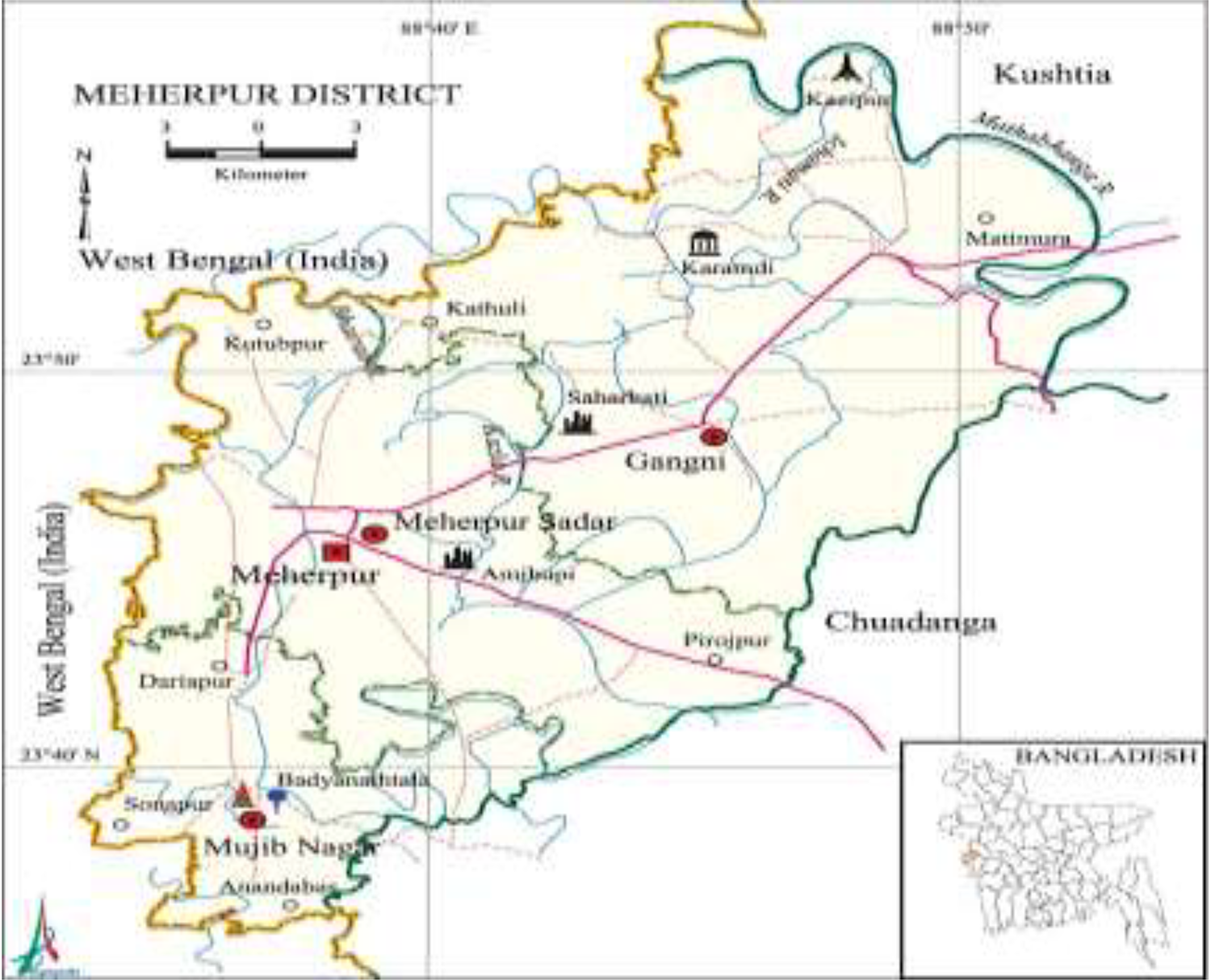
Meherpur District Map. Source: Banglapedia (2020).
To reduce the chance of nonresponse error, 16 additional respondents were taken. The questionnaire comprises of 2 segments. The first segment was dealing with the respondent’s sociodemographic information. The second part was mainly aimed at measuring the perception of service quality of UHC using the SERVQUAL model.
Collected data had been chronologically arranged for the questionnaire outline to ensure that the correct code was entered for the correct variable cleaned and tabulated. The responses were recorded on a 5-point Likert-type scale to measure the satisfaction level of research participants. To check the internal consistency of the questionnaire, a reliability test was conducted, and the Cronbach’s α score was.851, which fulfilled the recommendation of Nunnally (18). Kaiser-Meyer-Olkin and Bartlett’s test of sphericity were applied and also found to be significant (.864) for all the 23 variables, which permits to investigate key service quality factors using factor analysis. The conceptual model was tested using confirmatory factor analysis (CFA) based on research data. Then, the researchers used exploratory factor analysis to identify the most significant factors that influence the patient’s satisfaction at UHC in Bangladesh. Here, greater than 0.40 score is considered important to include an item in its respective construct for this study. An eigenvalue greater than 1 was fixed as a criterion in the principal component analysis (PCA). Varimax rotation was used to rotate the solution to make it a more interpretative one. The Statistical Package for Social Science IBM version 24 and R software version 4.0.2 have been used for quantitative data analysis.
Result
Table 1 showed that more than half of the respondents (60%) were male, whereas female participation was only 40%. Considering the age, most of the participant’s age was 16 to 35 years. In this research, only 3% of the respondents were from the upper class; on the other hand, 97% were from the lower-middle-income class.
Demographic Information of the Respondents and Satisfaction Score Characteristics of the Respondents

This study indicates a limited number of representations of upper-class people in UHC. It also found that very few numbers of higher educated patients (17%) went to UHC. Generally, illiterate and less educated respondents are the main users of UHC. The satisfaction score of the male respondents (2.78) is comparatively higher than female (2.71). Findings from the study demonstrate that younger people (16- to 25-year-old) are more satisfied (2.98) than middle-aged and older people. On the contrary, people aged more than 55 years are identified as the most dissatisfied people (2.43). The results confirm that the people from the lower middle class (2.58) are less satisfied than other income group people. It also explains that a few numbers of higher educated patients (17%) went to UHC, and they are more satisfied (2.87) than people from other education levels. Generally, illiterate and less educated respondents have more interest in UHC, but they possess fewer satisfaction scores. The overall satisfaction score (2.75 ± 0.943) of patients over health service shows that UHC is not performing well to serve the rural people (see Table 1).
The first-order comparative fit index (CFI) result shows that of 23 indicators, only 15 indicators can cross the 0.40 factor loading value from the collected data analysis. Both CFI and Tucker-Lewis index (TLI) values are also less than 0.9, and the root mean square error of approximation (RMSEA) value is greater than 0.08, which indicates this model as a weak one (19,20). The second-order CFI shows that only the indicator washroom condition has a factor loading of 0.366, which is less than 0.40. So, in the third model, this indicator was omitted to get a more accurate result. Both CFI and TLI values are also more than 0.9, and the RMSEA value is less than 0.08, confirming this second model as a significant one (19,20). Now, all the factor loadings are above 0.4. This is the final model. This model provides a better fit than the previous 2 as CFI, TLI, Akaike information criterion, Bayesian information criterion, and RMSEA give the best result (see Table 2).
CFA Model of Service Quality Dimensions of UHC.

Abbreviations: AIC, Akaike information criterion; BIC, Bayesian information criterion; CFA, confirmatory factor analysis; CFI, comparative fit index; RMSEA, root mean square error of approximation; TLI, Tucker-Lewis index.
These 14 important factors that affect the overall service quality of UHC can be reduced to 3 major dimensions using a standard eigenvalue of 1 based on the result of PCA. These 3 dimensions explained 66.46% of the total variance, which is consistent with the 60% threshold in social sciences. The first dimension explained 43.43% of the total variance, the second dimension explained 13.36%, and the third one explained 9.67%. The first dimension includes 9 variables, the second one includes 3 variables, and the third one includes only 2 variables. Thus, the result of PCA was consistent with CFA, which shows that 3 major dimensions are crucial to describe the service quality of UHC rather than the 5 dimensions model. The important factors are ordered in Table 3, considering their importance level from top to bottom.
Principal Component Analysis of Service Quality Factors.

Abbreviation: UHC, Upazila Health Complex.
Discussion
The findings demonstrate that overall service quality was not very much satisfactory in UHC. People were not getting the assured services from their nearest UHC, which caused significant distrust and poor satisfaction among the patients. Explicitly, service receivers and providers both stakeholders showed discontent on the performance of UHC in providing health service due to a number of complicating reasons.
Data showed that male patients are comparatively more satisfied than females on the health services in UHC. Acute discontentment among the female respondents rather than males may indicate the gravity of gender inequality, ingrained attitudes toward women and behavioral differentiation in getting health services. This study found that higher educated people are comparatively happier than others, but they seldom visit at UHC. A probable reason can be that they knew the service delivery procedure and possess minimal expectations while seeking service in any public hospitals (21). According to the findings in this study, young people are happier than older people. Prior studies found that the lack of specialized treatment facilities in the hospitals can create mass dissatisfaction among elderly people (22).
Findings demonstrate that service providers’ attitude and responsiveness to patients’ demand are the prime service quality factor at UHC. The current doctor–patient ratio and the doctor–nurse ratio need to be further narrowed down to provide responsive services (23). Modern diagnosis facilities and convenient operating hour are found to be very important factors from this study. Mannan (24) suggested that more doctors should be appointed and infrastructural capacity should be developed to provide prompted treatment service during the critical health condition of the rural people. A proper drug administration system should be developed to reduce the artificial medicine crisis, and illegal medicine sellers should be brought to justice by the law enforcement agencies. Raising awareness of antibiotics among rural people should also give immense importance to the sustainable development of health and well-being of the local people (25).
Our study result shows that tangibles are the second most important factor for service delivery and proved that physical appearance can greatly influence the patient’s satisfaction level. The public hospitals’ physical infrastructure is poor and not enough to provide quality care in Bangladesh, though the government has made a major investment for infrastructural development (24). Our results demonstrate that accessibility is a major concern of the people as private clinics are providing similar services at the local level. Due to low competition and great profit margin in the health care business, private clinics are developing rapidly in both rural and urban areas to provide a similar kind of health service like public hospitals in a hustle freeway (26,27).
Conclusion and Policy Implication
Despite making several changes under National Health policy 2011 and other reform initiatives, the service quality of UHCs in Upazila level is still not up to the mark and people are not much satisfied with the existing pattern of service provision the center. Close proximity, good physical accessibility, and lower cost treatment facilities fail to attract the rural people as it is the loss of the trustworthiness as well as poor tangible conditions that demotivate patients to visit their nearest UHCs. Empathy toward patients and quick responsiveness during medical emergencies were also missing.
This study had some limitations which should be minimized in the future research. First of all, the study was conducted in a particular district of Bangladesh. To generalize the findings of this study, the geographical area must be extended. Second, further study should be conducted to this particular field using other scales of measuring service quality in addition to the SERVQUAL scale used in this study (28). The principal component analysis also indicates the inaccuracy of the 5 dimensions model where only 3 dimensions were found significant to measure service quality at UHC.
The segment provides some significant recommendations on quality health care according to the key questions. The health sector in Bangladesh is underfunded, which is far from the global standard. It is very difficult for UHC to provide quality health services with existing human resources and equipment. Policy reform supported with an adequate budget is urgent including specific objectives with a time frame for every unit of health service from the center to periphery. Quality of public hospital management in Bangladesh is entangled with corruption, resource crunch, capacity mismatch, and the absence of professionalism; these are breeding dissatisfaction to the citizens; UHC is intertwined with such diseases. Special attention needs to be taken to fix mismanagement at UHC. Infrastructural facilities for providing service at UHC are largely abandoned due to poor maintenance arrangements. The number of doctors, nurses, and skilled technicians must be increased proportionately along with modern equipment. Ensuring accountability to the service providers—doctors, nurses, technicians, and so on—remains a big challenge. Robust monitoring and disciplinary action including exemplary punishment by the DGHS must be ensured for stopping various irregularities at UHC—illegal drug selling, absenteeism, prescribing unnecessary medicine, ill behavior, negligence in performing duties, and mismanagement. Regular monitoring by higher authority is essential to check the irregularities. Awareness-raising programs should be initiated to make the citizens aware and to prevent undue influence from the local influential people. Every venture will be futile at UHC; only good governance will be a panacea and will increase patients’ satisfaction.
Footnotes
Authors’ Note
The respondents were informed about the purpose of the study, and the researchers took verbal consent of them before starting the survey.
Declaration of Conflicting Interests
The author(s) declared no potential conflicts of interest with respect to the research, authorship, and/or publication of this article.
Funding
The author(s) received no financial support for the research, authorship, and/or publication of this article.
