




Abstract
Social determinants of health (SDOH) greatly impact an individual’s health, yet health care professionals are undereducated on addressing SDOH when identified. While many factors influence and drive educational practices, there is a lack of guidance in understanding best practices in teaching SDOH in online undergraduate health programs. This study examines the use of discussion board posts and peer to peer learning to increase knowledge of SDOH in an online, undergraduate course. Specific aims were to (1) examine students’ perceptions and understanding of SDOH and associated health outcomes in their communities, and (2) assess peer to peer discussions as one method for teaching SDOH in online, undergraduate programs. Discussion board posts and reflections were qualitatively reviewed using thematic analyses. Overall, students expressed positive and negative perceptions of certain SDOH domains. Discussion board posts with peer responses can provide valuable insight into how students perceive and engage with SDOH in relation to community health issues. Students demonstrated learning and understanding of the complex ways SDOH both support and hinder health outcomes, and the intricacies of the relationship between health and SDOH, such as hierarchies or the role of culture. Integrating SDOH activities in curriculum through discussion board posts is one effective teaching strategy to build knowledge in online, undergraduate health courses.
Introduction
The United States (U.S.) spends almost twice as much on healthcare per person compared to other high-income countries. Yet, health indicators such as life expectancy at birth and death rates for preventable or treatable conditions continue to be worse in the U.S. (The Commonwealth Fund, 2023). It is evident that social determinants of health (SDOH) such as neighborhood location, access to healthcare, socioeconomic status, education access, and social context influence health and well-being (Centers for Disease Control and Prevention, 2024) . Thus, it is an important aspect for healthcare providers to understand when assessing an individual’s health. If health professionals are not able to identify and help address compounding negative impacts of SDOH, it can impact access to health services and impede overall health and well-being among. (Wakefield et al., 2021).
A brief review of some existing studies shows mixed reports about current healthcare providers’ perceptions and attitudes toward addressing SDOH, as well as barriers and supportive resources. As high as 93% of healthcare professionals use SDOH information in patient care (Kostelanetz et al., 2022). Similarly, another study reports that about 69% of healthcare providers believe that SDOH affect their patient’s health, but only 60% felt confident in their understanding of SDOH, and only 34% stated that they highly prioritized addressing SDOH in their healthcare setting (Glenn et al., 2024). Indeed, Khan et al. (2022) highlight gaps in SDOH knowledge in healthcare providers, with up to half of health professionals reporting no knowledge about the SDOH. Training is necessary, as Naz et al. (2016) found that family physicians report either a lack of training or lack of knowledge as reasons for not engaging in addressing SDOH in their clinical practice.
Since SDOH impact likelihood of optimal health, it is important to integrate SDOH into the healthcare curriculum to support emerging healthcare providers in analyzing the impact of SDOH on their clinical interventions. However, there are several challenges related to effectively integrating SDOH into the health care curriculum, particularly for online, undergraduate programs in the health sciences. Limited information and unclear suggestions are barriers to understanding best practices to teach SDOH in ways that fully support healthcare professionals in the field (Garnett, 2017; Mangold et al., 2019). Some studies show promising results when assignments such as photo essays, service-learning projects, and critical reflection writing are integrated into online learning for undergraduate programs (Brown et al., 2021, 2023). With an increase in policies and interests to include SDOH into training curricula, many educators, universities, and policy makers might feel underprepared and under-resourced to properly integrate SDOH in their curricula and to effectively teach about them.
This study examines the use of discussion board posts and peer-to-peer learning to increase knowledge of SDOH in an online, upper-level undergraduate course as part of a health and kinesiology program. Specific aims were to (1) examine students’ perceptions and understanding of SDOH and associated health outcomes in their communities, and (2) assess peer-to-peer discussions as one method for teaching SDOH in online, upper-level undergraduate programs. Peer-to-peer learning on discussion board posts are relevant because when students respond to classmates, they explain ideas, defend their reasoning, and consider different viewpoints, ultimately deepening their understanding and revealing gaps in thinking. Collectively learning about and analyzing SDOH strengthens comprehension and encourages participation and confidence. Engaging with other perspectives on SDOH in their communities and related health outcomes can prepare students to engage similarly with their patients in the future. Therefore, identifying successful pedagogical practices for improving undergraduate students’ understandings of SDOH could better prepare future health professionals to address how social factors shape the health of their patients, ultimately promoting health.
Methods
Our methodological approach consists of assessments of pedagogical approaches in an online course and then analyzing student learning outcomes in relation to SDOH. Specifically, data from three discussion board posts for 31 students enrolled in an online upper-level undergraduate course required for a degree in the health and kinesiology department were collected from August 2023 to December 2023. Students were opted into having their assignments analyzed unless they requested to be removed. If a student opted out, their discussion board posts were not included in the analysis. Students were provided with an introductory video to discuss the overall study and purpose. Students were provided with an overview of SDOH prior to the assignment. A discussion board prompt asked students to identify a SDOH that impacted a particular health issue in their community. Students were required to respond to two peers on each discussion board.
Students had been given ID numbers assigned to their discussion board posts for de-identification during analysis. Student names, ID numbers, and content from the discussion board posts were stored in locked excel files. The instructor used qualitative methodology to analyze data from the discussion board posts, including peer responses. Open-ended responses from discussion posts were analyzed using thematic analysis. Thematic analysis is a method for identifying and analyzing patterns in qualitative data and it includes cyclical reading of transcribed data (Brooks et al., 2015).
Deductive coding was used to analyze discussion board posts related to SDOH and their related health outcomes using predefined domains from the SDOH framework (Office of Disease Prevention and Health Promotion, n.d.). This allowed for systematic categorization of data according to established categories, as well as coding for either positive or negative mentions to examine the student’s perceptions and experiences (Dawadi, 2020). Inductive coding was used for the peer responses about lessons learned from the class as a whole (Dawadi, 2020). The typical class size ranged between 20 and 40 students, although up to 31 students’ materials were analyzed for the complete study. Cyclical reading for themes and new insights continued until no new codes were developed. Consistent with definitions of saturation (Boddy, 2016; Hennink et al., 2017), we reach theoretical saturation when no new insights or themes emerged from the data. The study was deemed to be exempt by the University IRB.
Results
Overall, all 31 students in the class agreed to participate in the study. Two students dropped the course during the semester; however, their discussions were added to the analysis where applicable. 29 of the 31 students responded to the initial post for discussion board one, which asked students to identify a health issue and an associated SDOH. When naming a health issue they would like to address in their community, majority of students listed mental health (n = 8; 28%) or obesity (n = 5; 17%). Other health issues identified by more than one student included diabetes (n = 4; 14%) and hypertension (n = 2; 7%). One student mentioned technology as a root of sedentary behavior, stating: “Due to the increase(d) use of technology in schools such as using laptops and tablets to do school work, little physical activity is done in schools” Further, the student argues that because of technology, indoor play and social isolation are prevalent, and they state that these: “exacerbates the risk of diabetes.” Table 1 shows the health issues and related associations with SDOH categories, as well as indicators of the SDOH that were discussed either as a positive contribution to their health issue or as barriers to health.
Identified Health Issue with Positive and Negative SDOH Association.
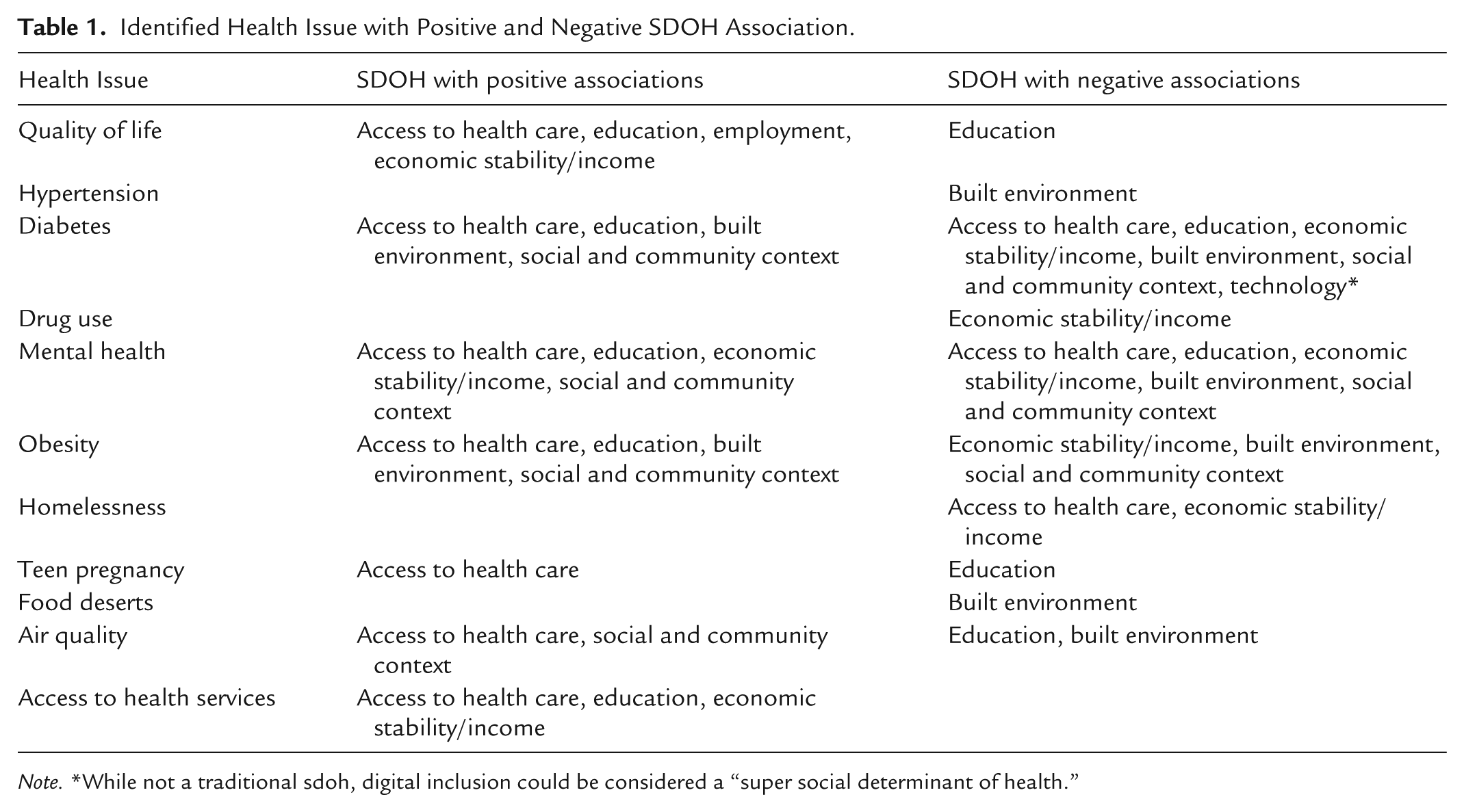
Note. *While not a traditional sdoh, digital inclusion could be considered a “super social determinant of health.”
Comments included a mix of positive and negative associations between a SDOH and a health outcome, highlighting the role of the SDOH in how it both supports and hinders health. For example, regarding the built environment and health and obesity, one student mentioned: The neighborhood that I live in is walkable and you can find plenty of people walking around. There are also a few trails and parks open to the public to help people be active. There are also some negative aspects such as the use of cars to get around and some neighborhoods have bad sidewalks or roads to walk on. All of these areas can impact the rate of obesity both positively and negatively.
Overall, there is an almost equal distribution of how SDOH are discussed in regarding positive (n = 44; 51%) or negative (n = 43; 49%) attitudes in relation to the associated health outcome. However, this varies by SDOH domain (Table 2).
Positive and Negative Mentions of Specific SDOH.
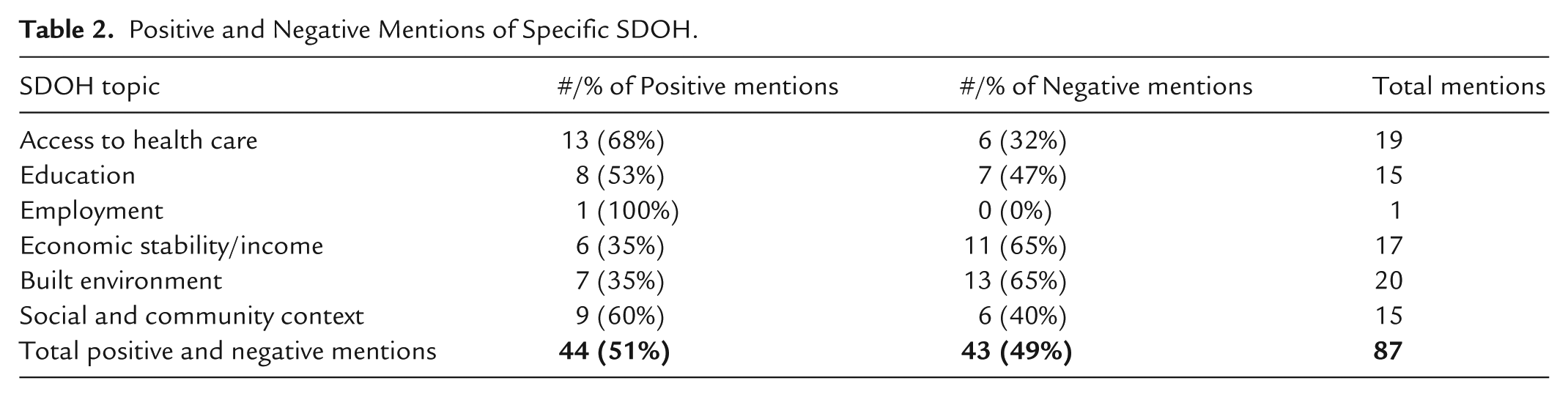
Notably, the built environment and economic stability (or instability), were discussed in a negative manner more commonly than other SDOH, whereas access to healthcare and social and community context were often discussed in a positive manner. When healthcare was mentioned, it was done so in a positive manner 68% of the time. When social and community context was mentioned, over half of the mentions (60%) were positive. Negative aspects regarding healthcare included additional factors, such as stigma around accessing care, especially mental healthcare, and sometimes within specific cultural context. For example, one student stated: Sometimes seeking mental health care is seen as a “weakness” and on top of that many African American families prioritize religion and believe that is the route to go if you’re struggling mentally, which would of course discourage someone from seeking mental health services.
Some students (n = 6; 31%) mentioned multiple SDOH and their impacts on each other, but also through a hierarchy, with phrases such as “economic stability is the root of all other SDOH” or mentioning how access to care can improve other SDOH such as educational achievements.
Lastly, of the students who had a negative attitude toward a SDOH, many (n = 72%) proposed solutions when making negative mentions of SDOH. Of those students, about a third (34%) discussed a new approach or a new program, while others (38%) mentioned building from existing programming in the community to support a solution for negative aspects of SDOH. When mentioning existing programs, students typically identified a gap in services or a need to increase awareness about an existing program.
Peer Responses in Discussion Board Post
Of the 31 students, 28 students (90%) completed two peer responses in discussion board one. Broad themes included commonality, advice on the project or problem, positive attitudes toward the discussion posts, and evidence of learning.
Some students (n = 7; 25%) specifically mentioned a connection in commonalities between their peer’s posts and their own posts, stating that they themselves were looking into similar health issues or the same SDOH. Half of the students (n = 14; 50%) provided advice related to health issues. Many (n = 12; 43%) students supported the initial posts by adding additional information to the scope of the health problem, with a few students (n = 3; 11%) explicitly using first person stories to validate a student’s connection between a health outcome and SDOH or health outcome and proposed program. Many students (n = 21; 75%) mentioned positive attitudes toward the discussion post. Some students (n = 7; 25%) responded with phrases indicating evidence of learning about the connection between the health outcome and SDOH. Of the seven students who responded in ways that indicated evidence of learning, none of students provided advice on the health issue, and only one mentioned similarities in their own health issue topic. One of the seven students who showed evidence of learning did provide validation of the health issues and SDOH as it related to their community context about ethnicity.
Discussion
While SDOH were not the main objectives of the course, students were provided with study resources, including video overviews, to frame SDOH in the context of course material. With prevalence of mental health issues in the student-aged population, it is not surprising that mental health was the most mentioned health issue (Lipson et al., 2022). While not a traditional SDOH, one student briefly discussed possible negative consequences of the advent of technology, stating technology encouraged more indoor play, less social isolation, and in turn, could be a risk factor for diabetes. Technology or access to technology has been recently described as a “super social determinant of health” and therefore should be considered when exploring future health assets and health risks (Sieck et al., 2021).
It can be challenging to discuss SDOH as individual categories without acknowledging the influence on other SDOH or systems as whole, as highlighted by students mentioning hierarchies in SDOH and their impacts on one another. It could be beneficial to incorporate several theoretical models into the discussion board assignment, such as the health belief model, transtheoretical model of change, which look at individual behavior change, or the social ecological model, or perhaps the life course theory both of which look at problems across intersecting societal levels and stages of the life course to explore different perspectives of an intervention or problem (Bronfenbrenner, 1979; Johnson & Lee, 2009; Rosenstock, 1974). Research shows multiple frameworks can be applied and adapted to different communities, capturing SDOH barriers differently (Nour et al., 2023). Education alone does not solve lack of resources (such as educating on public transportation does not mean there is public transportation available and accessible by community members). These theoretical models could be useful when taught alongside identifying SDOH and their related health outcomes.
Table 2 depicts the distribution of positive and negative connotations of SDOH. Students are aware of both positive aspects and negative aspects in their own communities, such as having walkable sidewalks in some areas, but not others. While there may be a presence of a SDOH, the positives (walkable sidewalks) or negatives (stigma) are not experienced in the same ways across communities when defined in broad geographical terms. Future prompts can have students explore more deeply the disparities within geographic communities. In addition, they could consider how we can continue to celebrate culture and highlight it as a community asset.
Of the students who mentioned a proposed solution, suggestions were nearly split in implementing a new program in the community or strengthening an existing program. While admirable for students to shift from awareness to action, it is important for students to understand community assets, and more deeply understand the root causes of the gaps in services in existing programs prior to proposing solutions which may have similar goals. Instructors can provide clarity on the needs for research and for existing programs, current status, and the barriers and facilitators to stimulating more systems-thinking – beyond the more surface-level questions about what the program does overall (Tofade et al., 2013). Education should highlight the importance of community engagement, leveraging of community assets, assessment of assets and resources to support the development of questions, and highlighting the importance of community feedback to inform programs to address social determinants of health (Hardy, 2020; Wilkins & Alberti, 2019).
Literature shows the benefits of online learning using peer responses, particularly when peer-feedback is specific (IDEA–An Online Higher Education Alliance, n.d). Therefore, it is not surprising that students discussed commonalities in their health outcomes, their identified SDOH, and in evidence of learning. It is validating to see that the students who did respond with phrases that were eventually coded as evidence of learning did not provide any advice on the health issue. However, one student provided validation of the health issue and SDOH as it relates to ethnicity. This can both validate and expand learning.
One caveat to consider is that the overall assignment looked at SDOH in a physical sense, excluding identity and status based SDOH such as racism, social exclusion, immigration status, sexual orientation and gender identity, or others outlined in the Minority Stress Model (Meyer, 2003). Future assignments could frame how social determinants embedded in marginalized identities and statuses affect marginalized populations. Additionally, as with any instructor/student dynamic, there are several visible, invisible, and hidden levels of power that might shape how students respond (Gaventa, 2006). The instructor and student relationships, as well as their identities matter when discussing SDOH with racially and ethnically diverse students. The rubric and course/ assignment expectations can play a vital role in setting a tone that considers and minimizes power dynamics embedded with student and instructor experiences.
Finally, to integrate an appropriate and realistic call to action to improve and address SDOH, educators should continue to evaluate current curriculum to include instruction on and engagement with social determinants of health, assess instructional effectiveness, and disseminate findings that would contribute to learning outcomes of future practitioners (Doobay-Persaud et al., 2019).
Conclusion
Discussion board posts with peer responses can provide valuable insight into how students perceive and engage with SDOH in relation to community health issues. Students demonstrated understanding of the complex ways in which SDOH both support and hinder health outcomes, and nuances such as culture that might shape these relationships. While students’ understandings of the relationships between SDOH and health issues improved, it is important to support the shift from awareness to action with additional course content such as evidence-based theories, policies, and programs, and education on assets mapping. Evidence from peer responses reinforces the discussion board’s effectiveness in promoting awareness, critical thinking, and peer engagement. Integrating SDOH activities in curriculum through discussion board posts is one effective teaching strategy to build knowledge in online, undergraduate health courses.
Footnotes

Funding
The authors received no financial support for the research, authorship, and/or publication of this article.
Declaration of conflicting interests
The authors declared no potential conflicts of interest with respect to the research, authorship, and/or publication of this article.