




Abstract
The wave of service-learning identifies the necessary turn toward justice-oriented, community-led, and more radical approaches to teaching and learning. Still, there is a continuing need for strong examples of innovative ways to implement a critical approach with practical steps that ensure students—who have primarily not experienced learning outside of traditional teaching methods—are learning from their experiences. Through a partnership between a graduate school of public health and a local public high school, we describe our efforts to integrate critical service-learning and case-based learning to help graduate students better understand the social context of adolescent health. Coined case-based service-learning, this approach centers youth in an equitable partnership while acknowledging and providing the support graduate students need to engage in experiential learning.
Introduction
Critical service-learning (CSL) and case-based learning (CBL) pedagogies are two strategies used to promote equity in education (Brighouse & McPherson, 2022; Derreth et al., 2021; Sabo et al., 2015; Spivey Provencio et al., 2022; Waldner et al., 2011). CSL courses are designed to partner with communities to address systemic issues. At the same time, students learn disciplinary, professional, and civic skills and content by implementing a community-derived project. This pedagogy pushes students to engage with others for community-based goals that make an immediate impact beyond the classroom (Mitchell & Latta, 2020). CBL courses model experiential learning through instructor-drafted scenarios that prompt students to discuss community issues (Spivey Provencio et al., 2022). In these courses, students decide what they would do to address the problem in the scenario. In these scenarios, students apply what they have learned and think practically about social issues and solutions.
However, scholars have noted several limitations of these pedagogies. For example, CSL pedagogies can focus on “making a difference” through the lens of students instead of the community (Stoecker, 2016). Often, the experience is students feeling like they’ve helped somehow and not necessarily mutually beneficial learning (Wollschleger et al., 2020). In addition, both pedagogies, in their traditional forms, are limited in their focus on systemic change. Instead, they highlight how individuals (i.e., students) can address “localized” issues (Bocci, 2015; Butin, 2005; Mitchell et al., 2012; Tawfik & Kolodner, 2016). In these traditional approaches, each pedagogy becomes an academic exercise for students’ betterment rather than modeling how they contribute to collective action. Thus, these teaching and learning approaches are frequently less applied and less collectively oriented than they claim (Allchin, 2013; Sheffield, 2015). At schools of public health, student training should include a focus on communities and systems. This is the first step to ensuring that early-career public health professionals are well-positioned to address public health issues using a person-centered, equity-focused lens.
In this paper, we describe a public health course that used an integrated case-based service-learning pedagogy to help students better understand the social context of adolescent health. We blended these two common pedagogies to address critiques of each and ultimately to answer the questions that guided our pedagogical framework development: How might case-based service-learning (1) centralize and amplify youth voices and (2) yield transformative learning for high school and graduate students?
Rationale
The Centers for Disease Control and Prevention (CDC) identifies promoting the visibility of groups that might be inadequately represented as a key principle of health equity (Burton et al., 2024). The Association of Schools and Programs of Public Health (2024) also recommends that schools “position academic public health in partnership with communities,” and “develop curricula to prepare learners with knowledge, skills, and mindsets for more effective partnering.” Integrating CSL and CBL may be one strategy to achieve these goals in graduate education. Blending these pedagogies allows for strengthening each of their advantages. CSL ensures that community voices guide and ground projects in lived experience. However, projects can often be unclear and disorienting to students with little experience blending academic work, social engagement, and collaborative work practices. CBL offers a guided process with clear expectations for students to build their academic skills in a controlled environment. However, the controlled nature of case-based learning can lead students to respond in unrealistic or overly assertive ways that position them as the sole problem-solver. This can lead to students worrying more about their course progress than the community project’s completion and effectiveness.
An integrated case-based service-learning pedagogy would leverage the academically focused case study as a collaborative project. The case-as-project can provide a familiar academic frame for students. Meanwhile, service-learning ensures community engagement is the core method for designing cases. Students and community partners can use an integrated case-based service-learning approach to develop cases as teaching tools. These products can serve as visible narratives of underrepresented voices in public health and as products of a guided practice of collaboration. This integrated pedagogy can also center equity-minded projects for social change while acknowledging the barriers and anxieties students may feel from the pressures of graduate academic programs.
The Curriculum
The Social Context of Adolescent Health and Development is an 8-week course that meets weekly at the Johns Hopkins Bloomberg School of Public Health in Baltimore, Maryland (hereafter referred to as the Bloomberg School). The course utilizes the social-ecological model, social determinants of health tenants, and the life course perspective to understand adolescent health. It explores the influences of multiple contexts (e.g., families and neighborhoods) on adolescent health and well-being. Five objectives guide student learning: (1) identify the social determinants of adolescent health and development; (2) explain the role of contextual factors in shaping adolescent health and development; (3) demonstrate effective communication and presentation skills with diverse audiences; (4) collaborate with high school students to develop case studies based on issues relevant to Baltimore’s adolescents; and (5) integrate contextual factors into health promotion strategies for adolescents.
Through participation in the Bloomberg School’s Service-Learning Academy, we refined the case-based service-learning components of the course through ongoing support and partnership with the university’s community engagement and service-learning center. The Service-Learning Academy is a 1-year, comprehensive program that equips faculty with the necessary tools and methods to develop critical service-learning partnerships and courses. Throughout the fellowship, faculty worked with other faculty, community partners and the center’s leadership team to design course materials. During implementation of the newly developed course material, a staff member from the center led a lecture about case-based service-learning and responded to inquiries from the course instructor as needed.
The teaching team-course instructor and graduate teaching assistant (TA)-held separate meetings with (1) staff from the community engagement and service-learning center and (2) the high school teacher and her students several times during the 6 months before the course to discuss the collaboration. The meetings covered alignment of high school and graduate course requirements, ways to use the case-based service-learning pedagogies, logistics of partnership (e.g., day and frequency of meeting), objectives for students, and products.
Implementation
Graduate students (N = 12; 92% female and 33% African American) worked side by side with high school (HS) students (N = 15; 67% female and 100% African American) to identify factors in their communities that influence adolescent health. Graduate students were told that the assignment would invite them to explore how the course materials apply to real world situations. Both graduate and high school students were instructed to develop case studies of common issues faced by Baltimore’s adolescents along with potential solutions. We divided students into four groups, all with high school and graduate students. Each group worked collaboratively to develop a locally inspired, adolescent-focused case study. High school and graduate students met four times for 90 minutes (hereafter referred to as joint meetings).
Before the first joint meeting, graduate students were prepped to consider icebreakers and prompts to guide the initial interactions with the HS students. In the first joint meeting, each team discussed and voted on a topic and potential characters for their case study narrative. There were 2 weeks between the first and second joint meetings. During these 2 weeks, graduate students wrote an initial draft of the case study using notes from their first meeting. They received feedback from classmates and the instructor. The high school and graduate student groups reviewed and edited the draft cases during their second joint meeting. The instructor provided printed copies of all cases for the third joint meeting. Groups reviewed the near-final versions of the cases and brainstormed solutions.
Graduate students were responsible for researching all solutions discussed during the third joint meeting. In the final joint meeting, graduate students presented details for each solution. They jointly selected the solutions they believed were most feasible and would significantly impact the characters in the case. The final joint meeting also included a small celebration and a presentation from high school students about their group’s cases. Graduate students also presented their cases and solutions at the university. High school students were invited to attend these presentations.
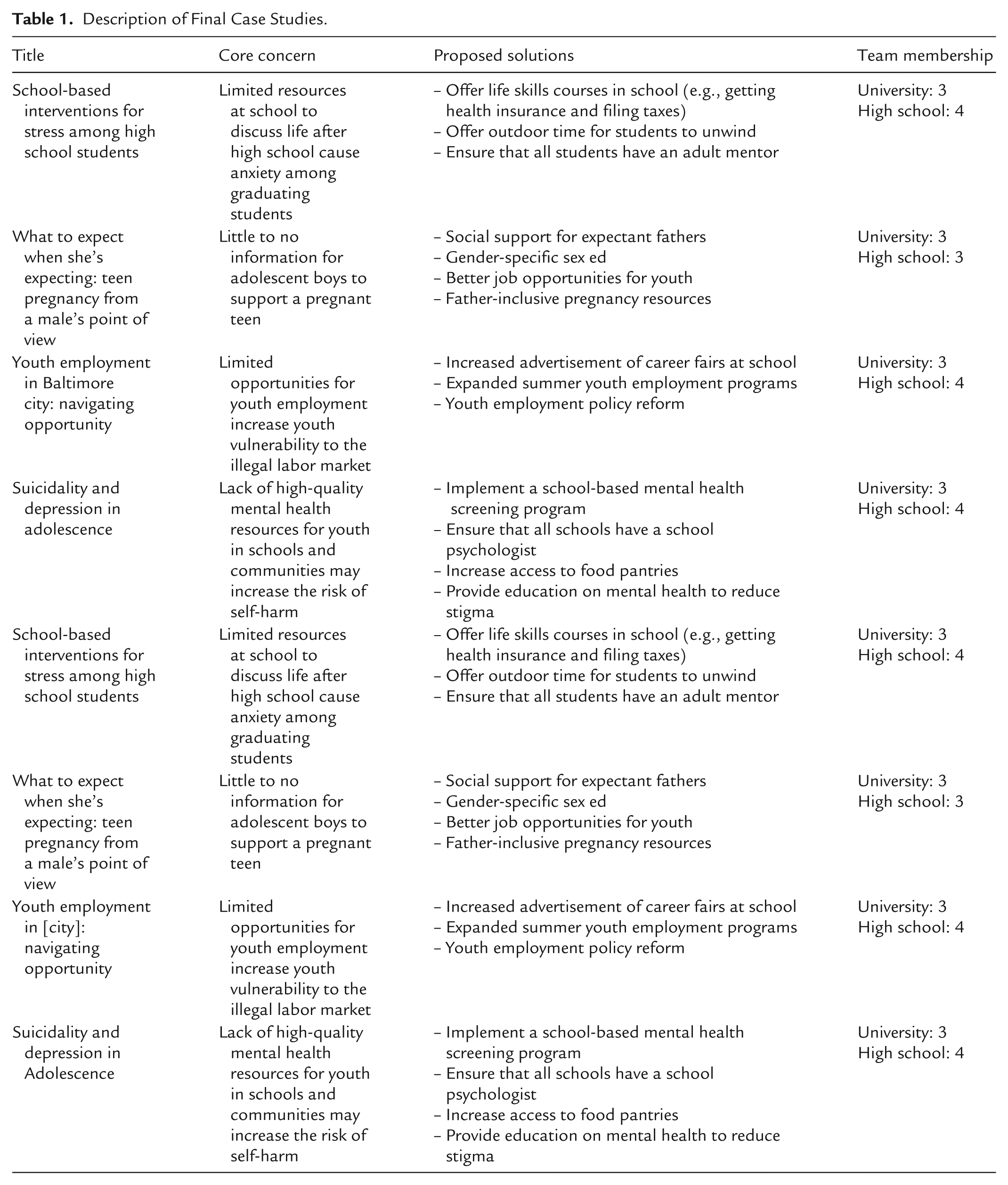
Consistent with an integrated case-based service-learning approach, all cases met academic standards for graduate and high school students, were co-written, integrated course materials, and addressed issues identified by local youth. The final case studies focus on solution-oriented actions that aim at individual wellness and systemic policy change. Table 1 provides a summary of the four final cases.
Description of Final Case Studies.
Assessment
We evaluated the quality of the integrated case-based service-learning pedagogy in three ways: course debriefs, student reflections, and course evaluations. All sources are described below in detail.
Joint meeting debriefs
High school and graduate students, separately, participated in an active debrief session after each joint meeting facilitated by their respective instructors (i.e., the course instructor and high school teacher). These sessions lasted approximately 45 minutes. All debriefing sessions started with the same four prompts: what happened, what went well, what challenges arose, and how will you make next time work better. Students actively participated by sharing information about their group interactions and providing strategies to address problems. All high school and graduate students participated in the course debriefs. A summary of the topics and solutions were shared after the class via email.
Graduate student reflections (Hedman-Robertson, 2024)
Graduate students were required to write two reflection assignments during the course. Students described their thoughts in anticipation of/reaction to course concepts and observations in this assignment. The reflection had to connect with course materials (including discussions) and their case-based service-learning project. These reflection papers were their opportunity to raise questions and develop answers. Each reflection was at most two pages in length. In their reflections, students responded to the following prompts: What topics and issues do you anticipate will be most relevant for high student partners and why (before the first joint meeting)? Describe and analyze the process for developing the case and solutions with your HS student partners (after the third joint meeting). All graduate students submitted reflection papers.
Course evaluations
Both high school and graduate students completed course evaluations at the end of the term. The high school course evaluation was a written assessment designed by the high school teacher where students described their thoughts about the partnership and provided recommendations for future collaborations between graduate and high school students. The graduate course evaluation included a total of 19 questions—12 closed- and 7 open-ended—about the course, instructor, and graduate TA. For closed-ended questions, students responded using a Likert scale ranging from 1 (poor) to 4 (excellent). All closed-ended and four of the open-ended questions were standard questions for all university courses. The following three open-ended questions were specific to this course:
– To what extent were the materials and content of this course representative and inclusive of diverse populations, especially those who have been traditionally excluded or marginalized?
– What has the instructor done that has helped you learn? What specific advice would you have for this professor about things he or she could do to help you learn better?
– This course involved partnering with local high school students to develop a Baltimore-based, adolescent health-focused case study. What worked well? What suggestions do you have to improve the experience for high school and graduate students?
Eighty-seven percent of high school and 92% of graduate students completed course evaluations. The high school and graduate students expressed high satisfaction with the case-based service-learning pedagogy used in this course and noted that the partnership was one of the highlights of both courses.
We evaluated the case-based service-learning product in three ways for graduate students. First, they had to attend at least three joint meetings. Second, each group was required to submit a draft and a final version of their case narrative. The draft was an ungraded opportunity for groups to receive feedback on their progress. The final version of the case needed to be no more than five pages. It had to include an opening, details, references, and an appendix aligning the teaching topics with the content of the case. The final cases also had to respond to feedback from instructors, classmates, and partners. Finally, they were also required to give a 10-minute presentation of their group’s case solutions. The presentation had to include a case description, connections to local and current events, integration of course materials, description and selection of solutions, next steps, and reflections on working with high school partners.
Lessons for the Field of Health Promotion and Public Health Pedagogy
Based on our experience teaching the course, three themes emerged for the instruction and course development team related to the success of this integrative pedagogical approach: the value of diverse voices, the need to reframe learning, and the importance of flexibility. These themes emerged from our content analysis of the debrief session summaries, graduate student reflections and course evaluations. Each theme is described below in detail.
Valuing Diverse Voices: “We benefited from getting to know the students and hearing their feedback.”
Most graduate students had not lived in Baltimore before attending the Bloomberg School or worked with youth in Baltimore before taking the course. Students were encouraged to recognize the differences and similarities of their adolescent experiences with their high school collaborators to create space for connection and understanding. Similarities included stresses about school, parents, and relationships with their peers. However, stark differences emerged in resources to address such issues. Despite the heavy use of the internet and online platforms for socializing, awareness of and access to resources for health and well-being were limited for the high school students living in Baltimore.
As the cases formalized, high school partners offered specific feedback on characters (e.g., names and appearance), settings (e.g., street names and neighborhoods), and behaviors (e.g., seeking help and retaliation). This integrative pedagogy ensured that the cases were reflective and authentic to the experiences of youth in Baltimore. Our high school partners noted they were excited to participate because adults rarely asked them for solutions. Likewise, our graduate students were eager to learn from our high school partners because they offered different perspectives from what they had learned through course readings and their understanding of the field. This assignment ensured that the course content and activities were relevant and timely. While the seminar readings and frameworks get older, integrating diverse voices creates opportunities for graduate students to discuss and tackle contemporary public health issues.
Reframing Learning: “Spend a half section describing the process you want us to use.”
Few students had participated in a CSL course, so having one’s grade dependent on a product developed with youth was unsettling to some. Accordingly, it was essential to manage grade anxiety throughout the term. Student anxieties were most explicitly observed during a debriefing session after graduate students submitted the first draft of their cases, where students seemed disappointed that they had received extensive feedback but not a grade. The hope was that they would use the feedback to improve their cases. The teaching team explained that the process of collaboration and engagement with youth was being graded, and that professional mastery demonstrated in the final product was not the primary expectation. However, we learned that some students view grades not only as an indicator of mastery but also as a barometer for how well they have met instructor expectations, revealing a commitment to and anxiety over hierarchies in academia instead of a focus on the actual process of learning.
In addition to grade anxiety, several of the components of this course were unfamiliar to high school and graduate students. Students were familiar with standard course components such as responding to readings, writing research papers, and taking exams. However, most students reported never participating in class debriefs or completing a reflection assignment. Rather than a critical thinking assignment, some graduate students interpreted the reflection assignment as an “expression of one’s thoughts.” It took several attempts for some students to deepen their writing, including critical analysis and synthesis of lived experience, theoretical concepts, and academic content. Through continuous, detailed feedback during debrief sessions, meetings with the teaching assistant, and written feedback on drafts, all students improved and did well in the course.
Flexibility: “Our first Friday visit was senior skip day.”
Flexibility and continuous feedback from all students were essential, especially related to the logistics of joint meetings and assignment due dates. Although the high school students were scheduled to start class at 8:00 AM, many students often arrived late, if at all. Challenges for high school students arriving on time included delayed buses, competing morning priorities, and senioritis. Each group experienced a change in membership across the term due to HS attendance rates. Thus, we instructed graduate students to be prepared to discuss what happened in the last session and leave enough time to meet the objectives of the current session regardless of which HS students were in their groups. This was a learning opportunity for graduate students seeking a career focused on community engagement – further exemplifying the benefits of case-based service-learning.
The short duration of an 8-week term also imposed extreme limits on the amount of time between assignments being due. This time constraint and the additional time required outside of class to complete the group assignments compelled flexibility in assignment due dates. After one debrief, students expressed their desire for more time on assignments. Collectively, we looked at the course calendar and activities to determine more appropriate times for assignments to be submitted.
Conclusions
Our findings suggest that even with shortcomings, the integration of CSL and CBL pedagogies—if done critically—can lead to successful partnerships and deep civic and intellectual learning. Combining these pedagogies allowed students to engage in action for change and practical education on an appropriate scale for an 8-week graduate course. With underlying scaffolding and a commitment to remain open to the often-messy experience of community-building, we leveraged the educational and social value these pedagogies afford while mitigating the harmful pitfalls they can contain. The lessons learned have been used to inform future course iterations and served as a viable model for applying this integrated pedagogy to other public health courses.
Footnotes
Declaration of Conflicting Interests
The authors declared no potential conflicts of interest with respect to the research, authorship, and/or publication of this article.
Funding
The authors received no financial support for the research, authorship, and/or publication of this article.
