




Abstract
Literature reviews constitute a core competence for public health professionals. Many public health graduate students thus choose to conduct a literature review for their thesis, but may face challenges delivering a high-quality systematic review due to time and resource constraints. Informed by the principle of constructive alignment, this article thus provides guidelines for conducting a systematized literature review on quantitative studies within the scope of a master’s thesis in public health, incorporating key elements of a systematic review (i.e., transparency, reproducibility) in a pedagogical context. Based on the authors’ research and supervision experience with the methodology at Stockholm University, this description of best practice presents 12 steps for successfully completing a quantitative systematized literature review, including formulating research questions, conducting searches, extracting and synthesizing findings, and thesis writing, while outlining the tasks of students, supervisors, and examiners in alignment with different learning outcomes. This guide can be used by postgraduate educators to effectively enhance the skills of future public health professionals.
Introduction
Literature reviews are a key analytical tool for summarizing evidence, representing a fundamental pillar of evidence-based education and practice. Synthesis efforts are crucial for health promotion, for example, to assess the impact and effectiveness of public health programs and interventions, and to aid policymakers and public health professionals to make informed decisions. Proficiency in literature review methodology is thus a core competence of public health professionals. However, providing adequate training and supervision in this methodology is complex. One reason is the widespread notion that only systematic reviews include rigorous synthesis efforts, despite their varied scope in the medical and social sciences, with public health straddling these two disciplines. Moreover, conducting a systematic review is time-consuming, which poses challenges within the limited time available in pedagogical contexts.
These constraints may motivate students and educators to pursue other review types for which clear guidelines are not available, compromising transparency and reproducibility. These challenges represent an opportunity to design a pedagogical guide that feasibly yet effectively incorporates practical training in conducting high-quality literature reviews. In this article, we present a guide for conducting a quantitative systematized literature review type (Grant & Booth, 2009) in the pedagogical context of a master’s thesis in Public Health Sciences (PHS).
Rationale
Systematic reviews, defined as comprehensive synthesis efforts that follow standard protocols and guidelines to design, search, critically appraise, and report evidence (Moher et al., 2015), are widely employed in clinical research (Evans, 2003). Their consideration as the “gold standard” stems from the availability of standardized guidelines for appraising and reporting scientific knowledge derived from randomized control trials, such as the Cochrane Handbook (Cumpston et al., 2022). While PHS also focuses on health, it diverges from clinical research in several aspects that influence the aim and scope of synthesis efforts (Jackson et al., 2005; Lhachimi, 2020). For example, PHS predominantly relies on observational and quasi-experimental designs, which are more likely to suffer from publication bias (since pre-registration is uncommon) and to be underpowered (compromising statistical significance). These studies can be highly heterogenous in terms of their study populations, measurement tools, and analytical strategies, thus impacting the validity of pooled effect size (Matthay et al., 2021). Despite their limitations, observational and quasi-experimental designs are the best options when controlled designs are unfeasible or unethical (Boon et al., 2022). Public health studies often have imprecise intervention specifications, typically leading to small effect sizes that can, nonetheless, translate into significant population health impacts (Matthay et al., 2021). Consequently, quantitative public health-oriented reviews often use narrative synthesis to summarize evidence rather than estimating true effect sizes via meta-analysis, which is more common in clinical disciplines, but is not less scientifically rigorous or relevant than their clinical counterparts.
Conducting literature reviews in PHS is challenging due to its diverse areas of action (research, services, promotion, protection) (Lancet Public Health, 2016) and levels of intervention (e.g., families, communities, states), with research designs ranging from epidemiological to policy analyses. This diversity results in scattered resources and tools, which are not always fully aligned with public health curricula, particularly within the European context. Consequently, transferring knowledge and skills from research practices to the educational setting is not always straightforward.
Across disciplines, conducting a systematic review demands considerable time and resources often resulting in a mismatch between training and practice. From a pedagogical standpoint, offering students theoretical training in performing systematic reviews without the practical opportunity to conduct one represents a case of constructive misalignment, that is, a lack of coordination between different learning components (Biggs, 2012). As per the principles of ABC learning design (Laurillard, 2012), learning through practice and production represents a higher stage of learning, where theoretical knowledge is consolidated through reflective action, promoting meaningful learning in students (Adams, 2015; Biggs, 2012).
A systematized literature review is a type of review that allows students to practice central elements of a systematic review (transparency, reproducibility), while omitting some of its more resource-intensive prerequisites, like conducting a comprehensive search or performing a quality assessment (Grant & Booth, 2009). However, the lack of guidelines tailored to a pedagogical context may still pose challenges for students, supervisors, and examiners alike.
The Curriculum
The authors developed a guide to conducting, supervising, and examining a systematized review as supporting material for a master’s thesis course in a 2-year Master’s program, Public Health Sciences: Individual and Societal Perspectives (120 European Credit Transfer and Accumulation System (ECTS) credits), offered by the Department of PHS at Stockholm University. The program offers a social science perspective on public health, considering social factors that contextualize individual behaviors. With a predominant research orientation, the program trains students to conduct and evaluate research that can inform both health and non-health targeted interventions.
By the end of the program, during the thesis course (30 ECTS), each student receives 40 hours of supervision to write a master’s thesis (8,000 words), supervised individually or in a group by two or three assigned supervisors from the department. Students are also welcome to choose supervisors from other institutions. The thesis course comprises two parts: a thesis proposal, demonstrating project feasibility to the course managers (7.5 ECTS); and the thesis itself, examined by a group of professors from the department (22.5 ECTS).
Given the strong quantitative focus of the program, most students choose to conduct statistical analyses using observational designs, aligning with the expertise of departmental supervisors and examiners. However, not all supervisors and examiners have experience in conducting literature reviews or they may be only familiar with systematic reviews. The lack of awareness of alternative review types, coupled with the absence of specific pedagogical guidelines, often results in poor-quality theses or lower grades for students who decide to conduct literature reviews due to unrealistic expectations. This issue is exacerbated by master’s theses being examined in the context of a course with no specific learning outcomes or grading criteria for literature reviews. Course leaders could provide the proposed guide in the beginning of the supervision period, ensuring clear learning outcomes and grading criteria, and aligning expectations among students, supervisors, and examiners.
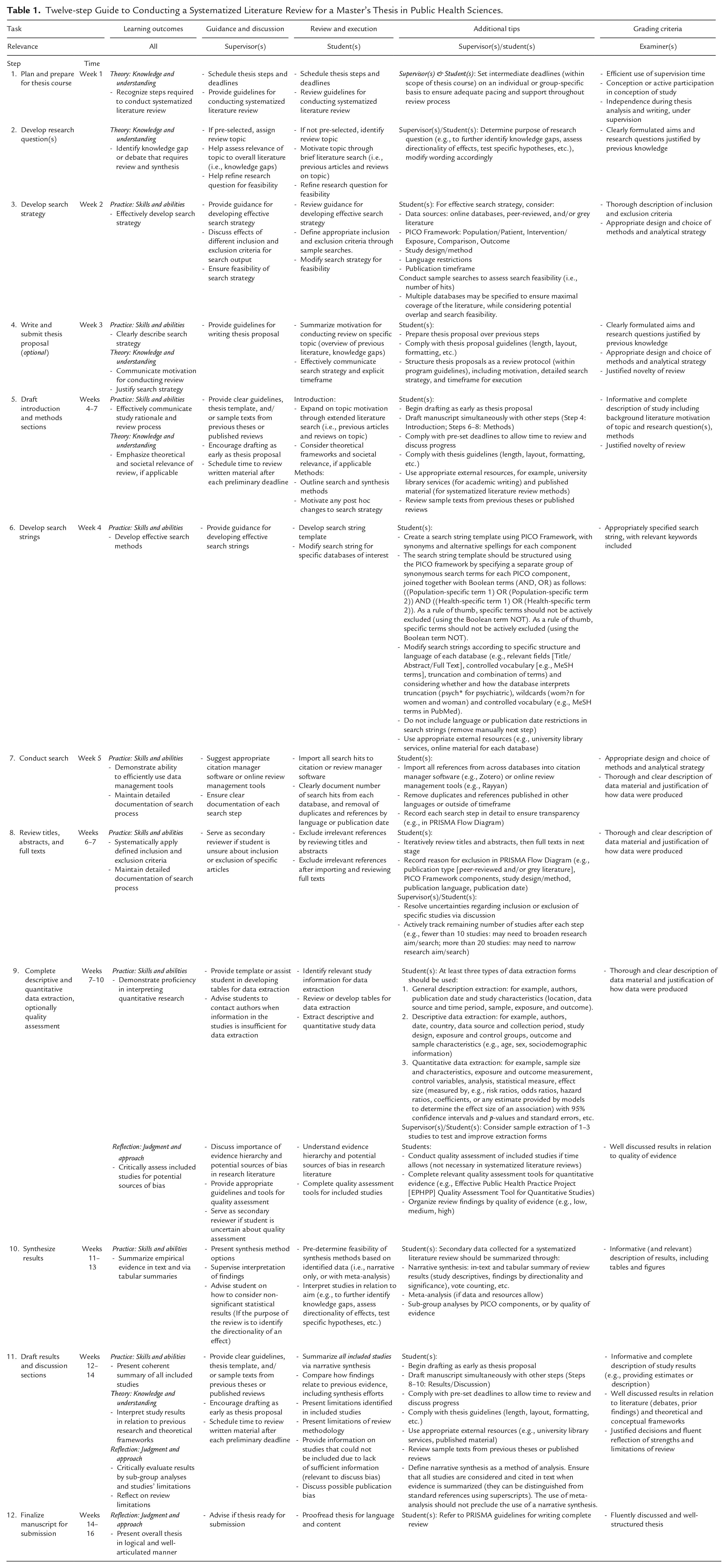
The proposed guide for conducting a quantitative systematized literature review draws on our experience using systematic reviews (Heshmati et al., 2023; Honkaniemi et al., 2017; Juárez et al., 2019, 2022, 2023), as well as on our application of the proposed 12 steps to supervise past master’s and Ph.D. students who have successfully completed their theses. After reviewing evidence on literature review methodology (Grant & Booth, 2009; Noble & Smith, 2018) and relevant guidelines, such as the Preferred Reporting Items for Systematic Review and Meta-Analyses (PRISMA) checklist (Page et al., 2021), we adapted each step to the pedagogical context of our program. This included considering each step’s timing within a 16-week thesis writing period. We also described the specific tasks of supervisors, students, and examiners throughout this time. Furthermore, we specified relevant learning outcomes organized by Bloom’s taxonomy, including theoretical, practical, and reflective goals (Adams, 2015). A summary and additional tips for all steps are provided in Table 1.
Twelve-step Guide to Conducting a Systematized Literature Review for a Master’s Thesis in Public Health Sciences.
Since these guidelines were developed in the context of a specific program, educators interested in applying them elsewhere should ensure alignment with their learning outcomes
Step 1. Plan and Prepare for Thesis Course (Week 1)
The thesis course should begin with a meeting between students and supervisors to discuss the systematized literature review process and set deadlines for each step. Supervisors should adapt the number of meetings depending on students’ level of independence, familiarity with the review method, topic, and the number of supervision hours available. Examiners can assess this step by evaluating students’ level of involvement in planning the thesis and their independence in the forthcoming steps.
Step 2. Develop Research Question(s) (Week 1)
Supervisors should designate or guide students to identify a review topic using supporting literature. This includes a brief search of the empirical literature and published reviews to identify knowledge gaps. The supervisor should guide students to iteratively refine the research question(s), balancing between relevance (breadth) and feasibility (specificity). The review should focus on a narrower area of inquiry (be less comprehensive) than a standard systematic review. This can be achieved by concentrating on a specific geographical area, timeframe, or population, with appropriate justification. Students and supervisors should also consider the overall aim of the review (i.e., identify further knowledge gaps, assess directionality of effects) and frame the research question(s) accordingly. Examiners can assess the formulation and justifications of the research question(s).
Step 3. Develop Search Strategy (Week 2)
Supervisors should advise students on how to effectively specify a search strategy. This involves identifying target databases based on their subject area (e.g., PubMed for general health), material covered (i.e., peer-reviewed and/or grey literature), and access (often listed on institutional library pages). Multiple databases may be specified to ensure coverage while considering overlap and search feasibility. Students should identify study designs and methods of interest and can apply the Population/Patient, Intervention/Exposure, Comparison and Outcome (PICO) framework to their research question(s) (Brown, 2020). The PICO framework helps students specify the different components of a research question (who, what, when, where, and how) to construct the search string (Higgins et al., 2021). To ensure feasibility and relevance, a target timeframe for publication dates and languages should be specified (depending on the research context and student’s linguistic abilities). Supervisors and students should conduct sample searches to assess the feasibility of the search, modifying the search strategy accordingly. Examiners can assess the search strategy in terms of the inclusion and exclusion criteria, paying special attention to sources of bias in relation to the research question(s).
Step 4. Write and Submit Thesis Proposal (Week 3; Optional)
If the course includes a proposal, this can be modeled after a review protocol, in accordance with course guidelines. Students should include the search motivation, search strategy, review methodology, and an explicit timeframe for conducting the thesis. Examiners should focus on whether the student has clearly formulated and adequately justified the aim(s) and research question(s), used an appropriate design and method, and the novelty of the review.
Step 5. Draft Introduction and Methods Sections (Weeks 4–7)
During the thesis proposal evaluation, students can begin expanding on the rationale for the review with a clear and well-structured introduction section. It is particularly important that students motivate their review not only in terms of gaps in previous synthesis efforts, but also in terms of relevant theoretical frameworks. Examiners should evaluate this connection with the broader PHS literature.
The methods section should be written simultaneously with each step of the search itself (Steps 6-8) to ensure a replicable description of the methodology. Students should also describe any post hoc decisions to narrow the scope of the review for feasibility, which the examiner should account for when assessing methodological rigor.
Step 6. Develop Search Strings (Week 4)
A search string template allows for effective and comprehensive retrieval of studies relevant to the review, and can be adapted to each database of interest. The search string template should be structured using the PICO framework, it can be modeled based on those of existing reviews (and with the help of supervisors). Students should then adapt the search string template to each database’s specific guidelines. External resources such as university library services can be used to check that the search strings are correctly specified. Examiners should determine the effectiveness of the search by considering the structure of the search string and the presence of relevant keywords.
Step 7. Conduct Search (Week 5)
Upon approval, students can enter the search strings into each database, then export all captured references into a citation management software (e.g., Zotero), or online review management tools (e.g., Rayyan), which allow for transparent documentation of each stage and inclusion/exclusion criteria. Once the references have been compiled, students can remove duplicates and irrelevant material (e.g., grey literature). Each of these steps and the number of excluded records should be clearly designated using, for example, a PRISMA Flow Diagram (Page et al., 2021). Examiners should assess the clarity and detail of the recorded search process for this step.
Step 8. Review Titles, Abstracts and Full Texts (Weeks 6–7)
After initially filtering the reference files, students can individually assess titles and abstracts, and then full texts, for relevance (deviating from standard guidelines which typically include at least two reviewers). Each excluded record should be justified by specific criteria in the flow chart. This step may be time-consuming and cognitively challenging for the student. Supervisors are encouraged to schedule regular meetings to help address challenges and serve as secondary reviewers in cases of doubt. If the number of included records is too great to extract and synthesize within the remaining thesis time, students and supervisors can agree on a post hoc modification to the research question(s) (e.g., by examining a more specific portion of the proposed study population) and record this adjustment accordingly. Examiners should evaluate the transparency of the review process using the flow chart.
Step 9. Complete Descriptive and Quantitative Data Extraction, Optionally Quality Assessment (Weeks 7–10)
Once the included studies are identified, students should begin extracting descriptive and quantitative data. The descriptive table, usually included in the main body of the thesis as the description of the data material, should comprise information on authors’ names, publication date, and study characteristics. A separate quantitative data table is also needed, whether for narrative synthesis alone or further meta-analysis, and should include detailed sample characteristics accompanied by statistical measures of association. Although this table is typically considered supplementary material, it should be clearly and systematically completed as it demonstrates ability to summarize information efficiently. This process will help identify similarities in study characteristics, facilitating a more efficient description of the studies. It is particularly important to be succinct and systematic with the information included in the tables. Supervisors can assist students in developing table templates (e.g., in Excel) and in conducting a sample extraction exercise with two to three studies. Examiners should assess whether the information in the tables is summarized with clarity and consistency.
Quality assessment is optional; different tools are available for assessing study quality for observational (Wells et al., 2021) or quasi-experimental designs (Effective Public Health Practice Project [EPHPP], 2024). The results of these assessments are commonly used to weigh the quality of the evidence during synthesis. The supervisor and students can perform sample quality assessments of two to three studies to ensure correct application of the tools. Even without a formal quality assessment step, it is important for the student to acknowledge common methodological pitfalls across the included studies in the discussion section.
Step 10. Synthesize Results (Weeks 11–13)
Once all descriptive, quantitative, and (optionally) quality-relevant results have been extracted, students and supervisors should choose how to synthesize and report findings. All systematized literature reviews should include a summary of the included studies’ characteristics. We recommend using the narrative synthesis method, following the Economic and Social Research Council guidelines (Popay et al., 2006), and considering the directionality of effects rather than effect size and statistical significance, although non-significant findings should be discussed. We suggest to organize results via tables (e.g., by “higher risk,” “lower risk,” “no risk”), identifying overarching patterns and summarizing the observed patterns in the text (e.g., “most studies indicated a higher risk”). The student should additionally consider organizing the tabular and textual results by relevant sub-groups and by quality of the reviewed evidence (if quality has been assessed) to add depth and public health relevance to the synthesis. Beyond narrative synthesis, meta-analyses of the included statistical data could be undertaken, although the supervision team should consider the relevance and feasibility of this approach considering student’s time and skills. Overall, supervisors can help interpret ambiguous statistical results based on study characteristics and quality, as well as guide the students to identify relevant patterns in the data. Examiners should evaluate whether this work has been well performed by jointly examining the tabular and textual synthesis results
Step 11. Draft Results and Discussion Sections (Weeks 12–14)
Students should draft their results concurrently with the synthesis stage of the review to ensure documentation of all observed patterns. The results section should include a description of the included study characteristics, followed by a clear and logical presentation of the main and sub-group analyses via narrative synthesis, with explicit reference to the tables supporting the findings. It is important to ensure that all studies included in the review are referenced in the results section. The discussion section should include a summary of the main results and a reflection on how the results compare to previous reviews (if relevant). Students should describe methodological limitations of the included studies, providing specific recommendations for advancing knowledge in the research area. The limitations of the research area should be clearly delineated from those of the review itself (e.g., selection bias due to search restrictions). Finally, students should consider the societal significance of the results, as one aim of synthesis efforts is to provide policymakers and public health practitioners with evidence-based insights on a problem. Examiners should pay attention to the explicit consideration of all studies when describing patterns in the results section, and the reported review limitations in the discussion.
Step 12. Finalize and Submit Manuscript (Weeks 14–16)
Students are encouraged to use general academic writing guides for clear communication of the review’s methods, results, and implications, alongside more specific guides (e.g., modified PRISMA guidelines for reporting systematic reviews) (Page et al., 2021). Supervisors should review the final manuscript to ensure satisfactory completion of all necessary steps, before examiners assess the overall quality of the academic writing and text structure.
Implications for the Field of Pedagogy in Health Promotion and Public Health
Quantitative reviews are a crucial skill for public health professionals, providing conclusions for evidence-based actions. Therefore, in accordance with the concept of constructive alignment, opportunities to conduct a literature review should be essential components of public health education. However, time and resource constraints may lead students to opt for alternative methodologies or to conduct other review types without guidelines to ensure transparency and reproducibility. We have presented 12 steps for successfully completing, supervising, and examining a systematized literature review for a master’s thesis in PHS. Our comprehensive focus on students, supervisors, and examiners aims to encourage higher-quality synthesis efforts in public health pedagogy.
Footnotes
Author Contributions
SPJ conceived of the study. SPJ and HH designed, drafted, and made critical contributions on equal terms. Both authors approved the final version of the manuscript.
Declaration of Conflicting Interests
The author(s) declared no potential conflicts of interest with respect to the research, authorship, and/or publication of this article.
Funding
The author(s) disclosed receipt of the following financial support for the research, authorship, and/or publication of this article: SPJ and HH acknowledge funding from the Swedish Council for Health, Working Life, and Social Welfare (FORTE; grant numbers 2016-07128 and 2021-00271) and the Swedish Research Council (Vetenskapsrådet; grant number 2018-01825). The funders of the study had no involvement in the study design, data collection, data analysis, data interpretation, or writing of the report.
