




Abstract
Growing appreciation of the necessity of, and evidence-based strategies for, working collaboratively with communities in health promotion and related fields have been well documented. Yet community engagement, the umbrella term for many of these efforts, is rarely taught as a standalone course, nor is a critical component of community engagement –antiracism practice—typically included. Following a review of the literature, we discuss the contexts, pedagogical grounding and strategies, learning objectives and piloting of a “micro course” on community engagement using an antiracism lens at UC Berkeley’s School of Public Health. Designed for graduate students interested in community-based participatory research and practice but unable to take a full academic course in this area, the 30 hour pilot course drew a diverse mix of 16 students. Focused attention on racism, systematic racism, and antiracism practice was provided through lectures, in-class exercises, homework reflections, and the course final. Case-based examples of the critical role of antiracism practice in community engagement, particularly in and with BIPOC communities, were shared, and a range of strategies explored for building and maintaining cross-cultural partnerships and transforming our own institutions to better reflect antiracism practice. Challenges faced are highlighted, and lessons learned shared, including the imperative of creating, in both course planning and teaching, sharing our positionality and creating safe spaces for discussing any tensions that may arise.
Recent decades have seen growing appreciation of the necessity of, and evidence-based strategies for, effectively working collaboratively with communities in health promotion and related fields rather than using a more traditional, “outside expert” driven approach (Coombe, Schulz, Guluma, et al., 2020; Minkler, 2014; Wallerstein et al., 2018). Yet community engagement (CE), the umbrella term for many of these efforts, rarely is taught as a standalone course, nor is a critical component of community engagement –anti-racism practice— often given the attention it deserves.
This article describes, contextualizes and analyzes a hybrid, university-based micro-course designed to teach the importance, principles and practice of community engagement, but to do so through an anti-racism lens, and with a particular focus on its relevance for public health and health care. Designed for students who desire understanding and skills in this area, but are unable to take a full class on the topic, the course provided an overview of the rationale, conceptual grounding, core concepts, and key practices and skill-building useful in a range of public health, health care, and related fields. As noted above, by combining the study of community engagement with a focus on anti-racism theory and practice, we hoped to foster approaches to CE that would help participants appreciate and model, in their own practice, research and commitments, the intimate interdependence of these approaches for achieving health equity and social justice.
Definitions and Examples
As classically defined McCloskey and Aguilar-Gaxiola (2011), CE is: “. . .the process of working collaboratively with and through groups of people affiliated by geographic proximity, special interest, or similar situations to address issues affecting [their] communities,” often in the process serving as a potent vehicle for change in multiple arenas (p. 9). Further, as others have noted, when the terms “community” and “engagement” are joined, the focus of this work can expand from the individual to the broader policy and other collective levels, and in the process, place a stronger accent on community diversity, belonging, and inclusion.
In public health, examples of such engagement include health departments or agencies partnering with residents in diverse, food insecure neighborhoods, to create programs aimed at increasing access to healthy foods while decreasing advertising and availability of tobacco, sugary beverages, and other unhealthy products often targeted at communities of color (Minkler et al., 2019). In the health care sector, collaborations between medical professionals and Black churches, and barbershops and beauty salons to offer—in trusted, local places of meaning—cancer education, testing and referrals, provide additional evidence-based examples of the utility of such engagement for improving health outcomes (Linnan, 2019).
As impressive as such examples are, however, we argue that CE also should be done through an explicit anti-racism lens. As Fletcher et al. (2021) note, anti-racism “emphasizes empowerment of traditionally marginalized populations and offers strategies to explicitly address power imbalance, stigmatization, and other consequences of structural racism in public health research” (p. 6). Further, anti-racism research and practice is reflexive and committed to the “decolonization” of knowledge (valuing or re-valuing traditional knowledge), uncovering different sources of power and correcting misinformation (Griffith & Came, 2022). These and other aspects of anti-racism work, moreover, make it as relevant when partnering with other marginalized groups, for example, low income, disabled or LGBTQ+ people, which are often stigmatized or sit at the margins.
What This Course Adds
Although there are an increasing number of short courses and other training opportunities on CE (e.g., Coombe, Schulz, Brakefield-Caldwell, et al., 2020; van Olphen et al., 2015), most are limited to community-based participatory research (CBPR) and/or to academic service learning (Brooks et al., 2019). Our course was unique in being offered as a micro-course at a major public university’s School of Public Health, focused on the rationale, principles, methods and challenges involved in community engagement practice more broadly but, as noted, doing so through an anti-racism lens. The course’s pedagogical framework thus included classic CE principles, for example, starting with the community’s issues and concerns and maintaining community ownership and control (Doubeni et al., 2022). Additionally, however, while many CE courses now also emphasize the importance of teaching about the Social Determinants of Health (SDoH), we believe that the particularly strong focus of our course on structural racism and viewing health and social issues through a prism that privileges the key role of racial discrimination and inequities, added important depth to such analysis. This is also consistent with Iton et al.’s (2022) argument that for public health and health care organizations today, a central challenge is to build community power and help engage with such communities to develop strategies “that can confront and dismantle policy-based structural inequity” (p. 1733).
Following a brief review of the literature on CE and anti-racism pedagogy and practice in which our course was grounded, we look in more detail at the contexts, framing, learning objectives and content, as well as the ethical and other challenges faced, and lessons learned through this pilot course.
Literature Review
We reviewed literature pertinent to two core areas of our mini-course to develop course content, assignments, and activities. We summarize key concepts and ideas on CE and anti-racism pedagogy and practice that, we believe, should be incorporated in CE courses designed with an anti-racist lens.
Community Engagement
Although interest in and writing about CE dates to the 1960s, CE theory, pedagogy, research and practice, particularly related to public health and health care, has more recently been a focus of attention in the literature (Derreth et al., 2021; Doubeni et al., 2022; Glanz, 2017; Michener et al., 2020; Montgomery & Johnson, 2015; Wallerstein et al., 2020).
The plethora of articles on CE was captured in Stuart’s (2017) systematic review using two large databases, ProQuest and EBSCO, which yielded roughly 993 articles. More recently, additional work has included, for example, two major longitudinal studies exploring several hundred long-term CBPR partnerships in health and their processes and outcomes (Coombe, Schulz, Brakefield-Caldwell, et al., 2020; Wallerstein et al., 2020).
With the exception of the substantial literature on academic-service learning (Brooks et al., 2019), however, we found relatively sparse attention specifically to the pedagogy of community engagement. Important exceptions include Doubeni et al. (2022) article offering a useful pedagogical framework to support curriculum development for CE in research, education, and clinical care in academic health centers and universities and Levin et al.’s (2021) review of best practices in CE by schools and programs in public health. Levin and co-authors describe facilitators of successful academic efforts, including leadership, infrastructure, and culture, as well as challenges, including mistrust by community members, power dynamics, and unequal sharing of credit.
Anti-Racism Pedagogy and Practice
Jones (2000) gardener’s tale on the levels of racism is among the first teachings and developments of anti-racism pedagogy in the field of public health. More than a decade later, Ford and Airhihenbuwa (2010) created a framework for merging critical race theory and public health research methods, public health critical race praxis, and developing novel research methods using CE approaches while accounting for the historical impact of racism. Ford et al. (2019) developed a book with tools for public health professionals to take an anti-racism approach across multiple settings including graduate student education.
To uncover the peer-reviewed literature on a growing body of literature on anti-racism pedagogy and practice in public health and health science education, we conducted a review across all ProQuest databases in 2022 using terms related to anti-racism and “pedagogy” or “praxis.” The review yielded 125 articles, including a number that we included in the course. Among the articles particularly relevant were eight that focused most specifically on pedagogical contributions to incorporating anti-racism into teaching and learning, and which appeared in journals ranging from education and ethics to public health and medicine. Several of these placed an emphasis on identifying and rejecting racist ideology and practice through critical self-reflection and of developing and sharing a brief “positionality statement” (reflecting one’s understanding of their own race, privilege, gender or gender identity and other identities and how these contribute to who they are and their worldview) (Diffey & Mignone, 2017; Kishimoto, 2018).
Two articles in Pedagogy in Health Promotion, Evans et al.’s (2022) Exploring Racism in Health Pedagogy and Lightfoot et al.’s (2021) Developing an antiracist lens: Using photography to facilitate public health critical race praxis in a foundational MPH course, were particularly useful in course development. Both articles stress the utility of self- and group-reflection on students’ images as a means of helping them foster a deeper understanding of the social determinants of health while creating conditions that may increase empowerment in youth, BIPOC and other, often marginalized communities.
Several writings on racism and anti-racism practice, such as Kendi’s (2019) How to be an Antiracist and Griffith and Came’s (2022) Anti-racism Praxis: A Community Organizing Approach for Achieving Health and Social Equity (2022), provided important additions to the initial literature review and were incorporated in the class. These stressed both the importance of conducting a structural power analysis to identify informal and formal powers impacting on health issues and key components of the work, for example, practice that is relational and reflexive and carefully monitoring progress and changes in policy and other arenas. Two other recent articles were particularly helpful in incorporating an anti-racism lens in teacher education and professional preparation. The Smith and Lander (2023) literature review on anti-racism in initial teacher education and training describes some of the complexities, obstacles, and effective anti-racism practices uncovered. Finally, Le Grange’s (2023) discussion of the connection between decolonization and anti-racism for teacher education, as well as challenges and opportunities for decolonizing teacher education programs to make space for new ways of thinking, are helpful when incorporating an anti-racism lens.
A Closer Look at Course Contexts, Framing, Topics, Methods, and Challenges Contexts of the Course
In 2020, and in concert with a broader, university-wide Berkeley Changemaker Program, the School of Public Health began planning and developing a bold new Public Health Changemaker Program that would be both multidisciplinary and science-based in nature. The program’s mission was “to activate students' passions, help them develop a sharper sense of the change they want to make in the world, and equip them with the confidence, commitment, and skills to bring about this change.” The program also emphasized “health as a right for all,” “strength through diversity, equity and inclusion,” and “questioning the status quo.” In Spring 2022, the first four graduate level Changemaker micro courses were offered: Health Policy Advocacy, Leading Change, Strategic Communication for Public Health Professionals, and the course on which we focus, Community Engagement in Public Health and Health Care. The micro courses, which were 30 hours in length, including 15 to 20 in-person hours, all stressed working across disciplines toward the aim of promoting health equity and social justice and increasing student confidence in their own ability to create change. Although each course had a target enrollment of 30 students, ours was deeply constrained by its unanticipated overlap in timing with a course that met a major school requirement, and a barrier in enrollment of students not affiliated with the UC system. As a result, we had 16 course participants, 11 of whom were able to formally enroll and the remainder attending most sessions and contributing to class discussions and activities. The success of this pilot course, however (see Multi-Method Evaluation below), led to its formalization as an annual School offering in 2023, with over 30 students enrolled for the new class prior to the close of the enrollment period.
In addition to its formal location within the School’s Changemaker Program, our course also was grounded squarely in two major and world changing developments. First, the COVID-19 pandemic, with its vast human and economic losses, disproportionately impacting communities of color, the unhoused, elders and people with disabilities, and low wage workers, often on the frontlines. Second, the impact of the brutal and widely seen police murder of George Floyd followed by those of many other Black people, and the leadership of Black Lives Matter in helping create the largest movement to end systemic racism in more than half a century. The COVID-19 pandemic impacted the class in numerous ways, with some students having lost family members or needing to miss class due to their own or others’ illness, or COVID-19 work-related conflicts. Finally, the pandemic of police violence and systemic racism within the criminal justice system, while always present in our country, were cast in much sharper relief during this same historic period. The new focus on systemic racism underscored many of the messages of this class, for example, the necessity of understanding our own positionality through deep reflection on our own biases and privileges; fostering more authentic and community-driven practice, and focusing on eliminating racialized health and social inequities as a key focus of our work.
Pedagogical Framing and Principles
As Doubeni et al. (2022) note, courses in dynamic areas such as CE often are usefully framed not within static models, but rather through relevant core principles. In addition to those introduced above and frequently used in courses on community building and CBPR (e.g., starting where the people are and maintaining community ownership and control) these included having a shared vision for the partnership, and emphasizing such values as respect and trust; identifying and building community strengths, being flexible, and committing for the long haul. In public health and related fields, emphasizing the key role of the SDoH is now widely embraced as a core principle of community engagement. Although this often is explained as including the role of structural factors such as racism and social class in health outcomes, we wanted to go further, teaching the course itself, particularly in this historical moment, through a prism of racism and race-based opportunities and inequities in life chances and health and social outcomes. We further wished to use this lens to help students learn how we can work to become antiracist, and importantly, to have our policies reflect this as well (Griffith & Came, 2022; Kendi, 2019).
Core Learning Objectives, Topics and Teaching and Learning Activities
We developed nine course learning objectives (CLOs):
Identify two theoretical perspectives integral to community engagement and describe the contributions of each
List and describe three major principles of community engagement in public health practice and research, using examples from the case studies or readings to illustrate their relevance
Describe three criteria for helping communities select an issue on which they wish to work
Describe the continuum of community- engaged practice, illustrating three of the different levels of engagement
Describe and discuss the importance of addressing racism and other isms in community engagement through building alliances across differences and engaging in anti-racism practice as core components of the work
Identify three ethical challenges that can arise in community-based participatory research and practice and provide an example of each and methods for helping to prevent or address these challenges
Identify and discuss three steps or stages in the policymaking process to which community engagement can make a significant contribution
Describe 1 or 2 visual approaches used in community engaged research and practice and the advantages and potential challenges they bring
Describe three advantages of engaging communities in project evaluation and three methods for such engagement
Student progress on meeting these CLOs was assessed, in part, though self- assessments, in-class applied activities, reviews of students’ weekly critical reflection papers, and a final written assignment. Several months prior to the start of the course, the three instructors met virtually to plan out the topics, readings, assignments and in-class activities for the course. We discussed how we wanted to meet the course objectives and what learning approaches we would utilize to ensure the students were learning tangible skills to apply these concepts in their current and future work.
Teaching Topics and Teaching and Learning Approaches
Table 1 offers an overview of the primary topics and activities included in each part of the five-week course. As noted in the table, the first week began with an in-person session to introduce students to the course and the topic of CE, its conceptual basis and core principles, and its practice and promise for improving equity-focused public health and health care on the community through policy levels. Short introductory presentations on community engagement and antiracist practice were offered by the faculty, including one of the instructor’s experiences engaging Black women in two communities defining and discussing structural racism and its impact on adverse maternal and infant health outcomes in the Black community. This professor also shared her brief yet powerful video capturing some of the women sharing, in their own words, their lived experience and community knowledge, and often reflecting their pride in being heard by outside health care researchers who valued their contributions (Chambers et al., 2021). Together with an in-class exercise and discussion, and two additional theoretical and case study presentations by guest speakers, the first day offered a snapshot of the breadth of topics and perspectives to be covered in the class.
Overview of Course Sessions and Assignments.
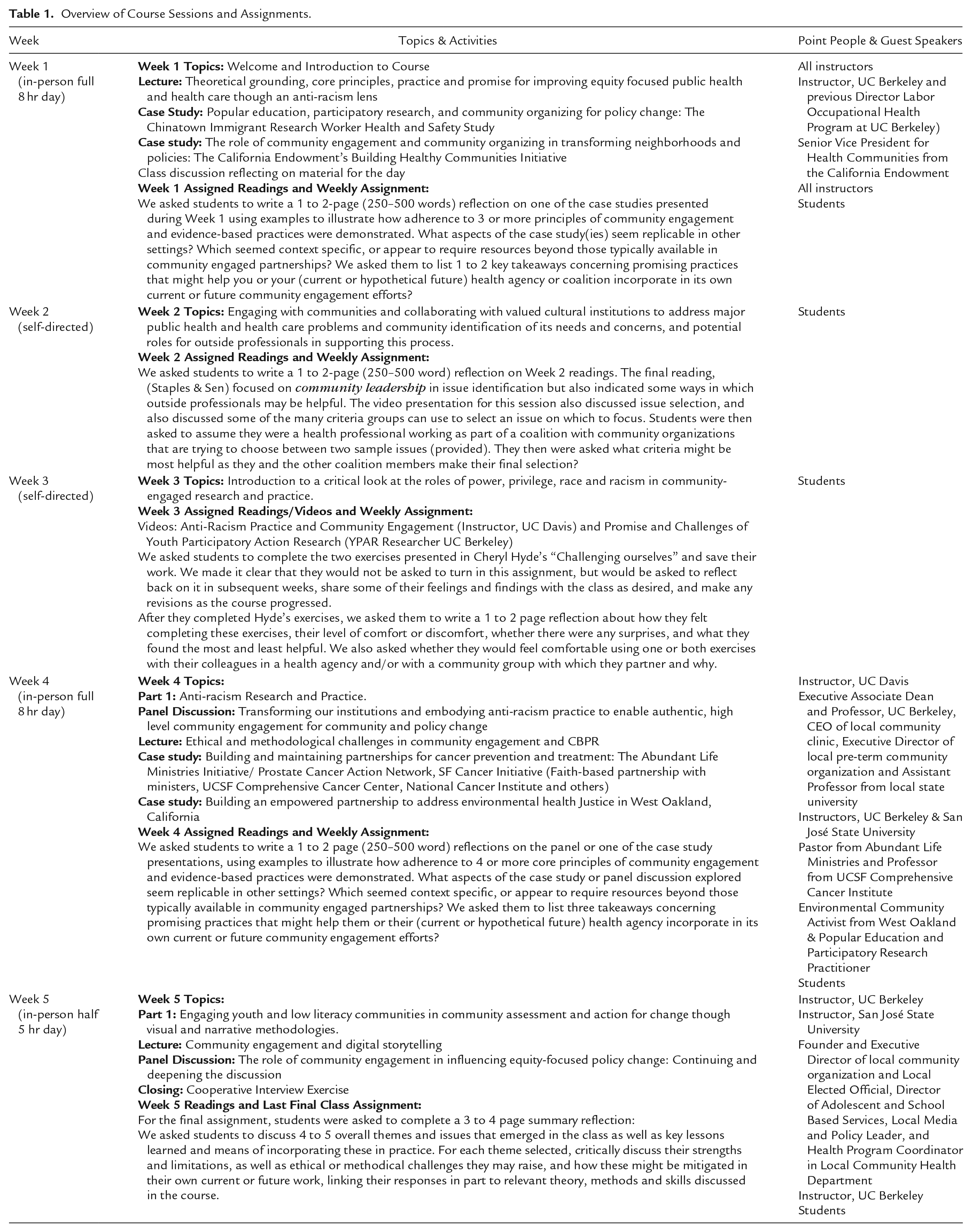
The second and third weeks were self-directed and included readings, videotaped presentations and reflections on topics including key considerations in community identification of its needs and concerns, and potential roles for outside professionals in supporting this process. For example, in the offline third week, students did a number of readings, but also watched a video by one of the instructors, “Anti-racism practice and community engagement,” explored a website on youth participatory action research, and participated in two exercises helping them reflect on and map out their own intersectionality and positionality. These included (Hyde’s (2022) “Challenging Ourselves. . .” in the course textbook (Minkler & Wakimoto, 2020), helping students take a critical look at the roles of power and privilege, including race and racism in their own lives and potentially impacting their work in community settings.
In the fourth week, a full day in-person session focused on the topics of anti-racism research and practice and transforming our institutions and a deeper dive into equitably sharing power with community partners. First, a panel of BIPOC community, academic, and health agency leaders discussed their own efforts to help their organizations embrace anti-racism practice and more authentic community engagement, followed by a lively interactive power-mapping activity. Second, and to address a key CLO on building and maintaining effective partnerships, two guest presentations shared respectively (1) a faith- based partnership between a large network of Black pastors and a university-based comprehensive cancer center, and (2) a widely heralded community-driven partnership to address environmental racism in West Oakland. These guest presentations were followed by a small group activity in which students used a “power mapping” technique (Minkler & Wakimoto, 2020) to visually identify a policy change they wish to see, draw boxes around the players affected by the policy, then circle the key actors with the power to help make or block the change, and who may help tip the balance. The relative power of these targets and players were indicated by the sizes of the boxes and circles drawn.
Our final half-day in-person session covered two topics, beginning with the engagement of youth, low literacy, and other groups in community assessment and action for change through the use of visual and narrative methodologies such as photovoice and digital storytelling. The second topic, and a logical one with which to end the class, was the role of community members and leaders in using evidence-based research and communities’ lived experience and policy advocacy to help achieve racial and health equity-focused policy change. Coverage of the latter topic featured a lively panel of community leaders and policy makers, one of whose members—a formerly incarcerated woman who co-founded and co-leads a CBO committed to ending mass incarceration and now serves as a City Councilmember—provided a particularly striking example of this approach in action.
Finally, to round out the session and the course, King and Stevahn’s (2012) Cooperative Interview, a lively assessment method designed to collect a surprising amount of feedback in ~10 min, was used to help elicit student discussion and feedback about the course as a whole. In groups of three, students took turns as interviewer, interviewee and scribe as they shared their perspectives on the course’s strengths and areas for improvement, and then looked together across their responses to note any themes or surprises that emerged.
Learning Assessment Approaches
Students’ understanding and application of course material were assessed in several ways. First, each week’s homework included a 1 to 2-page reflection, in which students demonstrated both their understanding of the material covered that week, their personal thoughts about its relevance to their lives and work, and its integration with theoretical and other concepts from prior weeks, including key concepts such as anti-racism practice (See rubrics in Appendix). Second, in-person days typically included small group exercises and discussions with presenters, which offered students a chance to reflect on and share their thoughts about the material and method(s) of presentations and their relevance in their own lives and practice. Third, students were asked to review an early homework assignment in which they had completed Hyde’s (2022) exercise on critical self-reflection and their own positionality, making any changes in light of what they had learned or experienced in the class. They then were invited (though not required) to share what they had learned with the class.
The course final was a written assignment designed to help students look reflectively and analytically on what they had learned by having them select 4 to 5 overall themes and issues that emerged, questions that remained, and how they might use this learning in their own lives and professional practice. For each theme they selected, we asked them to critically discuss their strengths and limitations, as well as ethical or methodological challenges they may raise, and how these might be mitigated in their own current or future work, linking their responses in part to relevant theory, methods and skills discussed in the course. The assignment was graded using the rubric for the final assignment rubric attached in the Appendix.
The written final was completed outside of class in a written essay format due by the last week of the course. Although the constrained course timing and structure precluded a uniform, formal mechanism through which students could receive additional feedback for revised drafts of the final prior to submission, clarifications were provided via email and verbally before and after the class final was submitted.
Multi-Method Course Evaluation
Several diverse evaluation methods were useful in our efforts to assess course effectiveness and determine areas for improvement. The first, King and Stevahn’s (2012) Cooperative Interview, described above, provided feedback on the questions, “What did you like best about the course?” and “What would you like to see changed?” as well as cross group common themes, or other reflections. In addition to providing useful feedback for the instructors consistent with the Scholarship of Teaching and Learning, using this method enabled students to learn about and then practice a tool they could later use in their own work. Findings from the Cooperative Interview included student appreciation of the diversity of perspectives and backgrounds of the instructors and other presenters, the “integrity, honesty and vulnerability” of the panel on working to transform their own institutions, as well as attention to shared power dynamics. Others also appreciated learning about activities (e.g., risk mapping, digital storytelling and photovoice) they could use in their own work but wished there had been more time for in-class interactive exercises using such tools. Several students also saw room for improvement in the written class reflections, which sometimes felt redundant from week to week.
The second evaluation method—the School’s formal anonymous and standardized course evaluation, taken online, was unfortunately the least helpful. Although the widely used seven-item survey was relevant and useful, the very late availability of this instrument for students in micro courses which were not on the normal academic calendar, meant that under half were completed. Although those who did submit the instrument ranked both the class and each instructor’s effectiveness seven out of seven, the fact that the majority did not participate negatively affected the utility of this result.
To address this low response rate, we created and administered an anonymous, seven-item retrospective course evaluation online, 1 year after the course’s completion. Ten out of the 11 enrolled students completed this second evaluation. The short survey included new items, for example, Likert-scale questions about the extent to which students agreed or disagreed that this course was helpful in their academic learning (100% strongly agreed) and whether they would recommend the class to a friend or colleague if it was offered again (100% strongly agreed). Additional questions asked if, as a result of taking this course, they have a better understanding of community engagement (100% agreed or strongly agreed), anti-racism (90% agreed or strongly agreed), and how anti-racism is a key part of effectively engaging with communities (90% agreed or strongly agreed). Lastly, open-ended questions asked if this course sparked their interest in taking another course or training in this or a related area (70% responded yes) and if they had used any frameworks, methods, approaches, or tools they learned in this class in other settings. Eighty percent responded in the affirmative, with four students adding that they had used power mapping and two having used photovoice in their work.
Challenges Faced
A number of pedagogical and other challenges surfaced in planning, teaching, and evaluating this course, including several related to the contexts in which the course took place. First, as one of the school’s first Changemaker micro courses, we faced challenges related to course roll out, including long delays in textbook availability, the timely payment of honoraria to guest speakers and other institutional challenges. For example, although two of the three instructors were from other local universities and were allowed and encouraged to invite students from their institutions to participate in the course, yet no formal mechanism was in place for students from the one university outside the UC system to receive academic credit.
Further, as noted above, although the cooperative interview method and weekly reflection papers provided helpful assessment data, the months-long delay in availability of the formal school course evaluation online resulted in a poor response rate, greatly limiting the value of this evaluation tool.
Another major context in which the course took place—the COVID-19 pandemic—also presented significant challenges. Although the syllabus noted that attending all in-person sessions would be mandatory, we quickly realized that having such a requirement during an infectious disease pandemic was inappropriate. As noted, some students did need to miss sessions due to COVID and/or caregiving, while another had to miss a full day due to her sudden role as manager of a large COVID test site, and we quickly dropped the requirement to accommodate this reality.
The course also was challenged by its limitation to just 2.5 in-person days and our strong commitment to “bringing the community in” since active engagement in the field was not possible. This conflict of time and desire led to the squeezing in of numerous guest presentations and panels, whose very numbers and length sometimes cut into the also critical time for in-class integration of theory and practice, as well as group exercises and reflections.
Serious time constraints and the desire to cover an unrealistic amount of material in the in-person days also led to frustrations for faculty and students alike, as well as ethical challenges. For example, our desire to cover two different and popular visual/narrative methods (photovoice and digital storytelling) in a single hour of the last half-day session (see Table 1) made it impossible for students to take part in even a brief activity that would help them get a sense of how one of those methods might work in practice. Both methods, moreover, involve real ethical challenges (e.g., sharing images of persons speaking or portrayed, even with their consent), and while there was a brief discussion of such issues, and a recommended reading, the minimal time left time to discuss such challenges in more depth was another major shortcoming of the session.
Although a key goal of our pedagogical approach was to incorporate anti-racism practice throughout the course, a fourth challenge involved the time constraints of the micro-course format, which meant that we were only able to focus in-depth on this critical topic and teaching and learning approach during our first and forth in-person days. Although the great majority of guest speakers and case studies, and both the final assignment and many readings and reflections each week, did focus on using an anti-racism lens and working in authentic partnership in and with communities of color, the lack of more focused in-class time specifically on anti-racism practice was an important limitation.
Relatedly, we were unable, in the short timeframe available, to provide ample focus on and examples of CE with the LGBTQ+ community, people with disabilities, and other often marginalized groups. An early required reading (McCloskey et al., 2011), did provide an exploration of how CE principles and practices helped address COVID-19 among a wide range of communities including people with HIV/AIDS, tribal nations, elders, and people with disabilities, and was positively received. But some students requested more attention to such groups, and we were able to add additional recommended readings and some in-class examples to partially address their concerns while also recognizing the intersectionality of these identities and ways in which diverse categories, like race, ethnicity, socio-economic status, gender and sexual orientation, interact at the individual level to reflect macro level systems of oppression and privilege (Bowleg, 2012).
Although each author shared some of their background and positionality during the manuscript writing process, it would have been helpful to include such sharing much earlier in the class planning process. Continuing weekly check-ins on how we each were showing up, and establishing safe and respectful spaces for raising and addressing tensions as needed, may further have prevented such tensions from building and, in one case, not being addressed openly until after the class was completed. Further, sharing by each instructor on the first day of class, their own positionality (Diffey & Mignone, 2017; Fletcher et al., 2021) and how it helped shape their pedagogy and practice, may help model for students how such self-reflection and sharing can contribute to high level community engagement and anti-racism pedagogy and practice.
Discussion
This paper offered a critical look at a pilot public university-based micro course on community engagement in public health and health care, with a special focus on the integration and use of an anti-racism lens. Particularly in its integration of this approach, grounded, in part, in the literature on the pedagogy of anti-racism practice, within a short (30 hr) academic course framework, this offering appeared to help fill an important niche.
The teaching of the course during a period of heightened awareness of gross race-based inequities on the personal through the policy levels, whether in relation to the COVID-19 pandemic or police violence and mass incarceration, further underscored the importance of using an anti-racism lens in our work. This included better understanding of the deep structural roots of racism and reflecting deeply on, and working to change, our own biases and those of our institutions, while learning to engage respectfully and authentically with BIPOC communities in working for multi-level change.
Yet other contexts of the class, including the continuing COVID-19 pandemic which contributed to absences and, in some cases, students needing to drop the class, both underscored the relevance of the class, and made its teaching more challenging. Among the lessons learned from these contextual issues and challenges were the following:
(1) The need for flexibility, for example, in finding alternatives to mandatory attendance during a hybrid class on campus days, when realities like the pandemic made that rigidity unethical and unwise. In cases like this, alternatives such as required virtual or make up sessions should be made available.
(2) Teaching a new course, in an entirely new format, requires additional time prior to roll out. This should include extra time for “getting the word out,” about the new course, getting textbooks in a timely way, and having a more streamlined system for paying honoraria.
(3) Particularly for new courses, taught in a new format, a method should be in place through which course participants can use the school or department’s formal evaluation system in a timely way, without which important assessment data can be lost. Although we recommend multi-method evaluation, including students’ written reflections and methods like the “cooperative interview,” being able to include new classes in the evaluation system relied on by the university in decision making about class retention and faculty promotions cannot be over stressed.
(4) Although it is tempting to include as many topics as possible in a condensed course, making tough decisions up front about how much can realistically be included, and omitting some topics to be able to do justice to those that remain is preferable to a “once over lightly” approach. Squeezing in too many methods, for example, without sufficient time for an experiential component or in-depth discussion of the ethical and social challenges their use may entail, should be avoided.
(5) Although we are pleased with the heavy accent universities and faculty, especially in fields like public health and health care, are now placing on structural racism and the need for far greater attention to BIPOC communities who bear the brunt of inequitable systems, sufficient attention also should be paid to other, often neglected yet also often marginalized communities. The heavy focus placed in our class on BIPOC communities, while critical, had the unfortunate effect of leaving less time to discuss and study the experiences of groups like people with disabilities and the LGBTQ+ community, which also often suffer substantial discrimination and inequitable treatment. We strongly recommend ensuring that key concepts, including those embedded in anti-racism theory and practice, and course material relevant to such other groups be emphasized as well.
(6) Following from the above, and to really do justice to both community engagement and anti-racism pedagogy and practice in public health and health care, we recommend that where possible, a course like this one be taught as a full academic offering. A semester-long course might also be able to offer opportunities for course-related involvement in CBPR and/or academic service learning in the field. Offering an additional unit credit for students who elect one of these options, having them keep a reflective, narrative journal integrating theory with their observations and experiences in the field, and including anti-racism practice, may prove useful in this regard.
(7) Because we are members of multiple identity groups and also have diverse backgrounds that help make us the people we are, we strongly recommend including early in a class like this one, time to reflect on and share, as comfortable, one’s own positionality and how it influences how we show up to this work. The utility of a written positionality statement as a teaching and learning tool has been demonstrated and indeed now is required in some applications for graduate school and positions in the academy and other institutions.
(8) Finally, we cannot overstate the importance in any pedagogical effort, but especially one like ours with its strong focus on anti-racism pedagogy and practice, of acknowledging and planning for the fact that tensions based on power, privilege, race and other factors will likely occur and need to be openly addressed in a safe space, in both course planning and implementation. To help facilitate such work, we recommend that faculty, and particularly those who are not BIPOC, and/or who occupy positions of economic or other privilege, enroll, (as one instructor did) in one of the many courses now available online and in-person on anti-racism pedagogy and practice.
Conclusion
Engaging effectively with communities requires that health professionals commit to learning and putting into practice the theories, principles, understanding of context, and evidence-based methods and tools that can help authentic, high-level partnerships develop and flourish. Doing so begins with reflecting on and understanding who we are—our own positionality—and on how we can better understand and work with each other and the communities—and particularly communities of color and other marginalized groups—with which we partner. But it also requires a deep appreciation of the need for decolonizing knowledge, understanding the nature and sources of power, and working to build community power and collaboratively transform systems as part of the process of working for health and social equity (Griffith & Came, 2022; Iton et al., 2022).
It is our hope that more courses like the one we described and critiqued may play a small role in helping educate students and build a public health and health care workforce better equipped to understand and work effectively for transformative change in the deeply challenging times in which we live. The essential roles of self-reflection and critique, authentic and high-level community engagement principles, approaches and skills, as well as focusing on changing the policies and other structures that contribute to deep health inequities in the first place, all with the guidance provided by an anti-racism lens, will, we believe, help in the critical work ahead.
Supplemental Material
sj-docx-1-php-10.1177_23733799231211536 – Supplemental material for Teaching Community Engagement Through an Anti-Racism Lens: Lessons Learned From a Pilot Micro Course in Public Health and Health Care
Supplemental material, sj-docx-1-php-10.1177_23733799231211536 for Teaching Community Engagement Through an Anti-Racism Lens: Lessons Learned From a Pilot Micro Course in Public Health and Health Care by Vicky Gomez, Amia Nash, Brittany Chambers and Meredith Minkler in Pedagogy in Health Promotion
Supplemental Material
sj-docx-2-php-10.1177_23733799231211536 – Supplemental material for Teaching Community Engagement Through an Anti-Racism Lens: Lessons Learned From a Pilot Micro Course in Public Health and Health Care
Supplemental material, sj-docx-2-php-10.1177_23733799231211536 for Teaching Community Engagement Through an Anti-Racism Lens: Lessons Learned From a Pilot Micro Course in Public Health and Health Care by Vicky Gomez, Amia Nash, Brittany Chambers and Meredith Minkler in Pedagogy in Health Promotion
Supplemental Material
sj-docx-3-php-10.1177_23733799231211536 – Supplemental material for Teaching Community Engagement Through an Anti-Racism Lens: Lessons Learned From a Pilot Micro Course in Public Health and Health Care
Supplemental material, sj-docx-3-php-10.1177_23733799231211536 for Teaching Community Engagement Through an Anti-Racism Lens: Lessons Learned From a Pilot Micro Course in Public Health and Health Care by Vicky Gomez, Amia Nash, Brittany Chambers and Meredith Minkler in Pedagogy in Health Promotion
Footnotes
Declaration of Conflicting Interests
The author(s) declared no potential conflicts of interest with respect to the research, authorship, and/or publication of this article.
Funding
The author(s) received no financial support for the research, authorship, and/or publication of this article.

References
Supplementary Material
Please find the following supplemental material available below.
For Open Access articles published under a Creative Commons License, all supplemental material carries the same license as the article it is associated with.
For non-Open Access articles published, all supplemental material carries a non-exclusive license, and permission requests for re-use of supplemental material or any part of supplemental material shall be sent directly to the copyright owner as specified in the copyright notice associated with the article.
