




Abstract
Undergraduate public health programs play a dual role in training the next generation of public health professionals while equipping nonmajors with basic public health knowledge. Our study aimed to understand if introductory public health courses were effective for recruitment and retention of majors. We used 5 years of institutional data to explore the public health course-taking and major enrollment patterns for students who enrolled in two introductory public health courses at a research-intensive, minority-serving institution. For students who enrolled in Principles of Public Health (PH1), 73% went on to take one or more additional public health courses. Trends show that most took Case Studies in Public Health Practice (PH2) after PH1 during their first 2 years in college, and the majority of nonmajors who took PH1 in their second year enrolled in PH2 within one quarter. Seventy-two percent of students who enrolled in both PH1 and PH2 graduated in public health regardless of their major at entry to the university, and 77% of public health graduates joined through a change of major. Importantly, 19% of all students took at least one public health course. Enrollment in both PH1 and PH2 may be important for major recruitment and retention, and efforts to encourage students to consider or stay in the public health major during these courses should be considered. Our analyses highlight that introductory public health courses provide critical opportunities for students to learn about public health and may serve as gateways to the major and possibly a public health career.
Introduction
In 2008, it was estimated that by 2020 the United States (US) would need an additional 250,000 public health professionals (Rosenstock et al., 2008). Despite this call to action, due to permanent job losses during the Great Recession and a disinvestment in public health, the US entered the COVID-19 pandemic with an understaffed, underpaid, and overworked public health workforce (Taylor Wilson et al., 2020; Tulenko & Vervoort, 2020). Further, public opposition to public health policies, such as masking policies and vaccine mandates, led to a flood of resignations from state and local health departments, leaving many of our communities without the leadership necessary to mount a robust pandemic response (Halverson et al., 2021; Smith & Weber, 2020). Ahead of the next pandemic, efforts must be made to create a more robust and equitable public health system, as well as to build stronger pathways to careers in community health and government for tomorrow’s public health leaders (Brownson et al., 2020; Krasna & Fried, 2021; Wells et al., 2021).
To address the needs of the US public health workforce, universities have an obligation to train future public health practitioners beginning at the undergraduate level through general education coursework and degree programs. The Institute of Medicine’s 2003 report on the future of public health education recommended that “. . .all undergraduates should have access to education in public health” (Gebbie et al., 2003, p. 144). The inclusion of public health in the liberal arts curriculum has also been discussed for several decades and more recently, public health illiteracy among the US population has raised questions about the possibility of requiring a public health course for all college student (e.g., Caron, 2009; Early et al., 2022; Fraser, 1987; Hill et al., 2012; Maddock & Moore, 2020). Training all students in public health is even more relevant in today’s context of global climate change, systemic racism, the COVID-19 pandemic, and the propagation of misinformation and disinformation about health and health protective behaviors. To this end, undergraduate majors in public health are becoming more common and, at present, the Council on Education for Public Health lists 264 accredited undergraduate degree programs in public health at 104 universities, which represents a steep rise over previous years (Council on Education in Public Health, n.d.; Leider et al., 2015; Sellers et al., 2019).
Given the current depleted state of the public health workforce, coupled with the increased collective awareness of the necessity of a robust public health system, there is a need to train more college students in public health, including those who will go on to be tomorrow’s health professionals. We present a case study that describes an approach to identifying opportunities to grow undergraduate public health majors at schools and programs through the analysis of institutional data on enrollment trends in introductory public health courses. Our study was guided by the following research question: To what extent are introductory public health courses effective for recruitment and retention of public health majors?
Method
Study Context
Our study was conducted at a large, suburban, minority-serving, public research university on the west coast of the US. This university has a well-established public health program and is home to one of the largest undergraduate public health majors in the US. Students are strongly encouraged to declare a major upon application to the university and are able to change majors upon matriculation provided they meet the requirements of the new major. This research was approved by the university’s Institutional Review Board prior to the beginning of data collection (IRB # 2018-4804).
Sample and Inclusion Criteria
Our sample was drawn from five student cohorts (Fall 2012 through Fall 2016) consisting of approximately 29,000 undergraduates. First-time college students who took at least one public health course were included in the sample (transfer students were excluded). Analyses were performed on a data set containing 5,410 undergraduate students. Data were collected from student academic transcripts and registrar data, including (1) first public health course taken, (2) public health courses taken after the initial course, if any, (3) major at admission to the university, (4) degree received from the university, and (5) quarter of enrollment in first and subsequent public health courses. We relied exclusively on institutional-level data about undergraduate student enrollment in public health courses (individual students were not contacted, surveyed, or interviewed as part of this research). Data analyses were carried out using R (R Core Team, 2021).
The focal courses of particular interest to this study are Principles of Public Health, (PH1), Case Studies in Public Health Practice (PH2), Introduction to Urban Environmental Health (PH3), Environmental Quality and Health (PH4), AIDS Fundamentals (PH5), and Natural Disasters (PH6). Each of the six focal courses are lower division and open to all students on campus, further details can be found in the supplemental materials (Supplemental Table S1). PH1 and PH2 are required for the public health major and minor, and in the last year of our study, PH1 became a general education course. PH1 is a prerequisite for PH2, but on rare occasions students can be given approval to take PH2 without meeting the prerequisite requirement or to take PH1 and PH2 concurrently. During the study period, PH3, PH4, PH5, and PH6 could be taken for course credit or to satisfy general education requirements—giving the public health program an opportunity to introduce students from other majors to public health content as well as recruit students who have not yet declared a major.
Results
Sample Demographics
From the five student cohorts included in our analyses, 5,410 students took a public health course and were included in the data set. Seventy-three percent (n = 3,942) identified as female. A majority of the sample reported being the first in their family to attend college (58%, n = 3,117), and 43% (n = 2,332) reported being from a low-income household. Forty-three percent (n = 2,342) identified as students who are Black, Latinx, Pacific Islander, or Indigenous to the United States and its territories.
First and Subsequent Public Health Course Enrollment
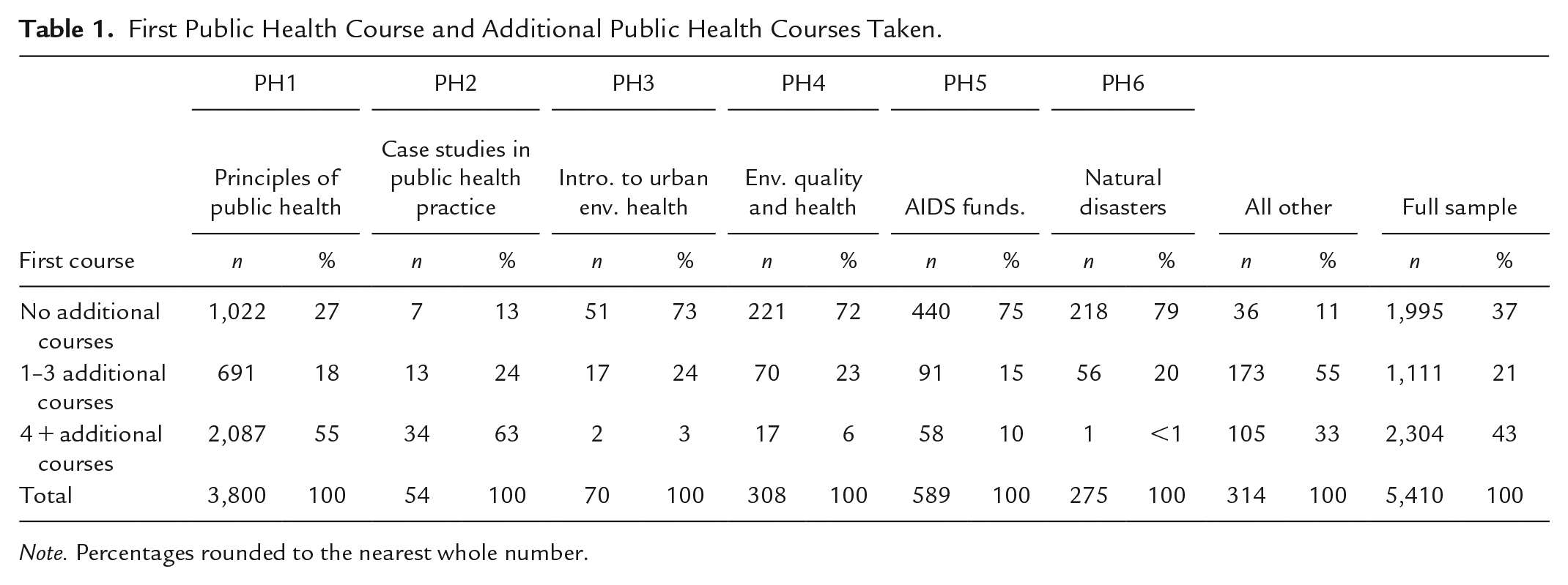
Overwhelmingly, students’ first public health course is PH1. Less frequently students’ first public health course is PH2, PH3, PH4, PH5, or PH6. About 37% (n = 1,995) of students who enroll in a single public health course never take additional public health courses and this is especially true for students whose first public health course is PH3, PH4, PH5, and PH6 (75%). Relatively few students take PH2 as their first course; but out of those students who start in PH2, 87% (n = 47) go on to take at least one additional public health course. Of the students who take PH1 as their first public health course, 73% (n = 2,778) take one or more additional public health courses (Table 1).
First Public Health Course and Additional Public Health Courses Taken.
Note. Percentages rounded to the nearest whole number.
Timing of Enrollment in PH2
More students went on to take PH2 after PH1 during years one and two in college, while enrollment in PH1 and PH2 during years three, four and beyond shows a different trend (Figure 1 and Supplemental Table S2). Direct persistence into PH2 from PH1 (students who took PH1 and in the subsequent quarter took PH2) increases as the years go on for public health majors (Figure 1A), though most public health majors enroll in PH1 and PH2 in their first year (Figure 1C). Furthermore, the percentage of public health majors who never take PH2 after taking PH1 decreases after year two (Figure 1A). For non-public health majors, direct persistence is highest in the second year (Figure 1B). Non-public health majors who enroll in PH1 in year three or beyond are less likely to enroll in PH2 at all, with approximately 65% of these students never taking PH2 (Figure 1B and Supplemental Table S2). The sheer number of students who enroll in PH1 and PH2 from a non-public health major relative to public health majors shows that these courses primarily serve non-majors, which in turn could provide opportunities for recruitment of new majors (Figure 1C and D).
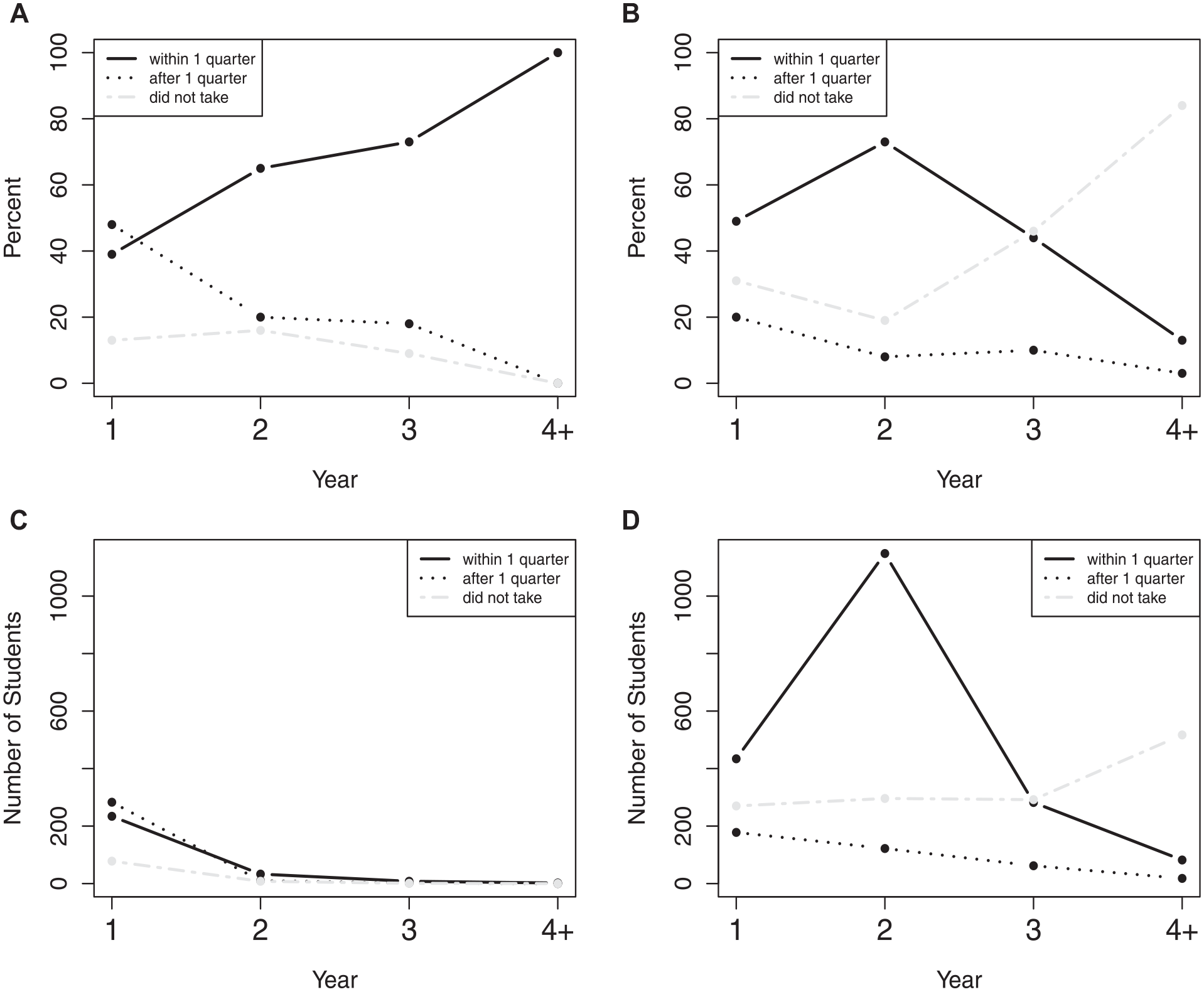
Percentage and number of students who persist into case studies in public health practice (PH2) after taking principles of public health (PH1) split by incoming major status: (A) incoming public health majors, (B) non-majors, (C) incoming public health majors, and (D) non-majors.
Major Recruitment and Retention through PH1 and PH2
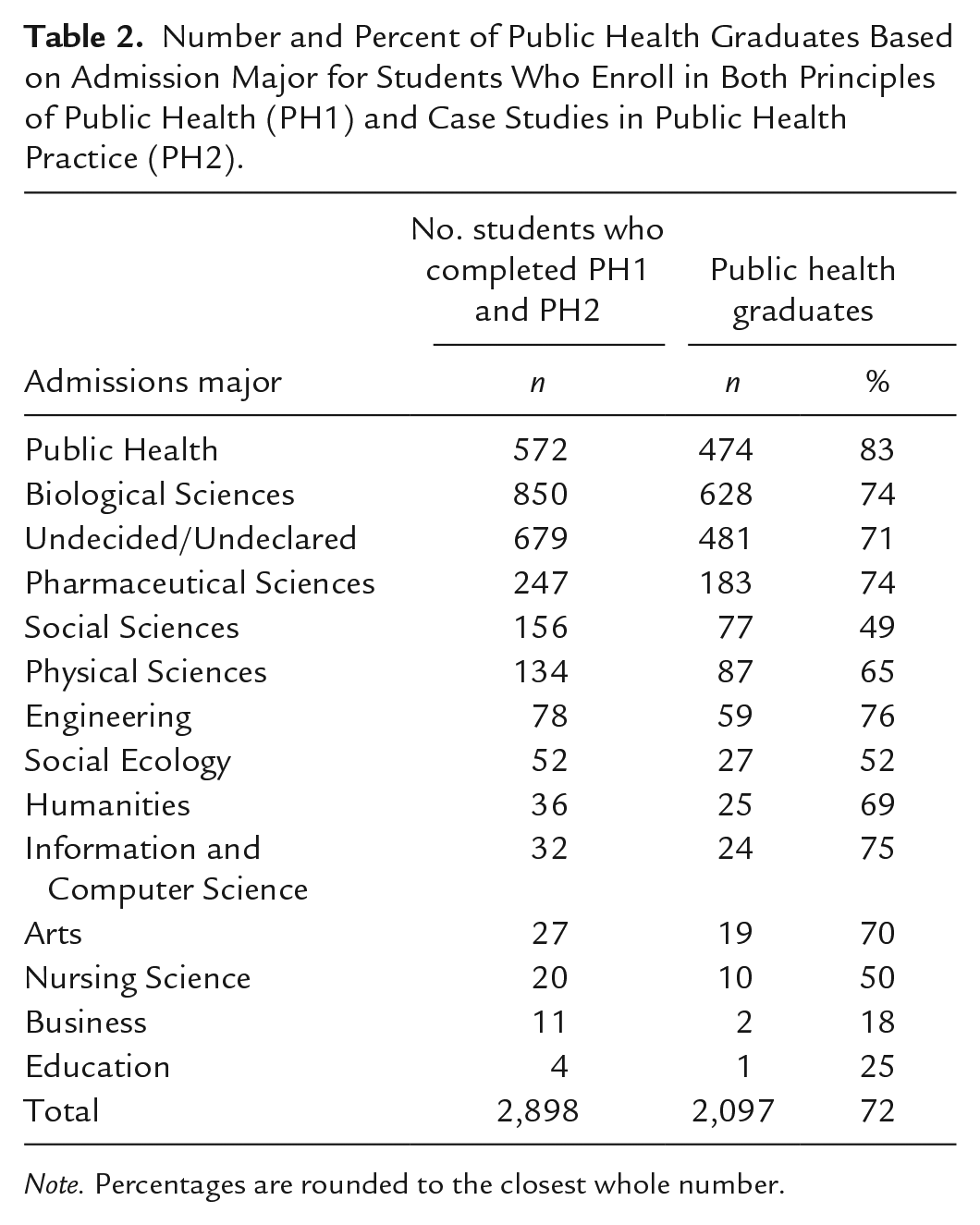
Seventy-two percent of students who enroll in both PH1 and PH2 graduate with a public health major regardless of their major at entry to the university. Out of these public health graduates, 23% started as PH majors and 77% transferred into the major. Students who started at the university as Biological Sciences, Pharmaceutical Sciences, and Physical Sciences majors and who took both PH1 and PH2 were more likely to graduate with a public health degree, compared to students from other majors, such as Education and Business (Table 2).
Number and Percent of Public Health Graduates Based on Admission Major for Students Who Enroll in Both Principles of Public Health (PH1) and Case Studies in Public Health Practice (PH2).
Note. Percentages are rounded to the closest whole number.
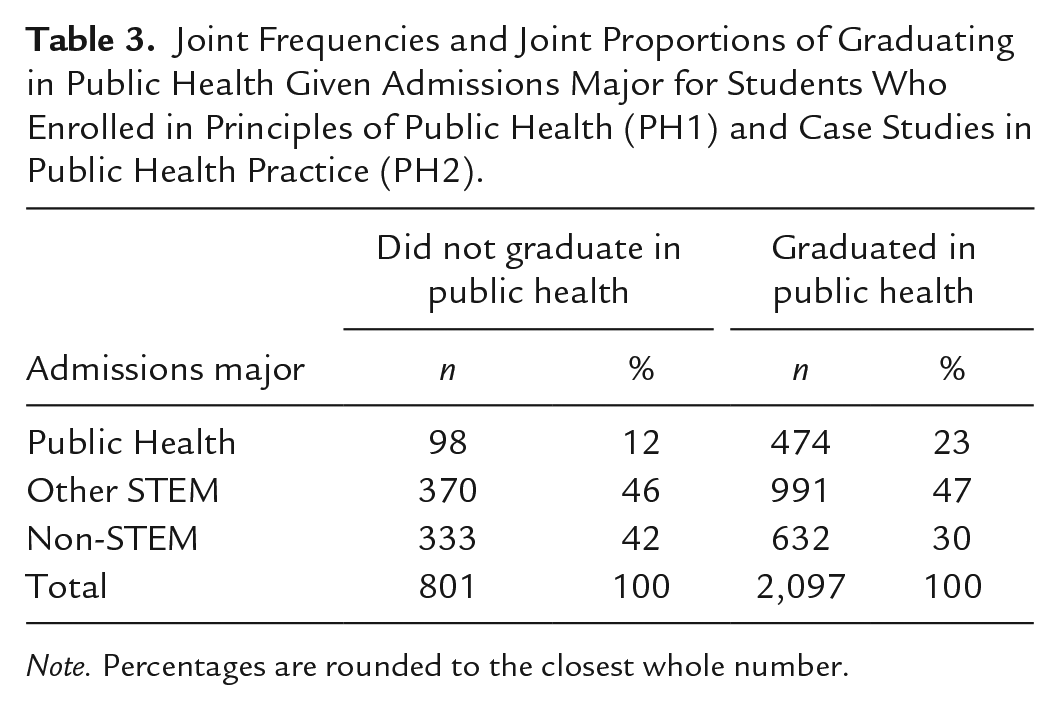
Fifty-five percent of students who enter the university as public health majors graduate with a degree in public health regardless of course-taking patterns. The graduation rate increases substantially for public health majors who complete PH1 and PH2 with 83% of those students graduating with a public health degree (Table 2). When we look at all public health graduates, we see that 47% of students transferred into Public Health from other Science, Technology, Engineering and Math (STEM) majors on campus while 30% are from non-STEM majors (Table 3).
Joint Frequencies and Joint Proportions of Graduating in Public Health Given Admissions Major for Students Who Enrolled in Principles of Public Health (PH1) and Case Studies in Public Health Practice (PH2).
Note. Percentages are rounded to the closest whole number.
Discussion
PH1 is by far the most common first public health course for students from any major and thus it may be the most important recruitment course for the major. Even though there are multiple possible entry points into the public health major, based on our analysis of historical data, most students enter the major through PH1. PH3, PH4, PH5, and PH6 do not appear to be functioning as major feeder courses, but instead may function as service courses for general education on campus, as well as requirements for the public health major. Though students may have different reasons for taking PH3, PH4, PH5 and PH6 compared to PH1 (e.g., fulfilling general education requirements vs. exploring the public health major), we suggest that interventions to increase major recruitment during PH3, PH4, PH5, and PH6 be considered. For example, sharing information about the public health major with enrolled students and inviting students to take PH1 in a future quarter could yield additional recruitment to the major. This recruitment approach could also be used by faculty at universities with public health majors and similar general education coursework in public health.
Additionally, approximately one-third of students do not go on to take PH2 after taking PH1, making PH1 their primary exposure to the public health major and discipline. Students who start the university as Business, Education, Social Sciences, and Nursing Science majors primarily enroll in PH1 out of personal interest, to fulfill university general education requirements, or to satisfy requirements of their own majors. For instance, all Nursing Science students are required to take PH1 for their major requirements. Given that just over 13% of all students in the five cohorts enrolled in PH1, and 19% enrolled in at least one public health course, the public health program is equipping a meaningful number of undergraduate students at the university with basic information about public health, health equity, and health-protective behaviors as recommended by the Institute of Medicine of the National Academies and the Consensus Conference on Undergraduate Public Health Education (Centers for Disease Control and Prevention, 2007; Gebbie et al., 2003). Based on the importance of the course as an entry point to the major, faculty assigned to teach PH1 should possess a strong connection to the broader public health curriculum and major to facilitate discussion of how PH1 material is further covered in subsequent coursework.
Students taking PH1 and PH2 during the first or second year in college are more likely to graduate with a public health degree. This finding has important implications as the public health program considers if and how to entice students to consider majoring in public health. Based on our analysis, recruitment and retention interventions during PH1 are warranted and could be as simple as inviting students to consider enrolling in PH2 the next quarter or reserving space in PH2 for students enrolled in PH1 during the previous quarter regardless of their major status. Another possible way to encourage students to enroll in PH2 after completing PH1 is to renumber the courses into a sequence (e.g., PH1 becomes PH1A and PH2 becomes PH1B). A module focused on public health career opportunities in PH1 may also attract students to the public health major. If there is not space in the course curriculum, a seminar (or set of workshops) may be a viable alternative to illuminate possible career opportunities in the field of public health. We found that recruitment and retention into public health occurs once students have completed PH2, with 72% of students who enroll in both PH1 and PH2 graduating with a public health degree. Specific interventions in PH2 should also be considered, such as discussing the public health major and career opportunities at the beginning of PH2 to further enhance recruitment and retention.
Our analyses revealed that students regularly change to the public health major from other majors on campus; 77% of public health graduates entered the university as a different major. There are multiple reasons that this may be the case. For instance, students applying for admission to the university may not be familiar with the field of public health or the myriad career opportunities. It is possible that as students from the Biological Sciences major, for example, explore non-major courses to satisfy their general education requirements, they discover other pre-health pathways that appeal to them through the public health major. Alternatively, students in other majors may not perceive a strong fit between their major coursework and their interests, aptitudes, and goals, leading them to seek out alternative majors such as public health. The public health major, which is inherently multidisciplinary and has overlap with other pre-health majors, as well as with STEM, Social Sciences, and Social Ecology majors, may have broad appeal in such situations. When students in other pre-health majors (e.g., Biological Sciences, Pharmaceutical Sciences, Nursing Science) change to the public health major at the university, they are often able to receive credit for their prior STEM coursework which reduces barriers to the change of major. In addition, students in other majors are often able to apply some of their prior major coursework as general education requirements, which helps pave the way for a seamless change to the public health major. These reasons may explain why the public health major receives a large number of students through the change of major process.
We found that the public health program retains a substantial portion of their students, especially once students complete both PH1 and PH2. Specifically, 83% of public health majors graduate with a degree in public health after completing PH1 and PH2, with only 23% of graduates starting in public health. The strong retention that we see in the public health major, especially among historically oppressed groups, does not match the trend that has been observed nationally in STEM (President’s Council of Advisors on Science and Technology, 2012). To reduce attrition, STEM programs in the United States have developed student success initiatives (e.g., Carver et al., 2017; Xu et al., 2018). One explanation for the public health program’s success with recruitment and retention of diverse students may be that the program has created an accessible pathway for students who have struggled with coursework or sense of belonging in other STEM majors to stay in science.
Future Directions and Limitations
It is worth exploring the academic performance and demographic characteristics of students who transfer in or out of the public health major. Such an investigation could lead to greater insights into those factors and supports that could help with recruitment, as well as retention. We plan to further delve into this topic in our future research. Another point of interest for future research is a comparison of public health curricula across universities.
This study is not without limitations. Specifically, we recognize that public health curricula can vary across universities. While PH1 and PH2 cover introductory principles of public health and applications, it is possible that the curriculum at other universities is structured differently. When considering the results of this study, local context is needed. That said, we feel that this paper is generalizable and can provide insights into how introductory public health courses can be used to recruit and retain students.
Though our results suggest that PH1 and PH2 are important courses for major recruitment and retention, we do not know if students were already interested in changing their major before taking PH1 and PH2 or if the courses themselves were the catalyst for the students to change their major. Another important point is that PH1 and PH2 are required for the major and to transfer into the major, so this course-taking behavior (or lack thereof) signals (dis)interest in the major. Follow-up surveys and interview studies could shed light on this question and help to establish patterns and understanding of student processes and thinking prior to enrolling in PH1 and PH2 and after completing the courses.
An additional limitation is that PH1 became a general education course during the final year of our study. Any students still enrolled at the university could adopt this newer catalog and that could affect enrollment trends in public health. Furthermore, as the public health program builds recruitment strategies and support programs, new majors are being developed on campus and other majors are working on retention of their own students – making major recruitment and retention a complex system with multiple moving parts.
Finally, the results of this study are correlational and not causal, therefore limiting the conclusions that can be drawn. Our results show public health course-taking and major enrollment patterns, but we do not know what motivated or guided students to enroll in public health courses or change their major to public health. Collecting data directly from students either through surveys or interviews could help to enhance our understanding of these trends.
Conclusions
This study has important implications for recruitment and retention of students in undergraduate public health degree programs. We found that 72% of students from any major who completed two introductory courses graduated with a degree in public health. Similarly, 83% of public health majors who completed two introductory courses graduated with a degree in public health. This finding suggests that the first two sequential courses in the major curriculum may be the most critical for recruitment of new students into the major and retention of current majors. Undergraduate public health degree programs wishing to grow their major and retain current students may benefit from interventions like those suggested in this paper.
The results of this study also suggest that offering public health courses as part of campus general education requirements is helping the campus to achieve the Institute of Medicine’s goal of providing all undergraduate students with the opportunity to take public health courses (Gebbie et al., 2003). We found that 19% of undergraduate students in the five cohorts took at least one public health course during their time at the university regardless of their major. Training undergraduates through introductory public health courses is even more critical today as communities work to address the most pressing public health challenges of our time, including global climate change, racism, the COVID-19 pandemic and future pandemics, and misinformation and disinformation about health.
Supplemental Material
sj-docx-1-php-10.1177_23733799231153167 – Supplemental material for Bolstering the Public Health Workforce: Recruitment and Retention of Public Health Majors
Supplemental material, sj-docx-1-php-10.1177_23733799231153167 for Bolstering the Public Health Workforce: Recruitment and Retention of Public Health Majors by Miryha Gould Runnerstrom, Kameryn Denaro and Brian Sato in Pedagogy in Health Promotion
Supplemental Material
sj-docx-2-php-10.1177_23733799231153167 – Supplemental material for Bolstering the Public Health Workforce: Recruitment and Retention of Public Health Majors
Supplemental material, sj-docx-2-php-10.1177_23733799231153167 for Bolstering the Public Health Workforce: Recruitment and Retention of Public Health Majors by Miryha Gould Runnerstrom, Kameryn Denaro and Brian Sato in Pedagogy in Health Promotion
Footnotes
Declaration of Conflicting Interests
The author(s) declared no potential conflicts of interest with respect to the research, authorship, and/or publication of this article.
Funding
The author(s) received no financial support for the research, authorship, and/or publication of this article.

References
Supplementary Material
Please find the following supplemental material available below.
For Open Access articles published under a Creative Commons License, all supplemental material carries the same license as the article it is associated with.
For non-Open Access articles published, all supplemental material carries a non-exclusive license, and permission requests for re-use of supplemental material or any part of supplemental material shall be sent directly to the copyright owner as specified in the copyright notice associated with the article.
