




Abstract
An important feature of public health education is integrating and synthesizing complex concepts across a variety of disciplines. Novel and effective approaches are required to successfully integrate learning and knowledge across Master of Public Health (MPH) programs. The MPH program at Western University uses Integrated Workshops (IWs) as a unique approach to integrating learning and knowledge. Occurring three times over the course of the 1-year program, these workshops provide an opportunity to reflect on past learning and integrate interdisciplinary knowledge from across courses to solve a complex public health problem. IWs are designed for learners to explore the intricacies of a problem by synthesizing their current knowledge along with new information delivered from experts and stakeholders. Learners pull information from across subjects and seek out new information (as needed) to problem-solve under time constraints—basic information is provided 12 hours in advance and new information is added during the workshop, in real-time. Learners develop key public health skills in critical thinking and decision making with incomplete data. Integrated workshops are an effective approach to training the next generation of public health leaders to handle the intricate problems at the heart of public health today.
Introduction
Public health professionals work in diverse and complex fields that require varied skills and competencies to succeed. The challenge for educating public health professionals is creating a comprehensive learning environment that prepares students for the complexities that exist within public health issues today (Fleming et al., 2009). Public health learners must navigate through traditional disciplines, engaging content, and integrate seemingly disparate skillsets to tackle complex problems.
Public health professionals need to be able to identify, prevent, and solve complicated or “wicked” problems—problems without a clear definition nor a clear course of action to fix (Kreuter et al., 2004). Continuous evaluation, innovation, and improvement of teaching methods can assist students in achieving these goals (Council on Education for Public Health, 2020).
Workshops are rooted in the concept of group learning, and rely on active participation, leadership, evaluation, and cooperation (Gupte et al., n.d.). When workshops include collaborative aspects, they can lead to higher quality learning outcomes compared to individual work (Bonwell & Eison, 1991). Utilizing workshops as an educational tool in the classroom has a positive effect on students’ attitudes and significant improvements in knowledge uptake (Barkley, 2009). Active engagement and participation in workshops enhance the exploration of new ideas and complex concepts, allowing for meaningful interaction with concepts beyond traditional classroom methods (Bonwell & Eison, 1991; Gupte et al., n.d.). This type of learning fosters critical thinking by enabling students to apply knowledge to situations where they may be less knowledgeable (Hotchkiss et al., 2013). In well-planned workshops, students experience problem solving and how to apply critical thinking skills broadly.
The MPH Program at Western University
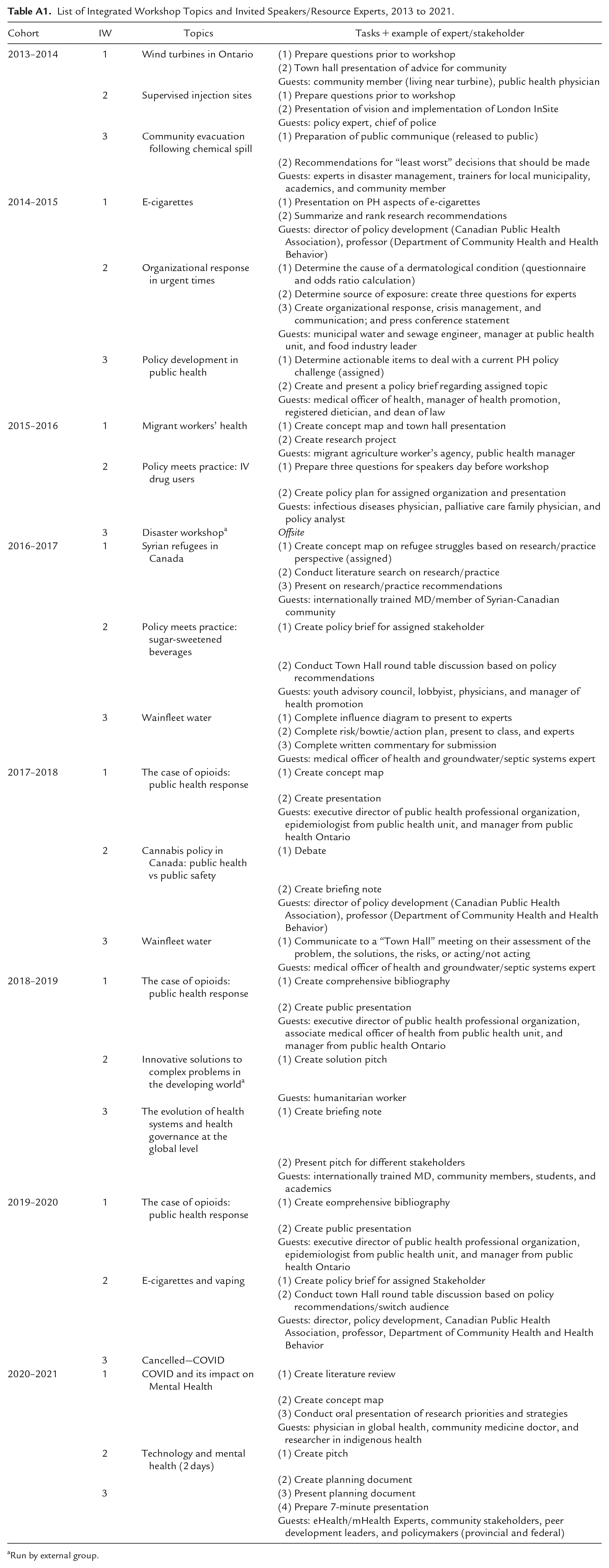
Western University’s MPH program is a unique 12-month public health program founded on competencies integral to public health, such as problem identification and priority setting. These skills are core competencies within any MPH program and are essential for students in the field of public health (Public Health Agency of Canada [PHAC], 2007). To master these skills, students must go beyond classroom learning and consider the integration of concepts along with the impacts on communities, policies, and the environment. The MPH program utilizes case-based pedagogy and team-based learning to enhance the uptake of knowledge and development of key public health skills (Sibbald et al., 2016). The Western MPH program also uses three daylong integrated workshops (IWs) to bridge learning done within individual classes and foster integrated learning across courses within the program (Sibbald et al., 2016). IWs give students an opportunity to practice essential public health skills in a simulated but realistic context and help prepare learners for the challenges that they will face in the workforce. Held once in the fall semester and twice in the winter semester, each IW presents students with a progressively more complex, real-world public health challenge. Within the Western MPH program, students work in pre-established learning teams for the duration of the program, including during IWs (Sibbald et al., 2016). IWs are evaluated on a pass/fail basis as a team. IW#1 challenges students to find, synthesize, and integrate evidence around a complex (but often demarcated) issue: such as e-cigarettes and vaping. IW#2 bring in more layers of complexity, forcing students to consider evidence within a broader social and political context (eg: taxation of sugar sweetened beverage). Finally, IW#3 integrates across all courses in the program through a complex scenario (such as an emergency evacuation) requiring students to synthesize evidence, make quick decisions, communicate effectively—with consideration of all social-ecological factors (see Table A1 in Appendix A for a summary of IWs across the years). IWs are a core part of the Western MPH program’s curriculum; student participation in all three is compulsory. The MPH program has run 23 IWs since 2013; 21 have been organized and delieverd by MPH faculty and two were run by external groups.
Components of an IW
IWs within the Western MPH program have four key components: (1) a multidisciplinary perspective; (2) incomplete information about the nature, scope, and extent of a specific public health issue; (3) an overarching goal with progressive more complex and challenging objectives to meet; and (4) a well-designed deliverable to work toward meaningful and relevant solutions.
A Multidisciplinary Perspective
Achieving a multidisciplinary perspective is done in a number of ways. IWs are planned and facilitated by the interdisciplinary faculty within the Western MPH program. This informs the way in which a topic is chosen and presented, the approach to defining and working to “solve” the problem, as well as the learning deliverables and outcomes of students. Content experts and stakeholders with diverse, and sometimes opposing, viewpoints are invited to play a key role in the workshop. For example, in our IW on wind turbines, we had a community member (living near wind turbines), and public health physician explaining the science behind wind turbines. IWs often start with a panel discussion where multiple viewpoints are presented. Faculty members are also used as panelists or experts and sometimes role-play as a protagonist or represent a particular position or voice (e.g., a disgruntled politician, an industry representative). Experts and stakeholders often stay the whole day, supporting learners in the development of deliverables, and providing feedback throughout the day as students seek out and synthesize information.
Incomplete Information
IWs allow students to trial new knowledge and skills obtained in the program while also applying knowledge they bring from previous field(s) of education and practice. The information learners have about the nature, scope, and extent of the specific issue is incomplete or conflicting by design. Learners are provided limited background material the afternoon prior to the start of the workshop. During the workshop, they are provided with additional information—mostly through discussion and dialog with the experts and stakeholders. Learners are also required to do their own research to seek out new information (searching online, asking faculty, calling on experts/guests), however, this must be done in an efficient way since timing is fast-paced (to mimick real-world decision making). IWs are designed to require dynamic engagement, forcing students to work with incomplete information to ask poignant questions, to explore unique (often imperfect) alternatives, and to come up with a feasible and defensible solution.
Objectives and an Overarching Goal
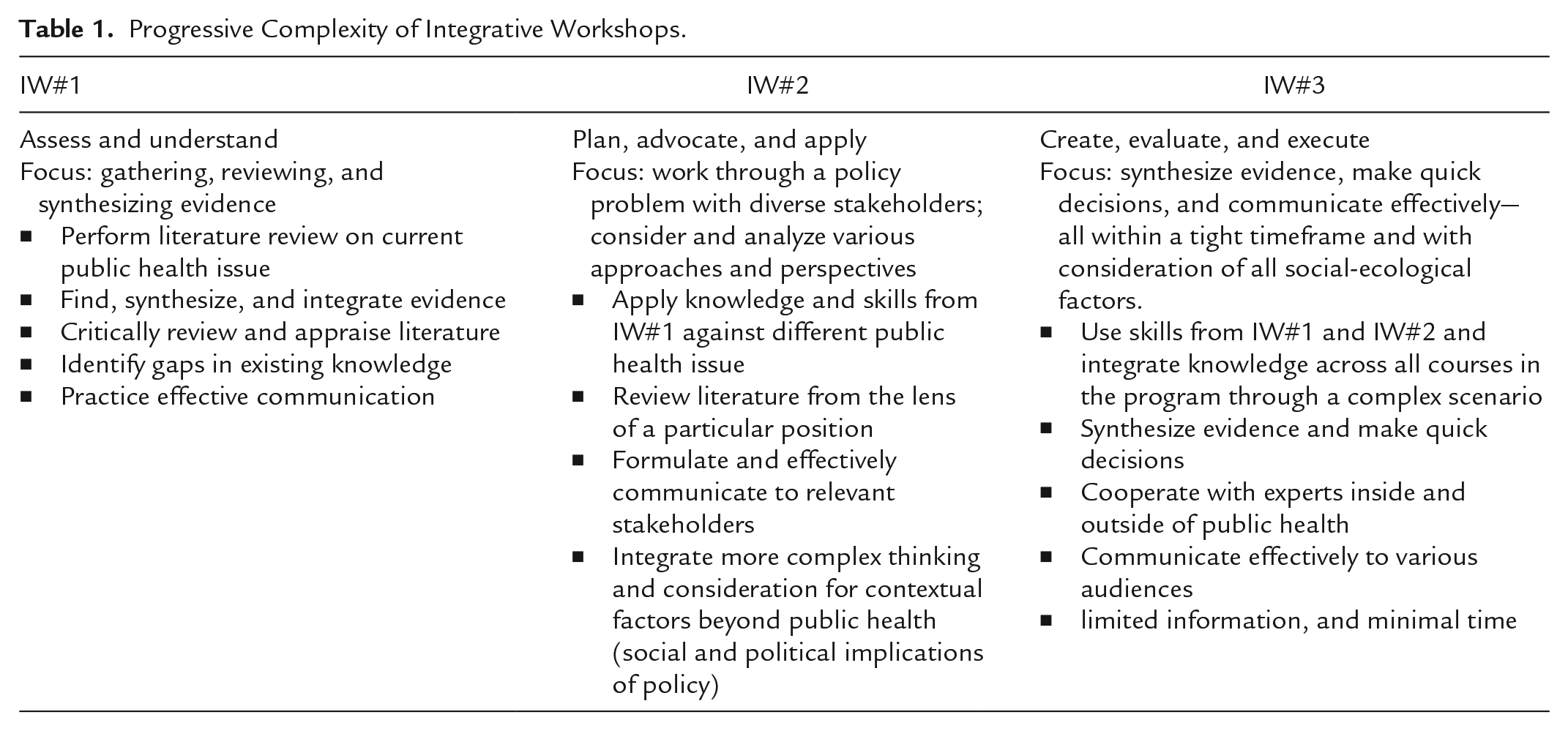
All three IWs share the common goal of synthesizing coursework through the exploration of a real-world “wicked” public health problem; each IW has its own objectives, which are progressively more challenging to align with the courses being taught and the skills being developed. Each of the three IWs have a specific objective that takes into account the different perspectives students are exploring in their coursework as well as the growing skillset students are gathering throughout the program (see Table 1). The first IW centers on assessing current public health issues, focusing on critical review and synthesis of existing literature; there is a focus on gathering, reviewing, and synthesizing evidence, along with communicating it effectively. The second IW focuses on application of knowledge to a policy issue, often requiring students to formulate and advocate for a particular policy position. Students integrate more complex thinking and consideration for contextual factors. The final IW involves the most complex scenario that necessitates cooperation with experts outside of traditional public health roles (eg: industry representatives and politicians) in an urgent situation, with limited information, and minimal time. The third IW is intended to be a culminating experience that incorporates learning from across the program and is conducted near the completion of all coursework. For example, the final IW requires students to respond to a natural disaster or plan for a massive policy change with limited evidence or agreement (e.g., multiple community evacuation decisions following a chemical spill). Skills nurtured in IWs include identifying and conceptualizing problems, oral and written communication tailored to a specific audience, evaluation of public health programs and policies, collaboration and negotiation, advocacy, and decision-making all within a complex and changing context.
Progressive Complexity of Integrative Workshops.
Meaningful Deliverables
In IWs, students work toward meaningful and relevant solutions that are feasible within the context and defensible to experts, faculty, and their peers. Deliverables for the day are intentionally designed to engage all learners, and much like the IWs themselves, deliverables become more complex and involved throughout the year. Most IWs leave the specific details of the deliverables unknown to students until the day of the IW to mimic real-world decision making and simulate a high-pressure situation. Common deliverables for IW#1 include a research summary and a concept map. While most of the work during an IW is done as a team, team members must also work independently on various components of the task to ensure the deliverable is completed on time. This becomes more evident in the deliverables for IW#2 which often require teams to delegate tasks to complete work on time (eg: a stakeholder analysis, a presentation, along with a policy brief, and a media statement). IW#3 builds on deliverables students have had exposure to during the program, but adds complexity through a tight timeline and more demanding requirements. Through meaningful deliverables, learning teams may be required to represent the interests of an assigned stakeholder position; this occassionally means being “forced” into a role that may counter their own personal position or values—for example, advocating for “big soda” or supporting members of the public who are opposed to a public health measure. Requiring students to adopt and adhere to a stakeholder position enhances learning opportunities, creative thinking, and understanding of differing perspectives. Feedback is an essential component of IWs; each deliverable is appraised by the other learning teams, experts, and faculty to assess the appropriateness and feasibility of their proposed solutions.
A newer addition to our IW deliverables has been the addition of individual work to support assessment and attainment of public health competencies. Each student writes a short reflection paper on the working of their team, commenting on the contribution of different partners, what worked well and what didn’t, and how to improve team functioning in the future.
Case Example: Policy-Focused IW on E-Cigarettes and Vaping
To explore how IWs are conducted in greater depth, this section outlines one of the policy-focused IWs run by the Western MPH program. IW#2 was designed to address the growing public health concern surrounding vaping and e-cigarettes. At 1:00 pm on the day prior to the scheduled IW, learners received limited information about the workshop. They were asked to read relevant peer-reviewed articles, were provided a brief agenda and details for the day, and were given instructions to prepare three questions to facilitate critical thinking and discussion with the panelists (see Appendix B for description of the IW, tasks/deliverables, and guests).
The IW began at 8:30 am with a brief introduction to the topic and review of the day’s events. A panel of experts and stakeholders immediately followed. For this IW, the panel included representatives from the local health unit, a physician from Smoke-Free Canada, a representative for smoke-free campus student organizations, and a vaping researcher. Given the controversy associated with vaping and tobacco products, we also had a faculty member representing a pro-vaping perspective. Each panelist had 15 minutes to present their perspective on the issue, after which students were given an opportunity to ask questions. The purpose of the panel was to provide both an overview of the different positions and expert insight into the research and current evidence. Following the panel presentations, learners were given instructions about their specific task. Each learning team was assigned a unique stakeholder position advocating for or against the use of vaping and e-cigarettes. Stakeholder groups included industry, professional, and not-for-profit perspectives (e.g., Juul, Vape-MD, and Drug Free Kids Canada). Teams were provided with a brief description of their stakeholder positions and were encouraged to further research their assigned stakeholder group. For this IW, each learning team was charged with developing a policy brief from the perspective of their assigned stakeholder, and preparing a brief pitch presentation for a government committee (in the IW, this was called the “Standing Committee on Health Promotion”). Specifically, students were asked to use the policy brief to propose solutions for the regulation of vaping products. In the Western MPH program, students received instruction on how to prepare policy briefs throughout their coursework, but in programs where this skill is not taught, students may require training in advance or be provided with a template to guide this activity. Teams were informed the presentation would occur later in the day and were given just under 2 hours to prepare for it. During the preparation of the policy brief and presentation, learning teams could consult with the invited experts and faculty present.
A mere 30 minutes before the presentations were set to occur, students were informed that plans for the presentations had changed. Rather than presenting to the “Standing Committee on Health Promotion,” they would be presenting to members of a “Youth Advisory Committee.” As a key demographic targeted by vape marketing, youth are disproportionately affected by the growing prevalence of vaping and e-cigarettes (Al-Hamdani et al., 2020; Goldenson et al., 2019). Presenting to youth forced students to consider a different, yet crucial perspective on vaping. It also required teams to tailor their completed presentation to inform a youth audience, communicating their ideas in a way that was audience appropriate (Schulich School of Medicine and Dentistry, 2020). For this IW, members of an already established and active youth organization, the Human Environments Analysis Laboratory Youth Advisory Committee (HEALYAC), were invited. The HEALYAC had independently identified vaping as one of its priority issues and were active in advocating for vaping regulations in our community.
One representative from each team presented their proposal to the youth advisory committee from their assigned stakeholder’s position. The committee posed questions and responded to each stakeholder’s ideas and proposal. After each team presented, there was an open discussion among all participants, including MPH students, the experts, and faculty. This open dialog began with discussion of the positions of the stakeholders, potential policy outcomes, challenges, and key learnings. The discussion concluded with an opportunity for faculty, students, and guests to debrief and reflect on the overall learnings and objectives of this IW.
Learning Opportunities in IWs
The use of IWs provides students with rich and integrated learning that can be difficult to attain in a traditional classroom approach. Based on our experience with IWs, feedback from current students during IW debriefs, and feedback from our graduates working in public health, IWs provide a unique training opportunity that is useful to achieve numerous learning outcomes. Leaners, faculty, and guests alike appreciate the planning, organization, and deliberate attention paid to interprofessional and interdisciplinary learning. We have learned several important lessons in the use of IWs as a key component of the Western MPH program.
First, learners benefit when they are given a multifaceted challenge with real-world constraints. Teams must work quickly and collaborate efficiently to formulate a feasible solution. Bringing in experts and stakeholders from different backgrounds/professions supports learners in understanding and appreciating the diversity of roles and perspectives in public health (Johnson et al., 2015). Working with experts and stakeholders exposes students to professionals outside of the traditional public health field, and their unique perspectives within a public health context (Ammerman et al., 2014). Of particular importance is the incorporation of perspectives that may represent marginalized or underrepresented views such as a community member impacted by a public health issue (Eckstrand et al., 2016). It is also important to try and build in challenges that may oppose public health action. For example, in an IW on wind turbines, we recruited an expert on wind turbines who could explain the science but also a resident of a town surrounded by turbines to highlight the lived experience. In this case, there was no clear solution; experts said there were no health risks while the resident had many examples of how her health had been impacted. Through this, students were given an opportunity to consider a more holistic approach to “expertise” and a broad definition of evidence that should include lived experience (Rycroft-Malone et al., 2004).
Second, incomplete and imperfect information facilitates students’ critical thinking skills and supports learning strategies to tackle complex public health problems. Learners must find and critically appraise literature on a given topic, identify gaps in knowledge, and work to reduce uncertainty all within a strict timeframe. To enrich the student experience, IWs can be structured to limit the type or quantity of research that can be used. Having access to “the best” and highest quality evidence is a privilege that is not held by many who work in public health (Brownson et al., 2009). Further, learners must be critical of what is taken to be quality evidence (Maudsley & Strivens, 2001). Often, high quality, context-specific information is lacking or inaccessible when needed (Parsons et al., 2003).
Third, IWs support higher order thinking by deliberately scaffolding skill development and knowledge application across IWs (Anderson, 2001). While the topic of each IW varies, the approach to expand the complexity of the problem and demands of students with each subsequent IW matches the increase of knowledge obtained by students in their coursework and facilitates synthesis across courses. Participation in three IWs per year allows students the opportunity to learn from prior IWs and hone their skills to apply, synthesize, and create new knowledge while working cooperatively under constraint. Repeating similar IW formats is advantageous because it provides students the opportunity to prepare for and become accustomed to the process, increasing the chance of learning success for students (Morris, 2016). To this end, the first IW requires students to apply newly developed skills of critical review and knowledge synthesis. The second IW aims to assist students with working through a policy problem with diverse stakeholders to consider and analyze various approaches and perspectives. The third IW comprehensively addresses learning from across the entire program and integrates the breadth of students’ knowledge.
Student feedback suggests that in addition to providing students with an opportunity to apply the skills and knowledge they have acquired in the classroom, IWs help to refine advocacy skills and build their confidence in communiation skills (e.g., being required to present to different audiences without much time to prepare). Informally, students appreciate the interaction and networking with experts that the IWs provide. Experts also appreciate coming into the classroom, and engaging with students in such an interactive way. From the perspective of faculty, IWs allow students to demonstrate competencies and identify areas that may require additional instruction or refinement. Faculty also benefit from the networking and growing connections with experts in the field. We recommend IWs be organized and delivered by faculty and staff internal to the program who have both an intimate knowledge of the students and the curriculum. Future research and quality improvement research should look more critically and rigorously at the value-added by IWs within the MPH program at Western University.
Limitations
Further research is needed to better understand which components of IWs are essential to create an exceptional learning experience. Our work demonstrates, anecdotally, the process and benefits of using IWs in health education. More rigorous research is required to determine the impact IWs have on specific outcomes such as overall learning and competency attainment. It would also be relevant to explore the implications of this type of learning on employment and job-related skills. As well, while IW can be run virtually, it is unclear how the recent shift to online learning (from the COVID-19 pandemic) might impact the potential benefits of the IW. Finally, in future years, the Western MPH program would benefit from a more formal assessment of practice through student and faculty evaluation at the end of each workshop.
Conclusion
Public health is a notoriously complicated field. Public health leaders require thoughtful and intricate framing. The purpose of IWs in the Western MPH program is to provide a safe yet challenging interdisciplinary education space in which key concepts from courses can be integrated and applied in real-time, with limited information, to an increasingly complex public health challenge. Students benefit from the active learning components that are built into IWs, which encourage interprofessional and collaborative learning and knowledge application while exposing learners to the intricacies of a problem from diverse perspectives. Learners must synthesize information across subjects and through expert opinion, challenging tasks, and limited oversight from faculty, apply this knowledge to problem-solve under the simulation of real-world constraints. The unique format of the IWs allow for the cultivation of skills and competencies such as problem-solving, oral and written communication, advocacy, and teamwork that will aid learners in their public health careers. Ultimately, IWs provide a learning environment that simulates the real-world complexity of public health while providing students with an experience that challenges the knowledge and skills they are acquiring to contribute to their overall development as public health leaders.
Footnotes
Appendix A
List of Integrated Workshop Topics and Invited Speakers/Resource Experts, 2013 to 2021.
| Cohort | IW | Topics | Tasks + example of expert/stakeholder |
|---|---|---|---|
| 2013–2014 | 1 | Wind turbines in Ontario | (1) Prepare questions prior to workshop |
| (2) Town hall presentation of advice for community | |||
| Guests: community member (living near turbine), public health physician | |||
| 2 | Supervised injection sites | (1) Prepare questions prior to workshop | |
| (2) Presentation of vision and implementation of London InSite | |||
| Guests: policy expert, chief of police | |||
| 3 | Community evacuation following chemical spill | (1) Preparation of public communique (released to public) | |
| (2) Recommendations for “least worst” decisions that should be made | |||
| Guests: experts in disaster management, trainers for local municipality, academics, and community member | |||
| 2014–2015 | 1 | E-cigarettes | (1) Presentation on PH aspects of e-cigarettes |
| (2) Summarize and rank research recommendations | |||
| Guests: director of policy development (Canadian Public Health Association), professor (Department of Community Health and Health Behavior) | |||
| 2 | Organizational response in urgent times | (1) Determine the cause of a dermatological condition (questionnaire and odds ratio calculation) | |
| (2) Determine source of exposure: create three questions for experts | |||
| (3) Create organizational response, crisis management, and communication; and press conference statement | |||
| Guests: municipal water and sewage engineer, manager at public health unit, and food industry leader | |||
| 3 | Policy development in public health | (1) Determine actionable items to deal with a current PH policy challenge (assigned) | |
| (2) Create and present a policy brief regarding assigned topic | |||
| Guests: medical officer of health, manager of health promotion, registered dietician, and dean of law | |||
| 2015–2016 | 1 | Migrant workers’ health | (1) Create concept map and town hall presentation |
| (2) Create research project | |||
| Guests: migrant agriculture worker’s agency, public health manager | |||
| 2 | Policy meets practice: IV drug users | (1) Prepare three questions for speakers day before workshop | |
| (2) Create policy plan for assigned organization and presentation | |||
| Guests: infectious diseases physician, palliative care family physician, and policy analyst | |||
| 3 | Disaster workshop a | Offsite | |
| 2016–2017 | 1 | Syrian refugees in Canada | (1) Create concept map on refugee struggles based on research/practice perspective (assigned) |
| (2) Conduct literature search on research/practice | |||
| (3) Present on research/practice recommendations | |||
| Guests: internationally trained MD/member of Syrian-Canadian community | |||
| 2 | Policy meets practice: sugar-sweetened beverages | (1) Create policy brief for assigned stakeholder | |
| (2) Conduct Town Hall round table discussion based on policy recommendations | |||
| Guests: youth advisory council, lobbyist, physicians, and manager of health promotion | |||
| 3 | Wainfleet water | (1) Complete influence diagram to present to experts | |
| (2) Complete risk/bowtie/action plan, present to class, and experts | |||
| (3) Complete written commentary for submission | |||
| Guests: medical officer of health and groundwater/septic systems expert | |||
| 2017–2018 | 1 | The case of opioids: public health response | (1) Create concept map |
| (2) Create presentation | |||
| Guests: executive director of public health professional organization, epidemiologist from public health unit, and manager from public health Ontario | |||
| 2 | Cannabis policy in Canada: public health vs public safety | (1) Debate | |
| (2) Create briefing note | |||
| Guests: director of policy development (Canadian Public Health Association), professor (Department of Community Health and Health Behavior) | |||
| 3 | Wainfleet water | (1) Communicate to a “Town Hall” meeting on their assessment of the problem, the solutions, the risks, or acting/not acting | |
| Guests: medical officer of health and groundwater/septic systems expert | |||
| 2018–2019 | 1 | The case of opioids: public health response | (1) Create comprehensive bibliography |
| (2) Create public presentation | |||
| Guests: executive director of public health professional organization, associate medical officer of health from public health unit, and manager from public health Ontario | |||
| 2 | Innovative solutions to complex problems in the developing world a | (1) Create solution pitch | |
| Guests: humanitarian worker | |||
| 3 | The evolution of health systems and health governance at the global level | (1) Create briefing note | |
| (2) Present pitch for different stakeholders | |||
| Guests: internationally trained MD, community members, students, and academics | |||
| 2019–2020 | 1 | The case of opioids: public health response | (1) Create eomprehensive bibliography |
| (2) Create public presentation | |||
| Guests: executive director of public health professional organization, epidemiologist from public health unit, and manager from public health Ontario | |||
| 2 | E-cigarettes and vaping | (1) Create policy brief for assigned Stakeholder | |
| (2) Conduct town Hall round table discussion based on policy recommendations/switch audience | |||
| Guests: director, policy development, Canadian Public Health Association, professor, Department of Community Health and Health Behavior | |||
| 3 | Cancelled—COVID | ||
| 2020–2021 | 1 | COVID and its impact on Mental Health | (1) Create literature review |
| (2) Create concept map | |||
| (3) Conduct oral presentation of research priorities and strategies | |||
| Guests: physician in global health, community medicine doctor, and researcher in indigenous health | |||
| 2 | Technology and mental health (2 days) | (1) Create pitch | |
| (2) Create planning document | |||
| 3 | (3) Present planning document | ||
| (4) Prepare 7-minute presentation | |||
| Guests: eHealth/mHealth Experts, community stakeholders, peer development leaders, and policymakers (provincial and federal) |
Run by external group.
Appendix B
Declaration of Conflicting Interests
The author(s) declared no potential conflicts of interest with respect to the research, authorship, and/or publication of this article.
Funding
The author(s) received no financial support for the research, authorship, and/or publication of this article.
