




Abstract
Tackling complex twenty-first century global health challenges requires crossdisciplinary collaborations that extend beyond physical classrooms and across continents. The Transdisciplinary Education and Community Health Collaboratory (TEaCH CoLab) is a global teaching co-op established by health promotion and humanities faculty at three universities (Waterford Institute of Technology and the Institute of Technology, Carlow in Ireland, and the University of Washington, Bothell in the U.S.). The primary goals of TEaCH CoLab are to enhance global learning and problem-solving among the next generation of community and public health practitioners, to improve public health teaching (with a focus on digital pedagogy), and to increase empathy and community-connectedness. In this descriptive article, we present our program model and lessons learned from the first three years of collaboration to provide insights into how such capacity-building projects are established and sustained over time and across diverse geographical, cultural and temporal landscapes. Collaboration happens primarily online through academic and community partnerships, collaborative online learning, and pedagogy discussion and development. Students get to engage with course content and experiential learning that is part of a shared, global curriculum which emphasizes social justice, health equity, cultural humility and anti-racism, and advocacy. Our “lessons for the field” are collective, practice-based reflections by members of TEaCH CoLab based on their experiences and their involvement in development and facilitation. Our model for learning may help other health promotion scholars and practitioners develop meaningful global learning experiences that strengthen the interconnectedness of praxis, pedagogy, and communities.
Introduction
Institutes of higher education are continually challenged to adapt to provide unique learning opportunities that meet market demands, and that integrate advanced technologies into teaching and learning (Nair & Henning, 2017). According to a recent report by the National Academies of Sciences, Engineering, and Medicine (2018), the education received by health professionals “needs a transformation” to ensure that graduates are better equipped with the skills and knowledge necessary to address “real world” situations (p.1). Tackling twenty-first century population health challenges requires what some term “transdisciplinary imagination,” or the generation of new conceptual frameworks, hypotheses, theories, models, methods, and solutions through multi-disciplinary collaborations that transcend beyond disciplinary boundaries (Brown et al., 2010, p.4).
While the development of global competence has always been a goal of higher Education, this has been traditionally achieved via study abroad programs. However, we know that most university students are not able to engage in such programs (Esche, 2018) due to factors such as an inability to travel abroad for extended periods of time; the expense of study abroad programs; the fear of experiencing discrimination abroad; historical trauma; and students’ lack of knowledge about resources that can support their ability to study abroad (University of Kansas, n.d.). Study abroad programs are also problematic for student athletes (Reed, 2016). In fact, the world’s largest and most diverse non-profit association dedicated to international education and exchange (NAFSA; www.nafsa.org), recently reported that only 1.5% of U.S. students enrolled in study abroad programs in their colleges and universities, and the majority of these students identify as White (NAFSA: Association of International Educators, n.d.).
In recent years, Collaborative Online International Learning (COIL), another model for global exchange and collaboration, has been developed. COIL leverages technology to connect students, professors, and organizations in different countries online to work on projects and tackle local-to-global challenges collectively as part of their academic coursework (Appiah-Kubi & Annan, 2020; Hughes Caplow & Kardash, 1995; Marcillo-Gómez & Desilus, 2016). It has only been possible since the rise of the internet (and is therefore internet-dependent) and courses are predominantly in English (Reed, 2016). However, COIL has proliferated with the advent of virtual learning environments (VLEs), learning management systems (LMSs) and massive open online courses (MOOCs) (Esche, 2018). While classes may be fully online, blended formats are more common and comprise of in-person teaching in both institutions that is complemented by collaborative student work online (Coil Consulting, 2021.). Notably, while travel abroad programs may sometimes be integrated into COIL, COIL provides cross-cultural learning opportunities for students who otherwise may not be in a position to avail of such programs (Esche, 2018). COIL has also evolved to include community partners local to the higher education institutions (see Figure 1). Broadening students’ world views through community engagement and working in and across communities and cultures can help students to gain an understanding of, and capacity to address the most pressing economic, health, social, and environmental challenges facing the world today. In fact, the recent “Declaration on University Global Engagement” calls on the higher education community to commit to developing global competence in all students through virtual mobility opportunities such as COIL (Association of Public & Land-Grant Universities, n.d.).
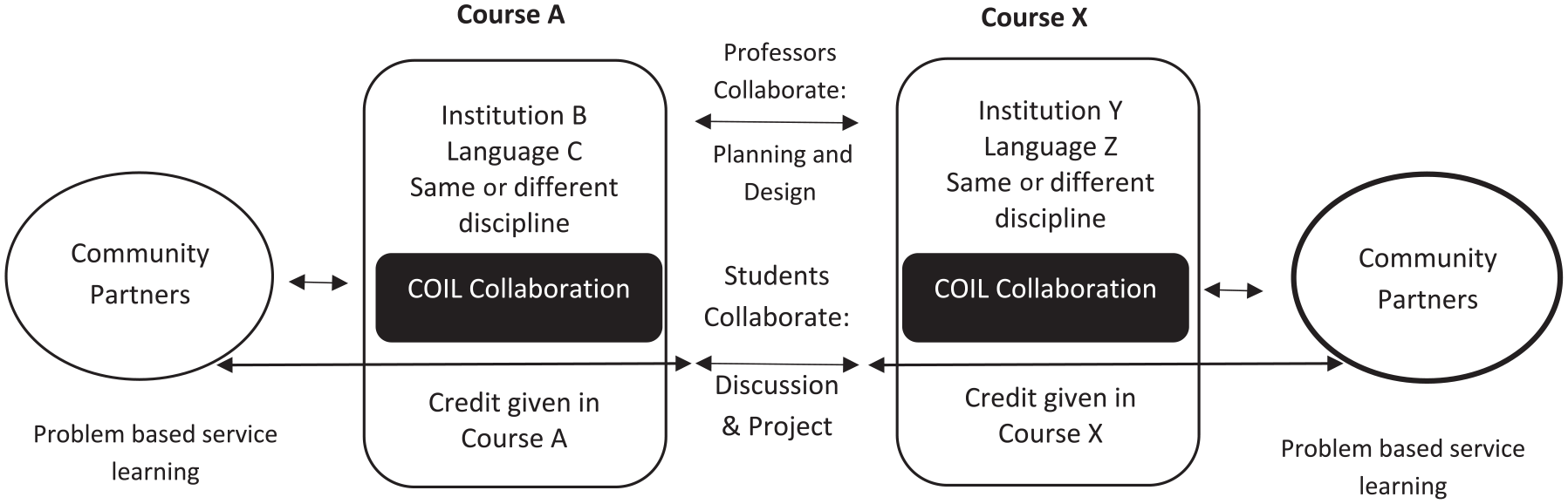
TEaCH CoLab Model. Adaptation based on SUNY’s COIL model (The SUNY COIL Centre, 2021a, 2021b).
The purpose of this paper is to share insights from Irish and U.S. university faculty participating in a multi-institutional, interdisciplinary, and international teaching collaborative (the Transdisciplinary Education and Community Health Collaboratory, or TEaCH CoLab) on implementing COIL in higher education and the health sciences using a case-based approach. We present our program model and lessons learned from the first three years of collaboration to offer some promising practices for how partnerships are developed and strengthened and how projects and assignments are established and sustained over time and across diverse geographical, cultural and temporal landscapes. This paper seeks to add to the growing body of knowledge in the use of COIL in the field of health promotion and public health education and may support others who wish to integrate COIL into health promotion curriculum development.
Background and Theoretical Frameworks
In this digital age, we cannot ignore the impact of world issues in daily living. Local problems have global implications, and these problems cannot be solved by individuals in a single country. The term “global” is not just a geographical marker; rather, it highlights the interconnectedness of students’ social, economic, cultural, political, and ecological environments, and enables them to think through their own learning and experiences within a broader context. While manifesting in a variety of ways, global learning is primarily a way of thinking about these interconnections. As Van Velzer (2019) asserts, intrinsically, global learning helps one develop awareness of one’s own identity, culture and beliefs, and how these connect with the wider world. Extrinsically, global learning amplifies students’ social awareness and empathy, encourages them to respect the diversity of perspectives, and the cultures, of others, and enables them to build relationships and social capital (State University of New York [SUNY], n.d.). Popular models of global learning still include study abroad and international service-learning. However, strategies are expanding to include more paradigms of discovery for place-bound students, including domestic “study away” opportunities as well as COIL approaches that leverage technologies to provide cross-cultural engagement, problem-based learning, and civic development (Sutton, 2018; Van Velzer, 2019).
COIL is defined by SUNY, one of its earliest proponents, as “an approach that brings students and professors together across cultures to learn, discuss and collaborate as part of their class” (SUNY, n.d.). Faculty members partner in order to design the experience, and students partner to learn and collaborate on the activities designed. COIL becomes part of the class, building capacity for students to experience deep, transformative and intercultural learning. de Castro and colleagues at the University of Washington (2019) differentiate COIL from other forms of online and global learning by the following: (1) faculty from different academic institutions located in different countries co-create, co-teach, and co-manage an entire course, or portion of a course, over a specified time frame; (2) students in different countries participate in the course, yet remain enrolled and obtain credit at their own academic institution; (3) students are evaluated and graded by their own in-country faculty members, which allows for learning objectives to be distinct between student groups; (4) students engage in highly interactive, shared problem-solving exercises and projects with international peers; and (5) course communication, content, and assignments use Internet-connected technology that is readily accessible and low cost to participating students (p.E2).
COIL is increasingly being integrated into internationalization strategies at institutions of higher learning globally and is a key priority for education policy. The COIL collaboration and case study presented in this article (TEaCH CoLab) are based upon the SUNY’s COIL model as per Figure 1 below.
COIL is not simply the use of technology or a technology platform to strengthen technology skills or to communicate online. Students enrich their intercultural learning and critical thinking by examining a topic or problem through a cross-cultural and global lens, which could also include cross-sector community engagement and cross-disciplinary perspectives. Students work collaboratively to address relevant issues, using a local-to-global approach, and applying communication skills that ideally help foster connection and build relationships with others from different areas of the world. This approach therefore encourages a focus on multiculturalism and diversity in contrast to enthnocentrism. Arteaga (2012) posits that collaborative and global learning forge new pedagogies; matched with digital technologies, such as social media and Web 2.0 tools, students help to create new learning ecologies that allow learning to happen anywhere. This illustrates what Siemens (2004) termed “connectivism,” which he describes as a “new learning theory for the digital age” (p.3). The ways in which institutions use technology to offer either a fully online or blended curriculum matters to students, who often view the “classroom” as a virtual space to be accessed via a device, from anywhere in the world, both synchronously and asynchronously (Allen et al., 2007; Oomen-Early & Early, 2015; Veletsianos, 2020). The flexibility offered by technology enables the pillars of COIL, as well as global learning, to be achieved: access to education is increased (Esche, 2018); power hierarchies are flattened (Van Velzer, 2019); students’ learning experiences are enhanced (de Castro et al., 2019); social networks are expanded (Siemens, 2004); and opportunities to internationalize curricula through collaboration between institutions of higher learning are created (Laurillard, 2012).
Digital technology has brought the world closer together and consequently people do not have to go far to connect to information or to each other. As a disruptive, immersive and ongoing innovation, the ability to engage beyond the classroom builds skills around the use of new and ubiquitous technologies. Veletsianos (2020) posits that by employing emerging technologies for learning, students’ views of the world also expand along with new “ways of exploring knowledge, scholarship, collaboration, and even education itself” (p. 11).
Methodology
In preparation for this paper, data were collected via two mechanisms. An audit of the collaboration over a three-year period (January 2018–December 2020) was conducted by the lead author from January – March 2021. All funding applications (n = 6), minutes of meetings (n = 24) and class planning notes were reviewed and a draft logic model prepared, detailing inputs, outputs and outcomes. This draft was circulated to all team members and discussed at a group meeting in March 2021 and checked for any omissions and/or inaccuracies. Thereafter, the updated draft was emailed to all members for final sign off (see logic model in Figure 2; discussed in TEaCH CoLab: Evolution of the program model).
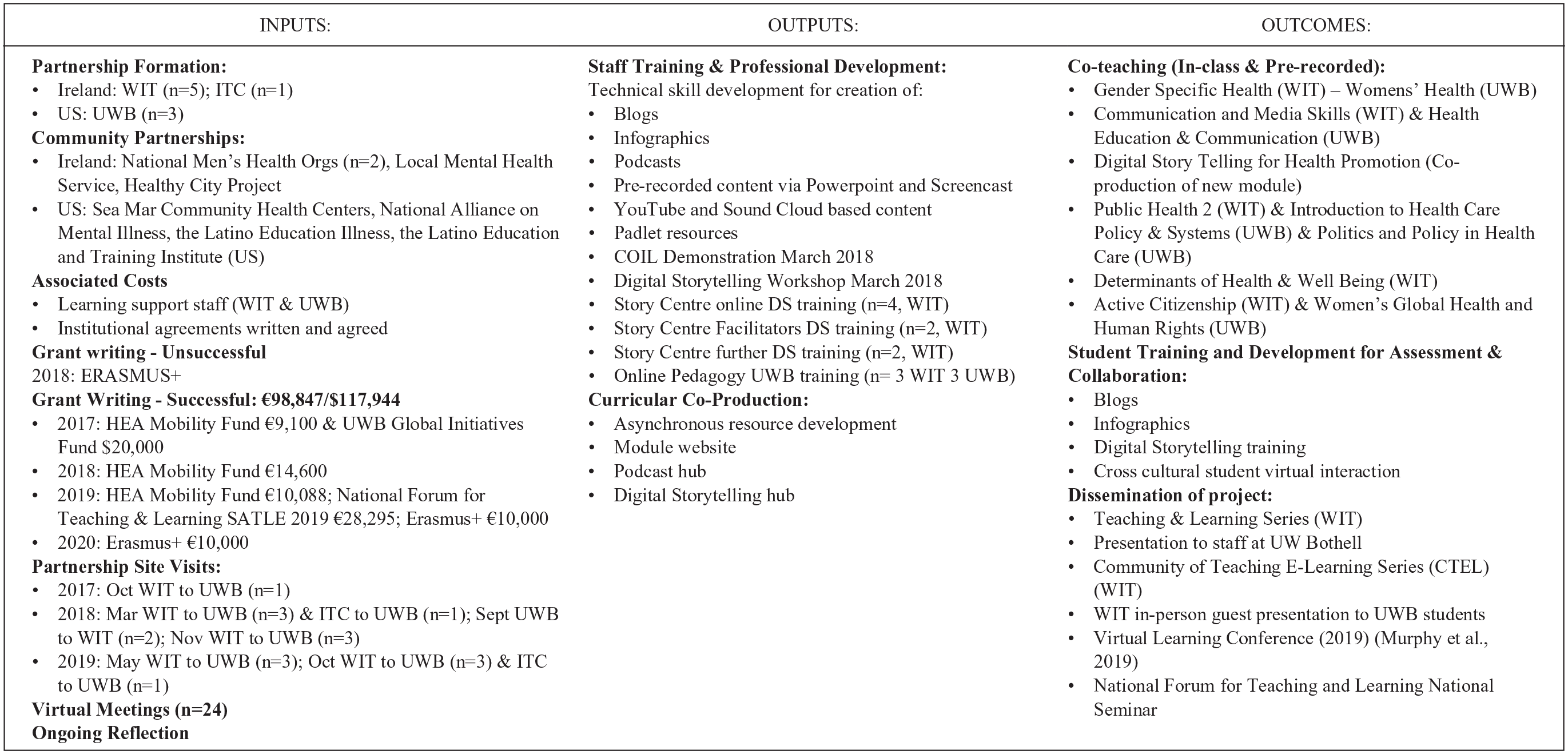
TEaCH CoLab Collaborative Online International Learning (COIL) Exchange Project: Logic Model of Inputs, Outputs and Outcomes.
The second source of data was derived from faculty reflections; at a meeting in March 2021, TEaCH CoLab members reflected on their experiences of this COIL initiative in terms of (a) what has worked well, (b) what factors underpinned success, (c) what has not worked well, and (d) what might be done differently to ensure success in the future. The discussion was recorded (via note-taking) by the lead author and a draft of the reflections was circulated via email to all members. Team members (PC, JE, NM, JOC) subsequently discussed, via email, the lessons learned and the lead author integrated these discussions into subsequent drafts of the “Lessons for the Field” until all were satisfied to sign off on them. This was completed in three drafts.
TEaCH CoLab: Evolution of the Program Model
TEaCH CoLab initiated from a site visit in 2016 to Waterford Institute of Technology (WIT, Ireland) by academics from the University of Washington Bothell (UWB, U.S.). TEACH CoLab seeks to examine specific and pertinent health-related issues through a cross-cultural lens and encourages collaborative efforts in addressing these issues in a global way. The collaboration has also expanded to work across disciplines beyond the traditional health realm and outside the third level sector to engage community health partners as active teachers and learners in the pedagogical network. The component parts of the program model were identified in terms of the resource inputs, outputs and outcomes and these are detailed in Figure 2 and described below.
Inputs
Creating the team
In 2017, following the initial site visit to WIT, faculty in the Schools of Health Sciences at WIT and Institute of Technology Carlow (ITC) and the School of Health Sciences and Nursing at UWB were invited to become part of the TEaCH CoLab team. No prerequisites were sought; nine academic staff across the three institutions volunteered and all were new to COIL. Faculty brought diverse experiences of curriculum development, assessment and educational pedagogies and an eagerness to expand the boundaries of the classroom and student perspectives. As the educational practices of the collaboration evolved, faculty reached out to their community partners with whom they had an established and effective relationship and invited them to become involved in the collaboration. Eight community partners (again with diverse health promotion experiences that were relevant to the COIL curriculum) across the two jurisdictions volunteered. Faculty and partners worked together to identify courses for co-teaching, assessment and student placements.
Virtual faculty meetings and site visit
From 2017 to 2020, the majority of partners (n = 8 academic staff; n = 1 community partner) have engaged in six site visits and approximately 24 whole group virtual planning meetings (eight meetings a year). At site visits, visiting faculty have presented on courses as well as attended planning meetings and visited community partners. A one month, US faculty sabbatical in Ireland was planned for 2020, which was postponed due to the COVID-19 pandemic.
Funding: Direct and indirect
In 2017, the team was awarded its first mobility grant from the Higher Education Authority (HEA, Ireland) that supports the creation of international teaching and learning collaborations. Faculty have been consistent in seeking funding opportunities in both jurisdictions to support the collaboration; to date a total of €98,847/$117,944 has been awarded to the TEaCH CoLab team to engage in site visits and capacity building. Notably, only approximately half has been spent to date due to COVID-19 restrictions. TEaCH CoLab has also been supported by considerable indirect funding in terms of capacity building and the sharing of resources across institutions.
Outputs
Building professional capacity
Partners have required professional development, particularly in the area of IT skills for virtual learning, in order to deliver the COIL curriculum. Competency in virtual exchange technologies and innovative pedagogies is essential for COIL collaborations (Egron-Polak, 2021) and as such, training in the area of digital pedagogies is ongoing. Specifically, such training has centered on the development of media to exchange/share learning and experiences (for example, creating blogs, podcasts, and digital stories) and to promote student interaction and collaboration (for example, the use of online discussion boards such as Padlet).
Outcomes
Educational practices
As a result of the partnerships formed and the professional development acquired, to date TEaCH CoLab has enabled the first steps toward an innovative internationalized curriculum in the areas of the social determinants of health, community connectedness, health literacy, and policy and equality (www.teachcolab.org). Currently, virtual exchange encompasses co-teaching, which includes asynchronous pre-recorded lectures and a host of innovative digital pedagogies that create opportunities for students to interact and share knowledge and learning experiences.
The following have been developed across COIL curricula:
- An audio interview series with multiple international scholars and practitioners;
- Student blogs;
- Discussion groups;
- Digital Storytelling (DS) (Lambert, 2020) using Adobe Spark and We Video;
- Electronic galleries and discussion boards using Padlet;
- A Gender, Health, and Human Rights website where four different classes interact
For example, students doing Communication and Media Skills (WIT) and Health Education and Communication (UWB) experienced both pre-recorded lectures from COIL faculty as well as in-person lectures from local faculty. As part of their assessment, they engaged in a community-based “Partner Challenge” in small groups locally (see “Opportunities & Challenges for Community Partners” below) and created a communications campaign for their community partner which they subsequently shared, via Padlet, with students across both groups for critical discussion from a cultural and theoretical perspective.
The educational theory that guides pedagogy and assessment includes problem-based learning, constructivism (Donnelly, 2008), critical pedagogy (Rahimi & Asadi Sajed, 2014), and empathy (Lu et al., 2005; Wondra & Ellsworth, 2015). This work underlines the importance of democratic discussion in the classroom (Brookfield, 2005) and the ways in which such engagement enhances student awareness of diversity and difference in relation to the availability and accessibility of health services. Students’ critical faculties are enhanced, and the collaboration encourages empathy with alternative perspectives and increased understanding of healthcare systems outside of their own. Currently this curriculum is applied to 11 modules with plans to further develop these in 2022. Co-assessment of modules planned for 2020 was postponed due to the COVID-19 pandemic.
Student mobility opportunities
In 2021, mobility opportunities to Ireland and the US were planned for students who traditionally have been disadvantaged for social, economic or geographical reasons. This has been postponed until 2022 (Ireland to US = 2, January 2022; US to Ireland = 1, May 2022) when students will get an opportunity to work with community partners in addition to engaging in learning opportunities at the host institution.
Dissemination
Learnings from this collaboration have been disseminated locally to peers, nationally via a HEA-funded teaching and learning seminar, and internationally at the Virtual Learning Conference in 2019 (Murphy et al., 2019), with a view to progressing knowledge generation in this relatively novel field of practice and study.
Lessons for the Field
Partners recognize that COIL has brought important opportunities for their HEIs, faculty, students and community partners and these are presented below along with the lessons learned in terms of how to ensure these inform planning from 2022 and beyond.
Opportunities and Challenges for Faculty and Collaborating HEIs
The TEaCH CoLab team needed to incorporate the cultural and structural differences of two systems of higher education, as well as the distinctly different educational and healthcare backgrounds of both faculty and students, which forced them to look critically at modes of learning and assessment, and to work creatively with students and partner faculty to find new ways to build knowledge collaboratively. Faculty brought together diverse perspectives, content, pedagogical approaches, and technical expertise to transcend the boundaries of the “classroom” in order to create innovative pedagogies that promoted shared learning experiences across institutions. Engaging in TEaCH CoLab has reinvigorated faculty in their approach to a course, particularly if they have been teaching it for many years. It has also motivated them in their teaching, deepened their capacity to be adaptable and to better engage students which they believe has improved them as teachers. This flexibility and inclusivity has had a positive impact on approaches to teaching, enabling faculty to offer more creative and inclusive ways to explore topics and assess students across all teaching, not just COIL curricula, which was particularly relevant during the COVID-19 pandemic.
Notably, technical upskilling was central to this; capacity building, however, often happened parallel to co-developing resources for students and piloting and troubleshooting the use of software and platforms to ensure consistency between classes. This was initially an added stress for faculty. Fortunately, much of this was achieved prior to the pandemic, which positioned faculty well to respond to COVID-19 teaching restrictions. With the exception of faculty and student site visits, the day-to-day collaboration has continued to operate smoothly despite the pandemic.
Opportunities and Challenges for Students
Through TEaCH CoLab, students are exposed to: (a) co-teaching and international guest presentations; (b) innovative assessments that require upskilling in digital technologies; and (c) opportunities to engage with students in another country in order to share ideas and perspectives. Through these mechanisms, the collaboration pushed modules beyond a potentially narrow focus on pressing health promotion and policy issues at home into a broader (and more complex) consideration of the matrix of factors that impact these issues globally. Faculty across HEIs shared webinars, podcasts and interviews and used them in their teaching to broaden students’ cultural awareness. While co-assessments have yet to happen, the nature of collaborative engagement require that students from each country share projects and tasks with their international counterparts for discussion. An example is Public Service Announcements (PSAs) on sexual health awareness that were created by students in both countries and which generated discussion on key barriers to sexual health among students’ own demographics. Through their collaborative engagement, students gained cultural perspective on issues affecting health, wellbeing and connectedness. However, building capacity among students to use technologies required for engagement was problematic and in some cases, extra time had to be dedicated to this type of instruction.
Faculty in both institutions noted that student standards and levels of engagement were heightened; this may be due to the fact that students knew their work was to be reviewed by their international peers. Furthermore, student interest in the study abroad program was much greater than that previously observed.
Notably, as per the experience of faculty, students engaged in TEaCH CoLab courses have been very well placed to respond flexibly to the COVID-19 restrictions and to reflect in a meaningful way on the health impacts.
Opportunities and Challenges for Community Partners
Student assessment is typically of an applied nature and can support community partners; an example of this is “The Partner Challenge” that flips the classroom, allowing for organizations to propose a problem for students to tackle collectively with guidance from faculty and the organization. A stipulation of the proposed project was that it had to benefit the organization, communities served, and the students’ academic and professional development. Students in both jurisdictions engaged in this challenge to support their local community partners.
As previously noted, students in some cohorts also developed skills in digital storytelling (DS), a creative practice and research methodology that appeals to community partners who wish to engage clients and disseminate their work to policy makers and funders.
Invest in Personal Relationships
The TEaCH CoLab team recognized the need to relate to one another on a personal level to both establish a shared vision for the collaboration and to achieve that vision. Having face-to-face contact at site visits was integral to how the collaboration communicated; personal connection is a key strength of the collaboration whereby faculty make an effort to engage and “do their part” and do so with diplomacy, trust, and respect founded upon personal relationships. In order to sustain this level of voluntary effort over time, the process has to be fun, exciting and supportive, and reflect value to all members of the team. A shared understanding of the field of health promotion practice and education also enabled the development of the mission and goals of the collaboration.
Check Institutional Compatibility and Adapt to Differences
UWB, WIT and ITC are culturally compatible; the Schools are similar in size in terms of staff and student numbers, they predominantly engage in face-to-face teaching, the student profile is similar in terms of age, demographics and the profile of awards sought, and there is a strong institutional ethos of supporting student retention given the demographic profile. Notably, the first language of all institutions is English. However, as with many other COIL initiatives, structural differences in HEIs and geography posed challenges to delivering COIL curricula. Semesters only overlapped for a 10-week period and with an 8-hour time difference. However, faculty believe that these can be overcome once the partnership is strong.
Europe’s General Data Protection Regulation (GDPR) posed another structural challenge as it limits the use of student data. Hence, any evaluative outcomes from a student perspective would have to be GDPR-compliant if they were to include Irish students and/or name Irish authors in a subsequent publication. This imposition on US partners cannot be overcome and will have to be factored into student evaluation in the future.
Make it Work with Limited Funding
This collaboration was funded by six modest grants, each with specific spending priorities. The team recognize that limited funding presented fertile ground for creativity and innovation that required effort and commitment. Notably, no prerequisites such as technical savvy or pre-existing international networks were sought from faculty to participate and only faculty who were committed to evolving their practice participated. This in turn supported the development of personal relationships.
Indirect funding from HEIs addressed some of the funding shortfall; however, the sense of “meitheal” (the Irish word denoting the co-operative labor system in Ireland) among the partners, cultivated by strong leadership within the team that was welcoming, inclusive and open, also facilitated the sharing of experiences and resources for the greater good.
Integrate Teaching Histories and Systems into all COIL Classes
Historical cultural influences on teaching practices and systems should be integrated into COIL curricula to offer students a context within which to frame international perspectives. It was important that US students understood Ireland’s history (e.g., independence from Britain, civil war, role of Catholic Church etc.) and that Irish students understood U.S. history (colonization, civil war, slavery, capitalism etc.) in order to contextualize how history and culture impacts health care systems, and public health policy and outcomes.
Discussion
Faculty face many challenges when implementing COIL and overcoming these challenges can be powerful for their own learning and sense of agency (Strand-Mudiamu, 2020). Faculty development and training to strengthen capacity for use of new pedagogies and modes of delivery (Egron-Polak, 2021) as well as a commitment to planning and problem solving on behalf of all partners (Strand-Mudiamu, 2020) is key to overcoming the challenges that COIL presents. It is evident from this paper that while challenging at times, faculty underwent considerable training, and offered consistent student support in order to deliver their COIL courses, and this required a significant commitment. However, in so doing, and in keeping with that reported elsewhere (Strand-Mudiamu, 2020), their engagement in TEaCH CoLab has reinvigorated them in their approach to a course, particularly if they have been teaching it for many years.
While a common frustration reported by students elsewhere was the limited or lack of response from their international partners (Guth & Helm, 2017; Naicker et al., 2021) this was not reported to TEaCH CoLab faculty. As reported elsewhere (Strand-Mudiamu, 2020), faculty in both institutions noted that student standards and levels of engagement were heightened. Furthermore, student interest in the study abroad program was much greater than that previously observed, a phenomenon also observed elsewhere (NC State University, n.d.; Reed, 2016). While student evaluations were not included in this study due to GDPR issues, data from elsewhere indicates a high student satisfaction with COIL (Appiah-Kubi & Annan, 2020) which may influence their interest in study abroad programs.
The importance of personal relationships in collaborative working is widely recognized (Maxwell et al., 2013; Pullon, 2008) and is underpinned by trust, mutual understanding and shared goals and visions. The factors that collectively contribute to such relationships are: (a) face-to-face contact; (b) having a shared history that includes a common professional background , as well as an established relationship; (c) making an effort; and (d) diplomacy (King et al., 2017). “Nurturing human connections” (p. 116) and building “relationship capital” (p. 122) with international partners is essential to overcome the challenges presented by COIL (Strand-Mudiamu, 2020) and this takes time. Notably, the TEaCH CoLab team dedicated considerable time and effort to attend in-person and virtual meetings to build relationship capital which effectively underpinned the commitment to the collaboration (Strand-Mudiamu, 2020). It is relevant that no prerequisites were sought from faculty to participate in TEaCH CoLab as COIL faculty are most often those who are committed to evolving their practice with a view to improving student experience (Strand-Mudiamu, 2020). Having this common ground between faculty proved to be a good starting point from which to build relationship capital.
Institutional compatibility in terms of ethos, student profile and culture can make or break a COIL collaboration (The SUNY COIL Centre, 2021a, 2021b) and TEaCH CoLab faculty explored compatibility in these areas at initial meetings. Notably the first language of all institutions involved in TEaCH CoLab was English, which is relevant as language proficiency can be a barrier for staff and students engaging in COIL initiatives (Naicker et al., 2021).
Conclusion
The initial first steps of the TEaCH CoLab initiative detailed here have provided significant learnings for partners. Informed by the pragmatic, “trial and error” approach of the TEaCH CoLab team, the findings here may support others who wish to integrate COIL into health promotion curriculum development elsewhere. This collaboration is ongoing with plans for 2022 and beyond in the areas of faculty capacity building to include using DS in research, student exchange, and impact evaluation, which, it is hoped, will lay the foundation for a promising journey ahead.
Footnotes
Author’s Note
Paula Carroll, Niamh Murphy, Jenny O’Connor, Mairead Barry, Robert O’Connor and Noel Richardson are now affiliated to South East Technological University (SETU).
Declaration of Conflicting Interests
The author(s) declared no potential conflicts of interest with respect to the research, authorship, and/or publication of this article.
Funding
The author(s) disclosed receipt of the following financial support for the research, authorship, and/or publication of this article: The authors would like to acknowledge the direct funding from the Higher Education Authority (€33,788), the National Forum for Teaching & Learning (€28,295), the ERASMUS fund (€20,000) and the Global Initiative Fund $20,000 as well as the benefit in kind from technical support staff at UWB, WIT and ITC.
