




Abstract
Coronavirus disease 2019 (COVID-19) has highlighted the need for well-trained public health workers to interpret evidence, make informed decisions, and disseminate information to the general public. As public health courses in Ontario universities have moved online due to this pandemic, instructors were required to simulate their teaching online while maintaining student engagement. Previous research has shown that there is a lack of description for the development of online public health courses. As such, the objective of this article is to outline the development and layout of a Professional Development Studio course offered in the Masters of Public Health program at McMaster University, Hamilton, Ontario. We use the Salmon model, previously described by Salmon and colleagues in 2013, to form the course outline. The Salmon model provides a five-stage framework for the development of a concise, engaging, and impactful online course. Based on student feedback, we found that the Salmon model positively shaped the development of the course by aiding the formulation of a course layout that was easily accessible, discussion threads to communicate in an inclusive and safe space, and relevant assessments requiring the use of tools to make judgments and appropriately disseminate information publicly. We conclude that the Salmon model is a helpful framework to use in developing an engaging online public health course. Further assessments based on student feedback should be completed to continually evolve the online course to better tailor the needs and interests of public health students preparing them for the public health workforce.
The coronavirus disease 2019 (COVID-19) pandemic has clearly demonstrated how some public authorities, media, and the general public are ill-equipped in interpreting scientific evidence, disseminating information, and relaying necessary changes to prevent and handle the spread of disease (Galvão, 2020). This pandemic has highlighted the need for public health workers who can communicate health information to the general public, especially on social media platforms, by using evidence-informed decision-making (EIDM) and project management skills. Concomitant with this need is a demand for the adequate education and training of the next generation of public health workers. With the decrease and difficulty of in-person gatherings, this learning is increasingly dependent on online platforms that offer students flexibility in participation. In the interest of training the next generation of public health workers, health training at the graduate level is a gold-standard approach (Rosenstock et al., 2008, Zwanikken et al., 2014). A graduate degree allows a student to pursue a thesis or practicum tailored to the field in which they are interested to work in areas dealing with the prevention, protection, and improvement of human health. Past research has mentioned that further description of the development of public health courses is needed to provide instructors with resources on how to set up such courses (Caron, 2013). Here, we outline the development and layout of a Professional Development Studio (PDS) course offered at an Ontario University. PDS aims to provide learners in a generalist Master of Public Health (MPH) program with the knowledge and skills necessary to excel in their practicum/thesis and future careers. We use the Salmon model, previously described by Salmon (2013), to form the online course outline.
The Salmon model provides a five-stage framework for the development of a concise, engaging, and impactful online course. The main outcomes of this model are geared to create a comfortable online environment for students to access resources, share opinions, and contribute to peer’s discussion in a safe environment, engage in relevant assessments that promote student engagement and interest, and lastly, encourage students to formulate their own ideas and provide tools to effectively defend their judgements to various audiences. As the COVID-19 pandemic continues alongside the need for innovative online graduate education, our aim is to provide a detailed framework of the development of an online PDS course and its outcomes in pursuit of enhanced online public health learning.
Theoretical Model
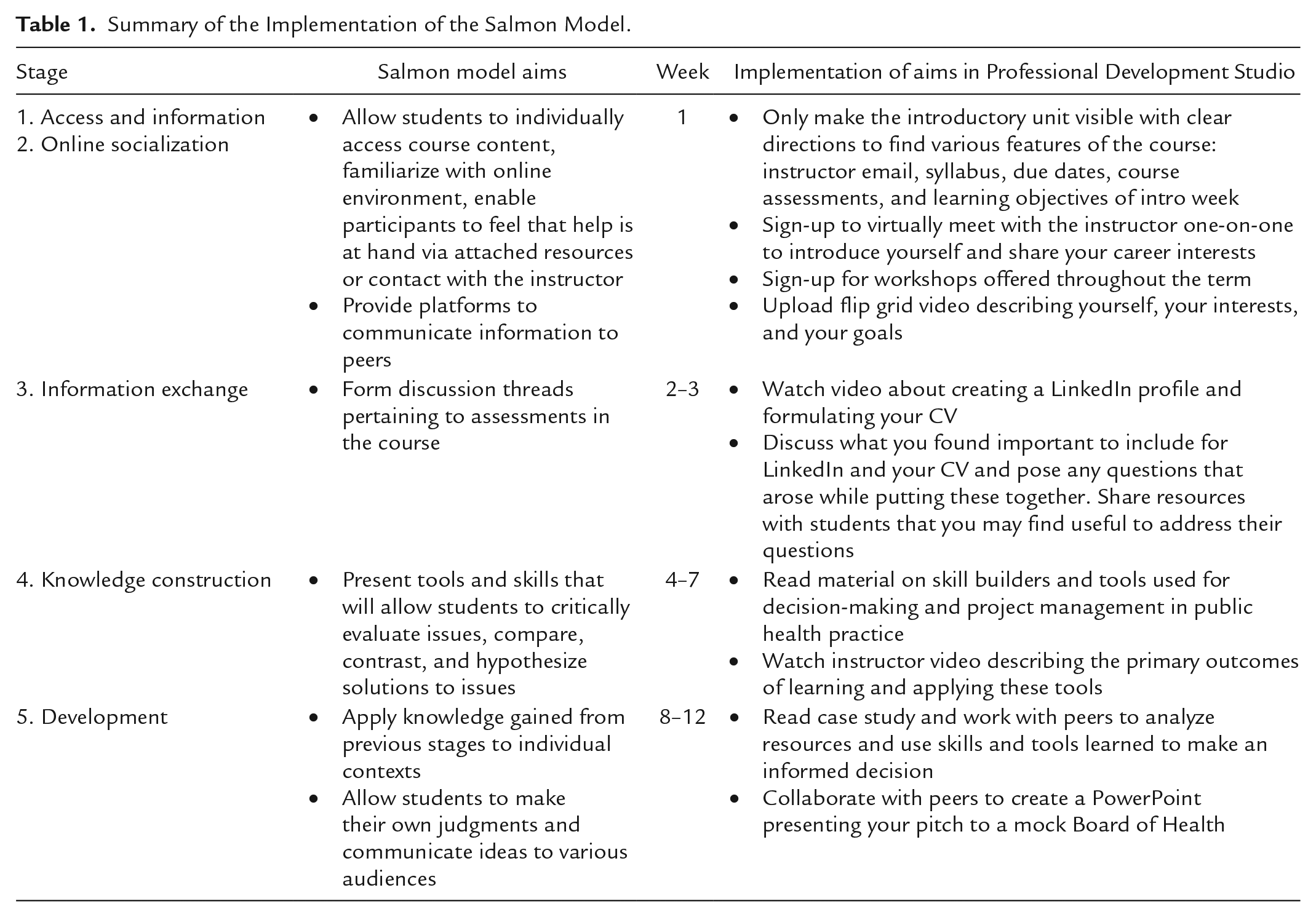
The five stages of the Salmon Model include the following: Stage 1: Access and Motivation; Stage 2: Online Socialization; Stage 3: Information Exchange; Stage 4: Knowledge Construction; and finally, Stage 5: Development. In Stage 1, the goal is to allow students to individually access course content and familiarize themselves with the online environment while also enabling participants to feel that help is at hand via attached resources or contact with the instructors. Instructors should not assume that all students will be comfortable using online platforms for education so e-activities in this stage should be easy to engage in and plainly viewable with clear instructions. Regardless of comfort in using online platforms, students should feel at ease to reach out to their peers for help and that they are not alone in tackling any issue that may arise during this introductory period. In this stage, an outline of activities, assessments, and time allocated to each task should be provided. Activities can promote motivation to engage in course material frequently if it has value to the student and if students are able to expect to succeed (Salmon, 2013). It is therefore important for the instructors to outline the purposes of these activities and link them to the successful completion of the assessments in the course. In Stage 2, students should be given platforms to communicate information with peers and instructions for engaging with submissions by others. The primary outcome of this stage is to help students understand the importance of learning together and how they can contribute to and engage in group work. The e-activities are tailored to stimulate exploration of course content by creating online spaces for students to share information and read viewpoints of their peer’s on a given topic. This writing and reading exposes students to other experiences peers may have faced, allowing them to learn various perspectives of a given topic. This will enable students to build a level of trust with their peers who they will work with in the following stage of knowledge construction. Stage 3 further deepens these interactions with the formations of groups and discussion threads pertaining to the assessments in the course. These discussions should be tailored to encourage sensitivity to societal issues relating to the course, thus providing relatable and relevant context for engagement. Students should feel comfortable sharing their opinions on various topics in a safe environment while also having the ability to comment on their peer’s responses. To ensure the discussions are kept relevant, learning objectives for these threads should be clearly stated beforehand. Prompts for discussions should be relevant to world events and/or students’ career paths. In Stage 4, students are encouraged to critically evaluate issues, compare, contrast, and hypothesize solutions by describing the use of tools and skills used in practice to accomplish such things. The goal of this stage is to allow students to structure knowledge for themselves. E-activities should continue to encourage exploration of societal issues that can hone in their skills of using tools to analyze information across various disciplines. In this stage, activities should allow students to work in groups to outline and create their own goals and achieve them through collaborative work. Communication is key in this stage, to allow students to constructively and supportively challenge their peer’s contributions to the task at hand (Salmon, 2013). Finally, in Stage 5, students are responsible for their own learning by applying knowledge gained from previous stages to their individual contexts. Students should be given the opportunity to translate their knowledge by making their own judgments and communicating their ideas to various audiences effectively. Activities should urge the students to demonstrate their ability to state their opinion and defend their judgment. These activities should also include a reflection component that allows the students to self-regulate and monitor their learning, applying it to their personal understanding of the topic (Salmon, 2013). Taken together, these stages formulate a framework for the development of a course to facilitate simple access to online information, stimulate and maintain motivation throughout the term, and include assessments that will encourage the application of knowledge to relevant issues, thus producing a valuable and translational learning experience.
Implementation of the Salmon Model in PDS
Stage 1: Access and Motivation
In the first stage of the Salmon model, our goal was to provide clear instructions on how to navigate through the course to allow them to familiarize with the online environment (see Table 1). We uploaded all course material, links to submissions, and sign-ups onto the web-based course management system, Avenue to Learn. Research has shown the importance of adequate orientation of students at the start of an online course to ensure that the diverse student population is comfortable navigating through the content and successful in completing tasks (Alperin et al., 2020; Song et al., 2004). For our PDS course, we set aside the entire first week to allow students to follow instructions listed in point form (as opposed to paragraphs) to clearly direct students to tasks that needed completion. This course consisted of synchronous and asynchronous activities. Synchronous learning included weekly 1½-hour live lectures on Microsoft Teams while assessments and group work were completed asynchronously. This allowed students to work on tasks on their own time before the due date. The first task was simply to read the syllabus embedded on the introductory page for ease of access. This allowed students to become familiar with the course content and what was expected from them for each unit. This introductory page also contained a link to a list of only the assessments so that students had a place to quickly see what was due in an uncluttered layout. Students also used this time to sign-up for workshops conducted throughout the term as well as one-on-one meetings with the instructor. Completing these sign-ups at this stage avoided last-minute sign-ups, forgetting to sign-up, or overwhelming amounts of administrative items to complete on top of assignments during the term. Links to discussion boards were also plainly embedded within the introductory instructions. Discussion boards were designed for use in Stage 2, to conduct open conversations regarding any concerns about navigating through Avenue to Learn and completing the first week’s tasks. This encouraged an open environment where students felt safe to ask questions and answer their peer’s concerns as well.
Summary of the Implementation of the Salmon Model.
Stage 2: Online Socialization
Online socialization is important for learning as it can affect students’ perception of collaboration and social presence (Koh & Hill, 2009). To engage students in socializing with their peers, we used FlipGrid, an online video discussion board. On FlipGrid, students uploaded either a video or an audio of them answering the following introductory questions: (1) name, (2) current location of study, (3) why you are pursuing an MPH, (4) one fun hobby you like doing/fun fact, and (5) anything else you would like your classmates to know about you (optional). All students submitted videos sharing exciting things they did over the summer, what they hoped to accomplish with a degree in public health, and other interesting facts about themselves. This was done to allow students to learn about their peers with similar program interests as face-to-face interactions were not possible. Discussion threads on Avenue to Learn were used as platforms for sparking socialization throughout the term. Participation in discussion threads accounted for 5% of their grade to provide incentives and objective meaning for completion.
Previously, studies showed that students performed better in an online setting when the instructor was approachable, interactive, and involved (Maki & Maki, 2007; Zhao et al., 2005). In our course, we provided the students an opportunity to meet one-on-one with the instructor online to introduce themselves and share their thoughts on pursuing a thesis or practicum. Students greatly appreciated this initiative, commenting that it allowed them to truly know their instructor and feel comfortable talking about their career choices to someone in the field. To further enhance instructor involvement in the online course layout, we made use of instructor introductory videos embedded at the start of each unit. The course instructor recorded themselves giving students a quick summary of the unit followed by learning objectives and assessments. This was done to create a learning environment closely mimicking in-person settings where the instructor is deeply involved with the success of students at each stage. Online socialization is a crucial stage in ensuring student enthusiasm throughout the term. It is important to create an environment where students are familiar with others involved to form a sense of belonging and easily facilitate exchange of information as required in the following stage.
Stage 3: Information Exchange
In this stage, the goal was to allow students to have platforms where they were able to communicate to one another their ideas and opinions regarding the task at hand. Here, students worked on putting together their curriculum vitae (CV) and LinkedIn profiles. Followed by a live lecture that included other core MPH faculty and links on how to build your CV and create a LinkedIn profile, we embedded a discussion thread in the unit where students were able to communicate with one another regarding putting the CV and profile together. Students used this platform to share links to efficient layouts, effective ways to describe experience, and balancing extensive details with relevance. Students also posed open-ended questions that elicited interesting discussions. One example of a question revolved around whether it was appropriate to include the acceptance to present at conferences though it was later cancelled due to COVID-19. As part of discussion, students shared thoughts on privacy and the disadvantages of sharing too much information. This thread provided students the opportunity to establish a safe space to exchange knowledge in the form of questions and ideas. The live lecture in this unit was also tailored to reiterate the knowledge learned from assigned readings and facilitated guided interaction to translate knowledge construction to skill building as a segue into the next stage.
Stage 4: Knowledge Construction
In this critical stage, our goal was to present students with important skills and tools used in public health practice. PDS included the description of skill-builder modules that provided students with an understanding of specific skills that public health professionals undertake and use within their profession. Students were given the opportunity to apply these skills within the experiential case study in Stage 5. The first set of skill builders described the nuances surrounding decision-making. This module described the application of strategies and frameworks regarding decision-making and priority setting used in public health practice. It comprised of synchronous live lectures and asynchronous discussion threads and group assignments. Students were required to complete prereading components, including the National Collaborating Centre for Methods model for decision-making (Ciliska et al., 2008) and the Health Impact Pyramid framework (Frieden, 2010). The in-class lecture focused on frameworks and techniques used in public health decision-making, and the group assignments were tailored to provide students an opportunity to apply these skills. In this stage, activities were also focused on planning and project management and its application within the public health workforce. Students were taught to describe program planning frameworks and construct project charters and Gantt charts. This allowed the students to become familiar with various planning components and to confidently apply these skills to the public health case study.
Students were also introduced to different communication strategies and to relaying information to various audiences. Through live lectures and required readings, students were introduced to the importance of risk communication, communicating health information, and to applying communication strategies in diverse settings. This unit also included an asynchronous small group activity where students read a short scientific report, summarized key findings, and learned ways to communicate the information to various audiences including policymakers and the general public. This theoretical background provided students with the knowledge required to apply these skills in the final stage.
Stage 5: Development
In this final stage of the PDS course, students were given the opportunity to formulate their ideas concisely, make their own judgments, and communicate their thoughts effectively. An assessment of multiple online courses across six campuses and 186 students in Indiana found that the use of application activities was correlated with higher student engagement with the course (Dixson, 2010). These include case studies or tasks that were relevant to current society, involved problem solving, applied the knowledge and skills learned, as well as discussed forums to communicate ideas with other peers. In our final unit, we utilized a novel case study workbook based on real-life scenarios and tools, forming the core component of PDS. The case study introduced students to a situation that required rational decision-making, priority setting, and project planning. Students were split into groups and worked asynchronously to apply EIDM strategies and learn how to prioritize cases. This was done by utilizing a group assignment feature on Avenue to Learn, where students were able to privately communicate and transfer files with their peers prior to submitting the final assignment. The public health case study was specifically developed with the assistance of a local public health community foundation to provide a genuine public health scenario for students to work on. Students’ main responsibility was to participate in the case study as a senior management team at a local public health unit in Ontario. The case scenario was developed in such a way where students were approached with an offer of $1,000,000 in annual program funding for at least 10 years to use toward one of five programs: (a) Nurse-Family Partnership, (b) Supervised Consumption Services, (c) Traffic Speed Limit Reduction, (d) HIV Pre-exposure Prophylaxis, and (e) a School-based Health Promotion Campaign. Their job was to complete the multicriteria decision-making matrix and select one program that should be funded based on the available evidence for each program. Once the case study was completed, students were required to record a 5- to 10-minute presentation using PowerPoint, presenting their ideas to a mock Board of Health (role-played by instructor). The final file was then uploaded to Avenue to Learn. Previously, immersing students in a role-play-like scenario was useful in engaging students and stimulating them to make use of knowledge accrued thus far (Dixson, 2010). As such, this critical situation immersed learners in a role-playing activity where they completed the multicriteria decision-making matrix and applied other decision-making strategies to select one program that should be funded based on the available evidence. Moreover, each of the five proposed public health programs also contained background information and an incomplete EIDM framework. All the groups completed the EIDM framework by populating it with missing information from the resources provided in the workbook. The next step was for students to formulate a brief plan for their proposed program. After receiving approval from the medical officer of health (role played by instructor), the assigned groups were expected to complete the project charter and Gantt chart for their approved program. This was accomplished by filling out the project charter template within the workbook. Completing the charter aided in improving students’ critical thinking skills and was an innovative approach to engage learners. The main sections of the project charter included background and rationale, program objective(s), partners and stakeholders, budget and resources, program risks, and lastly, timelines. Furthermore, through communication mediums such as interactive social media posts, presenting to a mock Board of Health, and an email correspondence to the Medical Officer of Health, students learned how different means of communication are a significant part of delivering successful public health services. After completing the entire case study, students completed reflection questions independently related to the case study. This was done to allow students to summarize key tools and transfer findings from the activity.
Lessons Learned
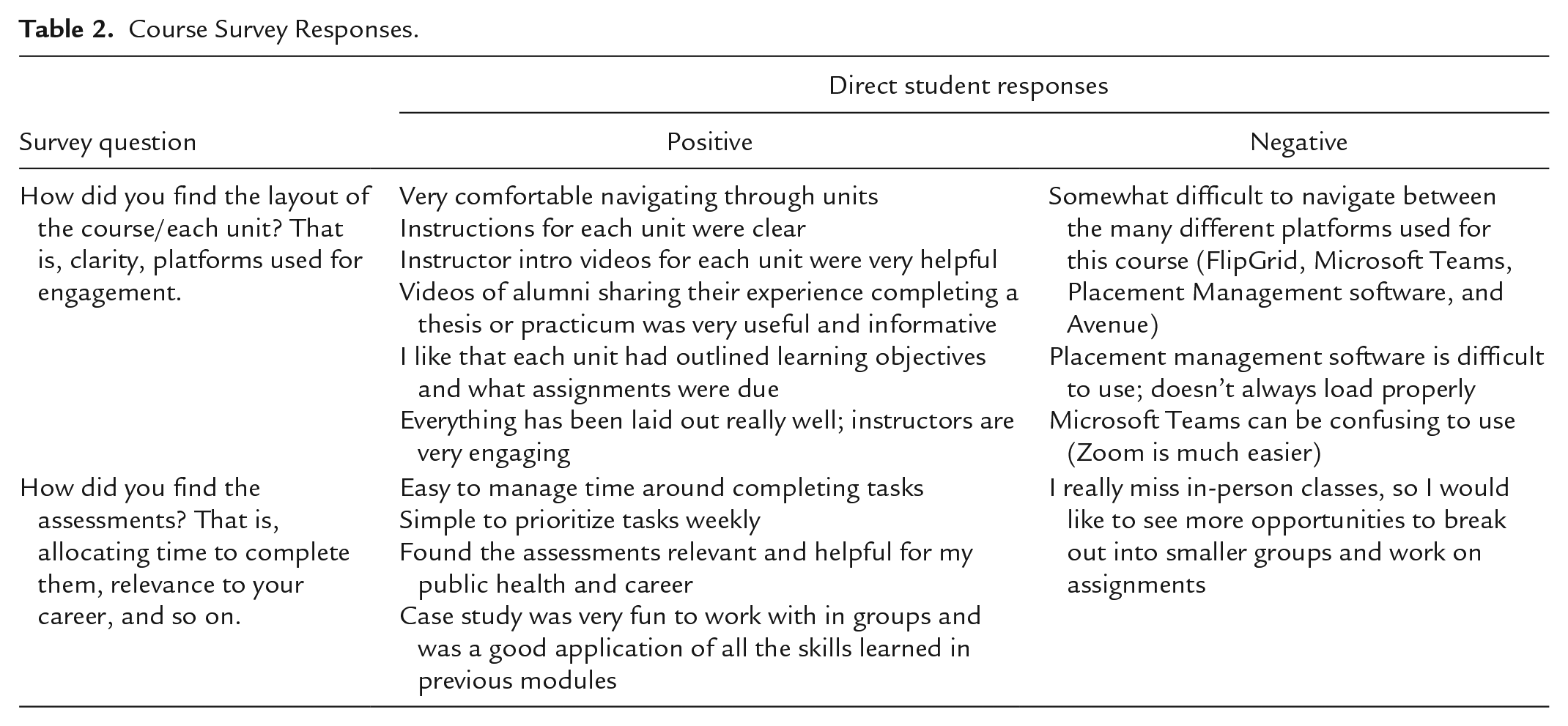
We conducted two evaluation surveys, one at the midpoint and one at the end of the course. These surveys were designed to receive input from students regarding the layout, presentation of material, assessment feasibility, and engagements of the course. For this class of 25 students, the response rate for the first survey was 32%, while the second survey had a response rate of 40%. Though these rates are low for student evaluations of teaching (Chapman & Jones, 2017), we were nonetheless able to receive constructive input from students regarding the structure of the course. Low response rates could be due to the short time period given for completion (1 week) as well as no impact on students’ success in the course. As we describe our course development, we were interested in qualitative responses from students that provide insight into what they enjoyed and features that did not aid in their learning. Therefore, direct quotes and responses were recorded and are summarized in Table 2 into two categories: layout and assessments. Overall, our use of the Salmon model proved to be a useful framework in organizing the elements of the PDS course, reflected by the majority of positive responses from students. Students especially enjoyed working on the case studies, reporting no technical issues, and found the project to be a good culmination of the skills learned in previous modules. With regard to course improvements, students generally felt that there were an overwhelming number of platforms they had to engage in. Some students also reported difficulty in learning how to use a few of the newer platforms we used in our online socialization. Technical problems and difficulty navigating online content are significant challenges that can hinder student engagement in online courses (Rapanta et al., 2020). Future amendments will address these issues by switching to commonly used apps (e.g., Zoom rather than Microsoft Teams for lectures) and only using a minimum number of platforms so as to keep the course easily accessible and simple to navigate. Students also enjoyed communicating in discussion threads and desired more opportunities to break out into groups and work with peers on tasks. Small-group inquiry-based activities, which use concepts learned throughout the course to apply to local and global settings, have been shown to aid students in making informed decisions related to public health (Nelson-Hurwitz et al., 2018). Students also repeatedly noted the helpfulness of embedded videos within the units. They particularly appreciated instructor introductory videos at the beginning of each unit outlining unit objectives and what was to be expected. In one of the units, we embedded a link to videos sent in by alumni describing their experience completing a practicum or thesis and what they enjoyed about it. Students in PDS found these videos very interesting and helpful in making their own decisions. In general, the course structure helped facilitate learning and engagement in the course. We acknowledge that our sample of learners may not be generalizable to all online learning cohorts as some might include learners that experience more barriers to online access than others. Therefore, we suggest that during Stage 1 or even before if feasible, instructors administer a brief survey of their learners to identify any modifiable barriers (e.g., course timing, submission deadlines, etc.) that could be adjusted to help ensure more equitable access to the online course.
Course Survey Responses.
Conclusion
Overall, the majority of student evaluation responses were positive regarding the framework of the professional development course for first-year students in the MPH program. We learned that keeping units and assessments relevant to current events and providing platforms for students to share concerns and ideas were crucial in keeping the students engaged. It is possible that in our desire to create a very engaging course, we used too many platforms. From student suggestions, we learned that the key is to keep it simple, relevant, and interactive. Students appreciated an involved and approachable instructor and felt they benefited from having online platforms to share ideas in a safe space.
These unprecedented times have shown now more than ever the need for public health workers. Even years after the COVID-19 pandemic, online learning will be greatly relied on as an inclusive and interactive method of training (Dhawan, 2020). It is therefore crucial to continually evolve and develop online courses ensuring that we have students’ enthusiasm and engagement for the duration of the term. Public health courses should attempt to assess the engagement and comfort of students at each stage of development to maximize the likelihood of their long-term success in working for public health.
Footnotes
Declaration of Conflicting Interests
The authors declared no potential conflicts of interest with respect to the research, authorship, and/or publication of this article.
Funding
The authors received no financial support for the research, authorship, and/or publication of this article.
