




Abstract
Individuals do not all come to tasks, activities, or assignments with the same readiness to engage. Differences in the ability to focus, comprehend, or problem-solve can lead to inequalities of outcome and make learners less likely to realize their potential. Given that interest development supports persistence, conscientiousness, and the ability to work with negative feedback, educators and policymakers could help to increase educational opportunity for all by promoting the development of interest. Interest is a cognitive and motivational variable that describes (a) engagement, or participation, with some content (such as physics, writing, or baseball) and also (b) the motivation to continue to seek opportunities to engage with that content: seeking information, posing questions, and tackling challenge. Interest works because the information search it creates is rewarding. The development of interest heightens understanding and sustains engaged work. It also positively influences outcomes such as performance and continued enrollment. Even the development of a little interest can make a difference. Educators and policymakers can enhance educational opportunities by promoting interest development. Methods are described.
Tweet
Being interested supports persistence, conscientiousness, and constructive responses to feedback. Educators and policymakers can help level the playing field by supporting interest development.
Key Points
Educators and policymakers can enhance educational opportunities for all by promoting interest development.
Interest is intrinsically rewarding.
Developing interest sustains engagement, deepens learning, and improves performance.
Interest is malleable; its development can occur at any age, and in a variety of contexts.
Before interest begins to develop, individuals may need extrinsic rewards to encourage them to make meaningful connections to content to be learned.
To date, educational policy has not focused attention on motivating student learning or, more specifically, how to trigger and maintain student interest in learning. The presumption may be that as long as we teach the basic subject matter, there is no need to worry about interest, and regardless, supporting interest to develop is unlikely or difficult. Research on interest suggests otherwise. Leveraging interest to support educational opportunity is not only beneficial but also doable. After providing evidence that illustrates this point, this article overviews research on how interest develops and how its development may be promoted.
Evidence of the Power of Interest
Interest can have remarkable results. Xu, Coats, and Davidson (2012), for example, reported that low-income African American students were much more motivated to learn science when their teachers were interested in science themselves and interested in cultivating their students’ interest in science. They described these teachers as creating a caring and accepting learning environment. They also reported that the teachers were explicit about scaffolding their students’ interest in science and used multiple instructional approaches (e.g., hands-on activity, technology, involvement of the community). Similarly, Crouch, Wisittanawat, Cai, and Renninger (2018) demonstrated that changing the focus (but not the rigor) of an introductory-level, undergraduate physics course to include life science content (e.g., optics, cell membrane potential) enabled life science students with a low level of interest in physics to perform as well as those who entered the course with a high level of interest. Infusing physics instruction with life science content was based on the expectation that life science students who want to pursue medicine are interested in life science. The students had multiple and repeated opportunities to work with, reflect on, and begin making meaningful connections to life science examples of the physics concepts that they needed to learn (see Figure 1 for examples of how physics instruction was infused with content specific to cell membrane potential).
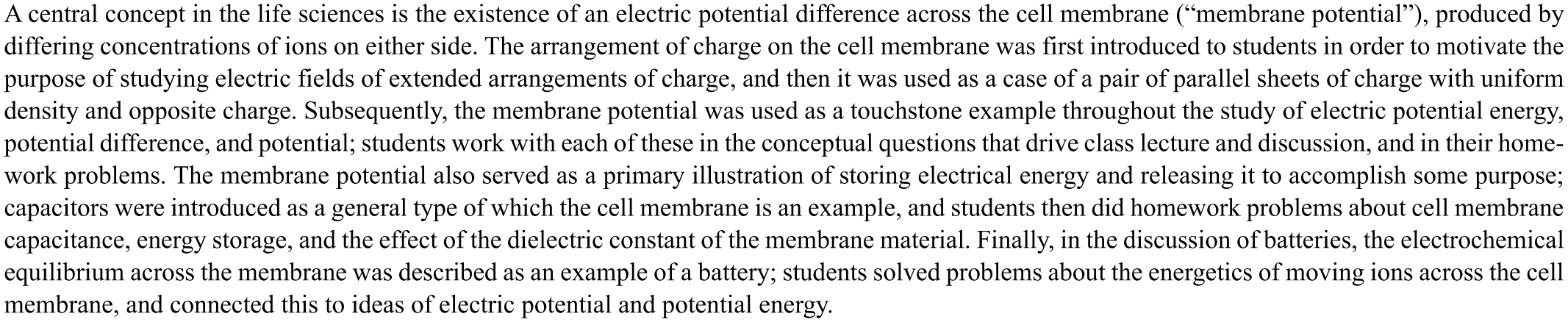
Example of physics lessons infused with life science content addressing cell membrane potential.
Having an interest in one’s work heightens understanding (e.g., Hagay & Baram-Tsabari, 2011), sustains engaged work (e.g., Azevedo, 2013a, 2013b), and benefits outcomes such as performance and subsequent course enrollment over as many as seven semesters (e.g., Harackiewicz, Durik, Barron, Linnenbrink, & Tauer, 2008). The development of interest supports individuals with low conscientiousness to meaningfully engage (e.g., Trautwein et al., 2015) and make productive use of opportunities to choose, such as deciding which courses they will continue to take (e.g., Patall & Hooper, 2019). The development of interest is coordinated with the ability to sustain attention (e.g., Hidi, 1995; McDaniel, Waddill, Finstad, & Bourg, 2000), set and realize goals (e.g., Harackiewicz et al., 2008), effectively use learning strategies (e.g., Bernacki & Walkington, 2018), regulate behavior (e.g., Sansone, Thoman, & Fraughton, 2015), feel self-efficacious (e.g., Lee, Lee, & Bong, 2014), and make creative contributions (e.g., Izard & Ackerman, 2000).
Neuroscience helps explain these findings and what early psychologists such as William James (1890), and educators such as John Dewey (1913) among others, had observed: Interest schools attention and learning (James, 1890), and when there is interest, effort follows (Dewey, 1913). As individuals’ interest in some content (e.g., physics, writing, baseball) develops and deepens, they are more likely to reengage that content to seek information; seeking behavior activates the reward circuitry of the brain (e.g., Gottlieb, Oudeyer, Lopes, & Baranes, 2013; Kang et al., 2009). Activation of the reward circuitry has long-lasting and pervasive effects (see Hidi, 2016). It enhances attention (Anderson, Laurent, & Yantis, 2011), increases memory (Adcock, Thangavel, Whitfield-Gabrieli, Knutson, & Gabrieli, 2006), and energizes and motivates behavior (Bunzec, Doeller, Fuentemilla, Dolan, & Duzel, 2009).
The association of developing interest with activating the reward circuitry
means that all individuals are “hard-wired” to engage in seeking behaviors, and also that they may develop interest at any age, and in a variety of contexts;
explains why the development of interest results in deeper learning, sustained engagement, and perfor-mance;
suggests that to effectively support learners, educators may benefit from professional development that helps them to know how they can promote the development of interest.
Interest development benefits the quality of individuals’ work with tasks, activities, and assignments. Interest enables people to be more conscientious, able to persist, and ready to work with negative feedback; when students exhibit these characteristics, this makes teaching rewarding. Instruction and curricular materials (texts, problems) can be anchored in questions that students in the class generate or those that researchers have identified as questions shared by students at that age (Hagay & Baram-Tsabari, 2011). The effect of interest on decision making also has implications for policies, such as whether course work should be required (e.g., mathematics, physics). Given that interest is needed to make an informed choice, students with little to no background should not be asked to make a choice about courses to take. Were the requirements to take such courses coupled with instructional practices specifically designed to trigger and develop interest, students’ subsequent possibilities (e.g., advanced course work, jobs in a wide range of fields) would open up.
In this article, we use the Xu et al. (2012) and the Crouch et al. (2018) studies to illustrate the potential and power of interest development. We note that their findings provide particular examples of Rotgans and Schmidt’s (2011) results showing that teachers who are knowledgeable in their subject matter and friendly had a strong effect on their students, and it is teachers who designed their instruction to scaffold and structure their students’ thinking who had the strongest positive impact on their students’ interest and learning. In the next sections, we provide an overview of research on interest development, describing its phases and its relation with reward. We then review methods of supporting interest development that have implications for policy and practice.
Interest Development: An Overview
Interest is a cognitive and affective motivational variable that is malleable and can be cultivated at any age. It refers to a person’s psychological state during engagement with some content, as well as the motivation to seek information and reengage with that content over time. 1
In the four-phase model of interest development, Hidi and Renninger (2006) describe the triggering of interest (e.g., the connection to life science content) as enabling engagement, which if maintained may continue to develop and deepen over time. As individuals begin asking curiosity questions (questions that may or may not be verbalized but are novel to them; Renninger, 2000), the process of addressing their questions leads them to other questions; their interest begins to shift into a later phase of interest—emerging individual interest—and then, possibly, to a well-developed individual interest (see Figure 2).
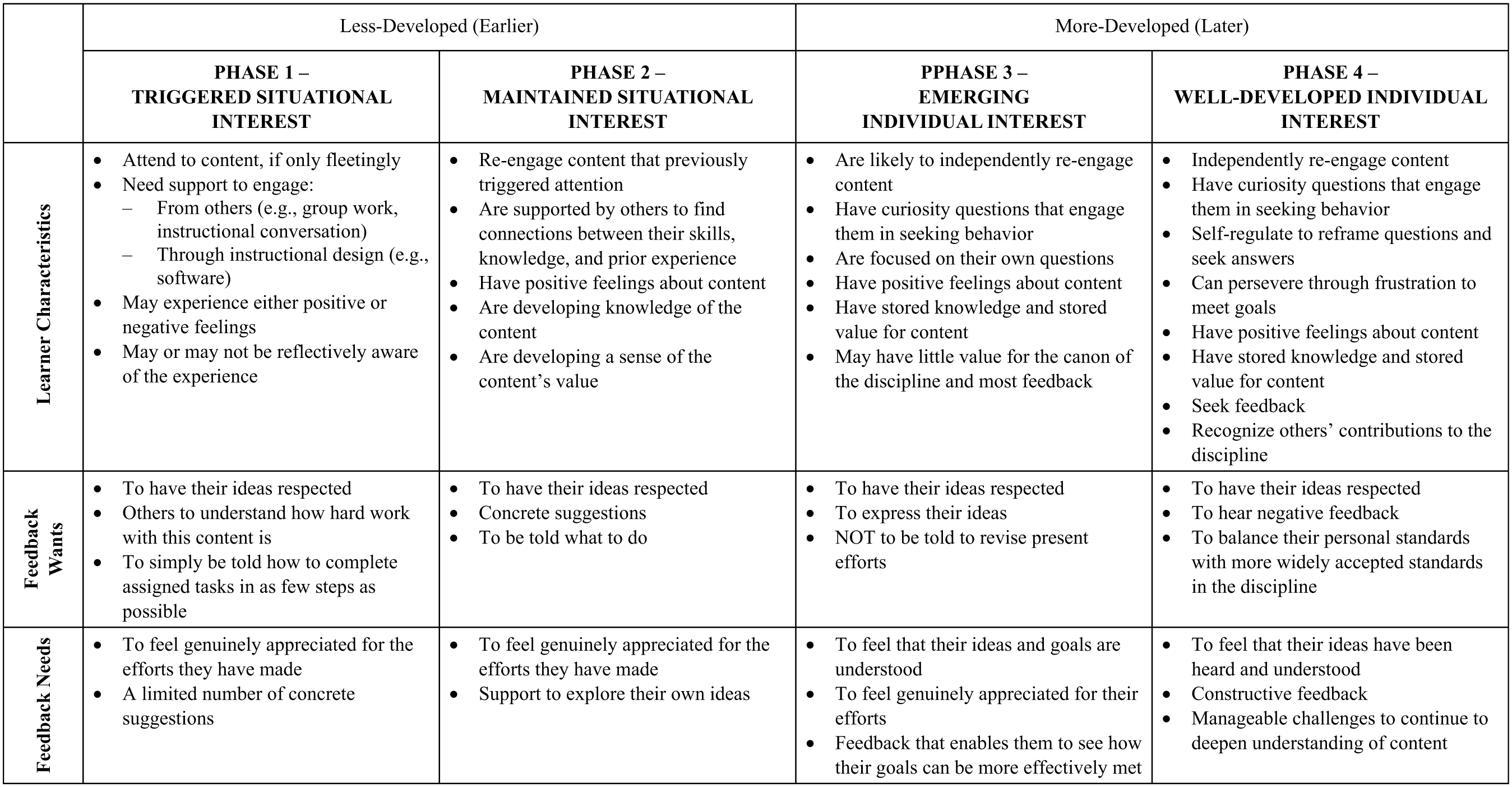
Learner characteristics, feedback wants, and feedback needs in each phases of interest development, revised. First published in Renninger (2009).
Differences among participants in their level of interest occur across a wide range of learning contexts, including the following: young children presented with literacy activities (McTigue, Solheim, Walgermo, Frijters, & Foldnes, 2019); primary school students working with science problems (Rotgans & Schmidt, 2017); middle- and high-school-aged youth participation in science, technology, engineering, and mathematics (STEM) activity provided by school and community partnerships (Staus, Lesseig, Lamb, Falk, & Dierking, 2019); middle- and high-school-aged participants in out-of-school computer science workshops who are learning to program (Lakanen & Isomöttönen, 2018); high school students in a government course (Lo & Tierney, 2017); high school students in biology (Larson, 2014); Japanese university students learning English (Fryer, Ainley, & Thompson, 2016); university students enrolled in engineering courses (Michaelis & Nathan, 2016); university students taking psychology classes (Harackiewicz et al., 2008); and older adults learning to work with mobile technologies (Beh, Pedell, & Doube, 2015).
Phases of Interest Development
Four phases in the development of interest are validated, and progression through them is related to the deepening of a person’s knowledge and corresponding value (e.g., Cabot, 2012; Harackiewicz et al., 2008; Lakanen & Isomöttönen, 2018; Larson, 2014; McTigue et al., 2019; Michaelis & Nathan, 2016; Nolen, 2007; Rotgans & Schmidt, 2017; Staus et al., 2019). However, depending on research questions and purposes, some researchers as well as practitioners focus on less-developed interest (the earlier two phases: situational interest, first triggered, then maintained) and more-developed interest (the later two phases: individual interest, first emerging, then well developed) (see Figure 2). For practice in particular, assessing how developed individuals’ interest is does not have to be direct, formal, or high-stakes (e.g., Penuel & Watkins, 2019). Observing how frequently individuals opt to voluntarily reengage with the content in question, together with the depth of their engagement, reliably indicates whether an interest is less or more developed (Renninger & Hidi, 2016).
In each phase of interest development, change is initiated by a process of triggering that propels information search, deepening knowledge and value. Even when students have little or no initial interest in a content, cultivating their interest and a desire to learn is still possible (see discussion in Renninger & Hidi, 2016). Opportunities that enable individuals to continue to stretch their present knowledge and value are critical to developing interest. These include the affordances of the learning environment, as well as the ability to pick up and make use of these affordances to learn. For example, among the strategies reported as beneficial for scaffolding science interest were teachers’ efforts to help their students make connections between what they were learning in science and their daily lives, as these led them to want to continue to talk about a topic and at the same time provided them with new ways to connect to what they already knew (Xu et al., 2012). Interviews with the life science students that Crouch et al. (2018) studied further illuminate this point. The interviews revealed that those who began the course with less-developed interest needed the support provided by the life science topic (e.g., optics) as a way to make the to-be-learned physics meaningful (Renninger & Hidi, 2019). Those with more-developed interest at the start of the course may not have needed the context of life science to learn physics; nevertheless, they described themselves as benefiting when the course content used life science topics such as optics to extend what they already knew and led them to make connections to other classes that they were taking (Renninger & Hidi, 2019).
Support for individuals to make connections to content may involve changing the way that other people and the educational environment enable them to set and achieve goals (e.g., Harackiewicz, Smith, & Priniski, 2016; Palmer, Dixon, & Archer, 2016) or help them to make their own (self-specific) connections to the content in which they are expected to engage (e.g., Hidi, Renninger, & Northoff, 2019; Renninger et al., 2014). J. M. Alexander, Johnson, and Neitzel (2019) described processes that enable interest to continue to develop as “on-ramps” and in longitudinal work demonstrated how parents, educators, and peers may provide such support for learners at different ages. They also chronicle the complications introduced by “off-ramps”: situations that did not support the individuals to continue to engage productively with content and led to decreases in interest. However, decreases in interest can reverse, and new interest can develop—even when individuals themselves may think that this is impossible (see discussion in Renninger & Hidi, 2016).
Interest and Reward
Feedback, or scaffolding, to know how to meaningfully engage can make working with new content feel worthwhile and rewarding, in turn both triggering interest and providing support for its continued development (see Figure 2). When individuals have little or no interest in a content such as physics, they can benefit from scaffolding that communicates respect for what they do understand, a point similar to the importance of the caring and accepting classrooms of the teachers on whom Xu et al. (2012) reported. For interest to continue to develop, individuals also want to know about gaps in their understanding and to receive help to know how to address these—information that should be more explicit, if their interest is less developed. Once interest is triggered, the information search that follows serves as an intrinsic reward that activates the reward circuitry in the brain and supports further engagement. Thus, the physics students whose interest is triggered by the life sciences examples may begin to develop some interest in physics. They also may then search for ways to increase their understanding of physics, indicating that searching for information about physics has become rewarding.
The reward circuitry is central to explaining the powerful and beneficial effects of interest on performance and learning (Ainley & Hidi, 2014; Renninger & Hidi, 2016). The functional role of intrinsic and extrinsic reward differs depending on the phase of a person’s interest development. Extrinsic rewards (e.g., grades, praise, and acknowledgment) are critical for those who are not intrinsically motivated (Hidi, 2016). For these individuals, extrinsic rewards can be used to encourage reengagement with the content (e.g., physics) until they begin to want to independently seek reengagement with it themselves. That is, extrinsic rewards are more important in the earlier phases of interest development when support may be needed to maintain interest (Hidi & Renninger, 2006). In the later phases of interest development, extrinsic reward may have a different role, as individuals in these phases are engaging in seeking information that is intrinsically rewarding and is likely to lead them to further engagement.
All of the strategies that work to develop interest are similar in that they appear to be based on the premise that seeking information about content can be rewarding. They enable learners to make connections to content. The connections lead them to engage in independent seeking behaviors, and when they do, the reward circuitry is activated and their interest continues to develop and deepen. Once individuals are engaged, their experience of interest becomes important as they continue to seek information and work (Sansone, Geering, Thoman, & Smith, 2019). Even those who only have some interest and are searching for a goal can purposefully make their experience more interesting for themselves.
How Interest Development May Be Supported
When learners have a developing interest, they are likely to already be seeking information. They need opportunities to continue to deepen and stretch what they presently know. However, it cannot be assumed that because individuals have an interest in physics, for example, that any physics-related content will be engaging for them. Just because they are interested in physics, they may not be interested in all aspects of that topic—even though they might be supported to develop such interest. Interest is only rewarding when it expands current thought; for this reason, it is essential that they can link new content to be learned to what they think about or are able to do already.
In a physics class, it is physics that needs to be the teacher’s and students’ focus. Teachers cannot be expected to individualize, or personalize, instructional activities for each student. Students do have a range of existing interests, only some of which overlap with other students in the same classes. When these are shared with others in the class, this may support students’ learning, as in the physics classroom for the life science students. In the Xu et al. (2012) study, the teachers focused on encouraging the students to develop an interest in the science they were being taught by involving them with science in a wide variety of ways. Although presumably the range of options worked differently for each student, likely it was the ongoing support to continue to engage different types of science activities that enabled interest to develop.
Simply recognizing and adjusting instructional practices to enable those with less- and with more-developed interest to meaningfully engage can be an on-ramp for supporting the development and/or deepening of an interest. Tasks, projects, activities, and lectures that are open-ended can each include triggers for interest that enable those who have less-developed interest to make connections to the content and those with more-developed interest to stretch their understanding by making additional connections.
Some examples of methods for triggering and maintaining interest that can accommodate differences in learner interest include the following: (a) using novel, surprising, or complex task features as a way to introduce materials that are new to students (e.g., Hidi & Baird, 1986; Nieswandt & Horowitz, 2015); (b) involving students in working directly with others on open-ended projects, drawing on many students’ interests in the social aspects of group work, and enabling them to benefit from the modeling and social support that peers can provide (e.g., Knogler, Harackiewicz, Gegenfurtner, & Lewalter, 2015; Mitchell, 1993; see discussion in Bergin, 2016); (c) personalizing content by inserting students’ existing interests as the context of problems or text (e.g., Bernacki & Walkington, 2018); or (d) using utility-value interventions to draw students’ attention to the usefulness of the content they are learning (i.e., giving students assignments that require them to explain why taking biology, for example, is useful to them) (e.g., Hulleman & Harackiewicz, 2009; see reviews in Harackiewicz, Smith, & Priniski, 2016; Hulleman, Kosovich, Barron, & Daniel, 2017). Each of these methods improves student performance. Moreover, the participant groups targeted in study of utility-value interventions have demonstrated that these interventions may be most effective for students who are considered to be at risk (e.g., first-generation or underrepresented minority students)—suggesting that they have the potential to close the achievement gap between students (Harackiewicz et al., 2014; Harackiewicz, Canning, Tibbetts, Priniski, & Hyde, 2016). 2
Instructional practices that enable learners to stretch their present understanding of content feel rewarding. However, their experience of interest during engagement is also influenced by the context of how they come to the task and its congruence with their goals (Sansone et al., 2019). Shifts to meaningfully engage with content and begin seeking information independently may occur almost immediately, but they also may take several years (e.g., Azevedo, 2013a, 2013b; Renninger & Riley, 2013). Learners need time to explore (making mistakes and resolving them) to begin posing and seeking answers to their own curiosity questions and for interest to “take” (Azevedo, 2006; Renninger, 2000; Sansone et al., 2019).
Implications
The presence of interest is intrinsically motivating and contributes to increases in understanding and sustained engagement. Everyone gains power when interest is leveraged to support educational opportunity. Not only may interest be able to help close achievement gaps, as suggested by research on utility-value interventions, but developing and deepening interest benefits all students, including those who are presently at the center of policy discussions (e.g., English-language learners, students with disabilities, immigrants, high school dropouts, college students who do not continue in STEM courses).
Students differ in their readiness to work with tasks, activities, or assignments, based on their ability to focus, comprehend, and problem-solve. These differences can lead to inequalities of outcome and make learners less likely to realize their potential. When individuals have not yet developed enough interest to find their work with some content rewarding—and, as a result, be in a position to persevere, be conscientious, and make use of negative feedback—the learning environment, or playing field, needs to be leveled so that it supports them to develop at least some interest.
Educators have a key role to play in supporting interest development. By requiring support for interest development, policymakers could enhance educational opportunities for all. Educators and policymakers are responsible for the design of the learning environments that students encounter. They are responsible for establishing classroom/school atmospheres that communicate caring and acceptance, and make students feel that they belong. They also plan instructional activity (e.g., curriculum, assessments) that can encourage the interest development of all students. However, before educators are in a position to encourage interest development, they may need to learn how to support their students’ interest to develop (Renninger, Talian, & Kern, 2019).
Preservice training and professional development opportunities may prove useful if educators think that covering a basic curriculum with students is sufficient, or that addressing interest is too messy, complex, or challenging. They may not realize that
interest can be developed,
a developing interest is intrinsically rewarding,
all individuals may develop interest at any age across a variety of contexts, and
there are reliable differences among students based on whether their interest is in an earlier or in a later phase of its development, and this information can be useful for supporting student learning.
They also may not realize that as educators, they have the power to help level the playing field for their students by supporting them to develop interest. It is essential that they are encouraged to recognize this.
Footnotes
Acknowledgements
We appreciate the comments we received on an earlier draft of this manuscript from Carol Sansone and Susan T. Fiske. We also gratefully acknowledge editorial support provided by J. Melissa Running.
Declaration of Conflicting Interests
The author(s) declared no potential conflicts of interest with respect to the research, authorship, and/or publication of this article.
Funding
The author(s) received no financial support for the research, authorship, and/or publication of this article.
