




Abstract
This article explores how the Crash Course video series are being used as a content-focused resource in the social studies classroom. It argues that the Crash Course series, alongside its YouTube competitors, has significantly stepped in to fill a vacuum left by criticisms and the unpopularity of lectures, textbooks, and feature films. With over 15 million subscribers and accumulated views over 1.9 billion, Crash Course has become an important and ubiquitous force in history and social studies classrooms and represents a new genre of educational media found on YouTube. However, the dramatic rise in the popularity of educational videos online has not coincided with a growth in educational research, particularly in social studies and history education. This article explores the findings of a mixed-methods study that examines how and why history and social studies teachers are using Crash Course videos in their teaching and planning. In particular, it analyses descriptive statistics derived from the results of a teacher survey (n = 181) and semi-structured interviews with seven social studies teachers who have used Crash Course in their classrooms. The authors found that teachers in the study are regularly using the Crash Course video series to deliver content which is clearly meeting a need many social studies teachers have. The videos–short, easily accessible, and fun–fit nicely with demands to keep students engaged, reduce reliance on textbooks, and explore new content that teachers have little time to learn themselves. This study also found that rarely, if ever, are teachers inviting students to evaluate or assess the content, trustworthiness, or perspective of Crash Course videos. This article discusses what is gained and what are the risks of embracing Crash Course in the social studies and history classroom.
We contend that the use of film media in social studies classrooms has undergone a significant change in the past decade. In this shift, both feature films and documentaries are becoming less desirable and less common as teaching and learning resources. As a teacher in our study said: “I used to use films in the classroom, but it drove me insane that students felt that they could sleep through them. Drove me absolutely nuts.” It’s not that films have completely disappeared from classrooms, nor is it the case that movies no longer have the ability to captivate young people. Rather, with increasing evidence that attention spans are decreasing (Mark, 2023), and the ever-present distraction of social media pinging from students’ smart phones (Pew Research Center, 2022), we argue that feature length films are losing their place in social studies teachers’ repertoire and are increasingly being replaced with shorter, more accessible, and more entertaining YouTube videos.
Alongside larger cultural shifts in how we consume media, social studies teachers have been under pressure for decades to find new and innovative ways to engage students beyond traditional lecture and textbook methods which are seen as relics of the past. Researchers have consistently critiqued history textbooks for misrepresenting racialized and marginalized communities, while also uncritically disseminating dominant ideologies such as white supremacy (King & Simmons, 2018; Loewen, 1995; Yacovone, 2022). Likewise, the teacher lecture maintains the perception of being the height of boredom in history and social studies classrooms (Stacy, 2009). How much teachers are actually limiting or rejecting these methods is not fully clear, however our previous research suggests that they are hungry for new options (Miles & Thind, 2022). The question then has become, what are teachers replacing lectures and textbooks with? To be clear, we are not arguing that textbooks and lectures are no longer commonly used, but rather that history and social studies teachers are experiencing increased pressure both from within the classroom and from outside to find more engaging ways to teach historical knowledge.
In this article, we explore what might be replacing certain types of curricular resources, like textbooks, films, and lectures, in the history teachers’ toolkit and how teachers are making decisions about these resources. We argue that YouTube videos, like the Crash Course series hosted by John Green, are becoming increasingly common in the social studies classroom. For example, consider the Crash Course World History series, which contains 42 short videos freely available to anyone with a phone signal or Wi-Fi connection. The series has over 72 million views on YouTube. Additionally, a quick search of teacher websites like “EdPuzzle.com” reveals tens of thousands of teacher-made quizzes and questions to support the use of these videos for teaching and learning. With over 15 million regular channel subscribers and accumulated views over 1.9 billion, we argue that Crash Course is becoming an important and ubiquitous force in many history and social studies classrooms.
Simultaneously there has been a dramatic rise in YouTube’s popularity among young people more generally which has not coincided with a growth in educational research. While some studies have begun to investigate the issue (Fyfield, 2020; Jones & Cuthrell, 2011; Maziriri et al., 2020; Tan, 2013), we know little about how, why, and to what effect teachers are using YouTube both inside and outside of social studies classrooms. The limited research on YouTube videos and education is surprising given the fact that surveys regularly show that almost all (approx. 95%) secondary students in the United States have access to a smartphone (Auxier & Anderson, 2021). Furthermore, a Pew Research Center survey conducted in 2022 showed that YouTube was the most popular social media platform among teenagers, surpassing Instagram, TikTok, Snapchat, and Facebook with 95% of respondents reporting that they use YouTube. This survey also revealed that respondents, aged 13 to 17, report using YouTube several times a day (41%) or almost constantly (19%) (Pew Research Center, 2022). These recent surveys, and Crash Course’s public viewing numbers, make clear that YouTube videos are a significant part of young people’s lives and some portion of that time is spent viewing educational videos both inside and outside of classrooms. As a result, we argue that YouTube videos, like the highly popular Crash Course series, must be taken more seriously by social studies teachers and researchers. Of course, not all YouTube videos are created equally and we do not intend to conflate all content across the platform, rather we seek to explore one social studies education focused example to understand how it is being used by teachers.
In this article, we explore findings from a mixed-methods study that examined how and why a selection of US history and social studies teachers are using Crash Course videos in their teaching and planning. We analyze the results of a teacher survey (n = 181) and teacher interviews (n = 7) to consider how teachers are making decisions about using Crash Course in their teaching and planning. In this article we aim to address the following research questions:
1) How often are teachers using Crash Course in their teaching and planning?
2) How do teachers use Crash Course in their teaching and planning?
3) Why are teachers deciding to use Crash Course in their teaching and planning?
What Is ‘Crash Course’?
Spanning multiple subject areas including history, biology, and astronomy, Crash Course began in 2006, primarily as the brainchild of video bloggers and authors John and Hank Green. In 2011, YouTube approached the brothers to begin making the Crash Course series, with John Green hosting the history series, which is written primarily by his high school history teacher Raoul Meyer (Talbot, 2014). The history series has since grown from world history and US history “courses” to include video playlists that focus on “Big History,” European history, the history of science, and film history. The history playlists currently contain over 300 videos, each lasting approximately 12 minutes, though the video number continues to grow. The most popular series are “US History” and “World History,” with each video in the series averaging between 2 and 15 million views. The Crash Course videos are short, fast-paced, content-heavy, easily accessible, free, and entertaining.
The Crash Course history videos primarily feature host John Green, speaking directly to camera on any given historical topic, such as the Civil Rights Movement or Reconstruction. Green’s fast-paced lecture is embellished by animated sequences, still images of primary sources such as maps, letters, or paintings, and a jump-cut aesthetic, which the New Yorker referred to as “the pedagogical equivalent of Red Bull shots” (Talbot, 2014, para. 24). The videos are also characterized by their sarcastic and nerdy tone, with Green regularly inserting in-jokes, memes, and silly asides. As the Crash Course videos are short, fast-paced, content-heavy, easily accessible, free, and entertaining, it is unsurprising that they are incredibly popular with teachers and students.
Conceptual Framework: Teachers as Curricular-Instructional Gatekeepers
In this article, we draw on concepts commonly used to explore and understand teacher decision making. In particular, we utilize Thornton’s (1991) influential conception of social studies teachers as curricular-instructional gatekeepers. In Thornton’s (1991) view, teachers are regularly making significant decisions about the content and learning activities students encounter on a daily basis in classrooms, despite the external standardizing pressures of curriculum, textbooks, and so on. In other words, social studies teachers demonstrate a great deal of autonomy over how and what students learn, and their decisions vary greatly from teacher to teacher. Subsequent research in social studies has shown that this gatekeeping process is often unconscious and is influenced by a great number of factors including policies, standards, ideology, emotion, teacher beliefs, and student identities especially around controversial or contentious topics (Journell, 2011; Merryfield, 2007; Salinas & Castro, 2010; Sheppard & Levy, 2019). The concept of teacher as curricular-instructional gatekeeper is useful here for guiding our analysis in this study as we aim to understand how and why teachers are making the decision to use Crash Course videos in their curricular planning and instructional activities. We also aim to explore how teachers’ beliefs about the nature and benefits of the videos shape their use in classrooms and that this as important consequences for students. As Thornton (1991) observed, teacher gatekeeping is never value neutral and is a product of the frame of reference that each teacher brings to their tending of the curricular-instructional gate. In other words, this concept can help researchers understand how and why teachers are choosing to use Crash Course and how these decisions relate to standardizing processes such as curriculum, standards, and textbooks.
Literature Review
The Use of Film in History and Social Studies Education
A great deal of research in recent years has been conducted exploring the uses of film media in social studies and history classrooms (Paxton & Marcus, 2018; Russell, 2007, 2012). Early research on films and social education coincided with the increase in film production in the early twentieth century (O’Connor, 1988; Peters, 2020). The ability to more widely and readily screen history films increased their relevance to people’s perception of the past, particularly young people (Donnelly, 2014; Metzger, 2010; Metzger & Suh, 2008). Many scholars have suggested that young people’s perception of the past comes from movies, more so than schooling (Briley, 2002; Marcus et al., 2018; Wineburg et al., 2001). In their research on students’ historical understanding of the Vietnam War, Wineburg et al. (2001) found that Forrest Gump had the most significant influence, superseding any book, documentary, or teacher. A similar finding arose from VanSledright and Afflerbach’s (2001) study analyzing how students read historical texts. In what they dub the “Disney Effect,” the authors found that students “judged the veracity and accuracy of the school history text’s account against the Disney film” (VanSledright & Afflerbach, 2001, p. 703).
In addition to bringing film-based historical understandings into the classroom, young people also directly encounter film in history classrooms. Scholars suggest that film can be advantageous in the classroom as it uniquely engages students emotionally and viscerally, something that texts cannot necessarily do (Paxton & Marcus, 2018; Rosenstone, 1995). As such, history films have the capacity to help students build empathy for historical events and figures (Marcus, 2005; Stoddard & Marcus, 2006). Stoddard et al. (2017) suggest that teachers may also seek out film to address subjects that may be emotionally difficult, or to address topics with which they are less familiar.
Previous teacher surveys confirm many of these scholarly findings, as teachers cite building content knowledge, enlivening historical topics, cultivating citizenship practices, and increasing historical empathy as reasons for using film in the classroom (Donnelly, 2014; Marcus & Stoddard, 2007; Metzger & Suh, 2008; Russell & Waters, 2010). Among classroom-level studies, Weinstein (2001) contends that working with film through his Film and History Project has helped his students to employ the same skills historians use to engage with the past. Similarly, in his case study with students viewing Do the Right Thing, Briley (2006) found that the film generated thoughtful conversations among his students around race relations.
While researchers initially focused on history films’ potential to educate students on history content, acting as a stand in for a teacher or textbook, more recent scholarly work emphasizes film as a construction and interpretation of history that should subsequently be analyzed as a historical source (Marcus et al., 2018; Peters, 2020; Wineburg et al., 2001). Due to a common lack of historical accuracy in feature films (Stoddard & Marcus, 2006) and a tendency for history films to “offer one dominant narrative about the past” (Metzger, 2007, p. 70), scholars stress that films should not be passively consumed (Briley, 2002; Russell, 2007; Stoddard & Marcus, 2006; Weinstein, 2001). Rather, scholarship concurs that teachers and students should engage in critical thinking and analysis of film, as one would with any historical text (Marcus et al., 2018; Metzger, 2007; Stoddard & Marcus, 2006).
While scholars emphasize pedagogical practices that encourage critical engagement with film, classroom-level studies suggest an absence of critical interrogation. For example, in a comparative case study of two white teachers’ lessons on race and slavery in early US history, Metzger and Suh (2008) found that the lessons did not successfully engage students in critical thinking about the movies. Rather, the authors suggest that teachers were more focused on building empathy or “seeing history as constructed from different perspectives” than on engaging students’ critical thinking (Metzger & Suh, 2008, p. 103). Similarly, in a study with high school students who viewed Dances with Wolves and The Searchers, Seixas (1993) determined that students were less likely to think about films critically when the “interpretive stance” (p. 364) of the film aligned with their own. Even where students communicate a level of distrust and skepticism towards movies as reliable historical resources, Marcus et al. (2006) findings across two case studies suggest that students were substantially impacted by the movies when discussing historical events.
Research suggests that teachers may not be engaging students critically in their use of history films because of a lack of skill, training, and/or comfort (Metzger & Suh, 2008; Russell, 2012). Through survey results and interviews with teachers, Donnelly (2014) found that few teachers had the training or skills to engage students in film analysis, tending to therefore “focus on the narrative of the feature films” (p. 24). This finding is echoed in Russell’s (2012) survey of 248 teachers, where the author found that teachers are not engaging students in critical analysis, instead equating films to a “visual textbook,” whereby students view the film and then “take a test or answer some questions” (Russell, 2012, p. 10). Survey data suggests that teachers fail to engage students in analysis due to a lack of training, as only 42% of teachers answered that they had “formal educational training on teaching with film” (Russell, 2012, p. 10). Without this intentional engagement, Metzger and Suh (2008) caution that films “are dangerous because of their potential to convey historically problematic messages to students which neither they nor their teachers are prepared or willing to confront” (p. 103).
Extant literature on film and history and social studies education thus reveals that films can be advantageous for and impactful on historical learning for myriad reasons, including increasing student engagement and building empathy. However, researchers emphasize the importance of engaging in critical analysis of film as a historical source. Despite this scholarly emphasis, empirical studies find that both teachers and students tend to focus on the narratives within film rather than engaging in critical historical analysis.
YouTube and Classroom Learning
As a free, accessible, and engaging platform that allows for social interaction among young people, researchers suggest that YouTube offers significant educational advantages (Brook, 2011; Burgess & Green, 2018; Chau, 2010). In a review of the literature on YouTube’s educational uses, Snelson (2018) finds that YouTube is used generally either to stream videos or engage students in video creation. Through streaming YouTube videos and engaging in writing exercises in response to videos, YouTube can be an asset for teaching and learning (Brook, 2011; Mayora, 2009). YouTube can also help to promote a participatory culture among students through allowing students to actively upload videos and engage with their peers on the platform (Burgess & Green, 2018; Chau, 2010). Brook (2011) also notes that YouTube videos are stimulating for students and elicit emotional reactions that may differ from typical classroom-based instruction and can thus be helpful in content instruction. YouTube can be especially advantageous for social studies teachers because of its vast archive of historical videos, many of which cannot be found elsewhere. Students can thus view actual footage of various historical events that can help to bring history alive for them (Jones & Cuthrell, 2011; White, 2009).
Recent empirical studies suggest that students and teachers view YouTube as a valuable educational resource (Fyfield, 2020; Maziriri et al., 2020). Focusing on how and why teachers use instructional videos, Fyfield (2020) finds that teachers view YouTube positively as a free and accessible resource. Though teachers tend to be uncritical in selecting and finding YouTube videos, Fyfield’s (2020) findings suggest that more experienced teachers incorporate activities into video screening, including critical analysis of videos as a historical document.
While researchers have noted the various benefits of using YouTube in the classroom, many urge educators to be cautious with their use of the platform. For example, in a recent discussion of social media in the classroom, Daly et al. (2020) note the potential for YouTube to disseminate misinformation, and thus calls for “explicit . . . teaching [in] how to gather, analyze, and determine the veracity of information gleaned from social media” (p. 147). Critical media literacy skills are therefore essential for both teachers and students.
As far as we aware very little empirical research has explored how Crash Course is used by teacher or students in social studies teaching or learning with a few exceptions (Anderson, 2020; Miles & Herold, 2023). While we do not intend to conflate or equate Crash Course videos with YouTube more generally, we argue that the Crash Course genre of YouTube video, commonly referred to as ‘edutainment’ videos is growing in popularity and requires further examination by educational researchers which is what we seek to begin here.
Methods
This article explores data from a mixed methods study which employed both a survey questionnaire of US social studies teachers (n = 181) and follow-up semi-structured interviews (n = 7). This article focuses on a quantitative analysis of the descriptive statistics created from the teacher survey’s responses and a qualitative analysis of teachers’ interview answers. The study’s purpose was to examine how often, why, and how teachers are deciding to use Crash Course videos in their classrooms. The data discussed in this article are part of a larger study aiming to address how young people’s and teachers’ historical understanding is being shaped by Crash Course videos.
Sampling and Data Collection
In this study, we invited US based social studies and history teachers who self-identified as using YouTube videos in their teaching or planning to take part in an online survey. To participate teachers had to self- identify as a current social studies or history teacher, and they had to identify as having used YouTube videos in some form in their teaching and planning. This purposeful and snowball sampling for the teacher survey was conducted through an online advertisement directed at social studies teachers and shared via email, social media including Facebook and Twitter, and online teacher networks. Approximately 204 teachers expressed some interest in participating in the study via the online recruitment process.
Drawing on Fowler’s (2013) conceptualization of valid survey design, the research team developed a survey instrument to explore different aspects of teacher decision-making related to how teachers select YouTube videos, what influences their decisions, how they use the videos in their teaching and planning, how teachers perceived the trustworthiness and reliability of the videos, and what learning activities teachers were asking students to participate in when using Crash Course videos. The survey instrument included 20 questions, including demographic, multiple choice, and ranked questions, and was conducted using Qualtrics online survey software (see Appendix 1). To increase the validity of the survey, it was piloted by all members of the research team to increase the clarity and conciseness of the questions. The survey was tested and revised multiple times to remove confusing or repetitive questions, and to shorten and simplify longer and convoluted questions.
Social studies and history teachers from 33 US states completed the online survey. 194 teachers completed some aspects of the survey, however once the data was cleaned, 181 responses were considered acceptable for analysis, although some questions were skipped by some respondents, and this is noted in the descriptive statistics discussed below. Table 1 below shows more specific demographic information of the teachers who participated in the survey. The average age of the participants was 37 and they were overwhelmingly secondary school teachers, with 91% of the respondents teaching in the 9th to 12th grade levels which aligns with the content focus of the videos. We note that this sample of teachers is not representative and does not reflect the general social studies teaching population which is a potential limitation of our findings, but it is also potentially revealing of which teachers are choosing to use Crash Course in their classrooms.
Survey Participant Demographics by Percentage (Self-Identified).

Note. N = 181, Note some percentages may not add to 100 because of rounding.
Of the 181 participants who completed the survey, 13 teachers indicated that they would be interested in a follow up interview. From this group, seven teachers were selected to participate in semi-structured interviews using guidelines developed by Adams (2015). The seven teachers selected for follow up interviews included two men and five women with varying levels of experience, diverse geographic locations, and school types to provide a range of teacher perspectives. The semi-structured interviews lasted approximately 30 to 45 minutes and focused on questions of teacher decision making related to how teachers select Crash Course videos for use, how they use them in their teaching and planning, and how they used other film media in their teaching (see Appendix 2).
Data Analysis
Data from the teacher survey was first cleaned to remove surveys missing either key demographic information or with less than half of the questions answered. This process left us with 181 usable surveys responses. Using Qualtrics online data analysis tools, we produced a series of descriptive statistics graphs and histograms of each variable. These descriptive statistics of each variable were then analyzed by each member of the research team to provide us a sense of key or emerging trends in teacher decision-making across the responses including how often Crash Course and other history specific YouTube videos were being used, which videos were regularly being selected, and how and why teachers were commonly implementing them in their classrooms. The descriptive statistics figures of each variable produced from the survey responses also shaped how we approached the interviews in part two of the data collection and analysis. In particular, we wanted to understand in more depth and texture how teachers were making decisions about their use of Crash Course and what was influencing that teacher decision making or curricular-instructional gatekeeping. Furthermore, we wanted to explore certain aspects of the variables that the survey did not provide clarity on, such as the various ways the videos are applied in classrooms.
Following the transcription of the interviews, the transcripts were analyzed independently by all three authors and then compared to establish inter-rater reliability. Analysis consisted of both inductive and deductive coding of the interview transcripts where codes remained flexible and iterative (Miles & Huberman, 2014). Deductive codes were drawn from set responses provided by the survey questions. For example, the reasons teachers might choose to select Crash Course videos included: a) free and accessible, b) likability of the host, c) content related to curriculum, d) length of video. Inductive codes were also developed after an initial close reading of the transcripts from which themes emerged based on what the Crash Course videos offered teachers and how they were used in the classroom. For example, we identified that teachers were often assigning the videos as homework or as extensions using guided questions on for profit teacher websites like edpuzzle.com These inductive codes were then applied to a secondary coding of the transcripts. Findings were then developed collaboratively by the authors from this process.
Limitations
The results of this study are not intended to be representative or generalizable to social studies and history teachers across the United States. Instead, this article is focused on providing early insights into a group of teachers who are actively using Crash Course or other history specific YouTube videos in their teaching and planning. Teachers who self-selected to participate in this study all reported using YouTube in some form in their teaching, and as a result we cannot generalize these results to all social studies teachers. Furthermore, while the survey was completed by teachers with varied levels of experience, age, and geographic representation, as discussed already the participants do not accurately reflect the diverse demographics of social studies teachers across the United States. Finally, many of the teachers in the interviews communicated ideas about how these videos impact student learning and engagement however we do not make any claims in this study on how young people are thinking about, being influenced by, or using Crash Course videos in their social studies learning.
Findings
We have organized our findings into three sections based on our research questions noted above. In each section we draw on both the descriptive statistics of individual variables from the survey responses, and the participants semi-structured interviews to explore how, why, and how often this group of social studies teachers are using Crash Course in their teaching and planning.
Frequency and Prevalence of Crash Course Videos in Classrooms
Before even considering the survey results, we already knew from publicly available data on YouTube that Crash Course videos are incredibly popular. As previously mentioned, the history-focused videos each have millions of views, with the US History having over 43 million views and the World History series having over 72 million views. It is difficult, however, to determine where these views are coming from, how many of them are unique, and how often these videos are being watched in schools by teachers or students. Nonetheless, despite this lack of information, considering the educational nature of the videos, their direct curriculum connections, and the high viewing numbers, we can infer that these videos are commonly being used in US schools. And even if schools and/or school districts are using software to block the use of YouTube as many do, many teachers and students get around this restriction by using websites and applications like edpuzzle.com that host YouTube videos for educational purposes, with thousands of teacher-created Crash Course examples freely available on this platform in particular.
The survey results confirmed many of our initial suspicions about the frequency and prevalence of Crash Course in social studies classrooms. While our sample was explicitly directed at finding teachers who used YouTube videos in their teaching, we wanted to get a clearer sense of which types of educational YouTube history videos are being used and how often teachers are using them. Ninety-two percent of the survey respondents indicated that they use Crash Course in their teaching and planning in some form, far more than any other educational YouTube history series such as Heimler’s History (66%) and Khan Academy (39%), which were the next most popular. Figure 1 demonstrates the frequency in which the surveyed teachers use Crash Course in their teaching and planning. As you can see, most commonly teachers are using Crash Course between 1 to 2 times per week and 1 to 2 times per month.
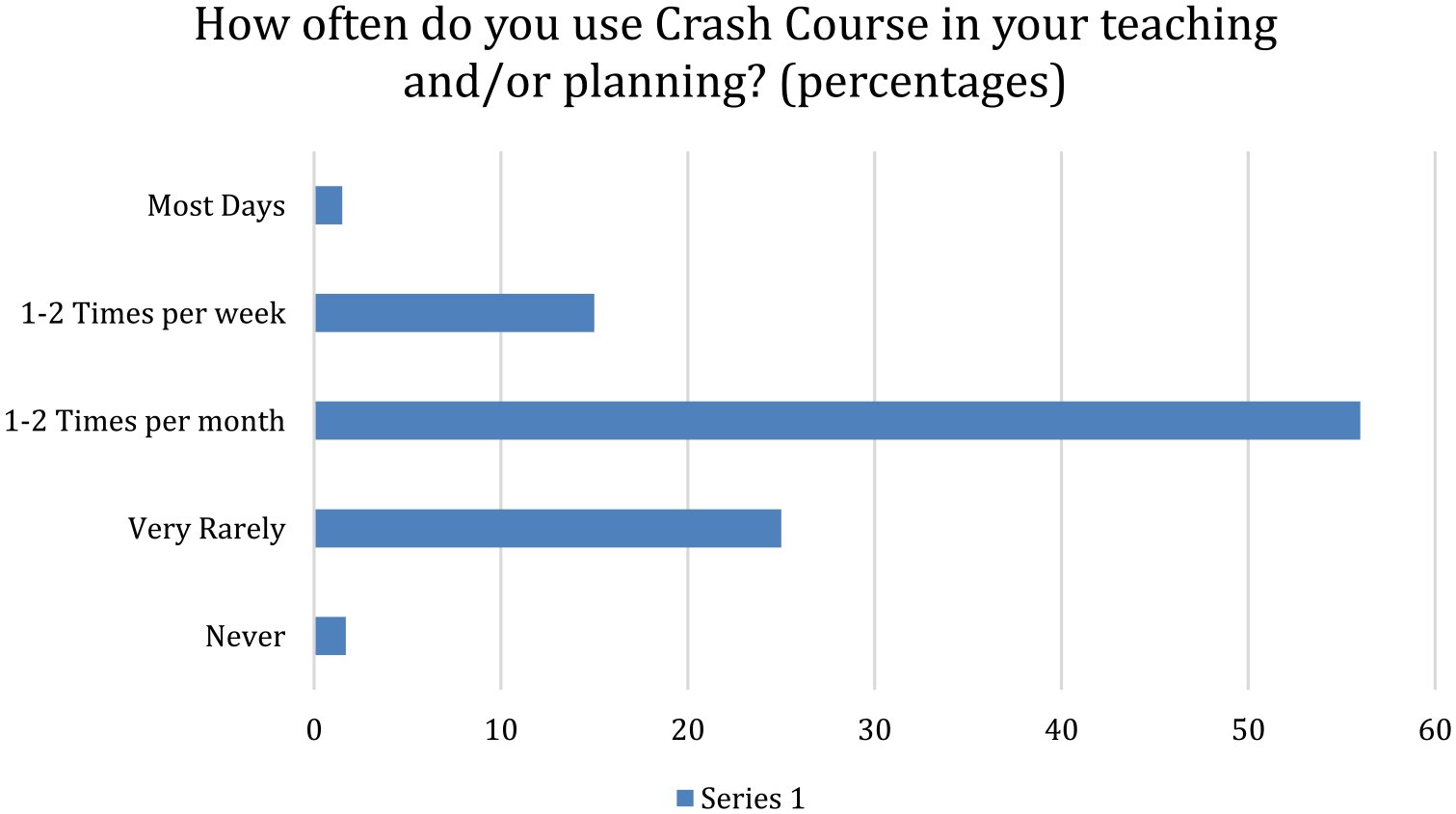
The frequency of Crash Course videos in teaching and planning.
While Figure 1 offers some insight into the frequency of use, the survey instrument was not adequately precise in providing exact frequency statistics among the teachers which of course were spread over a spectrum. This was reflected in our teacher interviews as well as some teachers reported using Crash Course almost every class to introduce new topics, while other teachers noted that they assign them for extracurricular watching or as homework. From these responses we can confidently say that Crash Course is the most popular YouTube video being used by the social studies teachers in this study and that it is most commonly shown 1 to 2 times per month; though examining how and why teachers are deciding to use videos provides a more significant finding for this study.
Uses of Crash Course in the Classroom
The survey also asked teachers to identify how they would describe the Crash Course videos and invited them to select their most common use from a list of options (see Appendix 2). We were particularly interested in whether teachers saw the videos as a form of content lecture, historical interpretation, audio-visual textbook, or a source that students should analyze. The teachers overwhelmingly responded that they would describe the videos as a content lecture (66%) (see Figure 2). This shows us that teachers recognize the videos primarily as providing a similar function that they might have provided without access to the videos. In other words, it is not that the teachers in this sample rejected lectures but rather saw the videos as offering a replacement for them. This was also supported in the interviews as teachers often explained they used Crash Course in replacement of them lecturing because the felt the videos did a better job summarizing and covering a great deal of content, an issue we discuss in our third finding.
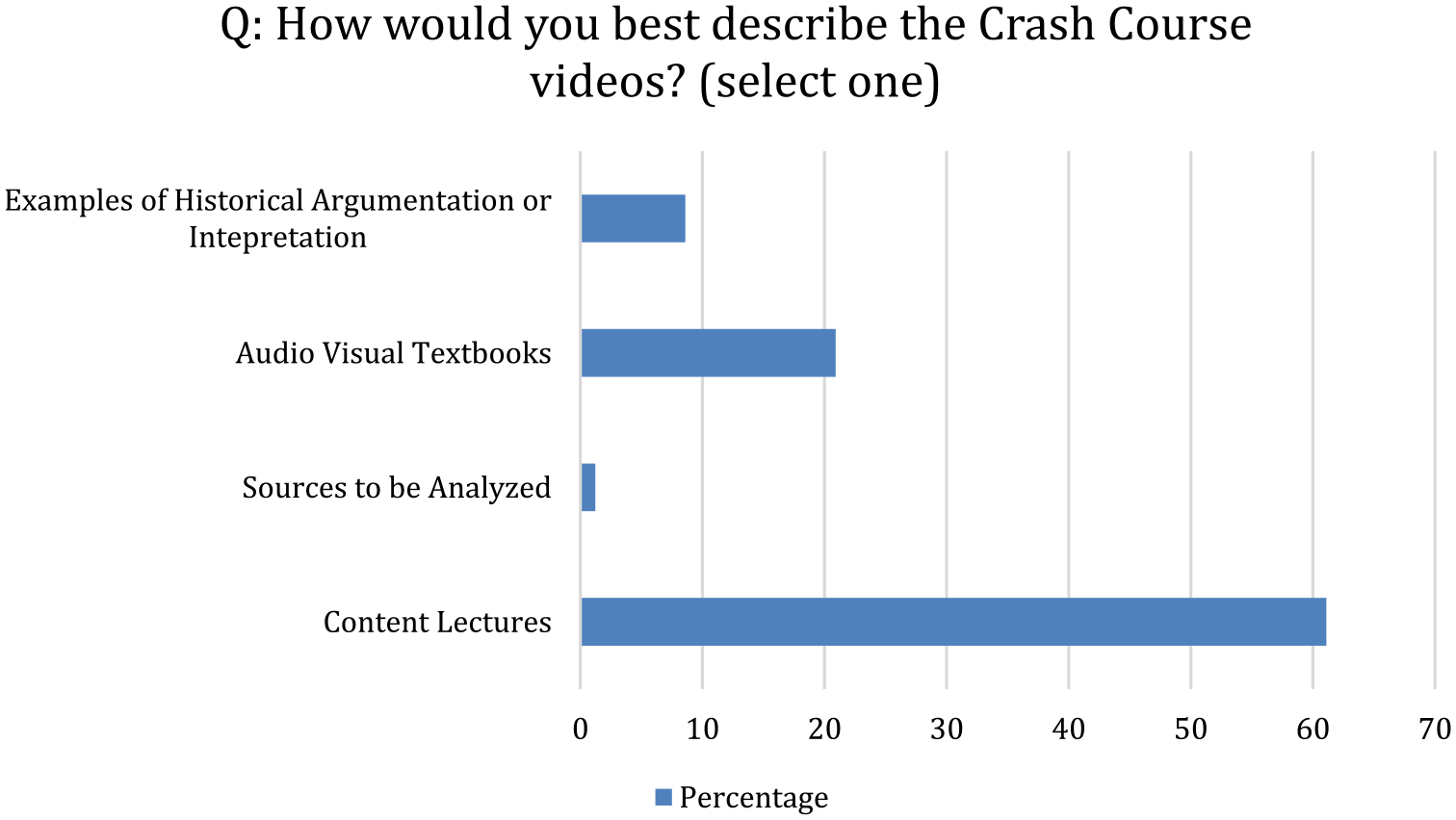
Teacher perceptions of Crash Course videos.
When survey respondents were asked what “they ask students to do” when using Crash Course videos in their teaching, the most common uses were “answer questions about the video” and “just watch the video” (see Figure 3). The most common response for strategies teachers “never use” was to “analyze the videos as a source” with 65% of teachers reporting that they never ask students to analyze the videos.
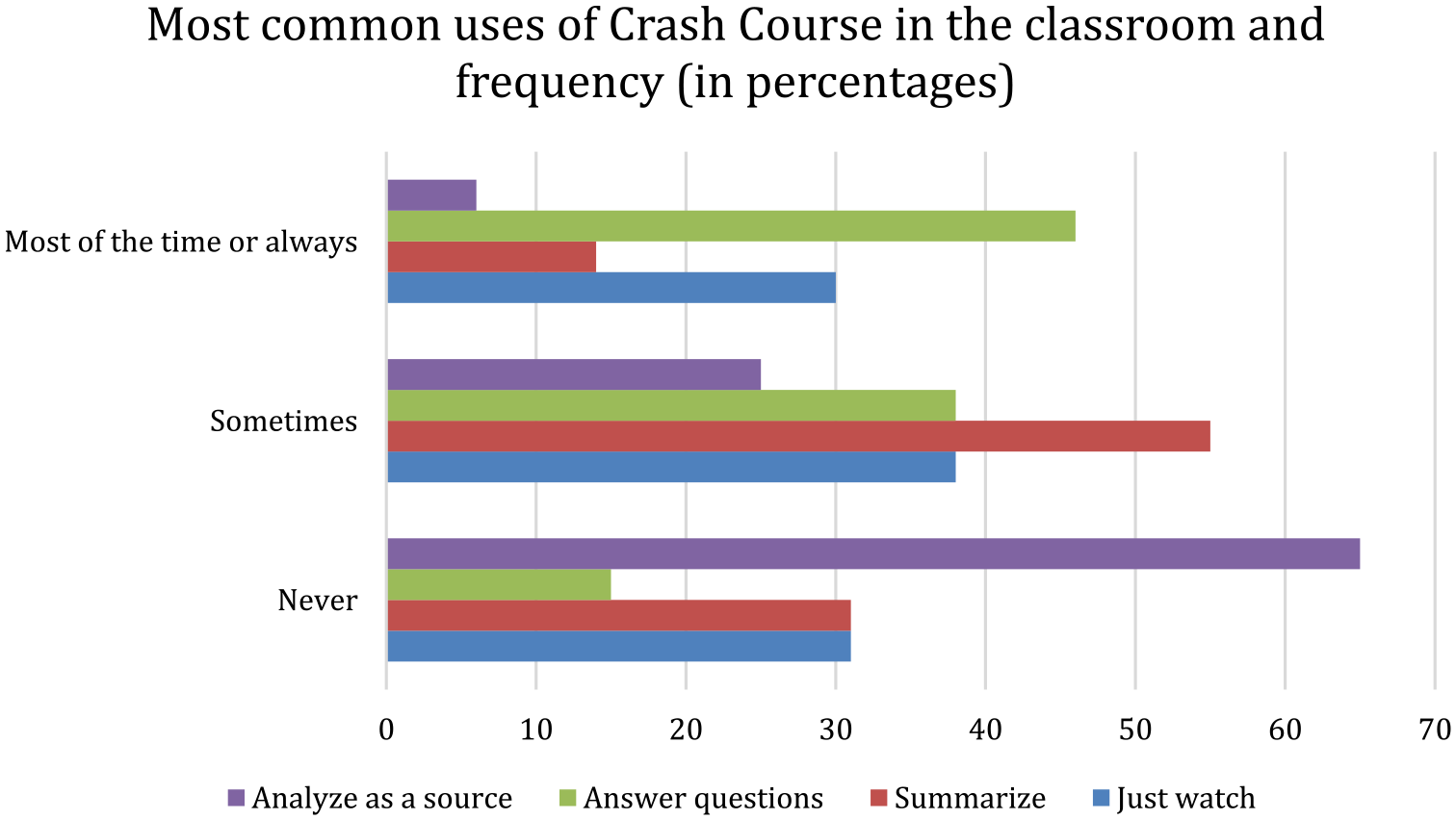
Learning activities and frequency of use with Crash Course videos.
This finding aligned with our initial hypothesis that teachers were using the videos largely in place of textbooks or lectures and that teachers were not asking students on a regular basis to analyze or critically interrogate the videos content, medium or message. In other words, teachers most often ask students to answer comprehension questions based on the video or simply to just watch them. This finding was supported in the interviews as well as none of the seven teachers described using the videos as a source instead explaining they were used as lecture replacement, a review or homework resource, and a way to introduce new topics or concepts.
Reasons Teachers Use Crash Course and its Perceived Benefits
Survey results and our interviews with individual teachers provided additional insight into what Crash Course videos offer and why teachers find them appealing. Data suggests that teachers use Crash Course because the videos are relatively short, engaging, and can be easily inserted within a lesson, with most teachers surveyed relaying that they use the videos primarily to introduce topics or concepts during class. As one interview participant put it: “I might introduce the topic with that video, but more likely, I’ve talked a little bit about the video and then use that to kind of bring out the big ideas and then have discussions about the videos afterwards.” Teachers in our study also explained that they decided to use the videos because they considered them both accurate and reliable. Survey results demonstrated that the teachers deeply trust the videos and consider them to be providing accurate and relevant information with 77% of teachers considering them “very accurate,” and 74% considering them “very reliable” as show in Figure 4. We found the perceived accuracy and reliability of the videos surprising given the lack of citation or references in the videos and the amateur status of both the host and the writer of the videos.
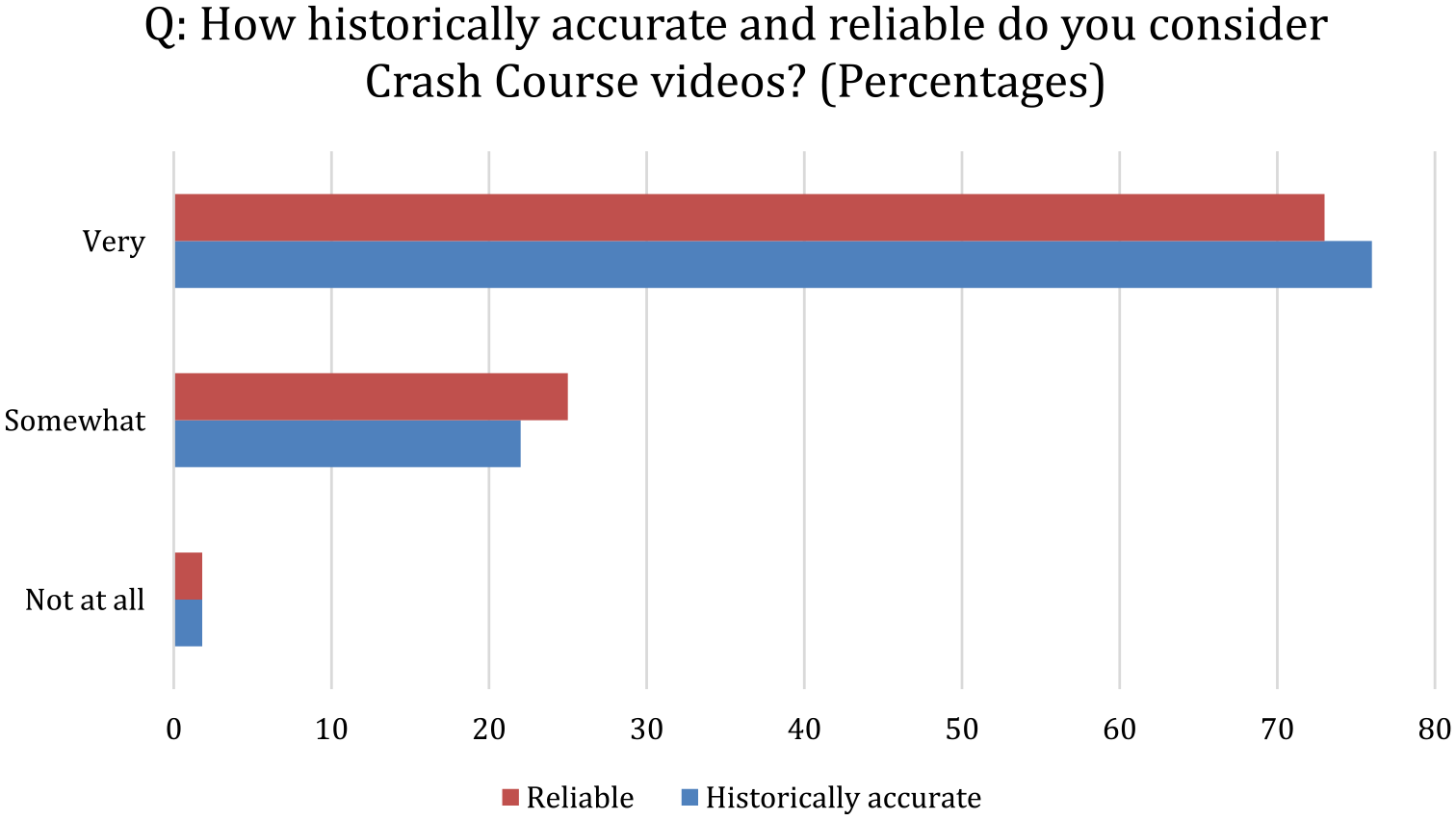
Perceived accuracy and reliability of Crash Course videos among teachers.
Several additional factors emerged in the interviews that might explain further why teachers use Crash Course as a vehicle for delivering content that were not found in the survey results. First, the teachers interviewed told us they increasingly avoid showing longer documentaries or feature films, opting instead for inserting shorter clips during class. This teacher decision seems to be in response to a perception that students’ attention spans are better suited to shorter videos, as well as broader systemic shifts to pedagogical approaches, such as avoiding extended periods of direct instruction. According to one participant, “I don’t like to lecture, but sometimes they just need to hear the information and they need to hear it not from me.” Likewise, another participant relayed that, “I would say it sort of replaces notes . . . that would be my direct instruction for the class period.” Yet another shared that they used the videos to “lay some content groundwork” at the beginning of a unit of study. Several participants remarked that they might show a clip from Crash Course as a “brain break” during a longer class because “students attention span is not two hours” and “it’s important to make [history] fun for students.” Thus, the length and informational nature of the clips afforded teachers the ability to swap out a teacher-delivered lecture for, as one participant described it, the “unadulterated content” presented by John Greene.
Similarly, data from the interviews indicated that Crash Course may impact teacher decision-making around content. Interviews suggest that teachers seek out Crash Course videos because they are unfamiliar with a particular topic and use the videos for their own edification. Teachers also use the videos because they are unsure of how to arrange and select content within a broader historical narrative in the absence of a textbook. One participant commented that they “use(s) Crash Course to teach myself,” while another expressed that the videos have “done a good job of keeping me on track and helping me remember what the big ideas are.” As a third participant put it, Crash Course has “helped me a lot in terms of thinking about the narrative, what’s important and what we emphasize and what we don’t emphasize.” For these teachers, the Crash Course series acts as trusted curation of required curriculum content, as well as a means for deepening the teachers’ own content knowledge. In some ways, Crash Course is increasingly acting as a new gatekeeper for what content teachers should know and share with their students.
Additionally, some participants suggested that they use Crash Course as a proxy to teach topics that provoke discomfort and are considered by some to be controversial. Especially in more polarized political environments, John Greene was used as a surrogate for some teachers who might be reluctant to teach certain topics for fear of blowback from administration or parents. In these cases, Crash Course steps in to replace the teacher’s voice in the classroom. One participant noted that “obviously difficult subjects come up from time to time, and we’re living in a very polarized environment where I have to be careful sometimes about the things I say and the things I show in class,” while another shared that “just to understand the magnitude of a difficult topic with good graphics and good visuals can be helpful.” These findings are consistent with previous research on film, where Stoddard et al. (2017) find in their research on using film to teach difficult history, that “teachers may be using film as a medium for engaging students in histories they are not familiar with or as comfortable teaching” (p. 4).
Our interviews with teachers also suggest that Crash Course videos are advantageous because teachers believe they are engaging and digestible. Participants note that history has the potential to be “boring” or “dry,” with one participant noting that they “don’t want students to be bored to tears.” Participants view Green’s videos as a mechanism to break up the monotony in the classroom or make otherwise dull material seem interesting. As one participant observed, Green knows to bring in fun, weird, or interesting details for students’ benefit, which “gets them more engaged.” Another participant noted that Green is able to summarize key information “in a fun way,” a feature that the teacher believed increases student engagement.
Teachers in our study also noted that they decide to use the videos because they synthesize and summarize big ideas for students in an accessible way. One participant describes how Green does a “great job of kind of crystallizing big ideas for the kids and telling it in an interesting, engaging way.” The videos’ ability to take big ideas and present them in a digestible way to students makes it a great resource for students needing clarification on topics they may have otherwise misunderstood. As one teacher describes, if a student seems confused or “didn’t understand the book,” the teacher can recommend that they “go watch this crash course video.” Rather than having to sit through a long lecture or read numerous pages of a textbook, the teachers in this study suggested that students should instead watch the short, engaging videos, providing them with the big ideas they need to understand the topic. While it is important to note that these are teacher beliefs and not those of students, it gives us a clear insight into how teachers are perceiving the value of these videos for young people in their classrooms.
Discussion: The Benefits and Disadvantages of Crash Course in the History Classroom
Our findings show that the Crash Course video series is meeting a need that history teachers clearly have. The videos–short, easily accessible, and fun–fit nicely with demands to keep students engaged, reduce reliance on textbooks, and explore new content that teachers have little time to learn themselves. From our point of view, it is not surprising that the videos are regularly being shown in classrooms. Our research shows that Crash Course videos are filling a void that is left when teachers feel reluctant or unprepared to use textbooks or lectures. Our study also corroborates previous findings that rarely, if ever, are teachers inviting students to evaluate or assess the content, trustworthiness, or perspective of YouTube videos (Daly et al., 2020; Fyfield, 2020; Jones & Cuthrell, 2011). In other words, these videos are seen in one participant’s words as “pure unadulterated content,” not sources. In this section we consider what is gained and what are the risks of embracing Crash Course in the social studies classroom.
There are a number of positive implications of using Crash Course videos to teach social studies. Crash Course videos are created especially for teachers and students—indeed, the stated objective on the Crash Course website is to “produce free, high-quality educational videos used by teachers, students, and learners of all kinds” (Crash Course, 2023). As such, the videos are easily accessible through YouTube. If teachers are blocked from using YouTube at school, Crash Course offers the option to download videos directly from their website at no cost. Additionally, Crash Course videos are designed to be highly entertaining and engaging, and their length fits easily into a typical class period. For these reasons, Crash Course videos offer teachers an attractive alternative to more traditional means of teaching such lecturing or assigning readings and questions from textbooks.
To this end, it seems that Crash Course is used, in part, as a response to increased pressure to shift away from more teacher-centered direct instruction. As Neumann (2022) points out, “history educators have rightly learned to be wary of lecture and other forms of direct instruction” (p. 325). Neumann (2021) argues that the movement toward inquiry-based instruction in social studies over the last three decades has led to an inappropriate disregard for lecture, contending that direct instruction is essential to the process of inquiry. However, despite its potential value to deepening student understanding, educators may continue to feel reluctant to include instruction that centers teacher voice. In these cases, Crash Course videos can be used to stand in for a teacher-delivered lecture. It is somewhat ironic though that in a drive to reduce the use of teacher lectures, teachers have decided to outsource the lecture to John Green. Using the videos in this way might support teachers when they endeavor to present unfamiliar material or content, which they might feel uncomfortable teaching. However, in terms of pedagogical innovation or the desire to develop a more inquiry driven approach to learning, the videos are not particularly innovative. In many respects the videos are just replicating existing lectures in a more entertaining and high paced fashion by an outside party who cannot respond to questions or critique.
With that point in mind, outsourcing lectures to Crash Course videos does provide teachers some personal distance from the content being shared, in particular around controversial issues or difficult histories. In light of recent controversies around teaching of so-called divisive topics around histories of race and racism (PEN America, 2022; Pendharkar, 2023; Waxman, 2023), Crash Course videos provide teachers a way to include perspectives and content that may not be found in state-approved textbooks and curricula or that they themselves may not want to introduce. This is not to say that content from Crash Course videos is immune to censorship. Rather, because Crash Course is already a widely used and accepted platform deployed across political contexts, the videos might offer teachers a way to insert contested content from a credible source. In other words, as the Crash Course hosts often address issues from a more progressive standpoint, the videos can act as a proxy for teachers attempting to resist efforts at conservative censorship. In this way, Crash Course can support teachers who are trying to challenge existing dominant narratives that might be embedded in textbooks.
Teachers in our study identified clear benefits for teaching with Crash Course yet we think it is imperative to also think through the risks and drawbacks of the Crash Course classroom. First, in thinking about what the videos are replacing, textbooks and lectures, it is worth considering what is being lost in this exchange. While teacher lecturing is perhaps becoming something of a lost art, it does have the ability to engage students in ways that videos, even ones with EdPuzzle questions embedded, do not (Stacy, 2009). Effective teacher lectures are interactive, responsive to student questions, and can take unexpected and valuable directions that video lectures cannot. While textbooks are perhaps easier to malign, it is important to remember that textbooks do have the benefit of often being written by historians or other experts and vetted by concerned teachers and stakeholders. Obviously, this can be a flaw as this process can be highly politicized, and it does not necessarily lead to accurate and engaging textbooks as decades of research has shown (King & Simmons, 2018; Yacovone, 2022). However, this process of mediation and regulation does ensure some oversight on what content and historical narratives are entering the classroom.
The rise of edutainment and Crash Course videos on YouTube is not necessarily dangerous, but it does suggest that teachers are acting as curricular-instructional gatekeepers for a new expansive range of content whose validity and trustworthiness is often suspect. This in turn suggests that harmful, offensive, and dangerous content can find its way into the classroom, even if purely unintentionally or accidently. In other words, it is unreasonable to ask teachers with the limited time they have, to vet videos for their political bias, inaccuracy, or for deliberate misinformation, especially if they are showing multiple videos a day or week. As our findings show, teachers in this study highly trust the Crash Course videos. Our point here is not that Crash Course is dangerous misinformation, because we don’t think it is. Rather, we argue that a reliance on freely available and entertaining YouTube videos as a regular part of classroom practice reduces mediation and regulation on the information students are exposed to on a regular basis and this has potential risks related to teacher decision making that require further consideration. A brief glance at the news over the past few years regarding how social media has influenced people’s distrust of democracy and its ability to radicalize individuals will only confirm these risks (Jones-Jang et al., 2021).
Alongside the potential untrustworthiness and unintended consequences of the content of YouTube videos, these videos represent another example of neoliberalism’s, via Google’s (YouTube’s owner), intrusion into public education. While the Crash Course videos are free in that there are no discrete charges to teachers, they do come with YouTube’s advertising, which further blurs the for-profit world and public education. Furthermore, our research tells us that the Crash Course videos are often used to support students to prepare for standardized tests set by the College Board’s Advanced Placement program. Indeed, the videos are called “crash course” for a reason, and their assessment driven focus, which aims to cover as much content as quickly and efficiently as possible also has repercussions for thinking about the testing ecosystem and an age of neoliberal accountability in which public education can be defunded and outsourced to cheap videos (Hill & Kumar, 2012). While this may sound hyperbolic, just this year Crash Course has announced that their videos will soon be available for college credit through Arizona State University, with each course costing potential students $400 for ASU credit (Tolentino, 2023). While this move is positioned by Crash Course as a solution to the debt crisis among students in the US, we argue that the solutions to the soaring costs of higher education are not to be found in further privatization, deregulation, and the outsourcing of higher learning to Google.
Conclusion
The popularity of Crash Course presents social studies educators and researchers a conundrum when considering teacher curricular-instructional gatekeeping. It is unlikely that this genre of teaching and learning resource will be going away any time soon and these videos are popular for a reason. Crash Course will likely only grow in acceptability in the classroom and will continue to expand its reach into public K-12 education. We maintain that Crash Course itself is not necessarily harmful and, in this article, we have aimed to acknowledge how teachers use it and perceive its many benefits. However, we also must acknowledge the risks that Crash Course videos represent for social studies education and public education more broadly. Furthermore, we know very little about the impacts of Crash Course on history teaching and learning, as researchers have spent little energy considering more generally YouTube’s impact on the history and social studies classroom and historical understanding broadly understood. We suggest that social studies and history researchers need to take Crash Course videos and their online competitors seriously. Further research needs to examine how young people use these videos and how they shape their thinking about history, historical thinking, media literacy, and historical consciousness as previous research on films has aimed to do (Seixas, 1993; Wineburg et al., 2007). We hope that this study can begin this conversation which we argue is both urgent and significant for the field of social studies and history education.
Footnotes
Appendix 1
Appendix 2
Declaration of Conflicting Interests
The author(s) declared no potential conflicts of interest with respect to the research, authorship, and/or publication of this article.
Funding
The author(s) received no financial support for the research, authorship, and/or publication of this article.