



Abstract
This semester-long research project examined the use of social studies trade books to thematically teach about six individuals who served as change agents in the United States during the late 19th century and early 20th century. Three of the individuals were African American men, Robert Smalls, Frederick Douglass, and John Roy Lynch, who took civic action to address racial discrimination faced by the Black community in the half century following the U.S. Civil War. The other three indivduals were women women, Ida B. Wells, Clara Lemlich, and Jane Addams, who challenged social inequities and injustices within their communities. Over the course of the semester-long research project, sixth-grade U.S. history students read selected trade books, examined primary sources, completed graphic organizers, and crafted writing assessments about each of the six individuals. Students demonstrated complex historical thinking, integrated economic and civic thinking, and communicated thematic ideas of systemic oppression of minorities, women, and the poor. They struggled to make connections between examples of historic oppression and contemporary examples of societal oppression.
Keywords
American democracy was founded on a contradiction. The democratic values and liberties enshrined in the Declaration of Independence and U.S. Constitution have not been the reality for disadvantaged communities throughout American history (Hubbard, 2019a). This reality can be seen in stark terms during the Gilded Age and start of the Progressive era. The Second Industrial Revolution and Jim Crow segregation laws created massive systems of inequalities along racial, ethnic, religious, class, and gender lines in U.S. society. The inequalities that emerged in these historical epochs caused some Americans to take civic action to confront and attempt to change these economic, social, cultural, and political realities. While it is not uncommon for research in social studies education to examine the agency and civic action for one historical figure that confronted social injustices, there is little research that thematically explores how to examine multiple individuals that worked within the same historical era and across time as change agents around specific public issues.
This article reports on a semester-long research project that occurred in a sixth grade U.S. history classroom in the Southeast to thematically teach agents of change during the second half of the 19th century and early 20th century. Our study was driven by the following research question. How, if at all, do students articulate thematic connections among the six historical figures that took civic action to address public issues? We used qualitative data analysis techniques to code students’ graphic organizers and writing activities. An additional goal of this research project was also to explore how if at all these students articulated the disciplinary thinking, literacy, and argumentation skills for civics, economics, history, and geography as advocated for by the National Council for the Social Studies (NCSS) in its C3 Framework (NCSS, 2013a). While there is a robust body of literature on historical thinking (Nokes, 2013; Seixas & Morton, 2012; VanSledright, 2014; Wineburg, 2001; Wineburg et al., 2013), scholarship on economic, geographic, and civic thinking is limited (Hubbard, 2019b; Journell, 2017; Journell et al., 2015; Keefer, 2019).
For 8 weeks over the course of the Fall 2022 semester, sixth graders read trade books and primary sources focusing on six change agents who attempted to address social, economic, and political inequalities in U.S. society. Students completed graphic organizers with analysis prompts to articulate each person’s civic actions while also making connections among the people studied. Three of the people explored took civic actions to address racial discrimination faced within the African American community for the half century after the U.S. Civil War. The other three people focused on were women who addressed societal issues in their respective communities during the Gilded Age and start of the Progressive era. Our study was driven by the following research question: How, if at all, do students articulate thematic connections among the six historical figures that took civic action to address public issues? Each 1 week project examined different public issues and how a historical figure took civic actions to address inequities in U.S. society. Student data show that they were able to articulate disciplinary thinking skills in civics, economics, geography, and history in the manners enumerated by the indicators of the C3 Framework by researching public issues for the half century after the U.S. Civil War.
Our project examined underexplored areas of social studies education. Thematic teaching has been discussed mainly from either a theoretical or practitioner standpoint (Clabough, 2021; Evans et al., 1996; Metro, 2017, 2020). In this project, we define thematic teaching as exploring a public issue chronologically over numerous time periods as different people attempted to address the topic or related issues in their respective eras. Specifically, we thematically explored change agents in different cities around the U.S. that attempted to address inequities born from the Gilded Age. Our research project provides one study addressing how thematic teaching could be used to explore the agency of historical figures while also developing the social studies disciplinary literacy, thinking, and argumentation skills outlined in the C3 Framework.
Public issues tend to be taught in isolation from each other (Evans, 2021; Evans et al., 1996). Our research study provides a different approach, one that affords the opportunity to explore connected public issues in the U.S. history curriculum. From analyzing and coding students’ work, they communicated how the historical figures with public issues discussed were facing systems of oppression as opposed to the bad actions of a few individuals. This demonstrates that students were able to think about injustices for the half century after the U.S. Civil War at a systemic level. The findings from our study are timely considering the contemporary debate in U.S. society on how to teach issues of gender and race (Alfonseca, 2022; Davis, 2023; Kreiss et al., 2021). Our study shows one approach for how K-12 social studies teachers can meaningfully engage with these issues in their classrooms.
Literature Review
Teaching of public issues has been a driving force in social studies education over the last century (Dewey, 1916; Evans, 2004, 2021; Evans et al., 1996; Oliver & Shaver, 1966). By public issues, we refer to those major issues within society that impact and define an historical era where people hold divergent views on solutions to the topic. These public issues impact multiple facets of citizens’ daily lives and are not easily solved as these topics are often debated, discussed, and argued across years, generations, and in some cases centuries (Evans, 2021; Evans et al., 1996). For example, a major issue throughout the 21st century is the competing policy plans by Republicans and Democrats to address healthcare issues in the United States (Dovere, 2021; Halperin & Heilemann, 2013). People’s solutions to public policies are often influenced and shaped by their economic, cultural, religious, regional, and political backgrounds, which are diverse throughout the United States (Blevins et al., 2018; Levstik & Barton, 2015).
Social studies education scholars have consistently argued that K-12 teachers should meaningfully integrate the teaching of public issues into their classrooms (Evans & Saxe, 1996; Oliver & Shaver, 1966). It is argued that there are numerous benefits associated with students examining public issues. One of the most potentially consequential benefits associated with studying public issues is the role these learning activities can play in preparing students to be actively involved democratic citizens. Students need opportunities to analyze solutions to public issues proposed by politicians, special interest groups, and corporations. Students should explore potential ripple effects of these plans on themselves, members of their local communities, individuals in the state, and nation as a whole. Such learning opportunities equip students with the skills and knowledge needed as future democratic citizens to deconstruct public policy plans in order to make informed decisions about policies and political candidates to support. The ability to make informed decisions is critical since democratic citizens are the stewards to protect the vitality of U.S. democracy (Engle & Ochoa, 1988; Hess & McAvoy, 2015; Journell, 2017; NCSS, 2013b).
A key aspect of teaching about public issues in U.S. society is helping students grasp some of their future roles as democratic citizens. Although democratic citizenship is not a passive process (Parker, 2015), many Americans are cynical about the impact that they can have on U.S. politics. They see how the political hyper-partisanship over the last 30 years has caused public policies to not be addressed by Congress. Often, only partial solutions to issues are given that result in little being accomplished (Dovere, 2021; Halperin & Heilemann, 2013; Kornacki, 2018). To make matters worse, public policies over the last 40 years have disproportionally helped the most affluent in U.S. society as lower and middle income Americans’ wages have remained mostly stagnant (Bartels, 2016; Frank, 2004; Halperin & Heilemann, 2013; Perlstein, 2020). Therefore, it is important for social studies teachers to show historical and contemporary figures that employed their agency and took actions as democratic citizens to confront and change economic, cultural, and political institutions (Barton, 2012; Levstik & Barton, 2015). Some historical and contemporary examples that might be explored include civil rights activists that participated in the Selma to Montgomery march, those that participated in the protests following George Floyd’s brutal murder, and McDonald’s workers that participated in New York marches demanding an increase to $15 for the minimum wage. By studying examples like the ones mentioned, these learning opportunities work to counter negative stereotypes that some students may have about the power of their agency as democratic citizens to impact public issues (Barton, 2012; Levstik & Barton, 2015; NCSS, 2013b).
Civic action tends to be discussed as that done by an individual or group of people around one public issue. Our review of the literature did not uncover research studies focusing on thematically teaching public issues that are interconnected. As mentioned earlier, scholarship on thematic teaching in social studies education is either discussed from a theoretical or practitioner-oriented approach (Evans et al., 1996; Metro, 2017). Our study looked to change this by adding to the body of literature on thematic teaching by offering one approach to thematically examine public issues that emerged from the Gilded Age by researching democratic citizens that were change agents across multiple time periods.
Theoretical Framework
Social constructivist theory informed this research study. Social constructivist theory argues that students need learning opportunities to strengthen their understanding of topics through educational experiences and social interactions (Kohlmeier & Saye, 2019; Van Hover & Hicks, 2017). Social constructivists believe students view new content through the schematic optics of previous learning experiences. Knowledge is not a novel product of original thought but rather a construction of students’ prior educational experiences and current analysis of topics (Doolittle & Hicks, 2003). As students’ schema form their analysis and interpretation of new primary and secondary sources, social constructivists argue social studies teachers need to design learning experiences to cultivate curiosity and guide student exploration of a topic.
K-12 students engaging in the heuristics of social scientists use background knowledge with their analysis of primary and secondary sources being examined. Students’ interpretations are malleable as they come into contact with new information that may potentially challenge and alter their beliefs while also complicating their thinking of and understandings about historical and contemporary issues (Anderson & Krathwohl, 2001; Benassi et al., 2014). The cognitive dissonance caused by tensions between prior knowledge and new information results in students having to reconcile these incongruities. All of the processes described here reshape the social studies class to move students from a passive to an active role when exploring the past (Nokes, 2019; Wineburg, 2018), one that requires students to ask more questions and engage in historical research to find answers. A social studies class that implements social scientists’ heuristics equips students with the cognitive skills to analyze arguments and use evidence to make informed decisions about public policies and politicians to support. The informed actions taken by democratic citizens are vital to help break through the political quagmire of contemporary U.S. politics by holding politicians accountable to address pressing public issues (Engle & Ochoa, 1988; NCSS, 2013a, 2013b).
Methodology
Participants and Setting
To understand how, or if at all, students make and subsequently articulate thematic connections among the civic actions of select historical figures, 103 sixth-grade students participated in this research study. Fifty-four percent (n = 56) were female and 46% (n = 47) students were male. Ninety-six students identified as African American, two students identified as white, two students identified as Hispanic/Latino, one student identified as Asian, one student identified as Native American, and one student identified as two or more races.
The participants attended a free public charter school in a mid-sized city in the Southeast. Participants were taught social studies daily for 65 minutes. The teacher of record has been teaching in middle and high schools for over a decade in the Southeast with two of those years being as this charter school.
Materials Used
The study consisted of six, 1-week units of study that took approximately 8-weeks to implement over the course of the Fall 2022 semester. Each unit focused on a select historical figure thought to have significantly impacted, through his or her respective civic actions, the trajectory of United States history. Figures included were Robert Smalls, Ida B. Wells, Jane Addams, Frederick Douglass, Clara Lemlich, and John Roy Lynch. For each historical figure, we used a trade book for the students to examine that individual’s agencies and civic actions taken to address social injustices.
The term trade book refers to publications available for purchase in retail establishments or to borrow in libraries, including novels, biographies, informational texts, picture books, and graphic novels (McGowan & Guzzetti, 1991). Trade books are easier to read, provide more depth to specific topics, and are more engaging, than a traditional textbook (Berkeley et al., 2016; Bickford & Schuette, 2016; Palmer & Stewart, 1997; Richgels et al., 1993; Tracy, 2003). The diversity of available trade books, in content, format, and readability, enables teachers to select texts that they deem to best match their students’ learning needs (Liang, 2002; Saul & Dieckman, 2005).
Trade books offer students a vehicle to explore a time or place, to meet lesser-known historical figures, and to make emotional connections to historical events (Beck & McKeown, 1991). Additionally, teaching with trade books provides social studies teachers a way to engage students in disciplinary literacy (Shanahan & Shanahan, 2008). Designing learning activities for students to analyze trade books for perspective, bias, and purpose, helps them to develop disciplinary thinking and literacy skills employed by historians and other social scientists.
Trade books also offer a way to honor the history and experiences of culturally diverse students in the classroom. Rudine Sims Bishop (1990) describes children’s literature as providing a mirror, a window, or sliding glass door for the reader. Literature is a window when it offers the reader a glimpse into real or imagined worlds, and they are sliding glass doors when that window encourages readers to step into and experience that world. For some students, literature can also be a mirror that validates their experiences as a valued part of society. For students of color, especially Black and indigenous students, historical figures who look like them are often portrayed as victims, with little agency or impact on U.S. history, if they are mentioned at all (King, 2020; King et al., 2018). This can be countered when teachers utilize trade books that present people of color as agents of change who have had lasting impact on the narrative of U.S. history.
Materials for each unit included a designated children’s trade book supplemented with additional text, visual, and web-based primary and secondary sources (please refer to Appendix A for a list of all materials used). For example, for the unit on Robert Smalls, students read The Escape of Robert Smalls: A Daring Voyage Out of Slavery (Jones-Radgowski & Kang, 2019), viewed images of Smalls, the Charleston Slave Market, Charleston harbor, the Planter, a slave auction placard, and a watercolor depicting an actual slave auction. Students also watched a brief video chronicling Smalls’s escape to freedom through the Charleston harbor. Additionally, to contextualize Smalls’s escape as a representation of civic action, students completed an array of graphic organizers, created their own anti-slavery advocacy poster, and collaborated on a Robert Smalls Historical Monument project whereby they had to articulate how Smalls’s actions led to civic change. Materials selected for this project reflected research on best teaching practices relevant to the use of rich children’s trade books (Golden-Hughes, 2022; Lord & Noel, 2022; Patterson & Shuttleworth, 2020), the strategic and systemic use of primary sources (Langan & Lawrence, 2021; Levstik & Barton, 2015; Manfra, 2017; Moreau & Smith, 2021), the inclusion of graphic organizers (Gallavan & Kottler, 2007; Gieselmann, 2011) and the importance of collaborative, interactive learning opportunities in the social studies classroom (Grant et al., 2017; Wineburg et al., 2013). The processes referenced in the paragraph above were replicated in similar ways with the other five historical figures explored in our research study.
Data Collection
During each week-long unit, students completed a series of writing activities that contextualized their understanding of the relationship among select historical figures and their resultant civic actions. Some of the writing activities were the same throughout the projects; others changed weekly. Thus, there was a measure of consistency in writing activities (structure) throughout the entire project (e.g., using the same graphic organizer templates for all six historical figures). The parallel structure with the writing activities was designed to help measure potential growth and change over the course of the project. Additional writing activities differed in each unit. For example, the unit on Robert Smalls included a writing prompt asking students to use their five senses to describe a slave auction in downtown Charleston, South Carolina. For the unit on John Roy Lynch, students completed a trifold graphic organizer addressing his personal background as well as how his actions impacted U.S. society. These writing activities were designed to help the sixth graders explore the six historical figures and the issues that they fought for in-depth.
Throughout the six units, students engaged in multiple writing activities exploring the lives and contributions of these six historical figures, with a concerted focus on representations of civic action. Of this total, our data analysis was focused on four sets of student data: A chart comparing the life and civic achievements of Ida B. Wells to another historical figures under study; prompted reflections on the perceived “dangerousness” of Jane Addams related to her challenge of prescribed gender roles; a graphic organizer asking students to chronicle the life of Frederick Douglass and, in particular, articulate his advocacy for social and racial justice; and a free-write journal entry exploring the factory conditions that led Clara Lemlich to organize a populous workers strike. These artifacts were collected based upon their ubiquity (all students completed them) and in their disparate representations of civic actions (women’s suffrage, racial equality, gender discrimination, and workers’ rights). (Please refer to the Table A1 in Appendix A for a detailed description of each writing prompt analyzed).
Data Analysis
Premised on qualitative research practices pertinent to the field of social studies education (Dinkelman & Cuenca, 2017), and being attentive to the methodologies exclusive to the collection and coding of written artifacts (Auerbach & Silverstein, 2003; Saldaña, 2013; Williams & Moser, 2019), data collected, in this case, select student writing samples, should be authentically situated allowing ideas, perceptions, and responses to naturally form and, hence, be naturally articulated. The interpretation, or thematic coding of such responses, should move from particularistic (singular) to generalizable (whole), and be rooted in both inductive and deductive methodologies (Auerbach & Silverstein, 2003; Creswell, 2013; Williams & Moser, 2019).
Student writing samples were read. Emergent patterns, or themes, were sought and identified. Once themes were identified, a matrix was created. Student work, in whole (entire document) or in parts (particular section or quote), was ascribed to its respective theme(s; Miles et al., 2014), allowing for ease of thematic identification and correlation. From the collected and coded student work, three themes emerged:
(1) the thematic connection of similar civic issues (and resultant actions) manifest at different times in U.S. history;
(2) the infusion of inter-content connections (economics, geography, civics, and history) and their impact on change and change agents;
(3) a shifted understanding of oppression whereby subjugation and repression were seen, not just as individualistic actions, but more so endemic to society writ large.
All identified themes will be discussed in detail in the findings section. The following section contains writing samples that underscore students’ emergent understanding of civic action from both individual and societal perspectives. To maintain confidentiality, pseudonyms are used when referencing student work.
Findings
Student data indicate that thematic teaching may be a promising approach to teaching social studies. Specifically, findings demonstrate that thematic teaching supports complex, integrated/connected, and justice-focused thinking in these middle school students. We provide some excerpts from student work to support each theme in the following sections.
Complex Historical Thinking
Throughout the different assignment formats (graphic organizers, journal entries, etc.), students provided answers that went beyond the traditional “facts and dates” focus of social studies. Students’ answers were not limited or constrained by a “right” answer. Instead, they included contradictions and even questions. For example, one student who reflected on Clara Lemlich’s arrival to America by taking her perspective wrote,
I will be sad and happy. Why I am happy is because I am in America and sad because they wouldn’t give me a job. . .and mad because child labor and working conditions. Why [is there] child labor because they need to treat child[ren] with respect and they need to go to school and have learning?
Here, the student acknowledges contradictory emotions, explicitly stating two contradictory emotions, happy and sad, while indirectly expressing emotions such as frustration and even indignation regarding the issue of child labor. This child also questions the system, navigating children’s needs for respect and education with the poor working conditions experienced by Lemlich. Another child completed the same activity by writing, “I [Lemlich] was confused why the rules were like that? I wonder why people still work there? I would have left but I need the job.” This answer indicates that the student is navigating the tension of living and working in an oppressive, unjust system. The student describes the system as unfair and wonders why people might stay in this situation while also acknowledging a feeling that they need to stay in such a system to survive.
Students were also able to support this more complex thinking with details from the text. They accomplished this in two ways. First, students used appropriate quotes from the text to supplement or enhance their claims. This ability to recognize and utilize supportive quotes when making a claim about an historical figure was common across each assignment. When describing Robert Smalls as courageous, one student used a quote that describes Smalls as feeling like a rabbit in a fight with a dog, but persevering despite his terror. In this example, the student acknowledged fear as an integral part of courage while also connecting to the text to reinforce their argument. Another child described activism by Douglass through the use of five different connected quotes, each highlighting a different action by Douglass that led to significant social change. This student’s ability to describe activism as multi-faceted while connecting varied supportive details appears to indicate complex, but well-supported, historical thinking.
Students also supported their thinking through specific text details. When examining Jane Addam’s historical impact, for example, students used details regarding her travel, the creation of the Hull House, the backlash she faced, as well as her specific accomplishments. Several students listed both the countries to which Addams traveled and the many nationalities of the Hull House inhabitants to demonstrate the breadth of Addam’s impact across the world. Many built on this argument to consider why Addams was considered “dangerous” by Americans who did not appreciate the assistance she provided to those considered “enemies” during this time period. For example, one student explained that Jane was considered dangerous because she “would go to the other side of the war and help them because she wanted both sides to come together” and another more succinctly stated “because they thought she helped the enemy.” These well-built arguments demonstrate the depth of student thinking and their ability to defend their conclusions. Notably, this complex thinking and reasoning became increasingly evident as the units progressed and students continued to engage with thematic teaching.
Integrated Disciplinary Thinking
The students also showed increasingly integrated thinking, or an increased ability to think across disciplines and contexts. This integrated thinking manifested in two ways. First, students’ answers showed that they were thinking across social studies disciplines. Specifically, student work tended to situate civic actions and economic factors into historical and geographic contexts. Thus, answers showed a visible awareness of the connectedness among the social studies disciplines in how they influence human behavior throughout different eras of American history. For example, one child wrote:
In Holly Springs she [Ida B. Wells] had refused to give up her seat and she didn’t give up. In the United States, women didn’t have the right to vote. There were no equal rights, and then there were Jim Crow laws. All the things that happened in the United States didn’t stop her from fighting for equal rights.
Here a reader can see the historical context for Wells’s civic actions. The student acknowledges the political and civic issue of segregation by referencing Wells’s refusal to give up her seat on a train and the eventual Jim Crow laws. The student also directly discusses voting laws and the concept of equal rights. These civic issues are consistently framed by the majority of the students as a part of a historical time period and in the specific geographical area of Holly Spring and the United States more broadly. Additionally, the student highlights attempts by segregationists to prevent African Americans from occupying certain spaces such as voting booths and seats on a bus. In another example, a student wrote:
Let the Truth be Told takes place in 1862 through 1931 after the U.S. Civil War. At this time, the Southern parts of the United States were free, but Black people were still being cruelly murdered and lynched so civil rights activist Ida B. Wells used her writing to seek justice.
This student explicitly described geographical and historical context for Wells’s civic actions. First, the student contextualizes Wells’s actions in both the historical era and physical setting, listing not only the dates but the impact of the U.S. Civil War and the type and severity of racial violence in this time period. This student also specifies the South as a complex place of continued violence in a time and place of legal freedom. This geographical thinking provides context to the historical actions and impact of Ida B. Wells.
It is worth noting that the text sets were historical narratives that featured agents of change. Thus, history and civics tended to be heavily integrated with geography serving largely as a setting, or a background for the other disciplines. In addition, economics was integrated most often in regard to the book that most explicitly described economic factors. Brave Girl: Clara and the Shirtwaist Makers’ Strike of 1909 (Markel, 2013), focuses largely on child labor, working conditions, factory strikes, and unions. These concepts connect directly to economic understandings about how businesses and individuals make decisions regarding resources in ways that are efficient and equitable (NCSS, 2013a). When describing these issues, students naturally integrated economics into their answers. Taking on Lemlich’s perspective, one student encapsulated gender inequity, economic oppression, and specific civic actions by writing:
I had overheard the men in the factory saying they tried to tell the girls to go on strike but the girls didn’t have the power to. So my factory went on strike. My rib cage got broken, arrested, and got beat but that didn’t stop me. Weeks later there was a meeting for 2 hours. After, I got on stage and spoke Yiddish and inspired the industry to go on strike for fair working conditions and pay.
This student highlights the view of women as less powerful and the actions Lemlich took, such as enduring physical abuse and rallying workers for a united strike, despite this view. The student also touches on economic oppression through the need for fair pay.
Another student wrote poignantly, “I saw that we had to work in poor conditions, and men didn’t believe that women could emphasize their opinions. Once I knew that, I knew that New York wasn’t going to be all I expected.” The student captured the disillusionment felt by Lemlich based on her identity as a young immigrant woman whose family had sought a new geographical location for a better life. The student identified economic factors such as working conditions and civic issues such as gender inequity in order to express and empathize with Lemlich’s historical perspective. However, economic thinking factored less into the other assignments and in fact only appeared when describing the socioeconomic status of the different historical figures.
Similarly, students also integrated the different themes of social studies as identified by the National Council for the Social Studies (NCSS, 2010). Several of their answers especially intertwined the following themes:
(1) Time, Continuity, and Change;
(2) People, Places, and Environments;
(3) Individual Identity and Development;
(4) Power, Authority, and Governance;
(5) Civic Ideals and Practices.
A strong focus on injustice, activism, and resulting social change allowed students to consider each of these themes and how they work together. Throughout, nearly every piece of student work utilizes at least two of these themes. An example of how these strands work together can be found in this student reflection from the perspective of Clara Lemlich: “My favorite memory is when we started our strike. I am proud to see the accomplishments and how far society came. Hopefully, society can see us women gain deserved rights. Without us women, there might not even be history.” In this answer, the child highlights civic ideals along with change over time by demonstrating the impact of protest efforts on women’s rights. Such answers were common across each different historical figure included in the thematic lessons.
Another way students showed integration was through integrating their knowledge of different historical figures, time periods, and/or systems of injustices. Opportunities for making explicit connections are a strong focus of thematic learning, and students demonstrated the impact of these opportunities through answers that utilized their learning across different lessons. For example, one student connected Lemlich’s work for unions to the continued need for children’s labor rights and Black rights. Another student noted that the “bosses” get mad because they do not want strikes or they do want continued slavery (systems of injustices). Such answers were common and demonstrate that the students were able to extrapolate the ideas of injustice and activism in order to apply them to different systems of oppression. The student observation about “bosses” was especially interesting, as it shows an understanding of how those in power attempt to keep their power across different situations, creating injustices against varied groups of people across varied contexts and time periods. Another child directly connected time periods, stating, “Wells fought against women not having the right to vote and the lynchings of black men. She even tried to stop segregation. . .” Arguably, such connected understandings can help students conceptualize that injustices are not isolated issues, but have been, and continue to be, perpetuated throughout U.S. history.
Students also showed integrated thinking by connecting across the experiences and impacts of different historical figures. This was highly evident in the Janus Figures completed by students at the completion of the units. The Janus Figures were intended to help students make purposeful connections between diverse historical figures. The figures included an outline of a person in the middle of the paper. The outline is intended to be split in half, with each side representing a different historical figure. Students were directed to color the figure, decorating one half to represent Ida B. Wells and the other half to represent any other historical figure included in the five other units. In addition, the Janus Figures provided prompts about Wells and the chosen historical figure along the sides of the paper. These prompts included: Childhood Fact, Causes They Fought For, Fact About Their Family, and Accomplishments. See Figures 1 and 2 for examples of Janus Figures.
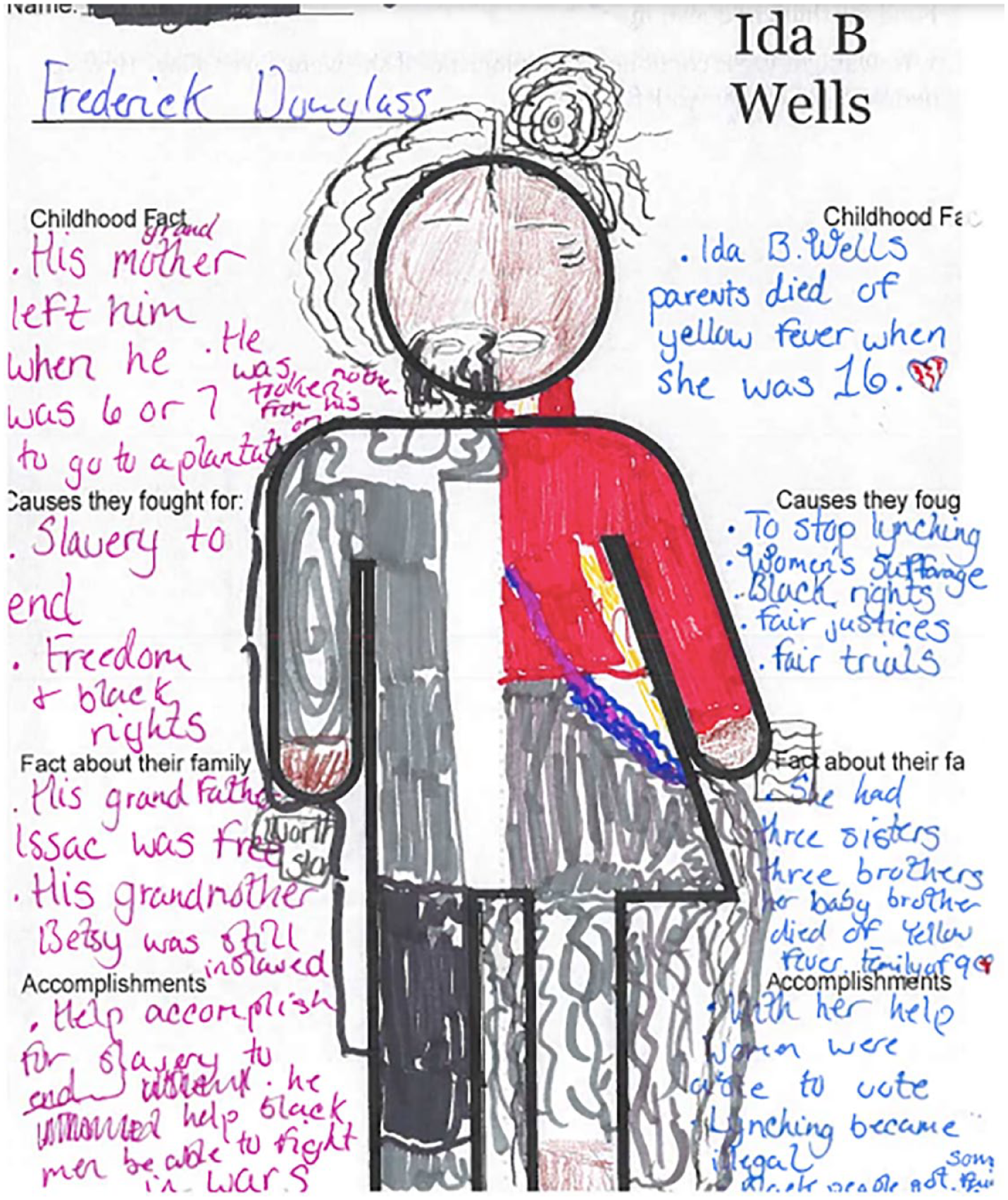
Sample of Janus Figure with Frederick Douglass and Ida B. Wells.
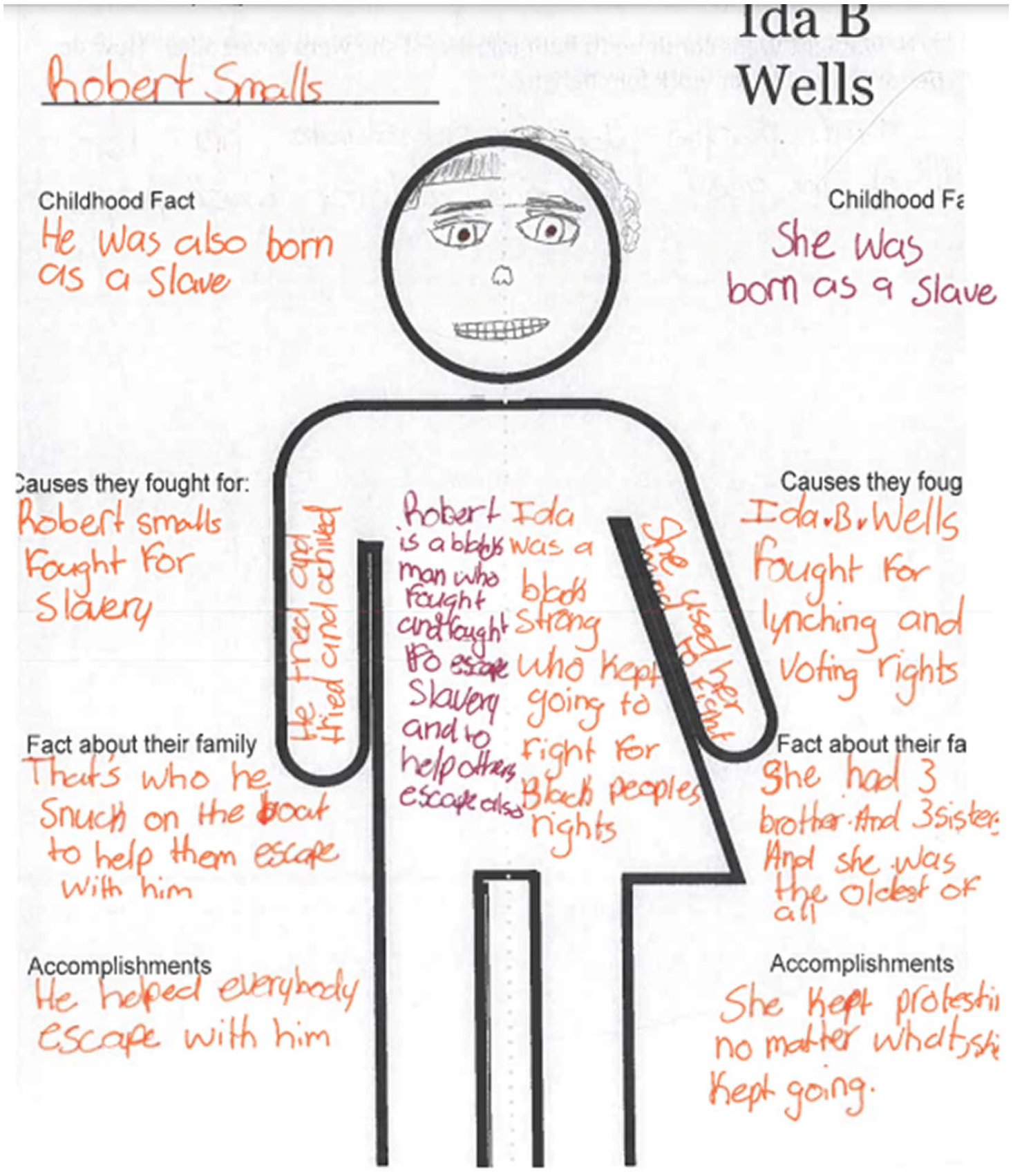
Sample of Janus Figure with Robert Smalls and Ida B. Wells.
When asked to complete the Janus Figures, the students nearly always found similarities between the two figures. Although each figure was born in different historical periods and had unique experiences, students were able to find and expand on themes that connected these experiences. For example, where Wells and Douglass are paired, they tended to discuss Wells’s advocacies for women’s right to vote but dive even more deeply into her fight against lynching, which connected well with Douglass’s work as an abolitionist. One child noted that both Douglass and Wells worked toward a common goal, writing that they both wanted all people to have freedom under the Accomplishments prompt. When asked what causes each fought for, another child wrote:
Douglass wanted to make it heard that he was unslaved. He wanted to stop slavery and racism for all Black men and women. Wells wanted to stop the process of lynching, and she believed that all Americans Black and white were entitled to equal justice.
This child also drew connections to Douglass’s support for the 15th Amendment, which states that the right to vote should not be affected by race, and Well’s support for the 19th Amendment, which states that the right to vote should not be affected by sex. This connection shows on a fundamental level that the students could articulate parallel goals between the advocacies of Frederick Douglass and Ida B. Wells toward different but related public issues.
This finding held true when students chose to compare Wells to other historical figures such as Robert Smalls. Many students noted that both Wells and Smalls were born into slavery and fought for equal rights. One child specifically made connections to freedom, noting that Smalls “fought for slavery to end [and] helped his family escape slavery” while Wells “fought for lynching to end and. . .she got to promote freedom by writing a book.” By finding a connecting theme across different historical figures, students demonstrated an ability to identify the large systems of oppression that persist over time.
In addition, when asked to describe different historical figures, students often used similar terms such as brave, smart, persistent, and resilient. Students were specifically asked to list characteristics of Ida B. Wells and Robert Smalls. In both cases, brave was the most commonly used descriptors. Brave is also used when students have opportunities to describe the other featured historical figures. For example, when taking on Lemlich’s perspective, one student wrote, “I was strong, brave, and political.” These connections allowed students to examine and draw conclusions about the characteristics of agents of change.
Justice-Focused Thinking About Activism
After engaging in thematic learning experiences highlighting agents of change, students overwhelmingly demonstrated justice-focusing civic thinking. They showed this thinking in two main ways:
(1) through describing specific acts and impacts of activism
(2) by identifying both broad systems of oppressions and specific oppressors.
These two ways demonstrate that students were articulating their thinking in concrete and abstract terms.
First, students examined the ideas of activism and change though specific and varied examples. One child described Wells’s experiences by writing:
She refused to move off the train when the people were dragging her off, and she stopped lynching even though she was threatened to get killed. At Woodrow Wilson’s Presidential Inauguration in 1913, Ida and 5,000 other women marched for the right to vote. She spoke and wrote about the crime of lynching. She believed that all Americans, Black and white, were entitled to equal justice.
This example correctly identifies three different specific acts of protest: Wells’s refusal to exit the segregated train, her march for women’s right to vote, and her role in raising awareness of injustices through her writing. The student connects these actions to Wells’s belief in equal rights and describes her impact on violence and lynching. Detailed and accurate accounts of activism were common throughout each assignment, with nearly every student naming at least one civic action taken by the six historical figures examined in our semester-long research project.
In their discussion of activism, several students described a process that loosely followed the C3 Framework. Specifically, they identified the historical figures as identifying a problem, crafting a solution, and taking action. Answers such as the following, which is written from the perspective of Clara Lemlich, were common:
What I accomplished when I was younger that changed what was going on. I succeeded in changing conditions in the factories for all young women. . .I came here hoping to start a new life but instead I had to work in a factory and not paid properly. I decided that I needed to change, so my first step to change this injustice I kept yelling to strike. My second step was to get all the girls together to strike.
The student’s response accurately depicts Lemlich’s awareness of injustices and actions needed to try and address the issues. The student also describes desired outcomes Clara strived for through taking civic action: better working conditions and higher wages.
Another student discussed the process of activism with Clara Lemlich. “As I [Clara] was working hard day by day the working conditions got worse. It was unfair so I started a movement to change things.” Such examples show that students were able to identify and discuss the impetus, action, and impact of activism. These processes reflect the goals of social studies education outlined in the indicators of the C3 Framework.
Secondly, students were consistently able to identify broad systems of oppression and specifically name oppressors. Rather than oversimplifying or glossing over systemic injustices, they directly addressed historical topics that can be considered difficult or controversial. An example of this can be seen in the following quote:
Ida became [an activist] because of what was happening in the world, and she was determined to change it. Ida fought against lynching, Black men being brutally murdered, white mobs being able to kill Black men without going to jail, women’s rights, and all over Black injustices.
In this answer, the student identifies white oppressors and the broader failure of the justice system to protect Black lives. The student acknowledges injustices beyond the specific examples listed and connects these systems to the needs for social change. The depth and breadth of this answer demonstrate an understanding of how oppression occurs at a societal level. One especially interesting answer highlighted discrimination and violence at both individual and societal levels, stating, “Douglass learned to read. He helped others be able to vote. He fought his master. Frederick tried to protest, and they were still being racist.” The student identifies fighting with the enslaver while also battling legal systems prohibiting voting rights. Through answers such as, “The U.S. was corrupted by people who were racist. Ida fought [against] the corrupted USA and racism,” students even connected the broad systems of injustices with individual perpetrators. While these examples are related to racial oppression, students were also highly likely to discuss discrimination based on gender through discussions of voting rights and labor unions. For example while taking Lemlich’s perspective, one child demonstrated an understanding of systemic gender-related discrimination by writing, “People didn’t believe that women could start a strike/unionize. I proved them wrong. I protested and I chose not to work until thousands of women protest with me and still get equal rights like men.” This student’s focus on the perception of women as incapable and the need for equal rights between men and women highlighted multiple facets of gender inequity.
It is important to note that students took different approaches to situating systems of oppression into different eras. Several students did acknowledge the need for ongoing work toward justice. Their answers did not paint a happily ever after narrative, but rather acknowledged a more complex reality in which work toward equity must continue. As Lemlich, one student wrote,
I helped women rightfully have their rights. Getting beaten and hurt for the cause. Fighting over and over and over, but it was worth it. This world will respect women’s rights, will respect their worth. Because they deserve it after everything we have done for this world, and I’ll make sure it happens if it’s the last thing I do!
This quote specifically recognizes ongoing injustices and demonstrates the need for further civic action. Another noted that Ida B Wells worked “to stop lynching and gain women’s rights to vote. And she tried to stop segregation but it didn’t work.” However, many students did frame change as absolute, essentially rooting oppression in the past. Answers such as “I am so glad I started the strike or I might still have worked in that crummy place. I’m living a happy life now I feel complete. I have done a great thing in the world. Those bad people are gone now they can’t hurt anyone now” were somewhat common. Such quotes demonstrate a belief that injustices may have been fully conquered by the historical figures featured in the lesson.
Discussion
The premise of this research study was to examine student-articulated thematic connections using six trade books with primary and secondary sources to both contextualize and illustrate the civic actions of six historical figures. Simply, how do students identify civic action as evidenced through different historical figures across different historical periods in time? This study served to illustrate, not only the role thematic teaching can play in curricular design and delivery, but its ability to promote cross disciplinary, reflective, and inquiry-based student learning.
So why is thematic teaching important in general and why, specifically, to social studies content and curriculum? Thematic teaching, or an integrated curriculum centered on a singular topic or issue, is not new. Its potential to create layered, cross-curricular understandings has long been touted as a means to enhance student learning (Lipson et al., 1993; Loughran, 2005). Student work from our study supports previous scholarship stating that embedding trade books into thematic teaching can facilitate higher-order thinking skills, spur critical conversations, and support student agency (Benevento, 2022; Van Deusen & Brandt, 1997; Vardell, 1995; Wan, 2006). For a social studies curriculum that often struggles to shift from the read-write-notes models of delivering content seen by many students as static, isolated, and irrelevant (Bolinger & Warren, 2007; Key et al., 2010; Ross, 2014; VanFossen, 2005), thematic teaching can alter the way both classroom teachers design social studies instruction and students engage with it. Here, social studies is not presented nor perceived as isolated moments in time, void of context or connection, but rather a mosaic of connections, both similar and disparate, that situates the curriculum as interdependent, intertwined, fluid, and, arguably most importantly, relatable. Furthermore, students are able to grasp the ever-present injustices in U.S. society as well as how historical figures’ advocacies attempted to address these public issues.
The potential for thematic teaching to transform learning is certainly true in social studies classrooms (Clabough, 2021; Jewett, 2007; White, 1995) particularly at the elementary and middle level (Fredericks, 2000; Hamman, 1995; Krey, 1998; Tschida & Buchanan, 2015). Due to the thematic structure of this 8-week study, students were able to demonstrate interdisciplinary thinking (especially between history and civics), a cornerstone of the C3 Framework (NCSS, 2013a). They consistently connected historical moments (evidenced through the characters they read about) with civic action writ large. Though each individual occupied a different moment in time, their civic action, often displayed differently, connected these historical figures together. Students now perceived history as a vehicle for civic action, a natural and expected by-product of it. They melded the two “pillars” of social studies together to create singular, connected, seamless, and complex understandings.
A somewhat surprising yet welcomed outcome of this study was the ability of students to identify and discuss systems of oppression and their resultant impact, both individually and collectively. Throughout the study, students increasingly came to perceive oppression, not as the result of a singular person or isolated to single group, idea, or moment in time, but rather as a connected, systemic thread woven throughout U.S. history that was both faceless and elusive. Though the characters in each text singularly challenged oppression situated in their respective historical moments, the students were able to articulate a more encompassing understanding of oppression that was evident, both overtly and covertly across the historical landscape of all the trade books read. There was no “bogeyman” that students could blame for the oppression of the characters they read about. What students realized, time and time again, was that oppression was endemic to the experience of many Americans, especially from marginalized groups. Insightfully, students talked about abstract systems of oppression in concrete ways. Yet students situated oppression as being “in the past.” Oppression was indeed real, but it was not here and now. Students struggled to make connections between the past and present. In fairness though, the scope of our semester-long research project was centered on the inequalities of the past not the present. Civic action, particularly the battling against oppression, was not seen as a contemporary issue. Our study was limited due to time constraints of only looking at issues during the Gilded Age and start of the Progressive era, so we could not help the students make connections to modern corollary issues.
The C3 Framework is built on an inquiry scaffold whereby students grapple with complex, often controversial topics and reach measured conclusions based on the gathering and evaluation of multiple sources of information (NCSS, 2013a). Students in this study consistently reached and articulated their conclusions by systemically employing the steps inherent in the Inquiry Arc of the C3 Framework. They parsed out and used textual evidence to make their claims. Such evidence came, not just through the main character text, but through an array of primary and secondary sources, both print and visual. The materials used throughout the 8 week research study challenged students’ assumptions and, in many ways, changed how they viewed the delicate and often contentious balance between oppression and action. And such new-found understandings led to advocacy whereby students questioned the roots of systemic oppression. As is the desired outcome of any inquiry-based social studies endeavor, students raised their hands and opened their mouths. And like the six historical figures in the trade books they read, they, too, had taken the first steps in becoming civic change agents.
Limitations
This research study had some notable limitations. It was conducted in one school with one teacher and her four classes, which limited the sample. Students were comparably homogeneous, when viewed demographically. Though the inquiry was extensive, students had no experience in previous years with comparable projects. Generalizations cannot be made, though findings point social studies education scholars toward important areas of future research.
Areas of Future Scholarship With Thematic Social Studies Instruction
Our research study provides one approach for social studies education scholars to engage in thematic teaching. However, there is much work that needs to be done with thematic teaching in K-12 social studies classrooms. First, there are obviously more public issues important to both the U.S. and world history curriculums that could be explored thematically using the approaches utilized in our study. For example, social studies education scholars working in a U.S. history class could thematically teach civil rights issues exclusively. Additionally, they could examine in world history classrooms the impact of emerging nationalism in the latter half of the 19th century and first half of 20th century in European countries and the impact this had on both World War I and World War II. It should be noted that there are not as many trade books available for world history topics compared to those in U.S. history. The reason for this is due to book publishers releasing trade books that may appeal to American teachers’ interests in their country’s history and more of a focus in the K-12 social studies curriculum on U.S. history. Researching more public issues in the manner advocated for in our semester-long research project has the potential to help students make connections among similar events across time as can be seen through these sixth graders’ writing samples.
Further research studies exploring thematic teaching could also expand the time covered in the project. Due to time limitations, we were only able to work with the sixth grade teacher for the Fall 2022 semester. Thus, our research project was limited to the Gilded Age and the start of the Progressive Era. However, other social studies education scholars could replicate our approach and move throughout a U.S. history curriculum with middle or high school teachers. We would especially encourage social studies teachers when possible to continue the thematic teaching project through contemporary U.S. society. Some modern agents of change that could be examined with trade books are John Lewis and Ruth Bader Ginsburg. The inclusion of more contemporary figures helps students to see that public issues from the past are still relevant to the present.
One aspect of the study that emerged was the students’ writing that discussed the oppressive systems our selected historical figures attempted to change. We did not intentionally set out to examine these systems with the sixth graders. The thematic analysis of primary sources and trade books for six historical figures where students explored public issues of the Gilded Age and Progressive era in-depth helped them discuss the larger oppressive systems from these historical epochs. We would argue that this may potentially be one of the most powerful items that emerged from our study, especially given the students were sixth graders. Due to their cognitive level of development, sixth graders tend to view social injustices through a more concrete lens than an abstract lens. For example, sixth graders can easily articulate racial discrimination African Americans faced through Jim Crow segregation laws with not being able to attend an all-white school. However, sixth graders would struggle more to convey how African Americans’ exclusion from certain jobs due to Jim Crow segregation laws would lead to limited opportunities for economic advancement. However, in our study, the sixth graders consistently articulated the more abstract aspects of oppressive systems in place during the Gilded Age and the start of the Progressive era in more concrete terms.
Due to these students’ ability to articulate the more abstract elements of oppressive systems in our study, we would suggest that social studies education scholars wanting to replicate our project include an emphasis on the more abstract systems of oppression that agents of change are confronting and trying to alter. This step can be accomplished by the inclusion of strategic analysis prompts that students answer and discuss while reading primary sources and trade books. The teacher can also guide class discussions of these analysis prompts to clarify any students’ misconceptions while also helping them grasp more abstract systems of oppression and articulate social injustices in more concrete terms. The discussion of the oppressive systems in the Gilded Age and Progressive era helps to prepare students to examine modern corollaries of the same existing oppressive systems and take civic action in the present to address these existing public issues to create a more equitable society for all Americans (Ochoa-Becker, 1996).
Footnotes
Appendix A
Student Writing Activities.
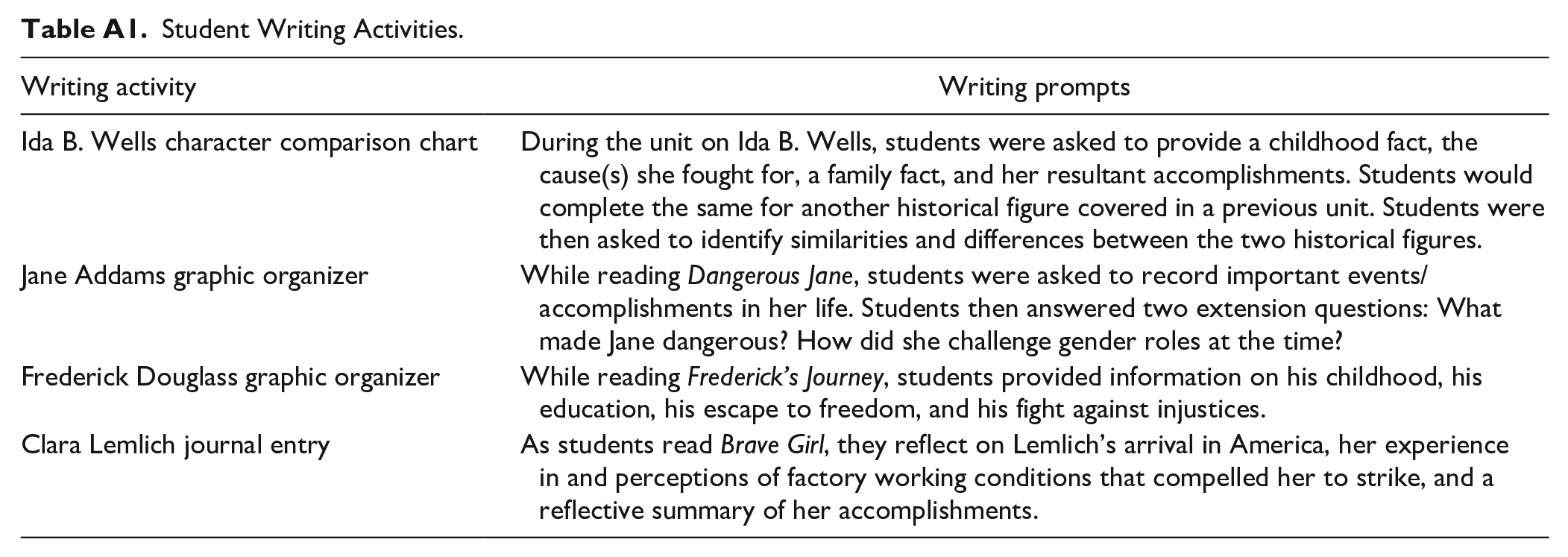
| Writing activity | Writing prompts |
|---|---|
| Ida B. Wells character comparison chart | During the unit on Ida B. Wells, students were asked to provide a childhood fact, the cause(s) she fought for, a family fact, and her resultant accomplishments. Students would complete the same for another historical figure covered in a previous unit. Students were then asked to identify similarities and differences between the two historical figures. |
| Jane Addams graphic organizer | While reading Dangerous Jane, students were asked to record important events/accomplishments in her life. Students then answered two extension questions: What made Jane dangerous? How did she challenge gender roles at the time? |
| Frederick Douglass graphic organizer | While reading Frederick’s Journey, students provided information on his childhood, his education, his escape to freedom, and his fight against injustices. |
| Clara Lemlich journal entry | As students read Brave Girl, they reflect on Lemlich’s arrival in America, her experience in and perceptions of factory working conditions that compelled her to strike, and a reflective summary of her accomplishments. |