



Abstract
The survey of the COVID-19 outbreak focused on studying the impact and long-term consequences on care leavers, especially residential care leavers who are living independently. Employment, education, physical health, hygienic practices, psychosocial and emotional health, and coping strategies adopted by care leavers were studied. Bronfenbrenner’s Ecological Systems Theory (1979) was used to study the impact of COVID-19 on care leavers at every system level in Sri Lanka. The methodology adopted was mixed method. The data collection was mainly a quantitative survey. Focused group discussion and semi-structured interviews were used to elicit qualitative aspects of survey findings. The findings highlight that care leavers were primarily female (69%) and young adults between the ages of 16 and 28 (61%); the majority of care leavers (80%) lived with their families and only 20% lived alone. Care leavers were well adapted to precautionary measures to prevent COVID-19. This study on care leavers has shed light on various social and economic issues, including care-leaving debt, lack of access to digital learning, food insecurity and homelessness, as well as lack of access to a continuum of care and mental health services. The impact was more severe care leavers’ employment and educational opportunities, which led to long-term consequences on their life cycle. The absence of income maintenance or social protection nets could further affect care leavers’ long-term consequences. The research recommends a range of interventions to support youth leaving alternative care settings and to promote their independence and dignity.
Introduction
This study discusses the socio-economic impact of COVID-19 which has affected the most vulnerable people, such as the care leavers of Sri Lanka. The sample online impact survey of the COVID-19 outbreak and long-term consequences on care levers, especially care leavers from residential care that have been established under the orphanages’ ordinances to provide care and protection in Sri Lanka. They are run by the Department of Probation and Child Care Services and volunteer organisations, and all matters from admission to social reintegration of children are processed by the provincial Department of Probation and Child Care Services in Sri Lanka. These institutions provide care for children up to 18 years of age and reintegrate them into society.
Contextual Background of the Study
SOS Children’s Villages in Sri Lanka played a vital role in addressing the needs of care leavers during the COVID-19 lockdown and faced challenges in providing support. One of the biggest issues that leavers faced during the first COVID wave was that they were not allowed to come home for any emergency. In addition, youth in Colombo are stuck in boarding homes and have limited access to food or basic needs. Also, COVID-19-positive youth had to leave boarding places and had no place to stay. Therefore, the study objectives focused on identifying the impact of the COVID-19 outbreak on care leavers’ profile, employment, education, physical health, hygienic practices, psychosocial–emotional health and coping strategies adopted by care leavers and seize their suggestions for better changes. The theoretical framework of Bronfenbrenner’s Ecological Systems Theory (1979) explains the ecological system and highlights the significance of various environmental and social influences affecting care leavers’ lives. The ecological systems identified by this theory include microsystems (the family system of care leavers themselves), microsystems (the neighbourhoods and their support systems), ecosystems (district services and resources for income opportunities, employment opportunities, health services and spiritual services), macrosystems (macrosystem factors that affect care youth, such as laws, policies, cultural beliefs and values) and chronosystems (factors intrinsically related to evolutionary time). This framework aims to understand the impact of COVID-19 on Sri Lankan care leavers at all environmental levels.
The transition from youth to adulthood is influenced by various social contexts, and the experiences of young people in this vulnerable group can differ significantly. Care leavers, in particular, face elevated risks of encountering numerous challenges (Roberts et al., 2021). However, the presence of robust social support networks can contribute to more favourable outcomes for youth during their transition to adulthood (Pote et al., 2022). Pamela Snow and Philip Mendes (2016) contributed to advocacy and policy on strengthening the support system. As a result, adequate preparation for youth before returning to family and living independently is crucial. This study describes a social support network as a formal and informal resource and service available to caregivers, where they can share and exchange information and receive support (Charity et al., 2022; Rosenberg, 2019). In Sri Lanka, welfare programs are provided by the state for children who stay in childcare institutions which promote aftercare services such as supporting care-lever education, National Vocational Qualification training and career guidance for work opportunities in common.
Previous studies revealed that support programs for rehabilitation often include social support networks to improve the results of youth after rehabilitation (Nurcombe-Thorne et al., 2018). Bond and Van Breda (2018) argue that a comprehensive and well-managed withdrawal process for children is crucial, including the inclusion of a social support network for children who leave the care system. However, there are no unified guidelines or practices for the implementation of transition, social reintegration or post-residential care. Young people who leave the care system face significant changes in their lives, much younger than their parents, and they lose most of the economic, social and emotional support previously provided by the care system (Charity et al., 2022). Care leavers seek employment and a new home, supporting others, their families and other youth organisations (Charity et al., 2022). Even with extended support, those who leave care face difficulties in acquiring higher education and training, finding and maintaining employment, securing stable homes, and building and maintaining healthy relationships (Bond, 2020; Campos, 2020; Charity et al., 2022). Studies have also shown that careless individuals struggle to meet their basic needs.
Methodology
The methodology employed in this impact assessment employed a mixed approach. The data collection primarily consisted of a quantitative survey to elicit in-depth qualitative data from care leavers and key informants. Qualitative data were obtained from former caregivers and managers from eight districts as well as from two focused group discussions (FGD) with care leavers and key informant interviews with two managers. An independently-devised questionnaire, utilizing a 5-point Likert scale to elicit responses. The scale ranged from strongly agree (5) to strongly disagree (1). An online Google form was used for the data collection. Key informant interviews and focus group discussions were conducted between December 2021 and the first week of March 2022. The ethical standards of international SOS children’s villages were adhered to, and informed consent was obtained from the care leavers and key informants. After the completion of the online data collection, all completed 76 responses were edited and re-coded on code sheets. Data were analysed using Microsoft Excel and Minitab. Descriptive statistics were used to describe demographic factors that influenced care leavers and their interactive systems during the COVID-19 pandemic. Qualitative data were analysed using content analysis based on the identified factors affecting care leavers. The limitation of the study was its impact on the assessment of the COVID-19 pandemic among care leavers; there was limited access to a direct meeting with them. Thus, the survey had limitations in its focus on online access to care leavers. Only 76 responses were received because of a lack of contact among care leavers. The study was limited to a network of care leavers who were members of the Generation Never Give Up Network in Sri Lanka.
Findings: Profile of Care Leavers
The gender distribution indicates a preponderance of female participants, as the care system accommodates more females than males (
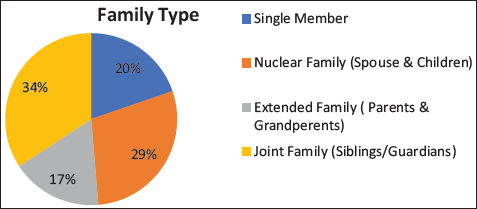
It is evident that care leavers are not isolated in a family or community environment; however, the data demonstrate that their identity and rights to relationships with family and relatives were not effectively developed while they were in childcare institutions. This is particularly significant for the continuum of care for an individual’s family lifecycle. It is noted that care leavers’ identity is linked to their time in childcare institutions, and, as a result, the social stigma attached to them as their permanent address was not considered during their registration for the first time. To address this issue, a system of registration within the Department of Probation and Child Care Services is not visible. One of the primary challenges facing care leavers is the fact that their residential address in the national identity card always refers to the childcare institution where they were previously residing. This has resulted in care leavers being stigmatised when applying for employment, vocational training or residential accommodation.
Housing is a significant concern for care leavers, as expressed by their experience of being abandoned by relatives and parents after leaving institutional care. Care leavers often have no land or housing on their own, and during the pandemic, many faced difficulties in securing residence, including being turned away from boarding places due to fear of infection and interpersonal issues. ‘I currently reside in a boarding house, but insufficient income is a significant issue. We have adapted by limiting our expenses’, shared one care-leaver. Another care leaver was accommodated with a family but was forced to find another home when the house owner objected to adding another care leaver.
There is a lack of systems or services to support care leavers transitioning to independent living after leaving childcare institutions in Sri Lanka (National Institute of Social Development, 2013). For example, a care leaver who was affected by war in the Northern Province and had no parents was unable to identify his parental property when he returned to his hometown. Without land deeds, the care leaver had to find an alternative means of earning a living. Such issues need to be addressed within a proper framework to ensure that care leavers can reclaim their rightful ownership.
Impact on Education and Employment
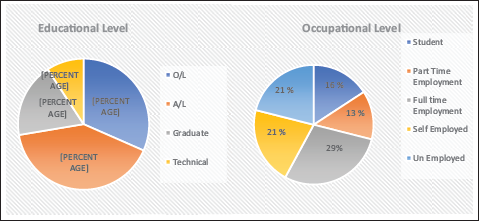
According to Figure 2, in the survey results 59% of the care-leaver respondents had completed senior secondary education, out of which 18% had pursued undergraduate-level education. The majority of respondents (63%) were currently employed and generated some form of income. The occupational spectrum of respondents included farmers, managers, officers, bankers, dental professionals, nurses, teachers, beauticians, business owners, drivers and cooks. It is worth noting that, in addition to 16% of students, around 21% of respondents are currently unemployed. The impact of the pandemic on employment is significant, with businesses downsizing or closing and employers reducing their workforces.
During the FGD discussions, participants voiced issues related to education and employment during COVID-19. A preschool teacher, who experienced economic issues, said ‘I was distressed due to the difficulties faced, and the care leaver network, neighbours, and friends helped me during the time I was infected’. ‘I had to discontinue the study due to coronavirus. Got support from the care leavers network for living in a boarding house’, said another participant. The participants, who were students, had to shift from physical classes to online education and faced issues regarding access to devices, and some had to discontinue education due to loss of income from a regular job. As a group, voices raised their concern about work and study becoming challenges, According to a research, impact of COVID-19 on children’s education (Devi, 2021) reflected the long-term consequences of school closures impacting not only students, teachers and families but also far-reaching economic and societal consequences.
Impact on Socio-economic Status
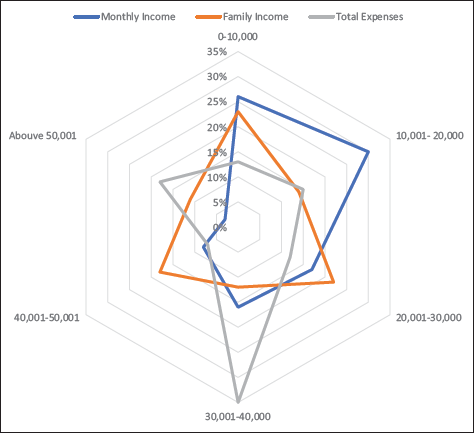
The family monthly income reveals that 37% of the respondents have an income of less than Sri Lankan rupees 20,000, with 22% opting not to disclose their family income. As shown in Figure 3, 16% of the respondents were students and did not have any income-generating opportunities. A care leaver expressed ‘No work during the corona, as I was studying and doing graphic design. I had to discontinue the study due to corona’. The pandemic has also caused a loss of jobs and a reduction in earnings, contributing to below-average earnings in both individual and family income, as per qualitative discussions. The expenses of the respondents exceed their earnings, and this deficit is mostly managed through credit facilities, pawning and the sale of assets, as shown in Figure 3, where 35% of their expenditures fall between Sri Lankan Rupees 30,001 and 40,000.
It is worth noting that these data indicate that unmarried individuals are more likely to be economically disadvantaged than married individuals, particularly in the face of economic and psychological factors. During the FGDs, participants shared that they had to mortgage their gold jewellery, borrow money, sell their homes and leave rented homes because of financial difficulties. Furthermore, a tragic incident involving a young male care leaver who committed suicide due to non-acceptance at home and who was unable to pay boarding fees was brought to our attention during one of the FGDs. One care leaver highlighted the significance of their network, stating that it helped them with their boarding fees and ensured that members did not fall out due to economic or stress-related issues. The care-leaver network also recognised the importance of strengthening their financial capacity and mutual aid to prepare for future unforeseen circumstances. However, the absence of social policies such as income maintenance or social protection nets could have long-term consequences for care leavers.
Impact of Physical Health and Hygienic Practices, Psychosocial and Emotional Factors on Care Leavers
The potential risks associated with COVID-19 may also stem from the physical health and hygienic practices of care leavers residing in group environments such as boarding houses and hostels. Single care leavers before entering these facilities were more likely to be housed with other care leavers, increasing the risk of transmission of COVID-19. Conversely, care leavers with independent living arrangements may be at a heightened risk of isolation and lack access to support for their daily needs. A care leaver shared their experience of adapting to rapid changes and adversity in their environment, stating, ‘When I was diagnosed with COVID, the network helped me. I had issues with my boarding house during the pandemic, and despite not losing my job during the pandemic, my salary was not paid. In response, I started making birthday cards as a source of additional income, and I also learned how to create artificial flowers’.
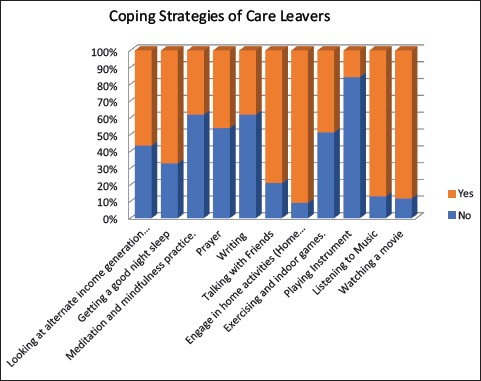
Despite these challenges, many individuals have demonstrated a high level of resilience by finding alternative means of supporting themselves and their families as per Figure 4. Some even started online businesses selling batik clothing. Care leavers have had to put in significant efforts to maintain strong family relationships during this period.
Care Leaver’s Support Network
Finding highlights that care leavers were able to establish their own care leavers’ forum, which allowed them to address their concerns and provide support to one another upon reintegration into society. It was found that the majority of respondents received support from their care leavers’ association during this period and other difficult times. The strength of care leavers lies in the relationships they develop with each other while living in childcare institutions, which resemble the bonds of siblings who support one another. This connection remains intact even after individuals have left care institutions, extending to offering support during trying times, such as the COVID-19 pandemic. It is clear that having secure attachments and being resilient, as highlighted by Schofield and Beek (2014), plays a significant role in navigating such challenges.
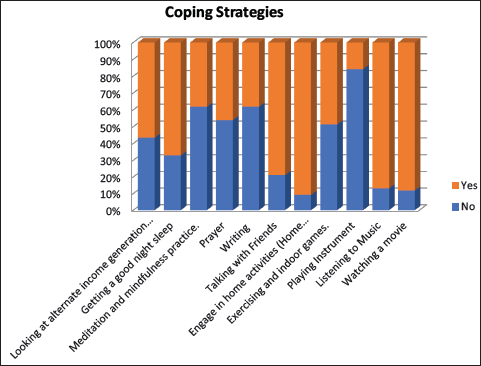
Figure 5 shows that 90% of the individuals surveyed adopted coping strategies, such as talking with friends, engaging in home activities, listening to music and watching movies. From the qualitative discussions, it was expressed that care leavers tend to experience breakdowns in psychosocial and economic matters more quickly than other individuals in society due to the lack of a strong support group. However, the surveyed individuals adopted appropriate adaptations and actions to live in harmony with society by engaging in multiple activities. They developed multiple skills, such as learning farming techniques, coping strategies, self-assessment of life, developing English language skills, identifying and helping others’ issues, and learning new ways of coping with life, as stated during FGD.
Conclusion
These findings indicate that the majority (80%) of care leavers are integrated into the family system and live with their own extended or joint families, with only 20% living as single members. However, despite integration into family and community environments, a continuum of care remains direly needed. As a result of the COVID-19 pandemic, care leavers have faced a plethora of social and economic challenges, such as care-leaving debt, limited access to digital learning resources, food insecurity and homelessness, as well as a dearth of access to a comprehensive range of care, housing and mental health services. The system has been inadequate in addressing the issue of locating parental property, resulting in several care leavers being unable to reclaim ownership. Macro-level factors, such as the absence of income maintenance or social protection nets, have exacerbated the situation for care leavers in the long term. However, care leavers have been resilient in their efforts to prevent COVID-19 by adapting to precautionary measures and engaging in various activities during the lockdown period, without becoming bored or isolated from their families and communities. It is noteworthy that the bonds of brotherhood or sisterhood among children persist naturally, even after they leave childcare institutions. To cope with difficult situations, many care leavers spoke with friends and engaged in home-based productive and leisure time activities.
Recommendations
This study revealed that COVID-19 has had a significant and detrimental impact on the life cycle of care leavers, and it is likely that they will be disproportionately affected by its long-term consequences. Care leavers face numerous challenges in accessing education and livelihood opportunities, and they are often marginalised and stigmatised. As such, care leavers were identified as a vulnerable group in Sri Lanka. The study recommends a range of interventions to support youth leaving alternative care settings and to promote their independence and dignity. These interventions were designed to enhance their ability to live fulfilling lives and reach their full potential.
Enhance the self-identity and socioeconomic status of care leavers, promote their independence and protect them from harm.
Deinstitutionalisation should be advocated, and family-based alternative care options should be implemented as per the National Policy on the Alternative Care of Children in Sri Lanka.
The reintegration process of children from care systems to society should be strengthened and streamlined through the involvement of the state.
Social workers in multi-disciplinary teams play a critical role in integrating care leavers into the community and in promoting self-help and support groups to build mutual aid systems.
Access to mental health, career guidance and counselling services should be facilitated.
Service delivery organisations prioritise care leavers as a target group for facilitating a continuum of care.
A multi-disciplinary team at the community level is crucial for integrating care leavers and preventing the entry of children into alternative care.
Care leavers should be prioritised as a target group in any policy implementation.
Footnotes
Declaration of Conflicting Interests
The author declared no potential conflicts of interest with respect to the research, authorship and/or publication of this article.
Funding
The author received no financial support for the research, authorship and/or publication of this article.
