




Abstract
The goal of this study was to expand the present understanding of the plight of child labourers who work in dangerous environments by discovering issues that are related to education and social relationships. The study presents the current situation of child labourers’ rights, as well as their working environment and family in Bangladesh. The study’s approach was based on both primary and secondary data. A sample survey was undertaken to gather primary field data once the relevant data was gathered from secondary sources. On the basis of the questionnaire, data were gathered, and the study’s sample was purposefully chosen. The study’s key findings show that both at work and at home, child labourers are highly exploited by both their employers and families. This study makes the case that the exploitation of child labourers can be stopped by raising public awareness, implementing measures to improve working conditions, establishing children’s rights, and working with GOs and NGOs to end child labour. Child work stands out as a flagrant violation of human rights. The socioeconomic situation in Bangladesh makes it a dismal reality, though.
Introduction
The number of children working globally in the last four years increased by 8.4 million, according to global projections from 2021, where the number of youngsters doing dangerous employment increased by 6.5 million. Almost one in five children work as child labourers in the world’s most impoverished nations. Child labourers work an average of 64 hours per week in Bangladesh. Young children have even worked over 100 hours per week in the worst scenarios. The worst types of child labour, mostly risky jobs in domestic work and agricultural, are prevalent in Bangladesh, where children are employed. In Asia, for example, shipbreaking yards employ children under extremely risky circumstances. It is estimated that less than half of the youngsters employed in shipbreaking in Bangladesh are under the age of 12 (Zaman et al., 2014). Children are also exposed to harmful gases while doing work that carries a significant risk of damage.
By 2025, all types of child labour are to be abolished, according to the Sustainable Development Goals of the UN. A noble goal, but it will be difficult to accomplish globally. By 2025, there will be 121,000,000 million children working worldwide, according to the current trend (Pless & Maak, 2016). A common definition of “child labour” given by the International Labour Organization (ILO) is work that robs children of their childhood, their potential, and their dignity and that is detrimental to their physical and mental development (Kamruzzaman & Hakim, 2018). Work that is harmful to children and dangerous to their mental, physical, social, or moral health is referred to as this (Banu et al., 1998). It interferes with their education by denying them the chance to go to school, forcing them to leave early, or forcing them to try to juggle school attendance with extremely heavy employment.
Bangladesh has long used child labour, which is illegal (Ruwanpura & Roncolato, 2006). A total of 3.45 million children were working in the nation in 2013, according to the Bangladesh Bureau of Statistics’ most recent national study on child labour, of which 2.10 million were classified as child workers and 1.28 million of those were identified doing dangerous jobs (Islam & Akhter, 2015).
In accordance with Article 32 of the UNCRC, States Parties are required to acknowledge that children have a right to be protected from economic exploitation and from engaging in any work that could be dangerous, interfere with their education, or be detrimental to their health or overall physical, mental, spiritual, or moral growth (Ahamed, 2013). The worst types of child labour must be urgently prevented and eliminated, according to Article 7 of the ILO Convention, which mandates that each Member State take concrete steps within a specified period of time (Kuddus & Rahman, 2015). The UNCRC has been ratified for three decades, and the ILO Convention No. 182 has been ratified for two decades, but child labour is still a problem in Bangladesh (Doftori, 2004).
The government’s announcement to end child labour, according to rights campaigners, came at a moment when the nation was feeling energised since the prevalence of child labour had declined. Bangladesh’s Labor Act, which has a section on child labour, was passed into law on a national basis in 2006 (Shahjahan, 2016). In addition to outlawing the employment of minors under the age of 14, this new rule also forbids the use of hazardous child labour by those who are younger than 18 (Ahad et al., 2021). Children who are 12 years old and older, however, may engage in ‘light work’ that does not endanger their physical or mental growth or interfere with their schooling (Shoji & Tsubota, 2022). The law’s restrictions against child labour do not have a reliable enforcement mechanism. The government must work to aggressively enforce laws that prohibit child labour and make going to school affordable (Uddin et al., 2009). There should be more personnel and logistical help from the enforcement apparatus.
This research aims to know the economic vulnerable situation of the hazardous child labourers who are working at risk, the educational status of the child labourers and the social relationship of the child labourers to general children (Wright, 2003).
Methodology of the Study
Study Area
All 30 wards of Barisal City were covered by the study. The highest concentration of the various kinds of working children and their variations in these locations received top importance when picking the study location in terms of the study’s objectives.
Population of the Study
All working children between the ages of 7 and 17 that conduct 10 types of hazardous work out of the 55 forms of employment that have been discovered.
Method
Given that this is an empirical study, certain details must be provided. A sample survey was conducted to obtain first-hand information from the field after gathering the pertinent data from secondary sources. Data were gathered using formal interviews and an observational technique. After selecting the appropriate area of research, a questionnaire was first created for respondents. Data were acquired in accordance with the questionnaire.
Sampling and Sample Size
A total of 300 samples, drawn from 10 occupational groups, were collected. The first consideration was selecting at least 125 children from the cigarette industry. The remaining 175 children were chosen from a variety of occupational groups, including waste collection, automobiles, biscuit factories, textiles, dock labourers, electronic goods, workshop labourers, load carriers, and hotel or restaurant workers. These 10 groups were chosen from the 55 occupations that were deemed harmful for children. The sample for the study was chosen with a specific goal in mind.
Processing, Analysing, and Interpreting Data
After the field study was completed, efforts were made to combine and edit the data that had been gathered to verify the validity and accuracy of the material. In addition to applying quantitative analysis, when necessary, a focus on qualitative interpretation was also made. There have been instances where basic statistical techniques like percentage mean have been used. Other presentation methods were employed with the data table, including bar diagrams, column diagrams, and others.
Discussion
Child Labour and Bangladesh
The National Child Work Survey indicates that 1.3 million children in Bangladesh are engaged in child labour (Hossain & Rahaman, 2011). According to the International Labour Organization, Bangladesh is home to 5 million full-time workers. Bangladesh is home to more than 5% of all youngsters who are old enough to work (The Daily Star, 2011). About 3.45 million children between the ages of 5 and 17 worked in the country in 2013, according to the National Child Labor Survey (NCLS). Of those, 1.75 million could not be categorically classified as children, while 1.70 million were, with 1.28 million of those working in hazardous conditions (Shamim, 2017). Child labour and exploitation frequently go hand in hand. Exploitation occurs when a child is subjected to brutal treatment, forced to work needlessly long hours, receives inadequate money or no pay at all, and is deprived of their basic rights while also being expected to undertake tasks that are hazardous to their physical and mental development and health (Kamruzzaman & Hakim, 2016). The main reasons of child labour in Bangladesh can be divided into three categories: ‘push factors,’ ‘pull factors,’ and ‘interactive factors.’ The so-called ‘push factors’ are those that need young people to work to earn money (Islam et al., 2019). Extreme poverty, the loss of the family’s main provider, a divorce between the parents, the abandonment of the parents, and natural disasters are a few instances of push factors (Mia et al., 2022). When immigrants are jobless as adults, their children frequently wind up working (Sheikh & Prodhan, 2013). The term ‘pull factors’ refers to both the cost-saving advantages of hiring young people and their predisposition to take less money (Hossain, 2012). In many developing countries in Asia, Africa, and Latin America, child labour has grown to be a serious global problem. The issue is widespread, not only in Bangladesh (Hoque, 2021). According to the 2013 Bangladesh Bureau of Statistics, 39,652,384 children between the ages of 5 and 17 years worked. Of these, 3,450,369 were working children, out of which 1,280,195 were categorised as child labourers in hazardous circumstances.
Findings of the Study
The empirical results following show that there were issues with child rights in the families and workplaces of child labourers. It is clear from both primary and secondary data that child labour not only hinders a child’s normal physical and mental development but also denies them access to suitable recreational opportunities, sleep schedules, and in some circumstances, actual sleeping quarters. This study adds noteworthy data to increase the understanding of child labourers in Bangladesh.
Table 1 states the overview of children’s work by sector and activity.
Overview of Children’s Work by Sector and Activity.
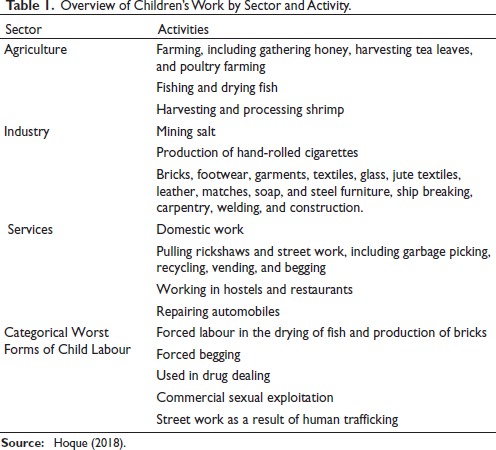
Table 2 shows the demographic data of the respondents, where 91.67% were male and 8.33% were female. In terms of age, the majority of the respondents, 36.67%, were aged 15–17 years. The second largest group, 30%, were aged 13–15 years. Then 17.33% were aged 11–13 years and the rest of them, 3.33%, were aged 7–9 years. Among the total respondents only 26.67% were school going children, with 73.33% did not go to school. About 60% of children belonged to a 4–6-member family. About 30% belonged to nuclear families and 30% were in extended families.
Demographic Information of the Respondents.
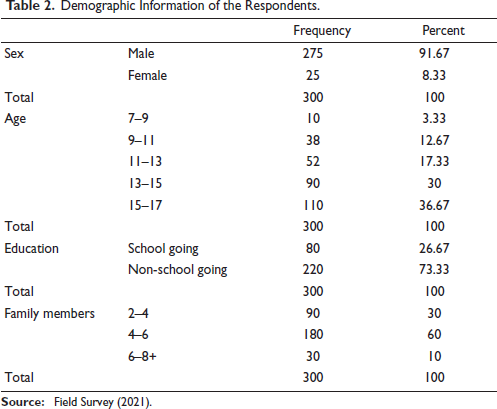
Table 3 depicts the educational institutions that children attend. Among them half of the children went to government primary school. Then 16.67% used to go to government high school. After that 13.33% children preferred to go to the religious and NGO operated school. Finally only 6.67% went to private high school.
Distribution of Child Labour by Types of Attended.
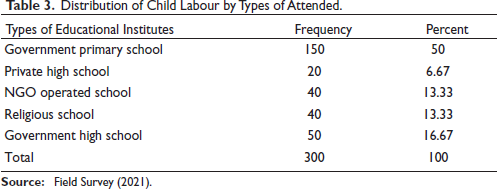
Table 4 depicts that 53.5% involved with laboring work to take part in their family income. Besides, 21.3% were not interested in school. Then 7.5% Involved for learning skills. Furthermore, 2.1% thought that they are not a good student and also they could help in their family income and 4.9% could not afford school fees.
The Reasons of Doing Laboring Work.
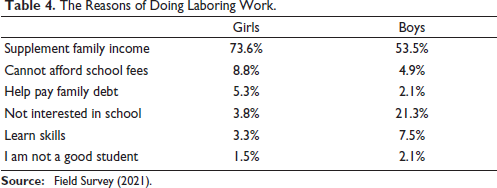
Table 5 shows multiple reasons behind dissatisfaction towards educational programs, where more than half of the children said that the boy child benefited less from school. About 18.67% of the respondents replied that they got neglected from school and another 18% said that they could not attend sports activities. The rest of them said that books are not provided properly from school.
Reasons of Dissatisfaction Towards Educational Institutions.
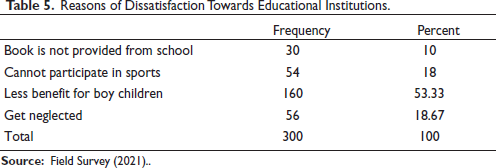
Table 6 depicts the attitudes of the educational institutions towards working. Here, 50.67% of the respondents said that educational institutions are cooperative with working children. But 20% of the respondents were denied this. Then 23.33% of the respondents stated that it is partial and rest of them said that the attitudes of educational institutions were impartial.
Attitudes of the Educational Institution Towards Working Children.
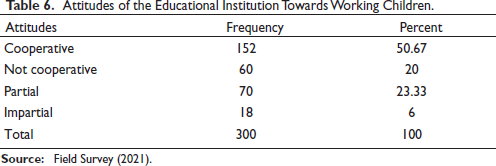
Table 7 depicts the various reasons why children are involved in labouring work. Among them 40% said that poverty is the main reason. The problem of being abandoned by their parents was 16.67%. Then 12.67% were overlooked by their fathers. 8% faced the problem of parental divorce. Then 7% lost their father forever and disease of earning members. After that 6.67% said that the lack of working members in the family and lack of access to quality education were the reasons for working.
The Reasons for Child Labour.
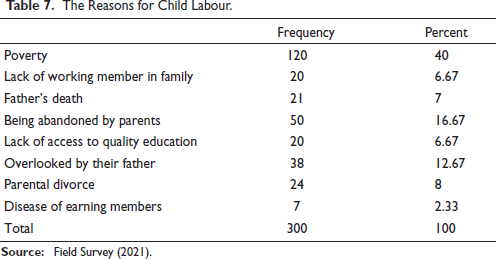
Table 8 shows that a vast part of the total respondents faced economic vulnerabilities. 73.3% got low payment despite their hazardous work. Then 8.33% felt that their work was so tiring and boring. 3.33% of the children experienced verbal violence, poor income, and long working hours. They said that their working environment was unfriendly (1.67%), and they were treated like a slave (1.67%). Respondents also faced dangerous and strenuous working situations (0.67%); their working environment was so hazardous that it eventually created a negative impact of their body and mind.
Economic Exploitation Faced by Child Labour.
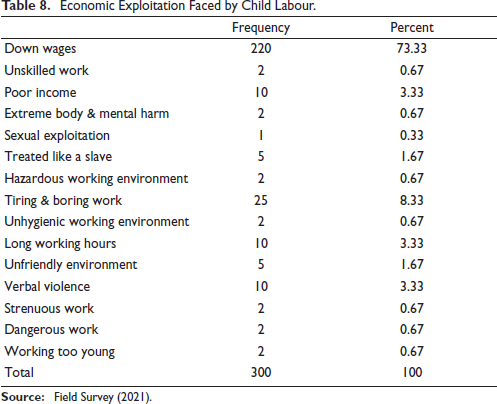
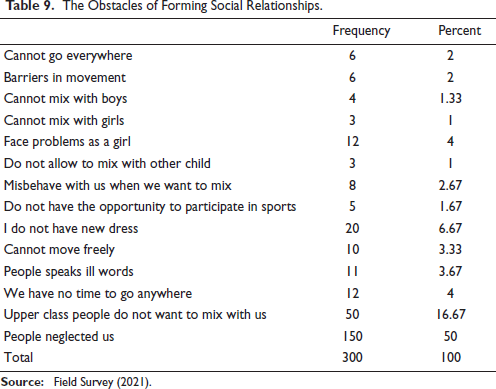
Table 9 shows that half of the respondents said that they were neglected by people. Then 16.67% replied that rich people do not want to mix with them, 4% told that they do not have any time to go anywhere and faced problems as a girl, 6.67% did not have new dresses to wear, 3.67% shared that people throw ill words towards them, 3.33% cannot move freely, and 2.67% faced problems when they wanted to mix with people. Besides barriers in movement, cannot mix with girls also occupied 2% and 1%.
The Obstacles of Forming Social Relationships.
Discussion
The study reveals that the majority of responders were young males. The majority are between the ages of 15 and 17. The majority of child labourers do not go to school. In addition, more than 50% of respondents said they attended a government-run primary school. They did not attend class because they believed that boys would benefit less from it than girls. There is cooperation between the attitudes of different educational institutions toward child labour. The fundamental motivation for using children as labourers is poverty. The majority of respondents, more than two thirds said they do not receive a fair salary. They deal with a variety of economic exploitations while working in this field. The majority of them reported that people avoid them and treat them poorly, particularly upper class individuals. Then, when working as child labourers, females encounter a variety of vulnerabilities.
Conclusion
The researchers learn novel information from this study that is unmatched by previous studies. According to the study’s findings, the majority of children are employed to support their families, while some youngsters were discovered to be uninterested in school (Shahen, 2021). Their development and well-being are negatively impacted by long hours, low income, and a hazardous atmosphere at work. Risky kid labourers are particularly exploitative (Shahen & Alam, 2020). Therefore, it is in the best interests of humanity to establish child labourer rights. It is believed that the study would help policy makers, researchers, citizens, and other interested parties to more effectively address the issue of dangerous child labour in this nation (Matubbar & Arifuzzaman, 2022). In order to ameliorate the current child rights status of child labourers and develop a child-friendly society, a concerted effort involving children, parents, employers, community members, local civil society, as well as the government, should be made (Saha & Kamal, 2018).
Recommendations
Several literatures were reviewed in addition to the survey. Every study, including the one being conducted right now, demonstrates that poverty is the primary cause of both the push factor and the pull factor, which forces kids into risky jobs (Dalal et al., 2016). It’s important to adequately implement current child labour rules (Rahman et al., 2014). The implementing authority needs to be educated on the dangers of child labour, the need to punish violators, and the pertinent laws and regulations (Islam & Choe, 2013; Masum, 2002) . Extreme poverty, lack of access to education, rural unemployment issue, lack of opportunity for institutional skill development, and ignorance of the dangers of child work are push factors (Chanani et al., 2022). Child work is encouraged by pull factors such as lower pay, the ability of youngsters to handle situations more easily than adults, etc. The detrimental effects of child labour in particularly risky areas should be made public, according to initiative (Islam et al., 2023).
It is one of Bangladesh’s major social problems and must be outlawed to save both the country’s future and the bright futures of many younger generations (Kamruzzaman, 2015). Children develop into the future leaders of the country; as such, they should be fed and cared for with great attention, especially by their parents (Alam et al., 2008).
Author’s Contributions
Tareq Mahamud Abir assisted in coordinating and analyzing the data, while Mithila took the lead in producing the manuscript after contributing to the ideation, design, execution, data gathering, writing, and planning of the project.
