




Abstract
Despite popular intents and plans to eradicate child-care institutions from the national scenario, institutional care remains the dominant model of alternative care for children among countries in the global South. Moreover, complete eradication of these residential institutions has multiple practical constraints. Given these limitations, building resilience among institutionalised children and youth has been considered a worthier goal for intervention. There is, an urgent need to appreciate the notion of resilience amid these settings from an ecological perspective rather than as an individual attribute. This study outlines certain best practices regarding how multiple stakeholders within resident children’s immediate ecological context might facilitate healthy adjustment in an atmosphere of trust and support.
Introduction
Concerns about deinstitutionalisation, especially among countries in the global South, like India, have for the most part being met with lack of workable solutions and concrete plans by child welfare policy makers and practitioners. Amid this chaos, children and youth residing within child-care institutions (CCIs) have failed to receive the attention they deserve. Building resilience among this population has been considered a worthier goal for intervention until the picture of alternate care changes for any country. This study outlines certain best practices for professionals taking care of children within institutional settings, such as wardens, mental health professionals, social workers, along with policy makers in their efforts for promoting better-than-expected outcomes for resident children and youth.
Context Setting
Limitations of institutional model of care within under-resourced countries, such as India, have mostly been addressed with a popular intent among policy makers and practitioners to achieve a radical transformation to family-based alternate care settings. Despite all these intentions and plans, institutional care still remains the dominant model of care within many of the countries across the globe, particularly within the global South. There are multiple practical obstacles foreseen by some child welfare advocates in the process of transitioning to family-based care. These include practical difficulties in recruiting people to foster due to cultural, religious, historical and political reasons; monetary benefits acting as a primary force in decisions to foster; infants and children to be taken up more readily leaving older and disabled ones behind (McCall, 2013). Given such limits, the accepted mandate is that such transitions will take time in many countries, and even after aggressive measures are put in place, a large number of children are likely to be left behind in the institutions, a scenario that is likely to be true for many under-resourced countries. In the context of such real and probable realties then, reliance on actual than aspirational goals is the need of the hour. There is an urgent need that is realised among the child care community to focus efforts on children and youth already residing within CCIs, and make attempts to promote their better-than-expected outcomes. Building resilience among this section of children has been considered a worthier goal for intervention in responding to child care problems and needs until the picture of alternate care changes for countries.
For set-ups such as CCIs, there is an urgent need to appreciate the notion of resilience from an ecological perspective (Ungar, 2012), rather than as an individual attribute. Majority of the resident children coming to institutions have faced severe adversities in their pre-admission contexts, and overcoming the impact of such severe risks places the critical onus on the resources available in their primary ecological context post-admission (see Differential Impact Theory; Ungar, 2018). For instance, Mishra and Sondhi (2019, 2021) found salient role of the institution itself in promoting positive outcomes among orphaned adolescents within CCIs in India. Resources within the immediate ecological context were found to exert their influence in not just initial maintenance of children at the facility, but also in their long-term adjustment.
There is a danger of attributing the entire responsibility on individuals themselves in achieving positive outcomes within the stated context. Against this backdrop, this CPD article highlights the best practices for multiple stakeholders within the immediate ecology of resident children in helping them build resilience.
Evidence Base
‘Resilience Science’ (Masten, 2014) has come a long way from the focus on individual’s resiliency to a more ecological understanding of resilience. Gilligan (2004) writes in his manual for children in substitute care: ‘The degree of resilience displayed by a person in a certain context may be said to be related to the extent to which that context has elements that nurture this resilience’ (p. 94). Emerging research within the field suggests that the more a child is exposed to adversity, the more his/her positive adaptation will depend on attributes of the environment, and the available resources within this environment to sustain well-being (Chandler & Lalonde, 1998; DuMont et al., 2012). For a population like this, individual characteristics are less responsible for positive outcomes, and when measured, factors within the environmental have proven to be more impactful (Klasen et al., 2010; Ungar et al., 2013).
Critical factors found to be making a difference in resident children’s lives have been close human relationships, including members of an informal support network who act beyond their stated role limits (resident or school peers, relatives, community members, members from institutional staff) as resources promoting perceived safety, feelings of being accepted and loved among young people in care (Collins et al., 2010; Gilligan, 2008; Jahnukainen & Jarvinen, 2005; Munson et al., 2010; Yunes, 2003). Similarly, aspects of care experience such as good educational achievement, knowledge about daily living like shopping, public transport, food preparation, taking care of oneself were found to have aided in social reintegration of institutionalised girls in India (Dutta, 2017). In their efforts to ascertain the protective pathways towards a resilient adaptation among institutionalised orphaned adolescents, Mishra and Sondhi (2021) found roles of guidance given by adults before or soon after institutional placements as a significant factor in aiding initial maintenance of a child in the institutional facility. This factor in conjunction with the presence of significant adults, like extended family members, teachers and institutional staff and protective role played by other resident peers, was found to be aiding in adolescents’ long-term adjustment at the facility. It was found that as children start residing within their institutions, gradually, these residential placements are preferred over the home environment on account of having sufficient growth-fostering resources (access to education, extra-curricular coaching, self-improvement workshops, etc.) having the potential to upgrade the quality of one’s future.
On similar lines, Lou et al. (2018) in their review on conceptualising and measuring resilience among young people in residential care settings reported importance of ecological factors, both contextual and interpersonal in serving a protective function for the residents in developing a sense of motivation and vision for the future. Similarly, a scoping review by Roche (2019) to understand children’s experiences of living in global South found contextual factors such as supportive peer relationships, access to material resources in promoting resident children’s perception of their respective CCI as an advantage over the pre-admission set-ups.
Learning Points for Practice
There appears to be a joint responsibility for multiple stakeholders for promoting resilience among the resident children and youth within institutions. Presented below is a diagrammatic representation (Figure 1) of significant caring adults within their primary ecology, all of whom are jointly expected to intervene in fulfilling certain protective goals for resident children.
Diagrammatic Representation of Significant Adults in CCIs.
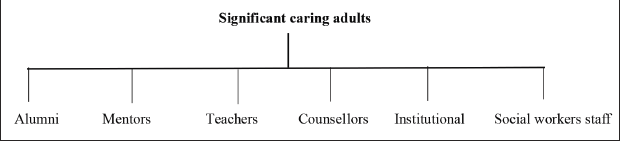
These caring adults act as supplemental and compensatory figures for adding social capital to resident children’s lives within the care facilities, most of whom come from backgrounds devoid of such figures. The primary role of these stakeholders is to promote supportive, caring, trustful and steady relationships with children. Some of the joint areas of intervention are mentioned as follows.
Guidance
The purpose of guidance given before or soon after residential placements is to make the placement less distressful. The stakeholders can cumulatively take up the responsibility to
Help the newcomer carefully assess the pros and cons (resource-wise) of residing in an institution relative to the home environment. Helping the child to attend the accessible structural resources (access to food, shelter, safety and education) not available in the pre-admission context is found to be of critical importance (Emond, 2009; Fournier et al., 2014; Freidus, 2010; Mishra & Sondhi, 2021; Morantz & Heymann, 2010; Rukundo & Daniel, 2016).
Cultivate a sense of purpose in life and bring the child to a position for realising the value of getting educated in reaching the goal. Have the child assess the pros and cons of both the living arrangements again, this time with respect to access to educational resources (Carpenter, 2015; Emond, 2009; Pienaar et al., 2011).
Social Recognition
Providing social recognition by incorporating positive feedback helps in the development of psycho-emotional autonomy and self-realisation. Whenever possible, interactions with the resident children should be focused on according worth and status (Marshall et al., 2020). Even small and seemingly insignificant achievements by children need to be celebrated and accorded value to. Emphasis should be placed on promoting achievements through sports, hobbies and personal achievements. Participating in such leisure activities can also impart a sense of normality (Anglin, 2002).
Opportunities for Discovering and Acquiring Competencies for Future
Providing ample opportunities to young people to help them discover their interests and talents can go a long way in fostering self-belief and a vision for the future by breaking future uncertainty (Marshall et al., 2020; Mishra & Sondhi, 2021). In addition, ample opportunities need to be provided for exercising autonomy, responsibility and control over one’s life (Fernando & Ferrari, 2011).
Promotion of pro-social behaviour among the resident children can be helpful in developing social competence leading to self-confidence, self-respect and self-esteem (Lou et al., 2018; Luksik & Hargasova, 2018). Moreover, such behaviours ensure in-house peer cohesiveness, which has also found to be crucial in facilitating resident children’s satisfaction and adjustment within their care settings (Mishra & Sondhi, 2019). The role of resident peers remains unparalleled in providing social support, feelings of being cared, accepted and supported (Duke et al., 2017).
Reflection
Within the context of under-resourced countries, where CCIs are still serving as the dominant alternate care model for children and youth, building resilience has been accepted as a worthier goal for intervention. There, is however, an urgent need to understand the mechanism of resilience as an ecological construct rather than as an individual attribute. Multiple stakeholders within resident children’s immediate social context can play facilitating roles in promoting healthy adjustment in an atmosphere of caring and supportive relationships.
Author’s Contribution
The manuscript conceived and prepared by the corresponding author.
Availability of Data and Materials
Not applicable.
Footnotes
Declaration of Conflicting Interests
The author declared no potential conflicts of interest with respect to the research, authorship and/or publication of this article.
Ethical Approval
Not applicable.
Funding
The author received no financial support for the research, authorship and/or publication of this article.
Informed Consent
Not applicable.