




Abstract
This article has been developed based on a systematic review of research studies conducted in the last 10 years on family-based childcare systems and a rapid review of research and assessments conducted in 2020 to explore the implications of the COVID-19 pandemic on adoption and foster care in India. The study explains child vulnerabilities with a focus on challenges to adoption and foster care before and after the COVID-19 pandemic. The findings depict that India is home to a large number of vulnerable children who have been living with hardships, and the COVID-19 pandemic has put them at a higher risk of adversity. There has been a significant focus on family-based childcare systems, such as adoption and foster care, instead of institutionalisation to provide a safe environment to children in need of care and protection. However, the study shows that the adoption rate has been sharply decreasing in the country due to low social acceptance, unawareness and delays in the adoption process. The study also identifies challenges facing foster care, in terms of lack of financial support to foster parents, lack of an appropriate monitoring system and lack of a social integration plan for children who age out of the system. The COVID-19 pandemic and related measures have further interrupted the process of adoption and foster care and placed several roadblocks in providing a safety net to a large number of children in the country. The article provides viable recommendations that may help make adoption and foster care effective in the country amid the COVID-19 crisis.
Child Vulnerabilities and Predicaments
Globally, child rights are the most widely ratified human rights, and the protection of child rights continues to be a key development issue across countries, including India. According to the United Nations Convention on the Rights of the Child (UNCRC), child rights are prerogatives and autonomies that should be used by all persons below the age of 18 years, irrespective of their background, colour, race, gender, language, caste or religion, and thus apply to all children universally. Article 19 of UNCRC mandates that government shall ensure that children are properly cared for and protected from any form of violence, abuse and neglect while in care of legal guardian(s) or parent(s) or any other person(s) who has the care of the child. The Constitution of India has also mandated, under Article 39(f), that the state shall direct its policies to secure children from exploitation and moral and material abandonment (The Constitution of India, 1950).
India is a country having the world’s second largest population of 1.21 billion, including approximately 40 per cent children. Children are considered valuable for any country; however, in India, children constitute the most vulnerable category of society. The Integrated Child Protection Scheme (ICPS) explains vulnerable children as ‘Children of potentially vulnerable families and families at risk, children of socially excluded groups like migrant families, families living in extreme poverty, scheduled caste, scheduled tribes, and other backward classes, families subjected to or affected by discrimination, minorities, children infected and/or affected by HIV/AIDS, orphans, child drug abusers, children of substance abusers, child beggars trafficked or sexually exploited children, children of prisoners, and street and working children’ (Ministry of Women and Child Development, 2015). The Childline India Foundation (CIF), which conducts child vulnerability mapping, explains vulnerable children as missing and runaway children, children suffering from malnutrition and those undergoing child marriage (Childline India Foundation [CIF], 2016–2017). The complex aspect of child vulnerability has been strongly ingrained in Indian society, which does not allow children to develop in a safe and protected environment, despite the existing child protection policies, legislations and network of child rights organisations in the country. One of the major factors responsible for making children victims of multiple vulnerabilities is the weakening of the family-based child protection system due to poverty, loss of livelihood and migration in the country. Consequently, millions of children get separated from their families.
According to the 2011 Census of India, out of the 430 million children in India, almost 40 per cent are destitute, who suffer a range of hardships. India is the country having the highest child mortality and child malnutrition rates. Almost 36 per cent of the children below the age of 5 years are underweight, 38 per cent are stunted and 2 per cent are wasted in the country (National Family Health Survey, 2015–2016).
Due to poverty, a large number of families encourage child marriage in India, despite the prohibition of child marriage by law. One in every three child brides in the world is Indian. Evidence also shows that 4 per cent of the married women in India were married as children (Child Rights and You). Consequently, girls experience unwanted pregnancies leading to reproductive morbidities and maternal and child mortality.
Children living in poverty get easily embroiled into forced labour and exploitation. However, child labour is prohibited by law in the country. More than 10 million children are child labourers. Required to contribute to their family’s livelihood, these children work in hazardous occupations and inhumane living conditions, without any access to healthcare services and education. Socio-economic inequalities and loopholes in the Indian education policies further marginalise the deprived children.
The situation is alarming when it comes to the snowballing crime against children in India. According to the National Crime Record Bureau (NCRB), 2018, the number of reported cases of crime against children in 2018 was 141,764, which had been 129,032 in 2017 and 106,958 in 2016 (India Today, 2020). The number of cases under the Protection of Children from Sexual Offences (POCSO) Act, 2012 and the Juvenile Justice (Care and Protection of Children) Act, 2015 (JJ Act) is also high, showing an increasing trend. The country is home to more than 30 million orphans and abandoned children suffering from additional vulnerabilities in the absence of parents or family protection. Their parents abandon most of them due to poverty. These children instantly need protection, being most vulnerable to child labour, child trafficking and sexual abuse.
COVID-19 Pandemic: Rising Vulnerability of the Vulnerable
The novel coronavirus (COVID-19) has spread across the globe. The COVID-19 pandemic and the response measures to prevent the spread of the infection have led to unprecedented challenges for vulnerable children. The sudden imposition of the lockdown to reduce infections of the disease has impacted hard upon the millions of abandoned and homeless children.
As anticipated, children are less likely to get physically affected by the COVID-19 pandemic; however, evidence shows that millions of children in India have been living under extreme poverty leading to poor nutrition, poor hygiene, cramped spaces for living and limited access to healthcare services. The susceptibility of children to COVID-19 is higher if they have limited access to healthcare for pre-existing co-morbidities (Thompson & Rasmussen, 2020). Consequently, these factors put poor or vulnerable children at direr risk of experiencing consequences of COVID-19 than children in stable families. The economic crisis at the family level and loss of parents’ income due to COVID-19 could push 117 million more children into poverty, amounting to 700 million children living in poor households by the end of the year in the absence of mitigating policies (UNICEF, 2020). Poverty has serious implications in terms of increasing child trafficking, forced labour and exploitation.
In general, the pandemic has generated a feeling of anxiety, fear and exasperation among children due to school closure, isolation and lack of support. Child abuse, exploitation and violence have also increased substantially during the lockdown (Childline & UNICEF, 2020). The situation of children living under institutional care is highly disconcerting, with the preventive measures for COVID-19 leading to emotional stress, abuse, neglect and increased risk of forced labour and child trafficking. The challenge is bothersome for children already having had traumatic experiences, including separation from their biological families in the pre-pandemic period. The institutional staff or caretakers play a crucial role in providing psychological support to children to overcome the harrowing situation. However, the COVID-19 pandemic has forced caretakers to work virtually, with limited direct support to children due to social distancing norms, which has brought a sense of insecurity, discomfort and stress among the children (Adoption Center, 2020).
Family-Based Childcare Systems: Pre- and Post-COVID-19 Challenges
India is a country having a large number of orphans and neglected children. Out of the 30 million orphans and abandoned children in India in 2017, only 470,000 orphans and abandoned children were under a childcare institution (SOS Children’s Villages, 2020).
The number of orphan and abandoned children in the childcare institutions are just a tip of the iceberg looking to the increasing vulnerable children in the country. Furthermore, the resource and infrastructural deficits of these fewer childcare institutions have made them ineffective in delivering the required services to the children. In 2018, the mapping and review of 9,589 childcare institutions in the country had revealed that most of them were facing inefficiencies in terms of human resources, infrastructure facilities and other required services and protection to children staying in them (Ministry of Women and Child Development, 2018). The review also highlighted the absence of a grievance redressal mechanism, which makes children unable to express themselves and thus creates vulnerability to abuse within childcare institutions.
Research-based evidence has shown that family-based childcare is more effective for children than institutional care, as institutional care elevates the risk of negative development outcomes among children. In the past few years, there has been more emphasis on de-institutionalisation and promotion of family-based childcare at the global and national levels. In December 2019, the United Nations (UN) General Assembly Resolution on Promotion and Protection of the Rights of Children also exhorted member states to take progressive actions to replace institutionalisation of children with quality alternative care through redirecting resources to families and community-based services to provide care and protection to children in a family environment (UN General Assembly, 2019).
Thus, adoption and foster care gained significant importance as means of providing family-based care and an opportunity for vulnerable children to develop in a familial environment. However, the COVID-19 pandemic is having a noticeable impact on adoption and foster care, which needs the immediate attention of policymakers and practitioners.
Over the last few years, adoption has gained significance as a form of a family-based childcare system under the JJ Act and the ICPS. There has been substantial focus on advocating de-institutionalisation and the effective re-integration of such children, especially through legal adoption, so that children in need of care and protection could get a family environment for their overall development. According to the JJ Act, adoption is defined as ‘the process through which the adopted child is permanently separated from his biological parents and becomes the lawful child of his adoptive parents with all the rights, privileges and responsibilities that are attached to a biological child’ (The Gazette of India, 2015). At the state level, a State Adoption Resource Agency is set up under the ICPS to promote and facilitate adoption in the states.
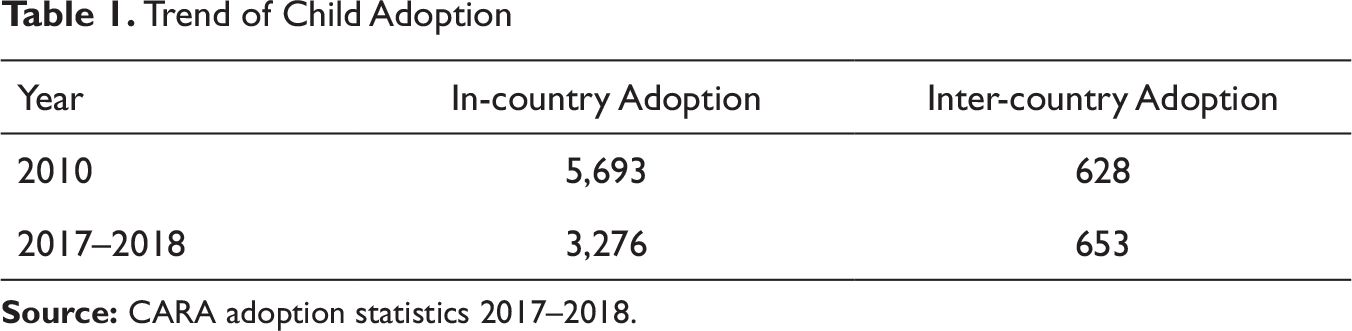
In India, a very small number of children find a way to avail permanent care through adoption, due to the abysmally low rate of adoption in the country. Data produced by the Central Adoption Resource Authority (CARA) depict that in 2017–2018, the total number of children adopted within the country was 3,276, at a sharp reduction from that in the year 2010, when 5,693 children were adopted in-country (CARA, 2018). The inter-country adoption rate is also not encouraging, as indicated in Table 1.
The adoption rate is very low in the country despite the number of couples experiencing infertility being very high—almost 27.5 million (The Economic Times, 2018). Ironically, there is very insufficient evidence or research on the causes of low child adoption in India. However, a few studies conducted in the pre-COVID-19 period argue that the major causes of declining adoption in India include low social acceptance of adoption, low awareness and the cumbersome process of adoption.
Trend of Child Adoption
COVID-19 Challenges to the Adoption Process
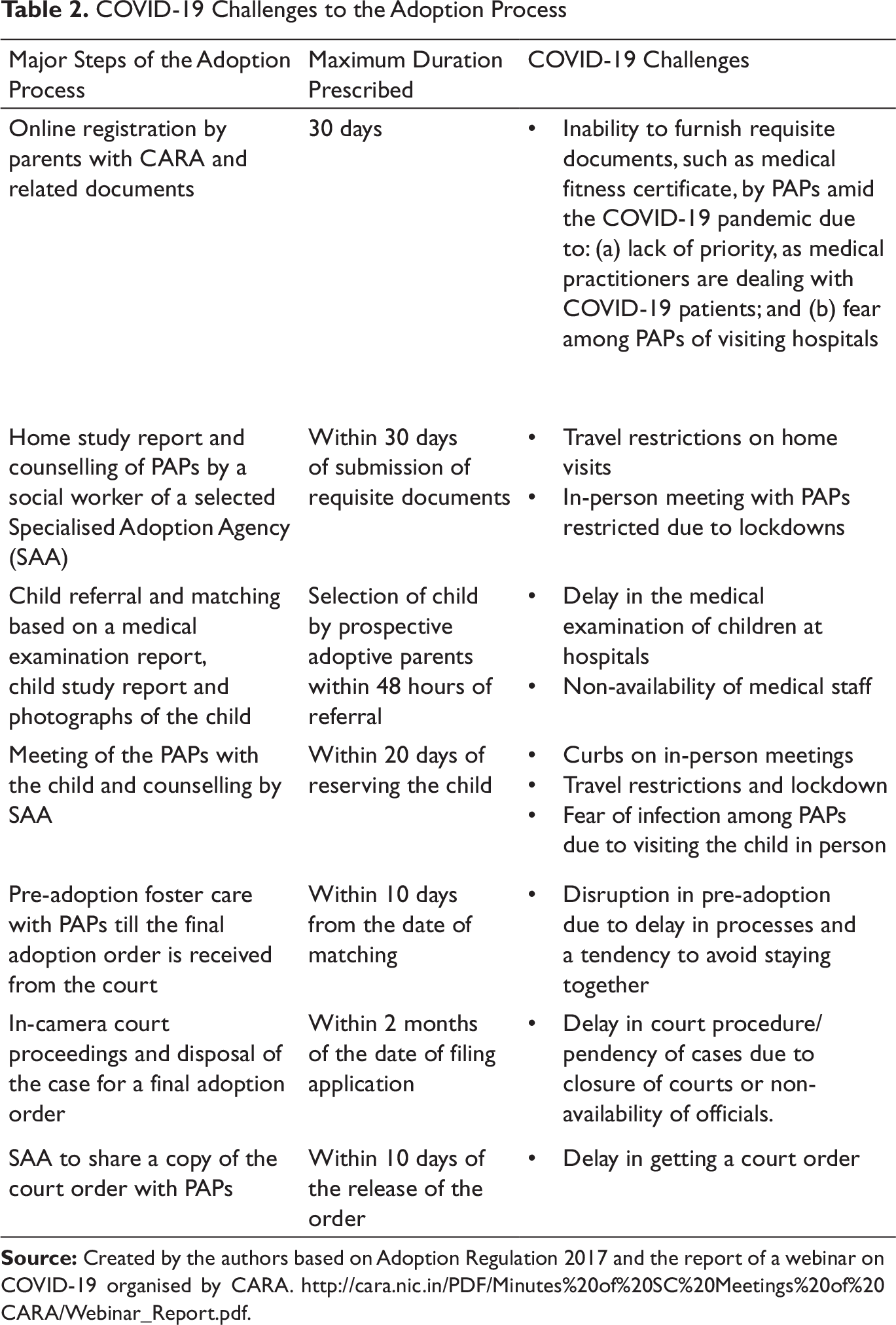
The first and foremost challenge to adoption is the delays throughout the child adoption process due to the lockdowns or the restricted movement of or restrictions in visiting the children. Even the prospective parents who have already matched with a child are unwilling to adopt the child if the place of adoption has a higher number of COVID-19 patients in general. Also, officials of adoption agencies are unwilling to meet parents in person due to the COVID-19 pandemic, thus keeping the whole process of adoption halted (The Times of India, 2020). The economic slowdown or loss of income sources of parents also has an impact on the rate of adoption, as parents have no choice but to drop the idea of extending their family through adoption or delaying child adoption.
The JJ Act endorses foster care as one of the effective mechanisms for child protection in India. The act defines foster care as the ‘placement of a child for alternate care in the domestic environment of a family, other than the child’s biological family, that are selected, qualified, approved and supervised for providing such care’. Foster care is a non-institutional, family-based care system under which a child in need of care and protection lives with a family other than his/her biological family. The period of foster care can be short, not exceeding 1 year, or long, till the child attains the age of 18 years (till children age out of the system). A foster family is a family that is identified by the District Child Protection Unit (DCPU) to keep a child in foster care. Foster care includes children of age 6–8 years who have not been adopted for 2 years, children of age 8–18 years who have remained unadopted for 1 year and children with special needs remaining unadopted for a year, irrespective of their age. It is far more beneficial for children than institutional care, as foster care provides a family-like environment to the abundant orphans and neglected or homeless children.
There has been an argument that foster care is the best alternative for the physical and psychosocial development of children, as it provides a substitute family for vulnerable children who are unable to get adopted. However, there have been several challenges faced by the foster care system in India even during the pre-COVID period, such as: (a) lack of financial support from the government and lack of moral appreciation to foster parents; (b) absence of proper implementation and monitoring of the foster care; (c) lack of preparedness or a proper plan for the social re-integration of children aging out of the system; and (d) reluctance on the part of foster parents to take care of children with human immunodeficiency virus/acquired immunodeficiency syndrome (HIV/AIDS), children with disability and street children, due to inability to take extra care and lack of enough funds and facilities to cater to the special needs of such children (National Research and Documentation Centre).
COVID-19 Challenges to Foster Care
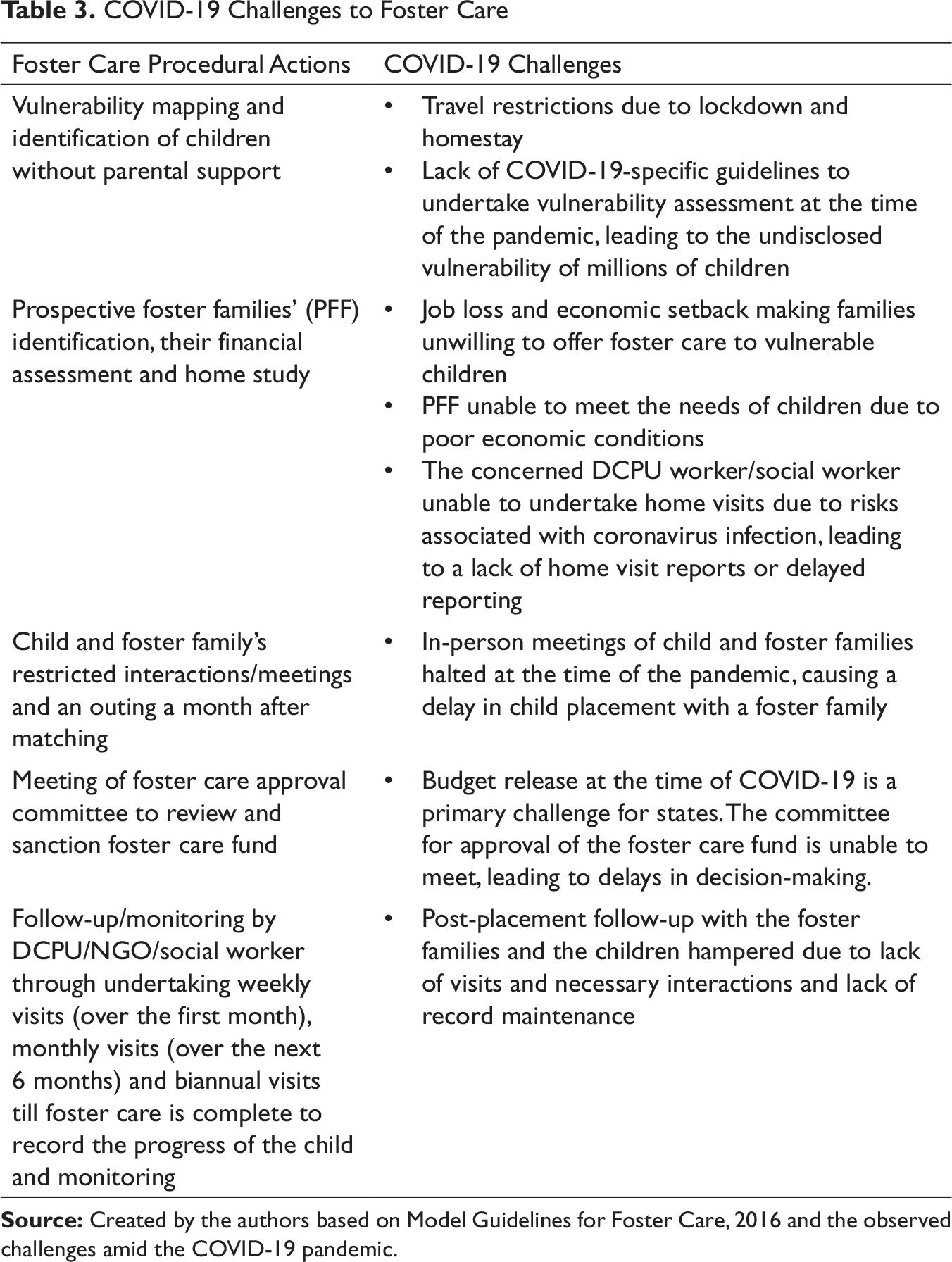
In the absence of proper vocational training, employment or a social re-integration plan, children who attain the age of 18 while living in foster care encounter difficult situations. Even before the COVID-19 pandemic, there were inadequate aftercare infrastructures and related interventions in the country. The COVID-19 pandemic and the post-pandemic economic slowdown put the children aging out of the system at a higher risk of homelessness, anxiety about the future, unemployment and behavioural problems (Panetta, 2020).
Recommendations
A worldwide pandemic has provided the opportunity to assess the loopholes in a child rights policy. One of the most important learnings from the pandemic is that there is an urgent need to assess and redesign the child rights policies and programmes in terms of the pandemic.
The COVID-19 pandemic has posed a child rights crisis in the country that needs immediate attention and action. Millions of children in the country already living with hardships will fall into adversity and poverty if the COVID-19’s impact on them remains unaddressed. There is a need to strengthen the family-based childcare systems in the country to protect children from further deprivation due to the COVID-19 pandemic. There must be considerable focus on strengthening adoption and foster care through minimising delays and gaps in the processes.
COVID-19-specific or pandemic-specific guidelines or standard operating procedure (SOP) needs to be prepared to facilitate early placement of children with PAPs and prospective foster families (PFFs) during the pandemic situation. Necessary capacity building and training of social workers, counsellors and other stakeholders are required to help them function effectively at the time of the crisis. There is a need to review the existing child protection policies and prioritise the same in plans for mitigating the COVID-19 pandemic across all the sectors, including health, education and livelihood, to reduce child vulnerability.
There is a foremost need for collaborative actions by the government, non-governmental organizations (NGOs), child rights activists and other development agencies to identify and map the vulnerable children in the community and provide the necessary services. Collaborative actions help utilise resources at the optimal level. A time-bound and PAPs/PFFs-friendly system for a smooth adoption or foster care process is highly required.
Research institutes have an important role to play in policy advocacy through encouraging more research on adoption and foster care systems in India, especially at times of health crises, to strengthen child protection systems in the country, especially family-based childcare.
