




Abstract
This article offers an investigation into sculptural artefacts from the early historic period. Most of the objects under study are small in size and are often found dismembered or in pieces. This is partly because of the fragility of the material—baked clay—but more often, because of the techniques of manufacture—whether owing to a weak armature (where used), incomplete baking or/and the pressing together of elements in the mould that has yielded to the passage of time and rough handling. The following analysis seeks to locate these fragments by contextualising them in the spaces/regions they were found in, as well as in the estimated time periods. This contextualisation is specifically attempted through some typologically categorised case studies pursued through the lens of ‘transculturality’ and ‘materiality’.
Methodologically, the study is prompted, in part, by what Deetz has called the ‘archaeology of small things’ (Deetz 1997, 167). Art historians have also engaged with objects and their materiality, not only for its aesthetic purposes but also for how art defines patrons’ or users’ position in society and how it could be placed within the social contexts in which art was used and produced (Bourdieu 1984).
Therefore, material, materiality and material culture, which is central to studying archaeological remains, have an important role in art history in general, and in early art history in particular. More so when art historical enquiry ‘involves a process of reconstruction out of a non-representative selection of what once existed’ (Stewart 2014). Given the fragmented, dispersed and often non-contextualised nature of artefactual and plastic sources, materiality becomes even more significant, as is hoped to be demonstrated through the following case studies of terracotta art from different regions of north and north-west India.
The interaction of materials with humans and the agency of humans in archaeological processes is one of the latest trends in the study of archaeology. This article seeks to explore the materiality of small things like terracotta produced in profusion in north and northwestern India. This entire region between the second century BC and the sixth century AD not only possessed a flourishing Buddhist tradition but was also the locus of flourishing internal and international trade. Trade patterns then facilitated the exchange of objects externally amongst India, China and the Mediterranean as well as internally within north and central India. This interaction brought streams of ethnically diverse populations into this already culturally diverse region (Behrendt 2003). This hybridisation is seen in both the major schools of art, be it Mathura or Gāndhāra, but, as we will see below, also in the small terracotta figurines. There is a strong element of cross-culturality in the entire region where, for example, Bramanical deities are often seen in Central Asian art (Muzio 2019, 8–43).
Whether the region was a single cultural zone may be contested. However, the fact that there is a great deal of cultural movement taking place in the entire north and north-western India, as well as central and eastern India, is undeniable. The consequential contacts are reflected in the art cultures witnessed in the area (Nath 1995, 149–17). The present study concentrates on viewing certain representational types in terracotta from the upper Ganga and Yamuna doab, which is the region under study here.
An extensive historiographical essay is not possible here, but the author would like to highlight the stellar work by Devender Handa, who has categorised sculptures from the region based on their sectarian origins as well as the site of their recovery (Handa 2006, 2011). The work documents material in museums as well as those in-situ works that have created a database in terms of collection, with a degree of chronological sequence achieved of art materials from 190 sites in Haryana and Punjab. Mohinder Singh has also made a significant contribution in this direction, as have Omanand ji and Virjanand ji of the Prantiya Purattatva Sangrahalaya, Jhajjar (Devakarni 2008). They were responsible for the collection of many surface finds from Agroha, Sugh, Naurangabad and other sites, while there is the meticulous documentation of these by Jagdish Parshad and Virjananda Devakarni.
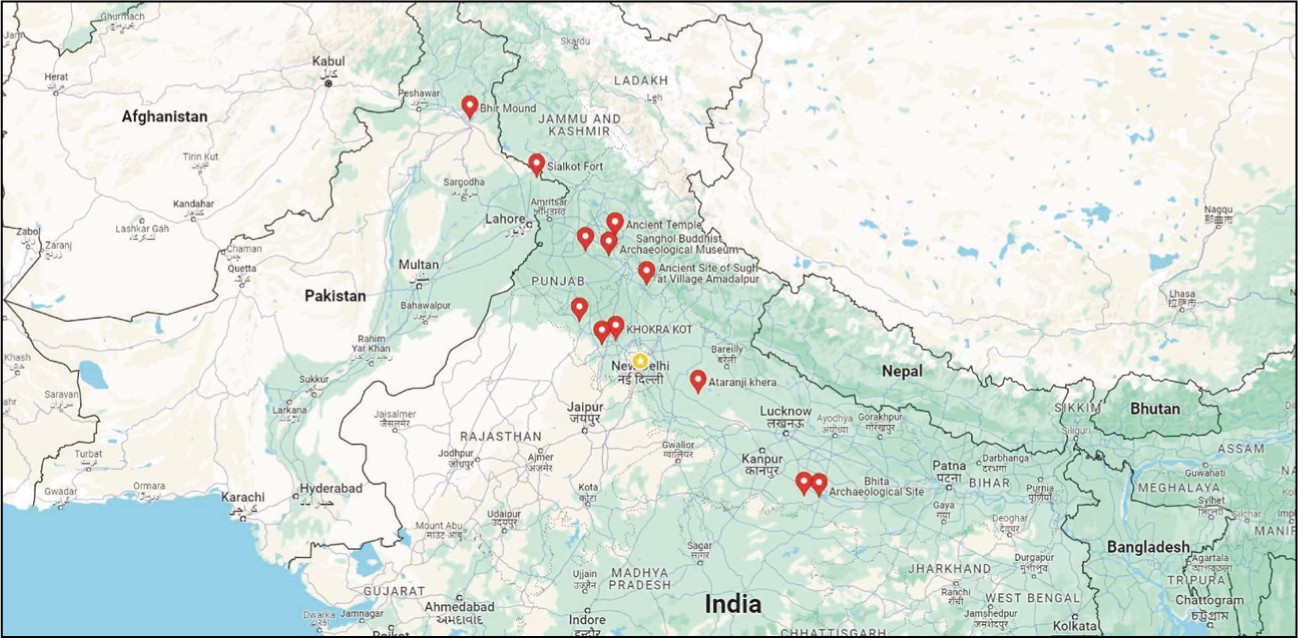
The focus in this article is largely on Sugh, Agroha and Naurangabad, Ropar and Sanghol (Plates 1 and 1a) as representative areas and also because these sites have very significant ‘Śunga - Kuṣāṇa’ archaeological strata.
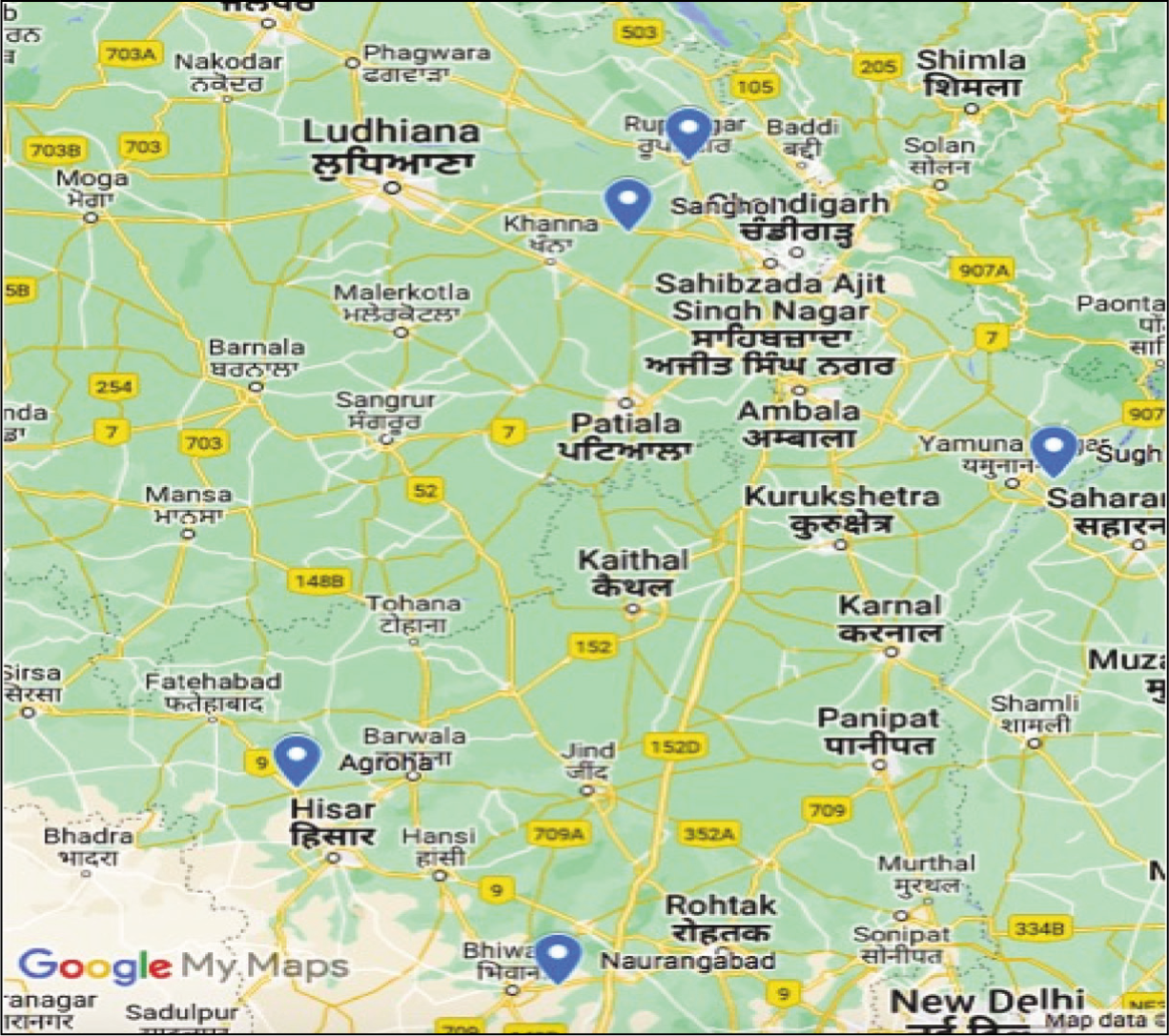
The archaeological data, as revealed by excavation and the subsequent cultural sequence at these sites, largely confirm the urban nature of the sites. Sugh (ancient Srughṇa), excavated by Professor Suraj Bhan, was a big urban site. Naurangabad also reveals a picture consistent with other sites from the region, such as Ropar and Sunet (IAR 1983–84, 67–70). From Painted Grey Ware (PGW) to Northern Black Painted Ware (NBPW) and then the orange pottery of the early centuries of the Christian era, along with large bricks, material remains of lapidary, terracotta and pottery further reinforce this notion. Srivastava in his report on Agroha calls it a well-planned and prosperous settlement (Srivastava 1999, 2).
The report on Agroha presents evidence of 401 antiquities, including terracotta objects, sculptures and plaque, that have been recovered from the second layer, which may belong to the post-Mauryan phase. The finds include model shrines, decorated tablets, decorated spouts, animal figurines and so on. One of the stone images represents an image standing on a lotus supported by Nagas (Srivastava 1999, 3). Plaques of Mahiṣāsuramardini, along with a seated image and perhaps Kubera, have also been recovered.
Similarly, in Sugh or ancient Srughṇa (Chhabra and Bhan 1964, 1965), the mound reveals different cultural periods through elements like pottery, terracotta objects, coins and other contemporary material. The post-Mauryan period corresponds to Period III, which has abundant remains of terracotta antiquities, human and animal figurines, which include both types of terracotta: moulded and handmade. Finely moulded terracotta female figurines were found with heavy ornamentation and transparent clothes. Most human figurines were made by mould, while animal figures were handmade. Those with animal forms, such as elephant, bull and horse, were perhaps used as toys; some other children’s toys, such as toy-cart, terracotta disc and balls, were also recovered (Sugh IAR 1963–64, 27–28; 1965–66, 35–36).
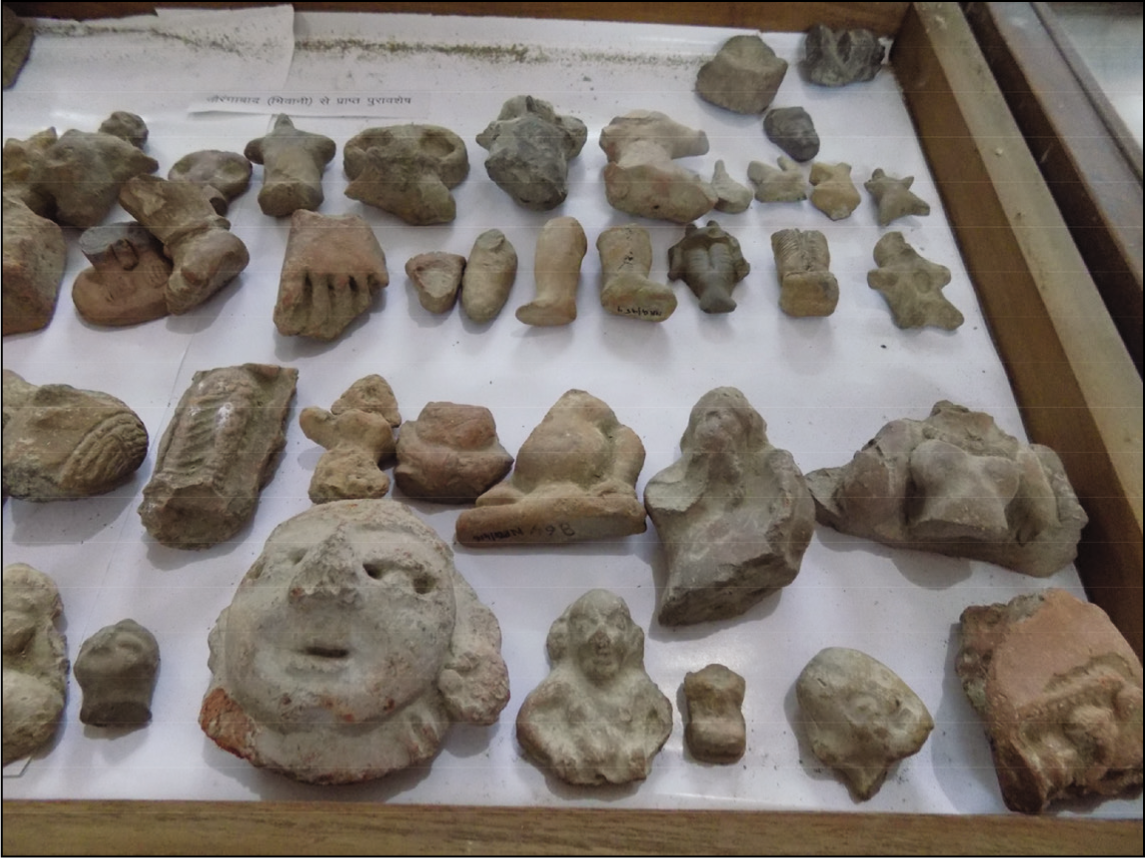
At the ancient site of Naurangabad, continuous cultural sequence has been traced dating from first century BC to fifth century AD. The excavations conducted here have so far yielded a large number of coins, coin-moulds, seals and sealing of different kings, including those of Yaudheyas, Indo-Greeks and Guptas. A terracotta seal found here confirms that the old name of this site was Nakanagar, which was an important urban centre of the Yaudheyas. The largest number of antiques may be seen in Prantiya Puratattva Sangrahalaya, Gurukul Jhajjar, in present-day Haryana (Plate 2).
Mould and Moulding, Yaks.a (?), First Century CE, Ropar Museum.
Sanghol (ancient Sanghapura) has been mentioned by Hiuen Tsang in his travels, and archaeologically, it consists of one main stupa, an adjacent vihara, an urban site close by with fortifications and two smaller stupas. Excavations revealed at least six cultural stages, beginning with the late phase of Harappa Culture. The next period was that of the painted grey ware and plain grey, black-slipped and associated red wares phases. The most interesting period for our study is Period IV, which was distinguished by the occurrence of Śunga-style terracotta, and Period V associated with the Kushan and Gupta periods. Several structures of mud bricks and baked bricks, drains, sullage water-jars and ovens were exposed in the various levels of this period. Noteworthy finds included: (a) coins of the Indo-Parthians, Kushans and some tribal states; (b) terracotta coin-moulds of Gondopharnes; (c) three sealings, two of which bear legends in early Gupta Brahmi; (d) terracotta figurines; and (e) votive tanks. A Buddha figure of the Mathura school (pl. XXVIIIC) obtained from surface may belong to the same period (IAR 1968–69, 25–26; 1969–70, 31–32; 1970–71, 31; 1971–72, 39, 41; 1972–73, 28; 1977–78, 43–44; 1980–81, 46; 1984–85, 62, 64; 1985–86, 67–68; 1986–87, 69–71; 1987–88, 95–99; 1988–89, 69–73; 1989–90, 88–94).
Rupanagar, or Ropar, has shown evidence of being continuously inhabited from the Harappan period onwards, and like some other sites in the region has yielded six distinct periods from Harappan to Medieval. Evidence of trade and exchange with the Gangetic Plains can be seen from the period that witnessed both the introduction and disappearance of the NBPW in 450 sherds, which must have been brought here by pilgrims and traders. However, from Period IV (c. 200 BC–AD 700), profuse terracotta pieces have been recovered: The subphases include the Śungas, Śaka-Kuṣāṇas, Guptas and post-Gupta. One can adduce a great degree of contact and exchange from the presence of coins of northwestern rulers here; such as those of Indo-Bactrian Antialcidas, and perhaps an Indo-Parthian ruler with the title of Soter Megas and also Apollodotus II. This is overlain with contemporary tribal coinage of the Kudindas and Audumbaras. Of the art finds, the significant figures include nude yakœa, and beautifully modelled figures of yakhās standing under trees (IAR 1953–54, 6–7; 1954–55, 9; 1955–56, 121–29).
It has been contended that terracotta forms a medium (Singh 1986, 166–74) that expresses the mundane and ritual needs of ordinary people. Devangana Desai is of the opinion that the tribal and peasant cults in towns deployed terracotta figurines of Nāginīs, mother goddesses, Śri Lakṣmī and Yakṣas and so on, as votive offerings. In addition, decorative figurines and plaques were made for the delectation of cultured nāgaraka (town dwellers). Desai emphasises the role of the cultured town dweller, the nagaraka, in the consumption of the terracotta plaques depicting themes like wrestling, palace scenes, women decorating themselves, romantic poses, drunken scenes, couples and so on, during the celebration of fertility festivals with festive gatherings in nagara-upavaµas city gardens (Desai 1976, 555–62). Desai also adds that during fertility festivals, terracottas such as śālabhañjikā, or aśokabhañjikā, were used for ritual purposes (Desai 1976, 558).
Jagdish Parshad holds that with the decline of centrally controlled authority, art came out of the clutches of the royal court and became a mass product. The sculpture of this period was patronised more by the masses than by the royal court (Parshad 2012, 37). The locus of consumption is thus located in the urban elite that created a demand for cultural production of art objects, both in stone and in terracotta.
A comparative study of the art with that found in the Gangetic Plains and north-western India reveals nodes of contact through which cultural artefacts and ideas travelled (1a). Different centres of terracotta production came up all over the country in the early historic period. Kausambi, Bhita (Mukhopadhyay 1972, Plate 12), Chandraketugarh, Mathura, Agroha and Naurangabad, among others, were some towns from where terracotta art was exported to different places. This has been established by the findings of different figurines from a single mould as well as similar terracotta forms from different sites. Interregional and intralocal communication networks between cities such as Sugh, Agroha and Naurangabad may be traced through objects such as small artefacts that may have been carried with travelling itinerant tradesmen or craftsmen.
The exchange and transmission of style and materials were facilitated not only by the portability of small terracotta forms but also by the use of moulds (Plate 3) to create them from the first century BC onwards. The profusion of terracotta figurines from the sites of the Satluj-Yamuna valleys of the region suggests that there was a wide demand for these, at least in urban areas that have been excavated (Singh 1994, 857–63). It is also indicative of specialist artisans who were skilled in making terracotta figures, hawking their skills or wares to where the demand existed.
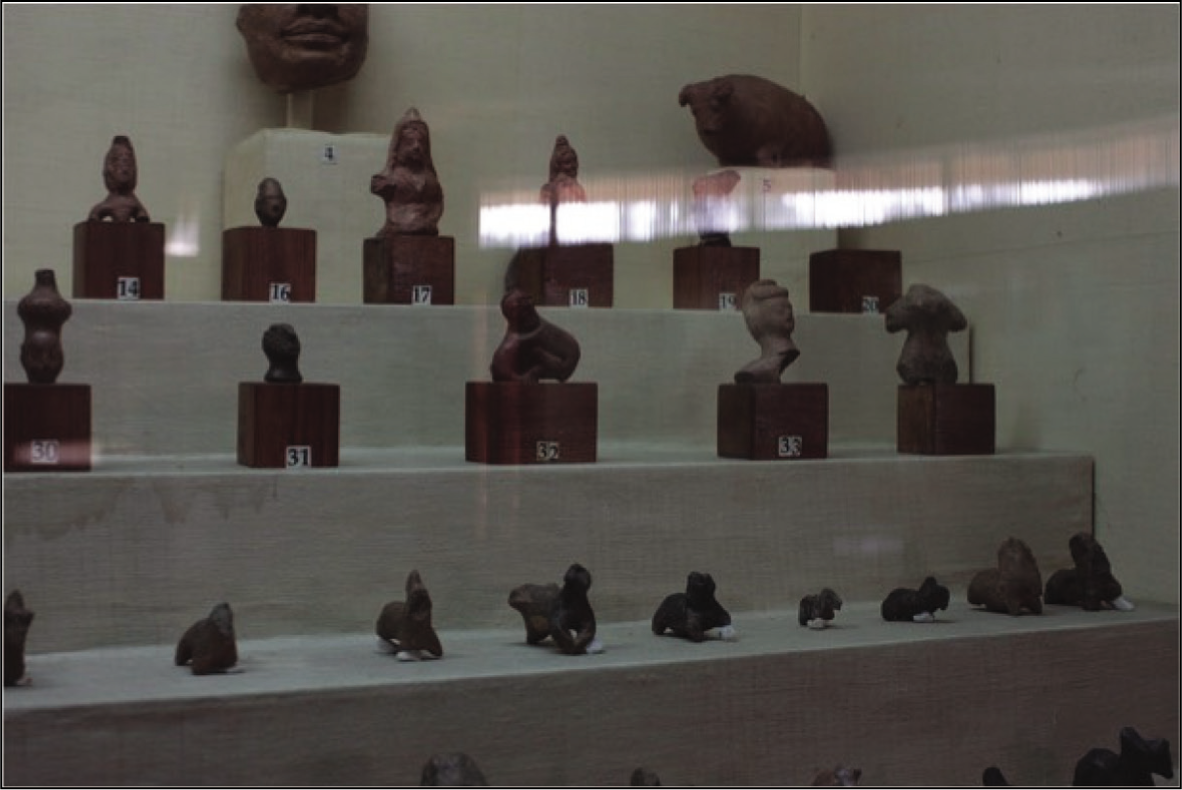
Naurangabad Terracottas.
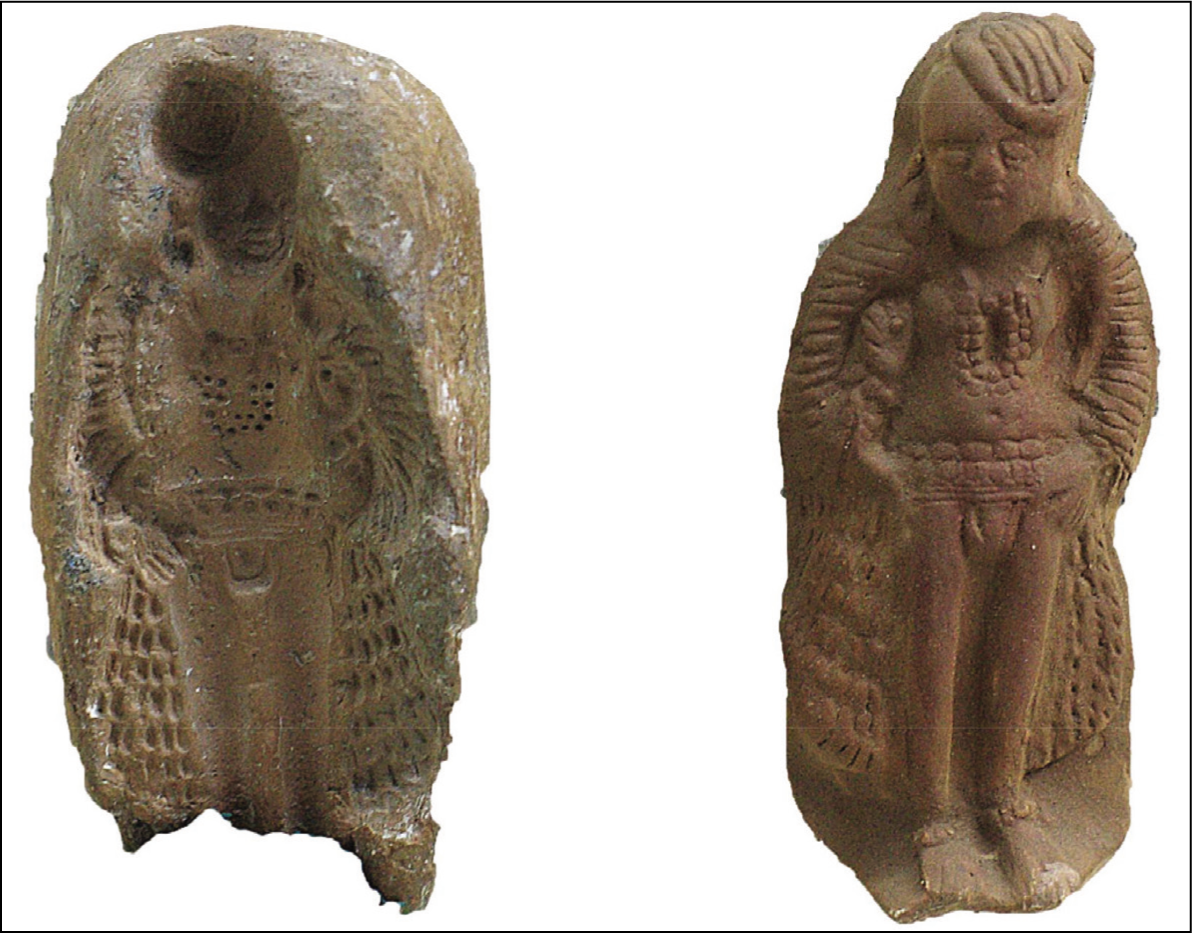
The use of these moulds ensured the production of multiple figures out of a single cast. It also created the possibility of depicting narratives, along with small pieces with details such as the alphabet clearly delineated on them. Specialised craftsmen called pustakāraka, modellers in clay, mentioned in the Mahāvastu, are described as being distinct and different from the kumbhakāra, the former being involved in making temple plaques, decorations and so on, in conjunction with architects of the temple (Desai 1976, 560). Devangana Desai explores the feasibility of large-scale production of terracotta in the urban milieu, and terracotta art as a social process mandated on the presence of surplus craft production, for example, eighteen śilpas in Jātakas and so on (Desai 1976, 555). The rich use of alluvium of Indo-Gangetic plains ensured ample raw material (Singh 1986, 160).
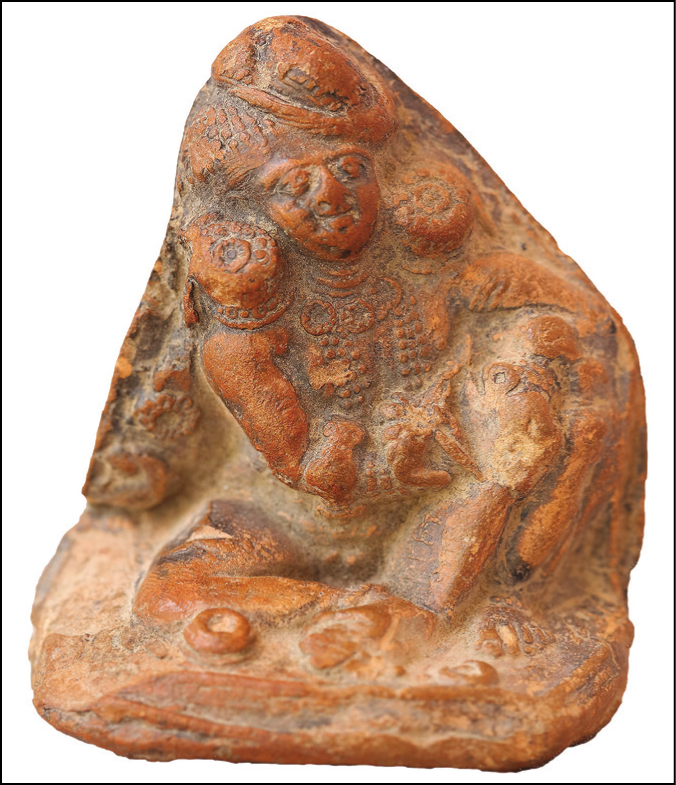
The first piece is the well-known Sugh terracotta of a boy with syllabary (Ahuja 2002, 46–57). At least six specimens, and perhaps more which have yet to be published, are of a young boy writing or reading the Brahmi alphabet on or from a wooden board or takhti, which have been found at Sugh, now in the National Museum and Gurukul Jhajjar, dated to the Śunga period (Chhabra 1970, 857–63). The figure in the National Museum has a broken face, whereas out of the figures found at Gurukul Jhajjar Museum (Plates 4 and 4a), two are complete and the rest are in pieces.
Child with Syllabry, Terracotta, First–Second Century CE, Sugh, Jhajjar Museum.
Child with Syllabry, Terracotta, First–Second Century CE, Sugh, Jhajjar Museum.
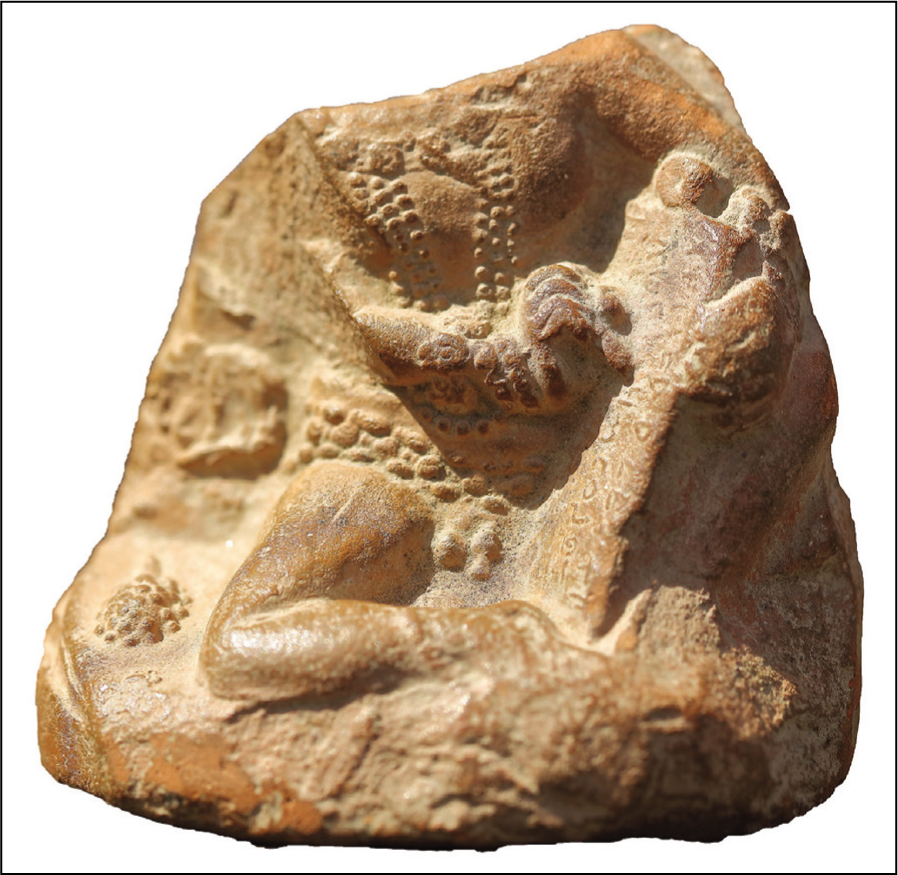
Yoganand Shastri has classified these figures into three categories or types (Shastri 1999, 182–84) based on the vowels and consonants written on the wooden board. Dr Jagdish Parshad et al. have instead classified the figures into four categories (Parshad and Kumar 2014, 1075–80). The first category depicts a child learning by pointing his finger at Brahmi vowels written in four lines on a wooden tablet, while the platform on which the small plaque rests is decorated with floral design; the lack of the inkpot points to the act of memorising the alphabet and not writing the letters. Resting the slate on his left leg and pointing to the letters using his fingers, he appears to be trying to memorise. Around him, one can see toy animals such as elephants. There are not many ornaments on his body.
In another type, a child is depicted as practicing writing over already-written vowels and consonants. The child is sitting with an upright left leg on which he is holding a wooden tablet. A double knot-style turban adorns the child’s head, and he wears many ornaments. The presence of the inkpot suggests that the child knows or is at least learning how to write. In the next type, one sees fruits, which reflect the observant eyes and delicate handwork of the artisan. Another plaque depicts a child writing with a stylus in one and a half lines, while another shows him using a similar stylus in two and a half lines (Parshad and Kumar 2014, 1078). The final type is that of a child who appears to be in an advanced stage of learning. The wooden tablet is divided into three columns, where the first and third columns are already written out, while he is writing the middle column. From sites like Ahhichatra and Agroha, we have found clay inkpots in large numbers, the shape and size of which correspond to those represented in the clay figurines found at Sugh.
Writing is an important rite of passage that is also depicted on the plaques at Sugh. Further, an added find from Agroha is an inscribed terracotta tablet with a musical scale in reverse order in the script of the ninth century (Srivastava 1999, 4). If one were to examine the above works in the context of each other and read them in conjunction with the Arapacana syllabary of the Mahayana doctrine (discussed below), it suggests the importance perhaps afforded to literacy at the times.
Significantly, the syllabary, or at least its mystical importance, is reinforced in Gāndhāra art, of which at least three pieces have been discovered where the young prince Siddharth is being taught the Arapacana syllabary of the Buddhist alphabet (Salomon 1990, 255–73). This so-called ‘mystical alphabet of the Buddhists’, which derives its name from its first five letters (a ra pa ca na), is widespread in Buddhist tradition, being attested in numerous texts and other sources in several languages. It occurs in several texts of the Prajna Paramita class, both in the Sanskrit originals and in Chinese and Tibetan translations. There are, according to Saloman, strong indications that the Arapacana syllabary was originally formulated in the Gandhāri language and recorded in the Kharosthi Script (Salomon 1990, 272).
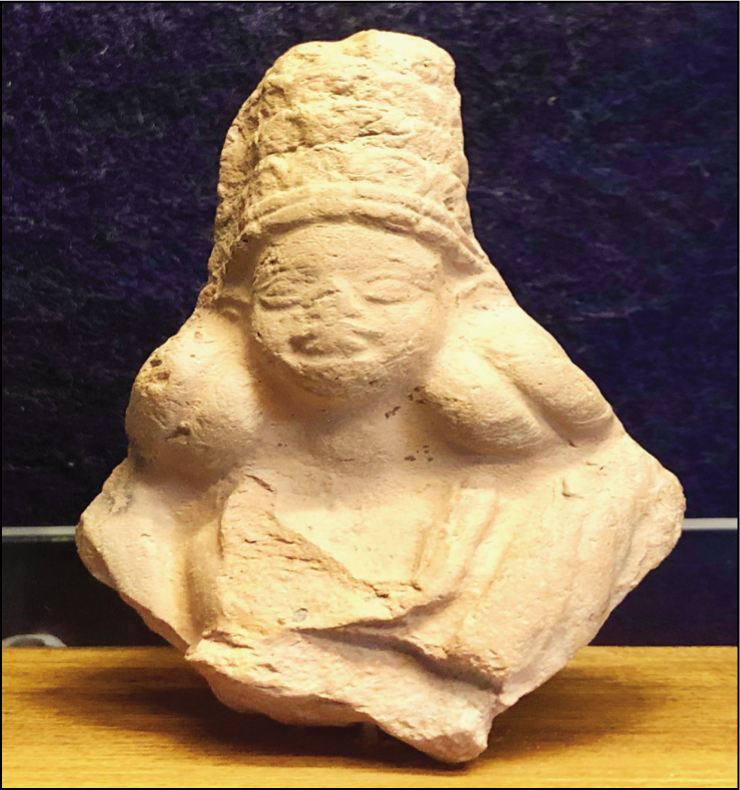
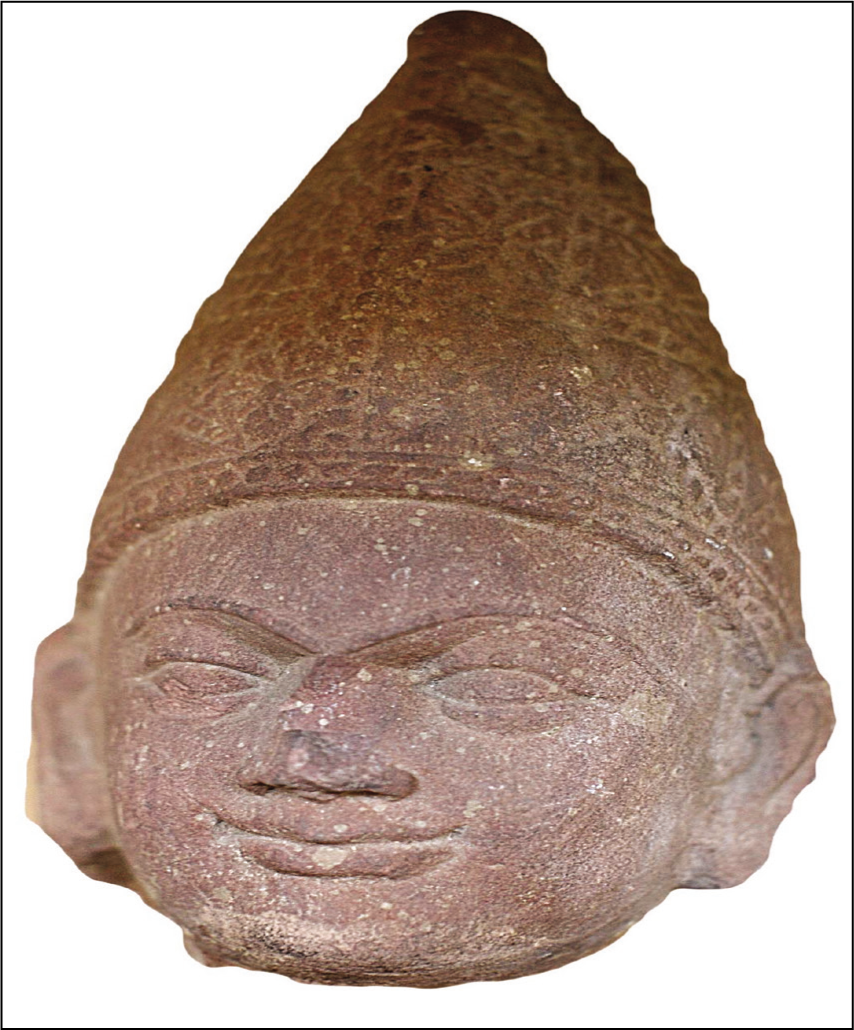
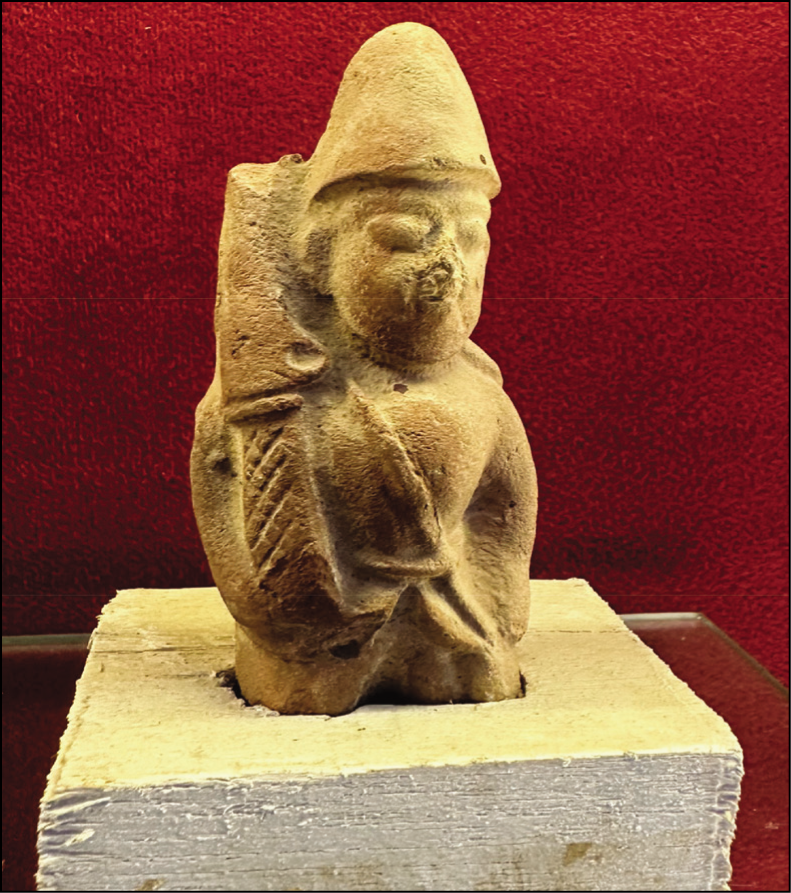
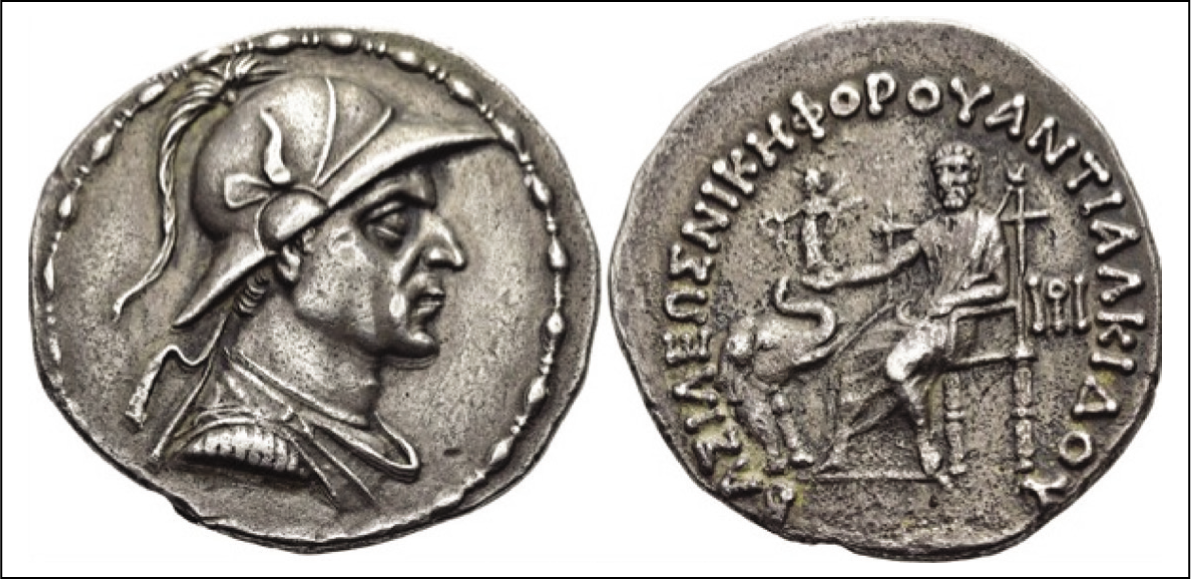
This congruence of knowledge systems in North and Northwest India is also seen in the terracotta figures of male heads wearing tall conical hats and cross-hatch patterns (Plate 5); square designs on the tunics of the figures and faces found from sites in Punjab and Haryana. These are easily recognisable as worn by Central Asian warriors (Plate 6), as seen also in the Kaniṣka portrait sculptures (Farrokh and Karamian 2017, 121–63). One may add that the hat-wearing figures from sites in Punjab, Haryana and Uttar Pradesh (Plates 6a and b) may be held to derive from the Indo-Greek helmet or circular hat, as these were visually understood in the eastern regions of the Kushana empire (Sinisi 2020, Plates 2 and 8a–d).
Yavana Head, Terracotta, First–Second Century CE, Sugh, Chandigarh Museum.
Scythian Head Stone, Second Century CE, Mathura Museum.
Terracottas from Sanghol Showing Types of Peoples Known.
Head with a Hat Like Helmet, Rupanagar.
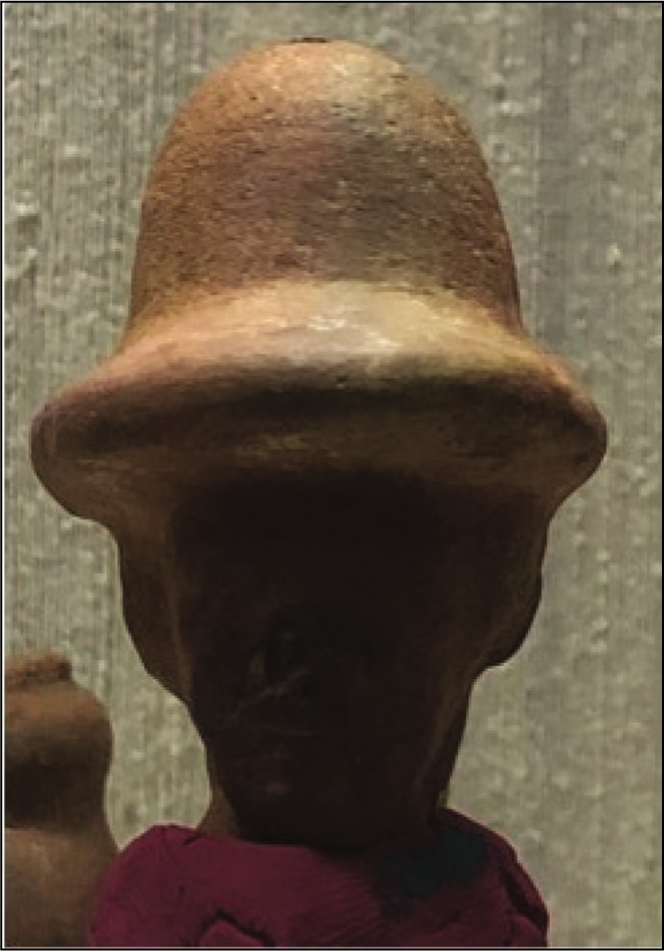
The exposure to the mleccha, or foreigner, may have prompted the creation of small figurines of them in northern India, especially around Mathura. Some other such examples are three helmeted heads adorned with two horned ram heads. Similar helmeted figures are found in abundance in the Mathura Museum (Gaur and Gaur 1980, 971–73). Excavations at Atranjikhera (Haider Naseem 1994, 872–81), now housed in the Aligarh Muslim University Museum, have also exposed some examples of these helmeted and hatted figures (Plates 6c and d). These hats can be seen on coins of the Indo-Greek rulers (Plate 6e).
Head with a Tall Helmet, Atranjikhera, AMU, Museum.
Head with a Head Band, Probably of Scythian Origin.
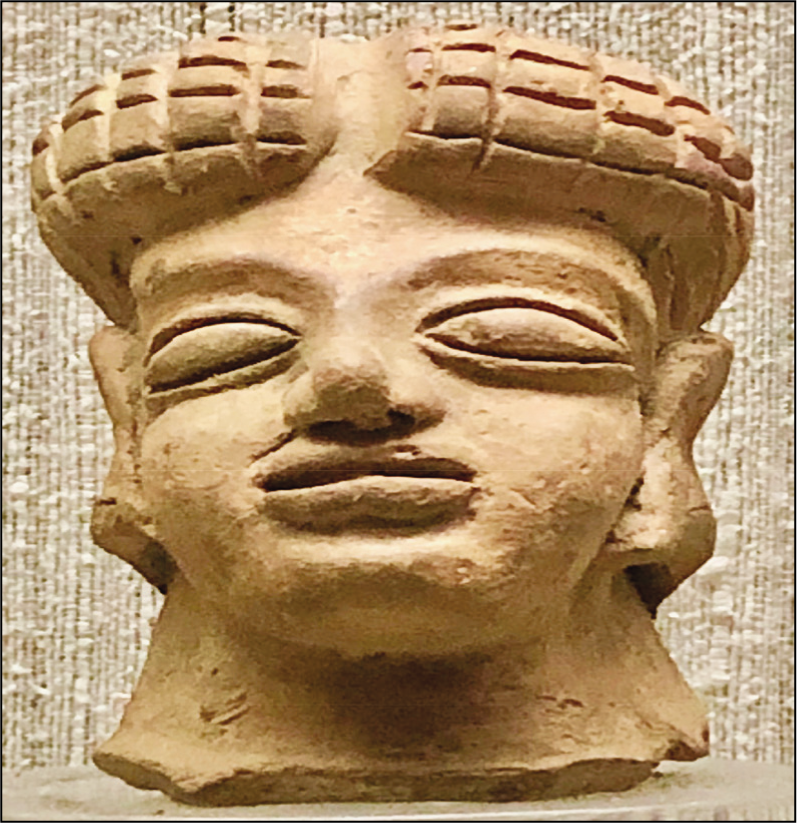
Courtesy:
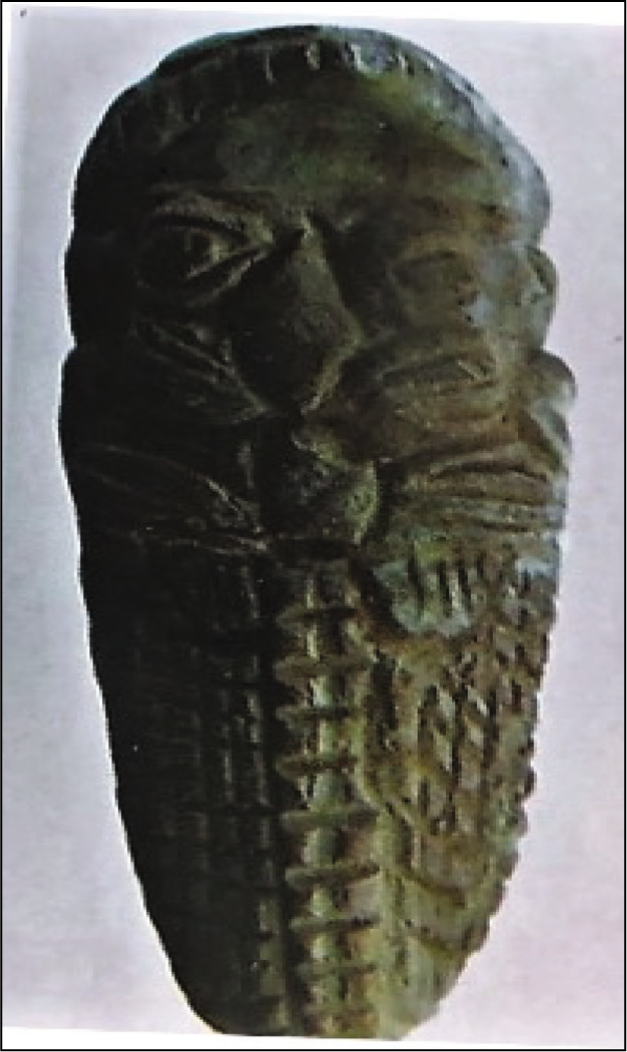
One may also point to the existence of the lone Achaemenid/Sassanian long, curly bearded head from Naurangabad (Plate 6f), which indicates contacts with multi-ethnic population in the region.
Head with a Long Beard, Naurangabad.
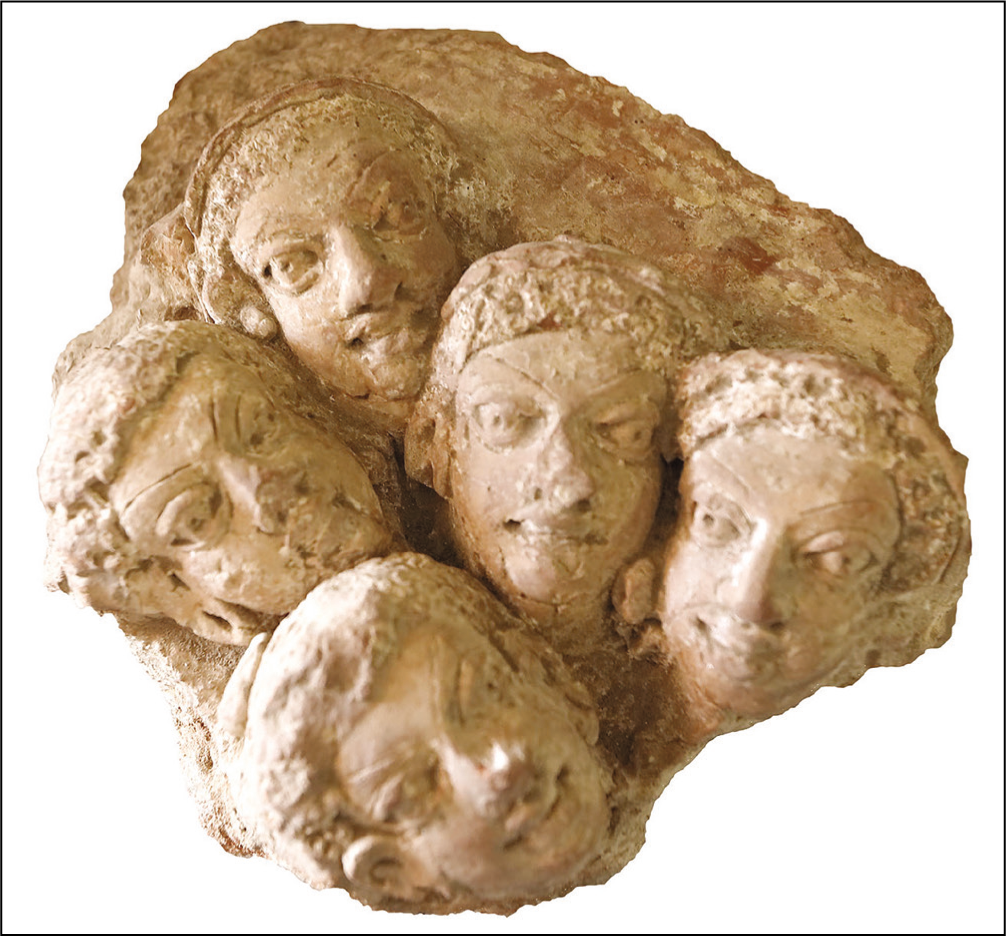
There is a very interesting set of conjoined five faces that are set in a single composition in terracotta from Agroha (Plate 7) that has been interpreted as representing members of the Greek ruling class (Parshad 2012, 63).
Set of Five Faces in a Single Composition, Terracotta, Second Century CE, Agroha, Jhajjar Museum.
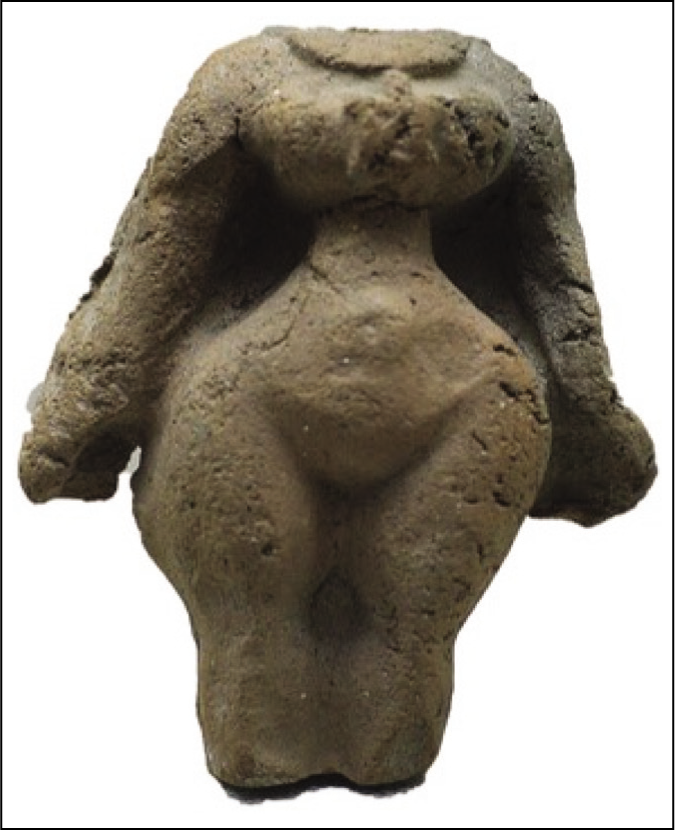
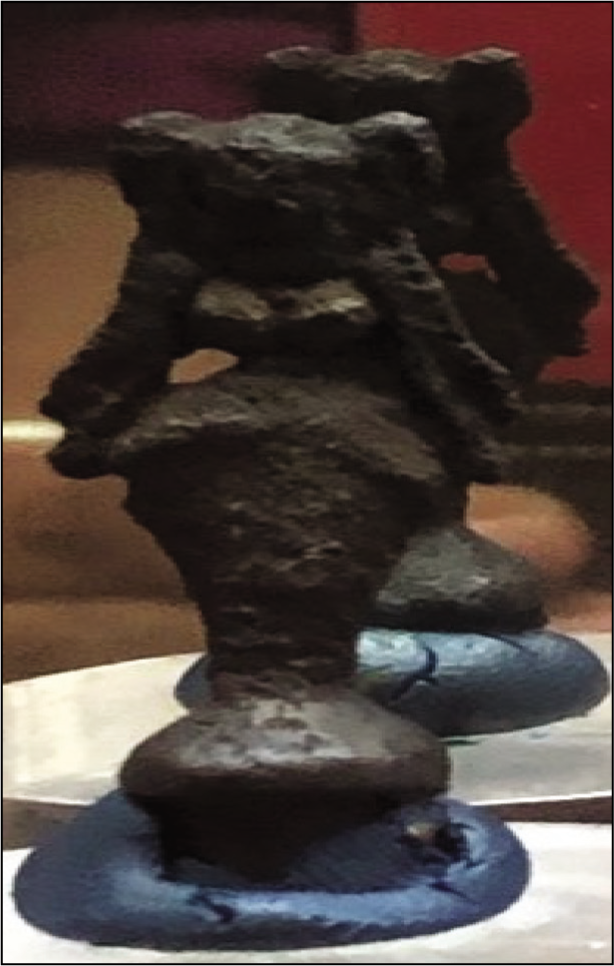
A Yakṣī figure from Agroha (Plate 8) is of great significance in understanding not only materiality but also sculptural parallels between terracotta and stone. The 4-inch-tall figure has a novel type of hairdressing style. The hair bun is a little damaged from above but is still intact enough to reflect the completeness of the structured coiffure. Two locks of hair flow from both sides, and on the left at the front, there is a smaller mini bun as well. The young woman is adorned with bangles extending upto her elbows. Her right hand is holding a flower, and her left side is resting on the thigh, perhaps in a playful pose. She is wearing different sets of earrings in both ears that are huge and heavy in size. She is wearing a three-layered mekhalā and a dhoti-sari that reveals the navel. The Agroha terracotta figure is quite similar in style and treatment to the Yakṣī figure found from Mehrauli, dated to the first century AD and now in the National Museum. Some other so-called Yakṣī figures have also been found from Naurangabad, Ropar and Taxila (Plates 9a–c), not just in terracotta but also in stone and bronze.
Yaks.ı-, Terracotta, Agroha, Jhajjar Museum, After: Virjanand Shastri, Agroha ki Mrinmurtiyan.
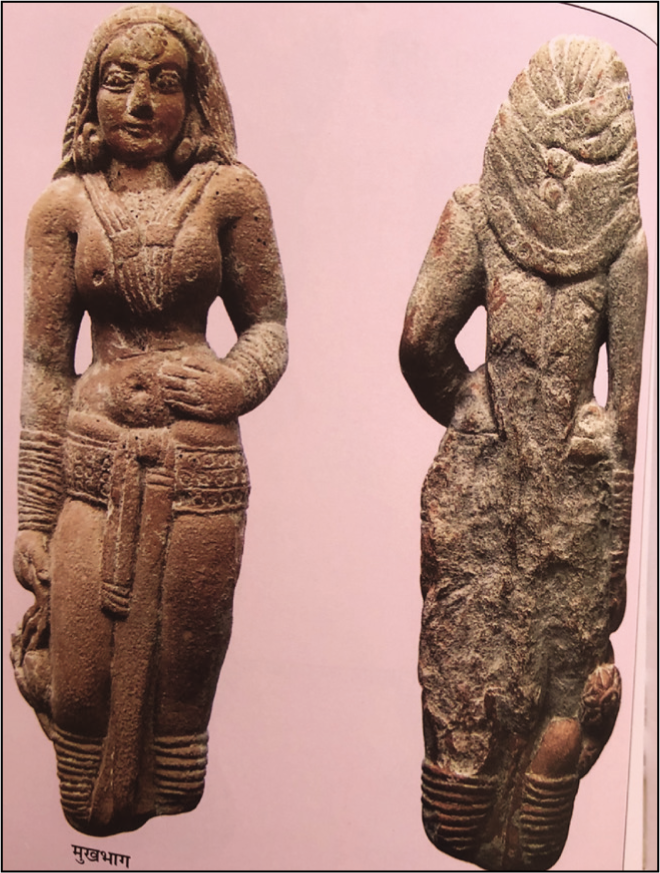
Yaks.ı-, Terracotta, Naurangabad, After: Virjanand Shastri.
Yaks.ı-, Terracotta, Rupanagar Museum.
Yaks.ı-, Bronze, Rupanagar Museum.
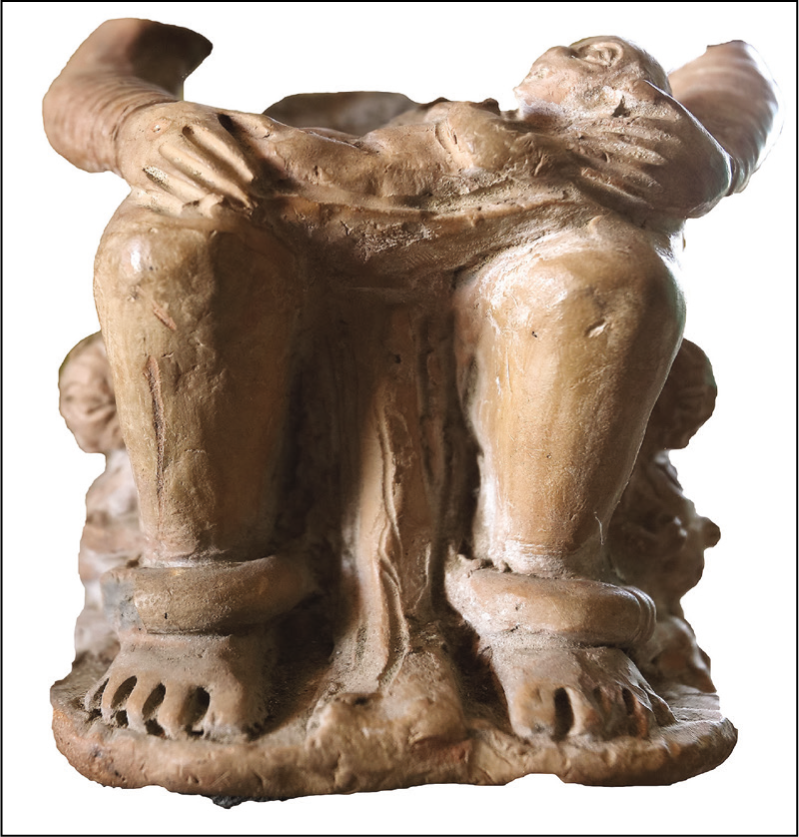
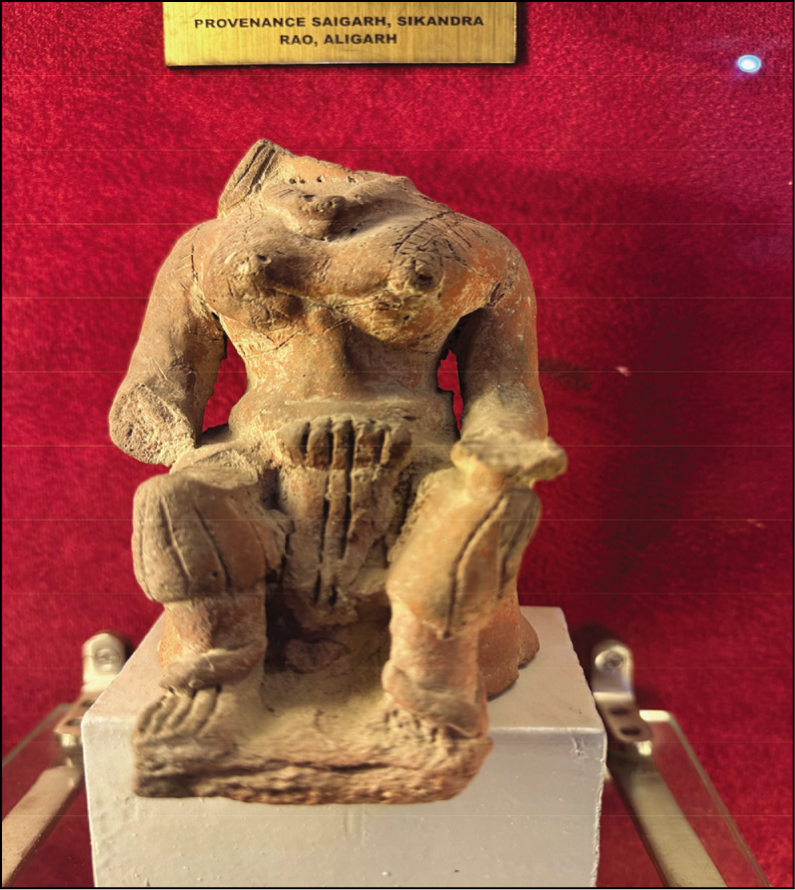
Another figure that lends itself to an analysis of similitude between iconography in stone and terracotta is the truncated Hāritī recovered from Agroha (now at Gurukul, Jhajjar) (Plates 10 and 10a), which in all likeliness is a votive offering to Hāritī, the goddess of child protection. Only the portion from the waist downwards, seated on a patterned short couch, now survives. The arms and ankles are heavily ornamented. The most important element is the presence of a baby cradled in her lap and two squatting children seated on the base of the sculpture on the right and left of the couch. A similar terracotta is found from Atranjikhera and is now in the Aligarh Muslim University Museum (Plate 11). This representation is similar to the one found from Mathura, now in the Mathura Museum (Plate 12) (Bawa 2013, 137–54). It seems that wherever Buddhism spread, the worship of Hāritī was also to be found.
Ha-ritı-, Terracotta, Second Century CE, Agroha, Now in Jhajjar Musuem.
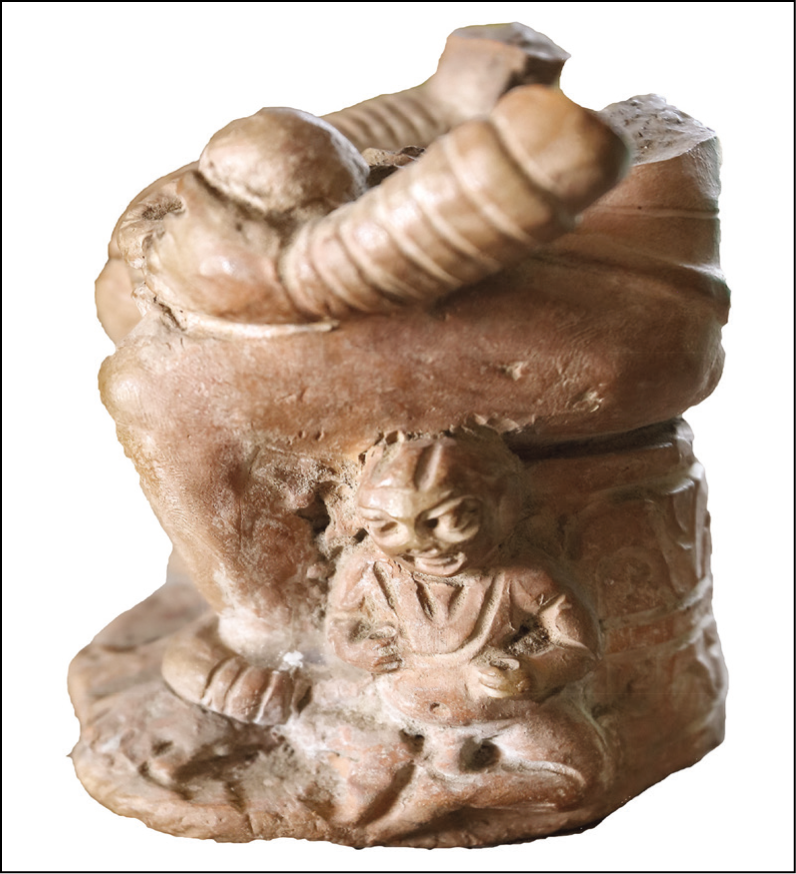
Another View, Ha-ritı-, Agroha.
Seated Matrika, Probably Ha-ritı- from Atranjikhera, Aligarh Muslim University Museum.
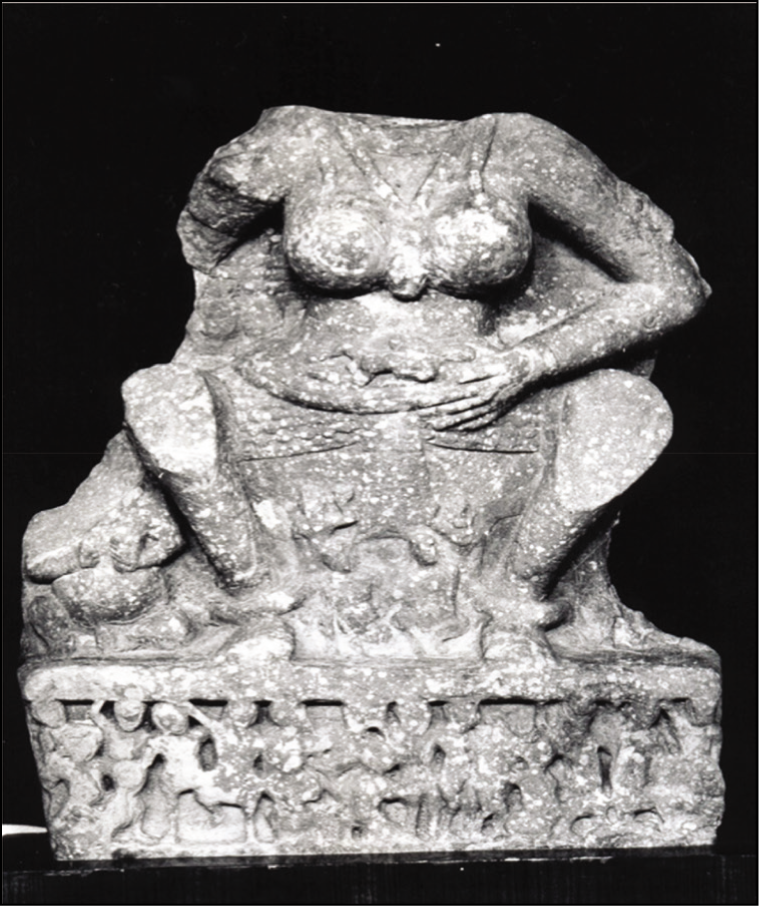
Courtesy: AIIS.
This is one of the many mother figures that have been found at the three sites. It includes a set of bird-faced Matṛkās that emulate a stone plaque, which can be seen at the Mathura Museum (Bawa 2013, 3, 6).
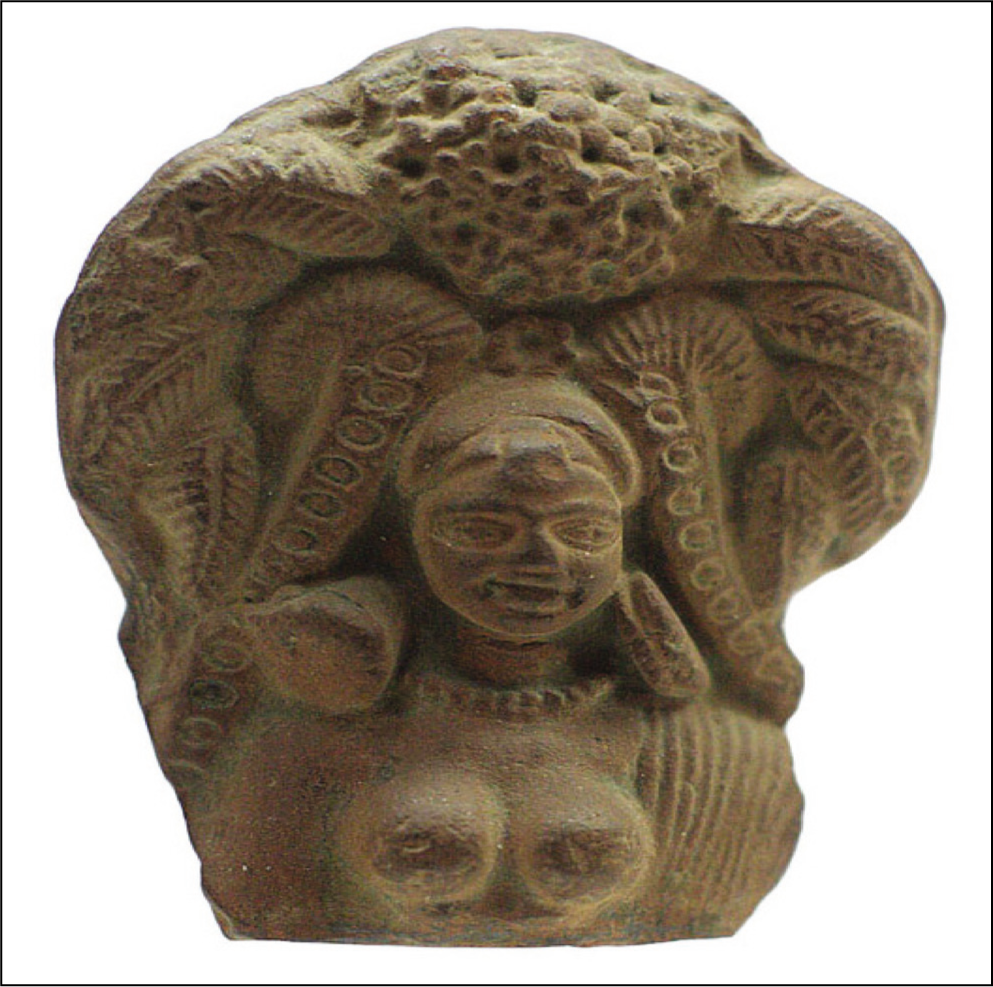
There are also busts of such figures as well as the so-called pañcacudā goddess and the Śri Lakșmī figures, the former having five or more weapons adorning the hair, along with sheaves of grains such as wheat flowing out from both sides of the head as found at Sugh and Agroha (Plates 13, 14, 14a and b), and Ropar, a peculiar combination of war goddess with the goddess of fertility. These are usually partially broken off, found from all the post-Mauryan layers of major sites from the Gangetic plains, namely Ropar (Plate 15), Kosambi (Plate 16), Chandraketugarh, Mathura and also from sites in Haryana.
Pañcacuda-, Terracotta, First–Second Century, Sugh, Now in Chandigarh Museum.
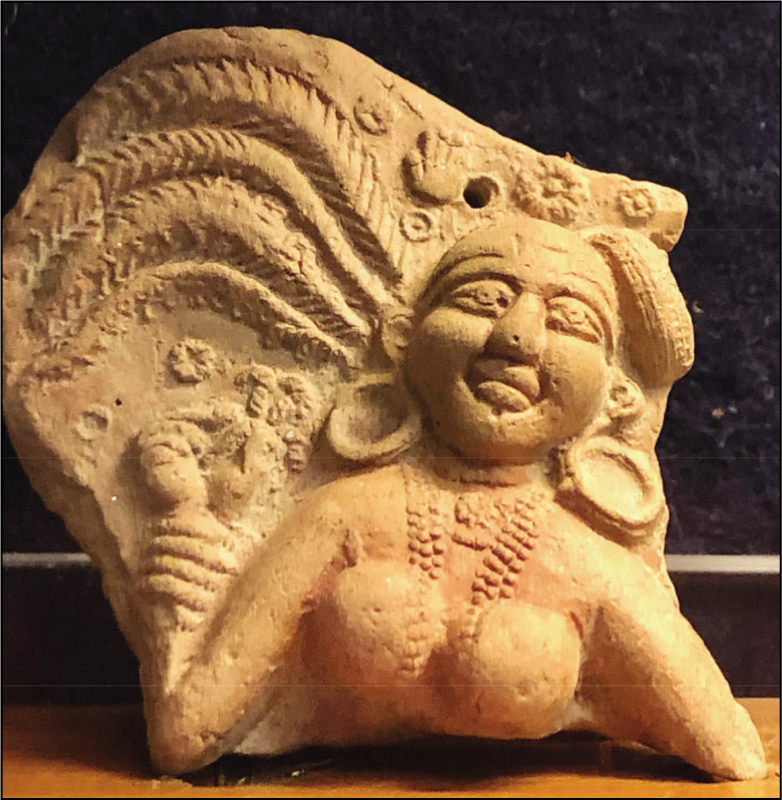
Pañcacuda-, Terracotta, First–Second Century, Sugh.
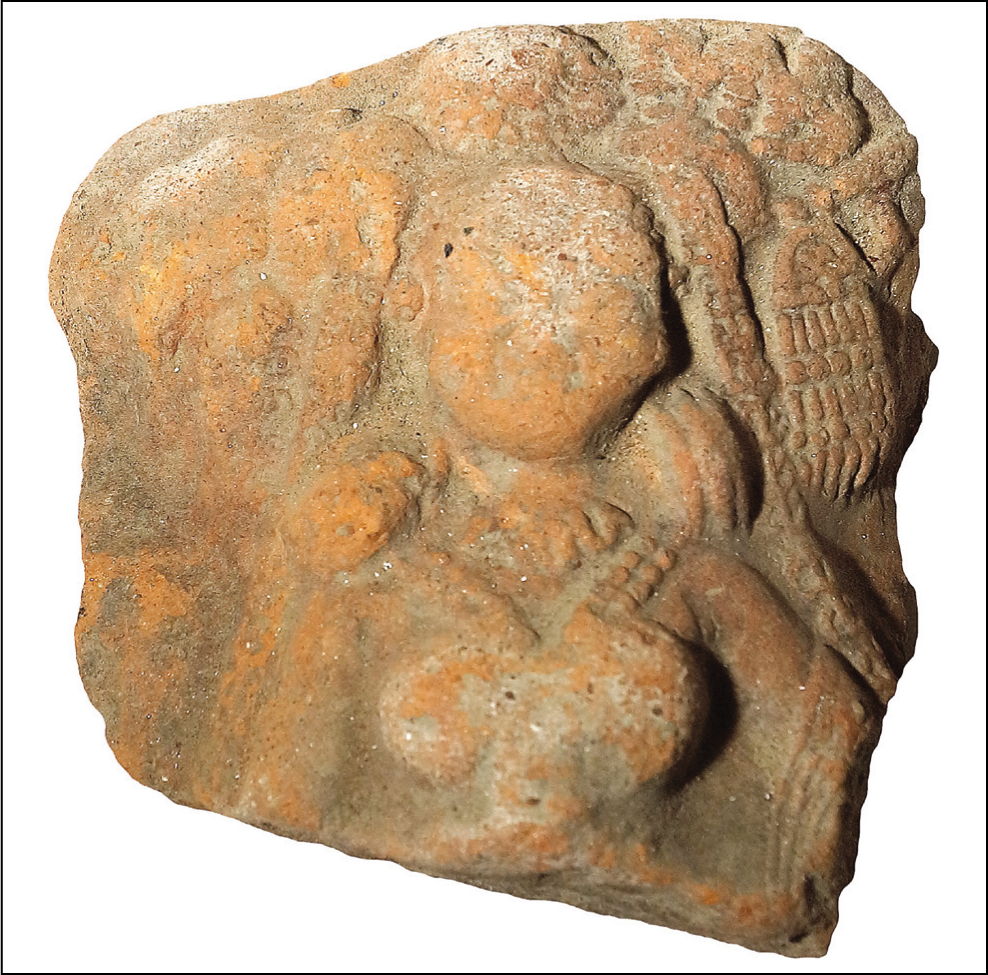
Pañcacuda-, Terracotta, First–Second Century, Sugh.
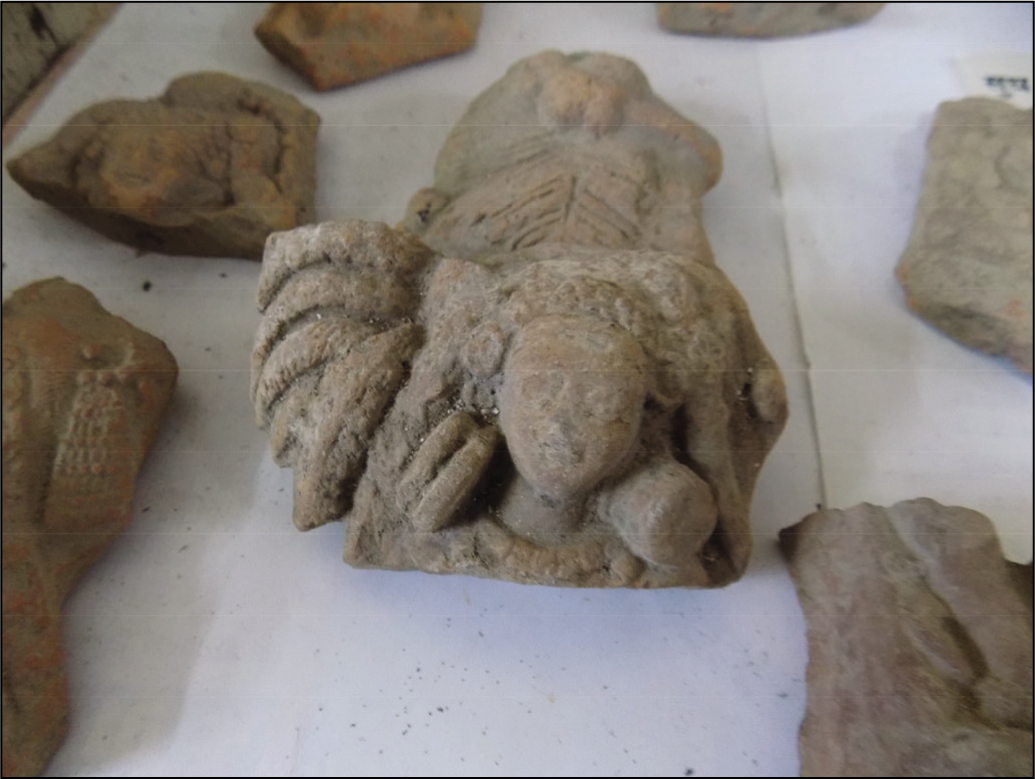
Pañcacuda-, Terracotta, First–Second Century, Sugh.
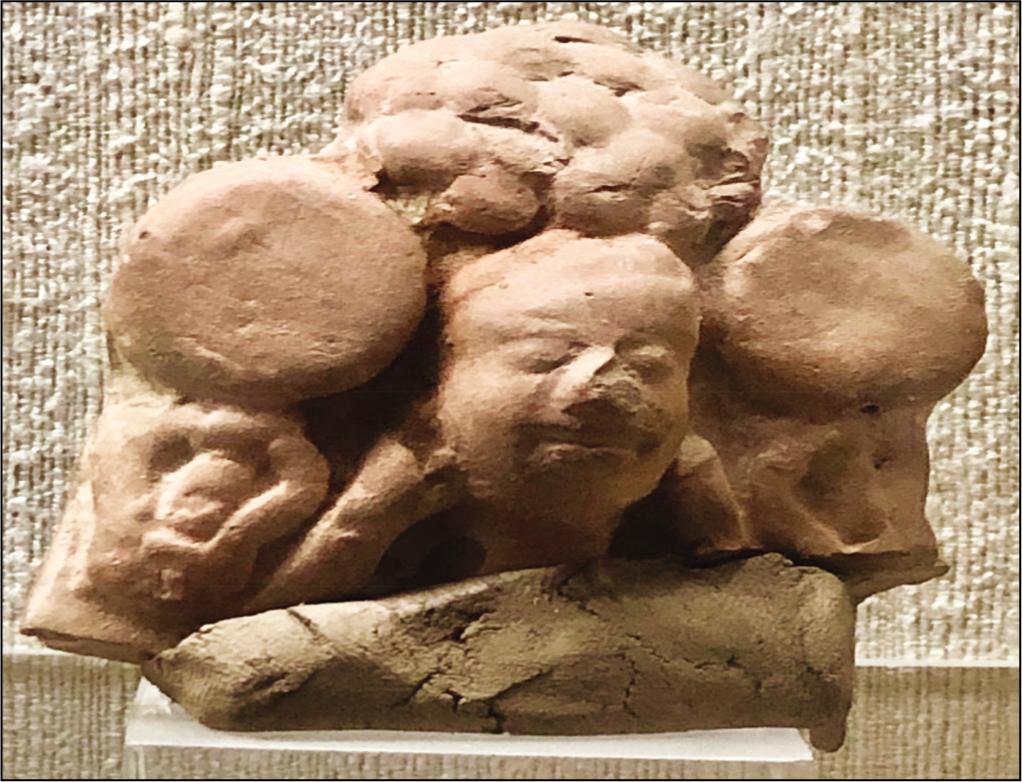
Goddess with Sheaves of Grain, Terracotta, First–Second Century, Ropar.
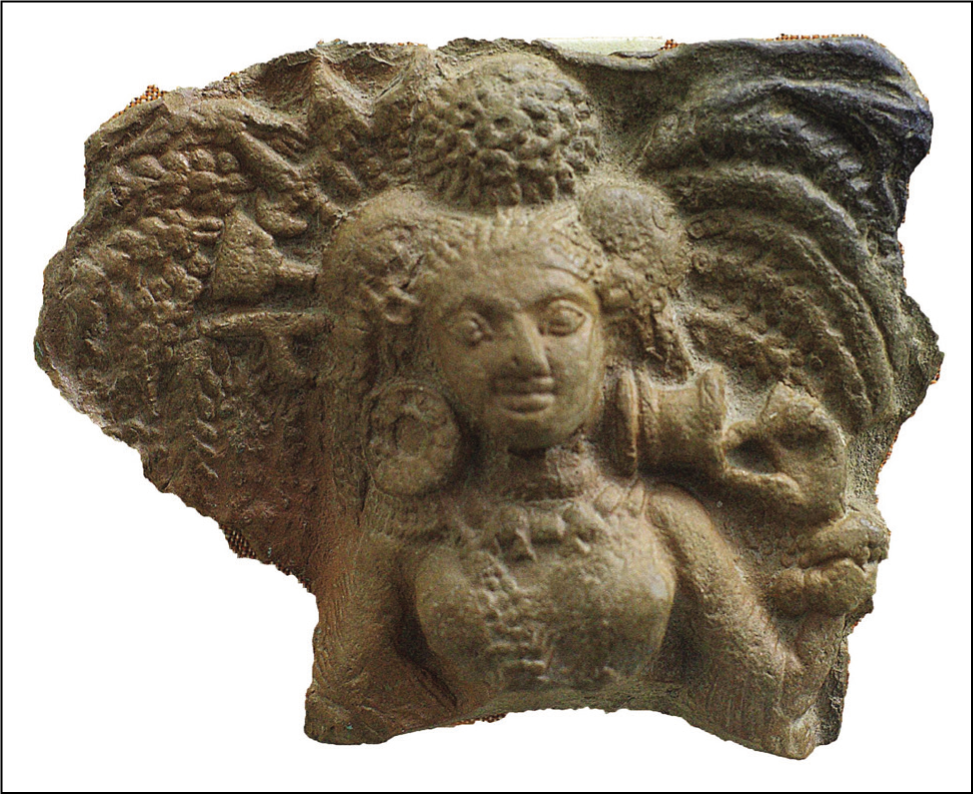
Pañcacuda-, Terracotta, First Century AD, Kausmabi.
The wide circulation of terracotta figurines suggests that these may have served a significant role in popular religious practice or household rituals that are not mentioned in the textual tradition. They might have served as important religious symbols. The evidence of a shrine in the wall of a house in Agroha points towards such a practice (Srivastava 1999, 3).
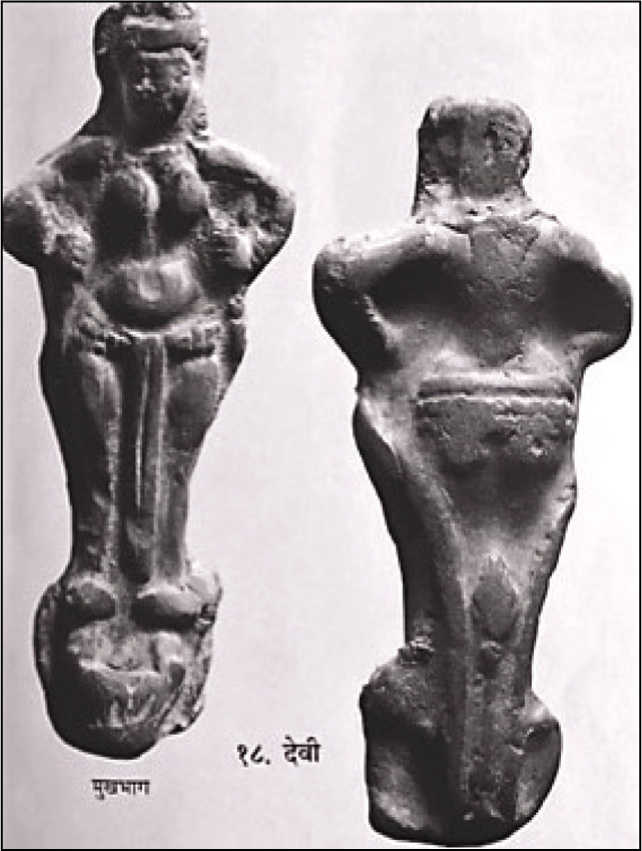
Auspiciousness (mańgala) may be attributed to the vast array of mithuṇa figures found from Sugh, Naurangabad and other sites. In these figures, the male is to the left and the female to the right, either engaged in some play, seated together on a couch, or looking straight. These include a couple riding on an elephant as a sign of social eminence, perhaps royalty, found at both Naurangabad and Agroha. Desai, as mentioned before, looks at the celebration of fertility festivals with festive gatherings in nagara-upavaṇas-city gardens as occasions for crafting terracotta plaques. These plaques had depictions of couples along with themes like wrestling and palace scenes. Women in toilette, drunken scenes and so on, were also represented (Desai 1976, 557). These are usually depicted on plaques that have holes (Plate 16a) that could enable them to be hung, presumably on walls. The abundance of such imagery that privileged the male-female dyad, often in amorous positions (Plate 17), may have been just a part of the decoration but is more likely related to ritual obligations of the householder. Well-adorned heads were often crafted (Plate 18).
Pañcacuda-, Terracotta, First Century AD, Kausmabi.
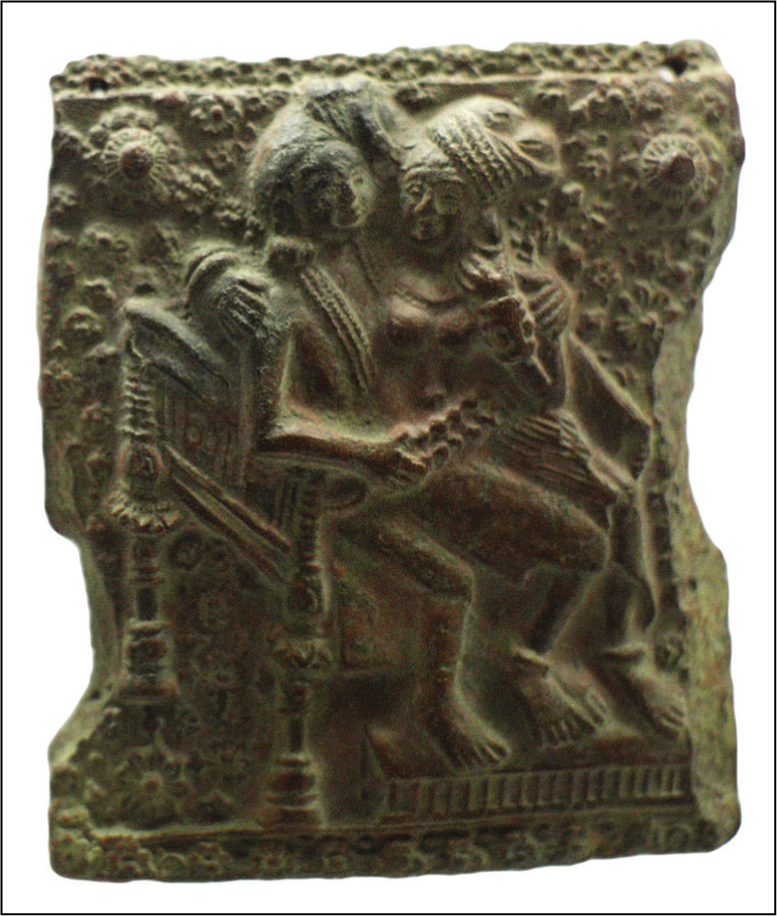
Seated Mithun.a, na-garaka, Terracotta, First Century AD.
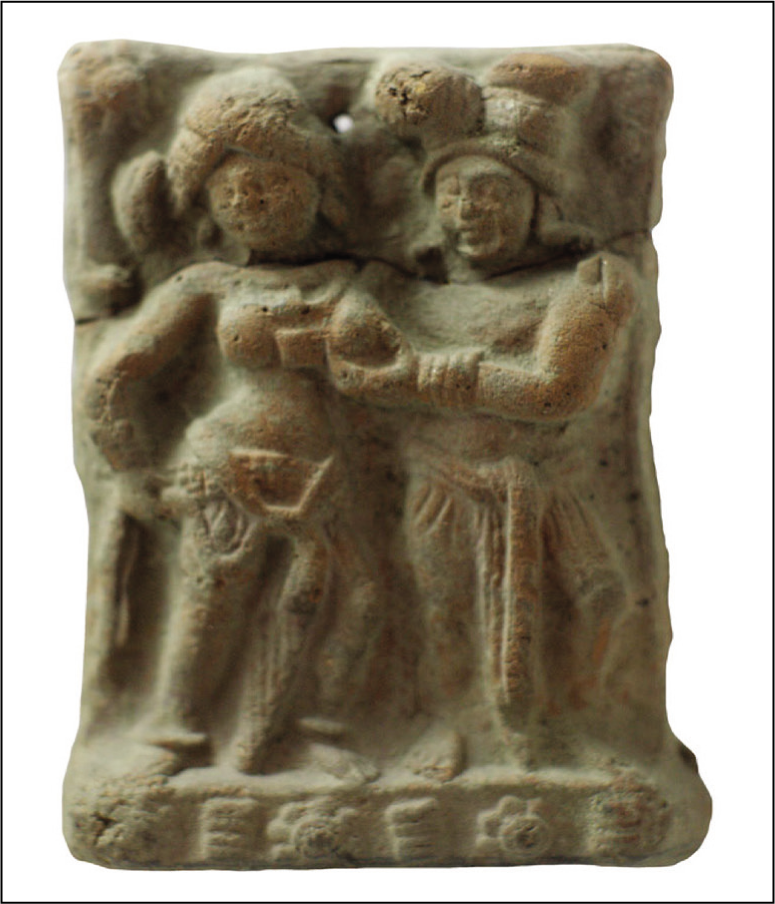
Mithun.a Plaque, Terracotta, First Century AD.
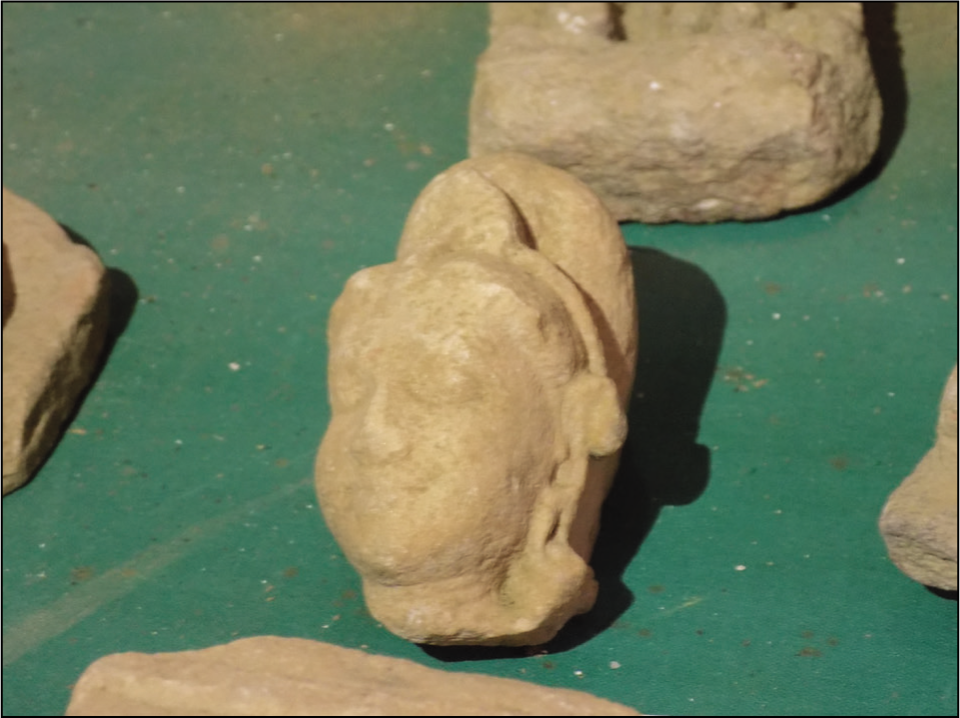
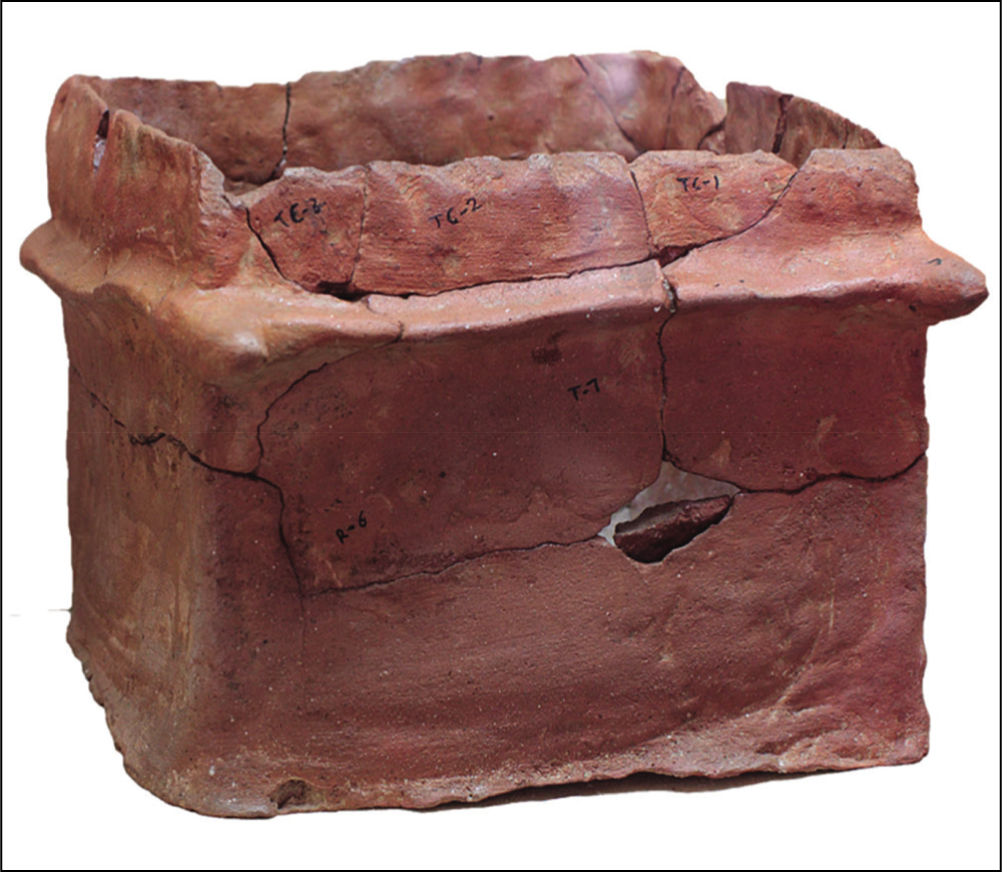
The specific use of terracotta for ritual and votive purposes may be discerned from the square tanks with trees, mithuµas, and huts built into it that may have been part of some form of agricultural or seasonal festivals (Plate 19).
Head, Terracotta, First Century AD, Agroha, Now in Jhajjar Museum.
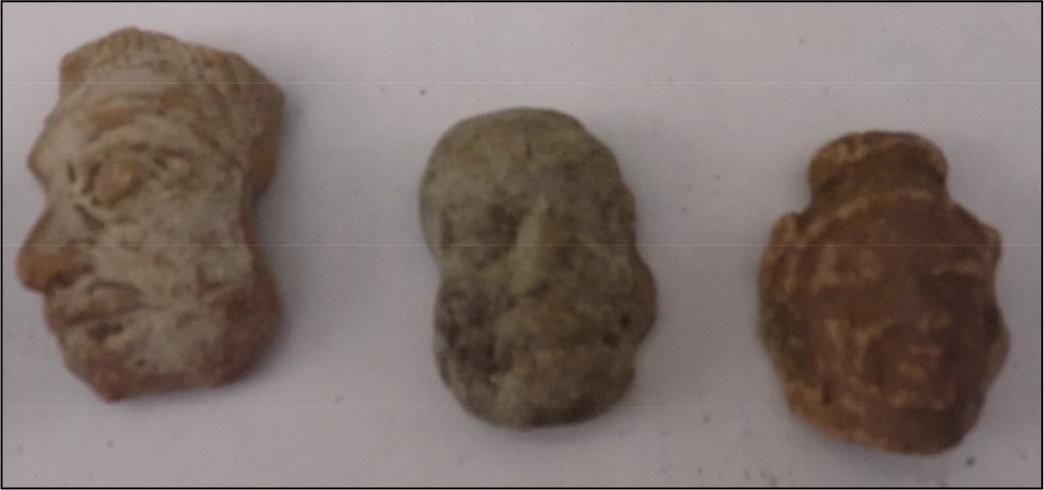
The most intriguing finds from these sites are of heads (Plates 20 and 20a), probably broken off from full-bodied figures. These were joined at the neck and easily broken off, which is why they all seem to be disembodied. These represent a wide array of faces, from realistic to grotesque, from the aesthetically beautiful to the comic (Plate 21) and from the hand-made to the moulded.
Heads, Terracotta, First Century AD, Agroha and Naurangabad, Now in Jhajjar Museum.
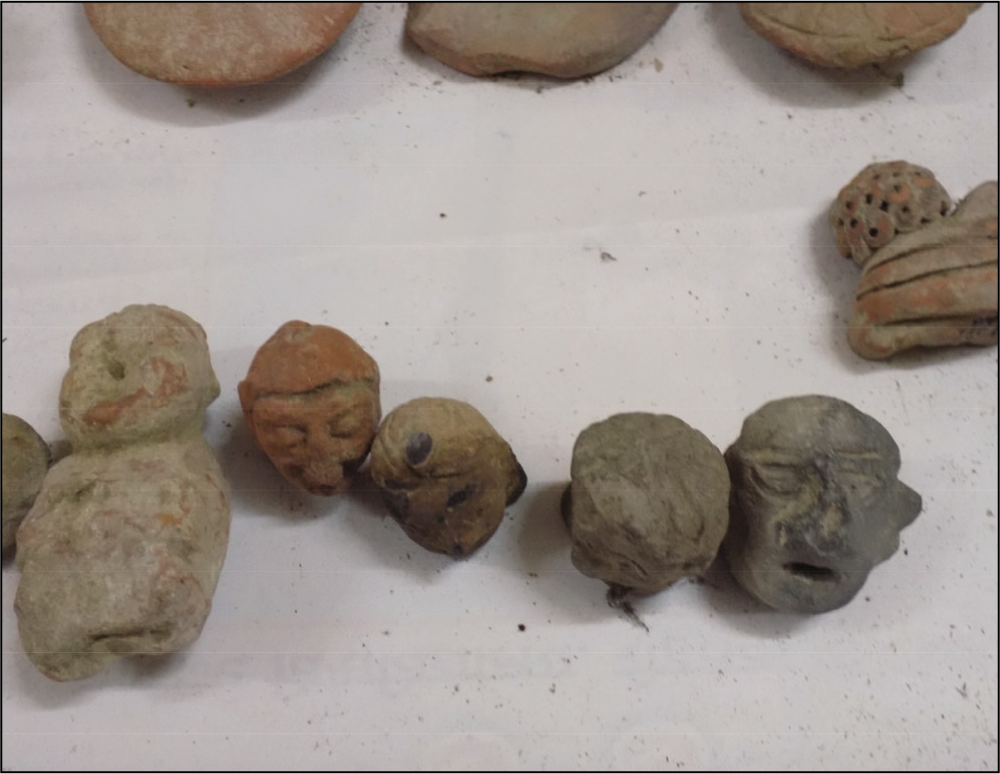
Heads, Terracotta, First Century AD, Agroha and Naurangabad, Now in Jhajjar Museum.
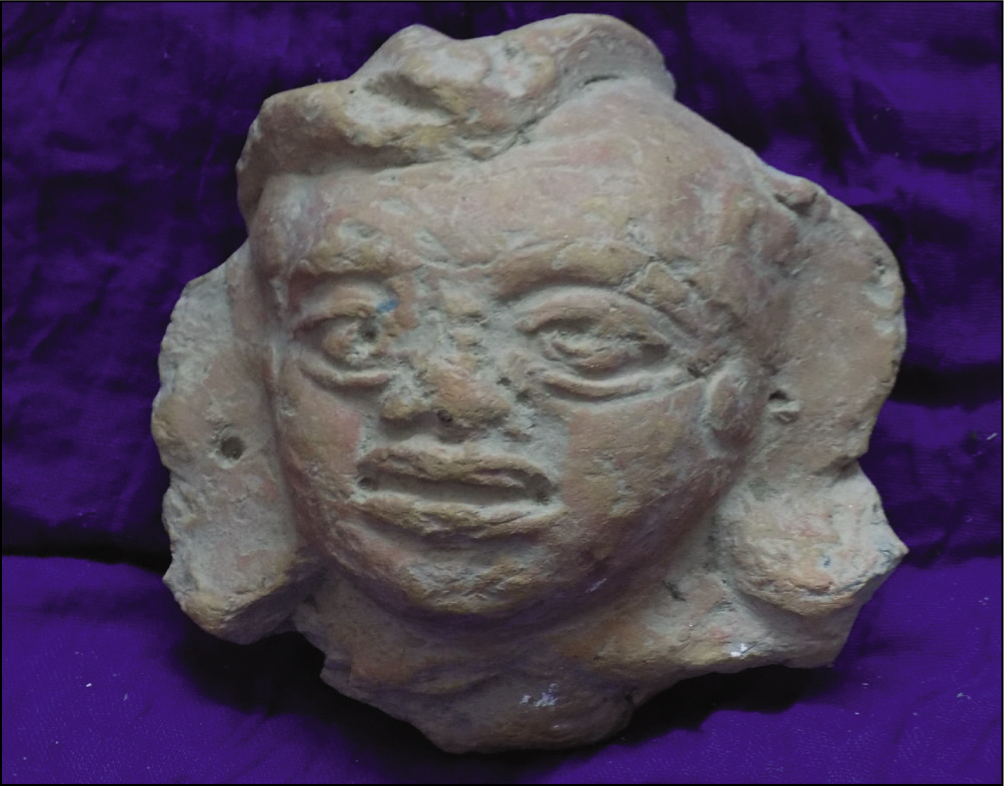
Heads with a Comic/Grotesque Element.
In another context, the transposition of the śālabhañjikā figures from the railings of early Buddhist art to functional art and their use in forming bow-shaped handles and spouts of vessels to carry water or wine, a type from Naurangabad and Agroha, is also of particular significance. Here the right hand is raised to lower the branches of the tree, and the left hand is carrying a plucked flower. Hands are adorned with bangles; a necklace is on the neck and dhoti covers the lower part as well as the breasts. This transposition in terracotta poses serious challenges to the traditional theory that śālabhañjikā figures were symbols of fertility rather than being merely decorative. Not only is this evocative but also reinforces the notion of the śālabhañjikā as a deliberate device for ornamentation, even in the mundane urban context (Bawa 2013, 331–34).
It has been suggested with reference to the Satavahana period that upper classes used stone while the lower classes used terracotta (Desai 1976, 559). There is very early evidence of Mahiṣāsuramardini (Singh 1986, 166) from the Indo-Gangetic plains in terracotta that predates the finds in stone. Another figure that can pose an art historic conundrum is the Ardhanārīśvara figure from Sugh, now in the Gurukul Jhajjar museum. The four-handed figure of Viṣṇu from Agroha, probably belongs to the Gupta period, and a similar one from Naurangabad from a slightly later period can be read in conjunction with Vaiṣṇava iconography from the fourth century onwards that was being produced both in Mathura and in Central India.
The concern in stone architecture and art, as well as in terracotta, with more mainstream religious traditions can be seen from the Gupta period onwards. There are examples of these from Ahicchatra, Bhitargaon, Katinghara and Nacharkheda (Plate 22) (Bawa 2018, 92–123). There is a remarkable coherence of the iconographic element and aesthetic detail, attesting to the continuity of the terracotta tradition in the region. These were part of the larger temple, providing ornamentation around the plinths and śikharas.
Meeting Between Sı-ta-, Laks.man.a, Ra-ma and Jata-yu on Way to Panchvati, Terracotta, Forth Early Fifth Century, Nacharkheda Now in Gurukul Jhajjar Museum.
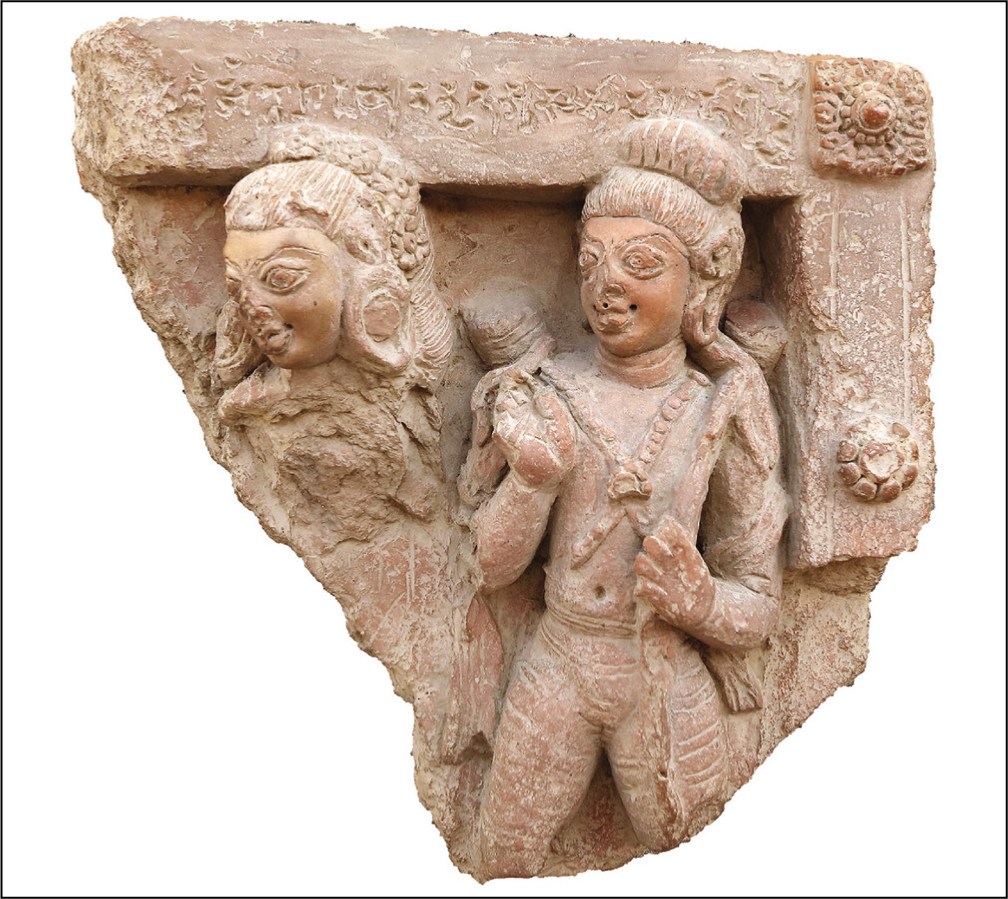
There are continuities in medium, style, devices and iconographies, as well as disjunctures between the post-Mauryan and Gupta periods in the region. An example of continuities may be seen from the acanthus on the base of the bārākhadi child from Sugh that also appears as a floral formation around the frame of the Ramayana scene from Nacharkheda.
The above case studies disclose various aspects of visual and material culture, particularly terracotta artefacts and sculptures from different regions of northern India during the early historic period. While the material evidence unearthed explores the significance of these artefacts in terms of style, materiality and cultural context, one can read nodes of interaction and production of visual knowledge through these. There are some elements related to transculturality and materiality that emerge from the study of these terracotta objects: (a) the cultural exchanges and interaction highlight the exchange and transmission of styles, iconographies and materials between regions and cultures; (b) the influence of diversity, such as Central Asia warrior helmets and adoption of certain artistic motifs, indicates how different cultural elements were integrated into the local culture, contributing to a transcultural environment; (c) the way terracotta figurines and sculptures were incorporated into religious practices and (e) the impact of urbanisation and the influx of new techniques, ideas and aesthetics. These processes often involved cross-cultural interactions as urban centres became hubs for cultural exchange during the early historic period. Thus, the case studies offer insights into how different cultures and regions in India have engaged in the exchange and blending of artistic and material elements, contributing to a complex and dynamic cultural landscape.