




Abstract
The rapid growth of the Haredi community in Israel presents significant challenges to the nation’s democratic and liberal foundations. This article explores the demographics and implications of the Haredi population growth, emphasizing the need for reform to balance Haredi growth and Israel’s West-aligned core values. It proposes strategies to address key areas such as education, employment, women’s empowerment, queer rights, military and national service, security implications, and the influence of the Haredi community on the Israeli–Palestinian conflict and Zionism. By promoting integration, accommodating diverse perspectives, and fostering open dialogue, Israel can navigate this complex situation and create a more inclusive society that upholds its foundational values. The article acknowledges the need for respectful and empathetic dialogue while recognizing the limitations of this perspective. The proposed reforms can be a starting point for discussion and collaboration, potentially inspiring similar efforts in other religious communities worldwide. Israel’s willingness and ability to unite its religious and secular worlds will determine its long-term identity as a democratic and inclusive homeland for the Jewish people.
Keywords
Navigating Change: The Imperative for Balancing Haredi Growth and Democratic Values
The Haredi community 1 is the fastest-growing population group in Israel. Whereas at the time of the founding of the state in 1948, it represented only about 4–5% of the population (Lintl, 2020), in 2022 it was 13% (Malach & Cahaner, 2022), and by 2065 it will constitute about 40% of Israeli society (Druckman, 2017). The ultra-Orthodox community in Israel grows by more than 4% annually and is, therefore, one of the fastest-growing minority groups in the world (Malach & Cahaner, 2022). This rapid growth is not least due to religious ideologies. But even though the State of Israel sees itself as the “homeland” of all Jews living in diasporas across the globe since its founding, it is increasingly facing challenges emerging from the growing ultra-Orthodox community. This is because Israel has aligned itself with a Western system that bases its values on democracy, liberty, free-market economy, and women’s rights. This self-perception is in tension with the cultural and religious-fundamentalist identity of the Haredim. Even today, ultra-Orthodox and religious–nationalist political currents and parties are causing deep cleavages in society, not least to Israel’s incumbent government.
Israel is facing an identity crisis. The authors argue that if Israel is to retain its Western, secular character, the Haredi community must engage in the process of reform and open itself to the secular community—just as the secular community must open itself to Haredim. It is a process that requires the formation of mutual understanding and can be made possible by compromising the ideals of one another. The article provides reform proposals for how the Haredi community might develop without losing its religious identity. Albeit there are already more contemporary currents in ultra-Orthodox circles (“Modern ultra-Orthodox Judaism”), the authors argue for a more far-reaching process of modernization, which in its complexity will require staying and willpower. It draws a picture of a modern Haredi that, in addition to being intensely engaged in Jewish traditions and studies, participates in secular life, can engage in public discourse in an all-literate manner, and respects and engages in dialogue with modern realities such as feminism or LGBTQAI+ 2 movements. It will also argue why Israel must deal with this reality, as this matter is not least a security issue.
The conservative–nationalist orientation of the ultra-Orthodox representation in the Knesset and the government is already causing destabilization in Israel and the Middle East region and an intensification of the conflict with Palestinians. This can be seen not least in the growing number of military operations in the West Bank, rocket attacks from and into the Gaza Strip, and the increasing number of terror attacks in both Israel and the West Bank. According to the United Nations, “2022 marked the most conflict-related deaths for both Israelis and Palestinians since 2015” (Center for Preventive Action, 2023). This trend continued and intensified in 2023. For years, the political influence of the Haredim in the Knesset and the Israeli government has been expanding. Some of the ideological aims of the religious minority are becoming Israeli state goals, and the resulting pressure to gradually push back the secular principles of the state is increasing, at least since the ultra-Orthodox have also been involved in the government and have secured generous financial injections and expanded minority rights for the community (Lieber & Raice, 2023). Moreover, the article also intends to show how such a reform process can be seen as a blueprint for churches worldwide to counteract the increasing discontent and resignations of (predominantly) young fellows.
The article will first provide an overview of how traditional ultra-Orthodox life is structured and how it differs from the seculars and, in this divergence alone, harbors strong potential for conflict. Special focus will be placed on the relationship between Haredim and the State of Israel, and thus, attitudes toward Zionism and Messianism related to this will also be discussed. In addition, demographic data and socio-economic implications will be used to highlight the topic’s relevance. Following this, it outlines certain domains in which they see a need for action to ensure a liberal and united country in the future. The authors would like to contribute to the academic and social discourse but are aware that such reform processes can only be initiated in an intensive dialogue with each other and that under no circumstances should arrogance or inequality arise between and toward the parties. As German Gentiles, the authors are also aware of their cultural socialization and try to enter the debate with the greatest possible empathy and respect. Criticism and disagreement with the proposals is strongly encouraged.
Unveiling the Dynamics: Significance of the Haredi Community for Contemporary Israeli Discourse
According to the Israel Democracy Institute, the Haredi community’s growth rate is around 4–5% annually (Malach & Cahaner, 2022), significantly higher than the general Israeli population’s growth rate of 1.6% in 2021 (The World Bank, 2022). This rapid growth is primarily attributed to high fertility rates within the Haredi community, with families often having many children. The Central Bureau of Statistics estimates that the average Haredi woman has 6.7 children, compared to 3.1 children for non-Haredi Jewish women (2021). This above-average reproduction rate is “ideologically and religiously driven by efforts to rebuild traditional Jewish life after the Shoah and to follow the divine biblical command in Genesis 1:28, to ‘be fruitful and multiply’” (Dödtmann, 2022, p. 120). From these figures, it can be concluded that the balance between secular Jews and Arabs and Haredim is becoming increasingly uneven, and the ultra-Orthodox community is gaining more and more influence, both societal and political.
On the socio-economic front, the Haredi community faces challenges in education and employment. The Haredi education system prioritizes religious studies over secular subjects, which can limit employment opportunities and contribute to poverty within the community (Berman, 2000, pp. 911–917). In 2017, around 43% of Haredi families in Israel lived below the poverty line, compared to 11% of non-Haredi Jewish families (Malach & Cahaner, 2020). The Haredi community’s growth also has political ramifications. Haredi political parties have gained influence in the Israeli political landscape, playing a decisive role in the government. The increasing political power of the Haredi community significantly affects policymaking, particularly in areas such as education, social welfare, and military conscription (Lintl, 2020, p. 18).
In summary, the rapid growth of the Haredi population has considerable socio-economic and political implications. Addressing these challenges and fostering integration within Israeli (secular) society is crucial for the country’s long-term stability and development.
Entwined Identities: The Complex Nexus Between Ultra-Orthodoxy and the Israeli State
The relationship between the ultra-Orthodox and the state, with its secular-Zionist nature, is multifaceted and complex. A prerequisite for understanding this relationship is that one must not see Haredim as a monolithic and homogeneous group, even in terms of their worldviews and political convictions. Particularly, concerning Zionist aspirations, they differ in their ideology, often fundamentally. A significant faction within the community categorically rejects the state of Israel. Some call it an anti-Jewish or even a Satanic Act. Following the ideology of Messianism, which is widespread among Haredim, the rebuilding of the state of Israel should be associated with the return of the Messiah (Ram, 2008, p. 69). Thus, they regard Zionism as “blasphemy, because it is not for flesh-and-blood to quicken the steps of the messiah” (2008, p. 69). Additionally, the opposition to Zionism is rooted in theological and ideological beliefs prioritizing religious redemption over political sovereignty (Ravitzky, 1996, pp. 66–70). Ever since the founding of the state in 1948, Haredim has struggled to accept the State of Israel as a secular entity. Many are offended by the nonobservance of their religious traditions and values (e.g., gender segregation, kashrut, Sabbath) by their secular fellow citizens in Israel (Keren-Kratz, 2023, pp. 81–82).
However, as mentioned before, it is important to note that not all ultra-Orthodox Jews hold anti-Zionist views. There is a diversity of opinions within the ultra-Orthodox community, and some individuals and groups may have more nuanced or moderate positions on Zionism. Some praise Israel as the state of the Jews and a divine state (Ravitzky, 1996, p. 7). Despite their reservations about Zionism, the ultra-Orthodox community has a complex relationship with the State of Israel. They are an integral part of the Israeli society, with their own educational system, political parties, and social services. The ultra-Orthodox community has a significant presence in areas such as Jerusalem, where they maintain their own neighborhoods and institutions.
Contrasting Paths: Unraveling the Socio-Cultural Divides Between Ultra-Orthodox and Secular Society
The lifestyle of Haredim is fundamentally different from that of their fellow citizens. For almost all areas of life, there are institutions and places of gathering that follow the strict rules of the ultra-Orthodox. This gives rise to neighborhoods and cities almost completely isolated from the outside world and where Haredim have created a kind of parallel world for themselves. Examples of those neighborhoods are Me’a She’arim  in Jerusalem or Bnei Brak
  close to Tel Aviv-Yafo. They have also been granted minority rights concerning the state, often perceived as unfair in public discourse and increasingly leading to tensions with the rest of the population (Freund & Band-Winterstein, 2017, p. 46). Haredim attend their own religious schools; are exempt from compulsory military service; and, in the event of a dispute, are brought before private courts that judge according to Jewish religious law, the Halakha
  (Dödtmann, 2022, pp. 120–121). These special privileges are significantly financed through state funds, which leads to considerable social tension in Israel (Conway, 2017, p. 249).
Haredim’s financial dependence on the state is because their lifestyle does not have a value-creating character in a market economy context. However, since the state and private contributions to the community are insufficient for the financial subsistence level, most Haredi men and about three-quarters of Haredi women are now engaged in paid work. Religious studies dominate the traditional path of a Haredi man. From early childhood, he learns to read and devotes himself to the holy books of Judaism, which, in essence, do not change until death. The role of women in this ideology has a supportive character, which is limited to unpaid work in the household, child rearing, and—following the spirit of the time—increasingly also to jobs outside the community (Dödtmann, 2022, p. 139). Haredim marry relatively young—mostly in their early 20s and arranged by their parents—and divorce is uncommon for theological reasons (Friedman, 1991, p. III). In everyday life, religion and its traditions are omnipresent; Haredim live strictly following the Mitzvot  3
and often live a simple and modest life (Hakak, 2012, p. 114). Many things that have long been part of everyday life for secular people are rejected by many ultra-Orthodox—except for some parts within Modern Orthodoxy (e.g., Internet use).
3
and often live a simple and modest life (Hakak, 2012, p. 114). Many things that have long been part of everyday life for secular people are rejected by many ultra-Orthodox—except for some parts within Modern Orthodoxy (e.g., Internet use).
Navigating Domains of Reform: Addressing Key Challenges and Initiatives in Haredi Community Transformation
Bridging Knowledge Gaps: Enhancing Integration Through Secular Education Initiatives: Secular education equips individuals with the necessary skills and knowledge to participate effectively in the labor market and engage in informed dialogue on various social issues. In the context of the Haredi community, their educational system primarily emphasizes religious studies, merely sidelining secular subjects. Former employees of the State Education Department reported “that some yeshivas  4
offered only an hour of secular studies a day” (Shapiro et al., 2022). Even though this quote refers to yeshivas in New York, this practice applies to yeshivas in Israel. The focus on religious education creates barriers to integration with the broader Israeli society, as it may limit the Haredi community members’ ability to access employment opportunities in various sectors and engage in social interactions or public debate with non-Haredi fellows.
4
offered only an hour of secular studies a day” (Shapiro et al., 2022). Even though this quote refers to yeshivas in New York, this practice applies to yeshivas in Israel. The focus on religious education creates barriers to integration with the broader Israeli society, as it may limit the Haredi community members’ ability to access employment opportunities in various sectors and engage in social interactions or public debate with non-Haredi fellows.
Addressing the imbalance between religious and secular education in the Haredi community could be a significant step toward fostering integration. By incorporating a more comprehensive secular curriculum that covers core subjects such as mathematics, science, English, and social studies, the Haredi community can ensure that its members are better prepared to participate in the labor market and engage with individuals from different backgrounds (Friedman, 2014).
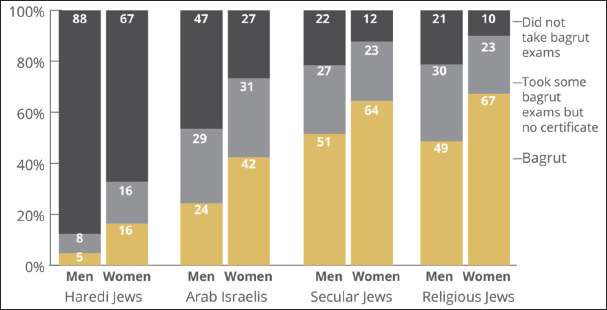
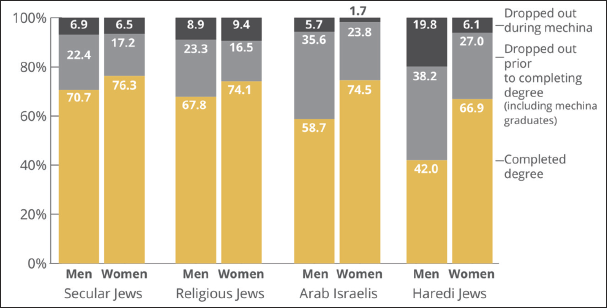
Empowering Progress: Encouraging Higher Education and Skill Attainment: Higher education provides individuals with advanced knowledge and specialized skills, which are increasingly in demand in the competitive job market (Friedman, 2014). It also offers opportunities for personal growth and development, fostering critical thinking, problem-solving, and communication skills that are valuable in various social and professional contexts. Ultra-Orthodox adolescents who decide to enroll in higher education programs—usually against the will of their parents and acquaintances within the community—face extreme hardship. Without the Te’udat Bagrut  ,
5
which only a fraction of Haredim complete (Figures 1 and 2), and thus without an intellectual foundation for academic studies, a university degree is only feasible at considerable additional expense. However, since the elementary and secondary education of young Haredim is usually determined by their parents, the affected children often have no say (and if they had, they probably would not be aware of a career plan at such a young age) but accepting their role as an obedient religious child in the family. The enormous gap between ultra-Orthodox and other Israelis in Bagrut and academic programs, including Mechina
,
5
which only a fraction of Haredim complete (Figures 1 and 2), and thus without an intellectual foundation for academic studies, a university degree is only feasible at considerable additional expense. However, since the elementary and secondary education of young Haredim is usually determined by their parents, the affected children often have no say (and if they had, they probably would not be aware of a career plan at such a young age) but accepting their role as an obedient religious child in the family. The enormous gap between ultra-Orthodox and other Israelis in Bagrut and academic programs, including Mechina  ,
6
underscores their intellectual isolation. Overcoming the imbalance between religious and secular subjects is a prerequisite for an inclusive Israeli society prepared for future challenges (Regev, 2016).
,
6
underscores their intellectual isolation. Overcoming the imbalance between religious and secular subjects is a prerequisite for an inclusive Israeli society prepared for future challenges (Regev, 2016).
Bagrut Status, Ages 19–30, 2014 (Regev, 2016, p. 226).
Combined Dropout Rates From Preacademic and Degree Programs, 2005-2014 (Regev, 2016, p. 231).
To promote higher education and skill development among Haredim, creating an environment that supports and encourages the pursuit of advanced studies and professional development is crucial. This can be achieved by establishing higher education institutions and vocational training programs that cater to the unique needs and interests of the Haredi community while also providing them with the necessary resources and support to succeed in their chosen fields (Friedman, 2014). Moreover, it is essential to address potential barriers to higher education and skill development among the Haredi community, such as financial constraints or cultural norms that may discourage the pursuit of advanced studies. By providing scholarships, financial aid, and flexible learning options, it is possible to create more accessible and inclusive educational opportunities for members of the Haredi community, ultimately fostering greater integration with the broader Israeli society (Friedman, 2014).
Pathways to Prosperity: Paving the Way for Haredi Economic Integration and Self-Reliance
Empowering Economic Engagement: Strategies for Facilitating Haredi Inclusion in the Job Market: Encouraging Haredi participation in the workforce is crucial for promoting economic independence and fostering integration with the broader Israeli society (Berman, 2000, pp. 943–944). Increased workforce participation can lead to higher living standards and self-sufficiency, reducing reliance on government subsidies and charitable donations (Endewald et al., 2019, p. 13). A multipronged approach can be taken to achieve this goal, including initiatives targeting education, skills development, and cultural sensitivities.
First, as discussed in the previous section, enhancing the secular education offered within the Haredi community can equip individuals with the necessary skills to enter the labor market (Regev, 2017, p. 33). Additionally, tailored vocational training programs that respect the cultural and religious values of the Haredi community can provide marketable skills and create pathways to employment (Black et al., 2021). Second, partnerships between the government, private sector, and community organizations can help create targeted employment opportunities for the Haredi population (Friedman, 2014). This may involve the development of work initiatives that cater to the unique needs and preferences of the Haredi community, such as gender-segregated workplaces or flexible work arrangements that accommodate religious obligations. However, the authors will later suggest that progress must also be achieved in such areas (e.g., the role of women).
Breaking Down Barriers: Overcoming Challenges to Achieve Haredi Economic Integration: Some barriers to economic integration faced by the Haredi community include discrimination, lack of access to resources, and cultural differences that hinder effective communication and collaboration with non-Haredim (Malach et al., 2016, pp. 83–84). Promoting awareness and understanding of the Haredi community’s cultural and religious practices among employers and the wider society could be vital to tackling these issues. This can be achieved in long term through cultural competency training programs, public awareness campaigns, and inclusive policies that create a supportive environment for Haredim in the workplace.
First, implementing incentive programs, such as cash incentives, would increase certification rates and educational attainment among ultra-Orthodox individuals. Research has shown that cash incentives can effectively impact low-achievers, particularly girls (Angrist & Lavy, 2009, pp. 1385, 1404). This can enhance their qualifications and increase their chances of successful integration into the workforce. Furthermore, creating a supportive and inclusive work environment that respects the cultural and religious values of ultra-Orthodox individuals can pave the way for easier integration into the Israeli workforce. This can involve developing diversity training programs, fostering understanding and acceptance of different religious practices, and implementing flexible work arrangements to accommodate religious observances (Frenkel & Wasserman, 2020).
Additionally, providing targeted support services, such as career counseling, job placement assistance, and mentorship programs, can help Haredi individuals navigate the job market and overcome potential barriers to economic integration. By addressing these barriers and promoting economic independence, the Haredi community can more effectively integrate into Israeli society and contribute to its overall prosperity (Malach et al., 2016, pp. 93–95).
Promoting Inclusivity: Advocating for Gender Equality and LGBTQIA+ Rights Within the Haredi Context
Equal Footing: Exploring the Importance of Women’s Rights in Israel’s Ultra-Orthodox Society: The role of women in the Haredi community is traditionally focused on the “earthly tasks” such as homemaking, child-rearing, and supporting their husbands in religious studies (Harris & Skinazi, 2020, p. 6). Nevertheless, as mentioned before, today’s reality is different: most Haredi women work to cope with financial hardships (Lidman, 2016). As the Haredi community integrates into Israeli society, it is essential to address gender inequality and promote women’s empowerment. Encouraging Haredi women can lead to improved educational and economic outcomes for the community and contribute to the broader national goal of gender equality (Harris & Skinazi, 2020, p. 6).
Challenging Norms: Analyzing Gender Inequality and Minority Rights in the Haredi Context: When a culture finds itself in another country through immigration, or when a community, such as the ultra-Orthodox in Israel, is a minority in a liberal country, that nation faces the dilemma of whether to insist on its own rules and laws and thus not allow a minority group to practice its own culture and religion, or whether to grant special privileges only to that group of people, as the values of a Western liberal state would logically require (Ejobowah & Kymlicka, 1997, p. 75).
The following paragraph will examine how the strict segregation between men and women within the Haredi community leads to unequal opportunities and discrimination of both girls and women.
As already mentioned, the school system of the Haredi Community differs fundamentally from the secular education in Israel. Girls and boys learn differently and separately: while girls are mostly prepared for being “housewives” and mothers with very basic education in math and science, boys are expected to read, learn, and discuss Jewish literature such as Torah  and Talmud
  their entire lives (Shiffer, 1999, p. 3). This social expectation of women leads to their lives being predestined, leaving no room for questioning their free will to live the life they desire. Personal laws are also different within the Haredi communities in Israel. Marriages arranged by families, not infrequently in early adulthood, are commonplace. Divorce is subject to religious laws, and a husband is obliged to grant his wife a get
  7
to end the marriage. If a man refuses to give his wife this decree, she may become an agunah
7
to end the marriage. If a man refuses to give his wife this decree, she may become an agunah  ,
8
unable to end the marriage and move on (Horn et al., 2022).
,
8
unable to end the marriage and move on (Horn et al., 2022).
Additional rules and traditions widen the gap between men and women, such as strict gender segregation in public and religious areas. For example, there are separate seating areas for men and women in synagogues and at weddings and separate prayer areas at the Western Wall. Ultra-Orthodox Jewish women must adhere to strict dress codes known as tzniut  , which require them to cover most of their bodies and hair to maintain modesty. Some critics view these dress codes as oppression (Schwartz, 2020).
Personal law, which is often of great importance in minority groups, has a more significant impact on women than other laws. The more expectations placed on women in their personal lives, the fewer opportunities they have to change public life (Okin, 1999, p. 13). With Haredi women being stay-at-home mothers, having numerous children, and lacking access to modern education, they do not even have the opportunity to make a substantial difference. According to Susan Moller Okin, a liberal feminist political philosopher, all cultures and cultural rules are predominantly influenced by men and less by women (1999, p. 13). By maintaining these patriarchal structures, the cultural rules systematically suppress women, and there is a clear interest in preserving these structures (Okin, 1999, p. 22). This leads to the conclusion that nonmodernized cultures are inherently antifeminist (Okin, 1999, p. 12).
While the concept of group rights, as advocated by Ejobowah and Kymlicka (1997), is intended to promote diversity and protect minority cultures, it can inadvertently contribute to the systematic suppression of women within such communities. The task for the state of Israel is to end injustices within cultures, working actively and internationally against them. Albeit this is often used as a counterargument, it is a misconception that such an agenda would automatically lead to the destruction of cultures, traditions, and history.
Charting Progress: Crafting Policy Measures to Advance Gender Equality Within Ultra-Orthodoxy: To establish gender equality within the Haredi community, a multifaceted approach is required. First, it is essential to enhance secular education for girls, ensuring they have equal access to educational opportunities and can acquire the necessary skills to participate in the labor market (Regev, 2017, pp. 33–35). This could involve advocating for gender-neutral curricula and encouraging the Haredi community to adopt more egalitarian educational practices. Haredi women should also be included in all other reform processes, such as educational and labor sectors. Second, promoting awareness of women’s rights and gender equality within the Haredi community can help foster a more inclusive environment. This can be achieved through public awareness campaigns, community dialogue, and advocacy efforts targeting Haredi religious leaders and decision-makers. Of course, those measures are only relevant for long-term development.
Contrasting Spheres: Fostering Inclusivity and Acceptance of LGBTQIA+ Individuals within the Haredi Community: The Haredi community’s traditional values often conflict with the LGBTQIA+ community’s pursuit of rights and recognition (Davis, 2008, p. 127). Consequently, there is a need to foster greater understanding, tolerance, and acceptance of queer individuals within the Haredi community. However, there has been some movement on this issue in recent years—such as the first openly gay rabbi in Jerusalem or some Haredi reformists allowing same-sex marriage (Sokol, 2019). But much remains to be done. Open dialogue, education about LGBTQIA+ issues, and fostering cooperation between the Haredi and the queer community are the first steps toward bringing these two cultural contrasts closer together. Encouraging rabbis to take an inclusive stance toward members of the LGBTQIA+ community can help create an accepting environment. This may include hosting interfaith dialogues, encouraging inclusive religious interpretations, and recognizing and respecting the diversity of human experiences and identities (Altman et al., 2023, pp. 9–10).
To conclude, encouraging women’s autonomy and queer legal rights within the Haredi community is a decisive aspect of their integration into broader Israeli society. By increasing the acceptance of LGBTQIA+ people, the Haredi community can contribute to Israel’s democratic, liberal foundations and ensure a more inclusive, more equitable future for all its citizens.
Serving Society: Assessing Challenges and Opportunities for Haredi Participation in National Service
Contribution and Coexistence: Evaluating Haredi Engagement in Israel’s Military and National Efforts: As legally secured through the Torato Umanuto  arrangement, the Haredi population has been exempted from mandatory military service, as they are engaged in full-time religious studies (Unpacked Staff, 2018). This exemption has led to tensions between the Haredi and non-Haredi populations, as some perceive it as unequal treatment (Pfeffer, 2023). In 2012, when the Knesset sought to renew the right to defer military service for Haredim, the Israeli High Court ruled against the law regarding equality issues (Ettinger & Cohen, 2012). Incorporating the Haredi community into military and national service can foster a greater sense of shared responsibility and social solidarity among Israeli citizens. Moreover, it can provide the Haredi population with valuable skills and experiences and opportunities for personal development and networking outside personal “bubbles.” However, there are significant challenges in implementing such integration, as military service can be perceived as a threat to the Haredi way of life, particularly regarding religious observance, modesty, and gender segregation (Zicherman, 2013). To address these concerns, the Israeli government must develop and implement flexible and accommodating service programs that respect Haredi cultural and religious values.
Adaptive Approaches: Crafting Inclusive Service Programs for Haredi Engagement: To facilitate Haredi participation in military and national service, it is imperative to create programs that cater to their unique cultural and religious needs. One example is the establishment of the Netzah Yehuda Battalion  , also known as the Nahal Haredi
  , which provides a framework for Haredi enlistment in the Israel Defense Forces while maintaining religious standards (Netzah Yehuda—Kfir, n.d.). This program includes accommodations such as kosher food, daily prayer sessions, and gender segregation (Nissenbaum et al., 2022). Even though it turned out that the Netzah Yehuda Battalion is largely manned by religious Zionist adolescents and not by young Haredi men, it still offers a good gateway out of the isolated world of Haredim (DAWN, 2022). In addition to military service, the government should consider expanding national service programs tailored to the Haredi community. This can involve creating opportunities for Haredi individuals to serve in religiously compatible settings, such as hospitals, schools, and nonprofit organizations (Yogev, 2021, p. 372). These programs should accommodate religious observance, gender segregation, and modesty requirements.
Another key aspect of promoting Haredi participation in military and national service is the provision of incentives and support. For instance, the government can offer financial incentives, such as scholarships and grants, to encourage Haredi enlistment. Furthermore, support services, such as career counseling, mentorship, and skills training, can help Haredi individuals transition into the workforce following their service. In conclusion, integrating the Haredi community into the military and national service presents an opportunity to promote social cohesion and mutual understanding within Israeli society. The Israeli government can foster Haredi participation while respecting their cultural and religious values by developing flexible and accommodating service programs, providing incentives, and offering targeted support services.
Securing a Balance: Examining Security Concerns and Opportunities Amidst Haredi Expansion
Addressing the Complex Intersection of Haredi Traditions and Western Norms: The discord between the fundamentalist traditions and values upheld by the Haredi community and the Western, liberal values and traditions poses a range of potential hazards. These dangers encompass the prospect of Israel’s increasing isolation, as its policies and actions, swayed by the ultra-Orthodox political representation, might (and already does) estrange its international allies, such as the United States, Germany, and others (Dödtmann, 2022).
This escalating isolation could culminate in a precarious security situation for Israel, given its location amidst hostile neighbors and its reliance on international support for defense and diplomacy. Furthermore, the ideological schism between Israel’s ultra-Orthodox population and its secular or liberal counterparts can exacerbate the strains on the nation’s social fabric and put its democratic foundations at risk (Pfeffer, 2023). One potential outcome of the widening gap between fundamentalist and Western values is a polarization of Israeli society, with the ultra-Orthodox community becoming more insular and resistant to change. This, in turn, could lead to increased social unrest and tensions between different population segments, potentially destabilizing the country and hindering its progress in various sectors, including education, economic development, and national security (Dödtmann, 2022).
Addressing these issues requires a careful balance between respecting the cultural and religious autonomy of the Haredi community and safeguarding Israel’s democratic, liberal foundations. Ensuring Israel maintains strong ties with its international allies while fostering social cohesion and integration at home is critical to its long-term security and stability (Dödtmann, 2022). In conclusion, the influence of the Haredi community on the Israeli–Palestinian conflict and the tension between fundamentalist traditions and Western values are critical factors shaping Israel’s future. Policymakers and scholars must consider these factors when assessing the prospects for peace in the region and the long-term stability and security of the Israeli state.
Strategic Unity: Analyzing the Interplay Between Socio-economic Stability and National Security: The rapid growth of the Haredi population in Israel has significant implications for the nation’s socio-economic stability and national security. As mentioned earlier, the Haredi community’s low labor force participation rates, reliance on government support, and limited secular education contribute to an increased financial burden on the Israeli state (Berman, 1999, p. 193). This burden, in turn, has the potential to strain public resources and infrastructure, leading to increased social tensions between the Haredi and non-Haredi populations (Pfeffer, 2023). From a national security perspective, the growing Haredi population could have implications for the composition and effectiveness of Israel’s military forces. As the Haredi community continues to grow, the proportion of the population exempt from mandatory military service will increase, potentially leading to a decrease in the overall number of conscripts available for military service.
Although it has often been misleadingly communicated otherwise, there is no general conscription in Israel. The conscription rate in Israel has declined significantly since the 1980s and is around 48% of the total population as of 2010. For Jewish men, the conscription rate is 74.6%, and for Jewish women, it is 56%. This decline in conscription can be attributed to several factors, including limited recruitment of Palestinian citizens (or Israeli Arabs) by the state and high religious exemption rates, particularly among ultra-Orthodox individuals (Getzoff, 2020, p. 825). The concept of universal conscription in Israel has been an issue since the 1990s, when it became clear that despite the nominal retention of universal conscription in Israel, participation in military service was declining (Cohen & Cohen, 2022). However, the idea of a “people’s army,” which is deeply rooted in Israeli society, has contributed to the fact that conscientious objection has not been officially recognized as a category for exemption. The state policy of “accommodation without recognition” aims to protect the ethos of universal conscription and the army as a symbol (Livny, 2018, p. 681). However, this demographic shift in Haredi population growth could challenge the Israeli military’s ability to maintain a capable and diverse fighting force.
Influence and Ideals: Assessing Haredi Impact on Israeli–Palestinian Dynamics and Zionist Ideology
The political representation of ultra-Orthodox groups within the Israeli government, such as in the national–religious settler parties Tkuma  , the Jewish Home Party [HaBayit HaYehudi;
  ], or Otzma Yehudit
  is often criticized for exacerbating the conflict with Palestinians, through encouraging settlement policies, territorial claims, and a general stance against compromises (Israel, 2019). The views of ultra-Orthodox groups on Jewish sovereignty over the historical land of Israel often conflict with international peace efforts and have an impact on the public’s opinion about the two-state solution (Klein, 2023) and also on the peace process in the Middle East:
The deepening occupation, the increase in violence, including terrorism, and the absence of a political horizon have empowered extremists and are eroding hope among Palestinians and Israelis, alike, that a resolution of the conflict is achievable (UN Envoy Reports ‘Sharp Increase’ in Violence This Year in Israel-Palestine Conflict, 2022).
Thus, the influence of the Haredi community on the conflict is multifaceted. The expansion of settlements in the West Bank, for example, is in some cases fueled by religious motivations, with ultra-Orthodox settlers believing in their divine right to the Zion  9
(Lintl, 2020, p. 32). This expansion undermines the possibility of a viable Palestinian state and contributes to increased tensions between Israelis and Palestinians. The incumbent Netanyahu cabinet also counts far-right ministers in its ranks who favor a much more lax—if not encouraging—approach to illegal settlements (outposts) in the West Bank. However, the fact that settling the West Bank, or Judea and Samaria, as religious settlers call the region, violates international law is ignored by the government (and many governments before it). Israeli authorities, meanwhile, are working to approve more than 100 illegally constructed outposts, which will at least be legalized under Israeli law (Kershner, 2023b). Additionally, ultra-Orthodox political parties tend to be more hardline in their negotiation approach, reducing the likelihood of successful peace talks and increasing the prospects for further conflict (Kershner, 2023a).
9
(Lintl, 2020, p. 32). This expansion undermines the possibility of a viable Palestinian state and contributes to increased tensions between Israelis and Palestinians. The incumbent Netanyahu cabinet also counts far-right ministers in its ranks who favor a much more lax—if not encouraging—approach to illegal settlements (outposts) in the West Bank. However, the fact that settling the West Bank, or Judea and Samaria, as religious settlers call the region, violates international law is ignored by the government (and many governments before it). Israeli authorities, meanwhile, are working to approve more than 100 illegally constructed outposts, which will at least be legalized under Israeli law (Kershner, 2023b). Additionally, ultra-Orthodox political parties tend to be more hardline in their negotiation approach, reducing the likelihood of successful peace talks and increasing the prospects for further conflict (Kershner, 2023a).
Harmonizing Coexistence: Understanding the Importance of Integration for Israel’s National Security
Given the security implications of Haredi growth, integrating the Haredi community into the broader Israeli society is crucial for ensuring the country’s long-term security and stability. By promoting Haredi participation in the workforce, education, and military and national service, the Israeli government can alleviate some of the socio-economic pressures associated with the community’s rapid growth and foster greater social cohesion. A more integrated Haredi population can contribute to the nation’s security by diversifying the talent available for military service and other critical national functions. As mentioned previously, tailored military and national service programs can help Haredi Jews acquire valuable skills and experiences that enhance their employability and expand their opportunities for social and economic mobility. In addition, fostering a more integrated society can help reduce social tensions and promote mutual understanding between the religious Haredim and secular non-Haredim, thus strengthening social cohesion and national unity. This, in turn, can contribute to a more stable and secure environment for all Israeli citizens.
Challenges and Barriers to Reform: Navigating Complex Dynamics in Ultra-Orthodox Judaism
The modernization of ultra-Orthodox Judaism in Israel has faced resistance from various actors in the past. These actors have employed different tools and processes to prevent or hinder reform initiatives. One of the main actors that has impeded modernization is the ultra-Orthodox community itself. It will be argued for considering ultra-Orthodox Judaism as a fundamentalist movement. Although the term “fundamentalism” is not undisputed in scholarly circles, nor is its application to ultra-Orthodox ideology a scientific consensus, this article argues that ultra-Orthodoxy can be characterized as a contemporary radical religious current and thus as fundamentalist (Aran et al., 2008, p. 26).
Haredim often view modernization as a threat to their religious beliefs and practices and, therefore, resist any attempts to introduce changes. The ultra-Orthodox community has been successful in preventing modernization through several means. One of the key tools they have used is their strong social cohesion and collective identity. The ultra-Orthodox society is characterized by its tight-knit communities and a strong sense of belonging (Berman, 2000). This cohesion allows them to maintain their traditional practices and resist external influences.
Another tool used by the ultra-Orthodox community is their control over religious institutions and educational systems. They have established their own schools and yeshivas, where they can ensure that their children receive a strictly orthodox education. This control over education allows them to shape the beliefs and values of the younger generation and maintain the status quo. Furthermore, the ultra-Orthodox community has successfully maintained political power and influence. They have formed political parties and alliances that have secured their representation in the Israeli government (Rosenberg, 2023). This political power enables them to protect their interests and resist any attempts at reform.
The resistance to modernization by the ultra-Orthodox community has significant implications for future reform initiatives. It suggests that attempts to modernize ultra-Orthodox Judaism will face strong opposition and challenges. The community’s social cohesion, control over religious institutions, and political power make introducing changes from within or outside the community difficult. This resistance has implications for future reform efforts, as they face significant challenges in introducing changes to the traditional practices and beliefs of the ultra-Orthodox community. These barriers are deeply rooted in religious, cultural, and social factors, and overcoming them will require navigating complex dynamics within the ultra-Orthodox community and broader Israeli society.
However, it is important to note that voices within the ultra-Orthodox community support modernization and reform. These individuals and groups advocate for a more open and inclusive approach to Judaism while maintaining their religious observance (Inbari, 2016). These voices may provide opportunities for future reform initiatives but face significant obstacles in challenging the dominant orthodox narrative.
Toward Unity: Forging a Path of Reform and Cooperation Amidst Haredi Growth and Democratic Principles in Conclusion
Israeli society is facing an ever-widening schism. The fronts between secular people or non-Haredi Jews and the ultra-Orthodox are increasingly becoming hardened. The strong demographic growth of the Haredim will greatly change Israeli society in the long run. The only question is whether it will be possible to unite these two worlds (both religious and secular)—to establish a shared narrative.
The desire of some Haredim for a religious Eretz Israel (especially in legal terms) is coming close due to the community’s claim for more political representation and will inevitably lead to major internal societal conflicts. Already western Tel Aviv is a thorn on the side of many Haredim, just as religious Jerusalem is for secular Jews. Israel faces a directional decision. The previous sections explained why a “business as usual” approach can only lead to an escalation of the situation. It is not possible to unite a democratic state with a capitalist-oriented economic system and liberal Western values with a traditionally religious society, the majority of which does not engage in monetary-value-creating work and does not share modern values such as gender equality. The steady growth of the community only highlights the urgency of the matter. Communities must open up—the religious must become more modern, and the secular must become more understanding of the religious. Thus, the successful integration of the Haredi community depends on the willingness of all groups within Israeli society to engage in open, honest, and constructive dialogue. By working together to find common ground and address the challenges ahead, both communities can contribute to a stronger, more united, and more resilient Israel that upholds its foundational values of democracy, freedom, and equality, thus creating an inclusive society.
The authors again acknowledge the cultural and social limitations of their perspectives and emphasize the importance of engaging in respectful and empathetic dialogue with all parties involved. The proposed reforms are not definitive solutions but rather starting points for discussion and potential collaboration. Through open conversation and mutual understanding, the Haredi and secular communities can work together to create an inclusive society. Furthermore, the reforms may also serve as a pattern for other religious communities worldwide dealing with similar integration, modernization, and social cohesion issues. In 1948, Israel was founded as a homeland for the entire Jewish people. Today, it must prove whether it can remain so long term.
Footnotes
Acknowledgments
The authors would like to thank Dr. Esther Rieder. Esthie led the course “The Ultra-Orthodox in Israeli Society: Differentiation vs. Integration” at Tel Aviv University (Lowy International School), which provided the authors with a valuable introduction to the world of Ultra-Orthodoxy. As part of the Haredi community, she was able to share first-hand experiences and provide the authors with an advanced understanding of it. Furthermore, the authors would like to thank the numerous guest lecturers who were invited to our seminar by Esthie and whose stories provided a valuable, personal perspective on the lives of Haredim in Israel. The courage and energy to break with one’s family, and even one’s entire social environment, in order to be able to freely develop and self-actualize—whether as a lesbian dropout or a secular filmmaker—deserves a lot of respect and recognition.
Declaration of Conflicting Interests
The authors declared no potential conflicts of interest with respect to the research, authorship and/or publication of this article.
Funding
The authors received no financial support for the research, authorship and/or publication of this article.
Notes

References

 2065:20
  . Ynet
 .
. 