




Abstract
This article presents a comprehensive exploration of ipsative and sociomaterial assessment methodologies, dissecting their theoretical frameworks, practical implementations, and the resultant effects on educational paradigms. The purpose of this article is to introduce a combined ipsative-sociomaterial assessment framework for science education at universities. The potential of this novel assessment methodology to influence student engagement, knowledge retention and educator practices is explored. Through a detailed analysis of existing literature and case studies, the article seeks to understand how these methods can transform science education. Four key themes are emerging: science education naturally leads to sociomaterial assessment, enhancing learning through ipsative feedback, measuring personal learning gain and reconciling ipsative with conventional assessment practices in the era of generative AI. Practical aspects of implementation in different online learning environments are discussed as well as institutional challenges that must be overcome. It is concluded that ipsative-sociomaterial assessment represents a transformative, yet natural approach in science higher education with the promise to enhance the educational experience and to provide a richer, more accurate reflection of student learning and achievement.
In the quest to enhance pedagogical approaches within science education at the university level, the role of assessment methodologies is paramount. This article presents a comprehensive exploration of ipsative and sociomaterial assessment methodologies, dissecting their theoretical frameworks, practical implementations and the resultant effects on educational paradigms. Ipsative assessment is a reflective practice that encourages students to measure their progress based on their previous performance, fostering a growth mindset and self-motivation. This method is beneficial in most areas of higher education, where a personal and professional development process takes place. In particular the various subjects of science require a progressive accumulation of knowledge and iterative development of skills that could be assessed with reference to previous performance rather than absolute measures. By focusing on personal benchmarks, ipsative assessment can lead to a more personalized educational experience, allowing students to become active agents in their learning journey. Sociomaterial assessment, in contrast, is grounded in the belief that learning is not only a cognitive process but also a social and material one. This approach examines the interactions between students, educators and the learning environment, including technological tools and resources. Any subject, where students interact with each other and at the same time with physical objects as well as computer software may benefit from sociomaterial assessment. In the context of science education, sociomaterial assessment can reveal how laboratory settings, collaborative projects and digital platforms contribute to the learning process, offering insights into how these factors can be optimized to support scientific inquiry and discovery (Fenwick, 2010). The importance of assessment in science education extends beyond the mere evaluation of student knowledge. It is a critical component that shapes the teaching and learning experience. Effective assessment strategies can guide curriculum development, inform instructional design and provide valuable feedback to both students and educators. In science education, where empirical evidence and experimental results are fundamental, the assessment must be robust, accurate and reflective of the scientific method (Black & Wiliam, 1998).
The purpose of this article is not only to compare ipsative and sociomaterial assessments but also to investigate how their combination can transform science education at the tertiary level. Through a detailed analysis of existing literature and case studies the article seeks to understand how these methodologies influence student engagement, knowledge retention and the development of scientific competencies. The scope of this article encompasses a variety of contexts within university-level science education, including traditional lecture-based courses, laboratory-intensive programs and online learning environments. The exploration of ipsative and sociomaterial assessment methodologies within university-level science education pedagogy offers valuable insights into the complex dynamics of teaching and learning. By understanding and implementing these approaches, educators can create more effective, engaging and personalized learning experiences for students, ultimately contributing to the advancement of scientific knowledge and practice.
Theoretical Framework
The theoretical framework of assessment theories in education is a multifaceted domain that encompasses various approaches and models designed to evaluate, understand and enhance student learning. A key component of this framework is the concept of ipsative assessment, a pedagogical approach that emphasizes personal improvement over time rather than comparison with peers. This form of assessment aligns with the sociomaterial perspective, which considers the entanglement of social and material factors in the learning environment. Ipsative assessment has been lauded for its motivational qualities, as it empowers all learners, not just high achievers, by acknowledging progress and setting personalized goals. Hughes (2017b) articulates that ipsative assessment can be a motivational tool for learners, as it rewards progress and fosters a sense of achievement irrespective of the learners’ starting points. The sociomaterial perspective on assessment further enriches our understanding by highlighting the interplay between social interactions and material conditions within educational settings. This view posits that learning and assessment are not solely cognitive or social processes but are also influenced by the physical and material environment. Fenwick (2015) suggests that learning is a material matter and that educational processes are temporary sociomaterial achievements, shaped by the dynamic interactions between students, educators, tools and contexts. In undergraduate science education at universities, the sociomaterial perspective can be particularly insightful. Science learning often involves interactions with various materials and technologies, from laboratory equipment to digital platforms, which all play a role in shaping the learning experience. Assessments in science must therefore consider not just the knowledge and skills of the students but also how these are enacted and demonstrated within specific material contexts. Specifically, this may include the psychomotor skills required for dispensing liquid with a pipette, or the pressing of buttons and inserting of a sample into equipment for measurement. Integrating ipsative assessment within this sociomaterial framework can lead to more holistic and meaningful evaluations of student progress in science education. By focusing on individual improvement and the specific conditions under which learning occurs, educators can create more inclusive and supportive assessment practices that recognize the diverse ways students engage with material and include the social aspects of science learning, all of which subsequently inform educators’ instructional strategies. Ipsative assessment and the sociomaterial perspective offer a comprehensive approach to understanding and improving assessment practices in undergraduate science education. By considering both the individual progress of learners and the material conditions of their learning environments, this framework supports the development of assessment methods that are equitable, motivational and reflective of the complex nature of learning in the sciences.
Edmund Husserl’s philosophy, known as phenomenology, is particularly relevant when considering research methodologies that involve subjective experiences and consciousness. Husserl proposed that to understand the essence of phenomena, one must go beyond empirical data and theoretical constructs to study the structures of consciousness itself (Husserl, 1931). This provides a suitable philosophical grounding for ipsative-sociomaterial assessment. Husserl’s focus on the lived experience and the intentionality of consciousness aligns well with the ipsative approach, which is concerned with personal progress and self-referential improvement. Similarly, his ideas about the lifeworld—the world as we immediately experience it—resonate with the sociomaterial perspective, which examines the interplay between social interactions and material conditions. Husserl’s phenomenological approach involves the ‘epoché’, a suspension of judgement about the natural world to focus purely on the experience of phenomena. This method could be applied to research that seeks to understand the subjective experiences of individuals in educational or organizational settings, where both personal growth (ipsative) and the influence of the environment and tools (sociomaterial) are of interest providing a rich, nuanced understanding of learning and development processes.
Ipsative Assessment in Science Education
Recent studies have highlighted the effectiveness of ipsative assessments in promoting self-regulated learning and motivation among science undergraduates. For instance, Hughes (2017c) discusses the potential of ipsative assessment to empower all learners, not just high achievers, by rewarding progress rather than just achievement. This shift in focus from competitive comparison to personal improvement can be particularly beneficial in the sciences, where complex concepts and cumulative learning are prevalent. In practice, the implementation of ipsative assessment can vary widely. A case study by Hughes (2014) provides insight into the benefits and challenges of applying ipsative assessment in academic settings. The study illustrates how ipsative feedback can enhance learning by providing students with a clear understanding of their personal learning trajectory, rather than how they compare to peers. Another significant contribution to the field is the work by Mansfield & Paterson (2021), who explored the use of ipsative feedback at the University of Westminster. Their findings suggest that ipsative feedback can lead to enhanced student engagement and improved learning outcomes.Hughes (2017a) conducted a meta-analysis of case studies and provided a comprehensive overview of ipsative assessment and its potential to motivate and empower all learners, not just high achievers. The meta-analysis highlights the following four key themes: enhancing learning through ipsative feedback, measuring personal learning gain, identifying implementation challenges and reconciling ipsative with conventional assessment practices. Another significant contribution is Crosby’s (2021) research at Newcastle University, which tracked three cohorts of computer science undergraduates. Crosby’s case study delved into students’ perceptions of assessment and feedback, revealing that ipsative assessment could mitigate issues related to assessment literacy, the mark-driven nature of students and mismatched expectations between staff and students. McIntyre (2017) illustrates raised metacognitive awareness and improved self-efficacy of students through an approach that combined ipsative assessment with Feuerstein’s instrumental enrichment programme.
Additionally, it is revealing to explore the relationship between ipsative assessment and reflexivity, as ipsative assessment fosters a reflexive learning environment that encourages students to internalize professional values in Higher Education. Malecka and Boud (2021) highlight the role of ipsative processes in enhancing student motivation and engagement with feedback, which is pivotal for developing reflexivity and the capacity for self-directed learning—a cornerstone of professional values. These processes, through iterative feedback, enable learners to perceive their autonomy and competence, fostering a sense of relatedness and intrinsic motivation to engage with their professional growth.
The implementation of ipsative assessment in higher education, as suggested by the case studies, can present challenges, particularly when integrating it into existing competitive assessment systems. However, the potential benefits, including the enhancement of learner-centred feedback and the measurement of personal learning gain, are compelling arguments for its adoption. However, ipsative assessment’s emphasis on personal progress and reflective practice not only nurtures the development of professional values but also aligns with the ethos of lifelong learning, preparing students for the complexities of the professional world.
Sociomaterial Assessment in Science Education
Sociomaterial assessment in university science courses is a burgeoning field that intersects with various theoretical frameworks and practical applications. Recent studies have begun to explore how sociomaterial perspectives can inform theory and practice in equitable science education. For instance, Burcks et al. (2019) conducted a study in a biological science-focused asynchronous learning environment, examining how materiality could be leveraged to support equitable assessment practices. They found that the collection of technological tools enabled students to participate fully in science practices outside of traditional face-to-face or laboratory settings, suggesting that sociomaterial arrangements can facilitate more inclusive and accessible learning experiences. Similarly, Fenwick (2015) discusses the implications of sociomaterial approaches for educational research, emphasizing the need to systematically consider both the patterns and the unpredictability that make the educational activity possible. Fenwick argues that materials actively influence learning and teaching practices, and that learning itself is a material matter. This view challenges conventional metaphors of knowledge acquisition and transfer, proposing instead that learning emerges in action through the ongoing interplay of social and material relations. The sociomaterial perspective also has implications for assessment practices in university science courses. Assessment is not merely a measure of student learning but is itself a sociomaterial practice that can either reinforce or challenge existing power dynamics and inequalities. By considering the material aspects of assessment—such as the design of digital platforms, the accessibility of resources and the physical setup of examination spaces—educators can work towards more equitable assessment practices that recognize and accommodate diverse student needs. Moreover, the sociomaterial lens encourages educators to reflect on the role of non-human actors in the learning process. Objects, technologies and spaces are not passive backdrops to human activity; they are active participants that co-construct educational experiences. This recognition can lead to a more holistic approach to designing and implementing science curricula, one that integrates the material dimensions of learning with the cognitive and social ones. The sociomaterial assessment in university science courses offers a rich and complex framework for understanding and improving educational practices. By acknowledging the intertwined roles of humans and materials that is typical for the workplace of scientists, educators can create more responsive and responsible learning environments that cater to the needs of all students.
Fusion of Ipsative and Sociomaterial Assessment for Educating Scientists of the Future
We propose here that the integration of sociomaterial and ipsative assessment approaches presents a transformative potential for the education of future scientists. When combined, these two assessment strategies can cultivate an educational environment where future scientists are not only adept at navigating the material aspects of their disciplines and the social-professional interactions but are also encouraged to reflect on their personal development trajectory. For instance, in a laboratory setting, a sociomaterial approach would consider how the arrangement of equipment, the availability of resources and other students and educators present impact student learning. Concurrently, an ipsative assessment could track a student’s evolving proficiency with these tools, providing a nuanced understanding of their learning journey. Assessments are related to instructional strategies, as the learning outcomes tested via assessment must have been learned in the first place. Therefore, both sociomaterial assessment and ipsative assessment inform instructional strategies, while both types of assessment interact with each other in the combined approach proposed here (Figure 1).
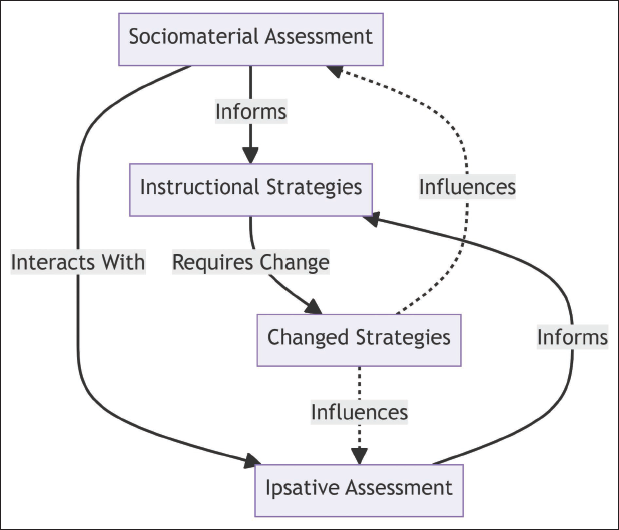
Dashed lines indicate influence rather than direct interactions.
While there is a lack of research in this area, some studies suggest that such a combined approach can lead to more engaged and resilient learners.Gourlay (2017) argues for a reframing of student engagement that recognizes the radically distributed nature of human and non-human agency in day-to-day student engagement. Fenwick (2015) further elaborates on this by showing how materials actively influence learning and teaching practices, and how learning itself is a material matter. These insights are particularly relevant for science education, where the materiality of the discipline is inextricable from the learning process. Moreover, the ipsative method’s focus on personal growth aligns with contemporary educational goals that emphasize lifelong learning and adaptability—a perfect fit for the ever-evolving field of science. As students engage with complex scientific problems, ipsative assessment can help them recognize their incremental progress, even when breakthroughs are not immediately apparent. This can be especially motivating in research-intensive disciplines where progress is often nonlinear. The application of these combined assessments can address the challenges of educating future scientists in a rapidly changing world. The PISA 2025 Science Framework (OECD, 2025), for example, highlights the need for students to navigate pressing global issues with scientific literacy and critical thinking skills. By employing sociomaterial and ipsative assessments, educators can better prepare students to meet these challenges, fostering the development of scientists who are not only knowledgeable but also adaptable and self-aware. In our opinion, the fusion of sociomaterial and ipsative assessments holds great promise for the education of future scientists. It offers a more holistic view of learning that acknowledges the interplay between the material world and personal growth. As we prepare students to tackle the scientific challenges of the future, these combined assessment strategies can provide a robust framework for developing the skills and mindsets needed for success in the interdisciplinary and dynamic landscape of science. The author argues that most standard homework assignments, such as essays and reports could be replaced by ipsative-sociomaterial assessments, which not only provides the pedagogical benefits outlined above but also practical benefits in the era of generative AI tools that can be used to answer most written assignments with at least a pass result (Herbold et al., 2023). Instead of providing a final mark for a laboratory report, for example, the process of improving the report through several iterations could be marked. While this may seem to multiply the workload of already overworked academic educators, the use of AI tools independently by the student could facilitate this interactive improvement, while the educator marks the process only.
In practice, implementing a combined sociomaterial and ipsative assessment strategy would require careful planning and a shift in educational paradigms. It would involve creating learning environments that are rich in material resources and opportunities for hands-on experimentation, as well as developing assessment tools that can capture the complexity of students’ interactions with these materials. Additionally, assessment tools would need to maintain a trajectory of students’ past performances to facilitate ipsative comparisons, which could be supported by digital technologies. These approaches are explored in the next paragraph.
Implementation of Combined Ipsative and Sociomaterial Assessments
A combined sociomaterial-ipsative assessment approach would involve students engaging with scientific materials and processes, both in physical and virtual labs, and reflecting on their learning journey through these interactions. The assessment would not only consider the end results of their experiments and reports but also their progression in understanding and utilizing scientific tools and concepts. For example, a student’s initial attempts at using a spectrophotometer might be clumsy, but over time, they could demonstrate increased proficiency in its use, as well as a deeper understanding of the underlying principles of spectroscopy. The ipsative component would capture this growth, while the sociomaterial aspect would consider how the spectrophotometer as a material artefact facilitated or hindered the learning process and how the student interacted with classmates or the educator to overcome any problems. In implementing such an assessment strategy, educators would need to design tasks that allow for repeated interactions with scientific materials and provide opportunities for students to reflect on their learning. For example, in the author’s institution this process was implemented in a first-year ‘Practical and Transferable Skills’ (PTS) module, in which students are exposed multiple times to a spectrophotometer followed by a summative assessment of their practical skills. For this specific example, the assessment is composed of an observation how a student measures a liquid sample, that includes inserting the sample into the instrument, resetting the instrument with a blank sample, taking the correct reading and determining the final result through the use of a ‘calibration graph’. Students who have not participated in the ipsative component, that is, grown the skills through repeated practice, observation of and discussion with nearby students are usually not receiving high grades in this assessment. The ipsative component is supported through writing personal reflections throughout the year. Feedback would be critical, not only in terms of accuracy and understanding but also in terms of the student’s development in relation to the material aspects of the task and the social interactions (Figure 2). This could involve a portfolio approach, where students collect evidence of their interactions with scientific materials and their reflections on these experiences over time. In the PTS module, students are required to submit a skills portfolio at the end of the year, which summarizes their sociomaterial experiences on all modules in the first year.
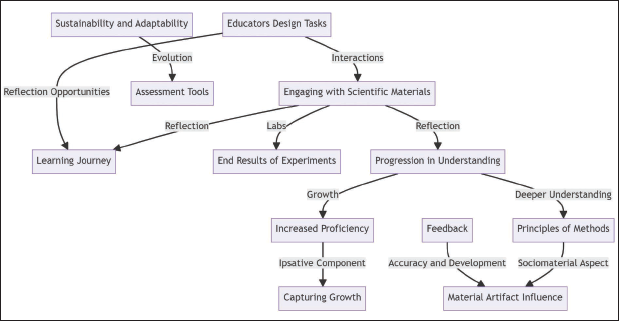
While recent research studies of such approaches are lacking, analysing different studies together strongly supports this approach. Fenwick (2015) discusses the importance of educators encouraging learners to attend to the material details that stitch together their practice, knowledge and environments, suggesting that sociomaterial approaches can lead to more engaged and effective learning. Similarly, Martínez-Arboleda (2021) emphasizes the value of ipsative assessment in providing feedback that celebrates specific improvements and proposes feedforward, thus supporting continuous improvement.
A tool that would facilitate this combined approach of ipsative and sociomaterial assessment is the ‘Ipsative Assessment and Personal Learning Gain’ framework, which emphasizes progress and motivates learners by rewarding improvement rather than just achievement (Hughes, 2017c). This framework can be particularly effective in science education, where practical skills and conceptual understanding develop over time. Additionally, Martínez-Arboleda (2021) discusses the potential of ipsative assessment in fostering personal improvement, highlighting its application in a wide range of feedback practices. For a more comprehensive assessment, the TESTA (Transforming the Experience of Students Through Assessment) programme approach may be integrated. It provides a structured method for evaluating the entire programme of study, rather than individual modules, thus aligning with the principles of sociomaterial assessment by considering the broader educational context (Burcks et al., 2019). In terms of sustainability and long-term applicability, such assessment tools need to be adaptable and evolve with educational practices. An analysis of sustainability indicators in university assessment tools can guide the development of more intelligible and effective assessment methods (Ceulemans et al., 2015).
In particular technology-enhanced assessment (TEA) methods would be pivotal for fostering a learning environment that is both sociomaterial and ipsative. A UNESCO report highlights the importance of learner-centred environments that encourage active engagement and personalized learning, which are sensitive to individual differences and emphasize high-level skills such as creativity and problem-solving (Midoro, 2012). These environments often incorporate Web 2.0 technologies, allowing for cooperative learning and the production of new knowledge. In the context of science education, the integration of technology can facilitate the evaluation of high-level skills and competencies, offering more effective methods and tools for assessment. This aligns with the more recent UNESCO perspective (UNESCO, 2024), which positions TEA as a continuum from simple ICT-based tests to more complex pedagogies involving assessment for learning, where both teachers and learners participate in reflection, dialogue and decision-making.
In the context of online learning environments, the suitability for combined ipsative-sociomaterial assessment can vary based on several factors, including the platform’s ability to facilitate personal improvement tracking and the integration of social-material aspects of learning. Ipsative assessment, which focuses on personal progress rather than comparative achievement, requires a platform that can track individual student growth over time. Moodle, with its open-source flexibility, allows for extensive customization and could be adapted to support ipsative assessment methods. It can be programmed to track individual progress and provide personalized feedback, which is essential for ipsative assessment (Martínez-Arboleda, 2021). On the other hand, sociomaterial assessments would benefit from a platform that supports collaborative tools and analytics. Canvas, known for its user-friendly interface and robust features, could be a strong candidate. It offers comprehensive analytics that can help educators understand how students interact with materials and each other within the learning environment (Vo & Ho, 2024). Blackboard, another widely used learning management system, offers a range of assessment tools and can be integrated with various third-party applications to enhance its capabilities. Its analytics features could also be employed to monitor sociomaterial interactions, although it may require additional customization to fully support ipsative assessment strategies (Hughes, 2017c).
Future specialized assessment tools that are designed specifically for ipsative-sociomaterial assessment could offer more targeted functionalities but may lack the broader learning management system features that platforms like Moodle, Canvas and Blackboard provide. Therefore, a combination of a robust learning management system with specialized tools might be the most effective approach to accommodate the complex requirements of combined ipsative-sociomaterial assessment. The choice of platform and tools should be guided by the specific needs of the educational program and its assessment goals. It is also important to consider the ongoing developments in educational technology, as new tools and features are continually emerging that could influence the effectiveness of ipsative-sociomaterial assessments in online learning environments.
Challenges of Ipsative-Sociomaterial Assessment
Ipsative-sociomaterial assessment presents a unique set of challenges in the context of equality and inclusivity, standardization and ethical considerations. This form of assessment, which focuses on individual progress rather than comparative achievement, can offer a more personalized approach to evaluating student performance. However, it raises questions about how to ensure fairness and inclusivity in educational settings. For instance, ipsative assessment can help counteract the alienating effects of competitive grading systems and promote a more inclusive environment by focusing on personal improvement. Yet, the implementation of such assessments must be carefully refined, especially at higher levels of education, to avoid the learning plateau effect and ensure that all students, regardless of their starting point, have the opportunity to demonstrate growth (Martínez-Arboleda, 2021). Standardization poses another significant challenge in ipsative assessment. The nature of ipsative assessment is inherently personal and longitudinal, requiring a holistic curriculum design that may conflict with standardized testing models that seek to compare students against a set benchmark (Hughes, 2014). This raises the question of how to measure learning gain and progress in a way that is both meaningful to the individual and comparable across different educational contexts. Ethical considerations are also paramount in ipsative-sociomaterial assessment. The focus on personal progress must be balanced with the need to maintain academic integrity and fairness.
Implementing such ipsative-sociomaterial assessments equitably requires careful consideration of diverse learning contexts and awareness of the potential for unconscious bias. Sociomaterial perspectives, which emphasize the interplay between social processes and material conditions, further complicate this picture by highlighting how resources, access and environment can impact educational outcomes. The sociomaterial aspects of science education—such as access to equipment and collaborative opportunities—can exacerbate inequalities if not managed with an inclusive mindset. Equality and diversity issues in science assessment are well-documented, with systemic challenges disproportionately affecting marginalized groups, including women, disabled and racially minoritized researchers (Jisc, 2022). The pursuit of an equitable assessment system in science must therefore be conscious of these disparities and strive to create conditions that enable all students to demonstrate their learning and progress. This includes rethinking how ‘excellence’ is defined and ensuring that assessments do not inadvertently privilege certain groups over others.
In the author’s opinion the combined ipsative-sociomaterial assessment approach in science education holds promise for a more personalized and contextually relevant evaluation of student learning, and is more suitable to overcome the challenges introduced above than any other assessment pedagogy. With the proposed approach educators and institutions can move towards a more inclusive and fair assessment system that recognizes the unique contributions of every learner.
Future Directions
The future of combined ipsative and sociomaterial assessment in higher education science teaching is geared towards creating a more personalized and contextually relevant evaluation system. Ipsative assessment, which focuses on individual student progress as opposed to comparative grading, can be integrated with sociomaterial perspectives that consider the complex interplay of social and material aspects of learning environments. This integration promises to provide a more holistic view of student learning and development. Educational institutions should consider adopting a dual approach that combines traditional assessment methods with ipsative measures to foster personal growth and self-improvement. This could involve the use of portfolios or reflective journals that track students’ progress over time, allowing for a more nuanced understanding of their learning journeys. Additionally, incorporating sociomaterial assessments could involve analysing the interactions between students and their learning environments, including technology, resources and peer relationships, to gain insights into the learning process (Sy et al., 2023). Furthermore, institutions should provide professional development opportunities for educators to learn about and implement these innovative assessment strategies. There should be a shift in institutional culture to value and reward educational practices that prioritize student-centred learning and growth.
For educators, it is essential to design assessments that not only evaluate knowledge and skills but also consider the learning context and the individual’s trajectory. This means moving away from one-size-fits-all tests and towards more varied and dynamic forms of assessment that reflect the diverse ways in which students engage with content and construct knowledge. To support these changes, policymakers and educational leaders must advocate for and allocate resources towards research in ipsative and sociomaterial assessment methods. This will help in developing evidence-based practices that can be scaled and adapted across different contexts and disciplines.
Recent literature suggests that digital technologies offer opportunities for more effective practice of assessment, allowing for authentic, accessible, automated, continuous and responsible evaluation of student learning (Viberg et al., 2024). These technologies facilitate a shift from traditional assessment methods to more dynamic, formative and student-centred approaches, which are essential for capturing the multifaceted nature of learning in the sciences. Emerging technologies such as Extended Reality (XR) are being trialled to enhance formative assessment and feedback practices, with a focus on human-centric issues and ethical considerations in their application (Li, 2024). This aligns with the transformative potential of assessment in higher education, where diverse methods are employed to improve validity, authenticity and inclusivity, thus maximizing relevance to students and focusing on assessing program-level outcomes (AdvanceHE, 2024). The use of TEA also supports the development of academic literacies and fosters student engagement with the assessment process, promoting deeper understanding and trust in the evaluation of their work.
Conclusion
The integration of ipsative and sociomaterial assessment within science higher education represents a transformative approach that aligns with contemporary pedagogical imperatives. The theoretical framework of ipsative assessment, which emphasizes personal improvement over competitive benchmarks, dovetails with the sociomaterial perspective that recognizes the entanglement of social processes and material conditions in learning environments. Implementation of this combined approach necessitates a reconfiguration of assessment practices to support individual learning trajectories while acknowledging the influence of technological tools and resources, such as generative AI. TEA offers a pathway to realize this integration, enabling dynamic, formative feedback mechanisms that are sensitive to the learner’s progress and context. Looking forward, the challenge lies in refining these assessment methods to ensure they are equitable, inclusive and capable of capturing the nuanced interplay of learner development within the sociomaterial fabric of higher education. At the same time, the approach must be supported by institutions requiring a shift in culture to value and reward educational practices that prioritize student-centred learning and growth. This endeavour not only promises to enhance the educational experience but also to provide a richer, more accurate reflection of student learning and achievement.
Footnotes
Declaration of Conflicting Interests
The author declared no potential conflicts of interest with respect to the research, authorship and/or publication of this article.
Funding
The author received no financial support for the research, authorship and/or publication of this article.
