



Abstract
Field action projects are a distinguishing feature in social work education and practice and can serve as a live lab for social work students. Many renowned social work educational institutions began with the field action projects and developed them to a significant level. The state of Madhya Pradesh, India has several problems, and field action projects can serve as an excellent tool to alleviate these problems. The article is an attempt to appraise field action projects of Bhopal School of Social Sciences—one of the well-recognized social work institution in the Central India. Statistical software Jamovi 2.3.21 was used for analysis. Mode, median and Functional Narrative Analysis is used for analysing data. The suggestions can be used by the practitioners and policy makers for an optimal usage of field action projects as tools for sustainable development. It also discusses the presence of outreach activities as a mandate in New National Education Policy of Madhya Pradesh and the relevance of such initiatives in accomplishing the requirements of the policy. The study is limited to the field action projects of BSSS and should not be generalized.
Introduction
Education in human life is considered as an instrument of progressive change in personal, family and community (Naik, 2006). It is also a popular tool of social change and transformation. Plato considered education as a life-long process starting from initial years of childhood to the very end of one’s life in order to pursue the ideal perfection of citizenship; he also believed that education teaches how rightly to rule and how to obey. Indian perspective of education emphasizes on spirituality. In the words of well-known philosopher Shankaracharya, ‘Education is the realization of the self that leads to salvation’. Rabindra Nath Tagore’s idea of education revolves around enabling the mind to understand that ultimate truth which liberates us from the chains of dust and gives us the wealth; not material but inner light, not of power but love, making this truth its own and giving expression to it. Chandra et al. (1996) also consider among others as education to be a mean of encouragement for social welfare and national development.
Social work education in particular has its roots deep into the philosophies of human rights and social justice, all promoting social welfare. From philanthropy to profession, social work has evolved gradually over years. Though the notion of social work is as old as mankind, most historians believe that as a professional concept social work got recognition only in the nineteenth century. Its origin can be traced back to the first university, Sir Dorabji Tata Graduate School of Social Work, established under the leadership of Sir Clifford Manshardt, in the 1936, today which is popularly known as Tata Institute of Social Work (Mishra & Mishra, 2004).
International Federation of Social Workers (2008) declares,
Social Work to be a profession that promotes social change, problem solving in human relationships and empowerment and liberation of people to enhance their well-being. Social Work intervenes where people interact with their environment, by means of theories pertaining to human behavior and social systems. Human Rights and Social Justice are elementary to social work.
It is noteworthy that involvement of statutory powers is necessary for protecting the vulnerable, controlling the offenders, and enforcing treatment and services. Therefore, social work must be considered as a rational-technical activity. In order to be empowering and liberating, social work must be reflective and activist practice. Only this way can the social work critical praxis be enhanced (Morley et al., 2020).
Being an applied social science, social work has the emphasis on teaching and learning through practice. It focuses on a two-way reflective process between theory and the field. Field work provides the social work student to explore a range of social milieu and diverse practice settings (Andharia, 2011; Noble, 2001; Subhedar, 2001). According to a study done by Littrel (1980), engaging in field work practice can enhance and cultivate the skills that are necessary for effectively assisting clients and resolving their issues. Therefore, field practice is crucial in social work education as it improves the quality of services that professional social workers offer. As suggested by Kanno and Koeski (2010), the effectiveness of the social work provided by a worker depends on the access to and the effectiveness of field practice opportunities offered in social work schools. A very strong ideal link between social work and social welfare promises sustainable development, now the term ‘sustainable development’ encompasses the ideas of wellbeing, equity and people’s rights (Qizilbash, 1998). D’souza (2018), in his article, also suggests that sustainable development is very closely related to social work, which in turn stresses the importance of social participation of the vulnerable section of the society. Ovais (2023), in her study done on college students, found that more so than sustainability knowledge, attitude towards sustainability affects behaviour. Knowledge of sustainability weighed more than their attitudes and behaviours. The groups with internal locus of control exhibited more sustainability behaviour. Thus, locus of control was influencing sustainability behaviour. The study provided a foundation for attaining sustainable development by explaining why sustainability knowledge, attitude and behaviour cannot be translated into one another.
Social work being a faculty of recent origin is reported with specific challenges apart from those in the Indian higher education system itself. Limited indigenous social work literature and non-involvement of practice teachers in the process of grading pose serious limitations to social work education (Johnson et al., 2012). Obsolete curriculum, weak alumni-institution link, quality of faculty and mere 1 year of specialization result into the mockery of the whole programme of social work (Thomas, 1994). For social work students, the praxis paradigm is adversely affected by various aspects, such as their failure to apply theory to fieldwork (Amiri, 2018). To upgrade the practice curriculum, field action projects (FAPs) can serve as a decent tool. Students engaged in a FAP should take social work as a process-oriented approach prioritizing the development of relationships and collaboration with community members. It is a pressing need that the social work educators in India should provide opportunities for critical reflection on the political dimensions of community work and create a learning environment that encourages students to challenge dominant narratives and power structures. Ferguson (2003) in his essay says that to create a perspective where learning occurs in terms of best practice, which is laid out as a model for developing systems and practice competencies, a ‘critical best practise perspective’ seeks to move the literature beyond a ‘deficit approach’, where the focus is on what does not get done (well). This necessitates an emphasis on the actual important practices that are ‘best’, showing the very practice by which successful results were obtained. Critical best practice perspective can facilitate learning in important areas such as how to involve service users, advocate on their behalf, encourage protection, build empowering relationships and carry out longer-term therapeutic work in an anti-oppressive way. In order to arrive at an operational definition of ‘excellence’ and what is ‘best’, from the viewpoints of the variety of stakeholders who develop practice, the research technique must be expanded to incorporate qualitative research techniques, the expertise of professionals, service consumers and the creation of ‘practice-based evidence’.
Although the term ‘sustainable development’ is broad, it is primarily associated with economic growth, basic needs, rights, and so on. Sustainable development literally consists of the two words ‘sustainable’ and ‘development’, which emphasize the conditions required for sustainability. According to the report ‘Our Common Future’, sustainable development is ‘to ensure that development meets the needs of the present without compromising the ability of the future generations to meet their own needs’ (World Commission on Environment and Development, 1987). The importance of minimal welfare and growth that is ecologically sustainable is emphasized in Pezzey’s concept of sustainability. Pezzey goes on to say that utility is non-declining, and consumption is above the minimum amount necessary but below the level required for ecological sustainability. He furthers that the government intervention should decrease in the environment and sustainability policies. Long-term optimality should be focused rather than short-run output maximization (Pezzey, 1992). Bossel (1999) categorized the constraints on sustainable development into three primary groups: (a) Physical limitations, encompassing ecosystem attributes, natural principles, fundamental logical rules, the non-living environment, solar energy distribution, available natural resources and ecosystem capacity, (b) human factors, encompassing individuals, societal structures, culture, technology and the influence of ethics and values and (c) time-related restrictions, involving the timing of natural and human-related processes and their development. Gallopín (2003) explained sustainability using systems theory. It is applied to real, open systems exchanging matter, energy and information with surroundings, impacting their state based on inputs, outputs and interactions over time. Being an open system concept there are several stakeholders impacting sustainable development. According to Holmberg et al. (1991), participatory democratic governments offer the greatest political framework for allocating and managing environmental resources for the benefit of the current generation. However, the materialization of this participatory approach has always been a challenge as correctly pointed out by Bass & Shah (1994) who describe that introducing participation is costly and demands behavioural changes. Measurement challenges persist, hindering progress. Moreover, the elites may resist equity-driven participation.
The move from a limited conception of need, conceived in terms of meeting a minimum of requirements, to a focus on rights entails a shift towards embracing a more strategic vision of what citizens are entitled to and require for their further development (Molyneux & Lazar, 2003; Piron, 2003). History has shown that most theories evolve from practice, precisely from closely observed experiences of people with their environments over time (Ebue & Agwu, 2017). Linking community development and social action with social movements theory and practice is the most effective and salient method for the advancement of more progressive social work practice (Ottoman & Noble, 2020). Critical practice, research and learning in social work and social care will certainly develop a new and more optimistic viewpoint towards social work and imbibe the essence of sustainability in development.
FAPs in India
FAP in social work education should address, respond and initiate innovative strategies and also enable teaching and learning in social work. Ideally, it should be the unique response to the field realities which are embedded in complex socio-political-economic structures, and democratic framework of civil and political rights. They must aim to protect the rights of marginalized and vulnerable sections. FAPs should determine the role of higher educational institutions in engaging the trainee social workers with the community.
Fieldwork, the heart of social work ironically is generally characterized as an unproblematic practice with the belief that ‘all social work students do the same thing in the field’. The statement is validated by the fact that there are very limited number of manuals and fairly inadequate academic literature on fieldwork instruction in India.
Priya and Solomon (2020) emphasized the importance of FAPs in academia, field work and research, as they can create new projects and conduct field-based studies. FAPs are also crucial in the development of international social work through a ‘training the trainers’ approach and can enhance the professional competencies of social work trainees and educators. FAPs can also impact the community by modifying their knowledge, attitudes and practices. However, the social work curriculum needs restructuring to improve FAPs. They also proposed a model for innovative social work practice (Figure 1).
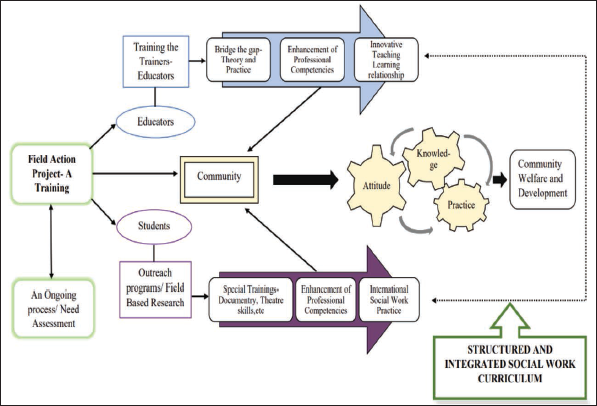
Fieldwork in community organization was consciously redefined in Tata Institute of Social Sciences (TISS) as a process of political engagement over a decade of collective work by faculty members (Andharia, 2011). A perfect example of community engagement is the very first FAP of TISS. The Child Guidance Clinic of TISS (now known as Muskaan: Centre for Child and Adolescent Guidance) was established in 1937 to offer clinical services to children with emotional and behavioural problems (TISS, n.d.). TISS (2011) describes the various FAPs undertaken by the institute in different parts of India, including the efforts to promote community development, social justice and human rights. It also provides insights into the various challenges faced by the institute in carrying out its field work activities, such as limited resources, political instability and social conflicts. (TISS, 2011). With numerous FAPs and a pioneer in social work education, the practices of TISS have made a reasonable impact in the community.
Another prominent educational institution in India that follows the practice of FAPs is College of Social Work (Autonomous), Nirmala Niketan. The institution has initiated more than 40 FAPs since 1956, just 1 year after it was established. Currently, there are four ongoing FAPs in the college (College of Social Work [Autonomous], Nirmala Niketan, n.d.). According to Balakrishnan (2018), for social work to be successful in contemporary times, there are ‘five areas of critical importance to be considered, namely, people, planet, prosperity, peace and partnerships’.
FAPs in the College of Social Work (Autonomous), Nirmala Niketan aim towards creating a practice- based learning environment. Also, it enhances the administrative capacity of the students. FAPs develop the critical thinking and research skills of the students. Further, FAPs formulate curriculum/ academic coursework and research around field experiences and result in the development of the local/ indigenous literature.
Yesudhas (2020), in his article ‘Social Work and Sustainable Development: Review of Field Action Projects Initiated by College of Social Work (Autonomous), Nirmala Niketan Institute’, examines the strengths and challenges of FAPs.
He presents the strengths as:
Commitment to the goals of the profession, Field Action Projects address local needs and They serve as lab for faculty and students to experiment with ideas.
Further, he identifies connection with community, government and other stakeholders as the opportunity to strengthen FAPs.
He also discusses the challenges of FAPs as:
Absence of rigorous process documentation, Limited dissemination of the intervention model, Problems of measurement and indicators and Problem of scaling/ reach of the projects.
He ponders over the question ‘What to do with the project once the project serves its demonstrative value?’ and notes this to be a concern that the educational institution should consider.
While presenting the suggestions to improve FAPs, Yesudhas (2020) concludes the following:
Sustainable Development Goals (SDGs) framework should be utilized to design Bachelor of Social Work and Master of Social Work programs. A ten-year strategic Field Action Plan (2020–2030) should be developed for local area/ adopted slum or village development. FAPs should be undertaken in the SDG -thematic areas where faculty members have expertise, and this must be mentioned in the strategic Field Action Plan. Document field practicum intervention of students that are addressing key SDGs. Conduct annual review of the field practicum, SDG outcomes achieved. Conduct proper and timely outcome mapping exercise to prove the impact created in the local communities and tasks done to address SDGs. Regular ‘SDG- forum meetings’ of social work inter-college/ university to be conducted for sharing of learnings and best practices.
Inspired from the practices of the notable social work educational institutions, Bhopal School of Social Sciences (BSSS) started with the practice of FAPs.
FAPs in BSSS
The Department of Social Work provides training opportunities to the social work students for balancing the theoretical orientation of conceiving and implementing a project and a platform to experience the need of actual clientele through FAPs. The students are appointed as student coordinators and volunteers (BSSS, n.d.a). At present, there are two FAPs, Jagrati and Disha, as the functional projects. These projects started recently in the academic year 2015–2016.
Disha is a project focusing on the adolescent girls. Adolescent is a period of identity crisis. A lot of whims and fancies go into the mind of children. The main aim of the project is to mould them into an integrated personality with essential life skills required in this competent world. The efforts are to enhance their coping skills and developing positive attitude, assertiveness and critical thinking.
The FAP Jagrati aims at creating awareness among immediate and distant stakeholders on issues pertaining to child labour. Further, it focuses on sensitizing the masses regarding challenges that confront child labours in our society. It also orients the trainee social workers on issues of child rights.
The activities happening under FAPs are of discontinuous and intermittent nature. Very recently from 2021 onwards, it was introduced as a field work component in the undergraduate first year and second year students (BSSS, n.d.b). In the very formative stages to keep FAP as a practical component is debatable because the students enrolling for Bachelor of Social Work (BSW) programme generally do not have any prior knowledge of social work. Though FAPs in the state of Madhya Pradesh can really contribute a lot towards the development, if new and responsive projects are designed and properly nurtured.
The present study is an attempt to appraise the two FAPs functional at BSSS and suggest measures to improve their operations.
Methodology
The study is mixed in nature. Quantitative method of questionnaire was used along with the qualitative method of focused group discussion to understand the effectiveness of FAPs. For the study, 14 respondents were selected using volunteer sampling. Only the participants who were interested to participate in the study from both FAPs were selected for the study. The selection was done keeping in mind that there should be equal representation for the two FAPs: Jagriti and Disha. The participants were split in two groups. Both the groups were heterogeneous in their composition as they comprised of students from both first- and second -year students of undergraduate programme of BSW. The female participants in both the groups outnumbered the male participants. Most of the participants in both the groups were in their early adulthood stage and were in a position to critically analyse the operations of FAPs. Initially, the same questionnaire was circulated to all the participants in the month of January 2023 which comprised of eight items measured on a 7-point Likert scale. Later, in the month of February 2023, focused group discussions were carried with both the groups with same themes. This was done for the purpose of data triangulation. It should be noted that with methodological triangulation, validity and credibility of the findings gets enhanced, also, research biases are reduced.
Reliability and Validity of the Tool
The reliability of the questionnaire was assessed using Cronbach’s α and McDonald’s ω. The results are presented in Table 1. The values are above the threshold values. McDonald’s Omega values > 0.8 can be interpreted as a good internal reliability (Feiβt et al., 2019).
Scale Reliability Statistics.

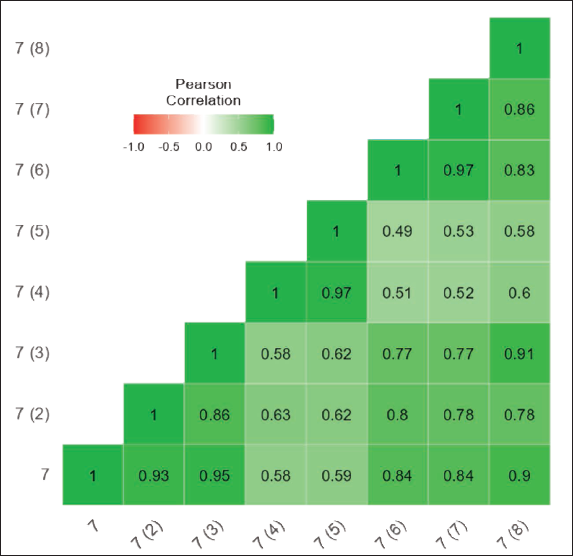
Further, internal consistency of the tool is tested. The results of correlation heatmap depict that the tool is valid (Figure 2).
Data Analysis and Results
Quantitative Analysis
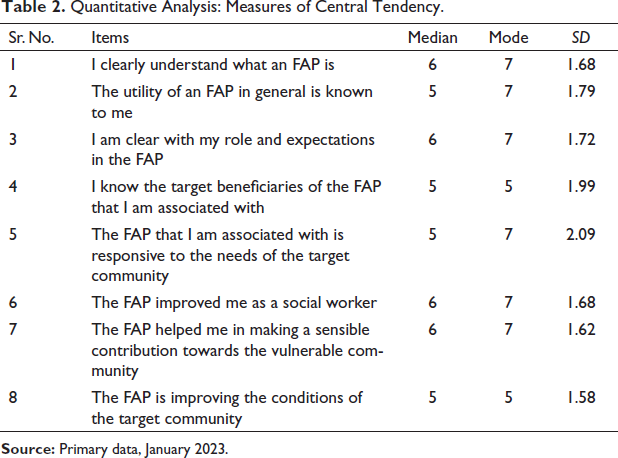
Upon analysing the gathered data using the two measures of central tendency, Median and Mode, it was indicated that the study participants had a strong know-how of FAPs. However, not everyone had a clear understanding of the overall usefulness of the FAPs. Certain respondents were unaware about the intended beneficiaries of these projects. Some of them expressed confusion regarding whether FAPs effectively addressed the community’s needs and actually led to better conditions for the beneficiaries (Table 2).
Quantitative Analysis: Measures of Central Tendency.
Qualitative Analysis
For the purpose of qualitative analysis, focus group discussion was carried out with two groups of seven students each who were a part of the two FAPs in BSSS. The participants were same, that is, those who had responded to the questionnaire were selected for focused group discussion. It is noteworthy that a range of 4–12 participants makes it ideal for a focus group discussion (Kitzinger, 1995). The questions of focused group discussion were primarily focused around the following themes:
Basic understanding about FAPs in general Specific understanding of the FAPs in BSSS to which the participants were engaged Clarity on roles and responsibilities as a member Utility and responsiveness of the FAPs Suggestions for improving the FAPs.
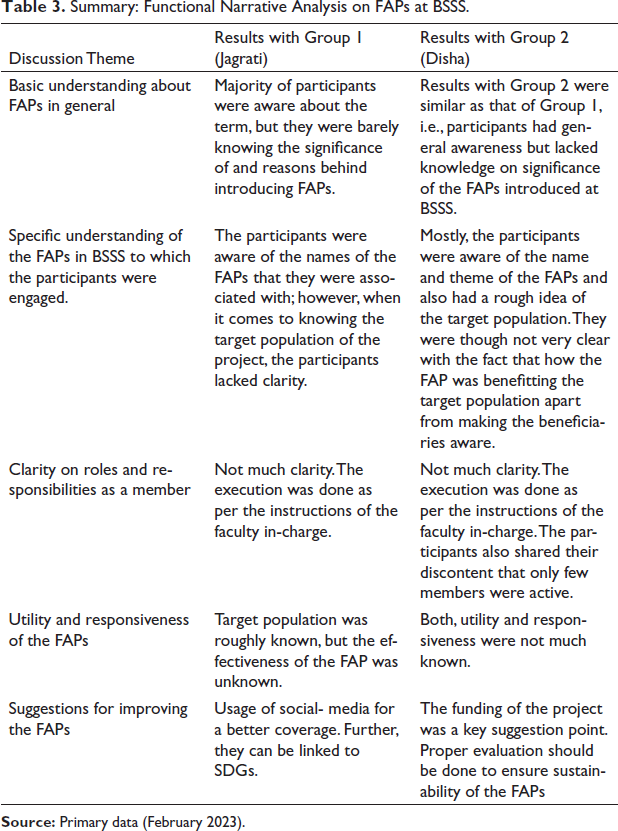
The discussion was recorded and transcribed. Further, Functional Narrative Analysis was carried on using the transcripts. The major findings are summarized below (Table 3).
Summary: Functional Narrative Analysis on FAPs at BSSS.
Discussions
Jagrati and Disha FAPs focus on some key issues in the state of Madhya Pradesh and all over India. However, it is worth noting that the state is the fourth poorest state of India (Saxena, 2021). Interestingly, the Madhya Pradesh Planning Commission report of 2022–2023 hardly makes any mention of poverty and employment ratios but just of self-employment and boasts of about ‘Bhagwan Birsa Munda Self-Employment Scheme’. The term poverty appears only once that too only in the context of CT scan facility (Directorate of Economics and Statistics, Madhya Pradesh, 2023). Further, upon analysing the data of ‘Handbook of Statistics on Indian States’, another key concern of Madhya Pradesh surfaces, that is, low Gross Enrolment Ratio. Upon comparing the enrolment of high school and higher secondary, it can be concluded that the problem of school dropouts is prevalent (RBI, 2022).
New Education New Flight Document describing the implementation of New National Education Policy also discusses the relevance of field studies/ project work/ apprenticeship/internship/ welfare work as a component of the higher education programme (MP HEd portal - higher education portal of government of Madhya Pradesh, 2022). Creating a green campus offers experiential learning for all. Higher education institutions (HEIs) can integrate sustainability into education, values and campus life. This in turn will fosters innovation, inspire future change-makers and align curriculum and educational practices with the SDGs (India Today, 2022).
FAPs are surely tools to change the social situation and promote sustainable development as they provide innovative means to address the problems of the community. Both quantitative and qualitative methods succeeded in depicting that the participants were not very sure about the benefits that FAPs bring to the target beneficiaries. Moreover, even the utility of FAPs was not clearly known to the participants and they did not have proper orientation about FAPs. Also, most of the participants failed to connect the ideas of FAPs and Sustainable Development. By updating the notions of sustainability in the curriculum and ensuring the provision of alumni linkage over the issues of sustainability of FAPs, the problems depicted by Thomas (1994) can be minimized to a lot of levels.
Sady et al. (2019) and Puig et al. (2019) argue that universities can play a key role in meeting the challenges of sustainability through education. They need to be made responsive to the needs of the community. They should be well-structured, and the participants should be given a chance to explore the ground realities before getting involved in the intervention. This will make them understand the target beneficiaries and their issues in detail. Bass et al. (1995) identified educational institutions as one of the stakeholders in participatory approach to sustainable development. In the recent past, HEIs have been seen in the role of catalyst (Findler et al., 2019). Higher education fosters sustainable development through job opportunities, societal stability, innovation and technology creation, but its full impact often goes unrecognized (Fehlner, 2019). HEIs have the potential to set a precedent and shape the behaviour of community members (Littledyke et al., 2013). With effective participation, strategies would become the product of society defining its (different) demands for sustainable development and professionals creating feasible means to perform the needed actions. The participation of the community can be ensured for making the FAPs responsive to the needs of the community. This will also generate accountability in the community members and assure sustainability of FAPs, which in turn will contribute to sustainable development. For the purpose of financial stability, the projects should be tied to some CSR initiatives or other funding agencies. FAPs should also be explored in terms of internship activities. Each year, the trainees should be involved right from the beginning of the project, and efforts should be made towards creating a sense of belonging to the project which should continue even after the candidate graduates. The link can sustain through alumni associations. Moreover, every year, evaluation of the objectives should be done to assess the outcome of the project. This will also shape the future objectives of the project. Overall, planning of FAPs should be done on 3 levels: Strategic, tactical and operational. Linking FAPs to SDGs will add more meaning to the work. Linking FAPs to SDGs will enable the budding social workers to engage in policy advocacy and social action addressing the pressing structural and systemic barriers. It will also ensure sustainable development through collaborative and participatory approach involving partnerships with communities, governments and other stakeholders.
FAPs will act as a niche for out of box thinking and team building. It will serve as a platform to nurture innovative and participative thinking and implementation of participative solutions. Thus, educational institutions can set benchmarks and mark their existence and positive changes in the community. The outcome of FAPs shall be multi-fold as it will enhance the goodwill of the institution, improve the impression of social work as an educational programme, inculcate values in social work trainees, strengthen the bond between alumni and current students, ensure community awareness and participation, result in sustainability and sustainable development and lessen the burden of development over the Government. These are some of the definite outcomes of FAPs. Moreover, if they are implemented with the right strategy and in its true spirit, they will further reap several ripple effects.
Conclusion
Social work can play a significant role in reaching the SDGs of the United Nations. The social and economic issues stated in the SDGs can be addressed using the principles and ideals of social work. If the community is actively involved in the planning and execution of development efforts, FAPs can be the instruments for tackling social and environmental issues and fostering empowerment by capacity building of the community members. Various tactics and methods can be used to solve the problems including poverty, health, education, environmental sustainability and so on. Therefore, it can be said that field action programmes are an effective way to encourage sustainable development as they guarantee community involvement and empowerment in accomplishing this goal. However, the tool needs refinement and polishing to take an evolved form like the FAPs at TISS.
Footnotes
Declaration of Conflicting Interests
The author declared no potential conflicts of interest with respect to the research, authorship and/or publication of this article.
Funding
The author received no financial support for the research, authorship and/or publication of this article.

Authors’ Bio-Sketch
Richi Simon (PhD) has a decade of experience as a seasoned Assistant Professor in social work. She is actively rendering academic and administrative duties at BSSS.