



Abstract
The article presents the replicable model of Curriculum and Community Based Academic Learning with Research, Action and Service (CCBALwRAS) through a framework of ‘2 Cs’, the ‘curriculum’ and the ‘community’. It puts forth a support strategy for participatory community-based interventions by formally inducting higher education institutions (HEIs) to achieve long-term sustainable, workable solutions for local communities. The study is based on a multi-stakeholder partnership, facilitated through partnerships between the HEI, committed faculty–student participation and civil society, executed between 2015 and 2020. The article draws from the execution and actual field experience of the partnership, along with qualitative data from the evaluation and assessment of the programme delivered. Given that the model developed is based on the experiences of a private fee-dependent HEI in a metro city, the study does not take into consideration infrastructural and resource constraints of other HEIs. The article focuses on the role of HEIs as fulfilling dual responsibilities of knowledge creation and dissemination while addressing socioeconomic, developmental and environmental needs within their immediate communities. The resultant pedagogical shift and the model proposed is an effective solution for equity, capacity building and civic-mindedness, which will nurture socially aware and critically conscious global citizens.
Keywords
Introduction
Community participation provides information on local problems that can be addressed through local interventions. This article puts forth a support strategy for participatory community-based interventions by formally inducting higher education institutions (HEIs) to achieve long-term sustainable, workable solutions for local communities. Integrating ‘curriculum’ with the needs of the local ‘community’, the 2Cs (Community and Curriculum) is facilitated through partnerships between the HEI, committed faculty–student participation and civil society. The article focuses on HEIs as fulfilling dual responsibilities of both knowledge creation and dissemination while also addressing socioeconomic, developmental and environmental needs within their immediate communities (Welch, 2016, in Van Eeden et al., 2021). ‘Curriculum and Community-Based Academic Learning with Research, Action and Service (CCBALwRAS)’ is offered as a strategy that facilitates community engagement at two levels, taking forward the earlier proposed CBALwRAS model (Sinha Deshpande et al., 2017). Theory divorced from practical experience often results in students becoming armchair philosophers with limited hands-on experience and knowledge of real-world issues (Sinha Deshpande et al., 2017). CCBALwRAS integrates service-learning (SL) activities into the curriculum to offer an effective solution for sustainable community development, as well as provide students with an academic grasp of social issues, leading to informed participatory citizenship, enabling educational institutions to contribute to social change.
This article shares a replicable model, course of action (process) and results of a pilot project carried out by an independent not-for-profit, fee-financed HEI in urban India between January 2016 and December 2019, for effective and sustainable development, poverty alleviation and increasing accessibility for all stakeholders. The term ‘project’, in this article, refers to the need-based research activities, followed by solution-based interventions undertaken by the HEI with the community-partner. The project integrated SL within the final year undergraduate courses in anthropology, and media studies, while the community outreach cell (COC) at the HEI took the execution forward. The institutional macro-curriculum mandates 100% student participation through internship and community outreach; while the discipline specific courses at the micro-level encourage community research, need-analysis, suggested interventions, reflection and active engagement with the community-partner. Conversations and inputs from the community, along with interdisciplinary dialogue enhanced the connectedness across problems, proposed solutions and interventions. Such a project benefits student learning as it involves a pragmatic, interdisciplinary solution-oriented approach. The article draws from the execution and actual field experience of the partnership, along with qualitative data from the evaluation and assessment of the programme delivered.
This article is divided into four sections: the first section outlines the multiple perspectives from the literature on education, its role in development, and a short overview of SL and academia. It moves on to discuss community engagement in India to establish the context of the proposed model while addressing the pedagogical shift. The final section proposes a 5-step replicable framework of CCBALwRAS that can be adopted by HEIs in India and globally.
Perspectives in the Literature
Education and Its Role in Development
Education is a powerful tool for poverty alleviation (DFID, 2008) and sustainable change. Development entails ‘…promoting efficient and sustainable economic growth, a level political playing field for strengthening capacities and providing social safety nets’ (Rauniyar & Kanbur, 2010, p. 455). It implies the upward movement of an entire social system, comprising economic and non-economic factors, including institutions and attitudes (Myrdal, 1974). Development connects to a society’s well-being, where equity incorporates liberty as a political dimension (Universidade Estadual de Campinas [UNICAMP], 2005 in Soares & Quintella, 2008). HEIs are accepted as learning spaces for disciplinary and practical problem-solving. Their role towards social responsibility, sustainable solutions for wicked problems and developing critically conscious citizens, while not generally applied, are acknowledged (PRIA, 2021). The increasing focus on HEIs engagement and collaboration with local communities stems from the university’s expected contribution towards social responsibility and their reciprocal engagement for mutual and sustained benefit (UGC, 2020; UNESCO, 2010). Conceptualizing reciprocity between universities and the local community and building equal partnerships through HEIs social responsibility programmes is gaining momentum (Butin, 2010; Esau, 2015; Holland & Ramaley, 2008; Jadhav & Suhalka, 2016; Sathorar & Geduld, 2021). Thus, there is a growing emphasis on HEIs building mutually beneficial partnerships with local communities.
Service-Learning (SL), Academic Service Learning (ASL) and Research-Based Service Learning (RBSL)
The shift of focus in higher education’s commitment to solving social problems in neighbourhood communities (Lemieux & Allen, 2007; Ramaley, 2014) across local, regional, national and transnational boundaries is an exciting and challenging way forward. Distinct from ‘volunteerism, co-curricular and extracurricular services’, SL aims to identify and respond to community needs with a deep experiential understanding through the lens of disciplinary knowledge and enhanced sense of civic responsibility (Bringle & Hatcher, 1995; Phillips et al., 2013). SL can be voluntary, research-based community engagements, or service-centric. The 4Rs—respect, reciprocity, relevance and reflection—are SL’s key aspects (Butin, 2010).
ASL as a pedagogy adds the perspective of critical thinking, interdisciplinary, creative problem-solving and reflection through the curriculum, instruction and assessment design within a course (Kiltz & Ball, 2010; Schön, 1987). As a philosophy, it entails a worldview preparing students for active citizenship (Kendall, 1990). It is a ‘synergistic model’ integrating service, academic and experiential learning to qualitatively change the teaching-learning process, resulting in a radically effective transformative method of teaching students and enhancing community development (Howard, 1998).
RBSL partnerships between local communities, students and faculty at the HEIs are long-lasting collaborations with research, both ‘for’ and ‘with’ the community as opposed to being a research study ‘on’ them (Enos & Troppe, 1996; Wolpert-Gawron, 2016). These interactions are built on trust, mutual respect and reciprocity (Holland & Ramaley, 2008). It shifts beyond transactional to transformational engagements fulfilling the needs of all stakeholders (Enos & Morton, 2003; Petri, 2015).
Academic Curricula and Community Engagement in India
Access to education, employability, civic engagement and migration are four significant challenges faced by India (Youth in India, 2017). The 15 to 24-year-old population is estimated to have increased from 233 million in 2011 to 251 million in 2021 (Ghosh, 2020). To drive socio-economic growth, India needs to avert its population dividend from turning into a burden (Jaffrelot & Kalyankar, 2019), and the Indian higher education sector with the second most extensive network of HEIs in the world (Anamika, 2020), with 1,043 universities, 42,343 colleges and 11,779 Stand Alone Institutions (AISHE Report, 2020) can be a powerful and effective ally in this effort.
The underlying ethos of education is social action. However, there is a lack of result-oriented frameworks that can be adopted and adapted by teachers and organizations locally for successful outcomes. National Service Scheme (NSS since 1969) and Socially Useful Productive Work (SUPW since 1978), while part of the curriculum at the school and higher education level, are more in the nature of community service. However, there is a distinct difference between community service and community engagement (UNESCO, 2015). The Ministry of Human Resource Development, Government of India, has mandated Institutional Social Responsibility and redefined parameters for assessing HEIs at the national level. The University Grants Commission (UGC) has set up a Subject Expert Group on Curricular Reforms (UGC, 2020) to include institutional social responsibility across disciplines to understand the community and their lives. India’s National Education Policy (NEP) 2020 aims to equip students with the necessary skills, knowledge, spirit and thought to contribute to sustainable development, human rights and global well-being, thereby reflecting a truly global citizen (NEP, 2020). The ‘spirit of service’, with ‘personal accomplishment and enlightenment, constructive public engagement, and productive contribution to society’ (NEP, 2020, p. 33), emphasizes the dual role that education is expected to play in the life of an individual for self and society.
The available literature on SL offers abundant details on programme development, its impact on students (Albert, 1996; Delve et al., 1990; Enos & Troppe, 1996; Morton, 1995), types of courses and guidelines for execution (Bringle & Hatcher, 1995; Giles & Eyler, 1994; McEwen, 1996). However, there is a lack of information on a framework to incorporate civic engagement at the disciplinary level (Phillips et al., 2013), or within a subject/course-specific curriculum, outside of SL or social work. Engaged scholarship has become an integral aspect of higher education in South Africa over the past two decades for transformative social change, which can be emulated by the Indian HEIs (Cherrington, 2015; Esau, 2015; Zuber-Skerritt et al., 2015).
The proposed CCBALwRAS model offers a framework to fill this gap through a pedagogical shift in the expected outcome of education that enables social transformation in the local community by addressing the community’s needs in a sustainable manner and would extend beyond the scope of the current intervention.
Pedagogical Shift
Higher education is associated with a strong sense of social purpose, which is the ‘why’, along with the ‘how’ (Zukas & Malcolm, 2002), that is the pedagogy. Pedagogy should lead to social intervention (Shor & Freire, 1987) built on critical understanding and interactions with people and the world (Bertrand, 2003). This shift calls for enriching the teaching and learning experience by engaging students with critical concerns via lived experience. It focuses on developing students’ capacity to gain insights through critical inquiry, participation, reflection, dialogue, negotiation and conciliation both in the classroom and in the local community. This requires integrating the ‘curriculum’ with the ‘community’ that focuses on the existing knowledge base with the everyday lived experiences 1 (Chandler & Munday, 2016) through research-based academic engagements. The shift takes place both at the institutional macro- and micro-levels. The former involves institutional commitment and responsibility through mandated engagement with the community. The latter incorporates specializations and individual courses in the teaching, learning and evaluation processes, focusing on engaged learning-connecting theory to experience gained on-field. CCBALwRAS integrates the HEI through the ‘curriculum’ and ‘community’ in socially responsible action and moves beyond the creation, delivery and dissemination of knowledge to a space for social action that is academically informed through research and theory.
The section below outlines the project design with a focus on actions undertaken at the HEI in exploring its collaboration with local communities to enable social changes at the local level.
The Project Design
The project developed as a collaborative partnership between 2 final-year courses and the underserved slum community, housing 500 families (the community-partner) within 2 km from the HEI. Good communication, dialogue among stakeholders and thoughtful planning for execution go a long way in conceptualizing community partnership as a two-way activity to ensure success (Bartel et al., 2019). Initiated in the applied anthropology course that integrated RBSL and Community Based Participatory Action Research (CBPAR) into the curriculum, it identified English as a Secondary language (ESL) as a possible intervention. CBPAR is a collaborative approach focused on the needs and participation of the community-partner at all levels for action and positive growth. The partnership extended into the Media capstone course as a branding activity for onboarding volunteers for the ESL or the Apna Basta 2 intervention. The COC at the HEI took the collaboration forward.
Frequent interactions during the data collection process and planning stages facilitated the active voice of the community-partner leading to the successful completion of two cycles 3 of the Apna Basta. This has led to the suggested replicable model of CCBALwRAS for broadening the scope of education to address social needs.
Institutional Commitment and the 2Cs
Institutional commitment towards community and civic engagement is integral to the framework of CCBALwRAS. Experiential and engaged learning is an integral component of courses at the HEI, where this framework has been implemented. At the macro-level, the undergraduate degree programme mandates a minimum of two hundred hours of experiential, graded community engagement through a Community Outreach Project (COP). At the micro level, embedding field and experiential SL through civic engagement in individual courses through ASL is encouraged.
Integrating the 2Cs, in Individual Courses
Engaged learning prompts the need to establish correlations between normative knowledge, its practical understanding and problem-solving. Interacting and immersing within the ‘field’ and the community to elicit information using ethnographic and mixed methods is integral to Applied Anthropology (Ervin, 2004). As a research methodology, it follows an immersive strategy, focusing on a collaborative, community-driven, graded and credit-bearing research project approach (Smedley-López et al., 2017). The objective was to develop a well-integrated 2Cs based classroom engagement; course objectives, outcomes, student activities and evaluations with graded credits were aligned with civic engagement and research for experiential and engaged learning. In the absence of a local precedent, the project incorporated the principles of RBSL, CBPAR (Burns et al., 2011; Smedley-López et al., 2017) and conducted a needs assessment. This approach applies exploratory and pragmatic tools (Liu, 1995). CBPAR directly engages with communities and centres their voices, needs, hopes (Cherrington, 2015), aspirations and knowledge in the research process and its outcomes, thus contributing to and enhancing strategic action for community transformation (Burns et al., 2011).
Demographic surveys (Allen, 2017), short-duration focused ethnographies (Pink & Morgan, 2013), need analysis with regular field notes and journals with reflections (Bernard, 2008; Lynch, 1993) by the students of the HEI constituted one of the key elements of the project, focusing on the experiential and graded course work. It was inductive and action-oriented, with needs identified from the local perspective and rationale from existing literature. Regular interaction and feedback during the project helped ‘academics see themselves as true partners with community members in the research at hand’ (Bartel et al., 2019, p. 3). The project design underwent a review process for viability and ethical considerations (Fetterman, 2010).
The broad aim was to maintain a long-term relationship with the community, and therefore, it was essential to ensure transparency for both partners. Hence, expectations were outlined and set before the project was initiated. With RBSL and CBPAR, the anthropology course generated data (over eight weeks of fieldwork) highlighting the ESL needs of the community-partner children, leading the HEI to support Apna Basta as an out-of-school remedial support programme in ESL. The media students captured the attention of the HEI and its students to the issues, while the Institutional Social Responsibility (ISR) initiative was undertaken by the COC. Students were encouraged to participate in this programme as volunteers to facilitate and mentor the community-partner children as one of the ways to complete their COP mandated by the curriculum.
Ensuring curriculum revision and redesign with activities and assessments that integrate research and community collaboration, theory and problem-oriented solution; student, faculty and institutional participation across disciplines; initiating or integrating community outreach activities; exploring possible funding support for interventions post the research and analysis were key elements of the design and implementation stage of the 2Cs initiative by the HEI.
Building Partnerships
Trust building in a community partnership is a slow but essential process for the success of a partnership. It should ideally be undertaken before the students are introduced into the community with the support of key community members and personnel designing the project.
In the initial stages of discussion, targeted and focused meetings with interested community members as against open community meetings with all, work well. The research project was initiated with approximately 30% of the community members (after three weeks of interaction) interested in engaging with the HEI.
The growing strength of the partnership is indicated by the increasing participation of the community members. Students and faculty who come together to outline the way forward. Investment and commitment to resources, including finance, infrastructure support—classrooms, teaching-learning resource material, transport, and people in terms of time invested by faculty, students and the community-partner were integral to the success. Supportive parents from within the community-partner were identified as key members (KM) for future planning that strengthened the second cycle of Apna Basta.
Prior personal connections with members of the community-partner eased the process of trust-building for a plan of action that centred the voice of the partner for the collaboration to succeed. In the absence of prior knowledge from within the community, the pragmatic-exploratory design allowed students and faculty to work out strategies and methods of inquiry and possible interventions based on the response of the community. Over four years, this partnership extended beyond the anthropology course to include students and faculty from media studies, COC and members of civil society, non-governmental organizations (NGO) and not-for-profit organizations (NPO). The longitudinal partnership witnessed the successful completion of two cycles of need-based interventions for ESL.
Sustained partnerships were forged through student engagement at local, civic, administrative and corporate levels. To build collaboration and trust between the HEI and the community-partner, two simultaneous activities were conducted throughout the four years. While the Apna Basta ESL continued, anthropology students of subsequent cohorts also worked with the community on other graded community-based assignments.
Students and Community Engagement
Student-volunteers are integral to a CCBALwRAS project for the successful design, organization, implementation and delivery of intervention programmes. In the case study, the student-volunteers worked closely with the HEI and community-partner. They worked with the KMs to improve enrolment in the ESL programme by interacting with community-partner parents, conducted skill tests for the community-partner children, addressed concerns related to nutrition, hygiene, washroom etiquette, first aid and creche facilities for younger siblings of the children who had joined the ESL. While the student volunteers doubled as facilitators for the ESL classes, this also allowed them to complete their mandatory COP requirements. Students also gained a deeper understanding of societal gaps and the challenges faced by the underserved community.
Partnership with Relevant Organizations
Collaborations are integral to the success of CCBALwRAS. Effective delivery of ESL was ensured by partnering with an NPO working for equity and access in the education sector. They assisted in outlining the relevant curriculum, lesson plans, pedagogy, pre-and-post-assessments to identify the requirements of the children. The NPO also trained student-volunteers in creating content, training them in pedagogy to facilitate effective delivery in the remedial classrooms.
Knowledge sharing and discussions with a USA-based international HEI engaged with community-based academic learning projects contributed to the curriculum design of the anthropology course and the successful execution of Apna Basta ESL.
Mutual Agreement on Goals and Participatory Social Change
It is imperative to understand that it is only with mutual agreement of goals and pathways will the partnerships achieve success. Regular meetings between the community-partner members, including interested parents, KMs, HEI management, concerned faculty students, COC and the NPO partner, ensured smooth planning and flow of events. Mutual convenience for time and availability of resources is imperative. In the project being discussed, the HEI not only provided transport support for children to be brought to the HEI campus but the sessions were also conducted on Sunday late morning to suit the requirements of the community-partner.
Evaluation and Assessment of the Project
Stakeholders are the best judge to identify problems and evaluate outcomes. Continuous feedback and reappraisal of the processes across all the stakeholders led to the execution and completion of the project. It was not just a learning experience for the HEI but a success when presented at a nationwide higher education summit, where it was presented as a replicable model oriented towards educational equity and access.
Both the anthropology and media courses were well received and appreciated for experiential learning, which encouraged other courses at the HEI to experiment with similar projects. The first evaluation was conducted during the initial curriculum design to gauge the feasible delivery of the content and research activities, followed by an assessment of the data collection process with the community-partner. Qualitative and quantitative feedback on course content, delivery, class engagement, experience and outcome mapping from the students were used to measure the various parameters of the course.
The execution of the Apna Basta project and the outcomes attained were evaluated during and after both cycles based on the performance of children in the ESL classrooms and their formal school programmes. 4 Feedback included informal conversations, reflections and testimonials from the community-partner children and their parents. Women were more open to sharing problems with young researchers, leading to the focus on education. The challenge of not representing the male perspective remained a continued concern due to their lack of participation.
As formal interviews or surveys can be intimidating, informal methods such as open conversations and reflections were used to elicit true feelings, both with the community-partner and HEI students. It was a constructive mechanism to discuss problems and possible solutions to ensure continued collaborative engagement with key stakeholders.
Reflections of the Community-Partner-Children: The Betterment of Academic Performance and Enhanced Confidence
‘I know how to answer all these questions because of our classes last semester; the classes are very interesting…you will understand all of this as they (the volunteer) will teach you. It’s fun, and you can answer all the questions in your school as well…they help us learn, …develop ourselves, and even make us do physical activities’. These achievements and experiences shared by the community-partner-children reflect their improved academic performance and confidence.
Two students being awarded a double promotion, with another scoring the highest, with improvement in emotional well-being, interpersonal relations, soft skills and social confidence, further indicate the success of the ESL. The children’s enthusiasm and commitment to the ESL were reflected when they chose to forego family weddings, attend classes despite injuries and enquired about new sessions. Increased participation, reduced absenteeism and feedback from parents along with their hope for a continued commitment from the HEI for Apna Basta in the future are pointers for a successful collaboration. Additional support, such as meals, first aid and informal counselling, enhanced motivation and participation of the community-partner-children in class. The increased enrolment of student-volunteers and community-partner-children (38 to 70, by gender and age) over the two cycles of ESL led to the suggestion of a replicable CCBALwRAS partnership.
Reflections of Student-Volunteers: Engagement with the Community, Curriculum and Social Issues
The project reinforced the community as ‘more than an intervention setting…it is where we live and relate with others’ (Flecky & Lynn, 2009, p. 12). It benefited student-volunteers with its pragmatic, interdisciplinary, multi-dimensional and multi-pronged approach to finding solutions. Their interaction with the community-partner-children was that of reciprocity, information sharing and skill enhancement such as the ability for interpersonal communication when working with individuals from diverse socio-cultural backgrounds. Other transferable skills include language competency, conversational skills, a deep sense of achievement and a sense of fellowship and camaraderie. The student-volunteers spoke of ‘the power of responsibility…values…maybe even more than what they (community-partner children) learnt from me (HEI student volunteer)’. ‘Fulfilment and trust, …patience, teamwork, adaptability and time management brought mutual (community-partner and volunteers) joy’ to both. ‘My students taught me life while I taught them English’. This close interaction between the HEI through its curriculum and the community resulted in a longitudinal partnership spanning four years, benefiting all stakeholders.
A multiple-stage evaluation process allows the assessment of different aspects of a multidimensional project that brings together a variety of methods and stages/phases of a project. This includes the expectations of and communication between the partners during all phases. Social change and informed participatory citizenship, together with a replicable model are the key outcomes of this project. The pedagogical experiment with the 2Cs—curriculum integrated with the community through research, action and service emerged as an effective tool for community engagement and academic learning concerning social issues.
Challenges and Learnings for Future Planning and Execution
While considered a success, the project was not without its challenges (Kearney, 2015). The initial hiccups included a lack of trust and confidence from the community-partner towards the project and the HEI, leading to a lack of participation in the early phase. One-to-one connections with some community members and personal connections of the faculty designing the project aided in building and strengthening the partnership over time.
Community-based studies without any relevant change may lead to a sense of wasted time for the community-partner. A prior engagement with another corporate social responsibility (CSR) programme without any concrete results in the past had disillusioned the community-partner towards any further engagement with outsiders. Community support plays an important role in designing a workable plan for successful and tangible outcomes. Open conversations without expectations with the community-partner help establish trust. The Apna Basta ESL programme was not promised to the community from the beginning, it was an outcome of the open conversations and trust between the community and the HEI.
From the point of view of student-volunteers, challenges faced during the execution of the Apna Basta ESL programme ranged from time and classroom management to the improvisation of lesson plans. Flashcards, worksheets, narrative videos, songs and context-specific relatable examples were used as teaching aids to maximize classroom engagement. Individualized attention was required to redress the short attention span of the children. This led to innovative in-class activities to encourage learning by doing and understanding (Bruce & Bloch, 2012). Community-partner children with advanced learning abilities extended support to their peers as mentors.
Although not an intended outcome when the program was initiated, the kind of wherewithal the HEI had, enabled the project to address some of their in-class behaviour linked to unaddressed nutritional needs that could have been the cause of discursivity and low attention. The emotional and nutritional needs of the community-partner children led to extended and sustainable support through CSR funds. Continued interaction between the HEI and community-partner through additional activities (not necessarily related to the intervention) throughout the duration further enhanced the trust and bond.
CCBALwRAS: A Replicable Model: Step by Step Framework
The proposed CCBALwRAS model takes forward the university–community partnership and responds to the challenges of lack of clarity on academic engagement with the community. The two-way collaborative approach against a one-sided outreach and extension bridges the gap between the HEI and the community-partner, which were otherwise distinct and distant from the needs of the community-partner. It helps academics and HEIs at every level to embrace community engagement critically for academic learning, the greater common good and social change (Sathorar & Geduld, 2021). Other challenges addressed are limited resources, the absence of ethical processes and unheard community voices. The process of interaction between students and the community promotes an engagement with social issues and the real world. It not only links theory to praxis but alters the meaning of education and motivates individuals to ‘see the world in new ways…construct a deeper sense of today’s realities from perspectives drawn from many disciplines; …draw others together to design solutions to the problems we face as a society and as a global community’ (Ramaley, 2014, p. 8).
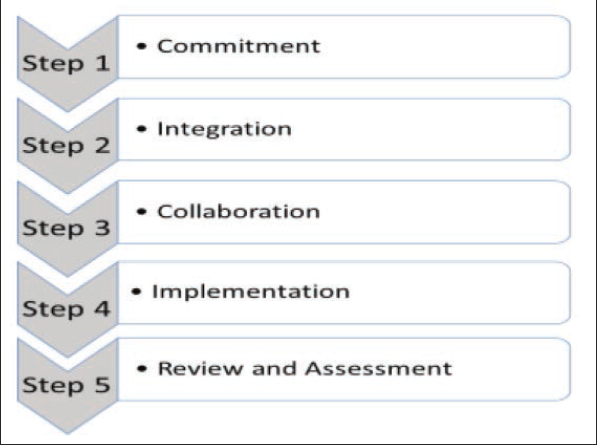
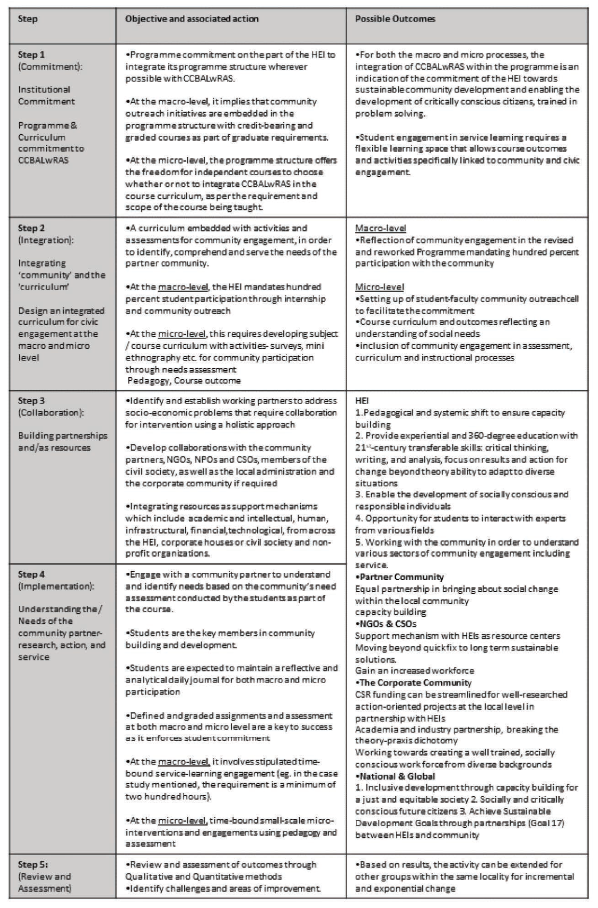
The five-step CCBALwRAS model (Figure 1 and 2) outlines strategies that can be replicated by institutions to incorporate community engagement within the curriculum. The key to a successful CCBALwRAS model lies in embracing the idea of change at various levels of administration and involvement of faculty, staff, student and the community-partner. The order in which step two and three are structured can be altered in accordance with the needs of the HEI and the community-partner. More often than not, these activities will be undertaken simultaneously and in congruence with each other. Information, needs, problems and success will feed into each other for a robust programme of community-based research, participation, collaboration and intervention.
Replicable Steps for CCBALwRAS.
Details of the Five Steps for CCBALwRAS.
Step 1: Commitment
The primary and critical element is the institutional commitment to incorporate CCBALwRAS within the programme/s offered by the HEI to ensure sustainable partnerships for community development. At the macro-level, which is at the level of the HEI, it implies that credit-bearing and graded community outreach engagement is embedded in the programme structure as a mandatory prerequisite for graduation. This requires the management, administration, faculty, staff and students to come together and delve deep into the vision and mission statement of the HEI.
At the micro-level, the programme structure should offer the freedom for individual courses and faculty members to have the opportunity to integrate CCBALwRAS in the course curriculum, as per the requirement and scope of the course being taught. A flexible learning space is required for student engagement in SL as it requires the course outcomes, pedagogies, assessments and activities to be aligned to ensure community and civic engagement through an academic and practical lens.
Step 2: Integration
The second step aligns the design and integration of the ‘curriculum’ with ‘community’ through civic engagement at the macro- and micro-levels. To take this forward, the HEI is expected to mandate student engagement with the community through internship and community outreach as requisites within the broader curriculum for graduation. Institutions could mandate a fixed number of hours to be dedicated for community engagement. The academic engagement should incorporate sessions on SL, philosophy of reflections, report writing and presentation of students’ experiences to an expert panel for feedback and enhanced learning. This should ideally be executed by a specific body with the support of trained and committed staff and students, with an allocation of adequate resources. To ensure student and faculty commitment, the time invested in taking forth these activities should be incorporated within the credit-bearing graded curriculum and performance goals, and appraisals, respectively.
Implementation of the CCBALwRAS at the micro-course level requires discipline-specific teaching-learning and assessment strategies that encourage on-field engagement with the community, research, need analysis and problem-solving for optimal results. CBPAR, RSBL, needs analysis and other community-centric research methods may be incorporated for an integrated and community-engaged learning experience.
Step 3: Collaboration
The third step focuses on developing collaborations as resources to take forward partnerships. While a slow and painstaking process, the mutual trust of stakeholders is integral to the success of CCBALwRAS. Collaborations with community partners, NGOs, NPOs, CSOs, members of the civil society, the local administration and the corporate community is the way forward to finding solutions to socio-economic problems that cannot be solved by individuals or independent communities. Integrating resources as support mechanisms include academic and intellectual, human, infrastructural, financial, technological, from across the HEI, corporate houses or civil society and NPO.
Mapping and sharing clearly defined goals, objectives and outcomes of activities to be undertaken, understanding aspirations and capabilities are of utmost importance to build equal, long-term, trustworthy and sustained partnerships for tangible outcomes. Personal connections between partners often enhance the process of building these partnerships. The focus is to work together with multi-stakeholders to ensure appropriate action and service based on CBPAR, RSBL and need analysis, thereby creating a level playing field against the top-down donor–recipient relations that often problematizes such projects.
Step 4: Implementation
Implementing community-based participatory research, followed by action and service with the support of mentors is the fourth step. Students, faculty and management, while intellectually and administratively equipped to incorporate partnerships for the successful completion of the project, may require training to deliver the required support. This can include research for needs analysis of the partner community using demographic surveys, participant observation, in-depth semi-structured interviews, open conversations, focused meetings and relevant academic literature. Sharing data and information with the community-partner and other collaborators for future action will ensure transparency and help maintain the level of interest and trust for all stakeholders involved. At the course level integrating experiential activities and interconnected graded assessments will lead to achieving the broader goal of education. Action and service stipulate time-bound activities and delivery through a structured approach. Reflective and analytical daily journals and graded assessment at the macro- and micro-levels are key to success as it compels student commitment. Faculty, staff and student are trained in designing and delivery of research and intervention activity, leading to intellectual gain. HEI student-volunteers, community partners, NPOs and civil society (where applicable) are KM for community building and development in the proposed CCBALwRAS model, which is in keeping with goal 17 of the sustainable development goals that envisions well-knit multi-stakeholder partnerships for capacity building and social change.
Step 5: Review and Assessment
The final and essential step is the review and assessment of activities and outcomes using qualitative and quantitative methods through the complete cycle of CCBALwRAS. The review process helps identify challenges and areas of improvement. Based on the results, the activity/ies can be extended and expanded for other groups within the same locality or outside for an incremental and exponential change.
Conclusion
CCBALwRAS integrates the ‘community’ and ‘curriculum’ by bringing together action and change-oriented SL with a programme and discipline-centric curriculum. It is a philosophy of learning that bridges the gap between the classroom experience and SL within the life cycle of a student (not necessarily pursuing a programme in SL), offering the opportunity for meaningful collaboration and intervention for social innovations and change. Unlike SL, which is critiqued as ‘doing for’, CCBALwRAS focuses on ‘doing with’ the community (Brown, 2001; Flecky & Lynn, 2009), evolving from a ‘transactional to a transformative relationship, …with genuine and long-term commitments…to the development of new values and identities for both partners’ (Shalabi, 2013).
CCBALwRAS offers a pedagogical shift by removing the dichotomy of the deductive-inductive methods of learning and the passive–active participation of students in the learning process. It enhances structure and direction in the classroom and focuses on experiential learning with the community, shifting from the objective knowledge-oriented classroom to integrating subjective and pragmatic ways of knowing. A sense of shared social responsibility and nurturing a community of active members working towards social change, promoting the well‑being of youth and ensuring they are ‘educated, empowered and employed’ (Lebada, 2019) are some of the outcomes of this proposed replicable model.
However, given that the model developed is based on the experiences of a private fee-dependent HEI in a metro city, the study takes does not take into consideration infrastructural and resource constraints of other HEIs.
The project successfully combines domain knowledge, research and application, with the humanitarian philosophy of service and action as a relatively new (UNESCO, 2015) approach to the higher education ecosystem in India. This transforms the HEI to move beyond its role as a knowledge provider to contribute towards social engineering (Bierschenk, 2014) and the transformation of society through education (NEP, 2020) and sustainable local and global partnerships. Given the network of over 50,000 HEIs in India (AISHE Report, 2020), the multiplier effect achieved through local interventions would make CCBALwRAS a pedagogical tool of critical importance. It will transform HEIs both locally and globally to become ‘engaged institutions’ (Boyer, 1990 in Sathorar & Geduld, 2021), moving beyond a quick fix to long-term sustainable partnerships and solutions. Enhanced social and emotional intelligence among student-volunteers, appreciation from the community-partner children and parents, capacity building among the community-partner children, and successful collaboration with the NPO, corporate and civil society showcases CCBALwRAS as a model that offers context-dependent paths of transformation across the local community partner, academia and industry.
Footnotes
Declaration of Conflicting Interests
The authors declared no potential conflicts of interest with respect to the research, authorship and/or publication of this article.
Funding
The authors received no financial support for the research, authorship and/or publication of this article.
