



Abstract
This essay explores the evolving landscape of corporate governance amid global disruptions and changing stakeholder demands. We argue that traditional governance models are unable to effectively address contemporary challenges such as technological advancements, sustainability pressures, and geopolitical conflicts. While corporate governance has traditionally prioritized financial metrics and majority shareholders, there is a growing shift toward incorporating broader societal and environmental considerations. As a result, we highlight the need for a new corporate governance framework that supports the evolving nature of organizations and their corporate governance practices. We argue that the future of corporate governance must integrate ethical leadership, transparency, and a commitment to sustainability to remain relevant in a rapidly changing global marketplace. We conclude by suggesting research areas that require deeper exploration to build robust corporate governance systems.
“Corporate governance involves a set of relationships between a company’s management, board, shareholders and stakeholders. Corporate governance also provides the structure and systems through which the company is directed and its objectives are set, and the means of attaining those objectives and monitoring performance are determined.”
Introduction
Corporate governance entails the power relationships between the different organizational stakeholders which are defined around the purpose of the organization and the means of attaining their organizational goals. Corporate governance practices can enhance organizational transparency and accountability, effectively allocate scarce organizational resources, and foster ethical leadership. Corporate governance (and governance more generally) exists all around us. Good corporate governance is the glue that moves mountains and keeps organizations from falling apart or pulls them together if they fall apart. It is complex because there is not a “one rule fits all.” Corporate governance is meant to co-evolve with the environment in which organizations are embedded. Moreover, organizations and their corporate governance systems differ dramatically in the wicked problems they seek to solve and in the characteristics of the individuals involved in these organizations (e.g., owners, managers, employees, directors, etc.).
Corporate governance is therefore essentially dynamic and global, as boards, executive teams, and organizations continually face new challenges, disruptions, and opportunities from their environment as well as their stakeholder demands. Having said this, the current and future of corporate governance is likely to be influenced by at least three specific emerging global trends. First, rapid technological advancements, such as AI and digital innovations, promise to transform board operations, decision-making processes, and transparency standards. Second, efforts to mitigate and operate under climate change scenarios are introducing fault lines in boards as well influencing strategy-making and compliance worldwide. And finally, the existing and future global geopolitical tensions, some of them heightened by state-led armed conflicts, alter global operations, becoming part of board and executive decision-making. Moreover, global governance standards are evolving, driven by international expansion of mostly large shareholders (e.g., pension funds, sovereign wealth funds, and the big three), sustainability demands, geopolitical tensions, and the increasing influence of stakeholder activism (including proxy advisors).
Corporate governance research has expanded significantly, requiring an interdisciplinary approach to fully capture its complexity. It intersects with multiple scholarly fields, including organization studies, strategy, ethics, leadership, finance, accounting, political science, sociology, and law. Moreover, corporate governance research and practice inevitably cross levels of analysis (e.g., TMTs, organizations, countries, industries) which are often embedded within each other and are hard to disentangle and establish causal relationships among them. The study of corporate governance continues to be fascinating because it seeks to prevent some of the most human misdeeds such as greed and to assure that all the parties involved in the organization are aligned toward fulfilling its goals while preserving their respective rights. In other words, corporate governance studies why corporate misconduct or simple myopic decision-making occurs and how they can be mitigated or resolved. Corporate misconduct examples abound; they have changed along with the complexity of the governance practices and the environment from the classic textbook case of Enron to more contemporary frauds related to climate change such as Volkswagen’ Dieselgate in Germany, cryptocurrency exchanges with FTX and therapeutic scams with Theranos in Silicon Valley, and intricate government bribes such as Adani in India, Odebrecht in Chile, and Petrobras in Brazil. Other misconduct cases are more contained within the different organizational corporate governance frameworks such as Uber’s challenges under founder Travis Kalanick or BP board response to the Deepwater Horizon. And yet, there are other corporate governance cases that are not blunt misconduct but fail to conduct effective corporate governance processes such as the sudden outs of Chat GPT CEO Sam Altman and his re-installment a few days later. All these cases have in common that the proper checks and balances were not in place, and some stakeholders benefited at the expense of the organization. On the bright side, scholars and practitioners have learned from these failed corporate governance cases and developed stronger controls and accountability mechanisms. There are of course many organizations that have highly professionalized corporate governance and are ready for potential future turbulent times.
Amid this dynamic environment, organizations, and particularly CEOs are also increasingly finding themselves compelled to address socio-political issues (Bach, 2024), not just as a matter of principle but as a strategic necessity due to the multiple pressures of geopolitical conflicts (e.g., US–China chip war), political polarization (e.g., Diversity, Equity and Inclusion (DEI)) and stakeholder scrutiny (e.g., environmental groups). As we look to the future, the adaptability and responsiveness of corporate governance structures and practices will be crucial to navigate the complexities of the modern corporate world effectively.
One key takeaway from examining corporate governance practices in organizations across sectors, industries, and countries is that there exist many different models of effective corporate governance, although there is a minimum threshold of necessary values and practices that need to be in place. This is most apparent in cross-national and international corporate governance research, where the role of institutions in which organizations are embedded strongly shapes the respective corporate governance models.
In the remainder of this essay, we briefly discuss the main insights from existing corporate governance research. We then present new challenges, illustrating the need for corporate governance to be continuously updated given the rapid transformations driven by environmental (regulatory, technical, social, political, cultural, etc.) and stakeholder demands (investors, employees, consumers, etc.). We close by proposing the pieces of an updated corporate governance framework that, given the existing challenges and governance innovations, will require further scholarly attention, revised conceptualizations, new data, and further methodological approaches.
Research milestones
Evolution of corporate governance as a field
The historical development of corporate governance provides critical context for understanding its current research focus. Shareholder primacy based on agency theory emerged as a dominant perspective in the 1980s, driven by the rise of agency theory (Meckling & Jensen, 1976). This theoretical framework emphasized shareholder value maximization as the principal objective of corporate governance. The shareholder primacy model marked a significant point in governance practices, reinforcing the role of boards and executives in aligning corporate actions with investor interests. Within this period, the Enron case and contemporaneous governance scandals in the United States and Europe become a turning point. In the pre-Enron era, corporate governance was mostly symbolic, and boards were rubber-stamping governing bodies. Following the Enron case, more stringent regulation was developed and enforced such as the Sarbanes Oxley-Act of 2002 to increase effective director independence, strengthen external auditors’ role and make executives more legally accountable. In parallel, in countries that rely on soft law, new editions of Codes of Good Governance based on the comply-or-explain principle have also been enforced as stronger guidelines to protect investors. In this era, the principle-agency theory was the main driver of effective corporate governance.
A contrast to the agency theory would be a corporate governance model that is not solely transactional but also intrinsically motivated by the welfare of the corporation, often placing the organization’s stakeholder interests above personal ones. This alternative model suggests that individuals within an organization can act as stewards rather than merely as agents of shareholders, aligning the organizations’ long-term goals with sustainable practices that benefit all stakeholders. Such perspective challenges the traditional shareholder primacy model by proposing that corporate success necessitates more than just financial returns; it needs to effectively promote long-term stakeholder relationships, environmental investments, and community engagement, which are increasingly recognized as crucial elements of modern corporate governance. This was triggered by the Business Roundtable (BRT), comprising CEOs from major US corporations, released a statement in August 2019 redefining the purpose of a corporation to commitment to all stakeholders, including customers, employees, suppliers, communities, and shareholders (Business Roundtable, 2019). Soon after, in 2020, the World Economic Forum released the “Davos Manifesto 2020” and introduced the concept of stakeholder capitalism which emphasized the importance of stakeholder responsibility in corporate governance.
Stakeholder theory (Freeman, 1984), stakeholder governance theory (Bacq & Aguilera, 2022), and the new stakeholder theory (McGahan, 2023) had been part of the scholarly debate before and concurrently to the social emergence of “stakeholderism.” These perspectives highlight the broader set of responsibilities that firms have toward a diverse range of stakeholders, including employees, customers, and society at large. Truth be told, comparative corporate governance research contrasting Anglo-American and Japanese corporate governance had already highlighted the very different weight of stakeholders such as employees or suppliers in Japan (Aguilera & Jackson, 2010). The recent global integration of a myriad of heterogeneous stakeholders and long-term sustainable principles into corporate governance further underscores rapid governance innovations. By embedding environmental, social, and governance (ESG) considerations into decision-making processes, organizations seek to pursue a commitment to balancing financial returns with societal and environmental goals. These shifts reflected the ongoing transformation in governance paradigms, bridging traditional shareholder-focused approaches with contemporary stakeholder-oriented frameworks, resulting in a set of compromises around how to satisfy stakeholders with conflicting interests and cope with managerial hubris, greenwashing, and non-genuine governance efforts. Investors, boards, and executive teams are facing exponential environmental volatility and complexity that requires corporate governance agility and enhanced risk management.
Current corporate governance research topics
The existing corporate governance literature covers a wide range of topics, reflecting the complexity and multifaceted nature of organizations and their environments, and its evolution over time. These topics can be broadly categorized into three main groups as shown in Figure 1: determinants, which encompass the factors influencing corporate governance structures and practices; organizational processes, which refer to the mechanisms and dynamics through which governance is enacted; and outcomes, understood as the results or consequences of corporate governance on organizational performance and stakeholder well-being. Within these categories, we further identified subcategories to clarify specific research focuses and their interconnections.
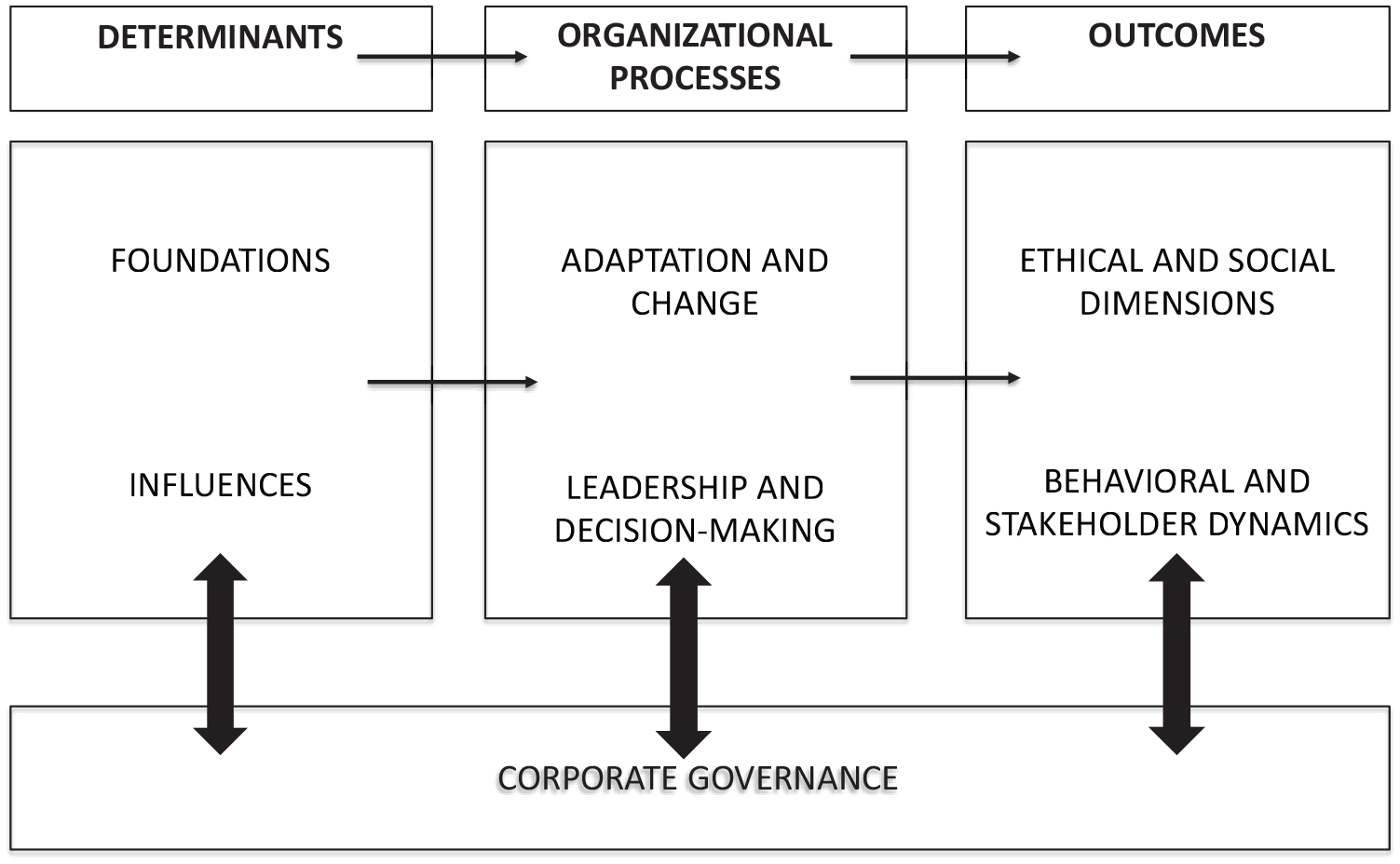
Corporate governance research.
In Table 1, we show the three key areas and their respective subcategories, offering an integrated overview of corporate governance research. We also list the review articles that focus on these different subcategories. Below, we highlight the main ideas in this existing large body of research.
Main topics in corporate governance.
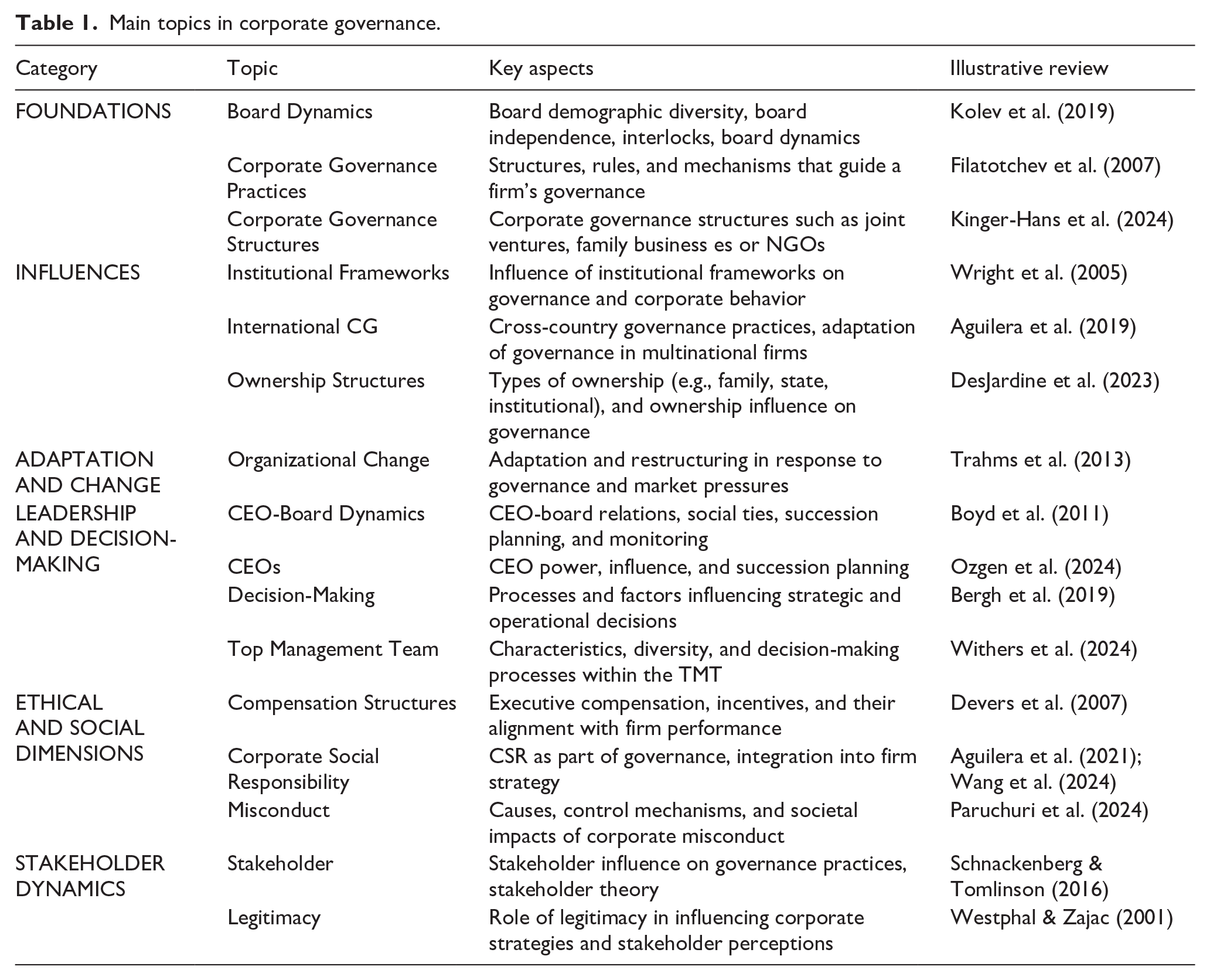
We identify two main bodies of work within Determinants: Foundations and Influences. Corporate governance foundations focus on the internal structures that shape decision-making and strategy. A significant body of research has explored board dynamics, emphasizing factors such as demographic diversity, board independence, interlocks, and overall board functionality. These studies examine the critical role that boards play in overseeing and guiding corporate strategies (Kolev et al., 2019). In addition, corporate governance practices and structures, including joint ventures, family businesses, and non-governmental organizations (NGOs), have been widely studied for their influence on organizational performance (Filatotchev et al., 2007; Kinger-Hans et al., 2024).
External influences, such as institutional frameworks, further shape governance practices. Research demonstrates how regulatory environments and legal systems drive differences in corporate governance across contexts (Wright et al., 2005). As globalization expands, international corporate governance has gained prominence, emphasizing cross-country practices and the adaptability of multinational firms to diverse institutional frameworks (Aguilera et al., 2019). Ownership structures, including family, state, and institutional ownership (big three), also significantly affect governance decisions and organizational strategies (Aguilera, Crespi-Cladera, et al., 2024; Aguilera, Desender, & LopezPuertas-Lamy, 2024; DesJardine et al., 2023).
The second block is Organizational Processes, which it is composed of Adaptation and Change and Leadership. Under Adaptation and Change, organizational processes center on firms’ ability to adapt and evolve. Adaptation often requires changes in governance structures to address external and internal pressures. This capacity for organizational change is critical to maintaining competitiveness and long-term success (Trahms et al., 2013).
Leadership plays a pivotal role in shaping organizational trajectories. Research has extensively examined CEO-board dynamics, focusing on succession planning, social ties, and monitoring mechanisms (Boyd et al., 2011). In addition, the influence and power of CEOs have been linked to strategic outcomes and organizational performance (Ozgen et al., 2024). Decision-making processes and the factors that influence them have also frequently been examined to understand how governance affects corporate actions (Bergh et al., 2019). Moreover, research on top management teams has investigated the characteristics, diversity, and decision-making processes within these teams, providing insight into how leadership influences firm trajectories (Withers et al., 2024).
The third block refers to Outcomes, and it encompasses Ethical and Social Dimensions, and Behavioral and Stakeholder Dynamics. Ethical dimensions of corporate governance, such as executive compensation structures, have been studied for their role in aligning managerial incentives with organizational goals (Devers et al., 2007). Corporate social responsibility (CSR) remains a cornerstone of governance research, with studies emphasizing its integration into firm strategies to address societal expectations (Aguilera et al., 2021; Wang et al., 2024). Furthermore, research on corporate misconduct highlights the societal and organizational impacts of unethical behaviors and the mechanisms for controlling such practices (Paruchuri et al., 2024). On the Stakeholder Dynamics area, research on stakeholder engagement reflects the growing recognition of the importance of how organizations respond to diverse stakeholder demands (Bacq & Aguilera, 2022; Bridoux & Stoelhorst, 2022; Schnackenberg & Tomlinson, 2016). Similarly, other topics explored include legitimacy as a key aspect of governance, focusing on how firms adapt and restructure in response to governance and market pressures to maintain their social and economic relevance (Trahms et al., 2013; Westphal & Zajac, 2001).
Together, these areas of research illustrate the breadth of the corporate governance literature and its evolution. While traditional governance research has extensively focused on the role of boards, shareholder control mechanisms, and compensation structures, other areas such as CSR, stakeholder engagement, and international corporate governance reflect the field’s adaptation to emerging global challenges. These studies have shaped our understanding of how governance influences organizations and their alignment with stakeholders, contributing to the field of management.
New challenges, new paradigms
In the current rapidly changing landscape, practitioners and scholars have identified some shortcomings in corporate governance practices, including insufficient attention to broader stakeholder interests, limitations in board effectiveness, and challenges in managing complex global operations within disruptive environments. New voices have emerged, challenging the previously accepted assumptions and questioning what has traditionally been considered correct. For example, in September 2024, a Harvard Business Review article by Tingle, advocated that “business leaders should re-consider the merits of inside directors,” challenging the traditional view that insiders compromise board independence and effectiveness. In this section, we identify some key new challenges and how they are requiring a shift from an old paradigm to a new one. These are also summarized in Table 2.
How key governance issues have shifted to a new paradigm.

In this new era of corporate governance, the traditional paradigms for assessing corporate performance are expanding beyond traditional financial metrics to include a wider variety of non-financial metrics. This change reflects an increasing awareness of the multidimensional nature of performance, necessary to drive and sustain success over time in a complex global landscape. According to Aguilera, De Massis, et al. (2024), corporate governance structures must now integrate advanced metrics that evaluate ESG factors, innovation capacity, and employee engagement levels, positioning these as critical to long-term strategic goals. This new paradigm calls for a transformation in governance models to not only monitor but also incentivize the achievement of this broader set of performance outcomes.
The role of corporate boards has become increasingly central in fostering trust among shareholders and ensuring companies’ long-term success. While there seems to be a growing consensus that boards must move beyond the narrow pursuit of shareholder value maximization, the concept of corporate purpose has gained prominence. This new paradigm highlights the generation of social value as a key element of long-term value creation. A demonstration of this shift is the already referenced 2019 BRT statement on “the purpose of a corporation,” emphasizing a commitment to all stakeholders. However, the integrity of this statement has sparked considerable debate. Research reveals that the vast majority of signatory firms did not have their boards approve joining the statement, and only a few companies had formally modified their corporate governance documents to reflect a commitment to broader stakeholder interests (Bebchuk & Tallarita, 2020a, 2020b). These findings raise concerns about the depth of the firms’ commitment to the new purpose, showing more concern about public relations than substantive changes with actual governance actions, highlighting a significant gap that questions the true intent behind the statement. These discussions underscore the importance of integrating sustainability and corporate purpose substantially into board-level strategies, which requires not only a cultural shift within organizations but also the implementation of regulatory frameworks and incentive mechanisms that align corporate goals with societal expectations.
The core responsibilities of corporate boards have remained essentially unchanged: leading strategy development, identifying strategic opportunities, assessing and managing risks, choosing and incentivizing leadership, ensuring strong performance, and maintaining relationships with stakeholders and shareholders. These foundational mandates serve as the cornerstone of effective governance. However, the changing global landscape has introduced complexities that demand a recalibration of how boards approach these responsibilities, presenting new challenges and opportunities. Thus, boards today must navigate an increasingly fragmented environment. Geopolitical divisions threaten the stability of global supply chains, while political polarization within countries heightens the risks of policies that may alienate key stakeholders. For example, corporations such as BlackRock have faced public scrutiny, exposing the delicate balance between corporate strategies and shifting political climates. Disney, as another example, has recently been involved in a political controversy with regards to Florida’s “don’t say gay” bill. Initially, the organization refrained from taking a public stance, but following social pressures they opposed it, leading to political consequences, including actions that targeted the special district status of their theme parks. Economic fragmentation further exacerbates these challenges, as trade barriers and capital market shifts are altering the financial landscape. Addressing this fragmentation requires boards to rethink their risk management strategies. To deal with this “radical uncertainty” (Kay & King, 2020), traditional probabilistic tools are not useful to predict future risks, making it necessary for boards to adopt innovative approaches to thrive in this volatile environment.
Corporate scandals have also altered the landscape of corporate governance. According to EY’s 2024 Global Integrity Report, firms in the United States and the United Kingdom have paid over one trillion dollars in penalties since 2010, with violations and the number of companies involved growing by over 40%. Some of these recent incidents include Wells Fargo consumer fraud from 2002 to 2016, creating millions of unauthorized savings and checking accounts; Boeing’s misevaluations of their 737 Max safety that led to catastrophic accidents and multiple demands; and Glencore, a European mining firm ordered to pay more than 150 million dollars after a bribery case in Congo. As a result, there is more intense regulatory oversight and greater expectations among stakeholders for transparency and accountability. Corporate governance structures, as a response to such scandals, have to put in place stronger oversight mechanisms. Some examples of these mechanisms could be an independent ethics committee, leveraging technology to improve oversight, and stronger repercussions for unethical activities. These reformed corporate governance structures would be better positioned to identify and prevent misconduct.
Ownership structures have also shifted and further complicated corporate governance. Concentrated ownership accompanied by dual-class shares can marginalize minority shareholders, while dispersed ownership may lead to inefficiencies and a lack of accountability. These conflicts of interest highlight the need for regulation to balance shareholder control rights with the protection of a broader set of stakeholders. In this context, shareholder agreements and market-level regulations play a crucial role in addressing these challenges, promoting transparent and well-governed organizations. Besides, the growth of private markets in debt and equity has transformed traditional corporate governance paradigms. Boards are also facing structural pressures from evolving market dynamics, such as the rapid accumulation of assets in passive funds managed by entities like the “big three” in the United States. These funds, which aim to match index performance rather than outperform it, lack incentives to promote substantial long-term corporate change. In addition to this, the role of third-party proxy advisors (ISS and Glass Lewis) also holds significant influence over boards’ decision-making, often influencing important strategic decisions without even holding a direct stake in the companies they advise.
At the same time, companies are facing increasing demands for disclosure, such as the SEC’s regulation linking performance to executive remuneration, which have produced mixed results, sometimes adding compliance burdens without delivering the intended benefits. The European Union has already passed new regulation on diversity in boards and extensive regulation on dual materiality and sustainability that some of it will go global.
Another important vector is substantive changes related to the sustainability agenda which seems to have reached a point of fatigue. While the integration of ESG factors remains crucial, there is a growing argument that governments and policymakers should take on greater responsibility for managing externalities, reducing the burden on corporations. Navigating this debate requires boards to balance their dedication to sustainability with an acknowledgment of the boundaries of corporate responsibility in addressing systemic challenges. As a result of these societal debates, some companies are retracting in their commitments to DEI and others experiencing anti-ESG backlash. As a consequence, one of the pressing challenges for boards is navigating the risks of greenwashing and social washing, where corporations overstate their environmental or social goals without meaningful action or steps to implement the goals. These communication practices erode stakeholders’ trust and highlight the need for prioritization in addressing sustainability goals. Limited resources make it essential for corporations to prioritize initiatives that truly align with both their core values and stakeholder expectations, avoiding superficial measures that hinder meaningful long-term progress.
In sum, when it comes to new challenges and new paradigms, at the macro level, rapid growth fueled by private equity and accelerated funding cycles has introduced a cultural deficit within corporations. Traditional methods of gradual growth and organizational integration are giving way to fragmented cultures where boards are struggling to understand the nuances of rapidly growing corporations. This disconnect calls for new tools and approaches to bridge cultural gaps, fostering alignment across diverse teams. Technological disruptions add another layer of complexity to corporate governance, requiring boards to stay informed and agile in adapting to digital transformation and facing the challenges of global virtual teams.
In this evolving landscape, at the organizational level, the role of corporate boards is more critical than ever. By addressing the fragmented environments, embracing new funding realities, and equipping themselves with innovative tools, boards can uphold their responsibilities while preparing for the future of governance. In addition, boards must foster trust, sustainability, and stakeholder alignment. Balancing competing demands requires not only strategic planning but also a regulatory framework that promotes accountability, incentivizes long-term value creation, and minimizes conflicts of interest. By addressing these issues, boards can reinforce their pivotal role in corporate governance while advancing societal and shareholder interests alike. This raises a critical question: What does the future hold?
Future research. The pieces of an updated framework
In this section, we turn our attention to future research, proposing new areas that could enrich our understanding of the evolving corporate governance landscape, given what we have discussed in the other sections. By highlighting emerging questions and underexplored topics, we aim to inspire further studies that push the boundaries of current knowledge and address the gaps identified in existing research. These suggestions serve as a roadmap for scholars looking to delve deeper into the complexities of the field and uncover fresh insights. In particular, we propose that the updated corporate governance framework needs to incorporate the following nine pieces, and in Table 3, we pose some relevant research questions.
Updated corporate governance framework pieces: Potential research questions.

Shareholder activism
Activism has become a strong force in shaping corporate governance, yet it remains a relatively nascent area in management research. Various pressures influence corporate practices nowadays, ranging from stakeholder activist campaigns embedded in social movements to shareholder activism from investors. On one hand, stakeholder activism accounts for a wide variety of stakeholders who use multiple methods to exert pressure. Employee activism reflects workers’ push for change within organizations not only in terms of workplace conditions but also in broader corporate policies. Similarly, social movement campaigns mobilize public actions against the organizations’ wrongdoing, to pursue meaningful changes, often gathering the collective power of various stakeholders such as consumers and employees. A powerful example of such activism is public boycotts, where consumers refrain from purchasing products or services in response to organizations’ policies or practices.
On the other hand, various forms of shareholder activism have emerged, such as shareholder divestment, hedge fund activism, and formal shareholder proposals. As shareholder activism grows, the complexity of its influence on corporate governance also raises. Recent regulatory changes have led to a surge in the number of shareholder activism campaigns, setting records for the number of initiatives pursued but at the same time raising questions about their actual substantive impact. Organizations increasingly express concerns that the escalation in activism has led to a disproportionate allocation of time and resources toward legal and administrative tasks, which could otherwise be employed in fostering real organizational change.
Growth of private markets
Global financial markets are facing the rise of institutional ownership, investments by mutual funds, pension funds, and insurance companies. The size of these investors and their influence are significantly shaping corporate governance and market dynamics. On one hand, the so-called “Big Three,” Blackrock, Vanguard, and State Street are leading this change. They manage trillions of dollars in assets, which entitles them with an unprecedented power. As a result, their voting behavior often sets trends in governance that affect the broader corporate world, even prompting changes among organizations they do not directly invest in. Moreover, this raises questions on the ethical challenges and potential conflicts of interests that arise with concentrated financial power and cross-holding or common ownership. On the other hand, passive investment strategies have also become increasingly popular among institutional investors. The shift from active to passive management leads to questions about the potential impacts on corporate governance, since these passive strategies usually lead to less involvement and oversight, potentially influencing accountability and performance.
Diversity and inclusion
Diversity and inclusion are no longer just ethical imperatives but rather critical elements in modern corporate governance. Diverse leadership teams have become essential to deal with the complexity and global challenges that companies are facing, since they facilitate decision-making processes. However, despite the growing awareness and advocacy, the way diversity within corporate boards and executive teams is approached remains inconsistent across industries and regions. Companies face barriers such as cultural norms, unconscious biases, and structural inequalities that interfere with the achievement of truly inclusive governance. While diverse leadership contributes to the emergence of varied perspectives that foster innovation and distinct decision-making processes, it also introduces challenges, such as integrating differing viewpoints and managing potential conflicts within more diverse teams.
Around the world, regulators have implemented a range of measures to promote diversity within corporate leadership, including quotas, targeted recruitment policies, and reporting requirements. However, while the push for diversity is widely supported, it also faces challenges. The intersectionality of various diversity dimensions and the proliferation of global virtual teams (GVTs) create additional layers of complexity. The commitment to these principles is essential for building resilient organizations that meet today’s corporate needs and can thrive in a complex global business environment, ultimately enhancing corporate performance but also contributing to a more equitable society.
Artificial intelligence and technology
One of the most pressing topics for both researchers and practitioners today is the rapid irruption of “extensively used” artificial intelligence (AI). The influence of this technological leap is disrupting our perception and expectations of the future of corporate governance. The effect of technological advancements extends deeply into decision-making processes within the boards and executives, raising questions about transparency and accountability, as well as potential ethical issues. Moreover, AI can homogenize innovation, leading to similar solutions among competitors, hindering originality, and disrupting competition. However, it has a strong potential to improve risk assessment models to better predict financial, operational, and reputational risks. The current lack of regulation offers both a challenge and an opportunity. Companies might exploit this absence of regulation to their advantage; however, when leveraged responsibly, AI also holds the potential to become a tool to streamline compliance. AI can facilitate a more robust adherence to global regulations, improving the accuracy and timelines of corporate reporting.
Fragmented global environment
The global landscape presents itself as increasingly fragmented, posing significant challenges and opportunities for the corporate governance of multinational firms as well as firms that rely on global sourcing. As geopolitical tensions escalate and political polarization intensifies, traditional frameworks for international cooperation are being tested. The rise of nationalism and regionalism, coupled with fluctuating alliances, further complicates the global landscape further, demanding a re-evaluation of how nations navigate these complex dynamics. Moreover, power distribution is now divided and significantly influenced by powerful non-political actors, such as international corporations and powerful shareholders. This paradigm introduces a new dynamic to the traditional geopolitics landscape, in which economic interests govern, intersecting with national sovereignty.
This heightened polarization demands robust mechanisms that encourage dialogue and reconciliation not just within countries but also between them. As we navigate these complex global dynamics, the importance of developing robust governance frameworks that can endure the challenges of a fragmented international landscape became more vital. These frameworks are crucial for ensuring resilience and adaptability, which are essential for maintaining global stability and fostering international collaboration.
Corporate governance across different types of organizations
Corporate governance structures differ significantly between public and private organizations. Public companies, which are listed on the stock exchanges, are subject to more strict regulatory standards and are required to maintain high levels of transparency. In contrast, private companies have greater flexibility in their governance structures, since having fewer stakeholders directly impacted by their operations allows them to operate with less regulatory oversight. In turn, this often results in private companies having faster decision-making processes and less bureaucratic overload, enabling them to adopt a more tailored approach to their governance structure that is better aligned with the organizations’ long-term goals.
Moreover, multiple and diverse types of organizations have emerged, each with unique operational challenges and goals. Hybrid organizations that aim to pursue dual goals, blending social impacts with financial viability, like European hospitals or social housing providers. Social enterprises, like TOMS or Warby Parker, with social goals as their primary purpose while being financially sustainable. NGOs such as Greenpeace focus purely on social aims without the intention of profit. Meanwhile, state-owned enterprises such as Fannie Mae are government-created or owned entities that balance social mandates with economic responsibilities.
These diverse organizations must navigate the complex balance between social and financial objectives, making governance structures crucial to align and support the pursuit of both goals without compromising one for the other. Moreover, such organizations require very high standards of both transparency and accountability, for example, to manage donations and funding. The political interference, the lack of autonomy, and the operational and competitive disadvantages are also some of the potential governance challenges that state-owned enterprises have to face.
Corporate governance innovations
The new corporate landscape necessitates innovative approaches to incentivize both employees and managers and to attract and retain talent. The workforce gathers a multigenerational workforce, each with distinct motivations and preferences, and the Gen Z is now joining. Junior and senior employees may have differences of opinions, since younger generations tend to put a greater relevance on sustainability topics which may challenge traditional business models. Moreover, the traditional focus on financial performance as the sole indicator of success is increasingly seen as inadequate. New indicators account now for environmental impact, social engagement, and ethical corporate governance, reflecting a broader definition of corporate success. To align with these broader key performance indicators (KPIs), incentive schemes also need to be restructured. An approach to incentives that encourages a more holistic view of success and drives behaviors that support long-term sustainability and ethical business practices, also aligned with a broader set of generations among the workforce, is crucial.
This introduces additional challenges when it comes to evaluating managers within this new, nuanced framework. Challenges that required to align the organizational design with the corporate governance goals. For example, performance reviews must now consider how effectively managers engage with and motivate a multigenerational team, how they contribute to advancing organizations’ non-financial goals, and how they adhere to ethical standards. Adopting this comprehensive approach to evaluation could help hold leadership accountable not only for financial outcomes but also for the broader impact of their decisions on stakeholders. These innovations in corporate governance are essential for organizations aiming to stay competitive in a rapidly changing business environment.
Comparative corporate governance
In comparative corporate governance research, mostly from political economy, there is a classic distinction between different types of capitalism, which in turn will shape the respective corporate governance systems. Capitalisms are defined by how market relationships are coordinated, the degree of state intervention, type of ownership, and labor market. Early research differentiated between Anglo-American or Liberal Capitalism versus Continental or Coordinated (Aguilera & Jackson, 2003), and subsequent work has included emerging markets as state-led versus family-led corporate governance models (Aguilera et al., 2018). This dichotomous typology to categorize corporate governance systems has been expanded based on the rights and types of ownership. A future area of research could explore as we summarize in Table 4 how the main global challenges identified in the introduction will affect corporate governance in organization across these four types of capitalism.
How different corporate governance systems adapt to global disruptions.

The board of the future
To navigate these challenges, boards must develop new competencies and more agility to quickly adapt to the rapidly changing environment and disruptive innovations. While some advocate for more technical expertise in boards, the essence of effective governance lies in maintaining balance, wisdom, and access to insider information rather than relying solely on specialized expertise. Boards should prioritize continuous training, dedicate time for in-depth strategic reflection, and leverage diverse perspectives to build resilience. The ultimate focus should remain on developing versatile, well-rounded leadership capable of navigating organizations through periods of uncertainty.
As previously depicted, a recent Harvard Business Review underlines the advantages of integrating more company insiders into boards. Bryce Tingle (2024) advocates for this approach, suggesting that insiders’ deep understanding of daily operations can significantly improve firm performance. Similarly, another recent publication by Bonini and colleagues (2024) calls for the inclusion of long-tenured directors on boards, highlighting their role in providing stability, depth of knowledge, and enhanced oversight. These insights into corporate governance suggest that the boards of the future will benefit from a mix of insider knowledge and long-term perspective.
Conclusion
In reflecting on the evolution of corporate governance and envisioning its trajectory into the future, we witness a critical shift toward integrating corporate purpose as a central element to guide strategic decisions. Traditionally, governance models have prioritized shareholder value, often at the expense of broader stakeholder interests. However, there is a growing agreement that substantive corporate success necessarily extends beyond financial returns to include societal concerns. Traditional corporate governance models require a fundamental reevaluation to remain relevant in a rapidly evolving and complex global business landscape.
Looking forward, the future of corporate governance lies in its ability to adapt and realign with a more holistic understanding of corporate governance as a system, not only through incremental adjustments but also with profound shifts in companies’ structure, values, and processes. This deep organizational transition requires a re-evaluation of traditional roles and responsibilities within organizations and boards, to include wider stakeholder engagement and more robust mechanisms to ensure firms’ adherence to their objectives and purpose.
The shifting landscape is further marked by regulatory changes and increasing political polarization, placing organizations under growing pressure to adapt their strategies to meet the evolving expectations of their stakeholders and investors. This essay outlines a forward-looking perspective on corporate governance, delving into how organizations will handle the pressing challenges ahead. A comprehensive understanding of these dynamics, together with their broader economic, societal, and environmental ramifications, is crucial. With our approach, we propose several critical questions about the future pathways and potential transformations in the corporate governance field.
Footnotes
Declaration of conflicting interests
The author(s) declared no potential conflicts of interest with respect to the research, authorship, and/or publication of this article.
Funding
The author(s) disclosed receipt of the following financial support for the research, authorship, and/or publication of this article: The second author thanks the financial support from: ERDF/UE; Grant PID2022-138331NB-I00 funded by MICIU/AEI /10.13039/501100011033 and by ERDF/UE; and Grant TED2021-129829B-I00-funded by MICIU/AEI/10.13039/501100011033.
