



Abstract
Self-managing organizations, characterized by flat hierarchies and decentralized power, are expected to empower and engage employees. In contrast, critics argue that a lack of structure could cause confusion and increased stress and burnout. However, neither assumption has been quantitatively tested. Furthermore, the concept of self-management remains ambiguous, and validated scales have been lacking. Addressing this, we conducted two quantitative studies, one with employees from several organizations (N = 425) and another with a nationally representative sample (N = 2,000). First, we distinguish between organizational and employee self-management and develop validated scales for both. Next, we examine their relations to work engagement and burnout, finding that both types of self-management are positively related to work engagement and negatively to burnout. Both types of self-management were also indirectly related to work engagement and burnout via job challenges and job hindrances. Our study clarifies and quantifies what self-management is and suggests it can benefit employee well-being.
Introduction
In a quest to increase employee engagement, proactivity, and creativity, self-managing organizations (SMO) have gathered much attention in recent years by challenging the orthodoxy around bureaucratic hierarchy with their flat and decentralized organizational structures (Bernstein et al., 2016; Billinger & Workiewicz, 2019; Martela, 2019). Defined as organizations that “radically decentralize authority in a formal and systematic way throughout the organization” (Lee & Edmondson, 2017, p. 39), SMOs aim to reanimate the old promise of increased productivity through employee emancipation and engagement (see Grote & Guest, 2017; Trist & Bamforth, 1951). The companies that have taken self-management furthest—examples include Buurtzorg, Morning Star, and Reaktor—have all eliminated middle management, leading to very flat, decentralized organizations where autonomous, self-directed employees and teams have authority to make independent decisions ranging from goal setting and customer acquisition to recruitment, purchases, and salaries (Bernstein et al., 2016; Lee & Edmondson, 2017; Martela, 2022). In contrast to self-managing teams that often operate within bureaucratic organizations (Barker, 1993; Cohen & Ledford, 1994), SMOs distribute the power and authority typically residing within higher levels of management to the whole organization.
SMOs are expected to offer increased employee motivation, engagement, and commitment (Bernstein et al., 2016; Martela & Kostamo, 2018). Research on work engagement, a positive motivational state at work, has previously demonstrated that autonomy (Van den Broeck et al., 2010) and team empowerment (Hakanen et al., 2021a) are predictive of higher levels of work engagement, thus suggesting that SMOs would also support work engagement. Crucially, it is through this increased employee proactivity and commitment that SMOs are supposed to deliver higher levels of innovativeness, agility, and profitability (Bernstein et al., 2016; Hamel, 2011). Indeed, research on work engagement has previously demonstrated that employee autonomy is related to higher performance through work engagement (Bakker & Bal, 2010). Conversely, lack of choice and control over one’s work has been identified as a contributor to increased burnout at work (Fernet et al., 2004; Taris et al., 2005). However, thus far, this promise of increased engagement and less exhaustion through self-management hangs on a few case studies (Hamel, 2011; Lee & Edmondson, 2017) and has not been tested through quantitative analysis—something that the present study aims to remedy.
At the same time, critical voices have emerged to highlight that self-management might not be as rosy as its advocates paint it (Foss & Klein, 2022). Hierarchies arguably fulfill “deep-seated needs for order and security” by providing clear lines of command and predictability to employees, and thus attempts to abandon them can be stressful (Pfeffer, 2013, p. 272). Too much autonomy can be detrimental to well-being (Stiglbauer & Kovacs, 2018), leading to suggestions that not all job autonomy is good for employee well-being (Hakanen et al., 2021a; Seppälä et al., 2020). Accordingly, one could also argue that too much self-management leads to uncertainties, stress, and eventually to increased occurrence of burnout. However, this hypothesis has not been tested either.
Using two different types of samples, employees from several organizations (Study 1) and a nationally representative sample of Finnish employees (Study 2), we aim to answer these calls to examine whether self-management is positively related to work engagement or burnout. However, given the conceptual ambiguity and lack of scales directly measuring self-management, the first contribution of the present article is to make a conceptual distinction between two types of self-management—employee self-management (ESM; related to decision rights granted to individual employees) and organizational self-management (OSM; related to the overall level of decentralization)—and to develop scales for both.
Second, this article offers the first quantitative study examining the practices of SMOs in a nationally representative study. Thereby, we complement existing qualitative case studies.
Third, this study is first to examine how the level of two types of self-management is related to work engagement and burnout. Thus, we examine both the potential positive and negative well-being correlates of self-management.
Fourth, we examine how self-management is related to job challenges (energy-consuming but stimulating aspects of work) and job hindrances (energy-consuming obstacles at work), and whether these mediate the potential well-being consequences. These conceptual and quantitative contributions on the well-being implications of decentralization have also important practical implications in modern work-life where such self-managing structural arrangements are becoming increasingly popular while employee well-being is the critical asset of organizations.
SMOs: distinguishing OSM and ESM
SMOs are organizations that have decentralized decision-making authority formally and systematically throughout the organization (Lee & Edmondson, 2017; Martela, 2019). Thus, in comparison with self-managing teams that have been extensively researched (Cohen & Ledford, 1994; Magpili & Pazos, 2018), but that often are pockets of self-management constrained by the larger bureaucratic structures, SMOs are “applying the principles of self-management to entire institutions” (Bernstein et al., 2016, p. 42). The rise of increasing self-management has been attributed, for instance, to more rapidly changing business environments requiring quicker adaptability and a more professionalized workforce requiring more autonomy (Martela, 2022).
However, while SMOs have gathered increased attention both academically (Billinger & Workiewicz, 2019; Klapper & Reitzig, 2018) and among business professionals (Bernstein et al., 2016; Hamel & Zanini, 2020), the term is often used in a relatively loose way referring to many different types of organizational arrangements making it hard to pinpoint what exactly is required to make an organization self-managing. In particular, when talking about self-management in organizations, two separate perspectives on the phenomenon are easily intermixed: organization-level structural decentralization and employee-level decision rights.
First, as regards the structures of the organization, following Lee and Edmondson (2017), we define OSM as the formal decentralization of decision-making authority systematically and radically throughout the organization. Thus, self-management refers to how decentralized the organization is in terms of authority and decision-making power, and how much the employees and teams are operating without any designated supervisors (Klapper & Reitzig, 2018; Martela, 2019).
Second, from the point of view of the employees, self-management refers to how much independent decision-making rights and power they have. For ESM, it does not matter how many layers there are above employees or what structural arrangements the organization has chosen. What matters is how much power and decision-making rights the employee in question has. These rights granted (or not granted) can be about (1) execution rights, referring to the ability to decide autonomously how one pursues one’s targets and goals; (2) direction-settings rights, where the individuals and teams not only decide how the work is performed and goals achieved but what goals to pursue in the first place; and (3) organizational development rights, which are about whether the employees have a saying over the organizational-level goals and strategy and how the organization is structured and operating. ESM is thus about the rights over how one executes one’s tasks, what tasks to pursue, how the work is arranged and resourced, and about rights to participate in the development of organizational practices and structures. In emphasizing rights to participate in the management of the organization, ESM is distinct from such constructs as a sense of self-determination and autonomy (Deci et al., 2017) and team empowerment (Kirkman & Rosen, 1999), which are about how employees feel and not about the rights granted to them, and from constructs that are about how the employees “influence themselves,” such as self-leadership (Houghton & Neck, 2002, p. 672). It is also distinct from job resources such as job autonomy which is about employees’ rights to have an influence on their own ways of working (Hackman & Oldham, 1975) but not about participating in the management of the organization.
The two perspectives, OSM and ESM, are connected and complement each other. An organization decentralizing authority and distributing the rights and responsibilities for decision-making power will provide employees and teams more rights to decide over their work. However, discrepancies are also possible. An organization with relatively traditional, hierarchical structures might be able to increase employee authority to self-manage by changing the power relationships between employees and their supervisors, by encouraging the supervisors, for example, to take more of a servant leadership attitude, without having to touch the organizational structures as such. On the other hand, a formally relatively decentralized organization might have hidden hierarchies and implicit power dynamics that nevertheless make the employees experience insufficient rights that they formally are supposed to have. Accordingly, these are two complementary, related yet distinct, perspectives on self-management. Therefore, we expect the following:
Hypothesis 1. OSM and ESM will be positively related but distinct from each other.
The relationship between self-management and work engagement
Those advocating SMOs often emphasize the positive effects on employee motivation and initiative that such organizations are supposed to have (Bernstein et al., 2016; Hamel, 2011; Lee & Edmondson, 2017). The decreased external control and increased empowerment are supposed to lead to more engaged employees taking responsibility for their own performance in autonomously striving toward the common goal (Martela & Kostamo, 2018; McGregor, 1960). Work engagement is defined as a positive, fulfilling, emotional, and motivational state of work-related well-being, characterized by vigor, dedication, and absorption (Schaufeli et al., 2002), with a large body of research demonstrating its importance for performance and productivity (Bakker et al., 2012; Xanthopoulou et al., 2009), employee mental health (Hakanen & Schaufeli, 2012), and even to (less) unemployment and (less) disability pensions (Hakanen et al., 2021b).
Self-management arguably increases the sense of empowerment and autonomy that employees experience by giving them more authority to govern their own work. Previous research has shown that such states of empowerment and autonomy are indeed connected to increased work engagement. For example, a longitudinal dominance analysis demonstrated that team empowerment has a strong impact on work engagement (Hakanen et al., 2021a). As regards autonomy, already job characteristics theory proposed that it is a crucial characteristic for positive motivational states at work (Hackman & Oldham, 1980) and many studies have since demonstrated that autonomy is important for work engagement (Van den Broeck et al., 2010, 2017). Thus, having the organization provide more room for self-management can be argued to increase work engagement. Accordingly, the second hypothesis is as follows:
Hypothesis 2. OSM and ESM will be positively related to work engagement.
The relationship between self-management and burnout
In addition to increasing work engagement, self-management could also decrease burnout. Lack of control over one’s work has been identified as one key contributor to burnout (Taris et al., 2005). Having more choice and voice on how to do one’s work could thus act as a protective factor that helps employees cope even when the workload is high (Fernet et al., 2004). Given that self-management focuses on the organization giving the employees more power over their work, one could thus argue that self-management is related to less burnout. Accordingly, we hypothesize the following:
Hypothesis 3. OSM and ESM will be negatively related to burnout.
However, there are also voices suggesting that too much self-management can actually be detrimental to employee well-being and increase the risk of job burnout. There are at least three lines of arguments that can be made for a positive link between self-management and burnout. First, too much self-management can be experienced as chaotic, when the lack of structure, clarity, and coordination leaves the employees too much on their own devices, feeling abandoned and not knowing what is expected of them. Role ambiguity has been associated with increased job burnout (Vullinghs et al., 2020) and if self-management would lead to such a lack of role clarity or clear goals and structures, it could increase job burnout. Second, some argue that hierarchies are natural for humans, fulfilling deep-seated needs for security and order, and thus having to operate in non-hierarchical environments can be stressful for humans (Pfeffer, 2013). Third, research on autonomy and work engagement has sometimes provided mixed results (Seppälä et al., 2020), with some research demonstrating that too much autonomy can be detrimental to well-being (Stiglbauer & Kovacs, 2018), leading to suggestions that not all job autonomy is good for employee well-being (Hakanen et al., 2021a; Seppälä et al., 2020). Thus, it could be argued that the relationship between self-management and burnout might not be linear but curvilinear: Too little self-management may be detrimental to well-being—but too much self-management could also deteriorate well-being. Due to these conflicting claims, we decided to explore the shape of the relationship between self-management and burnout, to check the robustness of a potential linear association.
The relations of self-management with challenge demands and hindrance demands
All jobs contain various demanding characteristics that burden and challenge the employees that are, in general, associated with psychological costs such as exhaustion and burnout (Bakker & Demerouti, 2007). An important distinction has been made, however, between two separate types of job demands: job challenges and job hindrances (LePine et al., 2005; Podsakoff et al., 2007). Job challenges are energy-depleting yet stimulating parts of the job, including demands like workload and high cognitive demands. Although excessive levels of job challenges can be burdening, employees typically seek a certain level of challenges in their job to make it interesting, motivating, and stimulating. Thus, job challenges are typically positively associated with work engagement. Job hindrances, in turn, are threatening obstacles to work, which by and large only have negative consequences as regards less engagement and more exhaustion. Typical job hindrances include red tape, interpersonal conflict, role ambiguity, and job insecurity. Therefore, we expect that the following:
Hypothesis 4a. Job hindrances will be positively related to burnout and negatively to work engagement.
Hypothesis 4b. Job challenges will be positively related to work engagement and negatively to burnout.
Self-management is arguably differently related to job challenges and job hindrances. The increased authority over one’s work means that there is typically less red tape and other bureaucratic hindrances preventing one from doing one’s work (Lee & Edmondson, 2017). Thus, self-management can be expected to be related to fewer job hindrances. This also means that a key reason why self-management might be related to less burnout is the lower amount of job hindrances, thus making job hindrances a potential mediating factor between self-management and lower burnout. Accordingly, we formulated the following hypotheses:
Hypothesis 5a. OSM and ESM will be negatively related to job hindrances.
Hypothesis 5b. Job hindrances will mediate the relation between both organizational and ESM, and burnout.
On the other hand, the increased authority and responsibility over one’s work that self-management entails is prone to make the work more challenging, thus having a positive relationship with job challenges. Thus, one central reason why self-management could increase work engagement is that it provides a more challenging and stimulating work experience. This means that job challenges could be a mediator between self-management and work engagement. Accordingly, we will test the following hypotheses:
Hypothesis 6a. OSM and ESM will be positively related to job challenges.
Hypothesis 6b. Job challenges will mediate the relationship between OSM/ESM and work engagement.
Study 1
Given that validated scales measuring ESM and OSM did not exist at the initiation of this project, the first task of the present investigation was to develop such scales. To that end, based on the theoretical literature, we generated several items for both aspects of self-management, and then examined them empirically in a sample partly drawn from the general audience and partly from five organizations identified by researchers as particularly self-managing. Besides psychometric examinations, we also tested whether ESM and OSM scores would be higher in the subsample from SMOs compared to the general subsample, as that would give evidence for the ability of the scales to capture differences in self-management between organizations.
Materials and methods
The sample was gathered in accordance with the recommendations of the Research Ethics Committee of Aalto University. In accordance with the Declaration of Helsinki, we sought informed consent from all study participants, and they gave their consent anonymously in the online form. First, the questionnaire was administered to all employees of five organizations in Finland that were selected to be part of a research project on the topic of self-management led by Tampere University based on the research team evaluating their practices and determining that they had low levels of hierarchy and had given unusually much discretionary power to the frontline employees (Tampere University, 2020). The organizations included a software company with ~30 employees (13 respondents), a software company with ~100 employees (27 respondents), a public library with ~70 employees (47 respondents), a digital marketing and analytics company with ~20 employees (10 respondents), and a quality measurement and inspections company in the construction industry with ~25 employees (18 respondents), for a total of 116 respondents, which represented 49% of their combined employee count. In addition, the survey was advertised through various social media platforms to gather responses from participants not specifically working in SMOs. Participants were asked to answer a brief survey about their work to help science and no compensation was provided. All in all, 309 participants answered the survey this way. The combined total sample size from these two sources was thus 425. Of these participants, 70% reported being female, 28% male, and 1% did not want to say. As regards age, 30% were under 35, 38% were between 35 and 44, 21% were between 45 and 54, and 11% reported being 55 or over.
ESM and OSM
Based on the theoretical definitions and a review of the relevant literature, we generated a pool of items for both ESM and OSM. These items aimed to be face valid and they were reviewed and discussed by the authors to ensure that they were consistent with the definitions of the constructs, and together covered the constructs broadly enough. All in all, from an initial pool of items, we included 13 items for OSM and 14 for ESM that were judged to be clear in item content and correspond with the definitions of the constructs. OSM items included four items related to general evaluations of lack of hierarchy in the organization (e.g., “How hierarchical is your workplace?” on a scale from 1 “very non-hierarchical” to 5 “very hierarchical”), and nine items that asked who is allowed to participate in the decision-making around various issues ranging from strategy to rewarding and recruitment evaluated on a scale from 1 (everybody starting from individuals and teams) to 5 (only top management). ESM, in turn, included four items related to execution rights, six items related to direction-setting rights, and four items related to developmental rights evaluated on a scale from = 1 fully disagree to 7 = fully agree.
Work engagement
We measured work engagement with the three-item version of the Utrecht Work Engagement Scale (UWES-3; Schaufeli et al., 2019), Cronbach’s α = .80.
Statistical analysis
To examine the initial pool of items for OSM and ESM, with the aim of retaining the best-performing items, a three-step process was utilized separately for both scales: (1) Examine the psychometric properties of the individual items, removing items with standard deviations below 1.0, the skewness and kurtosis values greater than 2.0, or with means less than 1.0 apart from the minimum and maximum of the scale. (2) Examine items as one scale, removing any items with item-total correlations of less than .50. (3) Examine items in a confirmatory factor analysis (CFA) using the maximum likelihood estimator with robust standard errors (MLR), to see whether the fit is satisfactory (comparative fit index (CFI) > .90, Tucker–Lewis index (TLI) > .90, root mean square error of approximation (RMSEA) < .10, standardized root mean square residual (SRMR) < .10). If not, delete items with highest modification indices to arrive at a scale with a satisfactory fit.
Results
We started the analysis by examining the psychometric properties of the individual items of the OSM scale, with all items seen as satisfactory, so no items were flagged for deletion based on this step. For OSM, the results for two subscales are shown, as that fit the data better (see online supplementary file for unidimensional results).
In the first step, we examined the four general OSM items and nine specific OSM items as two separate subscales. We examined the four items of general OSM, finding that the composite reliability (cr) was .77 and Cronbach’s alpha (α) was .74, with all item-total correlations above .60, except for one item, whose correlation was .30. This item was discarded. Examination of the three-item general OSM scale demonstrated good reliability (α = .81, cr = .81) with all item-total correlations above .62. A similar examination of the nine-item specific OSM found good reliabilities (α = .85, cr = .80) but one item with .26 item-total correlation. That item was discarded, and the subsequent eight-item scale had good reliabilities (α = .86, cr = .87) with all item-total correlations above .51.
In the third step, a hierarchical factor model with first-order factors for general and specific OSM was fit to the data. The model fits were satisfactory, χ²(df = 43) = 140.91, p < .001, CFI = .95, TLI = .93, RMSEA = .079, SRMR = .046. The reliability of the overall scale was good (α = .90, cr = .90) and omega hierarchical was acceptable at .75. Thus, the OSM scale seems to be an internally coherent measure of OSM.
An examination of the individual items of the ESM scale found their psychometric properties satisfactory, so no items were deleted, and similarly, when examining all items as one scale, all item-total scores were above 0.50, so no items were removed. Based on a subscale analysis (see online supplementary material), we deleted three items that were deemed theoretically incongruent as they loaded on a theoretically inconsistent factor. CFA with the remaining 11 items being part of the same factor had poor fitness, χ²(df = 44) = 509.43, p < .001, CFI = .83, TLI = .79, RMSEA = .18, SRMR = .08.
The poor performance of the scale led us to examine modification indices, with the aim of removing items with modification indices above 10 with some other item. This led to the removal of five items to arrive at a more parsimonious scale with six items and a better fitness, χ²(df = 9) = 35.60, p < .001, CFI = .97, TLI = .95, RMSEA = .089, SRMR = .036. This scale had the advantage of being significantly briefer, which increases its usability in the future. It had satisfactory reliability (α = .84, cr = .85) and correlated at .97 with the longer 11-item scale, demonstrating that it taps into the same overall construct.
To examine the validity of the scale and to provide an initial test of the connection between work engagement and self-management, we calculated the zero-order correlations, finding that both the aggregated 11-item OSM scale and the 6-item ESM scale correlated positively and significantly with work engagement (.22 and .26, respectively).
Finally, to test the ability of the new scales to detect meaningful differences in the degree of self-management, we compared the means of the subsample gathered from the ostensibly SMOs with the means gathered from the other, more generic subsample. Independent samples t-tests yielded significant differences for both the aggregate OSM scale and the six-item ESM scale. In generic organizations, the average OSM was 2.99 (SD = 0.78), while in SMOs, it was 3.89 (SD = 0.60), t(422) = 11.4, p < .001, Cohen’s d = 1.24. The average ESM in generic organizations was 3.24 (SD = 1.32), and in SMOs, 4.80 (SD = 1.17), t(419) = 11.18, p < .001, Cohen’s d = 1.22. The differences were also substantial in size, 0.90 for OSM on a scale from 1 to 5, and 1.56 for ESM on a scale from 1 to 7. This demonstrates that the scales can indeed detect meaningful differences between people working in generic organizations and people working in organizations that are particularly self-managing. In fact, t-tests of individual items from both scales revealed that the difference was significant (p < .001) and in the predicted direction for 10 out of 11 OSM items (for 1 OSM item, the difference was in the right direction but only approaching significance, p = .08) and for all 6 ESM items (p < .001).
Brief discussion
The aim of Study 1 was to develop scales to measure ESM and OSM and provide an initial examination of their psychometric properties. As regards the 11-item OSM scale, all the included individual items demonstrated satisfactory psychometric properties with the overall scale having good reliability (α = .90, cr = .90, ωh = .75) and satisfactory fit in the CFA. Similarly, the six-item ESM scale had individual items with satisfactory psychometric properties as well as the overall scale showing satisfactory reliability (α = .85, cr = .85). Positive correlations with work engagement, in turn, provided initial evidence that self-management is positively related to well-being. Most importantly, both the OSM and the ESM scales were able to detect meaningful and substantial differences between people working in generic organizations and in more SMOs, with employees in the latter reporting higher levels of OSM and ESM. Not only were the differences statistically significant, but relatively large: Cohen’s d for OSM was 1.24 and for ESM 1.22. This increases confidence in the ability of the scales to measure what they aim to measure.
Study 2
The second study aimed to continue the psychometric validation of the OSM and ESM scales. For this purpose, we used a longitudinal sub-sample to examine test-retest reliability and scale invariance over time. In addition, the sample was used to test the study hypotheses as regards the relations of ESM and OSM with work engagement, burnout, challenge demands, and hindrance demands.
Materials and methods
The sample for this study was gathered by Feelback Oy, a professional survey organization, with the aim of getting a nationally representative sample of the Finnish working-age population. The study was conducted in accordance with the recommendations of the Research Ethics Committee of Aalto University, with participants giving informed consent. In total, 1,500 Finnish participants answered the survey through a web-based panel, with 500 more answering through phone interviews, to ensure a sample that would be nationally representative in terms of age, gender, and region. The age of the participants ranged from 18 to 65 years old (M = 42), with 51% of respondents reporting being females and 49% males, and 44% having a bachelor’s degree or higher level of education. Due to our interest in organizational factors, the participants who employed themselves as private entrepreneurs (N = 31) were excluded from the analyses, for a final sample of 1,969. In addition, a sub-sample of 400 participants answered a second survey 4 months later, where they were asked to rate their current ESM and OSM.
ESM and OSM
For OSM and ESM, we utilized the scales developed in Study 1 (see online supplement material for a list of items). OSM items were scored in reverse to represent the existence of OSM. Psychometric properties are reported below.
Work engagement
We used the same measure as in Study 1 (Schaufeli et al., 2019), Cronbach’s α = .89.
Job burnout
Job burnout was measured by using the four-item version of the Burnout Assessment Tool (BAT) that was translated into Finnish (Schaufeli et al., 2020), for example, “At work, I feel mentally exhausted,” α = .80.
Job hindrances and job challenges
Hindrance demands were measured with a five-item scale (Harju et al., 2021), for example, “I have to make quick decisions at work,” α = .89. Challenge demands were measured with a four-item scale (Harju et al., 2021), for example, “Confusing expectations by different parties make my work hard,” α = .76.
Autonomy need satisfaction
Autonomy need satisfaction was measured with the three-item scale from work adjusted scale for Basic Need Satisfaction and Frustration (Chen et al., 2015) in Finnish (translated in Martela & Riekki, 2018), for example, “At work, I feel a sense of choice and freedom in the things I undertake,” α = .84.
Statistical analysis
All the analyses were conducted with the R software (Version 4.3.1), utilizing the lavaan package (Rosseel, 2012) and the psych package (Revelle, 2017) for most analyses. As the scales were ordinal, the MLR estimator was used in CFAs, and the maximum likelihood estimator with bootstrapped standard errors was used in the mediation analyses. Robust CFI, TLI, and RMSEA are reported. The same criteria for fit indices were applied as in Study 1. There were no items that would have had more than 2% missing values. As the missing values were distributed across items, listwise omission in analyses with only OSM and ESM items resulted in the omission of 4.67% of the data, which was deemed acceptable. However, in analyses with other variables, the selection led to an 8% omission of the data. To mitigate the issue, we did the analyses with self-management variables and other variables both with listwise omission and parallel by imputing missing items with the mean of other items in the same scale, when the participant had answered to at least half of the items in the scale. Here, we present results based on listwise omission and point out when results from the imputed data would have led to different interpretations of the results.
Results
Scale validity and reliability
The 11-item OSM scale with two latent factors (the overall scale and the subscales for general and specific OSM) had a good fit at T1 but not at T2 (see Table 1). We assessed the modification indices and noticed that the ill-fit was mostly caused by a question related to recruitment practices that was excluded from the scale. With 10 items, the model fit was satisfactory. The scale reliabilities for the overall scale and the subscales for general and specific OSM were acceptable at Time 1 (αT1 = .83, crT1 = .84, αGT1 = .69, crGT1 = .70, αST1 = .81, and crST1 = .82) and 2 (αT2 = .84 and crT2 = .85, αGT2 = .70 and crGT2 = .70, αST2 = .82 and crST2 = .82). Omega hierarchical was .64 at T1 and .66 at T2, which was deemed acceptable. The inter-item correlations ranged between .18 and .60 at T1 and .17 and .64 at T2. The longitudinal data were used to test the invariance of the scale. Fit indices of all the models are summarized in Table 1. The unidimensional OSM model did not fit the data because of the high residual correlations between the general OSM items (see online supplementary file).
OSM and ESM model fit indices.

Note: The structural invariance model expected the same structural models across time, the metric invariance model expected equal loadings, and scalar invariance model expected equal loadings, and intercepts, and subfactor intercepts were fixed to 1. For OSM, all models were based on the subfactor model with one aggregate factor. CFI: comparative fit index; TLI: Tucker–Lewis index; RMSEA: root mean square error of approximation; SRMR: standardized root mean square residual; OSM: organizational self-management; ESM: employee self-management.
The results indicated structural, metric, and scalar invariance for OSM as the metric model fit the data as well as the structural model (p = .42) and the scalar model fit as well as the metric model (p = .11) when assessed with scaled χ² difference test. The test-retest reliability of the sum scores of the OSM scale between the first and second measurement time was .67 for the overall scale, and .65 and .60 for the general and specific scales, respectively. This seems moderate, considering that there might be some possibility of real change in the time frame.
The inter-item correlations for the six-item version of the ESM scale were .21–.68 at T1 and .17–.69 at T2. The model fit of the six-item version of the ESM scale had an RMSEA of .10, which led us to inspect the cause. Looking at the modification indices, one item was highlighted as having strong unexplained associations with other items. The same item that is related to rights to schedule and prioritize one’s own work also had a substantially lower item-total correlation than the other items and it was excluded from the scale. The reliability of the remaining five-item scale was good in both samples (αT1 = .85, crT1 = .86, αT2 = .84, and crT2 = .85) and the model fit was acceptable at both times. The structural fit invariance prevailed across time and the model proved metric and scalar invariance. Based on the scaled χ² difference test, there was no difference in the fit between the structural and metric model (p = .29) nor between the metric and the scalar model (p = .14). Finally, the test-retest reliability of the sum scores of ESM scale between the two measures was .64, which seems plausible considering the time lag that can include real change in the latent variable. Also, the 11-item version of the ESM scale was tested, but it did not perform sufficiently (see online supplement material for details). As additional analyses, the scale invariances were also studied in different subgroups based on the organization size and between managerial and non-managerial employees (see online supplementary material). Results supported metric invariance for OSM and scalar invariance for ESM in different-sized organizations.
The discriminant validity between the self-management scales was assessed by calculating the correlations of latent estimates of ESM and OSM, where latent variable variances were fixed to 1 (Rönkkö & Cho, 2022). The upper limit of the correlation with a 95% confidence interval (rUL = .36) was well below the typically used cutoffs (>0.80) that would indicate the presence of a discriminant validity problem (Rönkkö & Cho, 2022). With the same analysis, ESM was found to be distinct from autonomy need satisfaction (rUL = .51).
Correlations between organizational and ESM and other variables
To simultaneously study the validity of the self-management scales, and to test our hypotheses, we analyzed the connections between the self-management scales and challenge demands, hindrance demands, work engagement, and burnout.
The self-management scale measures were scored as sum scores (calculated as the average of the items in the scale) and by using factor point scores to minimize the effect of measurement errors (DiStefano et al., 2009). The factor point scores were scored based on the CFA results of the same sample. The correlations were studied in the cross-sectional data of T1 (see Table 2).
Pearson correlations between the two self-management variables, hindrance demands, challenge demands, burnout symptoms and work engagement, and means of sum scored variables.

Note: The values above the diagonal central line are correlations between factor point scores, the values below are correlations based on sum scores, and the values on the diagonal line represent correlations between sum scores and factor point scores. All correlations above .05 are statistically significant (p < .001). OSM: organizational self-management.
The possible curvilinearity of the association between self-management variables and burnout was analyzed with regression models where burnout was predicted with OSM and ESM separately in second-degree models based on factor point scores (OSM: R2 = .06, F(2, 1862) = 54.46, p < .001; ESM: R2 = .06, F(2, 1913) = 54.65, p < .001). Robust standard errors were used due to identified heteroscedasticity in the data. The second-degree regression coefficient (−0.01) was not significant for OSM (p = .77), while the first-degree term was (p < .001). For ESM, the first-degree term was significant (p < .001), and the second-degree term estimated at 0.02 was approaching significance (p = .07) with listwise omitted data and significant with the imputed data (p = .05). The inconclusive result for ESM indicates that at different levels of ESM, there is some difference in the association between ESM and burnout.
Mediation analyses
Next, to test our theoretical hypotheses, we examined models where ESM and OSM were set to predict challenge demands and hindrance demands, which in turn were set to predict work engagement and burnout in the cross-sectional data at T1. Observed variables were used for latent factor modeling. For OSM, the model fit was acceptable, χ²(df = 289) = 1,952.86, p < .001, CFI = .92, TLI = .91, RMSEA = .056. The regression estimates are presented in Figure 1. The indirect effect of OSM through job hindrances was significant for burnout (−0.23, p < .001) and for work engagement (0.17, p < .001), but not through job challenges for either work engagement (0.03, p = .06) or burnout (−0.02, p = .07). The total effect for burnout was −0.32 (p < .001) and 0.24 (p < .001) for work engagement. OSM seems to be associated with differences in engagement and burnout through the changes in job hindrances rather than through changes in job challenges.
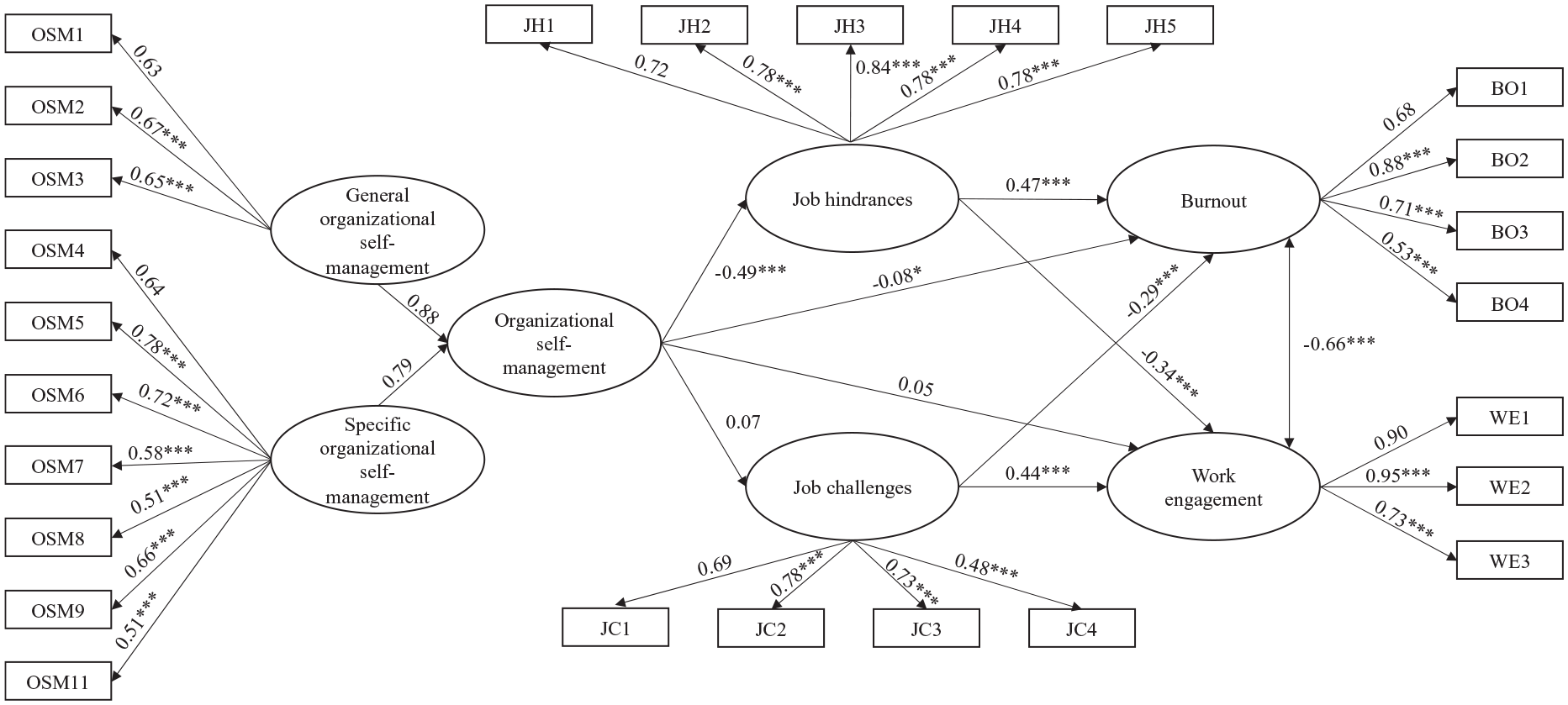
Structural equation model visualization with completely standardized regression estimates between OSM and other variables at T1. In measurement parts, non-significant loadings are fixed to 1.
For ESM, the overall model fit was acceptable, χ²(df = 180) = 1,813.67, p < .001, CFI = .91, TLI = .90, RMSEA = .070, with regression estimates presented in Figure 2. The indirect effects of ESM on work engagement were significant through job challenges (0.12, p < .001) and job hindrances (0.06, p < .001), and the total effect was 0.33 (p < .001). The indirect effect on burnout was −0.09 (p < .001) through hindrance demands, and −0.07 (p < .001) through work challenges, while the total effect was −0.31 (p < .001). The item loadings, regression estimates, and effect estimates in the results with the imputed data were within one standard error of the results presented here and there were no differences in significance.
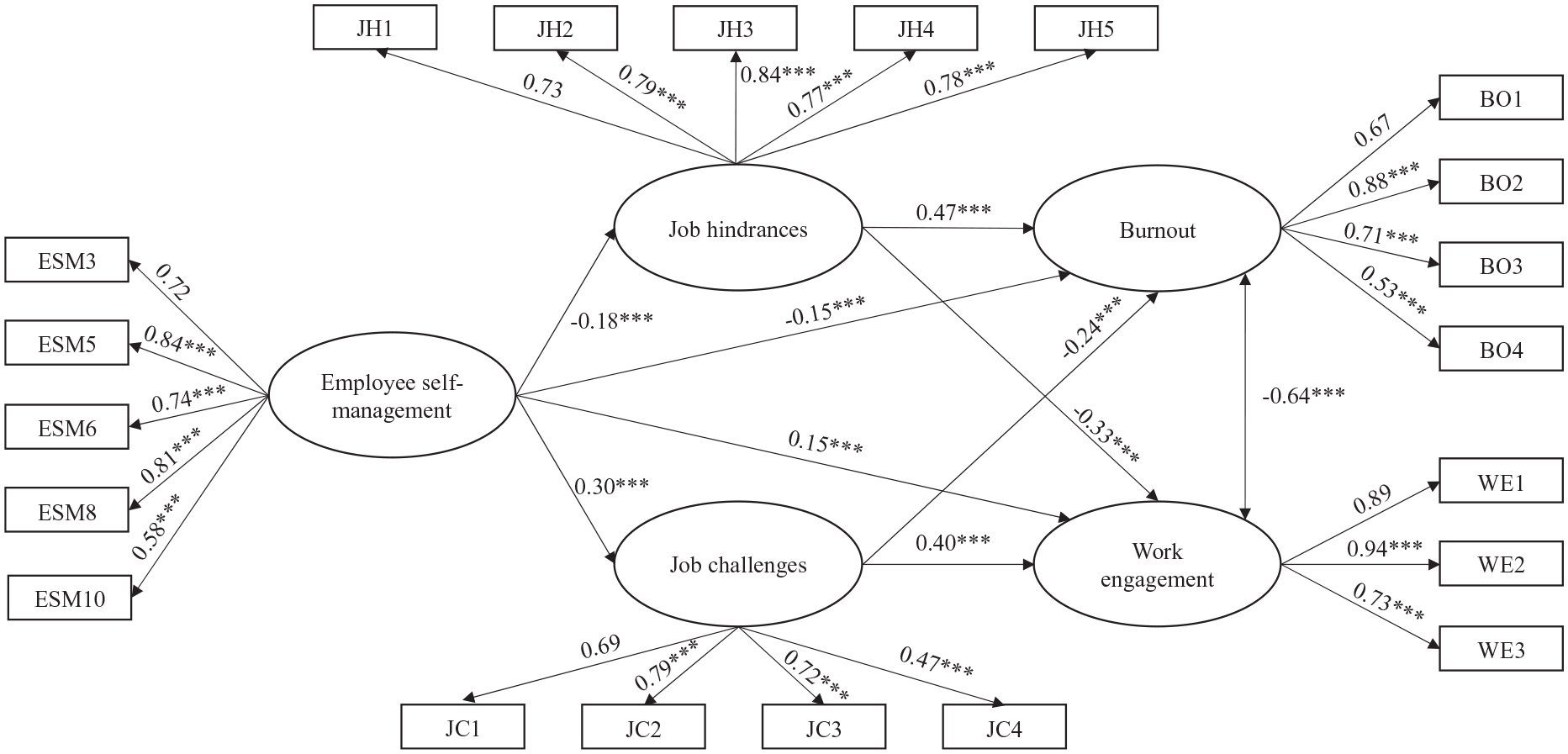
Structural equation model visualization with completely standardized regression estimates between ESM and other variables at T1. In measurement parts, non-significant loadings are fixed to 1.
Brief discussion
As regards scale validation, both ESM and OSM measurement models were supported in Study 2 but with adjustments to the measurement models. The measurement models for OSM and ESM were scalarly invariant across time, indicating a good fit to the data. This supports using the instruments to examine employee and OSM in future research.
Testing our hypotheses with the mediation models, we found that job demands accounted for some of the association between both types of self-management and well-being outcomes. However, OSM was not associated with more challenge demands. As additional analyses, we tested the models in different subgroups based on the size of the organization and the position of the employee (see online supplementary material), which provided further insight into the model in different populations.
Discussion
Given the increased interest in self-management currently visible in HRM and management studies, we aimed to examine whether self-management is positively related to work engagement and negatively to burnout. In this study, we made an important distinction between ESM and OSM and developed scales for them. Both scales demonstrated satisfactory psychometric properties in both studies, and their positive yet relatively low intercorrelation demonstrated that they indeed are empirically separable phenomena, supporting Hypothesis 1. Study 1 also demonstrated that the levels of OSM and ESM were notably higher in a sample from organizations allegedly high in self-management, compared to a convenience sample from a more general population. This demonstrated that the scales could detect meaningful differences between organizations on their levels of self-management.
Beyond scale development, we examined how ESM and OSM related to work engagement and burnout, expecting them to be associated with higher levels of work engagement and lower levels of burnout. The results of Study 2 mostly supported these hypotheses: Both OSM and ESM were related to higher levels of work engagement and lower levels of burnout. Generally, self-management thus seems to be associated with well-being rather than ill-being at work. However, the curvilinearity results for ESM and burnout showed that the association is not constant across different levels of ESM. This calls for further research on the association when high levels of ESM are related to burnout and on confounding aspects of work that relate to the association. We also found that both ESM and OSM were negatively related to hindrance demands—more self-management was associated with less red tape and other bureaucratic obstacles, as expected. Also, ESM was positively related to challenge demands—more discretion seems to be associated with the work feeling more challenging, as expected. However, while OSM was positively correlated with challenge demands, the relation was not significant in the mediation analyses. One explanation could be that ESM may be more likely than OSM to lead employees to craft more positive challenges at their work (see also Zeijen et al., 2018).
Furthermore, we anticipated that the relation between self-management variables and work engagement would be mediated by challenge demands, and the relation between self-management variables and burnout would be mediated by hindrance demands. The results partially support the hypothesis. For ESM, the direct effects to work engagement and burnout stayed significant and meaningful in quantity even when the mediators were considered. On the other hand, OSM was related to the well-being outcomes via job hindrances but not via job challenges. It seems that while organizational and ESM account for change in job hindrances and ESM for job challenges, there are also other mechanisms by which they affect employee well-being. For instance, organizations that have decentralized their decision-making may also be work environments where employees can better accumulate resources to meet job demands (Bakker & Demerouti, 2007; Van den Broeck et al., 2017).
This study contributes to the burgeoning literature on SMOs by making a conceptual distinction between ESM and OSM, and by providing validated scales to examine both. It also contributes to research on work engagement and burnout by identifying and examining two potential antecedents of higher work engagement and lower burnout: ESM and OSM. While OSM provides a structure-focused view on self-management, we have conceptualized ESM as consisting of the employee’s rights over how and what tasks they execute, direction-setting rights as decisions over recruiting, rewards, and resource allocation, and as rights to participate in organizational development, including firm strategy. As such, ESM cuts across organizational management activities over multiple levels and the employee’s ability to participate in them. The aspect of execution rights comes close to job autonomy which focuses on the experience of discretion, freedom, and independence over one’s own job (Hackman & Oldham, 1975). However, besides focusing more on practices rather than experience, ESM as a whole is a broader concept, entailing also rights to make decisions regarding the organization, its resources, strategy, goals, and its development beyond one’s own job.
Beyond theoretical contributions, the results are also important from a practitioner’s point of view. Many HRM professionals currently consider whether and how to make the organizations less hierarchical and more self-managing. However, one concern is whether such arrangements are truly motivating for the employees, instead of being a source of stress and increased burnout risk. Our results suggest that the worry about increased burnout does not hold at a general level. Instead, self-management is related to better employee well-being which supports the case that self-management can benefit employees. Also, the distinction between OSM and ESM is a healthy reminder for HRM practitioners that in addition to decreasing levels of hierarchy and other structural changes, they must ensure that this truly increases the sense of empowerment among employees. The relation of self-management with fewer job hindrances is an important reminder for practitioners that often the path toward more self-management starts with identifying the current key hindrances and giving employees the authority to not be stopped by them.
In interpreting the results of the two studies, certain key limitations need to be considered. First, the mediation models presented in this study were studied with a cross-sectional sample, which impedes testing the causality of the mediation model. For instance, we cannot rule out the possibility that higher work engagement may also lead employees to engage in job crafting to give them more room for self-management (see Zeijen et al., 2018). Future research should consider longitudinal research designs to provide evidence for causal effects. Second, the studies were conducted in Finland, and thus future work is needed to examine how well the results generalize across countries and cultures. Also, the ESM scale might not differentiate individuals in contexts where the level of decentralization is low, and the rights illustrated by the scale are not experienced. Third, Study 1 utilized a relatively small and gender-biased sample (70% women), limiting the generalizability of its findings. In addition, the sub-sample from SMOs was based on researchers evaluating the organizations as self-managing rather than objective criteria. Developing such objective criteria and identifying companies based on them would be preferable. Fourth, OSM was measured using self-reports. Future studies should identify more objective measures of decentralization of power to examine whether they have similar relations to work engagement and burnout. Fifth, and finally, future research should develop the measure further. First, since the measurement models were adjusted in Study 2, the measurement models should be validated in further samples. Second, as OSM is an organization-level construct, future research should include several participants from the same organization to examine how similarly they evaluate the same organizations as regards its level of OSM, as this would be an important way to establish the reliability of the measure.
Conclusion
Some argue that self-management liberates the worker thus enhancing their well-being (Hamel, 2011), while others warn that dismantling hierarchies can be stressful and lead to an increased risk of burnout (Pfeffer, 2013). This study among a heterogeneous set of employees working in various industries and organizations demonstrated that both employees’ perceptions of their own self-management and their perceptions of the organization being more self-managing were related to more work engagement and lower degrees of burnout. This is an encouraging message to HRM professionals interested in improving the self-management of the employees: It is more prone to be associated with better rather than worse employee well-being.
Supplemental Material
sj-docx-1-brq-10.1177_23409444241307734 – Supplemental material for Are employee self-management and organizational self-management related to work engagement or burnout? Evidence from two studies
Supplemental material, sj-docx-1-brq-10.1177_23409444241307734 for Are employee self-management and organizational self-management related to work engagement or burnout? Evidence from two studies by Merit Morikawa, Frank Martela and Jari J Hakanen in BRQ Business Research Quarterly
Footnotes
Declaration of conflicting interests
The author(s) declared no potential conflicts of interest with respect to the research, authorship, and/or publication of this article.
Ethic Approval
Research has been conducted in accordance with Research Ethics Committee of Aalto University.
Funding
The author(s) disclosed receipt of the following financial support for the research, authorship, and/or publication of this article: This work was supported by the Finnish Work Environment Fund [grant number 190434].

Supplemental material
Supplemental material for this article is available online.
References
Supplementary Material
Please find the following supplemental material available below.
For Open Access articles published under a Creative Commons License, all supplemental material carries the same license as the article it is associated with.
For non-Open Access articles published, all supplemental material carries a non-exclusive license, and permission requests for re-use of supplemental material or any part of supplemental material shall be sent directly to the copyright owner as specified in the copyright notice associated with the article.
