



Abstract
Entrepreneurs in their 50s and beyond face significant identity shifts and well-being challenges as they transition out of the businesses they have built. Grounded in Super’s career-development framework and utilizing the Eisenhardt Method for case study analysis, this research explores the entrepreneurial exit process during the maturity and decline stages. With an average business tenure of 11 years, these entrepreneurs encounter emotional and practical hurdles, such as health concerns, financial pressures, and shifting priorities. The study highlights valuing identity diversification and social support in easing the transition, revealing that financial success alone does not guarantee positive post-exit well-being. Gender differences show women prioritize sustainability and family, while men focus on growth and professional identity. These insights underscore the need for early exit planning and holistic support for successful entrepreneurial succession and retirement strategies.
Introduction
The entrepreneurial exit process, involving pathways such as selling a business, passing it to family members, merging, or retiring, is a critical phase in the entrepreneurial life cycle. This phase signifies transitioning from active business ownership to a different stage of life or career, requiring significant financial, operational, personal and psychological adjustments (Morris et al., 2020). Despite its importance, the well-being of entrepreneurs during this exit phase is underexplored, with limited literature addressing the psychological and emotional dimensions of entrepreneurial exits (DeTienne & Wennberg, 2016; Wennberg & DeTienne, 2014).
Entrepreneurial identity, deeply linked to one’s sense of self, encompasses roles, beliefs, and values tied to being an entrepreneur. During the exit process, notably through retirement, entrepreneurs often undergo profound identity shifts where these changes impact how they cope with the transition, their future aspirations, and overall mental well-being (L. Warren, 2004; A. M. Warren & Kelloway, 2010). This study focuses on subjective mental well-being, defined as an individual’s emotional state rather than diagnosed disorders (Friedli, 2009; Galderisi et al., 2015; Tudor, 2013). Understanding these dynamics is crucial for designing support systems for entrepreneurs undergoing life change.
The transition from entrepreneurship profoundly impacts emotional, psychological, and social well-being as individuals navigate the complex process of exiting their businesses (Haslam et al., 2019). Identity shifts during this phase can cause varied outcomes, from feelings of loss and diminished purpose to relief and the discovery of newfound autonomy (Muratore & Earl, 2015). These shifts highlight valuing, understanding the factors that influence these outcomes related to life satisfaction and mental health throughout the maturity and post-decline stages (Muratore & Earl, 2010). Examining age and gender in shaping identity changes during entrepreneurial exits is crucial for understanding entrepreneurs’ diverse experiences. These factors influence cognitive and emotional responses while guiding strategies for navigating identity transformations. Addressing these gaps in the literature offers a more detailed understanding of entrepreneurial exits, thereby enabling the development of tailored support systems that facilitate this pivotal transition.
Expanding on the significance of age and gender in entrepreneurial exits, retirement emerges as a particularly pertinent exit strategy, especially within the context of aging populations. Retirement, a growing trend in entrepreneurial exits (Morris et al., 2020; Ronstadt, 1986; Soleimanof et al., 2015; Solem et al., 2014), represents a full withdrawal from active business operations, often shifting focus toward personal fulfillment, leisure, family, and self-exploration (Bridges, 2001). This stage highlights prizing well-being by confronting existential fears associated with aging and mortality (Becker, 2007). Addressing retirement has societal implications, such as its impact on workforce demographics and the economic contributions of senior entrepreneurs (Crego et al., 2008), but also introduces unique challenges and opportunities for identity reformation, an essential area for focused research and strategic interventions (Vough et al., 2016).
Using the Eisenhardt method (Eisenhardt, 1989; Eisenhardt, 2021), this study employs multi-case analysis to explore the identity and well-being changes during the maturity (50s) and decline (over 60 years of age) stages in the entrepreneurial exit process. The method offers flexibility to explore personal factors like age and gender that influence identity changes, revealing how entrepreneurs navigate these shifts and related psychological challenges. This study employed crystallization, combining multiple methods and perspectives to capture complex social phenomena, balancing depth with rigor through techniques like pattern matching and iterative comparison to strengthen the credibility of the findings (Ellingson, 2009). Interviews and observations were used to gather comprehensive data, grounding the participants’ dynamic experiences thematically.
This study investigates the nuanced identity transitions of entrepreneurs during business exits, revealing significant variations influenced by age, financial outcomes, and gender. Entrepreneurs in their 50s often grapple with anxiety and identity crises because of deep business attachments and unresolved succession plans, while those over 60 years of age experience smoother transitions, motivated by health and financial stability. Financial success can complicate identity shifts, while less-favorable outcomes may facilitate them. Gender also plays a role: female entrepreneurs prioritize relational and community aspects after exit, while male entrepreneurs focus on legacy and professional identity through new ventures or advisory roles. The article addresses a gap in the literature by reviewing entrepreneurial identity and well-being among those nearing retirement, using a robust methodological approach to explore these dynamics and their implications, and concludes by suggesting avenues for future research.
Literature review
The entrepreneurial exit process involves various pathways through which entrepreneurs disengage from their ventures, such as selling the business, passing it to family members, or bankruptcy (DeTienne, 2010). This phase is crucial in the entrepreneurial life cycle as it marks shifting from active business ownership to a new phase of life or professional trajectory, involving financial, operational, and considerable personal and mental growth (Von Bonsdorff et al., 2019). Although entrepreneurial exit research being underexplored was spotlighted over a decade ago (DeTienne & Wennberg, 2016; Wennberg & DeTienne, 2014), there remains a notable gap in research addressing the critical impacts on well-being and identity shifts during this transitional period.
To better understand the complexities of the entrepreneurial exit process, Super’s career-development theory offers a compelling framework, highlighting the evolving nature of identity across various life stages. By framing career transitions as a continuous process of self-concept realization through occupational roles, Super (1957) provides a structured approach for analyzing how entrepreneurs in different stages—growth, exploration, establishment, maintenance, and decline—providing a lens to understand how entrepreneurs, particularly those in their 50s and over 60 years of age, shift from business growth to post-entrepreneurial pursuits. This approach emphasizes the crucial role of identity realignment, as entrepreneurs reconfigure their self-concept in response to changing roles and aspirations during the exit process.
Building on Super’s framework, entrepreneurial identity is key to understanding how individuals redefine themselves during exit. Shaped by social interactions and personal experiences, it influences decision-making and evokes complex emotions during retirement transitions, where these identity shifts can elicit both liberation and a loss of purpose, underscoring the emotional complexity of exits (L. Warren, 2004; A. M. Warren & Kelloway, 2010). This research examines the impact of these identity shifts on subjective well-being, focusing on happiness and autonomy (Friedli, 2009; Greenspoon & Saklofske, 2001). While exit can alleviate stress, it may also trigger distress, especially after financial strain (Hessels et al., 2018; Pauley, 2017). Even in voluntary exits, entrepreneurs often face identity crises, highlighting the importance of understanding these shifts for well-being during this pivotal phase (Morris et al., 2020; Wennberg & DeTienne, 2014).
Recognizing the relationship between identity, well-being, and resilience during business exits is essential for supporting smoother transitions and enhancing post-exit well-being. Resilience plays a crucial role in helping entrepreneurs navigate the psychological challenges of exit (Williams & Shepherd, 2016), where shifts in entrepreneurial identity throughout the business life cycle significantly affect well-being (Shepherd et al., 2019). Shepherd and Haynie (2011) argue that self-compassion is instrumental in enabling entrepreneurs to reconstruct their identity and foster emotional resilience following venture failure, which is supported by other scholars underscoring the pertinence of identity reconstruction in the recovery process (Shepherd & Cardon, 2009; Ucbasaran et al., 2013). The emotional complexity of exits, encompassing both liberation and potential identity crises, underscores the need for a deeper exploration of how identity shifts impact subjective well-being, especially in relation to happiness, autonomy, and emotional resilience.
While existing studies have examined the cognitive and emotional struggles, such as the role of resilience and self-efficacy in managing stress and well-being during exits (Baron et al., 2013; Hessels et al., 2018), further exploration of identity conflicts, principally in relation to gender-specific challenges and work-family conflicts, demands attention which can impact the exit experience and subsequent identity reconstruction (Lewis et al., 2016; Sardeshmukh et al., 2021). The underexplored impact of exit strategies on identity reconciliation and the role of reflective practices in facilitating transitions suggests that the way entrepreneurs navigate their past and post-decline identities, shaped by their chosen exit strategies, may profoundly influence their long-term psychological well-being and career satisfaction (DeTienne & Cardon, 2006; Radu-Lefebvre et al., 2021). By focusing on these complex identity processes, tailored strategies can better facilitate successful post-exit transitions, promoting not only psychological well-being but also sustained personal and professional growth.
Age also emerges as a pivotal factor shaping the entrepreneurial exit experience in well-being and identity evolution. Kibler et al. (2024) accentuate how aging affects emotional exhaustion and strategy, introducing the concept of the “felt age gap” to illustrate how subjective aging intersects with identity shifts, gender roles, and support networks. As entrepreneurs over 50 prioritize legacy and stability, significant identity changes can impact their well-being (Erikson, 1963; Super, 1957) and undergoes significant changes (Jung & Beebe, 2016). Entrepreneurs exiting during the decline stage face age-related stereotypes that hinder decision-making and complicate identity reconstruction (Levy, 2009; Ng & Feldman, 2009). For older entrepreneurs, deeply connected to their businesses, the uncertainty of life after exit can trigger anxiety (Atchley, 1989). With an aging global population, understanding these age-specific identity shifts is vital to developing tailored interventions as entrepreneurial exits rise (Morris et al., 2020; Ronstadt, 1986; Solem et al., 2014). Despite the complex personal dynamics at play, exits during the maintenance and decline stages remain underexplored (Shepherd & Williams, 2018).
Gender is another critical factor impacting how identity changes are experienced during the entrepreneurial exit, with men and women facing different societal expectations that shape their identity and exit strategies (Ahl, 2006; Chatterjee et al., 2022). Women frequently face increased stress and identity conflict during exits because of societal pressures to balance career and family roles, with guilt over prioritizing their career, which exacerbates these challenges (Lewis et al., 2016; Marlow & McAdam, 2013; Sardeshmukh et al., 2021). Other obstacles include structural barriers, such as access to capital and networks, which may limit their strategic exit options and further compound the emotional complexities of the process (Jennings & Brush, 2013). Exploring gender dynamics can help tackle the specific hurdles faced by women entrepreneurs, leading to more fair and sustainable outcomes. This will contribute to a better understanding of gender-specific barriers and opportunities in entrepreneurship, especially during exit stages.
The literature reveals the complex dynamics of entrepreneurial exits, which profoundly affect personal growth and well-being. Despite the significance of this transition, its impact on identity shifts and well-being is still underexplored. Career-development theory offers insight into how entrepreneurs reframe their identities as they transition from business ownership to new roles. Age and gender are pivotal, with older entrepreneurs facing stereotypes and women grappling with unique societal pressures. This study employs the Eisenhardt Method to examine how entrepreneurs in their 50s and beyond manage these identity shifts, focusing on mental challenges, coping mechanisms, and support systems. By highlighting the interplay of age and gender, it offers strategic insights for designing support systems that foster smoother exits and enhanced well-being.
Methods
To address calls for enhanced methodological rigor in entrepreneurship well-being research, this study employs the Eisenhardt Method (Eisenhardt, 1991, 2021; Eisenhardt & Graebner, 2007) via a multi-case analysis to investigate the evolution of identity and well-being during the mature and declining phases of entrepreneurial exits. Key constructs like “well-being” and “role identity” are operationalized using semi-structured interviews to capture phenomena such as identity shifts (Eisenhardt, 1989; Yin, 2018). This approach leverages theoretical sampling to refine theoretical frameworks and boost generalizability, highlighting the vital role of narrative identity work in sustaining psychological resilience during entrepreneurial transitions (Down, 2006). Purposive sampling enriches insights into identity shifts among older entrepreneurs (Etikan et al., 2016; Patton, 2002), and cross-case analysis strengthens validity through diverse perspectives (Creswell & Clark, 2017).
The research design—including the development of the interview guide—was profoundly shaped by the author’s extensive experience as the owner of five businesses across diverse industries over the past 20 years, as well as their role as a director of an entrepreneurship center and mentor for business startups and accelerators for over a decade across Asia, Africa, Europe, and North America. This multifaceted background provided a unique vantage point that deeply informed the study’s conceptual framework and methodological approach. The author’s practical expertise in navigating complex entrepreneurial landscapes enabled them to engage with participants on a deeper level, fostering a sense of trust and openness that was crucial for eliciting rich, candid insights. This depth of experience also allowed for the agile adaptation of interview questions in real time, responding to emerging themes and contextual cues, which proved essential in capturing the nuanced realities of entrepreneurial practice within the limited duration of the interviews. The research benefited from a robust and dynamic data-collection process, yielding substantive findings that otherwise remained unexplored.
The interview guide, informed by the entrepreneurial exit literature, drew on DeTienne and Cardon (2012) to explore motivations and identity shifts, while Forster-Holt (2013) shaped questions on strategy and well-being. Guided by the Eisenhardt method, the interviews examined exit motivations, strategies, identity evolution, and well-being among entrepreneurs in their 50s and over 60 years of age, using Super’s career transition framework. The protocol was refined through discussions with a business succession expert and tested in a pilot study with four entrepreneurs (of similar age, one female and three males), enhancing question depth and relevance. Secondary research informed tailored questions for each participant, improving data credibility through response verification, in line with the studies by Eisenhardt (1989) and Yin (2018). Data collection commenced between December 2015 and April 2016.
Participants
Separating the sample by age—individuals in their 50s (14 cases) and those over 60 years of age (seven cases)—was essential to understand the distinct impacts of entrepreneurial exit on identity change and overall well-being. Individuals in their 50s are commonly in the pre-retirement stage, where they manage both business exit strategies and future retirement plans. Meanwhile, those aged 60 years and above are typically in the decline or post-decline phase, confronting immediate transitions and the challenges that come with them, including the consequences of previous decisions. This separation allows for a nuanced analysis of age-specific patterns and needs, informing targeted support and interventions for entrepreneurs at different stages of retirement.
When engaging in the iterative process of analysis, the sample was reorganized again according to a financial harvest exit (sale, acquisition, buyout, liquidation, succession) that comprised 13 cases versus other exit types (dissolve, bankruptcy, default) with eight cases and by gender with five female cases and 16 male cases for a comprehensive understanding of the entrepreneurial exit process. By using dual segmentation, the study gains a comprehensive understanding of how factors intersect to influence entrepreneurial exits and improve support systems. Through within-case analysis and cross-case comparison, the method identifies emerging patterns and constructs. Individual cases within the groups were compared to elucidate the richness and depth narratives to uncover patterns and generate theory (Eisenhardt, 1989, 2021).
Each case was purposively selected through professional networks, involving micro, small, and medium enterprises (mSMEs) from Southern Ontario, Canada (see Table 1 for demographic details), to capture businesses that have thrived well beyond the typical 3-year, 50% failure rate (Amélie Lafrance-Cooke & Alex McDougall, 2023; Macdonald, 2012). Entrepreneurs with peak revenues between $60k to $23 million, and significant business tenures averaging over a decade, offer unique insights into sustained success because their prolonged engagement allows for deeper exploration of identity shifts and well-being during the exit process, which is often underrepresented in studies focused on startups or failed businesses (Hessels et al., 2017). Unlike early failures, resilient entrepreneurs plan deliberate exits that revolve around legacy and identity transition (Kašperová & Kitching, 2014). Exiting successful ventures comes with unique challenges, like emotionally letting go of an established identity (DeTienne, 2010).
Participant demographic details.
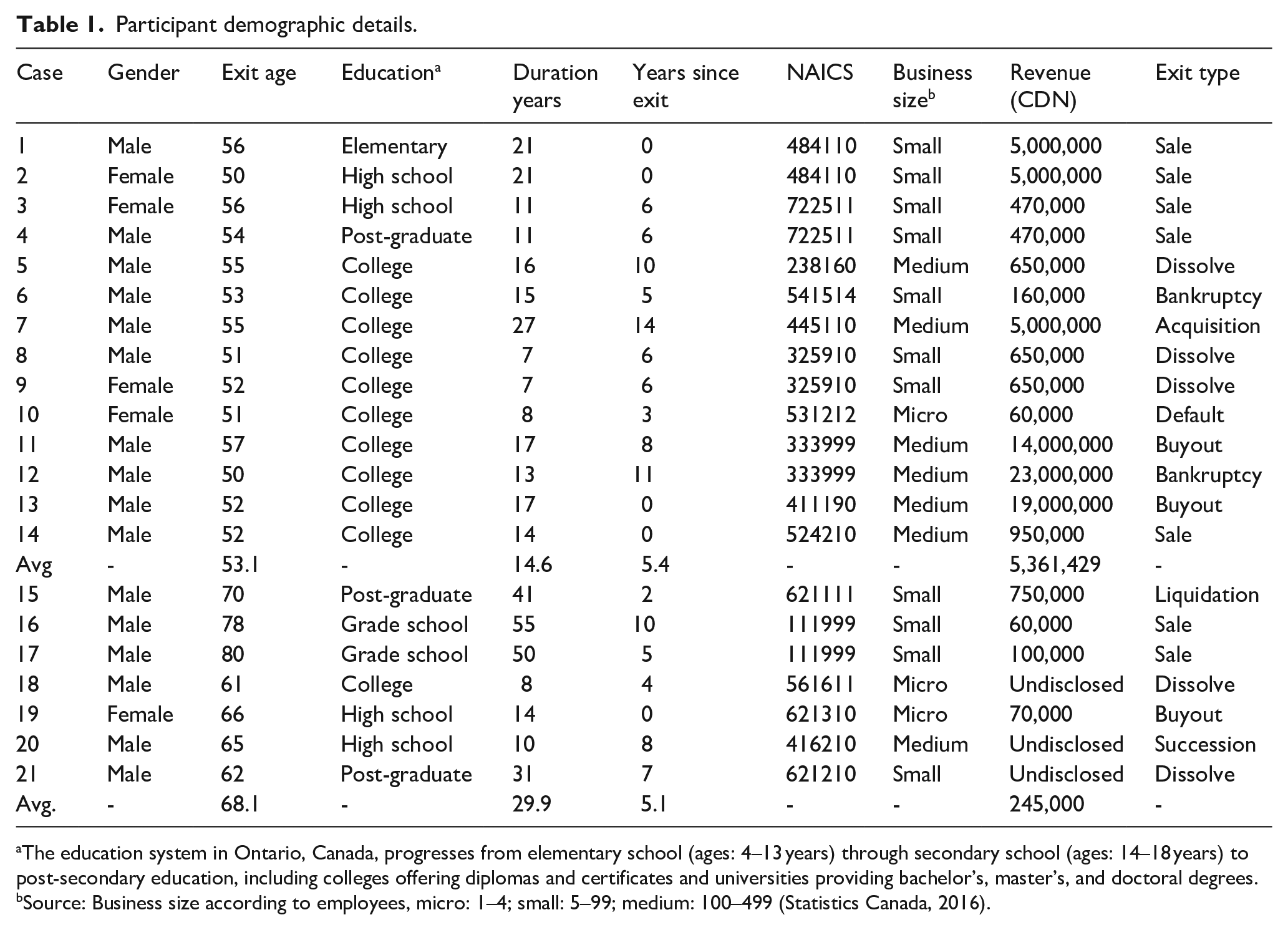
The education system in Ontario, Canada, progresses from elementary school (ages: 4–13 years) through secondary school (ages: 14–18 years) to post-secondary education, including colleges offering diplomas and certificates and universities providing bachelor’s, master’s, and doctoral degrees.
Source: Business size according to employees, micro: 1–4; small: 5–99; medium: 100–499 (Statistics Canada, 2016).
The industries represented according to their North American Industry Classification System (NAICS) codes include agriculture, health care, shipping, restaurant, technology, grocery, construction, service, and manufacturing. The average interview length was 40 minutes, which, in the Eisenhardt method, allows for flexibility to ensure all relevant data are captured (Eisenhardt & Graebner, 2007). Although a 40-minute average interview may seem short, it can yield valuable insights when the interview process is methodologically rigorous, with iterative and adaptive data collection enhancing the depth and relevance of the findings (Beaumont et al., 2014). The researcher adapted questions in real time to explore emerging themes and refined the interview guide after the initial analysis, enhancing the focus of subsequent data collection (Braaten et al., 2020).
Analysis
The analysis follows Eisenhardt’s comparative case approach, utilizing cross-case synthesis as a robust qualitative technique. This method involves several stages of data analysis, supported by NVivo, a qualitative data analysis software that enhances the organization, coding, and systematic exploration of semi-structured interview data. By leveraging NVivo, the analytical process gains rigor and efficiency, allowing for deeper and more comprehensive data investigation (Jackson et al., 2019). The process starts with a detailed within-case analysis to identify key themes, patterns, and insights unique to each case by meticulously coding interview data and observations (Miles et al., 2013; Saldaña, 2015).
Integrating a heuristics approach—emphasizing personal experience, self-reflection, and intuitive discovery—adds flexibility and depth to the study’s coding process, extending beyond the traditional Gioia method to capture the nuanced narratives of entrepreneurial exits (Gioia et al., 2010; Mees-Buss et al., 2022). While heuristic inquiry can be subjective, careful planning and reflexivity ensured methodological rigor and researcher well-being (Douglass & Moustakas, 1985). Higher-order heuristics, such as pattern matching and iterative comparison, aligned with the Eisenhardt method to provide a comprehensive understanding of each case. For example, a high-achieving entrepreneur struggled with identity loss and heightened anxiety during retirement despite financial success, highlighting the emotional toll of exiting a long-held business identity. To address these challenges, participants engaged in peer debriefing sessions, and systematic coding with NVivo and clear inclusion criteria helped maintain consistent, bias-aware analysis, preserving methodological depth and rigor (Ellingson, 2009).
Cross-case analysis is then used to iteratively compare and contrast cases to uncover similarities and differences to generate new theories (Eisenhardt, 2021; Ravenswood, 2011). This is not to be confused with the constant comparison method, which is also an iterative process where data segments are repeatedly differentiated to develop categories and identify patterns by refining categories through ongoing data analysis (Dye et al., 2000). The Eisenhardt method was employed by selecting case studies of entrepreneurs in their 50s and those older than 60 years to explore overall experience, financial success, and gender, identifying constructs and relationships between identity change and well-being. Using constant comparison, data were coded and continuously evaluated to identify common themes and divergent patterns related to emotional responses and identity shifts (Boeije, 2002; Glaser, 1965). These themes were refined and expanded upon through continuous comparison with new data (Dye et al., 2000).
Thematic analysis, using the Eisenhardt and constant comparison methods, revealed key patterns in identity and well-being changes during entrepreneurial exits (Braun & Clarke, 2006; Holton, 1975). Initial codes such as “loss of professional identity” and “emotional stress” were refined into broader themes like “identity reconstruction” through iterative comparisons (Braun & Clarke, 2019; Saldaña, 2015). Inductive pattern matching then aligned empirical data with theoretical constructs, such as debunking the myth that financial success ensures happiness and highlighting the role of emotional stress and identity shifts in well-being (Creswell, 2013; Nowell et al., 2017) by aligning identified patterns with predicted ones (Eisenhardt, 1989; Yin, 2018). The final stage employed theoretical coding, using axial and selective coding to develop a coherent theory (Strauss & Corbin, 1998; Thornberg & Charmaz, 2014). Axial coding revealed connections between categories, while selective coding identified “identity reconstruction” as the core theme, linked to “social support” and “emotional stress.” This framework shows how strong coping strategies and support networks promote positive identity reconstruction and well-being, while their absence can result in emotional challenges and mental health decline (Sinkovics, 2018; Terry et al., 2017).
Results
This study employed a rigorous methodological framework to examine how entrepreneurs in their 50s and beyond 60 understand and navigate identity shifts during the exit process. Utilizing data crystallization, pattern matching, and iterative comparison, the analysis uncovered nuanced insights into the identity transformations experienced by these entrepreneurs. Multiple sources of evidence, such as interviews and observations, enhanced the credibility and depth of the findings. Theoretical sampling and constant comparison grounded emerging themes in the data, reflecting the participants’ dynamic experiences.
Key findings reveal that identity and well-being strategies differ significantly across exit stages, with entrepreneurs in their 50s focusing on maintaining purpose, while those over 60 years of age prioritizing legacy and retirement adjustments. Financial outcomes and gender also play crucial roles: major financial success often complicates identity transitions, while modest outcomes facilitate smoother exits. Women tend to focus on community engagement after exit, while men emphasize legacy and professional identity through new ventures or advisory roles. These insights provide a comprehensive understanding of how age, financial outcomes, and gender shape identity and well-being during entrepreneurial exits.
Case comparison
The entrepreneurial exit process highlights distinct differences concerning entrepreneurs in their 50s and over 60 years of age in terms of well-being and identity transformations. Entrepreneurs in their 50s often face a tumultuous transition marked by a mix of complex emotions and practical concerns, best exemplified in the following quote:
It was Christmas, and things were falling apart. I’ve had no mental health issues or severe depression or anything like that but, at this point, I had a nervous breakdown. I was out on the road one day trying to collect cheques and I just lost it; emotions overcame me, and I was driving down the highway balling and I didn’t know why. I felt broken in every way, and I just knew my life would be over if I continued to do this [business].
This quote vividly reflects the burnout entrepreneurs in their 50s may experience, as their spiraling negative emotions, marked by a nervous breakdown and feelings of being “broken in every way,” drive a desperate need to alleviate the overwhelming stress through exiting their businesses. Their strong identification with their businesses means that contemplating an exit can lead to a profound identity shift, involving a re-evaluation of self-worth, purpose, and future aspirations. This period is often characterized by anxiety, uncertainty, and a deep sense of loss as they relinquish their professional roles.
The external pressures of increasing competition, economic downturns, and stringent regulatory environments exacerbate their stress, leading to mental and physical exhaustion, as exemplified in one of the male quotes:
During those big jobs, I felt like the king of the castle. I was very proud, but then it was quickly countered. Within six months, the company took a nosedive because the bills are catching up to us and you can only put them off for so long. It became such an intense pressure. There is $90,000 worth of bills owing out and we are waiting on a $100,000 cheque. Even when it comes, it does nothing to go around.
The overwhelming guilt from the business failure had a profound impact on both their mental and physical health. The collapse of their business, which had been a central part of their identity, sparked a self-worth crisis, intensifying their psychological distress and feelings of isolation. Entrepreneurs identifying as primary breadwinners tended to internalize the pressure to meet financial obligations, leading to chronic stress, anxiety, and feelings of hopelessness. Sometimes, this stress manifested physically as exhaustion, sleep disturbances, high blood pressure, alcohol dependency, and poor nutrition, leading to obesity.
Men in labor-intensive industries, such as construction or transportation, often tied their self-worth to the growth and prominence of their businesses, viewing success as reflecting their identity. The fixation on external achievement leads to unhealthy habits like overworking, neglecting relationships, and ignoring physical and mental health, resulting in chronic stress and burnout. Women took a more holistic and long-term perspective, prioritizing sustainability and the overall well-being of the family. This inverse perspective is best reflected in the following husband and wife business partnership in the maturity stage:
Husband (H): I got carried away because I wanted to grow, grow, grow. I was aggressive, and I wanted to grow. I wanted to out due them all, and I did. It was up to a 5 million dollar company for a while. But, the second it didn’t, it didn’t take too long [to decline]. It takes a big [physical] toll.
Wife (W): We had our battles. Me doing the paperwork; I kept trying to tell him the highway guys were not making money. We used to argue about this all the time, because [husband] didn’t understand. [He] didn’t do the paperwork every day. He thought, get bigger, and do this, and do more. He saw the big cheques coming in, but didn’t see how much was going out to keep those cheques coming in. We had some stressful times in our marriage because of that.
H: But, we pulled through and straightened it out in the last 3 years.
W: Because our marriage would be over (laughing).
The couple in their 50s in the maturity phase experienced identity changes differently, shaped by their distinct roles and priorities. The man, heavily invested in the business’s growth, derives much of his identity from external success and professional achievement. As the business faces challenges, he feels inadequate, stressed, and frustrated, compounded by a sense of failure in fulfilling his role as the primary provider. These emotions lead to physical exhaustion, burnout, and strained relationships, significantly impacting his well-being. In contrast, the wife’s identity is more balanced between family and business, focusing on long-term sustainability and emotional stability. As the business struggles, her emotions stem from a concern for the family’s future and frustration over her husband’s relentless pursuit of growth at the expense of stability. While both face emotional challenges, the man’s identity shift is tied to feelings of failure and loss of control, whereas the woman takes a more pragmatic approach, seeking solutions that prioritize the well-being of both the family and the business.
In a hospitality venture run by a wife who sold the business in her late 50s, the decision to step away was primarily driven by the growing monotony of the work:
Husband (H): The main contributor was [wife] didn’t want to do it anymore. She wanted a break from it and the competition exploded in the last few years in the area.
Wife (W): I was just tired. This is going to sound really bad, but I had the same staff for the whole 11 years. I love them dearly, but it was day-in and day-out with these people. I just needed a break from it. I was [mentally and physically] exhausted. I felt it was time. . . It was kind of like: let me out of here! I’m doing the same thing seven days a week.
H: You thought it was time for you because you didn’t want to do it anymore, and then financially, we were still okay.
When questioned about the emotions she felt during the exit, the wife replied,
W: That’s a really hard one to answer because we were going through our [son] being diagnosed with that tumor. I didn’t even take time to grieve the loss of that diner and our friends [employees] because of that. It was like that all happened for a reason. It was like we walked out the door and then our son has some health issues. That was same day almost, it was all boom boom and then it was just gone.
When prompted by whether the couple would start another venture, she replied,
W: It’s timing for me now. The job that I have is exceptionally flexible. It’s a hard thing to walk away from because of the type of position that I’m in. It’s less risk at this point in the time of our lives. When I retire I might open a gift shop. . . but, they say you’re 65 and you should retire, but neither one of us feels old. We aren’t ready for retirement. Maybe lower pace job, but more for myself. Health plays into a lot of things. When you get into your 60s things [health] can change overnight.
The couple’s decision to exit their business reflects a complex emotional struggle, marked by exhaustion, shifting identities, and unpreparedness for aging and financial realities. The wife’s burnout reached a breaking point, “let me out of here,” coinciding with their son’s health crisis, leaving little time to process the emotional fallout. Although they stepped away, their reluctance to fully retire indicates ongoing identity shifts. The wife’s new flexible job offers stability but reveals a compromise between practical needs and emotional readiness. Their interest in new ventures shows they are not ready to fully relinquish their entrepreneurial identity, balancing identity, well-being, and aging challenges.
This emphasis on family as a driving force behind business decisions was echoed by another entrepreneur in their 50s, whose exit was similarly abrupt:
[Son] was diagnosed with a brain tumor. My whole perspective on everything changed. Now, my focus was either on the job or deal with his illness. I wasn’t going to do both, so I phased things out slowly from there because his recovery was more important to me than anything else . . .
There are some things I should have done differently, but at that time I was so optimistic about the company and where the direction was. We weren’t thinking of long-term stuff and we probably should have. When we will look back on it, we could probably have put ourselves in a better position to weather through the tougher times, but no one can ever foresee or take into account an illness like [son] had. We didn’t have deep pockets. We were carrying a mortgage on this house, we had bills in the city, and we had other things. We took our trips, and we lived our lives well. I mean, we have no regrets that way. We are okay with everything.
The entrepreneur’s sudden exit in their 50s, prompted by their son’s health crisis, exemplifies identity and well-being transformations characteristic of Super’s maturity phase. Experiencing conflict between professional goals and personal responsibilities, they experienced guilt and anxiety as their focus shifted from business to family. Managing financial pressures alongside caregiving responsibilities led to considerable mental and physical strain, emphasizing the importance of robust support networks. Prioritizing their son’s recovery ultimately brought emotional clarity, and the transition from a business-centric identity to one centered on family, while challenging, signified a profound redefinition of self.
In stark contrast to the maturity stage of exit, entrepreneurs over 60 years of age encounter a distinct set of well-being and identity changes. The heightened awareness of aging and health issues plays a more pivotal role in their decision to retire. Confronting health issues such as heart attacks, persistent pain, and even cancer, these entrepreneurs are more inclined to prioritize personal well-being over business responsibilities. Realizing their mortality often acts as a motivator to focus on personal relationships and fulfillment. This shift in priorities is best illustrated by one entrepreneur’s reflection on the impact of health challenges on their decision to step away from the business:
I didn’t want to die at the job. I’d tell everybody the same thing today. I’d die at the job. If you can make enough money and walk away and live half comfortably. Why would you die at it? Do you really want to work that long? Because you can’t come back from the stone [death]. Financially, I can retire at this point in time.
This entrepreneur vividly captures the profound identity shifts and emotional transitions entrepreneurs have over 60 years of experience as they approach retirement. In the later stages of life, these individuals face the physical toll of aging but also the psychological challenge of redefining their sense of purpose outside of their long-standing professional roles. As the entrepreneur reflects on their decision to exit, the fear of death becomes a central motivator, influencing a shift in priorities toward personal well-being and relationships. The realization that “You can’t come back from the stone” underscores a heightened awareness of mortality that propels these entrepreneurs to question the value of continued work in the face of health issues such as heart attacks or cancer. This fear of dying while still immersed in business responsibilities acts as a catalyst for prioritizing a more balanced life, one centered on personal fulfillment rather than professional achievement.
Financial stability can ease the transition into retirement, allowing the individual to focus on personal well-being and relationships. One entrepreneur candidly reflected on the emotional preparation required, emphasizing the strain retirement can place on marriages and the need for compromise on shared goals. He highlighted that mental readiness, along with navigating different post-retirement desires, is crucial to maintaining harmony during this life transition,
You have to stick handle [navigate the exit process], seize an opportunity, or run like hell. You can’t have an exit strategy in less than three years if you truly want to do it right. [Selling] is not an immediate thing. I think it’s even longer to mentally prepare yourself, accepting it [leaving], and do it. You better have a supportive spouse at home that will put up with you . . .
I don’t want to retire the same time that she does. I want to retire first for a couple of years (laughing). That’s a component a lot of people don’t consider. A lot of marriages go through some real stresses at retirement, because if she [wife] is at home, and all of a sudden I come home now permanently, I am interrupting her [routine] and that can cause real issues. If you both retired together, I’m not sure how to prepare for that. I am fortunate because I have some things that I want to accomplish. You better share some retirement goals together, too. If you both want completely different things, it is not going to work. She wants to travel. I’m not interested, but I will, because I will compromise and that’s okay. Whether I’m doing it right, I have no idea, but that’s part of going forward.
The quote underscores the intricate identity shifts and well-being challenges faced by entrepreneurs over 60 years of age as they transition into retirement. The speaker highlights the relational strain that can arise when retiring concurrently with a spouse, stressing the disruption of established routines and the necessity of strategic planning. This dynamic reflects the broader identity transformation entrepreneurs undergo as they detach from their businesses and adapt to new roles in their personal lives. The emphasis on harmonizing personal aspirations with joint retirement plans reveals the emotional complexity of this phase, where compromise and alignment with a partner’s expectations are essential for sustaining both personal well-being and relational equilibrium. Ultimately, this insight illustrates that navigating the retirement phase demands both practical and emotional preparation.
In contrast, the lack of succession presents distinct challenges for entrepreneurs in their 50s and over 60 years of age. For those in their 50s, unresolved succession plans cause considerable stress and uncertainty, complicating their ability to detach from their professional identity. Many face rejection from potential successors, often their children, leading to emotional strain and a perceived devaluation of their life’s work. As a parent reflects, “My kids didn’t want it. They are young. I didn’t think I could hang on for 10 years when my oldest could get 26.” Rejection evokes inadequacy, frustration, and resentment. Even after a successful financial exit, many entrepreneurs in their 50s resist retirement, associating it with decline and loss of purpose. Despite financial security, fears of losing relevance and identity drive them back into employment, where diminished autonomy and control exacerbate their identity crisis. This dual struggle—navigating professional decline while grappling with personal uncertainty—triggers profound psychological turmoil. Feeling trapped between career maturity and decline, entrepreneurs find it difficult to embrace the next chapter, wrestling with a fading professional identity and the unsettling prospect of retirement.
Entrepreneurs over 60 years of age, already in the decline phase, tend to experience the absence of a successor with less emotional chaos, swiftly redirecting their focus toward personal well-being. Rather than dwelling on legacy, they embrace their “golden parachute” financial gains and shift to a lifestyle centered on personal pursuits such as travel, family time, and hobbies. This transition reflects a redefined sense of success, where personal fulfillment supersedes business continuity. With their children or potential successors often already in the early stages of establishing their own careers, these entrepreneurs can more easily rationalize rejecting succession, allowing for a smoother emotional transition into retirement. The gradual identity shift from business owner to retiree is supported by family, particularly spouses, and close friends who offer crucial emotional stability during this life change. This newfound balance enables them to enter retirement with less anxiety, focusing on personal enjoyment and the next chapter of their lives,
I have a lot of pastimes. I like to play out here [pointing to his forested property] (laughing). I knew it was time. If you want to put a good old Dr. Johnson to it, who was a dentist that died many years before, he was just retiring himself at that point and I ask him, “When the hell do you know when to retire?” I still remember, he looked at me like an idiot and says you’ll know (laughing), that was just his answer.
The entrepreneur’s tragic passing just 5 years after their interview starkly illustrates life’s brevity and the inevitability of mortality. For those over 60 years of age, time becomes a critical factor in deciding to retire, highlighting the finite nature of life. Delaying retirement may temporarily preserve professional identity and delay the emotional challenge of letting go, but it also reduces the time available to enjoy the fruits of their labor in good health. By holding onto their businesses out of fear—whether of losing relevance or control—they risk entering retirement when health limitations curtail their ability to engage in fulfilling pursuits like travel, hobbies, and family time. This creates a poignant paradox: extending their professional life diminishes the opportunity to fully leverage financial security for personal fulfillment, often leading to regret and emotional strain for not having embraced retirement sooner.
The financial harvest
From the literature, we find that accomplishing financial exit is believed to positively impact the well-being of the entrepreneur, yet findings within this research identified two explicit cases, Case 14 (50s) and Case 19 (over 60 years of age) that starkly contrast this conception. Below is a detailed description of their accounts.
Case 1: 50s
An entrepreneur, male of Syrian descent with a college diploma, started his insurance brokerage business at 38 years of age and dedicated 14 years to building and managing it. Throughout his tenure, he experienced significant success, culminating in a $950,000 financial harvest. The journey was not without its challenges. Over time, he faced severe fatigue and exhaustion from the constant demands of consumers and a shrinking market size. The rapid technological changes in the industry added to his stress, making it increasingly difficult to keep up. This, coupled with the disappointment that his children did not want to take over the business, led to growing concerns about the future of the company.
As he aged, the physical and mental toll of maintaining the business became more apparent, including his own mortality, reflected in the quote:
The other issue is I’m 52, right? When you get close to your 50s, you start to think of your life, because most of your life is behind you. When is the right time to retire? What do you want to do? 15 years from now I will be 67. 15 years goes like that (snaps his fingers). Do I want that stress? Stress will shorten your life.
He worried about what would happen if he passed away unexpectedly, fearing his wife would be burdened with selling the business under unfavorable conditions. He recounts:
If I got killed in a car accident, I leave a bit of a mess for my wife to trying to sell that business because she doesn’t have a license to operate it. I was the only one in the brokerage that had it. She would have had to sell that in a fire sale and that really weighed on me.
The decision to sell the business was initially motivated by a desire to secure the family’s financial future and alleviate concerns about potential vulnerabilities in unforeseen circumstances. As the sale process unfolded, a complex array of unexpected emotions emerged with profound feelings of guilt, fear, and sadness. Guilt stemmed from a perceived failure to provide his children with the opportunity to inherit and manage the business he had built from the ground up. This was intertwined with a deep sense of loss, not only of the business but also of the identity he had as the “boss” in control. The thought of relinquishing this role brought significant fear, chiefly regarding the new owners’ potential failure to uphold the values and culture he had instilled.
As the weight of his decision settled, an overwhelming sense of sadness emerged, driven by the realization that selling the business would mean severing ties with a fundamental aspect of his identity. The business was not merely a financial venture; it had become an extension of himself, embodying years of dedication, personal sacrifice, and deep emotional investment. Facing the prospect of walking away felt akin to abandoning a crucial aspect of his life, leaving him uncertain about his identity without the responsibilities and status associated with ownership.
These emotions culminated in a significant emotional breakdown as the sale agreement neared completion. The entrepreneur vividly recalls the moment:
We had a phone call from a guy. We talked; one thing led to another. We were close to making a deal. They came to my house, and I was with my wife. We agreed on the number and when they walked out the door; I bawled my eyes out because I was letting go of my child. I felt like I was letting my children down by not leaving them a chance to have a job. I started it from nothing. I like to say we had two-and-a-half employees: myself, wife and [company]. I was very emotional and had to go through that before selling to this other party.
This emotional response underscores the internal conflict he was experiencing by recognizing the practical necessity of selling the business triggered a profound sense of betrayal toward the legacy he had created. The thought of no longer being in control and letting go of the daily responsibilities that had given him purpose was profoundly unsettling. He was plagued by doubts about his future—how he would fill his time, whether he would ever find the same sense of fulfillment, and how he would redefine his identity in the post-decline phase. Confronting the reality of his situation—he needed to begin the process of emotional and cognitive detachment from the business, despite the difficulty associated with this transition.
He eventually sold the business, but the process was fraught with physical and emotional turbulence, as he described:
“There were mixed emotions, but it felt like I made the right decision only because I went through that process before, when I [emotionally] broke down. Just didn’t have the energy or health to run the business the way I think I needed to run it—to keep it going, to keep it strong. I thought it was going to affect my health. I got stress issues. I got pain. I am certain the business was partially responsible.”
The entrepreneur’s deep emotional attachment to his business made transitioning from a central role to a private citizen challenging, creating a significant void. His guardianship felt like parenthood, with selling the company challenging his duty to provide. Fatigue, fear for his family’s future, and decision-making pressure caused intense strain despite substantial financial gains.
After exiting the business, the entrepreneur resumed managing his storage facility, indicating his struggle to detach from his entrepreneurial identity. His initial goals of business growth, increased income, and creative freedom were central to his self-concept. The transition out of his insurance business compelled him to confront the loss of these aspirations and the reality of stepping back from a role that had defined him for over a decade. During this post-decline phase, he relied on a close-knit support network, including his wife, brother, a friend, and professional advisors such as a lawyer and an accountant. These relationships were crucial in helping him navigate the emotional and practical complexities of the transition. Despite this support, the emotional burden of the sale and its implications continued to weigh on him, underscoring his deep investment in the business.
Case 2: Over 60
A female entrepreneur, Caucasian, with a high-school education, began her journey in the chiropractic services industry at 52. Working with a chiropractor who developed mental health issues and left the company, she faced a critical turning point. With no job prospects and unsuccessful in finding alternative employment, she took over the company at her husband’s suggestion. For the next 14 years, she managed the business, transitioning from a sole proprietor to a partnership and achieved an annual revenue of $70,000. Her role as a business owner gave her a deep sense of identity and achievement, empowering her to provide for her family and solidify her standing within the community. With a clear vision for retirement, “My husband had always said when we retire, we should have X amount of dollars in the bank,” she had built her career around both personal and professional fulfillment.
Her decision to exit the business was largely propelled by the mental strain of her husband’s rapidly deteriorating health. The mounting pressure from shifting association requirements, insurance challenges, and the constant need to keep up with new regulations only deepened her burden. These cumulative stressors pushed her to deliberate on selling the business. A turning point came during a lunch with her primary employee, a chiropractor, where they explored the idea of an employee buyout. This conversation marked the start of her emotionally fraught exit process, as she juggled the complexities of selling her business while simultaneously managing her husband’s worsening condition. As she explains:
My husband was in a car accident with a brain injury. He was at home and fires were happening at the house. He was having seizures, and he never seemed to come back from wherever he was. It was stressful to be at work and always thinking about what’s going on at home. You are trying to deal with the patient and put in appointments, take their money and all these [accidents] were happening.
Upon retiring at 66 years of age, the entrepreneur faced the challenge of redefining her identity beyond her role as a business owner. Although the employee buyout provided a solution for the business transition, the emotional strain from her husband’s illness and exiting left a significant impact on her well-being. Her support network, comprising her children and professional advisors like a lawyer, accountant, and banker, provided critical guidance and emotional support throughout her transition. Her children offered personal encouragement and stability during an emotionally turbulent time, while her professional advisors helped navigate the complex legal, financial, and logistical aspects of selling the business. This combined support allowed her to make informed decisions and eased the burden of managing both her husband’s health crisis and the business exit.
As the entrepreneur transitioned through the phases of ownership, exiting and retirement, she faced dramatic changes in her emotional well-being and identity. While stepping away from the demands of her business offered some initial relief, it also triggered a deep sense of loss and uncertainty about her new role in life. The challenge of redefining her identity after years of professional purpose became overwhelming, as she candidly describes:
I’m just trying to find out who I am. I found the first month at home I was sleeping all the time. I would sit in the chair. I would go to bed. I realized I had been under a lot of stress. I was sitting and thinking, oh my gosh, here I am retiring and all I’m going to do is sleep? I do suffer from a medical condition, depression.
This reflection underscores how the absence of her professional role left her grappling with both emotional and psychological distress. While she cared deeply for her husband, the focus on his health did not fulfill her in the same way that running her business had, diminishing her sense of purpose. Without the structure of work or a supportive network of activities, she became increasingly isolated, leading to feelings of loneliness and helplessness. The absence of meaningful engagement not only heightened her isolation but also eroded her sense of dignity, as she struggled to find value in her new role. This shift from a highly structured professional life to a more solitary and uncertain existence exacerbated her depression, underscoring valuing maintaining strong social connections and diverse activities to support cognitive and emotional health during major life transitions like retirement.
Discussion
This cross-case comparison reveals key differences in the entrepreneurial exit process between those in their 50s and over 60 years of age, offering fresh insights and challenging existing literature on well-being and identity shifts. Entrepreneurs in their 50s face a challenging transition, deeply tied to their businesses emotionally and psychologically. They experience profound identity shifts, struggling with self-worth, purpose, and future aspirations. Although the emotional challenges are noted in the literature, the complexity and depth of these experiences are underexplored. For instance, Ronstadt (1986) highlights the emotional struggles during entrepreneurial exits but does not explore the specific identity crises and mental health challenges. DeTienne (2010) discusses the critical role of exit planning but primarily focuses on the strategic and financial aspects rather than the deep emotional and psychological impacts. Examining grief recovery from business failure, findings in the study by Shepherd et al. (2009) align with the emotional turmoil entrepreneurs face but lacks addressing how midlife entrepreneurs navigate these identity shifts and the associated well-being implications.
In contrast, entrepreneurs older than 60 years of age experience different well-being and identity changes, primarily driven by health concerns and the awareness of aging. Health challenges such as heart attacks, cancer, and chronic pain prompt these entrepreneurs to place personal well-being above business obligations, leading to significant emotional adjustments but also fosters relief and satisfaction. This finding diverges from that of Dijkhuizen et al. (2018), who emphasizes the influence of financial success on long-term well-being but overlook the health-driven motivations and emotional relief emphasized here.
Financial stability from a successful business harvest often allows entrepreneurs to transition smoothly, focusing more on personal fulfillment and leisure. This contrasts with Dawson (2017), who stresses financial optimism but overlooks the emotional complexities of exiting a business. While financial success eases practical concerns, it can intensify identity dissociation and emotional strain, extending Wach et al. (2021), who showed that emotional and cognitive demands hinder detachment from work. Financial success can also deepen identity crises, as Ekinci et al. (2020) explored in business growth. Hessels et al. (2018) emphasize how work-family conflict and mental health issues harm business performance, reinforcing that financial success does not protect entrepreneurs from emotional challenges.
Given the influential role of Shepherd’s research (Shepherd & Cardon, 2009; Shepherd & Haynie, 2011; Ucbasaran et al., 2013) on identity and well-being in entrepreneurship, these findings build upon his work by examining age-specific identity transformations and emotional challenges during business exits. For example, they spotlight the importance of self-compassion in coping with venture failure and identity loss for entrepreneurs in their 50s, and the shift from professional to personal well-being for those over 60 years of age in retirement. The research also underscores the crucial role of family support in fostering resilience across these stages.
While the impact of business succession on identity and emotional well-being has been widely recognized, much of the existing research has not fully addressed the complexities faced by mid-career entrepreneurs navigating these transitions. Studies by DeTienne (DeTienne, 2010; Wennberg & DeTienne, 2014) emphasize the importance of succession planning in reducing emotional strain, yet challenges such as identity shifts for those in their 50s remain underexplored (Hessels et al., 2018; Kautonen et al., 2014). While Dawson (2017) and Hessels et al. (2017) address mid-career psychological challenges, they do not fully explore how these differ from those faced by older entrepreneurs. The current study fills this gap by providing nuanced insights into how identity, family support, and age intersect during entrepreneurial exits, offering a deeper understanding of these critical transitions across different life stages.
Entrepreneurs over 60 years of age, lacking a successor, often view this as a temporary emotional setback and quickly shift their focus toward personal well-being and a broader redefinition of success beyond business ownership. Priorities shift from career achievements to personal fulfillment, health, and legacy, as they adopt a more flexible outlook, embracing leisure and relationships. This aligns with the studies by Super (1980) and Levinson (1978), who suggest aging brings a shift from professional accomplishments to well-being. Many older entrepreneurs pursue health, family, hobbies, or new ventures, supporting the findings of Bonanno (2004) on adaptability. While family support, particularly from spouses, plays a pivotal role in bolstering emotional resilience (Alshibani et al., 2024; Ronstadt, 1986; Wennberg & DeTienne, 2014), the age-specific nuances of this support have often been overlooked, and the current research adds depth to this understanding by examining how these dynamics differ between entrepreneurs.
In the maturity and decline stages of entrepreneurial exits, gender differences become evident, as women often place onus on sustainability, family health, and personal well-being over aggressive growth. This aligns with Jennings and Brush (2013), who emphasize the societal expectations placed on women to balance business success with family duties, adding emotional strain. Studies by Ahl (2006) and Lewis et al. (2016) further support this, showing that women entrepreneurs frequently integrate family and relational goals into decision-making. In the current findings, gender-specific pressures shape women’s identity shifts during exits, guiding them to prioritize relational goals and personal fulfillment over financial gains. The current findings fill a critical gap by focusing on how these pressures uniquely impact women in the later stages of their careers, highlighting how well-being and identity shifts are influenced by age, long-term family dynamics, and personal health considerations—an area underexplored in existing entrepreneurship literature.
Conclusion
Through the rigorous application of the Eisenhardt method and Super’s framework of career transitions, this research offers significant contributions to understanding well-being, identity, and age in the entrepreneurial exit process for entrepreneurs in their 50s and over 60 years of age. Entrepreneurs in their 50s, still at the height of their careers, face intense emotional challenges when exiting their businesses. Their deep connection to their professional identity creates anxiety and uncertainty, especially when succession plans remain unresolved. The inability to pass the business on, particularly to family members, complicates detachment and heightens identity crises. This group must balance career ambitions with the inevitability of exit, navigating the emotional strain of transitioning from positions of control and influence to uncertain futures, an area largely overlooked in entrepreneurial research.
Entrepreneurs over 60 years of age, while still facing emotional challenges during the exit process, demonstrate a different approach shaped by their life stage and health concerns. For this group, the lack of a successor is perceived as a temporary obstacle rather than a significant disruption to their sense of identity. Their priorities shift from business growth and professional achievements to personal well-being, family, and leisure. As they move into retirement, these entrepreneurs embrace the opportunity for personal fulfillment, often motivated by health concerns and the desire to spend more time with loved ones. This transition is generally more positive, with the support of spouses and family members playing a crucial role in helping them navigate the emotional adjustments associated with leaving their businesses behind. These findings extend current succession planning literature by emphasizing the distinct emotional and psychological transitions that entrepreneurs in the decline stage experience, including how they redefine success and personal identity beyond their businesses.
Gender dynamics further complicate these transitions, with women entrepreneurs prioritizing sustainability, family health, and personal well-being more frequently than their male counterparts, who can exhibit a “growth-at-all-cost” mentality. The findings suggest women are more likely to view the entrepreneurial exit as a necessary transition toward long-term balance and fulfillment, aligning their decisions with relational goals rather than solely financial ones. In contrast, male entrepreneurs, driven by societal expectations of being primary providers, struggle more intensely with relinquishing control and redefining their identity beyond the business. This research addresses a crucial gap in understanding how gender influences the entrepreneurial exit process, particularly during the maturity and decline stages. By examining these identity shifts and emotional challenges, it expands existing theories and provides practical insights for supporting entrepreneurs through their exits.
The findings suggest a theory of identity diversification and emotional well-being in the entrepreneurial exit process, highlighting how broadening one’s identity beyond business ownership can mitigate the emotional strain of relinquishing a professional role. Well-being during this transition is not solely dependent on financial success or security but requires a comprehensive approach involving emotional, social, and practical preparations. Entrepreneurs who cultivate personal interests outside their business and approach their exit gradually, while relying on strong support networks, are better equipped to navigate the emotional challenges of leaving their entrepreneurial roles. This perspective challenges the conventional notion that financial harvest alone guarantees a seamless transition into retirement, emphasizing prizing holistic planning.
Practical implications emerge from this study, emphasizing appreciating early exit planning that encompasses financial, emotional, and social dimensions. Entrepreneurs are encouraged to diversify their interests to maintain a balanced identity, participating in activities such as mentorship and community engagement. Business advisors and policymakers should implement a holistic approach, addressing every aspect of the exit process while offering access to support groups and mental health resources, facilitating smoother transitions and leading to more successful, fulfilling outcomes.
Limitations and future research
This article contributes to the literature but is subject to bias inherent in qualitative research, especially case study methodologies. To mitigate these biases, the study employed several strategies. Theoretical sampling was used to select cases that would best illuminate the research questions, ensuring relevance and depth while minimizing selection bias (Coyne, 1997; Etikan et al., 2016). The average time since exiting to being interviewed is 5.4 years (three significant outliers increasing this duration) for 50s and 5.1 years for over 60 years of age. Recall bias is a potential concern in this research because of the reliance on retrospective self-reports from entrepreneurs about their exit experiences. While significant and emotionally intense events are generally better remembered (Bluck & Habermas, 2000; D. C. Rubin & Kozin, 1984), as captured by one participant: “There’s certain days you remember, certain things that just standout because you’re emotionally attached and I won’t forget that.” There is still a risk of memory distortion over time (Coughlin, 1990). To reduce recall bias, the study used open-ended questions to elicit detailed narratives and specific probes to clarify responses, enhancing the reliability and validity of the data (Creswell, 2013; Patton, 2002).
Semi-structured interviews facilitated systematic data collection, allowing for in-depth exploration of participants’ experiences while maintaining consistency across interviews (Yin, 2018). To reduce participant bias, interviews were open-ended, encouraging honest and comprehensive responses, and conducted in a neutral, non-leading manner (H. J. Rubin & Rubin, 2011). Cultural bias was addressed by tailoring interview questions to be sensitive and relevant to participants from Southern Ontario, Canada (Patton, 2002). To address inherent biases in the Eisenhardt Method, cross-case synthesis and pattern matching were used to validate and refine emerging theories, while heuristic methods allowed for adaptive analysis (Douglass & Moustakas, 1985; Eisenhardt, 1989). Reflexivity was maintained through continuous self-reflection and peer debriefing to ensure objectivity and comprehensive analysis that enhanced the credibility and reliability of the research findings (Creswell & Clark, 2017; Finlay, 2002).
Future research could investigate how identity diversification and social support networks impact entrepreneurs’ well-being during the exit process. Longitudinal studies comparing pre- and post-decline phases could reveal the long-term effects of identity diversification on well-being and reintegration. Analyzing various social supports—such as family versus peer or professional versus informal networks—would help identify the most effective support structures at different exit stages (Gordon & Nicholson, 2008). Exploring the roles of gender, cultural background, and industry-specific factors in navigating identity shifts and emotional challenges (Brush et al., 2006) and examining the influence of digital advancements on identity and connectivity after exit are critical areas for future study. Identifying best practices for psychological support and interventions tailored to entrepreneurs, as well as comparing successful and challenging transitions, could refine theoretical frameworks and enhance exit strategies (DeTienne, 2010).
Footnotes
Declaration of conflicting interests
The author(s) declared no potential conflicts of interest with respect to the research, authorship, and/or publication of this article.
Funding
The author(s) received no financial support for the research, authorship, and/or publication of this article.
