



Abstract
This study examines how Colombian Multilatinas leverage spillovers from foreign direct investments to enhance their capabilities and expand internationally. Employing a qualitative, exploratory multi-case study approach grounded in inter-organizational learning theory, we find that indirect ties, through vicarious learning via observation and emulation, are pivotal in facilitating the acquisition of new knowledge. This learning is key for Multilatinas to improve their technological and organizational capabilities locally, thereby strengthening their position in global markets. In addition, our analysis reveals that the challenges inherent to the Colombian context encourage a distinctive internationalization model characterized by humility and collaborative partnerships. These findings offer actionable insights for managers aiming to leverage international spillovers for capability development and global growth.
Introduction
Foreign direct investment (FDI) spillovers play a pivotal role in acting as conduits for transferring advanced management practices, innovative technologies, and superior organizational skills (Meyer & Sinani, 2009; Villar et al., 2020). These spillovers facilitate a dynamic exchange of knowledge and expertise, allowing domestic firms to elevate their operational efficiencies, strategic capabilities, and competitive positioning in global markets (Buckley et al., 2002). Moreover, on a national scale, FDI spillovers are identified as essential avenues for emerging economies to close the development gap with their more advanced counterparts, thus promoting economic growth and facilitating industrial advancement (Castellani et al., 2024; Meyer & Sinani, 2009).
Despite the extensive research on the impact of FDI in emerging markets, the focus has predominantly been on Asian economies, particularly China (e.g., Fu, 2012; Gu & Lu, 2011; Kim et al., 2022; Liang, 2017; Liu & Buck, 2007; Zhang et al., 2010). This region’s global economic significance and appeal to multinational corporations have been well documented (Luo & Tung, 2007). However, exploring less examined regions like Latin America can offer alternative insights, given the distinct economic, political, and social landscapes that may influence FDI spillover mechanisms differently than in Asia (Finchelstein et al., 2022). The diversity in economic structures, market openness, regulatory environments, and cultural nuances in Latin American countries suggests that the effects of FDI spillovers could vary significantly, warranting a tailored analysis (Aguilera et al., 2017; Cuervo-Cazurra, 2016; Cuervo-Cazurra et al., 2018; Morris et al., 2023).
Building on this premise, our article adopts a qualitative methodology grounded in the concept of “contextualized explanation” (Welch et al., 2020). This approach posits that case studies can yield causal explanations that preserve, rather than diminish, the richness of the context (Tsui, 2006). Recognizing the importance of context in shaping theoretical justifications, recent academic work highlights the need to document these spillovers across various settings to invigorate research in international business (Delios, 2017).
Through this lens, we explore FDI spillovers in top Colombian Multilatinas, selected due to their superior absorptive capacity relative to domestic firms (Cohen & Levinthal, 1990), a critical determinant for receiving knowledge spillover benefits. By focusing on this context, we aim to elucidate how top-tier firms in a Latin American country leverage their advanced absorptive capacities to capitalize on FDI spillovers, thereby offering insights into the successful transfer and integration of knowledge. Based on an exploratory multiple-case study of 12 Colombian Multilatinas, our research investigates the primary channels through which these firms acquire knowledge from multinational companies. It examines the impact of this learning process on their competitive capabilities, including product technology, organizational processes, and international expansion strategies. In doing so, we unveil the “black box” of spillover effects from a managerial perspective, an area that prior quantitative research has largely overlooked.
Our contribution to the literature is twofold. First, conceptually, our qualitative approach enables us to emphasize learning outcomes and discern between two crucial dimensions: the channels or mechanisms facilitating spillovers and the actual effects of these spillovers (Javorcik, 2004). We contend that existing research often conflates these dimensions, primarily due to the limitations of quantitative economic methodologies, which may oversimplify the complex nature of spillovers and their dynamics within firms (Rojec & Knell, 2018). By adopting an inter-organizational perspective, we can shed light on the various channels (e.g., direct and indirect ties) facilitating knowledge transfers among actors and their contribution to spillover outcomes, particularly in generating unique capabilities that enhance competitiveness across local and global markets (Giroud & Scott-Kennel, 2009). Moreover, research examining the impact of FDI on indigenous firms’ international competitiveness beyond productivity or exports, except for some notable examples by (Fu, 2012) and Hernández and Nieto (2016), remains scarce. Our approach extends beyond product innovation to encompass organizational processes and internationalization, offering a comprehensive view of these effects. Consequently, we can observe their real impact, providing a more nuanced understanding compared with studies that rely on proxies to quantify potential effects.
Second, on a theoretical level, we enrich the relevant spillover theory by situating it within the Latin American context (Tsui, 2006). Our approach applies existing theory to an underexplored context, identifying potential mismatches between the context and established theory. This process fosters theory-building by recognizing and valuing the significance of contextual disparities. Our study suggests that indirect ties also potentially facilitate learning and bolster competitiveness. This effect is particularly relevant for latecomer emerging-market multinational firms such as Multilatinas, which may lack direct interactions or value-chain linkages with foreign MNEs. Furthermore, the characteristics of the institutional context in Colombia have shaped a leadership style grounded in humility and enduring partnerships. These factors, in turn, influence firms’ connections with foreign MNEs, capacity for capability enhancement at home and abroad, and internationalization processes (Cuervo-Cazurra et al., 2020).
The remainder of the article is organized as follows. The next section begins by introducing certain theoretical ideas central to the spillover analysis. Thereafter, we discuss our methodological design, including the frame for the investigation and the data collection. We then analyze our study’s findings and discuss their implications. Finally, we conclude our study and develop suggestions for future research.
Conceptual background
Interorganizational learning perspective: channels and effects
A closer look at the spillover literature reveals the importance of interactions between domestic and foreign firms in generating spillover effects (Perri & Peruffo, 2016; Villar et al., 2020). Studies on inter-organizational learning posit that interactions encompass complex patterns of information exchange, such that knowledge prospects and learning usually depend on the type of connections, the incentives of the partners, and the type of resource being shared (Bruneel et al., 2010; Gulati et al., 2000; Lane & Lubatkin, 1998). Transferring specific resources—for example, know-how—entails a significant tacit dimension, as it requires face-to-face contact and voluntary exposure to experience-based knowledge related to various business practices and problem solutions. As the effects of FDI on domestic firms depend on the resources transferred, many works in the IB field posit that spillovers focus on a transactional, collaborative relationship involving formal and direct contact, that is, alliances or value-chain linkages (Fernhaber & Li, 2013; Giroud & Scott-Kennel, 2009). In these cases, the MNE typically provides training and technical services, and these interactions between partners can upgrade learning in local firms.
However, firms can also learn vicariously through observation and emulation (Prashantham & Dhanaraj, 2015). Compared with formal and direct ties, this study stresses the role of “indirect ties” as mechanisms for learning through observation. This logic is based on the type of knowledge transfer each tie supports. Relationships and networks are important mechanisms for learning and acquiring experience, but not all ties lead to the same level of knowledge sharing: “. . . direct ties provide resource-sharing and information spillover benefits, but indirect ties provide only the latter” (Ahuja, 2000, p. 448). The basic stance is that indirect ties provide benefits through explicit, observable information exchanged informally through local trade shows, conferences, seminars, and communication with personnel from nearby companies or research centers (Fernhaber & Li, 2013). For firms with limited access to direct ties, indirect ties can provide information that supplements the existing information base. They serve as an effective way for actors to enjoy the benefits of network size without paying network maintenance costs (Ahuja, 2000). It should be noted that although these connections have been assigned a variety of names, such as “ties,” “relationships,” and “linkages,” we use the term “ties,” which is more aligned with the properties of strategic networks as for inter-organizational learning (Ahuja, 2000; McEvily & Zaheer, 1999).
Such conceptualization of ties offers insights to revisit the channels and effects in classic spillover studies. A comprehensive economic literature review by Crespo et al. (2009) concluded that FDI spillovers could occur mainly through four major channels: demonstration/imitation, labor mobility, competition, and backward and forward linkages with domestic firms. Among these, the most cited are the imitation effect (local firms copying technologies brought by MNE) and the competition effect (when an MNE’s entry leads to an increase in competition in the host country and local firms need to either use their existing resources more efficiently or search for new technologies) (Villar et al., 2020). However, one persistent problem in this stream of literature is the unclear use of the concepts of “channels” and “spillovers,” which fails to address the difference between the mechanisms or channels through which the spillovers occur and the measurable effects on output. For instance, labor mobility is often considered both a mechanism (Görg & Greenaway, 2004) and a spillover effect (Crespo et al., 2009). In our view, this ambiguous conceptualization is problematic—spillovers should always be indirect owing to their nature; “indirect” or “direct” should refer to the channel or mechanism rather than the spillover itself. This problem reflects that the literature on spillovers is rooted in macro-level aggregate studies from the field of economics, where direct and indirect effects are difficult to separate due to methodological issues (Kokko, 1996).
Concerning the effects of these spillovers on firms’ strategic capabilities, little empirical evidence exists on aspects beyond technological dimensions. Many empirical studies provide evidence on the diffusion of superior production-related technologies from foreign MNEs to local partner firms (Kokko, 1996; Liang, 2017). In fact, much of the literature uses the terms “productivity” and “technology” spillover interchangeably (Buckley et al., 2002). However, it has been suggested that spillovers might also take the form of marketing, distribution, human capital, or management skills (Crespo et al., 2009; Fu, 2012). As MNEs often possess stronger assets, they can pave the way for local firms to enter the same export markets by either creating the necessary transport infrastructure or disseminating information on market conditions, such as product-design and consumer preferences, marketing strategies, or even market access spillovers if they facilitate indigenous firms’ expansion in foreign markets (Buckley et al., 2002; Görg & Greenaway, 2004). By adopting a qualitative approach, we aim to provide evidence on the channels that can lead to different spillovers from competitiveness upgrades in Colombian Multilatinas.
Our context: research on Multilatinas
Our research context is based on Colombian Multilatinas. Multilatinas are multinationals from Latin America of any size with value-added operations abroad at the production-plant level and with branches, franchises, or any other type of presence in capital-receiving countries (Cuervo-Cazurra, 2008). In recent years, there has been increasing attention in international business research to studying Multilatinas (e.g., Aguilera et al., 2017; Blanco et al., 2023; Hermans & Borda Reyes, 2020; Hermans et al., 2024; Lopez-Morales, 2018). These firms can serve as a laboratory for identifying new issues that studies of firms in other regions have missed or have not analyzed in depth. Compared with other emerging market multinationals, Multilatinas have been considered latecomers in the global market due to a combination of historical, economic, and strategic factors (Cuervo-Cazurra et al., 2020). Historically, Latin American countries have grappled with political instability, economic turmoil, and social challenges, creating an unfavorable environment for international expansion. These nations have also experienced uneven economic development, limiting the resources and experience Multilatinas could draw upon compared with established global players and Asian multinationals (Ramamurti & Singh, 2009). Some Multilatinas were also risk-averse, prioritizing the establishment of a solid domestic presence before venturing into riskier international markets (Velez-Ocampo et al., 2021). Collectively, these factors have contributed to the perception of Multilatinas as latecomers emerging market multinationals. However, as Latin American economies continue to develop and stabilize, Multilatinas will likely play a more significant role in the global business arena, albeit with their unique challenges and opportunities.
Among these Multilatinas, Colombian firms have demonstrated remarkable progress in their international presence during the last two decades. During the 1990s, Colombia implemented important structural reforms due to market liberalization and favorable economic conditions. Moreover, the country began to offer incentives and protection to foreign investors and quickly became an attractive target. In addition, the financial rating of Colombian firms improved, signaling that Colombia was overcoming the stigma of being trapped in historical conflicts, corruption, and drug trafficking (Gonzalez-Perez et al., 2020). The country’s perceived political stability and potential growth led foreign firms to a massive and aggressive process of acquiring many Colombian companies in several key industries for the local economy (food, retailing, energy, financial services, telecommunications, etc.). Consequently, Colombia experienced the highest levels of FDI in its history, becoming one of the top inward FDI destinations in Latin America and an important source of FDI to the region (United Nations Conference on Trade and Development [UNCTAD], 2019). Nowadays, both Colombian companies and society, in general, have managed to overcome the country-of-origin liabilities, and the country now serves as a benchmark in the region (Boston Consulting Group [BCG], 2018).
Despite the importance of Colombian Multilatinas, few published research studies exist on this topic. On one hand, most of this research examines these companies’ specific internal attributes (e.g., hierarchical structure, paternalistic leadership styles, loyalty and personal bonds between supervisors and subordinates, and family-owned business) (BCG, 2018). On the other hand, other authors (González Pérez & Velez-Ocampo, 2014; Velez-Ocampo & González Pérez, 2015; Velez-Ocampo et al., 2021) depict the specificities of their process of internationalization based on the prevalence of organic growth, the exploitation of natural markets after consolidating at home and the adaptation to foreign markets. As far as we know, our article is the first to deal with how these Multilatinas have learned from foreign multinationals and how this learning reinforced their capabilities to compete at home and abroad.
Methodology
We follow a methodological approach trying to reconcile theory and context by generating “contextualized explanations” (Welch et al., 2020). We employ an abductive approach, leveraging existing theory as a source of inspiration to uncover new patterns relevant to our context (Alvesson & Sköldberg, 2017). This methodology is partially deductive, drawing inspiration from theory, and partially inductive, influenced by data.
We restricted our case studies to top Colombian multinational companies to control for context and limit the influence of other economic variables. Acquiring a representative sample of Colombian Multilatinas posed a challenge due to the absence of consolidated official databases. To overcome this limitation, we compiled a comprehensive inventory featuring the 50 most prominent Colombian multinational enterprises based on their experience and international sales.
Our compilation strategy encompassed two primary criteria. First, we included all Colombian Multilatinas featured in the Multilatinas ranking crafted by America Economica in 2016 (10 companies). This approach was embraced as these firms exhibited the highest degrees of globalization regarding foreign sales, assets, and employees. Second, we completed this list by including the largest Colombian firms in the Dinero magazine ranking in 2017. Given the potential non-multinational status of some companies within this latter group, we turned to secondary sources such as websites, specialized publications, and reports to validate this information. When a company failed to meet the multinational requirements, we proceeded to the next candidate on the list. This curated list of 50 companies ensured that the entities we approached to participate in the study were multinationals with extensive global experience.
The top executives of 12 of these Colombian Multilatinas agreed to participate in the study, representing 28% of the Colombian firms inventoried. We informed all participating companies that disclosing their names would enhance the study’s reliability and impact. Remarkably, each company consented to this request without hesitation. These companies belonged to different sectors and had various degrees of international experience, allowing for sample variation. The number of cases in our study fits with Eisenhardt’s (1989) view that 4–10 cases are usually adequate for achieving theoretical saturation in comparative case-study analyses.
Data collection
We used different data-collection strategies and data sources to ensure construct validity (Gibbert & Ruigrok, 2010). Data collection, which took place in 2017 and 2018, mainly involved structured interviews with the presidents and top managers of the participating companies. We conducted two face-to-face interviews in each company, each lasting between 60 and 120 min. To ensure a better understanding of the firm, we accompanied this data collection with corporate documents, especially annual reports, web pages, and information from press releases. The analysis of this documentation allowed us to triangulate the information, which ultimately contributed to completing and improving the reliability of the study (Gibbert & Ruigrok, 2010). The interviews followed a carefully prepared protocol that included a mixture of specific and open-ended questions. The interviews were initially carried out in Spanish and subsequently translated into English using a methodology akin to that of Blanco et al. (2023). Once the categorization process was finalized and our data structure was established, the fundamental components of the analysis—encompassing categories and quotations—were subjected to a thorough translation into English by a skilled translator specialized in the relevant domain. To ensure accuracy and fidelity, a researcher from Colombia, not affiliated with the authoring team, conducted a back translation, revealing a lack of discrepancies or divergences in the examined translated material. Fourteen interviews were conducted with the organizations’ presidents, while the remainder were conducted with top executives, such as vice presidents, CEOs, and international business managers. Some notes were taken during the interviews, and all interviews were recorded and transcribed. We took care to avoid influencing respondents’ answers by sharing our knowledge and understanding of the literature on the topic.
In the final step, we summarized all the information in the form of case reports, extensively using citations from the interviews and documents to ensure a high level of accuracy (Langley, 1999). Each report was sent to each interviewee for factual verification in the second interview, and interviewees were asked to comment on or add to the reports. Table 1 provides general information on the participating firms, details on the respondents’ positions, and information on the date and duration of the interviews.
Profile of companies surveyed and summary of interviews.
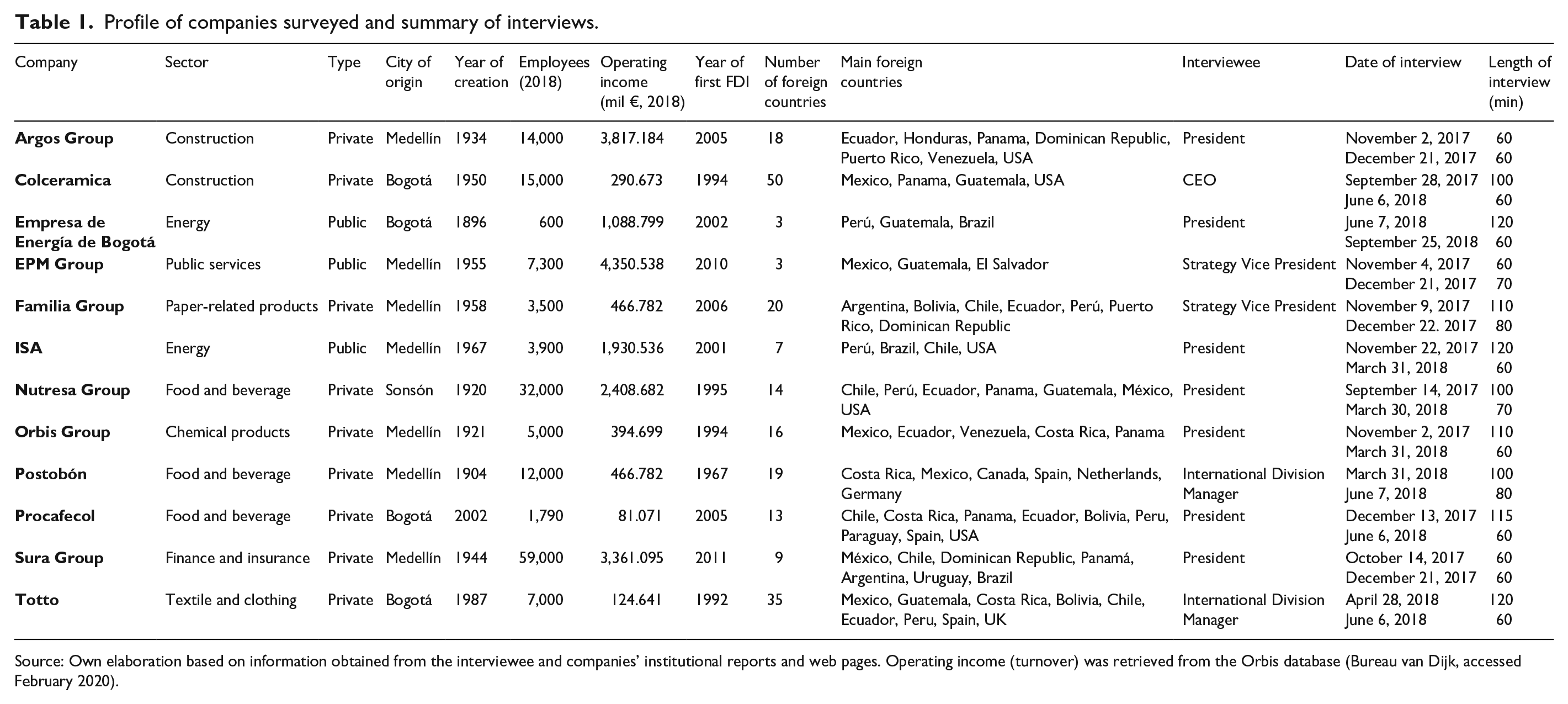
Source: Own elaboration based on information obtained from the interviewee and companies’ institutional reports and web pages. Operating income (turnover) was retrieved from the Orbis database (Bureau van Dijk, accessed February 2020).
Data analysis strategy
We developed strategies for data analysis from both primary and secondary sources, and we emphasized using tables and diagrams to present, record, organize, and manage data in an accessible and attractive way. Furthermore, the data collected in the interviews were translated into categories to make comparisons and possible contrasts so that data could be organized conceptually and display the information according to some pattern or emergent regularity (Strauss & Corbin, 2008). This process also facilitated the synthesis of the empirical findings and their relationships with the theoretical concepts in the literature (Gioia et al., 2013).
We carried out an iterative process of abstraction through which we moved from the experience of managers as stated in their own words (first-order codes) to theory elaboration through second-order themes and aggregate dimensions (Magnani & Gioia, 2023). This process allows us to move from data toward theory and from reality toward abstraction. First, each researcher independently read through the entire dataset and created an initial set of first-order codes. All differences in codes and coding rules were discussed until a consensus was reached. These first-order codes represent the companies’ realities and managers’ experiences related to foreign multinationals’ influence on their strategic capabilities. Second, we grouped the first-order codes into five second-order themes that were relevant to our research objective. These concepts were more abstract and represented the theoretical dimensions that helped simplify the information in the codes: direct ties, indirect ties, innovation and technology, organizational processes, and internationalization. Third, we arrived at the second level of abstraction by aggregating the second-order themes into the more general concepts: (1) the channels through which spillovers occurred and (2) the spillover effects. This broad scope allows us to observe types of spillovers that cannot be detected when adopting the quantitative perspective commonly seen in the literature.
Figure 1 presents the progression from raw data to theoretical themes and concepts, forming the framework for our discussion.
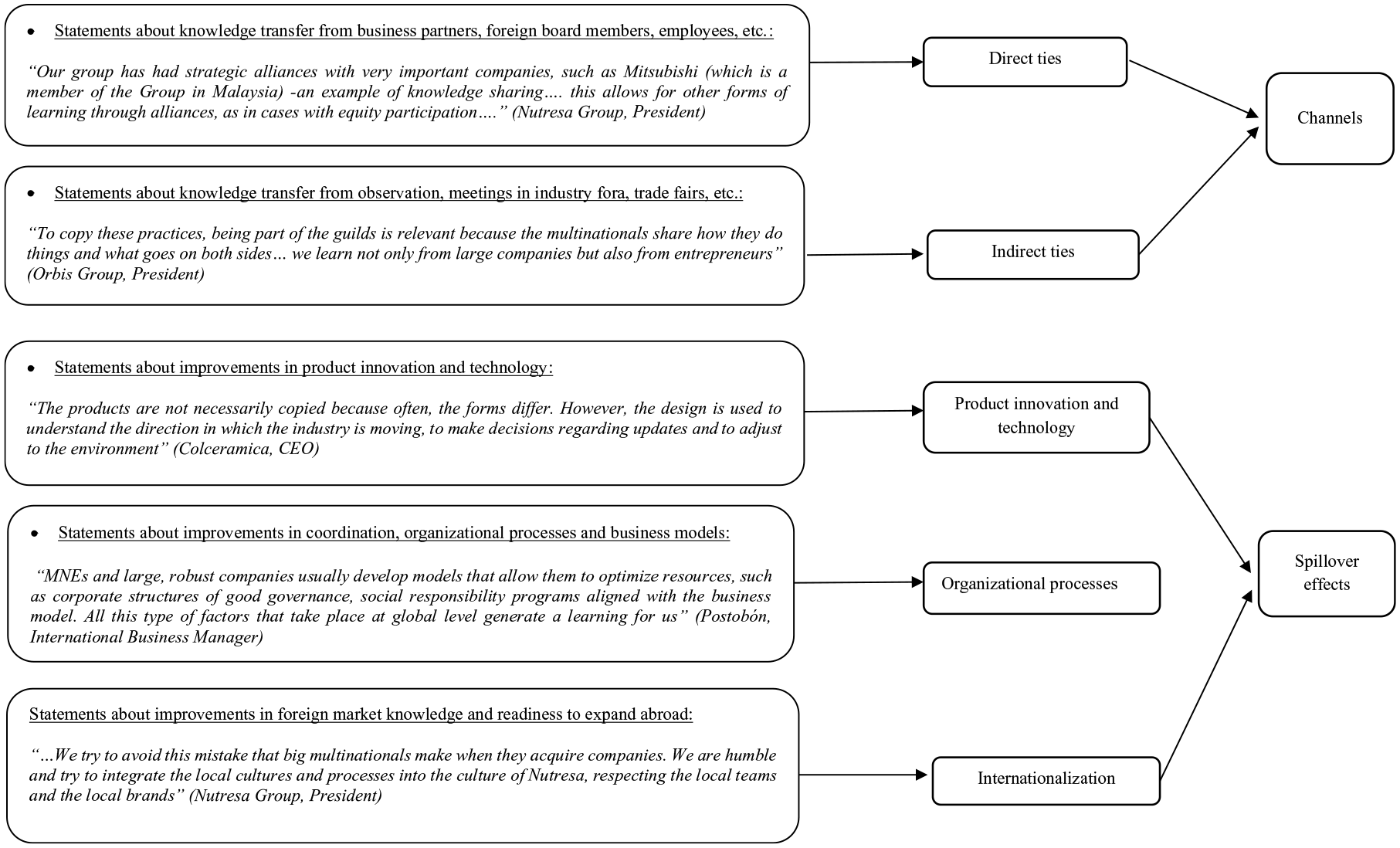
Data structure.
Findings and discussion
Channels: direct versus indirect ties
The relationships established between domestic and foreign firms deserve special attention in attempts to identify the effects of FDI spillovers on local firms (Giroud, 2012; Javorcik, 2008). In this regard, the surveyed firms emphasized two relational channels for knowledge transfer: direct and indirect ties.
Direct ties
Direct ties facilitate the transfer of know-how, which requires face-to-face contact in that it encompasses an important tacit component (Kogut & Zander, 1992). While multinationals have a strong incentive to prevent knowledge leakage to their competitors, they may want to transfer expertise and know-how to their partners (Javorcik, 2008). Therefore, the direct tie dimension included statements referring to relations with suppliers, customers, shareholders, staff, and other actors that led to the sharing of resources and know-how. Some of these ties were based on supply chains or alliances (Jindra et al., 2009). Other interesting cases arose when respondents referred to the know-how provided by other internal groups, such as foreign shareholders and partners or staff members previously employed by other multinationals.
Three out of the 12 companies mention the importance of learning through alliances. For example, the President of Nutresa, which has signed two equity joint ventures with the Mitsubishi group in Malaysia, a coffee producer (Dan Kaffe), and a distributor (Oriental Coffee Alliance SDN),
1
indicated: We are a limited company with approximately 14,000 shareholders. Seven per cent of our shareholders are not Colombian—they are shareholders from other countries who have questions and recommendations, and we learn from them. . . . Moreover, our group has signed strategic alliances with leading companies, such as Mitsubishi. . . . This allows for other forms of learning through alliances, as in cases with equity participation. . . . Competition and alliances are the primary sources of learning from the multinationals with which we compete. (Nutresa Group, President)
A parallel case is that of the Familia group. On its Board of Directors, the Group has had its partner, the Swedish multinational company SCA, since 1985, when Familia became one of the first Colombian firms to partner with an international industrial group.
2
The vice-president of Familia remarked: Multinationals can enter Colombia very easily, so we compete with the largest multinationals in the world: Procter and Gamble, Kimberly Clark, Johnson and Johnson, and CMPC. These companies present alternatives, innovations, and proposals . . . on products, communication, packaging, and market introductions. Therefore, we must leave the market if we do not follow the same path. We are not their suppliers, and the Board, especially our foreign partners, has forced us to take these steps. (Familia Group, Vice President) In similar terms, the President of Empresa de Energía de Bogota (EEB) stated: In 1997, our company was state-owned, and we were experiencing a major crisis. At that time, it was decided to privatize part of it. Endesa, the Spanish electricity multinational, entered the capital of our subsidiaries Emgesa and Codensa, with a 48.5% stake. This alliance provided important learnings, especially in the managerial and financial aspects. Moreover, we learned how to manage strategic alliances with foreign partners and to think of internationalization as a strategic option for our company. We have taken advantage of all this learning later in the expansion of our group. (EEB, President)
In fact, EEB recently signed a new agreement with the Spanish multinational Red Eléctrica to enter Brazil by purchasing the Brazilian company Argo Energia, one of the country’s most consolidated companies. 3
Indirect ties
Because not all firms can be part of the network to access the resource sharing arising from interaction with MNEs (know-how, human capital, etc.), indirect ties play a relevant role in disseminating the benefits of FDI to a broader pool of domestic firms. Indirect connections offer accessible opportunities in the form of explicit information that can be shared in situations other than business partnerships. For example, as proposed in the literature, the competition effect among domestic and multinational firms can indirectly induce local firms to improve updating production technologies and techniques to become more productive (Görg & Greenaway, 2004). In addition, the imitation effect occurs if there are indirect relationships between MNEs and local firms, and domestic firms learn superior production technologies and other knowledge from MNEs (Rojec & Knell, 2018). For example, attendance at trade fairs has been mentioned as an important way to create shared knowledge and solutions. Other settings, such as information fora, industry associations, and systematic follow-up interactions, were also highlighted as opportunities to be attentive to other firms’ strategies (Greenaway et al., 2004). This type of tie does not entail formal resource-sharing benefits but can provide access to information, knowledge, and experience from other actors (Ahuja, 2000).
Foreign firms increase local competition by infusing new technologies into the domestic market. These pressures indirectly force domestic firms to speed up new technology adoption and increase their managerial efforts to improve efficiency under this adverse scenario (Crespo et al., 2009). This seems the case with the arrival of Starbucks and competitors in the coffee business, such as Dunkin Donuts or Krispy Kreme in Colombia. The President of Procafecol (owner of the Juan Valdez brand, the leading domestic company in the coffee sector) declared in a press interview that new players had not affected them but, on the contrary, had forced them to improve standards: “The entrance of new competitors of the relevance of a Starbucks has forced us to be better. They have forced us to improve standards, to be more flexible and innovate faster.”
4
In our interview, he also stressed the importance of observing competitors’ practices, products, and processes, a type of information provided by indirect connections: When we travel, we analyze the iconic stores of Starbucks, observe their development, and examine where their market is going . . . our employees visit such stores, take notes and photos. Intelligence about the competition is gathered in any country. We study their best practices and their consumers’ preferences with great discipline. (Procafecol, President)
In the same vein, the President of Nutresa Group also remarked on the importance of these indirect ties: Our multinational competitors, such as Nestle or Unilever, were the main source of learning . . . our company now goes to other countries as a multinational, and the companies of that country look at our company in such a way that they start to imitate it. (Nutresa Group, President)
Indirect learning based on observations is often facilitated by attending trade fairs or association meetings. As the Totto International Business Manager mentioned, “Much learning occurs at international fairs, where you can see what the competitors are doing.” The ISA Group President stated, “Through fairs and participation in business associations, we have seen new product trends, design . . .” Most of the interviewees remarked on this issue: At the point of sale, in travel and at fairs, one can understand new developments and tendencies without direct communication with our competitors. The innovation comes to us—often, the suppliers inform us about new possibilities in machinery or raw materials . . . Fairs, points of sale, and trips are different options through which the market allows for information transfer, but not in a direct way. (Familia Group, Vice President) We attend international fairs to see what is being developed. Apart from attending them to sell, we go to know what to anticipate. (Postobón, International Business Manager)
Indirect learning can also result from other business meetings facilitated by guilds and inter-industry events. The President of Argos Group, a company that was included in the Dow Jones Sustainability Index (DJSI) as the second most sustainable cement company in the world in 2018,
5
referred to this point: Argos Group is part of international organizations, such as the International Sustainability Forum, in which 200 companies worldwide participate and present best practices on sustainability, alternative fuels, renewable energies, and other aspects. In those spaces, you share experiences with large multinationals from different sectors, such as Unilever, Coca-Cola, IBM, and Monsanto. In this sense, these types of fora are essential for transferring and exchanging best practices . . . They are not arenas for competition but focused on the general interest of the organizations, sustainability, social responsibility, and corporate governance . . . For instance, when you join a team created by a sustainable development organization, you can access the efforts of many companies from different sectors. (Argos Group, President)
In sum, the 12 companies mentioned that indirect channels provide valuable information and provide access to new knowledge of all dimensions. As such, they constitute a useful instrument that provides firms with better information on their potential.
Contextualized explanation: indirect ties as conduits for information in Multilatinas
Our research extends the theory of inter-organizational learning to address the unique challenges and opportunities Multilatinas faces. We begin by underscoring the pivotal yet often underappreciated role of indirect ties as channels for information flow, significantly influencing a firm’s strategic decisions. While previous studies have noted the importance of direct and vertical interactions in enhancing capabilities (Jindra et al., 2009), there has been limited investigation into how these dynamics may vary across different contexts.
The smaller technological gap between local and foreign firms in advanced economies facilitates direct collaborations (Giroud & Scott-Kennel, 2009; Zhang et al., 2010). However, the scenario is markedly different in Latin America. Multilatinas often struggle to form partnerships with established MNCs due to their nascent technological and managerial capabilities. This challenge is exacerbated by their status as latecomers to the global market, necessitating significant investment in knowledge acquisition and capacity building to reach international standards. Furthermore, the socio-economic landscape in Latin America, characterized by political instability, regulatory uncertainties, and social inequalities, adds layers of complexity to forming direct ties with foreign MNCs. In addition, a prevalent culture of risk aversion limits these firms’ willingness to pursue bold international collaboration strategies, curtailing potential growth and learning opportunities.
Given these challenges, the feasibility of direct learning, which typically necessitates co-location, is restricted to a select group of domestic firms that have already consolidated their positions to establish connections with foreign multinationals. This fact leaves limited opportunities for “outsider” firms or those striving to catch up with their more developed counterparts.
Our research uncovers an alternative pathway for knowledge dissemination through indirect ties, a mechanism that domestic firms, including those without direct business connections to foreign multinationals, are more inclined to adopt. This finding is particularly salient among the leading Multilatinas in Colombia, where indirect learning mechanisms are pervasive across their value chain operations. Despite the established nature of the firms studied, their management unanimously highlights indirect learning as the foremost approach for knowledge acquisition. This mode of inter-organizational learning, characterized by observing and emulating practices from foreign subsidiaries, holds the promise of fostering novel knowledge and capabilities.
Building on these observations, we propose the following proposition:
P1: In the specific context of Multilatinas, indirect ties become the most important channel for learning and upgrading capabilities.
Spillover effects: product innovation, organizational processes, and internationalization
According to our interviews, we categorized the spillover effects concerning three main outputs: (a) product innovation and technology in the firm, including productivity; (b) improvements in organizational processes, including the establishment of standardized routines or practices; and (c) internationalization. In alignment with the objectives of this article, the latter two focus on spillovers other than the classical efficiency-based improvements, thus offering a more advanced view of the complexity of spillovers.
Product innovation and technology spillovers
From a quantitative perspective, many studies have suggested that MNEs could diffuse their superior technology to local firms through productivity or innovation (Liang, 2017; Ning et al., 2023). The Vice President of the EPM group stressed the importance of this effect: “We innovate thanks to being more aligned with trends related to the environment, energy efficiency, and green technologies . . . we are learning from foreign companies that are showing the way in Colombia” (EPM Group, Vice President). In fact, recently, the EPM group and the American multinational Invenergy, a global specialist in wind and solar energy projects, have signed an agreement to invest, develop, and operate unconventional renewable energy projects in Colombia, specifically with solar and wind technology. 6
In the same vein, other companies such as Colceramica, Nutresa, or Totto acknowledged that the observation of the foreign competition’s products and technologies guided their introduction of new products to bring them into line with global requirements and industry trends: The products are not necessarily copied because the forms often differ. However, the design introduced by foreign MNEs is used to understand the direction in which the industry is moving, to make decisions regarding updates, and to adjust to the local markets. (Colceramica, CEO) We benchmark ourselves against international companies. The main source of learning is exposure to the competition. This generates new ideas related to the product and the form of packaging. (Nutresa Group, President)
The case of Totto is remarkable. Today, it is one of the most innovative companies in the industry. Totto Lab allows customers to design and personalize their backpacks or bags from home by entering gt.tottolab.com or Totto stores. 7 However, the director of internationalization recognizes that some product innovation in the past was inspired by the trends set by its international competitors: “At the beginning, looking at the windows of competitors’ stores and their catalogs helped us to leverage the product and introduce printed designs in our backpacks following this European trend. Now, through our Totto Lab, we are world leaders in customizing backpacks for each client” (Totto, International Business Manager).
We also observed another effect arising from the arrival of foreign firms. In some cases, domestic firms’ awareness of the products introduced by foreign competitors seemed to be useful for reassessing their own products, frequently to improve adaptation to their markets or increase efficiency. In this regard, the Vice President of Familia Group stated: “We collect all of the information available to enhance our innovation and try to present a better alternative to our foreign competitors’ products adapted to the needs of our local markets.”
In the same vein, the President of Sura remarked on improvements in efficiency: We have improved productivity mainly because many of our international competitors were more productive . . . Many of them arrived with a pricing strategy and the only way to combat this strategy was to be more productive . . . Another important aspect has been technological innovation. If a multinational enters the country with a new technology, we must respond to that movement. (Sura Group, President)
In fact, Sura Group, knowing that many technological innovations in its sector come from abroad, developed a program to invest in international companies with a high technological component. During 2018, they invested $ 10.6 million in minority participation in three companies: Slice, a digital Canadian insurance company; Welltok, an American company offering large-scale programs in health prevention and wellness; and Zendrive, the American technology platform for understanding drivers’ behavior. 8
Organizational processes and best practices
MNEs can be understood as a network of transactions in terms of capital, product, and knowledge flows, and to organize internal activity, MNEs need to use administrative or coordination mechanisms (Ghoshal & Nohria, 1989). Given the possibility to access local resources geographically dispersed and accumulate experience from these transactions, MNEs can recombine and formalize this knowledge in routines, creating transferable practices across borders. Compared with domestic firms, organizational routines and established processes or business models in MNEs pinpoint international experience and superior capabilities, which can constitute a valuable source of learning for other companies as seen in our case studies.
In most cases, managers in domestic firms acknowledged that although they did not necessarily imitate technology or products, they did imitate the organizational practices of foreign multinationals, either alone or in combination with product-based developments. The Presidents of Orbis Group, Argos Group, and EPM remarked on this point: When you work in a MNE, you learn discipline and many ways of doing things that most Colombian companies do not understand. In a MNE you are forced to follow the established norms and processes. (Orbis Group, President) When a responsible multinational arrives in a country, it must be a good corporate citizen and introduce best practices based on its many years of experience, which generates more demanding standards for all domestic companies. This need compels us to compete with world-class companies and it becomes an incentive for company development. (Argos Group, President)
Recently, EPM has undergone several organizational and structural transformations (EPM 2018 Annual Report). The vice president referred to this fact, stating, “EPM uses other foreign companies’ work processes and performance as references to change.”
An interesting case is that of Procafecol and the opportunities they perceived from the arrival of Starbucks. By the time Starbucks arrived in Colombia in 2014, Procafecol had a strong market position in its domestic market, with more than 200 stores. Therefore, Starbucks’ entry did not have a damaging effect, although it motivated Procafecol to consolidate and protect its business.
9
The President mentioned: “Nothing is copied from our competitors, but Starbucks and other coffee-based beverage stores inspired the business model.” Procafecol’s top management team had perceived that stores offering a full experience were establishing a new global trend: The competition led the company to redirect our consumption strategies and redesign our stores similarly. This effect did not occur previously with our main domestic competitor here. Although that company was a competitor, it did not affect our business model. A strong international competitor’s presence helps us continue being the best. The stores were modernized, and the processes were more standardized. (Procafecol, President)
Over time, domestic companies can recombine the knowledge from different geographical sources, standardize best practices, and create internal processes to transfer them efficiently across borders (Ghoshal & Nohria, 1989). In this manner, they can become a benchmark tool for other companies abroad. The President of ISA stated, “We had introduced some management practices to Peru that now are copied by domestic competitors.” The interviewee in the company Postobón also noted that they combined foreign multinationals’ successful processes and practices with those of their own: Multinationals are always important because they bring valuable lessons from other countries. These competitors force us to improve some of our processes. However, we are market leaders, and some of the processes we implement are our own, although other practices that help maintain our leadership have also been adapted from this learning. (Postobón, International Business Manager)
Internationalization
Several of the managers we interviewed agreed that the presence of MNEs had provided them with novel insights into competing abroad. The entry of foreign companies into the country made them realize that they also had firm advantages to compete overseas. This effect was evident in two of the state-owned Multilatinas included in the sample. Given the participation of public capital, they had financial and technical resources that could be exploited abroad. All that remained was to strengthen this idea and believe that it was possible. This effect was confirmed by both companies ISA and EPM, in the energy sector. The President of Isa stated:
There are many foreign companies here in our industry, such as ENEL (Italian), AES Gener (Chilean), and Gas Natural (Spanish). Their presence was an example of how we could go abroad, which was not necessarily the result of their competition with us or analyses of their strategies. They had the same strategic and technical characteristics as we did . . . After seeing how they entered Colombia and did well, we decided to follow the same strategy, knowing that our capabilities were more than similar to those of these multinationals (ISA, President): In fact, ISA has become a leading Multilatina with extensive technical and international experience. Through its 33 subsidiaries, it manages essential infrastructure projects that promote the development of the continent, contributing to the progress of the inhabitants of Colombia, Brazil, Peru, Chile, Bolivia, Ecuador, Argentina, Panama, and Central America. (ISA 2018 annual report)
The Vice President of EPM stated the same argument: At this moment, the vast majority of the Colombian generation are in the hands of multinational companies. The only public firm active in generation is ours—all others depend on multinationals. However, we did not have the impulse to leave; it only served to show that our group could provide services abroad like them.
In addition to the presence of MCNs prompting their internationalization, companies remarked that they learned from multinationals “what not to do.” Some multinationals from developed countries entered Colombia through aggressive purchases and behaviors, imposing their culture and processes without considering local companies’ views. In addition, the liability of the country’s bad image for a time also produced some distortions in the behavior of these foreign companies. Some companies interviewed indicate that they learned from these harmful practices. Consequently, they develop a less aggressive model based on mutual understanding and respect for partners in their internationalization process, adopting a sensitive attitude to cultural differences away from the behavior of the “conqueror.”
Remarkable examples are found in statements made by the presidents of Nutresa, Argos Group, Sura, and Postobon when discussing the internationalization process: We learn about both good practices and practices that should be avoided by MNEs when going international, such as the mismanagement of cultural issues often observed in investment-destination countries . . . many companies arrive here with a manual telling that the world is like this . . . We try to avoid this mistake that big multinationals make when they acquire companies. We are humble and try to integrate the local cultures and processes into the culture of Nutresa, respecting the local teams and the local brands. (Nutresa Group, President) In becoming a Multilatina, we have not been buyers who impose a particular way of doing things, like conquerors. Most of the time, our country’s image abroad does not correspond with reality. We need to cope with this. We are absolutely respectful of people and the local culture. We are a humble company that values human talent. This has also helped us overcome preconceptions about Colombian companies, especially during the acquisition in the United States. (Argos Group, President) We want to be a Latin American company for Latin Americans. . . . We respect diversity and local talent. . . . We come from a country that has had many problems throughout history, and this has made us humble and respectful of local teams and their cultures. . . . We buy companies with a long-term vision because they have excellent local teams and good results. We do not speculate on this type of operation. We want to build long-term relationships. (Sura, President) Acting with humility and learning how things are done in a foreign country are our main lessons in this process. We have a mental openness based on humility. . . . I am going there to learn and to understand them, not to impose my own thinking. (Postobon, President)
Contextualized explanation: real spillover effects in Multilatinas
In the unique landscape of Multilatinas, the role of vicarious learning transcends the conventional focus on technological adoption. These firms, navigating the complexities of emerging markets, engage in vicarious learning to bridge technology gaps and refine their organizational processes and strategies for internationalization. The latecomer status of these firms, coupled with the rapidly evolving global business landscape, demands an accelerated learning curve that vicarious learning can help achieve. By absorbing knowledge not just in technology but also in organizational and internationalization strategies from established MNCs, Multilatinas can leapfrog developmental stages, avoid common pitfalls, and carve out a niche for themselves on the global stage.
Our observations of Colombian Multilatinas reveal a co-evolutionary trajectory of capability development alongside their international expansion efforts. Our findings show that these indigenous firms observe and emulate multinational enterprises operating in Colombia. This practice enables them to enhance their technological and organizational capabilities, bolstering their competitiveness and fostering continued internationalization. This aptitude for vicarious learning is further amplified by the accumulation of experience, which in turn facilitates the identification and utilization of external knowledge. This learning is especially valuable in this context, marked by country-of-origin liabilities, as it enables these Multilatinas to catch up with their foreign counterparts.
Our findings suggest a nuanced learning mechanism and spillover effects in Multilatinas, distinct from traditional business linkages. For instance, product innovation and technological spillovers in firms such as EPM, Colceramica, Nutresa, Familia, Sura Group, and Totto predominantly stem from indirect ties, such as market observations and trade fair engagements. These interactions afford insights into emerging trends and innovations, guiding even the less established firms in aligning their offerings with global standards. Similarly, regarding organizational processes, benchmarking for best practices (e.g., standardization of processes, corporate social responsibility, or business models) occurred only through direct ties in three cases (Nutresa, Familia Group, and EEB) with alliances and shareholders. Again, results show the prevalence of learning driven from indirect ties (e.g., fora, observation) in Argos Group, Colceramica, Orbis Group, EPM, Postobón, and Procafecol.
Finally, regarding the spillover effect of internationalization, indirect ties also seem to play a role in the internationalization of domestic firms, encouraging expansion mostly toward regional markets. Indirect ties (e.g., observations of competitors’ strategies and trade fairs) prompted internationalization, particularly in the cases of ISA, EPM, Colceramica, Nutresa, and Postobón. In ISA and EPM, executives indicated that although competition was not a reason to leave the market, it served to confirm their international potential after consolidation in their home country. The vicarious learning acquired even from weaker ties in foreign market knowledge, international marketing, or cultural awareness was also crucial for some firms’ decision to expand abroad (Postobón and Nutresa).
By demonstrating the multifaceted nature of vicarious learning and spillover effects—encompassing technology, organizational processes, and internationalization—our research offers a more holistic understanding of the dynamics at play. This broader perspective enriches the theoretical discourse on spillovers, highlighting the complex interplay of factors that facilitate the growth and global integration of Multilatinas.
The above leads us to the following propositions:
P2a: Within the context of Multilatinas, the spillover effects primarily stemming from indirect ties are not only associated with product innovation but also extend to organizational processes and internationalization.
P2b: Within the context of Multilatinas, technological and organizational spillovers allow upgrading capabilities at home, subsequently streamlining the internationalization process.
Finally, our findings can help extend extant research regarding the internationalization of Multilatinas (e.g., Cuervo-Cazurra, 2008; Cuervo-Cazurra et al., 2018; Hermans et al., 2024). The interaction with MNEs and the liabilities of the country of origin have imprinted a specific model in terms of knowledge acquisition and relationships with partners. In periods of susceptibility (e.g., at the time of the founding, early stages of evolution as a multinational), the focal entity exhibits characteristics that reflect prominent features of the environment, and these characteristics continue to persist despite significant environmental changes in subsequent periods (Marquis & Tilcsik, 2013).
Interviews with long-tenured managers, including some founders or key figures during their companies’ development phases, reveal the pressures faced by the massive entrance of Multinationals in Colombia, particularly in the 1990s—a critical period of internationalization for these firms. They also navigated the challenging backdrop of Colombia’s historical conflicts, corruption, drug trafficking, and political instability. The interaction with foreign MNEs, some of which engaged in abusive practices, has engendered a learning effect on how not to approach internationalization. This learning has infused an internationalization philosophy grounded in humility and partnership, enabling these firms to adjust to foreign markets adeptly. For many Multilatinas, forging long-term, learning-focused relationships and preferring organic growth have been essential strategies due to the difficult nature of internationalization.
Our interviews with Colombian executives revealed that this humble management style is compatible with efficiency, adaptation, and growth. Companies such as Nutresa, Argos Group, Sura, and Postobon have embraced a partnering model of internationalization characterized by long-term relationships and a devoted commitment to continuous learning. However, Multilatinas face a critical challenge in their quest for international expansion: they must balance pursuing global reach and the imperative to enhance their capabilities. While these firms can extend their home-grown competitive edges to other emerging or developing markets, venturing into more developed countries is crucial. Such expansions expose them to sophisticated demands and enable the further development of their capabilities. For instance, firms like ISA, Nutresa, and Postobón have ventured into developed markets such as the USA, Spain, the Netherlands, and Germany. These strategic investments in developed countries are aligned with the framework proposed by Guillén and García-Canal (2009), suggesting that these international ventures are instrumental in advancing the firm’s capabilities. Through this approach, Multilatinas exemplify a model of international expansion that integrates lessons from their domestic and international experiences, reinforcing the importance of strategic flexibility and adaptability in the global marketplace. This approach provides additional empirical support for the idea that Multilatinas utilize the challenges encountered in their domestic markets as a springboard to forge competitive advantages. These advantages are then leveraged both domestically and internationally to support their global expansion efforts.
The above leads us to the following proposition:
P3: Within the context of Multilatinas, internationalization spillovers are further shaped by domestic challenges and insights gained internationally, fostering a collaborative model of internationalization characterized by humbleness and long-term relationships.
Concluding remarks
This study explores the competitive edge Colombian Multinationals gain from interactions with foreign multinationals, focusing on the nuanced spillover dynamics that bolster their market position as emerging-market latecomers. By examining the integration of these spillovers, we reveal how Colombian Multilatinas enhance their technological and organizational capabilities for improved competitiveness.
Our analysis, depicted in Figure 2, introduces a learning model that emphasizes the critical role of foreign competition and Colombia’s unique institutional environment. This model suggests that for Colombian Multilatinas, learning primarily occurs through indirect ties, emphasizing vicarious learning—observation and emulation. This approach not only enhances technological and organizational capabilities domestically but also prepares these firms for a more strategic internationalization characterized by a gradual, relationship-focused expansion.
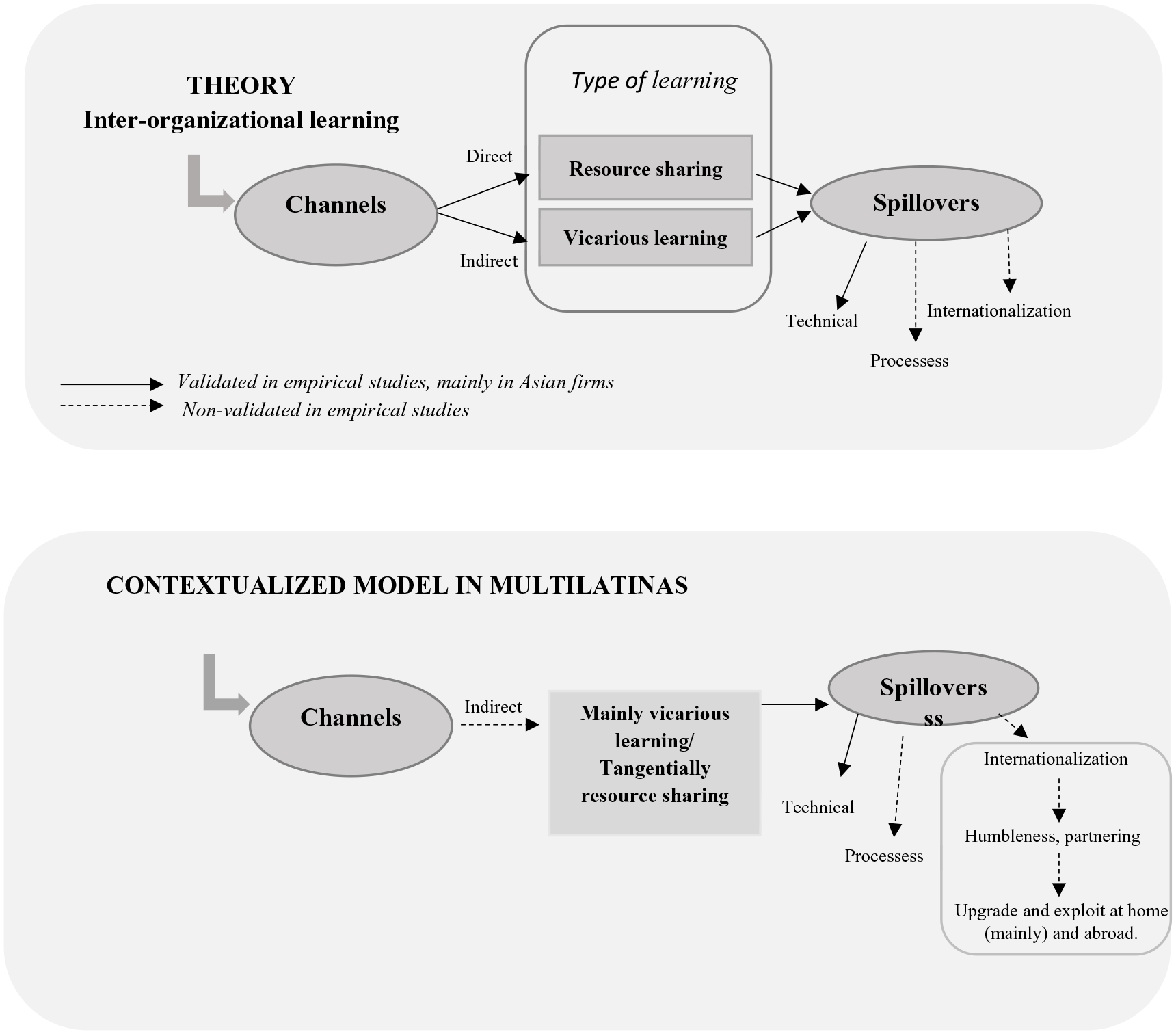
A model of learning for Multilatinas.
Addressing recent scholarly calls (Tsui, 2006; Welch et al., 2020), our research explores the mechanisms and impacts of spillovers, particularly noting how contextual factors shape local firms’ knowledge assimilation from foreign multinationals. By identifying indirect ties as a vital channel for spillovers, our study extends existing literature to include organizational practice improvement and knowledge on internationalization, moving beyond traditional focuses on production and technology.
Contrasting with findings like those of Liang (2017), which emphasize direct, vertical relationships in China, our study illustrates the critical importance of indirect ties for firms in contexts like Colombia. We present a model of internationalization rooted in adaptability and partnerships, enabling firms to navigate the unique challenges of their origin while adjusting effectively to global markets.
The results of this study have significant implications for both managerial and economic policy-making. While resource sharing with clients or suppliers remains a crucial mechanism for transferring tacit knowledge and enhancing technical capabilities, our study encourages managers to recognize the potential of less costly relational approaches as alternative sources of learning, which do not necessarily require physical co-location. We also advocate for policies that encourage FDI and the development of cooperative agreements to foster indirect ties and knowledge spillovers, offering a blueprint for firms in similar contexts to enhance their competitive position.
While centered on Colombia, our findings have implications that may extend across Latin America, indicating potential broad applicability for Multilatinas. Future research could explore the generalizability of our model in diverse Latin American markets through quantitative analysis and further investigate the transferability of knowledge and capability enhancement strategies.
Footnotes
Declaration of conflicting interests
The author(s) declared no potential conflicts of interest with respect to the research, authorship, and/or publication of this article.
Funding
The author(s) disclosed receipt of the following financial support for the research, authorship, and/or publication of this article: The authors acknowledge the financial support from the Ministry of Economy, Industry and Competitiveness (PI2020-118340RB-100) and Generalitat Valenciana (CIAICO-2022065)
