




Abstract
Organizational politics are recognized as a ubiquitous and negative threat to knowledge sharing in organizations, yet less research has examined the boundary conditions that affect this relationship, particularly in interdependent manufacturing contexts. This article aims to explore how authentic leadership, intrinsic motivation, and prosocial motivation bound the effects of organizational politics on the knowledge sharing activities of individuals and workgroups in the shop floor of the Brazilian automotive consortium during a political and economic crisis context (2015–2017). This crisis context was marked by presidential impeachment, high inflation, economic instability, and massive plant layoffs. We sampled 144 shop floor workers using a questionnaire-based survey and established scales, and employed multivariate regression analyses to test our hypotheses. Contrary to expectations, we found that organizational politics increase, rather than decrease, knowledge sharing of individuals and groups. Moderation analyses suggest that worker intrinsic motivation and prosocial motivation significantly moderate the positive relationships between organizational politics and knowledge sharing of individuals and groups, while authentic leadership had no significant effect on this relationship.
JEL CLASSIFICATION: D2: Production and Organizations
Keywords
Introduction
Knowledge sharing (KS) is widely viewed as a critical form of coordination inside organizations, enhancing competitive advantage by facilitating social learning (Grant, 1996; Martínez-Noya & Narula, 2018). KS is defined as the process where individuals mutually exchange their knowledge and jointly create new knowledge, transforming individual knowledge to organizational knowledge (Muniz et al., 2021; Rodriguez et al., 2021; van Den Hooff & De Ridder, 2004). However, KS is also a discretionary employee behavior, and it is important to understand the factors that inhibit or enable the KS of individuals and the workgroups in which they function (Cabello-Medina et al., 2020; Muniz et al., 2022; Ribeiro et al., 2022).
Research suggests that organizational politics are a ubiquitous negative influence in organizations (De Clercq et al., 2016; Hochwarter et al., 2010). Organizational politics are characterized as behaviors not sanctioned by the organization (Breaux et al., 2009), which employees use strategically to achieve their own self-interests (Ferris et al., 2002, 2019). As such, they represent a potentially important culprit affecting how individuals and groups engage in KS.
Yet, empirical research equivocates regarding the effects of perception of organizational politics (POPS) on KS. For example, some research suggests that POPS negatively impact KS (Evans et al., 2013; Gardner et al., 2021), while other research suggests that organizational politics are positively related to KS (De Clercq & Belausteguigoitia, 2017; De Clercq et al., 2016; Eldor, 2017; Rodriguez et al., 2021). These divergent effects suggest that boundary conditions, or moderators, are operating within the organizational politics—KS relationship (Asrar-ul-haq & Anwar, 2016).
Authentic leadership (AL) represents an important potential moderator of the relationship between organizational politics and KS. In contrast to the self-interested nature of organizational politics (Ferris et al., 2019), the AL paradigm is an effective leadership approach that promotes positive follower effects (Munyon et al., 2021), representing an important potential boundary condition of the POPS–KS relationship. Similarly, intrinsic and prosocial motivation positively impact work outputs and coworker treatment of others (e.g., Grant, 2008; Liao et al., 2022), suggesting they may also affect the relationship between POPS and KS. Research often evaluates knowledge sharing of individuals (KSI), which may vary from the observed knowledge sharing of the work groups (KSG) in which they function (e.g., Rodriguez et al., 2021). Finally, the context of work may play an important role differentiating how POPS affect KS, and we examine these relationships within a modular multi-firm manufacturing context.
The present study was developed in the context of a complex economic and political situation in Brazil. From the economic perspective, sampled workers were functioning amidst the effects of the global economic crisis, which peaked in Latin America and Brazil (2015–2017). In terms of politics, Brazil was facing an impeachment (Mancebo, 2017). The political and economic issues promoted several demonstrations and strikes with repercussions at the national and international levels. Specifically in the Brazilian automotive sector, measures were taken to deal with the crisis, such as voluntary redundancy programs, reduced working hours, layoffs, and collective vacations, among others. These measures have led to employee instability, which can consequently affect POPS (De Clercq et al., 2016; Ferris et al., 2019), leadership (Ferris et al., 2019), and employee motivation (Liao et al., 2022) due to the sense of threat of losing their jobs and pressure from employees to meet productivity targets, update work processes, be versatile, and work in teams.
In sum, our study aims to shed new light about how AL and motivation moderate the relationships between POPS and KSI and KSG in a Brazilian manufacturing consortium in the political and economic crisis context. Data were collected from 144 shop floor workers of the Brazilian Modular Consortium using a questionnaire-based survey and established scales. AL, intrinsic motivation (IM), and prosocial motivation (PSM) are theoretically and practically important influences subject to managerial intervention and development within the workforce (Grant, 2008; Martínez-Noya & Narula, 2018; Souza et al., 2020). The PROCESS macro (Hayes, 2013) was used to examine the moderating roles of use of AL, IM, and PSM in the relationship between POPS and KSI and KSG.
Several contributions are intended in this research. First, although the leadership literature has long noted its motivational impacts, it is rare to see leadership effects modeled alongside motivational influences. A side-by-side test of these influences helps clarify and illustrate the unique additive effects of AL and motivational forces as they affect discretionary workplace behaviors and behavioral reactions. Similarly, we contribute to AL by testing it in a seldom-used context, and also following a crisis in which the organization has been subject to a declining market. This contributes to the emerging stream of crisis leadership research (e.g., Dasborough & Scandura, 2022; Huang & Zhou, 2023; Junça-Silva, & Caetano, 2023). Our results also extend the political influence perspective (i.e., Ferris & Judge, 1991; Munyon et al., 2016) by highlighting the conditions under which POPS impact interpersonal processes, including KS in crisis context. Next, we contribute uniquely to the KS literature by testing two forms of KS conducted by individual and group referents. In doing so, we add much-needed granularity to this literature. Finally, these quantitative assessment data come from a seldom-tested empirical context in Brazil, representing a useful cross-cultural test of construct generalizability.
Theoretical background
This section explores the theoretical moderation of AL, IM, and PSM within the POPS and KS relationship. Our theory is premised on the political influence perspective (Ferris & Judge, 1991; Munyon et al., 2016), which assumes that individuals act within organizations to gain power and influence that furthers their objectives and goals (Munyon & Kane-Frieder, 2015; Rodriguez et al., 2021). This perspective proposes that the social influence activities of individuals are generally self-interested in nature, and that the management of meaning is a key underlying goal of individual actors (King & Vaiman, 2019).
Furthermore, organizational politics, and perceptions of such politics are natural ramifications of these behaviors as individuals seek to gain advantage for themselves (Munyon & Kane-Frieder, 2015). The self-interested nature of politics is one reason why they can be counterproductive (Chang et al., 2009; Munyon et al., 2016). However, such politics are also subject to conditions that change the way individuals interpret politics, including accountability (e.g., Breaux et al., 2009), suggesting that leadership (i.e., an outside influence) and individual motivation (i.e., an internal influence) may affect how politics translate to impact KS (see also Munyon et al., 2021). The proposed hypothesis system is represented in Figure 1 and will be theoretically and empirically discussed.
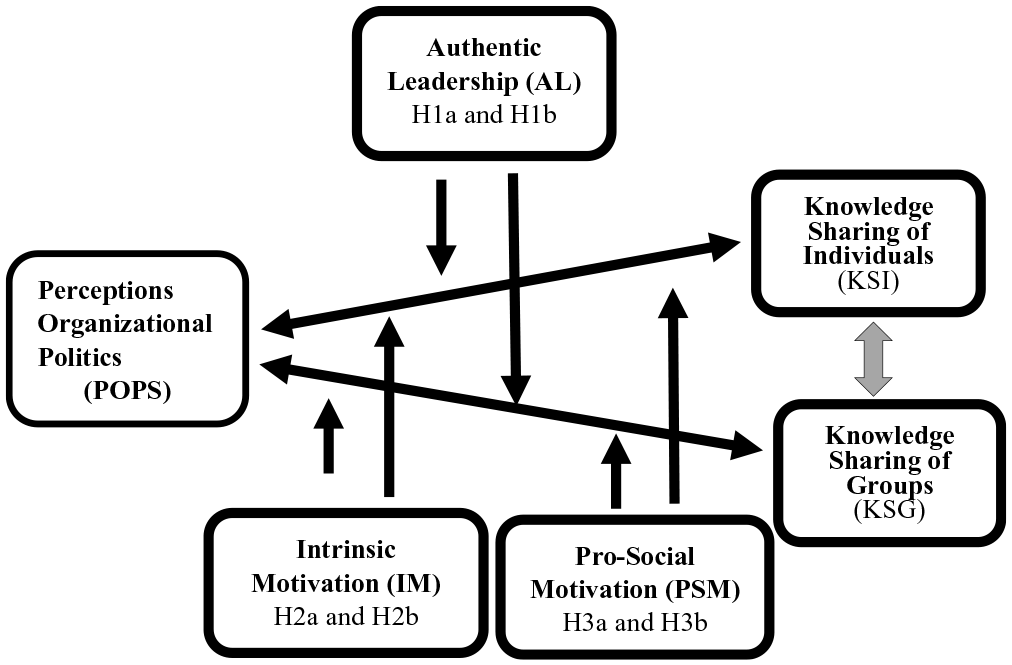
Authentic leadership and work motivation, as moderators of the relationship between organizational politics and knowledge sharing of individuals and workgroups.
AL
AL reflects how leaders know oneself, are transparent, balance information against moral imperatives, and seek to develop followers (Edú-Valsania et al., 2016; Gardner et al., 2020; Muntz et al., 2019). Authentic leaders leverage authentic behaviors, moral values, and positive communication to shape followers’ responses (Li et al., 2017). Authentic leaders are transparent, trustworthy, ethical, and truthful (Walumbwa et al., 2008). Furthermore, the ethicality and trustworthiness of authentic leaders engenders organizational commitment and performance from followers, which is why AL helps facilitate business success (Banks et al., 2016; Gardner et al., 2021; Li et al., 2017; Mingyuan & Geng, 2015; Muntz et al., 2019).
Investigations have shown that AL promotes the confidence of employees in their leaders (Edú-Valsania et al., 2016; Li et al., 2017), stimulates greater displays of organizational citizenship behaviors, and facilitates exchanges that improve work (Edú-Valsania et al., 2016). Since KS is a discretionary behavior, like organizational citizenship behavior, and authentic leaders build trust from their followers, it is plausible that this leadership characteristic may affect how otherwise negative POPS impact KS.
AL in the organizational politics–KS relationship
The literature suggests a broad and important relationship between leadership behaviors and KS (Gerpott et al., 2020; Muniz et al., 2023; Souza et al., 2020). However, there is less evidence in the literature regarding the effects of AL as a boundary condition, even as a handful of studies find a direct positive relationship with KS (i.e., (Edú-Valsania et al., 2016; Kim et al., 2017; Li et al., 2017; Malik et al., 2016; Mingyuan & Geng, 2015).
The findings suggest that AL helps provide a safe environment in which to engage in KS with fellow colleagues, who due to the same leadership influences, are more willing to receive knowledge and engage in subsequent KS themselves. The net effect of this process is an enhancement in social learning that is conducive to creativity, innovation, and enhanced problem-solving (Cabello-Medina et al., 2020; Edú-Valsania et al., 2016; Lee et al., 2020; Li et al., 2017; Mingyuan & Geng, 2015). Under authentic leaders, employees may begin to see KS as an important means of self-realization, and are not limited by myths such as “knowledge sharing is loss of power and control” or “knowledge sharing causes redundancy” (Malik et al., 2016). Authentic leaders may also stimulate KS in their employees, developing a strong sense of group identity, because the more officials identify with their workgroup, the greater their tendency to KS (Edú-Valsania et al., 2016). Specifically, as leaders show authenticity, it is expected that subordinates are more motivated to participate in KS at individual and group levels, seeking to obtain information from the organization, for improving its functions and to contribute with the group work and of the organization in general.
In sum, this evidence suggests that AL will act as a hedge against the negative effects of POPS on KS. By means of transparent leadership behavior, supervisors are able to effectively intervene to disrupt negative effects from politics and create an environment more conducive to KS (Muntz et al., 2019).
Greater authenticity from leaders may also change how followers respond to the negative politics of others (Cho & Yang, 2018), and thus, their tendency to participate in the KS individually and in groups may increase in the presence of authentic leaders (Evans et al., 2013; Gardner et al., 2021). Specifically, rather than focus on the negative ramifications of organizational politics, authentic leaders may be able to “change the narrative” and refocus worker attention on realizing the goals of the organization (Ferris & Judge, 1991), with anticipated positive effects on KS. Finally, even in highly political environments, authentic leaders may be able to engender an openness among employees that reduces the threats of politics that would otherwise impede KS.
Evidence suggests that leadership can mitigate the negative effects of POPS and enable functional KS, because even in very political environments, leaders can enhance the motivation of employees to engage in activities that are not formally required (De Clercq & Belausteguigoitia, 2017; Lee et al., 2020). However, it is necessary that leaders also build trust, promote effective communication, and engage in participatory decision-making to ease the flow of information in teams and communities of practice (Gupta, 2011). These are also characteristics reflective of AL (Li et al., 2017; Muntz et al., 2019), suggesting that AL will bound the effects of POPS on KS (Figure 1). In particular, we anticipate that the presence of authentic leaders will weaken the negative relationship between POPS and KS for individuals and groups. Thus:
H1: AL moderates the negative relationship between POPS and KSI (H1a) and KSG (H1b), such that the relationship weakens (strengthens) as AL increases (decreases).
Work motivation: IM and PSM
Work motivation is a psychological phenomenon, representing an internal state that drives humans to action (Deci & Ryan, 1985, 2008). Work motivation that can initiate behavior at work and determine its form, direction, intensity, and duration, is a subjective construct that manifests itself in the form of observable and therefore measurable behaviors (Latham & Pinder, 2005). The work motivation research encompasses the analysis of multiple forms of motivation, including IM, extrinsic motivation, and PSM (Akkermans et al., 2016; Bugenhagen & Barbuto, 2012; Kuvaas et al., 2012; Llopis & Foss, 2016).
Specifically, IM occurs when employees are motivated to perform their functions or engage in certain types of behavior for pleasure or inherent satisfaction, with the work itself acting as an incentive (Akkermans et al., 2016; Bugenhagen & Barbuto, 2012; Deci & Ryan, 1985, 2008). Intrinsically motivated employees are process-focused and see work as an end in itself, so when IM is high, employees will appreciate the task’s execution process and their behavior will be less determined by the characteristics of the context and more by the nature of the activity to be performed (Llopis & Foss, 2016).
Other studies address PSM, where employees have a strong sense of social exchange and feel a greater obligation to repay the organization’s benefits and support by engaging in behaviors that exceed minimum employment requirements (Kuvaas et al., 2012). Participation in prosocial actions will be less influenced by contextual factors and more based on internal values and beliefs (Llopis & Foss, 2016).
IM and PSM are intricately linked and even amplify one another’s effects (e.g., Grant, 2008). Employees with higher prosocial value scores tend to be more proactive in ambiguous situations and consequently when a certain activity is consistent with personal beliefs, core values, and lasting self-interests, IM is more likely to emerge as an energetic work force (Llopis & Foss, 2016).
IM and PSM in the organizational politics–KS relationship
Research suggests that work motivation may bound how POPS manifest and affect work outcomes (Cho & Yang, 2018; Randle et al., 2017). In support, self-determination theory (SDT) postulates that people are motivated to satisfy three basic psychological needs, including the needs for autonomy, competence, and social attachment. Psychological well-being is predicted to result as a function of satisfying these needs, and work also impacts how these needs are satisfied (Deci & Ryan, 1985, 2008; Suwanti, 2019).
Specifically, this research suggests work environments that enable need fulfillment engender motivation, and particularly IM, which reflects one’s enjoyment with work (Grant, 2008). Meanwhile, PSM reflects a desire to help others via one’s work (Grant, 2008). Taken together, both IM and PSM may modify how POPS manifest since they refocus individuals on enjoying work and benefiting others, with the net effect that politics become less cumbersome and negative for those with high levels of IM and PSM.
When IM and PSM are low, employees are more affected by the task environment around them and self-interested. This theoretically amplifies the effects of POPS in a unit, which could negatively impact how individuals share knowledge with colleagues and in groups. By contrast, high levels of IM and PSM focus employees not on potentially political work contexts, but on work and the benefit of colleagues (cf., Kuvaas et al., 2012; Llopis & Foss, 2016; Suwanti, 2019), suggesting that these factors will weaken the effects of POPS on KS. Thus:
H2: IM moderates the negative relationship between POPS and KSI (H2a) and KSG (H2b), such that the relationship weakens (strengthens) as IM increases (decreases).
H3: PSM moderates the negative relationship between POPS and KSI of (H3a) and groups (H3b), such that the relationship weakens as PSM increases (decreases).
Methodology
To explore the interrelationships among AL, IM, and PSM as moderators of the POPS–KS relationship, we incorporated a qualitative and quantitative study. The field study was approved by the Ethics Committee of the Brazil Platform process: 65500017.1.0000.5663. The research method adopted was validated in a Pre-Test study through data collection and analysis, with 44 employees of a company in the automotive sector (Rodriguez et al., 2016).
The research method adopted was validated in a Pre-Test study through data collection and analysis with 44 employees of a company in the automotive sector (Rodriguez et al., 2016). After the pilot study, this research was developed on a large scale; the data were collected by questionnaire during a Brazilian economic and politic crisis (2015–2017) context with 144 employees of the Brazilian Automotive Modular Consortium selected by non-probabilistic convenience sampling. The research instrument used Likert-type scales (5-point) to evaluate the demographic data of the sample (worker sex, age), as well as the work profiles of the interviewees, including organizational tenure, job tenure, and their employer.
The sampling frame was chosen first by the prominence of the automotive sector. Specifically, Brazil is among the 10 largest producers of cars and commercial vehicles in the world (International Organization of Motor Vehicle Manufacturers, 2022). Second, although prior research has examined the POPS–KS relationship in other nations, we are aware of no studies examining this relationship in a Brazilian cultural context, opening up new opportunities for cross-cultural comparisons. Third, to describe variables relevant to organizational management in special contexts, such as political and economic crisis.
In this research, data collection occurred during the political and economic crisis faced by Brazil from 2015 to 2017. For example, in the organization studied, voluntary resignation programs were developed, work hours were reduced, and workers terminated or given long-term furloughs. In this special context, the results obtained from the instrument reflect how employees perceive their work environment in a high-stakes crisis environment. As such, they represent an important contrast to studies highlighting worker perceptions and actions in more stable and secure environments.
The Modular Consortium consists of six companies that work in assembly lines co-located at a single facility. The facility represents a radical case of outsourcing among an automaker and the small number of direct suppliers, in which suppliers manage pre-assembly of the module and subsequent mounting in the assembly plant using its tools and equipment. Meanwhile, the assembler provides the plant and the final assembly line to execute the coordination of the same and the final test of vehicles (Rodriguez et al., 2021).
A total of 144 blue-collar workers were assessed of a total of 926 workers, so 15.6% of the population was analyzed. The participants were immersed in the production process, entered on the shop floor, of the male sex with mean industry tenure of 9.63 years (SD = 5.25 years), with a mean organizational tenure of 7.11 years (SD = 4.60 years), and 44.7% of employees had worked only for their current employer.
The instrument was applied by a team comprising seven graduate and doctoral students and the supervisor (leader and head of the research group). The team was prepared and trained for the application of the questionnaire, and one team member per plant was distributed. The application of the instrument was carried out with the first shift of employees, in the production sector, specifically on what is known as the factory floor, in an appropriate room, conditioned, and with good lighting. The application was done in work sessions, with a maximum of seven employees at a time, to facilitate the clarification of doubts when filling out the instrument.
Measures
The instrument collected information to evaluate the demographic data of the sample (gender, age), as well as the profiles of the interviewees, regarding length of experience in the industry (years), time as a collaborator in the company (years), occupation or function within the production process the productive process, and current position held within the company, among others. The research instrument analyzes the behavior of constructs based on scales previously validated in scientific evidence, applied in diverse contexts, cultures, and whose authors are duly cited. The questionnaire used a 5-point Likert-type scale ranging from (1) Strongly Disagree to (5) Strongly Agree and evaluated the perceptions of:
Organizational Politics (α = .95): Based on a six-item scale developed by Hochwarter et al. (2003) to measure organizational politics. The measure is based on the characterization of the working environment and interpersonal relations within the company. Example items include: “There is a lot of self-serving behavior going on here” and “Individuals are stabbing each other in the back to look good in front of others.”
KS (α = .88), KSI (α = .85); KSG (α = .90): We assessed using seven response items featuring the sharing of knowledge within the company and position itself in the sharing process. For a more detailed understanding of KS in the organizations, the KSI (four-item scale) and the KSG (three-item scale) were analyzed. Example items contain: “I spend time in personal conversation with others to help them with their work—related problems” (e.g., KSI); “My co-workers volunteer their knowledge and experiences even without being asked” (e.g., KSG). The full scales are available upon request to the first author.
AL (α =.96): Was measured using a 16-item scale taken from Walumbwa et al., (2008), in which employees give the perceptions of their supervisors in various situations. The authenticity of the leadership is analyzed through its behaviors, values, characteristics in making-decision, and communication, among others. Example items include: “My leader clearly expresses what he means,” “My leaders admit their mistakes when they occur,” and “My leader openly shares information with others.”
IM (α = .88): Was measured using a four-item scale from Grant (2008). The measure stem asks, “The work motivates me. . .” with example items, “Because I enjoy the work itself” and “Because I find the work engaging.”
PSM (α = .82): Was measured using a four-item scale from Grant (2008). The measure stem asks, “The work motivates me . . .” with example items, “Because I care about benefiting others through my work,” and “Because I want to help others through my work.”
Analytical approach
A Harman one-factor test suggests that there is no common method problem. In addition, the pattern of correlations identified in this article is consistent with the broader set of POPs and AL literature. To test the hypotheses, we employed the “PROCESS” macro script developed by Hayes (2013) as a supplement program to SPSS version 21.0. Three different moderation models were tested in which POPS were an independent variable, AL, IM, and PSM were moderators, and these effects corresponded to two outcome variables: KSI and KSG. The company classification, organizational, and industry tenure were entered as covariables to control for their potentially spurious effects. All predictors were standardized and centered. All results with p < .05 were considered significant.
Results
The results showed adequate reliability based on Cronbach’s alpha estimates (Table 1). Table 1 also reports descriptive statistics, intercorrelations of variables, and the results for the correlation coefficient, and the level of significance for all analyzed variables.
Means, standard deviations, and intercorrelations among study variables.
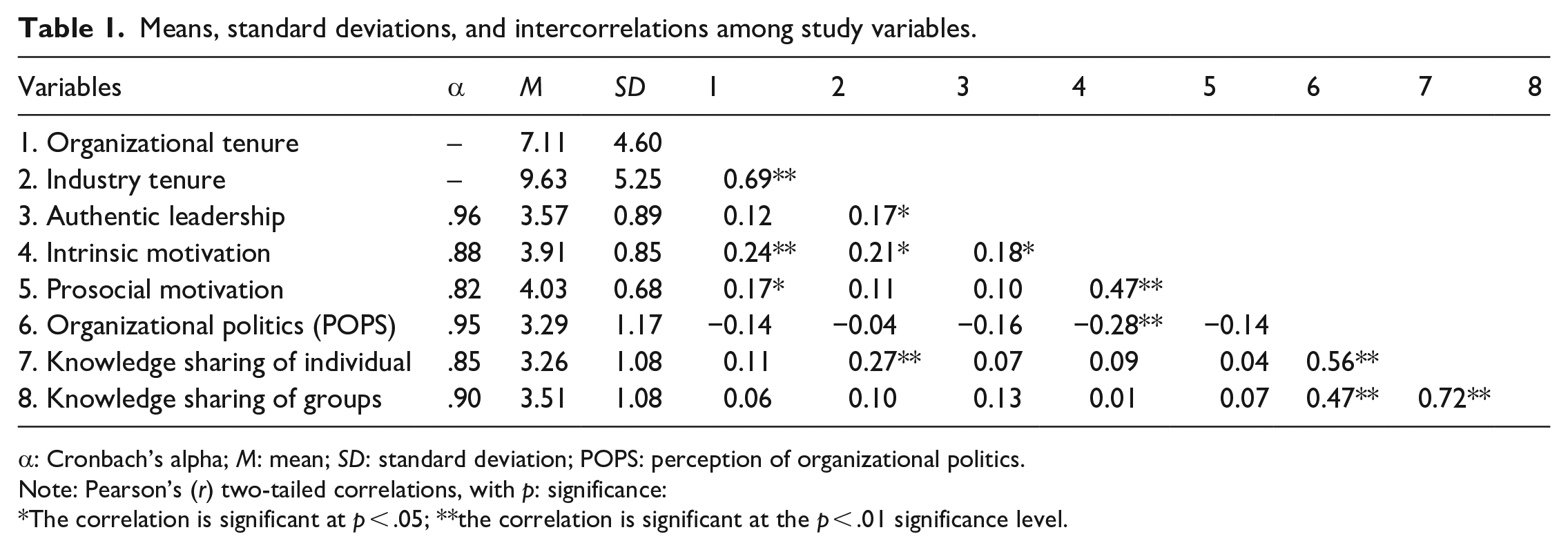
α: Cronbach’s alpha; M: mean; SD: standard deviation; POPS: perception of organizational politics.
Note: Pearson’s (r) two-tailed correlations, with p: significance:
The correlation is significant at p < .05; **the correlation is significant at the p < .01 significance level.
Contrary to our expectations, we find a positive relationship between POPS and KSI (r = .56; p < .01) and KSG (r = .47; p < .01). The KSI may reinforce the KSG, and vice versa (r = .72; p < .01). The correlation analysis indicated a significant negative coefficient between POPS and IM (r = −.28; p < .01), suggesting either that highly political organizational environments can diminish the IM of workers, or that intrinsically motivated workers reduce the incidence of negative organizational politics.
The findings suggest that the organizational and industry tenure can strengthen some organizational behaviors. For example, IM showed significant correlations with Organizational Tenure (r = .24; p < .01) and Industry Tenure (r = .21; p = .01), industry tenure can promote the KSI (r = .27; p < .01) and organizational tenure may favor PSM (r = .17; p < .05). IM was also positively related to AL (r = .18; p = .03) and PSM (r = .47; p < .01)
Table 2 summarizes the findings of three moderation analyses, where two types of KS behaviors (KSI and KSG) were separately regressed on the independent variables and on each of the moderating variables. We separated the analysis for each of the moderating variables and for its interaction with POPS to further ensure a lack of multicollinearity. The moderation analyses were performed with the Johnson–Neyman technique, so they are accompanied by their respective graph, to show more clearly the effect of the moderating variable (see Figure 2).
Regression analysis for moderation.
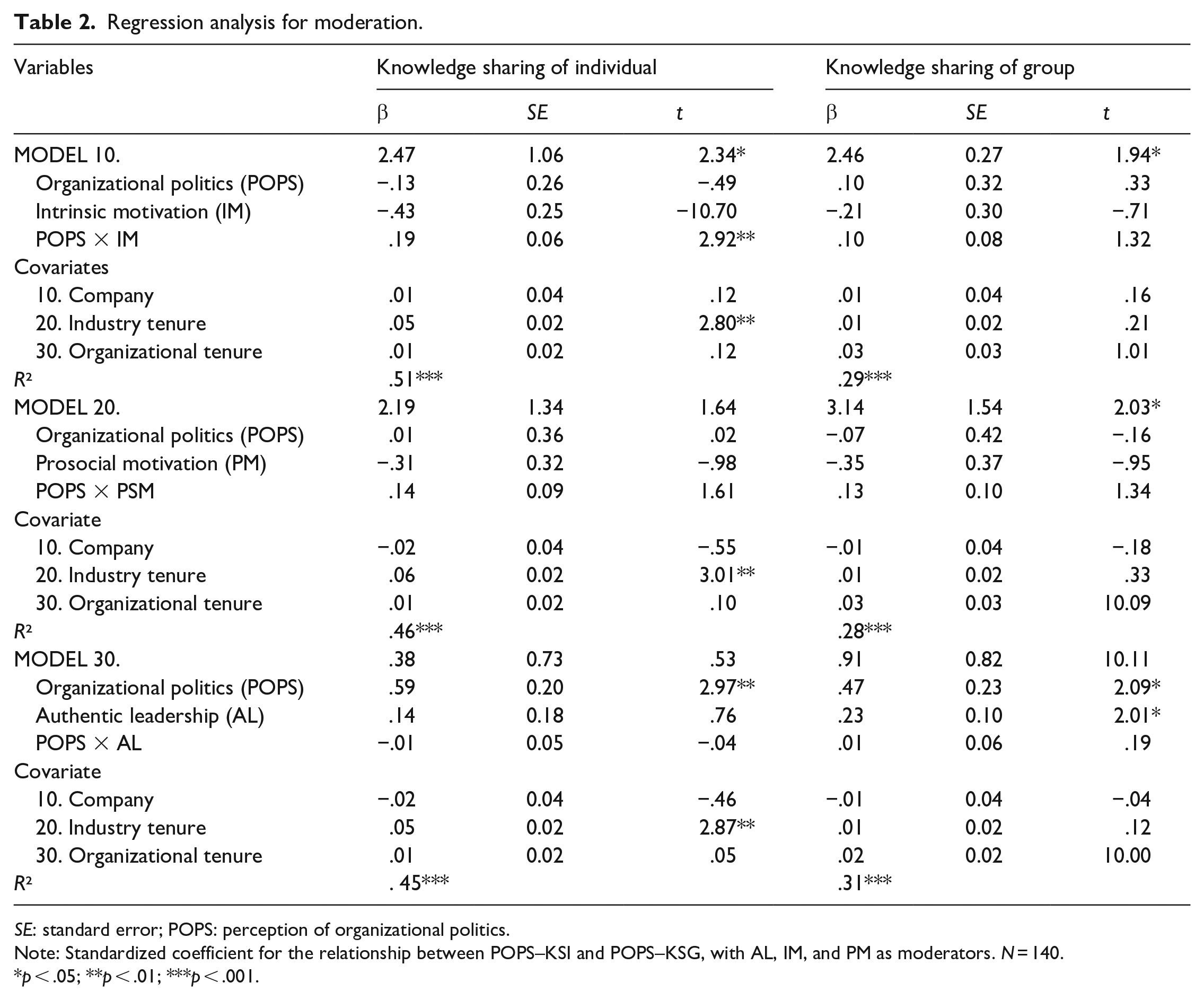
SE: standard error; POPS: perception of organizational politics.
Note: Standardized coefficient for the relationship between POPS–KSI and POPS–KSG, with AL, IM, and PM as moderators. N = 140.
p < .05; **p < .01; ***p < .001.
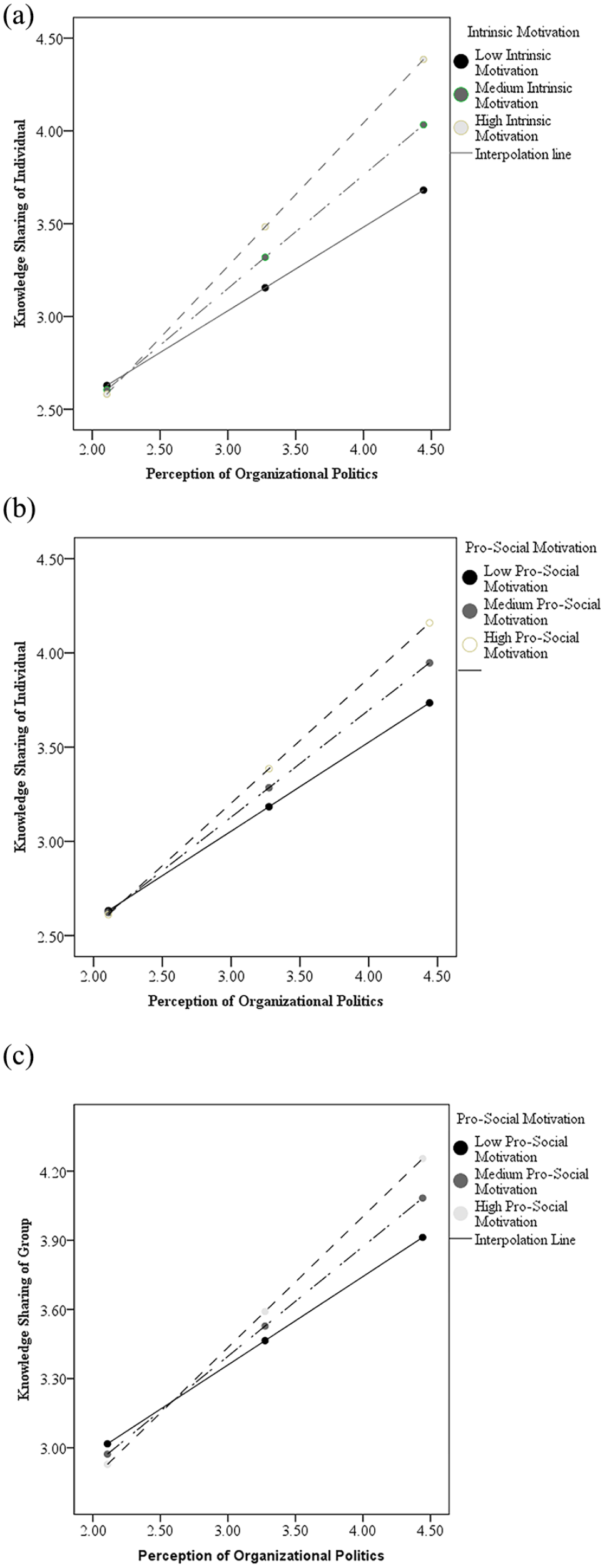
Graphics regression analysis for moderation: (a) Relationship between POPS and KSI with intrinsic motivation (IM) as moderator. (b) Relationship between POPS and KSI with prosocial motivation (PSM) as moderator. (c) Relationship between POPS and KSG with prosocial motivation (PSM) as moderator.
We proposed that the relationship between POPS and KSI and KSG would be altered in intensity by moderating variables that included AL, IM, and PSM. The moderation analyses (Table 2) indicated that the variables included in the model are predictors of KSI and KSG, because the interaction term R² was significant for all models; the significant R² also indicates the quality of the regression models.
As shown in Table 2, specifically in moderation analysis for the relationship between organizational politics–KSI and organizational politics–KSG, with IM as moderator. A main effect is the significative interaction organizational politics–IM on KSI (β = .19; p < .01), which suggests that worker IM moderates the positive relationship between POPS and KSI, such that the relationship strengthens as IM increases, and weakens as IM decreases. The results of the analysis of the organizational politics–KSG relationship with IM as moderator can be considered not significant because it has a p-value higher than the established significance value and the 95% confidence interval includes zero. The results allow us to accept the H2a hypothesis and reject the H2b hypothesis.
Contrary to expectations, PSM did not moderate the relationships between POPS and KSI and KSG, even as the trend showed marginal significance (i.e., p ≈ .10. Thus, we conclude that there is only partial and limited support for H3a and H3b.
In moderated hierarchical regression analysis for the relationship between organizational politics–KSI and organizational politics–KSG, with AL as moderator, POPS has a positive main effect on KSI and KSG (β = .59; p < .01 and β = .47; p < .05, respectively). Another main effect is the positive relationship of AL with KSG (β = .23; p < .05); however, the interaction effect between POPS and AL on KSI was not significant. Therefore, we do not find support for H1a and H1b.
To determine the form of the interactions, we plotted these effects graphically. IM and PSM both exhibit a similar pattern of moderation with POPS to affect KSI. Specifically, at high levels of organizational politics, IM and PSM differentiate KS, while there is no significant differentiation in KSI at low levels of organizational politics.
Discussion
This research provides new insights into boundary conditions that affect the relationships between POPS and KSI and KSG, content areas yet to be integrated in the organizational sciences to date using the industrial automotive context of Brazil. In particular, we explored how AL and motivational influences affected the politics to KS relationships for individuals and groups. This research was further strengthened by exploration in a time of economic and political crisis, shedding new light into the effects of organizational politics.
The direct effects suggest that POPS increase, rather than decrease, KSI and KSG. This finding is consistent with Fedor et al. (2008), who suggest that POPS may have functional effects at work, suggesting that contextual factors may affect their ultimate utility. These findings also accord with those of Eldor (2017) and Rodriguez et al. (2021). Thus, highly political environments may drive employees to seek out additional knowledge resources they desire as individuals and work groups (Ferris & Judge, 1991).
The moderator analyses suggest that motivational influences (i.e., IM and PSM), but not AL, moderate the relationships between POPS and KSI and KSG. Specifically, in work contexts characterized by high levels of organizational politics, IM and PSM differentiate KSI and KSG, while these motivational forces do not differentiate KS under conditions of low POPS levels. This finding suggests that individual motivational differences may be magnified in political environments, which are also self-interested environments characterized by ambiguity (Munyon et al., 2016).
The absence of a significant moderating effect for AL also merits discussion. Although AL creates an environment conducive to psychological safety and KS (see Banks et al., 2016, for review), we conjecture that the crisis context may have weakened or modified direct supervisory interactions with subordinates. Another potential alternative is that AL is less impactful in high power distance contexts such as those found in Brazil. Finally, the structured nature of manufacturing work may have weakened the influence of AL in this work context, mitigating its influence. Regardless, the cumulative evidence on the positive evidence of AL is compelling (Banks et al., 2016), even as its effects may depend on the situational constraints and interaction patterns between supervisors and subordinates.
The correlational analyses also suggest that POPS may decrease the IM of employees, potentially because they are associated with uncertainty about organizational decisions and ambiguity about expectations, procedures, and roles (Ferris et al., 1989, 2002) Ultimately then, these results suggest that POPS negatively impact IM as employees to feel indecisive when facing the possibility of acting, and also undermine the enjoyment derived from doing a task (Chang et al., 2009; Cho & Yang, 2018). However, conversely, the results also suggest that when there are intrinsically motivated contributors, they may mitigate or mitigate the negative effects of political perceptions, and future research is needed to shed light on this key relationship.
The assessment of IM, also, indicated significant correlations significant for the analyzed constructs, showing closer relational links with PSM (Fernet et al., 2010). However, considering employees’ perceptions, IM and PSM do not relate to KSI and KSG, which contradicts findings in the literature that pointed out a strong relationship between Work Motivation (intrinsic and prosocial) and KS in general (Kuvaas et al., 2012; Llopis & Foss, 2016; Suwanti, 2019). Thus, this unique context may represent an important boundary condition affecting how motivation and leadership influences manifest and impact work.
Meanwhile, the significant direct effect of AL on KSG also merits discussion. These results suggest that authentic leaders engender a climate in which groups feel free to engage in KS with one another (cf., Munyon et al., 2021). The significant direct effect of AL on KSG may also occur because AL favors the development of positive psychological skills of followers (Edú-Valsania et al., 2016; Gardner et al., 2021; Li et al., 2017; Mingyuan & Geng, 2015) and, above all, because authentic leaders encourage KS by developing a sense of identity with their work group (Edú-Valsania et al., 2016), which can favor KS at the group level.
Moderation analyses help answer how POPS conveys its effect on KSI and KSG by including moderating variables in this interrelationship. To summarize: the interaction effect between POPS and AL was not significant for either KSI or KSG (rejecting H1A and H1B). However, worker IM moderates the positive relationship between POPS and KSI, such that the relationship strengthens as IM increases and weakens as IM decreases (supporting H2A and rejecting H2B). The relationship between POPS–KSI and POPS–KSG, with PSM as a moderator, showed some degrees of prediction in the dependent variables (KSI and KSG), so there is partial and limited support for H3A and H3B (Figure 1).
The results reinforce previous findings about the negative influence of POPS on some variables such as IM (Cho & Yang, 2018; Ferris et al., 2002). Although there were significant results showing the empirical relationship between the variables analyzed, IM played the largest role in the POPS–KSI and POPS–KSG relationships. The results indicated that a high level of IM predicted more KSI and a low level of IM less KSI; congruent with that, the literature pointed out that intrinsically motivated employees share their knowledge with others, whether solicited or not, simply because of their passion for their work and as an expression of themselves, while a person with a regulated motivation may share when they consider it necessary and useful (Kuvaas et al., 2012).
The moderation analysis, for the relationship between organizational politics–KSI and organizational politics–KSG, with PSM as a moderator, showed no significant values for the organizational politics–PSM interaction as moderators of KSI and KSG; however, the trending results of the effect of PSM on the organizational politics–KSI and organizational politics–KSG relationships may support previous research that suggested that PSM could accentuate KS (Kuvaas et al., 2012); however, further research is needed to verify these findings.
Participation in activities that benefit other people may serve as a way to partially meet the three core needs (Deci & Ryan, 1985, 2008; Grant, 2008; Suwanti, 2019). KS can be closely linked to satisfying the need for relationships and can lead to building, developing, and maintaining social ties with colleagues in an ongoing game of sharing information and knowledge (Llopis & Foss, 2016).
Further research is needed to understand the interplay of intrinsic and prosocial forms of motivation as they affect KS and responses to workplace politics. For example, participation in activities that benefit others can serve as a way of partially meeting the three primary needs (Grant, 2008). KS can be closely linked to fulfilling the need for relationship and can lead to the building, development, and maintenance of social ties with colleagues in a continuous cycle of knowledge and information sharing (Llopis & Foss, 2016).
Theoretical contributions and practical implications
A number of theoretical contributions derive from this investigation. First, we contribute and extend the political influence perspective (Ferris & Judge, 1991) by highlighting how organizational politics influence KS. This finding expands the criterion space of political influence, highlighting how POPS impact the transmission of knowledge at work.
Similarly, we contribute to AL theory (Munyon et al., 2021; Walumbwa et al., 2008), highlighting AL’s operation as a boundary condition affecting behavioral reactions. We also extend AL theory by testing its operation in a novel crisis and cross-cultural (i.e., Brazilian) context.
Automotive companies could prioritize hiring experienced people within the industry, as industry tenure can strengthen some desirable organizational behaviors, for example, IM and KSI. Organizational tenure, in turn, may favor PSM, so maintaining stability in staff can foster employee engagement in behaviors that exceed minimum employment requirements (Kuvaas et al., 2012).
Organizations may also seek to promote IM, since intrinsically motivated employees are process-focused and see work as an end in itself, which is a situation in which work acts as an incentive (Akkermans et al., 2016; Bugenhagen & Barbuto, 2012). For this reason, when IM is high, employee behavior will be less determined by the context characteristics and more by the nature of the activity to be performed (Llopis & Foss, 2016), mitigating the negative effects of POPS (Breaux et al., 2009; De Clercq et al., 2016; Gupta, 2011; Hochwarter et al., 2010) and favoring KS (Fernet et al., 2010; Kuvaas et al., 2012).
Organizations may also provide training, development, and job opportunities with the goal of generating high levels of PSM that accentuates KS as a way to return incentives; this perception of social exchange is also associated with higher levels of work performance and organizational citizenship behaviors (Kuvaas et al., 2012). Finally, management should identify and develop AL within their organizations, since such leaders could have a positive impact on KSG and accentuate the competitive advantage of the organization (Edú-Valsania et al., 2016; Lee et al., 2020; Muntz et al., 2019).
Limitations and directions for future research
Despite inclusion of robust methods and validated scales, this study is not without limitations. First, the findings of this study limit the interpretations of the relationships established among various constructs by examining only the automotive industry. It is, therefore, suggested that more experimental studies be carried out in other industrial sectors to generalize these findings. Second, the study is based on three moderators only. More research considering other moderators is warranted to fully understand the relationship between POPS–KSI and POPS–KSG and the factors that impact this relationship. Limitations precluded us from exploring more sophisticated moderation models, including three-way interactions between the variables in this study, and thus future research using larger samples would be appropriate. Our data are cross-sectional. Even as our model and theory reflect experimental work, our findings may differ from within-subjects longitudinal tests, which are needed and represent an important next step.
Conclusion
To conclude, this study investigated the impact of POPS on KSI and KSG while studying the role of AL, IM, and PSM as moderators. Results show that intrinsic worker motivation significantly moderates the positive relationship between organizational politics–KSI and partially the organizational politics–KSG relationship. PSM as moderator also indicated certain degrees of prediction in the organizational politics–KSI and organizational politics–KSG relationship.
The above results allowed the presentation of organizational measures to favor the perception of organizational climate and policies, aiming at promoting KSI and KSG. The results also favored the analysis of these variables in a situation of economic crisis and layoffs in the automotive sector, obtaining different results from those pointed out in research in a situation of stable employment and also pointing to the influences of the Brazilian cultural context.
Footnotes
Data availability statement
The data that support the findings of this study are available from the corresponding author upon reasonable request.
Declaration of conflicting interests
The author(s) declared no potential conflicts of interest with respect to the research, authorship, and/or publication of this article.
Ethical approval
The field study was approved by the Ethics Committee of the Brazil Platform process: 65500017.1.0000.5663.
Funding
The author(s) disclosed receipt of the following financial support for the research, authorship, and/or publication of this article: The authors acknowledge the financial support of the Brazilian research funding agencies. This study was financed in part by the Coordination for the Improvement of Higher Education Personnel—Brazil (CAPES)—Finance Code 001. CNPq (National Council for Scientific and Technological Development 309028/2015-9) and FAPESP (Sao Paulo Research Foundation, 2016/00132-2).
