




Abstract
This study builds upon existing research on daily adaptive performance by focusing on two main aspects: (1) the fluctuations within individuals concerning uncertainty in relation to daily negative affect and daily adaptive performance and (2) the variations between individuals in the perceived effectiveness of their leaders as a relevant boundary condition of these relationships. Data were gathered during a post-COVID phase from a sample of 176 Portuguese working adults, for 10 days, resulting in a total of 1,760 measurement occasions. The results of the multilevel analysis revealed a positive correlation between fluctuations in daily uncertainty and daily negative affect. Notably, this relationship was influenced by the perceived effectiveness of leaders. Specifically, the presence of an effective leader mitigated the heightened negative affect caused by increased uncertainty. In addition, the findings demonstrated a positive link between daily negative affect and daily adaptive performance. Moreover, a statistically significant indirect effect was observed, indicating that uncertainty led to fluctuations in adaptive performance through its impact on daily negative affect. Essentially, higher levels of uncertainty contributed to increased negative affect among employees, subsequently influencing their daily adaptive performance. It is important to note that this pathway was further influenced by the perceived effectiveness of leaders. In cases where employees perceived their leaders as less effective, the connection between negative affect and adaptive performance was more pronounced. This study underscores the significance of perceived effective leadership, particularly in unique contexts such as the post-COVID era: an effective leader is always good for affective regulation, but a less effective leader is not always bad regarding adaptive performance. This complexity prompts discussions on implications for both theoretical understanding and practical application.
Introduction
The world is increasingly volatile, uncertain, complex, and ambiguous—the VUCA world (Madhok, 2021; Taskan et al., 2022). The COVID-19 pandemic, together with the war has pushed the world into a higher uncertain era that is characterized by increased levels of economic and work-related uncertainty (Charoensukmongkol & Phungsoonthorn, 2021).
At both strategic and organizational levels, the concept of uncertainty, broadly defined as the inability to foresee cause-and-effect relationships over an extended period, has garnered considerable attention in research spanning the last decades (Hillen et al., 2017). Nonetheless, the interaction between this high-level environmental uncertainty and uncertainties related to job-specific matters, which entail sudden and unforeseen shifts in the dynamics of the work environment and job roles, has received comparatively less scrutiny. On this plane, day by day, a variety of uncertainties manifest in multiple forms, encompassing factors such as task priorities, deadlines, and a multitude of unforeseen challenges. These circumstances require extra effort on the part of workers and can serve as precursors to adverse affective experiences, including feelings of frustration or tension (Li et al., 2021), subsequently exerting an impact on individual performance, as posited by the Integrative Model of Uncertainty Tolerance (IMUT; Hillen et al., 2017).
Negative affect, encompassing a range of adverse emotions (e.g., sadness, fear) experienced by individuals (Diener et al., 2020), serves as a pivotal mechanism linking situational factors to work-related outcomes, including performance (Kaplan et al., 2009). Moreover, this construct is extensively examined within the framework of daily data nesting, given its substantial predictive power over performance-related consequences (Kaplan et al., 2009).
Considering the pronounced instability and uncertainty characterizing the post-COVID-19 phase within the daily work environment (Junça-Silva & Caetano, 2023), adaptive performance emerges as a crucial facet for effectively navigating this turbulent landscape. Adaptive performance pertains to employees’ capacity to acclimate to swiftly evolving work conditions where uncertainty remains a constant factor (B. Griffin & Hesketh, 2005; Hesketh & Neal, 1999). It represents a performance dimension that significantly influences how employees address emergencies, cope with changes, and tackle unexpected challenges (M. A. Griffin et al., 2007). The importance of adaptive performance is underscored by its potential to yield favorable outcomes for organizations. This includes enhancing task performance and overall organizational productivity (Park & Park, 2019; Shoss et al., 2012).
The IMUT asserts that a context characterized by turbulence, volatility, and ambiguity, such as the post-COVID-19 era, prompts individuals to perceive uncertainty. This perception leads to the experience of negative affective states (e.g., worry or fear), which, in turn, influence behavioral outcomes such as avoidance or inaction (Hillen et al., 2017). The post-COVID-19 context is particularly unique and warrants further investigation due to its inherent volatility and ambiguity, elements that appear to heighten employees’ perceptions of uncertainty within the workplace (Chen et al., 2022). Uncertainty possesses the potential to undermine employees’ emotional and behavioral responses (Leach et al., 2021), suggesting that heightened uncertainty may amplify negative emotional responses, subsequently restricting adaptive behaviors.
Drawing on the IMUT, this study proposes that perceived uncertainty fluctuates over time, triggering corresponding within-person fluctuations in negative affect, which, in turn, influence within-person variations in adaptive performance. We posit that the perceived effectiveness of leaders, a judgment of their behavioral competence (Sy & van Knippenberg, 2021), serves as a moderating factor within these relationships. Extensive evidence supports the notion that the perceived effectiveness of leaders can mitigate the detrimental effects of a negative and volatile work environment (such as the uncertainties marking the post-COVID-19 era) on both affective (e.g., negative affect) and behavioral outcomes (e.g., adaptive performance; Dabke, 2016; Dong & Zhong, 2022; Weinberger, 2009).
This study bears significance as the empirical testing of IMUT, particularly in the context of within-person fluctuations and the post-COVID-19 era, remains limited. Furthermore, the scant studies examining fragments of IMUT have predominantly centered on the healthcare sector (Patel et al., 2022), underscoring the need to unravel how employees, as a whole, react both emotionally and behaviorally to perceived uncertain environments. In addition, Junça-Silva and Caetano (2023) highlighted the necessity for further investigations into potential boundary conditions, such as the perceived effectiveness of leaders, which might shape the relationship between uncertain work contexts and employee responses.
While some studies have explored the interplay between leadership styles or leader characteristics and their followers’ performance or behavioral outcomes (e.g., cooperation behaviors; Mutlucan, 2011; Youssef, 2004), there is a dearth of research, especially in the post-COVID-19 era, that explores the interaction effect of perceived leader effectiveness with both situational factors (i.e., perceived uncertainty) and affective factors (i.e., negative affect) concerning behavioral outcomes (i.e., adaptive performance). Thus, it is pertinent to comprehend the role of leaders in guiding their followers’ reactions to perceived uncertainty, particularly within a context marked by heightened volatility and uncertainty such as the post-COVID-19 era. By elucidating the role of leaders, initiatives can be formulated (e.g., enhancing leaders’ support and attentiveness to employees’ needs and uncertainties) to aid employees in effectively navigating uncertain and volatile work conditions.
The goal of this study is to enrich the existing literature on perceived uncertain work environments, particularly within the post-COVID-19 era, and their potential influence on employee affective and behavioral outcomes. It also aims to contribute insights into the role of perceived leader effectiveness under uncertain working conditions, specifically concerning their followers’ affective and behavioral outcomes. The study’s specific aims include unraveling (1) the affective mechanism (negative affect) that connects employees’ perceived uncertainty with their adaptive performance and (2) the contextual factors (perceived leadership effectiveness) that might moderate these relationships. In this pursuit, the study seeks to enhance comprehension of how perceived uncertainty influences employee adaptive performance, considering negative affect as an intermediary process, and perceived leadership effectiveness as a pivotal boundary condition influencing the impact of perceived uncertainty on adaptive performance through the lens of experienced negative affect. To achieve this, the study relies on data collected from 176 working adults who participated in a daily online survey over a span of 10 working days. Multilevel analysis outcomes unveiled that daily uncertainty triggered negative affect in employees, serving as a signal to adapt performance. Furthermore, the link between daily uncertainty, negative affect, and adaptive performance was subject to moderation by perceived leader effectiveness, implying the leader’s differential roles in influencing followers’ negative affect and adaptive performance.
In the subsequent sections, we begin by outlining the construct of perceived uncertainty and its connection to negative affect. We then delve into the role of work-related negative affect at the within-person level as a precursor to adaptive performance. Subsequently, we expound on the association between perceived uncertainty and daily adaptive performance. Finally, we present the comprehensive research model, encompassing the indirect connection between daily perceived uncertainty and daily adaptive performance via daily negative affect, along with the cross-level moderating influence of perceived leadership effectiveness.
The post-COVID-19 working context
The COVID-19 crisis ushered in substantial changes across various domains, including the realms of work and social interactions. For instance, as COVID-19 posed a global contagion risk, governments worldwide mandated organizations to implement telework strategies whenever feasible, aiming to curb the spread of the virus while maintaining organizational productivity (Milliken et al., 2020). This crisis necessitated organizations to swiftly adjust to novel work methodologies, often adopting large-scale telework policies, which carried implications for both employees and organizations in the long term (Gualano et al., 2022).
The pandemic-induced changes have left an enduring impact on the structure and execution of work, as well as the roles assumed by leaders within work settings (Arora & Suri, 2020). For instance, organizations worldwide embraced hybrid work models, a fusion of remote and in-office work, designed to balance the advantages of remote work with the benefits of in-person collaboration.
Therefore, it is important to recognize that the post-COVID working context does not involve reverting to pre-COVID or COVID-19 work routines. In essence, the post-COVID context represents a departure from previous norms, as objective changes have taken place in work dynamics, job design, task procedures, and goal establishment. Notably, a significant portion of workers in business and professional services, including the sample in this study, are now engaged in hybrid work models, encompassing one or two days of telework coupled with office attendance. This phase post-COVID is not synonymous with the pre-COVID period (a mere return to the prior state), nor is it comparable to the peak COVID phase (when complete teleworking was mandated in some sectors of activity). Overall, this fresh daily working context necessitated adaptability from both employees and leaders, facilitating their adjustment to unpredictable and fluid work environments.
Hybrid working models introduce distinct working dynamics and interpersonal interactions. Under this model, not all colleagues convene daily as they previously did, thus altering the social landscape and modes of socialization. This shift underscores the need for adjustments, with leadership required to accommodate this novel social dynamic for effective guidance. Furthermore, this new reality demands heightened leadership planning, control mechanisms, and support to simultaneously ensure engagement, and productivity, and foster trust between leaders and team members, as well as among peers. This paradigm also brings forth a different facet of flexibility—this involves coordinating remote workdays with colleagues and adapting to new forms of oversight enacted by leadership. Operational leadership has similarly evolved to oversee employees, define work objectives, assist in managing work-related pressures and overload, and promote the development of adaptive skills necessary to navigate uncertainty (Bennett & McWhorter, 2021).
Literature review and hypothesis development
Perceived uncertainty
The advent of the COVID-19 pandemic triggered far-reaching transformations across societal, business, and individual spheres (Charoensukmongkol & Phungsoonthorn, 2021). Subsequently, the global environment has become more volatile, uncertain, complex, and ambiguous, shaping the context in which individuals both live and work. Uncertainty now characterizes the daily experiences of a substantial number of individuals in their work settings. It can be defined as the incapability of an individual to forecast accurate cause-and-effect relationships (Downey & Slocum, 1975; Duncan, 1972). Milliken (1987) proposed that uncertainty pertained to “an individual’s perceived inability to predict something accurately” (p. 136). Accordingly, uncertainty emerges when an individual discerns gaps in information concerning cause-and-effect relationships or perceives an inability to discern between relevant (or irrelevant) information for prediction (Milliken, 1987). Notably, these definitions encapsulate the subjective experience of uncertainty and do not necessarily denote an objective state of the external world.
Employees may experience uncertainty when their work environment (or specific components thereof) becomes unpredictable. For instance, an employee might grapple with uncertainty regarding the adaptation required for new daily tasks or even the newly implemented task procedures within the organization.
Perceived uncertainty and negative affect
The IMUT has delved into the construct of perceived uncertainty within the work domain. Uncertainty emerges when individuals encounter unknown stimuli in the work context (e.g., events, situations, or work conditions; Han et al., 2011; Hillen et al., 2017). These stimuli remain unknown due to their complexity (e.g., technological changes such as the integration of artificial intelligence), ambiguity (e.g., insufficient information to grasp new skills), or unexpectedness (e.g., reverting to previous work methods). These stimuli evoke a sense of uncertainty in employees, influencing their responses on cognitive (e.g., threat or doubt), affective (e.g., worry or fear), and behavioral (e.g., avoidance versus adaptation) fronts. These responses may be conscious or subconscious (Hillen et al., 2017). While the perception of uncertainty is a conscious process, individuals’ responses to uncertain situations can vary in terms of awareness, contingent upon the degree to which the perceived uncertain object/stimulus shapes their cognitive, affective, or behavioral processes (Hillen et al., 2017). Furthermore, these cognitive, affective, and behavioral responses can unfold over varying timeframes (McLain et al., 2015). For instance, one may perceive uncertainty and experience fear, but the behavioral response (e.g., adaptation) might manifest later. This perception and reaction to uncertainty are also influenced by contextual characteristics (e.g., job attributes), individual dissimilarities (e.g., personality traits), and social factors (e.g., leadership; Hillen et al., 2017). Summing up, IMUT argues that specific stimuli within the work context can induce employees to perceive uncertainty, potentially engendering negative affect such as fear and shaping their thoughts and behaviors (Hillen et al., 2017).
Indeed, perceived uncertainty has frequently been associated with negative affect (Junça-Silva & Silva, 2022). Negative affect comprises emotional states of discomfort that may fluctuate in terms of arousal, encompassing activated emotions (e.g., anxiety) versus deactivated states (e.g., sadness; Warr et al., 2014). Scholars posit that emotions are adaptive processes reflecting cognitive evaluations of perceived uncertain stimuli (Anderson et al., 2019), crucial for facilitating individual reactions and adaptations (Moors et al., 2013).
The Fear of the Unknown theory (Carleton, 2016a, 2016b) supports the relationship between perceived uncertainty and negative affect. Similarly, appraisal theories of emotions elucidate the linkage between uncertainty and negative affect (refer to Moors et al., 2013). Appraisal theories contend that affect and emotions emerge as adaptive responses grounded in how individuals appraise their contexts and situations, evaluating their potential to hinder or accelerate the attainment of pertinent goals. Appraisals, frequently automatic associations, tend to align with context patterns and evidence, assisting individuals in adapting (Anderson et al., 2019). These appraisals comprise aspects such as goal relevance and congruence, individual coping ability, and uncertainty about outcomes (Moors et al., 2013). Consequently, an appraised context of uncertainty is liable to trigger negative affective experiences (Junça-Silva & Silva, 2022).
Empirical support for the relationship between perceived uncertainty and negative affect is evident (Anderson et al., 2019). For instance, Bottesi and colleagues (2018) demonstrated that perceiving uncertainty in the work environment correlated with negative affective states, ultimately leading to emotional distress. Pérez-Fuentes and colleagues (2020) illustrated that perceived uncertainty stemming from the COVID-19 threat culminated in negative affective experiences. Bakioğlu and colleagues (2021), in their study during the pandemic crisis, established that uncertainty predicted negative affective states encompassing fear, depression, anxiety, and distress. In their daily diary study, Junça-Silva and Silva (2022) underscored that an uncertain work context not only predicted within-person fluctuations in negative affect but also impacted individuals’ mental health. Hence, drawing from IMUT and the aforementioned empirical findings, we formulated the following hypothesis:
Hypothesis 1. Within-person fluctuations in perceived uncertainty are positively related to within-person fluctuations in negative affect.
The relationship between negative affect and adaptive performance
When employees grapple with negative affect, their performance is prone to being influenced (Zhao et al., 2019). Performance, a multifaceted construct, encompasses three main dimensions: (1) task performance (comprising behaviors or actions aligned with organizational goals; Campbell, 1990, p. 704); (2) contextual performance (pertaining to behaviors that bolster the organizational, social, and psychological milieu wherein the core technical activities transpire; Borman & Motowidlo, 1993, p. 73); and (3) adaptive performance (the degree to which an individual adjusts to shifts in the work role or environment; M. A. Griffin et al., 2007, p. 331). This study concentrates on adaptive performance, a vital aspect during turbulent and uncertain periods (Koopmans et al., 2014). Adaptive performance holds significance when encountering new technologies, altered task processes, or shifts in the work landscape (e.g., work redesign), as these necessitate behavioral adaptations on the part of employees (M. A. Griffin et al., 2007).
Despite occasional conflicting findings, certain theorists propose that negative affect is not invariably detrimental (Knight & Eisenkraft, 2015). The social functional theories of affect (Elfenbein, 2007) lend credence to the constructive impact of negative affect on specific outcomes (e.g., positive behavior). These theories posit that affect furnishes individuals with the information required for positive evolution, change, and adaptation; in essence, negative affect (e.g., anxiety) might signal the necessity for adaptive behaviors (e.g., altering task approaches) that ultimately support employees in adapting to evolving environmental circumstances. Knight and Eisenkraft (2015), for instance, found that negative affect facilitated effective social integration and elevated task performance. Consequently, from this perspective, negative affect might confer performance benefits.
Nonetheless, an adverse link between negative affect and adaptive performance has been empirically substantiated, particularly mediated by motivational processes such as (dis)satisfaction or occupational distress (Kaplan et al., 2009). Rooted in Gray’s premises (1970), when individuals encounter negative affect in their work milieu, they tend to gravitate toward avoidance behaviors rather than adaptive ones, given that negative affect is an integral aspect of the behavioral inhibition system. Consequently, the likelihood of avoidance-oriented actions following negative affect surpasses the probability of engaging in adaptive behaviors (Kaplan et al., 2009).
Moreover, grounded in the conservation of resources framework, individuals experiencing negative affect may find it more challenging to secure the resources essential for facilitating adaptive performance, such as seeking assistance (Zellars & Perrewe, 2001). The conservation of resources theory (Hobfoll, 1998, 2001) asserts that individuals strive to safeguard, sustain, and amass resources. When resources are depleted, vulnerability to further resource loss intensifies (Hobfoll, 1998, 2001). Thus, if negative affect remains inadequately managed, the individual’s self-efficacy might diminish, subsequently inhibiting adaptive performance in the short and long term (Cook et al., 2000). Furthermore, negative affect erodes essential resources—including energy, vitality, self-regulation capabilities, coping strategies, and resilience—indispensable for executing adaptive behaviors, such as formulating strategies to acquire novel procedures (Hobfoll et al., 2018; Junça-Silva & Caetano, 2023).
Given these empirical insights, we assert that individuals experiencing negative affect due to perceived uncertainty might find themselves lacking the resources requisite for adapting to such uncertain conditions. Consequently, their inclination to engage in adaptive responses could diminish. Thus, we formulate the ensuing hypothesis:
Hypothesis 2: Within-person fluctuations in negative affect are negatively related to within-person fluctuations in adaptive performance.
Indirect relationship from uncertainty to adaptive performance via negative affect
Drawing on the IMUT framework (Hillen et al., 2017), when individuals are confronted with an uncertain context, they are likely to experience a range of negative affective states (e.g., from fear to frustration or anxiety). For instance, Junça-Silva and Silva (2022) demonstrated that an uncertain context led employees to experience frustration and anxiety, posing a threat to their mental health. Negative affect tends to inhibit immediate action rather than facilitate it, effectively “paralyzing” action in the short term (Stephens et al., 2021). Therefore, we posit that negative affective reactions arising from an uncertain context will obstruct adaptive performance.
Appraisal theories of emotions also lend support to the link between uncertainty, negative affect, and adaptive performance (Moors et al., 2013). According to these theories, affect emerges from appraisals of contexts and events (Anderson et al., 2019). Appraisals can lean toward positivity or negativity, fundamentally shaped by the perceived relevance of the context and events for personal or work-related objectives (Moors et al., 2013). In this vein, the perception of uncertainty within a context is likely to give rise to negative affective experiences, ultimately impairing adaptive performance (Marques-Quinteiro et al., 2019). Research examining the potential path from uncertainty to performance through affective mechanisms has been limited, with few studies testing the IMUT in relation to performance-related outcomes (Stephens et al., 2021). Most research applying the IMUT has focused on health-related outcomes (e.g., stress or mental health; Reizer et al., 2021) and, to our knowledge, did not consider particularly the context that followed a pandemic situation, as it was the COVID-19 crisis. Millroth and Frey (2021) found uncertainty predicted the fear of COVID-19 through experiences of anxiety. Quinlan and Deane (2021) also evidenced, in a medical sample, that uncertainty showed within-person fluctuations that predicted anxiety, which in turn influenced performance. Based on the literature, it can be inferred that negative affect arising from uncertainty might hinder employees’ adaptive capacity, leading to diminished levels of adaptive performance. In essence, negative affect could serve as a mediating mechanism through which uncertainty impacts adaptive performance.
Given the IMUT’s premises, we argue that within-person fluctuations in perceived uncertainty give rise to corresponding fluctuations in negative affect, which subsequently exert a negative influence on adaptive performance. Thus, we propose the following hypothesis:
Hypothesis 3: Within-person fluctuations in negative affect mediate the relationship between within-person fluctuations in perceived uncertainty and daily fluctuations in adaptive performance.
Cross-level interaction of perceived leader’s effectiveness
The context in which individuals operate can significantly moderate their affective and behavioral reactions to perceived uncertainty (Hillen et al., 2017). Perceived leadership effectiveness, for instance, could shape how employees respond emotionally and behaviorally to an uncertain context. Leadership behaviors, such as supportiveness, might alleviate the negative impacts of uncertainty on negative affect and adaptive performance.
Perceived leadership effectiveness “reflects judgments of how well someone performs as a leader” (Sy & van Knippenberg, 2021, p. 11). In rapidly changing, complex work environments characterized by high uncertainty and volatility, perceived leadership effectiveness holds pivotal importance (Weinberger, 2009). Leaders wield significant influence over team members, often emotionally inspiring them through positive affect (Goleman et al., 2002). For instance, positive interactions with a leader on a given day can elevate employees’ positive affect and, consequently, enhance their task-directed behavior (Norman et al., 2010).
Effective leadership is critical for organizational efficiency and results, and for employee well-being and performance (Alimo-Metcalfe et al., 2008; Siddiqui et al., 2021). Leadership’s impact extends beyond merely driving improved performance; effective leaders contribute to heightened employee well-being (Siddiqui et al., 2021). Perceived leadership effectiveness can serve as a moderator in the relationship between context (e.g., an uncertain environment) and various outcomes (Vecchio, 2002), including affective experiences (e.g., negative affect) and behaviors (e.g., adaptive performance). Effective leaders might attenuate negative effects of uncertainty by demonstrating supportive behaviors that mitigate negative affect and bolster adaptive performance.
We argue that perceived leadership effectiveness may buffer the negative influence of uncertainty on the worker’s negative affect and adaptive performance for two reasons. First, there are aspects of each uncertain situation that may be accompanied by threat-related behaviors (objectively, perceived, or overestimated) that could intensify the negative affective reactions and decrease the worker’s ability to adapt (Carleton, 2016a; Freeston et al., 2020). That is, some leaders’ behaviors in an uncertain context may thereby be understood as threats, either objectively or perceived. Independently of its nature, it is likely that the interplay between the leader’s behaviors and an uncertain context may moderate the followers’ negative affective reactions to uncertainty. For instance, any help the leader may provide, in an uncertain context, might be understood as a reprimand or suggestion of incompetence, which will probably intensify the followers’ negative affective reactions, and thereby decrease the likelihood of adaptive behaviors. On the contrary, the same behavior from the leader, in a stable context, may be appraised as civility behavior, which will buffer the workers’ negative affective reactions (e.g., fear), and their adaptive performance. For example, Sy and van Knippenberg (2021) found that leaders significantly influenced their employees’ emotional regulation and behaviors, creating positive working environments. Similarly, Charoensukmongkol and Phungsoonthorn (2021) demonstrated that leadership effectiveness, particularly supportive behaviors, mitigated perceived uncertainty, acting as a buffer between leadership and emotional exhaustion.
Second, the IMUT describes that the relationship between daily perceived uncertainty and affective and behavioral reactions is moderated by contextual factors, such as perceived leadership effectiveness. Positive perceptions of leadership can promote a bias toward positive information, influencing workers in ways that buffer perceived threats of an uncertain context, potentially diminishing negative affect and enhancing adaptive performance (Weiss & Cropanzano, 1996). As such, effective leaders may likely lower the detrimental effects of an uncertain context on negative affect and adaptive performance and, therefore, will be able to find solutions to reduce the contextual perceived uncertainties, leading them to experience less negative affect and adaptive performance. On the contrary, an uncertain context will be more frightening for those who perceive their leaders as less effective, which will intensify their negative affective reactions, and reduce their adaptive behaviors.
In light of these premises, we propose the following hypotheses:
Hypothesis 4. Perceived leadership effectiveness moderates the within-person relationship between daily fluctuations in uncertainty and daily fluctuations in negative affect in such a way that for those who score lower on perceived leadership effectiveness, uncertainty will be strongly positively related to negative affect.
Hypothesis 5. Perceived leadership effectiveness moderates the within-person relationship between daily fluctuations in negative affect and daily fluctuations in adaptive performance in such a way that for those who score lower on perceived leadership effectiveness, negative affect will be strongly and negatively related to adaptive performance (see Figure 1).
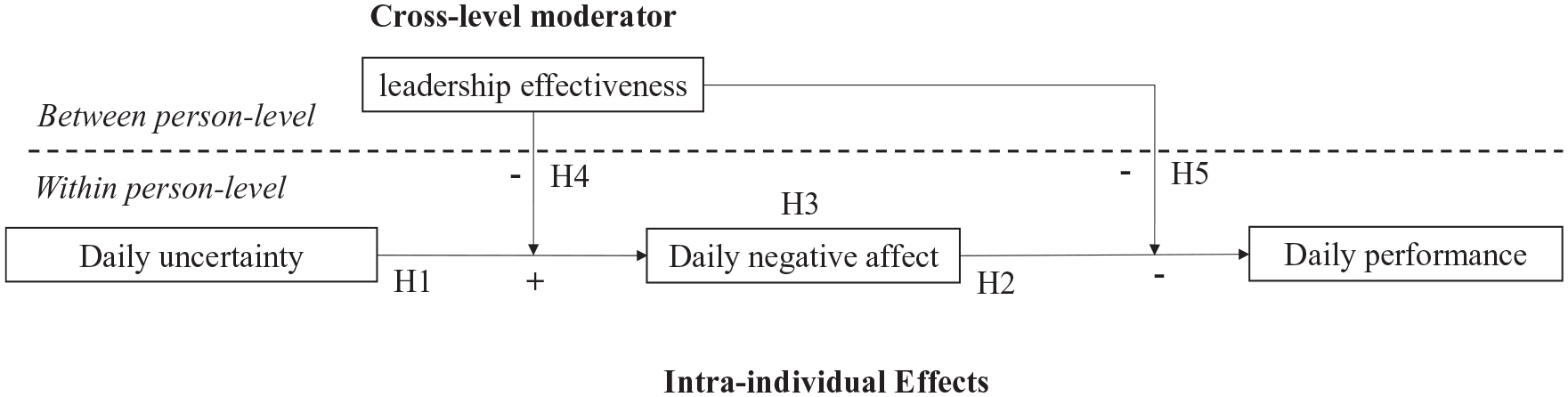
The hypothesized multilevel moderated mediation model.
Methods
Participants and procedure
This multilevel research involved both a general survey and a diary survey, conducted over a span of 10 workdays (from Monday to Friday for 2 weeks). The surveys were prepared in Portuguese, employing a process of translation and back-translation, and were administered online to record respondents’ date and time of response.
A total of 260 Portuguese working adults were invited to participate in the study through the researcher’s professional networks. The study took place between October and December 2022 (the date on which the post-covid-19 phase officially began).
Invitations were sent via email, including informed consent, outlining the study’s objectives, data collection process, and guarantee of data anonymity and confidentiality. Of the initial participants, 206 completed the general survey (response rate: 79.2%), 194 completed at least one diary survey (response rate: 74.6%), and 176 completed all 10 daily online surveys (response rate: 67.7%, resulting in 1,760 measurement occasions). This sample size exceeded the threshold recommended by Maas and Hox (2005) for cross-level interactions in a multilevel framework (i.e., 30 respondents), ensuring sufficient power and accuracy in the analysis.
The participant demographic breakdown was as follows: 33.4% female, 42.2% with a high school diploma, and 57.8% with a university diploma. The average age was 34.33 years (SD = 12.49), and the mean organizational tenure was 12.43 years (SD = 11.95). Participants reported working an average of 34.52 hr per week (SD = 14.67) across various occupational jobs in business and professional services, including human resources (58%), general management (29%), and finance (13%).
Measures
General survey
Socio-demographic data (sex, age, tenure, educational level) and the between-person variable of perceived leadership effectiveness were collected through a general survey.
Perceived leadership effectiveness
Four items developed by Giessner and van Knippenberg (2008) were used. Responses were provided on a 5-point Likert-type scale, ranging from 1 (totally disagree) to 5 (totally agree). An example item was: “My leader leads the team in a way that motivates the team members.” The scale demonstrated acceptable internal consistency (α = 0.74, ω = 0.76).
Daily survey
The daily survey followed recommended daily diary methods (Ohly et al., 2010) and employed the use of the word “today” and the past tense in all items to reinforce the daily nature of the survey. To enhance reliability and minimize participant dropout, concise scales were employed. Level-specific composite reliability (within-person ω) was assessed following the suggestion by Geldhof and colleagues (2014). The daily survey included measures of perceived uncertainty, negative affect, and adaptive performance.
Perceived uncertainty
Four items from the Rafferty and Griffin’s Organizational Change Scale (2006) were used to gauge perceived uncertainty. Participants rated items on a 5-point scale, ranging from 1 (strongly disagree) to 5 (strongly agree). Example items included: “Today, my work environment was changing in an unpredictable manner” and “Today, I felt unsure about the effect of change on my work unit” (ω = 0.64).
Negative affect
Experienced daily negative affect was assessed using eight items from the Multi-Affect Indicator (Warr et al., 2014). Respondents indicated their responses on a 5-point scale, ranging from 1 (never) to 5 (always; ω = 0.86).
Adaptive performance
Performance was measured using three items from the Individual Task Adaptivity Scale (M. A. Griffin et al., 2007). Participants rated the items on a 5-point Likert-type scale, ranging from 1 (very little) to 5 (a great deal). An example item was: “Today, I adapted well to changes in core tasks” (ω = 0.79).
Control variables
Given the daily diary format of the study, the time of data collection (from Monday to Friday) was included as a within-person variable, as it could potentially impact criterion variables (Hox & Boeije, 2005).
Data analysis
We used JASP to perform confirmatory factor analyses and SPSS with macro-Multilevel mediation (MlMed) to assess the hypothesized moderated mediation model (Rockwood, 2017). We used it because (1) other studies have reported reliable findings through the use of it (Rockwood, 2017); (2) it appears to deliver similar results to other statistical software (e.g., Mplus); and (3) it is particularly relevant when testing a cross-level interaction (Rockwood, 2017).
As we had a multilevel data structure, that is days nested in individuals, we estimated the intra-class correlation coefficient (ICC) for perceived uncertainty, negative affect, and performance (Hox, 2010). We did not estimate an ICC of perceived leadership effectiveness because this variable was only measured at a between-person level. The results indicated that a significant proportion of the variance (ICC values were 0.37, 0.58, and 0.40, respectively) was attributable to within-person fluctuations. Moreover, because all the ICCs were higher than 0.05, we assumed that the data had a multilevel structure (days nested in individuals); therefore, we followed a multilevel modeling approach (Marcoulides & Schumacker, 2013).
Results
Descriptive results
Table 1 presents the descriptive statistics and zero-order and person-centered correlations of the variables to be tested.
Means, standard deviations, and zero-order and person-centered correlations.
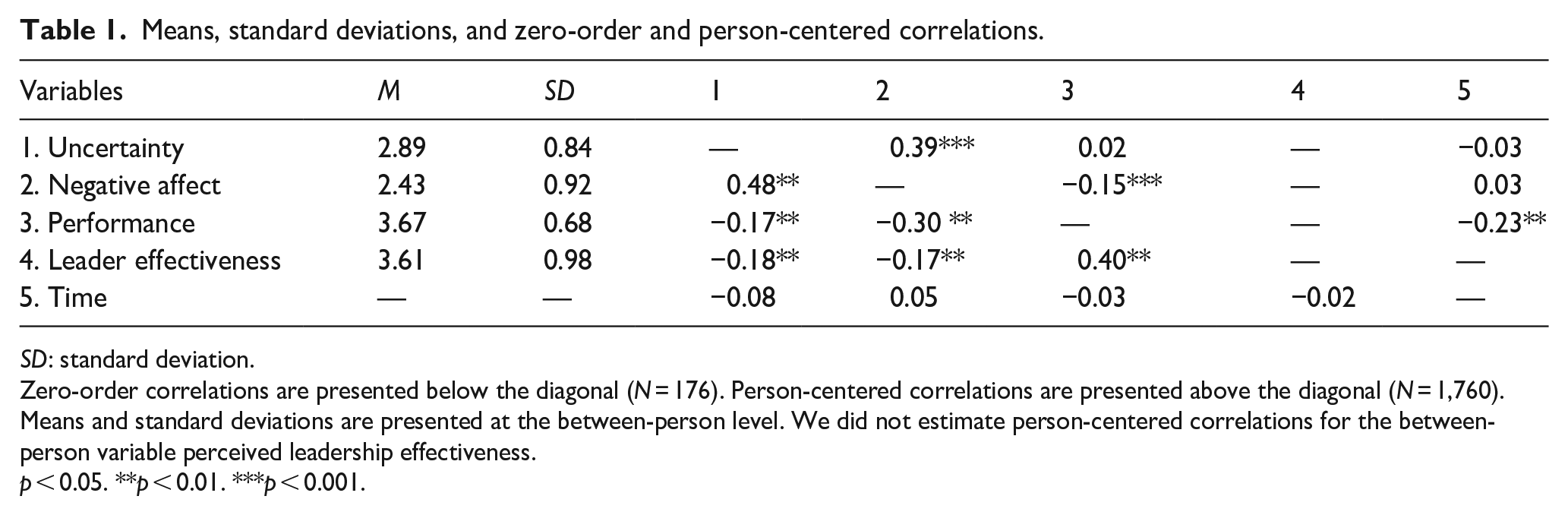
SD: standard deviation.
Zero-order correlations are presented below the diagonal (N = 176). Person-centered correlations are presented above the diagonal (N = 1,760). Means and standard deviations are presented at the between-person level. We did not estimate person-centered correlations for the between-person variable perceived leadership effectiveness.
p < 0.05. **p < 0.01. ***p < 0.001.
Confirmatory factor analyses
We conducted CFAs in JASP with which we accounted for the nested structure of our data (i.e., days nested within individuals). Table 2 presents the fit statistics. The first measurement model (M1) was the hypothesized model and included the following four latent factors: perceived uncertainty, negative affect, performance, and perceived leadership effectiveness. Four alternative CFA models were tested: (1) one alternative model comprised the same four latent factors and a common method factor (M1*); another alternative model comprised the two latent factors in which perceived uncertainty and negative affect were loaded onto one factor (M2), and (2) another one in which perceived uncertainty, negative affect, and performance were loaded on one factor (M3). Finally, we tested a CFA with only one latent variable (M4)—that is, all the variables were loaded onto one factor. In this way, we evaluated the model fit for each of these CFAs. They were evaluated based on the root mean square error of approximation (RMSEA), the comparative fit index (CFI), the Tucker–Lewis index (TLI), and the standardized root mean square residual (SRMR). As Schreiber et al. (2006) described, a model presents a good fit when the values of both CFI and TLI are higher than 0.90; and when the values of both RMSEA and SRMR are below 0.08. Following these criteria, the hypothesized measurement model (M1) had an acceptable fit with the data. In addition, we compared all the models to the one we proposed (M1) through the χ2-difference test. The χ2-difference test indicated that the hypothesized model presented the best fit to the data.
Fit statistics for the models based on confirmatory factor analyses accounting for a nested data structure (Nindividuals = 176; Nobservations = 1,760).
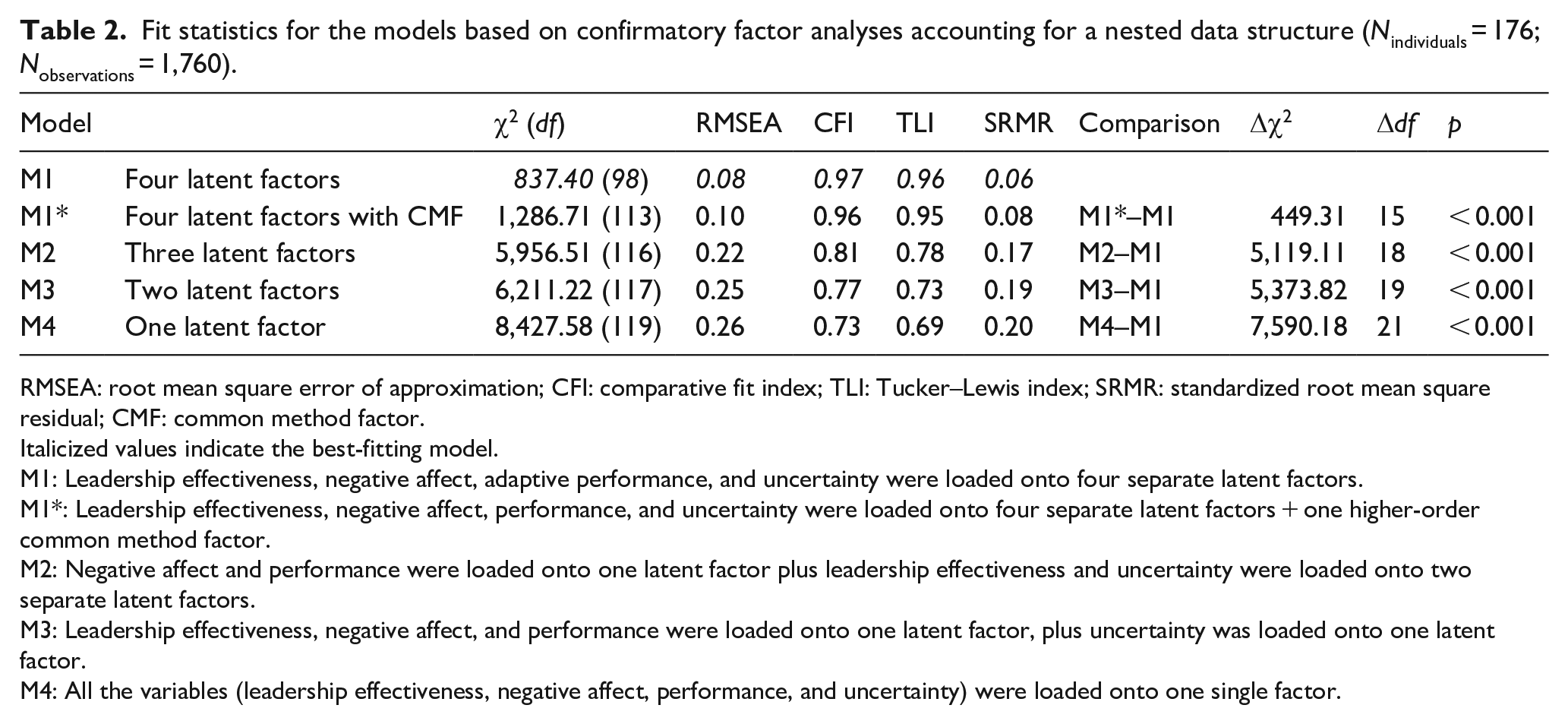
RMSEA: root mean square error of approximation; CFI: comparative fit index; TLI: Tucker–Lewis index; SRMR: standardized root mean square residual; CMF: common method factor.
Italicized values indicate the best-fitting model.
M1: Leadership effectiveness, negative affect, adaptive performance, and uncertainty were loaded onto four separate latent factors.
M1*: Leadership effectiveness, negative affect, performance, and uncertainty were loaded onto four separate latent factors + one higher-order common method factor.
M2: Negative affect and performance were loaded onto one latent factor plus leadership effectiveness and uncertainty were loaded onto two separate latent factors.
M3: Leadership effectiveness, negative affect, and performance were loaded onto one latent factor, plus uncertainty was loaded onto one latent factor.
M4: All the variables (leadership effectiveness, negative affect, performance, and uncertainty) were loaded onto one single factor.
Hypotheses testing
As suggested by Griep et al. (2022), we analyzed which model best fits the data. We analyzed the Bayesian information criterion (BIC)—that is, the balance between the number of parameters (i.e., model complexity) and the fit of the model to the data. We compared the BIC and the sample size–adjusted BIC values between the multilevel 1-1-1 mediating model and the multilevel, moderated mediation model. The findings showed that the multilevel moderated mediation model was the one with the lowest BIC value; it was, therefore, the one that presented the best fit to the data (BIC = 3,815.14; sample size–adjusted BIC = 3,811.14) when compared to the multilevel mediating model (BIC = 4,155.53; sample size–adjusted BIC = 4,151.53). Figure 2 presents the estimated paths of the model.
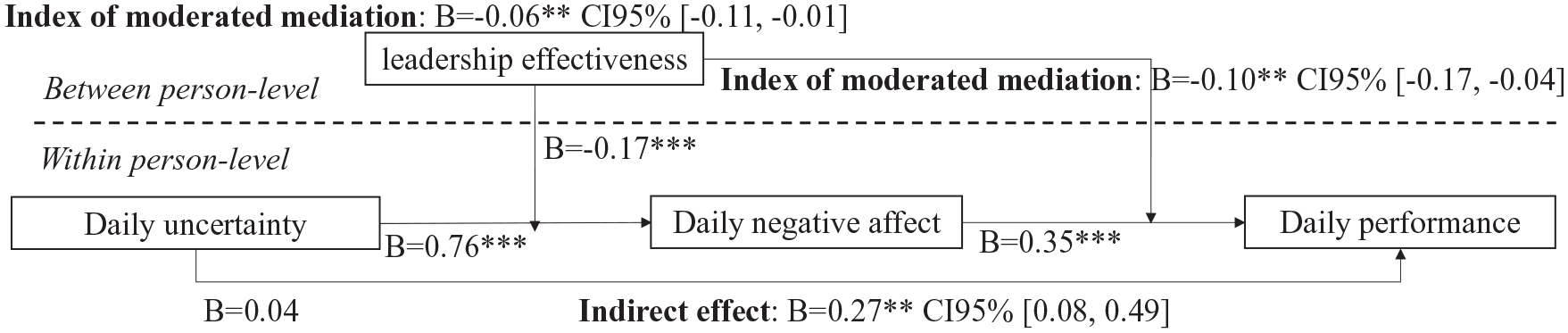
Estimated paths in the full multilevel moderated mediation model.
As hypothesized, daily fluctuations in perceived uncertainty (Estimate = 0.76, 95% CI = [0.50, 1.03]) were positively correlated to daily fluctuations in negative affect at the within-person level, supporting Hypothesis 1.
Next, with respect to the within-person relationships between daily fluctuations in negative affect and daily fluctuations in adaptive performance, our results showed a positive relationship (Estimate = 0.35, 95% CI = [0.12, 0.58]), thereby providing partially support for Hypothesis 2.
Moreover, results showed a statistically significant indirect effect from daily fluctuations in perceived uncertainty to daily fluctuations in adaptive performance (Estimate = 0.27, p < .001, 95% CI = [0.08, 0.49]) via daily fluctuations in negative affect, thereby providing support for Hypothesis 3.
The results also supported Hypothesis 4 because it was demonstrated a negative cross-level relationship between perceived leadership effectiveness and daily fluctuations in perceived uncertainty in relation to daily fluctuations in negative affect (Estimate = –0.17, 95% CI = [–0.24, –0.09]). Moreover, we found that perceived leadership effectiveness buffered the positive relationship between perceived uncertainty and daily negative affect. As Figure 3 shows, the strength of the relationship between daily fluctuations in perceived uncertainty and daily fluctuations in negative affect was smaller for employees who had more effective leaders (B = 0.66, p < .01) in comparison to those with less effective leaders (B = 0.77, p < .01). Put differently, daily negative affect was less dependent on daily fluctuations in perceived uncertainty when employees had leaders perceived as effective. Hypothesis 4 was thus supported.
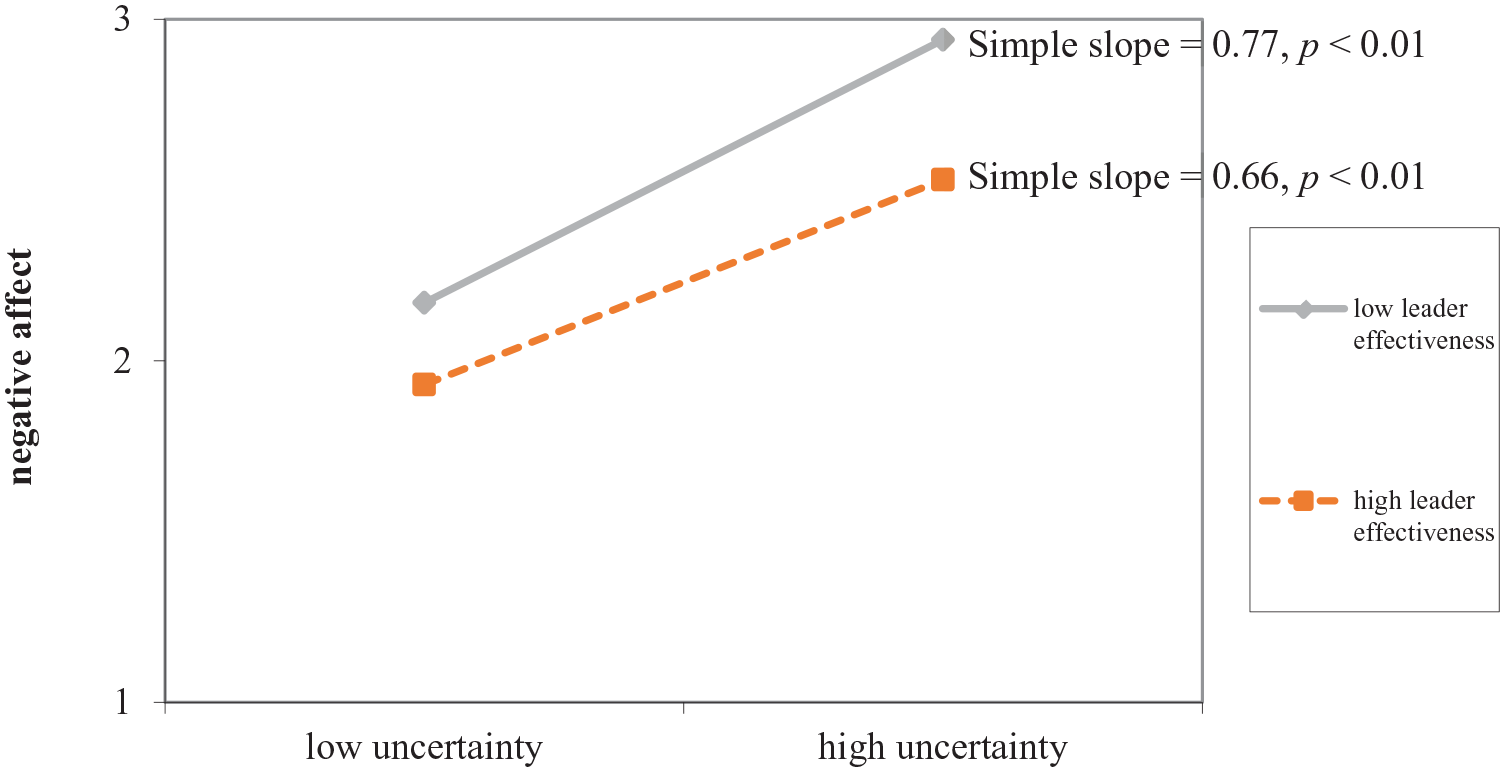
Cross-level interaction of perceived leadership effectiveness and perceived uncertainty in relation to daily negative affect.
Results also showed a negative cross-level relationship between perceived leadership effectiveness and daily fluctuations in negative affect in relation to daily fluctuations in adaptive performance (Estimate = –0.13, 95% CI = [–0.20, –0.06]), thereby supporting hypothesis 5. These results showed that perceived leadership effectiveness attenuated the positive relationship between daily negative affect and daily adaptive performance. As Figure 4 shows, the strength of the relationship between daily fluctuations in negative affect and daily fluctuations in adaptive performance was smaller for employees who had leaders perceived as more effective (B = 0.23, p < .05) when compared to those with less effective leaders (B = 0.36, p < .01). In other words, daily adaptive performance was less dependent on daily fluctuations in negative affect when employees had leaders perceived as more effective. Hence, hypothesis 5 was partially supported.
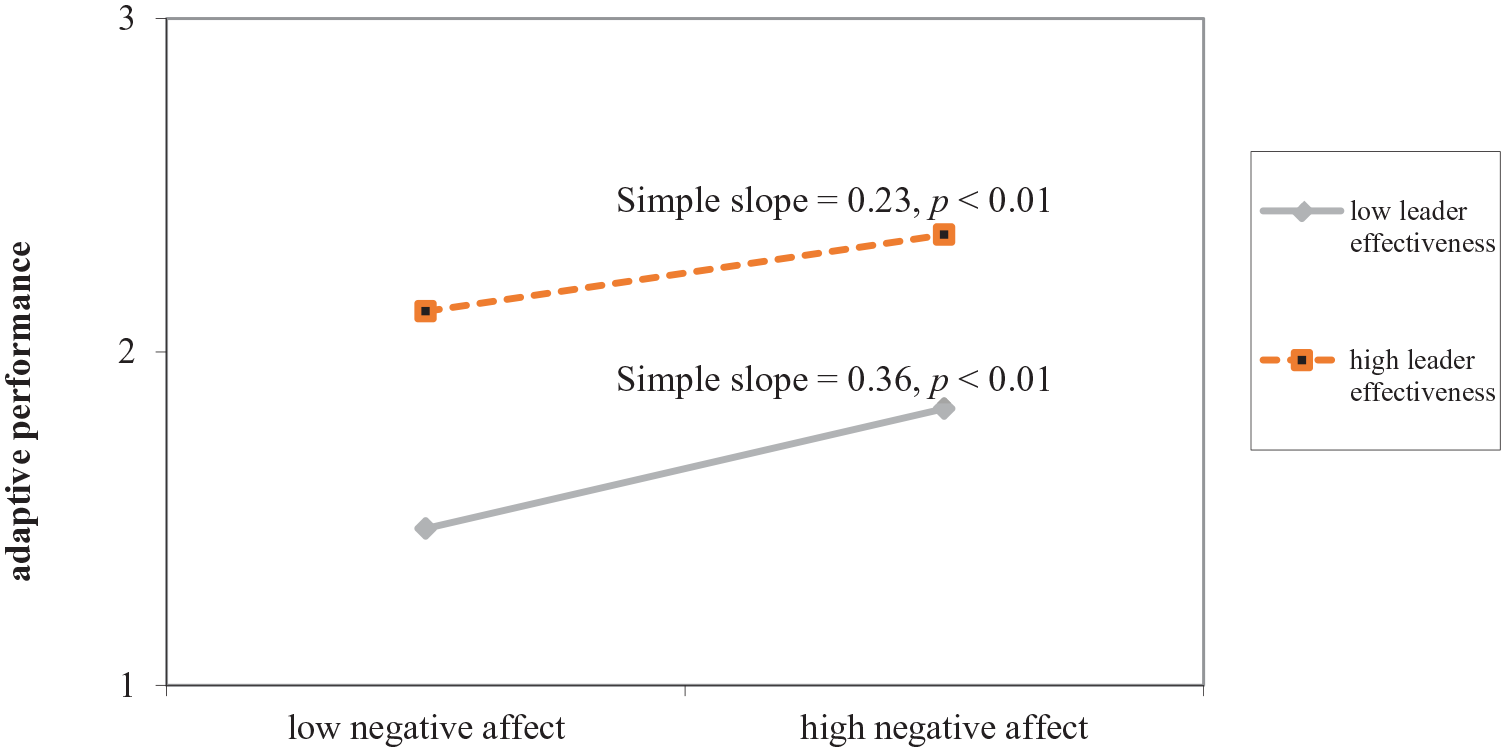
Cross-level interaction of perceived leadership effectiveness and daily negative affect in relation to daily adaptive performance.
Discussion
This study aimed to enhance the existing literature by delving into the implications of uncertain contexts and investigating the impact of perceived leadership effectiveness on affective and behavioral outcomes on affective and behavioral outcomes. Specifically, it sought to contribute to the understanding of (1) the role of negative affect as an affective mechanism linking workers’ perceived uncertainty to their adaptive performance and (2) the contextual conditions, as measured by perceived leadership effectiveness, that could moderate these relationships in the post-COVID-19 era. The study results shed light on how and why perceived uncertainty influences workers’ adaptive performance by exploring negative affect as a process through which this influence occurs, and perceived leadership effectiveness as a relevant boundary condition shaping these effects.
First, the results underscore that working in a perceived uncertain context triggers within-person fluctuations in negative affective experiences. In other words, perceived uncertainty makes employees experience diverse kinds of negative affective experiences (e.g., fear or frustration) that fluctuate daily. Theoretically, this is supported by the IMUT (Hillen et al., 2017) as it proposes that uncertain stimuli (either working conditions or work-related events) trigger affective reactions in individuals, normally in the form of negative emotions, such as frustration or fear. As Anderson and colleagues (2019) highlighted, uncertainty is frequently associated with negative affect. The authors also argue that people experience affective reactions (e.g., anger, anxiety, and fear) in their daily lives related to uncertain situations, from the more trivial ones (e.g., traffic jams) to more complex ones (e.g., social interactions). Hence, perceiving uncertainty tends to trigger negative affective reactions. The authors note that people experience affective reactions, such as anger, anxiety, and fear as they navigate uncertain scenarios in their daily lives, spanning from mundane occurrences such as traffic jams to more intricate ones such as complex social interactions. Consequently, the perception of uncertainty tends to trigger negative emotional responses.
Second, the results also demonstrate that within-person fluctuations in negative affect positively predict within-person fluctuations in adaptive performance. This finding was not expected, as an inverse relationship between negative affect and adaptive performance was expected; however, the results show that when workers experience more negative affect (e.g., frustration) they engage in the adaptive behaviors (e.g., learning new ways of performing the tasks at hand) needed to improve their adaptive performance. It appears that negative affect signals a need to adapt to new working conditions, or to unexpected changes. This can be understood through the lens of the affect-as-information model (Schwarz & Clore, 2007). The model proposes that affective reactions, whether positive or negative, offer tangible and experiential insights into events, situations, or conditions, which play a pivotal role in informing individual thinking, evaluating circumstances, and making decisions. Thus, affective reactions can prompt awareness of a situation, serving as a trigger for both affective and behavioral regulation (Schwarz, 2013; Storbeck & Clore, 2008).
The study results extend further, demonstrating that negative affect operates as a mediating mechanism in the relationship between perceived uncertainty and adaptive performance, at the within-person level. Drawing from the Affect-as-Information model (Schwarz & Clore, 2007), affective responses to uncertainty can be regarded as a valuable source of information that shapes cognitive processes, reasoning, and actions. This perspective highlights not only the influence of diverse contexts on employees’ affective reactions and subsequent behaviors (Schwarz & Clore, 2007), but also the societally significant role of affect. Viewed through the lens of social-functional emotions, affective expressions in response to uncertainty convey insights into individuals’ judgments and evaluations, thereby shaping work-related behaviors, including adaptive performance (Methot et al., 2017; Van Kleef et al., 2010). In line with the observations by Anderson and colleagues (2019), uncertainty can be seen as a subjective cognitive state characterized by ignorance or the presence of unknown elements in a given situation. Consequently, the affective reactions triggered by perceived uncertainty serve as informative cues guiding individuals’ understanding and reactions within uncertain situations. This heightened awareness, in turn, influences their behaviors. While Anderson and colleagues (2019) acknowledge a gap in understanding the minimal awareness threshold necessary for the existence of uncertainty as a psychological state and its triggering stimuli, it is feasible to argue that affect heightens situational awareness, thereby influencing behaviors. Essentially, negative affect offers insights into uncertain working conditions that not only boost situational awareness but also stimulate adaptive behaviors.
In addition, as explained by the social functional theories of affect (Elfenbein, 2007), affect provides the pieces of information needed for evolution, change, and adaptation, as it helps individuals to adapt to changing environmental conditions. Despite this controversy, negative affect is not always detrimental to performance. For instance, in a meta-analysis of more than 30 empirical papers, Knight and Eisenkraft (2015) showed that group negative affect positively predicted social integration and task performance. Hence, negative affect (e.g., fear) may serve a signaling function that alerts individuals to possible threats—the uncertain conditions that are the source of negative affect—which then helps them to adapt to such conditions.
Finally, the study explores how the relationship between uncertainty, negative affect, and adaptive performance is influenced by perceived leadership effectiveness. This dynamic reveals that the impact of perceived uncertainty on negative affect and its subsequent influence on adaptive performance is conditional on the levels of perceived leadership effectiveness. Essentially, individuals with effective leaders experience an attenuation of these relationships. The findings underscore that leaders’ behaviors can act as moderators of perceived threats within uncertain contexts. Effective leaders possess the capability to transform certain behaviors perceived as threats into supportive gestures. This moderating influence can potentially reduce negative affect’s detrimental effects and enhance adaptive performance.
Theoretical implications
In summary, the findings make notable contributions to the development of the IMUT framework within the broader context of the working environment, thereby taking a step toward its validation across various occupational sectors. In addition, this study offers insights into the pivotal role of leadership effectiveness in navigating volatile, uncertain, complex, and ambiguous contexts, particularly in the post-COVID-19 era. This becomes particularly significant when considering the potential influence of a leader’s perceived effectiveness on their followers’ affective and behavioral responses to uncertainty.
The first significant contribution lies in the context-sensitive nature of the indirect effect between uncertainty and adaptive performance through negative affect, contingent upon perceived leadership effectiveness. This moderating role of perceived leadership effectiveness operates differently across the two paths of the mediating model. First, concerning the path from uncertainty to negative affect, the perceived leadership effectiveness buffers the adverse impact of perceived uncertainty on negative affect. On the contrary, on the path from negative affect to adaptive performance, perceived leadership effectiveness dampens the favorable effects of negative affect on adaptive performance. This nuanced modulation implies that within an uncertain context, the presence of an effective leader can mitigate the amplification of negative affective reactions, thus fostering emotional resilience among employees. Conversely, in the absence of effective leadership, employees may experience heightened negative affective reactions in the face of uncertain conditions. Given the pronounced volatility, uncertainty, complexity, and ambiguity characteristic of the post-COVID-19 era, perceived leadership effectiveness can serve as a crucial strategy to support employees in regulating their emotions effectively. This aligns with recent research on leadership, such as Kawiana and colleagues (2021), who underscored the significance of effective leadership in times of substantial change and uncertainty, highlighting its potential impact on followers’ affective commitment. Similarly, studies by Bartsch and colleagues (2020) emphasized that effective leaders cultivate motivational environments and alleviate tension among their followers. Tuckey and colleagues (2012) also underscored that “leaders play an influential role in how employees experience their work and represent an important influence on worker happiness” (p. 15). Yukl (2012) highlighted leaders’ ability to help followers manage emotions, even in adverse or unforeseen work conditions. Thus, leaders’ behaviors, which shape followers’ perceptions of their effectiveness, emerge as crucial boundary conditions shaping affective responses to uncertain work contexts (van Knippenberg & van Knippenberg, 2005).
Perceived leadership effectiveness also serves as a moderator in the pathway from negative affect to adaptive performance. Specifically, negative affect signals the need for adaptive behaviors, contingent upon the perception of the leader’s effectiveness. In essence, effective leadership can mitigate the influence of negative affect on adaptive performance. In practical terms, when employees experience negative affect in conjunction with less effective leadership—leaders who are less supportive and lack assistance (Sy & van Knippenberg, 2021)—they have to adapt themselves and go through their resources to do so, while those with effective leaders have an external condition that helps them to better regulate affect and adapt to the context. In line with the self-determination assumptions (Ryan & Deci, 2001), when the leader is perceived as less effective, employees have to rely on their own resources, and thereby use negative affect as a guide for subsequent behaviors and actions (Knight & Eisenkraft, 2015). Thus, in uncertain work contexts, where employees perceive their leaders’ effectiveness negatively, they rely on and attend to negative affective experiences to guide appropriate behaviors.
This finding may raise some debate, given the substantial evidence pointing to leaders’ ability to inspire employees through motivation, support, connection, and empowerment (Decuypere & Schaufeli, 2020). For instance, Islam and colleagues (2020) demonstrated the pivotal role of leaders in supporting employees’ adaptive behaviors in rapidly changing and unstable environments. Similarly, Khan and colleagues (2022) stressed the importance of fostering balanced leader–follower relationships to enhance adaptability in an era characterized by globalization, cultural shifts, and technological advancements. Nonetheless, this dynamic may vary in work contexts characterized by constant change and unpredictability, such as the ongoing aftermath of the COVID-19 pandemic, which highlighted deficiencies in leadership during crises (Khan et al., 2022). In contemporary environments marked by perpetual pressure to modernize processes and routines, having a less effective leader seems to necessitate additional employee effort to independently adapt to uncertain circumstances, leading to heightened negative affective reactions. Conversely, effective leaders who consistently support and guide their employees create an environment conducive to effective emotional regulation (Khan et al., 2022).
The concept of empowering leadership may offer insights into this finding. Empowering leaders encourage followers to take initiative, manage their behavior, and foster self-leadership (Giustiniano et al., 2020; Yun et al., 2006). While not always perceived as effective, empowering leaders empower followers with autonomy and control over their available resources to address job demands and overcome challenges (Rego et al., 2021; Tuckey et al., 2012). This indicates that while effective leaders are beneficial, their consistent presence might lead individuals to expect solutions without exerting effort to adapt. Moreover, the assurance of available help might restrain individuals’ proactivity and adaptiveness—critical for learning and adjustment in volatile, uncertain, complex, and ambiguous contexts. Thus, perceiving a leader as more effective stands as a salient boundary condition, alleviating the adverse effects of uncertain contexts on followers’ negative affect. However, when it comes to adaptive performance, a nuanced perspective is necessary, recognizing that an effective leader is always good at supporting employees’ affective regulation, but a less effective leader is not always bad. From this standpoint, less effective leaders may incite followers to surpass expectations, fostering a drive for adaptability.
In sum, this study contributes to the advancement of knowledge by revealing the role of the negative affect as a mechanism in explaining how an uncertain work context shapes employees’ adaptive performance, thereby offering empirical support for the IMUT framework. In addition, the study underscores the moderating role of perceived leadership effectiveness, elucidating the intricate interplay between perceived uncertainty, negative affect, and adaptive performance. While an effective leader is instrumental in enhancing affective regulation, the findings highlight the need for discernment in the context of adaptive performance. As such, this study broadens our understanding of the leader’s role in shaping affective and behavioral outcomes.
Limitations and future directions
While this study brings forth valuable insights, it is important to acknowledge certain limitations that should be taken into account when interpreting the findings. First, the reliance on self-reported measures introduces the potential for common method bias (Podsakoff et al., 2012). However, mitigative measures were implemented, such as conducting multiple confirmatory factor analyses and assessing reliability using both ω and α indices. This helps to minimize the impact of this potential bias on the study’s validity.
Second, despite the daily diary approach, data were collected only once per day, which limits the ability to infer causality between variables. Future investigations should explore the model with a more fine-grained daily diary design, capturing data at multiple time points throughout the day. This approach not only deepens the understanding of these relationships but also strengthens the robustness of the findings.
Third, the assessment of followers’ perceived leadership effectiveness is inherently subjective, varying depending on who (the follower) perceives it and when (as suggested by Weiss & Cropanzano, 1996). Leaders’ behavior can differ due to factors like mood, personality, and affective states, resulting in varying interpretations by followers. To address this, future research could incorporate data from both followers and leaders themselves to provide a more comprehensive perspective.
Fourth, the study exclusively measured perceived uncertainty, potentially overlooking a crucial individual difference—intolerance of uncertainty. Considering the substantial variability in how people respond to perceived uncertainty due to differences in intolerance of uncertainty, future research should explore the interplay of this variable within the model.
Practical implications
The study’s findings hold pertinent implications for organizations and managers. First, the study underscores the influence of perceived uncertainty on employees’ affective and behavioral outcomes, encompassing negative affect and job performance. This underscores the importance of contextual considerations in leadership. In uncertain work environments, leaders should actively adopt positive behaviors (e.g., offering support and assistance) toward followers, as individuals seem to require added reinforcement in the leader–follower relationship during these times. Such actions can help alleviate the perception of uncertainty in the context, leading to positive effects on affect. By cultivating positive interactions, leaders can enhance their own positive affective experiences and diminish negative ones. Thus, organizations should invest in training leaders to navigate uncertain and complex scenarios effectively.
Second, recognizing the substantial impact leaders exert on their followers’ daily work experiences is crucial. This influence transcends both affective and behavioral domains. Just as Yukl (2012) highlighted, leaders wield the power to influence followers through emotions, shaping the perceived work climate and emotionally affecting their followers. This influence extends to behavioral aspects, impacting attitudes and behaviors (Weinberger, 2009).
Furthermore, organizations can leverage the study’s findings to devise strategies that mitigate the impact of uncertainty on employees. Managers can promote initiatives and training programs aimed at reducing the impact of perceived uncertainty among employees. For instance, interventions targeting increased tolerance of uncertainty through cognitive-behavioral approaches (e.g., coaching sessions) could yield positive results and improve employees’ well-being.
Conclusion
The study’s findings reveal a notable pattern: within-person fluctuations in perceived uncertainty trigger parallel fluctuations in negative affect among workers, subsequently influencing adaptive performance. However, the presence of perceived leadership effectiveness moderates this indirect effect. An effective leader consistently benefits affective regulation, while a less effective leader is not always bad for adaptive performance. This dual role of leaders highlights the intricate interplay between leadership effectiveness, affect, and adaptive behavior.
Footnotes
Authors’ note
António Caetano is also affiliated with APPsyCI – Applied Psychology Research Center Capabilities & Inclusion, ISPA – Instituto Universitário, Lisboa, Portugal.
Declaration of conflicting interests
The author(s) declared no potential conflicts of interest with respect to the research, authorship, and/or publication of this article.
Funding
The author(s) disclosed receipt of the following financial support for the research, authorship, and/or publication of this article: This work was granted by Fundação para a Ciência e Tecnologia, Grant ID UIDB/00315/2020.
Compliance of ethical standard statement
All procedures performed in studies involving human participants were in accordance with the ethical standards of the institutional and/or national research committee and with the 1964 Helsinki Declaration and its later amendments or comparable ethical standards.
Informed consent
Informed consent was obtained from all individual participants involved in the study.

Data availability
The data are available only upon reasonable request to the authors.