



Abstract
Training is often thought to benefit organizations; however, these benefits only materialize if trained employees remain at the organization. Empirical findings are mixed regarding the direction and significance of the training-turnover association, which implies there are important moderators for this association. Drawing on the social exchange theory, we posit the training-turnover association varies as a function of two characteristics of an organization’s employees: job qualification and educational background. We assess hypotheses for their moderating impact on the training-turnover link using the Human Capital Corporate Panel data sets from 2009 to 2017. The panel data analyses support the hypotheses regarding the interaction effects of training and job qualification on employee turnover and demonstrate three-way effects among training, job qualification, and educational background. We discuss the theoretical implications of these findings for the varied perceptions of the value of training and the value of staying at the organization from a social exchange perspective.
Introduction
A substantial amount of prior research has investigated the link between training and employee turnover (Benson et al., 2004; Hausknecht & Trevor, 2011; Heavey et al., 2013; Ito & Brotheridge, 2005). Identifying the association between training and employee turnover is important as organizations are unlikely to receive an adequate return on their investment in training if employees depart from the organization (Haines et al., 2010; Trevor, 2001; Trevor & Nyberg, 2008). Moreover, while the knowledge, skills, and abilities employees obtain from training can positively influence value creation (Barney, 1991; Kraimer et al., 2011; Van Iddekinge et al., 2009), employee turnover results in the outflow of knowledge, skills, and abilities to competitors (Benson et al., 2004; Haines et al., 2010). In addition, and more broadly, employee turnover can negatively impact organizational performance (Shaw et al., 2013) as it involves additional costs in the selection of replacement hires and implementation of further training (Jeong, 2008; Shaw et al., 2005) and can result in substantial disruption to the productive operations of an organization (Reilly et al., 2014). More importantly, no or very few clues about the quit-or-stay decisions of employees make it hard for organizations to develop and implement retention strategies and relevant human resources (HR) practices (Bolt et al., 2022; Boxall et al., 2003). In order to avoid poor investments in training and actions that could potentially negatively impact organizational performance or competitive positioning, it is necessary to look carefully at the effect of training on employee turnover.
Despite considerable research attention, we lack a clear understanding of the link between training and employee turnover. More specifically, while there have been a number of studies that support a negative association between training and turnover (Benson et al., 2004; Kampkotter & Marggraf, 2015; Ng et al., 2022), there are also studies that suggest a positive association (Cao & Hamori, 2020; Haines et al., 2010; Trevor & Nyberg, 2008). In addition, there are studies that report no significant association between training and turnover (Batt et al., 2002; Subramony, 2009; Walk et al., 2019). These findings are well aligned with the importance of the person-context interface in recent turnover research since contexts or conditions, in general, can have major implications for predictors of turnover (Bolt et al., 2022).
To better understand the mixed effects between training and employee turnover (Hausknecht & Trevor, 2011), it would be helpful to identify the conditions under which organizations experience more or less turnover when an employer provides their employees with training. This study seeks to make progress on this by leveraging the social exchange theory (Cropanzano et al., 2017; Cropanzano & Mitchell, 2005) to examine if the training-employee turnover link depends on two important employee characteristics associated with a firm’s overall HR approach (Hausknecht & Trevor, 2011): (1) the job qualification level of employees and (2) the reliance on employees with a college education. This article suggests that these characteristics impact employee perceptions of the economic value of training and the economic value of reciprocating by staying at the organization after training and thus offer insight into the association between training and employee turnover. In this article, we focus on organization-level analysis and consider how the organization-level HR practices and policies associated with employer-provided training and composition of employee characteristics (qualification and college education) can have interactive effects on employee turnover (e.g., Hausknecht, 2017; Hausknecht & Trevor, 2011). We test our hypotheses using a longitudinal data set on employees (Human Capital Corporate Panel [HCCP]) and fixed-effects regression analyses.
This study contributes to the extant literature in two ways. First, this article provides new approaches to understanding the inconsistent association between training and employee turnover (Gardner et al., 2011; Hausknecht & Trevor, 2011; Heavey et al., 2013; Ito & Brotheridge, 2005). Specifically, we leverage the social exchange theory and suggest that factors associated with an organization’s overall HR approach are important moderators of the association between training and employee turnover. In doing so, we hope to offer a new way to leverage the notion of horizontal fit (Boon et al., 2007, 2019; Kehoe, 2021) with respect to hiring and training strategies to shed light on the association between training and employee turnover. Second, this study contributes to the social exchange theory. Although much research on the association between HR practices and turnover has focused on the positive meaning of HR practices as social exchanges between an employer and employees (Hausknecht & Trevor, 2011; Heavey et al., 2013), this article suggests that the meaning of training as a social exchange may vary based on the general experience and educational backgrounds of an organization’s employees. That is, not all HR practices may be perceived positively by employees, and this could impact the degree to which employees positively reciprocate by staying at the organization. This study contributes to the HR management literature by providing a more nuanced and balanced approach to the application of social exchange theory to explain the training-turnover relationship.
This article is structured as follows. We begin by providing an overview of the literature on the training and employee turnover link. Next, we introduce the social exchange theory and leverage this theoretical framework to elucidate the conditions under which an organization’s employees might tend to leave or stay after training. Specifically, we focus on the potential moderating effects of the organization’s HR approach with regard to the overall level of employees’ qualifications and education. We then describe the methods used to test the study’s hypotheses and describe the results of our analyses. Finally, we discuss the findings and implications of this study for the extant literature.
Theoretical background and hypotheses
Training and employee turnover
A number of empirical studies have found training can reduce employee turnover in various job groups, such as high-technology engineers (e.g., Ferratt et al., 2005), lawyers (e.g., Malos & Campion, 2000), pharmacy employees (e.g., Koster et al., 2011), nurses (e.g., C. H. Lee & Bruvold, 2003), and service staff (e.g., Gelade & Ivery, 2003; Van Iddekinge et al., 2009). Moreover, previous meta-analyses have shown that human resource development (HRD) practices including training can reduce employee turnover (Hausknecht & Trevor, 2011; Heavey et al., 2013; Ng et al., 2022). This employee-turnover-reducing effect is suggested to materialize because the signal of investments in training leads to an increase in job commitment and a decrease in turnover intention for workers (Hausknecht & Trevor, 2011; Heavey et al., 2013). In addition, some of the prior training research has focused on the concept of perceived organizational support (POS), which can arise with training programs to explain the effects of training on reducing turnover (Aguinis & Kraiger, 2009; Cropanzano & Mitchell, 2005; Kraimer et al., 2011; Moreira et al., 2020).
From a different point of view, there is also a line of research which suggests that training may increase employee turnover. This perspective suggests a positive link based on the idea that a worker’s mobility options could increase from training (Trevor, 2001). In particular, as modern labor market conditions foster more boundaryless careers, employees have gradually been able to show their marketability from accumulated skills and job experiences to other employers who may be willing to offer higher compensation (Becker, 1964; Gault et al., 2010). Ultimately, based on the proficiency improved by training, employees may increase their turnover intentions and search for an opportunity to get a higher-paying job (Trevor, 2001; Trevor & Nyberg, 2008) and/or be targeted by competitors. Indeed, a number of studies have provided support for this positive association between training and turnover (Cao & Hamori, 2020; Ito & Brotheridge, 2005; Trevor & Nyberg, 2008).
Given prior theoretical and empirical findings, training can have either a positive or a negative effect on turnover. If the positive and negative effects of training on turnover occur simultaneously in an organization, and these are reflected in turnover research, offsetting effects of training on turnover might appear. The two different effects of training on employee turnover might make the overall association between training and turnover nonsignificant. Consistent with this possibility, previous studies have also reported nonsignificant associations between training and turnover (Batt et al., 2002; Walk et al., 2019).
In summary, the presence of inconsistent findings regarding the association between training and turnover suggests there may be important moderators to this association. To search for potential moderators, we take the position that increased consideration of an organization’s employee characteristics may shed light on why employee turnover increases or decreases when a firm provides training to its employees. Specifically, the perceptions of the benefits and costs of training and forgoing potential mobility options might be varied depending on the characteristics of an organization’s employees, and these may be influenced by the hiring approaches used by the organization. To explore this idea further, this study revisits the assumptions of the social exchange theory (Cropanzano & Mitchell, 2005) and focuses on the characteristics of employees.
A social exchange perspective
Drawing on the social exchange theory, prior research has emphasized reciprocity rules/norms and social exchanges over negotiated rules and economic exchanges (Cropanzano & Mitchell, 2005). Reciprocity rules/norms involve the provision of a benefit in the expectation that this favor will be returned in an equivalent but not necessarily same manner (Blau, 1964; Gouldner, 1960). Given that the core aspects of the social exchange theory reside in reciprocity rules and norms (Gouldner, 1960), the actor initiating exchanges and the target initially receiving exchanges can be any organizational entity such as employees, leaders, teams, and organizations. Although social exchange theory has largely been applied to a person-to-person exchange (e.g., leader-member exchange: Settoon et al., 1996; social exchanges among coworkers: Deckop et al., 2003), many recent studies have also utilized this theory to explain the importance of the quality of an organization-to-employee exchange (e.g., POS: Eisenberger et al., 2001; social contract between employees and the organization: Slack et al., 2015). The perceived reciprocity will be different depending on the recipient’s evaluation of the benefit and feelings of obligation to maintain the reciprocity norm (Blau, 1964; Homans, 1961). Furthermore, according to research on POS through which social exchange theory has been widely studied (Eisenberger et al., 2001; Harris et al., 2007), perceived investment in training and perceived benefits of training can lead to employees’ high commitment (Al-Emadi & Marquardt, 2007; Bartlett, 2001; Khan & Iqbal, 2020).
In the context of training and employee turnover, the situation-specific cost-benefit calculation is a baseline decision model regarding how to respond to another party after receiving its favors. This means social exchange can be initiated by organizations/employers when they send a signal of caring for or supporting employees (Gould-Williams, 2007). Given that the purpose of training is to improve employees’ job-related skills and socialization in their organizations (Mathieu et al., 1992), if training is useful in terms of knowledge transferability and applicability at the workplace, the employees tend to be satisfied with their training and jobs (Giangreco et al., 2009; Kraimer et al., 2011). This satisfaction can be the first step of making a positive psychological contract between an employer and employees, which is based on mutual expectations of long-lasting relationships or social exchanges between an employer and employees (Cullinane & Dundon, 2006; Rousseau, 1989).
In response to receiving this valuable benefit from their employer, social exchange theory suggests employees may reciprocate by staying at the organization. If employees perceive the value of training and feel obliged to repay this organization’s favor, they may become more committed to their organization and provide more discretionary work effort (Frenkel & Bednall, 2016). Previous training literature has also supported the idea that training improves employees’ work engagements by increasing their job-related capabilities and work motivation (Fletcher, 2016), which leads to in-role and extra-role performance like task performance and organizational citizenship behavior (Guan & Frenkel, 2019). Thus, the tendency of trained employees to stay at the organization is beneficial to the organization through improved employee engagement and its outcomes (Alfes et al., 2013; Karatepe, 2013).
However, it is important to consider that, depending on the characteristics of the employees, there may be differential perceived value in training (Newman et al., 2011), and this, in turn, may impact how many employees feel a need to reciprocate. That is, the utility of the training, and thus the propensity to reciprocate with the valuable action of staying at the organization, may vary based on the type of employees at the organization. In addition, the value of staying at the organization to reciprocate the value received from training may also vary depending on the characteristics of the employees. Specifically, to the extent that employees with more options in the labor market may perceive greater opportunity costs from staying at their current organization (Haines et al., 2010), the value of staying at the organization may be perceived to be greater than the value of training received from the organization. In that social exchange theory is ultimately about reciprocating in a manner that is equivalent from a value standpoint (Haines et al., 2010), and it may therefore be that for certain types of employees, training is not enough of a benefit for employees to entice them to forgo their more valuable options on the labor market.
Taken together, we believe that the social exchange theory provides a parsimonious theoretical framework to understand how the organization’s emphasis on certain employee characteristics can impact the degree to which the employees at the organization perceive the value of training received and the value of reciprocating by staying at the organization and that these influence the association between training and turnover at the organizational level. The overarching suggestion is that employee turnover is more likely as the perceived value of training decreases and the perceived cost of staying increases. We focus on two important employee characteristics, job qualification and educational background, in this study and leverage this general framework to discuss how an organization’s emphasis on these can impact the association between an organization’s training policies and practices and employee turnover. Figure 1 is a visual depiction of our general conceptual framework.
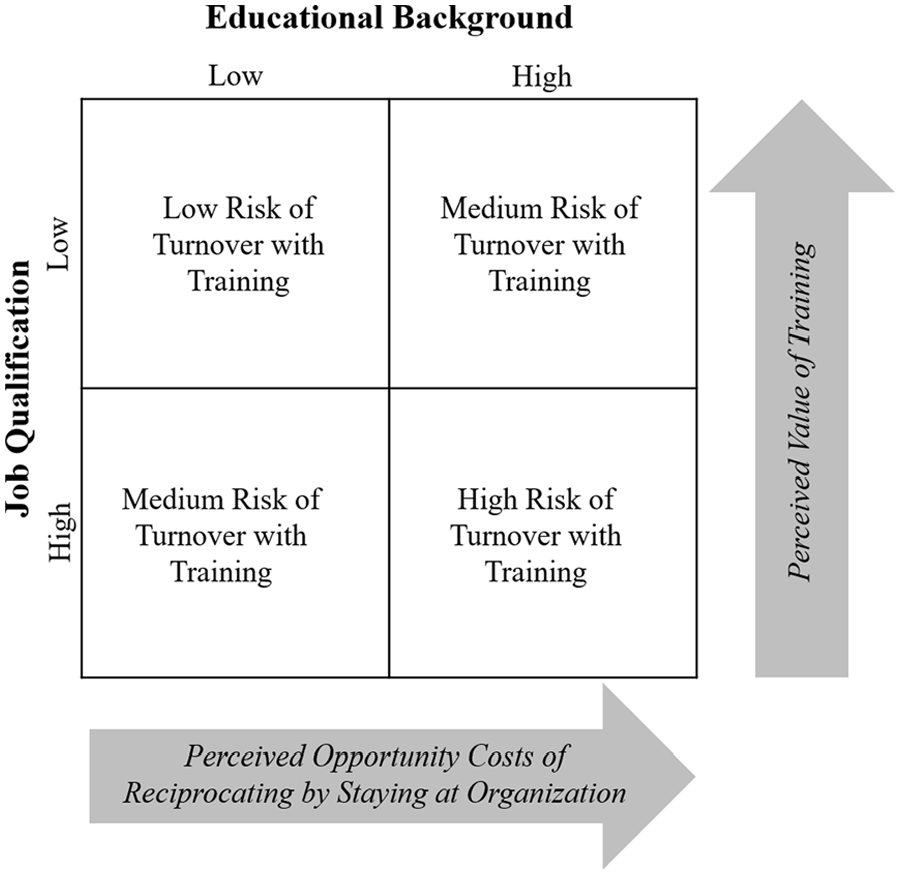
Conceptual framework for impact of human resource characteristics (job qualification and educational background) on training-employee turnover association.
Job qualification
Job qualification is the job-specific combination of knowledge, skills, and experiences, which are possessed by job holders in particular positions (Wang et al., 2016). The fit between this combination and the task requirements for a specific job position determines job qualification (Wan et al., 2012; Zhu et al., 2018). Low-qualified employees represent a poor fit between their knowledge/skills/experiences and the task requirements for their jobs. As a result, such employees are not able to fulfill all their job requirements and have lower task performance. In this case, they are not yet suitable for the job positions at the time of joining the organization and should be replaced or continue to learn to meet the job requirements of their positions (Wang et al., 2016). Organizations may hire employees that are not fully qualified to reduce labor costs (e.g., in line with a cost leadership strategic position—Miles & Snow, 1978) or in response to rapid growth. On the other hand, highly qualified employees refer to those with knowledge and skills that meet or exceed the task requirements for the job and thus have higher levels of job performance. Organizations may choose to rely on highly qualified employees to reduce their onboarding time at the organization or as a way to meet broader strategic goals associated with quality (Miles & Snow, 1978).
When an organization targets the hiring of low-qualified employees, coupling this with training HR policies and practices is necessary and useful for the employees to perform their job-related duties. This is because although the organization can replace the low-qualified employees with other employees or newcomers, it chooses to give them an opportunity to learn and grow to meet the job requirements (Wang et al., 2016). As these initial actions and interactions with an employee are the first important steps of building a quality employment relationship, low-qualified employees would perceive training as a useful social exchange and fair treatment, which increases the employees’ POS and motivates the employees to repay the employer’s favor by staying at the organization (Hausknecht & Trevor, 2011; Heavey et al., 2013).
On the other hand, when an organization has highly qualified employees, there may be a mismatch between the training an organization supplies and the needs of their employees, which could lead to employees perceiving such training as low value and result in negative reactions (Lambert et al., 2012). The reasons for such perceptions and reactions are twofold. First, training can have less utility for high-qualified employees than for low-qualified employees since they already possess the requisite job knowledge and skills and are able to perform appropriately and make a positive signal to their supervisors and coworkers (Haines et al., 2010). Second, highly qualified employees may be reluctant to take training because they may not want their high skills and performance to be attributed to the firm’s training. Such employees might believe they can outperform others without training. Training may even be viewed as a distraction that results in few benefits in terms of performance improvement and signaling of their abilities and skills to other organizational members. Training for highly qualified employees may therefore be viewed as a superfluous activity that is disconnected from their needs. As a result, high-qualified employees may be unlikely to perceive training as a valuable benefit provided by their employer that justifies reciprocating with an in-kind behavior, such as remaining at the organization.
In summary, if an organization relies on underqualified employees, the use of training programs is likely to be perceived as a valuable benefit for their employees, and this, in turn, will increase the chances the employees will reciprocate by staying at the organization. Alternatively, if an organization emphasizes highly qualified employees, it is less likely for their employees to perceive training as a valuable benefit and reciprocate by staying at the organization. The hypothesis stated in formal terms is the following:
Hypothesis 1. The job qualification level of an organization’s employees will moderate the association between training and employee turnover, such that the association between training and employee turnover is positive when job qualification is high and negative when job qualification is low.
Educational background
Education plays an important role in labor markets, and previous studies have found that individuals with high educational backgrounds earn higher salaries or wages, are less likely to experience unemployment, and tend to work in more prestigious occupations than those with low educational backgrounds (Hulin et al., 1985; Wei, 2015). Many employers also initially consider applicants’ educational background as a signal of their basic cognitive ability when recruiting and selecting employees (Renwick & Tosi, 1978) because those general abilities acquired from formal education and applied during that formal education can be beneficially leveraged at their workplace (Becker, 1964; Wei, 2015). Since better-educated individuals have more opportunities in the labor market than less-educated individuals, they may have a higher perception of the value they would be reciprocating to the organization by staying after receiving training. Furthermore, with stronger educational backgrounds, the job-relevant abilities improved through training can strengthen a positive signal of valuable knowledge, skills, and abilities to other employers in the labor market (Haines et al., 2010; Morris et al., 2017; Trevor, 2001).
In responses of an equivalent magnitude suggested by the social exchange theory, there is an increased risk for organizations/employers that employees with high education levels may therefore not see training as providing enough of a benefit to entice them to forgo their more valuable options on the labor market. Similarly, as weaker educational backgrounds reduce mobility options (Hanushek et al., 2017; Royalty, 1998), employees with lower levels of education likely see fewer opportunity costs by staying at the current organization and thus are more likely to respond to the organization’s training practices by remaining at the organization. Consistent with these arguments, organizations that rely on employees with high levels of education are likely to see more employee turnover when they provide training than those that rely on employees with lower levels of education. We therefore hypothesize:
Hypothesis 2. The educational background of an organization’s employees will moderate the association between training and employee turnover, such that the association between training and employee turnover is positive when employees have a high level of educational background and negative when employees have a low level of educational background.
Method
Sample
To test these hypotheses, we use data from the HCCP from the Korea Research Institute for Vocational Education and Training (KRIVET). KRIVET collected the HCCP data by asking strategy, human resource management (HRM), HRD, and R&D professionals to answer survey questions related to their corresponding specialty areas among strategy (planning/adjustment), HR practices, demographic information about employees, and R&D activities. This data source has been used in previous scholarly studies (e.g., Kim & Ployhart, 2014, 2018; Shaw et al., 2013) and is ideal for this study as it contains data associated with an organization’s training policies and practices, employee characteristics, and employee turnover at the organizational level. The longitudinal nature of the data is also an advantage in this study as it allows for model estimation techniques (e.g., fixed-effects models) that can reduce concerns associated with omitted variable bias (Haines et al., 2010).
Korea is an appropriate context to examine the hypotheses as training practices for Korean firms can play a critical role in improving firm performance (Kim & Ployhart, 2014), as well as be a means to establish effective employer-employee relationships. In addition, the two focal moderators (e.g., job qualification and educational background) in this study are loosely coupled in Korea. That is, a firm can have employees that have high educational backgrounds but low job qualification. This is due to the high value in Korean culture placed on college education and an emphasis on general college rankings rather than specific college majors. In particular, as the Korean labor market has an abundance of college-educated individuals at the national level, 1 there is a tendency for Koreans to select and apply to a college by considering school ranking rather than choosing a particular major for their initial job placement and future career (H. Lee et al., 2016). In response to this historical and cultural aspect related to college education, some Korean firms also tend to recruit and select college graduates based on the candidates’ school ranking first and then their college major later because they see more potential in their general knowledge due to high competition for school ranking than major-specific skills. This results in a labor market with individuals that can vary with respect to job qualification and college education. It also provides an empirical context where firms may need to provide job-specific training to address gaps in employees’ knowledge and skills. This allows training to potentially play a greater role in initially establishing social exchanges between an employer and employees as training can simultaneously meet the potential needs of both the employer and employees. Given this unique and important decoupling and variation between qualification and education and the general value of training for Korean firms, this context provides adequate variability and a suitable environment for our study.
Regarding the HCCP data structure, to understand the process of accumulation and development of employees’ knowledge, skills, and experiences and its effectiveness, the KRIVET has biennially conducted the HCCP surveys of the same firms since 2005 and completed the seventh-wave survey in 2017 (2005, 2007, 2009, 2011, 2013, 2015, and 2017). KRIVET also collected corporate annual financial data from the Korean Information Service. We used these data at the organizational level from the 2009 to 2017 timeframe in this study as the surveys for these years consistently collected the necessary information for the focal independent and dependent variables of this study.
Our final sample size is 308 firms in three broad industries: manufacturing (222 firms), finance (21 firms), and non-finance service (65 firms). The average firm age in the sample is 36.35 years, and the average number of employees is 704.43. The average ratio of the employees having college degrees is 63.78%, and the majority (93.36%) of employees in these organizations are classified as full-time employees. The data transparency table for the sample and data sources is provided in Appendix 1.
Measures
Dependent variable: employee turnover
In the HCCP survey, HR professionals provided data about how many employees voluntarily departed their organization in the survey year. Consistent with prior research, we measured employee turnover by dividing the number of voluntary departures among full-time employees by the number of total full-time employees and then rescaled by multiplying by 100 (Kim & Ployhart, 2018). The number of voluntary departures does not include the number of regular retirees, nor does it include adjustments to employment levels such as layoffs, advisory resignation, early retirement, or transfers to affiliates or partners.
Independent variable: training
HR professionals in the HCCP survey also provided information about whether training was provided by the organization to their employees in the survey year. Focusing on training provided by the organization is consistent with prior research (Kim & Ployhart, 2014) and can be viewed as a social exchange with the employees as it is an HR practice designed to improve their job-specific skills. Our measure leveraged these data and utilized a dummy variable where “1” was coded if the training was provided by the organization and “0” otherwise.
Moderator 1: qualification
The level of employee job qualification was measured based on items related to the match of the organization’s employees’ job-related skills and job demands. As job demands can vary based on different functional areas of the firm, the HCCP survey collects data on the qualification level of an organization’s employees in eight functional areas of the firm: R&D, service, engineering, management, production, product development, fund management, or core professional employees. The same request “Please respond regarding the job-related skill level of employees in light of the level of organizational requirements” was given to each relevant functional area practitioner and they selected one of five choices (1 = far below the level of job demands, 2 = somewhat below the level of job demands, 3 = similar to the level of job demands, 4 = somewhat above the level of job demands, and 5 = far above the level of job demands) to indicate the qualification level of employees working in their area of the organization. The responses across the functional areas were aggregated via the mean function to create an organization-level measure of the qualification level for the organization’s employees.
The number of functional areas varied based on the industry; however, all had adequate internal reliability. More specifically, the respondents in the manufacturing industry answered only five fields (R&D, service, engineering, management, and production), and the Cronbach’s alpha of the five items was 0.840. The respondents in the finance industry answered only four fields (service, management, product development, and fund management), and the Cronbach’s alpha of the four items was 0.825. Last, the respondents in the non-finance service industry answered only four fields (R&D, service, management, and core talented employees), and the Cronbach’s alpha of the four items was 0.791.
Moderator 2: educational background
The educational level of employees was measured using the proportion of employees in a firm with an undergraduate or higher (i.e., master/PhD) college education. Specifically, this proportion was calculated as the percent of total full-time employees with undergraduate or higher degrees.
Control variables
We controlled for a number of firm characteristics. First, we controlled for firm size using the number of total employees as larger organizations may invest more in HR management (Kim & Ployhart, 2018), and this, in turn, could impact the presence of training practices, the composition of employees, and employee turnover (Heavey et al., 2013). We used the logged value of total employees to lessen the impact of skewness in this variable. Second, we controlled for prior firm performance by using a lagged value of return on asset. Prior firm performance is important to control for in this study because it can impact the availability of resources for several HR practices including training programs (Wright et al., 2005) and employee turnover (Koys, 2001). Third, we controlled for firm age (current year—foundation year + 1) as firm age can impact employee turnover (Lane et al., 1996) and the maturity of HR practices (Xiu et al., 2017). Fourth, we controlled for the listing type of each firm as this could influence the ability to raise funds and the availability of surplus resources to support investments in training practices. The three listing types are (1) firms whose securities are traded on the Korea Composite Stock Price Index (similar to New York Stock Exchange) stock market, (2) firms whose securities are exchanged on the Korea Securities Dealers Automated Quotation (The National Association of Securities Dealers Automated Quotation is the benchmark for it) stock market, and (3) unlisted/private firms, and these were measured using a dummy variable approach. Fifth, we included the debt ratio (debt/capital) as a control variable since high-debt conditions might keep the firm from investing in training (Jeong, 2008) and also could impact the composition of an organization’s employees.
We also controlled for several relevant aspects associated with the organization’s employee characteristics. First, we controlled for the full-time-employee ratio (the number of total full-time employees/the number of total employees) because non-full-time employees are not associated with training and voluntary turnover, and the reliance on non-full-time employees could impact the general culture and climate. Second, to control for potential effects of gender regarding voluntary turnover related to parental leave or other issues in the Korean context (Cho et al., 2010), we controlled for the male ratio (the number of male full-time employees/the number of total full-time employees). Third, we added unionization as another control variable (Freeman & Medoff, 1983) as unionization has been found to impact employee voluntary turnover levels (Iverson & Currivan, 2003) and be associated with HR practices such as pay, benefits, or training (Haines et al., 2010).
A number of factors associated with HR practices were also added as controls for the models. First, we controlled for the proportion of the employees participating in training (Kim & Ployhart, 2014). When a training practice is present in the Korean context, it is often given to most of the employees in a similar or even the same manner (Yoo & Lee, 1987). Nonetheless, we included this control variable in the models to account for if any of the firms in the sample deviated from this tendency. This control variable also helps to account for the possibility that the employees at some organizations may engage in more than one training program per year. Second, we controlled for selective staffing. Selective staffing is operationalized as one minus a firm’s selection ratio; the selective ratio is measured by taking the proportion of applicants actually hired divided by the total number of applicants (Kim & Ployhart, 2014). This variable is associated with both the effectiveness of recruiting and selection and the quality of employees (Kim & Ployhart, 2014) and is important to control for as it could be related to the focal employee characteristics of this study (job qualification and education) and employee turnover. Third, we controlled for downsizing in the prior year since it can influence subsequent voluntary turnover and the effects of career development HR practices (Trevor & Nyberg, 2008). We measured downsizing with the downsizing ratio, which is calculated as the ratio of the number of leavers due to downsizing (e.g., layoff, advisory resignation, early retirement, and transfers to affiliates or partners) to total employees. Fourth, we controlled for five types of future rewards for participating in training using four dummy variables: no rewards, evaluation, compensation, promotion, and job rotation. If there is another future reward related to taking training such as promotion based on the scores of training, this could impact the perceived value of the training, and employees might stay at the organization because there is another opportunity for career development or rewards within the organization. Kraimer et al. (2011) also identified that there are interaction effects between developmental HR practices and career opportunities within the organization on predicting turnover. Fifth, as our main independent variable is related to training provided by the organization, we controlled for the effects of training provided by entities outside the organization. We calculated external training by taking a binary variable about whether employees receive training from external entities. Sixth, we also controlled for the effects of monetary and nonmonetary compensation as this can impact employee turnover (Anvari et al., 2014; Park et al., 1994) and may be particularly relevant depending on the composition of the employees (cf. Anvari et al., 2014). To measure this variable, we took the monetary compensation costs (salary and bonus) per employee (total monetary compensation costs/total employees) and employee benefit costs per employee (total employee benefit costs/total employees) as control variables and used the natural logarithm of those values due to highly skewed distributions. Seventh, given that selection practices are related to training practices (Kim & Ployhart, 2018) and can influence the composition of employees (Ployhart & Hale, 2014), we controlled for staffing costs per employee (total staffing costs/total new employees).
Finally, we controlled for the potential influence of industry and time. To account for the effects of the industry, we added dummy variables based on the three-digit Korean Standard Industrial Classification codes (Kim & Ployhart, 2014, 2018; Shaw et al., 2013). To control for time-relevant effects (e.g., changes to general labor market conditions over time), we added dummy variables for the survey years (2009, 2011, 2013, 2015, and 2017) as control variables in the model.
Data analysis
To test the hypotheses, we implemented a panel-data analysis approach by using a fixed-effects model. Fixed-effects models can be an effective and broad way to address omitted variable endogeneity issues (Antonakis et al., 2010) and is a commonly used approach to analyze panel data (Bliese et al., 2020; Kezdi, 2004). Although both random- and fixed-effects models can be viable options for modeling within-entity associations, fixed-effects models are appropriate because this study is interested in examining within-firm phenomena and relationships rather than identifying exogenous shocks or the impacts of higher-level entities (Bliese et al., 2020). Cluster robust standard errors were used in all the fixed-effects models to lessen the potential issues of nonindependence and heteroskedasticity that can arise with panel data (Antonakis et al., 2010).
To test Hypotheses 1 and 2, we used several models. First, in Model 1, we inserted the dependent variable (employee turnover) and all the control variables. We added the independent variable (training) in Model 2 and the two moderators (qualification and educational background) in Model 3. Each interaction term “training X qualification or educational background” was added in Models 4 and 5, respectively. We inserted both interaction terms at the same time in Model 6. Finally, we checked whether the moderating effect of each moderator on the association between training and turnover is statistically significant in Models 4, 5, and 6.
Results
Correlation analysis
We have summarized the means, standard deviations, and correlations of the focal variables, as well as reported standard descriptive statistics for all controls including correlations and significance levels (Bernerth & Aguinis, 2016) in Table 1. Employee turnover has a negative and significant correlation with training (r = −.066, p value = .021) but a positive one with prior downsizing (r = .200, p value < .001). In addition, employee turnover is not significantly correlated with qualification (r = −.002, p value = .950) and educational background (r = −.044, p value = .130). Training is positively correlated with qualification (r = −.093, p value = .001).
Mean, standard deviation, correlations, and Cronbach’s alpha of variables.
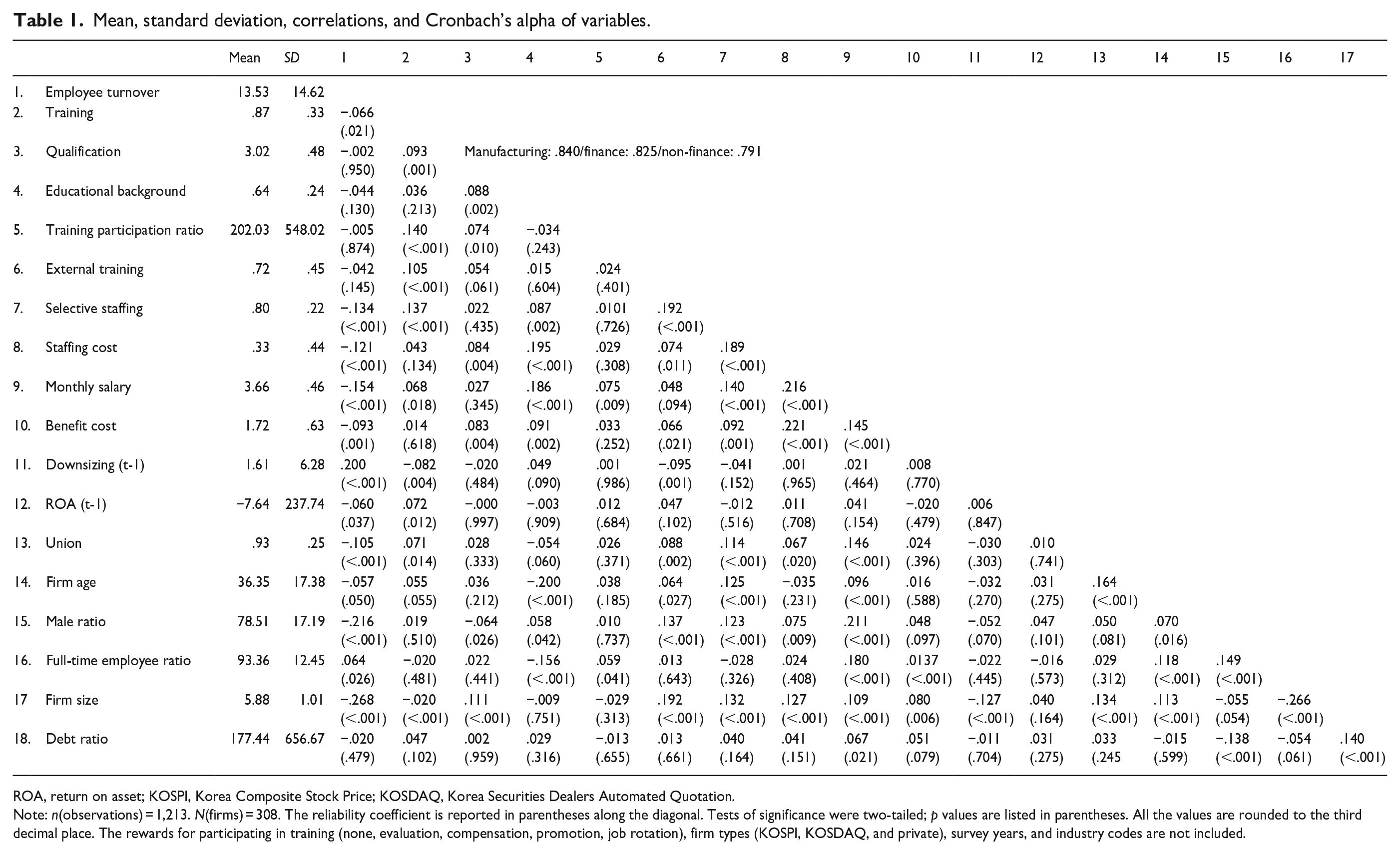
ROA, return on asset; KOSPI, Korea Composite Stock Price; KOSDAQ, Korea Securities Dealers Automated Quotation.
Note: n(observations) = 1,213. N(firms) = 308. The reliability coefficient is reported in parentheses along the diagonal. Tests of significance were two-tailed; p values are listed in parentheses. All the values are rounded to the third decimal place. The rewards for participating in training (none, evaluation, compensation, promotion, job rotation), firm types (KOSPI, KOSDAQ, and private), survey years, and industry codes are not included.
Testing hypotheses
As shown in Table 2, the basic association between training and employee turnover is not significant before the interaction terms are inserted (β = .119, standard errors = 2.063, t = 0.058, p = .954 in Model 2; β = .040, standard errors = 2.093, t = 0.019, p = .985 in Model 3). To test Hypothesis 1, we used the fixed-effects models. As shown in Model 4 of Table 2, the result indicated that the interaction effect of “training X qualification” was positive and significant (β = 7.75, standard errors = 3.764, t = 2.059, p = .040 in Model 4; β = 7.592, standard errors = 3.749, t = 2.025, p = .044 in Model 6). Accordingly, Hypothesis 1 was supported. As shown in Figure 2, the positive association between training and employee turnover was identified in the case of high job qualification (from 41.97% to 46.56%). On the other hand, the negative association between training and employee turnover was identified in the case of low job qualification (from 48.03% to 45.22%).
Results of models for hypotheses testing.
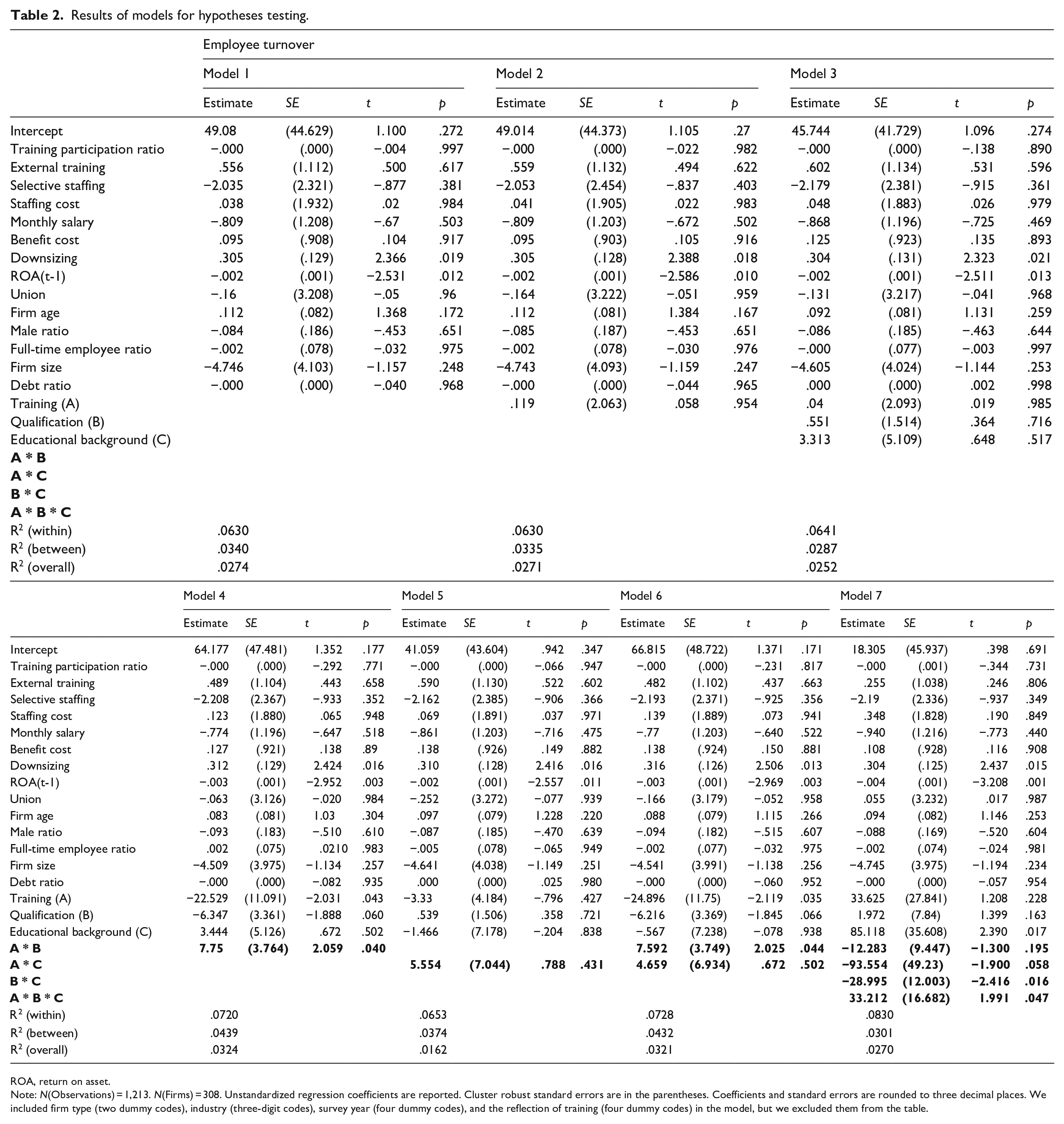
ROA, return on asset.
Note: N(Observations) = 1,213. N(Firms) = 308. Unstandardized regression coefficients are reported. Cluster robust standard errors are in the parentheses. Coefficients and standard errors are rounded to three decimal places. We included firm type (two dummy codes), industry (three-digit codes), survey year (four dummy codes), and the reflection of training (four dummy codes) in the model, but we excluded them from the table.
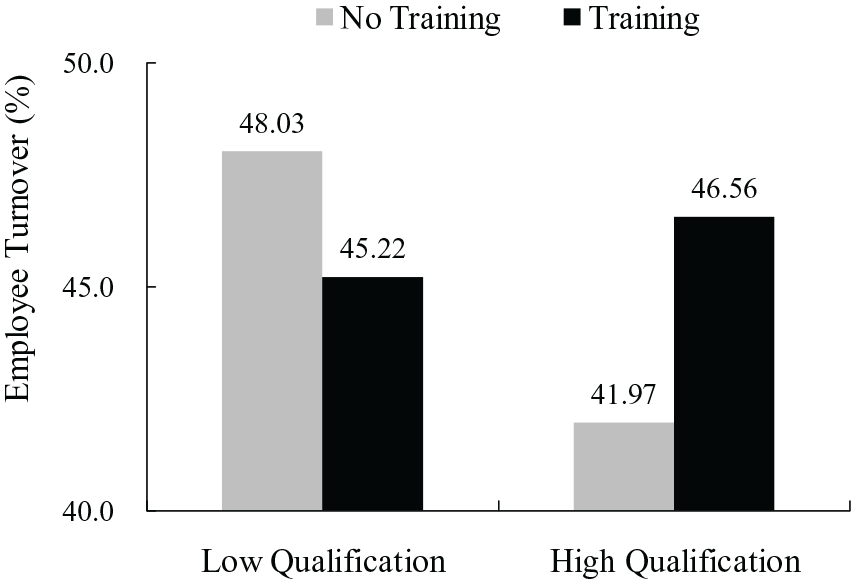
Interactions between training and job qualification on employee turnover (hypothesis 1—Model 4).
To test Hypothesis 2, we used Models 5 and 6. The results do not include a significant interaction effect between training and educational background (β = 5.554, standard errors = 7.044, t = .788, p = .431 in Model 5; β = 4.659, standard errors = 6.934, t = 0.672, p = .502 in Model 6). These findings do not support our hypothesis that a high educational background significantly moderates the association between training and employee turnover at the organizational level. We discuss an alternative explanation for this in the following “Post hoc analysis” and “Discussion” sections.
Post hoc analysis
Since Hypothesis 2 was not supported, we decided to analyze the data further to assess if the effect of training on employee turnover for the education level of employees is contingent on the job qualification level. Specifically, we included the three-way interaction term among training, job qualification, and educational background in Model 7 to explore the joint interaction effects among them on employee turnover. According to the results of Model 7, there is a significant three-way interaction effect among training, job qualification, and educational background (β = 33.212, standard errors = 16.682, t = 1.991, p = .047). These results are visualized in Figure 3. In Figure 3, the positive association between training and employee turnover was only identified in the case of high job qualifications and high educational background (from 42.33% to 52.90%). This post hoc analysis suggests that organizations experience increased employee turnover with training when they relied on employees with both high job qualifications and high educational backgrounds.
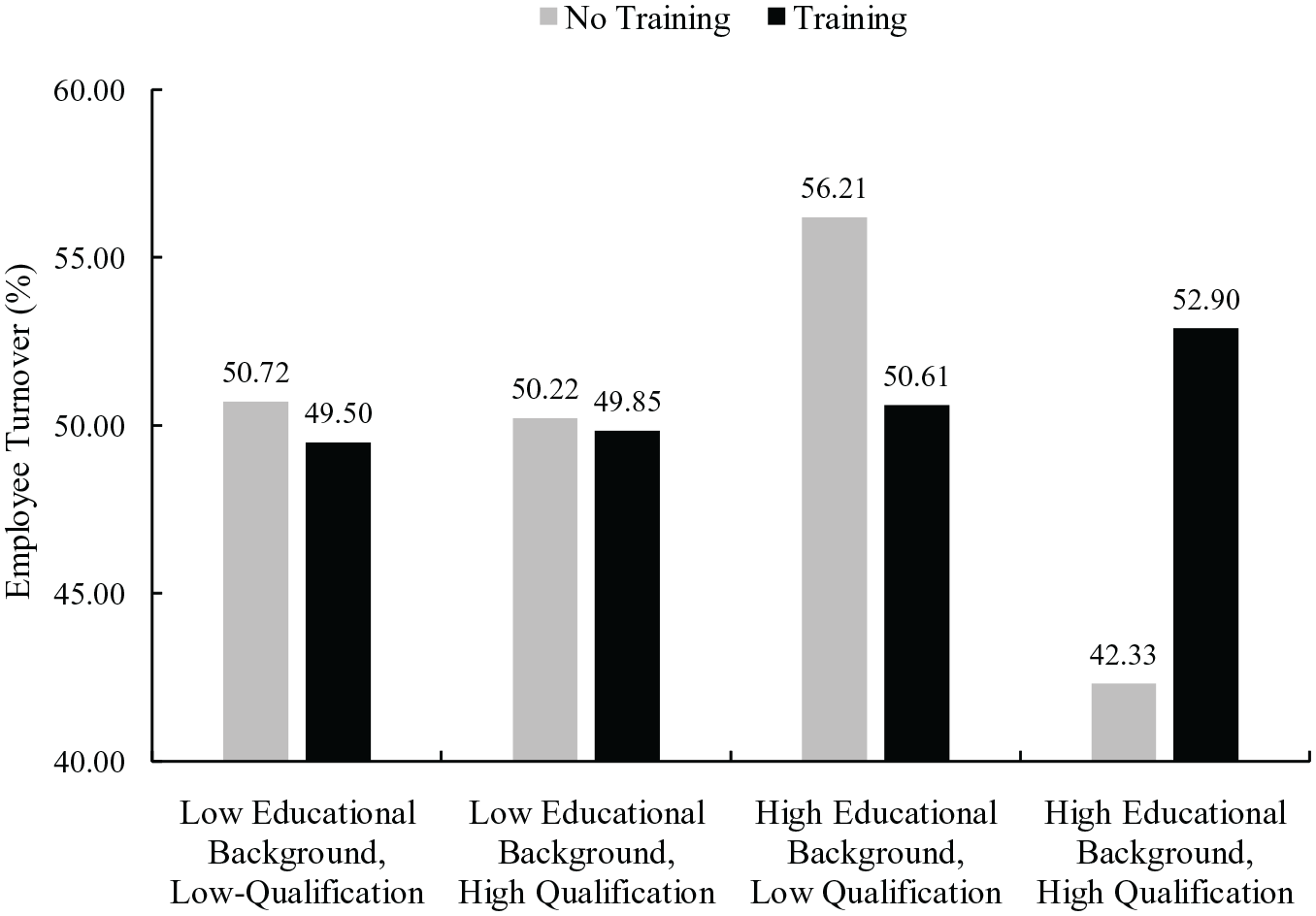
Three-way interactions among training, qualification, and educational background on employee turnover (post hoc analysis—Model 7).
These results seem consistent with the social exchange framework presented in this article. For example, training may have limited the perceived value in terms of improving job-related capabilities for the organizations with employees who are highly qualified and educated (Giangreco et al., 2009; Kraimer et al., 2011). Furthermore, such employees are likely to have several alternative options in external labor markets (Haines et al., 2010), and this, in turn, may increase the employees’ perceived opportunity costs of reciprocating by staying at the organization.
Discussion
We leverage the social exchange theory in this article to help understand when an organization’s training practice has a positive or negative impact on employee turnover. This study focused on two important characteristics of employees, job qualification and educational background, as these are likely to influence the perceptions of the value of training received from the organization and the perceived value of reciprocating by staying at the organization. According to the panel-analysis results of 308 firms, this study found that the association between an organization’s training practice and employee turnover was contingent on the job qualification level of employees; when the organizations rely on high-qualified employees, training was associated with increased turnover, whereas this association was reversed when the organizations deployed employees with low job qualifications. We also found that these tendencies were strengthened when the majority of employees have high educational backgrounds as well since the perceived opportunity costs of staying at the organization might be high due to available alternatives in the labor market (Haines et al., 2010). Conversely, the effects of a firm’s training practice appear to have a more consistent, albeit lower, effect on reducing employee turnover when organizations rely on employees with a low level of education. In general, this study provides support for the social exchange perspective for studying the training-employee turnover association. This helps to make sense of the inconsistent results of previous studies on the negative (e.g., Hausknecht & Trevor, 2011; Heavey et al., 2013), positive (e.g., Haines et al., 2010; Gardner et al., 2011), and/or neutral (e.g., Batt et al., 2002; Subramony, 2009) association between training and employee turnover and has important implications for future research related to training, HR, and employee turnover.
In Hypothesis 1, we suggested that, due to differential perceptions of the value of training and the resulting urge to reciprocate by staying at the organization, the training-turnover association is positive when the average job qualification is high and negative when the average job qualification is low. The results of this study provide support for this idea and may offer a new path to understanding the mixed association between training and employee turnover (Heavey et al., 2013; Ito & Brotheridge, 2005). In particular, the varied perceived value of training may be a key moderating factor in the training-turnover association and, drawing on social exchange theory, offers an explanation for why some organizations experience higher levels of employee turnover when they provide training for the majority of their employees. Also, this finding might also give some implications about approaches to calculating the cost and benefits of providing employees with training. For instance, if the organization’s employees are characterized by high job qualifications, it should be cautious about the training for its employees in terms of the needs-supply fit. On the other hand, if the organization relies on low-qualified employees, the organization might benefit from the trained employees who may perceive high values of training in terms of improving adaptive capabilities. This is aligned with the previous literature suggesting the needs-supply fit might be a critical type of fit from employees’ perspectives (Cable & DeRue, 2002).
Regarding Hypothesis 2, we posited that educational backgrounds moderate the association between training and voluntary turnover. In particular, we focus on the idea that employees with high educational backgrounds have more quality options in the external labor market than employees with low educational backgrounds (Hulin et al., 1985; Wei, 2015), which moderates the perceived opportunity costs of staying at the organization. Contrary to our expectations, the empirical results of this study did not provide support for this hypothesis. One potential explanation for this might be different market values of college degrees. Although employees may have the same college degrees, the perceptions of the value of that degree in the labor market could vary as a function of the reputations of the college or university providing the degree. For instance, if the organization relies on employees from top-tier colleges or universities, the opportunity costs of staying at the organization might be high because of a number of alternative options in the labor market. As the HCCP data do not provide information about the universities or colleges attended by their employees, we are not able to assess the validity of this potential explanation. However, we believe this is an interesting area for future research to explore.
Another explanation is that the moderating impact of educational background is contingent on other factors in the organization. We explored this idea by conducting a post hoc analysis to examine if there is a three-way interaction effect between training, job qualification, and educational backgrounds on employee turnover. According to our findings, the training-turnover association was positive only when the organizations rely on employees with both high job qualifications and educational backgrounds. As we find the effects of high education on employee turnover vary as a function of the job qualification level of employees, this offers a potential explanation for not finding effects for the two-way interaction in Hypothesis 2.
Specifically, when employees involve a low level of education, training appears to slightly reduce the rate of employee turnover regardless of the qualification level of employees. However, when an organization’s employees involve a high level of education, the impact of training on employee turnover varies based on the job qualification level: Training appears to reduce turnover of the employees with a low level of job qualification and increase turnover of the employees with a high level of job qualification. Moreover, the effect size for training on employee turnover appears to be much higher when employees have high levels of education. Given that it has not been easy for Korean full-time employees to leave their organizations due to the increased unemployment rates and the big different employment conditions including compensations, organizational status, and employment safety between temporary employees and full-time employees (i.e., labor market duality) since the IMF crisis, that is, the Asian financial crisis, in 1997 (Schauer, 2018), one possible explanation is that training might send particularly powerful ability-related signals derived from both high educational backgrounds and trained experiences to other employers (Hausknecht & Trevor, 2011; Morris et al., 2017; Trevor, 2001). Conversely, as training seems to result in a considerable reduction in employee turnover when organizations rely on highly educated but poorly qualified employees, this suggests highly educated employees may place considerable value on training when it is needed for them to become more qualified in fulfilling their job duties.
While the effects of high levels of education are potentially more complex or contingent than we had initially hypothesized, these findings are consistent with the social exchange framework developed in this article. Specifically, as noted previously, the potential availability of more job opportunities for employees with high levels of education seems to enhance the criticality of the perceived value of training: Employees that also have a low level of qualification may find more value in the training and thus feel a need to reciprocate by staying, whereas those with a high level of qualification may perceive a lower amount of value from the training and feel less obligated to reciprocate by remaining at the organization. Interestingly, this same pattern does not seem to be present for organizations with employees that have a lower level of education as training appears to reduce employee turnover for such organizations irrespective of the qualification level of their employees. One potential explanation for this finding is that the reduced mobility options that may arise with lower levels of education may fundamentally influence the perceived value of training; thereby suggesting there may be asymmetries in the effect of educational background and job qualification on the training and employee turnover association. While we are not able to examine this potential explanation with the data in the current study, we encourage future research to explore this possibility further.
Theoretical implications
This study has several theoretical implications about the effects of training on employee turnover. First, this study contributes to the knowledge of the inconsistent association between training and turnover (Haines et al., 2010; Heavey et al., 2013) by leveraging social exchange perspectives (Cropanzano et al., 2017; Cropnazano & Mitchell, 2005). The findings of this study are consistent with the idea that training can be positively and negatively associated with employee turnover (Haines et al., 2010; Hausknecht & Trevor, 2011; Heavey et al., 2013), but offers a potential way to reconcile these different effects of training on turnover by focusing on employee characteristics. In addition to highlighting the potential role of employee qualification and education, the results of this study imply that the social exchange perspective has potential as a new theoretical approach to improve understanding of the mixed association between training and turnover. For example, future research could leverage this theoretical perspective to examine what other characteristics of a firm’s employees may influence the perceived value of training, which could lead to different outcomes regarding the relationship between an employer and employees such as job commitment, satisfaction, attitudes, and performance.
Second, this article offers a new way to leverage the concept of horizontal or internal fit among specific HR practices such as training and selection because it suggests an organization’s HR approach regarding training and hiring should be consistent with respect to employee characteristics (Boon et al., 2007, 2019; Kehoe, 2021). This implies there may be benefits for future research concerning training and turnover to explore the notion of horizontal fit among HR practices and employee characteristics. It also implies, more broadly, that greater consideration could be given to the composition of employee characteristics in the work in HRM on horizontal fit, which has historically focused more on how a given set of practices are complementary and mutually reinforcing.
Third, this study contributes to the social exchange theory (Cropnazano et al., 2017; Cropnazano & Mitchell, 2005). This article suggests the meaning of training as a social exchange may vary based on job qualification and educational backgrounds of an organization’s employees. Specifically, whether training can be a valuable organizational aspect for employees depends on the current level of job qualification. Also, whether the value of reciprocating by staying at the organization can be different as a function of educational backgrounds in terms of alternative options in the labor market (Haines et al., 2010; Trevor, 2001). These are suggested in this article to be associated with the situation-specific cost-benefit calculation of employees about exchanges with their employer (Cropnazano & Mitchell, 2005). When researchers examine whether an employer-provided HR practice becomes a social exchange or not, it might be necessary to consider the varied values of that practice and those of reciprocating behaviors based on the characteristics of an organization and the cost-benefit calculations from the perspectives of the majority of employees.
Moreover, as the general decoupling of qualification and education in Korea allows us to test the moderating effects of job qualification and educational background, it would be helpful for future researchers to consider these factors in labor markets where there may be clearer connections between education and job qualification. That is, there may be other contexts where training plays less of a central role in workforce development, and this may fundamentally alter the relevant moderators in the training-turnover association and its implication for social exchange perspectives regarding the training-turnover association. In addition, as South Korea is generally viewed as having a greater collective orientation (Cho & Yoon, 2001; C. Y. Lee, 2012), it may be interesting and insightful for future research to consider how the factors and theory presented and tested in this article regarding social exchange may be different in countries and cultures with more of an individual orientation. In particular, it may be that the social exchange theoretical mechanisms we suggest in this article may be less salient in countries and cultures with greater individual orientation. Such studies would help to elucidate the potential boundary conditions of the theory and empirical findings of this article and also offer the opportunity to better contextualize social exchange theory perspectives regarding the training and turnover association (cf. Johns, 2006).
This article also has implications for the literature related to training investments and turnover that utilize alternative theoretical perspectives, such as psychological contacts (Rousseau, 1989) and human capital (Becker, 1964). With regard to psychological contract theory (Cullinane & Dundon, 2006), we provide meaningful boundary conditions for this literature. Specifically, given that psychological contract, which refers to an employee’s belief regarding conditions and terms of reciprocal exchange relationship with his or her organization (Rousseau, 1989), is closely associated with the social exchange theory, this study implies that the provision of inducement HR practices such as training to the employees does not always guarantee psychological contracts with employees and, in turn, employee commitment due to characteristics of the employees. Accordingly, a more nuanced view may be called for regarding the use of psychological contract perspectives when looking at the training and turnover link. Regarding human capital perspectives, our article suggests a specific way for human capital research to consider how to achieve both valuable trained employees and low voluntary turnover, which can be important for human capital-based competitive advantage (Coff, 1997). This is important for the literature on human capital because investments in training and development are critical for attaining valuable and committed employees and their effects on organizational performance or functioning, and these investments are costly in terms of both direct costs of training and potential risks from voluntary turnover of such valuable employees (Dess & Shaw, 2001). In this vein, this study implies there is value in thinking about contingent aspects among training and employee characteristics and also highlights the potential benefits and implications of horizontal fit among HR practices such as selection and training. Given such implications, conceptual overlap, and complementarities, we encourage future research on training and turnover to give greater consideration to further integrate the social exchange theory, psychological contracts, and human capital perspectives.
Practical implications
In terms of implications for practitioners, the findings of this study suggest that organizations could reduce voluntary turnover by being more mindful about the application of training depending on the characteristics of their employees. Specifically, if an organization relies on employees who are not qualified and do not have college degrees, our findings suggest that employers can attempt to build a reciprocal relationship with their employees by investing in and providing training to them and that this can reduce employee turnover after receiving training. However, if employees are qualified and have strong educational backgrounds, leaders or HR practitioners should be cautious about the use of training programs and explicitly consider additional actions that could be taken (e.g., modifying compensation structures, work design, and other potentially attractive job features) to reduce tendencies of their employees to leave the organization after receiving any training. In summary, regarding the provision of training and its potential implications for employee turnover, our study suggests it might be helpful for employers and HR practitioners to consider the level of qualification of their employees and the educational backgrounds of employees.
Limitations
This study has several limitations. First, there might be additional variables related to individual differences which are not available in the HCCP data set but could have a potential influence on the perceptions of training. Specifically, future research is needed to deeply examine the moderating effects of personality traits on the association between training and turnover. For example, highly extraverted people who are active, talkative, sociable, and socially attentive (Barrick & Mount, 1991) might have positive social networks and interactions in their workplaces, which makes their opportunity costs of leaving, losing their existing social networks and others’ acknowledgments, high. Thus, if there are many extroverted employees in the organization, the association between training and voluntary turnover might be negative. Second, we used the training variable and employee turnover variable that occurred in the same year since the HCCP data sets have been collected biennially. As a result, it is hard to infer the causation between training and employee turnover considering employee qualifications and education levels through this study. A future study could investigate this possible issue by using a data series that allows for time-lagged variables associated with training and turnover. Third, we only utilized employer-provided training and external training as the training variables in the models. However, there are other types of training. For instance, employees can choose the training that fits their own interests, job positions, or qualifications in some organizations, which might influence subsequent turnover differently. Future research can examine the different effects of various types of employer-provided training on employee turnover. Fourth, our use of a single country for our sample is a potential limitation in that there may be different labor market dynamics in other countries that could influence the results of our findings. For example, as one of the reviewers pointed out, employees with lower skills may have more opportunities in labor market contexts of high economic growth and low unemployment levels, and this may alter the findings presented in this study. As we noted previously, the labor market context in South Korea during the timeframe of our study is not such a labor market, and our inclusions of year-fixed effects help to address any temporal variations in general unemployment. Thus, while this issue is not present in the current study, we encourage future research to examine the focal constructs and associations of this study in other countries to see how labor market context (and other between-country differences) could influence these findings.
Conclusion
Training has inconsistent effects on employee turnover. Specifically, under certain circumstances, training can increase or decrease employee turnover at the organizational level. To understand this inconsistent pattern of effects, we employed the social exchange theory (Cropanzano et al., 2017; Cropanzano & Mitchell, 2005) and empirically examined the different associations between an organization’s training HR practice and employee turnover depending on two moderators associated with an organization’s employees: the level of job qualification and educational background. Our findings indicate that the characteristics of an organization’s employees do impact the training and turnover association and lend support to the general social exchange theoretical approach developed and used in this article. In doing so, we hope to provide a new theoretical framework for future research to further explore the differential associations between training and employee turnover.
Footnotes
Appendix 1
Data Availability Statement
The data that support the findings of this study are available from the corresponding author upon reasonable request.
Declaration of conflicting interests
The author(s) declared no potential conflicts of interest with respect to the research, authorship, and/or publication of this article.
Funding
The author(s) received no financial support for the research, authorship, and/or publication of this article.
