



Abstract
NATO members have been coping with low motivation and morale. Such environments typically have high turnover intentions and neglect behavior. However, safety behavior is paramount for military organizations and neglect behavior can have serious consequences. Social exchanges are often cited as the main reason for these phenomena. We therefore examine turnover intentions and safety compliance behavior of 1,593 airmen from a European NATO Air Force by focusing on different psychological contract (PC) dimensions. We use polynomial regression and response surface analysis. Results show that higher levels of PC fulfillment are related to lower levels of turnover intentions and higher levels of safety compliance behavior. Furthermore, perceptions of PC overfulfillment are negatively associated with turnover intentions, whereas safety compliance is unaffected by positive (overfulfillment) and negative (underfulfillment) PC discrepancies along all PC dimensions. We discuss implications for the PC literature, make suggestions for future research, and provide practical implications.
Keywords
Introduction
The psychological contract (PC), which is anchored in Social Exchange Theory (Blau, 1964), refers to “an individual’s beliefs regarding the terms of conditions of a reciprocal exchange agreement between the focal person and another party” (Rousseau, 1989, p. 123). These exchanges are important for organizations because the quality of the PC triggers everyday employee attitudes and behaviors in the workplace (e.g., Conway & Briner, 2009; Coyle-Shapiro et al., 2019). Following Social Exchange Theory (Blau, 1964) and the Norm of Reciprocity (Gouldner, 1960), it is generally assumed that when the employer fulfills their side of the exchange agreement (i.e., PC fulfillment), employees will respond with positive attitudes and behavior to keep balance in the exchange relationship (e.g., Lambert et al., 2003). However, if the PC is breached—defined as the failure of one party in a relationship to fulfill its promised obligation(s) to the other party (Robinson & Rousseau, 1994)—it will typically trigger negative employee reactions such as reduced satisfaction, reduced commitment, reduced in-role and extra-role performance, as well as increased mistrust, increased neglect behavior, and increased turnover intentions (for a meta-analysis see Conway & Briner, 2009; Zhao et al., 2007). In this research, we focus on the relationship between different levels of PC fulfillment and two dependent variables: turnover intentions and safety compliance behavior.
Turnover intentions have been studied as an outcome of PC breach (e.g., Conway & Briner, 2005; Robinson & Morrison, 2000; Robinson & Rousseau, 1994). Although the link is intuitive and might therefore seem straightforward, previous research did not always find a significant relationship between PC breach and turnover intentions (e.g., Clinton & Guest, 2013; Zhao et al., 2007). A possible explanation might be found in the level of detail used to measure and examine the PC. When the PC is viewed as a single construct, the relationship between PC breach and turnover intentions is typically significant (e.g., Zhao et al., 2007), but when the PC is viewed as a multi-dimensional construct, it is not uncommon that PC breach on one or more PC content-dimensions is not significantly associated with turnover intentions (e.g., Clinton & Guest, 2013; Kraak et al., 2017).We can even add an additional layer of complexity in that the simultaneous PC exchanges within the multi-dimensional perspective can have different levels of PC fulfillment (i.e., the actual level at which fulfillment takes place), underfulfillment (i.e., when deliveries on inducements fall short of promises), and overfulfillment (i.e., when deliveries on inducements surpass promises). We are currently not aware of any studies that have explicitly looked into charting the effects of PC fulfillment, under-, and overfulfillment on turnover intentions using a multi-dimensional view of the PC. This is an important gap in the literature as each of these dimensions can trigger different levels of employee reactions, depending on the importance of the dimension and the type of fulfillment (Lambert et al., 2003).
Safety compliance behavior has been largely overlooked in PC research. Even though PC underfulfillment triggers neglect behavior (Turnley & Feldman, 1999), which could result in reduced attention regarding safety rules and regulations, safety compliance itself has not been studied as an outcome of the PC. A number of studies did examine the relationship between safety-related PC inducements and safety behavior (e.g., Walker, 2010; Walker, 2013; Walker & Hutton, 2006). The results of two studies (Newaz et al., 2019; Walker, 2013) suggest that fulfillment of safety-related inducements (e.g., ensure that work demands do not compromise safety) is positively associated with safety behavior, whereas underfulfillment of safety-related inducements is negatively associated with safety behavior. Despite their value, however, there has been criticism regarding the very narrow scope of these studies (e.g., Grote, 2016) because the inducements included in these studies are limited to safety and did not include elements that are typically part of the PC. These studies thus overlooked that employees and employers exchange a much wider set of inducements, such as job content, career development, social atmosphere, policies, and rewards (Freese et al., 2008); ultimately, limiting the scope of the employment relationship to a narrow focus on safety-related inducements. In other words, these studies did not study the PC but an exchange of safety-related inducements, and we therefore do not know how different levels of PC fulfillment are associated with safety compliance behavior. This constitutes an important gap in the PC literature as PC underfulfillment potentially triggers a decrease in safety compliance behavior.
In this study, we focus on the relationship between the PC, turnover intentions, and safety compliance behavior for a sample of airmen from a European NATO member. We believe that this context is particularly appropriate for our investigation as many European NATO members are coping with retention problems due to reduced budgets, smaller military organizations, and increased pressure from operational deployments. These retention problems are happening across the board. Some examples are pilots (e.g., Guibert, 2017; Handelsblatt, 2018), medical officers, such as those in Germany (Richter, 2017), and noncommissioned personnel in France (Legge, 2019). Although the COVID-19 pandemic had a temporary positive effect on the retention of military personnel for certain NATO members such as the US (e.g., Losey, 2020), it is unlikely that retention issues will be solved for European military organizations in the near future. In line with Guest (2004), a commissioned NATO report from 2007 proposed that an increased focus on the PC in the military context would likely help gain insights into the employment relationship of military personnel and thereby explain issues with high levels of turnover intentions (Van de Ven, 2007). Despite this call for more research, dating back 15 years, there is still very little research on the PC in a military context (Pohl et al., 2016). Having a better understanding of how PC perceptions are associated with turnover intentions may help to explain why military personnel are more or less likely to leave, providing important insights into one of the most problematic issues contemporary military organizations are dealing with.
Moreover, generating insights into how the PC might influence safety compliance behavior is especially important in a military context, which is heavily reliant on their compliance with appropriate and effective regulations (Military Aviation Authority, 2020). When military personnel does not comply with all the prescribed safety instructions, the resulting accidents can be catastrophic as Dutch and French accidents during military operations in Mali have shown (e.g., Guibert, 2019; Righton, 2016). As stated above, PC underfulfillment on safety-related inducements was found to be negatively associated with safety behavior (Newaz et al., 2019; Walker, 2013). However, these studies only focused on safety-related inducements and did not include established multi-dimensional PC measures. There is therefore an important gap in the military PC literature despite the paramount importance of safety compliance in avoiding fatal accidents and assuring operational effectiveness (for an elaborate discussion on this topic, see Martínez-Córcoles & Stephanou, 2017).
To address these shortcomings in the (military) PC literature, we focus both on content-oriented measures (studying the reciprocal obligations that make up the PC; Rousseau & Tijoriwala, 1998) and evaluation-oriented measures (studying the levels of promised and delivered inducements; Rousseau & Tijoriwala, 1998). In this study, we examine the PC content through the six different PC dimensions of the Tilburg Psychological Contract Questionnaire (TPCQ; Freese et al., 2008). The evaluation of these PC contents is carried out by using the well-established expanded approach of the PC (Lambert et al., 2003). The expanded approach does not simply look at a single score that either represents PC fulfillment or PC breach but instead allows us to simultaneously chart the consequence of levels of PC fulfillment, under-, and overfulfillment for the six different PC content dimensions on turnover intentions and safety compliance behavior among European military personnel.
This article makes two main contributions to the (military) PC literature. First, by using the TPCQ in combination with the expanded approach, we provide detailed insight into how different levels of PC fulfillment trigger turnover intentions. Our findings show that higher levels of PC fulfillment were associated with lower levels of turnover intentions across all six dimensions of the TPCQ; as levels of PC fulfillment went up, turnover intentions decreased. Furthermore, we found that overfulfillment was associated with lower levels of turnover intentions for all six TPCQ dimensions; as levels of delivered inducements surpassed what was initially promised, turnover intentions decreased. Second, our methodology allowed us to explore how different levels of PC fulfillment are associated with safety compliance behavior. Our findings show that higher levels of PC fulfillment were associated with higher levels of safety compliance behavior for all TPCQ dimensions. Furthermore, and contrary to what we hypothesized, we found that perceptions of PC under- and overfulfillment were not significantly associated with changes in safety compliance behavior; positive (i.e., PC overfulfillment) and negative (PC underfulfillment) discrepancies between promised and delivered levels of inducements along all six dimensions of the TPCQ did not influence safety compliance behavior. Although we focus on military personnel in this study, numerous other sectors that rely heavily on safety compliance behavior are currently dealing with high turnover intentions (e.g., health care, De los Santos & Labrague, 2021; Zhang et al., 2021 law enforcement, Charman & Bennett, 2021; firefighters, Goh et al., 2021; private security personnel, Seung, 2021; construction, Ayodele et al., 2021). We therefore believe that this study on the relationship between different PC dimensions, turnover intentions, and safety compliance behavior can be relevant for PC research in all sectors and industries where safety compliance is important.
The article is organized as follows. We first provide the reader with a short overview of the PC literature, followed by a review of relevant studies on the role of the PC in the military context, and finally, we focus on the importance of using the expanded PC approach using polynomial regressions and response surfaces. We then present the empirical study, the analysis and results before moving on to the discussion in which we detail the theoretical and practical contributions, limitations of our study, and avenues for future research.
Theoretical framework and hypotheses
PCs: definitions, military context, and expanded approach
Definitions
The PC refers to “individual beliefs, shaped by the organization, regarding terms of an exchange agreement between individuals and their organization” (Rousseau, 1995, p. 9). Employees hold a PC with their organization wherein they believe that their organization is obligated to provide certain inducements (e.g., fair treatment, competitive salary, and benefits) in return for their contributions (e.g., excellent performance, loyalty). The PC is therefore regularly conceptualized as a multi-dimensional construct as certain inducements making up the exchange relationship can be grouped into specific types or dimensions. One way of studying these PC features is by looking at employer and employee obligations and determining if either party has delivered more than the other party or if these obligations are in balance (e.g., De Cuyper et al., 2008). However, the most common distinction in the PC literature is that of transactional versus relational PCs (Conway & Briner, 2005). Transactional PCs are described as being materialistic, tangible, specific, static, short-term in nature, and including minimal emotional investment, whereas relational PCs are described as intangible, subjective, flexible, long-lasting, and requiring significant emotional investment (Morrison & Robinson, 1997; Rousseau & McLean Parks, 1993). Despite being an often-used dichotomization of the PC content, this represents an oversimplification (Hansen & Griep, 2016). Another, and arguably more precise, way of conceptualizing the PC content is by using a multi-dimensional measurement such as the TPCQ (Freese et al., 2008), which has been used in different contexts (e.g., De Vos et al., 2003; Kraak et al., 2017; Lub et al., 2016; Van der Smissen et al., 2013; Van Niekerk et al., 2019; Willem et al., 2010). The TPCQ focuses on six different PC dimensions, in line with Human Resource Management practices: (1) aspects related to job content, (2) career development opportunities, (3) inducements with regard to the social atmosphere at work, (4) policies that the organization has put in place, (5) inducements related to achieving work–life balance, and (6) inducements that focus on different types of rewards. The advantage of using a framework such as the TPCQ is that we can explore the different areas of inducements/contributions that make up the employment relationship, allowing us to go beyond the oversimplified differentiation between transactional and relational PCs.
Employees have an established PC, labeled PC fulfillment, when their employer continues to provide them with the previously agreed upon dimensions of the TPCQ. However, when the organization does not deliver these inducements as part of their obligations toward their employees, employees may experience PC underfulfillment (Morrison & Robinson, 1997). Traditionally, these PC states are seen as the main drivers of behavioral change as exemplified by the fact that PC underfulfillment has been found to be associated, for example, with lower levels of job satisfaction, trust, OCB, in-role performance, organizational commitment, and increased turnover intentions, whereas PC fulfillment is associated with positive outcomes (for a meta-analysis, see Zhao et al., 2007; for a recent review, see Coyle-Shapiro et al., 2019). PC fulfillment generally triggers positive employee responses such as increased commitment (e.g., Coyle-Shapiro & Kessler, 2000) and satisfaction (Lambert et al., 2003; Montes & Irving, 2008). These behavioral changes in response to PC fulfillment levels are traditionally understood based on the theoretical tenets of Social Exchange Theory (Blau, 1964) and the Norm of Reciprocity (Gouldner, 1960). These theoretical frameworks state that the quality of an exchange relationship between two parties develops through the exchange of resources as per the norm of reciprocity. The reciprocity norms underlying this exchange come in two forms: positive and negative. The positive norm of reciprocity promotes stability in relationships through considerate, valued, and balanced exchanges. Favorable treatment by one’s organization (i.e., PC fulfillment or overfulfillment) generates favorable employee treatment (Cropanzano & Mitchell, 2005; Gouldner, 1960). In contrast, the negative norm of reciprocity proposes that when employees believe that they are on the receiving end of unfavorable treatment (i.e., PC underfulfillment), they will feel the desire to “return injuries” rather than “benefits” to the other party (Cropanzano & Mitchell, 2005; Gouldner, 1960, p.172).
The PC in a military setting
Although changes in the military PC have been discussed for well over a decade (e.g., Bondi, 2004; Griffith, 2006; Van de Ven, 2007), our knowledge about the role of PCs in the military remains rather limited (with the exception of a handful of studies we briefly review here). In his conceptual model, Guest (2004) has argued that the PC is grounded in policies and practices that are in turn anchored in the contextual and background factors of the studied environment; therefore, it is important to study PCs in the military organization if we want to better understand the military employment relationship and its consequences. A number of studies have focused on the role of PCs in the military. For example, Edgar and colleagues (2005) reported that PC breach resulted in offending behavior such as absenteeism among British servicemen. Jordan and colleagues (2007) found that US Army officers who perceived high levels of PC fulfillment, displayed more altruistic behavior than those who reported low levels of PC fulfillment. Among Portuguese soldiers, Chambel and Oliveira-Cruz (2010) found that PC breach reduced engagement and increased burnout. Soares and Mosquera (2019), also among Portuguese soldiers, found that holding a relational PC was positively associated with engagement, whereas holding a transactional PC was negatively associated with engagement. Claxton and Pilbeam (2013) found that British Army personnel experienced primarily relational PCs and that cultural aspects appeared to moderate the relationship between the feeling of PC violation and negative outcomes. Clinton and Guest (2013) found a positive relationship among British Royal Air Force personnel between PC breach and turnover. Heffernan and Rochford (2017) found that social status and connectedness with senior officers moderated the relationship between PC breach and turnover intentions for a sample of Irish Defence Forces officers. Pohl and colleagues (2016) found a positive relationship between PC fulfillment and job satisfaction and commitment among Belgian soldiers. Kraak and colleagues (2020) found among European Air Force pilots that PC breach and its strong emotional impact does not necessarily trigger the desire to exit the organization, voice concerns, or neglect important duties. Finally, Naweed and colleagues (2021) studied the experiences of Australian ex-military personnel when focusing on their PC formation and contract trajectory within the Australian military. They identified superordinate themes that were linked to transitioning out of the military.
Although this brief overview demonstrates that a handful of studies have focused on the role of PC breach and PC fulfillment in trying to explain behavioral reactions to these PC states, we know far less, and arguably nothing at all, about how fulfillment across different PC dimensions (as per the TPCQ) may affect important employee behavior in a military context. It is important to have a better understanding about how fulfillment of these different PC dimensions affects outcomes for the following reasons. The TPCQ provides a human resource-related vision of PC contents, resulting in an assessment of the PC that matches areas that have already been identified as potentially problematic in a military context (e.g., career development, rewards). Specifically, in the past, the European military enjoyed large budgets that were cut back severely after the end of the Cold War. Where in the past, a career in the military was characterized by an interesting and challenging job, an attractive rewards package, and numerous career development opportunities, among other things, the contemporary European military is dealing with moderate to severe budget cuts. For example, in their 2020 article, Kraak and colleagues argue that the three largest European countries (France, Germany, and the United Kingdom) saw their combined aircraft fleet decrease from approximately 4,000 to 2,900 aircraft between 2007 and 2014 (Flight International, 2007, 2014), a near 30% drop over 7 years. Overall, these budget cuts have led to, among other things, decreasing career advancement possibilities (career development opportunities dimension of TPCQ), insufficiently trained and qualified personnel (job content, career development opportunities, and organizational policies dimensions of the TPCQ), bigger salary gaps with the private sector (rewards dimension of TPCQ), and increasingly heavy workloads (job content and work–life balance dimensions of TPCQ) due to a combination of more external operations with fewer qualified people (e.g., Heinecken, 2009; Pécresse, 2018; Van der Parre & Runderkamp, 2017).
After having reviewed the literature on military PCs, we thus conclude that adopting a PC framework can help us understand how military personnel respond to different perceptions of PC fulfillment across a range of PC dimensions (i.e., job content, career development opportunities, social atmosphere at work, organizational policies, work–life balance, rewards) that have been seriously affected by the implementation of austerity measures. Hence, it is within this unique military context that we explore how perceptions of (under, over, and actual levels of) PC fulfillment affect our outcomes under study.
The expanded approach
The way that we evaluate PC fulfillment will determine the level of detail that our results provide. While there is an abundance of research on the effects of PC breach and/or underfulfillment (and to a lesser extent on PC fulfillment; see Conway & Briner, 2009; Griep et al., 2019), most studies to date have either used (1) a difference score, where one typically subtracts delivered inducements from promised inducements or vice versa or (2) the traditional PC breach measure (and reverse scored this scale for PC fulfillment) of Robinson and Morrison (2000), which produces a single score that either indicates PC breach or PC fulfillment on a numerical scale. Despite its frequent use, the Robinson and Morrison (2000) measure ignores the fact that scholars (e.g., Lambert et al., 2003; Montes & Irving, 2008) have argued and demonstrated that PC breach should be considered as a continuum ranging from the perception that one’s organization provided (far) fewer inducements than obligated (underfulfillment) to the perception that one’s organization provided (far) more inducements than obligated (overfulfillment). In other words, low PC breach does not equal high PC fulfillment (for a critique see, Hansen & Griep, 2016).
Similarly, and in line with the same logic, PC fulfillment itself should not be calculated as a difference score but should also be operationalized as a continuum ranging from a few fulfilled inducements (low levels of fulfillment) to many fulfilled inducements (high levels of fulfillment). There are many potential issues with the use of difference scores (for a review see, Edwards & Parry, 1993). When studying PCs several of these issues are important to understand: (1) difference scores have lower reliabilities than their separate components and conceal the relative contribution of each component (i.e., promised versus delivered contributions), (2) difference scores pose constraints that, more often than not, remain untested. For example, Kraak and colleagues (2018) argued that the difference score between promised and delivered inducements creates a PC breach indicator that only reflects either a difference between promised and delivered inducements but does not allow for the joint assessment of promised and delivered inducements in the same model; thus, overlooking an important part of the dynamic of the social exchange, and (3) difference scores constrain the relative importance of a difference between promised and delivered inducements to be equal in size (Cohen et al., 2010). This last point also has an influence on how we evaluate fulfillment itself as Kraak and Griep (2022, p. 13) showed in their example that “the same PC evaluation will be used for an employer keeping their promise of a 100€ raise in exchange for an employee contribution (the difference score is 0) as well as the employer keeping a promise for a 500€ raise (the difference score is also 0), even though employee perceptions regarding fulfillment are likely to be very different considering the 400€ difference between both situations.”
We therefore decided to use the well-established expanded approach of the PC (e.g., Irving & Montes, 2009; Lambert et al., 2003; Montes & Irving, 2008), which assesses the influence of both promised and delivered inducements, allowing for simultaneous visualization of both the continuum for fulfillment (i.e., fulfillment line), as well as the continuum for breach (i.e., breach line). The major advantage of this methodology is that we can see the complete picture of fulfillment (levels of fulfillment, under-, and overfulfillment) and how each relates to the dependent variable. Figure 1 visualizes the expanded approach.
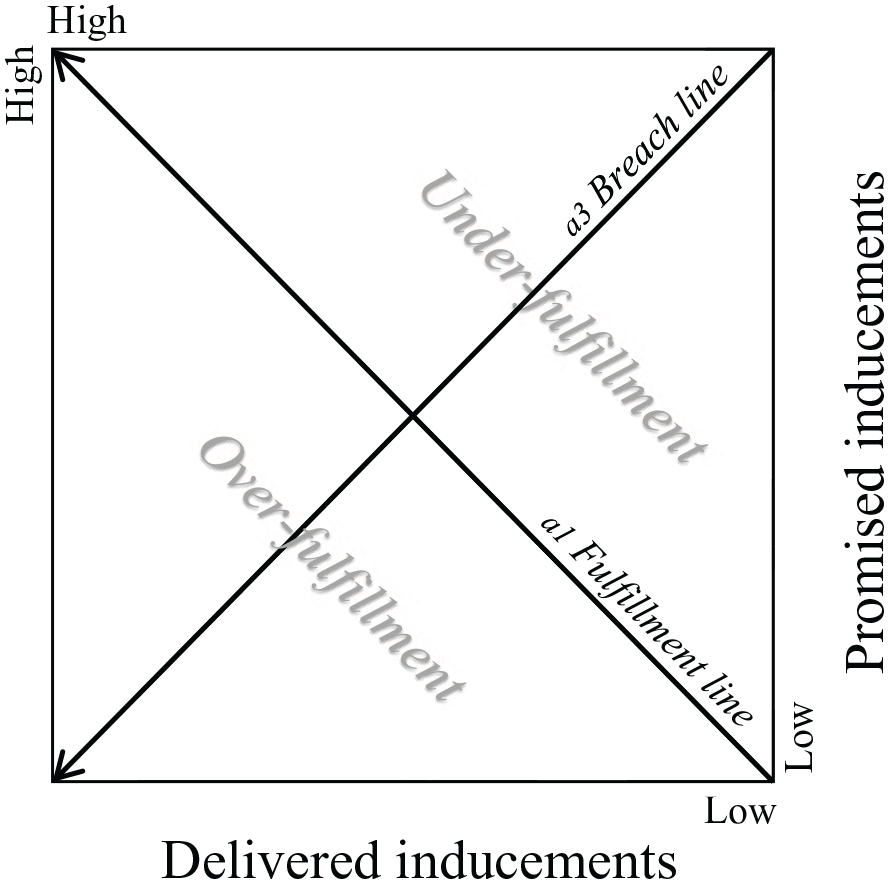
The expanded view.
Effects of PC fulfillment—from low to high levels of fulfillment
As stated earlier, the expanded approach (e.g., Lambert et al., 2003) considers PC fulfillment as a continuum ranging from low levels to high levels of PC fulfillment. In line with Social Exchange Theory (Blau, 1964) and the Positive Norm of Reciprocity (Gouldner, 1960), employees are expected to reciprocate their organization’s fulfillment of the promised inducements with favorable behavior. Previous research (Kraak et al., 2018) has indeed found a negative relationship between levels of PC fulfillment and turnover intentions. Furthermore, Lambert and colleagues (2003) and Irving and Montes (2009) reported higher levels of employee satisfaction as experience of PC fulfillment moved from low to high levels of PC fulfillment. These findings are consistent with those in the previous literature that the effects of PC fulfillment on outcomes are highest when both promised and delivered inducements are high, and thus when employees experience high levels of PC fulfillment (Lambert et al., 2003; Montes & Irving, 2008). We therefore expect that the relationship between PC fulfillment and turnover intentions will be negative across all TPCQ dimensions and increase in strength as levels of fulfillment increase from low to high levels of PC fulfillment. This expectation is backed by limited empirical support which looked into the relationship between PC fulfillment (not within the expanded approach as mentioned in this study) and turnover. For example, Collins (2010) found a negative relationship between PC fulfillment and turnover intentions among 328 managers from franchised service restaurants in the United States. Furthermore, Van den Heuvel and colleagues (2016) and Chaudhry and Tekleab (2013) also found a negative association between PC fulfillment and turnover intentions. Similarly, Sturges and colleagues (2005) found that PC fulfillment is positively linked to organizational commitment and independent ratings of job performance while being negatively associated with absenteeism and turnover. In addition, Sheehan and colleagues (2008) found that fulfillment of promises related to job content and social atmosphere (i.e., two dimensions of the TPCQ used in this study) were negatively related to intentions to leave among nursing professionals. We thus hypothesize the following with respect to turnover intentions.
Hypothesis 1: Higher levels of PC fulfillment are more negatively related to turnover intentions than lower levels of PC fulfillment for the TPCQ dimensions (H1a) job content, (H1b) career development, (H1c) social atmosphere, (H1d) organizational policies, (H1e) work–life balance, and (H1f) rewards.
Regarding the association between PC fulfillment and safety compliance, it is noteworthy that although there has been a steep increase in the number of PC studies over the last two decades (Kraak & Linde, 2019), safety-related behavioral responses to PC dynamics remain understudied (Grote, 2016), even though such behavioral changes could have severe negative consequences for employees and their surroundings. Safety performance and compliance among military personnel are of paramount importance in avoiding fatal accidents and assuring operational effectiveness (for an elaborate discussion on this topic, see Martínez-Córcoles & Stephanou, 2017). The handful of studies that studied the relationship between the PC and safety have all focused on the role of safety as part of the inducements that get exchanged within the PC (i.e., strictly limiting the PC to safety-related promises, Newaz et al., 2019, 2020; Vatankhah, 2021; Walker, 2010, 2013; Walker & Hutton, 2006). However, they have hardly provided answers about how deviations (i.e., either along the fulfillment or breach line) in the extent to which traditional aspects of one’s employment relationship get exchanged and may either positively or negatively contribute to members’ safety performance in these military environments. Consequently, we lack empirical data on any safety-related behavioral changes following different levels of fulfillment (levels of fulfillment, under-, and overfulfillment). Nevertheless, there are indications that different levels of fulfillment (levels of fulfillment, under-, and overfulfillment) may have, respectively, positive or negative effects on safety-related behavior. Newaz and colleagues (2019) found a positive association between PC fulfillment and levels of safety behavior at a large construction site, whereas Walker (2013) reported a negative relationship between perceptions of PC breach and the extent to which employees in a health care setting committed to their safety obligations. In the current study, we therefore decided to measure safety compliance—defined as “adhering to safety procedures and carrying out work in a safe manner” (Neal et al., 2000, p. 101). Safety compliance is particularly important in a military context where compliance with safety procedures and regulations is paramount. Based on the expanded approach to the PC, we expect high levels of PC fulfillment to be positively related to safety compliance compared to low levels of PC fulfillment. We therefore hypothesize the following.
Hypothesis 2: Higher levels of PC fulfillment are more positively related to safety compliance than lower levels of PC fulfillment for the TPCQ dimensions (H2a) job content, (H2b) career development, (H2c) social atmosphere, (H2d) organizational policies, (H25e) work–life balance, and (H2f) rewards.
Effects of PC breach—from underfulfillment to overfulfillment
We also consider PC breach as a continuum ranging from underfulfillment to overfulfillment (see Lambert et al., 2003; Montes & Irving, 2008). In line with Social Exchange Theory (Blau, 1964) and the Negative Norm of Reciprocity (Gouldner, 1960), when employees believe that they are on the receiving end of unfavorable treatment (i.e., underfulfillment), they will feel the desire to repay their employer by engaging in negative behavior as well (Cropanzano & Mitchell, 2005). Indeed, previous research (e.g., Bal, Chiaburu, & Jansen, 2010; Hyde et al., 2009) found that underfulfillment leads to negative outcomes, and more particularly may trigger an increase in turnover intentions (e.g., Blomme et al., 2010; Dulac et al., 2008; Kraak et al., 2018; Robinson & Morrison, 2000; Robinson & Rousseau, 1994). However, in the case of overfulfillment, Lambert and colleagues (2003) have argued that the effect of overfulfillment depends on the type of inducement that was promised and delivered. When the overfulfillment of a certain inducement interferes with the abilities, needs, and desires of employees, it will have a negative effect (much like underfulfillment) on outcomes. This argument aligns with previous arguments by Olson and colleagues (1996) stating that receiving excess inducements is not always beneficial because people may find the unpredictability (e.g., if I receive more, am I expected to do more?) associated with overfulfillment unpleasant. However, if the overfulfillment of a certain inducement can be used to satisfy a wide range of needs and desires, a positive effect on outcomes is to be expected. In the case of the PC dimensions that are inherent to the TPCQ, we do not believe that receiving excess clarity about one’s job content, rewards, or a pleasant social atmosphere at work, for example, will interfere with one’s abilities, needs, and/or desires. As a consequence, we thus expect that the relationship between PC overfulfillment and turnover intentions will be negative across all TPCQ dimensions but become negative as we move from perceptions of overfulfillment to perceptions of underfulfillment. We thus hypothesize the following.
Hypothesis 3: Perceptions of PC overfulfillment are more negatively related to turnover intentions than perceptions of underfulfillment for the TPCQ dimensions (H3a) job content, (H3b) career development, (H3c) social atmosphere, (H3d) organizational policies, (H3e) work–life balance, and (H3f) rewards.
With respect to the association between PC underfulfillment/overfulfillment and safety compliance, we base ourselves on the above-mentioned argumentation (e.g., Bal, Chiaburu, & Jansen, 2010; Cropanzano & Mitchell, 2005; Hyde et al., 2009) that when employees perceive PC underfulfillment, they are less likely to continue to engage in positive outcomes (i.e., safety compliance) and, instead, may engage in negative outcomes (i.e., see our arguments for turnover intentions above). However, in the case of overfulfillment, there is currently no empirical evidence on the effects of PC overfulfillment on safety compliance. Nonetheless, as previously stated, evidence from the PC literature suggests that when overfulfillment of PC inducements does not interfere with individual needs and desires, the outcome of PC overfulfillment is expected to be positive (see Lambert et al., 2003; Olson et al., 1996). In the case of the PC dimensions that are inherent to the TPCQ, overfulfillment of these dimensions does not prevent employees from satisfying their general needs and desires. As a consequence, we expect that PC overfulfillment will result in increased safety compliance. We thus hypothesize the following:
Hypothesis 4: Perceptions of PC overfulfillment are more positively related to safety compliance than perceptions of PC underfulfillment for the TPCQ dimensions (H4a) job content, (H4b) career development, (H4c) social atmosphere, (H4d) organizational policies, (H4e) work–life balance, and (H4f) rewards.
Method
Procedure, sample, and research context
We conducted a survey study among 1593 military personnel from a European Air Force who operated within the European and NATO framework and who had similar challenges in terms of reduced budgets and increased operations. The military organization explicitly asked for anonymity. Hence, we are unable to provide detailed information on the country of data collection. We obtained access to the research terrain through official channels; the central staff put us in contact with the unit responsible for administering internal surveys. This unit uploaded our survey to the Air Force’s intranet so that airmen interested in participating in our study could do so. After 2 weeks, the data collection was halted and the raw data file was sent to us. Prior to data collection, we translated all measures that were not available in the local language using a process of translation/back-translation (Brislin, 1970). All inconsistencies between the original version and the translation were discussed and resolved by the authors. Respondents were, on average, 38.33 years old (SD = 8.74), 20.10% were female, and the average tenure with the Air Force was 17.53 years (SD = 9.24).
Respondents occupied different hierarchical functions (77.45% non-commissioned personnel and 22.55% officers) from the various specialties that are characteristic of the Air Force’s missions (e.g., aircrew, mechanics, information and command systems, intelligence, special forces, general administration). Within this particular military organization, all personnel are equally involved in homeland security operations. Personnel whose specialty is directly linked to the deployment of military air and space capabilities are more concerned by overseas operations and they, as well as their families, receive psychological support if this is necessary. Beyond specialty, the main distinction influencing working conditions within this specific military organization concerns the type of contract of respondents, as well as their rank. These two characteristics determine the maximum seniority of personnel. Thus, active duty “career” officers can retire actively at age 43, with full retirement after 27 years of service. Non-commissioned personnel may retire after 17 to 20 years of service, whereas officers may retire after 27 years of service. Finally, all service members receive support for housing, transportation, schooling for children, employment assistance for spouses, job training, professional retraining, and health care.
Measures
Promised and delivered inducements within the PC were measured through the TPCQ (Freese et al., 2008). In line with recommendations for congruence research (Edwards & Parry, 1993), the items and rating scales were identical for both the versions of the scales that measured promised (Scale A) and delivered (Scale B) inducements. The only difference between these measures was the instructions. For Scale A we asked respondents to indicate to what extent certain inducements were promised, whereas for Scale B, we asked respondents to indicate to what extent these inducements were actually delivered. We asked respondents to use a 5-point Likert-type response scale ranging from (1) “not at all” to (5) “to a great extent.” We now present the six dimensions of the TPCQ and their psychometric properties; (1) Job content (6 items, αScale A = .83; αScale B = .82) focusses on different job characteristics. A sample item is: “Balanced workload”; (2) Career development (6 items, αScale A = .90; αScale B = .86) includes different items regarding training, development and one’s career. A sample item is: “Opportunities to fully utilize knowledge and skills”; (3) Social atmosphere (5 items, αScale A = .90; αScale B = .87) looks at different interactions between participants and their organizational environment. A sample item is “Appreciation and recognition”; (4) Organizational policies (8 items, αScale A = .85; αScale B = .90) focusses on the framework put in place by the organization to assure its operations. A sample item is “Clear and fair rules and regulations”; (5) Work–life balance (4 items, αScale A = .71; αScale B = .67) includes possibilities for creating more balance between organizational and personal demands. A sample item is: “Adjustment of working hours to fit personal life”; and (6) Rewards (6 items, αScale A = .85; αScale B = .76) looks at different kinds of remuneration. A sample item is: “Good benefits package.”
Turnover intentions were measured using a 3-item scale by Shore and Barksdale (1998). Two items (“I rarely think about quitting” and “I will probably look for a new job outside my present organization in the next year”) were measured on a 5-point Likert-type response scale, ranging from (1) strongly disagree to (5) strongly agree. The third item (“How likely is it you will actively look for a job outside your organization in the next year?”) was measured on a 5-point Likert-type response scale, ranging from (1) very unlikely to (5) very likely (α = .79).
Safety compliance was measured using a 7-item scale by Zacharatos et al. (2005) rated on a 7-point Likert-type response scale, ranging from (1) strongly disagree to (7) strongly agree (α = .89). A sample item is: “I do not take risks that could result in an accident.”
Demographic variables such as age (Bal, Jansen, et al., 2010) gender (Bellou, 2009; Blomme et al., 2010), tenure (Rousseau, 2001), rank (Heffernan & Rochford, 2017), and safety knowledge (Neal et al., 2000) have been theorized or shown to influence the study variables. Age was measured in years. Gender was coded as 0 for female and 1 for male. Tenure was measured in years working for the Air Force. Participants were asked to provide their current rank. Finally, safety knowledge was measured using a 4-item scale by Neal et al. (2000) rated on a 7-point Likert-type response scale, ranging from (1) strongly disagree to (7) strongly agree (α = .89). A sample item is: “I know how to reduce the risk of accidents and incidents.”
Analytical strategy
To test our hypotheses, we used polynomial regression and response surface methodology (Edwards & Parry, 1993) to counter considerable conceptual and methodological issues inherent to traditional approaches of measuring PC breach and fulfillment research such as, for example, the use of difference scores or the use of a general PC breach measure (e.g., 5-item Robinson & Morrison, 2000 measure). To counter these issues Edwards and Parry (1993) suggested to use polynomial regression analysis; regressions with increasing higher-order terms. The following equation illustrates this approach: Z = b0 + C + b1X + b2Y + b3X2 + b4XY + b5Y2 + e, where Z represented the dependent variable (i.e., turnover intentions and safety compliance), X was Predictor 1 (i.e., promised inducements), C represents the above-presented control variables, and Y was Predictor 2 (i.e., delivered inducements). This equation also includes the interaction between promised and delivered inducements (XY), akin to their second-order terms (X2 and Y2) to capture non-linear effects of promised and delivered inducements because Edwards (2002) has indicated that it is not realistic to assume a linear relationship such as with the direct measures of PC breach. Indeed, previous studies by Lambert and colleagues (2003), Montes and Irving (2008), Kraak and colleagues (2018), and Vantilborgh and colleagues (2013) have since found support for these non-linear effects of promised and delivered inducements. Prior to conducting the polynomial regression analysis, we scale-centered our independent variables (i.e., promised and delivered inducements along the six dimensions of the TPCQ) to remove all nonessential collinearity and to facilitate the interpretation of the regression and further response surface analysis (Edwards, 2002; Edwards and Parry, 1993). Finally, and to ease the interpretation of the polynomial regression, we relied on the macro of Shanock and colleagues (2010) to plot its response surface. This response surface forms a 3-dimensionsal representation of the combined effects of promised and delivered inducements on each of the six dimensions of the TPCQ on turnover intentions and safety compliance. This macro calculates two diagonal lines and their slopes (a1 with a2 and a3 with a4). The first line (a1) refers to the fulfillment line (Lambert et al., 2003); the line that flows from low to high levels of fulfillment (i.e., congruence between promised and delivered inducements). A positive coefficient on a1 represents a positive relationship between fulfillment and the dependent variable; as the level of fulfillment increases, so does the level of the dependent variable. The second line (a3) is referred to as the breach line (Lambert et al., 2003). This line runs from overfulfillment (i.e., low promises-high deliveries) to under-fulfillment (i.e., high promises-low deliveries). A positive coefficient on a3 indicates a negative relationship between overfulfillment and the dependent variable; as the breach line moves from overfulfillment to underfulfillment, the level of the dependent variable increases.
Results
Descriptive results
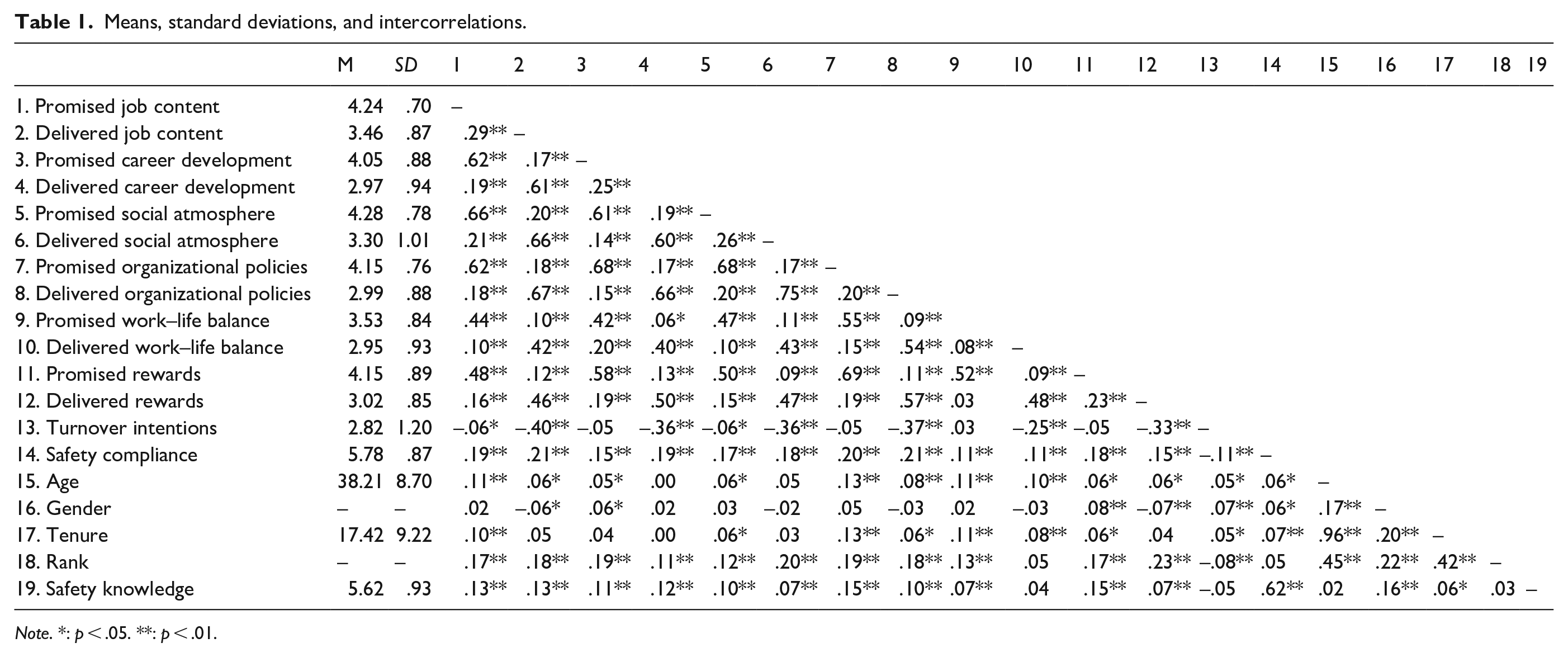
Table 1 provides an overview of the means, standard deviations, and correlations of the different variables that were used in the analysis.
Means, standard deviations, and intercorrelations.
Note. *: p < .05. **: p < .01.
Confirmatory factor analysis
We tested whether perceptions of promised (Scale A; see measurement instruments) and delivered (Scale B; see measurement instruments) inducements of each of the six TPCQ dimensions can be empirically distinguished from each other. Our results showed that the hypothesized model (Model 1), in which each construct loads onto a separate latent factor with an acceptable fit for promised inducements (χ2 [540] = 2,863.01, p < .001, CFI = .90, TLI = .90, RMSEA = .05, SRMR = .06) and delivered inducements (χ2 [540] = 3,119.21, p < .001, CFI = .90, TLI = .90, RMSEA = .05, SRMR = .06). We compared this 6-factor structure to an alternative 5-factor structure (combined job content and career development into one latent variable; Model 2), an alternative 4-factor structure (combined job content, career development, and rewards into one latent variable; Model 3), an alternative 3-factor structure (combined job content, career development and rewards into one latent variable and combined social atmosphere and work–life balance into one latent variable; Model 4), an alternative 2-factor structure (combined job content, career development, rewards, and organizational policies into one latent variable and combined social atmosphere and work–life balance into one latent variable; Model 5), and an alternative 1-factor structure (combined all variables into a single latent variable; Model 6). We found that Model 1, for perceptions of promised inducements, fit the data significantly better than Model 2 (Δ χ2 [5] = 830.67, p < .001 [χ2 [545] = 3,693.68, CFI = .87, TLI = .86, RMSEA = .06, SRMR = .06]), Model 3 (Δ χ2 [9] = 2,229.17, p < .001 [χ2 [549] = 5,092.18, CFI = .81, TLI = .79, RMSEA = .07, SRMR = .07), Model 4 [Δ χ2 (12) = 2,623.15, p < .001 (χ2 [552] = 5,486.16, CFI = .79, TLI = .78, RMSEA = .07, SRMR = .07)], Model 5 (Δ χ2 [14] = 3,303.90, p < .001 [χ2 [554] = 6,166.91, CFI = .77, TLI = .75, RMSEA = .08, SRMR = .07]), and Model 6 (Δ χ2 [15] = 3,323.03, p < .001 [χ2 [555] = 6,186.04, CFI = .76, TLI = .75, RMSEA = .08, SRMR = .07]). We also found that Model 1, for perceptions of delivered inducements, fit the data significantly better than Model 2 (Δ χ2 [5] = 1,212.05, p < .001 [χ2 [545] = 4,331.26, CFI = .85, TLI = .84, RMSEA = .06, SRMR = .05]), Model 3 (Δ χ2 [9] = 2,035.97, p < .001 [χ2 [549] = 5,155.18, CFI = .82, TLI = .81, RMSEA = .07, SRMR = .06), Model 4 [Δ χ2 (12) = 2,522.03, p < .001 (χ2 [552] = 5,641.24, CFI = .80, TLI = .79, RMSEA = .07, SRMR = .06)], Model 5 (Δ χ2 [14] = 3,344.42, p < .001 [χ2 [554] = 6,463.63, CFI = .77, TLI = .75, RMSEA = .08, SRMR = .06]), and Model 6 (Δ χ2 [15] = 3,419.42, p < .001 [χ2 [555] = 6,538.63, CFI = .77, TLI = .75, RMSEA = .08, SRMR = .06]). These results indicate that perceptions of promised (Scale A; see measurement instruments) and delivered (Scale B; see measurement instruments) inducements of each of the six TPCQ dimensions can be empirically distinguished from each other.
Hypothesis testing
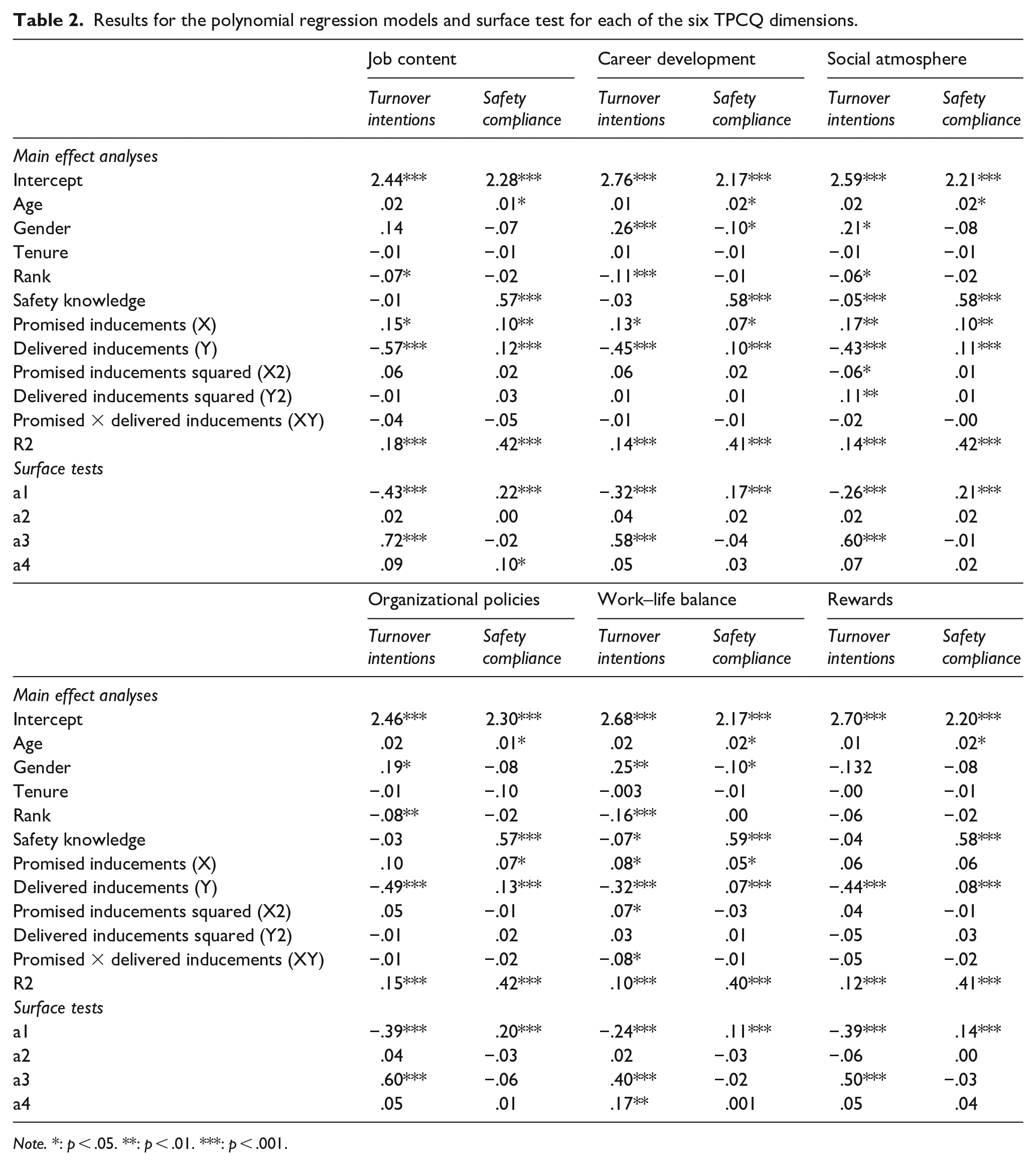
The results of the polynomial regression analysis, for each dimension of the TPCQ on our two dependent variables (turnover intentions and safety compliance) are presented in Table 2. Moreover, we also present the coefficients for the fulfillment and breach lines, as well as the slopes for these lines in Table 2 under the header surface tests. Finally, we provide a graphical representation of the response surfaces for both dependent variables for each dimension of the TPCQ in Figure 2.
Results for the polynomial regression models and surface test for each of the six TPCQ dimensions.
Note. *: p < .05. **: p < .01. ***: p < .001.
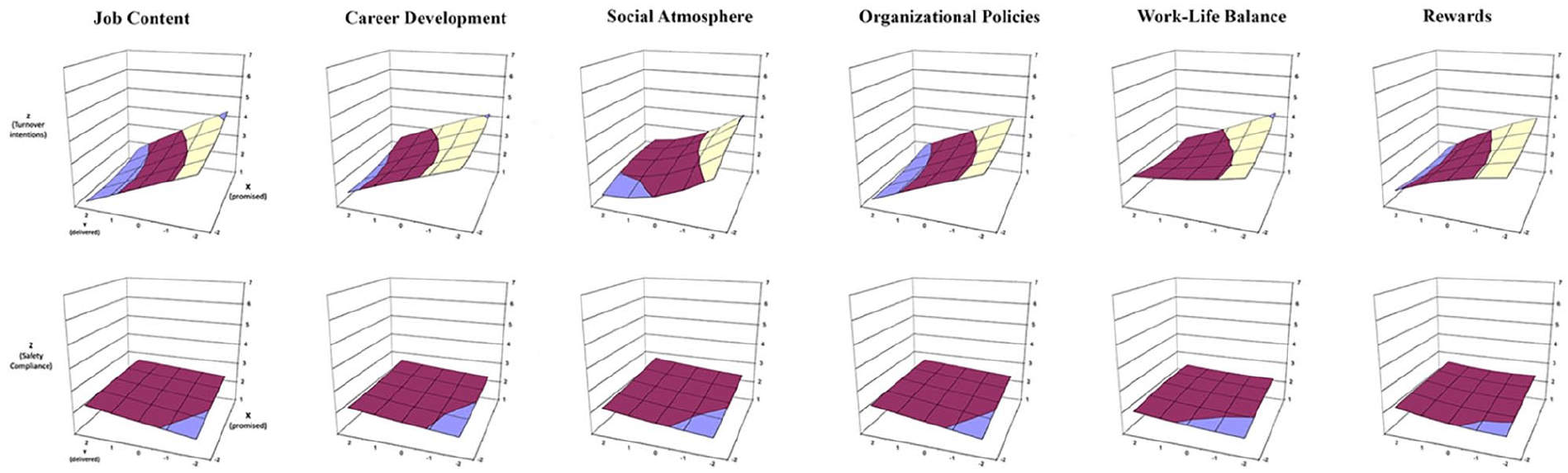
Turnover intentions and safety compliance response surface for each of the six TPCQ dimensions.
Hypothesis 1 tested if turnover intentions would decrease along the fulfillment line. The response surfaces clearly showed lower levels of turnover intentions when the levels of fulfillment were at their highest. This was confirmed by the significant negative a1 coefficients across all six TPCQ dimensions: job content (β = −.45, p < .05; confirming H1a), career development (β = −.32, p < .05; confirming H1b), social atmosphere (β = –.26, p < .05; confirming H1c), organizational policies (β = –.39, p < .05; confirming H1d), work–life balance (β = −.25, p < .05; confirming H1e), and rewards (β = −.41, p < .05; confirming H1f).
Hypothesis 2 tested if safety compliance would increase along the fulfillment line. The response surfaces clearly showed higher levels of safety compliance when the levels of fulfillment were at their highest. This was confirmed by the significant negative a1 coefficients across all six TPCQ dimensions: job content (β = .21, p < .05; confirming H2a), career development (β = .16, p < .05; confirming H2b), social atmosphere (β = .19, p < .05; confirming H2c), organizational policies (β = .20, p < .05; confirming H2d), work–life balance (β = .11, p < .05; confirming H2e), and rewards (β = .13, p < .05; confirming H2e).
Hypothesis 3 tested if turnover intentions would increase along the breach line. The response surfaces clearly showed higher levels of turnover intentions when the levels of underfulfillment were at their highest. This was confirmed by the significant positive a3 coefficients across all six TPCQ dimensions: job content (β = .71, p < .05; confirming H3a), career development (β = .57, p < .05; confirming H3b), social atmosphere (β = .60, p < .05; confirming H3c), organizational policies (β = .60, p < .05; confirming H3d), work–life balance (β = .36, p < .05; confirming H3e), and rewards (β = .48, p < .05; confirming H3f).
Finally, hypothesis 4 tested if safety compliance would decrease along the breach line. The surfaces showed an almost horizontal surface along the breach line and none of the a3 coefficients were significant across all six TPCQ dimensions: job content (β = −.04, ns; not confirming H4a), career development (β = −.04, ns; not confirming H4b), social atmosphere (β = −.03, ns; not confirming H4c), organizational policies (β = −.06, ns; not confirming H4d), work–life balance (β = −.03, ns; not confirming H4e), and rewards (β = −.03, ns; not confirming H4f).
Supplementary analysis
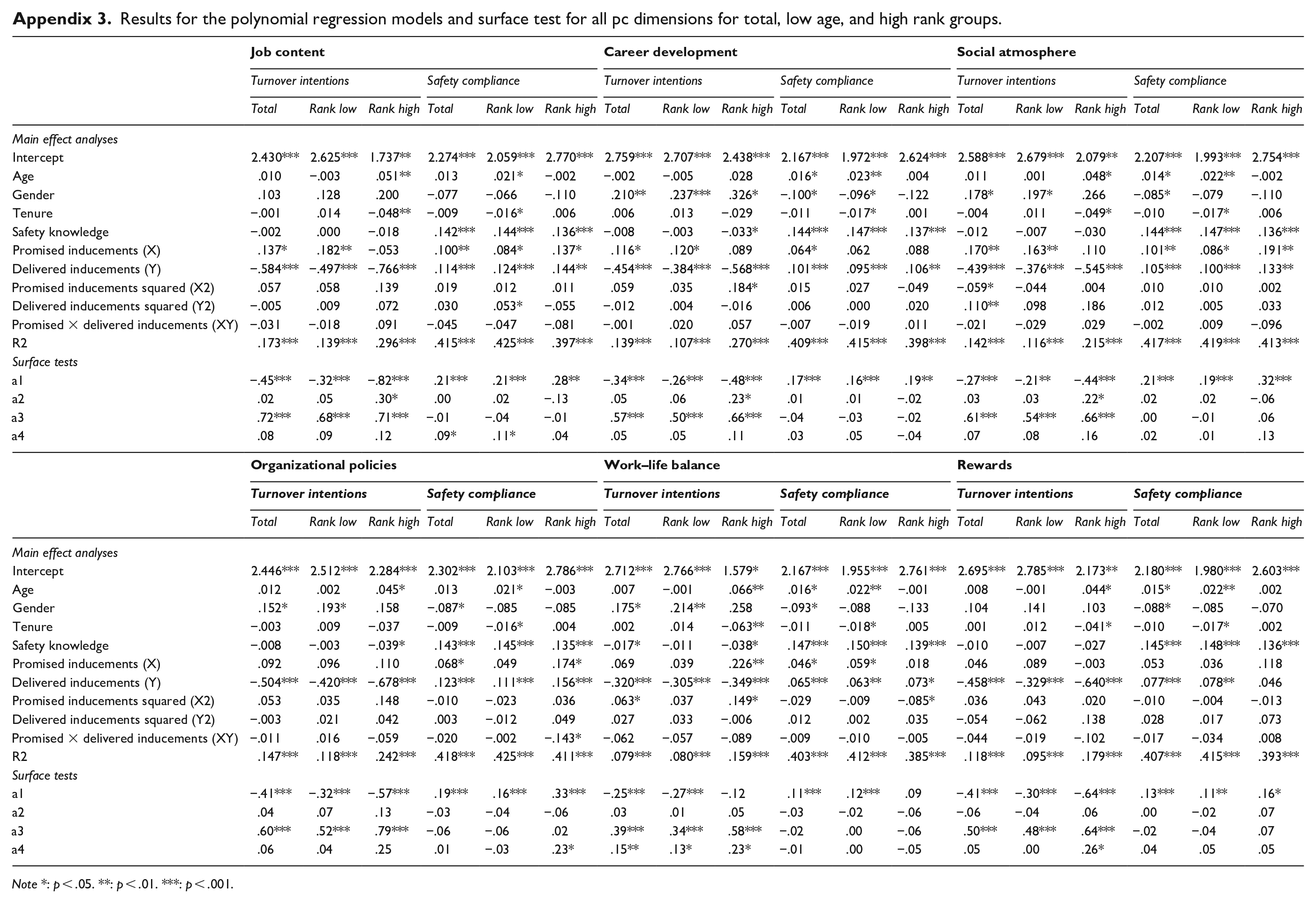
Age, tenure, and rank determine the working conditions in the military environment. We therefore performed a series of additional analyses to check if the results would be different for older participants, participants with a higher tenure, and participants higher in rank. We thus performed a median split for age (median was 38 years old) and tenure (median was 17 years tenure), resulting in a high (N = 786) vs. low (N = 807) age group and a high (N = 767) vs. low (N = 826) tenure group. As rank was not distributed along a continuous variable, we decided to split the data in non-commissioned personnel (N = 1,192) and officers (N = 401). To keep the same vocabulary throughout the analyses, we refer to these as low vs. high rank, respectively. Next, we ran “age,” “tenure,” and “rank” analyses (total sample vs. high group vs. low group) for each PC dimension (job content, career development, social atmosphere, organizational policies, work–life balance, and rewards), resulting in a total of 108 models and response surfaces. All the results are presented in the tables in Appendices 1–3, whereas all the response surfaces are visualized in Appendices 4−9.
The results for H1 and H2 were almost identical to the original analyses. Only one of 54 additional models for H1 was different from the original analyses. Although the relationship was as hypothesized (higher levels of fulfillment lead to reduced turnover intentions) this relationship was not significant for the “high-rank group” when it came to work–life balance. Furthermore, five of 54 additional models for Hypothesis 2 differed from the original analyses; although the relationship was as hypothesized (higher levels of fulfillment lead to increased safety compliance), this relationship was not significant for the “high-rank group,” “low tenure group,” and “low age group” when it came to work–life balance and for the “low tenure group” and “low age group” when it came to rewards.
In sum, this implies that in 99.94% of the cases, our results (both in terms of direction and significance) are identical in the overall sample versus the high or low age, tenure, and rank groups. In the remaining .06% of the cases, our results (only in terms of direction, not in terms of significance) are similar when comparing the overall sample with the high or low age, tenure, and rank groups. Overall, this demonstrates the robustness of our findings irrespective of age, tenure, or rank of our participants.
Discussion
This research expands the PC literature by using the expanded approach across the six dimensions of the TPCQ, thereby contributing to the understanding of how perceptions of PC fulfillment (levels of fulfillment, under-, and overfulfillment) relate to turnover intentions and safety compliance behavior. Both outcomes are of paramount importance in a military context as exemplified by the problematic high levels of turnover among military personnel (Guibert, 2017; Handelsblatt, 2018; Heinecken, 2009; Legge, 2019; Richter, 2017; Szvircsev, Tresch, & Leuprecht, 2010) and the fact that safety behavior is especially important in a military context, which is heavily reliant of the compliance with appropriate and effective regulations (Martínez-Córcoles & Stephanou, 2017; Military Aviation Authority, 2020). However, as stated in the introduction, these conditions can be found in numerous other professions that rely on safety compliance behavior such as firefighters, police officers, private security personnel, construction workers, nurses, and other health care personnel (e.g., Ayodele et al., 2021; Charman & Bennett, 2021; De los Santos & Labrague, 2021; Goh et al., 2021; Seung, 2021; Zhang et al., 2021). Furthermore, there are many other professions for which turnover is not as high but for whom safety compliance is also of the upmost importance (e.g., people working on oil platforms, train drivers, air traffic controllers). Our findings regarding PC and safety therefore contribute to the general PC literature as well as the literature on military PCs. In general, our results indicate that high levels of PC fulfillment were negatively associated with turnover intensions and positively associated with safety compliance behavior along all six dimensions of the TPCQ, whereas perceptions of PC overfulfillment were negatively associated with turnover intentions but did not significantly alter safety compliance behavior along all six dimensions of the TPCQ. In what follows, we will discuss the theoretical implications of our findings.
Theoretical implications
This research makes two main contributions to the PC literature. First, by relying on the TPCQ (Freese et al., 2008) in combination with the expanded approach on the PC (Lambert et al., 2003), we were able to generate novel and detailed insights into how the PC operates in a contemporary European military organization. Specifically, we were able to demonstrate that high levels of PC fulfillment (i.e., the fulfillment line, represented by the a1 coefficient in the results) on all six dimensions of the TPCQ (i.e., job content, career development, social atmosphere, organizational policies, work–life balance, and rewards) resulted in similar negative relationships with turnover intentions. These findings are in line with previous findings that the effects of PC fulfillment on outcomes are highest when both promised and delivered inducements are high, and thus when employees experience high levels of PC fulfillment (Lambert et al., 2003; Montes & Irving, 2008). Moreover, previous research (e.g., Kraak et al., 2018) has indeed found a negative relationship between levels of PC fulfillment and turnover intentions. When further unpacking these findings, we noticed that although our effect was similar across all six dimensions of the TPCQ, higher levels of PC fulfillment on the dimension “job content” seemed to be associated with the largest drop in turnover intentions, compared to the other five dimensions. This seems to indicate that to retain military personnel, it is advisable to especially promise and deliver an interesting and challenging job; an aspect of the PC which is traditionally defined as a relational element of the PC characterized by its long-lasting nature and significant emotional investment (Morrison & Robinson, 1997; Rousseau & McLean Parks, 1993).
Turning to the effects of under-, and overfulfillment (i.e., the breach line, represented by the a3 coefficient in the results) on turnover intentions, we found that perceptions of PC overfulfillment were negatively related to turnover intentions across all six TPCQ dimensions. These results are in line with previous research (e.g., Bal, Chiaburu, & Jansen, 2010; Hyde et al., 2009) which demonstrated that PC underfulfillment leads to negative outcomes, and more particularly may trigger an increase in turnover intentions (e.g., Blomme et al., 2010; Dulac et al., 2008; Kraak et al., 2018; Robinson & Morrison, 2000; Robinson & Rousseau, 1994). If we further unpack these findings, we once more found that although our effect was similar across all six dimensions of the TPCQ, higher perceptions of PC overfulfillment on the dimension “job content” had the strongest negative effect, whereas PC overfulfillment on the dimension “work–life balance” had the weakest negative effect on turnover intentions. These results seem to indicate that, in addition to the above-mentioned advice, military organizations can also provide military personnel with more inducements that initially promised (i.e., PC overfulfillment) to reduce turnover intentions, especially with regard to the dimension of “job content” and far less with regards to the dimension of “work–life balance.” Although these dimensions are both traditional relational elements of the PC (Morrison & Robinson, 1997; Rousseau & McLean Parks, 1993), the fact that perceptions of PC overfulfillment on job content are a stronger predictor than perceptions of PC overfulfillment on work–life balance can potentially be explained by the unique employment characteristics of military personnel; military personnel is often away from home during operational deployments and are generally expected to be ready to leave on a moment’s notice. As a corollary, it is possible that military personnel are less affected, in terms of turnover intentions, when the military falls short of delivering on work–life balance-related inducements. Overall, our results with regards to turnover intentions seem to underwrite the importance of (1) promising and delivering high levels of inducements and (2) overfulfillment on inducements across all TPCQ dimensions, and more specifically of relational inducements such as job content, when attempting to reduce turnover intentions.
The second main contribution of our study pertains to our study’s ability to demonstrate how perceptions of fulfillment, under-, and overfulfillment regarding these typical PC inducements relate to safety compliance; a behavioral outcome that is of paramount importance in avoiding fatal accidents and assuring operational effectiveness in a military context (see Martínez-Córcoles & Stephanou, 2017). Specifically, we extend previous studies which have focused on the relationship between safety-related PC inducements and safety behavior (e.g., Walker, 2010, 2013; Walker & Hutton, 2006). Despite the novel insights obtained from these studies, they have been heavily criticized for not having examined the reciprocal exchange relationship in the wider context of the employment relationship; ultimately restricting the entirety of the employment relationship to the exchange of safety-related inducements. To deal with this shortcoming we once more relied on the TPCQ to capture a wide set of traditionally studied PC inducements in relation to safety compliance behavior. Our results showed that higher levels of PC fulfillment were positively related to safety compliance behavior across all six TPCQ dimensions. Although we lack empirical data on any safety-related behavioral changes following different levels of fulfillment (levels of fulfillment, under-, and overfulfillment), these findings seem to align with preliminary indicators in the literature that PC fulfillment and levels of safety behavior are positively associated (Newaz et al., 2019). When further comparing the coefficients of the fulfillment line (a1), we noticed that higher levels of PC fulfillment on the dimensions “work–life balance” and “rewards” appeared to have the smallest effects on safety compliance. This finding seems to correspond with findings from a recent study by Kraak and colleagues (2020), who noted that military pilots reported far less promised inducements regarding work–life balance and rewards, compared to all other TPCQ dimensions. As stated above, the characteristics of military employment might potentially aid in explaining these findings. Furthermore, the severe budget cuts and limited control over remuneration by the military (compensation and benefits packages are regulated at the governmental level) may contribute to the military personnel’s perceptions that promised regarding rewards are not within the control of their commanding officers. The absence of control over the extent to which an inducement, such as rewards, can be delivered has been identified as an attenuating factor in the relationship between underfulfillment and outcomes (Conway & Briner, 2002; Robinson & Morrison, 2000) and is therefore likely to have a weaker effect on safety compliance in the current study.
Finally, contrary to what we hypothesized and the preliminary indicator in the literature that underfulfillment is negatively associated with compliance to safety obligations (Walker, 2013), we found that perceptions of overfulfillment and underfulfillment did not significantly influence safety compliance behavior. The response surfaces showed an almost unchanged level of safety compliance across all six TPCQ dimensions for the entire breach line. These unexpected results could potentially be explained by recent findings by Kraak and colleagues (2020); in their study, they found that military pilots, when faced with perceptions of PC breach deliberately chose not to engage in more profound negative reactions such as neglecting important duties. Their qualitative data showed that pilots explained these reactions by referring to a need to continue to protect themselves and their colleagues even in the face of PC breach. Potentially, there is something similarly happening in this study where military personnel feels a strong obligation to continue to engage in safety behavior because they are aware of the potential detrimental consequences of a reduction in safety compliance for themselves and their colleagues. Overall, our results with regards to safety compliance behavior seem to underwrite the importance of (1) promising and delivering high levels of all TPCQ dimensions, and more specifically of relational inducements such as job content, when attempting to maintain and boost safety compliance behavior.
Limitations
As in any other study, our study yields some limitations that deserve further attention. First, using self-report measurements potentially raises complaints with common method variance (Podsakoff et al., 2012). However, we reduced the risks owing to common method bias by checking for the existence of a common method factor in our CFA model (i.e., we loaded all factors of the hypothesized model on a higher-order factor) and found that the model with said higher-order factor for promised, χ2 (549) = 2,987.85, CFI = .90, TLI = .89, RMSEA = .05, SRMR = .07, and delivered, χ2 (549) = 3,257.66, CFI = .89, TLI = .89, RMSEA = .05, SRMR = .07, inducements did not fit the data significantly better, Δχ2 (9) = 124.84, p < .001; Δχ2 (9) = 138.45, p < .001, than the hypothesized model for promised, χ2 (540) = 2,863.01, p < .001, CFI = .90, TLI = .90, RMSEA = .05, SRMR = .06, and delivered, χ2 (540) = 3,119.21, p < .001, CFI = .90, TLI = .90, RMSEA = .05, SRMR = .06, inducements. As a consequence, we are confident that we reduced the risks owing to common method bias.
A second limitation pertains to the potential limitation of social desirability biases, it has often been suggested to rely on other-rated measures to overcome the issue of social desirability (Podsakoff et al., 2012). However, the concepts under study (perceptions of PC fulfillment, turnover intentions, and safety compliance) are idiosyncratic in nature; they exist in the eye of the beholder. Therefore, we relied on self-reported measurements, but aimed to minimize socially desirable responses by allowing discretionary participation and by guaranteeing the confidentiality of participants. Moreover, we did not ask any potential identifying details such as the airbase, squadron, or unit that participants were assigned to, meaning that our demographic questions did not allow for the identification of the participants in this study. In line with recommendations in the literature (Edwards & Cable, 2009), self-reported measures are deemed appropriate for designs like ours where researchers are interested in the perceptions of organizational values as seen by employees.
Third, the cross-sectional nature of our data limits our possibility to draw temporal inferences from this study, thereby restricting the scope of our conclusions. To investigate the temporal precedence of the proposed relationships, one would need longitudinal or repeated-measures, such as daily or weekly diary, research. For the inference of causal conclusions to be possible, experimental designs are required in which the nature of the PC (i.e., levels of fulfillment and/or perceptions of under- and overfulfillment) are evoked and intended turnover and safety compliance should be observed.
Finally, due to the singular character of our sample—military environment characterized by procedures, high stability as well as job and career security—it is challenging to generalize our results to other samples of workers in more conventional organizations. As we stated in the introduction of this article, we believe that this study is relevant for PC research in all sectors and industries where safety compliance is important. However, we also acknowledge that we do not know how employees in organizations that are subject to quick changes and job insecurity due to external market developments (e.g., security personnel at airports or personnel at a struggling airline) will react to PC fulfillment, under-, and overfulfillment on the six dimensions of the TPCQ. It would therefore be interesting to establish if our results could be replicated in samples of uniformed personnel or services outside of the military as well as compare these processes with employees in the private sector who are subjected to increased job insecurity or career uncertainty.
Suggestions for future research
The results of this study lead to several avenues for future research on PCs in general and military PCs in particular. First, future research could focus on high versus low levels of PC fulfillment using a longitudinal approach. Doing so would allow scholars to chart potential changes regarding how military personnel perceives their PC over time (see Bankins et al., 2020). We advise research to apply the said longitudinal approach to the period leading up to, during, and following important events such as specific assignments or operational deployments, thereby capturing how a phenomenon, such as perceptions of PC fulfillment, has a clear onset, followed by a variation of intensity in one or more aspects of the phenomena (see Roe, 2008). Furthermore, opting for a longitudinal approach would allow researchers to establish how divergent levels of PC fulfillment and/or under- or overfulfillment are related to actual turnover, providing military organizations with valuable information that they can use in trying to negate the issues regarding personnel retention.
Second, our findings regarding the absence of a significant change in safety compliance behavior in the face of perceptions of PC underfulfillment suggest that there are other powers at play in this relationship. Specifically, although we found that higher levels of PC fulfillment had a positive association with safety compliance behavior, fluctuations in perceptions of fulfillment (i.e., overfulfillment and underfulfillment) did not have a significant effect on safety compliance behavior. Future research could unpack the reasons as to why military personnel seem to remain unaffected, in terms of their safety compliance behavior, when perceiving fluctuations in PC under- and overfulfillment. In this regard, the earlier work by Kraak and colleagues (2020) may serve as some basis to build further research. In their work, they found that military pilots did not alter their neglect behavior when faced with perceptions of PC breach and further unpack these reactions in a qualitative study; this may provide a potential explanation for underfulfillment reactions. These explanations might be grounded in, for example, contextual and background factors (Guest, 2004), the factors during PC formation (Naweed et al., 2021), and/or social network factors (Heffernan & Rochford, 2017).
Practical implications
Our research also has a number of implications for European military organizations. First, military organizations can greatly benefit from better managing PC fulfillment. The benefits of improved PC fulfillment management are two-fold because our results showed that both higher levels of PC fulfillment as well as PC overfulfillment, across every dimension of the TPCQ, are negatively associated with turnover intentions. These results indicate that (1) military personnel are sensitive to PC fulfillment and that they are less likely to want to leave the organization when they both promise and deliver higher levels of inducements and (2) that military organizations should try and raise the general fulfillment level of PC inducements, but that they should be even more proactive in trying to avoid underfulfillment (i.e., delivering below promised levels of inducements). As previously stated, retention is a real issue for contemporary European military organizations (e.g., Haut Comité d’Évaluation de la Condition Militaire, 2017; Legge, 2019). Hence, anticipating possible PC underfulfillment can potentially help military organizations prevent further turnover among their personnel. However, within the military context, commanding officers—often those individuals who are responsible for the creation and upholding of PC promises—tend to be transferred to other positions every 2 to 3 years. It might therefore be in the organization’s best interest to raise awareness among these commanding officers about the dynamics of employees’ PCs so that they can better anticipate and react to possible PC underfulfillment events. In this regard, we, among others, suggest that it might be beneficial to make commanding officers aware of how perceptions of underfulfillment develop, what the potential outcomes are and how these outcomes might be damaging to the military organization, and how they could prevent potential future underfulfillment events by, for example, creating realistic expectations, being transparent when obligations cannot be met, and helping employees repair their PC when they have encounter an underfulfillment event. Furthermore, it might be helpful to formalize the handover of PC inducements when a commanding officer leaves so that their successor is aware of the promises that were made and the extent to which they have been fulfilled. In doing so, potential future underfulfillment events and their damaging consequences for the military’s retention rates can be prevented.
Second, our findings can be helpful for military organizations in their quest for safety excellence. Our results demonstrated that high levels of PC fulfillment, compared to low levels of fulfillment, were positively associated with safety compliance; underwriting the importance of being able to both promise and deliver a sufficient level of PC inducements. However, at the same time, we found no significant drop in safety compliance following perceptions of underfulfillment. These findings seem to corroborate findings from Kraak and colleagues (2020) who demonstrated that military personnel (flying personnel in their study) do not engage in the prototypical negative reactions following underfulfillment. Overall, these results with respect to safety compliance indicate that military organizations could benefit from an increase in safety compliance behavior if they manage to increase the quality of their PC. Specifically, this means that military organizations ought to be aware that they need to constantly work on generating the highest levels of PC fulfillment possible within the constraints of their budgets.
Conclusion
Our findings indicate that higher, compared to lower, levels of PC fulfillment are negatively associated with turnover intentions while at the same time boosting safety compliance behavior among military personnel. Furthermore, our findings show that PC overfulfillment, compared to underfulfillment, is negatively associated with turnover intentions. However, fluctuations along said PC breach line, do not result in any significant changes in safety compliance behavior. This result implies that military personnel, unlike in any other organizational setting, seems to be unaffected by perceptions of PC underfulfillment and overfulfillment with respect to their safety compliance behavior. We hope that the new insights from this study will motivate other scholars to further explore how PC fulfillment influence personnel retention and safety behavior in the military.
Footnotes
Appendix
Results for the polynomial regression models and surface test for all pc dimensions for total, low age, and high rank groups.
|
|
|
|
||||||||||||||||
|---|---|---|---|---|---|---|---|---|---|---|---|---|---|---|---|---|---|---|
| Turnover intentions | Safety compliance | Turnover intentions | Safety compliance | Turnover intentions | Safety compliance | |||||||||||||
| Total | Rank low | Rank high | Total | Rank low | Rank high | Total | Rank low | Rank high | Total | Rank low | Rank high | Total | Rank low | Rank high | Total | Rank low | Rank high | |
| Main effect analyses | ||||||||||||||||||
| Intercept | 2.430*** | 2.625*** | 1.737** | 2.274*** | 2.059*** | 2.770*** | 2.759*** | 2.707*** | 2.438*** | 2.167*** | 1.972*** | 2.624*** | 2.588*** | 2.679*** | 2.079** | 2.207*** | 1.993*** | 2.754*** |
| Age | .010 | −.003 | .051** | .013 | .021* | −.002 | −.002 | −.005 | .028 | .016* | .023** | .004 | .011 | .001 | .048* | .014* | .022** | −.002 |
| Gender | .103 | .128 | .200 | −.077 | −.066 | −.110 | .210** | .237*** | .326* | −.100* | −.096* | −.122 | .178* | .197* | .266 | −.085* | −.079 | −.110 |
| Tenure | −.001 | .014 | −.048** | −.009 | −.016* | .006 | .006 | .013 | −.029 | −.011 | −.017* | .001 | −.004 | .011 | −.049* | −.010 | −.017* | .006 |
| Safety knowledge | −.002 | .000 | −.018 | .142*** | .144*** | .136*** | −.008 | −.003 | −.033* | .144*** | .147*** | .137*** | −.012 | −.007 | −.030 | .144*** | .147*** | .136*** |
| Promised inducements (X) | .137* | .182** | −.053 | .100** | .084* | .137* | .116* | .120* | .089 | .064* | .062 | .088 | .170** | .163** | .110 | .101** | .086* | .191** |
| Delivered inducements (Y) | −.584*** | −.497*** | −.766*** | .114*** | .124*** | .144** | −.454*** | −.384*** | −.568*** | .101*** | .095*** | .106** | −.439*** | −.376*** | −.545*** | .105*** | .100*** | .133** |
| Promised inducements squared (X2) | .057 | .058 | .139 | .019 | .012 | .011 | .059 | .035 | .184* | .015 | .027 | −.049 | −.059* | −.044 | .004 | .010 | .010 | .002 |
| Delivered inducements squared (Y2) | −.005 | .009 | .072 | .030 | .053* | −.055 | −.012 | .004 | −.016 | .006 | .000 | .020 | .110** | .098 | .186 | .012 | .005 | .033 |
| Promised × delivered inducements (XY) | −.031 | −.018 | .091 | −.045 | −.047 | −.081 | −.001 | .020 | .057 | −.007 | −.019 | .011 | −.021 | −.029 | .029 | −.002 | .009 | −.096 |
| R2 | .173*** | .139*** | .296*** | .415*** | .425*** | .397*** | .139*** | .107*** | .270*** | .409*** | .415*** | .398*** | .142*** | .116*** | .215*** | .417*** | .419*** | .413*** |
| Surface tests | ||||||||||||||||||
| a1 | −.45*** | −.32*** | −.82*** | .21*** | .21*** | .28** | −.34*** | −.26*** | −.48*** | .17*** | .16*** | .19** | −.27*** | −.21** | −.44*** | .21*** | .19*** | .32*** |
| a2 | .02 | .05 | .30* | .00 | .02 | −.13 | .05 | .06 | .23* | .01 | .01 | −.02 | .03 | .03 | .22* | .02 | .02 | −.06 |
| a3 | .72*** | .68*** | .71*** | −.01 | −.04 | −.01 | .57*** | .50*** | .66*** | −.04 | −.03 | −.02 | .61*** | .54*** | .66*** | .00 | −.01 | .06 |
| a4 | .08 | .09 | .12 | .09* | .11* | .04 | .05 | .05 | .11 | .03 | .05 | −.04 | .07 | .08 | .16 | .02 | .01 | .13 |
|
|
|
|
||||||||||||||||
|
|
|
|
|
|
|
|||||||||||||
| Total | Rank low | Rank high | Total | Rank low | Rank high | Total | Rank low | Rank high | Total | Rank low | Rank high | Total | Rank low | Rank high | Total | Rank low | Rank high | |
| Main effect analyses | ||||||||||||||||||
| Intercept | 2.446*** | 2.512*** | 2.284*** | 2.302*** | 2.103*** | 2.786*** | 2.712*** | 2.766*** | 1.579* | 2.167*** | 1.955*** | 2.761*** | 2.695*** | 2.785*** | 2.173** | 2.180*** | 1.980*** | 2.603*** |
| Age | .012 | .002 | .045* | .013 | .021* | −.003 | .007 | −.001 | .066** | .016* | .022** | −.001 | .008 | −.001 | .044* | .015* | .022** | .002 |
| Gender | .152* | .193* | .158 | −.087* | −.085 | −.085 | .175* | .214** | .258 | −.093* | −.088 | −.133 | .104 | .141 | .103 | −.088* | −.085 | −.070 |
| Tenure | −.003 | .009 | −.037 | −.009 | −.016* | .004 | .002 | .014 | −.063** | −.011 | −.018* | .005 | .001 | .012 | −.041* | −.010 | −.017* | .002 |
| Safety knowledge | −.008 | −.003 | −.039* | .143*** | .145*** | .135*** | −.017* | −.011 | −.038* | .147*** | .150*** | .139*** | −.010 | −.007 | −.027 | .145*** | .148*** | .136*** |
| Promised inducements (X) | .092 | .096 | .110 | .068* | .049 | .174* | .069 | .039 | .226** | .046* | .059* | .018 | .046 | .089 | −.003 | .053 | .036 | .118 |
| Delivered inducements (Y) | −.504*** | −.420*** | −.678*** | .123*** | .111*** | .156*** | −.320*** | −.305*** | −.349*** | .065*** | .063** | .073* | −.458*** | −.329*** | −.640*** | .077*** | .078** | .046 |
| Promised inducements squared (X2) | .053 | .035 | .148 | −.010 | −.023 | .036 | .063* | .037 | .149* | −.029 | −.009 | −.085* | .036 | .043 | .020 | −.010 | −.004 | −.013 |
| Delivered inducements squared (Y2) | −.003 | .021 | .042 | .003 | −.012 | .049 | .027 | .033 | −.006 | .012 | .002 | .035 | −.054 | −.062 | .138 | .028 | .017 | .073 |
| Promised × delivered inducements (XY) | −.011 | .016 | −.059 | −.020 | −.002 | −.143* | −.062 | −.057 | −.089 | −.009 | −.010 | −.005 | −.044 | −.019 | −.102 | −.017 | −.034 | .008 |
| R2 | .147*** | .118*** | .242*** | .418*** | .425*** | .411*** | .079*** | .080*** | .159*** | .403*** | .412*** | .385*** | .118*** | .095*** | .179*** | .407*** | .415*** | .393*** |
| Surface tests | ||||||||||||||||||
| a1 | −.41*** | −.32*** | −.57*** | .19*** | .16*** | .33*** | −.25*** | −.27*** | −.12 | .11*** | .12*** | .09 | −.41*** | −.30*** | −.64*** | .13*** | .11** | .16* |
| a2 | .04 | .07 | .13 | −.03 | −.04 | −.06 | .03 | .01 | .05 | −.03 | −.02 | −.06 | −.06 | −.04 | .06 | .00 | −.02 | .07 |
| a3 | .60*** | .52*** | .79*** | −.06 | −.06 | .02 | .39*** | .34*** | .58*** | −.02 | .00 | −.06 | .50*** | .48*** | .64*** | −.02 | −.04 | .07 |
| a4 | .06 | .04 | .25 | .01 | −.03 | .23* | .15** | .13* | .23* | −.01 | .00 | −.05 | .05 | .00 | .26* | .04 | .05 | .05 |
Note *: p < .05. **: p < .01. ***: p < .001.
Acknowledgements
The authors thank Robert Vincent Jones Kraak for his insightful comments and help with this manuscript.
Data availability statement
The data used in this manuscript can be found on The Open Science Framework using the following DOI: 10.17605/OSF.IO/5YF2G
Declaration of conflicting interests
The author(s) declared no potential conflicts of interest with respect to the research, authorship, and/or publication of this article.
Funding
The author(s) received no financial support for the research, authorship, and/or publication of this article.
