




Abstract
Despite the massive incorporation of women into the labor market, equal pay for equal work remains a challenge. This article analyzes the influence of gender diversity in management positions on the gender wage gap (GWG) throughout the entire pay scale in Spain. The results show the existence of a GWG, particularly for wages below the average; though it decreases when female participation in management is higher. This is in line with the reduction of information asymmetry problems considered in statistical discrimination theories, which explain the barriers to promotion associated with dynamics at entry-level and low-qualified positions.
Despite the massive incorporation of women into the labor market, they suffer poorer labor conditions than men, including limited participation in decision-making positions and lower wages. Equality between men and women is a global priority as it is a fundamental right and a shared principle of the European Union, being a precondition to fulfilling its objectives of growth, employment, and social cohesion (Scicchitano, 2014). The European Gender Equality Strategy 2020–2025, includes the promotion of gender equality and women’s empowerment in firms as one of its key areas (European Commission, 2021b).
In Spain, the share of female board members in listed firms increased from 11.1% in 2011 to 27.4% in 2020 (European Institute for Gender Equality, 2022). However, if we focus on a measure that includes a wider range of decision-making positions the situation shows little improvement. The share of women in management position in firms has increased very little in the past decade, from 30.1% in 2011 to 31.2% in 2014 and 35% in 2020 (Eurostat, 2022).
Another major challenge for public policies is gender inequality in terms of salaries. This gap has been reduced in this century, but the rate of convergence is slow (F. D. Blau & Kahn, 2017; Kunze, 2018; Theodoropoulos et al., 2022). In the past decade, the average gender wage gap (GWG) in annual wages for the European Union (EU27) showed a small decrease, from 23.1% in 2010 to 19.4% in 2018, similarly to the case of Spain, with 20.1% and 17.0%, respectively (Eurostat, 2022). Even when controlling for observed factors that might explain differences, such as skills and experience, the unexplained GWG (which the literature interprets as a measure of wage discrimination) in the European Union has shown a reduced variation, from 11.4% in 2010 to 10.9% in 2018 (Leythienne & Pérez-Julián, 2021).
The traditional approach to explaining the gender pay gap relies in human capital theory (Becker, 1962), which explains the gap as a result of differences between men and women in individual decisions in terms of education, skills, and experience (Mincer & Polachek, 1977). However, this theory fails to incorporate the social and workplace contexts that affect individual decisions. The causes of the gender gap should be approached from a multidimensional perspective that goes beyond the individual sphere (Altonji & Blank, 1999), including sociological, institutional, and organizational dimensions.
Specifically, in a social context, workplace characteristics might have more explanatory power than personal differences in the explanation of gender gaps at work and discriminatory dynamics in the labor market (Lips, 2013; Rubery & Grimshaw, 2015) even if they are not explicitly or consciously designed to affect women. In this sense, gender roles and stereotypes are key issues underlying the dynamics that influence the preferences of male employers and managers against women as analyzed in the theory of taste (Becker, 1957), the social identity theory (Tajfel & Turner, 1979), and the statistical discrimination theory (Phelps, 1972). Conversely, a higher representation of women in the top echelons of management would be expected to lead to a narrowing of the gender pay gap (European Commission, 2021b). This increase might have a direct impact on gender discrimination within the workplace in terms of promotion and working conditions, and the implementation of female-friendly and work–family balance-oriented policies (Gagliarducci & Paserman, 2015; Theodoropoulos et al., 2022).
Thus, from a theoretical perspective, the increase in female participation in management positions should contribute to a decrease in the GWG. However, the evolution of the average values for the participation of women in management and the GWG has not shown the expected relationship, at least in terms of its intensity. The literature offers different, complementary arguments to explain this. First, it acknowledges the influence of gender differences in roles in society and the related disparities in occupations and industries where women and men work. In addition, retributions for extensive business trips, type of tasks, and other job position characteristics have different implications for the wages of men and women (F. D. Blau & Kahn, 2017; Goldin, 2014). Complementing this global approach, the literature also points out that the dynamics within firms are crucial factors to explain gender differences in labor markets. Nevertheless, internal processes regarding promotion and salaries are increasingly used to explain gender differences at work, including GWG (Barth et al., 2021).
This article explores the second approach, focused on the internal dynamics in firms, to enrich understanding of the mechanisms by which the higher proportion of women in management positions has an impact on the GWG. If the lack of women in management positions is a potential cause of lower salaries of women, does a higher share of women in these positions decrease the gender pay gap in firms? Moreover, does it have the same impact throughout the wage distribution in firms?
Previous empirical literature shows that the characteristics of executives can influence labor conditions (Flabbi et al., 2019; Hirsch, 2013). Regarding gender salary disparities, although some authors point out that the increasing participation of women in management reduces the GWG (Cardoso & Winter-Ebmer, 2010; Cohen & Huffman, 2007; Hensvik, 2014; Hirsch, 2013; Vega et al., 2016), there is a lack of consensus about the key factors that facilitate this process, the extent of the effect (i.e., whose wages are affected), the size of the impact, and its pattern throughout the wage distribution.
The objective of the work presented is to obtain a more complete picture of the impact of gender diversity in decision-making positions on the pay gap throughout the wage distribution, for Spain. In this sense, our first working hypothesis aims to corroborate the theoretical dynamics by which a higher participation of women in management positions should lead to a reduction in the gender gap in firms. Moreover, to understand the dynamics behind this potential influence, we studied the possible patterns throughout the wage distribution. Scicchitano (2014) suggests that
the glass ceiling constitutes a bigger problem than the sticky floor, because at the highest wage quantiles, differences in characteristics make no contribution to the overall GWG, and this suggests that upper-echelon female managers have the same characteristics as their male counterparts, which emphasizes the role of discrimination for these top-level jobs. (pp. 335–336)
Thus, the study of the effects throughout the pay scale can be linked to a positive contribution to the lowering of gender segregation in terms of “glass ceiling” and/or the “sticky floor” patterns of wage discrimination. These alternative dynamics in terms of the effects of different levels of participation of women in management positions are explored in our second hypothesis.
This article contributes to previous research in three ways. First, in terms of the theoretical framework for the analysis of the GWG, by combining a double perspective in the conceptualization of gender diversity. In particular, we bring together two diversity measures: Female representation in management and the Blau diversity index (Kagzi & Guha, 2018). The Blau index provides a gender-neutral measure of diversity, ascribing the same value for male and female increases in diversity; thus adding a new perspective to the traditional conceptualization of gender diversity in management focused on the increase in women in these positions. This will capture the effect of the incorporation of men in women-led firms, a perspective that is not properly incorporated in measures based on the share of women. The combined interpretation of these two dimensions constitutes a more complete approach to the assessment of the effect of gender diversity on the GWG.
In addition, we construct a global framework that explains how a greater participation of women in management positions can have a different impact throughout the wage distribution. This contributes to a better understanding of the impact that policies fostering the incorporation of women in decision-making positions in firms have on the reduction of the “glass ceiling” and/or the “sticky floor” patterns of wage discrimination.
Second, from an applied perspective, we add to the literature in terms of the delimitation of the group that decides labor conditions in firms. There is increasing acknowledgment that besides the chief executive officers (CEOs), there is a broader group that plays an important role in human resources dynamics and particular decisions that affect wages (Gagliarducci & Paserman, 2015; Hirsch, 2013; Noland et al., 2016). In fact, a deeper analysis of the impact of different managerial levels shows the relevance of this issue, as the level of management studied directly affects the results obtained (Gagliarducci & Paserman, 2015; Hultin & Szulkin, 2003). In this article, we focus on management positions, a similar criterion is followed in the works of Cardoso and Winter-Ebmer (2007), Vega et al. (2016), and Theodoropoulos et al. (2022).
The analysis of these internal dynamics within firms requires a specific database. Therefore, we used an employer-employee database: the wage structure survey for Spain published in 2016. This cross-sectional perspective permits analysis of the dynamics within firms with estimation techniques that lead to robust associations between the gender diversity at the management level in a firm and the size of the GWG throughout the pay scale in that firm. This perspective is crucial to understanding the behavior of aggregate average trends in the GWG.
Furthermore, compared to the traditional literature focused on large or listed firms, we include all firms from 10 employees upward. The inclusion of small firms constitutes an important contribution, as gender composition might be more important in the decision-making process in these firms (Mínguez-Vera & López-Martínez, 2010).
Finally, we focused on Spain, an interesting case in terms of gender equality in firms for which no previous analysis, such as ours has been conducted. Spain has become one of the leaders in terms of commitment to gender equality in Europe (Lombardo, 2016) and it ranks sixth in the EU on the Gender Equality Index 2021 (European Institute for Gender Equality, 2022). Nevertheless, it still ranks below the EU average in terms of female participation in decision-making positions in firms as well as in the GWG.
Diversity and labor conditions
Women’s labor conditions, their determinants and consequences have been analyzed from different perspectives, including the economic, sociological, psychological, and feminist (Conde-Ruiz & Marra de Artíñano, 2016; Stockdale & Nadler, 2013). Focusing on the economic dimension, the patterns of the participation of women in the labor market could be seen as the result of the dynamics by which firms (demand) and workers (supply) match in the market. In this sense, supply-side theories analyze the individual’s motivations and decisions regarding participation in the labor market. Demand-side theories study the firm’s strategies and internal dynamics that affect human resources, including the attraction, retention, and evaluation of workers.
The traditional approach to the explanation of gender pay gaps builds on supply-side theories. In particular, the human capital theory by Becker (1962) explains how the investment decisions workers make in human capital terms affect their productivity, and ultimately, their wages. Thus, differences between women and men in decisions regarding education (including long-life learning), skills, part-time or inactivity periods among others, could explain the gender gap in salaries (Mincer & Polachek, 1977).
However, the literature highlights the limitations of the human capital theory to isolate individual decisions from the social context in explain the causes of the GWG, acknowledging the key role society plays in these decisions (Lips, 2013).
In particular, social context crucially influences workplace internal dynamics in human resources processes (Anker, 1998). These dynamics are at the core of the demand-side theories of the labor market used to extend the theoretical framework that explains the GWG. Specifically, the social stereotypes regarding women and men’s roles, both at home and in the workplace, continue to affect the allocation of responsibilities and power, formal and informal norms in the workplace, including promotion and selection processes, and differences in salaries (Akerlof & Kranton, 2000; Conde-Ruiz & Marra de Artíñano, 2016; Fortin, 2005; Rubery et al., 2005).
Within firms, a gendered culture might lead to two types of discrimination dynamics. First, it can affect the preferences of employers and managers involved in human resources dynamics. The theory of taste (Becker, 1957) can be used to analyze the consequences, for women’s salaries, of a gendered culture in which employers harbor prejudices against women as a group perceived as different. These misogynistic preferences make men only employ, or promote, women when their lower wage compensates for the disutility they experience in making that decision. In general terms, this behavior might explain the poorer labor conditions women face in male-dominated firms, as their participation is conditioned to perceive lower salaries than men. The theory of taste is in line with social–psychological theories explaining the behavior of groups in societies, such as social identity theory (Tajfel & Turner, 1979), this explains the dynamics by which people tend to evaluate in-group peers more favorably than out-group members. From a gender perspective, evaluations within same gendered groups are more positive than those conducted by different gendered ones. For instance, this is observed by Tsui and O’Reilly (1989) and Shin (2012) in manager’s and executive’s evaluations in the US firms. Thus, in terms of social dynamics within firms, women suffer less discrimination in firms with a high participation of women in management positions where human resources decisions are made. This participation should increase the hiring and promotion of women, as well as decreasing the existing gender bias in the evaluation, which in turn would reduce the gender pay gap.
A second mechanism of discrimination stems from the influence of gender stereotype-based beliefs on the perceived performance of women. The undervaluation of women’s capacities and skills and their subordinate role in society translates into poorer evaluations of women in evaluation processes, such as in hiring, promoting, and salaries (Anker, 1997; Grimshaw et al., 2017). Statistical discrimination theory (Phelps, 1972) states that evaluators in these processes make decisions in imperfect information contexts, where accurate information is substituted with gender stereotypes. These assume that women are less productive owing to household responsibilities, a belief that overrides the objective evaluation of their individual skills and achievements (Aigner & Cain, 1977; Arrow, 1973; Phelps, 1972). As women have more accurate information regarding the productivity of female workers, the use of stereotypes in evaluation processes are lower in women-led firms than those with men occupying managing positions. Consequently, a higher percentage of women in management positions will contribute to a more accurate perception of the performance of women in the workplace, reducing discrimination in terms of salaries.
Empirical studies tend to be consistent with the theoretical framework developed, suggesting that diversity in management reduces barriers relative to labor promotion (Dalvit et al., 2021; Kunze & Miller, 2017; Mateos de Cabo et al., 2011; Matsa & Miller, 2011) and the GWG (Bell, 2005; Bertrand et al., 2019; Cardoso and Winter-Ebmer, 2010; Cohen & Huffman, 2007; Flabbi et al., 2019; Theodoropoulos et al., 2022). The results, however, are quite heterogeneous in terms of the size of the specific group of women affected and the significance of the effect observed. This heterogeneity reflects the complexity of the channels by which gender diversity in decision-making positions might reduce gender differences in firms.
Thus, our first working hypothesis seeks to corroborate the theoretical dynamics by which a higher participation of women in management positions should lead to a reduction in the gender gap.
H1: The increase in female participation in management positions leads to a reduction in the GWG.
Discrimination throughout the wage distribution
Despite the increase in qualified women entering the workforce and the removal of some structural barriers, men still dominate the upper tiers of most firms. Vertical segregation translates into various related phenomena, commonly described using metaphors, such as the “glass ceiling,” “pipeline,” or “sticky floor.” These terms reflect the difficulties women face in replicating the trajectory and success of the professional careers of their male colleagues and, of course, the associated benefits in terms of labor conditions, including salaries (Albrecht et al., 2003). In this context, while the previous section provides a global framework for the potentially positive effect of a higher presence of women in management positions, in this section, the objective is to analyze the possible patterns throughout the pay gap. Is this effect linear, affecting all female workers in a similar (proportional) way, or does the influence of female managers on the gender pay gap follow a non-linear pattern, affecting entry-level workers or senior ones to a greater extent?
Vertical segregation can be associated with differences in wages throughout the pay scale. The existing literature analyzes the patterns that the GWG follows and explores the causes and possible solutions. The results obtained vary in terms of the size of both the unadjusted gap (the directly obtained gap) and the adjusted gap (reflecting the wage differences that cannot be explained by “objective reasons,” and that the literature associates with wage discrimination) (Arulampalam et al., 2007). Some countries display the largest gender gap in the highest percentiles of wage distribution, reflecting glass ceiling issues, while others see the largest gap at the lowest percentiles (implying some sort of sticky floor phenomenon). Thus, a deeper understanding of GWG dynamics requires further analysis of wage discrepancies (Huffman et al., 2017).
The existence of higher wage gaps in the upper part of the pay scale is related to the existence of supplements awarded as a result of greater time demands, travel, and the volume of projects taken on at that level (De la Rica et al., 2015). Moreover, these bonuses are usually established in an individualized way allowing for subjective and less structure dynamics in the evaluation of performance. In fact, the more individualized and decentralized wage determination is, the higher the individual differentials in retributions, as decentralization allows for discretionary decisions by managers (Barth et al., 2009; Rubery et al., 2005). Christofides et al. (2013) analyze the existence of glass ceilings in Europe with data for 2007 and confirm the existence of larger wage gaps at the top of the distribution. Furthermore, they observe a positive correlation between the existence of adequate work–family conciliation patterns and that of glass ceilings, especially at the top of the wage distribution. In an analysis conducted by the International Labor Organization (ILO, 2019), 44% of the 93 countries included in the study show a wider gender pay gap for managers than for total employees. This result is in line with the evidence obtained for Spain, that finds a wider wage gap in the upper part of the pay scale (Gardeazabal & Ugidos, 2005; Gradín & Del Río, 2009; Ministerio de Sanidad, Servicios Sociales e, Igualdad, 2013; Segovia-Pérez et al., 2020).
The implementation of bonuses and other differences in salaries between men and women might reflect the consequences of gendered dynamics in salary policies. Likewise, it is partially related to a segmentation within management occupations, with female managers clustered more in supporting-type tasks than in strategic management areas (ILO, 2019, p. 71), which also affects their salaries. Social identity and taste discrimination theories imply that a higher participation of women in management positions would decrease the gap in the upper end of the pay scale as these positions are more affected by the social dynamics behind these models. As more women enter these traditionally male-dominated circles, the outcome of closure and taste-based processes might change positively. This process affects women’s labor conditions and salaries, with a reduction in the GWG in the upper part of the pay scale (Bell, 2005; Carter et al., 2017; Elkinawy & Stater, 2011; Flabbi et al., 2019; Quintana-García & Elvira, 2017).
At the lower end of the pay scale, information asymmetry (and the resulting use of gender stereotypes to compensate for the lack of specific information regarding individual productivity) is highest in entry-level positions and other jobs where there is a scarcity of information about individual workers, such as some low-qualified positions. Del Río et al. (2011) find that there are signs of a sticky floor type of wage gap, in addition to the glass ceiling situation they observe in their work on highly qualified women’s careers. Moreover, Pena-Boquete et al. (2010) link both phenomena to occupational and industry segregation. As the focus of study moves up throughout the pay scale, hiring and evaluation processes become more complex, including more elements to account for, reducing the effect of discrimination theories on wages. Thus, discrimination theory can explain the gender pay gap in low-wage positions associated with the sticky floor phenomenon. In this respect, a higher participation of women in management positions might introduce a new perspective to human resources policies. This perspective can incorporate a female-friendly perspective in terms of the fight against gender stereotypes in labor conditions below management levels (Cardoso and Winter-Ebmer, 2007, 2010; Cohen & Huffman, 2007; Hultin & Szulkin, 2003; Vega et al., 2016).
To summarize, a higher percentage of women in management might break different dynamics related to gender discrimination, resulting in a reduction in the gender pay gap which can affect the upper or the lower part of the wage distribution.
However, the literature also suggests a third possibility, in which gender diversity policies do not affect the gender pay gap significantly (Huffman et al., 2017). The outcome of a higher participation of women in decision-making positions can be influenced by other elements beyond the expected interest in reducing gender gaps as they belong to the discriminated group. Castilla and Benard (2010) analyze the meritocracy paradox in organizations, to understand the persistence of gender disparities in organizations that promote merit-based protocols in reward and promotion processes. The authors suggest that equality policies and other meritocracy protocols can give moral credentials and a sense of self-perceived objectivity to decision-making managers. In this context, as they become more confident about their objectivity, they reduce their self-reflection processes to avoid using pre-existing biases or stereotypes. Thus, equality policies, and the related increase in women in management positions, could have a small effect on the reduction of gender gaps in labor conditions.
In addition, women reaching decision-making positions can be affected by the “queen-bee syndrome,” by which they might favor out-group members (men) in an attempt to fit into the social status order (male-dominated) by imitating men’s behavior (Kalogeraki & Georgakakis, 2021). Some empirical literature suggests that in fact, the increase in women in top positions in firms might not have a significant impact on gender pay gaps. Vega et al. (2016) show that a higher participation of women in management positions does not reduce the GWG, although it is related to lower wage discrimination in non-management positions. Bertrand et al. (2019) essentially find no effect of female board members on the number of women represented at various points of the wage distribution (with the exception of the top five paid jobs in the firm, understood as belonging to board members), and no effect on the gender gap. Other studies stress the possible limitations of the impact of female participation in management on the improvement of female labor conditions. Bell (2005), for example, supports the link between a higher presence of women in top positions and better labor conditions for all female workers in the firm, although the impact is weak from a statistical perspective.
Thus, the incorporation of women in management and executive positions has the potential to trigger dynamics that reduce gender disparities at the top and/or at the bottom of the pay scale. However, the transmission mechanisms are complex and the increase in female participation might not be enough to have a significant impact on female labor conditions in firms. In this sense, the need for deeper analysis on the effect of gender diversity on the wage gap is clear. Regarding Spain, previous literature on the GWG tends to support the existence of a glass ceiling phenomenon in the labor market, where variable pay is an important part of salaries. Conversely, wages for junior positions or the lower tail of wage distribution are more affected by collective bargaining agreements that reduce subjective elements in salaries (De la Rica et al., 2015). However, there is no empirical evidence for the contribution of gender diversity in management to the reduction of the glass ceiling in terms of the GWG.
H2: Higher participation of women in management contributes to the reduction of the GWG at the upper part of the wage distribution.
Methodology and database
The data source used in this work was the Spanish Structure of Earnings Survey (SSES) for 2014 published by the Instituto Nacional de Estadística (INE) (2016). It is an employer–employee linked database with information about demographic, social, workplace, and job characteristics. The dataset consists of a random sample of employees registered in the Social Security General Register of Payments records as of October 2014. It includes firms from the construction, manufacturing, and services sectors, and all establishments are considered (i.e., small, medium, and large). The survey excludes owners, CEOs, and workers whose earnings are mainly commission-based, or bonus-related. In this sense, the survey focuses on a broad group of top management positions in firms defined as “group A” in the National Classification of Occupations for 2011, which includes directors and managers.
The working sample included firms that reported at least one management position. In this respect, the inclusion of firms with only one management position permits the identification of female- and male-led small firms. Though such firms cannot demonstrate gender diversity in management positions, their inclusion enriches the analysis by providing evidence of the influence of men-/women-led firms on the GWG internally. Due to the statistical techniques applied, we excluded firms with only one observation from the final sample. This had information for 48,959 workers working in 3,722 firms.
From a methodological perspective, the gender pay gap is generally analyzed using augmented Mincer’s wage regressions (Mincer, 1974; Mincer & Polachek, 1974). This approach relies primarily on the human capital theory that explains wages in terms of variables that capture individual decisions affecting human capital, but it is has been subsequently improved by including other elements that affect the gender pay gap, such as firm and society aspects. In the context of our article, the augmented version of the Mincerian wage equation is as follows:

Here, i identifies each individual worker in firm j, wij is the salary logarithm, X is a vector of control variables related to wage determining characteristics. The coefficient β2 is estimated by this regression, with the variable diversity j capturing the degree of gender diversity in firm j, and ui as a random error term.
The endogenous variable wi is the hourly wage. Specifically, the natural logarithm of hourly wage in this transformation allows us to normalize and linearize the model, increasing its explanatory power. Hourly wage is calculated as the ratio of monthly wage to number of hours worked in a month, where hours worked results from adding up ordinary hours and overtime hours (which were computed by multiplying the number of days worked in a month by the ratio of weekly hours worked per 7 days). Monthly wage includes base wage, bonuses, overtime pay, and non-ordinary payments.
Besides traditional variables included in Mincer-type equations, our specifications include two variables related to gender diversity to analyze the impact on the GWG. First, “Percentage of women directors” (ShareWM) represents the number of women in management positions. Second, the Blau Index (P. M. Blau, 1977) shows the degree of gender diversity from a neutral point of view. This neutrality means that the diversity can come from an increase in men in women-led firms as well as from an increase in women in men-led firms. The Blau index is one of the most-used diversity indexes (P. M. Blau, 1977), considering the diversity of a group as an aggregate-level index of inter-personal similarity considering one or several dimensions (which in our case will be the gender of the manager). This index is calculated as follows:

Here pi is the percentage of members in each ith category of k existing categories (in this case, one category for each sex, k = 2). A maximum value of 0.5 indicates perfect parity (in our case, between men and women). The Blau index provides a gender-neutral measure of diversity, ascribing the same value to male- or female-led firms. Using the Blau index in the analysis, however, we may uncover differences between women- and men-led firms—that is, the results from the Blau index will serve as a context for the analysis of our second working hypothesis.
The two variables capturing gender diversity and female participation in management will first be individually included (set of regressions 1 and 2). In a third set of regressions, the variables will then be simultaneously included to analyze whether gender diversity affects wages in the context of women-led firms more than it does in men-led firms.
The control variables that determine the wage (vector X in equation 1) are grouped into three categories: individual, job position and firm characteristics. Individual characteristics account for traditional human capital factors and include age, experience, level of education, and tenure. In addition, we incorporate job position characteristics that add information about work status (full- or part-time), type of contract (temporal or permanent) and responsibility tasks that might explain the difference in wages. Finally, in terms of the firm’s characteristics, the size of the firm was included to control for differences in the negotiation dynamics of wages. The bigger the company, the lower the chances wages are individually negotiated, decreasing the existence of subjective elements. Moreover, in Spain, firms with over 250 employees (in the year of the data used) must have gender equality plans. The sector of economic activity was included to account for differences in productivity that influence wages. In this sense, the literature suggests a higher chance of women filling leadership roles in industries with lower productivity than male-leaded ones (Busch & Holst, 2011; Gagliarducci & Paserman, 2015), which translates into lower wages. In addition, the sector of economic activity also controls for the potential influence of collective agreements in the economic sector.
The econometric strategy followed using cross-section data might suffer from unobserved heterogeneity or endogeneity problems that may introduce bias in the estimations for the coefficients associated with our explanatory variables. Despite the use of heteroscedasticity-robust standard errors to account for the possibility of heteroscedasticity of an unknown form, a further intractable issue is the risk of bias related to unobservable dynamics: an excluded variable may introduce a bias in the results.
We controlled for unobserved heterogeneity using firm fixed effects. In particular, we focused on the firm specific factors that might affect wages, including gender gap, as our target variables were firm-related, and we were especially concerned about bias in the coefficients associated with those variables. For instance, the type of management position that women/men occupy, or the implementation of policies attending to reduce GWGs due to, for instance, stakeholders’ interests, might affect the GWG at a firm level and could be partially captured by our target variables.
A limitation of this strategy is that the incorporation of fixed effects at firm level will capture any firm specific variable; thus, we cannot directly incorporate our target variables (Blau index and percentage of women in management positions). To overcome this, we included the cross effects of these variables with the gender variable. These cross effects will give key information about the impact of the target variables on the GWG as they capture the specific effect of these variables on women’s wages compared to the reference category, men.
Thus, firm-related fixed effects were added to Equation (1), and the final model was as follows:

where i identifies each individual worker in firm j, wij is the salary logarithm, the Blau index and the share of women in management positions are the target variables in the analysis, and X includes a vector of control variables related to personal salary-determining characteristics (k variables for each individual i).
To test our second working hypothesis, we also conducted quantile regressions that allow for the analysis of wage gaps throughout the earning distribution (instead of average values). This methodology has clear practical advantages for interpretation compared to traditional techniques; it is more compatible with actual pay gap patterns as averages may conceal the effect of different patterns throughout wage distribution and the operation of the glass ceiling and sticky floor effects (Albrecht et al., 2003). Also, from a methodological perspective, it is less sensitive to atypical values (Koenker & Basset, 1978) and obtains better results in detecting heteroscedasticity in the presence of residuals with non-normal distributions (Deaton, 1997).
Koenker and Bassett’s (1978) seminal work on quantile regressions allows for the calculation of lineal regressions at different points of the wage distribution of a variable (in our case, salary). The quantile regression technique is based on the identification of θ percentiles and redefines Equation (1) in the following way:

Here,
The use of instrumental variables (IVs) in quantile regressions has been developed (see, e.g., Chernozhukov et al., 2015), but in our case, there was no available IV to implement this strategy. An alternative strategy would be to conduct quantile regressions with fixed effects, but due to the specific characteristics of the regression (no temporal dimension), and in particular the inclusion of our target variables, the implementation of this type of model was not feasible.
Results
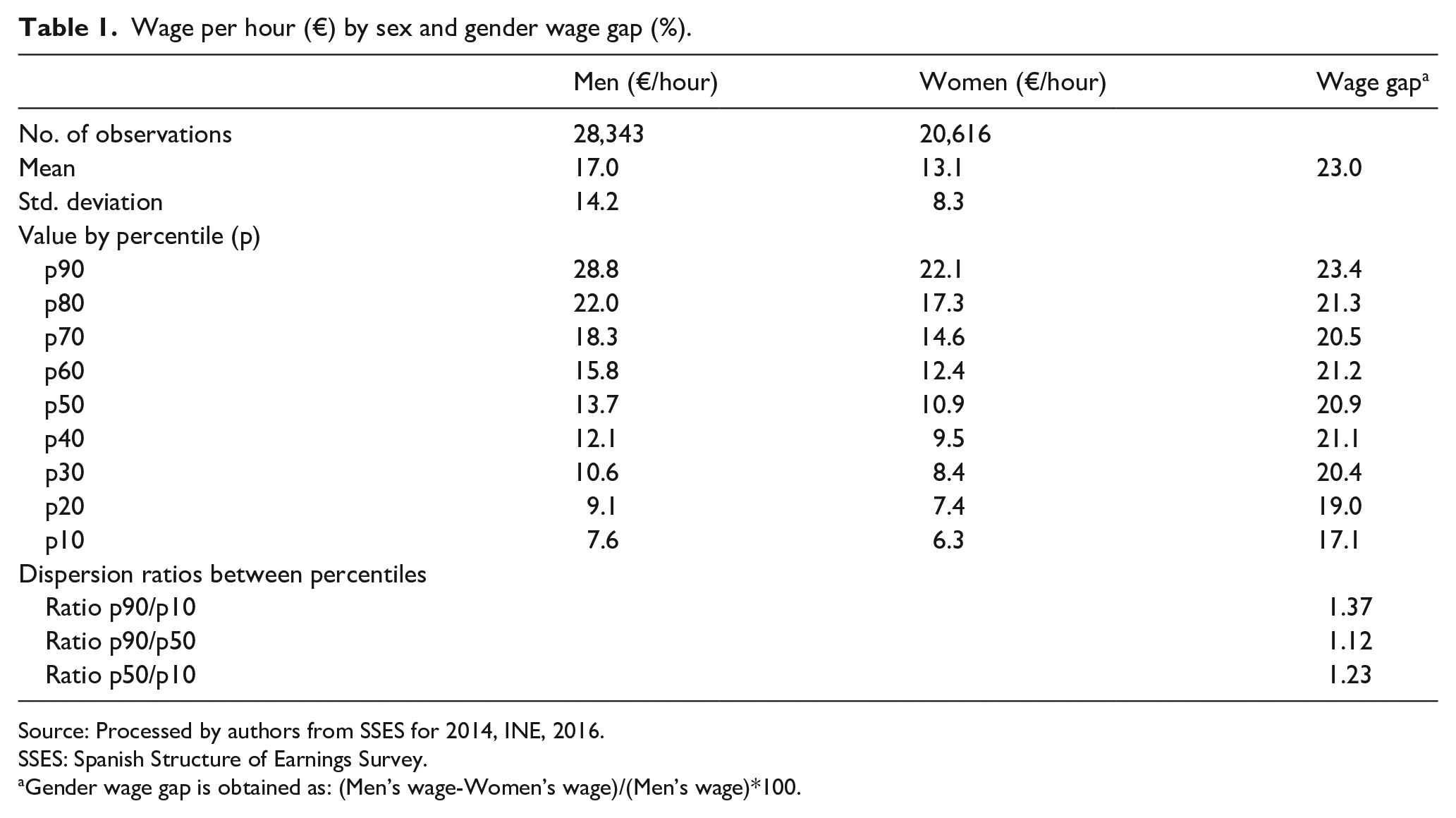
Women are underpaid compared to men, with an average wage gap of 23% in terms of hourly wage, a gap that increases with the salary (see Table 1). Calculated dispersion ratios give extra information about the pattern of that gap. The ratio 50/10 equals 1.23 (low wages) and it is slightly higher than that obtained for the ratio 90/50 (1.12 points). This could be related to a sticky floor phenomenon as the gap increases approaching the average wage at a slightly higher speed that at higher ranges of wages, above the 50 percentile.
Wage per hour (€) by sex and gender wage gap (%).
Source: Processed by authors from SSES for 2014, INE, 2016.
SSES: Spanish Structure of Earnings Survey.
Gender wage gap is obtained as: (Men’s wage-Women’s wage)/(Men’s wage)*100.
The Kernel density distribution functions in Figure 1 are very useful to understand wage gap patterns beyond the reference points contemplated in Table 1 as it represents the entire wage distribution. The shapes shown for men and women’s respective wage distributions point out two main issues. First, the women’s distribution is left-shifted compared to the men’s, showing that they are underpaid throughout the whole distribution.
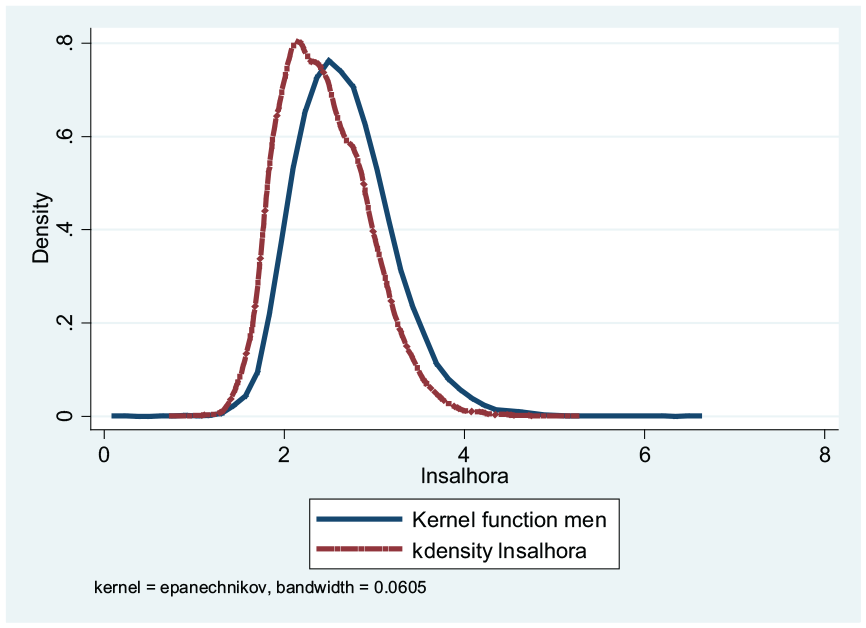
Kernel density distribution of wage by gender.
Salary/hour
Second, only men reach the maximum wages (represented by the right tail of the distribution) showing that women obtain a narrower range of salaries (as also shown by the lower value for standard deviation in Table 1).
Based on these results, women may face poorer labor conditions in terms of wages, but that pay gap could be explained by differences in variables related to personal characteristics and other determinants besides the sex of the workers, as explained at the theoretical framework section. The augmented Mincer equation permits controlling for other determinants, such as wage differences related to personal, job position, and firm characteristics.
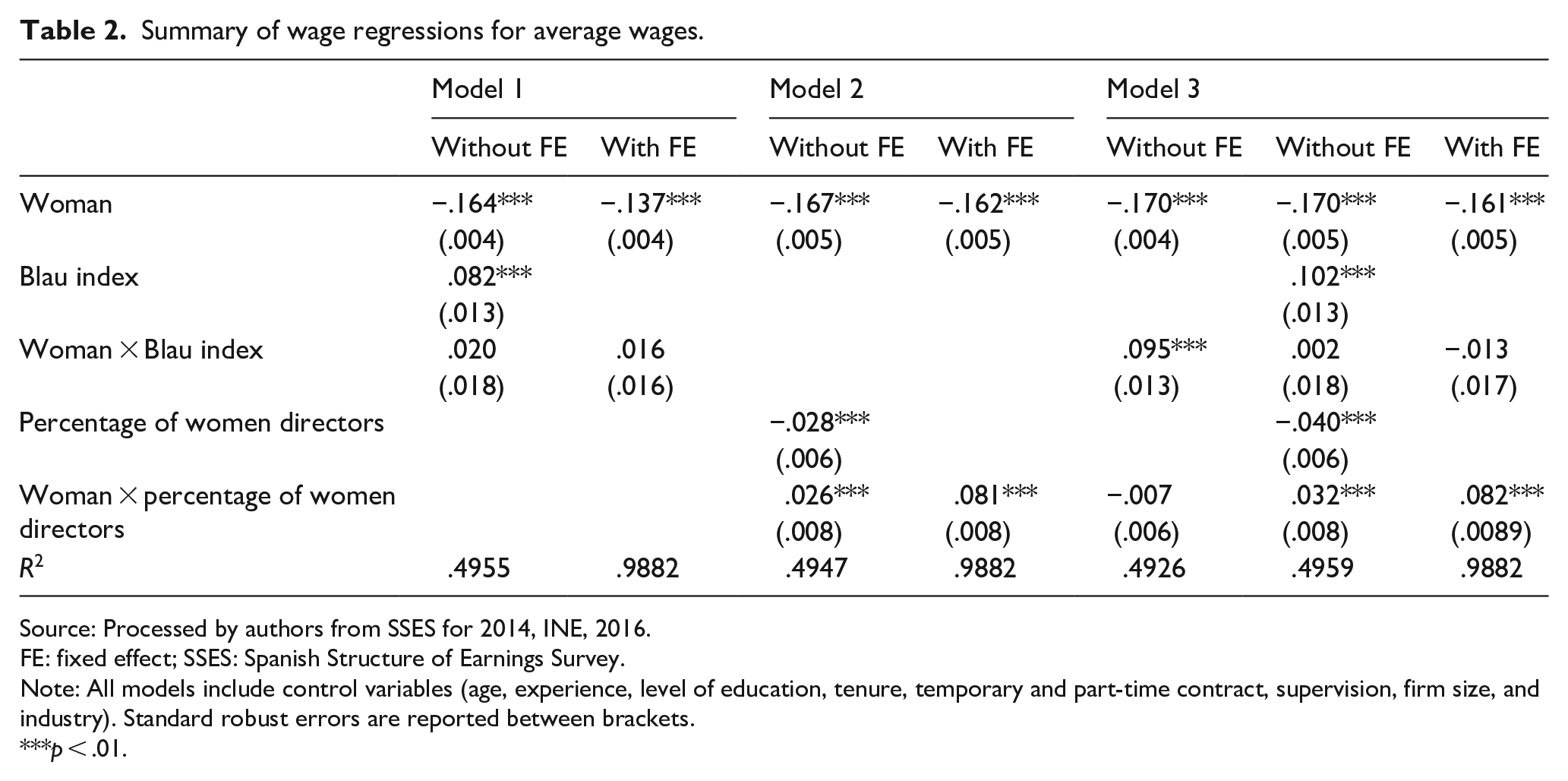
Table 2 shows the results of the regression analysis. The results obtained show the average effect of gender diversity (as measured by the Blau index) and women’s participation in management positions over wage. The use of fixed effects focused the analysis on differences between men and women in the same workplace, with similar age, type of contract, qualifications, time dedicated, and responsibility. Fixed effects were used to control for possible non-observable endogeneity issues and results without fixed effects were reported for comparison purposes (in this case, we used heteroscedasticity-robust standard errors to account for the possibility of heteroscedasticity of an unknown form).
Summary of wage regressions for average wages.
Source: Processed by authors from SSES for 2014, INE, 2016.
FE: fixed effect; SSES: Spanish Structure of Earnings Survey.
Note: All models include control variables (age, experience, level of education, tenure, temporary and part-time contract, supervision, firm size, and industry). Standard robust errors are reported between brackets.
p < .01.
First, the coefficient for the women-dummy variable was negative in all specifications; thus, even after controlling for traditional wage determinants, women’s wages were 16% lower than men’s in the same firm. The results associated with the Blau coefficients revealed that a gender-neutral definition of diversity (a gain in parity, regardless of whether it means reaching there from a men- or women-leaded firm situation) has no significant effect on the wage of women compared to men in the same firm. In models with no fixed effect, where that variable can be included with and without interaction with the women-dummy, the results show that firms with higher gender diversity improve pay conditions for all workers, but the specific effect on gender wage differences is not significant. In this regard, it is worth mentioning that 75.1% of the employees worked in firms with no diversity in managing positions (a zero value for the Blau index). This lack of value for diversity influenced the significance test results for the cross-effect variable “Women × Blau index.” Overall, a gender-neutral diversity measure implies that diversity might come from women-led firms with some men as well as men-led firms with some women in management positions. Thus, it could be that no diversity has the same effect on the wage gap, and a specific women-based diversity measure needs to be included.
If we focus on women-based diversity, by which we refer to an increase in the participation of women in management positions, the associated coefficients were positive and statistically significant in all the specifications. But they do not fully compensate the global GWG, although they contribute to its reduction. Moreover, as the results obtained in the specifications with and without fixed effects reinforced each other, it is worth mentioning that the coefficients for the percentage of women directors (model 2 and 3 without fixed effects) have negative signs (–0.028 and −0.040, respectively), suggesting that women are on average underpaid in the Spanish labor market and women-led firms have poorer pay conditions for all workers, a result that is also obtained by other authors (Flabbi et al., 2019; Gagliarducci & Paserman, 2015). It is worth mentioning that our specifications control for industry but not for any gendered occupational segregation that may affect these industries, which in turn might also affect the GWG indirectly. Moreover, the differences in the role of collective bargaining in the wage structure (and, in Spain, by region) might also influence wages. This presents a line of inquiry for future studies.
Overall, the results for the GWG within firms showed that both women and men receive higher wages the more diverse the management positions are, but the wage gap is not significantly affected by the degree of gender diversity measured by the Blau index (Table 3). However, when diversity was considered specifically in terms of higher percentages of women in management positions (Model 3) the results changed. The cross-effect coefficient “women × percentage of women directors” showed a positive, significant sign (0.08 points), which compensates for around half of the overall underpayment women suffer reflected by the coefficient for the variable “women” (–0.16 points). Therefore, the results confirmed our first working hypothesis: The increase in female participation in management positions leads to a reduction in the GWG. The increase in the participation of women in management positions is the type of gender diversity that contributes to a lower wage gap, while a gender-neutral improvement in diversity does not show a relevant impact, suggesting that the incorporation of more male managers in women-led firms has no impact on gender gaps.
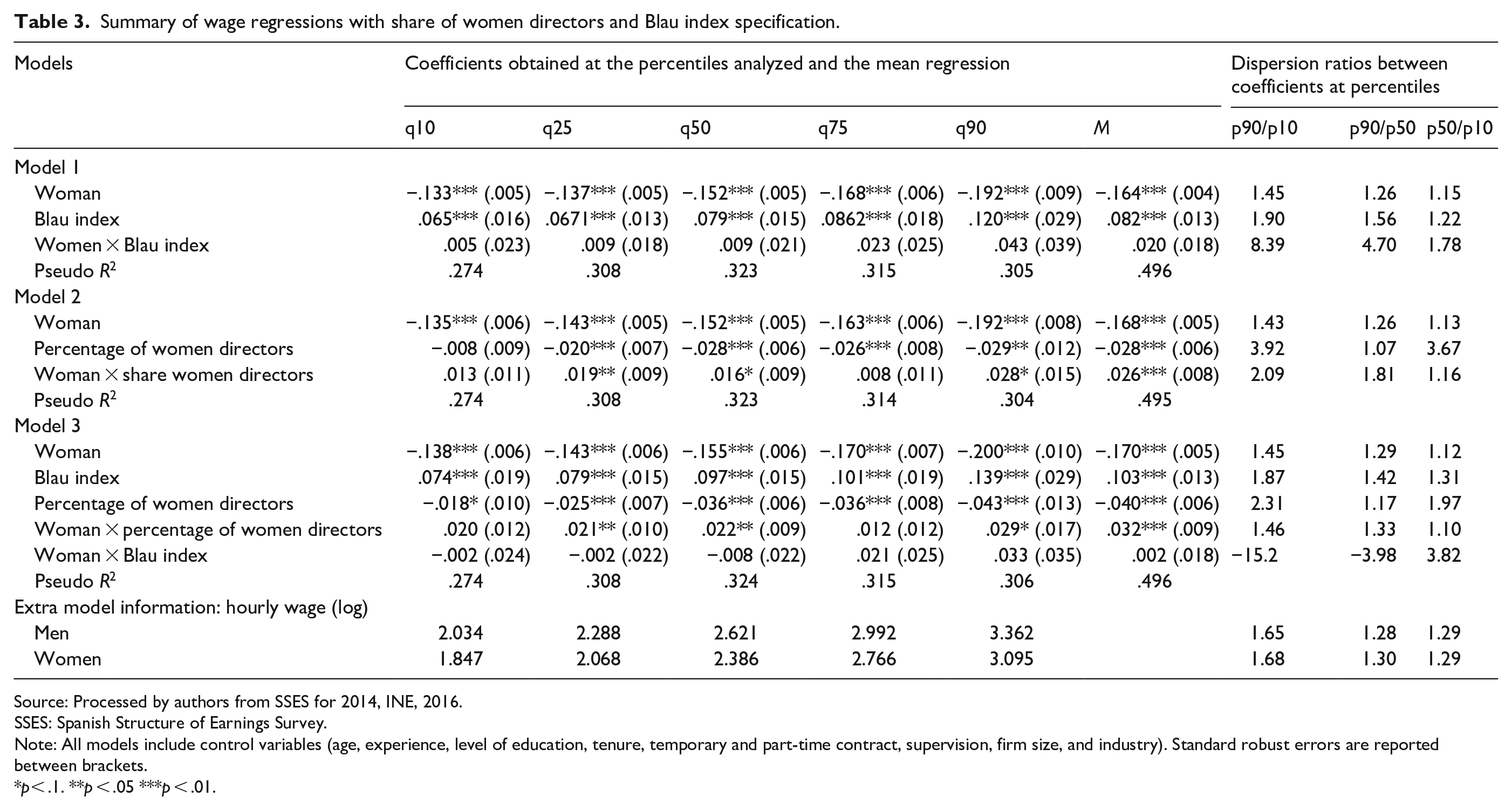
Summary of wage regressions with share of women directors and Blau index specification.
Source: Processed by authors from SSES for 2014, INE, 2016.
SSES: Spanish Structure of Earnings Survey.
Note: All models include control variables (age, experience, level of education, tenure, temporary and part-time contract, supervision, firm size, and industry). Standard robust errors are reported between brackets.
p< .1. **p < .05 ***p < .01.
To test our second hypothesis regarding the potential pattern in the influence of gender diversity on the wage gap throughout the pay scale, Models 1, 2, and 3 were estimated at different quantiles of the wage distribution using quantile regression techniques.
The results obtained at different moments (percentiles) of the wage distribution for the coefficient of the variable “women” confirm that the pay gap increases in upper percentiles, and dispersion ratios for coefficients obtained at percentiles 50/10 and 90/50 suggest that this effect persists when we control for unit measurement issues. This pattern of dispersion can be seen in the evolution of the coefficients for women in all specifications and led us to conclude that they face higher discrimination in the upper side of wage distribution, meaning there is indeed a glass ceiling effect in terms of the wage gap.
Our analysis of gender diversity (as measured by the Blau index in Models 1 and 3) throughout the wage distribution reinforces the results already obtained and shows that globally better salaries for all workers increase in the upper part of the wage distribution (dispersion ratio values for coefficients at percentiles 90/50 are higher than those for 50/10). However, this improvement in wages seems to be related to male-led diverse firms, and the non-significance of the cross-effect coefficient “Woman × Blau index” in Models 1 and 3, indicates that in those firms the improvement in wages does not affect women in particular compared to men.
The global analysis of the results for the variables “Percentage of women directors” and the cross-effect “Woman × Percentage of women directors” shed some light on gender diversity and the GWG. In general terms, wages tend to decrease in firms as the percentage of women in management positions increases (coefficients for “Percentage of women directors” are negative in Models 2 and 3), but interestingly, while there is a global reduction of wages, women experience a lower decrease, as the coefficient for the cross-effect “Woman × Percentage of women directors” is positive. The results in Regression 3 show higher significance and the inclusion of the Blau index increases the nominal bonification of women’s wages as the percentage of women directors increases (coefficients for the variable “Blau index”) in Model 3 were higher than in Model 1.
A closer look at the coefficients for “Woman × Percentage of women directors” shows that the effect of higher shares of women in management positions is not equally significant throughout the pay scale. Indeed, the lower percentiles were, the more significant the effect was, specifically at percentiles 25 and 50, while at percentile 75, there was no significant effect (p-values are higher than .1). Moreover, in general terms, the evolution of coefficients throughout the wage distribution was smaller than that experienced by the wages themselves, as shown in the extra model information rows. This suggest that more women in management positions has a significant impact in terms of reducing the sticky floor phenomenon, while the results were mixed regarding the effect on reducing the glass ceiling effect as the nominal bonification of women increased at a slower pace than the increase in wages and significance at upper percentiles was less stable than at lower percentiles.
Thus, we cannot accept H2; our results do not suggest a reduction in the gap in the upper part of the wage distribution, though they do support the idea of reducing sticky floor dynamics related to the wage gap, in line with a reduction in information asymmetry problems as considered in statistical discrimination theories. This is in line with other works, such as Flabbi et al. (2019) for Italy.
Discussion
The results obtained show that an increase in gender diversity in management positions only has a significant impact on reducing the gender pay gap when more women attain these positions in men-led firms. Our work contributes to the literature with the construction of a broader conceptualization of gender diversity in management positions. We consider not only the participation of women in management positions, a women-focused diversity perspective, but also a gender-neutral diversity perspective (captured by the Blau index). This is crucial, as it contributes to a deeper understanding of the dynamics by which gender diversity might reduce gender gaps. Furthermore, the empirical evidence provided support policies aimed at breaking the dynamics that prevent women from attaining decision-making positions in firms.
The incorporation of more women in management positions decreases the gender pay gap, but it is also associated with a lower wage level, both for men and women, as observed in previous studies of Spain (Vega et al., 2016) and Portugal (Cardoso & Winter-Ebmer, 2007). Indeed, our results show that although having more women in management reduces the gender pay gap, this gap persists in all types of firms. Overall, women are underpaid, regardless of the level and measurement of gender diversity in management positions. The literature suggests that this situation persists as a result of horizontal segregation in the industries in which female-led firms are located (Bell et al., 2008). It is still arguable whether women choose less productive sectors, or whether these sectors have lower productivity because of the perception that “women’s work” has less value (and thus lower salaries) compared to male-dominated activities. Whatever the cause, occupations research shows lower wages in occupations associated with feminine roles and activities (Lips, 2013).
From the perspective of women’s careers in firms, the literature also suggests that the differences in wages between men and women may be caused by occupational gender segregation. This phenomenon may be partially caused by men being more likely to be promoted to supervisory and management positions than women due to discrimination or self-restraints (Leythienne & Pérez-Julián, 2021). Likewise, the higher presence of women may not reach the threshold value needed to exercise real decision-making. Our results suggest that the participation of women in management positions might suffer from tokenism issues that limit their influence on the wages of senior female workers. Token women are those that reach management positions but remain a minority, isolated, and confronted with their male colleges’ stereotypical views of female inferiority (Busch & Holst, 2011).
Indeed, the effect of a greater presence of women in management, on the wage gap, is not uniform throughout the wage scale. In this respect, we developed a theoretical framework that analyzed the driving forces of this potential diversity of effects, including the dynamics within firms. For the Spanish case, the empirical study of these dynamics shows that reduction of that gap is greater in the lower part (sticky floor) than in the upper level of the wage distribution (glass ceiling). Thus, our results provide new empirical evidence about the specific effects of gender diversity in management throughout the pay scale. This adds a new perspective to the previous literature for Spain (Del Río et al., 2011; Vega et al., 2016).
Implications
The complexities of the relationships and dynamics within firms, and the channels by which they affect labor conditions have strong implications for the fight against gender differences in wages. Higher gender diversity in firms does not seem to be enough unless it implies more women in male-led firms. Ensuring equal participation of women and men in the labor market and in decision-making spheres, is considered a strategic objective (European Commission, 2021a, 2021b; United Nations, 2015). The proportion of women in managerial positions is marked by international institutions as a major progress indicator and remains a challenge for policy makers and social actors (United Nations, 2019). Moreover, as pointed out recently by the ILO, the fight against gender discrimination goes beyond firm-oriented policies and related legal frameworks. It must also be oriented to create a society free from gender stereotypes, where women are treated equally, and gender diversity is understood as a key factor for businesses to leverage their competitiveness and innovation (ILO, 2019).
In this context, Spain has shown a commitment to the reduction of gender differences in labor conditions with the development of a legal and institutional framework, with specific plans and policies (Lombardo, 2016) including the Spanish Organic Law 3/2007 for Effective Equality between Women and Men (LOIEMH in Spanish). However, the LOIEMH is only applied to large, public or listed firms, and lacks effective enforcement mechanisms. Despite being one of the key targets of this initiative, the wage gap has not shown the desired reduction, especially in terms of the upper part of the pay scale. In 2019, the government passed a new law (Royal Decree-Law 6/2019) to overcome some of the limitations of LOIEMH and advance the reduction of gender gaps in the labor market. The law has extended the mandatory design and implementation of equality plans to firms with 50 or more employees, compared to the previous groups of firms affected by the law. The incorporation of medium size firms constitutes a step forward in the generalization of these plans, as in Spain there are almost 20,000 firms (compared to less than 5,000 large firms). The database used in our analysis includes these firms and thus, the results provide useful insights for the design and evaluation of their plans.
Equality plans should include specific actions to reduce the discrimination mechanisms observed in management and other decision-making positions that persist in traditionally male-dominated circles within firms. These dynamics influence the discretionary decisions associated with bonuses and other variable components of wages and explain part of the gender pay gap in firms in the upper part of the pay scale (Barth et al., 2009; Rubery et al., 2005). In this respect, the law forces firms to have a salary record by gender, with desegregation by different occupational categories. The literature shows that transparency requirements might change a firm’s internal dynamics (e.g., Bennedsen et al. (2022) for Denmark). This transparency requirement constitutes a key element in the reduction of the glass ceiling type of wage gap that persists in Spain and has direct implications in terms of human resources policies in firms, especially those related to job evaluations systems.
In addition, the lack of a significant effect of gender diversity in management on that gap might reflect occupational segregation of women in positions with no executive power, or more complex dynamics, such as the described meritocracy paradox in organizations and the “queen-bee syndrome.” In this regard, labor market dynamics mirror the broader social context in terms of the recognition of the role of women in society and the fight against gender discrimination at work. Social attitudes and cultural biases constitute relevant obstacles to equality between men and women in terms of wages (Scicchitano, 2014). Thus, there is a need to reinforce collaboration between firms, institutions and other actors at society, as well as to mainstream gender in policy-making.
Limitations and future research
In an organizational context, it would be interesting to analyze whether the existence of a threshold value of female participation in decision-making jobs (related to tokenism theories) has a significant impact on labor conditions in firms. Another key aspect to include is the degree of influence and power associated with the positions women hold in firms. The effects of diversity at different levels of management and responsibility (such as whether they are executive or not, the degree of participation in wage determination, etc.) would contribute to a better understanding of the dynamics and channels by which diversity affects wage gaps.
Although the database used includes a qualitative variable “responsibility” that accounts for “positions with responsibility or supervision functions,” it is not necessarily related to the existence of an influence on labor conditions. In this regard, the lack of more detail information about the type of management position is a limitation in terms of the interpretation of the results. Moreover, firm-employee linked databases do not include key variables in terms of gender gaps in labor conditions, such as those related to the existence of conciliation policies. From a more global perspective, they also do not include information about the distribution of household responsibilities in families and other variables that contribute to more equal access of women and men to positions of responsibility (Kreimer, 2004).
The effect of gender diversity in management on human resources dynamics within firms might have a timing structure that requires a database with that perspective. The empirical evidence for 2014 serves as a baseline scenario for further analysis that incorporates updated information. It would be interesting to test whether the influence of gender diversity affects wages with a time delay, in the sense that the effect of a higher participation in management positions might be observed in following years. To do this, it would be necessary to have a panel database that permits analyzing the changes in the variables over time in the same set of firms. The replication of this study with data beyond 2022 would permit testing of an interesting hypothesis about human resources dynamics within firms in the light of the new transparency requirements (Royal Decree 902/2020, of October 13, on equal pay between women and men.). Moreover, the incorporation of small firms that must implement equality plans should also imply a structural change compared to the current situation (equality plans were only mandatory for big firms from 2020).
Finally, the SSES includes firms with 10 or more employees, but approximately 93% of enterprises in the non-financial business economy in Europe are micro-sized businesses (up to nine employees). Therefore, a larger sample would permit robustness tests of the results, considering all size of firms with some management structure.
In the light of the availability of data and the limitations mentioned, futures lines of research will focus on two extensions. First, extending the presented results to a multi-year perspective. Second, designing an empirical strategy that tests whether there is a threshold in the participation of women in management positions related to a significant, global impact on the reduction of gender gaps. This is in line with the quota perspective that supports the need for a critical mass of female participation in management positions.
Footnotes
Declaration of conflicting interests
The author(s) declared no potential conflicts of interest with respect to the research, authorship, and/or publication of this article.
Funding
The author(s) disclosed receipt of the following financial support for the research, authorship, and/or publication of this article: This research has received financial support by the Spanish Government (Project I+D+I FEM2017-83006-R, funded by Ministerio de Economía, Industria y Competitividad/AEI/FEDER,UE).
