



Abstract
Entrepreneurial intention is a key research question in entrepreneurship. Previous studies have proven the theory of planned behavior (TPB) to explain entrepreneurial intention. Scholars have thus focused on analyzing factors to develop the three antecedents of TPB, one of which is social capital. However, research has barely considered social capital online. We extend research by exploring the effect of social capital on these antecedents and on entrepreneurial intention, and by analyzing the differences in these influences between social capital online and offline. Using partial least squares and commonality analysis for 587 individuals in Spain, we find that social capital influences these antecedents and entrepreneurial intention. Furthermore, social capital online has a greater effect in attitude toward entrepreneurship, a similar effect on perceived behavioral control, and a lesser effect on social norms than social capital offline. Finally, social capital online has a greater influence on entrepreneurial intention than social capital offline.
Keywords
Introduction
Entrepreneurship is understood as the discovery, evaluation, and exploration of opportunities (Shane & Venkataraman, 2000). Intention is the best predictor of behavior, particularly when this behavior is rare and difficult to observe, or involves unpredictable time lags, with entrepreneurship being one typical example of such behavior (Bird, 1988). Entrepreneurial intention, defined as the desire to start a firm (Krueger et al., 2000), is often considered an important factor of actual involvement in the creation of new firms (Kautonen et al., 2015). Entrepreneurs first have the intention to start a business, since entrepreneurial behavior does not occur overnight (Hsu et al., 2019). In this sense, research into entrepreneurial intention is appropriate for studies addressing nascent entrepreneurs whose intentions may lead to entrepreneurship several years later (Hsu et al., 2019).
Entrepreneurial intention research has been widely studied by adopting models based on psychological literature. Among such models, theory of planned behavior (TPB) is the most commonly used theoretical framework (Schlaegel & Koenig, 2014), and numerous studies have proven its validity (e.g., Karimi et al., 2016; Kautonen et al., 2015; Krueger et al., 2000; Liñán & Chen, 2009). According to TPB, intention is determined by three antecedents: attitude toward a certain behavior, perceived control of the behavior, and social norms concerning behavior (Ajzen, 1991). Given its relevance, entrepreneurship literature has focused on revealing different factors that can promote these antecedents, such as entrepreneurship education (Karimi et al., 2016), closer and social valuation (Liñán et al., 2011), and collectivistic personal values (Hueso et al., 2020). Since these antecedents and entrepreneurial intention are cognitive in nature (Krueger & Carsrud, 1993; Mitchell et al., 2002), any factor that affects cognition may also affect them. Social cognitive theory considers that cognition is not isolated in individuals’ internal processes since it is interdependent with their social environment (Bandura, 1986). This theory can thus be applied to relate the antecedents of TPB and entrepreneurial intention to social environment.
One key element of an entrepreneur’s social environment is social capital (Gedajlovic et al., 2013). Social capital is an asset based on individuals’ relationships and involves the added value which flows from friends, colleagues, and others (Adler & Kwon, 2002; Burt, 1992). Studies exploring the role of social capital in entrepreneurial intention, or its antecedents, have mainly focused on social capital offline (e.g., Liñán & Santos, 2007; Sequeira et al., 2007), which is developed face to face over long periods (Gedajlovic et al., 2013). Some recent studies have explored the impact of social capital in virtual communities on the entrepreneurial intention of online university students (Pérez-Macías et al., 2018, 2019b) and in comparison to face-to-face students (Pérez-Macías et al., 2019a).
Individuals increasingly develop social capital online, which refers to the social capital created in the context of social network sites (SNSs; Smith et al., 2017). SNSs such as Facebook, Twitter, and LinkedIn are web-based services that allow individuals to (1) construct a public or semi-public profile within a bounded system, (2) articulate a list of other users with whom they share a connection, and (3) view and traverse their list of connections and those made by others within the system. (Boyd & Ellison, 2007, p. 211)
SNSs thus create a context that favors communicative exchanges and potential social capital benefits (Ellison et al., 2014), with implications for entrepreneurship (Smith et al., 2017). Furthermore, the literature suggests that social capital online and offline may be different constructs with different consequences (Gil de Zúñiga et al., 2017), including how individuals use this social capital online and offline to build and grow their new business (Smith et al., 2017). Our interest thus lies in examining how social capital may exert an influence and whether the influences of social capital online and offline have different effects on the cognitive antecedents of TPB and, in turn, on the entrepreneurial intention of university students. Specifically, we draw on the three dimensions of social capital developed by Nahapiet and Ghoshal (1998): structural, relational, and cognitive. Previous entrepreneurship literature has employed this perspective (e.g., De Carolis & Saparito, 2006; Liao & Welsch, 2005) in an effort to recognize and differentiate multiple forms of social capital (Gedajlovic et al., 2013).
This study makes several contributions to literature. First, we extend previous research on social capital and entrepreneurial intention (Liñán & Santos, 2007; Vuković et al., 2017) and, particularly, the effect of the three dimensions of social capital on TPB antecedents (Pérez-Macías et al., 2018, 2019b) by considering both social capital online and offline. Second, we examine whether social capital online and offline differ in their effects vis-à-vis the antecedents of TPB and entrepreneurial intention, extending previous research on the different influence of social capital online and offline (Gil de Zúñiga et al., 2017) to the context of entrepreneurship. In doing so, we combine the partial least squares (PLS) approach with commonality analysis, which has been underused in entrepreneurship research (Lomberg et al., 2017). Finally, we advance the literature that has considered the role of social capital online, created in SNSs, in the early stages of entrepreneurship (Olanrewaju et al., 2020). Thus, we address the digital era in entrepreneurial intention research and respond to demands for further research aimed at fully understanding the antecedents, moderators, and mediators of entrepreneurial intention (Fayolle & Liñán, 2014).
Theoretical background
TPB posits that three antecedents determine intentions: attitude toward behavior, perceived behavioral control (PBC), and social norms (Ajzen, 1991). Attitude toward a behavior is conditioned by the person’s evaluation of said behavior as well as their beliefs regarding the possible outcomes and costs of such behavior (Ajzen, 1991). Specifically, attitude toward entrepreneurship (ATE) refers to the degree to which an individual has a positive or negative opinion vis-à-vis engaging in entrepreneurial behavior (Ajzen, 2001; Kolvereid, 1996), including the beliefs about the outcomes and costs of starting a new business (Schlaegel & Koenig, 2014). PBC refers to perceived control over the performance of a behavior (Ajzen, 2002). In entrepreneurship, PBC is the individual’s perception of either possessing or not the capabilities, resources, and knowledge to carry out entrepreneurial behavior. PBC embraces both self-efficacy and controllability (Ajzen, 2002). In the case of entrepreneurship, self-efficacy is the belief that starting a business is possible because of the individual’s capability. Controllability is self-belief in having the behavioral control to achieve the goal of creating a business and overcoming any external constraints that may arise (Ajzen, 2002). Social norms refer to the perceived social pressure to engage in or refrain from a specific behavior (Ajzen, 1991). In entrepreneurship, social norms are the perceived beliefs that reference people have about becoming entrepreneurs (Ajzen, 2001). Positive (negative) social norms encourage (discourage) the adoption of favorable (unfavorable) perceptions regarding entrepreneurship (Schlaegel & Koenig, 2014).
According to Bandura’s (1986) social cognitive theory, the social environment shapes individuals’ cognition and, ultimately, their behavior. Indeed, prior studies that simultaneously consider social environment and entrepreneurial cognition provide a more comprehensive explanation (De Carolis et al., 2009; De Carolis & Saparito, 2006). A key part of social environment is social capital, which is “the sum of actual and potential resources embedded within, available through, and derived from the networks of relationships possessed by an individual or social unit” (Nahapiet & Ghoshal, 1998, p. 243). Since the three antecedents of TPB and entrepreneurial intention are cognitive in nature (Krueger & Carsrud, 1993; Mitchell et al., 2002), social capital may thus affect entrepreneurial cognition (e.g., perceptions and attitudes) and, in turn, entrepreneurial intentions and behaviors (De Carolis & Saparito, 2006).
Although research has studied in depth the consequences of social capital in entrepreneurship (Gedajlovic et al., 2013), very few studies have specifically focused on the role of social capital in entrepreneurial intention or its antecedents (see Table 1 for a review of existing studies). Chen and He (2011) or Quan (2012) use the bonding perspective, which considers social capital as the value which individuals can obtain from repeated social connections (Coleman, 1988). Sequeira et al. (2007) or Sesen (2013) apply the bridging perspective, which considers social capital as the result of structural holes 1 (Burt, 1992). Finally, the literature has often used both perspectives jointly, arguing that both strong and weak ties can generate more favorable perceptions of entrepreneurship (Liñán & Santos, 2007; Vuković et al., 2017).
Previous studies of social capital and entrepreneurial intention.
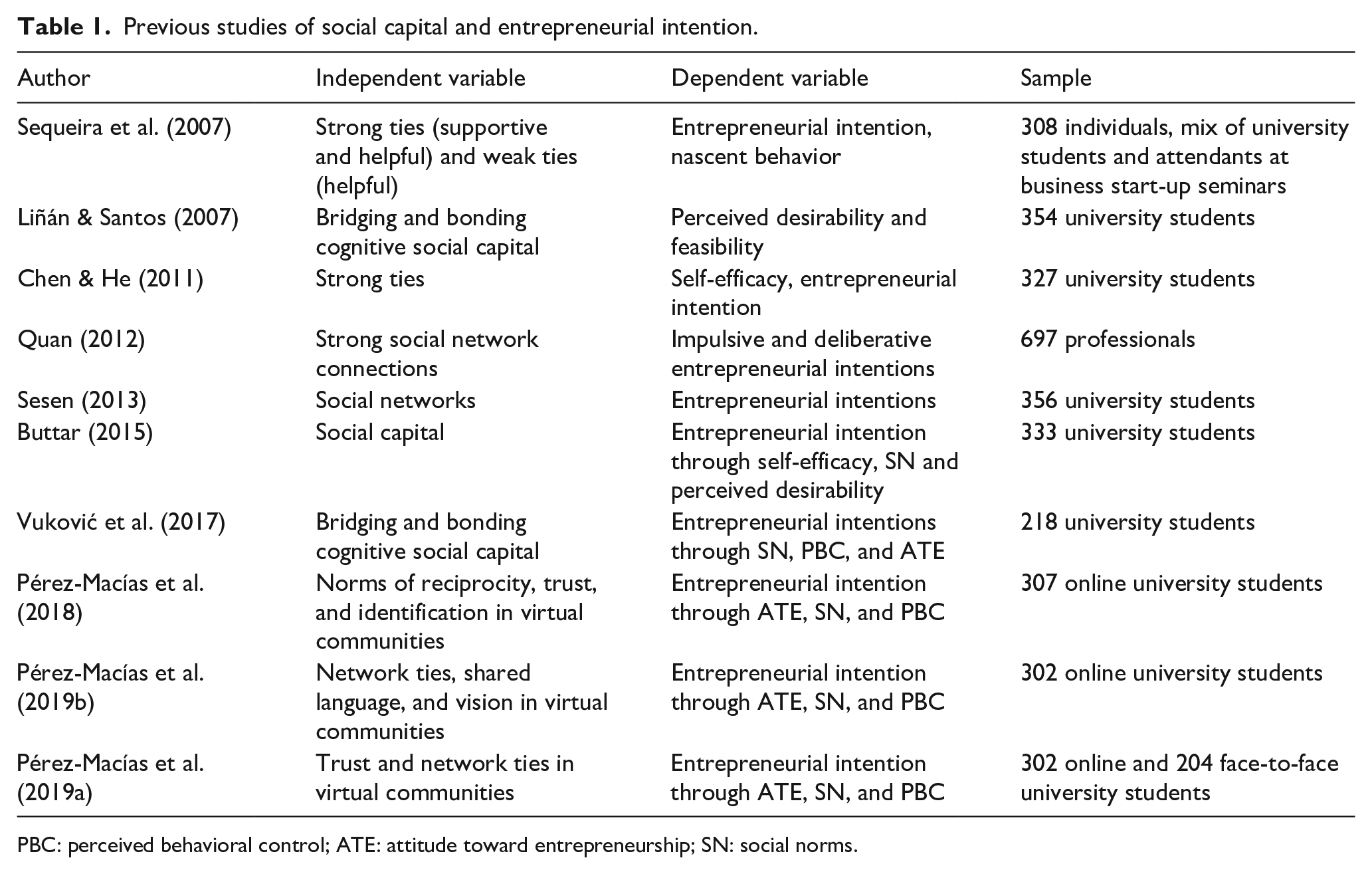
PBC: perceived behavioral control; ATE: attitude toward entrepreneurship; SN: social norms.
Beyond the bonding and bridging perspectives, Nahapiet and Ghoshal (1998) developed a more extensive explanation of social capital based on three dimensions of social capital: structural, relational, and cognitive social capital. The structural dimension of social capital refers to the properties of the social system and networks as a whole, describing the set and general pattern of relationships among people (De Carolis et al., 2009; Nahapiet & Ghoshal, 1998). Structural social capital covers both the total number and the diversity of individuals in the network (Nahapiet & Ghoshal, 1998). The relational dimension of social capital refers to the personal relationships that people develop through a history of interactions (Granovetter, 1992). It focuses on elements such as trust, reciprocity, and identification (Nahapiet & Ghoshal, 1998). Cognitive social capital dimension refers to resources that provide shared representations, interpretations, and systems of meaning between parties (Nahapiet & Ghoshal, 1998). Specifically, a shared language and vision are elements that facilitate a common understanding of collective goals and the correct way to act in social groups (Tsai & Ghoshal, 1998).
Previous research in entrepreneurship has applied these three dimensions at an individual level and has considered the usefulness of distinguishing among multiple forms of social capital (Gedajlovic et al., 2013). For instance, Liao and Welsch (2005) found the importance of the three dimensions of social capital for individuals involved in starting a business. De Carolis et al. (2009) find that structural and relational social capital positively influence the progress of new ventures. Recently, research has evidenced that TPB antecedents and entrepreneurial intention for online university students are influenced by network ties (structural dimension) and shared language and vision (cognitive dimension) (Pérez-Macías et al., 2019b), and trust, reciprocity, and identification (relational dimension) in virtual communities (Pérez-Macías et al., 2018). Network ties (structural dimension) and trust (relational dimension) in virtual communities also influence TPB antecedents and entrepreneurial intention for both online and face-to-face university students (Pérez-Macías et al., 2019a).
The literature has also used these three dimensions in relation to SNSs (Delacroix et al., 2019; Kromidha & Robson, 2016). These studies, as well as other areas of entrepreneurship research, have already considered the importance of SNSs and social capital online (for a review, see Olanrewaju et al., 2020). SNSs provide an opportunity for individuals to participate in interactions on a scale and in a way which was hitherto impossible (Reuber & Fischer, 2011). This favors the development of social capital online (Gil de Zúñiga et al., 2012) with implications for entrepreneurship (Smith et al., 2017). Moreover, the literature suggests that social capital online and offline may be different constructs with different consequences (Gil de Zúñiga et al., 2017), implying that entrepreneurs’ social capital is manifested differently online to offline (Smith et al., 2017). In fact, previous research has considered a different impact of social capital on the antecedents of TPB between online and offline university students (Pérez-Macías et al., 2019a).
Previous research has barely explained how SNSs encourage the development of the three dimensions of social capital online. First, the literature suggests that SNSs help structural social capital online to develop. SNSs enable users to create large, highly disseminated networks of relationships (Wellman et al., 2001). In addition, SNSs proactively suggest digital contacts, thereby helping entrepreneurs to expand their networks (Smith et al., 2017). SNSs may thus prove particularly well-suited for accruing more diverse social ties (Ellison et al., 2007). SNSs may also favor the development of relational social capital online (Ellison et al., 2014; Sigfusson & Chetty, 2013) by fostering trust and reciprocity (Valenzuela et al., 2009). Sigfusson and Chetty (2013) find that entrepreneurs actively increase their participation in SNSs, which establishes an initial motive for trust. In addition, SNSs help to fulfill the norms of reciprocity because individuals expect to obtain social resources from these SNSs in the future (Ellison et al., 2014), given that interactions with individuals through SNSs may allow users to see themselves as part of a larger community (Ellison et al., 2014), which proves key to identification. Finally, SNSs are likely to influence cognitive social capital online. SNSs are an alternative way for individuals to connect with others who have common interests or goals (Ellison et al., 2006). Indeed, digital profiles in SNSs convey people’s beliefs, systems of meanings, and other cognitive attributes (Jensen Schau & Gilly, 2003). SNS user profiles therefore allow the search for some basis of similarity with others when integrating people in an individual’s network, thereby favoring the accrual of cognitive social capital (Smith et al., 2017).
Hypotheses development
As commented, both the dimensions of social capital online and offline, as a part of social environment, may influence TPB antecedents, which are part of the individual’s cognition. We hypothesize the influence of social capital on ATE, PBC, and social norms. This section also develops hypotheses about the differences between social capital online and offline (Gil de Zúñiga et al., 2017), and how they may trigger different influences in these antecedents.
Structural social capital and antecedents of entrepreneurial intention
Engaging in entrepreneurial behavior implies participating in exchanges with uncertainty (Hébert & Link, 1988). Structural social capital provides individuals with the opportunity to make exchanges (Nahapiet & Ghoshal, 1998) with a large group of diverse individuals (Burt, 1992; Granovetter, 1973). Indeed, Jonsson (2015) argues that structural social capital helps entrepreneurs to make the exchanges required to start up. This could be explained because large and highly diverse networks favor the possibility of valuable exchanges, providing more diverse information (Burt, 2000) and reducing the amount of time and cost required to gather this information (Burt, 1992; Nahapiet & Ghoshal, 1998). Therefore, favorable entrepreneurial exchanges—in terms of information and costs—are more likely in larger and more diverse networks (De Carolis et al., 2009), positively affecting ATE. In addition, De Carolis and Saparito (2006) propose that networks consisting of many and diverse relationships allow entrepreneurs to reduce uncertainty in exchanges, thereby enhancing their chances of achieving success in the entrepreneurial opportunities identified (Fischer & Reuber, 2011). Thus, large and diverse relationships increase individuals’ perceptions that they will achieve the expected outcomes, making the pursuit of a new entrepreneurial opportunity more attractive (De Carolis & Saparito, 2006): in other words, they positively affect ATE. Therefore, we state the following hypothesis:
One crucial activity in the start-up process is accessing resources, including information and knowledge (Baron, 2008). Entrepreneurs with a large and diverse network are better positioned to obtain the resources required to undertake their activity (Hernández-Carrión et al., 2020) such as financial and human resources, and information that is relevant in the early stages of entrepreneurship (Dubini & Aldrich, 1991). In addition, knowledge favors the creation of entrepreneurial opportunities (Audretsch & Keilbach, 2007). Diverse ties favor knowledge creation (Nahapiet & Ghoshal, 1998) by increasing individuals’ access to diverse sources of information (Burt, 1992; Granovetter, 1973). Hence, structural social capital can increase individuals’ belief in their level of knowledge (W. M. Cohen & Levinthal, 1990). In sum, individuals’ structural social capital is positively related to entrepreneurial self-efficacy. As regards controllability, individuals with high structural social capital may believe they can control the unknown through the information obtained from their networks (De Carolis & Saparito, 2006). In fact, De Carolis et al. (2009) have found that structural social capital is associated with overconfidence, which is a cognitive bias that causes individuals to overestimate their capabilities. Following this, we state the second hypothesis:
Previous research has found a different impact of network ties on the antecedents of TPB and entrepreneurial intention between online and offline university students Pérez-Macías et al., (2019a). This suggests that the impact of structural social capital online and offline on the antecedents of entrepreneurial intention may differ. Indeed, there is a cognitive limit on the size of face-to-face social networks that individuals can have (Dunbar, 1993). However, SNSs allow users to track and engage with more people than they would normally do through face-to-face relationships and at a reduced cost (Ellison et al., 2007). As SNSs enroll a wider range of individuals, each individual’s networks become larger and more diverse (Ellison & Boyd, 2013). In this sense, SNSs enable individuals to maintain a larger set of weak ties (Ellison et al., 2014), which favor structural holes where individuals can have more social exchanges (Burt, 1992). These structural holes allow more diverse information to be obtained (Burt, 2000). In addition, SNSs enable asynchronicity, such that they do not require individuals to be online simultaneously. This allows individuals to overcome temporal limitations and extract content from social ties (Baym, 2010). Thus, the greater number of weak ties in an online context compared to an offline context and the asynchronous communication of SNSs allows individuals to obtain newer and more diverse information and knowledge (Ellison et al., 2011), including that which is related to entrepreneurship. Therefore, we state the following hypothesis:
Relational social capital and antecedents of entrepreneurial intention
Relational social capital is related to trust, reciprocity, and identification. Trust creates confident expectations and makes individuals more likely to become involved in uncertain situations (Rousseau et al., 1998), such as entrepreneurial exchanges. Reciprocity helps shift individuals from a self-seeking focus to a focus on collective action (Adler & Kwon, 2002). In addition, identifying with a group enhances the opportunities for exchange within the group (Kramer et al., 1996). Thus, relational social capital can motivate people to engage in exchanges and entrepreneurial behavior because it favors an individual’s belief that they can trust network resources to obtain the desired results that might derive from exchanges and entrepreneurship (De Carolis et al., 2009; De Carolis & Saparito, 2006). In addition, trust and reciprocity diminish the likelihood of opportunism, thereby reducing the cost of monitoring exchanges (Nahapiet & Ghoshal, 1998), favoring the individual’s positive evaluation of the possible outcomes of entrepreneurial behavior, that is, ATE increases. We therefore state the following hypothesis:
As argued above, it is crucial to access information and knowledge in entrepreneurship (Baron, 2008). Trust and reciprocity are associated with the flow of fine-grained information (Gulati, 1998), access to new knowledge (Uzzi, 1997), and the combination and transfer of knowledge for entrepreneurship (Inkpen & Tsang, 2005; Liao & Welsch, 2005). Group identification also increases frequency of cooperation, which has positive consequences for exchanging information and knowledge (Lewicki & Bunker, 1996). The information and knowledge obtained may improve an individual’s belief concerning their ability to perform entrepreneurial tasks (Martin et al., 2013), that is, self-efficacy beliefs. In addition, because relational social capital grants access to resources (De Carolis et al., 2009), it acts as a safety mechanism for entrepreneurs and bolsters their sense of control, enhancing their belief that they will develop their business ideas successfully, thus increasing entrepreneurial controllability. Finally, prior literature relates the relational dimension to overconfidence (De Carolis & Saparito, 2006). Given these arguments, we state the following hypothesis:
Previous research has found that relational social capital influences the antecedents of TPB and the entrepreneurial intention of online and offline university students differently (Pérez-Macías et al., 2019a). There are likely to be differences between relational social capital online and offline. Social exchange theory explains how repeated social exchanges create trust, obligations, and expectations where obligations and expectations in relationships refer to reciprocity (Blau, 1964). Similarly, Granovetter (1973) explains that social relationships with multiple interactions characterized by higher levels of trust and reciprocity are seen as strong ties. SNSs enable more frequent message exchanges with a set of contacts (Tong & Walther, 2011). Repeated social exchanges are more likely in SNSs than in face-to-face relationships because time is compressed, interactions are accelerated, and individuals become more accessible (Baym, 2010). In this sense, SNSs provide an ideal platform for maintaining relationships easily, with different activities such as signaling attention, building trust, and creating expectations of reciprocal attention that are not easy to do in the offline context (Ellison et al., 2014). Therefore, the different attributes of SNSs in terms of relational social capital and strong ties allow individuals to find more substantive information for entrepreneurship than in the offline context (Smith et al., 2017). Following this, we state the sixth hypothesis:
Cognitive social capital and antecedents of entrepreneurial intention
Access to information is a critical component of entrepreneurial opportunities (Baron, 2008). Cognitive social capital facilitates relationships between actors in a network, enabling them to share resources and to conduct exchanges, which increases their ability to develop a business (Liao & Welsch, 2005). This can cause individuals to overstate their abilities related to entrepreneurship (De Carolis et al., 2009; De Carolis & Saparito, 2006). Therefore, cognitive social capital is related to entrepreneurial self-efficacy. Furthermore, sharing a common language and vision helps the exchange and combination of entrepreneurial information between individuals (Boland & Tenkasi, 1995; De Carolis et al., 2009). In addition, it allows the share of knowledge (Inkpen & Tsang, 2005) because similar ways of seeing the world can help to make sense of information and knowledge (Grant, 1996). Finally, shared language and vision can lead to entrepreneurs’ belief that their information and knowledge may affect the outcome of their decisions (De Carolis & Saparito, 2006), thereby increasing their perception of controllability regarding entrepreneurship. Therefore, we state the following hypothesis:
According to interpersonal attraction theory, individuals with similar beliefs are attracted to each other (Byrne, 1971). Therefore, individuals’ opinions and beliefs correlate with the opinions and beliefs of their close contacts because people tend to relate with individuals like themselves (Burt, 1992). In the case of entrepreneurship, shared codes and languages encourage similar points of view within networks of entrepreneurs (De Carolis & Saparito, 2006) either because they hold a similar vision prior to entering the network or because they adopt this vision after entering it. These shared beliefs can model social normative perceptions of entrepreneurial activity (Thomas & Mueller, 2000). Individuals who believe in their capabilities and knowledge related to entrepreneurship thus tend to seek connections with others who have a similar view of entrepreneurship. As argued above, cognitive social capital positively influences entrepreneurial intentions through PBC. Individuals with high cognitive social capital are therefore both attracted to and in turn attract other individuals who have shared opinions and views regarding entrepreneurship. Given this discussion, we state the following hypothesis:
Social capital online and offline can have different consequences (Gil de Zúñiga et al., 2017), which may result in cognitive social capital online and offline having a different influence on the antecedents of entrepreneurial intention. Many SNSs explicitly connect people based on shared interests and facilitate meetings between individuals who have no previous offline connection (Ellison et al., 2006). In addition, SNSs allow users to include their identity and values in their profiles (Smith et al., 2017), allowing anticipated interactions which increase common understanding in social interactions (Gibbs et al., 2006). Therefore, impressions formed in SNS environments are often more intense than those formed in face-to-face environments (Hancock & Dunham, 2001). These features of SNSs, in terms of cognitive social capital online, can provide individuals with new and more relevant information and knowledge compared to cognitive social capital offline (Walther et al., 2008). Furthermore, social norms are based on normative beliefs which can be influenced by individuals who are important in a person’s life (Ajzen, 1991). The increased prevalence and frequency of social interactions via SNSs enhances the interpersonal visibility and salience of these social interactions in SNSs compared to offline contexts (Kwon et al., 2014). Interpersonal visibility refers to being aware of others’ opinions and information, while interpersonal salience refers to finding others’ opinions and information interesting or important (Friedkin, 1993). Thus, the influence of other individuals on entrepreneurship in SNSs would be greater than in the offline context. We therefore state the following hypothesis:
Dimensions of social capital and entrepreneurial intention
Previous literature has extensively proven the influence of the three antecedents on entrepreneurial intention (see the meta-analysis of Schlaegel & Koenig, 2014). The literature has also argued that structural, relational, and cognitive social capital indirectly influence entrepreneurial intention (e.g., Pérez-Macías et al., 2018, 2019a, 2019b). Furthermore, H3, H6, and H9 propose that each dimension of social capital online has a greater effect than the same dimension of social capital offline in TPB antecedents. Taking these arguments together, we expect dimensions of social capital online to also have a greater indirect effect on entrepreneurial intention than dimensions of social capital offline. Therefore, we state the following hypothesis:
Figure 1 shows our main model.
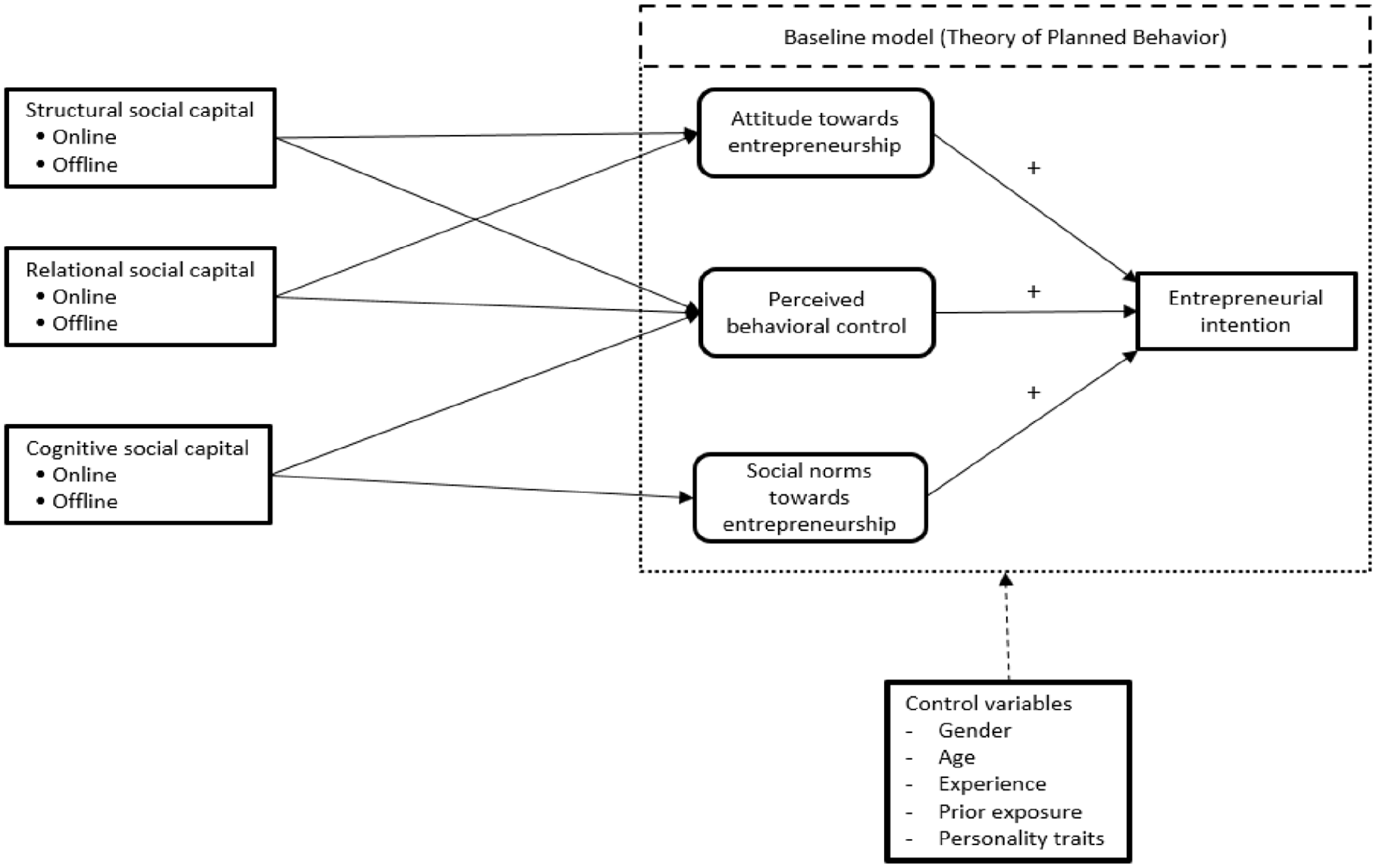
A model of entrepreneurial intention based on TPB and social capital.
Research method
Sample and data collection
Our sample comprises undergraduate university students in their final 2 years of university who study degrees in business or related disciplines. The sample selection follows Krueger (1993) who argues that when analyzing entrepreneurial career choices, researchers should use samples of individuals who are currently facing major career decisions. Students in our sample have, on average, roughly 1 year in which to make a decision regarding their professional career (Fitzsimmons & Douglas, 2011). Given this relatively short period of time, students’ entrepreneurial intentions are likely to remain stable after graduation (Audet, 2004), and their answers, although self-reported, have a high degree of validity related to their entrepreneurial intentions as a predictor of future behavior (Ajzen, 1991). Therefore, student samples are appropriate in studies on nascent entry into entrepreneurship (Hsu et al., 2019). Indeed, university student-based samples are very common in entrepreneurial intention research (Fayolle et al., 2006; Kolvereid, 1996; Krueger et al., 2000; Pérez-Macías et al., 2019a; Veciana et al., 2005). Our table on previous studies into social capital and entrepreneurial intention (see Table 1) shows that the majority of these studies are based on university student samples. Our findings are thus comparable to existing research (e.g., Liñán & Santos, 2007; Sequeira et al., 2007). Finally, numerous studies in computer-mediated communication also use undergraduate samples (Ellison et al., 2007, 2011; Valenzuela et al., 2009) because these younger adults use networks extensively to connect with other people (Subrahmanyam et al., 2008).
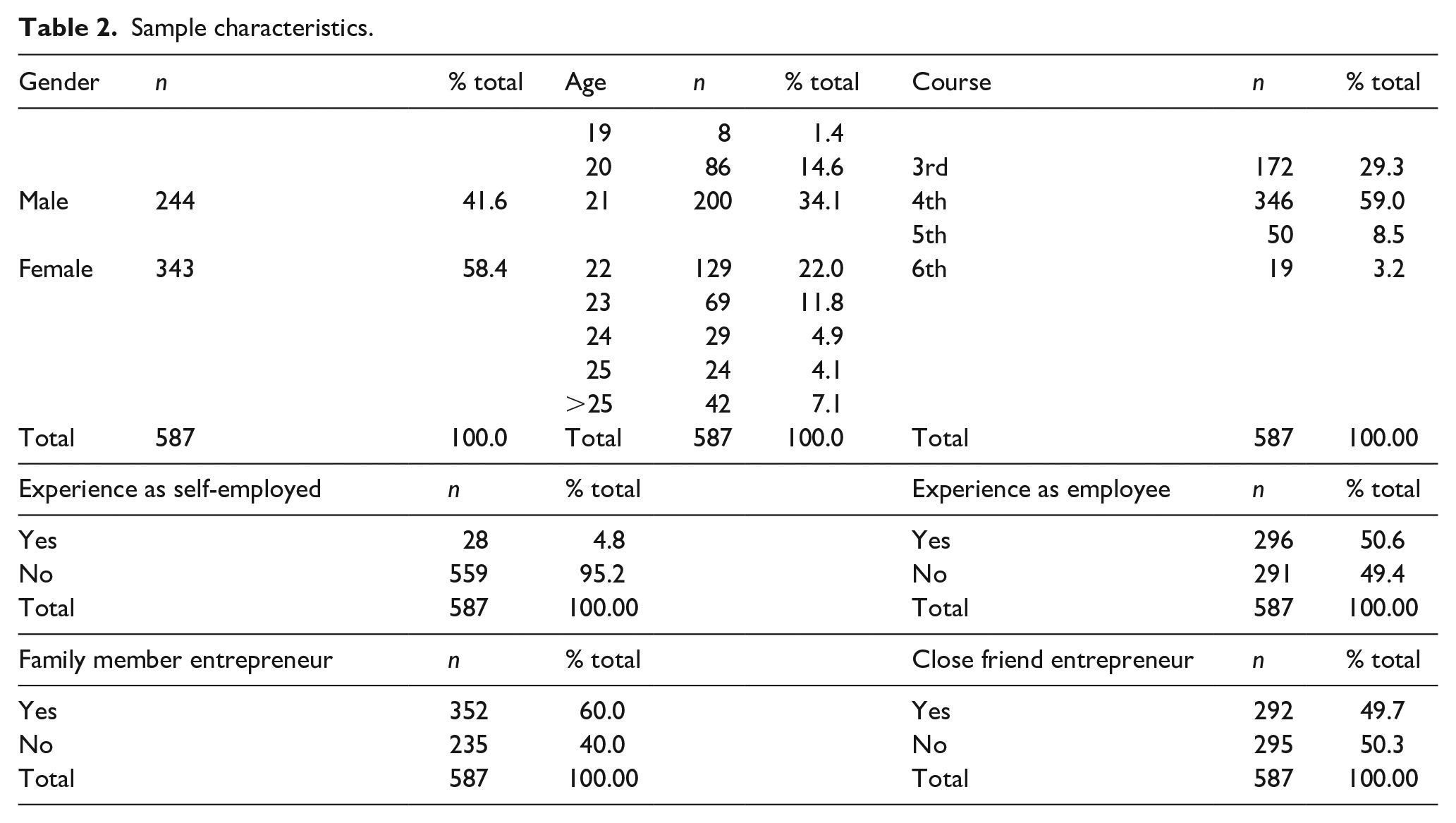
We collected information from October to December 2017. Face-to-face students from two public universities of a Spanish region voluntarily and anonymously responded to paper form questionnaires in class after being informed about our study. We obtained 609 responses and discarded 22 due to missing data. Table 2 shows the characteristics of the remaining 587.
Sample characteristics.
To determine the statistical power of our sample, a series of post hoc power analyses were conducted using G*Power 3 computer software (Faul et al., 2009). Power calculations were based on a medium effect size and Type I error values (α) of .05. In all instances, power values exceed Cohen’s (2013) recommended criterion of .80 (β). Specifically, the minimum value in our sample is near to 1.00.
Measurement scales
Appendix 1 shows the operationalization of our measures. To validate the measurement items, we first confirmed them with an expert in entrepreneurship. Following a pretest with a sample of 31 students, we then adjusted some items so as to facilitate understanding.
TPB
We measure TPB variables with Liñán and Chen’s (2009) Entrepreneurial Intent Questionnaire (EIQ), which is based on previous literature on entrepreneurial intention (Kolvereid, 1996; Krueger et al., 2000; Veciana et al., 2005) and which is widely used in research (e.g., Karimi et al., 2016; Liñán et al., 2011; Pérez-Macías et al., 2019a).
Social capital
Structural social capital comprises two facets: size and diversity. Size is measured with two items: the total number of friends with whom an individual connects through SNSs and what proportion of these friends are frequently contacted (Ellison et al., 2011). We use smaller intervals for size in structural social capital offline because SNSs allow individuals to engage with more people than offline relationships do (Ellison et al., 2011). Diversity is measured by four items regarding whether friends in SNSs or offline networks are diverse in certain issues, adapting this scale from Stone and Hughes (2002).
To measure relational and cognitive social capital, we follow Chiu et al. (2006). Trust is operationalized with five items that address whether the members of the individual’s SNSs or offline networks do not behave opportunistically and act honestly. The reciprocity measure consists of two items, indicating the help that individuals can either give or be given from their SNSs or offline networks. Finally, identification is measured with four items related to an individual’s sense of belonging and union in SNSs or offline networks. Shared language is measured with three items related to common and understandable communication patterns in SNSs or offline networks. The shared vision measure consists of three items that address whether members of an individual’s SNSs or offline networks share a similar vision and goals.
Control variables and common method bias
We include control variables in the analysis. For ATE, we use gender because men, compared to women, display a greater preference for entrepreneurial behavior (Camelo-Ordaz et al., 2016; Mathews & Moser, 1995). We also use age because it is negatively related to a favorable motivation to start a business (Curran & Blackburn, 2001). For PBC, we use two dummies which indicate whether the respondent has been an employee or self-employed in the past. Research has found a relation among a greater belief in entrepreneurial potential and work experience (Mathews & Moser, 1995) or entrepreneurial experience (Shepherd, 2003). We also control for previous exposure to entrepreneurship through two dummy variables: whether students have prior family members or close friends who have been entrepreneurs (Davidsson & Honig, 2003). Finally, for entrepreneurial intention, we use two personality traits—need for achievement and risk-taking propensity—which have been associated with entrepreneurship (Chell, 2008; Rauch & Frese, 2007). Need for achievement is measured with a three-item scale adapted from Lee and Tsang (2001). Risk-taking propensity is measured using four items (De Carolis et al., 2009).
Common method bias is a serious concern when dependent and independent variables refer to perceptual measures answered by the same individual (Podsakoff et al., 2003). To assess how serious common method bias might be, we conduct a Harman one-factor test (Podsakoff & Organ, 1986) with our 18 main variables. This test checks whether data variance is largely attributed to a single factor. We adopt the rule of an eigenvalue above 1 and find 15 factors. The highest covariance explained by one factor is only 14.4%, such that common method bias is not deemed to be a concern.
Analysis and results
Analysis techniques
We use structural equation modeling (SEM) for our analysis. Specifically, we employ the PLS approach (SmartPLS 3.1.5). In PLS, measurement and structural parameters are estimated via an iterative procedure that combines simple and multiple regressions by traditional ordinary least squares. This avoids any distributional assumption of the observed variables. Thus, PLS does not require data normality and does not suffer from the indeterminacy problems of other modeling techniques (Wittmann et al., 2009). In addition, PLS can handle both reflective and formative constructs (Chin & Newsted, 1999), and allows for the modeling of first- and second-order constructs. 2 All first-order constructs are reflective, except the social norm related to entrepreneurship, size, and diversity. Three concepts are modeled as second-order constructs: structural social capital, which is modeled as a formative–formative construct, and relational and cognitive social capital, which are modeled as reflective–formative. Figure 2 illustrates these first- and second-order constructs.
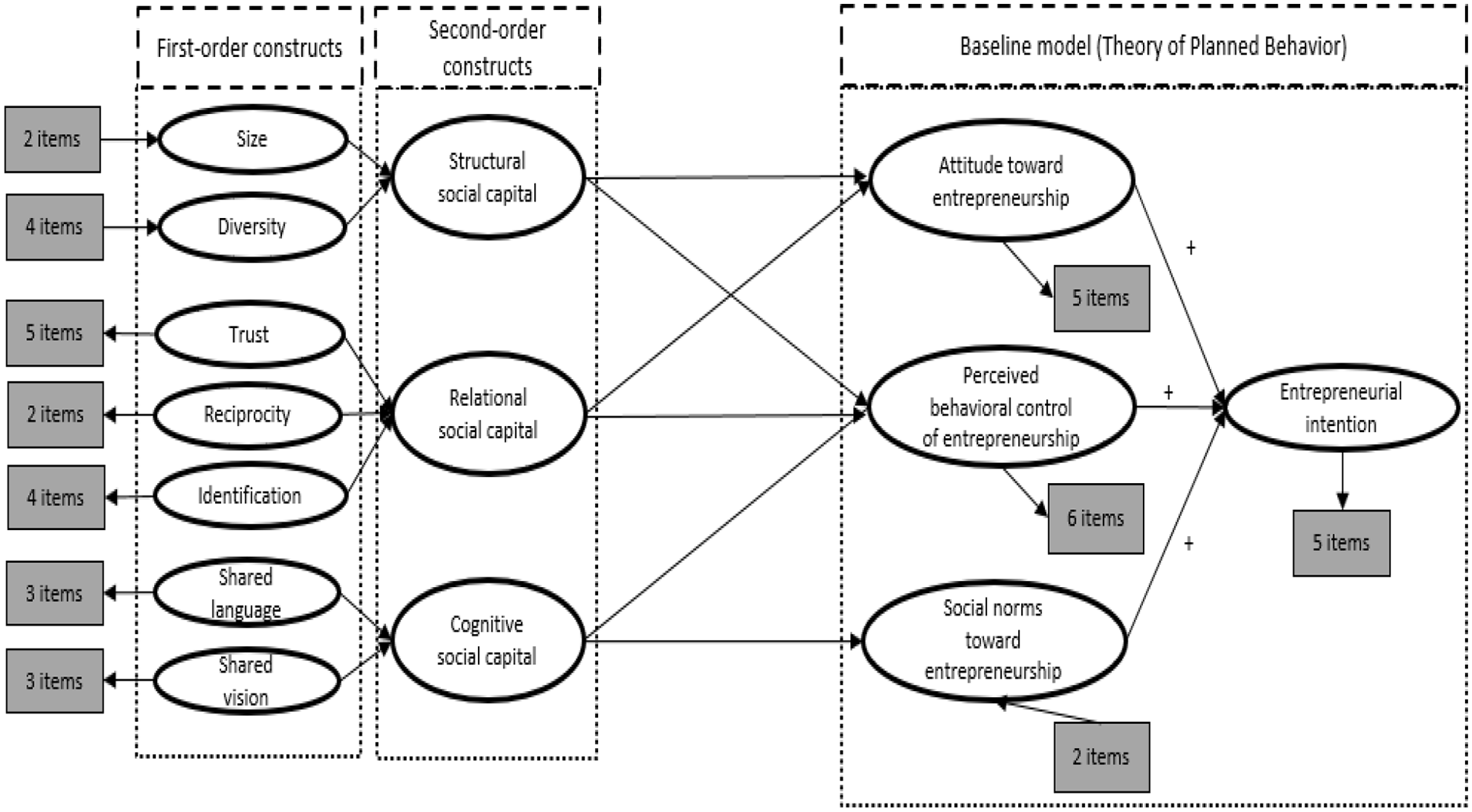
Visual representation of the first- and second-order constructs.
In an effort to extend our understanding, we complement our analysis by employing commonality analysis because large intercorrelations among predictors may undermine the interpretation of β (e.g., Kraha et al., 2012; Nimon & Oswald, 2013). The correlation matrix shows that the correlations between ATE and PBC (r = .568) and between some dimensions of social capital online and social capital offline are high. Commonality analysis provides a more rigorous assessment of the relative contribution of the different predictors to explaining the dependent variable. Commonality analysis partitions the R-squared (R2) explained by all the predictors in an equation into two components: the explained variance unique to each predictor (U) and the explained variance shared (C) between different combinations of predictors (Kraha et al., 2012; Nimon & Oswald, 2013). Although underused in entrepreneurship research, Lomberg et al.’s (2017) study recommends commonality analysis because researchers can quantify the degree to which effects cannot be attributed to individual dimensions but instead to covariation between these dimensions. This covariation can have explanatory power and allows a more detailed interpretation of data. We use R software to conduct the commonality analysis.
Measurement model
First-order constructs
We evaluate the measurement model of the reflective constructs by examining item reliability, internal consistency, as well as convergent and discriminant validity (Roldán & Leal, 2003). All item loadings are significant at p < .01 (see Table 6 in Appendix 1). We appraise the constructs’ internal consistency by observing Cronbach’s alpha and composite reliability. All Cronbach’s alphas are above .6, and composite reliability exceeds the .7 boundary for all constructs (see Table 6 in Appendix 1). This table shows that the average variance extracted exceeds the recommended threshold of .5 for all constructs (Fornell & Larcker, 1981). We thus confirm the convergent validity of the constructs.
We also evaluate the discriminant validity of the reflective scales by examining the extent to which (a) the root square of average variance extracted is larger than the interconstruct correlations (Fornell & Larcker, 1981; see Table 3) and (b) each item loads more highly on its intended construct than on others. Furthermore, as recommended by Henseler et al. (2015), we also examined the heterotrait–monotrait (HTMT) ratios of correlations. Table 3 shows no HTMT ratios above the threshold of .85, and none of the corresponding confidence intervals included the value 1, which means that this study met the criteria for establishing the adequate discriminant validity suggested by Henseler et al. (2015).
Zero-order correlations and discriminant validity.
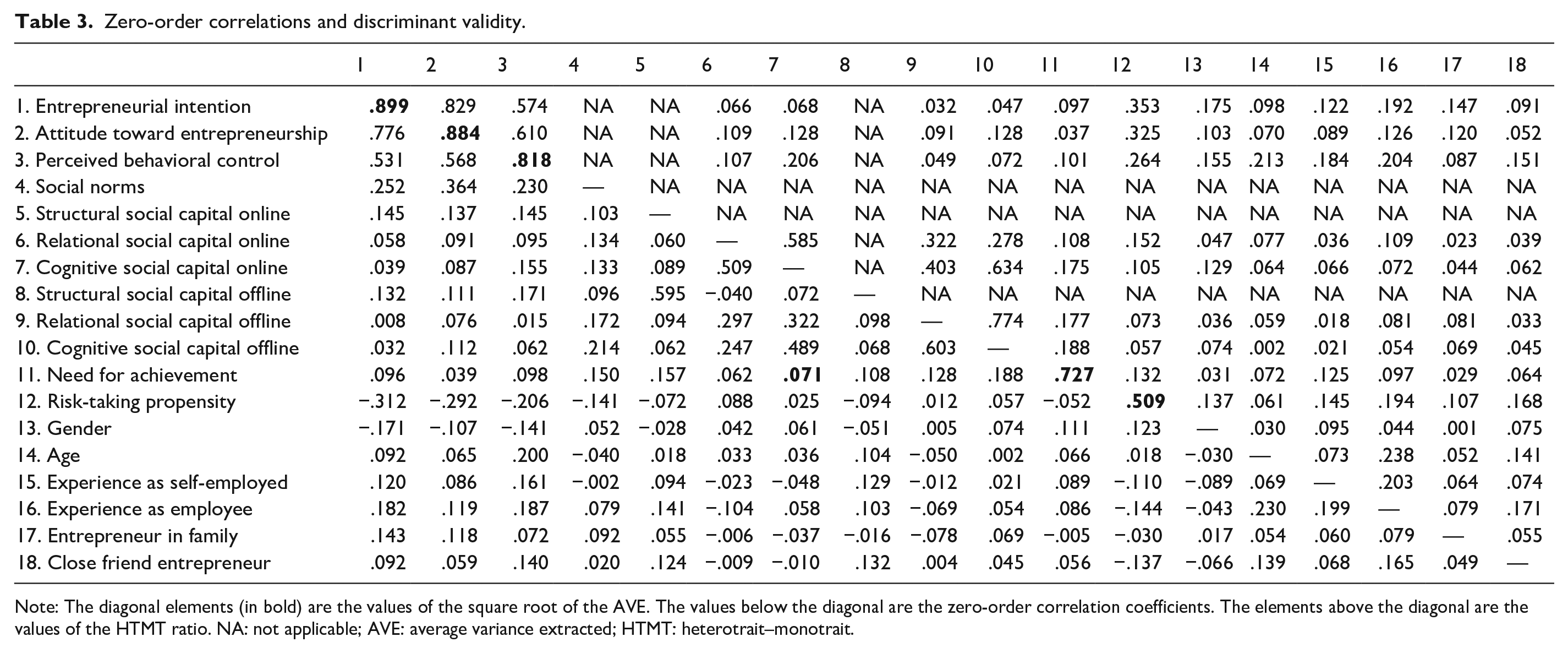
Note: The diagonal elements (in bold) are the values of the square root of the AVE. The values below the diagonal are the zero-order correlation coefficients. The elements above the diagonal are the values of the HTMT ratio. NA: not applicable; AVE: average variance extracted; HTMT: heterotrait–monotrait.
Finally, we evaluate the measurement quality of the formative constructs (social norms, size, and diversity) according to their weights (Chin, 1998). The weight of each item indicates how each contributes to its respective construct (Carrión & Salgueiro, 2005). Table 6 of Appendix 1 shows that the weights of formative items are statistically significant in their respective constructs. In the case of formative items, the absence of high multicollinearity between them must be checked. The highest variance inflation factor is below the cutoff value of 5, indicating that multicollinearity is not a problem (Kleinbaum et al., 2013).
Second-order constructs
To statistically validate the formative nature of second-order constructs, we examine the significance given by each facet of the dimensions to the second-order construct for both social capital online and offline. Following Becker et al. (2012), we use the repeated indicator approach to estimate the measurement models for size and diversity (structural); trust, reciprocity, and identification (relational); and shared language and shared vision (cognitive).
Table 4 shows that the outer weights of all the facets that belong to their respective dimensions are significant, confirming that the fit of the formative measurement models is good. We then check for multicollinearity using the variance inflation factor. Values of the respective dimensions are below the cutoff value of 5, indicating there are no collinearity concerns.
Quality criteria of second-order measurement.
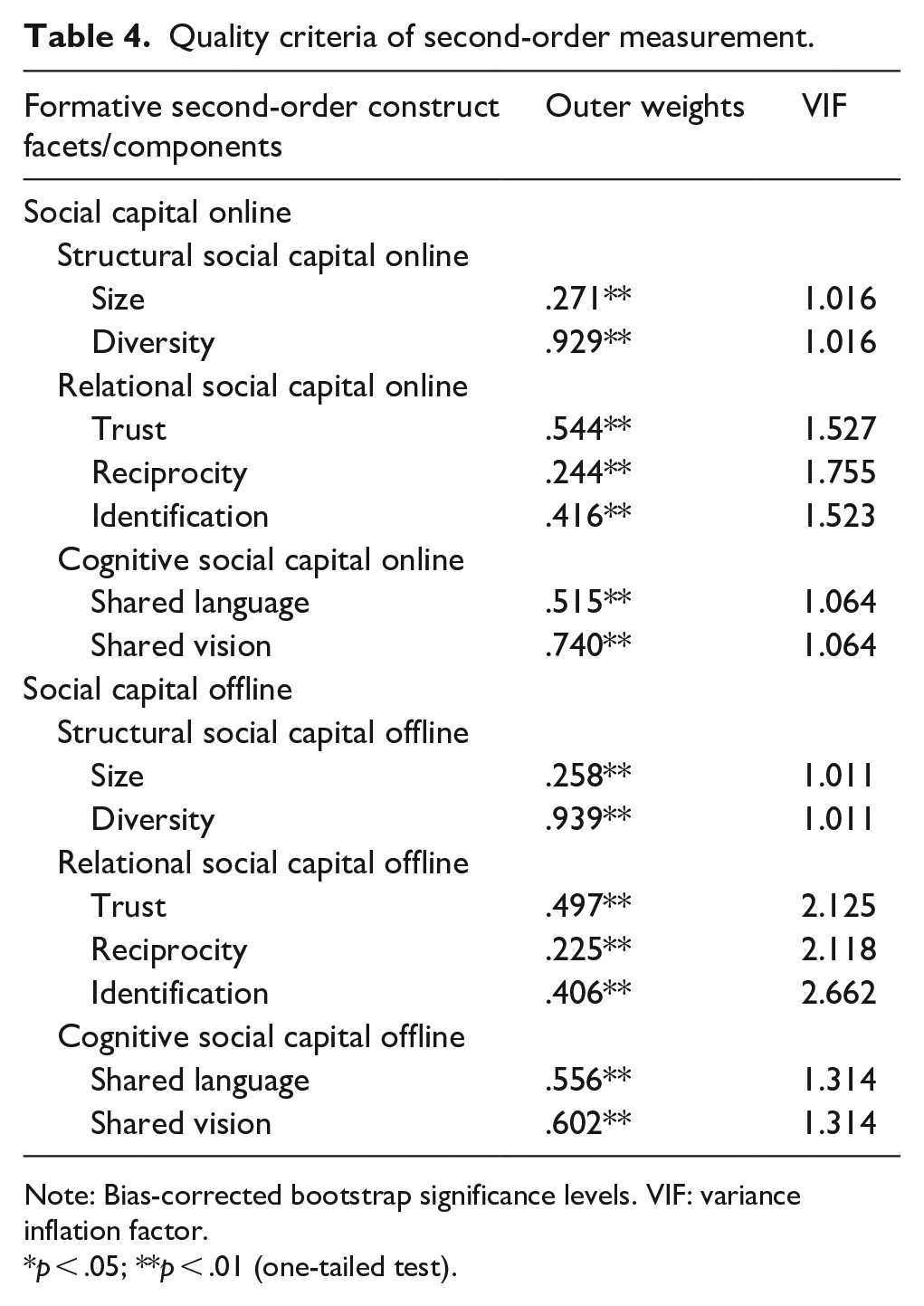
Note: Bias-corrected bootstrap significance levels. VIF: variance inflation factor.
p < .05; **p < .01 (one-tailed test).
Model fit
To measure our model fits, we consider the standardized root mean square residual (SRMR), which is a goodness-of-fit measure for PLS that can be used to avoid model misspecification (Henseler et al., 2016). This is the only index on which there is some agreement in the PLS–SEM community (Cepeda-Carrion et al., 2019). A value below .08 is considered a good fit (Hu & Bentler, 1999). In our specific case, the model has an SRMR of .071, which is considered to offer a good fit.
Results
Table 5 presents the results, including the standardized regression parameters (β) and the explained variances of dependent variables (r2) obtained in SmartPLS 3.0 with a bootstrapping of 5,000 randomly generated subsamples. Table 5 also shows the results of the commonality analysis. We include structure coefficients (rs), squared structure coefficients
Standardized regression parameters (β) and commonality analysis.
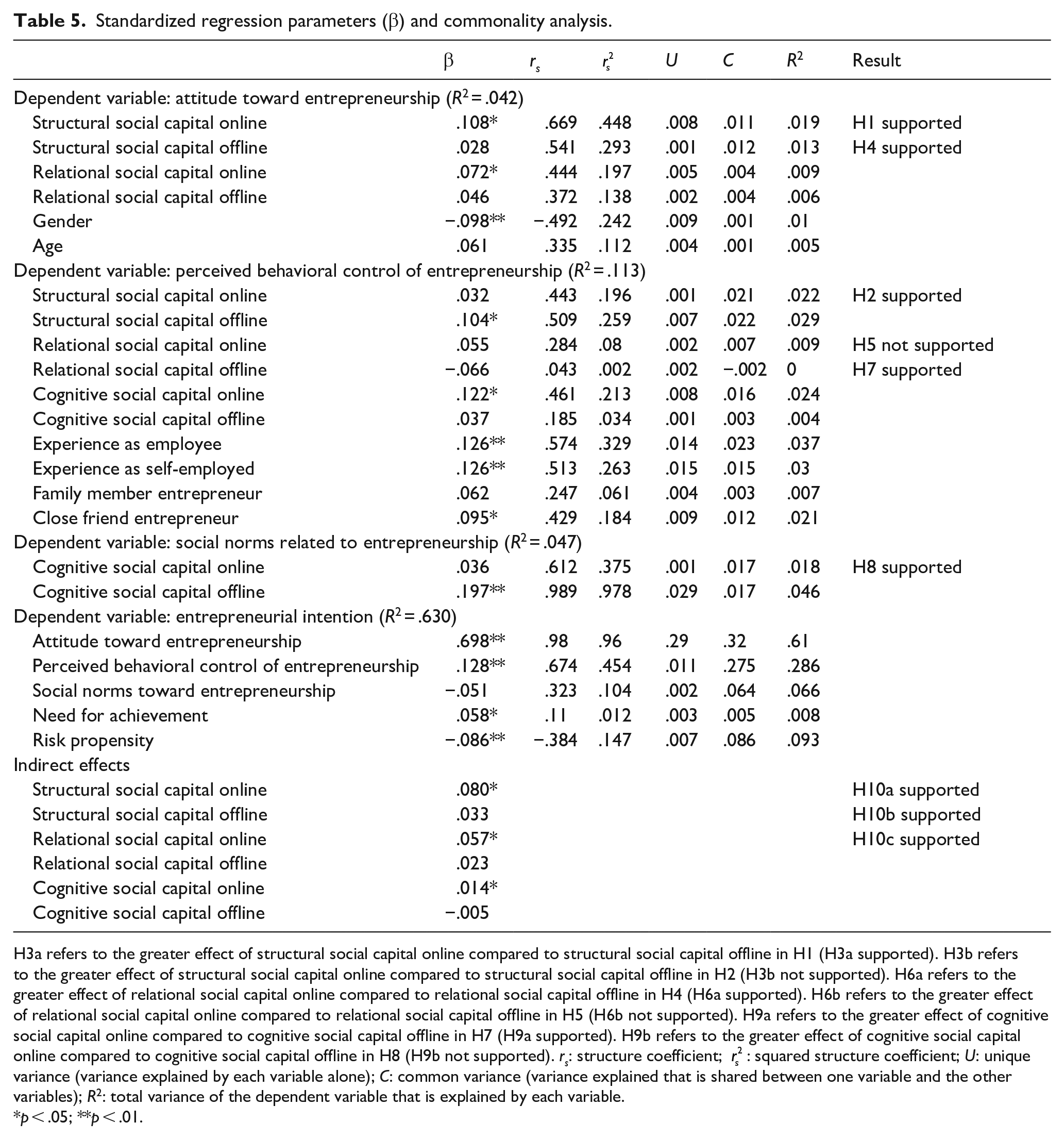
H3a refers to the greater effect of structural social capital online compared to structural social capital offline in H1 (H3a supported). H3b refers to the greater effect of structural social capital online compared to structural social capital offline in H2 (H3b not supported). H6a refers to the greater effect of relational social capital online compared to relational social capital offline in H4 (H6a supported). H6b refers to the greater effect of relational social capital online compared to relational social capital offline in H5 (H6b not supported). H9a refers to the greater effect of cognitive social capital online compared to cognitive social capital offline in H7 (H9a supported). H9b refers to the greater effect of cognitive social capital online compared to cognitive social capital offline in H8 (H9b not supported). rs: structure coefficient;
p < .05; **p < .01.
The results indicate a positive significant coefficient for structural social capital online (β = .108, p = .039) on ATE but not for structural social capital offline (β = .028, p = .316). Structural social capital online and offline are highly correlated (r = .595). Examining unique and common variance, structural social capital online has the highest explained variance on ATE, mainly due to common variance (C = .011). Social capital offline has a low unique variance (U = .001) but a high common variance (C = .012), which makes it the second variable with the largest total explained variance of ATE, in contrast to β. Indeed, structural social capital online and offline share a bilateral effect that explains 18.62% of the r2 of ATE, supporting H1. In the comparison, we find a greater contribution of structural social capital online (β = .108, r2 = .019) than offline (β = .028, r2 = .013) in ATE, supporting H3a.
In addition, structural social capital online (β = .032, p = .284) has no influence on PBC while structural social capital offline has a positive significant effect (β = .104, p = .046) on PBC. Because structural social capital online and offline are highly correlated, the common variance is high for both structural social capital online (C = .021) and offline (C = .022). Indeed, their bilateral effect explains 6.56% of the r2 of PBC. Thus, structural social capital offline makes the largest contribution to the total variance of PBC. Furthermore, structural social capital online is more important than is shown by β. We thus find support for H2. Our results also show a greater contribution of structural social capital offline (β = .104, r2 = .029) than online (β = .032, r2 = .022) in PBC, such that H3b is not supported.
As regards the relational dimension, relational social capital online (β = .072, p = .048) has a positive influence on ATE. However, relational social capital offline (β = .046, p = .169) does not influence ATE. Relational social capital online and offline have a correlation of .297 and a bilaterally shared effect that is 6.07% of the r2 of ATE. Thus, both relational social capital online (r2 = .009) and relational social capital offline (r2 = .006) are important, supporting H4. In addition, relational social capital online (β = .072, r2 = .009) has a greater contribution than relational social capital offline (β = .046, r2 = .006), supporting H6a.
We find no support for H5 because both relational social capital online (β = .055, p = .131) and relational social capital offline (β = –.066, p = .140) do not significantly affect PBC. Since both effects are not significant and, therefore, can be estimated as null, we cannot consider that one type of capital makes a greater contribution than the other.
In addition, cognitive social capital online has a positive significant effect (β = .122, p = .018), on PBC (β = .127, p = .010), but cognitive social capital offline (β = .037, p = .281) has no effect on PBC. We also find that cognitive social capital online has the second highest total variance explained (r2 = .024) due to its unique (U = .008) and common variance (C = .016). Cognitive social capital offline is also important (r2 = .004) because of its bilateral effect with cognitive social capital online (3.60% to the r2), supporting H7. In addition, our results support H9a because cognitive social capital online (β = .122, r2 = .024) has a greater contribution to PBC than cognitive social capital offline (β = .037, r2 = .004).
Furthermore, cognitive social capital online has no significance on social norms related to entrepreneurship (β = .036, p = .263), although cognitive social capital offline positively influences these norms (β = .197, p = .000). However, cognitive social capital online is also important because it has a low unique variance (U = .001) but a high common variance (C = .017). In fact, the bilateral shared effect of cognitive social capital online and offline represents 35.27% of the explained variance, supporting H8. In addition, our results show that cognitive social capital online (β = .036, r2 = .018) contributes less than cognitive social capital offline (β = .197, r2 = .046), thereby not supporting H9b.
In addition, the indirect effects of the three dimensions of social capital are evaluated through PLS, which provides the β and significance of these effects. First, structural social capital online (β = .080, p = .042), relational social capital online (β = .057, p = .046), and cognitive social capital online (β = .014, p = .048) have a positive and significant indirect effect on entrepreneurial intention. However, structural social capital offline (β = .033, p = .232), relational social capital offline (β = .023, p = .262), and cognitive social capital offline (β = –.005, p = .304) have no indirect influence on entrepreneurial intention. We thus support H10a, H10b, and H10c regarding the greater indirect effects of the dimension of social capital online on entrepreneurial intention compared to the dimensions of social capital offline.
As regards TPB, our results show the influence of ATE (β = .699, p = .000) and PBC (β = .128, p = .000) on entrepreneurial intention. However, social norms show no effect on entrepreneurial intention (β = –.051, p = .059). Decomposing the variance, we find that PBC has a very high common variance (C = .275): its total effect (r2 = .286) is almost half that of the total effect of ATE (r2 = .610). This is because these two variables are highly correlated (r = .568) and share a bilateral effect that explains 29.63% of r2 of entrepreneurial intention. In addition, the common variance of social norms is relatively important (C = .064) due to the shared effect between this variable and the other two antecedents of TPB.
Discussion
Our study extends the literature on entrepreneurial intention by analyzing the impact of the dimensions of social capital—structural, relational, and cognitive—on the antecedents proposed by TPB (Ajzen, 1991) and, in turn, on entrepreneurial intention. Furthermore, this research examines differences in the influence of the dimensions of social capital online and offline in these relationships. Previously, only a few studies had made contributions to the literature on social capital and the antecedents of entrepreneurial intention, focusing on the offline context (e.g., Liñán & Santos, 2007; Sequeira et al., 2007) or on the impact of social capital in virtual communities (Pérez-Macías et al., 2018, 2019a, 2019b). However, the way in which social capital has developed has changed in recent years. SNSs now play a key role in social capital, supplementing physical relationships. Although SNSs are starting to become a relevant topic in entrepreneurship research (Fischer & Reuber, 2011; Sigfusson & Chetty, 2013; Smith et al., 2017), little is known about how social capital influences the antecedents of entrepreneurial intentions or the different influence of social capital online and offline in these antecedents and entrepreneurial intention. Combining PLS and commonality analysis, we confirm that the three dimensions of social capital influence the antecedents of TPB and, in turn, entrepreneurial intention. Furthermore, we find that social capital online and offline have different but also joint effects on the three antecedents of TPB and entrepreneurial intention.
First, ATE is positively influenced by structural social capital. Individuals with more and diverse connections can use these connections to reduce the uncertainty in exchanges (De Carolis & Saparito, 2006), thereby increasing the possibilities of obtaining positive outcomes from their entrepreneurial ideas (Fischer & Reuber, 2011). Therefore, their networks allow them to have a more favorable perception of making entrepreneurial exchanges (De Carolis et al., 2009). This result is in line with previous research (Pérez-Macías et al., 2019a). In addition, structural social capital online has a greater effect on ATE compared to that of social capital offline. Since offline networks are more difficult and costly to develop than large online networks (Ellison et al., 2007), individuals have many more and more diverse contacts in online networks (Ellison et al., 2014). Individuals would thus have more social exchanges in SNSs than in an offline context (Burt, 1992), and the influence of structural social capital online on their attitude toward entrepreneurial exchanges would be greater than if offline.
Second, structural social capital positively influences PBC. Individuals with high structural social capital may feel they possess more knowledge (W. M. Cohen & Levinthal, 1990) and information to start up (De Carolis & Saparito, 2006). This is consistent with De Carolis et al.’s (2009) finding that a large and diverse number of connections increases individuals’ perception of control relative to entrepreneurship. In addition, the greater effect of structural social capital offline than online is in line with the finding that structural social capital has a greater influence on PBC in offline than in online students (Pérez-Macías et al., 2019a). This suggests that individuals do not perceive all the advantages of SNSs because they obtain large volumes of information and knowledge that are not always relevant and they neglect much of the information and knowledge due to limited human cognitive capacity (Kwon et al., 2014).
Relational social capital also positively influences ATE. This suggests that individuals who trust, reciprocate, and identify with people in their networks have favorable beliefs that they can trust the reciprocity of network resources such as information (De Carolis & Saparito, 2006), which would allow them to anticipate a higher probability of success in entrepreneurial exchanges (De Carolis et al., 2009). This is in line with the previous finding about the influence of trust (Pérez-Macías et al., 2019a) and identification (Pérez-Macías et al., 2018) on ATE. Furthermore, relational social capital online shows a greater influence on ATE than relational social capital offline. There are more repeated social exchanges between individuals in SNSs than in offline relationships (Baym, 2010; Tong & Walther, 2011), which allows them to develop more trust, reciprocity, and identification (Blau, 1964). Individuals can thus maintain relationships through SNSs more easily than in the offline context (Ellison et al., 2014) and, ultimately, can influence their attitude toward entrepreneurial exchanges to a greater extent.
Both relational social capital online and offline are not significantly related to PBC. This may be explained based on the similarity between relational social capital and strong ties (Gedajlovic et al., 2013; Granovetter, 1973). Individuals in a strong tie network tend to have the same contacts, and the information obtained from these ties is therefore more likely to be redundant (Krackhardt, 1990). Since trust and reciprocity are developed through repeated social interactions with these strong ties (Blau, 1964), individuals may consider that they have already obtained all the possible knowledge and resources from these strong ties. They thus perceive that relational social capital (both online and offline) might not provide them with the novel resources and knowledge required to develop a greater PBC of entrepreneurship.
The positive influence of cognitive social capital on PBC suggests that individuals can leverage shared language and vision to exchange information (Boland & Tenkasi, 1995) and knowledge (Inkpen & Tsang, 2005), which improves individuals’ belief in their capabilities and controllability for entrepreneurship (De Carolis & Saparito, 2006; Liao & Welsch, 2005). This result confirms the importance of cognitive social capital for perceived feasibility (Liñán & Santos, 2007). In addition, the influence of cognitive social capital online is higher than the influence of its offline counterpart. This finding suggests that the shared language and vision formed in SNSs through profiles and identities are more intense than those formed in offline networks (Hancock & Dunham, 2001). Individuals would thus obtain newer and more diverse information and knowledge in SNSs than in offline networks (Walther et al., 2008), which would influence their perceptions about controlling the start-up process to a greater extent.
Our results for social norms indicate the importance of cognitive social capital. Therefore, individuals’ shared language and vision can foster close points of view about entrepreneurship (De Carolis & Saparito, 2006), including those of their reference people. This result confirms previous research by Vuković et al. (2017). In addition, we find that the influence of cognitive social capital offline on social norms is greater than the influence of cognitive social capital online. This finding suggests that the family and close friends, which form individuals’ reference people, are more easily accessed in the offline than in the online context (Ellison et al., 2007). Furthermore, although SNSs enhance the interpersonal visibility and salience of these social interactions in SNSs (Kwon et al., 2014), individuals may attach greater importance to offline relationships. This is because they can control and manipulate their profiles in SNSs to show an enhanced self-image, and convey what others’ perceptions of them have come to expect (Walther, 2007). Therefore, the shared language and vision in SNSs may not be as relevant as in offline networks for social norms toward entrepreneurship.
Furthermore, we find that the three dimensions of social capital online have a greater indirect effect on entrepreneurial intention than the three dimensions of social capital offline. This finding suggests a greater influence of social capital dimensions on entrepreneurial intention for the online compared to the offline context (Pérez-Macías et al., 2019a), which could be caused by the different affordances of social capital online with respect to social capital offline (Smith et al., 2017). Nevertheless, both social capital online and offline are relevant because, through commonality analysis, we find an overall complementary effect of SNSs and offline networks on the antecedents of TPB and, in turn, on entrepreneurial intention. Since online and offline worlds are connected and individuals can bring issues from their SNSs into their online worlds and vice versa (Subrahmanyam et al., 2008), there could be a spillover effect between social capital online and offline (Kobayashi et al., 2006). This would allow individuals to develop their antecedents of TPB and entrepreneurial intention.
Finally, in line with previous studies (Kautonen et al., 2015; Liñán & Chen, 2009; Liñán et al., 2011), we find that ATE and PBC have a positive and significant influence on entrepreneurial intention. However, the unique effect of PBC is very low because results show a very high bilateral shared effect between ATE and PBC on entrepreneurial intention. This finding suggests that an individual may feel they have the capabilities, opportunities, and resources to engage in entrepreneurial behavior (i.e., high PBC), but that these perceptions are not relevant if they do not also have a favorable ATE. This result is in line with Hsu et al. (2019), who consider that the relationship between self-efficacy and entrepreneurial intention is weaker if individuals perceive a low fit with entrepreneurship. Nevertheless, ATE has a very high unique effect. Thus, the entrepreneurial intention of an individual with high ATE but low PBC may be sufficient for them to act on those intentions and to become an “inevitable” entrepreneur (Fitzsimmons & Douglas, 2011). The common shared effect of ATE, PBC, and social norms helps to explain previous non-conclusive findings regarding social norms as a weak predictor of entrepreneurial behavior (Ajzen, 2001; Liñán & Chen, 2009).
Theoretical implications
Overall, we contribute toward current understanding of what role is played by the three dimensions of social capital in developing the antecedents of TPB as well as entrepreneurial intention. Specifically, we consider the different effects of both social capital online and offline in these antecedents and entrepreneurial intention, and we provide further insights into how social capital online helps in the early stages of entrepreneurship (Olanrewaju et al., 2020; Smith et al., 2017). We extend the literature focusing on how offline social capital influences antecedents of entrepreneurial intention (Liñán & Santos, 2007; Vuković et al., 2017) and how social capital influences the antecedents of entrepreneurial intention of online university students (Pérez-Macías et al., 2018, 2019b), thereby further exploring the antecedents, moderators, and mediators of entrepreneurial intention (Fayolle & Liñán, 2014). From a broader perspective, this article responds to De Carolis et al.’s (2009) suggestion that social cognitive theory can be applied to examine how the environment (social capital) impacts cognition (antecedents of entrepreneurial intention) and ultimately affects entrepreneurial behavior. Finally, we find the differences as well as complementary effects between social capital online and social capital offline on the antecedents of TPB and entrepreneurial intention. This study thus extends previous research addressing the different influence of social capital online and offline in other contexts (Gil de Zúñiga et al., 2017) to entrepreneurship.
Practical implications
Our study has practical implications. First, different types of social capital online and offline are important for understanding the antecedents of entrepreneurial intention and, thus, for designing specific training programs to promote entrepreneurial action (Fayolle et al., 2006). These programs should focus on both social capital online and offline, since each dimension of social capital influences the antecedents of TPB differently. Specifically, these programs should first help individuals to develop the size and diversity of SNSs, for example, by searching for virtual groups in SNSs where individuals can join (Ellison et al., 2007). At the same time, these individuals should improve the trust, reciprocity, and identification by investing time regularly in interacting repeatedly with their social contacts in SNSs (Blau, 1964). These two ways of participating in SNSs would favor a positive ATE. Second, if these programs aim to encourage individuals’ control of entrepreneurship, then individuals must develop a shared language and vision in SNSs. For instance, programs should provide training in how to create a profile in the different SNSs, using extensive information on individuals’ interests that would allow a shared understanding with other individuals from the outset (Jensen Schau & Gilly, 2003). Furthermore, programs should help to increase the size and diversity of face-to-face networks, which can be achieved by promoting cooperation between the individuals who attend the training programs. Finally, having a shared language and vision in face-to-face relationships is essential vis-à-vis developing a positive view of the reference people about entrepreneurship. Thus, programs can teach individuals about the different advantages of entrepreneurship. Individuals may share this information with their reference people to show that entrepreneurship is a good career option.
Second, universities should promote the development of social skills among business that will enable them to improve their social capital. Specifically, universities can include courses related to social psychology, where students learn about the associations between the different dimensions of social capital, from online to offline or vice versa. In addition, universities can promote activities between students from different degrees such as group dynamics, where students can meet each other, and so expand their social networks, bringing these new contacts from their offline worlds into their online ones (Subrahmanyam et al., 2008).
Third, particularly important is the fact that ATE alone may be sufficient to turn entrepreneurial intention into entrepreneurial action, whereas high PBC alone is unlikely to lead to entrepreneurial behavior. This result suggests that having high ATE may be used as a primary selection criterion for potential capital venture investors. For example, when potential entrepreneurs request funding for a new business, these institutions might assess whether they have a high ATE to carry out entrepreneurial projects.
Limitations
Our research has several limitations. First, our cross-sectional analysis does not allow us to make strong inferences regarding the causality of the proposed relations. Although theoretical arguments suggest a causal direction, the nature of the relations could only be assessed through longitudinal research. The relation between social capital and the antecedents of TPB may be reciprocal in nature, insofar as social capital is both a logical antecedent and the result of entrepreneurship (Carney & Gedajlovic, 2002). Second, although samples of university students are common in research into entrepreneurial intention and have the advantage of analyzing individuals who have a similar age and use of internet and SNSs, our findings may not be applicable to samples based on a broader population. For instance, it is likely that university students use SNSs differently to other segments of the general population. Nevertheless, our sample is similar to those employed in previous research analyzing the role of social capital offline in the antecedents of TPB, or entrepreneurial intention (Liñán & Santos, 2007; Vuković et al., 2017), which enables the comparability of findings. Third, although we use the EIQ by Liñán and Chen (2009) to measure entrepreneurial intention and TPB antecedents, entrepreneurial intention and ATE are highly correlated, which might bias our results. Nevertheless, convergent and discriminant validity are shown to be appropriate by the Fornell–Larcker criterion and HTMT. Fourth, the relationship between social norms and the other two antecedents has been proposed in some studies (e.g., Liñán & Chen, 2009). However, most of the studies which posit the TPB model do not include it; hence, we have been cautious when opting for the most widely accepted model.
Future research
Our findings point to other lines of research. First, future research should extend the factors that affect the cognitive antecedents of TPB and entrepreneurial intention. For example, prior research has reported the influence of affect on cognition and key aspects of entrepreneurship (Baron, 2008). Thus, a positive (negative) affect may relate to higher (lower) ATE, PBC, and SN. In addition, since affect and social capital may be related (Hayton & Cholakova, 2012), future research could examine whether the interaction of affect and social capital influences the cognitive processes related to entrepreneurship.
Second, drawing on previous literature, our empirical evidence points to an overall positive effect of social capital on entrepreneurial intentions. Nevertheless, literature on entrepreneurship has suggested that social capital may also have its drawbacks (Nahapiet & Ghoshal, 1998)—hence the need to explore the “dark side” of social capital (Gedajlovic et al., 2013). In this sense, our non-significant relation between relational social capital and PBC may also be explained by some negative influences of relational social capital that counteract other positive effects. Furthermore, future research may explore whether the expected positive consequences of social capital do actually occur or whether they are the result of a confirmation bias (Nickerson, 1998). For instance, it may be argued that individuals with high levels of structural, relational, or cognitive social capital expect positive advantages from this social capital and might seek and interpret information to support such expectations.
Third, our findings indicate that social capital online and offline are important and different elements in the early stages of entrepreneurship (i.e., entrepreneurial intention). Since different types of networks are more useful depending on the stage of entrepreneurial activity (Casson & Della Giusta, 2007), future studies should analyze how the dimensions of social capital online and offline have a different impact on advanced stages of entrepreneurship, such as when exploiting opportunities, managing ventures, or developing corporate entrepreneurship.
Furthermore, our study has been conducted in Spain, a country where almost all individuals have constant access to internet and SNSs. However, this access may not be easy and constant in developing countries. Our model might thus be analyzed in developing countries to test whether social capital offline may be of greater importance than social capital online in the antecedents of TPB and in university students’ entrepreneurial intention. Our model may be also tested in different groups of individuals, such as minority entrepreneurs and immigrant entrepreneurs who might also have limited access to internet and SNSs.
Finally, we follow previous recommendations that digital technologies can extend existing research streams in entrepreneurship (Nambisan, 2017). Our study offers an initial attempt to relate SNSs and digital technologies to entrepreneurial cognition. However, research may consider other approaches to analyze this effect. For example, SNSs may offer advantages such as lower uncertainty and higher perceived differentiation (Fischer & Reuber, 2014), which can influence opportunity recognition, evaluation, and exploitation (Olanrewaju et al., 2020).
Conclusion
SNSs such as Facebook and Twitter have changed the entrepreneurial landscape, creating opportunities by providing entrepreneurs with access to a wider variety of people. However, little is known about how SNSs affect individuals’ cognition in the early stages of entrepreneurship. We shed light by relating relational, structural, and cognitive social capital with the antecedents of entrepreneurial intention. Furthermore, the effects of social capital online and offline influencing these antecedents differ, and social capital online displays a greater importance than social capital offline in explaining entrepreneurial intention.
Footnotes
Appendix 1
Measurement scales and psychometric properties.
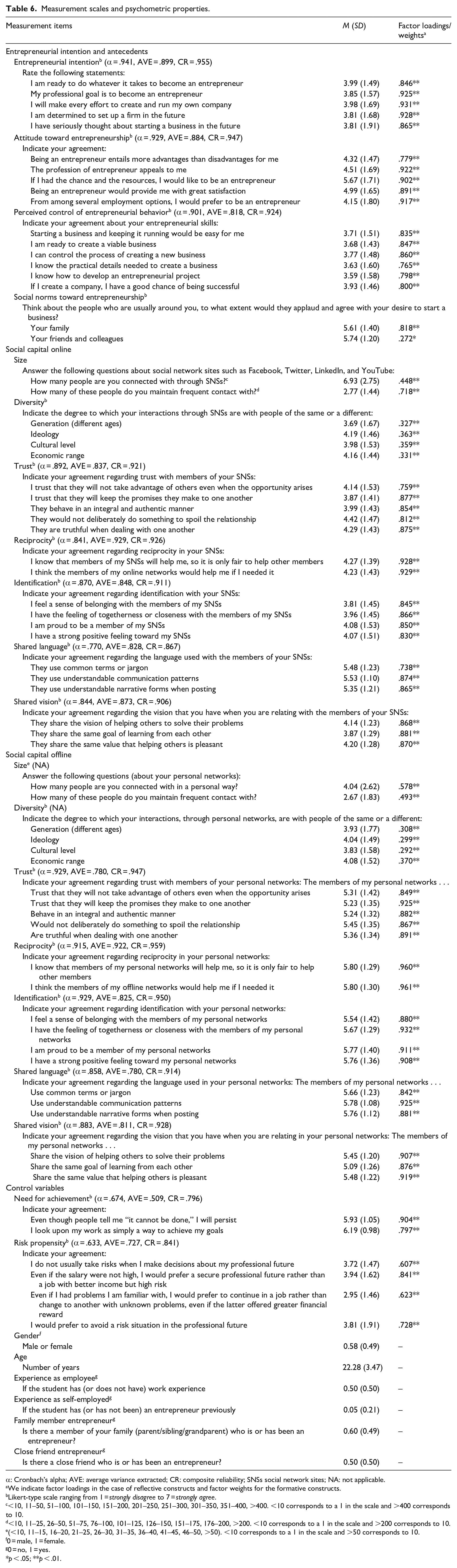
| Measurement items | M (SD) | Factor loadings/weights a |
|---|---|---|
| Entrepreneurial intention and antecedents | ||
| Entrepreneurial intention b (α = .941, AVE = .899, CR = .955) | ||
| Rate the following statements: | ||
| I am ready to do whatever it takes to become an entrepreneur | 3.99 (1.49) | .846** |
| My professional goal is to become an entrepreneur | 3.85 (1.57) | .925** |
| I will make every effort to create and run my own company | 3.98 (1.69) | .931** |
| I am determined to set up a firm in the future | 3.81 (1.68) | .928** |
| I have seriously thought about starting a business in the future | 3.81 (1.91) | .865** |
| Attitude toward entrepreneurship b (α = .929, AVE = .884, CR = .947) | ||
| Indicate your agreement: | ||
| Being an entrepreneur entails more advantages than disadvantages for me | 4.32 (1.47) | .779** |
| The profession of entrepreneur appeals to me | 4.51 (1.69) | .922** |
| If I had the chance and the resources, I would like to be an entrepreneur | 5.67 (1.71) | .902** |
| Being an entrepreneur would provide me with great satisfaction | 4.99 (1.65) | .891** |
| From among several employment options, I would prefer to be an entrepreneur | 4.15 (1.80) | .917** |
| Perceived control of entrepreneurial behavior b (α = .901, AVE = .818, CR = .924) | ||
| Indicate your agreement about your entrepreneurial skills: | ||
| Starting a business and keeping it running would be easy for me | 3.71 (1.51) | .835** |
| I am ready to create a viable business | 3.68 (1.43) | .847** |
| I can control the process of creating a new business | 3.77 (1.48) | .860** |
| I know the practical details needed to create a business | 3.63 (1.60) | .765** |
| I know how to develop an entrepreneurial project | 3.59 (1.58) | .798** |
| If I create a company, I have a good chance of being successful | 3.93 (1.46) | .800** |
| Social norms toward entrepreneurship b | ||
| Think about the people who are usually around you, to what extent would they applaud and agree with your desire to start a business? | ||
| Your family | 5.61 (1.40) | .818** |
| Your friends and colleagues | 5.74 (1.20) | .272* |
| Social capital online | ||
| Size | ||
| Answer the following questions about social network sites such as Facebook, Twitter, LinkedIn, and YouTube: | ||
| How many people are you connected with through SNSs? c | 6.93 (2.75) | .448** |
| How many of these people do you maintain frequent contact with? d | 2.77 (1.44) | .718** |
| Diversity b | ||
| Indicate the degree to which your interactions through SNSs are with people of the same or a different: | ||
| Generation (different ages) | 3.69 (1.67) | .327** |
| Ideology | 4.19 (1.46) | .363** |
| Cultural level | 3.98 (1.53) | .359** |
| Economic range | 4.16 (1.44) | .331** |
| Trust b (α = .892, AVE = .837, CR = .921) | ||
| Indicate your agreement regarding trust with members of your SNSs: | ||
| I trust that they will not take advantage of others even when the opportunity arises | 4.14 (1.53) | .759** |
| I trust that they will keep the promises they make to one another | 3.87 (1.41) | .877** |
| They behave in an integral and authentic manner | 3.99 (1.43) | .854** |
| They would not deliberately do something to spoil the relationship | 4.42 (1.47) | .812** |
| They are truthful when dealing with one another | 4.29 (1.43) | .875** |
| Reciprocity b (α = .841, AVE = .929, CR = .926) | ||
| Indicate your agreement regarding reciprocity in your SNSs: | ||
| I know that members of my SNSs will help me, so it is only fair to help other members | 4.27 (1.39) | .928** |
| I think the members of my online networks would help me if I needed it | 4.23 (1.43) | .929** |
| Identification b (α = .870, AVE = .848, CR = .911) | ||
| Indicate your agreement regarding identification with your SNSs: | ||
| I feel a sense of belonging with the members of my SNSs | 3.81 (1.45) | .845** |
| I have the feeling of togetherness or closeness with the members of my SNSs | 3.96 (1.45) | .866** |
| I am proud to be a member of my SNSs | 4.08 (1.53) | .850** |
| I have a strong positive feeling toward my SNSs | 4.07 (1.51) | .830** |
| Shared language b (α = .770, AVE = .828, CR = .867) | ||
| Indicate your agreement regarding the language used with the members of your SNSs: | ||
| They use common terms or jargon | 5.48 (1.23) | .738** |
| They use understandable communication patterns | 5.53 (1.10) | .874** |
| They use understandable narrative forms when posting | 5.35 (1.21) | .865** |
| Shared vision b (α = .844, AVE = .873, CR = .906) | ||
| Indicate your agreement regarding the vision that you have when you are relating with the members of your SNSs: | ||
| They share the vision of helping others to solve their problems | 4.14 (1.23) | .868** |
| They share the same goal of learning from each other | 3.87 (1.29) | .881** |
| They share the same value that helping others is pleasant | 4.20 (1.28) | .870** |
| Social capital offline | ||
| Size e (NA) | ||
| Answer the following questions (about your personal networks): | ||
| How many people are you connected with in a personal way? | 4.04 (2.62) | .578** |
| How many of these people do you maintain frequent contact with? | 2.67 (1.83) | .493** |
| Diversity b (NA) | ||
| Indicate the degree to which your interactions, through personal networks, are with people of the same or a different: | ||
| Generation (different ages) | 3.93 (1.77) | .308** |
| Ideology | 4.04 (1.49) | .299** |
| Cultural level | 3.83 (1.58) | .292** |
| Economic range | 4.08 (1.52) | .370** |
| Trust b (α = .929, AVE = .780, CR = .947) | ||
| Indicate your agreement regarding trust with members of your personal networks: The members of my personal networks . . . | ||
| Trust that they will not take advantage of others even when the opportunity arises | 5.31 (1.42) | .849** |
| Trust that they will keep the promises they make to one another | 5.23 (1.35) | .925** |
| Behave in an integral and authentic manner | 5.24 (1.32) | .882** |
| Would not deliberately do something to spoil the relationship | 5.45 (1.35) | .867** |
| Are truthful when dealing with one another | 5.36 (1.34) | .891** |
| Reciprocity b (α = .915, AVE = .922, CR = .959) | ||
| Indicate your agreement regarding reciprocity in your personal networks: | ||
| I know that members of my personal networks will help me, so it is only fair to help other members | 5.80 (1.29) | .960** |
| I think the members of my offline networks would help me if I needed it | 5.80 (1.30) | .961** |
| Identification b (α = .929, AVE = .825, CR = .950) | ||
| Indicate your agreement regarding identification with your personal networks: | ||
| I feel a sense of belonging with the members of my personal networks | 5.54 (1.42) | .880** |
| I have the feeling of togetherness or closeness with the members of my personal networks | 5.67 (1.29) | .932** |
| I am proud to be a member of my personal networks | 5.77 (1.40) | .911** |
| I have a strong positive feeling toward my personal networks | 5.76 (1.36) | .908** |
| Shared language b (α = .858, AVE = .780, CR = .914) | ||
| Indicate your agreement regarding the language used in your personal networks: The members of my personal networks . . . | ||
| Use common terms or jargon | 5.66 (1.23) | .842** |
| Use understandable communication patterns | 5.78 (1.08) | .925** |
| Use understandable narrative forms when posting | 5.76 (1.12) | .881** |
| Shared vision b (α = .883, AVE = .811, CR = .928) | ||
| Indicate your agreement regarding the vision that you have when you are relating in your personal networks: The members of my personal networks . . . | ||
| Share the vision of helping others to solve their problems | 5.45 (1.20) | .907** |
| Share the same goal of learning from each other | 5.09 (1.26) | .876** |
| Share the same value that helping others is pleasant | 5.48 (1.22) | .919** |
| Control variables | ||
| Need for achievement b (α = .674, AVE = .509, CR = .796) | ||
| Indicate your agreement: | ||
| Even though people tell me “it cannot be done,” I will persist | 5.93 (1.05) | .904** |
| I look upon my work as simply a way to achieve my goals | 6.19 (0.98) | .797** |
| Risk propensity b (α = .633, AVE = .727, CR = .841) | ||
| Indicate your agreement: | ||
| I do not usually take risks when I make decisions about my professional future | 3.72 (1.47) | .607** |
| Even if the salary were not high, I would prefer a secure professional future rather than a job with better income but high risk | 3.94 (1.62) | .841** |
| Even if I had problems I am familiar with, I would prefer to continue in a job rather than change to another with unknown problems, even if the latter offered greater financial reward | 2.95 (1.46) | .623** |
| I would prefer to avoid a risk situation in the professional future | 3.81 (1.91) | .728** |
| Gender f | ||
| Male or female | 0.58 (0.49) | – |
| Age | ||
| Number of years | 22.28 (3.47) | – |
| Experience as employee g | ||
| If the student has (or does not have) work experience | 0.50 (0.50) | – |
| Experience as self-employed g | ||
| If the student has (or has not been) an entrepreneur previously | 0.05 (0.21) | – |
| Family member entrepreneur g | ||
| Is there a member of your family (parent/sibling/grandparent) who is or has been an entrepreneur? | 0.60 (0.49) | – |
| Close friend entrepreneur g | ||
| Is there a close friend who is or has been an entrepreneur? | 0.50 (0.50) | – |
α: Cronbach’s alpha; AVE: average variance extracted; CR: composite reliability; SNSs social network sites; NA: not applicable.
We indicate factor loadings in the case of reflective constructs and factor weights for the formative constructs.
Likert-type scale ranging from 1 = strongly disagree to 7 = strongly agree.
<10, 11–50, 51–100, 101–150, 151–200, 201–250, 251–300, 301–350, 351–400, >400. <10 corresponds to a 1 in the scale and >400 corresponds to 10.
<10, 11–25, 26–50, 51–75, 76–100, 101–125, 126–150, 151–175, 176–200, >200. <10 corresponds to a 1 in the scale and >200 corresponds to 10.
(<10, 11–15, 16–20, 21–25, 26–30, 31–35, 36–40, 41–45, 46–50, >50). <10 corresponds to a 1 in the scale and >50 corresponds to 10.
0 = male, 1 = female.
0 = no, 1 = yes.
p < .05; **p < .01.
Acknowledgements
We are grateful to the participants for their helpful comments.
Author’s note
Previous versions of this paper were presented at the 2016 Asociación Científica de Economía y Dirección de la Empresa. conference and the 2016 British Academy of Management conference.
Declaration of conflicting interests
The author(s) declared no potential conflicts of interest with respect to the research, authorship, and/or publication of this article.
Funding
This study was supported by Ministerio de Economía y Competitividad, Programa Estatal de Fomento de la Investigación Científica y Técnica de Excelencia 2016-2020, project reference ECO2016-78128-P.
