



Abstract
In this study, we expand on the existing work on job crafting by focusing on (1) within-person fluctuation in affective experiences in relation to job crafting and person-job fit and (2) between-person fluctuations in personal growth initiative (PGI) as an important boundary condition of these relationships. Using multilevel data from 116 employees (341 observations), our results showed that fluctuations in positive active emotions (PAE) and negative active emotions (NAE) related positively to daily job crafting; this relationship was moderated by overall PGI levels. Next, we found a positive association between daily job crafting and daily person-job fit. Finally, we found indirect effects from NAE and PGI to daily fluctuations in person-job fit via daily fluctuations in job crafting; NAE and PGI energized employees to engage in daily job crafting, which contributed to their daily person-job alignment. We discuss implications for theory and practice.
Theoretically, job crafters are assumed to be “all around us” (Wrzesniewski & Dutton, 2001, p. 180). By means of job crafting, employees shape their own job to align their job demands and resources with their personal abilities and needs (Tims & Bakker, 2010). However, particular individual characteristics might make it more likely that employees will craft their job and hence experience a better person-job fit. As the fields of organizational psychology and management are seeking to better understand employees optimal functioning at work, job crafting and its effect on an increased person-job fit help to illuminate the job-related actions that employees engage in to move themselves toward more optimal functioning and ultimately to the creation of a work environment characterized by a higher degree of psychological well-being (Berg et al., 2010; French, 2009); increased work engagement and performance and reduced turnover intentions (Bakker et al., 2003, 2004, 2007; Tims et al., 2013); decreased absenteeism and increased performance (Ghitulescu, 2006); increased perceptions of control, higher self-image, and increased readiness to change (Lyons, 2008); overall positive emotions, happiness, and experience of flow (Ko, 2012; Wrzesniewski et al., 2013); increased alignment with personal expectations and fulfillment of valued identities (Grant, 2007); feelings of achievement and enjoyment (Berg et al., 2010); and increased competence and feelings of mastery (Barker, 2007). Overall, job crafting alters the meaning of work, ultimately re-enchanting the organization one works for, as Wrzesniewski and Dutton (2001, p. 186) note: “job crafting changes the meaning of the work by changing job tasks or relationships in ways that allow employees to reframe the purpose of the job and experience the work differently.”
To date, the majority of the empirical studies on job crafting accounts for between-person differences in job crafting and examines its between-person correlates. However, job crafting does not only differ between individuals, but it also shows within-person variation at, for example, the daily level (Demerouti et al., 2015; Petrou et al., 2012; Tims et al., 2013). In the current study, we therefore include job crafting at the daily level to capture important differences that are observed within the same person when they are assessed over time; thus accounting for intra-individual variation in job crafting, and its antecedents and outcomes. Although job crafting scholars theoretically assume that everyone engages in job crafting, at least to some extent, they also agree that some individual characteristics (e.g., work orientation, proactive personality, regulatory focus) impact job crafting (Bakker et al., 2012; Brenninkmeijer & Hekkert-Koning, 2015).
Building on this, we broaden the functional trait perspective in relation to proactive behavior (Wu et al., 2013) and argue that malleable individual characteristics (i.e., state and state-like characteristics) enhance job crafting because they fulfill necessary functions to engage in proactive behavior. More specifically, we studied daily fluctuations in active work-related emotions as antecedents of daily fluctuations of job crafting because, especially at a daily level, active emotions might urge people to engage in job crafting. Indeed, fluctuations in job crafting have been found to be positively related to less job boredom and more work engagement, which over time accumulates in the collection of more job resources and triggers further job crafting behaviors (Harju et al., 2016), thus contributing to potential long-term benefit of high-arousal mood states such as interest, engagement, and enthusiasm (Løvoll & Vittersø, 2014), all of which contribute to sustained well-being and proactivity in the workplace. Such high levels of well-being at work are in the best interest of both employees and organizations alike. We, moreover, opted to include personal growth initiative (PGI) as a state-like characteristic over other state-like characteristics such as self-efficacy or hope, because PGI explicitly taps into the self-regulatory processes such as envisioning and planning (Parker et al., 2010) preceding proactive behavior and hence job crafting. These daily fluctuations in emotions and stable differences in PGI fuel daily fluctuations in job crafting via two main mechanisms, namely energy and human agency. At the within-person level, we account for the day-to-day variation in work-related emotions, which are very malleable. We thus expect that daily fluctuations in active work-related emotions energize employees to engage in job crafting at the daily level (Wu et al., 2013). At the between-person level, we argue that PGI is a valuable antecedent of daily fluctuations in job crafting because it triggers employees’ agency to actively change the environment (Robitschek, 1998; Wu et al., 2013). More specifically, this means that employees who score higher on PGI have the capacity to make voluntary choices with respect to their job and to impose those choices onto their work; high scorers on PGI have a more profound ability to intentionally focus on a desire to change and grow, akin to possessing the cognitive and behavioral ability to take control over their environment and implement the necessary changes for growth (Robitschek, 1998). Indeed, several studies found that individuals with high PGI are better able to manage stressor and make necessary and desired adjustments to their environment (Yakunina, Weigold, & Weigold, 2013; Yakunina, Weigold, Weigold, Hercegovac, & Elsayed, 2013) Despite some level of malleability of PGI (e.g., through training; Robitschek, 1998), it is relatively stable and it is therefore relevant to include PGI at the between-person level. Furthermore, we expect daily fluctuations in work-related emotions and PGI to interact in the prediction of daily fluctuations in job crafting.
Second, because job crafting theoretically entails the purpose of thriving for an optimal person-job fit (Tims & Bakker, 2010; Wrzesniewski & Dutton, 2001) and contributes empirically to a better alignment between person and job (Chen et al., 2014; Lu et al., 2014; Tims et al., 2016), we investigate whether daily fluctuations in job crafting also contribute to daily fluctuations in person-job fit at a within-person level. Investigating these daily dynamics is relevant given that person-job fit has been found to be a promising pathway from job crafting to enhanced work engagement (Chen et al., 2014) and meaningfulness (Tims et al., 2016). More generally, the findings of this study contribute to a better understanding of how daily fluctuations in work-related emotions may transform contemporary workplaces into enchanting and meaningful workplaces characterized by employees who proactively engage in job crafting behaviors to ultimately experience a better person-job fit. In line with the work by Boje and Baskin (2011), enchanted and meaningful workplaces are characterized by employees who are active agents of their own lives and work; they engage in the necessary activities (i.e., job crafting) to ensure that they find meaning in their work and, in doing so, are happy, resilient, passionate, motivated, healthy at work, and experience that they belong to their job and place of work (i.e., person-job fit).
In what follows, we first present the concept of job crafting. Second, we detail the roles of work-related emotions at the within-person level and PGI at the between-person level as antecedents of daily fluctuations in job crafting. Third, we elaborate on the relationship between daily fluctuations in job crafting and daily fluctuations in person-job fit. Finally, we present the overall research model by also including the indirect relationships from daily fluctuations in work-related emotions and overall PGI to daily fluctuations in person-job fit via daily fluctuations in job crafting.
Literature review and hypothesis development
Job crafting
Job crafting emerges as a promising individual behavior in the contemporary world of work which is increasingly characterized by change, uncertainty, and the call for flexibility (Grant & Parker, 2009; Wrzesniewski & Dutton, 2001). Wrzesniewski and Dutton (2001) introduced the term job crafting as the changes employees make in the task, relational, and cognitive boundaries of their job to achieve meaning and identity at work. Tims and Bakker (2010) embed job crafting in the job demands-resources model (JD-R; Bakker et al., 2014) and conceptualize job crafting as the actual changes employees make in the levels of job demands and job resources to fit the job with one’s personal abilities and preferences. Despite the initial differentiation in types of crafting of both Wrzesniewski and Dutton, as well as Tims and colleagues and more recently fine grained conceptualizations of types of crafting (Bindl et al., 2019; Zhang & Parker, 2019), recent developments in the field of job crafting approach this construct in a global way (Bruning & Campion, 2018). Accordingly, within this article, we define job crafting as the self-initiated changes employees make to their job to optimize their functioning in terms of well-being, attitudes, and behavior (Vanbelle et al., 2014). The global approach builds on the two main perspectives on job crafting (Tims & Bakker, 2010; Wrzesniewski & Dutton, 2001) because it defines job crafting based on the two shared crucial elements of the other perspectives, namely (1) employees making self-initiated changes to their job with (2) a pro-self-focused purpose. Instead of limiting job crafting to task, relational, and cognitive crafting (Wrzesniewski & Dutton, 2001) or to include only changes in specific job demands and resources, the global approach makes abstraction of the specific type of changes. In addition, whereas other perspectives (especially theoretically) explain different reasons to craft (e.g., creating meaning and identity, Berg et al., 2008; enhancing person-job fit, Tims & Bakker, 2010), the global overarching emphasizes the pro-self-focused purpose and accounts for multiple reasons by referring to the overarching purpose of optimizing one’s functioning in terms of well-being, attitudes, and behavior. In other words, taking a global perspective does not limit job crafting to the employees’ changes in tasks, relations, cognitions, job demands, or job resources. Employees may, for example, also craft their work context (i.e., the workplace), work hours, and physical work environment. It also accounts for multiple reasons to craft, such as creating meaning and work identity (Berg et al., 2008; Wrzesniewski & Dutton, 2001) or enhancing one’s person-job fit (Tims & Bakker, 2010), because it refers to the overarching purpose of optimizing one’s functioning in terms of well-being, attitudes, or behavior.
In general, overall job crafting was found to be associated with a series of immediate and long-term positive outcomes which directly benefit the individual, its surroundings, and the wider organization such as increased alignment with personal expectations and fulfillment of valued identities (Grant, 2007), feelings of achievement and enjoyment (Berg et al., 2010), increased competence and feelings of mastery (Barker, 2007), increased job satisfaction (Ghitulescu, 2006; Kim et al., 2018; Tims et al., 2013), self- and other-rated work performance (Bakker et al., 2012; Petrou et al., 2015; Tims et al., 2015), creativity and contextual performance (Demerouti et al., 2015), in-role and extra-role performance (Bakker et al., 2012; Cenciotti et al., 2017; Dierdorff & Jensen, 2018; Kooij et al., 2017; Rofcanin et al., 2019; Tims et al., 2015) and reduced counterproductive behavior (Esteves & Lopes, 2017), and increased customer satisfaction and organizational success (Kanten, 2014), all of which may positively contribute to the enhancement of one’s meaning of work and ultimately making both the individual and organization better able to cope with potential future adversity.
Individual characteristics and job crafting
Individual characteristics play a role in the prediction of proactive behaviors (Wu et al., 2013) such as job crafting (Bakker et al., 2012; Brenninkmeijer & Hekkert-Koning, 2015). The current study focuses on individual characteristics at both the within- and between-person level (Luthans et al., 2007), namely active emotions and PGI, respectively. We thereby build on a functional classification of individual characteristics to derive our hypotheses (Mayer, 2015; Wu et al., 2013). Luthans and Youssef (2007) distinguish four categories of individual characteristics according to their malleability. On the one extreme of the continuum, they fit the very stable and unmalleable traits (e.g., intelligence, talents), which are more stable than the trait-like aspects (e.g., the core self-evaluations) which are difficult to change. Next on the continuum, they situate the relatively malleable and open to development state-like characteristics (e.g., self-efficacy, hope, optimism, and resilience). The momentary and very changeable states (e.g., moods, emotions) occupy the other extreme of the continuum. Hence, traits, trait-like, and state-like characteristics are relevant at a between-person level to explain differences between persons. Even state-like characteristics fit at the between-person level as they are only malleable in the sense that they might be influenced through training but they do not change with each momentary situation (i.e., they are unlikely to fluctuate on a daily or weekly level for example). Because they are more stable in the short run, they are less suited to be included at a within-person level of analysis (Luthans & Youssef, 2007). Momentary states, in contrast, should be investigated at a within-person level to explain differences within persons (e.g., within the same person over consecutive days). We focus on two types of individual characteristics as antecedents of daily job crafting, namely active emotions as momentary states at the within-person level and PGI as a state-like characteristic at the between-person level.
Individual characteristics: emotions and PGI
Emotions are dynamic, show high levels of variation within the same person, and are highly sensitive to external stimuli which make them especially relevant to be studied on a daily basis (Luthans et al., 2007; Van der Heijden et al., 2014). Traditionally, emotions can be positioned within a circumplex, varying along the dimensions of valence and activation (Warr et al., 2014). Valence refers to the pleasantness of the emotions and ranges from unpleasant or negative to pleasant or positive. Activation refers to a sense of mobilization or energy and ranges from passive to active. The combination of these dimensions leads to four kinds of emotions: (1) positive active emotions (PAE; for example, enthusiastic), (2) positive passive emotions (PPE; for example, contented), (3) negative active emotions (NAE; for example, angry), and (4) negative passive emotions (NPE; for example, dejected). Moreover, PGI refers to the active, intentional engagement in the process of personal growth, including both cognitive and behavioral components of self-efficacy. PGI “is an orientation toward change and growth across life domains” and “can be thought of as a metacognitive construct, an awareness and control of intentional engagement in growth enhancing cognitions and behaviors in all areas of life” (Robitschek, 1998, p. 184). Although PGI shares some resemblance with other personal resources such as self-efficacy and hope, it is clearly distinct. With respect to the difference between PGI and self-efficacy, self-efficacy has traditionally been viewed as an important antecedent of PGI because PGI has been posited to reflect the cognitive components of self-efficacy “including beliefs, attitudes and values that support personal growth” (Robitschek, 1998, p. 184) but, and more importantly, PGI has the ability to translate growth-related self-efficacy cognitions (e.g., “knowing what is needed to get started toward reaching personal goals”) into behavioral aspects (e.g., “having an action plan to help one reaching personal goals”). Moreover, existing empirical research has indeed established a positive relationship between self-efficacy as an antecedent of PGI (e.g., Ogunyemi & Mabekoje, 2007; Sharma & Rani, 2013; Weigold et al., 2014). With respect to the difference between PGI and hope, it is important to keep in mind that both PGI and hope involve cognitive agency, personal goal-setting, and the development of pathways toward personal goals; the concept of PGI is more geared toward goals related to personal change and its implementation in daily life (Robitschek, 1998). In contrast, the concept of hope assesses perceived abilities to strategize and achieve goals more generally. In other words, while hope and hopeful thinking connotes one’s desire to pursue the goal to build upon or add to what already exists, it does not specifically relate to personal change and its implementation in daily life. As such, hope constitutes an additive process related to temporally distinct goals, whereas PGI is characterized by transitory goal achievement and implementation of said goals in one’s daily life with the objective of achieving long-term life directions. Moreover, Shorey and colleagues (2007) found that PGI and hope are distinct yet related constructs. Given that job crafting is an individually change-oriented behavior to optimize one’s functioning, to strive for personal goals, PGI might be an especially relevant antecedent.
Individual characteristics and job crafting: a functional classification approach
Besides a malleability classification alongside the trait-state continuum, individual characteristics can also be categorized according to their function or the way they influence behavior, which is referred to as a functional classification approach of individual characteristics (Buss & Finn, 1987; Mayer, 2015). Buss and Finn (1987) distinguish three types of traits that fulfill three distinct functions: (1) cognitive traits enhance employees’ thinking and envisioning; (2) affective traits energize employees; and (3) instrumental traits entail employees’ mastering, planning, and behavioral intentions. This functional classification approach has already been used to understand the role of traits in the prediction of proactive behavior (Wu et al., 2013). In the current study, we broaden Wu et al.’s (2013) trait perspective and argue that individual characteristics (i.e., active emotions at the within-person level and PGI at the between-person level) may fulfill the functions needed to engage in job crafting at a daily level. Furthermore, we integrate the three types of functions into two underlying mechanisms (i.e., energy and human agency) to derive our hypotheses, thereby building on the literature on proactivity and work psychology (Parker et al., 2010).
The first mechanism entails “energy” and fulfills the energizing function of affective individual characteristics. At a daily basis, especially active emotions may be relevant in relation to job crafting because they urge employees to respond to a situation in the short run (Parker et al., 2010). Active emotions—be it negative (NAE) or positive (PAE)—entail a high motivational intensity or energizing function and indicate employees’ goal-directedness (Harmon-Jones et al., 2013) and readiness for action (Bindl et al., 2012). More specifically, we argued that daily active emotions (both NAE and PAE) fulfill an energizing function. In the short run, namely at a daily level, NAE and PAE urge employees to behaviorally respond. That is, both PAE and NAE may trigger proactive behavior, either to pursuit personal goals in case of PAE, or to react to a negative situation or stimulus in case of NAE (Bindl et al., 2012; Parker et al., 2010; Warr et al., 2014). PAE likely broadens thought-action repertoires, enhances the ability to generate distinct, creative ideas and to come up with diverse solutions to deal with specific situations which are beneficial to proactivity, and hence job crafting (Fredrickson, 2004; Parker et al., 2010). Daily NAE may trigger employees’ desire to relieve negative feelings and to reduce the discrepancy between the actual and desired emotional state (Parker et al., 2010). NAE may thus actively signal an undesirable current situation which urges employees to craft their job (Yu, 2009). In other words, the activation dimension of affect translates discrete experienced emotions into immediate behavioral reactions, regardless of the valence of the emotion. Active emotions are so salient at the very moment that they urge people to behaviorally respond in the short run. People have to deal with the amount of energy they are feeling, either to react on a negative situation or stimulus in case of negative active affect, or to act upon the object of positive active affect (see Warr & Inceoglu, 2012). The motivational intensity or activation of affective emotions drives goal-directed behavior such as job crafting (“motivational intensity perspective”; Harmon-Jones et al., 2013). Job crafting has indeed been found to be positively related to less job boredom and more work engagement, which over time accumulates in the collection of more job resources and triggers further job crafting behaviors (Harju et al., 2016), thus contributing to potential long-term benefit of high-arousal mood states such as interest, engagement, and enthusiasm (Løvoll & Vittersø, 2014); all of which contribute to sustained well-being and proactivity in the workplace. Such high levels of well-being at work are in the best interest of both employees and organizations alike.
In contrast, passive emotions are more likely to be related to the cognitive elements of the proactivity process and are hence considered to be more distal antecedents of proactivity (Parker et al., 2010). Passive emotions (i.e., PPE and NPE), on the contrary, allow people to cognitively disengage from a specific goal or situation, to reflect on situations (Warr & Inceoglu, 2012), and to envision new goal opportunities (Harmon-Jones et al., 2013) which might precede proactive behavior (Parker et al., 2010). Although Wang and colleagues (2020) recently showed that dissatisfaction (an exemplary passive emotion) with one’s career leads to job crafting under conditions of high social support and self-efficacy, their study was semi-longitudinal in nature with a 3-month time lag between both measurement moments. As a consequence of this long time lag, sufficient time has passed for passive emotions to have energized respondents’ willingness to change their situation (e.g., dissatisfaction with one’s career) and craft their jobs. We thus argue that PPE and NPE might thus trigger proactive behavior, such as job crafting, within a longer time frame but not within a day or from one day to the next day. Together, this brings us to the following hypotheses:
Hypothesis 1. Within-person fluctuations in PAE (H1a) and NAE (H1b) are positively related to within-person fluctuations in job crafting.
Hypothesis 2. Within-person fluctuations in PPE (H2a) and NPE (H2b) are not related to within-person fluctuations in job crafting.
The second mechanism through which individual differences may relate to job crafting concerns “human agency,” which entails both functions of cognitive (i.e., thinking and envisioning) and instrumental (i.e., mastering and planning) individual characteristics. Proactive behavior, and hence job crafting, relies on the employees’ ability to act upon the work environment, to take initiative, and to engage in self-regulation which is referred to as human agency (Van der Heijden et al., 2014; Wu et al., 2013). Given that PGI entails both cognitive aspects (i.e., knowing what goals to reach and which pathways to follow) and behavioral or instrumental aspects (i.e., making plans to reach the goals), we expect PGI to positively influence job crafting. Therefore, we hypothesize:
Hypothesis 3. PGI has a direct positive cross-level effect on daily fluctuations in job crafting such that individuals scoring high on PGI engage more in daily job crafting.
Cross-level interaction of PGI and work-related emotions
Investigating the link between more stable personal resources (i.e., PGI) and within-person processes (i.e., fluctuations in active emotions) contributes to our understanding of individual job crafting behavior. Situation-influenced antecedents of behavior, such as daily emotions, may have a different impact on daily behavior depending on more general personal resources such as PGI (Mischel & Shoda, 1998). Hence, we expect active emotions and PGI to interact in relation to daily job crafting as their functions might reinforce each other. This is in line with the assumption of the Conservation of Resources (COR) theory that having a stronger resource pool may help employees to engage in more proactive behavior (Hobfoll, 1989). This line of thought is also in line with Mayer’s (2015) functional classification approach in which he argues that functional areas of individual characteristics work together through dynamics of action (between energizing and mastering) and dynamics of self-control (between envisioning, thinking, and mastering). To account for these interplays, we include PGI as a cross-level moderator of the within-person relationship between active emotions (both PAE and NAE) and job crafting. Given that a high PGI increases the pool of resources employees have at hand, and PGI provides employees with agency and persistence, we expect that those employees who score high on PGI will be more energized by PAE and NAE to craft their job the most. In contrast, and in line with the above argument that passive emotions (both PPE and NPE) need more time to be translated into concrete proactive behavior, such as job crafting, because they lack the energy required to energize individuals’ willingness to change their situation (e.g., dissatisfaction with one’s career) and craft their jobs, we expect that PGI will not moderate the already non-existing relationship between daily fluctuations in PPE and NPE and daily fluctuations on job crafting. Taken together, we hypothesize:
Hypothesis 4. PGI moderates the within-person relationship between daily fluctuation in PAE (H4a) and NAE (H4b) and daily fluctuations in job crafting such that for those who score high on PGI, experiencing PAE and NAE will more strongly positively relate to job crafting.
Hypothesis 5. In the absence of a relationship between daily fluctuations in PPE and NPE and daily job crafting, PGI does not moderate the within-person level relationship between daily fluctuations in PPE (H5a) and NPE (H5b) and daily fluctuations in job crafting.
Job crafting and person-job fit
Job crafting scholars agree that striving for a better person-job fit aligns with the inherent purpose of job crafting (Tims & Bakker, 2010): by means of job crafting employees “act upon the job to create a better fit” (Wrzesniewski & Dutton, 2001, p. 188), they “customize [their job] to fit their own sense of what the job should be” (p. 185). Job crafting can therefore be classified as a “proactive fit behavior” given that “employees seek to ‘make jobs fit’ by proactively modifying their jobs to match their values, skills and preferences” (Grant & Parker, 2009, p. 347). Despite the agreement on the inherent connection of person-job fit to the concept of job crafting, the positive empirical relationship between these constructs has only rarely been demonstrated at the between-person level (Chen et al., 2014; Lu et al., 2014). Tims et al. (2016) demonstrated the temporal relationship between job crafting and person-job fit at a weekly level, but because job crafting may also occur on a daily basis (Petrou et al., 2012), we add to the literature by hypothesizing positive associations between job crafting and fit at a daily level. In this perspective, two types of fits are relevant. On one hand, employees who make changes to their job to optimize their functioning may aim for a greater perceived congruence between their knowledge, skills and abilities, and the demands of the job (i.e., demands-abilities fit; DA-fit). On the other hand, they may shape their job to achieve a better perceived congruence between their needs, preferences and desires, and what the job has to offer (i.e., needs-supplies fit; NS-fit; Cable & DeRue, 2002). Moreover, increased person-job fit as a consequence of fluctuations in job crafting may increase overall job satisfaction (Kim et al., 2018), levels of commitment, performance, dedication, and enactment of proactive behaviors (Caesens et al., 2016), ultimately making organizations a better and happier place to work. This brings us to the following hypothesis:
Hypothesis 6. Within-person fluctuations in job crafting are positively related to within-person fluctuations in DA-fit (H6a) and NS-fit (H6b).
Indirect relationships from individual characteristics to person-job fit via job crafting
To complete our research model, we include indirect relationships from daily fluctuations in active emotions (i.e., PAE and NAE) and passive emotions (i.e., PPE and NPE) to daily fluctuations in DA-fit and NS-fit, via daily fluctuations in job crafting. Yu (2009) has developed a theoretical integration of affective influences in relation to person-environment fit. In this article, Yu argues that affective experience may influence one’s desire to craft fit narratives following two distinct perspectives: (1) an affective consistency perspective in which employees are predicted to actively change the way they fit to their job when they realize that they do not currently fit with their job and experience positive affect or when they realize that they currently fit with their job but experience negative affect and (2) a hedonistic perspective in which employees are predicted to actively change the way they fit to their job when they realize that they do not currently fit with their job and experience negative affect. While this proposition paper provides us two competing (affective consistency vs hedonistic) perspectives to account for why work-based affect may influence one’s desire to better fit to one’s job, it attempts to answer a fundamentally different question compared to our article. That is, Yu’s (2009) model assumes that employees will only have a desire to change the fit to their job or environment when they are either confronted with a misalignment between their current fit to the job and their experienced affect or because they are chasing a hedonic high. In contrast, the job crafting literature assumes a third alternative perspective, namely the Matthew effect in which employees are predicted to engage in job crafting and change their fit narratives because they already experience something which is positive (i.e., they already fit with their job) but want to accumulate and capitalize on this positivity (i.e., they want to further improve their already existing fit).
In other words, both PAE and NAE (active emotions) may influence person-job fit because they provide employees with energy and information to actively manage and optimize one’s person-job fit. On one hand, a growth-oriented view on human nature, which goes beyond the tendency toward hedonic pleasure or happiness (Ryan & Deci, 2001), implies that “feeling good” not only “signals optimal functioning [but rather stimulates people to build or] produces optimal functioning” (Fredrickson, 2004, p. 1367). People are motivated to fulfill or realize their “true nature” (Ryan & Deci, 2001, p. 143) and hence are motivated to optimize the alignment of their job with who they are. However, on the other hand, people are also vulnerable to malfunctioning and to experience negative affect, which may signal a suboptimal fit and therefore trigger coping behaviors to reduce the discrepancy between the current and the ideal person-job fit (Edwards, 1992). Both positive and negative experiences (i.e., PAE and NAE) may thus theoretically be beneficial for person-job fit through job crafting. In contrast, when focusing on passive emotions, it is important to note that the experience of passive emotions allows people to disengage from a specific goal and/or objective (Warr & Inceoglu, 2012); it allows for a period of reflection and envision new future objectives (Harmon-Jones et al., 2013). As mentioned earlier, passive emotions might need more time to convert into concrete action and/or a shift in one’s frame of mind (e.g., assessment of fit within the organization). In the absence of the energy required to change one’s cognition about the level of fit with the organization and in the absence of an expected effect of daily fluctuations in PPE and NPE on daily fluctuations of job crafting (see Hypothesis 2a and 2b), we propose that daily fluctuations in passive emotions are not related to daily fluctuations in DA- and NS-fit. Combined, these arguments bring us to the following hypotheses:
Hypothesis 7. Within-person fluctuations in PAE and NAE are positively related to daily fluctuations in DA-fit (H7a and H7b, respectively) and NS-fit (H7c and H7d, respectively) through within-person fluctuations in job crafting.
Hypothesis 8. Within-person fluctuations in PPE and NPE are not related to daily fluctuations in DA-fit (H8a and H8b, respectively) and NS-fit (H8c and H8d, respectively) through within-person fluctuations in job crafting.
Finally, we include indirect relationships from PGI to daily fluctuations in person-job fit, via daily fluctuations in job crafting. PGI as a state-like resource includes human agency to positively encounter the environment by means of job crafting and, as a result, relates to positive outcomes such as a stronger fit and alignment of the job with the person’s characteristics (van Dam, 2013). Moreover, the achievement of a different future and change, and hence person-job fit, is more likely when people are more effectively engaged in the process of both goal-generation and goal-striving (Parker et al., 2010). PGI adds to these processes as it encompasses knowing what and how to strive for, as well as planning and behavioral engagement in the process to personal growth. Therefore, we expect PGI not only to trigger job crafting but as a result to also relate indirectly to increased person-job fit.
Hypothesis 9. PGI is positively associated with within-person fluctuations in DA-fit (H9a) and NS-fit (H9b), through within-person fluctuations in job crafting.
Taken together, our hypothesized model can be summarized as outlined in Figure 1.
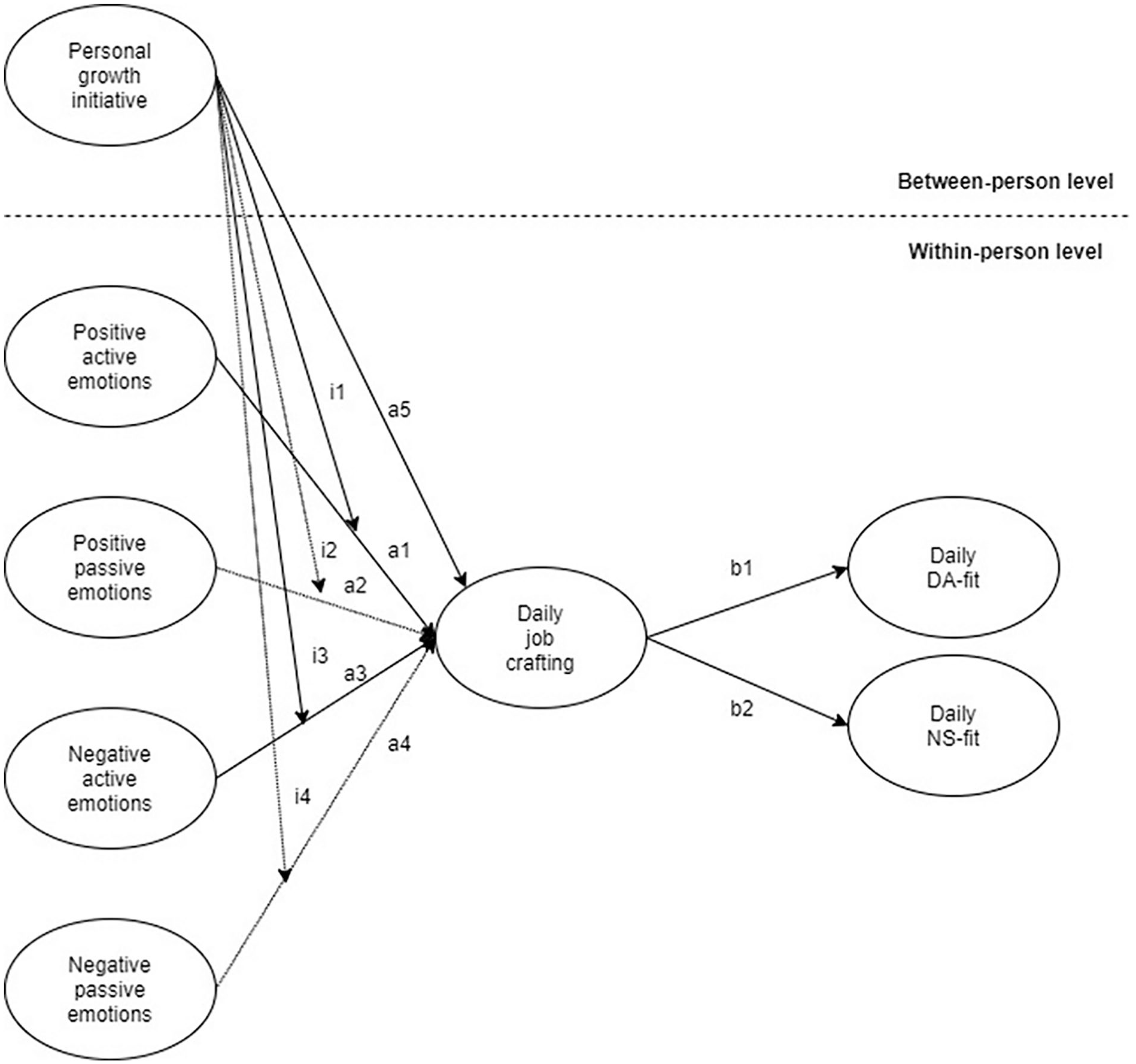
Hypothesized multilevel moderated mediation model. Full lines represent expected positive relationships and dashed lines represent expected non-significant relationships.
Method
Procedure
We conducted a multilevel study, which consisted of a general survey and diary surveys for five consecutive work days. We invited 166 employees via email to take part in an online survey. Those who did not have access to a computer at work received paper-and-pencil survey and a stamped envelope to send their completed survey directly to the research center. We prepared all surveys in Dutch, using a process of translation and back-translation. Of the 166 invited employees, 120 completed the general survey (98.33% responded electronically and 1.77% used the paper-and-pencil survey) and at least one diary survey (response rate: 72.29%; all diary data was collected electronically). Collecting the data mainly electronically allowed us to check the exact date and point of time the survey was filled out for nearly all respondents. We excluded four respondents who completed several diary surveys on the same day.
Because the unit of analysis is “daily surveys” rather than “respondents” (Conway & Briner, 2002) for all within-person hypotheses, the effective sample size was 341 observations (116 respondents × daily surveys), or an average of 2.94 daily surveys per respondent. Irrespective of the number of completed surveys per respondent, this sample size far exceeds the minimum sample requirements (Maas & Hox, 2005). For the cross-level interactions (between-person moderator on a within-person relationship), the unit of analyses is both “respondents” and “daily surveys.” Maas and Hox (2005) found that Level 2 (respondents) sample sizes exceeding 30 in a multilevel framework resulted in an accurate estimation of standard errors. Hence, our sample of 116 respondents had satisfactory power and accuracy. Finally, we would like to note that we did not exclude respondents who dropped out during any point in time throughout the study (i.e., traditionally referred to as listwise deletion), because this approach would result in the loss of valuable information. In contrast, we relied on the Full Information Maximum Likelihood (FIML) method rather than on the more traditional methods to deal with missing data such as listwise deletion, pairwise deletion, and mean imputation because the advantages of the FIML method over these three methods in terms of accuracy of estimation and Type I error reduction have been well documented by comparing the four methods of dealing with missing data by several authors (Duncan et al., 2006; Enders & Bandalos, 2001; Wothke, 2000).
Sample
Our respondents were on average 38 years old (SD = 10.33), 63.8% were female, 42.2% held a university degree, 36.2% a higher education degree, and 21.6% a high school degree. The respondents mainly worked in three main different health care organizations: 34.5% in organization A, 19.0% in organization B, 26.7% in organization C, and 19.8% worked in several other organizations.
Measures
General survey
We used a general survey to collect demographical data (i.e., gender, age, and educational level) and the between-persons variable PGI. PGI was assessed using the original Personal Growth Initiative Scale of Robitschek (1998). Respondents were asked to rate nine items on a 5-point Likert-type scale ranging from 1 (totally disagree) to 5 (totally agree). Example items are as follows: “I know how to change specific things that I want to change in my life” and “I have a specific action plan to help me reach my goals” (α = .79).
Daily survey
Consistent with the recommendations for studies using a diary methodology (e.g., Ohly et al., 2010), we used short scales to ensure a reasonable length and to avoid endangering the compliance of respondents. In addition, to reinforce the daily nature of the survey, all items were worded such that they (1) included “today,” and (2) used the past tense. Finally, level-specific composite reliability (i.e., level-specific ω) was tested using the multilevel confirmatory factor analysis (CFA) approach advocated by Geldhof and colleagues (2014).
Positive and negative emotions were assessed building on the Positive and Negative Affect Schedule (Watson et al., 1988), Russell’s (1980) four-dimensional circumplex, and Warr and colleagues (2014). We asked participants, “To what extent did you experience the following emotions at work today?.” Positive active emotions (PAE) were measured using the following five items: “enthusiastic,” “cheerful,” “inspired,” “energetic,” and “determined.” Based on the CFA results, we excluded the fifth item “determined.” The within-person omega reliability coefficient was .81. Positive passive emotions (PPE) were measured using the following five items: “happy,” “contented,” “calm,” “relieved,” and “relaxed” (ω = .68). Negative active emotions (NAE) were measured using the following seven items: “angry,” “frustrated,” “irritated,” “anxious,” “guilty,” “ashamed,” and “tense” (ω = .79). Negative passive emotions (NPE) were measured with six items, namely “despondent,” “dejected,” “depressed,” “sad,” “bored,” and “fatigued” (ω = .69). All emotions were rated on a 5-point scale ranging from 1 (I did not) tot 5 (I did).
Job crafting was measured using the job crafting scale of Vanbelle et al. (2014). Respondents rated the four items on a 5-point Likert-type scale ranging from 1 (totally disagree) to 5 (totally agree). An example item is: “Today, I made changes in my job to feel better” (ω = .78).
Person-job fit was measured with Cable and DeRue’s (2002) need-supplies (NS) and demands-abilities (DA) scales. An example item of daily demands-abilities fit is “Today, my personal abilities and education provided a good match with the demands that my job places on me.” An example item of needs-supplies fit is “Today, there was a good fit between what my job offered me and what I am looking for in a job.” Each subscale comprised three items rated on a 5-point Likert-type scale ranging from 1 (totally disagree) to 5 (totally agree). The reliabilities of both demands-abilities and needs-supplies fit were satisfying with within-person omega reliability coefficients of .81 and .86, respectively.
Analyses
We used Mplus version 7.11 (Muthén & Muthén, 2013) to conduct CFAs and to test our hypothesized multilevel moderated mediation model. We applied the FIML algorithm for handling missing data and relied on the TWOLEVEL RANDOM option in Mplus to assess the cross-level interaction in our multilevel moderated mediation model (Hox, 2010). In the estimated model, the indirect effects were tested using the product-of-coefficients approach (the product of each a-path with each b-path; see Figure 1). More specifically, we calculated 10 indirect effects, each consisting of the product of the regression coefficient of the association between an antecedent and job crafting (a-paths) and the regression coefficient of the association between job crafting and one of both fit outcomes (b-paths). The significance of these indirect effects was scrutinized by means of 95% bias-corrected confidence intervals (CIs)—hereafter simply referred to as 95% CI—thereby exceeding the minimal of 5,000 bootstrap samples suggested by Preacher and Hayes (2008). To facilitate the comparability of these indirect and direct effects, we will report 95% CI for all effects when discussing the results. Furthermore, we allowed for correlations between (1) the positive and negative emotions and (2) the outcomes. We would like to point out that we did not include any control variables at the between-person level (e.g., age, gender, education), because these do not directly influence the within-person effects.
To assess the added value of a multilevel modeling approach, we estimated the intra-class correlation coefficient (ICC) for PAE, PPE, NAE, NPE, job crafting, DA-fit, and NS-fit (Hox, 2010). We did not estimate an ICC of PGI because this variable was only measured at a between-persons level. The results indicated that a substantial proportion of the variance (ICC values are .52, .48, .43, .42, .48, .48, and .46, respectively) is attributable to within-person fluctuations. Furthermore, given that all ICCs at the day level were higher than .05, we are confident that our data had a nested structure and that investigating the variables at a within-persons level is warranted (Marcoulides & Schumacker, 2009).
Results
Descriptive results
Table 1 presents means, standard deviations, and zero-order and person-centered correlations of study variables.
Means, standard deviations, and zero-order and person-centered correlations.
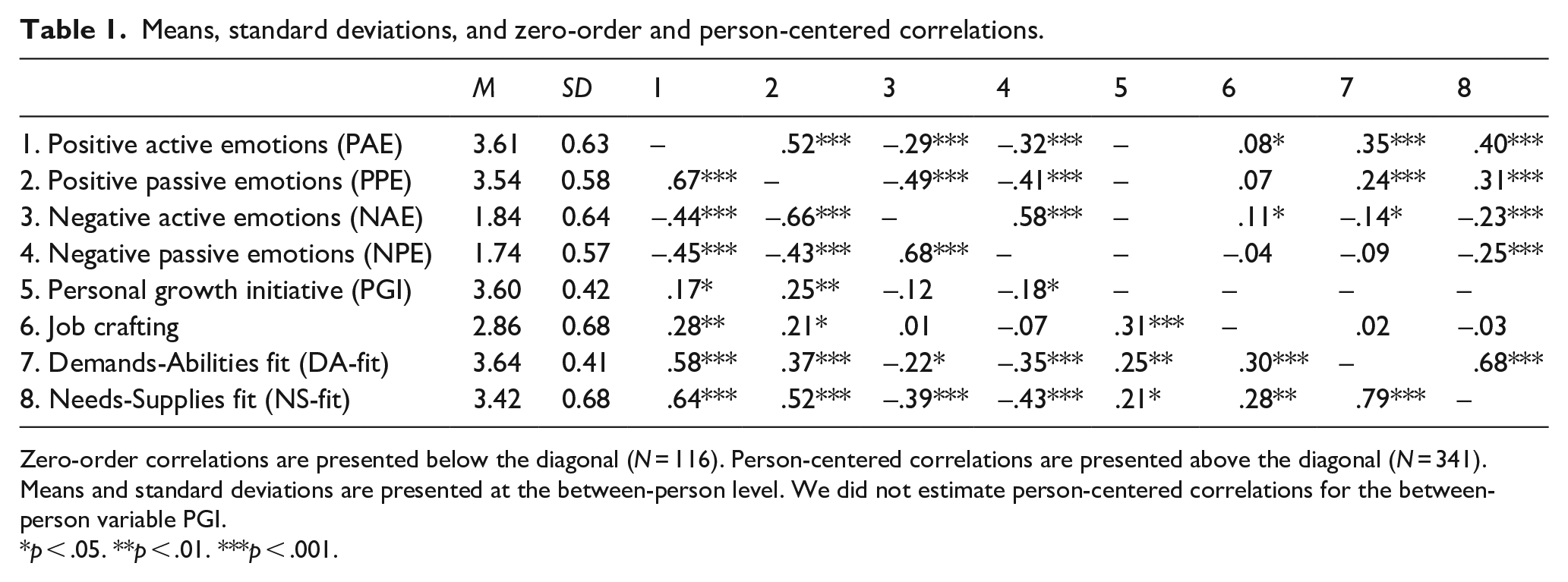
Zero-order correlations are presented below the diagonal (N = 116). Person-centered correlations are presented above the diagonal (N = 341). Means and standard deviations are presented at the between-person level. We did not estimate person-centered correlations for the between-person variable PGI.
p < .05. **p < .01. ***p < .001.
CFAs
We conducted CFAs in Mplus version 7.11 (Muthén & Muthén, 2013) in which we accounted for the nested structure of our data (i.e., daily surveys’ nested within “respondents”). The fit statistics are presented in Table 2. The first measurement model (M1) is the hypothesized model, including the following eight latent factors: PAE, PPE, NAE, NPE, PGI, job crafting, DA-fit, and NS-fit. Seven alternative CFA models were estimated: one alternative model comprised the same eight latent factors and a common method factor (M1*), three alternative models comprised seven latent variables (M2, M3, M4), one model consisted of six latent factors (M5), one model consisted of five latent variables (M6), and one model included four latent variables (M7).
Fit statistics for the models based on confirmatory factor analyses accounting for nested data structure (Nindividuals = 116; Nobservations = 341).
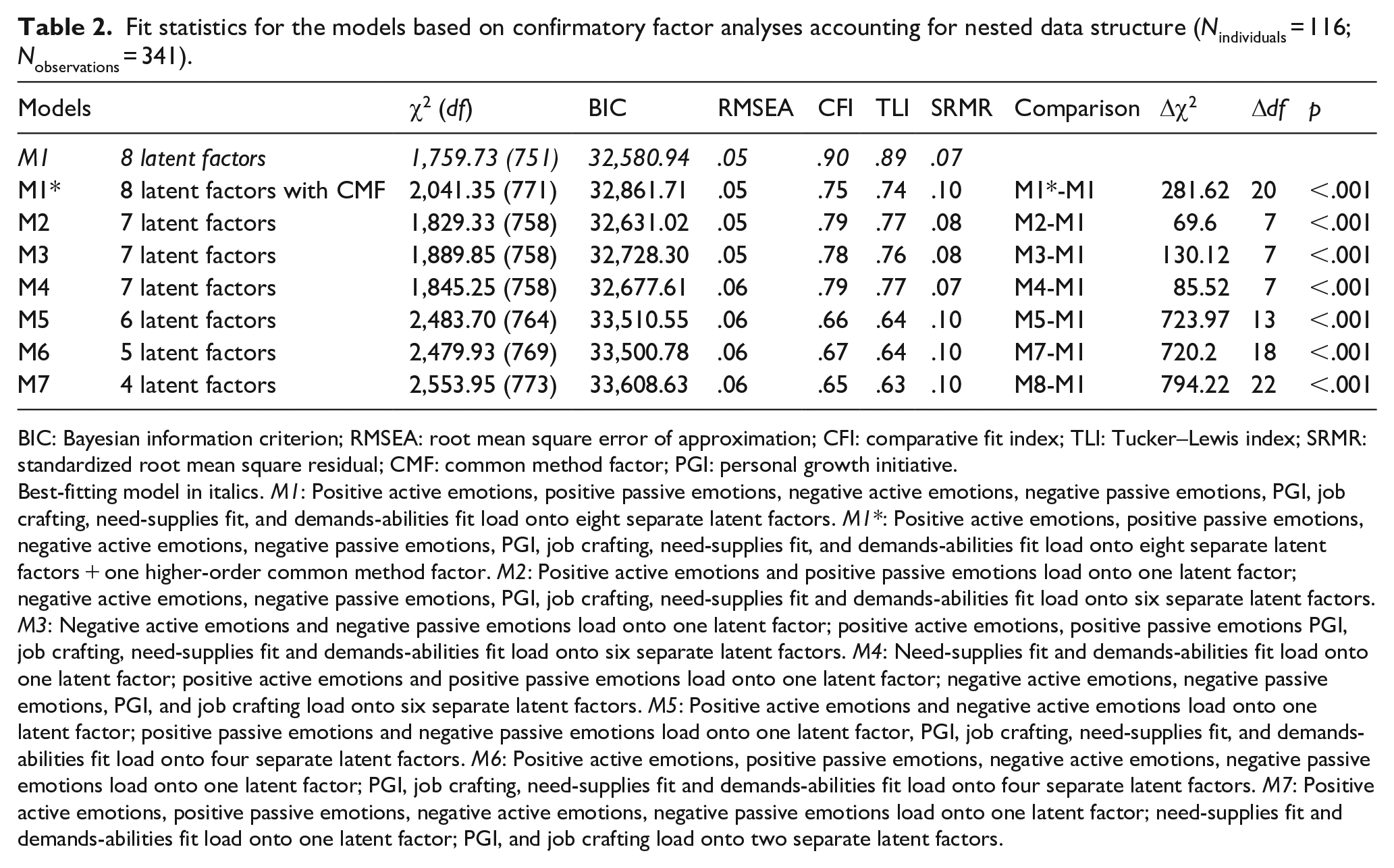
BIC: Bayesian information criterion; RMSEA: root mean square error of approximation; CFI: comparative fit index; TLI: Tucker–Lewis index; SRMR: standardized root mean square residual; CMF: common method factor; PGI: personal growth initiative.
Best-fitting model in italics. M1: Positive active emotions, positive passive emotions, negative active emotions, negative passive emotions, PGI, job crafting, need-supplies fit, and demands-abilities fit load onto eight separate latent factors. M1*: Positive active emotions, positive passive emotions, negative active emotions, negative passive emotions, PGI, job crafting, need-supplies fit, and demands-abilities fit load onto eight separate latent factors + one higher-order common method factor. M2: Positive active emotions and positive passive emotions load onto one latent factor; negative active emotions, negative passive emotions, PGI, job crafting, need-supplies fit and demands-abilities fit load onto six separate latent factors. M3: Negative active emotions and negative passive emotions load onto one latent factor; positive active emotions, positive passive emotions PGI, job crafting, need-supplies fit and demands-abilities fit load onto six separate latent factors. M4: Need-supplies fit and demands-abilities fit load onto one latent factor; positive active emotions and positive passive emotions load onto one latent factor; negative active emotions, negative passive emotions, PGI, and job crafting load onto six separate latent factors. M5: Positive active emotions and negative active emotions load onto one latent factor; positive passive emotions and negative passive emotions load onto one latent factor, PGI, job crafting, need-supplies fit, and demands-abilities fit load onto four separate latent factors. M6: Positive active emotions, positive passive emotions, negative active emotions, negative passive emotions load onto one latent factor; PGI, job crafting, need-supplies fit and demands-abilities fit load onto four separate latent factors. M7: Positive active emotions, positive passive emotions, negative active emotions, negative passive emotions load onto one latent factor; need-supplies fit and demands-abilities fit load onto one latent factor; PGI, and job crafting load onto two separate latent factors.
We evaluated model fit for each of these CFA models based on the root mean square error of approximation (RMSEA), the comparative fit index (CFI), the Tucker–Lewis index (TLI), and the standardized root mean square residual (SRMR). Based on the recommendations of Schreiber and colleagues (2006), a model was considered to offer a good fit to the data when CFI and TLI values were in the mid .90’s or higher, and when RMSEA and SRMR values were 0.08 or less. In line with these criteria, the hypothesized measurement model (M1) had an acceptable fit with the data. In addition, we compared all competing models (M1*-M6) to our theoretical model (M1) using a χ2-difference test. The χ2-difference test indicated that M1 fit the data significantly better than all alternative models. Furthermore, when comparing the Bayesian information criterion (BIC)—which represents the balance between the number of parameters (i.e., model complexity) and the fit of the model to the data (Aiken et al., 1991)—the hypothesized model is the one with the lowest BIC value and thus the best fit to the data. Hence, it will guide our hypotheses testing.
Hypotheses testing
Prior to presenting the results, we assessed whether the full or partial multilevel moderated mediation model fit the data best. The BIC and sample size–adjusted BIC value identified the full multilevel moderated mediation model as the one that fits the data best (BIC = 10,391.40; sample size–adjusted BIC = 10,216.93) compared to the partial multilevel moderated mediation model (BIC = 10,716.59; sample size–adjusted BIC = 10,567.38). Hence, the full multilevel moderated mediation model will guide hypotheses testing.
The estimated paths are presented in Figure 2. As hypothesized, both daily fluctuations in PAE (95% CI = [0.09, 0.93]) and in NAE (95% CI = [0.09, 0.68]) related positively to daily fluctuations in job crafting at the within-person level, supporting Hypothesis 1a and 1b. We did not find significant results concerning the relationship between PPE and job crafting (95% CI = [−0.02, 0.63]) or for the relationship between NPE and job crafting (95% CI = [−0.57, 0.36]), supporting Hypothesis 2a and 2b. Next, our results support Hypothesis 3 because we found a positive cross-level relationship between PGI and daily fluctuations in job crafting (95% CI = [0.04, 0.83]). Furthermore, we found two significant cross-level interactions for PGI and PAE (95% CI = [−0.27, −0.01]) and for PGI and NAE (95% CI = [−0.20, −0.003]) in relation to daily fluctuations in job crafting.
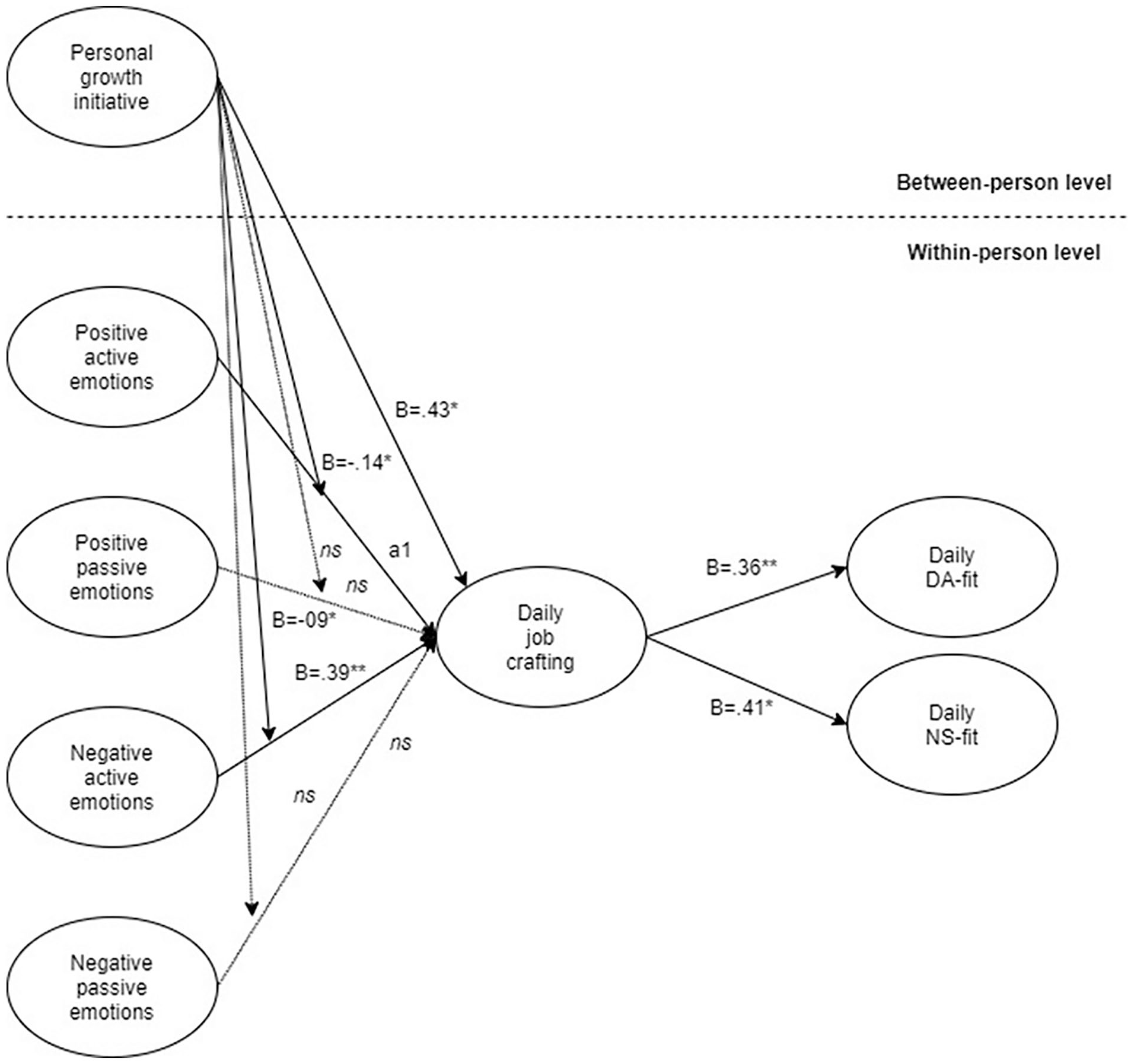
Estimated paths in the full multilevel moderated mediation model.
Moreover, we found that PGI buffered the positive relationships between PAE/NAE and daily job crafting. Both Figures 3 and 4 demonstrate that the strength of the relationship between daily fluctuations in PAE/NAE and daily fluctuations in job crafting was smaller for employees scoring high on PGI in comparison to employees scoring low on PGI. Put differently, daily job crafting was less dependent on daily fluctuations in PAE and NAE when employees had a high PGI. Hypothesis 4a and 4b was thus not supported because we found the opposite moderating impact of PGI than initially expected; namely a buffering effect of PGI on the relationships between both positive and negative active emotions and job crafting instead of a boosting effect. However, Hypotheses 5a and 5b were supported because we found no moderating impact of PGI on the relationship between daily fluctuations in PPE and NPE and daily fluctuations in job crafting.
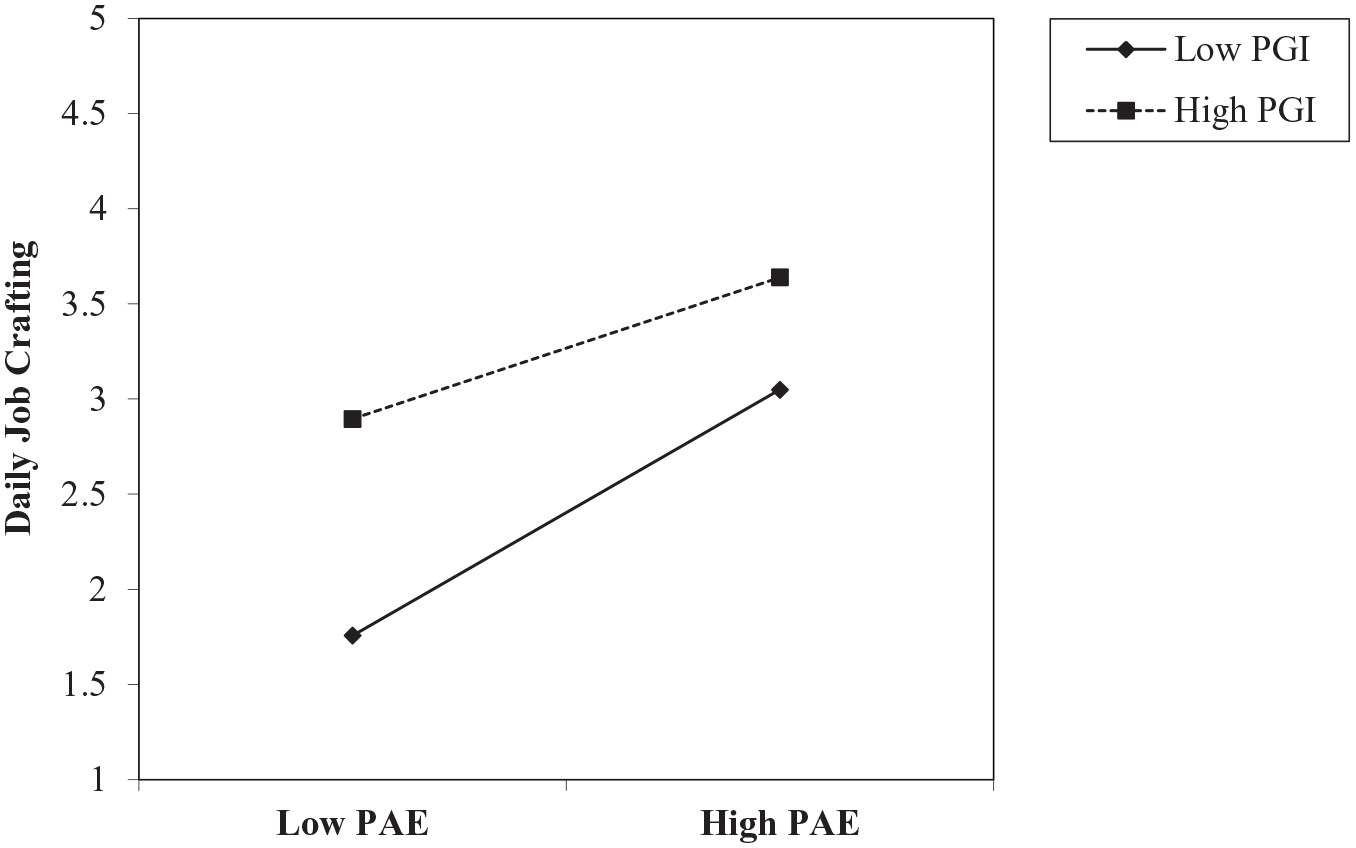
Cross-level interaction of personal growth initiative and positive active emotions in relation to daily job crafting.
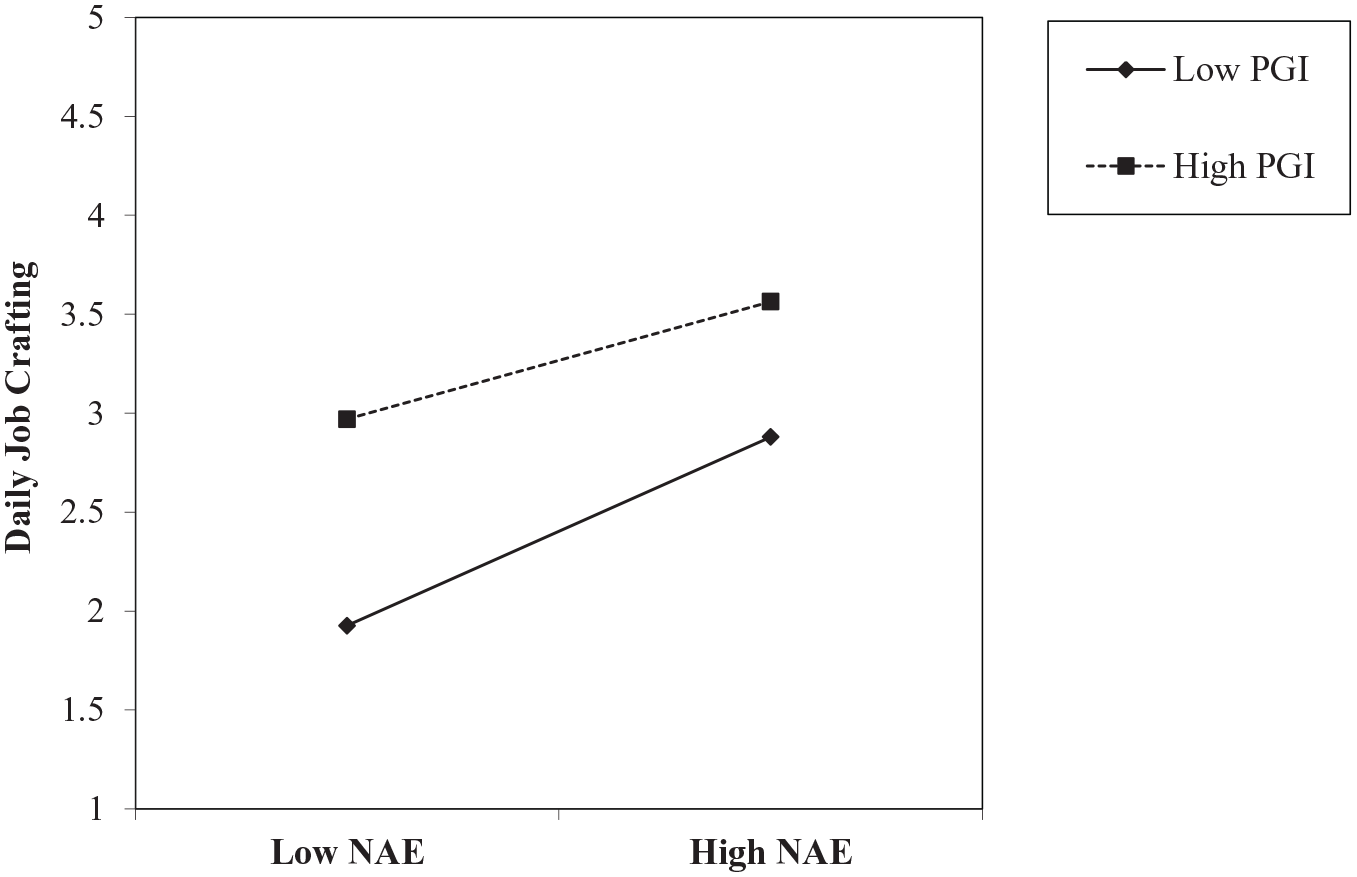
Cross-level interaction of personal growth initiative and negative active emotions in relation to daily job crafting.
With respect to the within-person relationships between daily fluctuations in job crafting and daily fluctuations in person-job fit, our results showed that daily fluctuations in job crafting related positively to daily fluctuations in DA-fit (95% CI = [0.06, 0.66]) and NS-fit (95% CI = [0.01, 0.81]), thereby providing support for Hypotheses 6a and 6b.
Finally, we found significant indirect effects from daily fluctuations in NAE to both daily fluctuations in DA-fit (95% CI = [0.01, 0.27]) and NS-fit (95% CI = [0.01, 0.31]) via daily fluctuations in job crafting, thereby providing support for Hypothesis 7b and 7d, respectively. Our results also supported Hypothesis 8a through 8d because we did not find significant indirect relationships from daily fluctuations in PPE and NPE to daily fluctuations in DA-fit (95% CI = [−0.02, 0.24]; 95% CI = [−0.05, 0.30], respectively) and NS-fit (95% CI = [−0.23, 0.15]; 95% CI = [−0.27, 0.18], respectively) via daily fluctuations in job crafting. Moreover, we also found support for hypothesis 9 because we found significant indirect effects from PGI to both daily fluctuations in DA-fit (95% CI = [0.04, 0.28]) and in NS-fit (95% CI = [0.03, 0.32]) via daily fluctuations in job crafting. Finally, we found no support for Hypothesis 7a and 7c because we did not find significant indirect relationships from daily fluctuations in PAE to daily fluctuations in DA-fit (95% CI = [−0.11, 0.48]) and NS-fit (95% CI = [−0.15, 0.57]) via daily fluctuations in job crafting.
Discussion
Most contemporary organizations are confronted with an increased sense of rationalization in which profit and neo-liberalism are omnipresent. In its search for increased efficiency, calculability, and profit, many employees are experiencing a threat to their sense of self and may feel alienated from their place of work (Gill, 2019). It is within this context that we set out to better understand how the experience of daily fluctuations in work-related emotions may create an enchanting and meaningful workplace characterized by employees who proactively engage in job crafting behaviors. Understanding the factors that contribute to the emergence of said enchanting workplaces if of crucial importance for both employees and employers alike because they can be a catalyst for a fair society through the promotion of meaningful work experiences (Michaelson et al., 2014).
Theoretically, every employee engages in job crafting to enhance the alignment of the job with personal abilities and needs (Tims & Bakker, 2010; Wrzesniewski & Dutton, 2001). Job crafting is also argued to be a continuous process in which employees engage in on a daily basis (Berg et al., 2008; Petrou et al., 2012). In previous studies, job crafting showed to yield beneficial consequences for employees (e.g., less job boredom, more work engagement, more positive experiences such as interest, enthusiasm, achievement, enjoyment, happiness, and mastery, more alignment with personal expectations, fulfillment of valued identities, a higher degree of psychological well-being, increased perceptions of self-control; Barker, 2007; Berg et al., 2010; French, 2009; Grant, 2007; Ko, 2012; Løvoll & Vittersø, 2014; Lyons, 2008) and organizations alike (e.g., increased performance, reduced turnover intentions, reduced absenteeism, increased readiness to change, increased creativity, increased commitment; Bakker et al., 2003, 2004, 2007; Demerouti et al., 2015; Ghitulescu, 2006; Petrou et al., 2015; Tims et al., 2015); all of which ultimately contribute to sustained well-being and proactivity in the workplace. Such high level of well-being at work are in the best interest of both employees and organizations alike. Hence, investigating job crafting at a within-person level in relation to both between- and within-person level correlates expands our understanding of the occurrence of job crafting as a daily strategy to enhance daily person-job fit, and indirectly work engagement and performance. The current study provides a first step toward achieving this objective through our examination of active emotions and PGI in relation to daily fluctuations in job crafting and person-job fit.
Our findings support our assumptions that daily fluctuations in job crafting are also positively associated with daily fluctuations in person-job fit at a within-person level. Furthermore, we found that individual characteristics have both a direct and interactive impact on daily fluctuations in job crafting. More specifically, our results demonstrated that the within-person level differences in both PAE and NAE (but not in PPE and NPE), as well as the between-person level differences in PGI play a positive role in relation to daily fluctuations in job crafting. However, contrary to our expectations, we found buffering cross-level interaction effects of PGI on the relationships between daily fluctuations in PAE/NAE and daily fluctuations in job crafting, rather than the expected amplifying effects. Moreover, we only found indirect effects from PGI and daily fluctuations in NAE to both daily fluctuations in DA- and NS-fit, via daily fluctuations in job crafting. The findings obtained from this study contribute to the job crafting literature in three important ways.
First, our multilevel study design allowed to examine both within- and between-person level individual characteristics and their interaction to understand daily fluctuations in job crafting. By doing so, we expand the growing number of studies which revealed that the extent to which employees engage in job crafting not only differs at the between-person level but also differs within a particular employee as that employee moves through daily life (Demerouti et al., 2015; Petrou et al., 2012; Tims et al., 2013). Specifically, our results indicated that active emotional states (i.e., PAE and NAE) at the within-person level and PGI at the between-person level seemed to fuel daily fluctuations in job crafting. At the same time, our results indicated that passive emotions do not show a similar activating effect at the daily level. This latter finding contrasts the recent work by Wang and colleagues (2020) who found that dissatisfaction with one’s career leads to job crafting 3 months later. However, our finding is in line with previous theoretical arguments that passive emotions lack the necessary energizing effect need to trigger respondents’ willingness to change their situation and craft their jobs. We thus conclude that daily fluctuations in active emotional states, but not in passive emotional states, are able to trigger proactive behavior, such as job crafting, within a work day.
Broadening the functional classification perspective on traits in relation to proactive behavior (Wu et al., 2013), we reason that daily fluctuations in active emotions (i.e., PAE and NAE) and between-person differences in PGI trigger daily job crafting behaviors because they provide employees with the needed energy and human agency to engage in job crafting, respectively. At the within-person level, active emotions (i.e., PAE and NAE) fulfill the energizing function needed to engage in proactive behavior and hence in job crafting (Parker et al., 2010; Wu et al., 2013). Active emotions include high motivational intensity that narrows the attentional or cognitive scope in the sense that one is focused on a desired goal which is beneficial for effective goal striving and accomplishment, and hence job crafting (Harmon-Jones et al., 2013). In contrast, passive emotions might be more likely to relate to cognitive processes and behavioral intentions (Clore et al., 1994) because they include low motivational intensity which broadens the cognitive scope (Harmon-Jones et al., 2013). Employees experiencing passive emotions might lack the energy and goal-directedness to engage in behavior in the short run (i.e., the same day).
This line of argument is clearly reflected in our above-demonstrated findings. Moreover, and in contrast to previous studies on the affect–proactivity relationship (Fay & Sonnentag, 2012; Fritz & Sonnentag, 2009), we also found a positive relationship between daily fluctuations of NAE and daily fluctuations in job crafting. Perhaps, NAE does not tend to stimulate employees to engage in proactive behaviors such as taking charge (Fritz & Sonnentag, 2009), or helping behavior (Fay & Sonnentag, 2009) because these behaviors are primarily targeted to positively impact others or the organization. However, because job crafting is primarily targeted to impact the self (Tims & Bakker, 2010), it might therefore be a good way to cope with NAE. Furthermore, the finding that job crafting also seems to be a strategy to deal with NAE adds to the proactivity literature in which job crafting is merely considered to operate in a positive spiral of well-being (Bakker & Costa, 2014; Bakker et al., 2014). Taken together, active emotions thus seem to be so salient at the very moment that people are urged to behaviorally respond in the short run, either to pursuit unsatisfied goals in case of PAE or to react on a negative stimulus in case of NAE (Edwards, 1992; Warr & Inceoglu, 2012). At the between-personal level, we demonstrated the role of PGI as a cross-level antecedent of daily job crafting. By integrating PGI within the functional classification approach of individual characteristics, we argue that PGI includes human agency as it entails both the cognitive functions of envisioning and thinking (i.e., knowing what goals and how to reach them) and the instrumental functions of mastering and planning behavioral enactment (Robitschek, 1998). These functions involve key self-regulatory processes that precede the implementation of proactive behavior (Parker et al., 2010; Wu et al., 2013). Furthermore, PGI (a) includes agency to actively encounter the environment by means of daily job crafting, (b) is malleable to some extent and open to development and training (Robitschek, 1998), and (c) indirectly relates to the positive outcomes of daily DA- and NS-fit.
Second, we found that job crafting was also positively associated with both DA- and NS-fit at a within-person level. Although the enhancement of person-job fit is commonly agreed to be an inherent purpose of job crafting (Grant & Parker, 2009; Tims & Bakker, 2010), the empirical association between job crafting and person-job fit has only rarely been addressed (Chen et al., 2014; Lu et al., 2014). Extant studies revealed that employees who engaged in job crafting were more likely to experience a better person-job fit compared to employees who did not, or to a lesser extent, engaged in job crafting. Recently, Tims and colleagues (2016) demonstrated the within-person relationship between job crafting and person-job fit at a weekly level. The current study adds to these findings by demonstrating that daily fluctuations in job crafting were also positively associated with both daily fluctuations in DA- and NS-fit in such a way that an employee who crafted his or her job on a particular day was more likely to experience a higher person-job fit that same day compared to days on which the same employee did not, or to a lesser extent, engaged in job crafting. Moreover, our findings seem to suggest the need to extent the proposed model by Yu (2009) when scholars want to use it to understand the impact of affective influences in relation to person-environment fit. Specifically, our results seem to hint toward an alternative perspective (compared to the proposed affective consistency and hedonistic perspective), namely the Matthew effect perspective in which employees are predicted to engage in job crafting and change their fit narratives because they already experience something which is positive (i.e., they already fit with their job) but want to accumulate and capitalize on this positivity (i.e., they want to further improve their already existing fit).
Finally, we demonstrated that within- and between-person processes in crafting one’s job do not operate in a vacuum but instead happen in interaction when triggering daily fluctuations in job crafting and person-job fit (Mischel & Shoda, 1998). Specifically, we drew on COR theory (Hobfoll, 1989) to argue that PGI would boost the positive within-person relationships between PAE/NAE and job crafting. Contrary to these expectations, we found a buffering impact of PGI; PGI might thus be seen as a general personal strength of employees that directly stimulates employees to craft their job on a daily basis, akin to making employees’ daily job crafting less dependent on daily experienced emotions. Our findings are similar to the results of Ilies and colleagues (2006), who found that employees who scored high on trait agreeableness engaged more in daily organizational citizenship behaviors and were less dependent on daily experienced positive affect. Daily situations influence daily emotions (Affective Events Theory; Weiss & Cropanzano, 1996) and the intra-individual impact of these emotions on employees’ behavior also depends on personal factors (Cognitive-Affective Personality System; Mischel & Shoda, 1998). Furthermore, although we found a buffering interaction effect of PGI, our results demonstrated that employees who score high on both PGI and PAE/NAE engage in the most job crafting behaviors. The combination of experiencing active emotions at the daily level and scoring high on PGI at the stable trait level is thus beneficial for job crafting, but these within- and between-person level characteristics seem to interact in a compensating instead of boosting way. In sum, taking both within- and between-person level individual characteristics and their interactions into account adds to the understanding of daily individual behavior (Ilies et al., 2006; Mischel & Shoda, 1998).
Limitations
Notwithstanding the methodological and theoretical contributions of this study, our study has some limitations that deserve further attention. First, the use of self-reports might raise concerns about social desirability and common method variance (Podsakoff et al., 2012). Although the use of other-rated (e.g., supervisor, colleague) measures would be advisable to overcome the issue of social desirability, we relied on self-reported measurements because employees themselves are probably the best persons to report on personal goal-related questions (i.e., PGI) as well as on daily fluctuations idiosyncratic concepts such as emotions, job crafting behavior, and perceptions of person-job fit (e.g., Demerouti et al., 2015; Tims et al., 2013). Furthermore, given that job crafting is an individually initiated and motivated behavior, it might be difficult—or even impossible—for others to decide whether the observed changes can be labeled as job crafting behavior or as other types of proactive behavior (Wrzesniewski & Dutton, 2001). However, we aimed to minimize risks owing to social desirability by guaranteeing confidentiality and by relying on discretionary participation. To overcome the risks of common method bias, we tested an alternative model in which we included a common method factor which did not fit the data better than the hypothesized model. In addition, Siemsen and colleagues (2010) argued that common method bias cannot explain nor distort interaction effects (i.e., PGI as a cross-level moderator). Therefore, we are relatively confident that our results are not influenced by common method bias. Finally, it is noteworthy that although we collected daily diary data over the course of a workweek, the highly fluctuating nature of one of our key concepts under study (i.e., active and passive emotions) forced us to analyze the within- and between-person relationships within the same day instead of over time. As a consequence, the relationships portrayed in this study are in facto cross-sectional in nature. It is hence advisable for future research to replicate these findings using multiple measures within the same day to demonstrate the unfolding nature of our proposed model over the course of a single day.
Future research
The current multilevel study raises at least four valuable future research directions. First, our theoretical model could be investigated in a longitudinal way to strengthen the empirical evidence on the hypothesized directionality of the relationship between, for example, daily fluctuations in job crafting and daily fluctuations in person-job fit. Although our study design does not allow us to make causal assumptions, theoretical arguments (Grant & Parker, 2009; Tims & Bakker, 2010) and Lu and colleagues’ (2014) empirical longitudinal findings suggest that job crafting should precede and result in a better person-job fit. However, from a COR perspective (Hobfoll, 1989), the relationship might also be the other way around such that an employee who experiences person-job fit on a particular day might be more likely to engage in job crafting that same day. That is, in line with the basic tenet of COR theory, individuals strive to obtain, retain, foster, and protect those things—such as the ability to craft their job—they centrally value. However, COR theory also specifies that to protect and potentially expand the ability to craft one’s job, one should invest additional resources (i.e., the principle of gain cycles as per COR theory; Hobfoll, 1989). It is within this gain cycle perspective that it could be argued that when an employee experiences a higher daily DA- and NS-fit, this employee may experience more freedom and ability—due to the more optimal fit with one’s job—to invest additional resources toward the achievement and protection of his or her daily job crafting. This potential reciprocal relationship between DA- and NS-fit and job crafting at the daily level aligns with theoretical arguments that resources and their outcomes are reasoned to interact bi-directionally, potentially adding up to a full gain cycle (Hobfoll et al., 2018). Future research could thus investigate these reciprocal dynamics between job crafting and person-job fit more thoroughly.
Second, future research could investigate how other personal resources may enhance employees’ agency to engage in job crafting (Luthans et al., 2007; Shorey et al., 2007) as well as how these resources may help employees to deal with the daily environment and accompanied emotions. Whereas Tims et al. (2013) already presented the role of self-efficacy in relation to job crafting, and Vogt and colleagues (2016) recently investigated the longitudinal between-person level relationships between psychological capital and job crafting, future research might also explore the role of psychological capital aspects in within-person level fluctuations of job crafting (Luthans et al., 2007).
Third, we found that employees who experienced NAE were more likely to craft their job and in turn were more likely to experience a higher person-job fit on that particular day. However, one may question whether job crafting triggered by NAE always entails positive consequences both for and beyond the individual, such as for the direct colleagues or the organization. Although employees intend to craft their job for their own sake, recent findings indicate that job crafting not necessarily results in positive consequences for themselves, others, or the organization. For example, Demerouti and colleagues (2015) found that daily reducing demands such as job crafting resulted in a lower daily workload, diminished engagement and exhaustion for the employee, and was detrimental for daily task performance and altruism. Moreover, Tims and colleagues (2015) recently showed that job crafting might increase colleagues’ risk for burnout due to an increased workload and role conflicts. Even though NAE might thus trigger employees to craft their job at the very moment which then relates to a better person-job fit, it is important to explore possible distinct consequences for both the individual and others.
Implications
The current study yields some practical implications. The most important one includes the development of PGI which, given its state-like nature, is an excellent construct to focus on in coaching, mentoring, training, or other forms of interventions (Robitschek, 1998). Practitioners can enhance employees’ PGI by stimulating both cognitive (i.e., goal setting) and behavioral aspects (i.e., goal implementation) of PGI. More specifically, the cognitive aspects of PGI can be strengthened through reflection on personal interests, abilities, and values which might enhance employees’ goal setting in a “SMART” way. This could be achieved by having a coaching session with an employee during which you postulate the following questions: “What do you want to achieve in your job?,” “Which concrete things do you want to change to achieve this objective?,” “How would these changes contribute to your desired objective?” (contributing to Specific goals), “How will you know that you achieved the desired objective?” (contributing to Measurable goals), “Are you able to make these changes and who or what do you need to make these changes?” (contributing to Acceptable goals), “Is the desired objective in line with other objective in your job?,” “Is it realistic and feasible to achieve the desired objective?” (contributing to Realistic goals), and “How and when will you make the necessary changes?” (contributing to Timely goals). In attempting to find an answer to these questions in a coaching session, employees are more likely to achieve the desired objectives and make the necessary changes (i.e., engage in job crafting).
In addition, employees might be coached in developing a realistic and time-bounded action plan to reach their personal goals which in turn would enhance their goal implementation capacities and therefore the behavioral elements of PGI. Furthermore, supervisors might have a valuable role to take herein. Organizations might provide training to supervisors so they would be able to stimulate employees’ personal growth and development, their goal-setting and goal-striving, and to communicate on employees’ daily well-being. Increasing employees’ awareness of their personal goals (cognitive component) and supporting them in planning the implementation of these goal strivings (behavioral component) may stimulate them to engage in job crafting. This in turn would positively add to positive outcomes such as an increased person-job fit. Moreover, when employees have a stronger PGI, they may be less dependent of affective fluctuations to engage in daily job crafting. PGI might thus be comprehended as a state-like personal resource which helps employees to actively encounter the environment and its accompanied emotions.
In addition, employers should create work conditions that induce PAE as these emotions positively associate with job crafting. Strengthening employees’ job resources such as the amount of autonomy, skill utilization, and social support would be especially relevant to enhance positive active states of well-being (Bakker et al., 2014). Furthermore, it is recommended to give explicit support to employees who experience NPE such as sadness or depression as these employees may not find the needed energy themselves to actively encounter their environment by means of job crafting. Similarly, employees who experience PPE such as contentment and calmness should be energized to craft their job toward an optimal person-job fit.
Conclusion
The findings of this multilevel study can be summarized into three main messages. First, especially the activation dimension of emotions (i.e., active vs passive) may have an important within-person role to play in triggering job crafting. That is, active emotions provide energy to initiate changes in the work environment to optimize functioning, regardless of the valence of these emotions. Daily fluctuations in NAE were also indirectly associated with daily fluctuations in person-job fit through daily fluctuations in job crafting. Second, in addition to affective states, personal resources such as PGI provide employees with agency to directly engage in job crafting and to reduce their dependency of affective fluctuations to engage in daily job crafting. Third, we strengthen our empirical understanding of the relationship between job crafting and person-job fit at a within-person level as employees who craft their job on a particular day also experience an increased person-job fit that day.
Footnotes
Acknowledgements
We would like to thank Jill Vandervoort for her contribution in collecting the data. We would also like to thank two anonymous reviewers and the Editor (Dr Alma Rodríguez Sánchez) who handled our manuscript for their suggestions to further improve our manuscript. Yannick Griep and Els Vanbelle contributed equally to this manuscript and are shared first authors.
Declaration of conflicting interests
The author(s) declared no potential conflicts of interest with respect to the research, authorship, and/or publication of this article.
Funding
The author(s) disclosed receipt of the following financial support for the research, authorship, and/or publication of this article: This work was supported by FWO Flanders Belgium under Grant G.0954.12.
Data availability statement
The data used in this manuscript can be found on the Open Science Framework using the following DOI: 10.17605/OSF.IO/MTZWK.