



Abstract
We followed the continuity perspective of leadership skill requirements to examine the interplay between the design competencies of different management cohorts, relational coordination, and organizational learning and growth performance outcomes. Using a two-source sample of 103 organizations, we found evidence for compensatory effects. Specifically, a conditional process analysis (moderated mediation) revealed that: (a) design competencies are a highly relevant type of managerial knowledge or skill, (b) competent middle-level managers compensate for a lack of design skills and design-related knowledge at the top management level, and (c) top- and middle-level managerial design competencies simultaneously create a cross-echelon complementarity effect on organizational learning and growth performance.
Keywords
Learning and growth (innovation) capability has become a highly relevant organizational target (e.g., Heraty, 2004) within hypercompetitive markets. Managers at every hierarchical level—as part of their jobs (Worren, 2012) are involved in some respect in design decisions (Anderson, 2018b), thus becoming increasingly responsible for designing optimized solutions (e.g., Nadler & Tushman, 1997). To be able to meet performance goal requirements, they need to be competent, that is, possess adequate design-related knowledge (Martin, 2009; Wolff & Amaral, 2016) and develop problem-solving skills (de Beeck et al., 2017; Sturm et al., 2017; Zaccaro et al., 2000). Notably, starting with Weihrich and Koontz (1994), managerial design competencies (i.e., the underlying knowledge base and a set of skills related to system thinking, pattern recognition, problem-solving, and creativity; Dulewicz & Higgs, 2004) have been increasingly recognized as a relevant skill category for determining the true nature of the wicked problems—such as unprecedented market challenges, ongoing trade-off decisions, strategic role ambiguity, or managing dualities—organizations face (e.g., Mumford et al., 2007).
However, we still do not know much about how this particular type of managerial competency is represented at different hierarchical echelons, nor to what extent, it has an influence on performance outcomes. This is not surprising if we acknowledge that existing leadership competencies research has predominantly targeted a specific managerial level (i.e., executives, top-, or middle-level managers) and examined single-level relationships, such as the linkage between the CEO or leadership and performance outcomes (DeChurch et al., 2010). Consequently, mixed evidence exists about the organizational benefits of developing managerial competencies (Boyatzis, 1982; Dulewicz & Higgs, 2004; Sturm et al., 2017; Waldman & Yammarino, 1999). Only a few recent studies have started to examine the performance effects of interplay between managerial competencies across hierarchical levels (e.g., DeChurch et al., 2010; Kaiser & Craig, 2011; Mumford et al., 2007; Wilcox King & Zeithaml, 2001; Yukl, 2012), that is, interplay between several or many managers with interdependent responsibilities. Despite the emerging research, we still cannot confirm whether managerial competencies are generic (the continuity perspective) or level-specific (the discontinuity perspective) or if the continuity and discontinuity views of leadership skills transition can occur simultaneously (e.g., De Meuse et al., 2011).
Therefore, our main aim for this article was to add to the discussion by examining how individual competency elements at distinct managerial levels are complementary for striving to reach higher organizational performance results. Specifically, responding to Yukl’s (2012) propositions on desirable and relevant future leadership research streams, we applied the continuity perspective of leadership skill requirements (De Meuse et al., 2011) and followed the assumptions of the theory of relational coordination (Hoffer Gittell, 2016) to test empirically—on a sample of 103 medium- and large-sized organizations from an EU member state—how the design competencies of different management cohorts (top- and middle-level managers) enable less tangible (learning and growth) performance throughout the organization via relational coordination (i.e., “the management of task interdependencies carried out in the context of relationships with other group members,” cf. Hoffer Gittell, 2001, p. 471) as a type of informal structural mechanism.
This examination of cross-echelon dynamics offers a threefold contribution to the science of leadership. First, we addressed not only the continuity, but also the complementarity of managerial competencies across hierarchical echelons. Thus, we managed to add value to the research stream focused on strategic leadership at multiple levels of an organization. Second, our empirical research investigated a novel category of managerial design competencies and how this dimension of competency impacts the strategic outcomes of still less-examined performance perspective of organizational learning and growth. Finally, we joined the leadership competency approach and theory of relational coordination to explain how the interface between upper-echelon managerial competencies (top- and middle-level managers) contributes to the development of a lateral integrative mechanism that, in turn, drives the strategic implementation of learning and growth-related performance goals.
The article is structured in a such manner that we start by introducing managerial design competencies and relational coordination as relevant predictors of organizational learning and growth performance (a basic mediation model), and continue with providing theoretical arguments supporting a continuity perspective of the changing leadership skill requirements across management levels (a first-stage moderation and moderated mediation models). Next, a sampling strategy, measurement instruments and data analytic procedures applied in the article are described, followed by field survey results provided by exploratory (i.e., factor analysis, subjective/objective measure comparison, and descriptive statistics), hypothesis testing (a conditional process analysis) and supplementary analyses (i.e., complementarity analysis and endogeneity testing). Finally, we highlight theoretical and practical implications of the present research, with a special attention given to potential limitations of our study.
Theory and hypotheses
Managerial design competencies and organizational performance
Competencies represent skillfulness and ability, that is, the human capacity to perform new tasks and solve highly complex problems in a given work situation (Hunt & Wallace, 1997). They reflect the leadership skills and resulting action-driven behaviors needed to accomplish an organization’s strategic and developmental objectives (Hambrick, 1989; Hollenbeck et al., 2006). A diverse set of managerial competencies have been recognized in the literature. The most established competence-based approach is a managerial skill model developed by Katz (1955). However, his threefold managerial skill set (conceptual, interpersonal, and technical skills) is generic and should be expanded (Peterson & Van Fleet, 2004) to meet contemporary business and leadership skill requirements.
Continuous growth in environment uncertainty and organizational complexity (Lacey & Fiss, 2009) has led to renewed and increased attention being given to organizational design as an applied science domain (Joseph, 2018). Organizations are increasingly turning to design as an important invisible asset (Borja de Mozota & Kim, 2009) for optimizing strategy execution (Capelle, 2014; Cichocki & Irwin, 2011) and gaining competitive advantage (e.g., Deloitte, 2016; Kotler & Rath, 1984; Ravasi & Lojacono, 2005). Consequently, leaders and managers are challenged to solve an increasing number of wicked problems (e.g., World Economic Forum, 2016) that require problem identification skills (Yukl, 1989), solution appraisal and objective evaluation skills (Mumford et al., 2000; Mumford et al., 2007), and complex problem-solving skills (Connelly et al., 2000). Weihrich and Koontz (1994) labeled this important problem-focused subset of conceptual competencies as design competencies.
Design(ing) is a cognitive activity (Visser, 2006) and a management skill that represents a core competency according to the resource-based view (Borja de Mozota, 2013). The origin of this specific dimension of managerial competencies dates back to the pioneering work of Katz and Kahn (1978), who suggested that top-echelon managers should have a systemic perspective involving the ability to integrate and harmonize various organizational subsystems. Within the last decade, design management has been increasingly perceived as a strategic program for organizations (Libânio et al., 2017) responsible for integrating core capabilities, work processes, and corporate strategies (Wolff & Amaral, 2016). The rising number of CEOs is approaching design not from the standpoint of the design outcomes, but from the standpoint of contemporary managers’ challenges that can turn to design thinking for solutions and for inventing new ways of governance (Borja de Mozota, 2013).
Extant research clustered around the upper echelons theory has established that organizations are often reflections of their top managers (Hambrick & Mason, 1984), whose background characteristics (such as personality, age, gender, education, job tenure, personal values, and cognitive biases) impact on firm performance (Carpenter et al., 2004). However, a straightforward answer about the role of top-level managerial competencies in shaping firm’s overall performance is still missing (e.g., Semeijn et al., 2014). Moreover, a number of scholars who point to close versus distal leadership alternatives consider this issue somewhat controversial (Waldman & Yammarino, 1999). For instance, the meta-analytic results revealed modest support for a direct relationship (i.e., close leadership) between top management team characteristics (team size and team heterogeneity) and financial performance, and also indicated the existence of moderating influences (Carpenter & Sanders, 2002; Certo et al., 2006). Top-level managers’ influence might be neutralized as they are often disconnected from the shop-floor operations. On a related note, we should also acknowledge that competencies in and of themselves are not performance (Ledford, 1995). Rather, they should be approached as a means through which performance is achieved (Levenson et al., 2006). Nevertheless, the capitalization of executives’ skills and competencies and the skills and competencies of managers at each hierarchical level are highly relevant to organizational performance (Eisenbach et al., 1999; Pawar & Eastman, 1997).
A viable approach to building a case for distal leadership would be to develop and test rich theories on the top-down mechanisms through which executives ultimately impact their organizations (DeChurch et al., 2010). A good candidate might be the intangible value of managerial design skills that is supposed to address the learning and growth perspective in the balanced scorecard (Borja de Mozota, 2013). Specifically, we considered the role of relational coordination representing an informal structural mechanism (i.e., a proxy for horizontal informal integration) that translates top-level managerial design competencies into higher (learning and growth) performance results. Relational coordination subsumes specific dimensions of interpersonal relationships (e.g., shared goals, shared knowledge, mutual respect, communication, problem-solving). It is carried out for the purpose of task integration (Hoffer Gittell, 2002), and offers a much-needed information-processing capacity for coordinating highly interdependent work (Hoffer Gittell et al., 2008).
This construct is central to our research and should be perceived as a linking pin between structural/work process interventions and performance outcomes. The existing research grouped around the theory of relational coordination (Hoffer Gittell, 2016) provides a supportive evidence of the mediating nature of relational coordination. For instance, Hoffer Gittell et al. (2008) examined relational coordination as a mediator between job design and certain measures of efficiency and quality. Likewise, Siddique et al. (2019) reported on the intervening role of relational coordination between high-performing work systems and organizational performance. More closely to our research topic, Vainieri et al. (2019) showed that managerial competencies have significant positive effect on overall performance, where relational coordination fully mediated this relationship.
Although path b (relational coordination and organizational performance) has already been examined and had a positive association confirmed in several studies (e.g., Edmondson, 1999; Hoffer Gittell, 2001, 2002, 2015), we are still waiting for confirming evidence on whether relational coordination mediates the link between leadership competencies and organizational performance. Top-level managerial design competencies are expected to enable cross-functional coordination, mutual adjustment, and horizontal communication throughout an organization (path a), which should eventually result in better organizational learning and growth outcomes (path c′). Therefore, we hypothesized the following:
Hypothesis 1. Relational coordination mediates the relationship between top-level managerial design competencies, and organizational learning and growth performance.
A continuity-discontinuity perspective of managerial design competency
Mumford et al. (2007) recently emphasized a continuity–discontinuity issue in organizational psychology research, that is, contrasted theoretical perspectives of changing managerial competencies across organizational levels, similar to Freedman’s (1998, 2011) let go, preserve, add on model. The continuity perspective posits that (managerial) jobs at successively higher levels require all of the skills important for managing at lower levels of hierarchy. This inherently transitive and replicative nature of knowledge, skills, and abilities means that certain competencies that one develops while working as a first-line supervisor or middle-level manager do not diminish but are still relevant for upper-echelon positions. Such reasoning is in line with the insights of Mintzberg (1973) that jobs vary by hierarchical level only regarding the amount of time devoted to each managerial role. In contrast, the discontinuity perspective contends that managers need to relinquish some skills as they get promoted from one organizational level to another (De Meuse et al., 2011) to prevent a decline in their performance. This stratified and segmented nature of the changing skill requirements across managerial levels has been described as a strataplex model of leadership development (Mumford et al., 2007).
Despite some research findings that have provided evidence about differences in effective leadership behaviors across hierarchical levels (Bartlett & Ghoshal, 1997; Dai et al., 2011), the analyses of a 360-degree competency rating data set found that the two perspectives occur simultaneously (De Meuse et al., 2011). Namely, according to Natali (2014), certain activities, roles, performance requirements, skills, organizational responsibilities, and traits remain important across levels or require greater aptitude in the same area in higher levels of the hierarchy (supporting the continuity perspective), while others decrease in importance or change in how they are enacted (supporting the discontinuity perspective).
Furthermore, by envisioning organizational design as an ongoing cognitive activity not only performed by top management (Nissen, 2014), but also involving middle-level managers likewise (Livijin, 2019), we leaned toward an integrative approach to managerial design competencies in which the continuity and discontinuity perspectives of leadership development apply concurrently. For instance, we expected top- and middle-level managers to take an important role in initiating and executing change (Heyden et al., 2017). In addition to top-level managers’ default role, middle-level managers likewise play a crucial role in accomplishing organizational restructuring (Balogun & Johnson, 2004). Indeed, Livijin (2019) identified designing as one of the important roles that middle-level managers play in building collaboration and coordination across a hierarchy.
Middle-level managers provide change and execution support to top management (Floyd & Lane, 2000), representing a buffer between top management and lower level employees (Ryan, 2008) and enabling the strategy–operations link (DeChurch et al., 2010). This managerial layer is expected to interpret and communicate both up and down the hierarchical ladder (Kang et al., 2015; Wilcox King et al., 2001), thus helping to create a shared understanding of the organization’s capabilities, enabling the optimal utilization of resources, and directing the employees’ focus to the most valuable sources of competitive advantage. Middle-level managers are also expected to translate strategic plans into concrete everyday actions that employees can understand (Balogun, 2007; Heyden et al., 2017).
By building on early examples of the continuity perspective of the changing leadership skill requirements across management levels (Mahoney et al., 1965) and acknowledging more recent insights into the importance of cognitive skills at each level, we similarly expected that design competencies would be represented and might be relevant beyond the top management level (Mumford et al., 2007). Therefore, we assumed that cross-echelon managerial design competencies simultaneously and somewhat cumulatively affect relational coordination practices across an organization (for an overview of our research framework, see Figure 1), thus producing shared leadership:
Hypothesis 2. Middle-level managerial design competencies moderate the relationship between top-level managerial design competencies and relational coordination, making it more positive when top-level managerial design competencies are low.
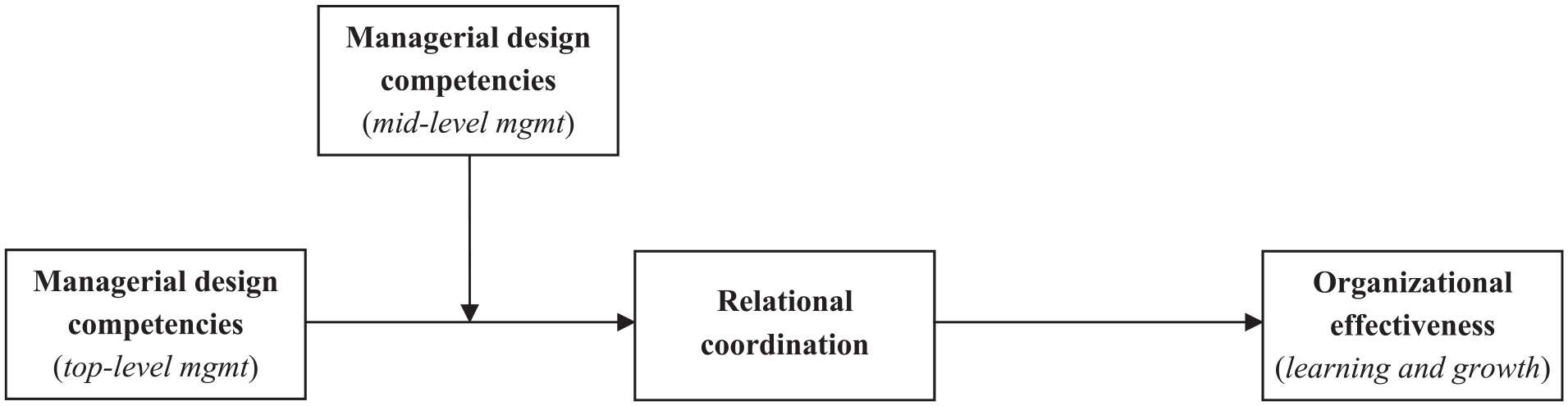
Research framework.
Complementarity effect of managerial design competencies across levels
The leadership literature is mostly silent on how interactive models of managerial competencies across hierarchical levels explain organizational performance. Although it is clear that leaders at different echelons have an effect on the implementation of strategic initiatives, how aggregate leadership shapes performance outcomes is not straightforward (e.g., O’Reilly et al., 2010). Two exceptions are a study by Raes et al. (2011), who specified the functions of the top management team and middle-level managers’ interface, and the work of Gentry et al. (2013), who examined whether middle-level managers’ behavioral manifestations of integrity are related to top-level executives’ performance ratings.
To understand and bridge the competency-based differences across managerial levels with the ultimate goal of driving organizational performance, we decided to pursue the under examined idea of complementarity (Cable & Edwards, 2004; Piasentin & Chapman, 2007), that is, to examine whether “opposites attract to complete and offset each other” (cf. Kristof-Brown & Jansen, 2007, p. 131). Specifically, we proposed a compensatory model of leadership skills, meaning that managerial design competencies at lower levels of a hierarchy compensate (a negative interaction) for the lack of such characteristics at higher levels. Similar to innovation management research conducted by Heyden et al. (2018) on a sample of top- and middle-level managers, we believe that a cross-echelon alignment of managerial design competencies could be an important vantage point from which we can understand learning and growth perspective of organizational performance.
Because top-level managers often do not know exactly what sort of linkages would work best or how to implement them, the role of senior leaders is enabling middle-level managers to engage in linking activities that provide adaptability and create change (Taylor & Helfat, 2009). Such linking activities at the level of middle management might include boundary spanning (e.g., brokering), organizing and implementing aligned actions (i.e., integrating), promoting cross-functional training (e.g., enabling collaboration), joint planning and decision-making (e.g., coordinating), and deploying resources across units in ways that foster interconnectivity. In addition, highly competent middle-level managers can help to achieve relational coordination for the purpose of task integration (Hoffer Gittell, 2002).
Therefore, we acknowledged and further searched for support to introduce relational coordination into the debate as a highly relevant integrative mechanism between organizational members (Hoffer Gittell & Douglass, 2012). For instance, Jansen et al. (2009) argued that leaders at all levels must advocate new organizational logic and foster collective patterns of interaction (Helfat & Peteraf, 2003). Ben-Menahem et al. (2016) added that managers should achieve cross-echelon consistency by creating a consensus on organizational priorities and thus becoming better able to coordinate knowledge exchange and integration.
Relative coordination highlights that organizations can achieve desired outcomes in a superior manner through frequent, high-quality communication supported by work relationships with shared goals, knowledge, and mutual respect. This informal structural mechanism is not expected to emerge solely from interactions among individuals; rather, it is theorized to depend upon organizations to support its development (Bolton et al., 2021). Specifically, competent managers who possess design skills and design-related knowledge—by carefully designing and implementing informal structural mechanisms, such as relational coordination in and across hierarchical levels (Galbraith, 1973; Galunic & Eisenhardt, 2001; Tsai, 2002)—boost the organizational learning and growth performance curve.
Hypothesis 3. Middle-level managerial design competencies moderate the indirect effect of top-level managerial design competencies on organizational learning and growth performance through relational coordination, such that the indirect effects are realized when middle-level managerial design competencies are low to medium.
Method
Sample
The conditional process research model has been tested on a cross-industry sample of medium- and large-sized organizations (more than 100 employees) listed in an online database of the Croatian Chamber of Economy. Multisource survey data were collected from 103 organizations from October to December 2017. However, we had to discard a few responses due to invalid or incomplete data entries, leading to a final sample of 96 organizations (for a response rate of 9.0%) which operate in different sectors (31.1% manufacturing, 12.6% construction, and 10.7% trade, automotive repair, and maintenance services) with a 1:2 ratio in favor of privately owned companies. A majority of the sampled organizations (53.4%) had less than 250 employees, although very large companies counting more than 1,000 employees were also represented (10.7%). Overall, of the studied companies, 29.3% had women in managerial positions, although top-level managers were mainly men (more than 90.0%). The majority of the managerial workforce was highly educated (82.5% had a university diploma), with either a business (49.5%) or technical and engineering academic background (48.5%).
Human resources or organizational design and development managers reported on their existing organizational complexity (the level of relational coordination), and CEOs or members of the management board evaluated the echelon-specific competency of the managerial workforce (top- and middle-level managerial design competencies) and their organizational effectiveness (learning and growth performance dimension). Following an established practice (e.g., Glaser et al., 2015; Heyden et al., 2017) and given the considerable challenges of gaining multilevel data on managerial echelons (Heyden et al., 2018), we solely examined top- and middle-management position levels because the nature of low-level managerial work might be significantly different in terms of complexity, organizational responsibilities, and requisite skills (see Kaiser et al., 2011). We analyzed data using the PROCESS macro (Hayes, 2013).
Measures
Managerial design competencies
Acknowledging difficulties in obtaining an objective assessment of competence and competencies (Elliot et al., 2017; Lichtenberg et al., 2007), we applied the skill rating to determine the perceived level of design competencies present at different hierarchical levels. Executives (CEOs or members of the management board) evaluated the aggregated level of design competencies present in top- and middle-level hierarchical echelons because they are supposed to have a general overview of the existing situation (i.e., knowledge base) within an organization (Glaser, 1968) and a specific understanding of managerial skills and efforts (Mohrman et al., 1989). Design competencies per se targeted different problem-solving approaches (positive and optimistic approach, inclusive approach, quick and effective, or objective problem-solving). Commensurate measures consisted of 5-point Likert-type agreement scale items (1 = strongly disagree to 5 = strongly agree) originally proposed by the authors appeared to be reliable, as Cronbach’s alphas were above the threshold of .70 (Nunnally, 1978) for two consecutive managerial levels examined (top: α = .852; middle: α = .844). The sample items were “Confronted with new situations and challenges, managers are capable of developing a novel solution quickly and efficiently” and “Whenever possible, managers analyze a wide set of alternatives, including problem-solving ideas generated by others.”
Relational coordination
Because previous research showed that human resource managers are eligible to report on various aspects of organizational complexity (Turkulainen & Ketokivi, 2013), we used their input to measure relational coordination. Specifically, we applied the 7-item Likert-type agreement scale (1 = strongly disagree to 5 = strongly agree) developed by Hoffer Gittell (2002) which has been already validated in several industries and countries. Four items focused on communication ties (frequent, timely, accurate, and problem-solving) and three on relationship ties within an organization (shared goals, shared knowledge, and mutual respect). Slightly adjusted original sample items were “Employees communicate in a timely way about focal work processes” and “When a problem occurs with a work process, employees work together to solve the problem.” The reported value of Cronbach’s alpha coefficient for this measure was .862.
Organizational performance/effectiveness
Learning and growth perspective is a constitutive part of the influential balanced scorecard model of performance (Kaplan & Norton, 1992, 2005) that represents an important lead indicator of organizational effectiveness (Akkermans & Van Oorschot, 2018). It covers a broad spectrum of intangible performance drivers (such as employee motivation and job satisfaction, employee loyalty, R&D and training, and internal communication) that might explain the predictive role of managerial design competencies. We decided to use four original balanced scorecard measurement items (Kaplan & Norton, 2006) that were additionally supplemented with the overall quality of a work environment item (Niven, 2006). The 5-item performance scale described was internally consistent with Cronbach’s alpha coefficient of .823. As both objective and subjective performance measures have been widely adopted (Singh et al., 2016), the methodological choice was made for the latter ones; subjective measures are more commonly used as they enable cross-industry comparison and might offer insights on intangible performance. Moreover, subjective performance was extensively found to be positively correlated with the objective performance (e.g., Vij & Bedi, 2016; Wall et al., 2004), and is much more appropriated for addressing an intangible asset/resources, such as organizational learning and growth.
However, to further support our reasoning, we ran a comparative analysis of subjective (top manager’s assessment) and objective measures (retrieved from the Financial Agency [FINA], a public company that provides financial and electronic services) of financial performance. The similar subjective/objective comparison was not possible for focal-dependent variable (i.e., organizational learning and growth performance), as the majority of Croatian companies still do not measure objectively this specific dimension of organizational performance/effectiveness. The publicly available objective financial data (i.e., profit, return on assets [ROA], and return on equity [ROE]) were obtained for three consecutive years (2017–2019).
The convergent validity has been confirmed as Spearman’s rank-order correlation coefficients were significant and positive for subjective financial performance measure and each of the objective financial performance measures (please see the correlation matrix shown in Supplemental Appendix 2). In addition, we found a positive link between subjective measures of financial, and learning and growth performance (ρ = .367, N = 101, p < .01), while there was no statistical evidence of the relationship between perceived learning and growth performance, and financial statement results, respectively. At the same time, by comparing subjective (2017) with objective financial indicators (2017 and 2018), we noticed a decrease in objective financial performance, which is consistent with the requirements for discriminant validity (Wall et al., 2004). Finally, we found an evidence for construct validity as subjective and objective financial performance measures corresponded closely to each other in relation to main variables of the present study (i.e., top-, and middle-level managerial design competencies, and horizontal informal integration; see Supplemental Appendix 3). Some anomalies have been identified regarding the control variables, yet they were not substantive leading to the conclusion that managerial-reported subjective measures of organizational performance/effectiveness are valid and reliable reference points.
Control variables
Following best practice recommendations for control variable usage (see Bernerth & Aguinis, 2016), we controlled several variables that may affect our model. Taking the general organizational context into consideration, we introduced contingency factors, such as environment uncertainty (i.e., environment complexity and environmental dynamism; see Mascarenhas, 1984), corporate strategy type (i.e., prospector, defender, analyzer, and reactor; see Miles & Snow, 1978), organizational size (i.e., the number of employees), and management gender ratio (i.e., the percentage of women in the corporate board). In terms of formal structural arrangements, variables such as the executive’s and middle managers’ span of control (i.e., the [average] number of direct line and staff reports), horizontal formal integration (α = .622; five items capturing the extent to which organizations use cross-functional interfaces, such as teams and projects, job rotation, and liaison roles; see Jansen et al., 2009), type of organizational structure (e.g., functional, divisional, matrix, project, front-back), specialization (i.e., the number of different job descriptions), and vertical differentiation (i.e., the average number of hierarchical levels) have been addressed. Finally, both organizational (i.e., industry and ownership type) and individual (i.e., respondent’s job position and respondent’s job tenure) demographic factors were examined.
Analytic strategy
A respondent-driven pretest of our survey was done on a small subsample of the targeted population (Ferketich et al., 1993). Specifically, we initially ran our survey on 38 pilot participants from the corporate world, thus satisfying a general rule of thumb for conducting pilot tests (Sheatsley, 1983). As a result, the face validity of the constructs and their item wording were checked. To test our research model, we used the PROCESS macro version 2.16.3 for SPSS (Hayes, 2013). We conducted hypotheses testing by examining the nested: (a) a basic mediation model, that is, the role of relational coordination; (b) a first-stage moderation, that is, the role of middle-level managerial design competencies; (c) a complete moderated mediation model, that is, the simultaneous moderating role of middle-level managerial design competencies and the mediating role of relational coordination on the relationship between top-level managerial design competencies, and learning and growth performance dimension. To further validate our data and study findings, supplementary analyses were conducted: (d) complementarity analysis of the conjoint influence of top- and middle-level managerial design competencies on learning and growth performance; and (e) endogeneity testing to examine whether our research model is correctly specified and as such enables causal reasoning.
Results
Exploratory analyses
Factor analysis
We used exploratory factor analysis to determine or identify the underlying structure among the set of items or variables (Nunnally & Bernstein, 1994), which tapped a specific factor or latent construct related to managerial design competencies (Dyer et al., 2005). Consistent item loadings were reached; that is, each managerial design competencies’ item fit into a corresponding factor (Clapp-Smith et al., 2009). According to the results obtained, our exploratory factor analysis was valid because the Kaiser–Meyer–Olkin measure of sampling adequacy was above .60, and Bartlett’s test of sphericity was statistically significant (p < .01). Furthermore, following a predetermined number of fixed factors, a principal component analysis extracted three very strong factors. The R2 values or communalities showed that all items contributed significantly to measuring the underlying factors (R2 > .40). Finally, the varimax rotated method with Kaiser normalization produced a rotated component matrix from which it was evident that the first factor was measured by the middle-level managerial design competencies’ items, and the top-level managerial design competencies’ items loaded on the third factor. Organizational learning and growth performance items also loaded on the third factor, and relational coordination items exclusively loaded on the second factor.
Descriptive statistics
Means, standard deviations, reliability coefficients, and correlations are presented in Table 1. As expected, managerial design competencies were more represented in top-level management (M = 3.84, SD = .69) than in middle-level management (M = 3.75, SD = .66). A paired-samples t-test showed that differences across managerial levels were marginally statistically significant because design competencies stretched throughout different 95% confidence intervals (top-level: 3.68–3.96; mid-level: 3.60–3.87).
Descriptive statistics and correlations (main variables and contingency/structural controls).
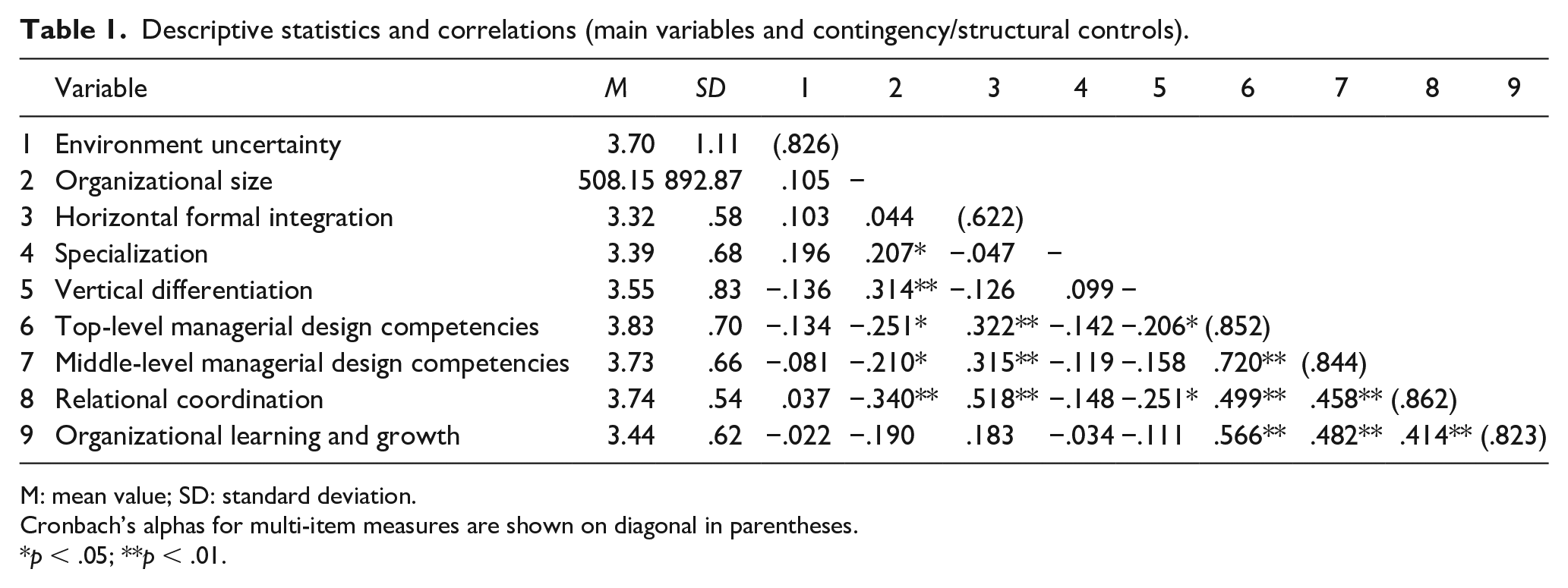
M: mean value; SD: standard deviation.
Cronbach’s alphas for multi-item measures are shown on diagonal in parentheses.
p < .05; **p < .01.
Although medium to high values of Pearson’s correlation coefficients were reported to exist between design competencies of top-middle echelons (r = .712, N = 96, p < .01), collinearity diagnostics indicated that multicollinearity was not a significant issue (with a tolerance indicator = .481 and variance inflation factor = 2.077).
Hypotheses testing
Hypothesis 1 stated that relational coordination mediates the relationship between top-level managerial design competencies and organizational learning and growth performance. As shown in the basic mediation model (recognized as Model 4 in the PROCESS template), our analysis provided clear evidence that top-level managerial design competencies are positively related to relational coordination (β = .37, p < .01). The relationship between relational coordination, and organizational learning and growth performance was also significant (β= .28, p < .05), eventually leading to a significant indirect effect of relational coordination as a potential mediator (c′ = .10, 95% CI = [.017, .221]). Therefore, we confirmed our first hypothesis. In addition, we found that the examined mediating relationship is partial, because the top-level managerial design competencies also had a direct effect on the performance results (c = .39, p < .01).
Hypothesis 2 covered the first stage of the conditional process (mediator variable) model, assuming that middle-level managerial design competencies create boundary conditions for the focal relationship between top-level managerial design competencies and relational coordination. The regression coefficient for the interaction term between top- and middle-level managerial design competencies was negative and significant (a3 = −.234; 95% CI = [−.386, −.082]). A simple slope analysis (see Figure 2) shows that organizations reported the highest level of relational coordination when having both a high amount of top- and middle-level managerial design competencies, thus providing support to our second hypothesis.
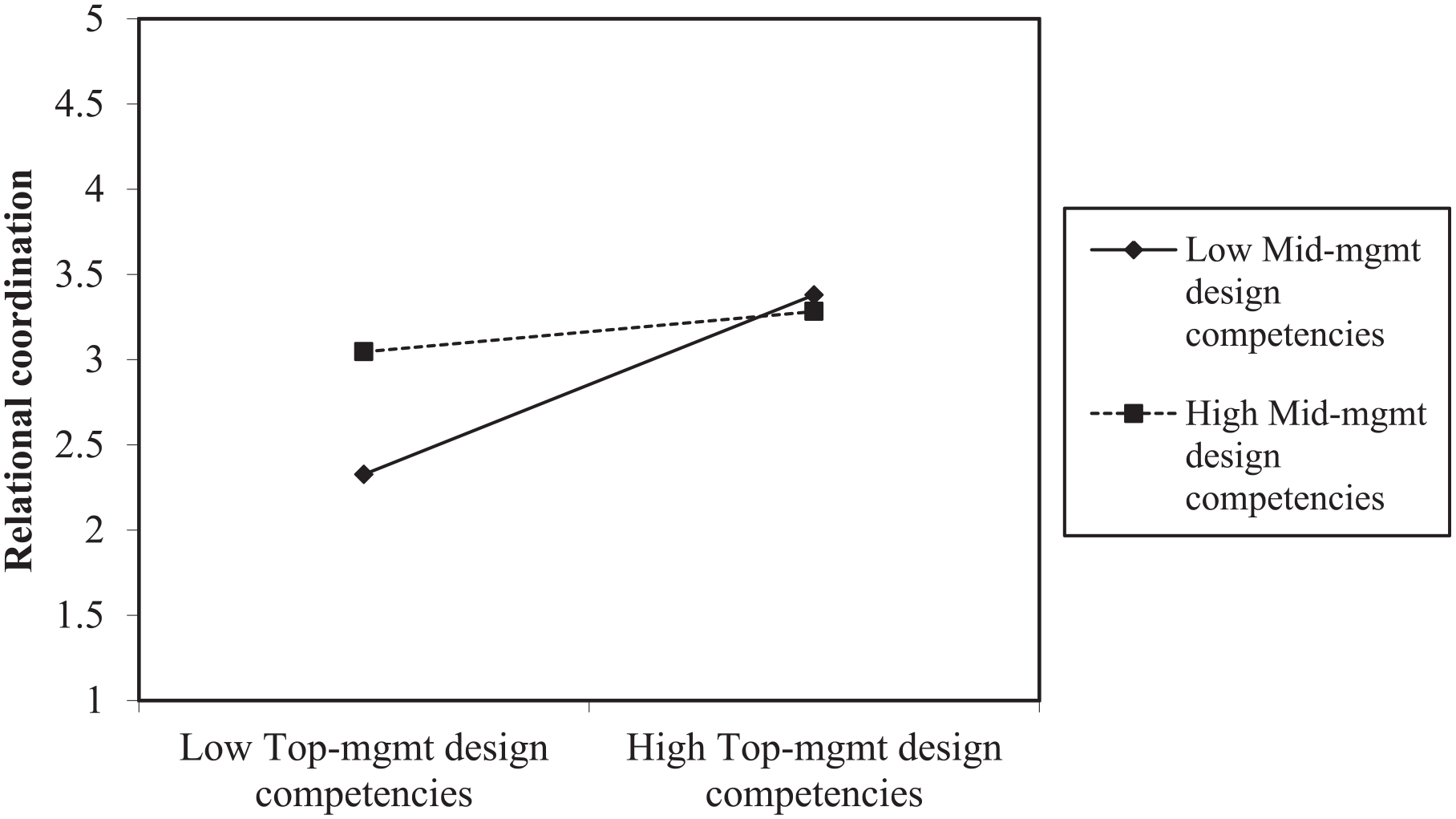
Interaction plot of the first-stage moderation.
For testing our final hypothesis, we conducted analyses of the conditional indirect effects of our independent variable (top-level managerial design competencies) on the respective dependent variable (organizational learning and growth performance) using Model 7 in the PROCESS template. Specifically, we applied Preacher et al.’s (2007) statistical procedures for moderated mediation testing. The results (see Tables 2 and 3) demonstrate that the conditional indirect effects were significant when middle-level managerial design competencies were low (b = .105; 95% CI = [.020, .235]) as well as in a situation characterized by a medium level of middle-level managerial design competencies (b = .064; 95% CI = [.013, .170]). Overall, a bootstrap confidence interval for the index of moderated mediation (Hayes, 2015) did not include zero (95% CI = [−.148, −.006]), generating the conclusion that the indirect effect of top-level managerial design competencies on organizational learning and growth performance through relational coordination is negatively moderated by middle-level managerial design competencies. Thus, we found support for our third hypothesis.
Hierarchical regression analyses testing moderation of the mediated effects of relational coordination to organizational learning and growth performance.
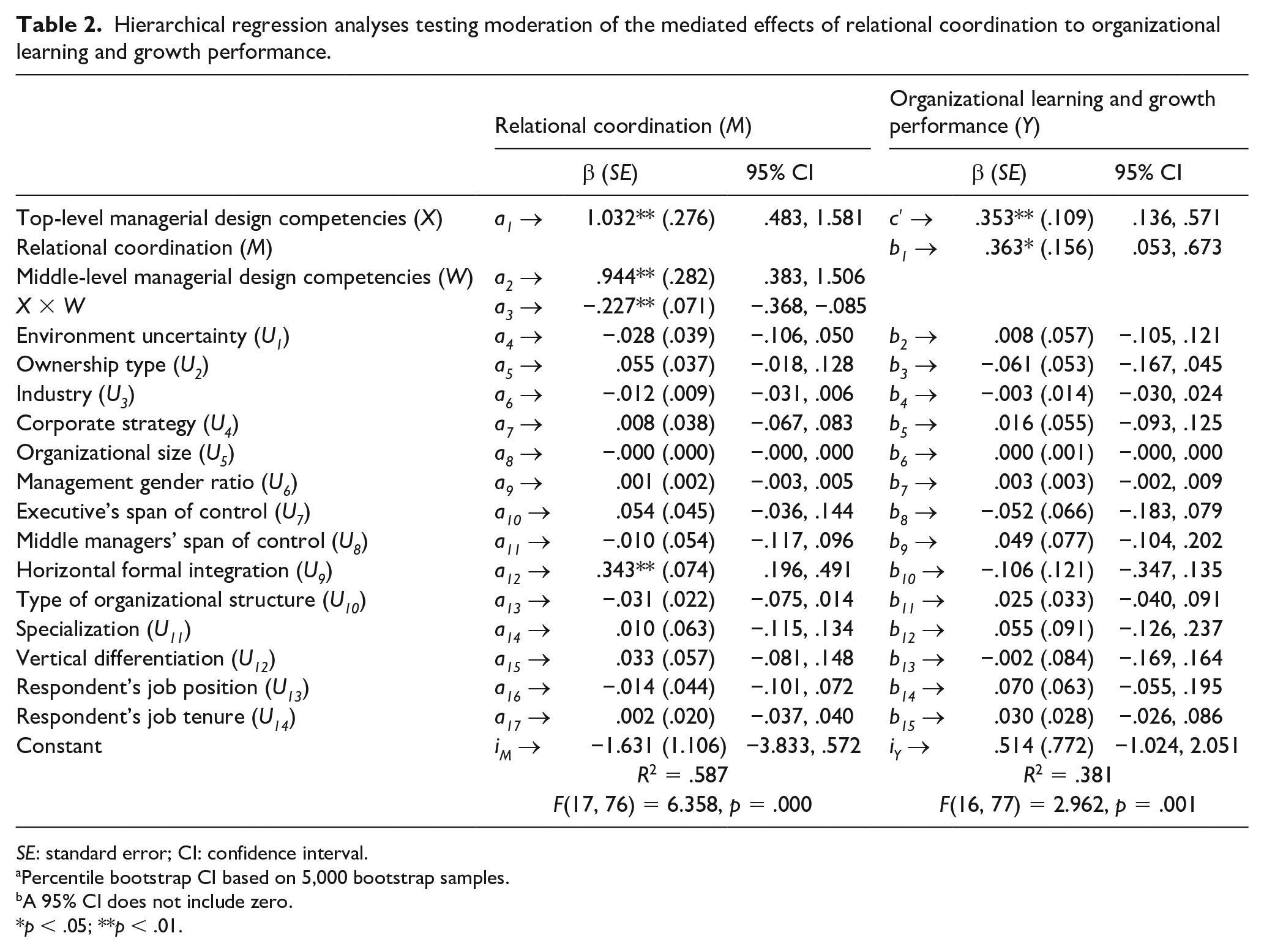
SE: standard error; CI: confidence interval.
Percentile bootstrap CI based on 5,000 bootstrap samples.
A 95% CI does not include zero.
p < .05; **p < .01.
Moderated mediation results for top-level managerial design competencies across levels of middle-level managerial design competencies.
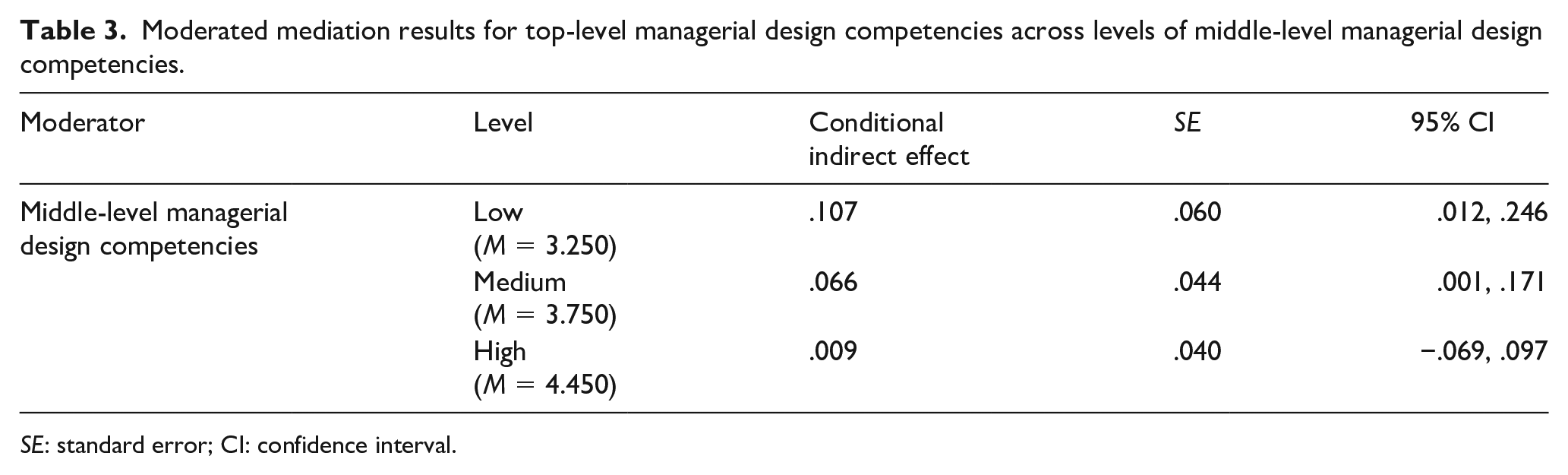
SE: standard error; CI: confidence interval.
Given results should be interpreted with regards to control variables. Despite controlling for a wide range of contingency factors, structural characteristics and demographic variables, the Model 7 results indicate that identified confounding variables are non-significant and do not skew the study results. An exception is revealed only in terms of horizontal formal integration; this structural characteristic of an organization is significantly positively related to horizontal informal integration (β = .343, p < .01) thus supporting the view that formal and informal structure “are conceived of not in isolation, but in combination” (cf. McEvily et al., 2014, p. 303). However, our analysis also showed that horizontal formal integration is not related to organizational learning and growth performance (β = −.106, ns). These findings do not undermine the relevance of structural (formal) design of an organization for business performance (e.g., Csaszar, 2012; Ketchen et al., 1997); instead, they are indicating that design skills and design-related knowledge possessed by upper-echelon managers are particularly relevant for introducing less-hierarchical organizing as means toward achieving better non-financial (i.e., organizational learning and growth) results.
Supplementary analyses
Complementarity analysis
We initiated an additional test of the existence of complementarity by creating a set of dummy variables (the median score has been used as the threshold to assign a 0 or 1 value; see Furlan et al., 2011) to discriminate between organizations possessing high (1) versus low (0) levels of managerial design competencies for each of the examined hierarchical echelons. Thus, we were able to generate four exclusive categories of companies in terms of their managerial design competencies: (1) high-top- and high-middle-level managerial design competencies (x = 1, w = 1), (2) high-top- and low-middle-level managerial design competencies (x = 1, w = 0), (3) low-top- and high-middle-level managerial design competencies (x = 0, w = 1), and (4) low-top- and low-middle-level managerial design competencies (x = 0, w = 0). Initial t-tests for the equality of means for both predictor variables (top- and middle-level managerial design competencies) were significant, thus confirming that the approach taken statistically discriminated the subsamples (for simple count statistics, see Table 4).
Frequencies and mean values of organizational learning and growth performance conditional on competency sources.
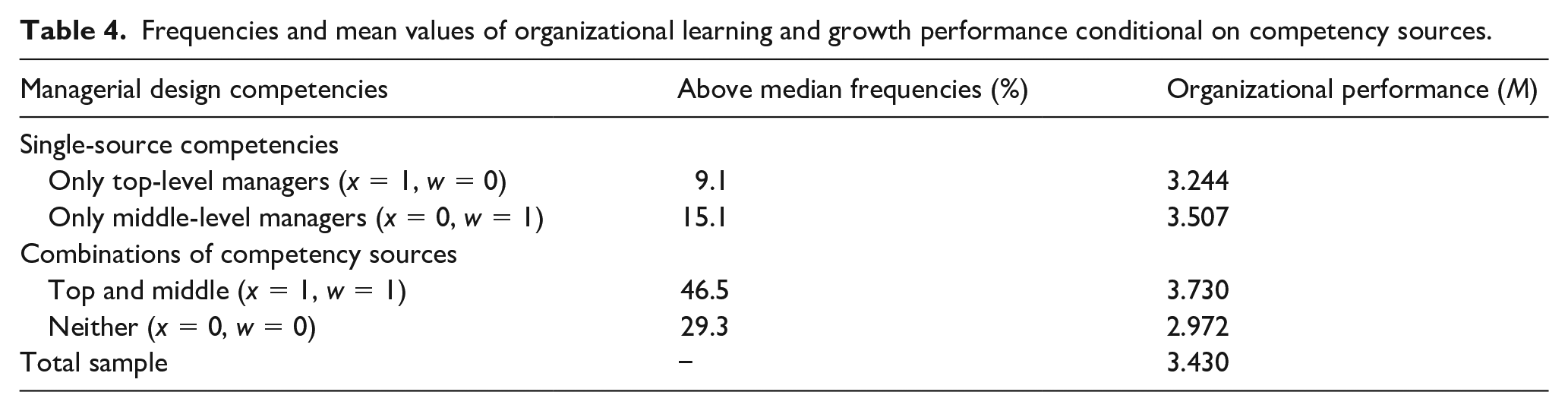
The cross-tabulation analysis offered suggestive evidence that some degree of complementarity-in-use existed between the top- and middle-level managerial design competencies. Specifically, we revealed that the simultaneous presence of managerial design competencies across hierarchical echelons was the most frequent of the exclusive combinations (46.5% organizations in the sample). In addition, an analysis of variance confirmed that the mean values among the groups were statistically different in the case of matching combinations, that is, a high-high (x = 1, w = 1) combination (F = 25.881, p < .01) and a low-low (x = 0, w = 0) combination (F = 29.631, p < .001). Similar insights resulted from the conditional process analysis using ordinal data. Although supportive, the moderation and mediation approaches were neither sufficient nor definite evidence for complementarity (e.g., Carree et al., 2011; Cassiman & Veugelers, 2006; Patel & Terjesen, 2011). Therefore, we continued with a more systematic approach, relying on Mohnen and Röller’s (2005) proposition that the best approach to directly test the effect of complementarity is to test whether an outcome variable’s function was supermodular (i.e., effects achieved from increasing the presence of all [both] competency sources are greater than the sum of their separate increases; see Mothe et al., 2015). Following the supermodularity approach, we tested whether the organizational learning and growth performance function [y = f (x, w)] was supermodular, and two predictor variables [top- (x) and middle-level managerial design competencies (w)] were complements, satisfying the if-and-only-if equation (Cassiman & Veugelers, 2006; Mohnen & Röller, 2005):

We applied the testing procedure of Choi et al. (2008) to implement each of the organizational performance functions in the form of conditional probability. To conduct this kind of analysis, having already created dummy variables for both top- and middle level managerial design competencies, we additionally created a dummy variable (high = 1, low = 0) for our dependent variable (y). By applying the conditional probability approach, the supermodularity function was modeled as follows (Choi et al., 2008):
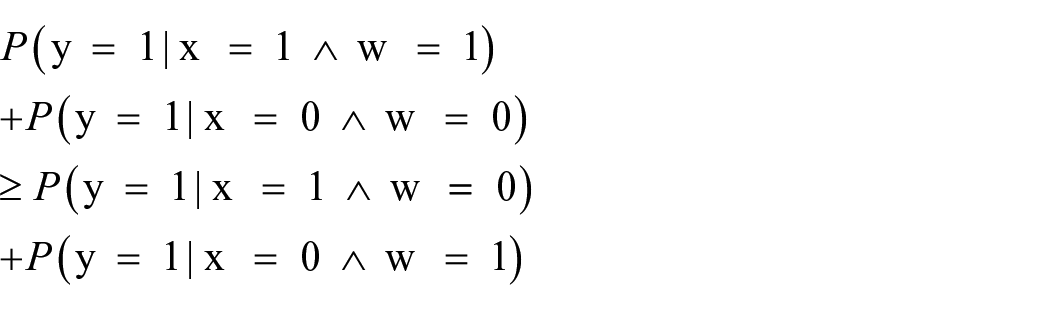
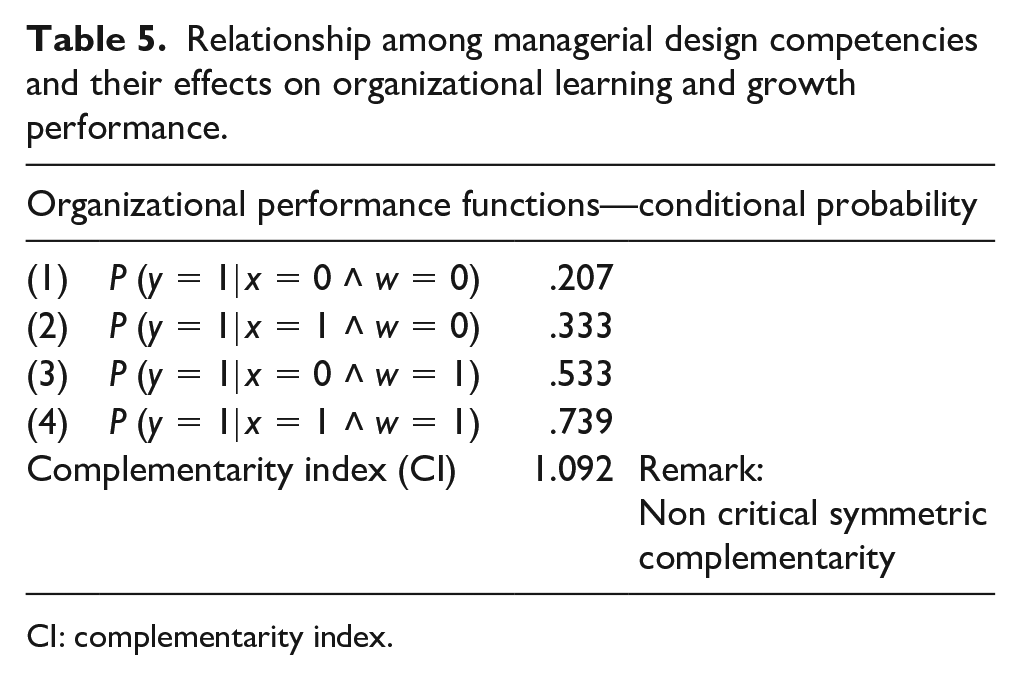
The results obtained by performing the mentioned testing procedure (see Table 5) showed that the sole presence of top- (β = .333) or middle-level managerial design competencies (β = .533) would raise the probability of achieving a high level of organizational (learning and growth) performance compared with situations in which both sets of competencies were low or not present (β = .207). In this sense, it has been evidenced that middle-level managerial design competencies have a much stronger relationship with organizational learning and growth performance compared with top-level managerial design competencies. The probability of achieving a high level of performance in the case of both top- and middle-level managerial design competencies being simultaneously present on a high level is larger (.739 + .207 = .946) than the sum of probabilities of achieving a high level of performance in the case when only one of two sets of managerial design competencies was present on a high level (.333 + .533 = .866), satisfying the supermodularity condition in the above-listed equations. Furthermore, following Choi et al. (2008) and combining the obtained results by which:
P (y = 1|x = 1 ˄ w = 0) and P (y = 1|x = 0 ˄ w = 1) were higher than P (y = 1|X1 = 0 ˄ X2 = 0), leading to a noncritical symmetric condition.
The complementarity index (CI), which was calculated as
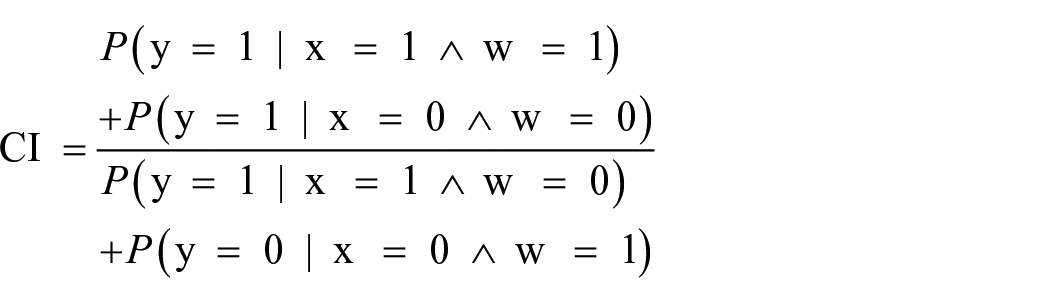
and totaled 1.092 (complementarity precondition for CI is > 1.0), leading to supermodularity condition hold; we concluded that noncritical symmetric complementarity exists between top- and middle-level managerial design competencies in their effects on organizational learning and growth performance. In other words, top- and middle-level managerial design competencies behaved in a similar manner in their effects on organizational performance (symmetry), where a positive incremental effect of the presence of one managerial competency source on organizational performance can be achieved separately from the presence of another managerial competency source, whereas their joint presence raised the positive incremental effects of both managerial competency sources even more (noncritical; Patel & Terjesen, 2011).
Relationship among managerial design competencies and their effects on organizational learning and growth performance.
CI: complementarity index.
Endogeneity testing
Before drawing theoretically and practically sound conclusions of our causal moderated mediation research model, we decided to validate our findings by addressing a potential endogeneity bias (i.e., the major methodological concern that the independent variable is correlated with the error term in a regression model; see Semadeni et al., 2014).
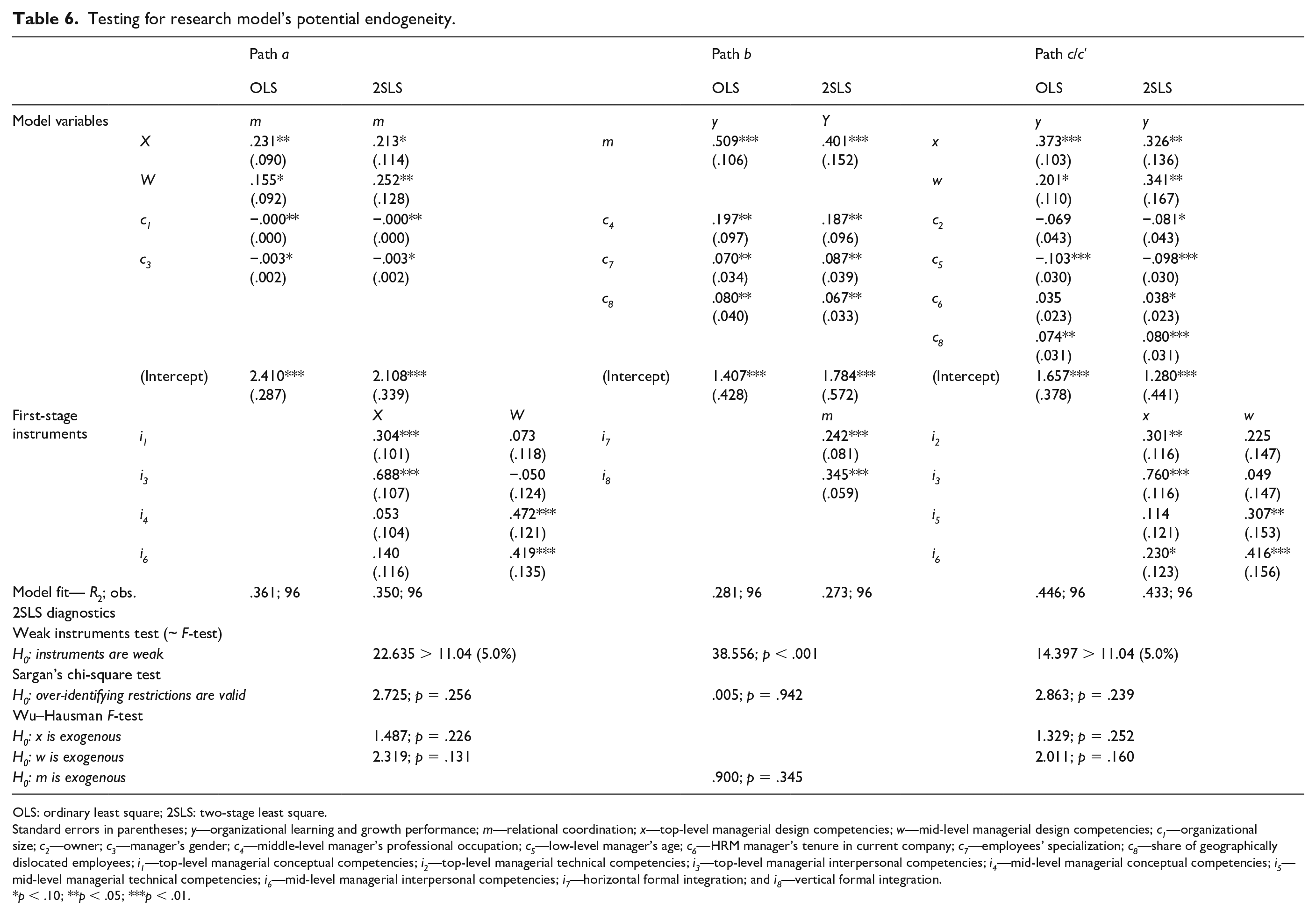
Following Antonakis et al. (2014) and Anderson (2018a), we applied a two-stage least squares (2SLS) or instrumental variable estimation to obtain consistent estimates of causal relations embedded in our research model. Specifically, we initially tested the causality between relational coordination (m), and top- (x) and middle-level managerial design competencies (w) to evaluate the endogeneity of our predictor variables (x and w), that is, path a. In doing so, we conducted the diagnostic tests needed to evaluate the validity and suitability of the instruments and overall first-stage regression in the context of 2SLS—the F-statistics for weak instruments test and Sargan’s overidentification (instrument redundancy) test (Mertens et al., 2017). To detect endogeneity for individual regressors in the ordinary least squares (OLS) regression model (two control and four theoretically grounded instrumental variables), we used the Wu–Hausman test (Echambadi et al., 2006). For both predictors, test results suggested acceptance of the null hypothesis (x: F = 1.487; p = .226; w: F = 2.319; p = .131), leading to the conclusion that cross-echelon managerial design competencies (x and w) are exogenous in their effects, including the interaction effect on relational coordination (m).
We applied the same testing procedure and 2SLS diagnostics to estimate the remaining two regression equations in our research model. The results of the Wu–Hausman endogeneity test for path b of our research model (with three control and two theoretically grounded instrumental variables introduced in the first-stage regression and two instrumental variables excluded from the second-stage regression), in which we examined the causal relationship between the outcome variable of the learning and growth performance dimension (y) and the predictor variable of relational coordination (m), clearly showed that the predictor variable (m) is exogenous in its effect on the outcome variable (y: F = .900; p = .345).
Finally, we estimated whether managerial design competencies as our predictor variables (x and w), as well as their interaction effect on the learning and growth performance dimension (y), that is, path c/c′ (with four control and four theoretically grounded instrumental variables in the first-stage regression and with four instrumental variables excluded from the second-stage regression) were endogenous in nature. The Wu–Hausman test results (x: F = 1.329; p = .252; w: F = 2.011; p = .160) suggested that neither predictor variable in our regression equation was endogenous, leading to the conclusion that top- (x) and middle-level managerial design competencies (w) are exogenous in their effects, including the common interaction effect, on organizational learning and growth performance (y).
By comparing the estimation of coefficients from (efficient) OLS regression and (consistent) 2SLS models following different research model paths (a, b, and c/c′), we noticed that the differences in the coefficients statistically did not differ (see Table 6), signaling that our conditional moderated mediation model is free from endogeneity bias.
Testing for research model’s potential endogeneity.
OLS: ordinary least square; 2SLS: two-stage least square.
Standard errors in parentheses; y—organizational learning and growth performance; m—relational coordination; x—top-level managerial design competencies; w—mid-level managerial design competencies; c1—organizational size; c2—owner; c3—manager’s gender; c4—middle-level manager’s professional occupation; c5—low-level manager’s age; c6—HRM manager’s tenure in current company; c7—employees’ specialization; c8—share of geographically dislocated employees; i1—top-level managerial conceptual competencies; i2—top-level managerial technical competencies; i3—top-level managerial interpersonal competencies; i4—mid-level managerial conceptual competencies; i5—mid-level managerial technical competencies; i6—mid-level managerial interpersonal competencies; i7—horizontal formal integration; and i8—vertical formal integration.
p < .10; **p < .05; ***p < .01.
Discussion
With this study, we offer insight into how the interaction between managerial design competencies and relational coordination determines organizational learning and growth performance, thus extending the existing knowledge base on leadership-driven organizational design processes and outcomes. A two-source field study of the cross-echelon managerial competency revealed that leadership complementarity across levels is associated with organizational performance/effectiveness. Specifically, we evidenced that (a) managerial design competencies represent a highly relevant type of managerial knowledge or skill that is positively related to organizational learning and growth performance, (b) a cross-echelon complementarity effect exists because design-competent middle-level managers compensate for a lack of design competencies at the top management level, and (c) high levels of both top- and middle-level managerial design competencies help to boost learning and growth performance through relational coordination.
Theoretical implications
Our first contribution targets the leadership literature. We introduced design competencies as an increasingly relevant category within the contemporary managerial skill set, thus going beyond a traditional typology consisting of conceptual, interpersonal, and technical skills (Katz, 1955). Moreover, we examined leadership competencies across top- and middle-management levels. Not only did we confirm the continuity perspective of leadership skill transition (De Meuse et al., 2011), but also we recognized the existence of the complementarity effect between managerial competencies. Specific combinations of top- and middle-level managerial design competencies are beneficial for performance because they build organizational capabilities of coordination and integration of effort. In particular, organizational members with similar knowledge boundaries (i.e., the overall portfolio of managerial design competencies) tend to have a higher consensus on organizational priorities and are better able to coordinate knowledge exchange and integration (Ben-Menahem et al., 2016), ultimately affecting organizational learning and growth performance.
The second contribution adds value to the emerging theory of relational coordination (Hoffer Gittell, 2015). Within a single research model (a moderated mediation), we examined relational coordination both as an antecedent and an outcome, as well as an intervening variable. Initially, we analyzed this specific type of task integration as an outcome of the interaction between top- and middle-level managerial design competencies. Next, we examined relational coordination as a predictor of organizational learning and growth performance. Finally, relational coordination has been shown to be an intervening variable in the relationship between top-level managerial design competencies and an intangible dimension of organizational effectiveness (i.e., learning and growth performance), although it is moderated by middle-level (the first-stage moderation) managerial design competencies. This tripartite role of relational coordination sheds a new light on its possible relevance and thus extends the theory of relational coordination.
A third potential contribution of this study arises from making a connection between the leadership competency literature and the theory of relational coordination. We explained how the interface between upper-echelon managerial competencies (top- and middle-level managers) contributes to the development of an informal structural mechanism that, in turn, drives the strategic implementation of learning and growth-related performance goals. Thus, we added to recent case study insights provided by Livijin (2019), who reported that middle-level managers have an active role in the development of microstructures aimed at enhancing the lateral coordination and collaboration (such as horizontal informal integration) needed to realize the new organization.
Implications for practice
Following the micro foundations movement (Teece, 2007) and building on the pipeline model of leadership skill requirements (Dai et al., 2011), we introduced design-related knowledge and problem-solving (design) skills as crucial leadership competencies for developing organizational learning and growth capability. Such competencies should no longer be expected only from executives but are also welcomed from managers at different position levels. Our findings clearly demonstrate these complementary dynamics between different sources of managerial design competencies and how they might go along with relational coordination. Thus, we confirmed previous more general assumptions that top-level managers should rely on middle-level managers to realize planned organizational change (Heyden et al., 2017; Huy et al., 2014). We found a substantial performance surplus effect (see Table 4) when more than a single managerial level possessed design competencies (i.e., the condition in which both top- and middle-level managers possessed design competencies; MPERF = 3.730). However, somewhat surprisingly, in the situation of single-source competencies, having competent middle-level managers (MPERF = 3.507) seems to be more beneficial for organizational learning and growth performance than having competent top-level managers (MPERF = 3.244). Obviously, our data highlight the importance of the middle-level management echelon for reaching higher levels of intangible (organizational learning and growth) performance. If top-level managerial design competencies are missing but middle-level managers possess the required design competencies, organizations will be able to develop the appropriate level of relational coordination to drive their performance results. The insight from this field survey positions middle-level managers at the center of organizational design processes (e.g., Livijin, 2019). With the combined results of our research, we offer support to the idea of developing managerial competency systems that will capture the interdependent nature of managerial jobs (Levenson et al., 2006).
Limitations
A cross-sectional design is one of the main potential limitations of this research, which does not allow us to make causal statements with full confidence (Heffernan & Flood, 2000; Pedhazur & Schmelkin, 1991). Although we ran the endogeneity testing to increase the credibility of our findings (showing that our main constructs of interest were exogenous in nature), longitudinal studies would offer significantly more confidence in assertions related to cause-and-effect, lack of time issues, and the potential loss of the sample over time and as such might retest the cross-sectional effects obtained in this study. Aware of the fact that our research design limits the possibility of addressing the dynamics of construct development (design competencies, relational coordination, and learning and growth performance), we followed Porter’s (1991) assertion that logically, the cross-sectional problem has to be addressed prior to a consideration of dynamics. Moreover, evidence shows that under certain conditions, cross-sectional research results exhibit validity comparable with results obtained from longitudinal data (Rindfleisch et al., 2008; Spector, 2019).
This research also considered the fact that individuals’ reports of their internal states, their past behavior, and the potential consequences of their internal states were collected at the same time predominantly from a single source (i.e., CEOs or members of the management board), leading to the problem of common method bias (Lindell & Whitney, 2001). Bearing in mind that item validities and reliabilities as well as the covariation between latent constructs can be significantly influenced by common method variance (Podsakoff et al., 2012), we tried to minimize potential sources in this study by checking for endogeneity and avoiding the use of common informants (single-informant bias). The latter, in turn, led to another potential limitation of this research: the research approach requirement that two different informants answer two separate questionnaires within the same organization, which resulted in a smaller sample size.
Another potential limitation of this research is the use of perceptive evaluation of relational coordination, organizational learning and growth performance, and especially, managerial design competencies. Previous studies have confirmed that perceptual evaluation of performances or organizational effectiveness meets the reliability and validity requirements of objective measures (Ketokivi & Schroeder, 2004; Swink & Schoenherr, 2015). Regarding relational coordination and managerial design competencies, despite the literature’s recognizing respondents’ tendency to provide answers in which they overrate the real picture of themselves or their organization (Donaldson & Grant-Vallone, 2002), some research attempts show complete compatibility of results obtained in this manner with results obtained through direct observations (Osborne et al., 2016).
Based on Cavallo and Brienza’s (2002) and Yukl’s (2010) arguments on high data relevancy and research approach appropriateness, we investigated managerial design competencies of two hierarchical echelons in which an executive person evaluated design competencies of both top- and middle-level managers. Nevertheless, data gathered on managerial design competencies from various sources—for example, 360-degree feedback—would (not) provide additional validity and reliability of the results obtained in this study and the inferences made (e.g., Semeijn et al., 2014).
Finally, unlike research instruments used for measuring relational coordination and organizational learning and growth performance, we did not use an existing and empirically validated research instrument to measure managerial design competencies, thus providing an additional potential limitation of this research. Namely, we have developed our own research instrument for measuring managerial design competencies, for which repeated empirical validations are yet to come, although Cronbach’s alpha and exploratory factor analysis results, reported in this article, begin to establish support for the developed measurement instrument.
Supplemental Material
sj-pdf-1-brq-10.1177_23409444211022749 – Supplemental material for Cross-echelon managerial design competencies: Relational coordination in organizational learning and growth performance
Supplemental material, sj-pdf-1-brq-10.1177_23409444211022749 for Cross-echelon managerial design competencies: Relational coordination in organizational learning and growth performance by Tomislav Hernaus, Ana Juras and Ivan Matic in Business Research Quarterly
Footnotes
Declaration of conflicting interests
The author(s) declared no potential conflicts of interest with respect to the research, authorship, and/or publication of this article.
Funding
The author(s) received no financial support for the research, authorship, and/or publication of this article.
Supplemental material
Supplemental material for this article is available online.
References
Supplementary Material
Please find the following supplemental material available below.
For Open Access articles published under a Creative Commons License, all supplemental material carries the same license as the article it is associated with.
For non-Open Access articles published, all supplemental material carries a non-exclusive license, and permission requests for re-use of supplemental material or any part of supplemental material shall be sent directly to the copyright owner as specified in the copyright notice associated with the article.
