



Abstract
This research aimed to achieve two sequential objectives: (1) to provide conceptual support for the idea of organizational commitment toward employees (the employer’s commitment), showing differences in concepts such as perceived organizational support, high commitment work systems, human resource (HR) philosophy, and psychological contracts, and (2) to develop a scale to measure employer’s commitment. To define the construct, we extrapolated the three-component model (TCM) dimensions (affective, continuance, and normative) from the individual to the organizational levels. To develop the new scale, we first used the Delphi method to determine the items in the questionnaire. Second, to verify the validity and reliability of the new scale, data collected from two sample populations (financial and hospitality sectors) were examined. The results suggest that the three dimensions of TCM in the final construct are independent and autonomous.
Introduction
The assumption that committed employees work harder than non-committed employees (Jung & Takeuchi, 2019; Riketta, 2000) has long justified researchers’ and practitioners’ interest in determining how such a commitment could be generated. With growing interest in this field, the construct of “employees’ commitment” has been defined explicitly, its antecedents and consequences studied, its correlations with other performance-related variables emphasized (Mathieu & Zajac, 1990; Meyer & Allen, 1991, 1997; Meyer et al., 2002, 2012), and measuring scales suitably tested (Allen & Meyer, 1990; Becker et al., 2009; Mowday et al., 1979).
However, work sciences have paid less attention to commitment from the employer’s side. Thus, while the association between employees’ commitment and behavior is comprehensively established in the literature (Meyer et al., 2002), the concept, measure, and influence that the employer’s commitment could exert on employee behavior, and on their own, have sparsely been explored. The question that we ask is whether this lack of interest is the result of irrelevance of the concept or if it is because of the presence of other variables measuring this idea of employer’s commitment.
In this vein, the literature review reveals that employer’s commitment construct is important because it determines and helps explain aspects such as effectiveness of the human resource (HR) department (Nguyen & Teo, 2018), organizational success (Roca-Puig et al., 2007, 2012), and company performance (Lee & Miller, 1999; Muse et al., 2005), and also creates a more committed and responsible workforce (Miller & Lee, 2001). Likewise, it is necessary and relevant to study employer’s commitment because it allows us to explain and understand the behaviors and attitudes of both employers and employees (Lee & Miller, 1999).
Previous studies defined the concept of employer’s commitment based on its manifestations or consequences (employee satisfaction, well-being, remuneration systems, etc.). In this article, it is defined based on its own essence or nature. Likewise, a review of literature seems to show that employer’s commitment is unidimensional. Nevertheless, in the present study, we propose that employer’s commitment is multidimensional. To operationalize the multidimensional idea of this construct, we extrapolate from the individual to the organizational level a proposal made by Allen and Meyer (1990) of the employees’ commitment (Meyer & Allen, 1991, 1997). This multidimensional conceptualization of the construct is useful because it allows us to obtain deeper and more detailed knowledge of the type of commitment that an organization has with its employees. Knowledge about the organization’s commitment is also useful because it can explain organizational decisions in the field of HR.
To provide conceptual support for the need to study and analyze the employer’s commitment to their employees and its contribution to the literature, we pose two questions: (1) what is employer’s commitment? and (2) how can we measure this construct?
To answer these questions, we offer an explicit definition of the construct and its dimensions, differentiating it from concepts such as perceived organizational support (POS), high commitment work systems (HCWS), HR philosophy, and psychological contract. First, to define the construct, we use accumulated existing knowledge from the literature on commitment. Second, to measure the employer’s commitment construct, we developed a new instrument through a Delphi analysis and verified the scale’s validity and reliability.
Carrying out these actions has allowed us to investigate and understand the aspects related to the commitment of the organization that have not been investigated before. In other words, we contribute to commitment literature in several ways. First, the construct is defined according to its own essence or multidimensional nature and not according to its consequences, which is how it has traditionally been defined in the literature (Arthur, 1994; Huselid, 1995; Lee & Miller, 1999; Miller & Lee, 2001; Muse et al., 2005; Roca-Puig et al., 2007, 2012). Second, we developed a scale to measure the construct, given that no previous instrument has been found to do so. Third, the new employer’s commitment scale provides managers with a useful “tool” for understanding of what certain organizational decisions represent in the field of HR and the behavior of both organizations and their employees. Fourth, we provide practitioners with a tool that allows them to confront perceptions that employers and employees have about the commitment of the organization.
Nevertheless, the principal contribution of this article entails an examination of commitment from the employer’s perspective, thereby changing the focus of analysis from the individual to the organizational level. In this vein, it is important to realize that when we analyze commitment from the employer’s perspective, we refer to the managers of the organization. We identify the organization with agents that represent it (managers) based on two assumptions (Coyle-Shapiro & Shore, 2007): (1) employees view managers’ actions as actions by the organization itself through anthropomorphism (Levinson et al., 1962) and (2) managers pursue the organization’s interests in such a way that the interests of managers and organizations are aligned (Coyle-Shapiro & Shore, 2007; Eisenhardt, 1989). In fact, in previous studies in which the organization’s commitment to employees (OCE) has been analyzed, managers (top managers or line managers) were surveyed to inform on OCE (Lee & Miller, 1999; Miller & Lee, 2001; Nguyen & Teo, 2018).
The remainder of this article is organized as follows. In the “Theoretical framework” section, we develop the theoretical framework by explaining the meaning of employer’s commitment. In “A measurement scale for employer’s commitment: a validation process” section, we build a new instrument to measure the construct using the Delphi method. In the “Analysis of dimensionality, reliability, and validity of the scale” section, we carry out a validity and reliability process of the scale using structural equation modeling (SEM) on two samples extracted from two different populations (financial and hospitality). In the “Discussion and conclusion” section, we discuss the results obtained, draw conclusions, list limitations of the study, and propose future recommendations for research based on this work.
Theoretical framework
Defining the employer’s commitment: delimitation and dimensions
Before offering a concrete and explicit definition of the concept, we consider it appropriate to proceed to its conceptual delimitation to explain what the employer’s commitment means and how it differs from other constructs such as HCWS, empowerment, POS, HR philosophy, and psychological contract.
To examine employer’s commitment, it can be useful to distinguish three approaches: (1) the attitude that the organization adopts toward its employees, which is what we consider “employer’s commitment”; (2) the organization’s behavior toward its employees as a consequence of its attitudes (actions), which is the “employer’s behavior”; and (3) how the organization’s attitudes are perceived by employees and employers.
Regarding the first approach (attitude), Torka et al. (2005) define employer’s commitment as “a mind-set that binds the employer to courses of action of relevance to employees” (p. 529). Regarding the second approach (behavior), Lee and Miller (1999) define OCE as a reflection of this attitude. Similarly, Muse et al. (2005) define OCE through an organization’s actions toward and treatment of its employees. Roca-Puig et al. (2012) note that OCE is a multifaceted concept since an organization can exhibit commitment to its employees in many ways.
We understand that human resource management (HRM) policies and practices designed by the organization to manage its employees are just mechanisms through which the organization expresses its commitment. Miller and Lee (2001) point out that the commitment of the organization can be exhibited through HCWS (Arthur, 1994; Huselid, 1995), a bundle of HRM practices with the objective of fostering commitment among employees. However, these practices are not the employer’s commitment directly but a consequence of it. Similarly, Spreitzer (1995) defines empowerment as a practice through which employers share with employees the power to control organizational resources. This action is carried out by the employers to express their commitment (attitude). However, empowerment is not the employer’s commitment per se but a manifestation of this organization’s commitment.
Regarding the third approach (perception), POS was conceptualized by Eisenberger et al. (1986) as employees’ perceptions of the extent to which the organization values their contributions and cares about their well-being. On the contrary, the employer’s commitment examines the attitude or willingness of the organization toward its employees, either perceived by employees or by the employer.
A second aspect that contributes to differentiating the employer’s commitment from the POS, which also involves adding a contribution, is related to the dimensionality of both concepts. Eisenberger et al. (1986) do not distinguish different (dimensions) forms or types of support perceived by employees. These authors define the POS as a unidimensional construct and limit themselves to measuring aspects related to the organization’s concern for the welfare of employees and their contributions. However, as we explain below, we consider that the commitment an organization has with its employees may have an economic, affective, and/or normative basis. We also consider that this triple motivation better explains attitudes of the organization toward their employees, as well as the behaviors they develop. In short, we reiterate that they are two concepts that measure different aspects.
Another construct that could be confused with employer’s commitment is HR philosophy. This construct is defined by Lam and White (1998) as an intangible element of the HRM process, reflecting an organization’s general beliefs about the central role performed by HR to access the competitive advantage. Thus, while HR philosophy helps organizations ensure employees understand the content of the HRM system (Kellner et al., 2016), the commitment of the organization makes reference to their attitude. As a sign that neither concept refers to the same idea, we suggest that one could be the antecedent of the other. In this vein, Nguyen and Teo (2018) tested positive and significant associations between HR philosophy and OCE.
The last construct we compare with employer’s commitment is psychological contract. This construct is defined as an employee’s beliefs about reciprocal obligations between an employee and his or her organization (Morrison & Robinson, 1997). Thus, while the focus of employer’s commitment is on the attitude of the organization toward employees, the focus of a psychological contract is on the expectations of employees about promises made by the organization toward them. We understand that these two constructs are very different. Furthermore, we could even speculate that the attitude of the organization might determine employees’ expectations through organizational action. Thus, if the employer’s commitment contributes to explaining the psychological contract, it is because they are different constructs.
The employer’s commitment: a proposal of its definition and dimensions
Taking all previous comments into consideration, we can say that the employer’s commitment refers to the commitment that the organization has regarding its employees. In this case, the issuer of the commitment is the organization and employees are the recipients. Thus, we propose, as a first approach to conceptualization of the construct, that the commitment of an organization to its employees can be defined as “the attitude of the organization towards its employees.”
The next question that arises is dimensionality. In this regard, in contrast to previous studies (Nguyen & Teo, 2018; Roca-Puig et al., 2007, 2012; Torka et al., 2005) that consider this construct as unidimensional, we suggest that it can be multidimensional. While we accept the rational or economic dimension by Torka et al. (2005), we believe that it could also have an emotional and/or social dimension. For example, by representing the employer, we observe that managers can develop emotional attachments toward their employees. Based on these emotional ties, we suggest that the employer’s commitment involves going beyond what a simple cost–benefit analysis (economic) might suggest. Literature on corporate social responsibility (CSR; European Commission, 2011; Turker, 2009) and HR sustainability (Kramar, 2014; Mariappanadar, 2012; Pfeffer, 2010) indicates that companies are willing to carry out actions for the benefit of their employees and other stakeholders that go beyond a strictly economic analysis even if it entails incurring additional costs for the organization.
Based on these arguments, we understand that the employer’s commitment is more a multidimensional construct than a unidimensional construct. In this regard, and from an individual perspective, the most famous multidimensional model of organizational commitment is the three-component model (TCM) proposed by Allen and Meyer (1990) and later developed by Meyer and Allen (1991, 1997). Given that TCM has dominated research in recent decades (Bentein et al., 2005), we have decided to extrapolate this model from the individual to the organizational level to define employer’s commitment.
Meyer and Allen (1991) define employees’ commitment as “a psychological state that (a) characterizes the employee’s relationship with the organization, and (b) has implications for the decision to continue or discontinue membership in the organization” (p. 67).
By extrapolating rational logic from the individual to the organizational level, we define the employer’s commitment as an organizational attitude that (1) characterizes the organization’s relationships with employees, and (2) explains the employer’s decision to extend the employment relationship (ER).
Just as employees have various reasons for extending the ER with their employer, we believe that the employer also has various reasons for deciding to extend the ER with employees, namely, because the employer (1) needs to do so (employer’s continuance commitment), (2) wants to do so (employer’s affective commitment), or (3) feels obliged to do so (employer’s normative commitment).
Following Allen and Meyer’s (1990) rational logic regarding an employer’s continuance commitment, the employer has two principal reasons to retain employees in the organization: (1) there are no alternatives for new employees to be hired, and (2) to avoid having to bear the perceived costs associated with departing employees.
According to resource-based theory (Barney et al., 2001; Barney & Wright, 1998) and resource dependence theory (Pfeffer & Salancik, 1978), when the employees of an organization have specific and valuable knowledge making them irreplaceable, the organization will be interested in retaining them. In addition, the employer might have made large investments in training its employees, which makes them more marketable. Thus, the employer will be interested in retaining them to prevent these employees from leaving the organization and facing sunk costs (Meyer et al., 2002). In all cases, the employers retain employees for economic, rational, or calculating causes; in other words, employers extend the ER because they “need” to do it.
In the continuance dimension described above, emotional attachment, that is, “affect,” plays a minimal role in the relationship of commitment between the employer and employees. However, we suggest this affective dimension could also explain the employer’s decision to extend the ER with its employees.
To justify this suggestion, we use social exchange theory (SET; Blau, 1964) and the affective dimension of employees’ commitment. First, SET is a suitable approach for explaining exchange relationships when what is exchanged has an emotional/affective nature (Shore et al., 2006). Second, from the employees’ perspective, Allen and Meyer (1990) define the affective dimension of employees’ commitment as an affective or emotional attachment to the organization in such a way that committed employees are identified with, involved in, and enjoy membership in the organization.
Extrapolating this idea from the individual to the organizational level would imply that the organization, according to the norms and values that govern its management, is oriented to identifying and being involved with its employees, even going so far as to wanting them to be part of the company.
We understand this situation could occur, for example, when an organization is socially responsible for its employees and oriented toward sustainability in a broad sense (Profit, People, and Planet; Kramar, 2014; Pfeffer, 2010). Under this orientation, a company would be willing to go beyond what a merely rational calculation would advise for the benefit of its employees and would seek to prevent work-related illnesses and side effects to foster employees’ well-being and development (Kira, 2002). We suggest that when an organization has affective commitment, the organization understands that it is a big family of which employees are a part. According to these beliefs, the employer will retain employees within the organization because they really “want” to do so (to extend ER).
In contrast, there are organizations that do not fully identify with these values but apply them equally because they consider it necessary to do so. This perception of obligation is what Wiener (1982) called “normative pressures” (Meyer & Allen, 1991). In this vein, institutional theory (DiMaggio & Powell, 1983) suggests that the employer may not be interested in extending the ER; however, the employer does so because of the social costs (image and reputation) that a ruptured decision would entail. It is not economic or affective rationality that explains the attitudes of the organization but the result of social pressure (Fernandez-Alles et al., 2006).
Another motive that explains the normative dimension of employer’s commitment is the feeling of psychological debt that employers could develop regarding their employees. This situation could occur, for example, when employees have demonstrated loyalty to their company by remaining in it even after receiving valuable job offers from similar companies or when employees demonstrate a positive attitude toward the organization because they are always willing to perform extra-role activities. These employees’ behaviors, perceived as “contributions in advance,” according to SET (Blau, 1964) and reciprocity norms (Gouldner, 1960) make the employer understand that the ER is imbalanced. Thus, the employer will decide to extend the ER to balance it because they feel “obliged to do so.”
SET and reciprocity norms are also frameworks used to justify the affective dimension. However, while the employer’s affective commitment entails establishing emotional and affective attachments with employees, the employer’s normative commitment involves engaging in associated behavior to comply with what is right. In short, it is more a case of reciprocity by obligation (normative commitment) than reciprocity by desire (affective commitment).
These three forms of commitment (affective, continuance, and normative) are not incompatible. In fact, all three could be present simultaneously, reflecting the real commitment the employer has toward its employees. Thus, an employer could perceive employees as valuable and irreplaceable; additionally, the employer could be oriented toward sustainability and therefore feel socially responsible for its employees. Finally, as the employer and employees usually sign a legal contract, the employer has an obligation to extend the ER to avoid breaking the law.
A measurement scale for employer’s commitment: a validation process
To conceptually define the construct, we extrapolate rational logic that Allen and Meyer (1990) used to construct the TCM. Accordingly, to measure the employer’s commitment variable, we also extrapolated and adapted, from the individual to the organizational level, TCM items these authors elaborated on for their measurements. However, before adapting and reformulating the original items of TCM, we examined the feasibility of extrapolation at the organizational level.
Regarding the affective dimension, we excluded Item 2 of the original scale (“I enjoy discussing my organization with people outside it”) because we surmised that it was not susceptible to extrapolation from the individual to organizational level. Furthermore, Item 2 was not taken into account in the revised scale of the construct (Meyer & Allen, 1997; Meyer et al., 1993).
Item 4 (“I think that I could easily become as attached to another organization as I am to this one”) was also eliminated from the revised scale of commitment, so we decided to remove it from our scale as well. In short, the new scale on the affective dimension of employer commitment was formulated by adapting Items 1, 3, 5, 6, 7, and 8 of the original scale by Allen and Meyer (1990, pp. 6–7) and Meyer and Allen (1997, pp. 118–119). Regarding the dimension of continuance, we did not encounter any problems reformulating and adapting the eight original items at the organizational level. Similarly, for the normative dimension, the six items of the revised version could be extrapolated and adapted to the organizational level.
From this extrapolation, adaptation and reformulation of the items from the individual to organizational level, a questionnaire of 20 items was obtained to measure the three dimensions (affective, continuance, and normative) of the employer’s commitment construct. The process of verifying the reliability and validity of the new scale was structured in two steps: (1) Delphi analysis for content validation (Landeta, 2006) and (2) confirmatory factor analysis (CFA) was applied to data obtained from two samples taken from populations related to the financial and hospitality sectors for analyses of dimensionality, reliability, and validity.
Delphi analysis: content validity
The validity of the content reflects the degree to which proposed elements refer to the concept intended to be measured. In this case, it is important to know if the proposed items include the three types of commitments that an employer might have with its employees: affective, continuance, and normative.
The Delphi method used to determine content validity is structured in four steps (Landeta, 2006): formulation of the problem or objective, election of an experts’ panel, preparation and launch of the questionnaire, and analysis of results.
Objective
The Delphi technique aims to measure level of consensus in the opinions of a group of experts on aspects for which knowledge about a phenomenon is poorly understood or incomplete (Dalky & Helmer, 1963; Giannarou & Zervas, 2014; Rayens & Hahn, 2000). In our case, the objective is to measure the level of consensus of a group of experts on whether proposed items reflect the organization’s commitment to its employees.
Experts’ panel
The development of the technique Delphi is based on (1) the choice of a group of experts in the subject matter under study, (2) the anonymity of members of that group, (3) the feedback provided to all members of the group of experts regarding the subject under study, and (4) the measurement of the degree of consensus in their opinions as a result of the iteration processes developed (Von der Gracht, 2012).
Regarding the appropriate size of a group of experts, Landeta (1999) recommended that it should not exceed 50. Similarly, Giannarou and Zervas (2014) reviewed papers that used Delphi between 1975 and 2013, and found that most of these groups comprised approximately 30 experts. In our case, the experts were 37 professors (two from the United States, three from the United Kingdom, two from the Netherlands, and 30 from Spain) in the field of HRM and have knowledge of the subject under analysis. It is noteworthy that the number of participants in the panel remained unchanged throughout the process.
The iterations usually performed with panelists to obtain a consensus vary with the number of experts included in the panel. However, a minimum of two rounds are necessary to provide feedback to the panelists and thus allow them to review the answers given (Christie & Barela, 2005). The number of questions that arise in each round may vary, as questions in which consensus has been reached need not be included in subsequent rounds (Rayens & Hahn, 2000). In our case, three rounds were necessary to reach a consensus.
Development and launch of questionnaire: measures used
A new questionnaire was developed from the original instrument elucidated by Allen and Meyer (1990) and Meyer and Allen (1991, 1997) based on the opinions of experts in the subject under study. The experts were asked to rate, using a 5-point Likert-type scale (1 = totally disagree, 5 = totally agree), the degree to which they considered the newly formulated items to reflect the organization’s commitment to its employees in each of three established dimensions: affective, continuance, and normative.
In the questionnaire, the wording of the original items as well as the revised wording proposed for the new scale were used. In this manner, experts could assess whether adaptation from the individual to organizational level was adequate. Similarly, they were given the opportunity to provide suggestions for changing the proposed wording of items. The questionnaire was distributed electronically to experts through the LimeSurvey platform provided by the university’s informatics staff.
The statistics used to measure consensus with the Delphi method vary among different studies or papers (Landeta, 2006). However, a review of existing studies seems to show that the statistics most commonly used are frequency distribution, median, and interquartile range (IQR; Giannarou & Zervas, 2014). Based on this review, in this article, we consider there is consensus (Giannarou & Zervas, 2014) (1) when the sum of the experts’ positioning in the two highest scores on the scale (4 and 5) is greater than or equal to 75% (Von der Gracht, 2012) and (2) when the IQR is less than or equal to 1 (Von der Gracht, 2012).
In addition to the statistics indicated above, we also used the so-called convergence of group (CG) method. This coefficient, which varies between 0 and 1 and takes the IQRs of two consecutive rounds as points of reference (Landeta, 2006; Ray & Sahu, 1990; Von der Gracht, 2012), allows determination of the degree of convergence in the opinions of a group through successive rounds.
Delphi analysis results
Employer’s affective commitment
Items on the original scale (1, 3, 5, 6, 7, and 8) were extrapolated from the individual to employer level and enumerated as follows: 1, 2, 3, 4, 5, and 6 (see Table 8). Subsequently, these six items were submitted for expert opinion.
The results of the first round of evaluation of these six items showed that, except for Items 5 and 6, the remaining items were adjusted for requirements stated to reach consensus (see Table 1).
Employer’s affective commitment (Round 1).
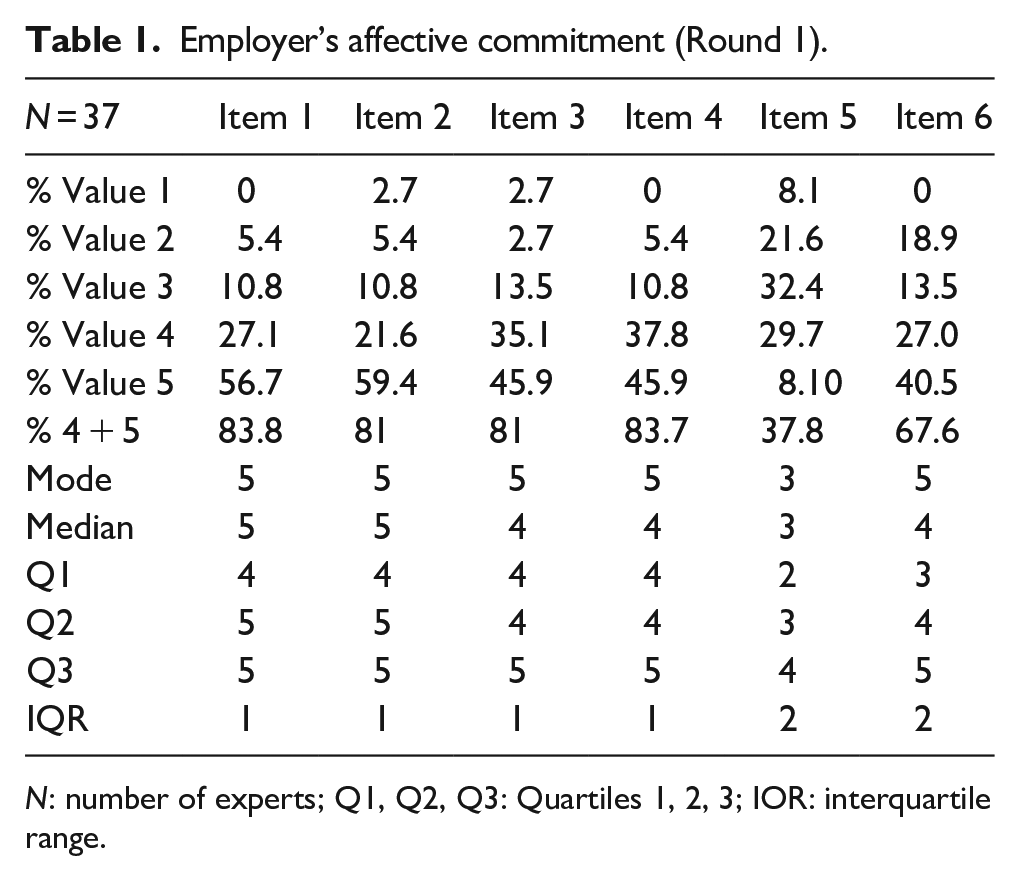
N: number of experts; Q1, Q2, Q3: Quartiles 1, 2, 3; IOR: interquartile range.
These results led us to consider a second round. In this round, all panelists were informed of the new wording of two items (5 and 6), in which there was no consensus. In addition, we sent information on the positions of other panelists with respect to items considered acceptable by experts who had evaluated these items as 3 or less. In this way, they could compare their evaluations with others and decide whether they would continue with their initial evaluation or modify it.
The results obtained in the second round indicate the existence of a consensus. The concentration of experts who rated items with scores of 4 or 5 was above 80% in all cases, and the IQR acquires a value of 1 for all items (see Table 2). Similarly, when CG is considered, it becomes clear that convergence exists as its index adopts values located within the pre-established margins in all cases.
Employer’s affective commitment (Round 2).
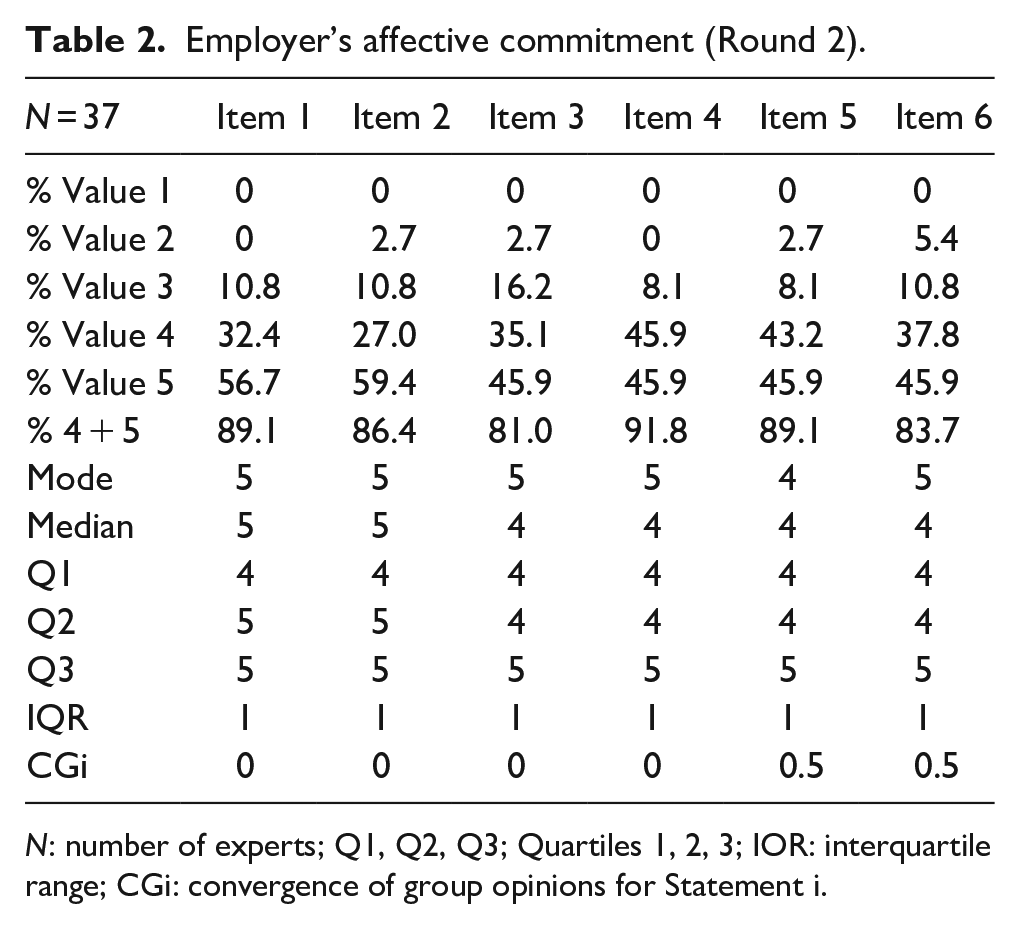
N: number of experts; Q1, Q2, Q3; Quartiles 1, 2, 3; IOR: interquartile range; CGi: convergence of group opinions for Statement i.
In short, the results obtained led us to consider that there was consensus regarding the relevance of six items indicated to define the affective commitment of an organization toward its employees. Therefore, following the literature, we did not consider it necessary to carry out a third round.
Employer’s continuance commitment
There were eight items subject to the evaluation of experts in this dimension of employer’s commitment. In the first round, established requirements were only fulfilled in three items (Items 5, 6, and 7) to consider the existence of consensus (see Table 3).
Employer’s continuance commitment (Round 1).
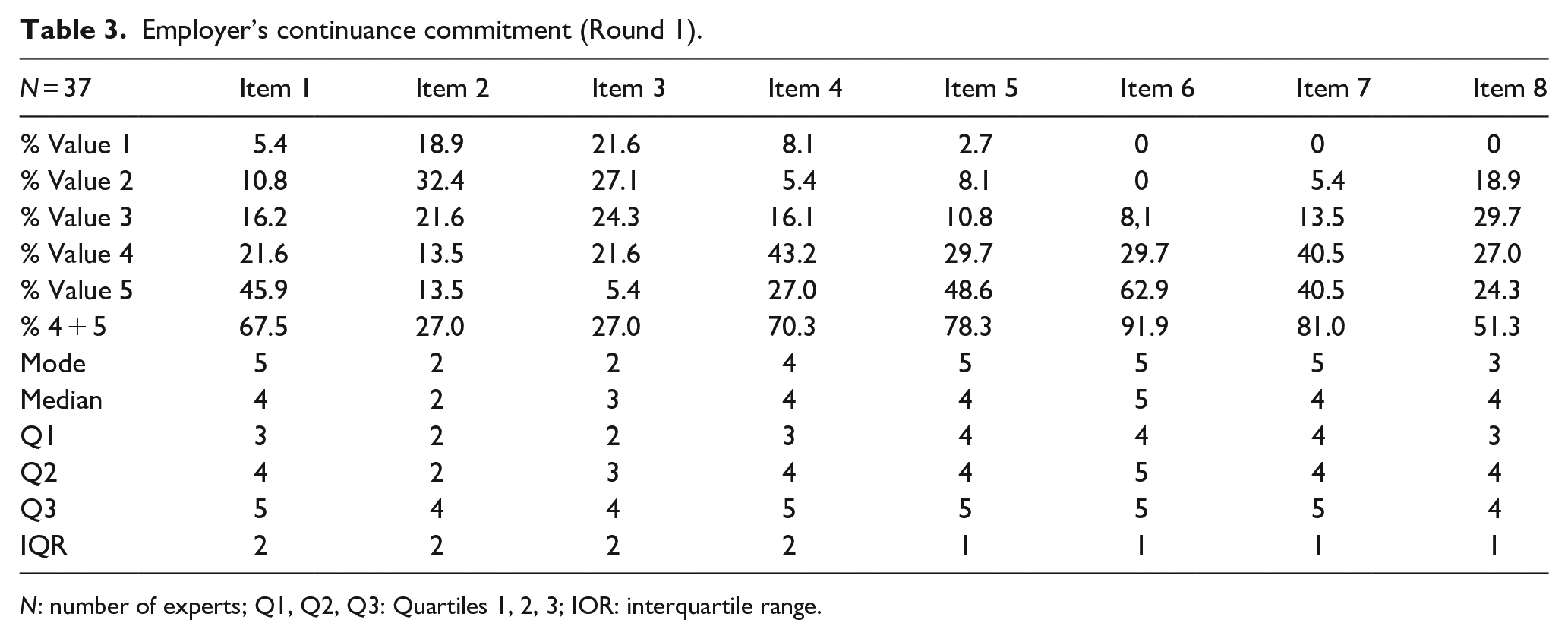
N: number of experts; Q1, Q2, Q3: Quartiles 1, 2, 3; IOR: interquartile range.
These results led us to reconsider the initial wording of the five items that had low ratings (1, 2, 3, 4, and 8). Thus, using indications of the experts, new wording for these five items was proposed in a second round of consultation.
In the second round, consensus was reached in four of five items analyzed (except for Item 2). The concentration of experts who gave values of 4 or 5 to these items exceeded 75%, and the IQR reached a value of 1. Regarding the convergence indicator (convergence of group opinions for Statement i [CGi]), all values were within the acceptance margin (see Table 4).
Employer’s continuance commitment (Round 2).
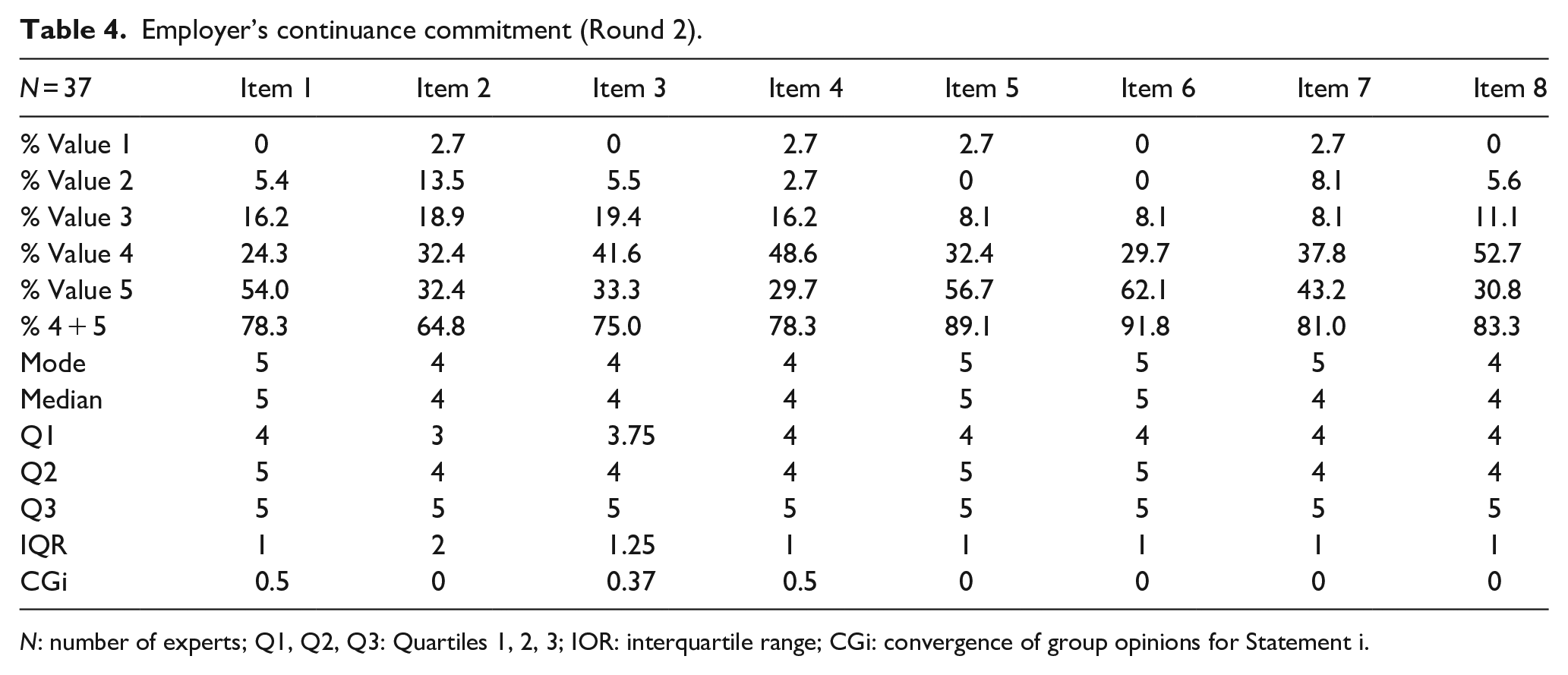
N: number of experts; Q1, Q2, Q3: Quartiles 1, 2, 3; IOR: interquartile range; CGi: convergence of group opinions for Statement i.
Considering experts’ comments and results of the second round, it was decided to eliminate Item 2, as it did not meet any criteria established for its acceptance, and to reassess Items 3 and 8. Although Item 3, in the opinion of the experts, reached the minimum score required (75%), it presented an IQR of 1.25% higher than the 1 required. Although Item 8 fulfilled the requirements established for its acceptance, it was reformulated. This decision was made because a high percentage of panelists proposed a new wording for this item. We understood that these drafting suggestions should be addressed for improvement and clarity of understanding.
Thus, in the third round, only two items (3 and 8) were incorporated, submitting new wording to the experts. Responses improved from previous results. Item 3 went from 75% to 91.8% regarding the position of panelists at Values 4 and 5, and from 1.25 to 1 in the IQR. Furthermore, Item 8 went from 83% of experts with ratings of 4 or 5 to 91.8%, and the range remained at the required value of 1. The CGi indicates that convergence in the opinion of the group of experts remains acceptable (see Table 5).
Employer’s continuance commitment (Round 3).
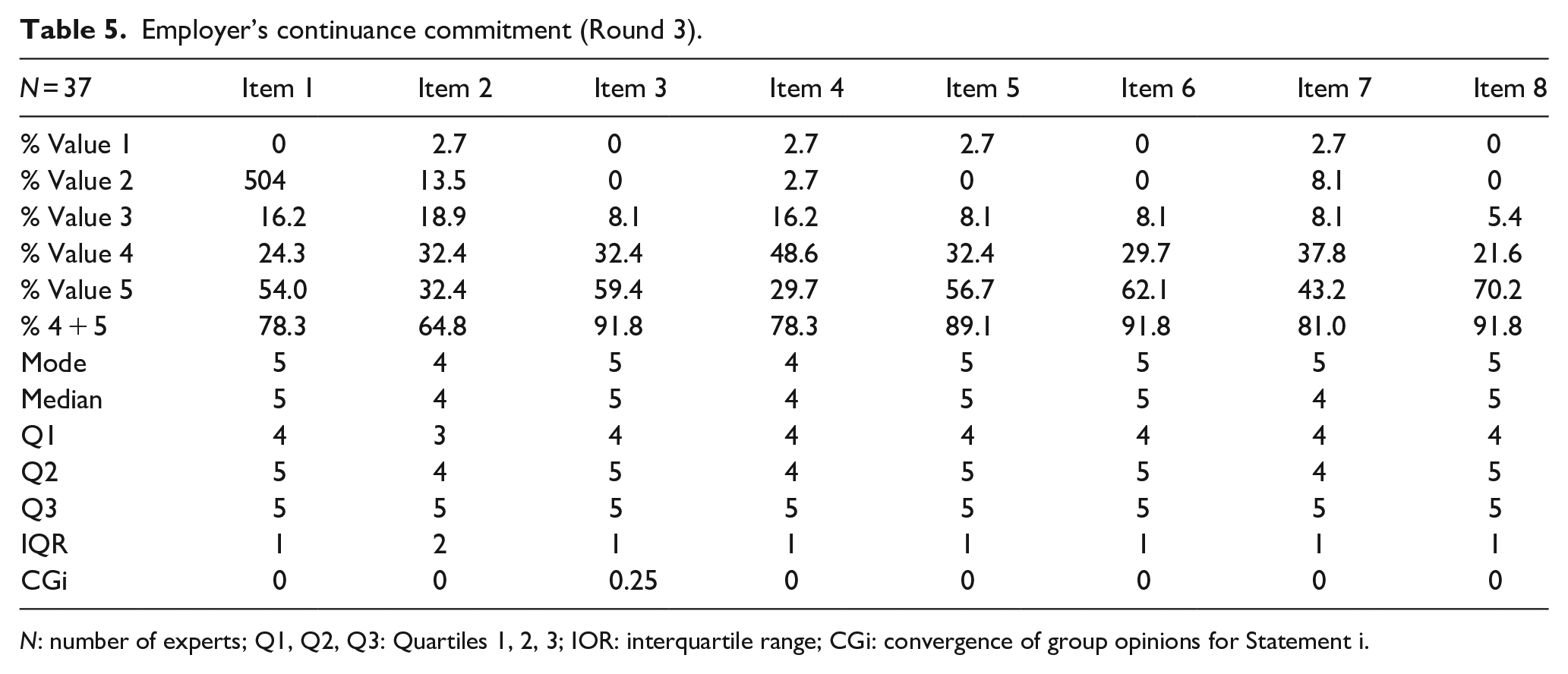
N: number of experts; Q1, Q2, Q3: Quartiles 1, 2, 3; IOR: interquartile range; CGi: convergence of group opinions for Statement i.
Employer’s normative commitment
Of the six items included in the first round of evaluation for this construct, only Items 1 and 5 posed consensus problems when they failed to reach established limits. In the remaining four items (2, 3, 4, and 6), for both the position of experts and IQR values, it can be said that there was consensus on their adequacy (see Table 6).
Employer’s normative commitment (Round 1).
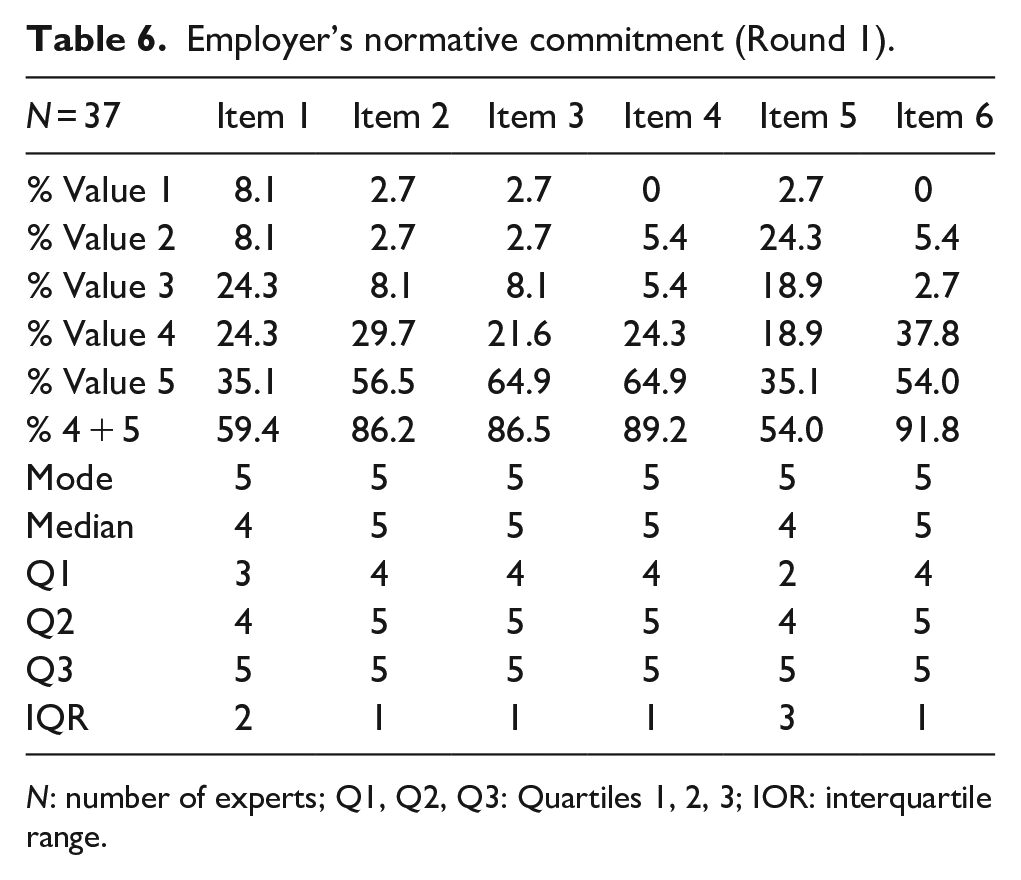
N: number of experts; Q1, Q2, Q3: Quartiles 1, 2, 3; IOR: interquartile range.
In the second round, based on comments and suggestions from the experts, new wording was proposed for Items 1 and 5. The results obtained were substantially improved compared to previous rounds. Thus, Items 1 and 5 reached a concentration of experts in Values 4 and 5 that exceeded 90% (91.8% and 97.2%, respectively) and interquartile indicators of 0 and 0.25, respectively. This indicated that desired consensus was reached. The convergence indicator was also deemed acceptable (see Table 7). These results led us to consider that the six items obtained after the second round could be considered adequate for measuring the normative commitment of an organization with respect to its employees.
Employer’s normative commitment (Round 2).
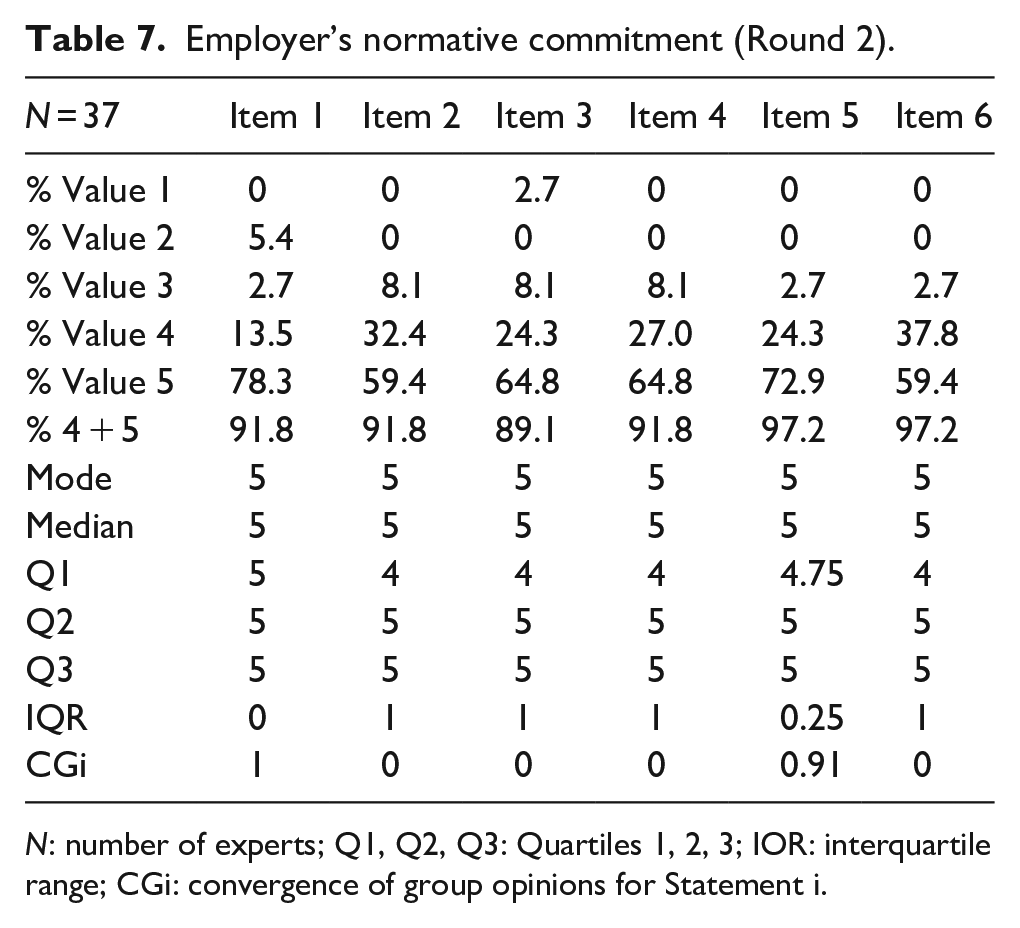
N: number of experts; Q1, Q2, Q3: Quartiles 1, 2, 3; IOR: interquartile range; CGi: convergence of group opinions for Statement i.
In short, from the Delphi analysis, a new questionnaire of 19 items was generated (see Table 8) and structured according to the following: six items measure the affective dimension, seven items measure the dimension of continuance (Item 2 was eliminated), and six items measure the normative dimension.
The Employer’s Commitment Questionnaire (Delphi analysis).
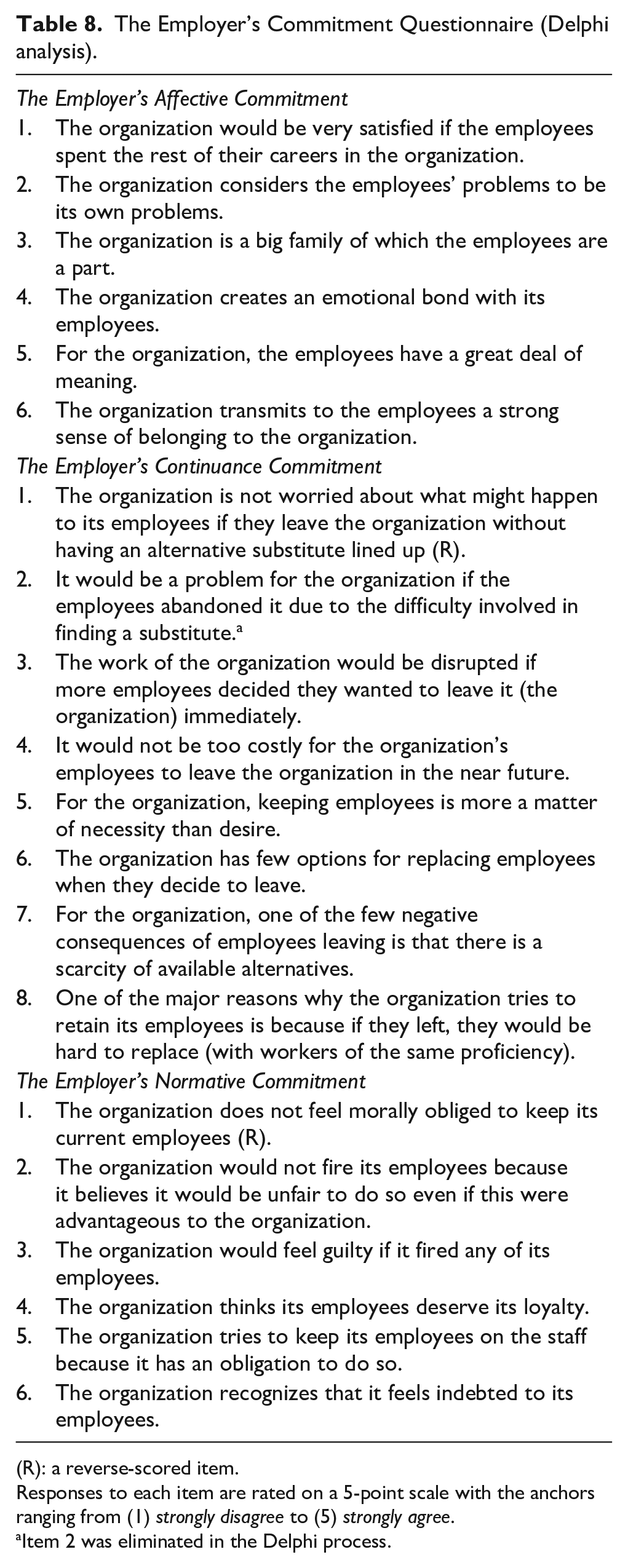
(R): a reverse-scored item.
Responses to each item are rated on a 5-point scale with the anchors ranging from (1) strongly disagree to (5) strongly agree.
Item 2 was eliminated in the Delphi process.
Analysis of dimensionality, reliability, and validity of the scale
Once the proposed questionnaire met the content validity requirement, the next step was to check whether it satisfied the dimensionality, reliability, and validity conditions normally required in scale validation processes (S. L. Ahire et al., 1996; S. L. T. Ahire & Ravichandran, 2001).
In the validity analysis, content, convergent, and discriminant validity were distinguished. Content validity was guaranteed through application of the Delphi process, which was carried out in the first phase of this validation process. Convergent validity measures the degree to which the three dimensions indicated as components of the examined construct reflect it. Convergent validity is confirmed when the average variance extracted (AVE) mean exceeds 0.5 and the value of the factor loads is greater than 0.7 (Hair et al., 1999). Discriminant validity measures the degree to which the three dimensions indicated are statistically different from each other such that although all three reflect the same concept (the employer’s commitment), they simultaneously represent autonomous ideas given that they are different factors regarding its content.
Sample and data collection procedures
To carry out dimensionality, reliability, and validity analyses, we used data obtained from two samples of populations related to the financial and hospitality sectors. Three criteria were adopted to select companies of the target populations: (1) belonging in the financial and hospitality industries, (2) possessing an HRM department or the equivalent, and (3) having more than 50 employees.
First, we decided to analyze these two industries because both are particularly important to the Spanish economy (Briedenhann & Wickens, 2004). Second, to assess the attitude or commitment that an organization has with its employees, we surveyed HR managers because we consider them to be broad connoisseurs of the phenomenon under study (Arthur & Boyles, 2007). Third, we only considered companies with 50 employees or more to focus on those companies for which, because of their size, the three dimensions of commitment could be better represented.
We used the Sistema de Análisis de Balances Ibéricos (SABI)—Iberian Balance Sheet Analysis System—database to identify companies belonging to the financial and hospitality industries with an HRM department and 50 or more employees. In this way, we obtained 401 hotels and 272 financial firms.
Our research team contacted each company to verify whether they fulfilled all three requirements. We received 130 completed and valid questionnaires from hotels and 87 from financial firms, corresponding to a response rate of 32.41% and 31.98%, respectively. For each company, we administered a questionnaire to the HR manager. Data were collected through on-site questionnaire administration.
To check for any possible selection and non-respondent bias in the samples, we used the archival analysis procedure (Rogelberg & Stanton, 2007) to examine any significant differences between respondent and non-respondent companies. The results of this analysis revealed no significant differences.
Results of the scales’ dimensionality, reliability, and validity
To analyze data obtained in relation to dimensionality, reliability, and validity of the employer’s commitment construct in the selected populations and samples (financial and hospitality), we performed SEM through CFA modality using the EQS 6.3 software.
Dimensionality analysis verified the degree to which the data obtained in each of two samples analyzed fit the proposed three-dimensional theoretical model (affective, continuance, and normative), reflecting the same construct, employer’s commitment.
Regarding data obtained from the hospitality population and in relation to individual analysis of the dimensions, the fit of the affective dimension suggests excluding its first item (see Table 8). After its exclusion, the model showed a suitable fit, as can be deduced from the goodness-of-fit indices (GFIs; Satorra–Bentler χ2 = 8.5068, df = 5, p = .13043; BBNFI = 0.965; BBNNFI = 0.970; comparative fit index [CFI] = 0.985; GFI = 0.972; adjusted goodness-of-fit index [AGFI] = 0.915; root mean square error of approximation [RMSEA] = 0.07). Moreover, estimated parameters were all significant, and standardized factor loads were above 0.7 (R2 > .5). We considered this model to be acceptable.
However, we did not obtain a similar result for the “continuance” dimension. In this case, the model did not fit, as indicated by the GFIs (Satorra–Bentler χ2 = 31.9581, df = 14, p = .00406; BBNFI = 0.816; BBNNFI = 0.824; CFI = 0.882; GFI = 0.929; AGFI = 0.859; RMSEA = 0.1); the calculated parameters were mostly not significant, and almost all factor loads were less than 0.7.
This adverse result leads us to consider the possibility that within this dimension of continuance coexists subdimensions. To test this idea, an exploratory factor analysis was conducted. It was found that, indeed, indicators of the continuance dimension are grouped into three subdimensions associated with different ideas: (1) the organization considers its employees as “numbers” rather than people (Items 1 and 4; see Table 8), (2) the costs the organization would incur if its employees decided to leave (Items 2 and 3), and (3) the lack of new employees to substitute those already in the organization (Items 5, 6, and 7).
To verify this, a measurement model consisting of these three subdimensions of employer’s continuance commitment was tested. The results obtained (Satorra–Bentler χ2 = 18.9250, df = 11, p = .00406; BBNFI = 0.891; BBNNFI = 0.901; CFI = 0.948; GFI = 0.955; AGFI = 0.885; RMSEA = 0.07) indicate that although their GFIs were acceptable, the non-significance of almost all parameters estimated in the model and a majority of factor loads less than 0.7 (R2 < .5) led us to reject them. Similarly, a closer examination of this result revealed that indicators related to the third factor (“the lack of employee alternatives”) were significant with loads greater than 0.7. This seems to show that the continuance dimension of the employer’s commitment construct is represented only by three indicators related to the “lack of employee alternatives” subdimension (Items 5, 6, and 7).
Regarding the normative dimension of employer commitment, the CFA indicated that the model does not fit (Satorra–Bentler χ2 = 22.4603, df = 9, p = .00753; BBNFI = 0.878; BBNNFI = 0.868, CFI = 0.921, GFI = 0.935, AGFI = 0.849, RMSEA = 0.108). The analysis suggests the elimination of Items 3, 4, and 6. This led us to measure this factor using the remaining three items. Considering that this dimension and the continuance dimension are measured by only three items prevents them from being individually tested because they would be saturated models whose solutions were not admissible.
To solve this problem, we tested a three-factor model comprising the three dimensions indicated—affective, continuance, and normative—which we call the complete measure model (CMM) and contains items of each dimension that were not rejected, that is, Items 2, 3, 4, 5, and 6 for the affective dimension; Items 5, 6, and 7 for continuance dimension; and 1, 2, and 5 for normative dimension.
This model presents a satisfactory fit, as can be inferred from the GFIs (Satorra–Bentler χ2 = 50.3840, df = 41, p = .14946; BBNFI = 0.908; BBNNFI = 0.975; CFI = 0.981; GFI = 0.940; AGFI = 0.904; RMSEA = 0.041). Similarly, all estimated parameters are significant except for covariance between the affective and continuance dimensions, which indicates these two dimensions are not related.
As expected, the second-order measurement model fits. However, the non-significance of estimated parameters relative to factor loads that associate each dimension with the factor considered shows that the three dimensions analyzed do not reflect the same construct. Consequently, these three dimensions are considered autonomous and independent factors that manifest three different types of commitment: affective, continuance, and normative.
From the results of analysis, it can be stated that the scale is reliable and that convergent and discriminant validity exist. First, we confirm that all standardized factor loadings are significant and higher than 0.7, except for Item 5, whose factor loading value is 0.604 (Hair et al., 1999). Composite reliability (CR) confirms reliability of the scales because in all cases, it is higher than .7. Similarly, Cronbach’s alpha for each factor is higher than .7 in all cases. Convergent validity is confirmed by the AVE since, in all cases, the value is higher than or equal to 0.5. Finally, following Fornell and Larcker’s (1981) procedure, we can state that divergent validity exists by confirming that the AVE is greater than the square of correlations existing between each pair of factors. In Table 9, we summarize these results.
CR, AVE, and squared correlations between factors (hospitality sample).
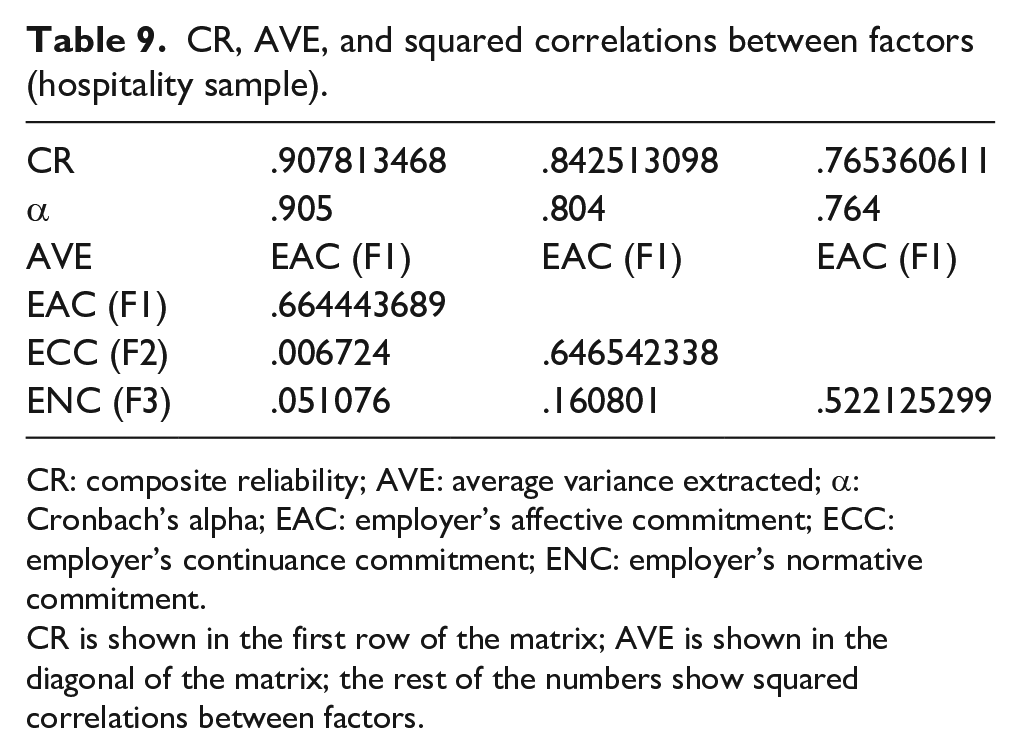
CR: composite reliability; AVE: average variance extracted; α: Cronbach’s alpha; EAC: employer’s affective commitment; ECC: employer’s continuance commitment; ENC: employer’s normative commitment.
CR is shown in the first row of the matrix; AVE is shown in the diagonal of the matrix; the rest of the numbers show squared correlations between factors.
Table 10 shows the means, standard deviations, and correlations of the variables’ dimensions included in the analyses related to the hospitality sample.
Means, standard deviations, and correlations between factors (hospitality sample).
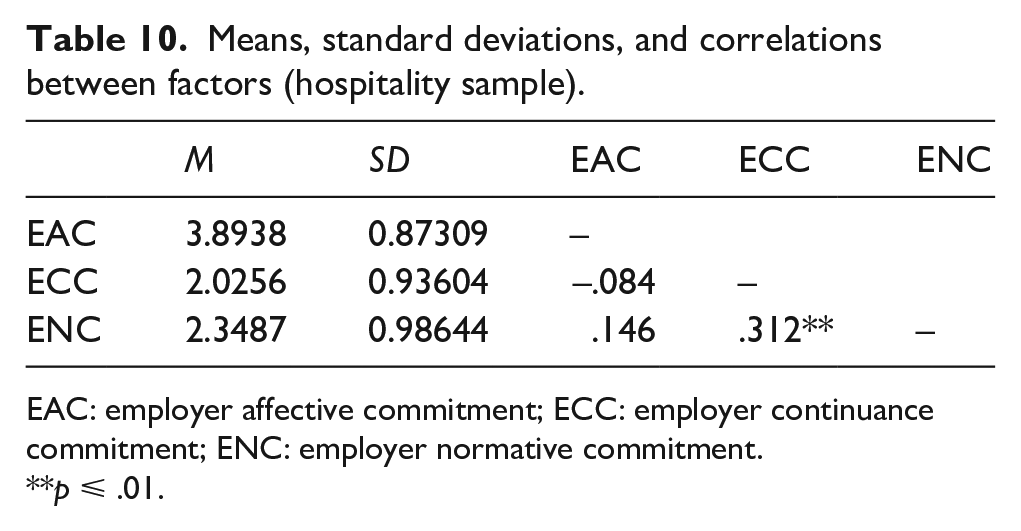
EAC: employer affective commitment; ECC: employer continuance commitment; ENC: employer normative commitment.
p ⩽ .01.
We replicate the same model (CMM) in the financial sample. The results obtained were very similar to those obtained in the hospitality sample. Thus, the fit of CMM is equally satisfactory, as can be inferred from the GFIs (Satorra–Bentler χ2 = 50.5866, df = 41, p = .14498, BBNFI = 0.866, BBNNFI = 0.960, CFI = 0.970, GFI = 0.908, AGFI = 0.852, RMSEA = 0.052). As is the case with the hospitality sample, the parameters corresponding to covariances between factors are equally non-significant, which indicates the absence of a relationship between the three dimensions.
The second-order measurement model is also suitable. However, as was the case with the hospitality sample, the factor loadings of each dimension associated with the factor considered were not significant. Therefore, in this financial sample, there are three autonomous and independent dimensions measuring commitment of the affective employer for continuance and normative; nevertheless, they do not reflect the same construct, the employer’s commitment.
Regarding the results related to reliability and convergent and discriminant validity, they are equally valid, as shown in Table 11.
CR, AVE, and squared correlations between factors (financial sample).
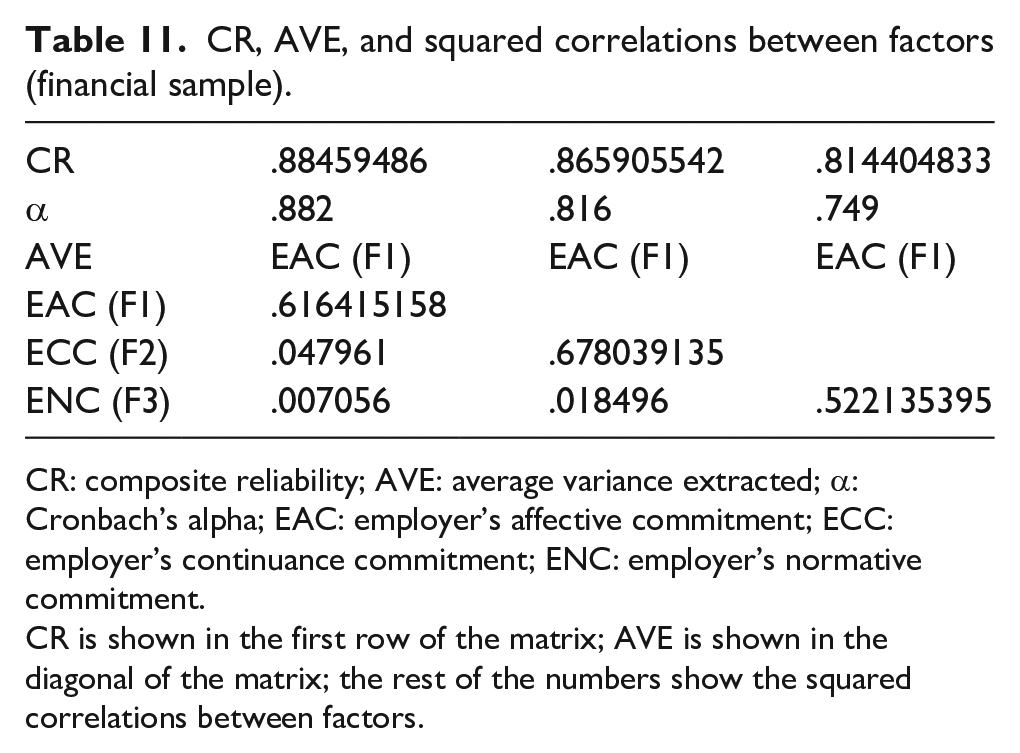
CR: composite reliability; AVE: average variance extracted; α: Cronbach’s alpha; EAC: employer’s affective commitment; ECC: employer’s continuance commitment; ENC: employer’s normative commitment.
CR is shown in the first row of the matrix; AVE is shown in the diagonal of the matrix; the rest of the numbers show the squared correlations between factors.
Finally, Table 12 shows the means, standard deviations, and correlations of the variables’ dimensions included in the analyses related to the financial sample.
Means, standard deviations, and correlations between factors (financial sample).
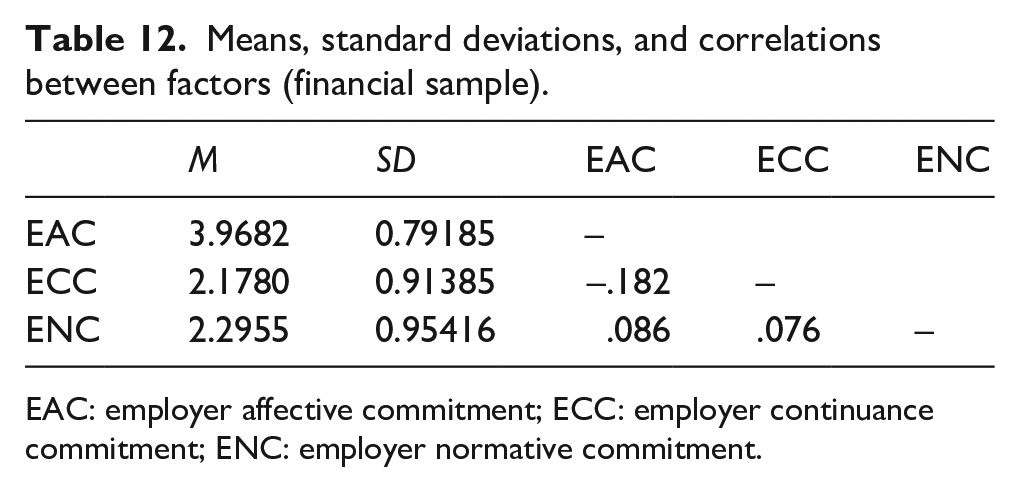
EAC: employer affective commitment; ECC: employer continuance commitment; ENC: employer normative commitment.
Based on the results obtained in the two samples analyzed (financial and hospitality), we conclude that there are three autonomous and independent factors measuring affective, continuance, and normative commitment that an employer has with its employees. That is, they are not three forms of the employer’s commitment but three kinds of commitment since they do not reflect the same superior factor (the employer’s commitment). This result was not unexpected. When Solinger et al. (2008) analyzed similarities and differences between these dimensions in the case of employees’ commitment, they concluded that the dimensions are indeed different and autonomous because they are different from a conceptual perspective.
The proposal for the final questionnaire is shown in Table 13.
The employer’s commitment (final questionnaire).
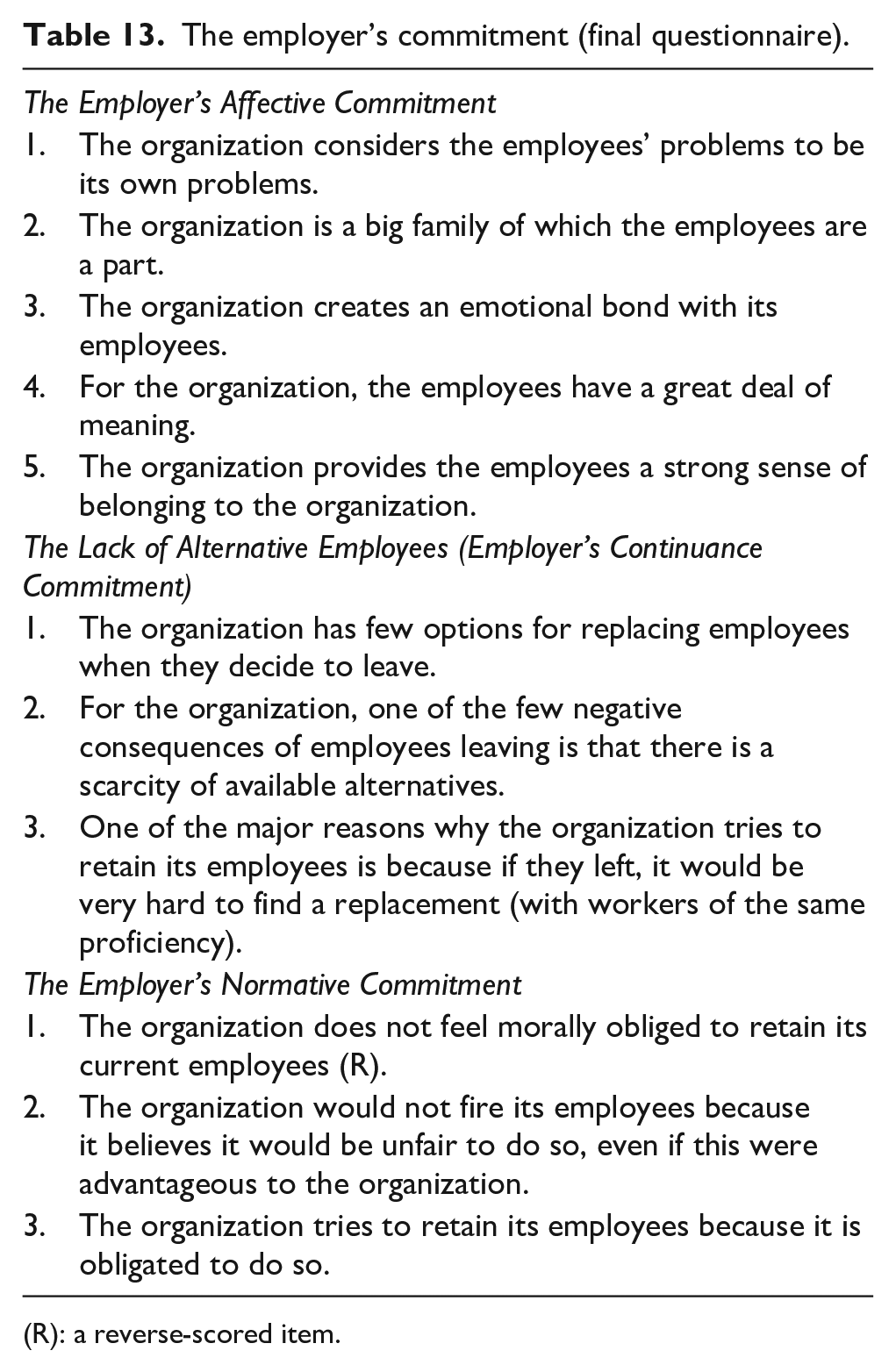
(R): a reverse-scored item.
Discussion and conclusion
This study explored and emphasized the need to determine whether the behavior of companies and their employees could be explained according to the commitment of an organization toward its employees. In turn, the commitment of employees to their organization can be a reflection and manifestation of the commitment that the organization shows toward them. However, while the literature has focused on employees’ commitment, it has paid little attention to the employer’s commitment. Therefore, this article, referring to the literature on organizational commitment, considers an organization’s attitudes toward its employees as representative of its commitment.
Two important aspects of the proposal to conceptualize commitment from the perspective of an organization should be pointed out. First, we moved the focus of analysis from the employee to the organizational level and, second, we considered managers as the organization’s representatives. In relation to this second aspect and following the approaches of Levinson et al. (1962) and the agency theory (Eisenhardt, 1989), we decided that an organization is represented by those with maximum capacity in the decision-making process (managers) in a way that their decisions and behaviors are understood as if carried out by the organization itself (Shore et al., 2004; Tsui et al., 1997; Tsui & Wu, 2005).
The formulated employer’s commitment approach gives rise to a third aspect worth highlighting: the possibility of comparing the employer’s perception of their commitment to the employees with that which is actually perceived by employees. Regarding this aspect, it is useful to keep in mind that employers and employees tend to perceive inducements and contributions in a biased manner. Thus, while employers tend to overvalue their inducements and undervalue the contributions of employees, employees tend to overvalue their contributions and undervalue the inducements of employers (Coyle-Shapiro & Shore, 2007). This juxtaposition of perceptions could explain why employees’ behaviors do not correspond to those expected by the employer.
A fourth aspect emerging from the analysis conducted in this study is that the employer’s commitment, understood as the attitude an organization adopts or makes toward employees, would allow us to determine whether behaviors and decisions of the organization really reflect their commitment. For example, is the HCWS actually a reflection of employer’s commitment? Assessment of the employer’s commitment would make it possible to understand that there might be cases in which the organization’s attitudes (commitment) do not correspond to facts or decisions reflected in the design of the human resource management system (HRMS). Similar examples could be provided when considering the relationship between an employer’s commitment and other variables.
With the aspects mentioned so far, we have attempted to reflect our contributions, incorporating the employer’s commitment as a new variable. This allows us to better understand the behaviors of both the organization and its employees. A closing contribution of this article is the final proposal made regarding dimensionality of the employer’s commitment construct based on an empirical analysis.
Examination of results obtained in analyses of dimensionality, reliability, and validity of the scale allows for interesting conclusions to be drawn that differ from the conceptual proposal set out initially. Thus, the first and most important conclusion is that the three dimensions examined are not related to each other but rather function autonomously and do not reflect the same phenomenon. These results and conclusions are not surprising, as Solinger et al. (2008) criticized TCM, pointing out that the three dimensions of employees’ commitment referred to different types of commitment rather than dimensions of the same construct, given that they are different from a conceptual perspective.
This conclusion explains the unnecessary presence of these three types of commitments in an organization and shows that each one can have different values and orientations. Thus, the fact that an organization is affectively and emotionally committed to its employees does not have to influence its decision to keep retain them for economic, rational, or calculative reasons, and vice versa. Hence, while the dimension of continuance would suggest managing employees with exclusively rational and efficient criteria because their primary concern is the company’s benefit, the affective dimension would entail going beyond simple cost–benefit analyses to consider employees as “people before numbers” and being mindful of their well-being and future. This implies that fewer organizational benefits would be obtained.
Similarly, the affective and normative dimensions are different. While the affective dimension is associated with being oriented toward people because the employer identifies emotionally and affectively with employees, the normative dimension is associated with compliance with what is right (the norm) and having a balanced ER (psychological debt).
In short, the analyses carried out lead us to propose the existence of three independent and autonomous ways of expressing commitment (three kinds of commitment) that an organization has toward its employees.
A final noteworthy aspect is derived from CFAs made in each type of commitment. While affective and normative are unidimensional factors, the continuance dimension seems to be subdivided into three subfactors: the degree to which the company considers employees its responsibility, costs associated with the departure of employees, and the lack of alternative employees. However, CFAs indicate the factor that works correctly is “lack of alternative employees.” This last result, which is seen in the two samples examined (financial and hospitality), shows that the continuance dimension of an employer’s commitment is represented exclusively through items measuring a lack of employee alternatives. In other words, the commitment to continuance is also a unidimensional factor in which its content is exclusively determined by items that reflect the dimension highlighted. Thus, when an employer decides to retain its employees for economic reasons, this is primarily because of the scarcity or absence of other employees who could replace the current ones.
This study has some limitations. The first limitation is related to context. As indicated in the paragraph above, in the financial and hospitality contexts, the dimension of continuity of employer’s commitment is only represented by the “lack of alternative employees.” If we replicated this scale in a context distinct from that analyzed, results could indeed be different from those obtained in this study. The second limitation is related to sample size. Although the response rate in this study is similar to those obtained in other studies (Nguyen & Teo, 2018; Roca-Puig et al., 2007), it is true that it could be improved. In addition, analysis was performed using cross-sectional data. It is always desirable to have longitudinal data to incorporate the time variable into analysis. In addition, employer’s commitment is measured and validated through perception of the company’s HR manager. Although we consider that, given the nature of the variable under study, the HR manager is a key informant (Arthur & Boyles, 2007), we also recognize that the perceptions of other managers of the company, as well as that of the Chief Executive Officer (CEO), would have enriched validation of the proposed construct.
Based on the limitations indicated, we propose four directions for future research. First, we ask ourselves if the employer’s commitment toward employees depends on variables such as characteristics of the employees. Answering this question would imply taking into account contingent variables such as characteristics of the employees (their strategic or supportive consideration, hierarchical position, knowledge, and greater or lesser capacity to be replaced by other employees, etc.; Lepak & Snell, 1999). Second, we ask whether the effects of employer’s commitment to employee behavior or organizational decisions can be moderated for variables such as characteristics of the environment (economic, social, political, etc.) in which the company carries out its activities. As a third line of research, we suggest incorporating organizational result measures associated with the examined variable (the employer’s commitment), as well as employees’ perceptions of the employer’s commitment. In this manner, we would have, on one hand, information showing how a company’s representatives perceive the commitment of the organization to its employees and what influence this has on results; on the other hand, we would know what employees think and how they actually perceive the commitment of their organization. We understand that this would help answer the typical question of why employees do not behave as employers expect and vice versa. Finally, as a fourth line of research, we ask ourselves whether the employer’s commitment to its employees is homogeneous or heterogeneous. In this sense, we wonder what degree of consensus is present among managers regarding how they perceive the organization’s commitment to its employees? Do these perceptions depend on the managers’ individual characteristics? In addition, given that there are individual differences among employees and they are differently committed to their organization, does the organizational commitment depend on the employees’ individual characteristics and their commitment to the organization? Future research related to the homogeneous/heterogeneous application of the employer’s commitment can help address these questions.
Footnotes
Acknowledgements
The authors would like to thank the participants in the Delphi process for their contribution, since this has allowed us to validate the scale of the “commitment of the organization to its employees”.
Declaration of conflicting interests
The author(s) declared potential conflicts of interest with respect to the research, authorship, and/or publication of this article.
Funding
The author(s) disclosed receipt of the following financial support for the research, authorship, and/or publication of this article: financial support received from the Junta de Andalucía research group SEJ-602 is gratefully acknowledged.