




Abstract
Theoretical debate suggests at least three strategies for firms to provide training to employees in the same job position: individualized and egalitarian with or without adaptation to the abilities of the recruited employees. The article provides a formal framework for deriving distinctive empirical implications regarding the relationship of these strategies with the firms’ selection policies, which are tested using a dataset of blue-collar workers in Spanish industrial plants. The evidence is consistent with the empirical implications of the egalitarian strategy with adaptation. This strategy entails providing the same level of training to all workers in the same job position and setting this level according to the average ability of recruited workers. Paradoxically, this strategy has not been used to interpret the results of the existing empirical literature.
JEL CLASSIFICATION
M53; M54; M21; J24
Keywords
Introduction
Barron et al. (1989, 1997) pointed out a positive relationship between firm-provided training and the intensity of their workers’ selection procedures. We are not aware of any posterior academic effort to reinvestigate that relationship until now. By contrast, there is extensive literature analyzing other determinants of firm-provided training, predominantly, the workers’ educational level (see Kramer & Tamm, 2018). Although we provide evidence of a positive relationship between firm-provided training and workers’ education level, this relationship vanishes when we control for the firms’ selection intensity. This is a result not predicted by the previous literature. Furthermore, in our empirical application selection intensity emerges as the most important variable to explain training. This evidence suggests the need to revisit the study of the relationship between training and selection intensity. This article is an effort to analyze the relationships among firm-provided training, the selection process intensity, and workers’ education in light of theoretical advances that have occurred in recent years.
Barron et al. (1997) developed a formal model analyzing the relationship between the training provided by firms and their selection procedures. In this model, training is an exogenous variable; therefore, these authors are implicitly assuming that the firms’ training strategy is (1) egalitarian: firms offer the same level of training to all workers in the same job position, thus they do not use the information provided by the selection process for training decisions and (2) static: firms do not adapt the training level to the relevant information about the workers’ abilities that might be revealed between the moment in which the candidate is hired and training is provided.
These assumptions contrast with those usually made in models interpreting the empirical evidence on the determinants of firm-provided training (see Kramer & Tamm, 2018, for a recent contribution). The most common finding of this literature has been the positive relationship between workers’ educational level (which is interpreted as an indicator of workers’ abilities) and the training provided by firms. This evidence has been interpreted as indicative of the existence of dynamic complementarities between training and ability (Cunha & Heckman, 2007), which implies that firms find it profitable to set the level of training according to the ability of the candidates (Cunha & Heckman, 2007; Heckman, 2000; Mincer, 1992; Rosen, 1976). Implicitly, this literature is assuming that the firms’ training strategy is (1) individualized, as opposed to egalitarian, and (2) adaptative, that is, firms adapt the training level to the information about the workers’ abilities. Following Prasad and Tran (2013), we will term direct contract to a strategy combining these two characteristics.
Comparing these two strategies, we observe that the second one, direct contract, is less restrictive (individualized and adaptative vs egalitarian and static) and, one would expect, more efficient (see Bishop, 1991, for a discussion on this argument). Therefore, further theoretical justifications need to be provided to explain why firms may want to self-restrict their training strategies. Henceforth, we refer to the training strategy with egalitarian and static characteristics as the restrictive contract. Psychological literatures related to procedural justice (Folger & Cropanzano, 1998; Greenberg, 1996; Wiesenfeld et al., 2007) and social comparison (Ployhart et al., 2006; Taylor et al., 1990; Wood, 1989) provide informal arguments for why human resources practices cannot be individualized.
In addition, contractual justifications have been provided recently in the literature on the economics of private-sector training. Since the influential contributions of Acemoglu and Pischke (1998, 1999a, 1999b) explained why firms might provide general training to their workers, the focus of the theoretical debate has moved from the distinction between general and specific training toward the implications of labor market imperfections. For example, Leuven’s (2005) literature review classifies the theoretical models related to the economics of private-sector training based on their assumptions about competition in the labor market, or, in other words, whether it is perfect or imperfect (Boom, 2005).
The main source of imperfections in labor markets considered in the theoretical literature is the information about the workers’ abilities. Several authors (Chang & Wang, 1995; Kahn & Hubberman, 1988; Prasad & Tran, 2013; Prendergast, 1993) argue that it is generally not feasible to make training contracts contingent on workers’ abilities and that firms should therefore commit to providing the same level of training to all workers with the same contractible characteristics, such as those in the same job position. In fact, Prasad and Tran (2013) stress the importance of adapting training policies to environmental changes. Based on this literature, we suggest a third training strategy, one that is (1) egalitarian and that (2) adapts the level of training as the firm updates its information about the workers’ abilities gathered after the firm’s selection process. We term this training strategy an indirect contract.
This article contributes to the literature in the following ways. First, it provides a formal analysis of the implications of indirect training contracts on selection procedures. Second, it develops a theoretical framework encompassing and comparing the empirical implications of the three firm training strategies or contracts described above. Finally, it provides evidence on these implications, using cross-sectional data based on a survey of Spanish industrial plants providing information on human resources policies for blue-collar workers. The results are consistent with the implications of indirect contracts rather than with those of the other two types of contracts, direct and restrictive.
The remainder of this article is organized as follows. Section “Theoretical framework” provides the analysis of the empirical implications of the three training strategies or contracts already mentioned. Section “Methods” details the methods for providing the evidence. Section “Results” presents the results and section “Discussion and managerial implications” concludes the article and discusses its managerial implications.
Theoretical framework
Scope of the framework
This section develops a general framework to analyze the relationship between selection policies and firm-provided training under the three training strategies or contracts mentioned in the introduction. Therefore, the general assumptions of this framework are common to these three contracts and reflect the existence of imperfect information regarding candidates’ abilities as well as the complementarities between those abilities and firm-provided training. The timing of the model reproduces the sequence of actions made by firms. First, firms evaluate available candidates using different levels of intensity (including null intensity). Then, some of those candidates are selected and join the firms. Finally, firms provide training to those employees.
The differences among the contracts (or firm training strategies) are discussed in section “Types of contracts,” and this discussion is mainly focused on deriving (section “Empirical implications and the role of education”) the implications that can be tested using the data available. Obviously, the framework is a simplification of the related literature and some important aspects of their discussions are therefore missing. Furthermore, we focus on two properties of the training strategy (individualization and adaptation), which in most cases are not central in this literature.
A general framework
Period 1: abilities
A pool of heterogeneous candidates for a job position reaches a firm. To capture this heterogeneity, we define the variable ability
Period 2: information collection
The firm opens a job position with an associated selection procedure. Each job position opened is understood as an evaluation process of a particular candidate. Following Barron et al. (1997), we focus on two characteristics of the selection procedure, its intensity and extensity. Intensity is the set of tools for acquiring information about the candidate’s ability (e.g., credentials, ability or knowledge tests, interviews, Internet searches) that determine the quality of the information collected. Based on this information, the firm decides whether to reject or hire the candidate. Extensity is the number of times that the process is repeated until a candidate is hired and, consequently, it is directly related to the probability of rejecting a candidate. For the sake of simplicity, in this period, we focus on intensity and defer the analysis of extensity to Period 3. In both cases, the goal is the same: to set the assumptions to represent these concepts in terms of a single variable. Next, we detail the assumptions related to selection intensity.
First, the selection procedure generates information about the candidates’ abilities. After this process, the firm will have more (or at least the same) information about the candidate’s abilities than before the process. This information is summarized in the index number
Third, information quality ρ can be improved by investing more into the selection process (using more or better selection tools) and, consequently, increasing the costs of the firm. Then, we define function C(ρ), which represents the minimum cost at which the firm can obtain quality ρ. We assume that C(ρ) is increasing in ρ and that it is always possible to contract with a candidate without a selection process, C(0) = 0. In addition, we assume that
Finally, selection intensity affects the social surplus associated with the job position. For the sake of simplicity, we assume that the agents (firms and candidates) are risk neutral and maximize the expected social surplus—the difference between the expected profits of the job position
In sum, at Period 2, a random candidate from the pool applies to a job position opened by a firm and goes through the selection process. Every selection process has an associated selection intensity
Period 3: candidate selection
Now we focus on the extensity of the selection procedure or selection criteria. We assume that each firm establishes L, the minimum expected ability of a candidate for being accepted by firm i. At the beginning of this period, firm i obtains information on the particular candidate j (for example, the candidate has a high school degree with 4 years of experience, scored 60 points on the ability or knowledge test, and had a very good interview) that is summarized into Ij. The candidate’s expected ability is
We assume that a rejected candidate will generate profits of zero, whereas a candidate filling the job position will generate expected profits of E(πi). Therefore, before obtaining any information about the candidate’s abilities, the expected profits associated with the job position
Although the profits of filling the job position πi will be defined in the next period, we anticipate that they will depend on the candidates’ abilities, which in the current period are random variables. Note that the expected ability of the selected workers is
Period 4: training provision
Between the period that the candidate is selected and training is provided, the firm can collect more information about the worker. For simplicity, we assume that in this period, the firm acquires perfect information about the workers’ abilities. Firm i provides level of training t to a hired candidate j, thus obtaining the corresponding profits associated with the job position.
Our focus of interest is the relationship between the selection intensity of the candidates and their posterior training. Therefore, we assume that the profit of firm i when a candidate j is hired, denoted by πi , is a function of the worker’s abilities m and training (e.g., the time devoted to training), t ⩾ 0. This function can be written as

Let us interpret q as the increment in the workers’ production associated with training and workers’ ability. Hence, positive parameter
Function πi can be considered the second-order Taylor expansion of any functional form
4
that considers only workers’ training and abilities. This is the minimum order of the Taylor expansion that represents the existence of complementarities among training and abilities in a single parameter and provides a simple expression for the optimal level of training,
This benchmark is designed to compare the implications of the three contracts mentioned in the introduction. In restrictive contracts, the training decision is made in Period 1. Obviously, making decisions in advance has a cost because firms cannot adapt to future circumstances. To capture this cost, we assume that the marginal productivity of one unit of training is
Types of contracts
The contracts that we will discuss are defined according to the moment when the training decisions are made and the information is used for making such decisions. In direct contracts (c = DI), training decisions are made in Period 4 and use all the information available about the parameters and abilities defined in the general framework (Period 1–4). In indirect contracts (c = IN), training decisions are also made in Period 4, but firms do not use the information available about the abilities of a particular worker to set the level of training. In restrictive contracts (c = R), training decisions are made in Period 1, before the selection process, thus firms do not use information either on Ij or on
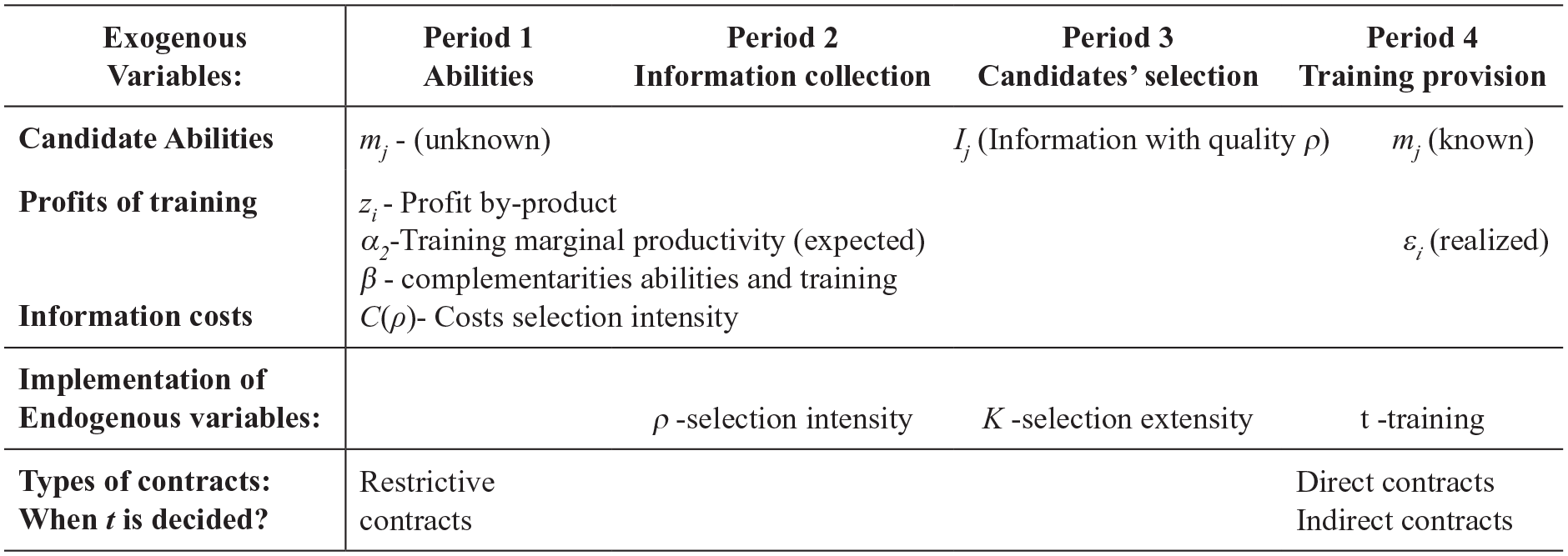
Timeline of the general framework.
Given that in our context, direct contracts make better use of the information available, they outperform (in terms of social surplus) indirect contracts, which in turn outperform restrictive contracts, which make use of no information (
The data available does not include information about the specific training contract used by each firm; hence, we cannot investigate the contexts in which such contracts could be infeasible. Therefore, our research approach will be to deduce the empirical implications of each type of contract and infer which one fits the data best. In the empirical application, we do not have information about the firms’ selection extensity; thus, henceforth, our discussion will focus on selection intensity. Next, we summarize the main implications of each type of contract.
Empirical implications and the role of education
In Barron et al. (1997), an exogenous level of training required for a position determines the level of selection intensity
Summary of direct effects in restrictive contracts.
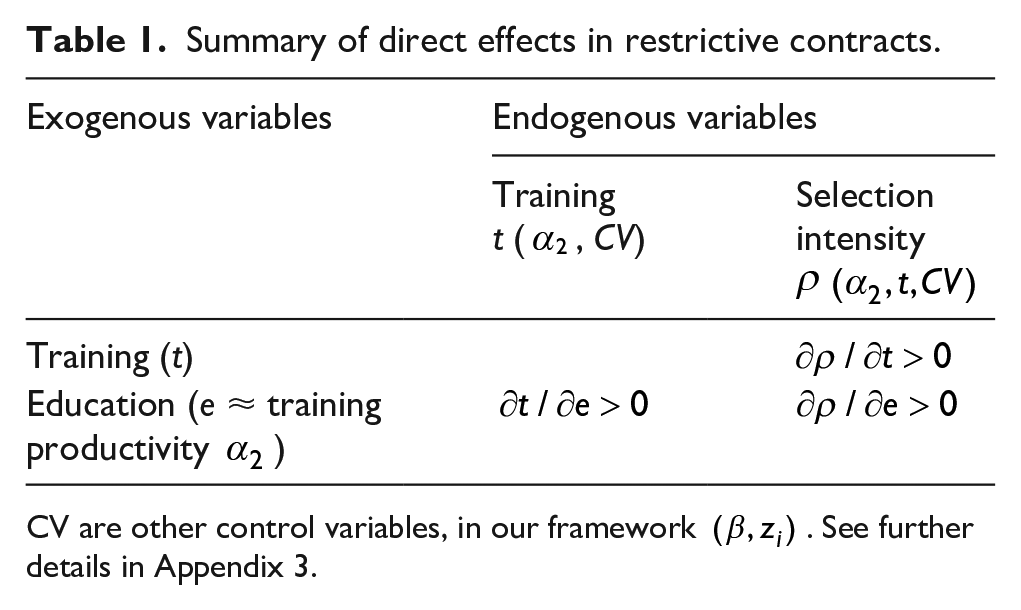
CV are other control variables, in our framework
On the contrary, several theoretical approaches suggest that education might be an indicator of candidates’ abilities.
7
If this were the case, the percentage of educated workers in a job position would be an endogenous rather than an exogenous variable (e.g.,
Our general framework assumes homogeneity in terms of the cost function of providing information
Our empirical application is in line with this interpretation. It is based on firms’ blue-collar workers, where differences in such parameters seem to be much less important than in data for several job positions. Furthermore, we will use variables as technological intensity that can help control for these factors. Therefore, we expect little variability in the expected marginal productivity of training
In our framework, the average ability of the workers hired by firm i, denoted

where
The direct contract presented here tries to represent the most common approach in the empirical literature on firm-provided training (Kramer & Tamm, 2018), in which there is no information about the selection process. In this type of contract, the selection intensity is irrelevant for training decisions

Since we have assumed that education is a proxy of the workers’ abilities, direct contracts predict that firms hiring (on average) more educated workers will provide them with more training
Summary of direct effects in indirect contracts.
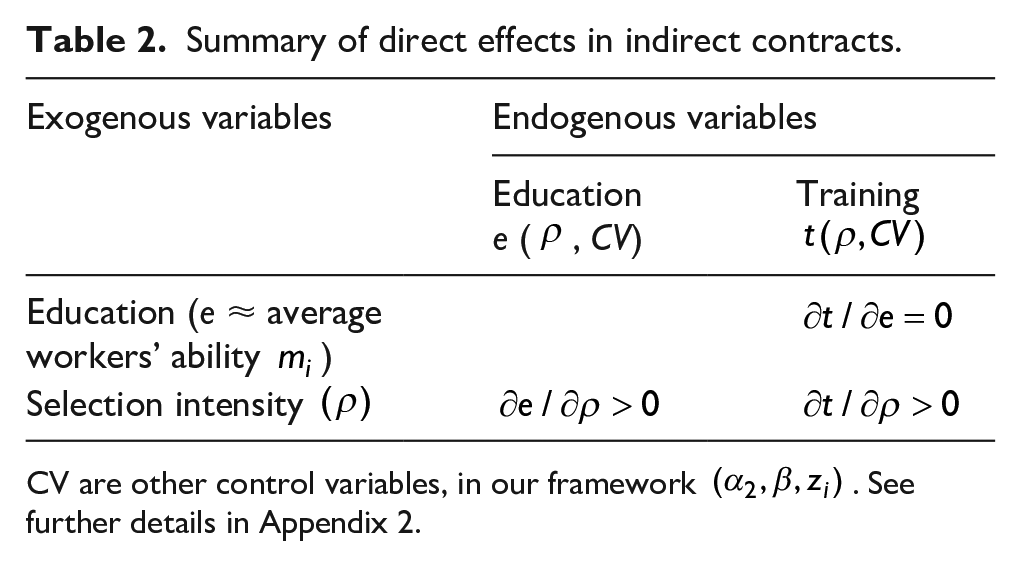
CV are other control variables, in our framework
On the contrary, the indirect contract assumes that the same level of training is provided to all workers in the same job position, but this level of training is decided once their abilities are known. Under this assumption, it is sensible for firms to reject the candidates that are expected to generate negative profits after training. Note also that those incentives will be higher for firms with higher unitary profit
In this contract, selection intensity positively affects selection extensity,

This contract predicts that the firms’ selection intensity
Summary of direct effects in direct contracts.
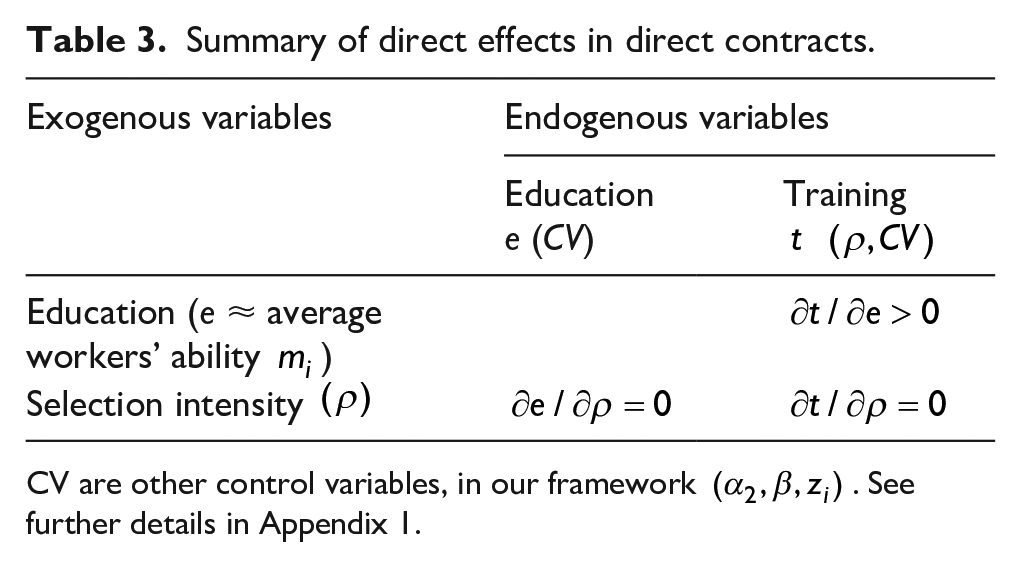
CV are other control variables, in our framework
Finally, one could suggest that education always is a contractible variable. When education is perfectly related to workers’ abilities, the optimal contract will be the direct one. In the case where education is unrelated to the workers’ abilities, the optimal contract will be the indirect one. These contracts can be understood as the extreme cases of a combination of (direct) contracts based on education and (indirect contracts) with some (minimum) level of training associated with the job position.
Methods
Econometric specifications
We use cross-sectional data for estimating the following recursive triangular system of equations determining the education and training levels of workers


where observations i are industrial plants, and the variables of interest are selection intensity
This specification allows us determine the type of contract that better fits the data by testing the following predictions (see Tables 1 to 3, above):
Direct contracts:
Indirect contracts:
Restrictive contracts:
8
We do not claim that we provide evidence on causality among the variables. The econometric specification is chosen on the basis of firms’ usually observed sequence of decisions, as described in the theoretical framework. A similar specification is used by Kramer and Tamm (2018) but with the difference that they do not analyze the impact of the intensity of firms’ selection policies.
The estimations can be conducted with two alternative assumptions about error terms
If, on the contrary, one assumes that they are correlated with each other and with the independent variables (e.g.,
Sample
The data are taken from a survey 9 of Spanish industrial plants, which was designed to obtain information on human resources and work organization practices for blue-collar workers. To ensure that the survey instrument adequately conveyed the intended research questions, the original questionnaire was fine-tuned with a pretest sample of 15 plant directors. The anonymity and use of subjective assessments by the interviewee on various scales is a common practice in the empirical literature concerned with the analysis of human resources and work organization practices. This approach increases the possibility of obtaining information on some concepts, even if objective information is not available. The caveat is that it makes it difficult to complement the information with other sources and then search for instruments outside the sample.
The target group was a collection of manufacturing plants in mainland 10 Spain with 50 or more workers and whose economic activity was included in one of the 13 manufacturer sectors of the NACE 11 classification for 1993. The unit of observation was the plant, not the firm as a whole. The sample of manufacturing plants was identified in CAMERDATA (the database for the Chamber of Commerce of Spain) and consisted of 3,000 plants. A stratified random sample that guaranteed the representativeness of strata by size and industrial sector based on 401 interviews (13.4% of the target group) was finally achieved. For each plant, a questionnaire was completed between December 2007 and April 2008 through personal interviews conducted by a specialized firm, in most cases with the directors or with the production or human resources managers of the plant; each interview was approximately 60 min long. 12 As some questionnaires were incomplete, 13 we ended up with 362 observations. Table 4 compares the distribution of the plants by size and economic sector among the population of Spanish manufacturing plants 14 and the sample. As seen, there are no important differences in terms of these variables. Note also that given the institutional structure of the Spanish state, we do not expect important differences across regions in the legislation regulating firms’ economic activities.
Distribution of the plants by size and economic sector.
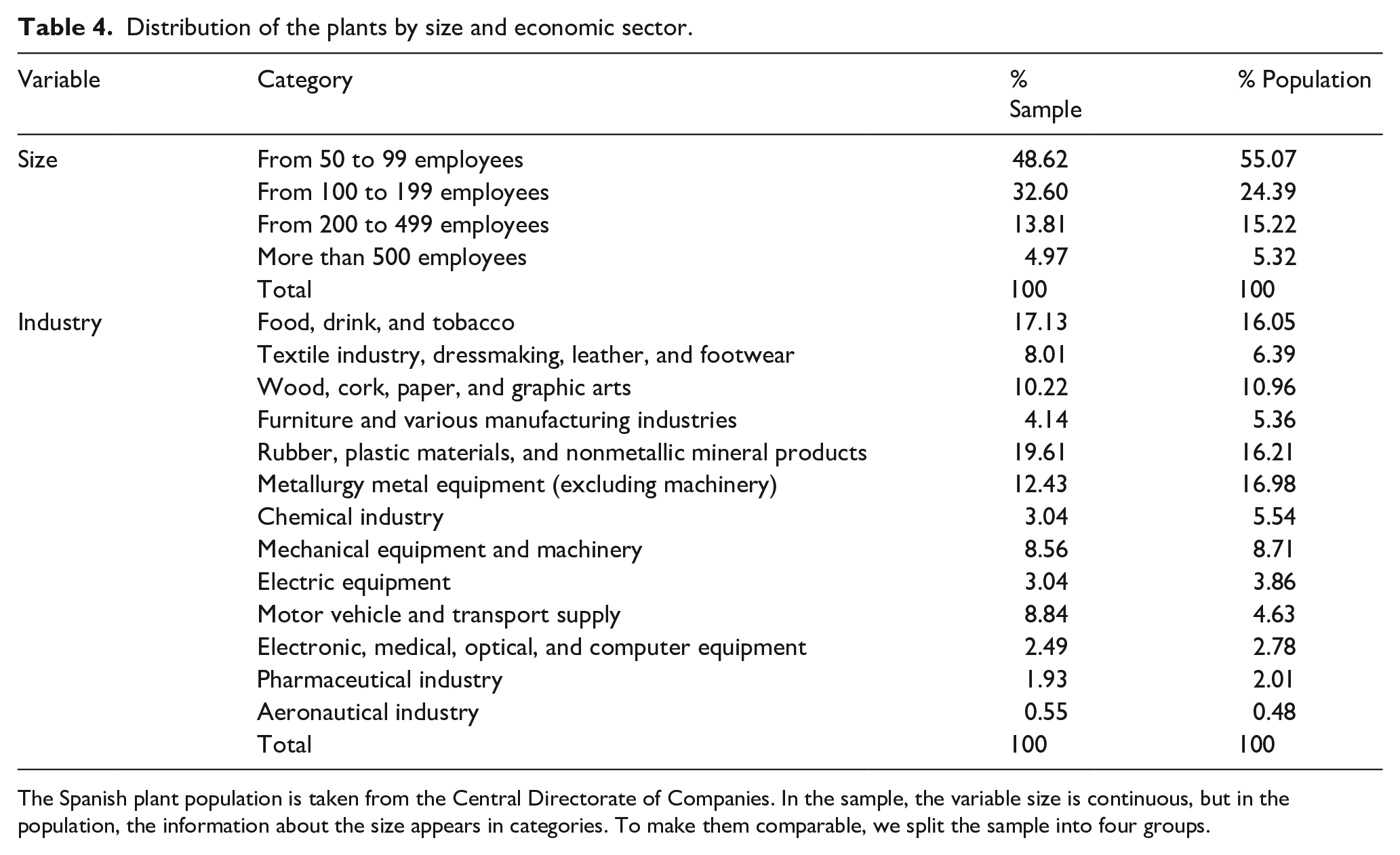
The Spanish plant population is taken from the Central Directorate of Companies. In the sample, the variable size is continuous, but in the population, the information about the size appears in categories. To make them comparable, we split the sample into four groups.
Measures
Our survey provides measures for selection intensity as well as staff education and firm-provided training, which are the variables of interest in our theoretical discussion. Table 5 shows the distributions and the descriptive statistics of the variables used in the estimations. The original questions from which we define the variables are presented in Appendix 4.
Frequency distribution and descriptive statistics.
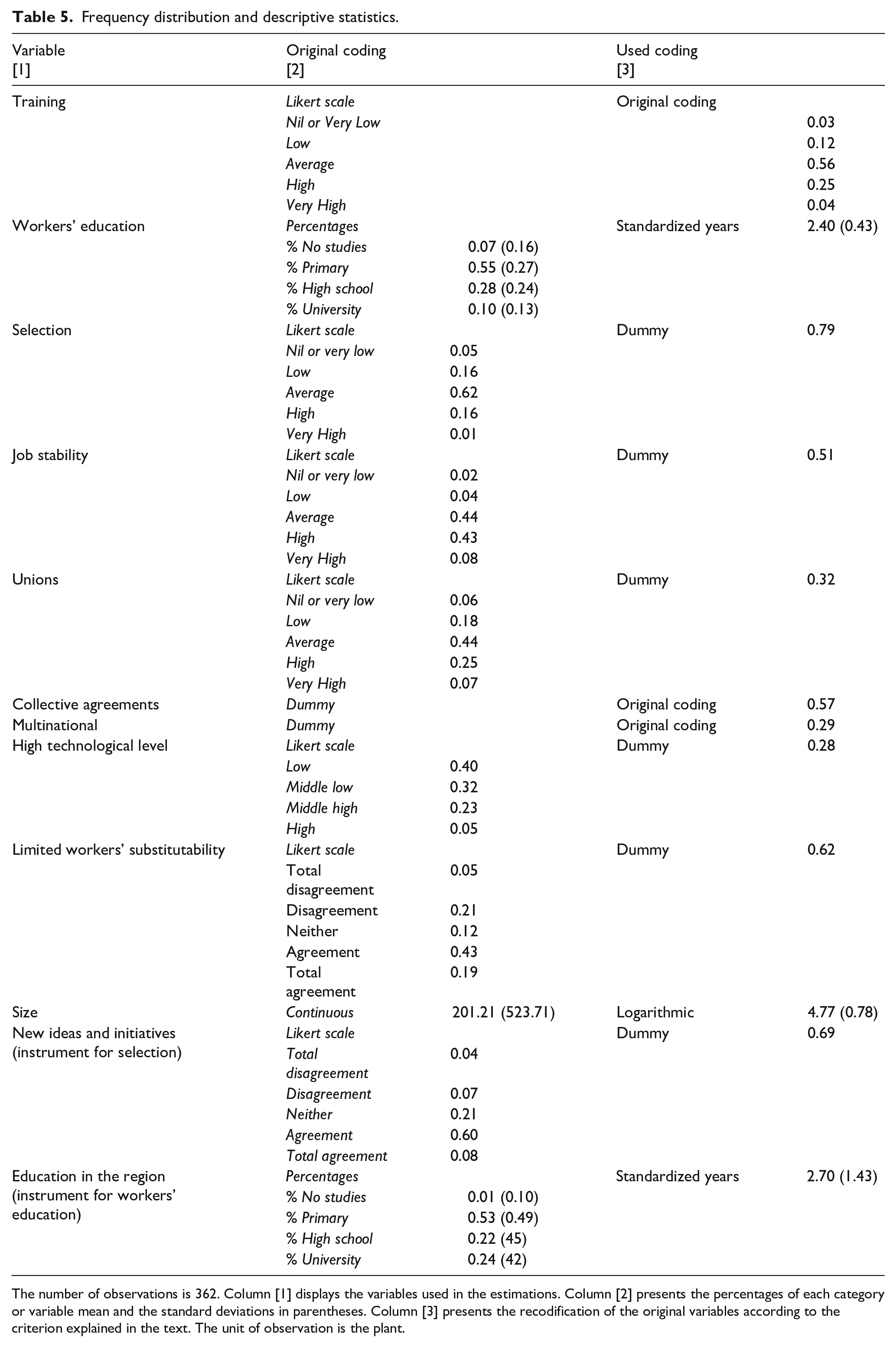
The number of observations is 362. Column [1] displays the variables used in the estimations. Column [2] presents the percentages of each category or variable mean and the standard deviations in parentheses. Column [3] presents the recodification of the original variables according to the criterion explained in the text. The unit of observation is the plant.
The dependent variables in equations (1) and (2) are education attainment and investment in training of blue-collar workers, respectively. Regarding education, for each plant, we have information on the percentages of blue-collar workers with no education (P1, 7% on average), with primary education (P2, 55% on average), with secondary education (P3, 28% on average) and with university education (P4, 10% on average). We aggregate all this information in the variable Workers’ education (P1 + 2P2 + 3P3 + 4P4). This variable is the average of the standardized years of education of the plant’s blue-collar workers when the differences between educational levels are held constant. 15 For robustness, we replicate the analyses (not presented but available upon request from the authors) by measuring education as the percentage of blue-collar workers with more than a primary education (P4 + P3). The main conclusions are maintained. The other dependent variable, Training, is measured by ordered (5-point Likert-type scale) answers to the question related to investments in blue-collar workers’ training.
The independent variable selection intensity, Selection hereafter, is measured by ordered answers to the question about the variety of tools used during the selection process of blue-collar workers. To capture all available information, four dummies must be included in the estimations. A potential problem with this approach is that some of the categories have very few observations, which could cause collinearity in the estimations. To avoid this problem, and for the sake of expositional clarity, we transform the ordinal into a dummy variable that takes the value of 1 at or above the integer nearest the median of the ordinal variable and 0 otherwise (for a similar procedure, see Barrenechea-Mendez & Ben-Ner, 2017).
The survey allows us to control for a series of variables. Job stability, Unions, High technological level and Limited workers’ substitutability are also measured by ordered (five-point Likert-type scale) answers. Thus, we transform these ordinal variables into dummy variables using the procedure described above. The recoded variables are shown in Column [3] of Table 5. Other control variables, Collective agreements and Multinational, are based on a binary answer from the questionnaire, so they do not need to be transformed. Finally, the control variable Size is measured by the logarithm of the number of workers, so it is continuous. For the parameters associated with these variables, we provide no prediction.
Results
Table 6 shows the results of the ordinary least squares (OLS) estimation of equation (1). The F-test rejects at the 1% level the null hypothesis that the parameter estimates of all explanatory variables are zero. The estimate on Selection is positive and statistically significant at the 1% level. Regarding the control variables, only High technological level is positively associated with Workers’ education. The standard errors of this estimation are calculated using the White-Hubert procedure. 16 This procedure is adequate under both the existence and inexistence of heteroscedasticity (in the latter case, the robust standard errors will be the conventional [OLS] standard errors). The Breush-Pagan and White tests cannot reject the null hypothesis of the existence of homoscedasticity. 17 The same methodology is used to calculate the standard errors for the estimation of equation (2).
Determinants of workers’ education.
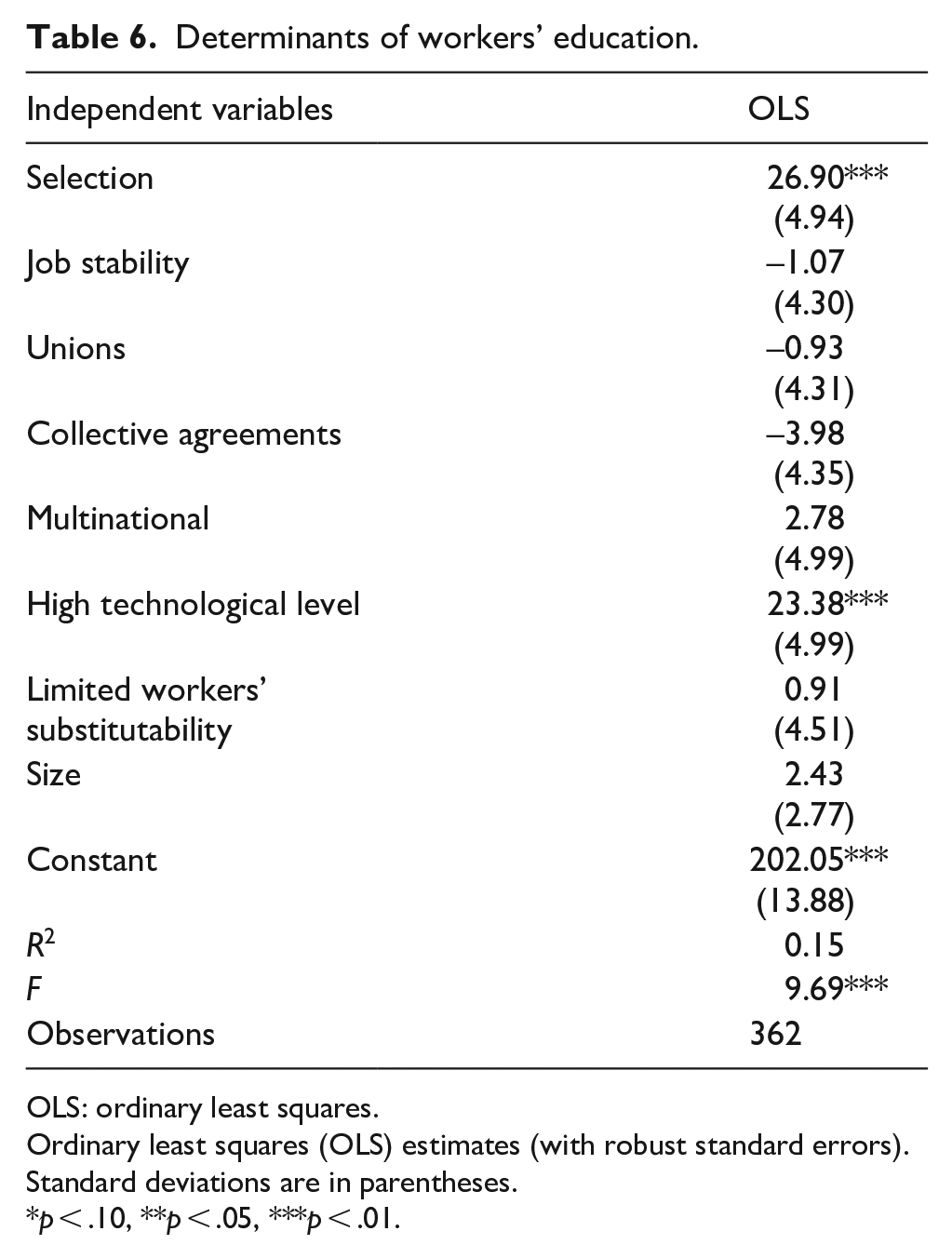
OLS: ordinary least squares.
Ordinary least squares (OLS) estimates (with robust standard errors). Standard deviations are in parentheses.
*p < .10, **p < .05, ***p < .01.
Equation (2) is estimated by ordered probit probability models, since training is an ordered variable. We provide three different specifications. In Model 1, Workers’ education is not included as an independent variable, Model 2 does not include Selection, and Model 3 includes both Workers’ education and Selection. In this case, the Likelihood ratio tests (for homogeneity of variance) cannot reject the null hypotheses of the existence of heteroscedasticity. 18
Columns [1] to [3] in Table 7 show the results. In the three alternative specifications, the Wald
Determinants of training.
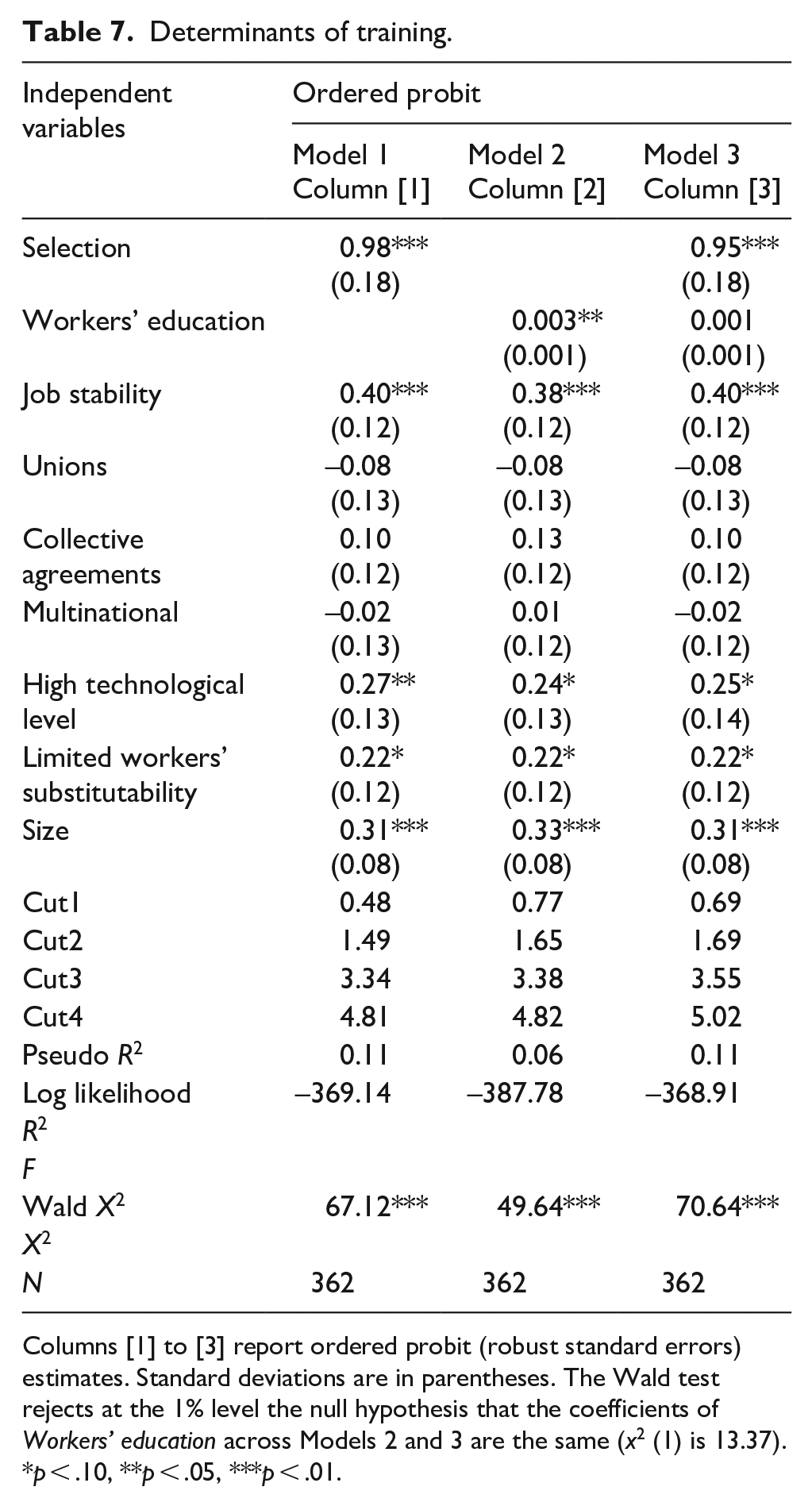
Columns [1] to [3] report ordered probit (robust standard errors) estimates. Standard deviations are in parentheses. The Wald test rejects at the 1% level the null hypothesis that the coefficients of Workers’ education across Models 2 and 3 are the same (x2 (1) is 13.37).
*p < .10, **p < .05, ***p < .01.
Appendix 5 provides additional estimations using instruments for education and selection intensity. The main results are similar to those shown above.
Discussion and managerial implications
Contributions to theory
This article extends the analysis of Barron et al. (1997) on the relationship between firms’ training strategies and selection policies by relaxing the assumption that the training associated with a job position does not adapt to the information on workers’ abilities gathered during the selection process and the period between the worker’s hiring and when training is provided. When direct contracts (Heckman, 2000; Mincer, 1992; Rosen, 1976) are not feasible (Chang & Wang, 1995; Kahn & Hubberman, 1988; Prasad & Tran, 2013; Prendergast, 1993), firms might use indirect contracts, which provide the same level of training to all workers in the same position. Candidates are heterogeneous in terms of their abilities; therefore, the existence of complementarities between training and abilities implies that the expected profits of training will differ among candidates. For some of them, the cost of training does not compensate for its benefits. Our argument is that firms could take advantage of the information provided by the selection process (on the expected profits of training a particular candidate) to identify and reject those candidates. Therefore, the abilities of the selected workers will determine the profitability of their future training.
Contribution to empirics
Our theoretical framework is also an effort to encompass and compare the implications of the three training strategies considered in this study. The empirical application has identified clear patterns in the data suggesting the prevalent use of indirect contracts for blue-collar workers’ positions in Spanish industrial plants. We found that plants collecting more information on candidates’ abilities select those with more education and provide them with more training. In addition, when we control for selection intensity, the relationship between training and education is not statistically significant. Selection intensity is the variable with the greatest capacity to explain training. Surprisingly, the indirect contracts considered in this article have been virtually neglected by the existing empirical literature for interpreting their results.
Additional evidence is that both blue-collar workers’ training and education levels are higher in technologically intensive sectors, whereas training is more prevalent in large firms and firms which offer more stability and find it harder to substitute workers.
Limitations and future research
As noted in the theoretical section, direct contracts will always outperform indirect contracts if they could both be implemented. However, in the context of training strategies, the incomplete contracts literature (Chang & Wang, 1995; Kahn & Hubberman, 1988; Prasad & Tran, 2013; Prendergast, 1993) suggests that, in general, it is not possible to make training contracts at the personal level. In the same line, the psychological literatures related to procedural justice (Folger & Cropanzano, 1998; Greenberg, 1996; Wiesenfeld et al., 2007) and social comparison (Ployhart et al., 2006; Taylor et al., 1990; Wood, 1989) also note the difficulties of implementing different human resources policies for workers in the same job position. One limitation of this study is that it does not provide evidence on these contractual difficulties. This evidence would allow us to better understand the reasons that explain the use of those contracts.
The cross-sectional data used in the empirical section allow us to present correlations conditional on a set of organizational characteristics but do not permit the testing of the causal order. Note, however, that the results of the instrumental variables methods presented as a robustness check (in Appendix 5) seem to suggest that endogeneity bias is not a severe problem. Future research with access to better-equipped data (in particular with data that allows for identification of exogenous shocks leading to different selection intensity levels) and in other environments is needed to corroborate the evidence presented.
At a theoretical level, we do not explain the evidence related to the statistically significant control variables. Linking a significant control variable to one parameter of the model whose variations consistently explain this variable’s relationships with the variables of interest is not straightforward. For example, one of these control variables is the firm’s technological level. The evidence presented in the article, which is consistent with previous research (Acemoglu, 1997; González et al., 2016), shows a positive relationship between high technological level and blue-collar workers’ training. We might explain this result, assuming that the marginal productivity of training
Tentative avenues for including these findings into the model could be to extend the model to incorporate new relationships. For example, in the model, we might include the increasing marginal productivity of workers’ abilities (when there is no training). If this parameter is related to the firm’s technological level, the model could explain the positive relationship between the technological level and workers’ level of education reported in Table 6. This approach could also be useful for integrating into the theoretical framework other relationships found in the empirical application, such as the positive relationship among firm size, job stability, and substitutability of workers with training. We speculate that the degree of substitutability of workers could be a measure of the degree of specificity of workers’ skills and that job stability could be a mechanism for providing incentives for firms to invest in specific skills. However, to avoid diverting attention from the model’s central objective, we leave this exercise for future research.
The future research agenda should extend the model to include variables related to differences in the marginal productivity of abilities, economies of scale in the provision of training, and an analysis of the negotiation process for appropriating the profits of (general and specific) training among workers and firms. Furthermore, it could be interesting to analyze the implications of relaxing some of the model’s other assumptions, such as, for example, that the information is always costly or that the quality of the information is independent of its realization. 19
Managerial implications
At the current stage of knowledge, the theory suggests that managers should ask themselves whether they can implement training policies adapted to the particular workers allocated to the same job position. The evidence suggests that individualized training policies are not always implemented and indirect contracts are therefore used. In indirect contracts, all the workers in the same job position receive the same training, although the optimal level of training may not be profitable for some of them. One way to improve the firms’ profits is to identify and reject those workers during the firms’ selection processes. Therefore, firms should consider this when deciding the extensity and intensity of their selection policies. The article provides a formal model for guiding such decisions. Although establishing the training policies before selecting candidates (restrictive contracts) could provide some advantages, firms will lose the opportunity to generate profits related to the adaptation of training to the real abilities of the workers finally hired or changes in the relevant factors of their job. Updated workers’ abilities comprise a key element of firms’ competitiveness.
Conclusion
The article formalizes the link between a training strategy, which was (informally) suggested over the last three decades in the economics of private training literature, and the firms’ selection policies. Our empirical analysis reveals that, at least in the context in which we conduct it, this is the prevailing strategy. This is surprising, given that the alternative strategies, in particular direct contracts, have been virtually the only ones used by empiricists to investigate the determinants of firm-provided training. To summarize, our analysis calls for an extension of the debate on the determinants of the training provision by firms and its links with selection policies.
Footnotes
Appendix 1: direct contracts (DI)
Appendix 2: indirect contracts (IN)
Appendix 3: restrictive contracts (R)
Appendix 4: survey items used for the variables
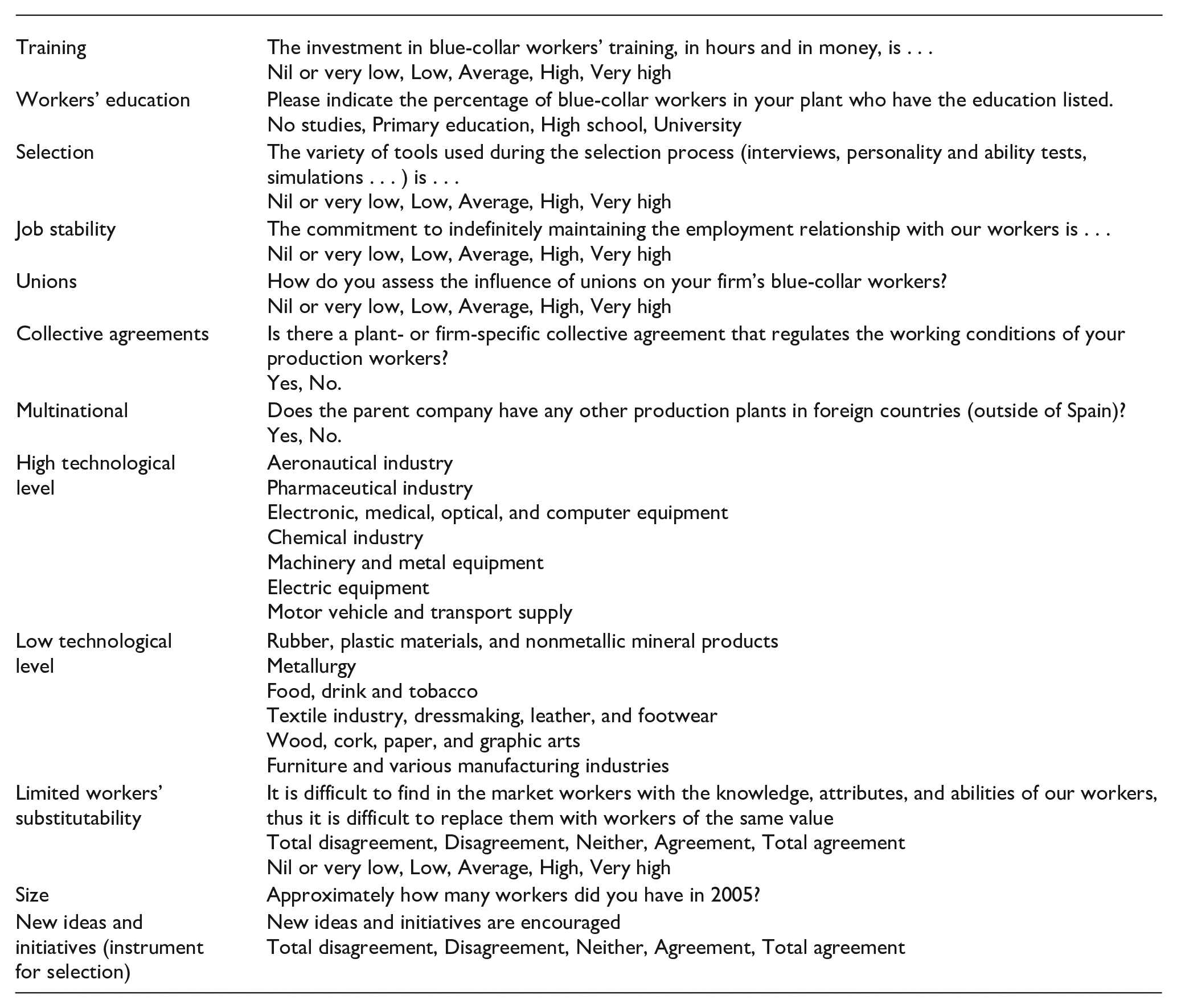
| Training | The investment in blue-collar workers’ training, in hours and in money, is . . . Nil or very low, Low, Average, High, Very high |
| Workers’ education | Please indicate the percentage of blue-collar workers in your plant who have the education listed. No studies, Primary education, High school, University |
| Selection | The variety of tools used during the selection process (interviews, personality and ability tests, simulations . . . ) is . . . Nil or very low, Low, Average, High, Very high |
| Job stability | The commitment to indefinitely maintaining the employment relationship with our workers is . . . Nil or very low, Low, Average, High, Very high |
| Unions | How do you assess the influence of unions on your firm’s blue-collar workers? Nil or very low, Low, Average, High, Very high |
| Collective agreements | Is there a plant- or firm-specific collective agreement that regulates the working conditions of your production workers? Yes, No. |
| Multinational | Does the parent company have any other production plants in foreign countries (outside of Spain)? Yes, No. |
| High technological level | Aeronautical industry Pharmaceutical industry Electronic, medical, optical, and computer equipment Chemical industry Machinery and metal equipment Electric equipment Motor vehicle and transport supply |
| Low technological level | Rubber, plastic materials, and nonmetallic mineral products Metallurgy Food, drink and tobacco Textile industry, dressmaking, leather, and footwear Wood, cork, paper, and graphic arts Furniture and various manufacturing industries |
| Limited workers’ substitutability | It is difficult to find in the market workers with the knowledge, attributes, and abilities of our workers, thus it is difficult to replace them with workers of the same value Total disagreement, Disagreement, Neither, Agreement, Total agreement Nil or very low, Low, Average, High, Very high |
| Size | Approximately how many workers did you have in 2005? |
| New ideas and initiatives (instrument for selection) | New ideas and initiatives are encouraged Total disagreement, Disagreement, Neither, Agreement, Total agreement |
Appendix 5: endogeneity concerns
In this Appendix, we conduct the estimations using instrumental variable methods. To conduct the estimations, we need instrumental variables for selection intensity and education. Those variables need to be (1) correlated with the endogenous variable to be instrumented (relevance) and (2) uncorrelated with the error term of the equation for the dependent variable (independence). This is a challenge given the nature of the problem that we are studying.
Previous studies have used instruments for education (for a discussion of its relevance and independence, see Kramer & Tamm, 2018). One of these instruments is the percentage of the population with different levels of education (see Frenette, 2004). To construct this instrument, Education in the region, we collected information from the Spanish Institute of Statistics INE about the percentages of individuals with no education, with primary education, with secondary education, and with university education at the level of autonomous communities (NUTS2 Eurostat 20 ) in 2007. Then, we aggregate this information in the same way as we did to create the variable Workers’ education.
We are not aware of the use of instruments for selection intensity in the previous literature. The exogeneity in our theoretical model comes from the shock
Based on this discussion, we use as an instrument for Selection the dummy variable New ideas and initiatives, which is constructed on the basis of a survey containing 5-point Likert-type scale items asking interviewees whether the establishment encourages new ideas and initiatives. This question is in a different section of the questionnaire, that is, one related to the leadership style of plant managers, than the other questions, which are in the human resources section. There are methods for the estimation of this type of system when the independent variable is continuous (e.g., 3SLS), but we are not aware of such methods when it is an ordered variable. Therefore, we treat the ordinal variable Training as continuous. Before presenting the simultaneous estimations, we check that this change is innocuous. Therefore, we reproduce the estimations of Columns [1] to [3] using Training as a continuous variable. The results (not presented) are very similar.
To identify the model, we use the variables New ideas and initiatives and Education in the region as instruments for selection and workers’ education, respectively. In Table 8, we show the results of simultaneous estimations of equations (1) and (2) using 3SLS (Zellner & Theil, 1962), which is consistent and the most efficient instrumental variable method among those that use only sample information about the systems of equations (Schmidt, 1976). The main conclusions identified in the benchmark models are maintained. The estimates on Selection are positive and statistically significant in both the Workers’ education and Training equations, although they are now significant at the 3% and 4% levels, respectively. After Selection is controlled for, the estimate on Workers’ education in the Training equation is nonsignificant at conventional levels.
We used alternative instrumental variable methods (e.g., 2SLS), and the conclusions were similar; thus, we do not present those estimations in the article, although they are available upon request from the authors. At this point, we note that the results of the Hausman specification test 21 seem to suggest the existence of endogeneity. In this Appendix, we have tried to reduce the potential endogeneity using instrumental variables methods. However, as we have acknowledged above, the results of these estimations must be interpreted with caution. Our instruments for selection and education, although potentially theoretically justified, seem to be weak. 22 Therefore, in spite of our efforts, we cannot claim to prove causal effects.
Acknowledgements
We thank participants at EALE 2018, Lyon, and EARIE 2018, Athens, for valuable comments.
Authors’ Note
Eduardo C. Rodes is now affiliated with Pompeu Fabra University, Barcelona, Spain.
Declaration of conflicting interests
The author(s) declared no potential conflicts of interest with respect to the research, authorship, and/or publication of this article.
Funding
The author(s) disclosed receipt of the following financial support for the research, authorship, and/or publication of this article: Financial support from the Spanish Ministry of Economy, Industry and Competitiveness (R&D project: ECO 2017-86305-C4-2-R) is gratefully acknowledged. The usual disclaimer applies.