




Abstract
The purpose of this article is to study the curvilinear effect on pioneering orientation of one of its key relational backgrounds: strength of ties. The study is based on a sample of 224 companies in the footwear industry in Spain. A hierarchical regression analysis was performed. The results show a curvilinear U-shaped relationship between the strength of ties and pioneering orientation. This curvilinear relationship is increasingly pronounced as scanning capabilities grow. Managers wishing to develop a pioneering orientation should avoid excessive levels of strength in their ties and unduly low levels. Furthermore, firms might benefit from developing scanning capability.
Introduction
Over the last few years, there has been much debate from a social relations perspective about the potential benefits and effects of the relative strength of ties on strategic behavior (Hernández-Carrión et al., 2019; Khachlouf & Quélin, 2018; Zhang et al., 2018). In spite of previous research, the question of how to balance the level of weak/strong ties of social relations to lead the firm to a successful strategy has still not been satisfactorily addressed (Capaldo, 2007; Hemmert, 2019). Pioneering orientation (PO) has been considered a potential, successful strategy since it can capitalize on first-mover advantages and achieve sustainable competitive advantages in dynamic environments (García-Villaverde et al., 2020; Gómez et al., 2016; Mueller et al., 2012). Several authors underline that PO depends on a firm’s expectation of obtaining and maintaining net first-mover advantages (Song et al., 2013). However, many issues about the antecedents of PO remain unresolved and the entry timing literature has demanded new approaches to address them (e.g., Fosfuri et al., 2013; Garret et al., 2009; Schoenecker & Cooper, 1998). To respond to this demand, several authors suggest analyzing the relational determinants of PO (Lieberman & Montgomery, 2013; Zachary et al., 2015) since social relationships allow firms to connect with key agents in their environment to detect and achieve net first-mover advantages (Suarez & Lanzolla, 2007). We propose to address the gaps detected in both perspectives, social relations, and entry timing, analyzing the effect of the strength of ties on PO. The interest in delving deeper into this relationship is due to the conceptual ambiguity of both issues, considered as a continuum (Mueller et al., 2012), and the controversy on how the level of weak/strong ties of social relations (Hu et al., 2019) affects the expectations of generating first-mover advantages/disadvantages due to the paradoxes of networks (Håkansson & Ford, 2002). This perspective prompts us to propose the following research question: How does the strength of ties lead to PO?
From a social relations perspective, following Granovetter (1973, p. 1361), the strength of a tie is a “combination of the amount of time, the emotional intensity, the intimacy (mutual confiding), and the reciprocal services which characterize the tie.” Drawing on this approach, we present the strength of ties on a scale from weak ties—contacts with low frequency and intensity of interaction—to strong ties—contacts with high frequency and intensity of interaction. The strength of ties can enhance knowledge transfer between companies in a climate of trust, thus providing positive effects for organizations (García-Muiña & González-Sánchez, 2017; Krackhardt, 1992; Uzzi, 1996). However, several studies have questioned or have established limits to these potential benefits (e.g., Brown & Konrad, 2001; Granovetter, 1973), highlighting, in contrast, the advantages of weak ties. Against these conflicting approaches, different authors have argued for conciliating these perspectives on weak and strong ties, suggesting how they can be combined to gain competitive advantage (Capaldo, 2007; Edelman et al., 2004).
From an entry timing perspective, PO is considered as a company’s focus on being the first with new products and new markets, ahead of competitors (Covin et al., 2000). In contrast to the authors who focus on the roles of pioneer or follower, we consider PO to be a continuum ranging from market pioneer to late follower (Mueller et al., 2012). This strategic posture can allow competitive advantage to be gained and maintained (among others, García-Villaverde et al., 2017; Gómez et al., 2019; Klingebiel & Joseph, 2016). Several studies have highlighted first-mover advantages—technology leadership, preemption of scarce assets, and switching costs/buyer choice under uncertainty—and first-mover disadvantages—imitation, “free rider” effect, “harvest” effect, technological and demand uncertainty, and incumbent inertia (Gómez et al., 2016; Ruiz-Ortega et al., 2018; Stevens & Dykes, 2013). PO integrates a set of decisions about entry timing that depends on managers’ perceptions of these potential first-mover advantages and disadvantages (Song et al., 2013). Despite the interest shown in the literature, the conceptual ambiguities and various constraints that have recently been detected in the empirical development of PO (Zachary et al., 2015) justify the necessity of incorporating new approaches to satisfactorily explain the antecedents of PO (Fosfuri et al., 2013).
The social relations perspective has made a considerable impact on the entry timing literature (García-Villaverde et al., 2020; G. K. Lee, 2007). The integration of both fields of research is needed since PO can be considered as a result of the interactions of knowledge and resources with different agents in contexts of interdependence (Landry et al., 2002). A priori, the social interactions in the network allow access to heterogeneous knowledge, mutual learning between network members, the reduction of uncertainty, and the exchange and combination of valuable resources, generating a favorable climate for the development of a PO (Schilling & Phelps, 2007). However, due to network paradoxes, the strength of ties can generate both first-mover advantages and disadvantages (Filieri et al., 2014; Håkansson & Ford, 2002). Thus, although it is possible to find arguments in favor of a positive influence of the strength of ties in PO, we suggest that this positive effect could decline in the case of very high levels of strength since the excessive frequency and proximity of relations can generate information redundancy and decrease performance (Gilsing et al., 2008; Mahmood et al., 2011).
In addition, the literature highlights that taking advantage of the benefits of the links established in the network of contacts or in the alliance will depend on the firm’s ability to detect new knowledge. Thus, it is necessary to complete the research on the effects of the relationships between the sources of knowledge with the internal mechanisms available for their absorption (Autio et al., 2011; Cabello-Medina et al., 2019; Ferreras-Méndez et al., 2015; Martínez-Cháfer et al., 2018; Sciascia et al., 2014). Thus, this study considers that the relationship between the strength of ties and PO will be influenced by a firm’s scanning capacity. Scanning capability is defined as a firm’s capacity to scan, monitor, and analyze information about the environment to detect opportunities and threats (McEvily & Zaheer, 1999). Scanning capacity could both reinforce the benefits and mitigate the drawbacks derived from strong ties in the development of a PO.
The aim of the article is to examine the curvilinear effect between the strength of ties and the PO. The main contribution of this article is to delve deeper into a key relational antecedent of PO, as recent studies of entry timing literature have demanded (Zachary et al., 2015). Specifically, the study goes deeper into the analysis of how the strength of ties affects PO, proposing and substantiating the curvilinear U-inverted effect of the continuum between the weak and strong ties on PO.
The hypotheses were tested on a sample of companies in the Spanish footwear industry. The footwear is a low-tech industry that has the potential for making breakthroughs in product and process innovation to leverage opportunities in the environment (Seo et al., 2017). This industry requires reacting creatively and quickly to new trends, short life cycles, and continual changes in demand (Belso-Martinez & Molina-Morales, 2013), and firms can develop higher PO to react to this context (Ruiz-Ortega et al., 2018).
The structure of the study is as follows. First, the authors define and contextualize the key concepts. Then the proposed hypotheses are justified. Following that, the methodology is described and the results and conclusions derived from them are explained.
Theory and hypotheses
Strong versus weak ties
One central concept in our research refers to the strength of ties. This is defined by Granovetter (1973, p. 1361) as a “combination of the amount of time, the emotional intensity, the intimacy (mutual confiding), and the reciprocal services which characterize the tie.” This approach greatly influenced management studies where the role of the strength of ties is generally evaluated in terms of knowledge acquisition and innovation of individuals and organizations.
Depending on the degree of intensity of the relationships, the specific literature has distinguished between strong and weak ties. Strong ties benefit firms in different ways; for instance, they enable trust between organizations, consequently lowering transaction costs and increasing commitment and collaboration, among other values and assets (Hernández-Carrión et al., 2019; Hu et al., 2019; Khachlouf & Quélin, 2018; Zhang et al., 2018). In addition, Uzzi (1996) suggested that strong ties facilitate exchange of complex and tacit knowledge. Indeed, all these advantages lead companies to continue these relationships (Kim et al., 2006). However, these relationships can have the opposite of the desired effect and, in some respects, transform these ties from assets to liabilities (Hemmert, 2019; Seggie et al., 2013).
Weak ties connect different social circles and thus provide people with access to information and resources beyond those available in their own social circle. It is suggested that the specific configuration of networks (a person’s position within a greater social structure) creates information and control benefits (Rost, 2011). Contrary to the case in strong ties, weak ones might reduce the risk of limiting a firm’s knowledge base and of restricting actions outside the relationship or constraining the access to other resources and opportunities (Brown & Konrad, 2001).
The literature highlights the interest of studying the strength of ties, one of the most controversial elements of social networks, due in no small part to network paradoxes (Filieri et al., 2014; Håkansson & Ford, 2002; Hu et al., 2019). Following Granovetter (1973), we focus on the strength of ties as a combination of frequency and emotional intensity ranging from weak to strong ties. The frequency indicates the number of times that an actor or company is in contact with another actor (McEvily & Zaheer, 1999), while privacy refers to the proximity of the companies with their contacts in terms of emotional intensity (Brown & Konrad, 2001).
Derived from network paradoxes, two approaches coexist in the literature regarding the advantages and disadvantages of the characteristics of social capital reflected in the strength of ties. The first approach focuses on dense structures, strong ties, and cognitive proximity, which generate common norms and values in which tacit knowledge is transmitted between the actors in the network (Coleman, 1990; Krackhardt, 1992; Uzzi, 1996). Authors defending this point of view usually recommend building ongoing intense relations within the network to take advantage of the positive effects of dense structures. The second approach sets a contradictory focus on the structures of dispersed networks, weak ties, and low cohesion, through which it is possible to exploit the benefits of information brokering (which flows through connections with different companies that are unconnected to each other), and new and exclusive knowledge, which highlights the potential positive effect of being connected with currently unconnected actors (Burt, 1992; Granovetter, 1973; McEvily & Zaheer, 1999).
These two approaches are mutually reconciling positions that support the need to leverage a dual network architecture to gain a competitive advantage (e.g., Capaldo, 2007). This line of research recommends the creation of a portfolio of different relations, thereby exploiting the different benefits of strong and weak ties for different circumstances (Ahuja, 2000; Gargiulo & Benassi, 2000; Hemmert, 2019; Rowley et al., 2000). This is a contingent approach because it considers that each form of social capital has a specific strategic purpose for the company. Dense structures, strong ties, and highly cohesive networks adapt better to the search for exploitation strategies, while scattered and weak ties are recommended when companies try to explore new and exclusive ideas or technologies (Edelman et al., 2004; Huang & Wang, 2018).
With regard to the strength of ties, a double perspective is thus noted. On one hand, the literature has highlighted the advantages deriving from strength, as a generator of a series of relational assets, such as trust, enabling the more fluid and efficient transmission of knowledge resources (Krackhardt, 1992). On other hand, the advantages derived from weak ties related to the transmission of novel and exclusive knowledge resources have also been underlined (Granovetter, 1973).
The strength of ties and PO
Over the last two decades, the social networks perspective has been increasingly present in the entry timing literature (G. K. Lee, 2007; J. Lee et al., 2016; Park & Chang, 2019; Suarez, 2005 among others). This presence is probably due to the tendency to conceptualize PO as a result of the interactions of knowledge and resources with different actors in situations of interdependence (Landry et al., 2002). More specifically, the role of social relations in the development of first-mover advantages has been the focus of attention (Capello & Faggian, 2005; Houghton et al., 2009; L. T. S. Lee & Sukoco, 2007; Wu et al., 2008).
Recent literature has established the influence of strength of links in different aspects related to innovation (Gao et al., 2017; Hemmert, 2019; Huang & Wang, 2018; Tomlinson & Fai, 2013). The strength of ties defines the potential opportunities for companies to develop a PO (Smith et al., 2005). The network of contacts affects the time of entry into the market through the detection of opportunities and the generation of new products. From this approach, several studies suggest that there is a positive influence arising from the use of networks external to the company in the speed of developing new products (G. K. Lee, 2007; Todo et al., 2016).
Although there are few studies that relate the strength of ties to PO, some empirical studies suggest a positive relationship between these two constructs (Partanen et al., 2008). The literature highlights different arguments that lead companies with strong ties to the generation of potential first-mover advantages. First, access to detailed information and key tacit knowledge inserted in context is the main advantage of having strong ties with the members of the network (Obstfeld, 2005). Martinez and Aldrich (2011) show that this kind of network provides resources that firms have not yet developed. The strength of ties is linked to exploratory and exploitative learning (Huang & Wang, 2018). This accessed knowledge provides companies with the ability to explore and exploit innovations with those that require a large amount of shared knowledge, thus reducing the uncertainty of being pioneers.
Second, having strong ties with the network’s members allows the company to detect opportunities and gain first-mover advantages (Fosfuri et al., 2013) since the search for costs and coordination of new opportunities can be reduced (Grégoire et al., 2010). Companies cannot directly detect all the opportunities that emerge in the market. However, they can be captured by the members of the firm’s network of contacts with which the firm maintains strong ties and, through these contacts, it can gain access to the potential opportunities (Bhagavatula et al., 2010). In addition, close and frequent relations allow firms to detect problems with products of other members of the network, generating opportunities to develop products that respond to new needs and improving the outcomes of collaboration (Hemmert, 2019). In this context, expectations of obtaining pioneer advantages derived from the customers’ switching costs are also generated (Gómez et al., 2016; Gómez & Maicas, 2011) since the proximity and continuity of contacts allow the firm to strengthen ties with customers. Hence, these relations help firms to operate in a changing environment (Estrada-Robles et al., 2018).
Third, important knowledge gained through frequent and close relationships with contacts can help pioneer firms to obtain and maintain technological leadership since it allows them to exploit economies of scale and the learning curve (Soetanto, 2017; Stevens & Dykes, 2013). The strength of ties also provides the company with a level of trust in members of the network, facilitating the exchange of valuable information and resources that are difficult to convey otherwise (Uzzi, 1996). Strong ties between the network members also generate social norms that prevent opportunistic behavior and encourage the exchange of information. In this context of shared values and trust, companies can anticipate access to key resources to develop innovative ideas, such as physical location, factors of the manufacturing process, access to distribution channels, or entry into the most appropriate market segments (Song et al., 2013). Finally, the strength of ties promotes the rapid development of complementary capabilities to develop and commercialize new products (Vidal & Mitchell, 2013). Thus, the greater cohesion of networks facilitates the possibility of collecting the necessary knowledge to detect opportunities of gaining first-mover advantages for the company and to anticipate accessing resources and developing key capabilities that encourage them to develop a PO (Wu et al., 2008).
The previous arguments indicate a positive influence of the strength of ties on PO. However, several studies suggest that this positive effect may decline when there are very high levels of strength of ties in the network, with the excessive frequency and closeness of relations generating redundancy in information and declining performance (Mahmood et al., 2011).
From this perspective, an excessive strength of ties with the network of contacts can generate first-mover disadvantages. First, the excessive frequency and closeness of the ties generate redundant information and limit access to the information needed to develop a PO. This difficulty can generate a situation of collective blindness (Nahapiet & Ghoshal, 1998), which reduces the generation of combinations of knowledge, creativity, innovation (Andersen, 2013), and PO (G. K. Lee, 2007). Myopia and redundant information cause a greater perception of technological and market uncertainty, blindness to the changing needs of customers, and a risk of inflexibility and inertia (Song et al., 2013), which leads to a follower orientation (Stevens & Dykes, 2013). Second, very frequent and close ties favor the development of shared norms and promote social sanctions, which limits the space for the development of innovative actions among network members (Andersen, 2013). In addition, social sanctions lead to control of change (Gilsing et al., 2008). Thus, fear of social sanctions derived from the high strength of ties may inhibit PO. Third, the strength of the relationship generates opportunity costs (Zach & Hill, 2017). Thus, these networks of relationships have creation and maintenance costs which counteract the advantages of the network of knowledge and resources (G. K. Lee, 2007), so that the time and resources required to maintain these frequent and close ties may not be efficient under certain conditions. Following these arguments, excessive levels of the strength of ties with contacts can generate the accumulation of homogeneous knowledge, restricting the firms’ opportunistic behavior due to social norms. This lack of knowledge about the market and the lower flexibility to accept changes may lead firms to develop a follower orientation (Stevens & Dykes, 2013). Thus, this context tends to generate a blindness imposed by the network, generating risk (Andersen, 2013) and creating negative expectations of an early entry which leads to a decrease in PO.
Therefore, the strength of ties involves both advantages and disadvantages depending on its level (Edelman et al., 2004). Very weak ties do not allow the absorption of tacit knowledge and important information. Conversely, the excessive frequency and closeness of the ties with contacts reduce the existence of diversity and, therefore, of new value. In consequence, the success of strength/weakness of ties is based on a delicate balance between innovative creation and effective absorption (Gao et al., 2017; Gilsing et al., 2008).
In summary, the authors expect that when the strength of ties is low to moderate, its positive effect on PO will predominate over the negative effect since information and knowledge provided by the network of contacts generate expectations of net profit arising from a PO. However, for levels between moderate and high strength of ties, when a certain threshold is exceeded, the negative effects on PO begin to predominate, having a negative effect on the relationship. Thus, although firms develop further PO when this increases the strength of ties, there is a level at which resistance will emerge, diminishing this relationship. This study proposes that a certain degree of strength of ties promotes a PO. However, PO is hampered when the strength of ties is too high. Therefore, the authors predict a curvilinear relationship with an inverted U-shape for the strength of ties on PO, where an intermediate level between the weakness and the strength of ties will be optimum for developing a PO. Drawing on these arguments, the following hypothesis is proposed:
H1. The strength of ties has a curvilinear relationship (inverted U-shape) with a firm’s PO.
The moderating effect of scanning capabilities
The resource-based view suggests that the resources and capacities available in a company are critical for creating expectations of high value (Makadok & Barney, 2001) and, therefore, determine firms’ decisions and strategic behavior (Flatten et al., 2011; Teece et al., 1997). Along these lines, several studies suggest that the development of a PO will depend on a firm’s resources and capabilities (Lieberman & Montgomery, 1998; Suarez & Lanzolla, 2007). Companies need to have resources and specific skills that enable them to generate and maintain first-mover advantages (Sciascia et al., 2014). In this way, the potential to develop a PO in a company depends on the expectations that the company can generate a higher value due to the availability of resources and complementary capabilities for the development of this PO (Lévesque & Shepherd, 2004; Vidal & Mitchell, 2013).
In this line, absorptive capability appears as a key capability for the definition of a firm’s strategic orientation (Camisón & Forés, 2010; Parra-Requena et al., 2013; Patel et al., 2015; among others). Following Cohen and Levinthal (1990), we can understand absorptive capability as a firm’s ability to identify the value of new external information, its assimilation, and application for commercial purposes. Subsequently, Lane et al. (2006) divided this ability into a three-part sequential process: identification and understanding of new, potentially valuable external knowledge; assimilation of valuable external knowledge; and application of the assimilated knowledge to generate new knowledge or commercial applications. Parra-Requena et al. (2013) pointed out that the identification dimension can be assimilated to the ability to scan, monitor, and analyze external information to detect threats and opportunities (McEvily & Zaheer, 1999), that is, the firms’ scanning capability. Thus, we can bring scanning capability closer to the concept of environmental scanning considered as the “process of monitoring events in the external environment for the purposes of strategic management and applying the knowledge gained to organizational decisions” (Liao, 2018, p. 1495). Firms use this process to scan and obtain relevant information for strategic decisions. This capacity to identify critical knowledge generated beyond its frontiers has traditionally been linked to innovative activity (Expósito-Langa et al., 2011) and helps firms to better understand the changes in the environment and market needs. This capacity reinforces and complements the available knowledge, thus favoring the search for new valuable knowledge (Ritala & Hurmelinna-Laukkanen, 2013), interorganizational learning (Ferreras-Méndez et al., 2015), and firms’ survival and performance (Lane, et al. 2006). Although there are many studies on absorption capacity and despite the relevance indicated by various authors to the ability to scan, there are very few studies on the specific effect of this dimension. Scanning capability is especially interesting for our study since it is related to social networks and can affect the creation of expectations of first-mover advantages. The literature describes scanning capabilities as a solid grounding in firms for the development of innovations and their incorporation into the market rather than their competitors (Autio et al., 2011; Cepeda-Carrion et al., 2012).
It has also been established that firms embedded in the same network differ in learning outcomes as a result of absorptive capability. In this line, the availability of a high scanning capability will allow the company to strengthen the possibilities of detecting and accessing the opportunities to maintain pioneer behavior derived from having strong ties, especially those linked with confidence building and sharing of resources and ideas relevant to the detection of opportunities (Liao, 2018). In this way, scanning capability will improve the capacity of networks with strong ties to obtain valuable information about the market and to gain trust with network agents (Parra-Requena et al., 2013). Furthermore, the efficiency of this dimension of absorptive capacity depends on the strength of the relationships between firms that interact in the knowledge sharing (García-Muiña & González-Sánchez, 2017). Expósito-Langa et al. (2011) highlight that to gain acquisition of knowledge external to the company, it is necessary to explore the environment in search of potentially useful knowledge, that is, the company needs scanning capability. In this way, if a company has a high capacity to identify and understand external knowledge that can be valuable, strong relations with its contacts facilitate greater access to tacit knowledge and confer more confidence in the contacts as well as in the information provided (Schilling & Phelps, 2007; Tsai & Ghoshal, 1998), increasing the potential for first-mover advantages. Thus, relationships based on strong ties are the ideal framework for the learning process, which will be bolstered if firms have high scanning capability since this capability permits recognition of the valuable knowledge derived from these relationships (Parra-Requena et al., 2013). In other words, although, due to the strength of the links, the network of relations favors the transmission of knowledge, the intensity of this transmission will depend on companies’ internal capacities, such as the ability to scan. Therefore, the ability to scan the market and the competitive environment allows firms to take greater advantage of strong ties since it allows companies to extract information from their contacts on strategic trends of its competitors and the new demands of consumers (McEvily & Zaheer, 1999; Parra-Requena et al., 2013). Thus, these companies will be able to generate innovations and enter the market early (G. K. Lee, 2007).
Scanning capability also reduces the expected risks of a PO due to an excess of strength in the network. Scanning capability can limit the negative effects arising from an excessive strength of established ties with the contacts of the network, such as redundancy in information exchanged or myopia (Inkpen & Tsang, 2005). In this way, scanning capability allows companies to recognize novel, useful, and valuable knowledge for the company from their strong and frequent relationships. In addition, this ability to monitor and analyze information in the competitive environment allows firms to mitigate or reduce the effects of myopia or internal locking of these companies whose network of contacts maintain strong ties. Recent studies show that all dimensions of absorptive capacity enhance the firm’s ability to mitigate the risk of social capital (Ambulkar et al., 2016). So, scanning capability will be required to transform strong relationships into positive outcomes (Najafi-Tavani et al., 2018; Yu, 2013) since this capability helps firms against difficulties (Gölgeci & Kuivalainen, 2019). We can posit that a firm’s scanning capability is a contingent factor which promotes PO as a result of belonging to a network with strong ties. Particularly, under a context of strong ties, a high scanning capability will amplify the effect of a PO derived from the strength of ties in the network of contacts when the firm has a greater scanning capacity. Initially, the positive relationship between the strength of ties and PO will be amplified by scanning capability. Companies can enhance their PO through the strength of ties in the network if they have complementary capabilities that allow them to explore the potential of first-mover advantages (Weisinger & Black, 2006). Therefore, greater scanning capability will allow the company to extend the positive effect of the strength of ties on PO. In addition, companies with greater scanning capability can also mitigate the negative influence of high strength of ties on PO. In short, scanning capability is a key, complementary capacity for the commercialization of innovations in new markets, allowing the exploitation of the benefits derived from the strength of ties in the network of contacts and mitigating the negative effects arising from an excess of strength in that network. Thus, the following hypothesis is proposed:
H2. Scanning capability amplifies (strengthens) the curvilinear relationship (inverted U-shaped) between the strength of ties and the firm’s PO.
Methods
Data and sample
To test the proposed hypotheses, this study uses a sample of companies in the footwear industry in Spain. 1 In 2018, the fashion sector—which includes the textile, clothing, and footwear industry—generated 2.9% of the gross domestic product (GDP) and represented 4.1% of the total employment (CESCE, 2018). It is a mature, traditional industry that is especially appropriate for our study because the strength of the ties between companies needs a certain period of time to develop completely (Seo et al., 2017). In addition, footwear is a highly competitive industry in which it is particularly interesting to analyze the aspects related to PO. Several studies have underlined the interest of studying PO in these industries (Kim & Min, 2012; Ruiz-Ortega et al., 2018).
To establish the population of companies, the SABI 2 and CAMERDATA 3 databases were used. Companies with fewer than five employees were not included in the study, thereby excluding companies without a minimal operational structure and ensuring that data from the study were significant. Once any duplications were eliminated, the authors obtained a population of 1,403 companies. We used a questionnaire to obtain the information because, given the variety of data included in the study, another approach (longitudinal) would have proved to be very complex. Furthermore, solely the cross-sectional approach to achieve the proposed aims was used, a method which has often been used in studies on PO (Ruiz-Ortega et al., 2018; Wiklund & Shepherd, 2005). The questionnaire was answered by production managers, project directors, and CEOs of companies. Each of the respondents received a letter in which the purpose of the study and an e-mail questionnaire were explained. After 2 weeks, the questionnaire was sent for a second time to those companies that had not yet responded, with this process yielding a total of 224 valid questionnaires, constituting a response rate of 16.97%, at a 95% confidence level and a sampling error of 5.73%. In addition, the non-response bias was checked. The authors compared the average values of the variables of size and age across the companies in the sample and the population and obtained similar values for both groups. Thus, according to Armstrong and Overton (1977), the existence of this bias can be excluded. In addition, analysis of variance (ANOVA) and chi-square analysis of the companies that responded to the first and second sending were conducted, and no significant differences between the variables analyzed in both groups were found.
Measures
Dependent variable
PO was included in this study as the dependent variable. 4 It was measured as a continuum using a scale of three items adapted from the study by Zahra (1996) and Zahra and Bogner (2000). This scale allowed us to measure the propensity of a company to develop a PO, which means not exactly creating a new product or entering a new market, but a propensity to take decisions and develop actions related with the early entry of products into new markets (Covin et al., 2000). This scale has been used in other studies, such as those by González-Ramos et al. (2014) and García-Villaverde et al. (2017). For the measurement of PO, we utilized a similar approach to that proposed by Mueller et al. (2012). The items reflect two primary elements of pioneering—market timing and distinctiveness. A seven-point Likert-type scale was used; although bias resulting from the subjective assessment about the moment of entry is present, it eliminates the tendency of late entrants to self-exclude (Golder & Tellis, 1993). The scale varies between strongly disagree (1) and strongly agree (7) (α = .944) (see Appendix 1).
Independent variables
Strength of ties
Strong ties are present in relationships with contacts characterized by their high frequency, intimacy, and intensity of interaction. In this case, after reviewing different scales to measure them (Brown & Konrad, 2001; Hansen, 1999; Maula et al., 2003; Yli-Renko et al., 2001), we decided to use the scale by Maula et al. (2003) because we consider the most appropriate in the context of our study. 5 This is due to the fact that this scale fits with the aim of this study and in addition, it has already been extensively used in previous research (Ruiz-Ortega et al., 2017), also, similar scales have recently been used in the specific literature, such as Hernández-Carrión, et al. (2019) or Zhang et al. (2018). This three-item scale shows the social interaction that occurs in a relationship throughout the frequency of interactions, the narrowness of the relationship, and the strength of it through the knowledge of the other agent in a personal way. Thus, in our opinion, this scale fits perfectly with our definition of the strength of ties. However, on the original scale, some different items referred to relationships with the largest investor. In our case and to better adapt the items to the context of this study, the investor agent was changed for company contacts (α = .809).
Scanning capability
Scanning capability is defined as the capacity of firms to establish search mechanisms and, by means of these, to discover and identify opportunities outside the company (Hambrick, 1982). This capacity can be a mechanism for early discovery of the changes that occur in conditions external to the company (Aguilar, 1967). In this sense, scanning capabilities will help the company to identify opportunities, threats, and resources, through the scanning and analysis of the different agents in the environment. This dimension has an important role in the detection of key information for the firm, especially in industrial districts, and has been used in other studies, such as Parra-Requena et al. (2013). This scale is similar to the scales recently used by Chang (2018) and Brandon-Jones and Knoppen (2018). In this study, this variable was operationalized by three items adapted from scale created by McEvily and Zaheer (1999) on the basis of a broader concept of scanning that does not focus exclusively on analyzing competitors but on the overall environment of the company, according to the scale proposed by Miller (1987) (α = .880).
Control variables
This study includes age, size, type of footwear, and the firm’s performance as control variables. The age of the company was measured by the number of years since its creation (Thomas, 1996). Older companies may have more experience in the development of innovative practices, which would encourage the development of a PO (Kyrgidou & Spyropoulou, 2013). However, the age of the company can also be considered as indicative of structural rigidity (G. K. Lee, 2008), having, in this case, a negative influence on PO. The size of the company was measured through the logarithm of the number of employees. In this respect, previous studies have obtained different results. While Henderson and Clark (1990) concluded that large companies do not tend to develop a PO due to structural inertia, Robinson et al. (1992) found that larger companies tended to develop a PO. The type of shoe was also included as control variable, differentiating between male, female, specialized, children, and diversified shoe types (Boschma & Ter Wall, 2007). Previous studies have suggested that each type of product has specific characteristics and the competitive conditions of each can affect the behavior and processes of the firms (Bremmers et al., 2007). With regard to the firm performance variable, the company’s level of satisfaction with its profitability in preceding years was included. According to Gupta and Govindarajan (1984), this variable weights the level of satisfaction by its importance for the CEO. In this dimension, each respondent had to rate on a seven-point Likert-type scale (from completely dissatisfied to completely satisfied), their satisfaction with the performance of the company compared to their expectations for the profitability variable.
Analysis
First, the descriptive statistic of each of the analyzed variables was calculated. Then, the Cronbach alpha of the multi-item scales was obtained to validate their reliability and the correlation levels between pairs of variables. Finally, the proposed hypotheses were tested using ordinary least squares (OLS)-based hierarchical regression. The hierarchical approach is necessary since an interaction effect exists if, and only if, the interaction term gives a significant contribution over and above the main-effects-only model (Cohen & Cohen, 1983). To assess how significant interactions affect the dependent variable, we first included the values of the interactive effect in the regression equation. Subsequently, we plotted these values against the values obtained for the dependent variable. These plots show the effect of a variable, given different combinations of values for other variables.
Results
Table 1 shows the mean and standard deviation for each variable, as well as the correlation matrix. In the study, the hypotheses were tested using a hierarchical regression analysis, the results of which are shown in Table 2. The control variables of age, size, type of footwear, and firms’ profitability were included in a first model (Model 1). In the next step, the linear and non-linear effects (independent variables) were included, being the increase in R2 of .1. Model 2 shows that the strength of ties exerts a weak influence on PO, while a positive and significant effect of scanning capacity on PO emerges. This model also shows the results of the non-linear (curvilinear) regression analysis (inverted U-shape) conducted to check the quadratic effect of the strength of ties on PO (β = −.145, p < .05). A curvilinear relationship (inverted U-shaped relationship) is a type of relationship between two variables where as one variable increases, so does the other, but only up to a certain point, after which, as one variable continues to increase, the other decreases. In this case, the sign of the square regression coefficient (strength of ties 6 ) represents the direction of the curve, which shows the effect of the strength of ties on PO. These results suggest that the strength of ties initially has a positive effect on PO, but this effect becomes negative when strength is excessive (it shows the negative effect of the squared strength of ties). In this sense, Hypothesis 1 is corroborated, that is, the strength of ties has an inverted U-shape effect with regard to PO for firms in the footwear industry (Figure 1).
Descriptive statistics and correlation matrix.
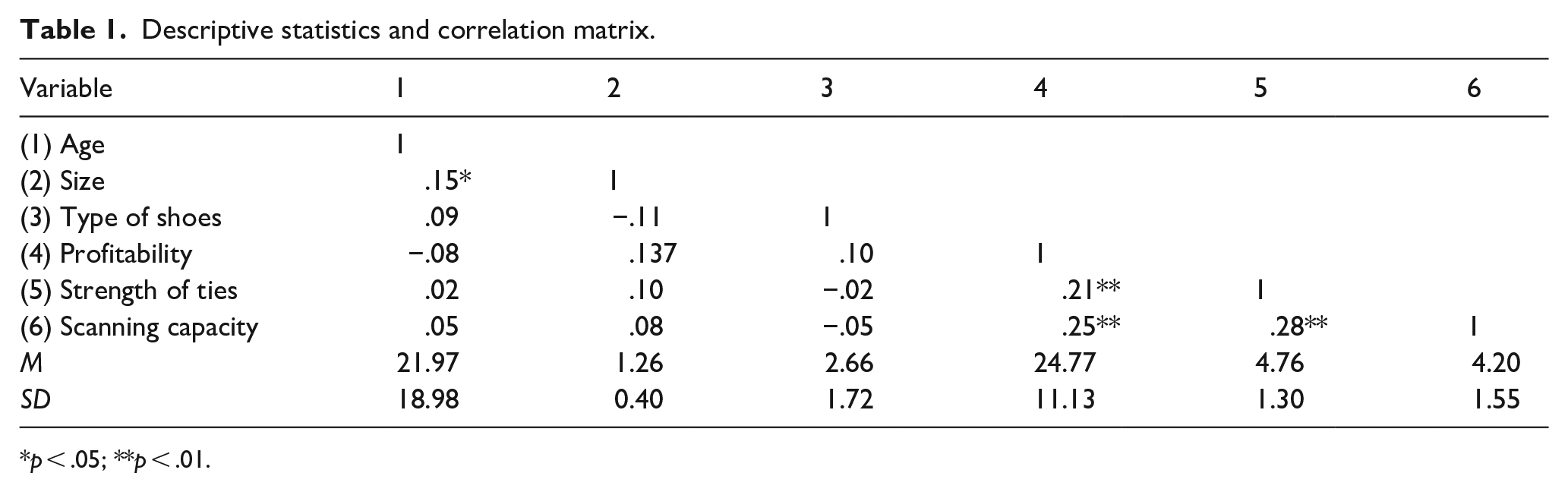
p < .05; **p < .01.
Effect of the strength of ties on PO. The moderator role of scanning capability.
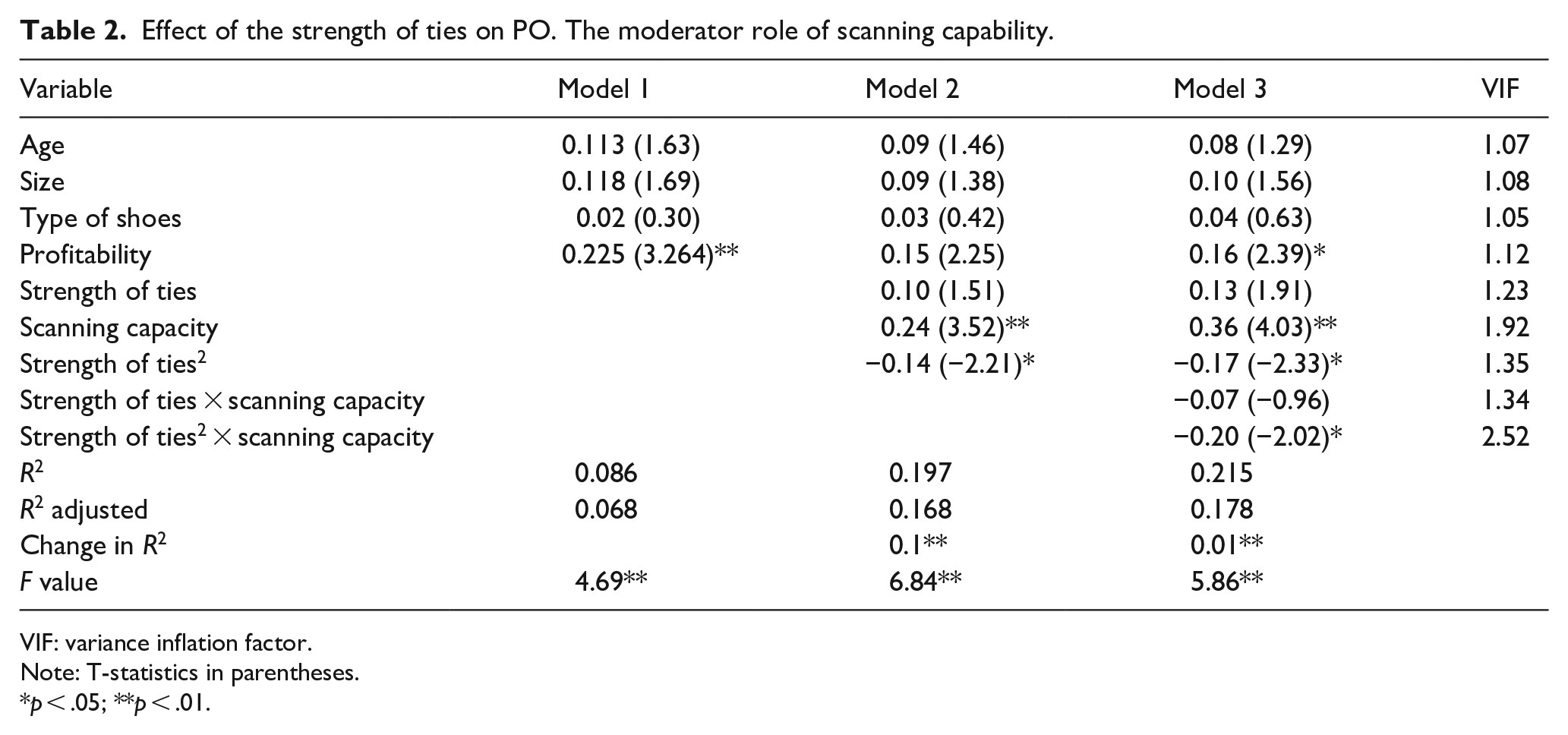
VIF: variance inflation factor.
Note: T-statistics in parentheses.
p < .05; **p < .01.
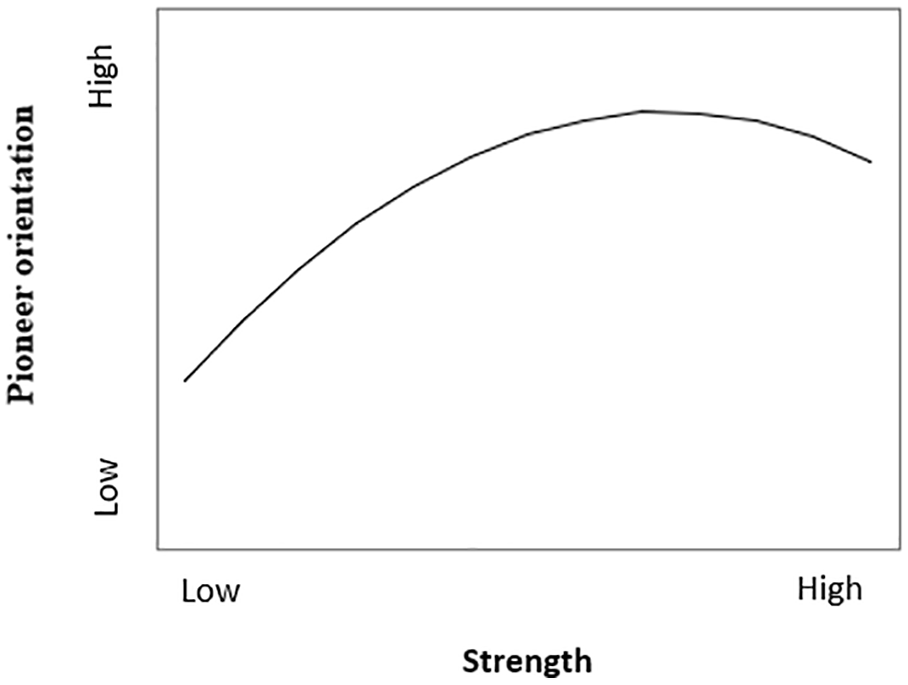
Effect of the strength of ties on PO.
To test Hypothesis 2, we included the interactive effect of scanning capacity by means of the quadratic effect term of strength of ties. The hierarchical approach is necessary since there will only be an interactive effect if the inclusion of the interaction term involves a significant contribution of the main effects to the previous model (Cohen & Cohen, 1983). The inclusion of the interactive term (Model 3) in the quadratic model (Model 2) increases adjusted R2 from .168 to .178. This shows the existence of an interactive effect—the level of scanning capability of the company moderates the quadratic relationship between the strength of ties and PO. The coefficient of the interactive term between scanning capability and the quadratic effect of the strength of ties describes how the non-linear relationship between the strength of ties and PO is moderated by scanning capability. 7
Model 3 shows strong evidence for accepting Hypothesis 2: the interactive effect between the quadratic term of the strength of ties and scanning capability has a negative and significant effect on PO. This result means that scanning capability amplifies (strengthens) the curvilinear relationship (inverted U-shaped) between the strength of ties and the firm’s PO, that is, for firms in the footwear industry, scanning capacity increases the positive influence of the strength of ties on PO when strength is low and mitigates the negative influence when the strength is high. In this sense, the inverted U-curve is more pronounced when scanning capability is high and less pronounced when it is low. Figure 2 shows the differences in the form of the curve in these different situations.
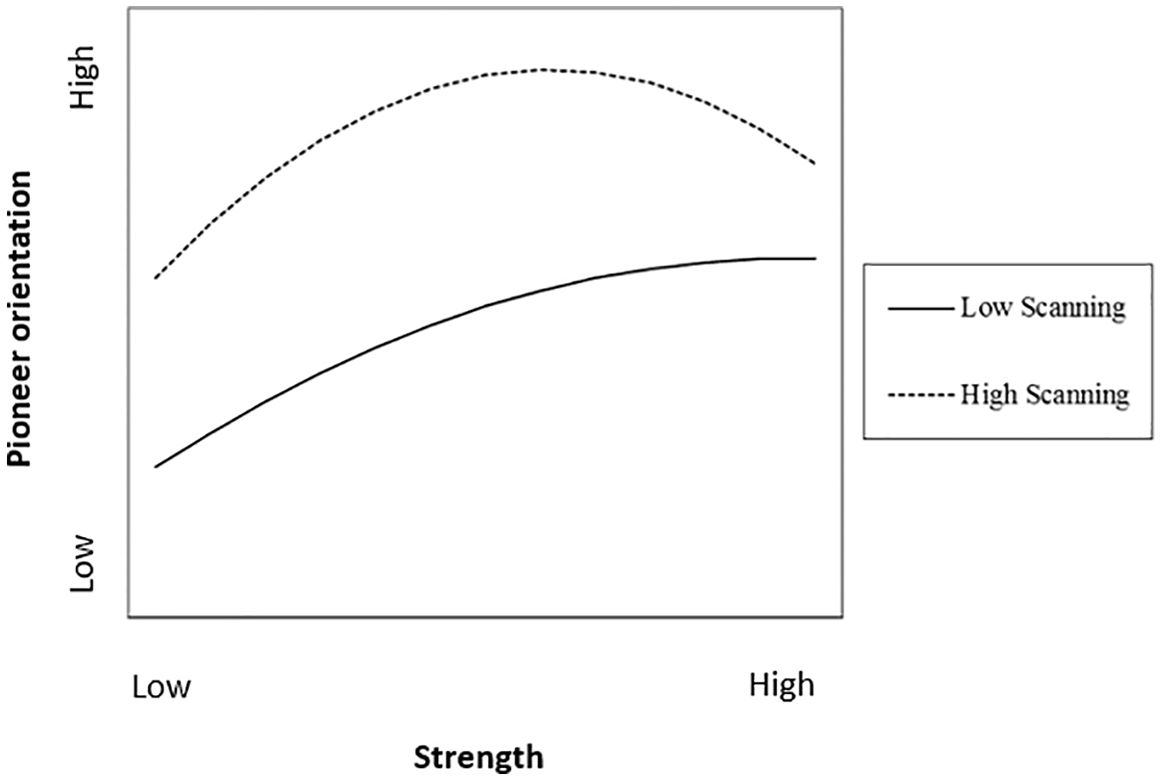
Moderating effect of scanning capability.
Discussion
The results of the study show that the strength of ties in a firm’s relationships has an influence on PO. Specifically, the results indicate that there is a curvilinear relationship—inverted U-shape—between these two variables. In addition, the results show that this curvilinear relationship between the strength of ties of the network in which the company is immersed and PO is moderated by scanning capabilities.
The results show that the strength of ties initially has a positive influence on PO. However, as of a certain level of strength of ties (when an optimal level is exceeded), a further increase in strength has a negative influence on PO. In this sense, this study detected that firms will increase their PO with increasing strength of ties. Thus, an increase in the frequency of relations and personal contact with members of the network encourages companies to develop a PO. However, a high frequency and personal contact with the agents of the network will see the emergence of the negative effects of excessive strength in relationships, resulting in myopia and inertia, which will decrease PO. In this case, the results of the graphic representation of this relationship (Figure 1) show that the level of the strength of ties from which the influence on PO becomes negative is very high. Therefore, only for very high levels of strength of ties is a negative influence on this variable generated.
As proposed in the second hypothesis, it was determined that the curvilinear relationship between the strength of ties and PO is increasingly manifest with escalating scanning capabilities. Scanning capabilities will strengthen the curvilinear relationship between the strength of ties and PO. Therefore, the availability of a high level of scanning capability will enhance the positive influence of the strength of ties on PO and will mitigate the negative influence. In this sense, the results show that scanning capability can counter the problems of redundancy in information and myopia caused by the strength of ties.
Conclusion
The main contribution of the study is to show both the positive (Fosfuri et al., 2013; Wu et al., 2008) and the negative effects (G. K. Lee, 2007; Stevens & Dykes, 2013) of the strength of ties on PO since this effect has an inverted U-shape. Therefore, the results suggest that an appropriate balance in terms of strength/weakness in social relationships is a critical factor to develop a high level of PO. The findings of our research confirm and are in line with previous literature focused on the contradictory or contingent effects of the strength of the ties. However, our study also makes important contributions, extending or going further than other previous research.
This study, therefore, reinforces the theoretical linkages between the perspective of social relations and entry timing theory. First, it contributes to the social relations literature by providing evidence about the effect that the strength of ties (a component of the most controversial dimension of social relations in terms of its effects) has on the strategic behavior of firms and, more specifically, on PO (G. K. Lee, 2007). The finding that social capital factors can lead to PO extends previous research on social capital that has traditionally regarded it as a benefit to organizations circumscribed to knowledge and the innovation process (i.e., Huggins et al., 2012).
The literature has largely argued reasons to explain the negative effects of strong ties and the dense structure of organizations (Leana & Van Buren, 1999). However, this study suggests a contingent approach of the effects of the strength of ties in line with previous research (Ahuja, 2000; Gargiulo & Benassi, 2000; Rowley et al., 2000). In fact, the curvilinear relationship between the strength of ties and PO contributes to the clarification of the ambiguous effects of social capital, similarly to other studies as Molina-Morales and Martinez-Fernández (2009).
Second, this study furthers the analysis of the backgrounds of PO, a widely demanded issue in the previous literature (Lieberman & Montgomery, 2013; Song et al., 2013), consolidating strength of ties as a factor that affects the expectations of generating and maintaining first-mover advantages.
Our study also confirms the positive effect of capabilities, in particular, scanning capabilities, arguing that they influence the expectations of gaining first-mover advantages (Vidal & Mitchell, 2013). This study proposes and verifies that scanning capabilities can improve the possibility of firms in the identification and exploitation of new opportunities in the market from the strength of the relationships with their contacts. Consequently, this study also contributes to resources and capabilities theory, highlighting the important effect of capabilities, specifically scanning capability, as a moderator factor in the relationship between strength of ties and PO. Thus, it highlights the significance given in the literature to the importance of complementary capabilities in developing innovations and a PO (Cepeda-Carrion et al., 2012; Lévesque & Shepherd, 2004; Vidal & Mitchell, 2013).
In summary, the results of this study are a step forward in a number of lines of already consolidated research, and, to some extent, they call into question others based on excessively simplistic approaches and causal associations
There are some limitations of this study that may affect the scope of the obtained results. The most important limitation of the study is its cross-sectional rather than longitudinal approach. However, the authors consider that a cross-sectional study is sufficient to meet the proposed aims. The limitation for a single method “common method bias” must also be assumed. This study has attempted to control this bias through the use of self-questionnaires with single-response items and by performing the Harman test (Podsakoff et al., 2003). The results of this test show that the common method bias is not a problem in our study. However, the subjectivity in the perceptions of managers when it comes to answering the questionnaire may be a limitation for the results obtained. However, in accordance with Spanos and Lioukas (2001), the authors believe that managerial perceptions are very important when it comes to representing the strategic behavior of firms. Furthermore, caution is necessary when generalizing the results obtained, due to the study having been conducted in a single industry. In this sense, the effect of the strength of ties on PO in a mature industry like the footwear industry may be different from the role that it would play in a more dynamic industry. Despite this, the authors have attempted to minimize such limitations by introducing different control variables in the regression analysis. Finally, this work does not analyze the level of strength for each of the relationships maintained by the company, but the strength of ties is presented in average terms for the set of relationships. In this sense, the measurement of this variable at the dyadic level would have also provided a good capture of the concept, allowing to differentiate between stronger and weaker connections. However, this would have meant using social network analysis (SNA), and due to the focus and the magnitude of the study, which addresses the footwear sector at the national level and not for a specific network, this type of measurement would have been unfeasible. However, we followed a method extensively used in the previous research.
The results obtained in this study also allow us to establish some managerial recommendations. The first implication for managers is that they should take into account that when the level of strength in the relationships with contacts is low or moderate, an increase in this strength positively influences PO. However, once past a moderate or high level of strength, increases in strength will be counterproductive, reducing PO, as, at these levels, the advantages of strength do not outweigh any negative effects. Thus, the authors recommend that companies, if they wish to develop a PO, should avoid excessive levels of strength in their ties and overly low levels. To do this, managers must maintain relationships with agents unconnected to the rest of the agents in the network of relationships maintained by their company, to act as bridge agents. Another implication is that managers should promote the generation and development of scanning capability since these capabilities are complementary and key for the development of a PO and can mitigate the negative influence of strength on PO. One way to do this is to attend different fairs, conferences, and events held in the industry that allow the search and collection of information about the market, customers, and so on. The use of new technologies is a good alternative for the generation and development of these capabilities. Thus, the development of online surveys for clients, and/or the use of big data can be key elements for strengthening the scanning capability.
Finally, the development of this study allows us to propose a series of future lines of research. Based on the previously established limitations, it would be interesting to conduct new research in dynamic industries that allow us to observe and compare the effects obtained in this study and allow a greater generalization of results. Another interesting study would be to analyze the role that other key aspects of social capital, such as trust or common values and norms, have on PO. The authors also consider it of interest to analyze the effect that different capabilities can have on the relationship between social capital and PO. Finally, the introduction of various aspects of the environment—dynamism, hostility, and imitation—could provide key information for understanding the antecedents of PO.
Footnotes
Appendix 1

| Please indicate the level of agreement with the following statements about your company’s capabilities (1 = strongly disagree; 7 = strongly agree) |
1 = Strongly disagree
|
||||||
|---|---|---|---|---|---|---|---|
| We supervise and control strategies and tactics of our contacts | 1 | 2 | 3 | 4 | 5 | 6 | 7 |
| We seek information about customers in our industry | 1 | 2 | 3 | 4 | 5 | 6 | 7 |
| We collect information about the market in which the company operates | 1 | 2 | 3 | 4 | 5 | 6 | 7 |
Acknowledgements
The authors thank the Associate Editor Claudio Giachetti and the two anonymous reviewers for their helpful comments and their investment in the article throughout the review process.
Declaration of conflicting interests
The author(s) declared no potential conflicts of interest with respect to the research, authorship, and/or publication of this article.
Funding
The author(s) disclosed receipt of the following financial support for the research, authorship, and/or publication of this article: This research was supported by the Ministry of Economy and Competitiveness of Spain (Project: ECO2016-75781 -P).