




Abstract
We examine how a firm’s centrality within a network of geographically proximate firms affects its competitive capabilities. Our study of the total population of one Spanish cluster of fishing firms shows that the effects of centrality on a firm’s competitive capabilities are contingent on the effects of two relational characteristics of its direct ties: strength and degree of cognitive cohesion. Specifically, our results indicate that the centrality of a firm within the cluster network enhances its competitive capabilities as the strength of its direct ties increases. Furthermore, firms can capture the value of centrality for enhancing competitive capabilities with a combination of strong (or weak) direct ties and low (or high) degree of cognitive cohesion. We contribute to the network and strategy literatures by reconciling conflicting results with regard to the strategic benefits of a firm’s centrality in a cluster and the relational characteristics of its direct ties.
Keywords
Introduction
Network studies across different levels of analysis agree that an actor’s centrality in a knowledge network—the extent to which the actor is well connected to others in the network—increases the knowledge it receives and its potential learning (Phelps et al., 2012), having consequences for the development of critical skills and capabilities and ultimately performance.
However, this generally accepted statement has generated some doubts, if not contradictions, in the literature on regional clusters. While some authors have found a firm centrality in a network of geographically close actors to have strategic benefits (Hervas-Oliver & Albors-Garrigos, 2014), others have suggested that it only offers a small positive influence (Whittington et al., 2009) or even that it has no strategic effect (Owen-Smith & Powell, 2004). Still, there is consistent evidence that within regional clusters, firms that participate in social relations with other firms in the cluster have access to tacit knowledge beyond the explicit knowledge that is available even by mere proximity, which could be of strategic value (Huber, 1991; Scott, 2000).
To resolve this tension in prior research, we seek to understand when a firm centrality in a network of geographically proximate firms does offer strategic advantages for acquiring competitive capabilities. Competitive capabilities, which guide the correct functioning of the firm (Winter, 2003), are a key indicator of value creation in the particular context of our study—fishery, a primary and traditional activity (Sciascia et al., 2014). A fast-growing body of research shows that variations in firms’ competitive capabilities can be partially explained by differences in their access to new knowledge and potential learning through relational ties (e.g., Ahuja, 2000; Gulati, 1999; Mahmood et al., 2011; McEvily & Marcus, 2005; McEvily & Zaheer, 1999).
Our study invokes a contingent perspective to understand under what conditions cluster centrality offers strategic advantages for firms, building on recent research arguing that the advantages firms gain from their network positions depend on the relational characteristics of the ties composing those positions (Baum et al., 2012). Specifically, we first examine the independent two-way interaction effects of cluster centrality with the strength and cognitive cohesion of firm’s direct ties on its competitive capabilities, and second, we examine their combined three-way interaction effects.
Tie strength and cognitive cohesion are the critical characteristics of the networks of ties that exist within regional clusters (Glasmeier, 2011). Strong ties arise with frequent and intense relations, extended duration, and affective closeness (Granovetter, 1985, 1973), and cognitive cohesive ties develop with the existence of a shared vision and a set of common values, goals, and aspirations (Tsai & Ghoshal, 1998). These characteristics of direct ties are triggered by close proximity (Cooke, 2002; Cooke & Wills, 1999; Li et al., 2015; Paniccia, 1998; Staber, 2010; Trigilia, 2001), which explains intense and varied knowledge exchanges in the local area (Baptista & Swann, 1998; Rocha & Sternberg, 2005). Still, we have a limited understanding of how these two factors affect clustered firms’ competitive capabilities (e.g., McEvily & Zaheer, 1999).
Our study of 118 fishery firms representing the total population of a regional cluster in Spain provides evidence that the strategic implications of holding a central position in a regional network of knowledge relations do not come in isolation, but rather in combination with the relational qualities of firms’ direct ties. We, therefore, contribute to research at the intersection of clusters, networks, and strategy by reconciling conflicting results with regard to the strategic benefits of a firm’s centrality within a regional cluster, emphasizing the cognitive aspects of direct ties and explaining how ignoring network positions has led to finding no conclusive relationships between the strength of direct ties and the acquisition of competitive capabilities for clustered firms (McEvily & Zaheer, 1999).
Centrality in networks of geographically proximate firms and competitive capabilities
Competitive capabilities are grounded on routines and processes that guide the correct functioning of the firm (Winter, 2003). While strategy researchers agree in that firms with superior organizational capabilities—whether operational (to make their daily living) or dynamic (to change their current way of doing things)—enjoy a competitive advantage (Helfat & Peteraf, 2003; Teece et al., 1997), there is a weaker understanding of the idiosyncratic trial and error learning process on how such competitive capabilities emerge (McEvily & Marcus, 2005).
Most explanations for the development of capabilities concentrate on sources that are internal to the firm, based on relatively inimitable and immobile resources owing to causal ambiguities and incomplete factor markets (Helfat & Peteraf, 2003; Penrose, 1959), and to different evolutionary paths (Eisenhardt & Martin, 2000; Zollo & Winter, 2002). Still, firms can develop competitive capabilities through interorganizational ties using the network to pool knowledge and resources and gather and learn from relevant knowledge that could be useful for the firm’s ongoing activities (Ahuja, 2000). Indeed, conceiving ties as pipes through which knowledge flows, a number of studies combining strategy and network approaches have recently attributed to the structural and relational characteristics of firm ties to the extent to which they can forge superior competitive capabilities (e.g., Ahuja, 2000; Mahmood et al., 2011). In the particular case of territorial contexts, authors have argued that firms can benefit from systemic competitive capabilities (see, for instance, the notion of the higher-order industrial capabilities discussed by Foss, 1996).
In particular, network centrality is an important characteristic of firm ties that influences the development of competitive capabilities (Ruiz-Ortega et al., 2017). Firms holding central network positions are well connected through two types of distinct ties to others in the network: direct and indirect ties. Direct ties refer to immediate connections, while indirect ties encompass connections through a third firm in the network (Ahuja, 2000). Central positions allow firms to get timely access to a large volume of diverse knowledge that increases the extent to which they can learn from their networks (e.g., Beckman & Haunschild, 2002; Tsai, 2001), gaining advantages in competitive capabilities, innovation, and performance (Tsai, 2001; Tsai & Ghoshal, 1998). These advantages require the existence of certain level of prior related knowledge in the firm to be able to successfully understand the value, integrate, and exploit external knowledge flowing through the network (e.g., Cohen & Levinthal, 1990; Lane & Lubatkin, 1998).
Although there is consistent support for the strategic value of network centrality at both the organizational and the individual level (Phelps et al., 2012), recent studies have found conflicting results for geographically proximate firms (Owen-Smith & Powell, 2004; Whittington et al., 2009). One explanation is that both direct and indirect ties provide access to very similar knowledge in such contexts (Bell & Zaheer, 2007). Within regional clusters, knowledge is traditionally described as being “in the air” (Hendry & Brown, 2006; Marshall, 1920), so that firms can learn through observation, emulations, and so on (Huber, 1991) and do not need, in most of the cases, to engage in social relations (Almeida et al., 2003; Bell, 2005; Fleming et al., 2007). Under this assumption, the costs of maintaining numerous ties may equal or even exceed the benefits arising from the amount and novelty of the knowledge to be acquired. The evidence that the costs of relationships may call into question the usefulness of intensifying ties in clusters is already present in literature (e.g., Molina-Morales et al., 2011).
Notwithstanding, what is definitively important in this context is that cluster-specific advantages are firm-specific and the basis for competitive advantage (Lechner & Leyronas, 2012). Indeed, regional clusters contain very heterogeneous firms (McEvily & Zaheer, 1999; Ter Wal & Boschma, 2011), which compete by building on different types of knowledge (Giuliani & Bell, 2005; Staber, 2010). In fact, one important dimension on which firms in clusters differ is the nature and extent of direct ties to other firms in the cluster (Giuliani & Bell, 2005), therefore, making sense to examine the relational characteristics of direct ties.
Relational characteristics of the direct ties of geographically proximate firms and competitive capabilities
Despite the benefits of network centrality are accrued through both direct and indirect ties, in many aspects, direct ties are particularly relevant (Ahuja, 2000). Direct ties have a strong impact on the overall effect of centrality as direct ties can ease the transfer and understanding of knowledge from indirect ties, can make the process harder, or even interrupt it altogether. This suggests that the potential value of network centrality would then be contingent on the characteristics of direct ties.
Strength and degree of cognitive cohesion are the two important characteristics of direct ties. However, the literature has not paid the same attention to these two characteristics. While one of the most heated debates in the network literature addresses the advantages and drawbacks of strong versus weak ties (e.g., Burt, 1992; Capaldo, 2007; Coleman, 1990; Granovetter, 1973; Krackhardt, 1992; Sobrero & Roberts, 2001), the strategic implications of varying degrees of cognitive cohesion have received little research attention (Bolino et al., 2002; Fornahl et al., 2011).
Somehow strong ties have been implicitly associated with high cognitive cohesion because frequent and repeated interaction is presumed to generate common norms and values, and weak ties have been indirectly linked to low cognitive cohesion because a lack of shared values and culture is presumed to limit common understanding.
Although these two relational characteristics of ties, strength, and cohesion, indeed, tend to correlate over time, they not necessarily follow similar patterns (Nahapiet, 1998; Tsai & Ghoshal, 1998). To the extent to which firms can deliberately regulate the strength of their direct ties, but have little (or at any rate less) control over their degree of cognitive cohesion, it is important to determine the independent effects of these two relational characteristics, as well as their combined effects, on the advantages that firms can extract from central positions within knowledge networks for enhancing their competitive capabilities.
Tsai and Ghoshal (1998) already advanced the important interplay between structural and relational characteristics of ties for creating firm value, and more recent works in the context of geographic proximity suggest that the structural aspect of social ties only indirectly affects knowledge acquisition through the relational and cognitive dimensions of firms’ membership of a cluster (García-Villaverde et al., 2018).
Cluster centrality and the strength of direct ties
Strong direct ties entail both the benefits and constraints for a firm’s external knowledge acquisition and learning (Hansen, 1999), with potential consequences for the development of its competitive capabilities. Given that direct ties are the gate to indirect ties (Ahuja, 2000), we argue that it is the interaction of both direct and indirect ties which determines the ultimate effect of the engagement in the cluster network on the competitive capabilities of clustered firms.
Relational assets, such as trust and reciprocity, provided by direct strong ties increase the focal firm’s awareness of the existence of particular knowledge and the likelihood of receiving it (Dokko et al., 2014; García-Villaverde et al., 2018; Kraatz, 1998; Simonin, 1999; Sobrero & Roberts, 2001), enabling an efficient combination with the firm’s existing knowledge (Tallman et al., 2004). Some scholars even argue that only through strong ties the complex knowledge can be transferred (Hansen, 1999; Reagans & McEvily, 2003). In contrast, strong direct ties can also lock the focal firm into a given relationship, reducing its autonomy and its access to more diverse information that could seriously harm the refinement of their competitive capabilities (Granovetter, 1973; Molina-Morales & Martinez-Fernandez, 2009; Yli-Renko et al., 2001).
By extending the above argument, it can be argued that in regional clusters, the net benefit of maintaining strong direct ties may be reduced, given the tendency of clustered firms to homogenize their knowledge bases (Boschma, 2005; Pouder & St. John, 1996; Tallman et al., 2004) and the existence of opportunities to absorb knowledge from spillovers without the need to maintain strong relations in the area, thanks simply to proximity between firms (Baptista & Swann, 1998; Saxenian, 1994).
Holding a central position in the cluster affects the potential knowledge access and exploitation for firms. Firms occupying central positions in the cluster can extract benefits from strong direct ties, multiplying their advantages while minimizing their constraints. First, strong direct ties ensure the flow of knowledge from indirect ties, increasing the amount and precision of potential knowledge to be acquired (Ahuja, 2000). Second, central firms are connected to a greater number of distinct contacts in the cluster and thus are more likely to be exposed to diverse and non-redundant knowledge (Beckman & Haunschild, 2002; Reagans & McEvily, 2003; Tortoriello et al., 2012). Strong direct ties help them understand and integrate this knowledge (Dokko et al., 2014). Third, central firms are less prone to focus exclusively on nearby firms, so they diminish the risks of insufficient monitoring of alternative potential relationships (Langfred, 2004) and other undesirable consequences derived from the potential lock-in of strong direct ties (Burt, 1992).
The strength of direct ties will thus enhance exploitation of the positional advantages of cluster centrality. Access and use of new relevant knowledge through these relations nurture the ongoing activities of clustered firms enhancing their competitive capabilities. Therefore:
Hypothesis 1. The interaction between the strength of a clustered firm’s direct ties and its centrality within the cluster network is positively associated with its competitive capabilities.
Cluster centrality and the cognitive cohesion of direct ties
Direct ties with high cognitive cohesion have advantages and disadvantages for a firm’s external knowledge acquisition and learning and the subsequent development of its competitive capabilities. As with the strength of direct ties, we suggest that it is the interaction between the degrees of cognitive cohesion of direct ties together with the firm’s position in the cluster network of relations which determines the ultimate effect of the engagement in the cluster network on the competitive capabilities of clustered firms.
However, direct ties with high cognitive cohesion foster joint action and common understanding (Bolino et al., 2002; Fornahl et al., 2011; Portes & Sensenbrenner, 1993), increasing free access to knowledge and ideas and enhancing the effectiveness of knowledge integration (Inkpen & Tsang, 2005). However, like other bonded social capital assets, highly cohesive direct ties may become a liability because of a number of obligations, such as reciprocate (Marsden & Campbell, 1984) or the tendency to develop common, rather than diverse knowledge (Storper, 1997; Uzzi & Spiro, 2005). When considering both aspects, the net effect of these ties on a firm’s competitive capabilities remains unclear.
Specifically, in the case of regional clusters, it is reasonable to expect relatively more disadvantages than advantages. By definition, regional clusters are associated with the existence of shared norms and beliefs (Barabel et al., 2007; Boschma, 2005), which can explain the general ease and success of knowledge exchanges within the area (Glasmeier, 2011). The base level of cognitive cohesion common to all cluster members may reduce the additional positive returns of direct ties with high degrees of cohesion.
Firms occupying central positions in the cluster can attain benefits from holding direct ties with the high levels of cognitive cohesion. Such ties imply willingness to take action to benefit partners (Bolino et al., 2002), thereby securing the flow of knowledge coming from indirect ties. In addition, highly cohesive direct ties enhance the acquisition of diverse and non-redundant knowledge from indirect ties by triggering common understanding and knowledge integration (Inkpen & Tsang, 2005). Despite the average high level of cognitive cohesion among cluster members, the indirect ties accessed through a central position in the cluster can vary in their degrees of cognitive cohesion with other intermediary ties, increasing the chances to acquire novel knowledge. Cluster centrality will augment the firm’s likelihood of receiving and comprehending knowledge and avoiding overembeddedness in a closed circle.
In sum, we suggest that high cognitive cohesion of direct ties will enhance the firm’s exploitation of the positional advantages of cluster centrality, increasing its likelihood of absorbing relevant knowledge that can be used for enhancing the firm competitive capabilities. Therefore:
Hypothesis 2. The interaction between the degree of cognitive cohesion of a clustered firm’s direct ties and its centrality within the cluster network is positively associated with its competitive capabilities.
Cluster centrality, strength, and cognitive cohesion of direct ties
Once strength and cognitive cohesion of direct ties have been separately discussed, we go further in considering their potential combined effects. The causal mechanisms by which the strength and cognitive cohesion of direct ties influence clustered firms’ competitive capabilities are almost the same: increases in the focal firm’s likelihood of receiving knowledge and the ease of integrating that knowledge and learning (Bolino et al., 2002; Inkpen & Tsang, 2005; Simonin, 1999; Tallman et al., 2004). The disadvantages are also similar, related to maintaining ongoing relationships and the reciprocity norms associated with them (Marsden & Campbell, 1984; Molina-Morales & Martinez-Fernandez, 2009; Uzzi & Spiro, 2005; Yli-Renko et al., 2001). This may suggest the possibility that strength and cognitive cohesion can act as substitutes, reducing the need of clustered firms to devote efforts to cultivate at the same time the strength and high cognitive cohesion of their direct ties.
In fact, scholars have stressed that under certain conditions, firms that are focusing on a particular relational characteristic could abandon or underuse others (e.g., Capaldo, 2007; McEvily & Zaheer, 1999; Moran, 2005; Padula, 2008; Rowley et al., 2000). This logic is grounded on Tsai and Ghoshal’s (1998) seminal ideas about the positive association among the structural and relational dimensions of ties. A central position in the network allows the firm to exploit more efficiently the advantages provided by indirect ties through direct ties (Ahuja, 2000), which suggests that central firms might be better off focusing their energy on establishing new ties with alternative firms rather than maintaining strong ties with current firms, once those relationships have reached a certain degree of cognitive cohesion. Alternatively, firms with low cohesive ties do not integrate the knowledge they receive so easily and need more frequent relationships to be able to integrate knowledge and to benefit from it. Consequently, these firms rather than focusing on increasing the number of ties, should focus on being able to extract the benefits of the relationships they already hold by strengthening them.
Based on the above logic, we suggest that central firms can enrich their competitive capabilities using either strong or cognitively cohesive direct ties rather than both at the same time. Central firms developing either type of tie are likely to save time and resources that can then be invested in other aspects of the firm strategy while avoiding inefficiencies generated by redundant bonds. Redundancy might isolate firms from some profitable sources of knowledge and information (Stuart & Sorensen, 2003) through a lock-in effect (Bathelt et al., 2004). In sum, central firms can afford to invest in only one of these two relational characteristics since both are costly to maintain and exert the same effects on firms’ competitive capabilities. Hence, we propose that:
Hypothesis 3. The centrality of a clustered firm within the cluster network enhances its competitive capabilities as both the strength of its direct ties increases (decreases) and the degree of cognitive cohesion of its direct ties decreases (increases).
Methods
Sample and data
The study’s setting is composed by one particular regional cluster of fishing firms in southern Spain: the sea bream fleet that operates in the Strait of Gibraltar. Most of the vessels in fleet are based in the village of Tarifa, though some vessels are based in Algeciras (approximately 20 km away). The vessels are allowed to land their catches in any of both ports. However, the majority of the landings occur in Tarifa where the skippers of both villages can relate to each other easily. The sea bream fishery has been under a recovery plan since 1999. This recovery plan includes restrictions regarding the minimum size of the fish, the total number of fishing days per year, the maximum volume and length of the vessels, the number and size of long lines, and the number of hooks. Seasonal closures are also imposed and incentives for scrapping. In both villages, the fishing community (fishers and those involved in fishing-related activities) represents a high percentage of the total population. The fishing companies are very small having an average of five crew members each. The clustered firms are located in a very limited space, which normally implies intense social interactions, including ones based on friendship or kinship. Yet, knowledge exchanges are not widespread, and firms have varying numbers of knowledge ties and relational characteristics.
These firms carry out a very traditional activity, in which achieving a competitive advantage is based on a number of capabilities, such as mastering fishing gears. There is some knowledge, such as location of fishing banks, which is not available in written documents but can be acquired through experience and intuition—or from other firms. Even if the boats compete for the same fish, captains may opt for sharing this knowledge based on friendship, which creates commitment and reciprocity behaviors. In our direct interviews with captains, they insisted on that they do not give knowledge away to actors that do not share knowledge with them, confirming the idea that they do not give knowledge for free, they share knowledge with specific actors. These knowledge exchanges between actors create informal social networks through which knowledge is transferred. Therefore, we assume, a priori, that in this context, knowledge transfer and social capital are particularly relevant to building and sustaining competitive capabilities.
The total population in the area was 131 fishing companies at the time of the field work. We collected data from those 131 fishing firms between November 2008 and December 2009 through three different sources. First, we used secondary sources to get data on the population. There is a close census in this fishery and the number and the name of the fishing vessels that compose the fleet, together with their plaques is published in the Spanish Official Bulletin. We also got information regarding the volume (capacity, measured in GRT, Gross Registered Tons) of the fishing vessels. We then interviewed captains on two occasions, and finally, for robustness, we consulted a panel of six industry experts to check for mono-method bias (e.g., Chen et al., 1993). The personal interviews with captains followed a structured questionnaire. Apart from the pre-test, the captains were interviewed on two occasions: first, we asked them some basic questions regarding their functioning and capabilities and who they shared information with, and in a subsequent questionnaire, we asked them about specific features of their specific relationships, such as cognitive cohesion or tie strength. By doing it in two rounds, we could confirm that they really hold the relations they acknowledge in the first round and that they had not forgotten any.
The first round of questionnaires started with some questions regarding the capabilities and functioning of their firms. The data regarding the relations they hold were collected using a sociometric approach. Fishing firms’ captains were first presented with a fixed roster that listed all the firms in their cluster. Respondents were asked to identify the firms that represented an important source of knowledge in the past 3 years and those from which they intentionally sought knowledge. By presenting them the list of all vessels in the fleet, we intended to make sure that they did not forget any relations they could held. In the second round, they were then asked to describe their relationship with each cited contact in terms of strength and cognitive cohesion. Captains were interviewed before or after they went out to the sea. Often, they were interviewed while they were in port repairing their nets or getting ready to get out to the sea. On some occasions, we even had to get on board to take the opportunity to interviewed them. The time needed per questionnaire varied greatly from one captain to another, being the minimum time around 15 min. While some managers of big manufacturing firms are frequently interviewed, managers of fishing boats are interviewed on few occasions, so once they felt confident regarding the objective of the research project, they were curious and keen to dedicate time to us. Interviewing them also represented an interesting source of information regarding the functioning of the industry and the learning process in the fishing industry which was of high value for our research.
Average centrality is 3.138; average tie strength is 4.61, and average cognitive cohesion is 4.169 (see Table 1). Out of the 131 firms, 13 reported not having any relation with other firms in the cluster and were not included in the final analyses, resulting in a sample of 118 firms. Figure 1 displays a graph with all network relations within the cluster, where the average density of the network is .012. This low value in network density is in agreement with similar previous studies in the field of regional clusters (Molina-Morales & Martínez-Cháfer, 2016). As the core-periphery literature argues (Morrison & Rabellotti, 2009), the existence of supporting organizations, such as the fishermen guilds in our case, can increase the connectedness among geographically proximate firms even if relations are not explicitly acknowledged (McEvily & Zaheer, 1999). In contrast with what happens in other better-defined networks, regional clusters usually present a low number of recognized ties compared with the total amount of potential ties. In our case, it can be particularly low because the fishing firms compete for the same fish.
Means, standard deviations, and correlations among the study’s variables.
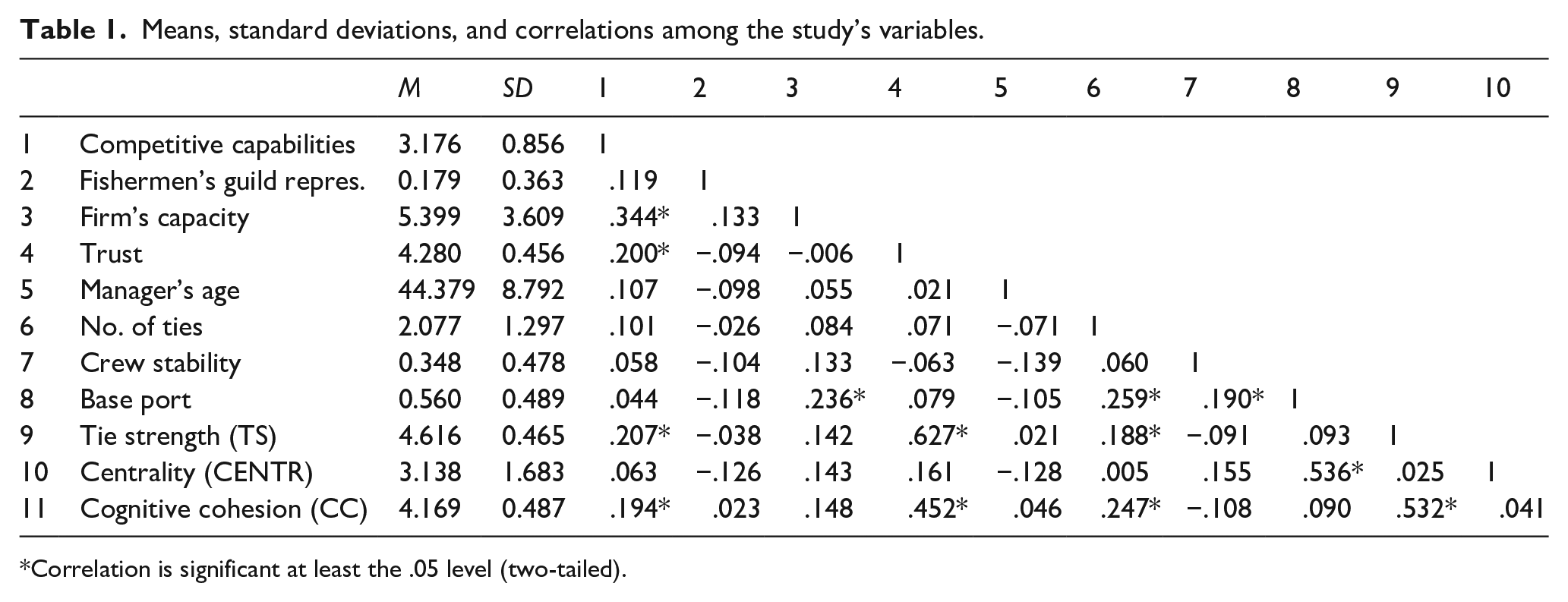
Correlation is significant at least the .05 level (two-tailed).
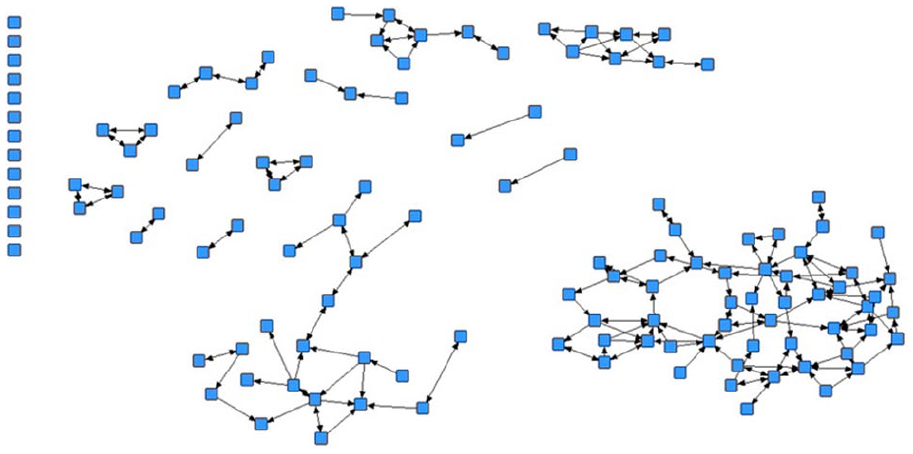
Firms’ knowledge networks in the regional cluster.
Measurement and validation of constructs
The study used valid scales that had been published in previous research. As a pre-test, the initial scales were tested in 10 in-depth interviews with fishing firms’ captains, who were asked to complete the questionnaire and indicate any ambiguity in the phrasing of the items. Afterward, the phrasing was improved by asking academic colleagues and peers to provide comments and suggestions, resulting in the final version of the questionnaire.
To examine the potential for common method variance (CMV) associated with having single informants, we ran a number of analyses, all of which indicated the absence of this bias. First, we performed Harman’s one-factor test on the items included in the study. The Harman’s one-factor test is used as an indicator or CMV. It is based on confirmatory factor analysis (CFA); if a single common factor emerges, it would indicate that the variables present an artificially high common correlation, which would show a problem of CMV. We found multiple factors with the first factor not accounting for more than half of the variance explained by the set of factors with eigenvalues above one (Podsakoff & Organ, 1986). Second, we used Lindell and Whitney’s (2001) “Correlational Marker Technique,” which suggests that the best estimate of CMV in a dataset relying on a single source is represented by the smallest observed positive correlation between a substantive variable and an a priori chosen “marker” variable that is believed to be theoretically unrelated to at least one substantive variable but susceptible to the same causes of CMV. In our case, we have chosen a scale that measures “intensity of knowledge sharing among members of the boat crew” as marker variable. The results suggested that the likelihood of CMV in our data was low. This conclusion was consistent with several other factors that, collectively, suggested that CMV is not a major concern in our study, such as the significantly high correlation (.534, p < .001) between the yearly catches of the fishing companies and subjective measures of performance extracted from the captains’ responses.
Dependent variable: firms’ competitive capabilities
We relied on a panel of six industry experts to gather knowledge about the key competitive capabilities needed by firms to succeed in this sector. These interviewees were selected among the members of the regional administration with competences in the fishing sector and the members of the boards of diverse industry associations and institutions. We took an unstructured interview approach, in which the experts provided us with some useful background information that guided the construction of the questionnaire. Experts agreed on five competitive capabilities a fishing company must master to perform efficiently: knowledge of fishing gears, tides, fishing places, engines, and sales. Accordingly, we built a scale asking fishing firms’ captains to value their capabilities from 1 to 5 in comparison with the rest of the companies from the cluster with regard to those five competitive capabilities. For this construct, we also ran an exploratory factor analysis (EFA), resulting in a one-factor construct of five items (α = .982). Again, Cronbach’s alpha values suggested sufficient internal consistency and reliability. Previous research (McEvily & Marcus, 2005; McEvily & Zaheer, 1999) has also measured the firm’s competitive capabilities in a specific industry through field research. We did a careful analysis of the field interviews and industry experts who strongly maintained that the key aspects to achieve competitive advantage in this industry were those specific items.
To test the robustness of the dependent variable based on the firms’ captains responses, we asked the six industry experts to assess the competitive capabilities of the fishing companies they knew. We employed a single question using a five-point scale: “value each fishing firm’s overall competitive capabilities in comparison with the rest of the fishing companies from the cluster (considering the five aspects a fishing company must master to perform efficiently: fishing gears, tides, fishing places, engines, and commercialization).” Responses varied between 1 (low value) and 5 (very high value). The industry experts could only rate the 49 companies they knew better, representing 42% of our sample, and the correlation between average experts’ responses and the boats captains’ responses was .764 (p < .001). As this correlation was significant and reasonably high, we considered that the captains’ self-assessed competitive capabilities were adequate, and we used them in our analysis.
Independent variables: strength of direct ties, degree of cognitive cohesion of direct ties, and network centrality
We asked captains which other companies their own companies seek knowledge from. We also suggested them to report this information both for all formal and informal ties they maintained. By doing so, we tried to get all connections that could provide knowledge and information to them. Then we collected data about the strength of direct ties using Hansen’s (1999) two-item scale. We asked respondents to indicate how frequently their companies sought knowledge from each listed contact, and how close were the affective relationships between them. We gathered information about the degree of cognitive cohesion of direct ties by adapting Tsai and Ghoshal’s (1998) measure of the shared ambitions, vision, beliefs, and practices among firms’ subunits to interfirm connections. The two items used a five-point scale with responses ranging from strongly disagree (coded 1) to strongly agree (coded 5). We did not require our relations to be reciprocated. A tie exists from the respondent firm to the contact, if the respondent firm reports a relationship.
For each relationship characteristic, we averaged the values for all the firm’s direct ties, as we intended to capture the effects of ties on the firms’ competitive capabilities. Note that in trying to explain firm’s competitive capabilities, we have to work at the firm level. The knowledge provided by each of the ties influences the final competitive capabilities the ego firm possesses, not being possible to distinguish the individual effect of each of these relations. For this reason, our final dataset included the competitive capabilities of each firm as dependent variable and explanatory variables, such as the firm’s centrality, number of ties (which had to be aggregated at firm level), tie strength (averaged for each firm across its ties), and cognitive cohesion (again averaged for each firm across its ties).
We ran an EFA to assess the validity of our measures. We used principal component analysis with a varimax rotation, where the items loaded on two factors with factor loadings above .50: one factor for tie strength, with two items (α = .777), and another factor with two items for cognitive cohesion (α = .955). Cronbach’s alpha values show that the scales have sound measurement properties.
Firm network centrality was measured in terms of closeness centrality. This is a global centrality measure that indicates how close an actor is to each actor of the whole network (Provan et al., 2007) taking into consideration not only direct relations but also indirect ones. It represents the capacity of a given actor to reach any other actor. The farness of a node is defined as the sum of its distances (length of their shortest path) to all other nodes. The inverse of this measure is defined as closeness centrality (Sabidussi, 1966). Therefore, a very central node will present a high value of closeness centrality. We used UCINET program to calculate the network measures (Borgatti et al., 2002).
In unconnected graphs, the farness measure would be infinity for all points and the closeness measure would be zero (assuming 1/∞ = 0). To avoid this problem, several solutions have been proposed. One of the most used ones is the one suggested by Latora and Marchiori (2001) and Opsahl et al. (2010), who suggested that the closeness centrality of a node should be defined as the sum of the inverse of its distances (length of their shortest path) to all other nodes (in opposition to the inverse of the sum of those distances). Under this definition, an unconnected node would have a closeness centrality equal to zero and a very central node would take a very high value for closeness centrality. Another solution was proposed by Dangalchev (2006) who suggested a closeness centrality measure defined by Cen(n) = Σ2−d(x, n). Any of these measures offer similar results and can be subsequently standardized.
Control variables
The analyses also controlled for several variables that affect the fishing companies’ competitive capabilities: firm capacity, crew stability, number of direct ties, being a representative in institutional networks (fishermen’s guilds) in the cluster, trust placed in the alter, manager’s age, and a dummy variable accounting for the base port.
Firm’s capacity was measured by the volume of the vessels in GRT. We did not consider other measures of firm size, such as number of employees or vessel’s engine power, as these variables are highly correlated. Crew stability was measured as a dummy variable specifying whether employees were constant all year round or not. Direct ties were simply counted. A dummy variable was coded 1 for firms that were representative of the fishermen’s guilds, or “Cofradías de Pescadores,” a sort of institutional network which coordinate fishers with governmental or local administration, deal with commercial organizations, and represent fishers when needed. Firms belonging to the government of the fishermen’s guild would probably have access to more information, which in turn would make knowledge transfers more efficient (Granovetter, 1973; Leonard et al., 2011). Trust was measured by a scale developed by Zaheer et al. (1998) (α = .873). This is a scale composed of five items in a 5-point scale with responses ranging from strongly disagree (coded 1) to strongly agree (coded 5). This scale has been validated and widely used in the literature. Initially, higher levels of trust should facilitate knowledge transfer between ego and alter. We also included the age of the captains as a proxy for experience in the business that could potentially affect firm’s competitive capabilities. The dummy variable accounting for the base port was coded 1 for the Tarifa and 0 for Algeciras.
We took several additional steps to ensure data validity and reliability. After checking the factorial structure of each concept that we wanted to measure and test the reliability of each scale as mentioned before, we used CFA to check the goodness-of-fit of the measurement model (Anderson & Gerbing, 1988; Fornell & Larcker, 1981). We also checked convergent and discriminant validity. Convergent validity tests whether concepts or measurements that are supposed to be related are, in fact, correlated, whereas discriminant validity tests whether concepts or measurements that are supposed to be unrelated are, in fact, uncorrelated. Scales should present convergent validity to show that the items measure the same construct while at the same time they should present discriminant validity to indicate that different items do not measure exactly the same concept. Convergent validity was confirmed since factor loads were higher than 0.5, t coefficients were significant, and the composite reliability of each construct was higher than the minimum threshold of 0.7 (Hair et al., 2005). Following Fornell and Larcker (1981), we also confirmed discriminant validity for all our constructs since the average variance extracted (AVE) was higher than the squared multiple correlations with the rest of the constructs.
Analysis and results
The descriptive statistics and correlations among variables are presented in Table 1. The correlations among the interaction effects were not high (on average .378), being the maximum value .58. We tested for multicollinearity among the variables in our models and it did not seem to represent a problem. We used two indexes that provide a measure of multiple correlations among variables. The presence of multicollinearity would provoke some regression coefficient estimates to appear erroneously as non-significant. The maximum condition number was equal to 5.20 which is well within reasonable levels, and the values for the variance inflation factor (VIF) were also far away from limit levels (maximum value 2.85). We also checked that endogeneity was not a matter of concern, and results showed that the residuals of the model were not correlated with our variables. We then standardized all variables and used hierarchical regression analysis to test the study’s hypotheses. We tested for normality to provide validity to our hierarchical ordinary least squares (OLS) regression analyses. Parametric tests of significance were also possible in this case because the skewness and kurtosis statistics of the dependent variable fell well within the boundaries of normality (Shapiro & Wilk, 2016). We also tested for network dependence. Given that vessels’ performance is enhanced by their relations, it may happen that fishers in the same network have access to similar resources and, consequently, present a performance that is more similar than that expected by chance. To check for autocorrelation of residuals, we carried out a Moran’s I test. We use the matrix of the network distance as the weight matrix (Leenders, 2002). The Moran’s index was found equal to −.037, close to 0, indicating that the residuals are randomly distributed in the sample. The p-value associated to the Z statistic was non-significant (p = .19), indicating that the correlation of residuals of observations within the same cluster network was non-significant.
Table 1 provides the means, standard deviations, and correlations for all of the study’s variables. Some of the correlations among the variables were significantly different from zero.
The results for the OLS hierarchical regression analysis among the firm’s network centrality, strength and cognitive cohesion of direct ties, and competitive capabilities are presented in Table 2. The base model (control variables only) explains a statistically significant share of the variance in the firm’s competitive capabilities, nearly 12%. As expected, boat capacity and trust have significant positive coefficients in all models considered, indicating that firms with bigger boats and higher levels of trust are associated with higher competitive capabilities. Contrarily to our expectations, other control variables, such as the manager’s age, the number of ties, or the crew stability, were significant. Manager’s age has been used in some studies as a proxy for manager’s experience and we expected it to be positive. Similarly, crew stability was found non-significant. A potential explanation may be that even if crew instability may buffer the positive effects of long-term relations with other external actors, joining new crew members can compensate it by bringing new knowledge to the firm.
Results of hierarchical regression analysis among firm’s centrality in the cluster network, direct tie strength, direct tie cognitive cohesion, and competitive capabilities.
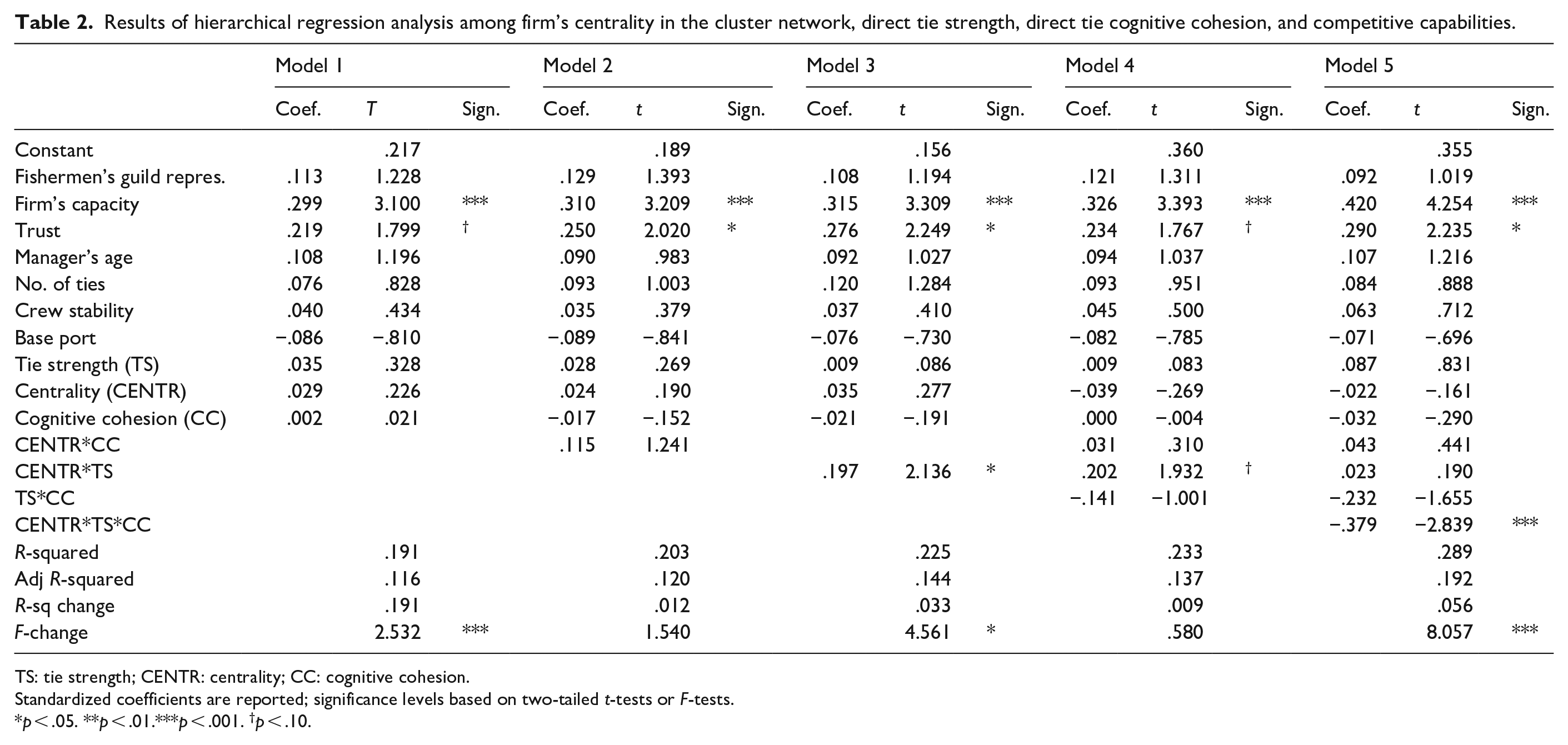
TS: tie strength; CENTR: centrality; CC: cognitive cohesion.
Standardized coefficients are reported; significance levels based on two-tailed t-tests or F-tests.
p < .05. **p < .01.***p < .001. †p < .10.
Interestingly, while we expected that having a high number of ties would positively affect firm performance, its coefficient was not significant. Its non-significant effect indicates that it is not how many ties you hold but how these ties are, and who you are connected with (an actor with more or less ties) what really affects performance. The effect of belonging to the government of the fishermen’s guild is not significant either. The variable accounting for base port differences was also non-significant, suggesting that the effect of being based in one port or another was irrelevant. This was what we expected because the vessels in the fleet operate in both ports, so that they can relate to each other either formally or informally.
The output of the regression analysis shows significant results regarding the relationship among network centrality, the two relational characteristics of direct ties under study, and firms’ competitive capabilities. While none of the direct effects of the key variables are significant, some of the interaction terms among them are significant.
For instance, the direct effect of network centrality is not significantly different from zero, but it influences the firms’ competitive capabilities through the interaction terms. The interaction term of network centrality and direct tie strength (Model 3) is positive and significant, providing support to Hypothesis 1. Figure 2 captures the interaction effect between the strength of a clustered firm’s direct ties and its centrality within the cluster network of relations on its competitive capabilities. We have considered low and high values of the variables to the mean minus two times the standard deviation and plus two times the standard deviation, respectively. We carried out a STATA analysis on the margins’ statistical significance using the MARGINS command. We have graphed an ellipse around the points in our lines at which the interaction effect is significantly different from zero. Figure 2 shows that while the competitive capabilities of peripheral firms are not affected by the strength of direct ties (as the interaction effect of those variables is not significantly different from zero when firm centrality is low), central firms benefit from their position when they hold strong ties (Region B) yet, suffer when these ties are weak (Region B).
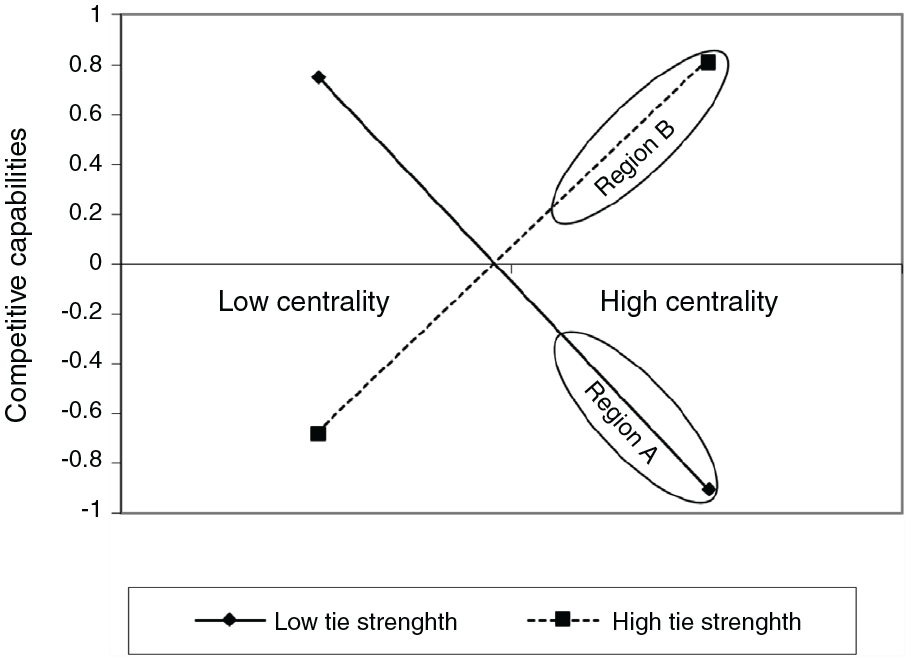
Interaction effect of the strength of a clustered firm’s direct ties and its centrality within the cluster network on its competitive capabilities.
Our results do not support Hypothesis 2, as the interaction term of network centrality and direct tie cognitive cohesion is positive but not significant (Model 2) and the STATA analysis on the margins’ statistical significance using the MARGINS command shows that the marginal effect for the different combinations of low and high values of the two variables is not significantly different from zero in any of the cases.
When we included the three-way interaction effect of centrality, the strength and cognitive cohesion of direct ties, the R-squared of the model improved significantly, explaining around 20% of the variance in firms’ competitive capabilities, with the associated coefficient of the three-way interaction being highly significant, supporting Hypothesis 3. We plot the three-way interaction effect considering the low and high values of the variables to the mean minus two times the standard deviation and plus two times the standard deviation, respectively (as well as in Figures 1 and 2). For a better understanding, we have marked four regions which include the points in our lines at which the interaction effects are significant. Figure 3 illustrates that central firms that maintain weak ties with low cognitive cohesion (those in Region A) are not associated with high competitive capabilities. Central firms’ competitive capabilities benefit from two different combinations of their direct ties: either strong direct ties with low cognitive cohesion (those in Region B) or weak direct ties with high cognitive cohesion (those in Region C). Figure 3 finally shows that more peripheral firms with weak direct ties with low cognitive cohesion are also associated with high competitive capabilities (observations in Region D).
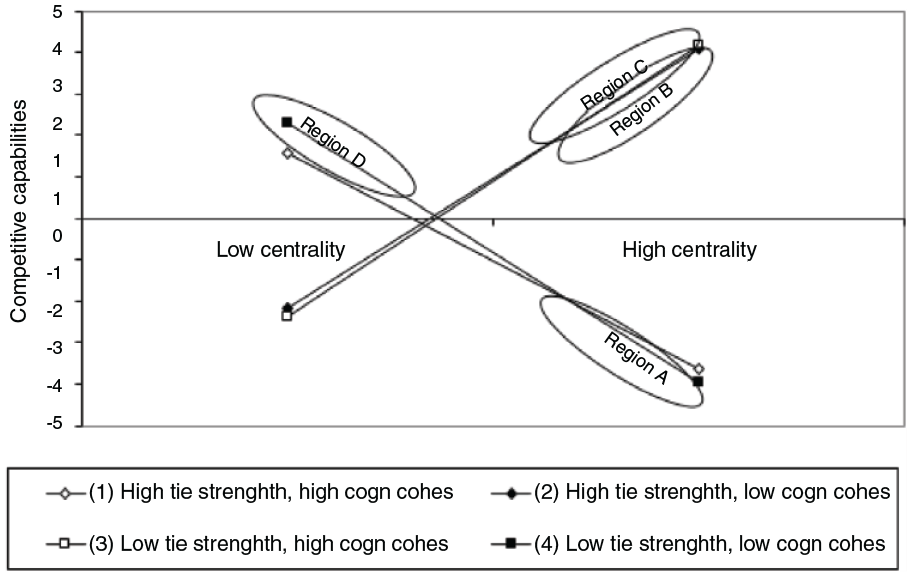
Three-way interaction effect of the strength and degree of cognitive cohesion of a clustered firm’s direct ties and its centrality within the cluster network on its competitive capabilities.
Discussion and conclusion
Our findings provide evidence that, in the case of geographically close firms, the effects of network centrality on the firm’s competitive capabilities are contingent on both the strength and cognitive cohesion of its direct ties. Our results contribute to the regional cluster, network, and strategy literatures offering a potential explanation for the conflicting results that appear in the literature regarding the strategic effects of (1) centrality in a network of geographically close firms and (2) the relational characteristics of direct ties among geographically close firms.
As predicted, our results graphed in Figures 2 and 3 indicate that the relational characteristics of a firm’s direct ties have a contingent effect on the independent influence that its position in the network exerts on its competitive capabilities. Firm’s abilities to understand and exploit potential advantages of relational characteristics vary. This signals, in alignment with McFadyen et al. (2009), that though direct ties do not provide by themselves access to diverse knowledge, their strength and degree of cognitive cohesion increase the firm’s likelihood of capturing and utilizing the diverse knowledge made available through its indirect ties in particular ways. Specifically, our results support Hypothesis 1, indicating that the strength of direct ties is associated with the competitive capabilities of central firms in the cluster network; yet, they are irrelevant for less central firms. Given that less central firms access to knowledge and other resources from indirect ties is very low (Beckman & Haunschild, 2002; Phelps et al., 2012; Tsai, 2001) and that maintaining strong direct ties is costly (Granovetter, 1973; Molina-Morales & Martinez-Fernandez, 2009; Storper, 1997; Uzzi & Spiro, 2005), the benefits and disadvantages of direct tie strength may be balanced, making direct tie strength irrelevant (or not sufficient) for the development of the firm’s competitive capabilities. In line with our claims in the theoretical section, these results reinforce the importance of both central positions in knowledge networks and the relational characteristics of ties. Access to diverse sources of knowledge (through network centrality) does not explain competitive capabilities by itself, while the strength of direct ties appears as a requisite for learning for central firms.
In our opinion, these results extend the work of McEvily and Zaheer (1999), explaining why studies that ignore network position have found no conclusive relationships between the strength of direct ties and the acquisition of competitive capabilities for clustered firms, thereby contributing to the debate over the conditions under which tie strength entails strategic advantages (Adler & Kwon, 2002; Elfring & Hulsink, 2001; Lane & Lubatkin, 1998). Interestingly, our results signal the importance of managing the strength of a central firm direct ties within the cluster as positive direct ties would enhance its competitive capabilities while weak direct ties would diminish them.
However, our results do not support Hypothesis 2, proposing an analogous interaction effect of the degree of cognitive cohesion of direct ties with network centrality on the competitive capabilities of clustered firms. This finding can suggest that the degree of cognitive cohesion of direct ties by itself does not significantly affect the outcomes of network centrality. This result could be explained in light of the specificity of the context of geographic clusters. The literature on geographical proximity highlights the cognitive dimension of proximity as one of its essential dimensions. Cognitive proximity, in the form of shared norms and believes, explains the initial ability of geographically proximal actors to communicate meaningfully and generate new knowledge (Boschma, 2005; Boschma & Frenken, 2010), which ultimately affects the general ease and success of knowledge exchanges within the area (Glasmeier, 2011). Our results may suggest, in alignment with this literature, that the base level of cognitive cohesion common to all cluster members (cognitive proximity) may reduce the additional positive returns of direct ties with high degrees of cohesion.
However, by finding support for our Hypothesis 3, we still reveal an important role played by direct ties cognitive cohesion for taking advantage from a central position in a network for revamping competitive capabilities. Rather than a direct interaction effect, we suggest a substitutive effect with the strength of direct ties. Specifically, our results show that for central firms in the cluster, direct tie cognitive cohesion can act as a substitute of direct tie strength in capturing the value of centrality for enhancing competitive capabilities. Figure 3 illustrates such effect, indicating that central firms can achieve high competitive capabilities either through strong direct ties with low cognitive cohesion or through weak direct ties with high cognitive cohesion. In fact, a comparison of regions A, B, and C in Figure 3 illustrates the relevance of direct ties cognitive cohesion in achieving superior capabilities through network centrality, despite tie strength has received tremendously more research attention. This result is in line with established theorizing in the regional cluster literature that identifies cognitive cohesion among clustered firms as the real mechanism that distinguishes these contexts from others and drives the benefits for their members (Barabel et al., 2007; Boschma & Frenken, 2010; Fornahl et al., 2011). Our study, therefore, helps to integrate cluster and general network literatures.
Moreover, our study provides important strategic prescriptions for managers. As we argued in our theoretical set up prior to Hypothesis 3, this substitutive effect is explained because the causal mechanisms by which the strength and cognitive cohesion of direct ties influence clustered firms’ competitive capabilities are almost the same (i.e., increases in the focal firm’s likelihood of receiving knowledge and the ease of integrating that knowledge and learning); and the disadvantages are also similar (i.e., related to maintaining ongoing relationships and the reciprocity norms associated with them). Accordingly, to maximize strategic advantages, managers should make their decisions about how to regulate the strength of their direct ties based on the degree of cognitive cohesion already reached with their partners. For instance, managers should devote efforts to strengthen the ties with those firms with whom they have a low degree of cognitive cohesion, yet should abandon these efforts with firms with whom they already have a high degree of cognitive cohesion.
Alternatively, a closer look into Figure 3 suggests that less central firms in the cluster network follow a quite different dynamic for whose competitive capabilities appear to not be much affected by direct tie strength and cognitive cohesion. We found a reasonable explanation for the fact that less central firms that rely on very few firms with which they hold direct relations find it difficult to acquire and integrate all the knowledge they need to fuel their competitive capabilities. Presumably, it can be expected that such firms need to make relations outside the cluster to make this process effective, given that they have access to very few indirect ties within the cluster (Beckman & Haunschild, 2002; Phelps et al., 2012; Tsai, 2001). To be able to make more relations outside the cluster, these firms need to have a limited engagement with the rest of the firms in the cluster and keep only few weak ties with low cognitive cohesion, so that these relations do not represent a liability. Providing support to this explanation, previous studies have emphasized the benefits of ties outside an existing network, as they offer firms new and non-redundant knowledge (Dokko et al., 2014; Hansen, 1999; Reagans & McEvily, 2003; Tortoriello et al., 2012). Since time consumption is relevant, devoting little time and effort to maintain relationships with other clustered firms may not only allow less central firms to focus on firms outside the cluster but also enhance the effectiveness of knowledge absorption from within and outside the cluster. Indeed, bridging actors are said to become experts in getting and absorbing knowledge from various sources (Tortoriello et al., 2012).
Although our study provides important insights, it has several limitations which open avenues for future challenging research. The first limitation concerns sample size. While obtaining this type of information is difficult and our sample size is similar to many other previous studies, studies using larger databases. We examined one particular regional cluster in the fishing industry, a setting with intense social relations and high levels of cognitive cohesion and generally strong ties. Even though there are specific methodological advantages to studying a single industry and to studying regional clusters, our findings may have quite limited generalizability to other settings. Especially, industries relying on more complex knowledge may not experience the same dynamics we found in the fishing industry. In fact, the firms in our study that hold ties cooperate by sharing information, but then they do not operate jointly or carry out activities together, as it occurs in other industries. Consequently, it would be desirable to test our hypotheses in other industries.
In addition, we acknowledge the limitations of using subjective measures for our dependent variable and our statistical approach. Several studies in the same specific literature use other methods, such as social network analysis (SNA). Our study represents a picture of the cluster network at a single point in time. Although there are good reasons to expect that knowledge networks among fishing companies within a regional cluster are quite static, this approach did not allow us, for instance, to separate the effects of networks from those of other firm-specific, but constant characteristics. In addition, the cross-sectional nature of our research design does not guarantee causality among the variables under study.
Apart from extensions that would allow overcoming these limitations, our research has raised several issues worth exploring in the future. For instance, what conditions determine whether peripheral firms benefit from holding any type of direct ties in terms of cohesion and strength, and how far are these conditions related to firms’ relational ties (such as their bridging nature) and/or internal characteristics (such as their levels of absorptive capacity)? It is also essential to determine the extent to which these relations occur exclusively in the context of close geographical proximity. We also encourage researchers to explore both independent and combined strategic effects of the variability in the strength and degree of cognitive cohesion of firms’ direct ties. A final challenge refers to the possibility of analyzing to what extent the lessons that are useful and valid in such spatial contexts can be compared with other more advanced and intensive knowledge experiences. We have explored the average characteristics of clustered firms’ direct ties but still need to understand the strategic implications (in terms of competitive capabilities, innovation, performance, or other value-creating indicators) of the variations in relational characteristics among a firm’s direct ties.
Finally, our results suggest that peripheral firms present lower competitive advantages than central firms. This is in contradiction to some authors who maintain that less central actors are in a key position to extract value from other relations external to the network. They suggest that holding many ties is time-consuming and central actors cannot easily form ties external to the network. Thereby, it would be interesting to test if being central effectively precludes these actors to hold some weak external relations and if they cannot act as bridges between the network and outsiders. Potentially, these central actors could be good at holding many of both types of ties, external and internal to the network.
Footnotes
Acknowledgements
The authors thank Jose Luis Galán Gonzáez, Harry Sapienza, and three European Academy of Management reviewers for their useful suggestions.
Declaration of conflicting interests
The author(s) declared no potential conflicts of interest with respect to the research, authorship, and/or publication of this article.
Funding
The author(s) disclosed receipt of the following financial support for the research, authorship, and/or publication of this article: This work was financially supported by the Program for Research Excellence of Junta de Andalucia of Spain (Grant SEJ-6658), the Program for Advanced Research of the Spanish Ministry of Science, Innovation and Universities ( Grants ECO2016-75047-P MINECO-FEDER & RTI 2018-101038-B-100)