




Abstract
To insure a proper and meaningful productivity assessment of DMUs with different production technologies, this article develops a difference-based profit metafrontier Luenberger productivity indicator. Adopting the proposed model, we empirically measure the profit inefficiency and examine the profit productivity convergence for samples banks consisting of 31 Taiwanese banks and 50 Chinese city banks over 2010–2014. Empirical results show that Chinese banks perform better in profit efficiency than Taiwanese banks. While Chinese banks have better technology in profit creation than Taiwanese banks, the latter may reap much higher profit gain than the former if they can adopt the profit metafrontier. The results of the profit metafrontier Luenberger productivity indicator analysis show that both Chinese and Taiwanese banks have experienced declines in profit productivity. However, the results also indicate a divergence in productivity growth for Chinese city banks and a convergent productivity growth for Taiwanese banks.
Introduction
To accommodate a potential measuring problem of the ratio-based Malmquist Productivity Index (MPI) which fails to model the distance function with both input contraction and output expansion, Chambers et al. (1996) develop the difference-based Luenberger productivity indicator (LPI) with the directional distance function. The duality between the directional distance function and the profit function provides the LPI to be a useful mean for performance assessment when profitability is the overall goal of firms. LPI has received much attention recently for various applications (Boussemart et al., 2018; Briec & Kerstens, 2009; Epure et al., 2011; Juo et al., 2015; Lansink et al., 2015; Lin et al., 2017). Briec and Kerstens (2009) extend the Luenberger framework of Chambers et al. (1996) by diagnosing the economic conditions under which infeasibility may occur and exploring solutions. Epure et al. (2011) use LPI to analyze changes in productivity and efficiency of Spanish banks and decompose this indicator into pure efficiency, scale change, and congestion change. Lansink et al. (2015) develop primal and dual versions of the Luenberger productivity growth, depending on the dynamic directional distance function and cost minimization. Lin et al. (2017) also set up a cost-oriented LPI and provide its decomposition. Furthermore, Juo et al. (2015) enhance the profit-oriented LPI by giving a full picture of the sources of productivity change, whereas Boussemart et al. (2018) provide an extended decomposition of LPI on Chinese healthcare sector assessment.
Although LPI has already defined many extensions, to our knowledge, the current versions of LPI still fail to consider decision-making units’ (DMUs’) productivity differentials across different groups where they may separately operate under different technologies. A direct comparison may not be valid if DMUs operate under different production technologies (O’Donnell et al., 2008). To make an analogous comparison of efficiency or productivity indices of DMUs across different technology groups, it is necessary to build a common technology frontier, called metafrontier, for all DMUs.
Battese et al. (2004) and O’Donnell et al. (2008) develop the metafrontier production function models that allows for the possibility of technological differences across groups to measure comparable efficiency scores of DMUs among these groups. Such a metafrontier framework has been extended to measure productivity change over time using the ratio-based MPI by studies such as Chen et al. (2009), Oh (2010), Oh and Lee (2010), and Chen and Yang (2011). They are however still subject to the above-mentioned limitation embedded in the ratio-based MPI. To accommodate such limitation under the metafrontier framework, this article attempts to fill this research gap by developing a profit metafrontier LPI and applies the proposed model to assess the performance of profit efficiency and productivity changes on the banking industries of Taiwan and China.
The banking industries in Taiwan and China have different technologies due to their political separation since 1945. With the establishment of the cross-strait financial supervision memorandum of understanding (MOU) and the Economic Cooperation Framework Agreement (ECFA), Taiwanese and Chinese banks now have the opportunity for offering financial services to companies on the other side of the Taiwan Strait. Facing huge market opportunities for investment and financial activities in China, Taiwanese banks are looking to enlarge their scale of operations and taking advantage of cheaper labor costs in China. The incentives for Chinese banks may rest on the good opportunities to adopt a better operating technology as well as the rich experiences of financial development from Taiwan. Mutual benefits are expected if both parties can eliminate market restrictions and collaborate in accessing better production technology and a large-scale financial market (for Taiwan’s banks). However, such benefits are unpredictable without extensive information of the operation performance of banks in these two economies. To obtain comparable results of a bank’s productivity and efficiency in China and Taiwan, the adoption of the metafrontier framework should work well.
Previous studies have investigated the efficiency and productivity performance between Chinese and Taiwanese banks under the production or cost metafrontier framework. Chen and Yang (2011) apply the meta production frontier to examine the technical efficiency of banks in Taiwan and China, whereas Huang and Fu (2013) develop the cost metafrontier function to compare the cost efficiency and technology gap. Huang et al. (2015) apply the metafrontier cost MPI to assess the dynamic banking performances between China and Taiwan.
Despite profitability is the ultimate goal for most of banks, we find very few profit efficiency studies that compare profit performances across groups or regimes. Mulwa and Emrouznejad (2013) first introduce profit efficiency analysis under the metafrontier framework. Fu et al. (2016) consider risk-based metafrontier profit efficiency model to analyze bank performances in Taiwan and China. While measuring profit efficiency under metafrontier framework, both studies only employ a single-period metafrontier profit model and fail to consider the changes of profit efficiency and productivity over time. Juo et al. (2015) are the first to utilize LPI for measuring the dynamic profit-oriented productivity performance of Taiwanese banks. They combine the Nerlovian profit efficiency measurement with the conventional LPI and give a full picture of the source of profit productivity change. However, unless their model can be extended to a metafrontier framework, it is otherwise inadequate for comparing firms’ performance from production groups with different production technologies.
Profit inefficiency is an indicator to measure manager’s ability to adopt the best input–output bundle for profit maximization given input–output prices faced by DMUs. The profit loss due to profit inefficiency is defined as the difference between maximized profit and observed profit. The input–output bundle of the profit maximization may be a benchmark for less profit inefficiency DMUs to emulate if they face similar prices as the benchmark DMU does. It is a general interest to decompose profit inefficiency into technical inefficiency and allocative inefficiency. The directional vector using current input–output for projecting observed point on production frontier can help identify an appropriate measure of technical inefficiency. The allocative inefficiency could be biased without an appropriate technical inefficiency measure. Since the input–output bundle of a DMU varies over time, it is also necessary to assure the directional vector to be time variant for inducing appropriate technical and allocative inefficiencies over time. The drawback of adopting time-invariant directional vector has also been raised by previous studies. Balk (2018) criticized that the time-invariant directional vector used in Juo et al. (2015) resulted in a failure to provide a meaningful interpretation to price effect, a component of productivity decomposition. Aparicio et al. (2012) pointed out that a time-invariant directional vector would cause an inappropriate measure of technical efficiency. A time-variant directional vector is thus necessary for an appropriate measurement of the profit-oriented LPI and its productivity decomposition.
In this study, we therefore extend the profit-oriented LPI of Juo et al. (2015) into a metafrontier framework with a time-variant directional vector. This newly developed metafrontier profit-oriented LPI measures the profit productivity and efficiency performance across banks in Taiwan and China. The measures for the gaps in productivity help us examine the convergence between the group profit frontier and the profit metafrontier. These analyses have not been expressively accounted for in the LPI literature. We hence empirically apply the proposed profit metafrontier LPI to measure the profit efficiency and productivity of 31 Taiwanese banks and 50 Chinese city banks in the period 2010–2014.
Compared to the previous literature, we make three contributions to the application of profit analysis. First, we develop a new metafrontier profit-oriented LPI. Our proposed model not only considers a profit-oriented productivity comparison between two groups due to group-specific heterogeneity but also combines the intertemporal changes in productivity, thus offering a supplement to the studies of Juo et al. (2015) and Fu et al. (2016). In addition, our proposed indicator is distinct from that of Juo et al. (2015) on the assumption of using a direction vector. We propose a time-variant direction vector which avoids the problems mentioned by Balk (2018) and Aparicio et al. (2013). Second, the proposed LPI model successfully accommodates the problem and limitation embedded in the ratio-based MPI under the metafrontier framework. Third, this study is the first to empirically analyze the profit-oriented efficiency and productivity changes of Taiwanese and Chinese city banks by the proposed method.
The remainder of the article is organized as follows. “Methodology” section defines the methodology used to measure the profit inefficiency and profit LPI under the group frontier and metafrontier technologies. “Data and variables” section lists the definitions of variables and data statistics. “Empirical results” section is the empirical results and discussion. The conclusion follows in the “Conclusion” section.
Methodology
Group-specific technologies, meta-technologies, and profit inefficiency
This study considers the panel data of the hth (h = 1, 2, . . ., H) production group—for example, of a country or an industry. Assume that DMUs at period t use the input vector
The directional distance function (DDF) is defined by

where the directional vector
The profit function is defined for the technology

Equation (2) implies that maximum profit is greater or equal to the observed profit

The relationship of profit inefficiency measure πlth and technical inefficiency measure
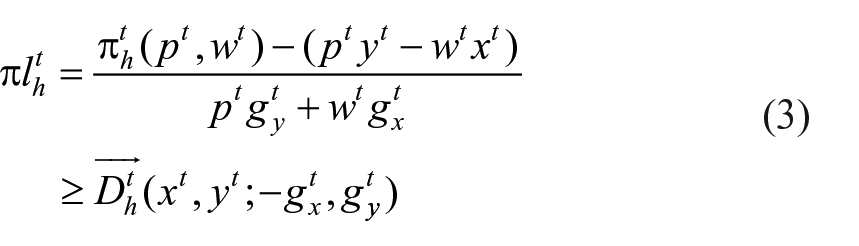
We note that profit inefficiency measure, πlth, or the difference in maximal profit and observed profit, is normalized by the sum of
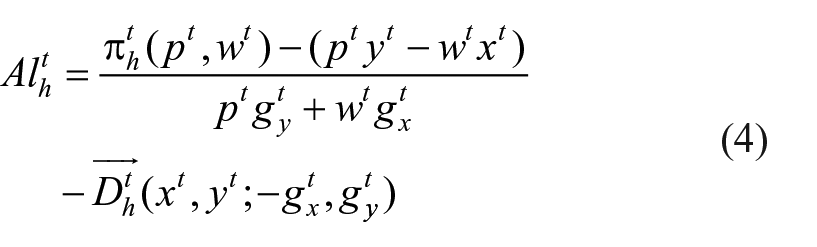
Rearranging equation (4), profit inefficiency can be decomposed into two sources as

From equation (5), it can be seen that profit inefficiency is a summation of technical inefficiency and allocative inefficiency. The former
The meta-technology at period t can be defined as the convex hull of group technologies. This study assumes that all members in each group operate under a common potential frontier, the meta-technology set, that is,
Under the meta-technology, we similarly define DDF along the direction
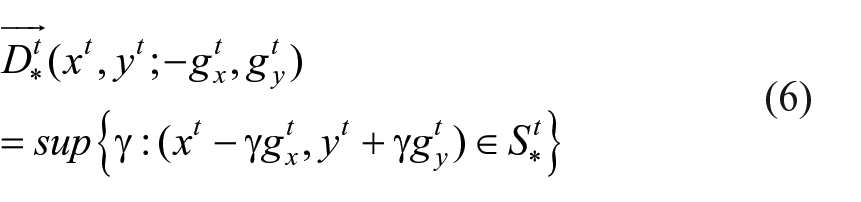
When a DMU operates under the production metafrontier, its profit function at period t is

The meta-Nerlovian profit inefficiency measure is defined as

Similarly, we can decompose meta-profit inefficiency

The difference between the meta-profit inefficiency

The profit inefficiency gap, πlGh, measures the incremental degree of potential profit inefficiency if a DMU operates under the metafrontier instead of its group-specific frontier. By comparing equation (8) to (3), we also can define πlGh as the difference in DMUs’ maximum profits between operating under the metafrontier and under the group frontier. The positive (negative) value of πlGh indicates that the maximum profit under the profit metafrontier is higher (lower) than that under the group-specific profit frontier. Therefore, the higher the value of πlGh a DMU has, the more profit it could gain if it operates using the metafrontier instead of the group frontier.
The profit inefficiency gap πlGh can be further decomposed into technical inefficiency gap

Here,
Group-specific technologies, meta-technologies, and profit LPI
The LPI introduced by Chambers et al. (1996) is used to evaluate a difference-based productivity change. This indicator is defined and calculated by the quantity distance function.
This study defines the profit-oriented LPI between periods t and t + 1 for the hth group as
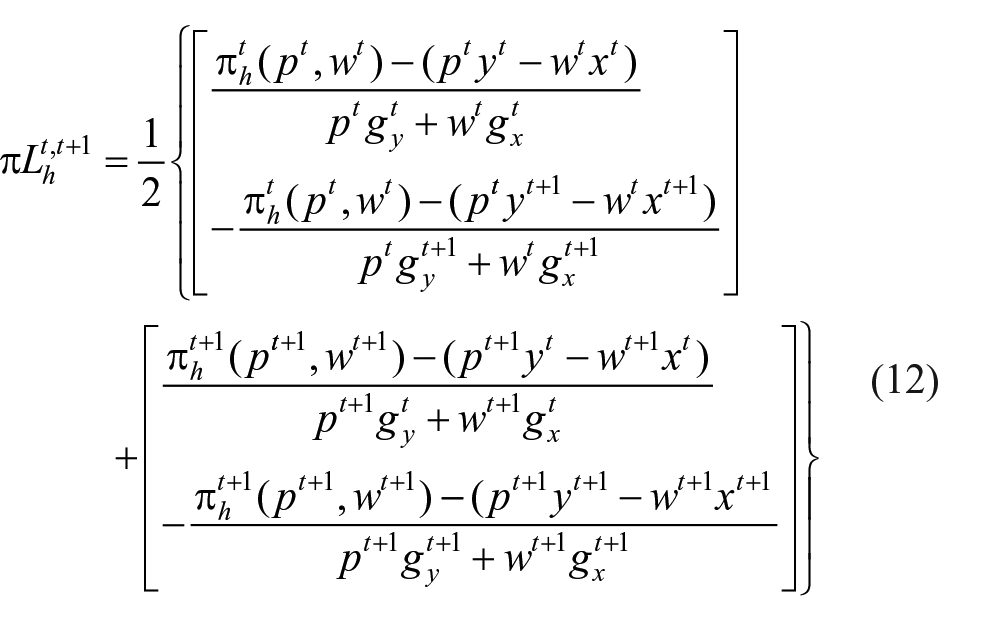
Here, we assume the directional vector to be time-variant
Under the metafrontier technology, the meta-profit LPI
For a DMU, we define the profit LPI gap of the hth group-specific frontier to the metafrontier as the difference ratio for the profit productivity change between the meta-technology

If
Suppose banking industry A has a negative catch-up index value for the last t few years. We thus expect the productivity of banks in banking industry A is getting closer (convergent) to the metafrontier over time. On the contrary, banking industry B exhibits divergence in consecutive years, implying that these banks’ productivity is moving away over time from the metafrontier. We may conclude that the productivity growth of banks in banking industry A will outperform those banks in banking industry B in the future, even though the current productivity level of the former is lower than the latter.
It should be noted that the group-specific and metafrontier profit LPI can be decomposed into components of technical efficiency change, allocative efficiency change, technical change, and price effect. In our empirical estimation. We also adopt the short-run variable profit function, instead of the long-run profit function. 2
Data and variables
The sample data consist of 50 Chinese city commercial banks and 31 Taiwanese banks over the period 2010–2014. We do not include those state-owned and joint-stock Chinese banks, because these banks are operating across provinces in China and have a much larger scale of operations than Taiwanese banks. Chinese city banks operate mainly within a province, whereas Taiwanese banks provide service in Taiwan. Since Taiwan’s geographical size is similar to the size of a province in China, a performance comparison using samples of Chinese city banks and Taiwanese banks can avoid the problem of great scale diversity and may provide meaningful managerial implications.
This study follows the intermediation approach for the specification of inputs and outputs. It assumes that the bank collects deposits to transform them with labor and capital into loans and other earning assets. Following Fu et al. (2016) and Berger and Humphrey (1997), this study considers two outputs: financial investments (y1) and total loans (y2). The investments are defined as other earning assets, including financial assets, securities, and equity investments. The corresponding unit price of the investments (p1) is the ratio of the investments’ revenue to the total investments. Total loans consist of all types of loans issued that generate a given amount of interest income. The corresponding unit price of loans (p2) is the ratio of the raised amounts of interest income to the total loans.
This study specifies two inputs and one quasi-fixed input. The input vector includes financial funds (x1) and labor (x2). The quasi-fixed input (f1) is physical capital, which is the net amount of fixed assets. Financial funds (x1) are defined as deposits and borrowed funds. This input always accounts for the highest percentage of total costs in a bank, but it also generates interest and other financial expenses. Thus, the corresponding unit price (w1) is calculated as the ratio of financial expenses to financial funds. Labor (x2) is defined as the number of employees, while the corresponding unit price (w2) is calculated as a ratio of personal expenses to the total number of employees. Table 1 defines all the variables.
Variable specification.
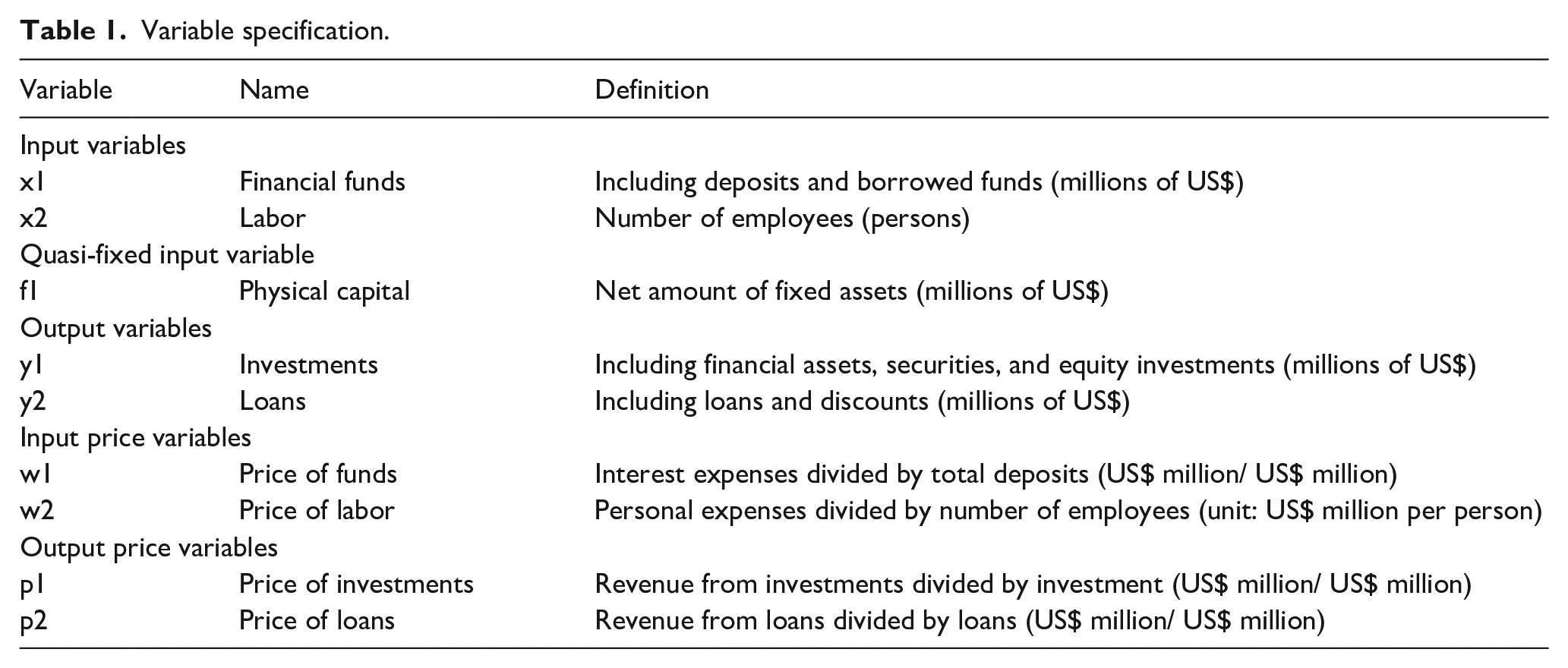
Table 2 presents summary statistics of the sample banks. The column for the annual growth rate in Table 2 clearly shows that both Taiwanese and Chinese city banks experience positive growth in outputs and inputs, whereas the growth in China outperforms that in Taiwan during the sample period. The output structure between the two groups presents a significant difference, as the value share of investment to loans is about 1:1 in China compared to that of 1:3 in Taiwan. It implies that there are different strategies on funding allocation between banks in Taiwan and China. Moreover, a five to six times higher output growth rate in China than in Taiwan also indicates faster growing financial demand in China, which may attract Taiwanese bankers to invest in China.
Summary statistics of inputs and outputs, 2010–2014.
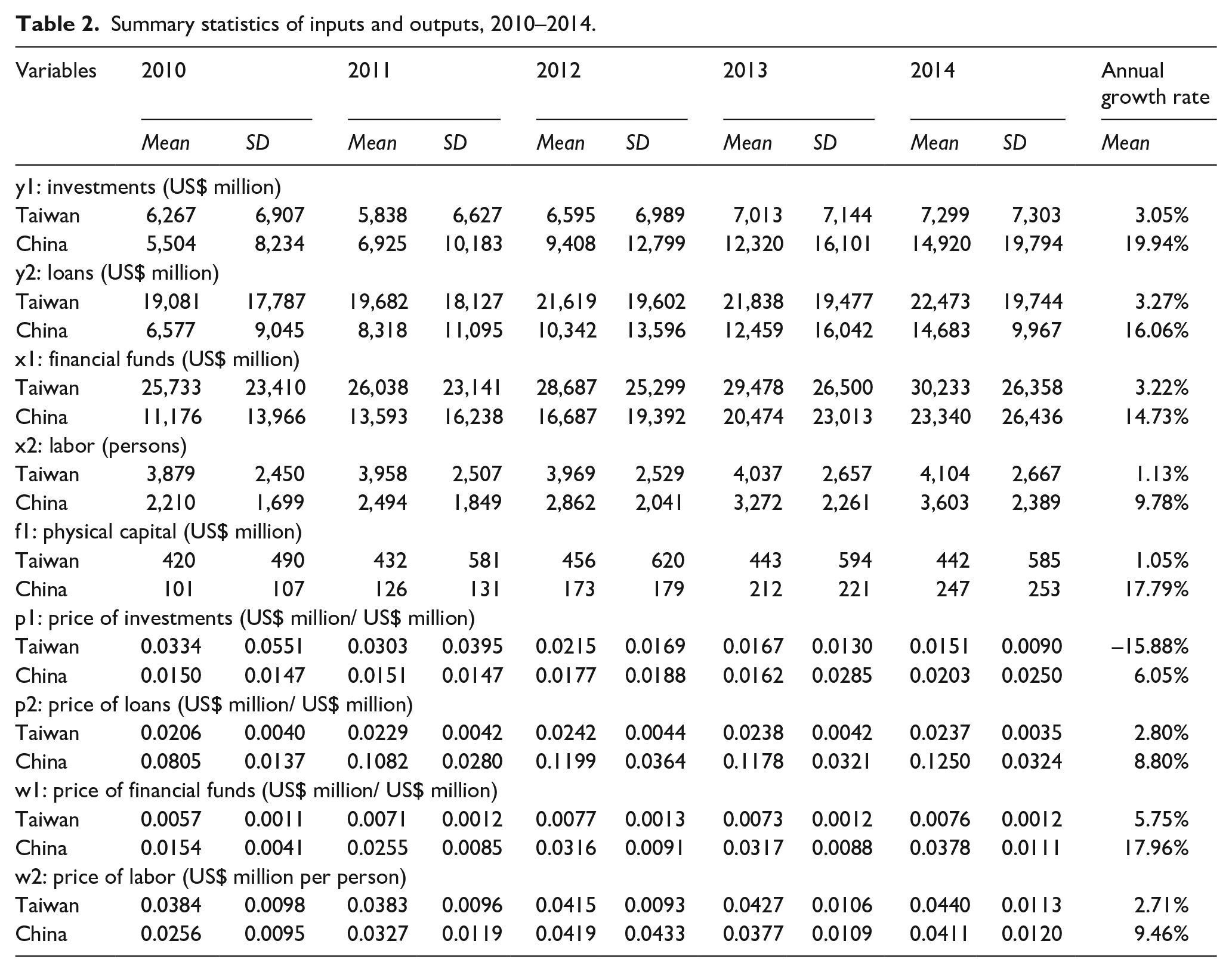
The price of investments (p1), representing the return on investment, shows that the price of investment in Taiwan was higher than that in China in 2010, but it decreased over time at a rate of –15.88%. While such a price in China showed a low positive level of growth in 2010–2013, it was catching up with Taiwanese banks in 2014. As for the price of loans (p2), representing the return to loans, Table 2 shows that this price has been more than four times higher in China versus that in Taiwan during the sample period, which implies a much higher return rate for making loans in China. Such a difference in prices of outputs could induce different portfolio decisions for banks in Taiwan and China.
For input prices, the price of financial funds (w1) in Taiwan is much cheaper than that in China, whereas the price of labor (w2) in Taiwan is relatively higher than that in China. The prices of both inputs are also found to be increasing over time, and a relative higher growth rate can be seen especially in China. The difference in relative prices in inputs between Taiwan and China provides strong incentives for banks in both places to operate on the opposite side of the Taiwan Strait under the recently signed financial cooperation agreement.
In sum, the high growth of outputs in China and the difference in output structure and prices between two economies induce mutual incentives for financial cooperation. Furthermore, the vast difference in the relative price ratio and growth rate of inputs for banks in Taiwan and China may result in different impacts of price changes on bank efficiency and productivity.
Empirical results
Analysis of meta-profit and group-specific profit inefficiencies
Results of meta-profit inefficiency and its decompositions
To consider the different production environments of banks in China and Taiwan, we employ the proposed profit metafrontier framework to compare bank performances across the Taiwan Strait. Table 3 presents the results of meta-profit inefficiency and its decompositions for Chinese and Taiwanese banking industries over the period 2010–2014. The meta-profit inefficiency (πl*) is defined as the profit difference between maximum profit and observed profit to a normalized vector,
Meta-profit inefficiency and its decomposition.
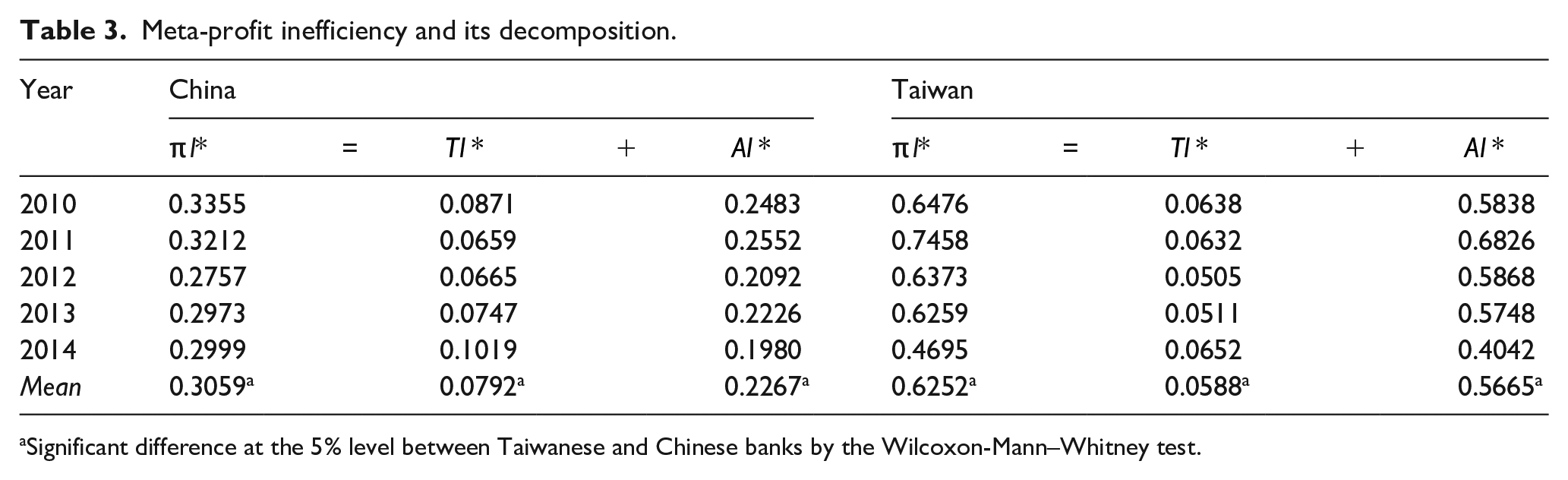
Significant difference at the 5% level between Taiwanese and Chinese banks by the Wilcoxon-Mann–Whitney test.
Profit inefficiency consists of two components: technical inefficiency
Results of group-specific profit inefficiency and its decompositions
For a comparison of profit inefficiency between group-specific and metafrontier frameworks, we conduct group-specific profit inefficiency analysis. Table 4 summarizes the results of group-specific profit inefficiency and its decomposition. We find that the mean group-specific profit inefficiency (πl) is 0.1973 for Taiwanese banks and 0.2986 for Chinese banks, denoting that Taiwanese banks are a bit closer to their own Taiwan group–specific profit frontier than Chinese banks to the China group–specific profit frontier.
Group-specific profit inefficiency and its decomposition.
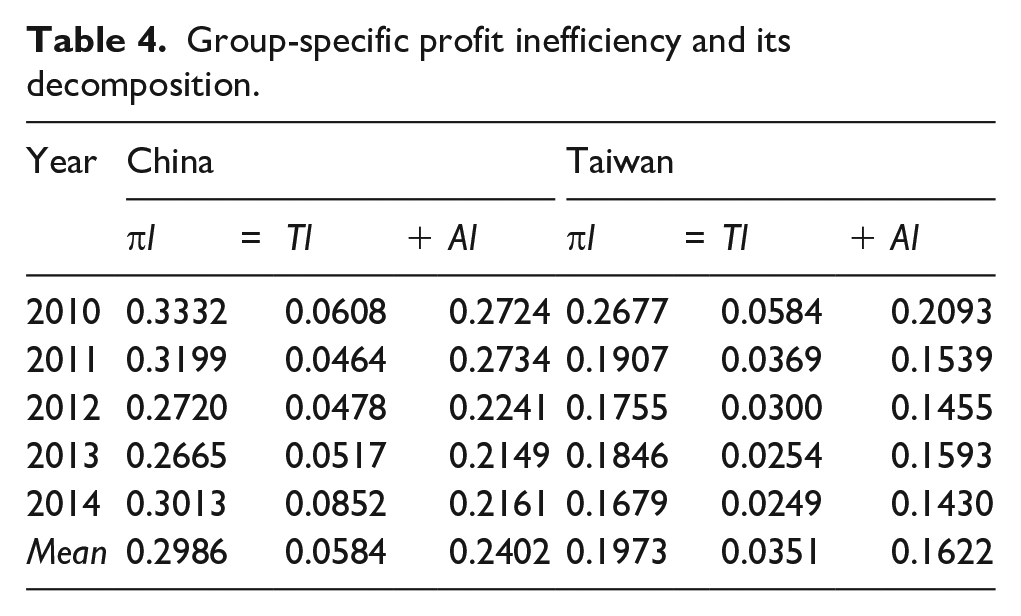
It should be also noted that the values of profit inefficiency for Taiwanese banks estimated from group frontier (0.1973 in Table 4) and metafrontier (0.6252 in Table 3) are found to be significantly different. Such discrepancy in profit inefficiency may reveal a fact that Taiwanese banks operate much better under current Taiwan specific technology than under a potential metafrontier technology, given current input and output prices. On the contrary, the difference in values of profit inefficiency for Chinese banks estimated from group frontier (0.3059 in Table 4) and metafrontier (0.2986 in Table 3) are found to be insignificant. The Chinese banks thus perform no difference in profit efficiency between under China group specific technology and under the metafrontier technology.
Allocative inefficiency (Al) shows similar pattern as that in profit inefficiency. The negligible values of technical inefficiency (Tl) between banks in Taiwan and banks in China also indicate that the group-specific profit inefficiency may be mainly attributed to their allocative inefficiency.
Results of the profit inefficiency gap and its decompositions
As indicated in equation (10) earlier, πlGh can be regarded as the difference in DMUs’ maximum profits between operating under the metafrontier and operating under the group frontier. A higher value in πlGh implies a better potential profit increment for a bank to adopt the metafrontier technology. On the contrary, a bank with a low value in
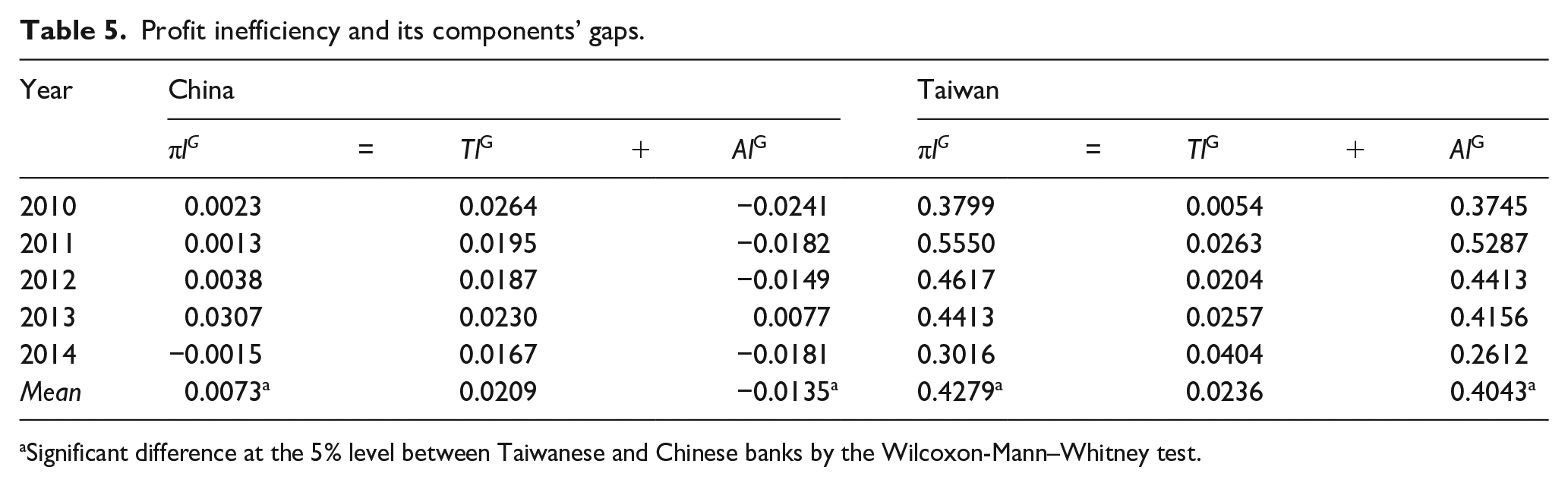
Table 5 shows that the mean profit inefficiency gap πlGh is 0.4279 in Taiwanese banks and 0.0073 in Chinese banks. A very low gap value for the Chinese banks means that the profit gain will be negligible for Chinese banks to operate under the metafrontier technology since their gaps between group and meta-profit frontiers are very small. On the contrary, Taiwanese banks have a relatively high value (0.4279) of πlGh, which implies that Taiwanese banks can potentially increase their profit up to 43% of their production size if they operate under the metafrontier rather than under the current Taiwanese group frontier. Therefore, Taiwanese banks can reap much profit gain if they can operate using the profit metafrontier, whereas such profit gain to Chinese banks may be very small.
Profit inefficiency and its components’ gaps.
Significant difference at the 5% level between Taiwanese and Chinese banks by the Wilcoxon-Mann–Whitney test.
Table 5 also shows that the allocative inefficiency gap (AlG) for Taiwanese banks (M = 0.4043) contributes mostly to profit inefficiency (M = 0.4279). Therefore, manager’s ability of finding a better input–output mix to maximize profit (given input and output prices) under metafrontier technology is crucial and the key to the profit maximization for Taiwanese banks. The Wilcoxon-Mann–Whitney test results on the profit inefficiency gap and the allocative inefficiency gap between Taiwanese banks and Chinese banks are significantly different at the 5% level.
Results of the metafrontier profit LPI and gap
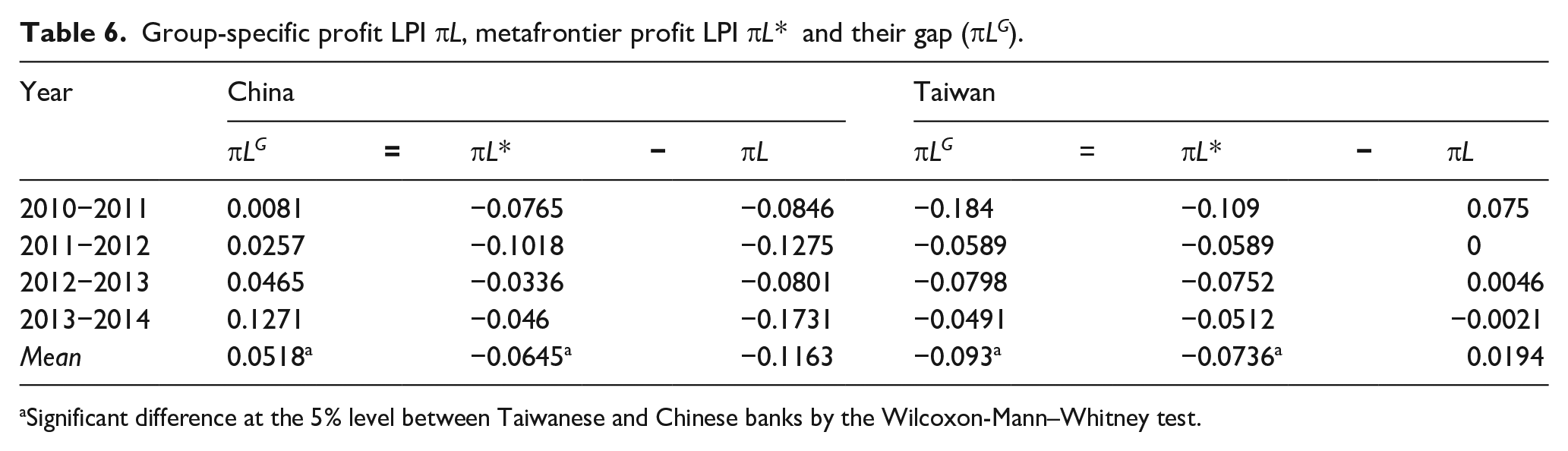
The metafrontier profit LPI (πL*)expresses the change in profit productivity over time for banks in Taiwan and China given a common profit frontier. As in previous sections, the metafrontier profit Luenberger productivity is defined as growth, decline, and constant if
Group-specific profit LPI πL, metafrontier profit LPI πL* and their gap (πLG).
Significant difference at the 5% level between Taiwanese and Chinese banks by the Wilcoxon-Mann–Whitney test.
As shown in equation (13), the profit Luenberger productivity gap is defined as
Table 6 summarizes the results of the profit LPI gap (πLG). The mean values of the profit productivity gaps (πLG) are 0.0518 for Chinese banks and −0.0930 for Taiwanese banks. The positive values of πLG for Chinese banks denote divergence in their productivity along the China profit frontier over time, while the Taiwanese banks with negative values of πLG show their productivity growth is catching up with the meta-profit frontier over time.
Overall, the results present an opposite pattern of productivity growth for Taiwanese and Chinese banks.
Conclusion
To accommodate the potential measuring problem of the ratio-based MPI which fails to model the distance function with both input contraction and output expansion, Chambers et al. (1996) develop the difference-based LPI with a directional distance function. Despite LPI having received much attention with various applications, previous research on LPI still fails to insure a proper and meaningful productivity assessment for DMUs with different production technologies. In this article, we thus adopt the metafrontier framework of Battese et al. (2004) and O’Donnell et al. (2008) and extend the profit-oriented LPI of Juo et al. (2015) from a group-specific frontier to a metafrontier version. The proposed model helps us to measure the profit productivity and efficiency performances across banks in Taiwan and China, which are operating under different production technologies. We also examine the degree of convergence between the profit group frontier and profit metafrontier by comparing those profit LPI results from the group specific and metafrontier technologies for Taiwanese and Chinese city banks.
The empirical evidence herein finds that relative to Taiwanese banks, Chinese banks are characterized as having higher profit efficiency and higher allocative efficiency under meta-technology. Allocative inefficiency plays a major contribution to profit inefficiency. Given a smaller profit inefficiency gap for Chinese banks than that for Taiwanese banks, we conclude that the Chinese banks have better technology in profit creation than Taiwanese banks during the sample period. However, Taiwanese banks may reap much profit gain if they can reach the profit metafrontier, whereas such profit gains for Chinese banks may be very small. Therefore, the Taiwan government should promote Taiwanese banks to take advantage of the financial cooperation between Taiwan and China.
The results of the profit metafrontier LPI analysis show that both Chinese and Taiwanese banks have experienced declines in profit productivity. However, results of different patterns in profit productivity dynamics also indicate a divergence in productivity growth for Chinese city banks and a convergent productivity growth for Taiwanese banks.
Footnotes
Declaration of conflicting interests
The author(s) declared no potential conflicts of interest with respect to the research, authorship, and/or publication of this article.
Funding
The author(s) received no financial support for the research, authorship, and/or publication of this article.