




Abstract
This article presents a novel conceptual framework that uses the notion of knowledge sourcing to explain how firms realize benefits from R&D subsidies in terms of innovations. The study considers two dimensions of the firm’s knowledge sourcing: its R&D effort and level of openness to technology markets. This article proposes that the policy-induced effects of R&D subsidies on the knowledge-sourcing process increase firms’ innovation outcomes, thus making this policy intervention effective in promoting innovation. By using panel data from Spanish manufacturing firms, this article presents evidence consistent with the hypothesis that by changing the knowledge sourcing of firms, National R&D subsidy programs in Spain also favor more firm innovation, measured by patent applications and new product launches. It is also documented that the granting of R&D subsidies does not affect firm innovation directly but rather through inducing changes in the firm’s R&D effort and openness to technology markets.
Keywords
Introduction
Governments allocate substantial resources for R&D subsidies to stimulate firm innovation and thus generate potential benefits in terms of economic growth and technological progress (Romer, 1990). Given the presence of market failures, the logic of granting R&D subsidies is to provide incentives for firms to invest in R&D activities, conceived by the policymakers and proved by previous research as conducive to firm innovation (Martin & Scott, 2000). In line with the direct objective of R&D subsidies, the literature emerging on input additionality indicates that this policy instrument leads firms to increase their R&D effort (Becker, 2015; Czarnitzki & Lopes-Bento, 2013; David et al., 2000; Dimos & Pugh, 2016; Zúñiga-Vicente et al., 2014). Besides the direct intended impacts, R&D subsidy programs also have additional, unintended effects on subsidized companies. For instance, the literature on behavioral additionality postulates that, by inducing learning processes, R&D subsidies also produce an indirect effect on companies, alongside the input additionality (Autio et al., 2008; Clarysse et al., 2009; Cunningham et al., 2016). Complementary effects on a firm’s partnership behavior, particularly on the propensity and breadth of R&D collaborations, have received the most attention in previous research (Afcha, 2011; Bianchi et al., 2019; Busom & Fernández-Ribas, 2008; Cano-Kollmann et al., 2016; Chapman et al., 2018; Grilli & Murtinu, 2018). The interest in these complementary effects rests on the fact that R&D subsidies also create additional incentives for firms to acquire external knowledge, which is widely recognized by research on innovation management as a critical element in shaping firm innovation (Cassiman & Veugelers, 2006; Chesbrough, 2006; Laursen & Salter, 2006).
Despite the insights generated by the literature on technology policy evaluation, the effectiveness of R&D subsidies in fostering firm innovation remains surprisingly under-researched. In many cases, the policy evaluation focuses on the firms’ R&D decisions, assuming that the intended policy-induced effects on intramural R&D investments, and those unintended on the firms’ R&D collaboration behavior, will generate improvements in their innovative outcomes (Bronzini & Piselli, 2016; Falk, 2007). As a result, an important part of the literature on technology policy concentrates on the assessment of intermediate effects, such as changes in the R&D effort or collaborative behavior of the subsidized firms, largely ignoring how these changes affect their innovation outcomes. Although some studies evaluate the firm innovation impact of R&D subsidies, or the presence of output additionality (Bronzini & Piselli, 2016; Hewitt-Dundas & Roper, 2010; Luukkonen, 2000), this line of research neglects the innovation consequences attributable to input and behavioral additionalities.
In this research, we aim to fulfill these limitations. To achieve this objective, we present a novel conceptual framework that incorporates the notion of knowledge sourcing in the evaluation of the impacts of R&D subsidies. The main objective of this study is to examine how the granting of R&D subsidies shapes firm innovation through policy-induced changes in the knowledge sourcing of firms. By exploiting the flexibility of the knowledge-sourcing notion to characterize knowledge acquisitions from internal and external R&D activities, the study evaluates the effectiveness of R&D subsidies in boosting firm innovation by considering induced changes in both a firm’s internal and external knowledge sourcing. In doing so, the input, output, and behavior additionalities are examined all together within the same framework.
From a conceptual point of view, our article advances the literature on technology policy evaluation and innovation management by explaining how firms realize the benefits of public R&D support in terms of their innovations. We draw on prior studies on technology policy and innovation management to articulate a framework that describes how the granting of R&D subsidies affects the knowledge sourcing of firms and, subsequently, their innovation outcomes. This article also advances the literature on knowledge sourcing by providing new insights into the contribution of firms’ knowledge-sourcing activities to exploit their available resources (i.e., R&D subsidies). This article shows that the knowledge-sourcing behavior of subsidized firms is a critical element for boosting financial resources coming from R&D public support. These insights show how these firms can articulate actions to transform their resources into new technologies and products.
From an empirical point of view, this article contributes to the literature on technology policy evaluation by presenting a more comprehensive assessment strategy in which both the effects of R&D subsidies on firm innovation, via induced changes in the internal and external knowledge sourcing of firms, are considered simultaneously. While studies on input and behavioral additionalities place the attention on changes in the R&D behavior of firms (Afcha, 2011; Busom, 2000; Busom & Fernández-Ribas, 2008; Czarnitzki & Lopes-Bento, 2013; Gelabert et al., 2009), our analysis goes forward by examining how these policy-induced changes further impact firm innovation. Compared to the research on output additionality (Bronzini & Piselli, 2016; Hewitt-Dundas & Roper, 2010), our study evaluates alternative mechanisms (i.e., internal and external knowledge sourcing) through which firms may obtain the benefits of R&D subsidies in terms of innovation. With this, we solve the limitation of output additionality studies that consider the relationship between R&D support and firm innovation as a black-box.
Our study positions within the growing literature that simultaneously assesses the effect of R&D subsidies in terms of input/behavioral additionality as well as in terms of output additionality (Cerulli et al., 2016; Czarnitzki & Hussinger, 2018; Czarnitzki & Licht, 2006; Kang & Park, 2012). In comparison to these studies, our research makes the following contributions. For instance, in relation to Czarnitzki and Licht (2006) and Czarnitzki and Hussinger (2018), our research considers the effectiveness of R&D subsidies in promoting firm innovation by considering not only the policy-induced effects on internal (R&D effort) but also those on external knowledge sourcing (openness in technology markets). Compared to other studies that examine the innovation consequences of behavioral additionality in terms of propensity and breadth or R&D collaboration (Cerulli et al., 2016; Kang & Park, 2012), our article evaluates the impact of R&D subsidies on external knowledge sourcing occurring in technology markets. Our approach offers a broader perspective that considers both R&D collaboration and market-based agreements in the policy evaluation of R&D subsidies. In doing so, we uncover knowledge sourcing in technology markets as a new channel through which R&D subsidies can shape firm innovation.
By using data from Spanish manufacturing companies, our study shows the effectiveness of R&D subsidies in inducing firm innovation by improving the knowledge sourcing of firms. First, we show that being granted R&D subsidies from Spanish National programs increases the R&D effort of manufacturing firms and their openness to knowledge sourcing in technology markets by 14.3% and 10.7%, respectively. Most importantly, the induced effects of R&D subsidies also have positive and significant impacts on the production of innovations, characterized in terms of patent applications and new product launches. In addition, the study shows that the effect of R&D subsidies does not affect firm innovation outcomes directly but through changing the knowledge sourcing of firms. This result demonstrates the role of knowledge-sourcing activities in linking R&D subsidies to firm innovation. To the best of our knowledge, our research is the first in showing the effectiveness of R&D subsidies in increasing firm innovation through inducing knowledge sourcing in terms of R&D effort and openness to knowledge sourcing in technology markets.
This article proceeds as follows. Section “Conceptual background” outlines the conceptual background that considers the notion of knowledge sourcing in the evaluation of R&D subsidies. This section also presents the hypotheses of the study. Section “Empirical approach” discusses the Spanish context, data, and methods. Section “Results” reports the results, and section “Discussion and conclusions” summarizes our contributions and states the implications and limitations of the study.
Conceptual background
Knowledge sourcing in the evaluation of R&D subsidies
To generate new technologies or new product developments, firms need to obtain knowledge for solving relevant innovation problems. Knowledge sourcing is defined here as the process that allows firms to produce that knowledge (Katila & Chen, 2008). In our context, knowledge sourcing occurs in two ways. The first consists in performing intramural R&D activities, which are primarily recognized as prominent mechanisms producing knowledge that solves problems during the innovation process (Nerkar, 2003; Pisano, 2000).
The second way consists in obtaining knowledge from external sources through the markets for technology (Arora et al., 2016; Belderbos et al., 2004; Chesbrough, 2006; Laursen & Salter, 2006; Love et al., 2014). In line with Arora et al., (2004), we define these markets as the range of knowledge exchanges occurring through several means, such as R&D alliances, technology in-licensing, R&D outsourcing, and the hiring of R&D personnel. 1 Technology markets have been acquiring relevance because knowledge production for firm innovation is progressively becoming a more modularized process (Baldwin & von Hippel, 2011) which favors a growing division of labor throughout the innovation process (Arora et al., 2016). Therefore, knowledge needed for firm innovation is increasingly generated by diverse sources, such as other companies, R&D providers, universities, and public research centers (Baldwin & von Hippel, 2011). The importance of technology markets manifests itself in the estimations reported by Arora et al. (2016), according to which denying access to technology markets could produce a reduction of as much as 33% to 45% in the share of innovating firms in the U.S. manufacturing sector. Similar results have been documented for the case of Europe (Belderbos et al., 2004; Love et al., 2014; Tether, 2002).
Given the previous views, we describe the knowledge sourcing of a firm as the effort it puts in obtaining valuable solutions to generate innovations. Two dimensions measure this effort: a firm’s R&D investments and its level of openness to knowledge sourcing in the markets for technology. These two dimensions are viewed here as observable characteristics that reveal how firms source knowledge for developing their technologies and new products.
The use of the knowledge-sourcing notion is justified in our context for the following reasons. First, an important part of the literature on technology policy evaluation places the attention on determining the role of R&D subsidies in increasing the firm’s R&D effort, or input additionality (Becker, 2015; Zúñiga-Vicente et al., 2014). Also, more recent studies focus the attention on a complementary and more unintended effect on the R&D collaboration behavior of firms, or behavioral additionality (Afcha, 2011; Busom & Fernández-Ribas, 2008; Chapman et al., 2018; Grilli & Murtinu, 2018). The interest in assessing these effects is justified because of the presence of market and system failures that discourage firms from choosing socially desirable levels of knowledge sourcing (Czarnitzki & Lopes-Bento, 2013; Falk, 2007). By adopting the notion of knowledge sourcing, we represent within the same framework the impacts of policy interventions on both knowledge sourcing occurring internally, through the R&D process, and externally, through technology markets. Second, given the recognized role of knowledge sourcing in promoting firm innovation (Helfat, 1994; Katila & Ahuja, 2002; Laursen & Salter, 2006; Love et al., 2014; Pisano, 2000), the use of this notion is also critical in representing mechanisms which link the granting of R&D subsidies to firm innovation. Knowledge sourcing is viewed here as a channel explaining how firms turn the benefits of being granted R&D subsidies into innovation outcomes. In doing so, our study uses a unified framework to examine the intermediate effect of R&D subsidies on firms’ knowledge sourcing and the effectiveness of policy-induced impacts in promoting firm innovation. Our framework implies that the effectiveness of R&D subsidies on fostering firm innovation is realized through improvements in the knowledge sourcing of firms.
The effectiveness of technology policy in favoring firm innovation, however, remains mostly under-researched, with little assessment of the innovation consequences of policy-induced changes derived from the public intervention (Cerulli et al., 2016; Czarnitzki & Hussinger, 2018; Czarnitzki & Licht, 2006; Kang & Park, 2012). Despite the insights provided by these studies, the policy effectiveness evaluation reported remains highly fragmented. Some of these studies assess the effectiveness of R&D subsidies on firm innovation due to changes in the R&D effort of supported firms but ignoring the policy-induced effects on external knowledge sourcing that also may impact firm innovation (Czarnitzki & Hussinger, 2018; Czarnitzki & Licht, 2006). Some other studies incorporate the innovation consequences of the policy-induced effects on the breadth of R&D collaboration, but disregarding other forms of external knowledge sourcing occurring in technology markets, such as technology in-licensing and R&D outsourcing deals (Cerulli et al., 2016; Kang & Park, 2012). The main contribution of our study consists of solving these limitations.
At this point, it is worth clarifying why participation in R&D subsidy programs is not, by itself, considered as part of the knowledge-sourcing process in our conceptual framework. Here, we conceive R&D subsidies fundamentally as a financial instrument that provides companies with funds to undertake activities intended to solve relevant innovation problems. While firms’ participation in these programs is a process through which firms seek financial resources for funding their innovation activities, we considered firms’ involvement in, for example, internal R&D activities and technology market transactions (i.e., technology in-licensing, R&D outsourcing, and R&D collaboration) as strategies allowing companies to search knowledge for boosting their innovation effort. We posit that the public funds used by a firm to undertake internal or external R&D activities are part of the knowledge-sourcing process induced by public intervention. We therefore assume that the primary motivation leading companies to apply for R&D subsidies is to obtain financial resources for their innovation activities rather than to seek technological knowledge. 2
Policy effectiveness through improving internal knowledge sourcing
We posit that the effectiveness of R&D subsidies in fostering firm innovation critically depends on the induced effects of this policy on the internal knowledge sourcing of firms. The first step to prove the policy effectiveness is to determine how the internal knowledge sourcing is affected by the granting of R&D subsidies.
The impact of R&D subsidies on internal knowledge sourcing
In the literature on technology-policy evaluation, the question that has received the most attention is whether direct support in the form of R&D subsidies leads firms to increase their R&D effort, or, in contrast, whether there is a crowding-out effect (Becker, 2015; David et al., 2000; Zúñiga-Vicente et al., 2014). Although a vast majority of the studies present evidence consistent with the presence of input additionality, some other studies show evidence indicating the presence of crowding-out effects (Busom, 2000; Lichtenberg, 1988; Marino et al., 2016; Wallsten, 2000). However, the presence of crowding-out seems to be contingent on some contexts. For instance, Wallsten (2000) finds that full crowding-out effects appear for the case of small- and medium-sized companies, Lichtenberg (1988) for non-competitive R&D contracts, and Marino et al., (2016) for the case of medium-high levels of public subsidies, and under an R&D tax-credit regime.
In this study, we draw on the existing literature on technology-policy evaluation to identify a range of factors that explain how R&D subsidies can lead supported companies to increase their R&D effort. In particular, the presence of a cost-alleviating effect and a learning effect are viewed as the primary mechanisms generating a positive impact of R&D subsidies on a firm’s R&D effort, a dimension used in the study to represent internal knowledge sourcing.
Cost-alleviating effect
The vast uncertainty, information asymmetries, and low collateral value of R&D means external finance can be costly and difficult to obtain and this can generate financial constraints which affect firms’ incentives to invest in intramural R&D activities (Hall, 2002). The granting of R&D subsidies mitigates the financial constraints which can lead to under-investment in two ways. First, funds from R&D subsidies have a direct effect that reduces the costs of financing R&D activities. David et al. (2000) explain this effect by using a framework 3 in which profit-maximizing companies decide whether to invest in R&D according to the expected returns of alternative R&D projects. The cost reduction effect of R&D subsidies enhances the expected returns of additional R&D activities because of involved decreases in the marginal costs of capital, thus leading subsidized companies to reinforce their internal knowledge sourcing. Several studies highlight this cost-alleviating effect. For instance, Wallsten (2000) remarks that R&D subsidies reduce market frictions that increase a firm’s cost of financing R&D projects. Also, Hottenrott et al. (2017) indicate that R&D subsidies generate a cash effect that decreases the amount of financing to be raised to undertake additional R&D projects.
Second, the granting of R&D subsidies further mitigates the presence of financial constraints by generating a certification effect. When being funded with R&D support, a quality signal is generated, thus enabling subsidized firms to raise additional funds from private investors. This mechanism is based on signaling theory, which highlights the crucial role of quality signals in reducing information asymmetries between parties (Connelly et al., 2011; Kleer, 2010); in our case between subsidized firms and private investors. The extant research on technology policy evaluation shows that the granting of R&D subsidies conveys information about the (valuable) capabilities, knowledge, and skills of subsidized firms (Cerulli et al., 2016; Kleer, 2010; Meuleman & De Maeseneire, 2012). In doing so, R&D subsidies help private investors to reduce uncertainties about the technical quality of subsidized companies. The informative role of R&D subsidies as a quality signal mitigates market frictions impeding the financing of intramural R&D activities, thus increasing resources available for additional internal knowledge sourcing (Hottenrott & Demeulemeester, 2017; Lerner, 2000; Takalo & Tanayama, 2010). For instance, Hottenrott and Demeulemeester (2017) provide evidence that subsidized firms face a lower cost of debt attributable to the presence of a certification effect. Takalo and Tanayama (2010) propose a theoretical model that analyzes how R&D subsidies work in improving the financing of R&D projects. These authors conclude that being subsidized improves the funding of innovation projects through two channels. First, the support in itself reduces the capital costs of innovation projects and, second, it sends informative signals to market-based financiers that ease the access of subsidized companies to additional private funds.
Learning effect
Other studies on technology policy adopt an organizational learning perspective to explain the effect of R&D subsidies on a firm’s R&D effort (Autio et al., 2008; Clarysse et al., 2009). Learning-by-doing from public-funded projects is the primary mechanism referred to in this literature. According to this perspective, the execution of public-funded projects facilitates a learning-by-doing process by which firms accumulate experience in performing R&D activities. From experience accumulation, firms also develop skills in the management and organization of R&D projects. These skills produce productivity gains in the execution of additional R&D activities. In line with this premise, Roper et al. (2004) suggest that skills created by firms’ participation in public-funded projects help them develop R&D management capabilities that favor the future undertaking of privately funded R&D activities. For instance, firms building these capabilities can determine more easily the target of future R&D projects and evaluate more easily their potential value, compared to those lacking such capabilities (Clarysse et al., 2009).
Now, we posit that the positive impact of R&D subsidies on a firm’s R&D effort also contributes to improving the innovative performance of subsidized companies.
Innovation effects of policy-induced levels of R&D effort
We hypothesize that the induced effect of R&D subsidies on the R&D effort of subsidized companies also favors increases in their innovation performance, thus implying the effectiveness of this policy in promoting firm innovation. The following reasons explain the policy effectiveness of R&D subsidies. By inducing increases in the R&D effort of firms, the R&D subsidy policy favors an expansion of the knowledge-sourcing process, thus facilitating the production of solutions to relevant innovation problems. This expansion can occur in two ways. First, firms may expand the scale of their current R&D projects by sourcing knowledge in technological areas closely related to these projects (Falk, 2007). In doing so, firms generate benefits from the innovation derived from the experience accumulation in sourcing knowledge that is within the same field and related to their current technological bases. Experience accumulation helps firms build routines that make the knowledge-sourcing process more predictable, consistent, and efficient in the generation of solutions to innovation problems (Katila & Ahuja, 2002; Levitt & March, 1988). Second, firms can expand the scope of their R&D projects by sourcing knowledge in technological areas that are unrelated to their existing technological background (Falk, 2007). This possibility allows firms to benefit from their exposure to new knowledge. With this exposure, firms can increase the diversity of the knowledge bases used for solving their innovation problems, facilitating more cross-fertilization effects in the production of relevant solutions (Lucena & Roper, 2016).
The previous ideas are coherent with the organizational learning principle that a broad knowledge sourcing (i.e., induced by R&D policy) also spans the frontiers delimiting the knowledge pool from which firms draw relevant solutions for their innovation (Katila & Chen, 2008; Levitt & March, 1988; Rosenkopf & Nerkar, 2001). An enhanced knowledge landscape further enhances firms’ possibilities of combining and recombining knowledge sources in novel ways or reconfiguring the way knowledge elements are linked; this creates situations shown by prior research in innovation as conducive to firm innovation (Fleming & Sorenson, 2001; Phelps, 2010).
Existing research supports our argument that the policy-induced effects of R&D subsidies stimulate firm innovation. For instance, Beck et al. (2016) show for a sample of Swiss companies that policy-induced R&D effort has a positive impact on firms’ radical innovations. Likewise, Czarnitzki and Licht (2006) and Czarnitzki and Hussinger (2018) for Germany find that the induced effect of R&D subsidies on firms’ R&D effort further increases their patenting activity and patent citations, respectively. Beck et al. (2016) for Switzerland, and Hottenrott and Lopes-Bento (2014) for Belgium, report that the effect of R&D subsidies on a firm’s R&D effort has a positive impact on innovative performance, measured in sales as a result of new products.
Given the link existing between intramural R&D and firm innovation documented above, and taking into account the presence of the induced effect of R&D subsidies on a firm’s R&D effort, we hypothesize the following:
Policy effectiveness through improving external knowledge sourcing
The effectiveness of R&D subsidies to boost firm innovation also depends on the policy-induced effects on the external sourcing chosen by a firm. We show how the granting of R&D subsidies shapes the level of openness to knowledge sourcing in technology markets.
The impact of R&D subsidies on the openness for knowledge sourcing
The cost-alleviating and learning effects identified in the case of internal knowledge sourcing are also used in this section to describe how the granting of R&D subsidies shapes the level of openness chosen by a firm in technology markets.
Cost-alleviating effect
The granting of R&D subsidies produces a cost-alleviating effect that allows firms to raise financial resources for funding the openness to knowledge sourcing in technology markets. As in the case of internal knowledge sourcing, there are two ways in which the effect shapes the openness chosen by firms in technology markets. First, there is a direct effect that reduces the financial costs of knowledge acquisitions in these markets. These acquisitions impose high economic costs because they require companies to develop R&D alliance management, recruiting and technology surveillance skills, all elements that directly affect firms’ cost structure (Cassiman & Valentini, 2016; Faems et al., 2010). As indicated by Bianchi et al. (2019), R&D subsidies may alleviate financial constraints not only in the execution of R&D activities but also in the tasks required to develop and manage external knowledge sourcing. Second, the granting of R&D subsidies also generates a certification effect that facilitates access to additional funds from private investors, thus reducing firms’ financial constraints (Hottenrott & Demeulemeester, 2017; Kleer, 2010). For instance, the greater access of private financial resources could be used for funding the costs of acquiring necessary R&D services and technologies (i.e., R&D outsourcing and in-licensing arrangements), recruiting R&D employees, and developing a suitable internal structure for managing R&D partnerships effectively (Chapman et al., 2018). Subsidized companies may also finance the costs of searching and selecting external knowledge for their innovations across diverse sources. Empirical evidence shows the importance of financial resources in increasing external knowledge sourcing of firms. For instance, Grilli and Murtinu (2018) find evidence that R&D subsidy programs help companies to form R&D alliances, particularly in the case of new technology-based firms which suffer more from financial constraints. Park et al. (2002) demonstrate empirically the importance of having access to financial resources for firms to form alliances.
Learning effect
Some studies on technology policy evaluation identify the impact of R&D subsidies on a firm’s absorptive capacity (ACAP) as a learning mechanism promoting openness to the knowledge-sourcing process (Clarysse et al., 2009; Roper et al., 2004). As firms gain new experiences through developing their public-funded projects, they also increase their stocks of knowledge. The formation of these stocks enables subsidized companies to establish abilities in identifying, assimilating, and applying external knowledge associated with the technological fields closely related to these stocks. This argument is in line with the view of ACAP developed by Cohen and Levinthal (1990), according to which the degree of external knowledge utilization critically depends on the level of prior related knowledge a firm has accumulated.
In addition, as R&D subsidies commonly fund far-from-the-market and more technologically challenging projects (Clausen, 2009; Santamaria et al., 2010), knowledge produced by R&D subsidy-funded ventures is likely to be novel to firms’ existing knowledge stocks, thus increasing their diversity (Falk, 2007; Hsu et al., 2009). This increase in variety of knowledge stocks improves a firm’s ACAP (Cohen & Levinthal, 1990; Lucena & Roper, 2016). This improvement also helps firms to increase the breadth of sourcing knowledge from technology markets, as an improved ACAP extends the knowledge landscape within which firms can recognize and assimilate knowledge (Lane & Lubatkin, 1998). Firms can search and screen knowledge and technologies across multiple fields and sources (Chapman et al., 2018). For instance, as high levels of ACAP induce firms to explore external knowledge sources, they will be more able to participate in R&D alliances with dissimilar technological partners, leading them to widen the scope of their R&D activities (Lavie & Rosenkopf, 2006). Also, high levels of ACAP play a critical role in enabling the use of external knowledge coming from alternative strategies for R&D collaboration. As shown by prior research, a firm’s ACAP also favors knowledge sourcing occurring through R&D outsourcing (Cassiman & Veugelers, 2006; Mowery, 1983), technology in-licensing (Laursen et al., 2010), and the hiring of knowledge workers (Hess & Rothaermel, 2011). Because of the effects of R&D subsidies on the formation of ACAP, we expect to see that subsidized companies source external knowledge using different mechanisms, including R&D collaboration and market-based arrangements.
Innovation effects of policy-induced levels of openness to technology markets
We hypothesize that the effect of R&D subsidies on the level of openness to technology markets positively affects the innovation performance of the subsidized companies, based on the following reasons. A higher level of openness to technology markets means that funded companies are exposed to new knowledge sources, which brings new possibilities of knowledge recombination. In addition, openness to knowledge sourcing produces new learning opportunities that allow the formation of innovation skills, which favor an increase in firm innovation (van Beers & Zand, 2014). Where firms form alliances with technologically similar partners or acquire in-market external knowledge sources that are close to their expertise, they can develop valuable knowledge associations. Technological relatedness gives partners a profound understanding of the exchanged or acquired technologies, leading them to a better identification of new knowledge combinations with potential value for producing improved technologies and products (Katila & Ahuja, 2002; Rosenkopf & Nerkar, 2001). Where firms participate in alliances with unrelated technological partners or acquire in-market knowledge unrelated to their technical background, this gives rise to even greater possibilities for knowledge recombination with a high level of innovation (Laursen et al., 2010; Phelps, 2010; Rosenkopf & Almeida, 2003). In both cases, the induced effect of R&D subsidies on the level of openness to technology markets implies an expansion of the pool of knowledge from which subsidized companies may generate solutions for producing new technologies and product developments.
Previous studies on organizational learning show the positive effect of external knowledge sourcing on innovation. For instance, Rosenkopf and Nerkar (2001) provide evidence that firms with external knowledge sourcing have higher innovation rates in terms of patents. Similarly, Rothaermel and Alexandre (2009) show that external technology sourcing strategies positively contribute to enhancing a firm’s propensity to patent and obtain revenues from new product launches. In addition, the literature on innovation and technology shows that R&D collaboration, technology in-licensing, R&D outsourcing, and the hiring of qualified employees are all effective mechanisms of knowledge sourcing that shape firm innovation (Cassiman & Veugelers, 2006; Hess & Rothaermel, 2011; Laursen et al., 2010; Love et al., 2014).
Very few studies have shown the positive effects that public R&D support has on firm innovation by increasing the propensity of R&D alliance formation (Kang & Park, 2012) and the diversity of the formed alliances (Cerulli et al., 2016). We extend this logic by examining external knowledge sourcing occurring not only through R&D partnerships but also through market-based agreements, such as R&D outsourcing and technology in-licensing.
In summary, given the documented effects of openness for knowledge sourcing on firm innovation, and given the potential-induced impact of R&D subsidies on the level of openness chosen by a firm, we hypothesize the following:
Empirical approach
Spanish context
Since 1998, the R&D and innovation policy in Spain has been established by the National R&D Plans. Through these plans, the objectives, priorities, and needs of the Spanish innovation ecosystem are defined. Although over different plans gradual changes have occurred to adapt public research, development, and innovation (R&D&I) policy to the needs of the Spanish innovation ecosystem, they share four common areas: knowledge generation and capability buildings, promoting R&D collaboration, technological development and innovation, and strategic activities. While fostering R&D collaboration is a relevant objective, most R&D subsidy programs do not require previous cooperation as a precondition for funding (Chapman et al., 2018). In addition, these programs allow companies to employ any funds received to finance current R&D costs, including the acquisition of R&D services and technologies in the technology markets. As firms’ participation in technology markets is neither a requirement for receiving funds and given that R&D subsidies are mainly addressed to fund internal R&D activities, we consider the potential effects of this scheme on firms’ external knowledge sourcing as an unintended impact.
The programs under consideration focus on the performance of R&D&I projects. The program of Industrial Technology Development represents one of these programs, which is one of the most relevant funding instruments in the country, awarding more than 400 million euros annually (FECYT, 2013). They sponsor specific projects, assigning grants to R&D business projects presented through public tender after they have been evaluated by agencies, such as the Center for the Development of Industrial Technology (CDTI) which is the main body responsible for allocating public funding in Spain. Spanish firms may also receive support from regional and European programs. However, our attention is on the National program, as in the regional and European interventions, collaboration is commonly a precondition to be funded. Since this can cause endogeneity problems, in line with Busom and Fernández-Ribas (2008), we exclude these options from the analysis.
Data
The analysis in this study uses data from the Survey of Business Strategies (ESEE is its Spanish acronym). The ESEE carries out a panel survey of firms every year, supported by the Fundación Empresa Pública in collaboration with the Spanish Ministry of Industry. Since 1990, the survey has gathered detailed information on several dimensions of firms’ business strategies and includes an average sample of 1,800 manufacturing companies. The ESEE is an unbalanced panel because some companies stop providing information for reasons such as mergers, closures or liquidation. The survey adds new companies each year to preserve representativeness. The ESEE includes information on firms operating in all Spanish manufacturing industries, classified according to the two digit-level NACE industry classification (Statistical classification of economic activities in the European Community). The ESEE includes all firms with more than 200 employees. For firms with between 10 and 200 employees, a stratified random sample is collected by industry and firm size intervals. These data provide us with a representative sample of companies, describing relevant information on their knowledge-sourcing activities, innovation outcomes, and subsidy receipts, along with other firm and industry characteristics. Our data cover the period 1998–2013, with pre-sample information for firms’ innovation outputs for the period 1995–1997. Given the lack of relevant data on firms’ knowledge sourcing before 1998, we consider the period 1995–1997 as the pre-sample period.
Our analysis has two stages. First, we estimate the average and individual treatment effect of R&D subsidies on firms’ knowledge sourcing to determine the induced impact of this policy. After eliminating missing values and imposing one lag structure between outcomes and explanatory variables, the resulting sample for this stage contains 22,465 firm-year observations and 3,281 companies. Second, we assess the impact of the treatment effects previously calculated on firm innovation to test our hypotheses on the effectiveness of R&D subsidies in shaping innovation through firms’ knowledge-sourcing activities. Because our estimation strategy uses data from the pre-sample period 1995–1997 and, considering the presence of missing values and one lag explanatory variables, the available sample reduces to 10,142 firm-observations and 1,178 companies.
Methods
We assess the impact of R&D subsidies on firms’ knowledge sourcing and their innovative performance by accounting for several sources of endogeneity. Our evaluation has two stages. In the first stage, we assess the impact of R&D subsidies on how firms source knowledge. In line with the literature on technology policy, we control for the selection bias inherent in R&D support programs using matching estimators (Czarnitzki & Lopes-Bento, 2013). In this stage, our goal is to determine whether companies being granted R&D subsidies change their knowledge-sourcing behavior by increasing their R&D effort and levels of openness to technology markets, taking into account observable factors which explain selection into program participation. In the second stage, we use regression analysis to determine whether the induced impact of R&D subsidies on firms’ knowledge sourcing also affects their innovation performance. Given the nature of our dependent variables (see variable description below), we implement count-data models. In our estimations, we include pre-sample information on the dependent variables to control for the presence of unobserved heterogeneity (Czarnitzki & Hussinger, 2018). This strategy accounts for biases due to omitted variables and selection. In both stages, we exploit the panel design of our data by imposing a lag structure that mitigates the risk of reverse causality problems. Finally, supplementary material in Appendix A and B presents alternative strategies to treat the presence of endogeneity. Supplementary material Appendix A presents an estimation with instrumental variables and firm-fixed effects that control for the presence of unobserved heterogeneity and selection bias. Supplementary material Appendix B shows a Generalized Methods of Moments (GMM) for count-data panel models that also control for persistency in innovation and the presence of firm-fixed effects.
Impact of R&D subsidies on knowledge sourcing
In line with previous research studies, we use non-parametric matching methods to estimate the treatment effect on the knowledge sourcing of firms (Busom & Fernández-Ribas, 2008; Chapman et al., 2018; Czarnitzki & Lopes-Bento, 2013; Hottenrott & Lopes-Bento, 2014). In this study, we implement non-parametric nearest neighbor propensity score matching (PSM) to account for selection bias.
4
PSM matches subsidized firms with their closest control twin-firm according to a propensity score calculated as a firms’ probability of being granted R&D subsidies. We evaluate the impact of R&D subsidies using the average treatment effect on the treated
Thus, the ATT for the outcome j is defined as follows:
Innovation impact of the effect of R&D subsidies on knowledge sourcing
In the second stage, we examine the effectiveness of R&D subsidies in fostering firm innovation via changes in the knowledge sourcing of firms. More precisely, our goal is to verify if the individual treatment effect on the knowledge sourcing j also induces increments in firm innovation. If this is the case, then the knowledge sourcing j will be considered as a valid mechanism proving how R&D subsidies affect firm innovation. To examine this, we adopt the method developed by Czarnitzki and Licht (2006) and subsequently applied in other studies on R&D policy evaluation (Beck et al., 2016; Czarnitzki & Hussinger, 2018; Czarnitzki & Lopes-Bento, 2013; Hottenrott & Lopes-Bento, 2014). First, we estimate the individual-level treatment effect of R&D subsidies on knowledge sourcing—R&D effort and openness to knowledge sourcing—for each treated company as follows:

where
To assess the impact of the individual effects on firm innovation, we adopt an innovation production function approach (Blundell et al., 1999; Czarnitzki & Hussinger, 2018; Love et al., 2014). Therefore, innovation outcomes are modeled as being determined by policy-induced levels of knowledge sourcing,

where
In line with previous studies on innovation (Blundell et al., 1995, 2002, 1999; Katila & Ahuja, 2002; Nerkar, 2003) and R&D policy (Czarnitzki & Hussinger, 2018; Czarnitzki & Licht, 2006), Equations in (2) are estimated using a pre-sample estimator for the count-panel data model. Specifically, we build pre-sample counts of patent applications and new product launches covering the period 1995–19975 to control for unobserved firm-specific heterogeneity,
Measures
Dependent variables
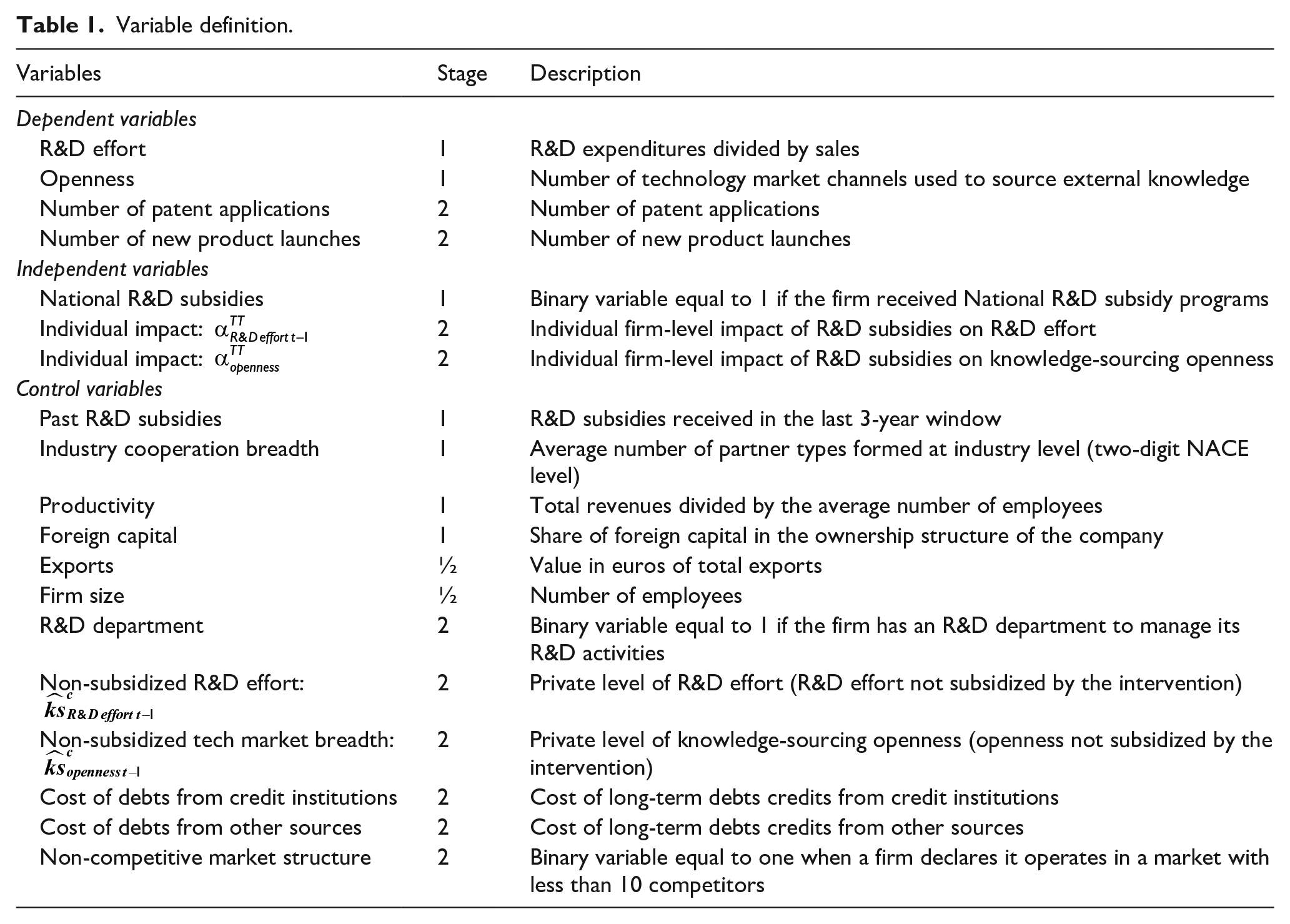
Our analysis has two parts. In the first stage (matching analysis), the dependent variables refer to the knowledge sourcing of a firm, measured in terms of R&D effort and knowledge-sourcing openness. R&D effort is represented as the ratio of intramural R&D expenditures to total sales. 7 In line with Laursen and Salter (2006), Love et al. (2014), and Cano-Kollmann et al. (2016), Openness is built as the sum of binary values—where the value of one indicates the use of an external knowledge acquisition strategy—for five options: R&D collaboration, R&D outsourcing, technology in-licensing, R&D employee, and college graduate/engineer recruiting. Consistent with Cano-Kollmann et al. (2016), this variable is considered a formative construct measuring the level of openness in terms of the number of activities a firm performs in technology markets. This measure has an acceptable degree of internal consistency (Cronbach’s alpha = .702). The resulting variable ranges from 0 to 5, with low values indicating low levels of openness to knowledge sourcing in technology markets and high values indicating high levels of openness to knowledge sourcing in technology markets.
In the second stage (innovation performance), we measure innovation outcomes using the counts of patent applications and new product launches as the dependent variables. These two measures represent alternative dimensions of the innovation process, with the former referring to a firm’s technological performance (Nerkar, 2003) and the latter to a firm’s new product development capabilities (Katila & Ahuja, 2002). Patent counts are primarily adopted as outputs generated by a knowledge-production function, which describes how firms build new knowledge from R&D activities (Cincera, 1997; Hausman et al., 1984; Nerkar, 2003; Rothaermel & Alexandre, 2009). New product counts are commonly viewed as a signal of a firm’s abilities to apply sourced knowledge in the generation of new products with the potential to fulfill emerging and existing customers’ needs (Blundell et al., 1995; Salomon & Shaver, 2005). Thus, new product introductions are considered as an essential element of a firm innovation capability (Katila & Ahuja, 2002). See Table 1 for a description of the dependent variables.
Variable definition.
Independent variables
In the first part of the analysis, the granting of R&D subsidies by the Spanish Government is the leading independent variable. This variable explicitly refers to funds granted for undertaking research and technological development projects. These funds are allocated to R&D projects that fulfill a set of criteria defined by the funding agency, such as the R&D intensity of the project, technical capabilities of a firm, and potential to commercialize and export new products or technologies (Huergo & Trenado, 2010). Unlike some regional and European programs, those under scrutiny in this study do not require previous firms’ participation in R&D partnerships as a necessary condition to receive support (Chapman et al., 2018). Our focus on National R&D subsidies is justified because of their relevance as the primary source of public funding in Spain (COTEC, 2007). In line with previous research studies, we use a binary variable National R&D subsidies to define the treatment status, with the value of one indicating a firm is in receipt of R&D subsidies and zero otherwise (Beck et al., 2016; Busom & Fernández-Ribas, 2008; Czarnitzki & Lopes-Bento, 2013; Hottenrott & Lopes-Bento, 2014). In the second part of the analysis, the treatment effects,
Control variables
We further control for a range of factors in the estimation process (see description in Table 1). In the first stage (matching analysis), we account for previous experience in receiving R&D subsidies by adding the dummy variable Past R&D subsidies. Experience may increase firm participation in subsequent R&D subsidy programs, by using their improved skills in applying to those programs. Also, funding agencies may consider such experience as a sign of quality (Hottenrott & Lopes-Bento, 2014). We include lagged values for the outcome variables—R&D effort and Openness—to control for persistence in the knowledge-sourcing behavior of companies, an element considered necessary in explaining firms’ incentives to participate and in the awarding choices of agencies (Aerts & Thorwarth, 2008; Blanes & Busom, 2004). As indicated by Gonzalez and Pozo (2008), matching treated and non-treated firms with similar R&D pre-treatment behavior potentially contributes to correctly assessing the impact of R&D subsidies. González and Pazó (2008) highlight that R&D persistence is a critical source of selection bias, which supports the need to control for such persistency when assessing the treatment effects of R&D subsidies.
In the first stage, we also include the variable Industry cooperation breadth to control for the fact that policymakers may be predisposed to allocate R&D subsidies into industries with high probabilities of forming R&D networks (Chapman et al., 2018). The interest of policymakers in these networks lies in the fact that networking facilitates knowledge spillovers and technology diffusion (Branstetter & Sakakibara, 2002; Czarnitzki et al., 2007). We further add the indicator Productivity to take into account that funding agencies may grant subsidies to firms showing high competitiveness (Beck et al., 2016). Next, we account for the preference of funding agencies for supporting domestic firms (González & Pazó, 2008), by including the variable Foreign capital. Also, we include the variable Exports to account for policymakers’ preferences for supporting exporting firms, given their exposure to greater competition in international markets which is usually viewed by funding agencies as conducive to innovation (Czarnitzki & Hussinger, 2018; Czarnitzki & Licht, 2006). Finally, we include the variable Firm size to account for the presence of potential scale effects that may drive firm participation in R&D subsidy programs and the choices made by funding agencies (Czarnitzki & Licht, 2006; González & Pazó, 2008).
In the second stage (innovative performance), we control for the private knowledge sourcing of firms in terms of both intramural R&D and knowledge-sourcing openness. To do so, we add to the innovation production functions in Equations in (2) the terms,
In both stages, we include both time-fixed effects and industry-fixed effects. 8 With the former, we control for period effects, such as differences in macroeconomic conditions that may influence eligibility to R&D subsidy programs and a firm’s innovation behavior. This aspect is critical to control for the effect that changes in the National R&D Plans over time may have on the innovation conditions of firms. With the latter, we account for unobservable industry-specific characteristics (i.e., technological regimes) that may shape a firm’s participation in applying for R&D subsidies and its prospect for innovation.
Results
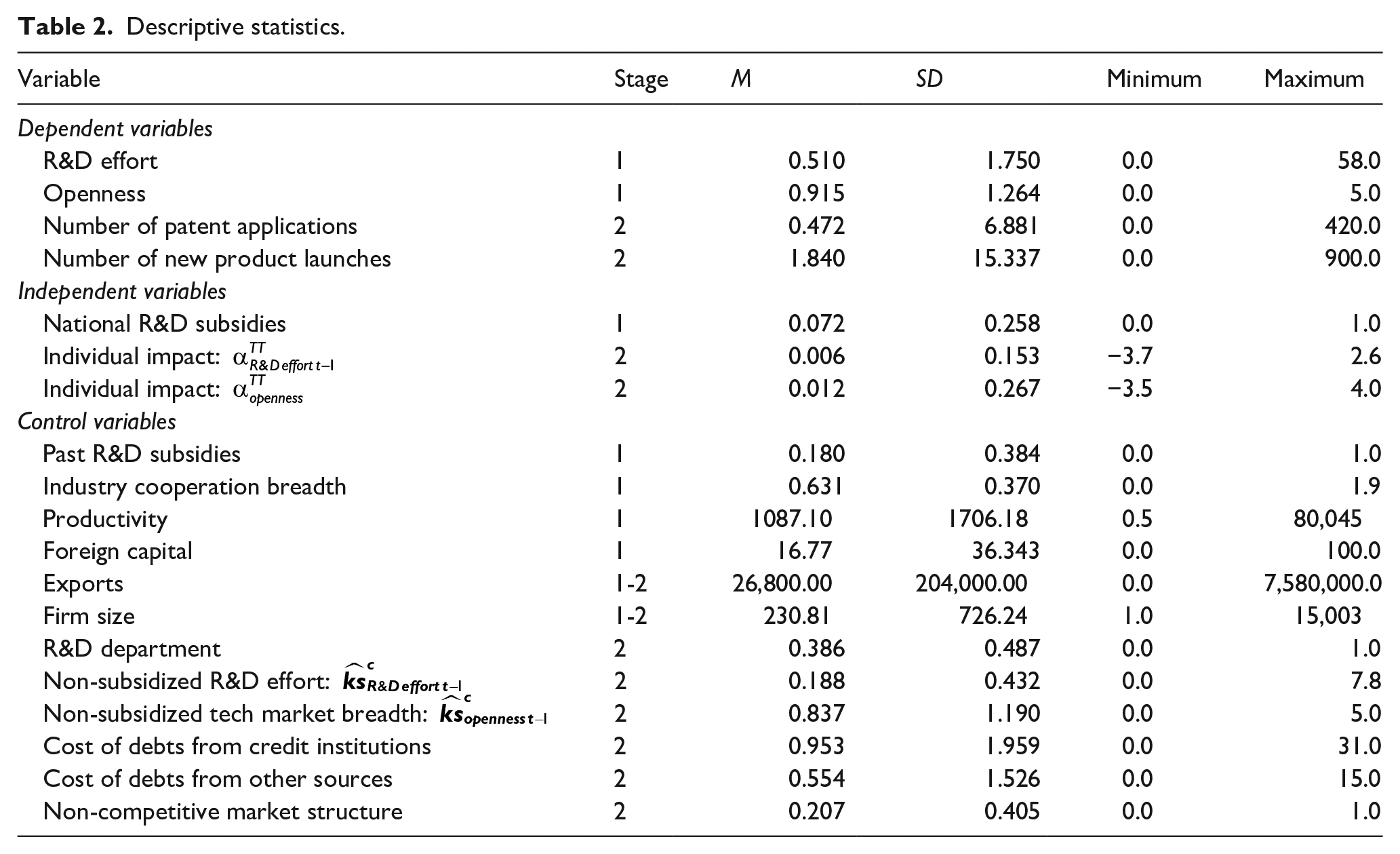
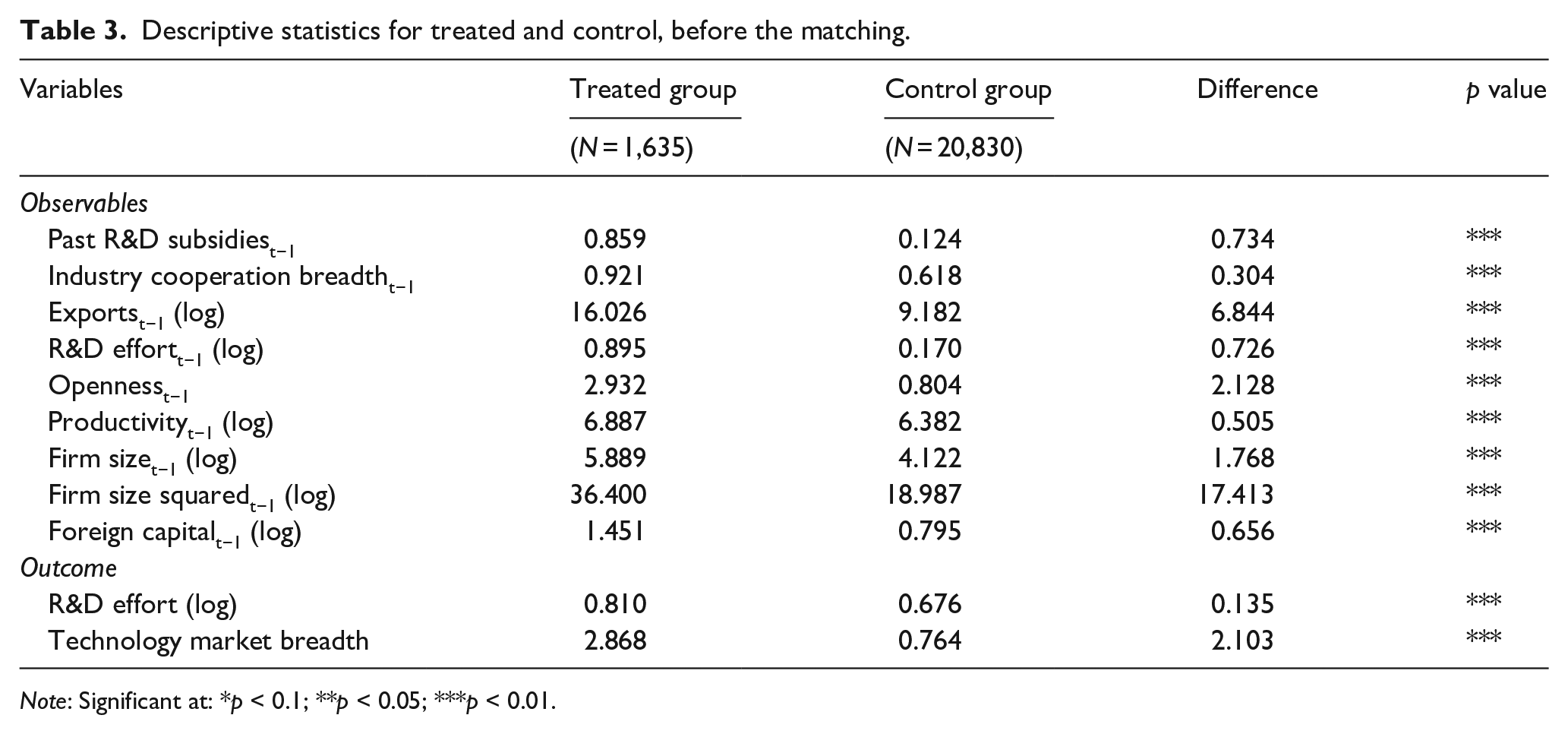
Table 2 reports the descriptive statistics for our variables in both stages, while Table 3 presents descriptive statistics for the variables used in the matching analysis, distinguishing between the treated and non-treated firm groups. On average, the sample R&D effort is equal to 0.501%, while the score for knowledge-sourcing openness is 0.915. On average, the sample number of patent applications is 0.472 and the number of new product introductions equal to 1.84. The sample proportion of firms being granted with National R&D subsidies is equal to 7.2%.
Descriptive statistics.
Descriptive statistics for treated and control, before the matching.
Note: Significant at: *p < 0.1; **p < 0.05; ***p < 0.01.
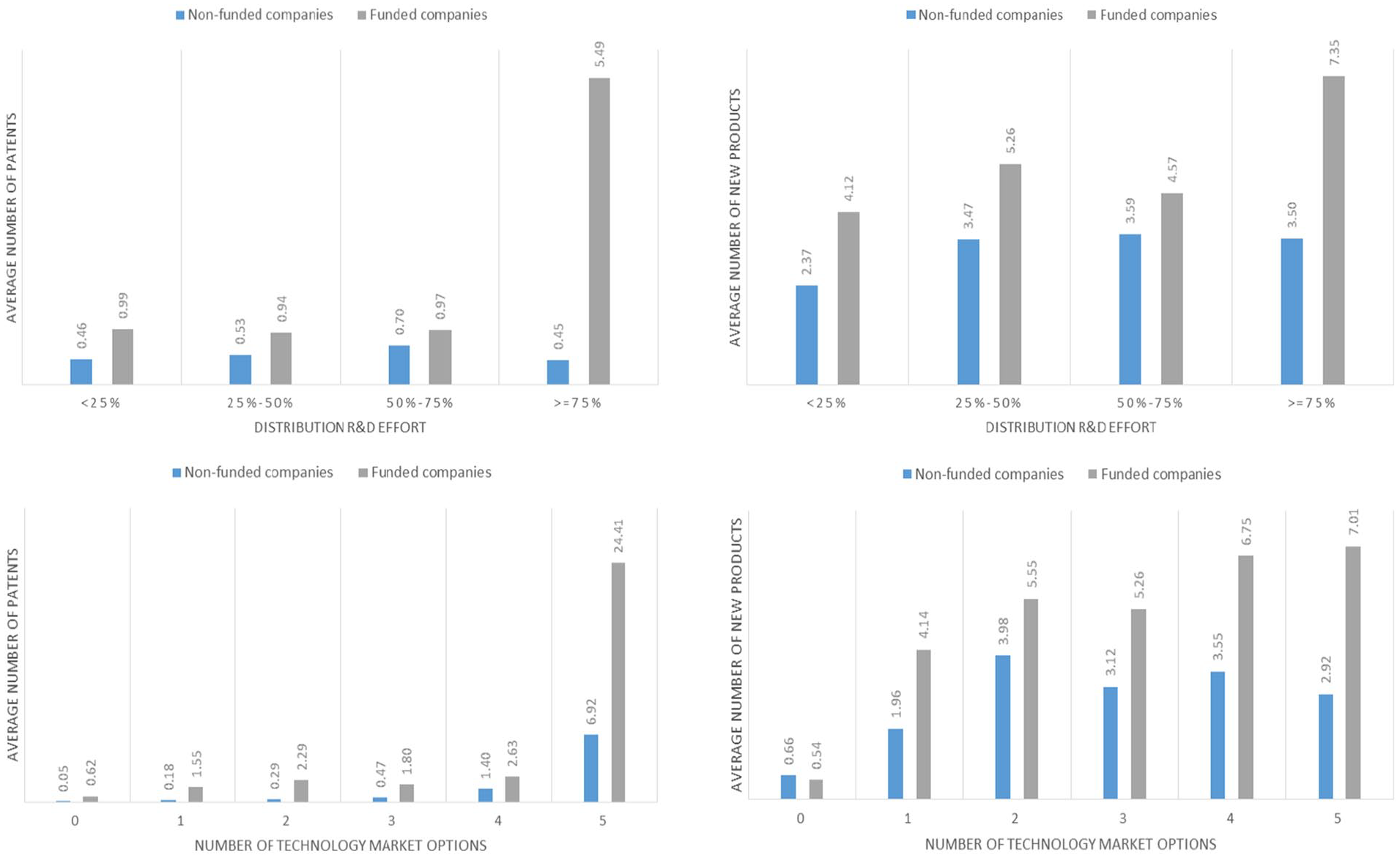
To explore the linking role of knowledge sourcing, Figure 1 compares the relationship between knowledge-sourcing activities and firm innovation, between funded and non-funded companies. The upper charts present the association between R&D effort and the number of patents and new product introductions, respectively. These charts show that a positive association exists, with innovation outcomes increasing as the level of R&D effort grows. The association is particularly strong in the case of R&D subsidized firms. The lower charts show the relation between knowledge sourcing openness and firm innovation, also revealing a positive association that is particularly strong for the case of supported companies. These patterns suggest the importance of a broad knowledge sourcing openness in favoring better innovation performance. Also, these patterns indicate a high degree of effectiveness of R&D subsidies in fostering firm innovation by improving knowledge sourcing.
Knowledge sourcing and firm innovation by treatment status.
Results from the association between openness and firm innovation presented in Figure 1 contrast with other studies showing a decreasing relationship between firm innovation and external knowledge breadth once a threshold is achieved (Hottenrott & Lopes-Bento, 2016; Laursen & Salter, 2006). At least two reasons may explain this contradiction. First, as shown by Laursen and Salter (2006), companies can experience the benefits of using diverse external knowledge on their innovative performance until reaching a threshold of 11 different sources. This result indicates that the use of five channels of external knowledge sourcing in technology markets, as in our case, seems to be far from an over-searching situation and does not generate negative effects on firm innovation. A similar conclusion is reached if we compared the threshold identified by Hottenrott and Lopes-Bento (2016), which is around 0.61 on a scale 0–1. Second, in our context, openness involves the combination of alternative mechanisms of external knowledge sourcing which facilitates the generation of complementarities in innovation, as defined by Milgrom and Roberts (1995). That is, the adoption of one mechanism increases the returns of adopting others in terms of a given innovation outcome (i.e., patents and new product launches). The presence of complementarities may compensate for the costs associated with the breadth of knowledge sourcing in technology markets. The presence of these complementarities is documented in previous studies for the case of combinations between R&D alliances and R&D outsourcing (Lucena, 2011) and between R&D alliances and the hiring of R&D personnel (Hess & Rothaermel, 2011). Other studies show complementarities from combinations of different types of R&D alliances (Belderbos et al., 2004).
As can be seen in Table 3, significant differences exist between treated and control groups in terms of firm and industry observable characteristics. On average, treated firms have more experience in receiving R&D subsidies and in sourcing knowledge from R&D and technology markets, they operate in industries with higher probabilities of forming R&D partnerships, and have more exports. Treated firms are also larger in terms of the number of employees; they have greater labor productivity and a higher proportion of foreign capital in their ownership structure than their counterparts in the control group. For the outcome variables, treated companies have, on average, a more considerable R&D effort and greater knowledge-sourcing openness scores compared to non-treated companies. However, given the potential presence of selection bias, it is not possible to identify how much of the additional R&D effort and knowledge-sourcing openness is triggered by the granting of R&D subsidies and how much is due to the selection effect.
Results: impact of R&D subsidy on knowledge sourcing
We present the treatment effect of R&D subsidies on knowledge sourcing by allowing for potential selection bias. First, we run a pooled probit model to estimate the conditional probability of receiving R&D subsidies for each company, according to the following specification:

where
Results for the probability of receiving R&D subsidies.
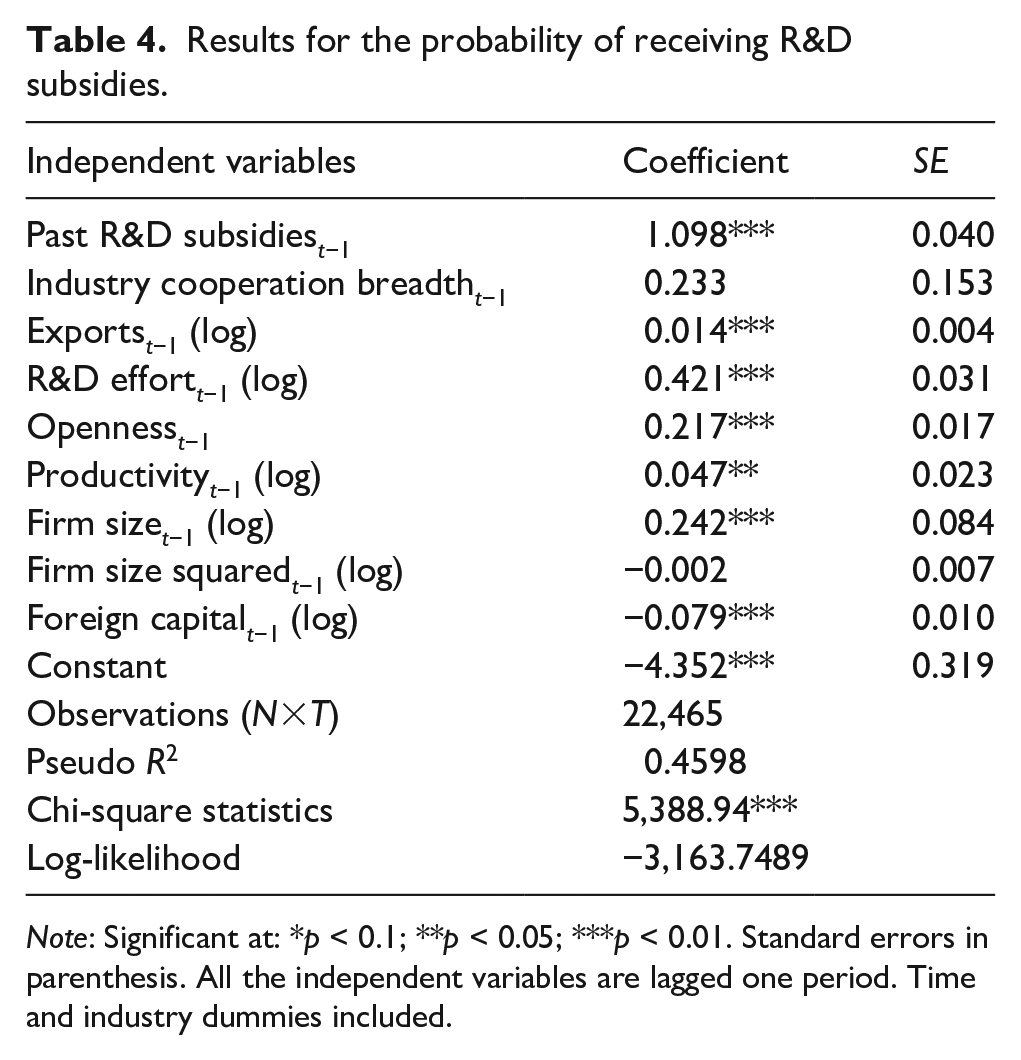
Note: Significant at: *p < 0.1; **p < 0.05; ***p < 0.01. Standard errors in parenthesis. All the independent variables are lagged one period. Time and industry dummies included.
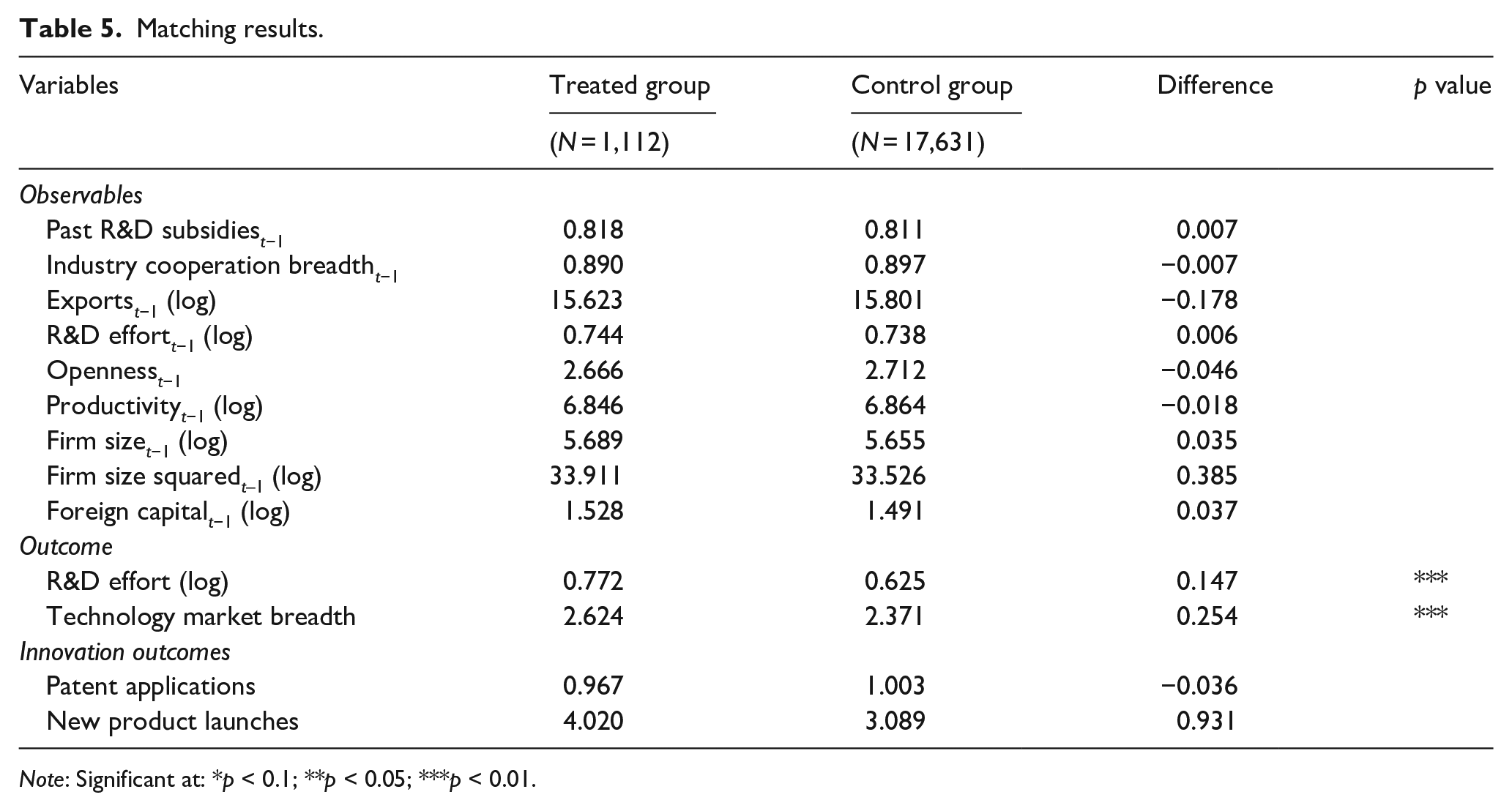
We match firms according to the estimated propensity score resulting from the estimation of model (3). In line with Caliendo and Kopeinig (2008) we assess the quality of the matching in the following terms. First, as shown in Table 5, the results of the balancing test indicate that all pre-matching statistically significant differences reported in Table 3 between treated and control groups disappear once the matching has been performed, showing matches are valid. Second, comparing the pseudo-R2 for the pre- (0.465) and post-matching (0.006) indicates that conditioning on the firm and industry characteristics under consideration no longer predicts the reception of R&D subsidies. We further examine the standardized bias measure, which compares the mean of each covariate included in the model (3) between treated and control firms before and after the matching. In general, the matching reduces the standard bias on all variables to below 5% (in absolute value). These inspections suggest that the match is successful in reducing the observed heterogeneity between subsidized and non-subsidized companies and that close neighbors are found for each of the treated companies in the sample. Hence, matched firms in the control group are viewed as a valid counterfactual for the corresponding firms in the treated group.
Matching results.
Note: Significant at: *p < 0.1; **p < 0.05; ***p < 0.01.
As indicated by Table 5, statistically significant differences persist only in the case of knowledge-sourcing indicators, R&D effort, and knowledge-sourcing openness. Here, we assume that any remaining difference existing between these indicators is attributable to the receipt of R&D subsidies. In terms of internal knowledge sourcing, the grant of R&D subsidies generates a significant average treatment effect at 1% on R&D effort:
In addition, we compare the average of firm innovation outcomes between the treated and control group for the matching sample. As indicated by Table 5, these groups do not differ in terms of their innovation outcomes. This finding implies that the granting of R&D subsidies does not have a direct effect on firm innovation measures. As a result, if the impact of any policy on firm innovation exists, it is the one transmitted through the induced effect on the knowledge sourcing of firms.
To account for potential selection on unobservable characteristics, we further test the robustness of these results by implementing a fixed-effects regression analysis with instrumental variables. The findings strongly support that R&D subsidies have a positive and significant impact on a firm’s R&D effort and technology market involvement. Appendix A in the supplementary material presents the methods and results for this analysis.
Results: innovation impact of the treatment effect of R&D subsidies
Given the positive effect of R&D subsidies on firms’ knowledge sourcing, we now assess the effectiveness of these impacts on enhancing technology performance and new product development capabilities. Table 6 presents the results of the estimated innovation production functions given by Equations in (2). Apart from the linear and square terms of a firm’s size variable, the variance inflated factor (VIF) scores are very below 5 in all the models, with average VIF scores of around 3.44 even when the square of a firm’s size variable is considered. These results indicate the absence of multicollinearity problems.
Regression results for firms’ innovative performance.
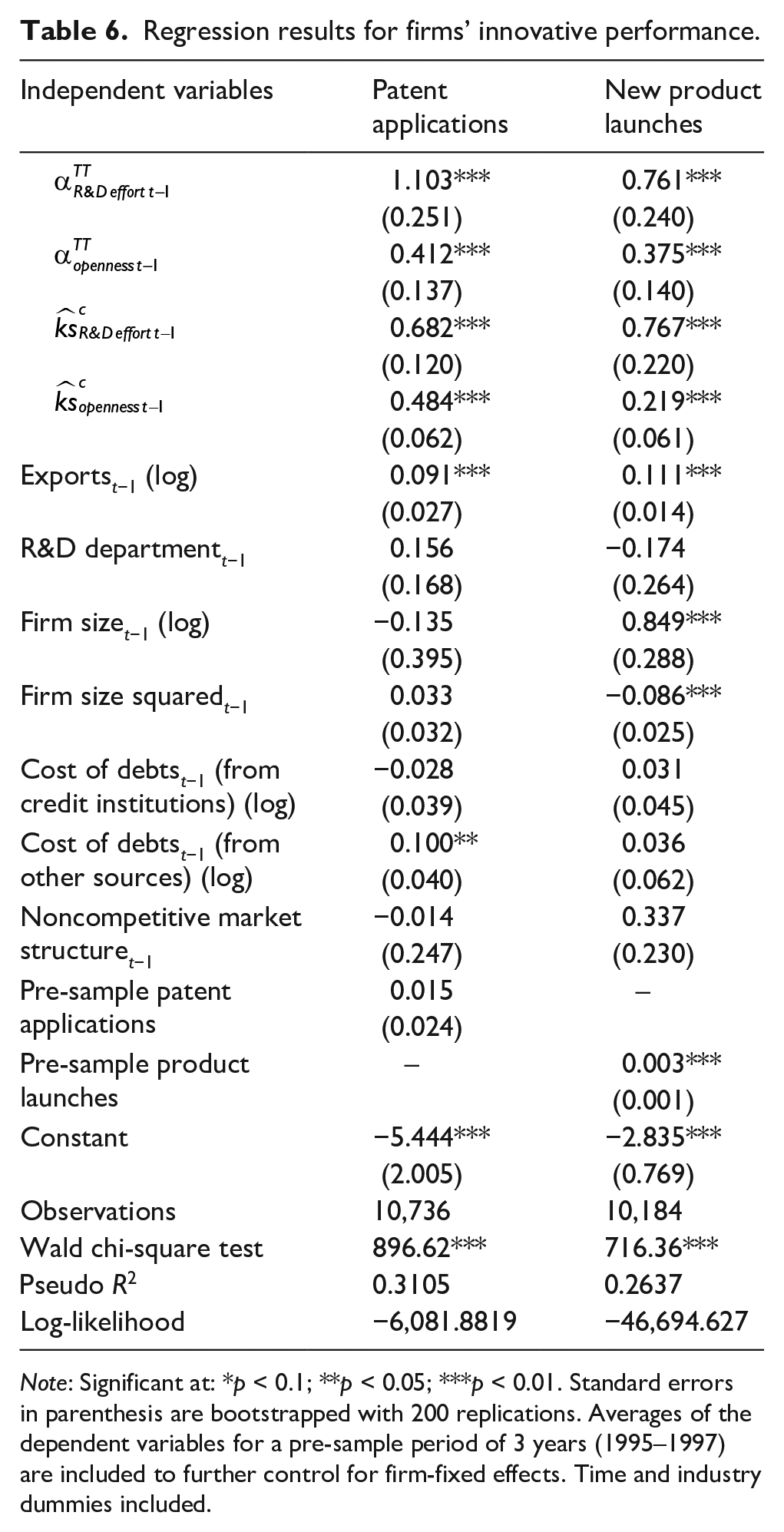
Note: Significant at: *p < 0.1; **p < 0.05; ***p < 0.01. Standard errors in parenthesis are bootstrapped with 200 replications. Averages of the dependent variables for a pre-sample period of 3 years (1995–1997) are included to further control for firm-fixed effects. Time and industry dummies included.
In terms of R&D effort, we see that the treatment effect of R&D subsidies has a positive and highly significant impact on the number of patent applications and new product launches. As regards patents, an increment of one unit in the policy-induced R&D effort produces a proportionate increase in the conditional mean of patent applications of 1.103, while in terms of new product counts, we observe a proportionate increase in the conditional mean of new product launches of 0.761. These results show that R&D subsidies are useful instruments in driving technological performance and new product development. Hence, the results support the premise that R&D subsidies have an impact on firm innovation by inducing additional private R&D effort. As regards openness to technology markets, we also observe that the treatment effect of R&D subsidies has a positive and statistically significant impact on firm innovation. Specifically, the conditional mean of patent applications experiences a proportionate increase of 0.412 for an increase of one unit in the score of openness to technology markets. Similarly, the conditional mean of new product counts experiences a proportional rise in 0.375 for an increase in one unit in the level of openness. These results provide evidence of the effectiveness of R&D subsidies in driving firm innovation via external knowledge in technology markets, thus confirming the role of openness to knowledge sourcing as a mechanism linking R&D subsidies and firm innovation.
Wald’s test reveals that the policy-induced effect of R&D effort is significantly stronger in driving patent applications
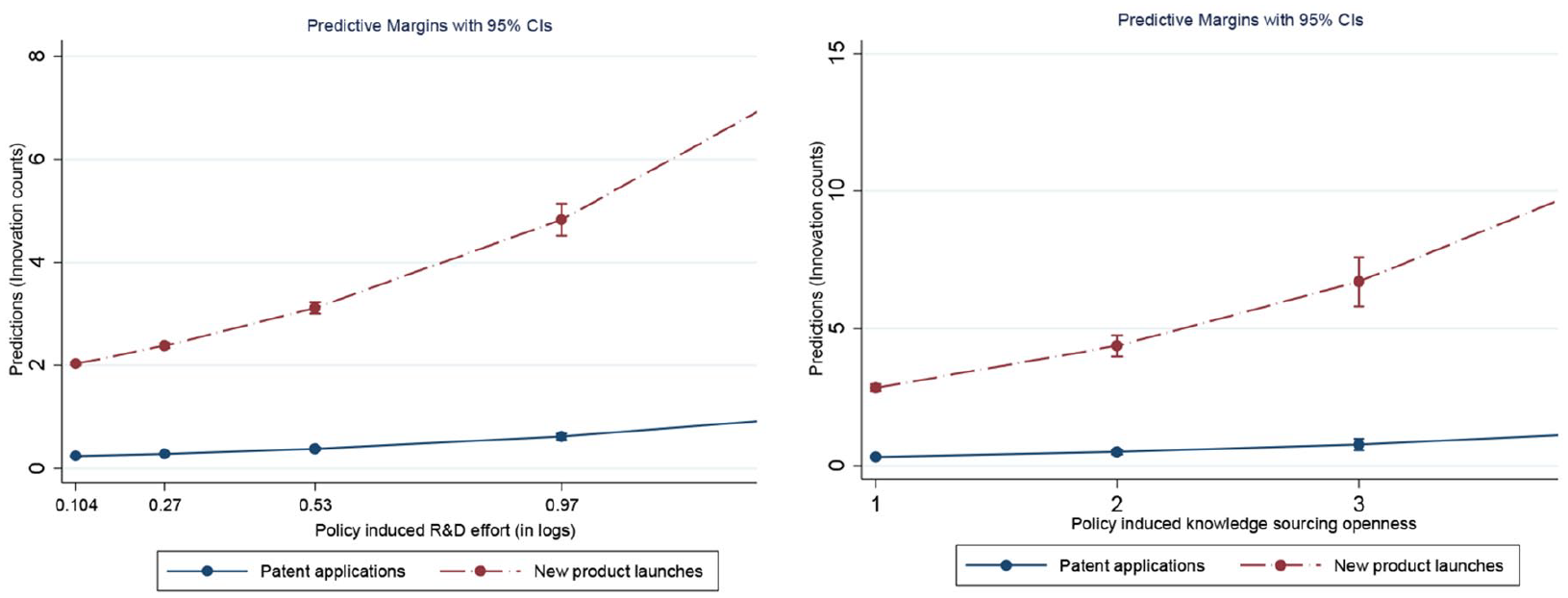
Firm innovation effects of policy-induced knowledge sourcing.
As a robustness check, we use count-data panel techniques to estimate a GMM dynamic Poisson model with fixed effects. Results from this estimation confirm our main finding that R&D subsidies are highly effective in inducing firm innovation through incentivizing R&D effort and openness to knowledge sourcing. Results and discussion for this analysis are presented in Appendix B of the supplementary material.
Concerning control variables, knowledge sourcing privately funded by a firm (i.e., knowledge sourcing not funded by R&D subsidies) has a positive and significant effect on both innovation outcomes, as shown by the parameter estimates for
Discussion and conclusion
This article proposes a novel application of the knowledge-sourcing notion to the technology policy evaluation literature that generates a more integrative assessment of the effects of R&D subsidies. First, the knowledge-sourcing notion allows the characterization of different strategies to obtain knowledge about firms’ innovations, including intramural R&D and external R&D activities. In doing so, our study advances research on technology policy by providing a unified and more comprehensive framework for policy evaluation, in which the granting of R&D subsidies affects both the internal and external knowledge-sourcing behavior of firms simultaneously. This fact makes it possible to assess the input and behavioral additionalities attributable to R&D subsidies within the same framework. Second, the knowledge-sourcing notion also facilitates assessment of the effectiveness of R&D subsidies in fostering firm innovation. In contrast to previous research which often presumes the effectiveness of R&D subsidies in favoring firm innovation, our study proposes a framework in which the granting of R&D subsidies generates changes in a firm’s knowledge sourcing and this further shapes its innovation outcomes. Elaborating on the documented connections between knowledge sourcing and innovation (Cassiman & Veugelers, 2006; Laursen & Salter, 2006; Nerkar, 2003), our view is that firms’ knowledge-sourcing activities, internally and externally based, act as a mechanism linking the granting of R&D subsidies to firm innovation.
Also, our study advances prior studies on technology policy evaluation by examining the role of R&D subsidies in shaping the level of firms’ openness to technology markets. Contrary to previous studies where the evaluation focuses on a firm’s propensity or breadth of R&D collaboration, our study places the focus on the openness to knowledge sourcing in technology markets, which allows us to include not only R&D collaborations but also market-based arrangements, such as technology in-licensing, R&D outsourcing, and the hiring of R&D employees.
Our results reject the presence of full crowding-out effects and provide evidence that R&D subsidies are an effective intervention to mitigate market failures and promote firms’ R&D activities. Our results also show that a complementary effect of R&D subsidies exists which goes beyond changes in a firm’s R&D collaboration behavior. Specifically, our findings show that R&D subsidized firms increase openness to knowledge sourcing in technology markets. Once these effects are confirmed, we test the hypotheses that R&D subsidies are effective in inducing firm innovation by changing the knowledge-sourcing behavior of firms. Our data confirm Hypothesis 1 by showing that the induced effect of R&D subsidies on a firm’s R&D effort further increases its innovation outcomes in terms of patent applications and new product launches. This result indicates the effectiveness of this policy intervention scheme in favoring firm innovation. Our results also indicate that the induced effect of R&D subsidies on firms’ openness to technology markets translates into better innovative performance in terms of patent applications and new product launches. Our results show that the impact on firm innovation comes exclusively through changes in a firm’s knowledge-sourcing activities, reinforcing the linking role of these activities in connecting R&D subsidies and firm innovation. In terms of mediation analysis (Baron & Kenny, 1986), our study proves the mediating role of knowledge sourcing in the relationship between R&D subsidies and firm innovation. Specifically, the study shows that R&D subsidies shape the knowledge sourcing behavior of firms (i.e., significant treatment effects). Our study also shows that the policy-induced impacts also shape firm innovation (i.e., significant effects of the individual effects on patent and new product launch counts). The presence of mediation is consistent with our idea that R&D subsidies are effective in fostering innovation because of their induced effects on the knowledge sourcing of firms. Finally, this article shows that R&D subsidies have a stronger induced impact on internal than on external knowledge sourcing, while the policy effectiveness is greater in terms of new product launches than in terms of patent applications.
Implications
Our results have several implications. First, they indicate the need for policymakers to evaluate R&D policy in terms of its input additionality (i.e., changes in R&D effort) as well as in terms of behavioral additionality (i.e., changes in openness to knowledge sourcing). These results show the importance of using the notion of knowledge sourcing to evaluate R&D subsidies, given the capacity of this concept to characterize, within the same framework, policy impacts on internal and external knowledge acquisitions occurring via internal and external R&D activities. Also, our results show that these two types of additionalities constitute intermediate effects with impacts on firm innovation. This points to the need to measure the extent of the innovation effects corresponding to input and behavioral additionalities. This research calls for a more integrative approach when assessing the impact attributable to R&D subsidies, one that considers the effects on a firm’s knowledge sourcing as well as the innovation consequences derived from this policy intervention. Our empirical evaluation informs policymakers by showing that evaluations only centered on the intended effects of R&D subsidies on a firm’s R&D effort and on the unintended effects on their external knowledge-sourcing behavior are necessarily incomplete without the assessment of the involved impact on firm innovation. Second, the study uncovers the role of the technology markets in helping firms to turn the benefits of R&D subsidies into additional innovations. As a result, policies that improve the efficiency of these markets (e.g., developing intellectual property rights systems) promote cooperation (e.g., founding R&D consortia) or enable mobility of knowledge workers (e.g., between public and private institutions) may increase the effectiveness of R&D subsidies in promoting firm innovation.
Similarly, policies allowing firms to develop their human capital (e.g., technical training programs) may facilitate knowledge sourcing through in-house R&D (Barge-Gil et al., 2018; Kato et al., 2015), leading to an appreciation of the potential benefits of R&D subsidy grants. These suggestions inform policymakers by showing that significant complementarities exist between alternative policy instruments. For instance, the contribution of R&D subsidies to promoting innovation may increase if policies stimulating firms to use technology markets are also applied (Cano-Kollmann et al., 2016). An implication of this is that innovation policy combining several schemes may alleviate not only market failures producing underinvestment in R&D but also high transaction costs, both of which lead to a lack of connectivity across organizations in technology markets.
For managers, our study shows that knowledge sourcing allows subsidized companies to harness the resources received from R&D funding programs. This fact implies that subsidized strategies that improve a firm’s knowledge-sourcing may also contribute to realizing the potential benefits of R&D subsidies. This idea is in line with the work of Wong and He (2003), who show that public R&D support is more effective when firms create an internal culture for innovation. Likewise, strategies stimulating the use of open innovation models, namely, the use of information technology, cross-functional teams, and incentives based on open-orientated metrics (Chiaroni et al., 2010), may further encourage firms to use technology markets in a broader sense, thus favoring an appreciation of the benefits of public support for R&D.
Limitations and future research
More research is needed to explore and clarify some other insights raised by this study. Although our theoretical background identifies alternative effects explaining how R&D subsidies impact firms’ knowledge-sourcing strategies, the empirical framework does not determine which of these effects contribute most to the induced-policy effect identified. Some evidence exists which highlights the role of the cost-alleviating and learning effects in promoting knowledge sourcing. For instance, Hottenrott and Demeulemeester (2017) and Bianchi et al. (2019) provide evidence showing the importance of the certification effect in improving the financing of companies receiving subsidies, which in turn translates into an increase in a firm’s R&D effort and propensity to form alliances, respectively. The role of a firm’s ACAP is supported by Clarysse et al. (2009) and suggested by Roper et al. (2004). Much more empirical research is needed to discriminate the predictive capacity of the identified impacts in fostering the policy-induced effect of R&D subsidies on both internal and external knowledge sourcing. Second, while our data provide insights into the treatment effect on knowledge sourcing, it does not allow us to examine whether, or how, R&D subsidies have an impact on the nature of a firm’s knowledge-sourcing activities. For instance, our data prevent us from considering the depth and breadth of knowledge-sourcing occurring through intramural R&D, or the intensity and quality of the interactions between a firm and its partners in the technology markets. The nature of a firm’s knowledge sourcing can produce new insights into understanding under which conditions a firm’s knowledge sourcing is more effective in inducing innovation. Third, despite the use of panel data techniques, the study does not treat the issue of the time scale needed to observe the effects of public intervention. Hence, long-term effects induced by R&D grants are not entirely considered. Additional research is required to identify the period needed to observe the indirect impacts of R&D grants on a firm’s innovation that includes knowledge sourcing. Finally, although the study of the linking role of knowledge sourcing provides an integrative approach to assess the impact of intermediate effects of public intervention on innovation outcomes, this perspective remains incomplete because it does not consider effects on variables measuring commercial success, such as revenues for out-licensing, sales growth, or market value. Future research is needed to complete the link between policy-induced innovative performance and other dimensions of performance in firms.
Supplemental Material
BRQ933629_Supplementary_Material_CLN – Supplemental material for The effectiveness of R&D subsidies in fostering firm innovation: The role of knowledge-sourcing activities
Supplemental material, BRQ933629_Supplementary_Material_CLN for The effectiveness of R&D subsidies in fostering firm innovation: The role of knowledge-sourcing activities by Sergio Afcha and Abel Lucena in Business Research Quarterly
Footnotes
Declaration of conflicting interests
The author(s) declared no potential conflicts of interest with respect to the research, authorship, and/or publication of this article.
Funding
The author(s) disclosed receipt of the following financial support for the research, authorship, and/or publication of this article: Abel Lucena acknowledges the financial support of the research grant ECO2017-86305-C4-1-R (AEI/ERDF, EU) funded by Agencia Estatal de Investigación (AEI) and the European Regional Development Funds (ERDF). Any remaining errors or omissions are entirely the author’s responsibility.
Supplemental material
Supplemental material for this article is available online.
Notes
References
Supplementary Material
Please find the following supplemental material available below.
For Open Access articles published under a Creative Commons License, all supplemental material carries the same license as the article it is associated with.
For non-Open Access articles published, all supplemental material carries a non-exclusive license, and permission requests for re-use of supplemental material or any part of supplemental material shall be sent directly to the copyright owner as specified in the copyright notice associated with the article.
