



Abstract
This article studies how the choice of the mechanism of governance affects online ratings of hotels, empirically exploring the conditions under which various governance mechanisms improve (or damage) them. We emphasize that no governance mode is universally superior. However, when the mechanism of governance fits hotel characteristics, online ratings improve. We argue that such characteristics (i.e., hotel category, size, and age) determine the severity of agency problems (e.g., managerial shirking and free-riding) and the performance of governance choice. We test several organizational fit hypotheses on a data set of 2,328 hotels operating in Spain. Our results support the fit argument, because they show the superiority of franchise and management contracts (i.e., hybrids) for enhancing online ratings, as opposed to vertical integration, when category rises and size increases. Furthermore, we find evidence that maintenance does not appear to be a major problem in leasing.
Introduction
There is growing interest in the effects that governance mechanisms (i.e., rules adopted to mitigate conflicts and realize gains) may have on firms’ performance (e.g., Kalnins, 2016; Oh et al., 2018; J. J. Zhang et al., 2015). Such studies are mainly based on agency theory and transaction cost economics (TCE) and emphasize the role of incentive conflict and opportunistic behaviors in explaining firms’ performance (Eisenhardt, 1989; Williamson, 1985). On the other hand, tourism literature has recently highlighted the increasingly important role of social media sites for providing information about hotels and allowing comparison between them, and their salient role in consumers’ purchasing decisions (Kwok et al., 2017; Yang et al., 2018). In fact, online review is becoming the most common way for buyers to make a complaint, express their feelings, comment on their satisfaction, and rate a hotel (Schuckert et al., 2015). This has totally modified traditional performance metrics, making online reviews a key performance indicator within the tourism industry (Sainaghi et al., 2017, 2019), especially for the provision of hotel services (Cantallops & Salvi, 2014). This literature has also analyzed factors affecting online reviews, pointing to aspects such as service quality and satisfaction, customers’ psychological behavior and characteristics (Cantallops & Salvi, 2014; Schuckert et al., 2015), or tourism destination and hotel attributes (Radojevic et al., 2017) as relevant antecedents.
However, little research has been conducted on the role played by hotel governance mechanisms as an antecedent of this key performance indicator (online reviews). This is an important gap in the literature (Cantallops & Salvi, 2014; Field et al., 2018; Kosová & Lafontaine, 2012), especially considering that the hotel sector displays a large variety of mechanisms of governance, ranging from chain-owned hotels to hybrid structures such as management and franchise contracts (e.g., Andreu et al., 2019; Contractor & Kundu, 1998; Dahlstrom et al., 2009; Kruesi et al., 2018; Li & Singal, 2019), which can influence corporate functioning and performance very differently.
The aim of this study is to fill this gap, exploring whether the performance of a chain-affiliated hotel in terms of its online rating, that is, the score given in online reviews (Bigné et al., 2019), can be affected by the mechanism of governance chosen. It joins a growing set of papers which emphasize that we should not be satisfied with just knowing the determinants of the choice of governance mechanism, but should assess the relevance of that choice for firm’s performance (Fadairo & Lanchimba, 2014; Madanoglu & Karadag, 2016; Song et al., 2013). Specifically, focusing on the hotel industry, a mechanism of governance may influence its performance (e.g., online ratings) by shaping the incentives of hotel agents to achieve coordination (complying with the hotel business format) and to exert efforts to offer a better service (e.g., Hong et al., 2017; Michael, 2000). However, only a few related studies have tried to find evidence on the effects of the mechanism of governance on online ratings in the hotel sector (Hong et al., 2017; Lawrence & Perrigot, 2015) and their results are far from conclusive. Lawrence and Perrigot (2015), examining only one hotel chain, find that franchising (compared to ownership) is a significant predictor for online ratings but only for business customers. Hong et al. (2017) examine how governance choices (i.e., branded vs independent hotels and vertically-integrated vs not integrated hotels) moderate the effectiveness of certain human resource policies. Overall, these studies have failed to demonstrate the hotel-specific features under which one mechanism of governance would outperform others. They have also overlooked the complexity of governance solutions that characterize the hotel sector, restricting their empirical analysis to two governance modes (i.e., a pairwise comparison).
Filling this gap requires exploring the fit between each governance mechanism and the relevant agency problems faced by the hotel in order to ensure the service and enhance online ratings. Our main argument is that no mechanism of governance is universally superior to others for promoting performance but, rather, the effectiveness of a particular governance mechanism will depend on the specific context in which it is deployed. Specifically, hybrid forms of governance (i.e., franchise and management contracts) will perform better when risks of managerial shirking are relevant (Fladmoe-Lindquist & Jacque, 1995; Norton, 1988). Conversely, more vertically integrated solutions (leased and company-owned hotels) will have advantages when the demand for tight coordination is high (i.e., maladaptation costs and free-riding risks are high) (Gulati & Singh, 1998; Michael, 2002). We consider the category of the hotel, its size and age, as contextual characteristics that may cause such monitoring and coordination difficulties to vary significantly and, therefore, may condition the comparative advantages of the governance mechanisms for enhancing hotel performance (online ratings).
This study makes two main contributions. First, we clarify, and empirically demonstrate, the conditions under which the various governance solutions of hotels may affect online ratings, a performance indicator that has become key in the hospitality industry. Second, we extend this analysis to all governance forms that are currently relevant in the hotel sector (Collins & Perret, 2015; Horwath HTL, 2019; Loeda, 2020) but whose benefits (in terms of online ratings) have been underexplored. In this regard, we help to clarify the advantages of franchising and management contracts to improve service in high-end hotels or large establishments. Furthermore, we find evidence of the potential difficulties of leasing to manage the problems posed by growth in hotel size and that maintenance, contrary to expectations, does not appear to be a major problem in leasing.
The mechanisms of governance in the hotel industry
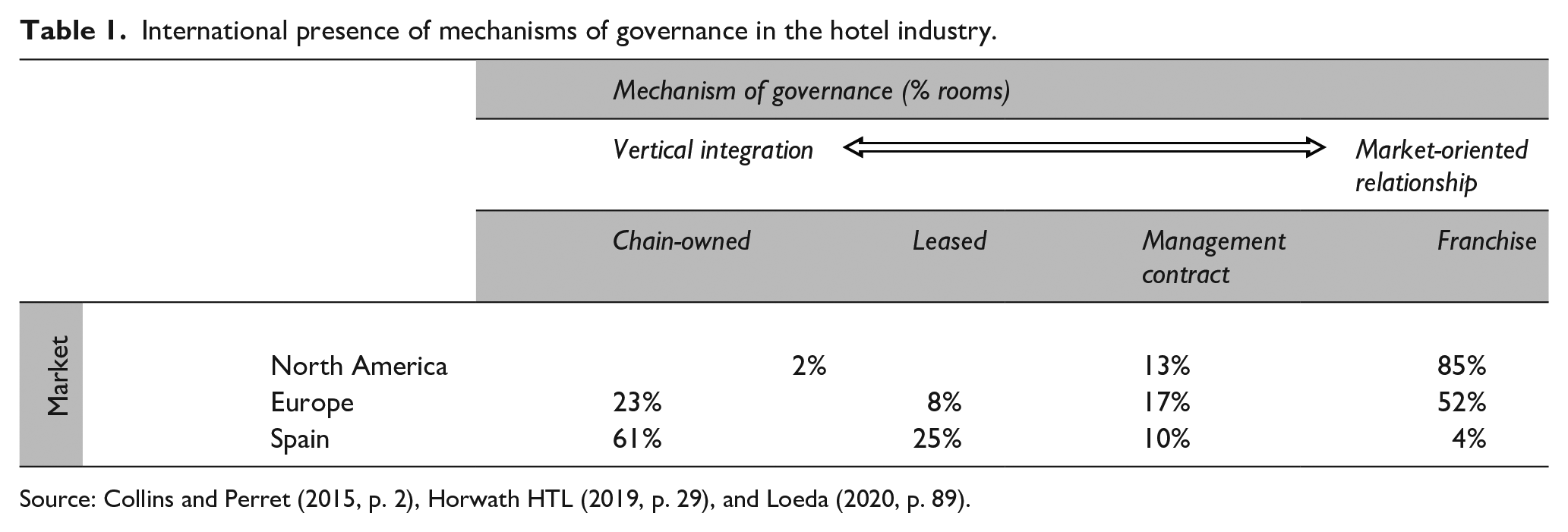
As in other industries (Stigler, 1951), the growth of the hotel industry tends to specialize resources such as brands, knowledge, facilities, and workforce, which also forces the emergence of new governance mechanisms (Williamson, 1985, 1991). As a result, the hotel industry stands out because its larger companies (hotel chains) today display a wide variety of mechanisms for operating hotels (Andreu et al., 2019; Contractor & Kundu, 1998; Dahlstrom et al., 2009; Kruesi et al., 2018; Li & Singal, 2019). Recent reports about the most touristic areas (i.e., North America (Collins & Perret, 2015), Europe (Horwath HTL, 2019) and Spain (Loeda, 2020), point to chain-owned, leased, managed, and franchised hotels as the prevalent mechanisms of governance (Table 1).
International presence of mechanisms of governance in the hotel industry.
 Market-oriented relationship
Source: Collins and Perret (2015, p. 2), Horwath HTL (2019, p. 29), and Loeda (2020, p. 89).
These four governance mechanisms differ in who retains the control over key business assets such as the global reservation system, brand name, tacit expertise embedded in local routines and daily operations, physical assets, and real estate (Contractor & Kundu, 1998 and Table 2). First, in chain-owned hotels, the chain obtains the control of all assets used in the production of the hotel service via ownership. Second, the chain can lease a property from an independent proprietor to carry out the hotel activity in it. Here, the chain has full control over all business assets, with the exception of the building and any related physical asset belonging to its proprietor, over which the chain retains weak control regulated by the lease contract. Third, under a management contract (DeRoos, 2010; Eyster, 1988), the chain also retains ownership of the organizational assets (brand and booking system) and control over key hotel management positions (i.e., the chain is the employer of the hotel’s general manager and key staff). In turn, the hotel owner is the claimant of residual profits and controls, in addition to the physical assets, the line employees (e.g., front-desk personnel, cleaning staff, waiters, butlers). Compared with the two previous cases, this results in weaker control over the hotel assets for the chain, except for the brand and the booking center. In addition, it can create a conflict of interests inside the hotel between the general manager (who is hired by the chain) and the rest of the hotel workers (who remain on the managed company’s payroll). The fourth governance mechanism is franchising, under which the chain grants the right to exploit its business concept for a period of time to a local entrepreneur, who also owns the facilities, in exchange for a fee. In this case, the hotel is managed by the franchisee with remote assistance from the chain, which reduces the chain’s control over the hotel assets (again, with the exception of the brand and the booking system).
Mechanisms of governance and control in the hotel industry.
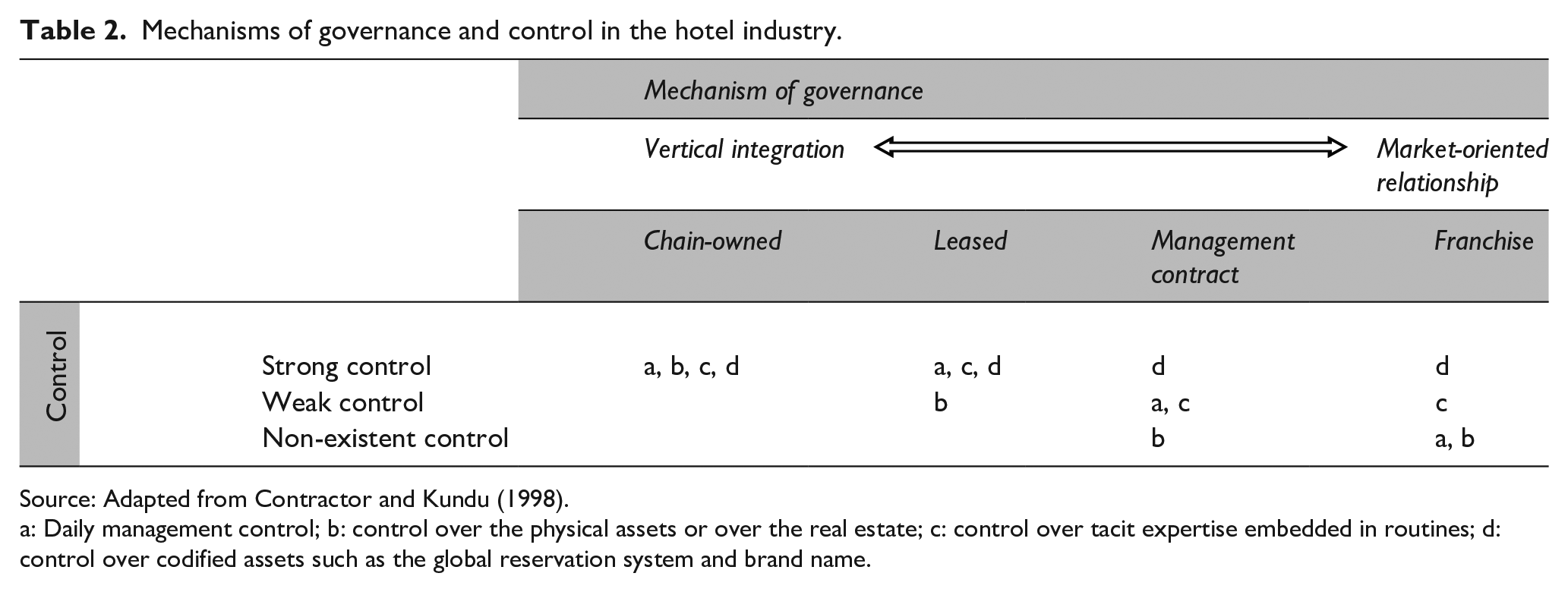
Source: Adapted from Contractor and Kundu (1998).
a: Daily management control; b: control over the physical assets or over the real estate; c: control over tacit expertise embedded in routines; d: control over codified assets such as the global reservation system and brand name.
Governance mechanisms and hotel performance
The literature on TCE systematizes the analysis of governance mechanisms by arguing that there is a continuum of intermediate or hybrid solutions between the two extreme or pure mechanisms—market and firm (hierarchy) (Williamson, 1991). From this perspective, both franchising and management contracts are considered hybrid (or more market-oriented) mechanisms because they allocate high levels of authority and control over key hotel assets to independent agents (i.e., franchisees and managed companies) (Kruesi et al., 2018; Li & Singal, 2019). Under both these contracts, reservation systems and brand ownership (held by the chain) are separated from ownership of the hotel (held by the managed company/franchisee), so the proprietors in both cases enter into an alliance to exploit their co-specialized assets. Furthermore, managed companies and franchisees assume the economic consequences of management decisions, due to their status as residual claimants in their respective establishments (chain-affiliated hotels). 1 In contrast, leased and chain-owned hotels are more vertically integrated solutions.
These governance differences have been highlighted from a theoretical point of view (e.g., Contractor & Kundu, 1998). However, the literature has overlooked their effects on the comparative performance of hotels (Kruesi et al., 2018) and, in particular, their influence on hotel online ratings. In this regard and following TCE (e.g., Williamson, 1985, 1991) and agency theory (e.g., Eisenhardt, 1989), we argue that hotels’ mechanisms of governance influence their performance by affecting the parties’ incentives to make efforts and achieve the coordination required to provide the service (Hong et al., 2017; Michael, 2000, 2002). If opportunism is not prevented and mutual cooperation reached, the relationship between the partners and their ability to provide adequate service will be damaged, thereby reducing customer satisfaction and hotel ratings (Brown & Dev, 1997; Dev et al., 2011). So the best governance mechanism will be one that minimizes such organizational problems, resulting in superior (hotel) performance (Masten et al., 1991).
However, this study assumes that no single governance solution (hybrid or vertically integrated) is universally superior to the others in preventing agents’ opportunism or misconduct (Williamson, 1991). The effectiveness of each solution will depend on the specific context in which the service is deployed, as this will affect the type and severity of the agency problems faced by hotel partners. In particular, the better the fit of the chosen governance mechanism (hybrid vs vertical integration) with existing monitoring and coordination requirements, the better the hotel’s performance will be (Michael, 2000). The following section introduces the main differences (i.e., advantages and disadvantages) between hotel governance mechanisms when dealing with these agency problems, which have been highlighted by the hotel literature under the perspective of transaction cost theories.
Managerial shirking and hybrid advantages
From the perspective of hotel chains, the lodging business can be seen as a source of potentially problematic agency relationships that may lead to significant opportunism and monitoring costs (Dev et al., 2011; Zhang et al., 2015). The relationship between the general managers of the establishments (agents) and the chain (principal) is considered particularly challenging in this regard (Hodari et al., 2017). General managers’ knowledge and organizational capabilities are basic resources for guaranteeing hotels’ operational performance and competitiveness (Crick & Spencer, 2011; Ferrary, 2015; Kim et al., 2015; Lee & Hee, 2016). However, as has been widely documented in the literature, these general managers might be reluctant to exert the appropriate effort for different reasons. For instance, hired managers may purposely neglect their responsibilities because they have weak economic incentives to monitor operations and line employees closely (Dev et al., 2011; Freedman & Kosová, 2012) or to make efficient investment and expenditure decisions. 2 This problem will be aggravated when it is very costly to appraise managers’ efforts or performance (i.e., the chain cannot reliably attribute local performance levels to managerial efforts or other factors beyond the manager’s control).
Hybrid forms can provide the solution to such monitoring difficulties by altering asset ownership and mitigating the incentive problems of hired managers (Brickley & Dark, 1987; Contractor & Kundu, 1998; Eyster, 1988; Kehoe, 1996; Lafontaine, 1992). Compared to more vertically integrated hotels, both the managed company and the franchisee will assume the economic consequences of their behavior because they are residual claimants in hotel profits, and this will prevent them from shirking on management efforts. In the words of Norton (1988), franchising “avoids the monitoring costs because the local manager is now an investor whose wealth is strongly dependent on the performance of the local unit” (p. 202).
The hierarchy can also introduce explicit incentives for hired managers through pay-for-performance programs (e.g., profit or sales commissions), but cannot imitate the incentive intensity created by the residual claim rights on hotel profits (including the right to transfer the position of the residual claimant) that characterize hybrid forms (Alchian & Demsetz, 1972; Norton, 1988). Furthermore, labor laws and unions also limit firing and incentive systems, thus reducing the capacity of the hierarchy to link performance and wages, in comparison with market relationships. 3 In line with these arguments and focusing on the hotel industry, previous research has related the adoption of franchise agreements with the difficulty of monitoring the hotel manager (Alon et al., 2012; Fladmoe-Lindquist & Jacque, 1995; Norton, 1988). In the same vein, the study by Brown et al. (2014) reveals that when monitoring a hotel is difficult, chain headquarters face higher opportunism from chain-owned facilities.
Coordination advantages of vertical integration
TCE and agency theory point out that opportunism or agency problems do not disappear under hybrid forms of governance, as goal divergences and information asymmetries persist that prevent perfect alignment of interests between partners (Eisenhardt, 1989; Williamson, 1985). In fact, the same interest for maximizing the residual rent that encourages managed companies/franchisees to invest greater efforts in supervision or other activities that might improve their profitability, can also induce opportunism and weaken coordination—that is, they may be more motivated to maximize efforts that benefit their own local investments than to conform to the general rules of the chain (Cox & Mason, 2007; Kaufmann & Eroglu, 1999). Accordingly, several studies in the hotel sector highlight that the risk of opportunism in franchised and/or managed hotels should not be underestimated (e.g., Brookes et al., 2015; Ginneken et al., 2019; Sun et al., 2019). Specifically, opportunistic behavior may occur when owners of branded establishments use their leeway in service provision to wilfully evade contractual obligations 4 or to free-ride on the shared brand equity by allowing others to invest in the brand while retaining their local investment in service or product quality (Brickley & Dark, 1987; Kidwell et al., 2007; Michael, 2002).
In view of these drawbacks, TCE theory considers that, compared to hybrid mechanisms of governance, vertical integration facilitates coordinated investments and uncontested adaptations (Williamson, 1991). The reason is that fiat, the typical coordination device in a hierarchy, elicits greater cooperation among agents (cooperative adaptation) than market-based relationships. In the latter, misalignments and delays may arise due to the incentive intensity of agents and their different readings of and reactions to market changes, which in turn may impede adaptation or may undermine their willingness to make effective realignments. In contrast, hierarchy facilitates the required cooperative adjustments through relationships of authority over the employees and their relatively flat or lower-powered incentives, that is, employee compensation is not necessarily affected by the required adaptations, so they are usually more willing to accommodate them (Gulati & Singh, 1998; Hsieh et al., 2010; Milgrom & Roberts, 1992; Tadelis, 2002; Williamson, 1991).
A number of previous studies (Michael, 2000, 2002; J. J. Zhang et al., 2015) have found empirical evidence on the superiority of the hierarchy to facilitate cooperative adaptations in the hospitality industry. Michael (2000, 2002) showed that hybrid forms of governance (franchising) result in worse coordination than a hierarchy and then offer lower quality. Similarly, Zhang et al. (2015) found evidence of free-riding problems within franchised hotels as compared to chain-owned ones. In view of this governance trade-off, that is, hybrid forms sacrifice cooperative coordination in exchange for higher-powered incentives, it seems reasonable for hotel establishments with high coordination demands to find more advantages in adopting vertically integrated mechanisms of governance. In contrast, when exposure to managerial shirking is high, hybrid forms of governance will result in improved hotel management and performance.
This leads to the question of what circumstances intensify coordination demands versus managerial shirking in hotel chains, making integrated hotels more successful than hybrids (or viceversa). The next section develops this contextual analysis.
Hotel features and the relative advantages of ownership and hybrids
This section focuses on the hotel-specific characteristics of category, size, and age, as relevant contextual factors considered from the perspective of transaction cost theories and hospitality literature (i.e., studies on hotel expansion and international entry modes), to assess governance choice decisions and their influence on hotel performance (i.e., online ratings).
Hotel category
The positive impact of the hotel category (measured by its star classification) on online ratings, while not without critics (e.g., Fernández-Barcala et al., 2009), has been supported by several studies (e.g., Hong et al., 2017; Hung, 2017; Martin-Fuentes, 2016; Nuñez-Serrano et al., 2014; Radojevic et al., 2017). In line with the latter, we assume that, regardless of the governance form, there is a positive direct relationship between online ratings and hotel category, simply because higher-star hotels offer superior rooms and services. However, the literature has also highlighted the difficulties involved in managing and monitoring establishments providing high-end or luxury services (Ehbauer & Gresel, 2013). These mean that higher-end hotels may be exposed to greater risks of managerial opportunism, which may jeopardize service efficiency and online ratings.
First, a hotel’s category is positively related to the number of services (amenities) it offers (Israeli, 2002; López Fernández & Serrano Bedia, 2004). This wider range of services increases monitoring costs not only because the number of tasks to be controlled increases, but also because such a wide range might induce undesirable strategic shirking by managers (Holmstrom & Milgrom, 1991). Specifically, wide-ranging hotel activities make competing demands on managers’ limited time and attention, so they may shift efforts inefficiently from tasks that are hard to measure (and control) to easily measurable ones, damaging overall effectiveness. In line with this argument, Dahlstrom et al. (2009) show that, as the number of hotel amenities increases (especially outdoor amenities), hotel chains tend to franchise hotels instead of owning them to capture franchise monitoring advantages. Similarly, Yin and Zajac (2004) show that franchised establishments tend to offer more types of service than relatively tightly controlled, chain-owned ones.
Second, as Blal and Sturman (2014) and Zhang et al. (2011) observe, the importance of service rises as hotel category (and room price) increases, implying that customers’ expectations are mainly room-based in low-category hotels and mainly service-oriented in the upper categories (Chen & Dimou, 2005). As a result, hotel business is a more labor-intense activity in high-category segments than in low-category ones (Ferrary, 2015). Labor intensity has traditionally been considered a determining factor of firm monitoring costs (i.e., capital is easier to monitor) (Norton, 1988). Therefore, an owner-manager (with higher-powered incentives in monitoring) would be preferable for supervising the local operations of high labor-intensive hotels (Lawrence & Perrigot, 2015).
Third, the know-how needed to offer a high-category or luxury service is more tacit and complex in nature and thus more difficult to codify and supervise than that needed for lower-category hotels, where service is usually more basic (Chen & Dimou, 2005; Ferrary, 2015; León-Darder et al., 2011). It is therefore hard to explain and to exactly define in advance how to deliver high-value services, and to design reliable, internal measures for assessing them. In fact, Ehbauer and Gresel (2013) note that luxury retail is still deficient in holistic performance measurement and management tools, because it is difficult to develop a framework that includes quantitative as well as qualitative key performance indicators for the efficient management of luxury stores.
One could suggest that management contracts would still pose significant risks in high-end hotels, as the general managers of such establishments remain on the chain’s payroll (i.e., their incentives remain low-powered). However, these managers are not only supervised by the head office (they do not report solely to the chain), but also by the hotel owner (who has a vested interest in the hotel’s performance and, presumably, a greater disposition to closely monitor its operations). As Hodari et al. (2017) have pointed out, management contracts are not subject to a single traditional (bilateral) agency relationship. Instead, they involve a complex multi-agency (trilateral) relationship between the chain (operator), the managed company (hotel owner), and the general manager. This implies that the latter will be supervised by two principals (the chain and the managed company), and that both will control his or her autonomy. Thus, we expect the ability of management contracts to overcome managerial shirking in high-end hotels to be superior to that of vertical integration.
Despite the above arguments suggesting that high-end hotels would be better managed under hybrid forms of governance, other studies offer counterarguments regarding the relationship between hotel category and governance choice. Specifically, they highlight that mantaining tight coordination and control over the chain’s standards and preserving system uniformity through a hierarchical structure seem to be more relevant in high-end or luxury hotels (e.g., Dimou et al., 2003; Ferrary, 2015). This is because customers’ tolerance of service failures and fluctuations decreases as the hotel’s category increases (Blal & Sturman, 2014; Zeithaml et al., 1993). In addition, high-category establishments operate as flagships and benchmark points for customers (Álvarez Gil et al., 2001), which magnify the importance of disturbances in the hotel service. So firms will be more concerned with free-riding and deviations from business standards in this type of establishment, demanding the tight coordination that more hierarchical solutions offer (and discouraging market-based relationships) (Andreu et al., 2020; Chen & Dimou, 2005). Moreover, as already stated, much of the knowledge and business practice needed to offer a high-category service is of a tacit and uncodified nature (Dimou et al., 2003). Since the transfer of tacit knowledge to external agents (e.g., franchisees) can be particularly costly and difficult 5 (Barthélemy, 2008; Darr et al., 1995), several studies also recommend maintaining a more hierarchical and unified structure for governing high-category hotels (e.g., Gatignon & Anderson, 1988; Kruesi et al., 2018).
Nevertheless, we do not expect these opposing effects to counterbalance the incentive advantages of hybrids in high-end establishments. From this perspective, solving managerial shirking through the higher-powered incentives that hybrids provide will improve hotel performance more than reaching the efficent adaptation to service requirements that hierarchical solutions facilitate. In hypothesis form:
H1. Hybrid forms of governance (as opposed to vertically integrated ones) will result in greater online ratings improvements when the hotel category rises.
Hotel size
Recent hospitality studies have found a negative direct effect of hotel size on hotels’ online ratings, regardless of their governance choice (e.g., Radojevic et al., 2017). We agree that a larger number of rooms may make hotels congested and could cause customer dissatisfaction and lower online ratings. However, this disadvantage is expected to be attenuated when large hotels make an efficient governance choice, that is, aligned with their specific agency problems.
As pointed out by Norton (1988) an important restriction on the size of companies is entrepreneurial capacity or the supply of non-shirking managers. Larger premises (i.e., with more rooms) require more investment and also more staff (i.e., they need to organize larger, more specialized human teams), 6 which entails more management and monitoring efforts. Some authors have considered that managerial shirking problems increase with hotel size, thus favoring the use of hybrid formulas as suppliers of non-shirking managers (Dimou et al., 2003).
On the other hand, as with high-end hotels, larger establishments are highly visible and well-known so they also operate as chain flagships. This would also magnify the importance of consistency of standards and would stress the goal of lower variability in the service provided by larger-scale establishments (Briggs et al., 2007), which would favor the adoption of vertically integrated solutions. However, franchising or signing a management contract that involves significant investments, as is the case for large hotels, could counterbalance the coordination advantage of the vertical integration. The argument is similar to the explanation for the existence of multi-unit franchising (e.g. Sánchez-Gómez et al., 2010) which sustains that multi-unit franchisees are less prone to free-riding on the chain reputation because their greater investment in chain-related assets decreases this misbehavior. Similarly, owners of large hotels would not be not prone to free-riding on the hotel chain quality standards because they would internalize the negative consequences to a greater extent. This increases their interest in achieving good coordination with the chain compared to smaller-scale owners. Therefore, we expect hybrid forms of governance to outperform more vertically integrated ones as the size of the hotel increases. In hypothesis form:
H2. Hybrid forms of governance (as opposed to vertically integrated ones) will result in smaller deteriorations in online ratings as hotel size rises.
Hotel age
A critical aspect in managing hotels in accordance with chain standards is the proper maintenance of their facilities, equipment, and furnishings. Refurbishment and the appearance of physical assets deeply influence service evaluations (Akbaba, 2006; Ekinci et al., 1998; Mei et al., 1999; Parasuraman et al., 1985, 1988) and, in any case, guests prefer new or recently restored buildings (Skalpe & Sandvik, 2002). As real estate investors and residual claimants in the hotel business, managed firms/franchisees will have a clear interest in the proper use and maintenance of hotel facilities. 7 In contrast, leasing contracts promote additional important contractual hazards regarding poor maintenance and overuse of the leased assets (Allen & Lueck, 2003; Benjamin et al., 1995).
The real estate owner in a leasing relationship is usually interested in economizing as much as possible on maintenance of the facilities because he or she does not profit directly from such investments. Similarly, the user of the facilities is not interested in investing in maintenance when this affects the long-run return on assets. In addition, the user does not usually pay for intensity of use but just for the right to use the asset, which creates an interest in overuse to increase profits. This misalignment of interests may result in neglect of building maintenance. Given that parties are perfectly aware of consumers’ preferences for restored and new buildings, leasing contracts are less attractive when maintenance is a relevant concern (e.g., when the building is old or has not been recently restored). Ownership and hybrid forms of governance are clearly preferable in such situations because the maintenance problem is internalized (Rivas Yarza et al., 2013). Therefore,
H3. When maintenance is an important concern in a hotel, chain ownership and hybrid arrangements will result in smaller deteriorations in online ratings than leasing.
Empirical analysis
Data collection
To test the above hypotheses, hotel chains in Spain were set as the target population since they present the types of organizational form under study. In order to select our target population, we started with a data set for the 250 largest hotel chains in Spain. These chains were running 505,752 rooms in 3,105 establishments at the beginning of 2018. Together, they were running 80 (92%) of hotels (rooms) belonging to chains in Spain at that time (see Nota, 2018, for more details and the list of chains). Consequently, detailed information about the category, size, location, opening date, chain, and mechanism of governance of the 3,105 establishments was gathered in February 2018 from the Directory of hotels and apartments in Spain of Alimarket (www.Alimarket.es).
We then restricted the population to focus only on the traditional lodging service offered by hotels and aparthotels. First, hostels (nine units), rural tourism establishments (five units), or holiday villages (three units) were not included in the study because they were minor types of establishment among the hotel chains. Similarly, 1-Star establishments (the lowest category) were not included because of their low presence in the chains operating in Spain (only 45 establishments were 1-Star in the population) and because it is not the typical market segment in which chains want to compete (Muñoz Colomina et al., 2003). Second, apartments (361 units) were not considered in the study because relevant services to guests differ significantly from those of hotels and aparthotels (e.g., meals, bedmaking, cleaning). In sum, we do not consider 395 establishments, so our target population covers 2,710 hotels.
Our target population only includes establishments located in Spain to control for the influence of the country and its institutions (e.g., regulation, economic and political stability, sector organization) on the hotel industry and its governance solutions (Lafontaine et al., 2017). Focusing on a single country can also avoid the bias that country-specific characteristics may cause in online ratings (Radojevic et al., 2017).
Furthermore, our final data set is slightly smaller because of missing values in some variables. In some cases, this was due to an incomplete variable (e.g., no information on hotel category). In other cases, it was because the information (e.g., the establishment’s age, years since opening, or last refurbishment) was not available in the Directory of hotels and apartments in Spain (which only gives the opening date) and we had to take it directly from each establishment’s website during the second quarter of 2018 (information on age or last refurbishment was not available for 335 establishments). In sum, the above hypotheses were tested on a data set of 2,328 establishments belonging to 233 hotel groups operating in Spain in 2018. 8
Information about establishments’ online ratings was gathered manually from March to June 2018 from the following tourist websites: Booking, Expedia, and TripAdvisor. Such websites have become an increasingly important source of information for academic studies on the hotel sector (Cantallops & Salvi, 2014; Kwok et al., 2017; Schuckert et al., 2015; Yang et al., 2018). Various sources (websites) were used to avoid the bias that one particular source might present (Bigné et al., 2019; Mariani & Borghi, 2018; Xiang et al., 2017).
Measures
The dependent variable, Online ratings, was computed as a weighted mean of all the website scores after homogenizing their scales. The weighting variable was the number of comments used to compute each website rating because we believe that the reliability of scores comes more from the number of comments than from the site itself. All websites review the comments before they are published and claim to verify the authenticity of the comments. So our dependent variable is calculated as follows
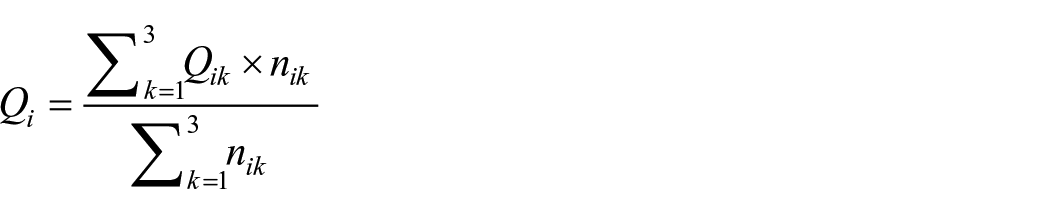
where Qi is the weighted average online rating of hotel i, Qik is the score provided by website k for hotel i, and nik is the number of comments on which the score of hotel i on website k is based. In total, 2,328 hotel ratings were calculated based on 5,941,934 comments. The number of comments per hotel range from 38 to 19,757, the average being 2,552.38.
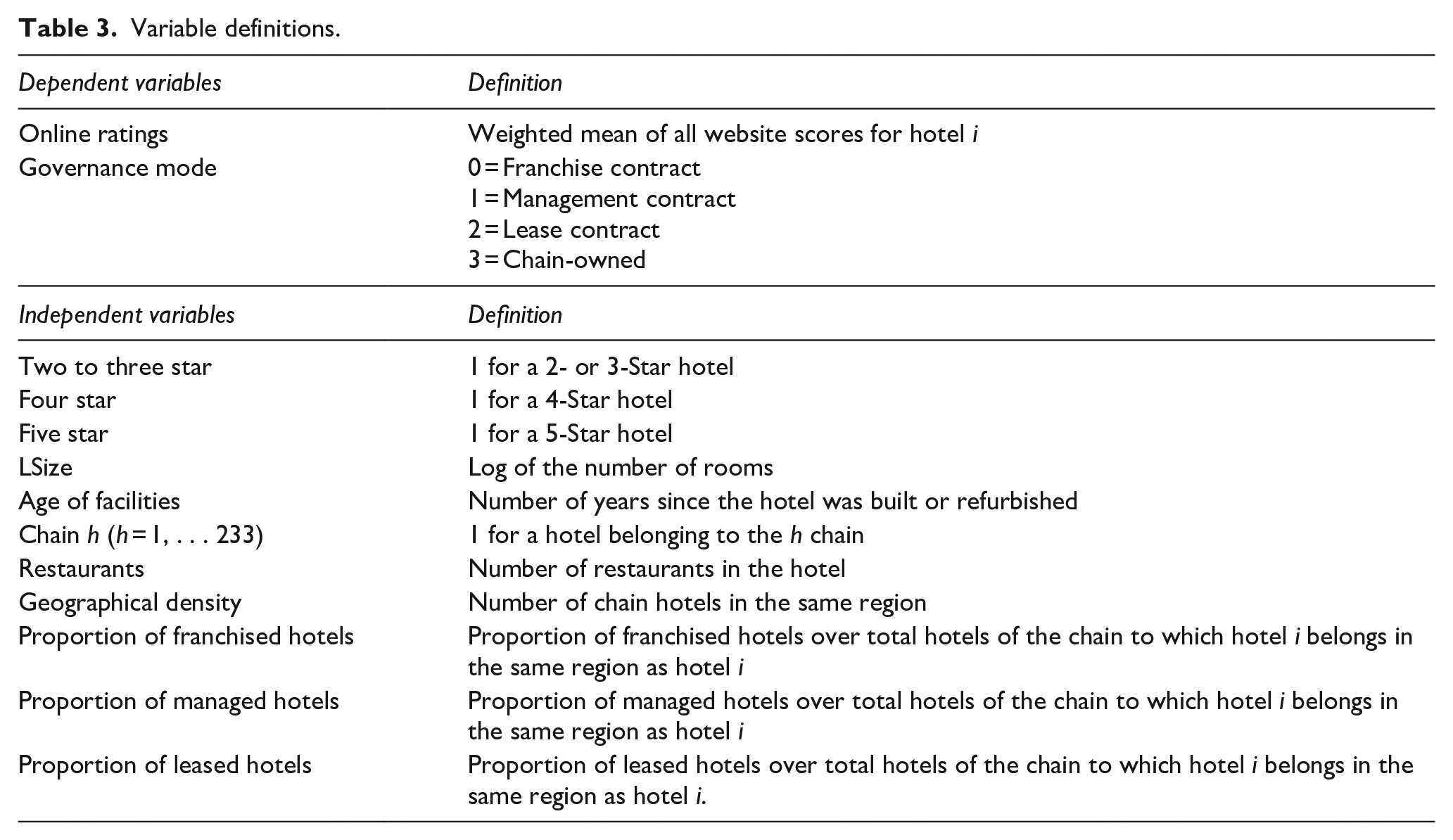
Governance mode identifies the status of hotel i in chain h, and its value increases with the degree of vertical integration of the hotel. Thus, it takes value “0” when the chain uses a franchise contract, “1” if it uses a management contract, “2” if it uses a lease contract, and “3” if it is chain-owned. This variable is a predictor in online ratings estimations, but is also used as a dependent variable in an auxiliary regression because of methodological requirements.
This study considers the category of the hotel, its size, and its age as three basic factors that influence the type and severity of agency problems in hotel firms. To measure the hotel category, we used a set of dummy variables, n-Star, which take value “1” if hotel i has “n” stars. Spain has a compulsory hotel classification system ranging from one to five stars. As has already been mentioned, 1-Star establishments were not included in the sample. Likewise, 2-Star hotels are hardly used by hotel chains, so we grouped them with 3-Star hotels. Consequently, our lowest category (2–3 Star) includes 2- and 3-Star establishments. The 4-Star is an intermediate type of hotels frequently offered by Spanish chains. They offer larger rooms and additional services. The 5-Star hotels have the largest and most luxury rooms and offer refined additional services. The variable LSize measures the size of hotel i as the natural logarithm of its number of rooms. Finally, Age of facilities refers to the number of years since hotel i was built or renovated and is used as a proxy of the hotel’s maintenance requirements. To control for possible chain effects in the selection of the governance form (i.e., brands may specialize in different governance solutions), dummy variables were constructed for the 233 chains included in the study (h = 1, . . . 233). The chains considered were taken from the Informe de Grupos Hoteleros en España 2018 (Nota, 2018). We also include Restaurants as a control variable, which refers to the number of restaurants of hotel i.
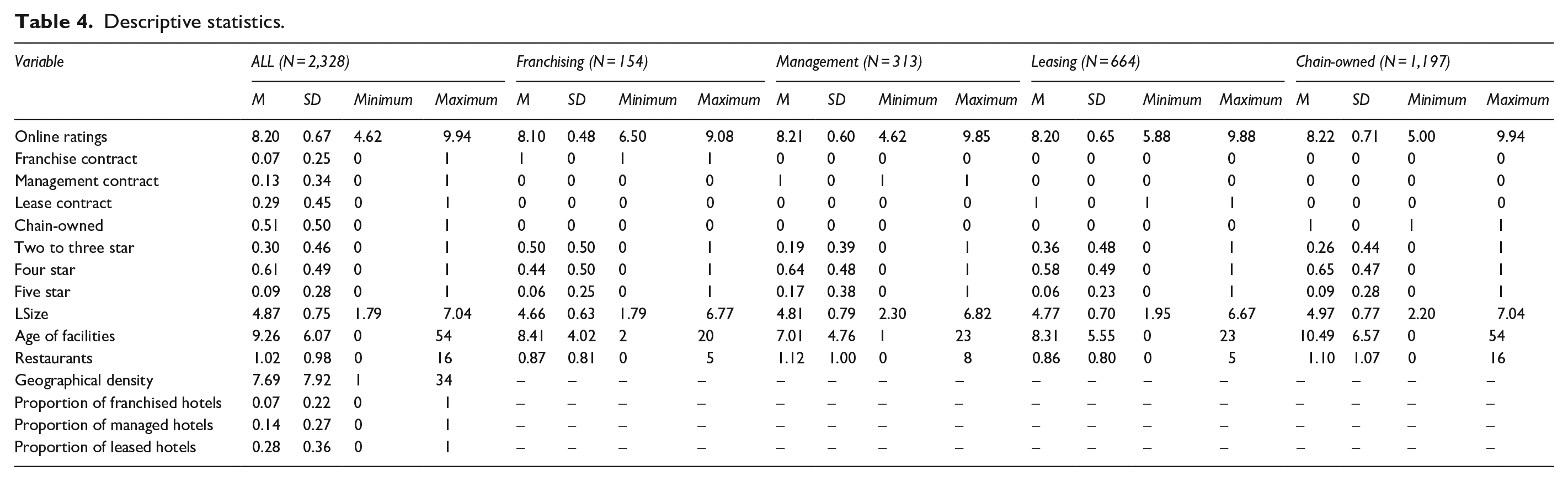
Finally, we used two variables as the main instruments to control for self-selection bias in governance mechanism choices (this will be further discussed in the “Estimation” section). The first variable, Geographical density, measures the number of hotels belonging to the same chain h in the same region. The second variable, Proportion of j-form hotels, measures for each hotel i the proportion of hotels of the same chain h and in the same region as hotel i having mechanism of governance j (j = 0, 1, 2, 3), over the total number of hotels belonging to chain h and in the same region as i. Table 3 summarizes the variables, and Table 4 shows their descriptive statistics (see in Appendix 1 the distribution across hotel star category and governance mode in Table 6, and the correlation coefficients in Table 7).
Variable definitions.
Descriptive statistics.
Estimation
To analyze the extent to which governance choice is relevant for hotels’ online ratings, it should be pointed out, first, that managers tend to choose the governance mechanism according to the characteristics of the hotel (i.e., type of contractual hazards or agency problems) and, second, that making the right choice yields better online ratings. In this model, however, the governance form is endogenously determined. That is, it might not be randomly chosen but, rather, might be selected seeking to achieve the highest performance. Consequently, a simple ordinary least squares (OLS) estimation of online ratings as a function of the endogenous predictor, that is, governance mode, may lead to biased estimates (Hamilton & Nickerson, 2003; Masten, 1996; Mayer & Nickerson, 2005). In our model, this happens because hotel chains might anticipate conflicts attributable to each governance mode and self-select into structures that perform better in terms of online ratings. This endogeneity problem should be controlled for in order to obtain robust estimations. To this end, Hamilton and Nickerson (2003) recommend an alternative methodology to OLS based on a switching regression model with two stages (Greene, 1997, ch. 20; Maddala, 1983, ch. 9).
The first stage uses covariates to predict the choice of the governance mode using an ordered probit formulation. We use this model because the dependent variable, Governance mode, is ordinal in terms of the degree of vertical integration and the control exerted by the chain over the hotel assets (see Table 2). The first-stage regression used to predict the governance mode is
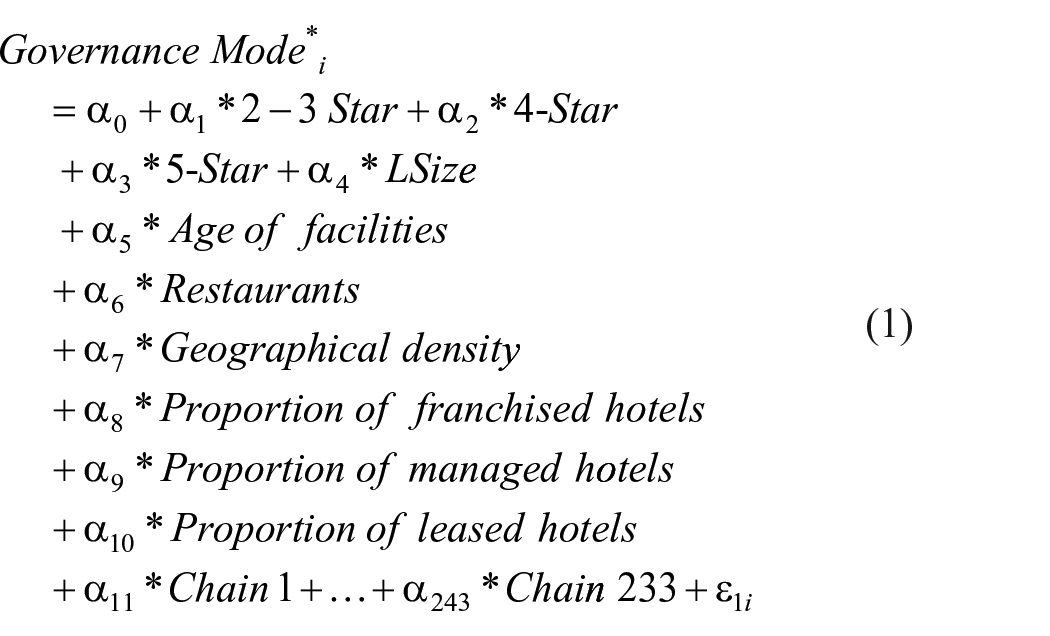
where ε1 i is a random error term and Governance Modei* is an unobservable measure of the mechanism of governance. However, we observe the chosen contract, Governance Modei, with Governance Modei = 0 if Governance Modei* ⩽ µ1, Governance Modei = 1 if µ1 < Governance Modei* ⩽ µ2, Governance Modei = 2 if µ2 < Governance Modei* ⩽ µ3, and Governance Modei = 3 if Governance Modei* > µ3, where µ1, µ2, and µ3 are referred to as break points in the ordered probit.
The second stage analyzes online ratings conditioned by the choice of mechanism of governance. While all observations were used to estimate equation (1), the sample was broken down into four subsamples—franchised, managed, leased, and chain-owned hotels—to estimate four performance regressions separately (Stage 2). They take the form
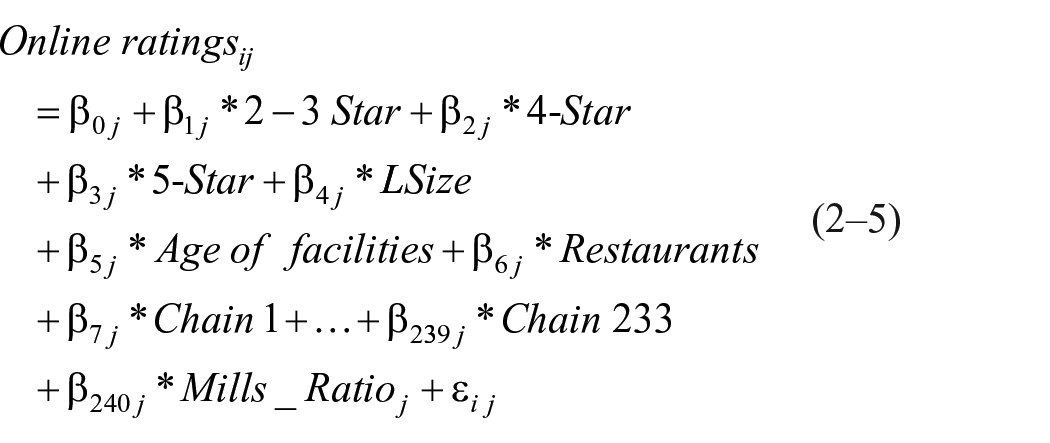
where j = 0, 1, 2, 3 for franchised, managed, leased, and chain-owned hotels, respectively; Mills_Ratioj is the appropriate inverse Mills ratio for governance mode j (computed following Hamilton & Nickerson, 2003; Maddala, 1983) and ε ij is a random error term. The inverse Mills ratios are computed in the first stage using the estimated governance mode likelihood and are introduced in this second stage to correct for endogenous self-selection. Furthermore, to econometrically identify equation (1), at least one instrument not considered in the performance regressions must be introduced into the governance mode regression.
Specifically, we use Geographical density and the Proportion of j-form hotels as instruments for the endogenous variable (Governance Mode). Applying a similar argument to Kosová et al. (2013), we expect that the latter, that is, the proportion of hotels of chain h in a region with a particular governance mode j, is inversely related to the unit costs of monitoring this type of establishment. From this point of view, this proportion reflects the unobserved costs of selecting a governance mode within a particular region. Moreover, from a monitoring perspective, there may be scale economies at local level from developing and using the management devices needed to monitor each type of governance mode (Dahlstrom et al., 2009; Hoffman & Preble, 2003; Shane, 1996). Therefore, as the proportion of j-form hotels grows in a region, its costs relative to alternative governance modes will decrease in that area, thus increasing the probability that it will be chosen. As for the former variable, Geographical density of chain establishments in the region, this allows us to control for the chain size and, thus, to weight the scale economies approximated by the proportion of j-form hotels. On the other hand, these density measures should not directly affect online ratings, which mainly depend on customer expectations about each particular hotel and on the service actually experienced in it. In fact, customers are not aware of either the governance mode of each hotel or the number of establishments belonging to chain h in the same region.
Results
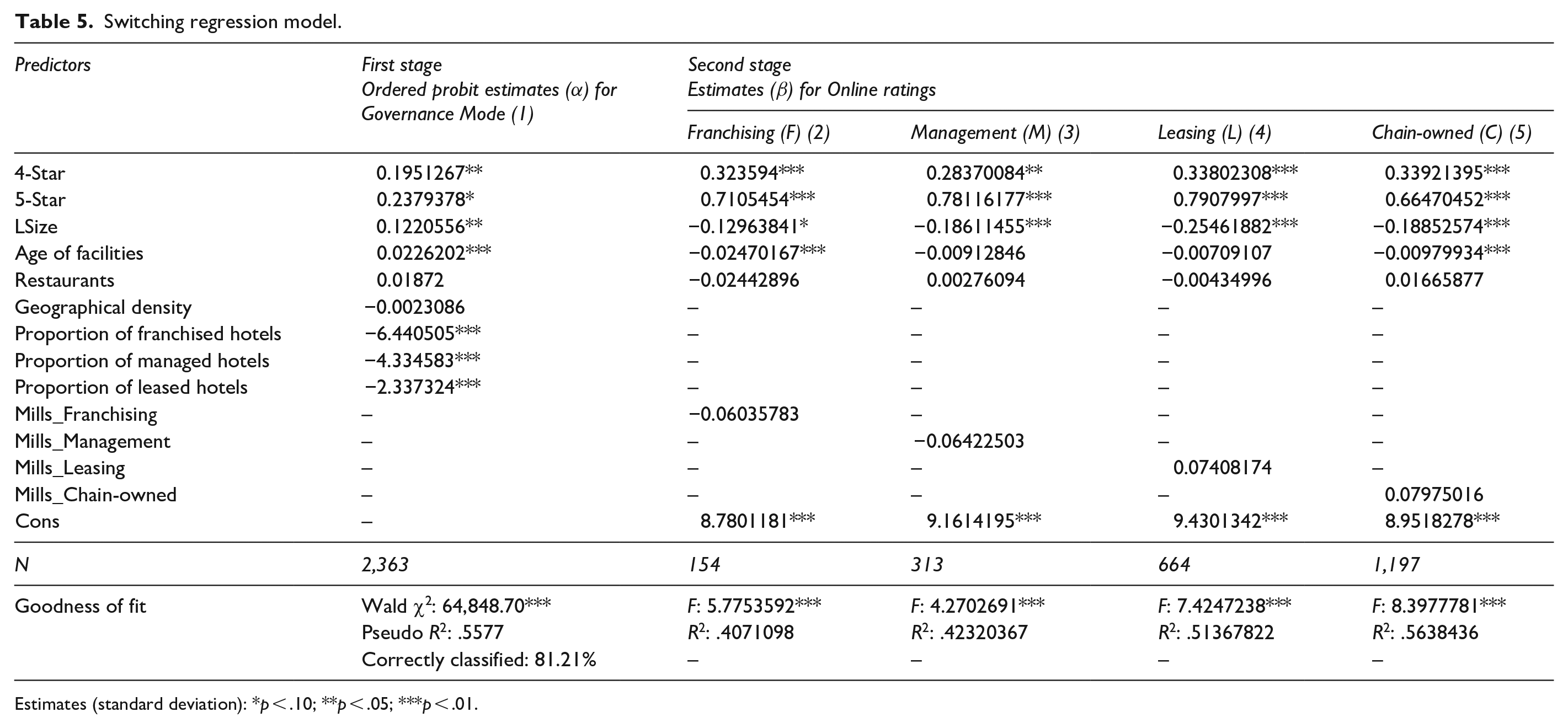
Table 5 reports the estimations of the switching regression model. The first column shows the ordered probit results for the determinants of the mechanism of governance (Stage 1). It should be noted that this is an auxiliary regression and is not used to test our hypotheses. It is statistically significant overall (χ2 = 64,848.70; p < .01) with a pseudo R2 of .5577, and correctly predicts for 81.21% of the observations. The coefficients for the instrumental variables Proportion of franchised/managed/leased hotels are statistically significant, which is coherent with the requirement that the instruments should be correlated with the choice of governance mode. Specifically, a higher proportion of franchised, managed, or leased hotels within a region reduces the likelihood that a chain-owned solution will be chosen (α8 = −6.440505; α9 = −4.334583; α10 = −2.337324; p < .01 in all cases). This first stage also shows that vertical integration is more likely in 4-Star and 5-Star hotels compared to the lowest category. In addition, it indicates that larger and older hotels have a greater probability of vertical integration.
Switching regression model.
Estimates (standard deviation): *p < .10; **p < .05; ***p < .01.
To test the hypotheses, that is, the influence of hotels’ governance choices on online ratings (Stage 2), we regressed Online ratings on both the independent variables and the inverse Mills ratios obtained from the first stage for the four types of governance modes separately (see Table 5; Columns 2–5): franchising (equation (2)), managed (equation (3)), leased (equation (4)), and chain-owned (equation (5)). We controlled for the 233 chains, but, for the sake of brevity, we omit the corresponding results from Table 5. Complete results can be provided upon request. These equations are statistically significant as measured by the F statistics (Fj = 0: 5.7753592; Fj = 1: 4.2702691; Fj = 2: 7.4247238; Fj = 3: 8.3977781; p < .01 in all cases).
The purpose of this second stage is to determine specifically whether there are differences in the marginal performance impacts of the independent variables (β ij ) between the four governance modes examined: franchising, management contracts, leasing, and chain-owned. So the key question is not so much whether the estimated coefficients for the performance equations are different from zero but, instead, whether the coefficients estimated for more market-oriented governance modes (β iFranchised , β iManaged ) differ with respect to the coefficients estimated for the more vertically integrated ones (β iLeased , β iOwned ). It should be noted that the estimated coefficients for the independent variables can be directly compared across equations (equations (2)–(5)) in this second stage and their differences reflect the different effects that a variation in one independent variable (e.g., hotel category) provokes on the online rating when this happens under each of the four organizational forms.
The results (Table 5; Columns 2–5) show, first, that the coefficients for the inverse Mills ratios are not significant for any governance mode. This suggests that self-selection bias correction is hardly relevant in these estimations, so hotel chains do not systematically self-select into their current governance mode to improve their online ratings. This outcome does not concur with previous findings by Kosová et al. (2013) for the hotel industry, which highlight the existence of significant self-selection bias when analyzing hotel performance across different governance modes. Nevertheless, their study focuses only on one single company, two governance choices (i.e., franchising vs ownership), and on other performance metrics (prices and occupation rates).
Second, the results show a positive relationship between the hotel category and online ratings. We used the lowest category (2- to 3-Star) as the reference group in the analysis, so the coefficients for the other hotel categories must be interpreted in relation to this control group. Irrespective of the form of governance, the coefficients for 4-Star (β
However, such online ratings improvements vary depending on the category and the governance mode considered. Focusing on the advantages of 4-Star versus 2- to 3-Star hotels, online ratings improvements seem to be greater in more integrated establishments. That is, the marginal positive effect of 4-Star on online ratings is greater in owned (β2Owned = 0.339) and leased hotels (β2Leased = 0.338) than in hybrid hotels, that is, franchised (β2Franchised = 0.323) and especially managed hotels (β2Managed = 0.283). But, if we compare the extreme categories (5-Star vs 2- to 3-Star), although leased hotels obtain the highest marginal positive effect of 5-Star on online rating (β3Leased = 0.790), chain-owned hotels benefit less from moving to the highest category than any other governance mode (β3Owned = 0.664). These results partially support H1.
The same conclusion is reached from Figure 1 (left-hand graph). The figure plots the linear prediction at the average of the covariates except for the hotel category, which takes value 1 for 2- to 3-Star, 4-Star, and 5-Star successively. We observe how managed hotels would make better use of category upgrades (as opposed to chain-owned hotels) in terms of improving online ratings, and their relative position improves as we move toward the high-end hotels (H1). Conversely, the relative position of chain-owned hotels worsens as the category of the hotel rises because their online ratings grow at a lower rate. The only result that does not match the hypothesis is the one related to the leasing contract for which such a positive evolution was not anticipated.
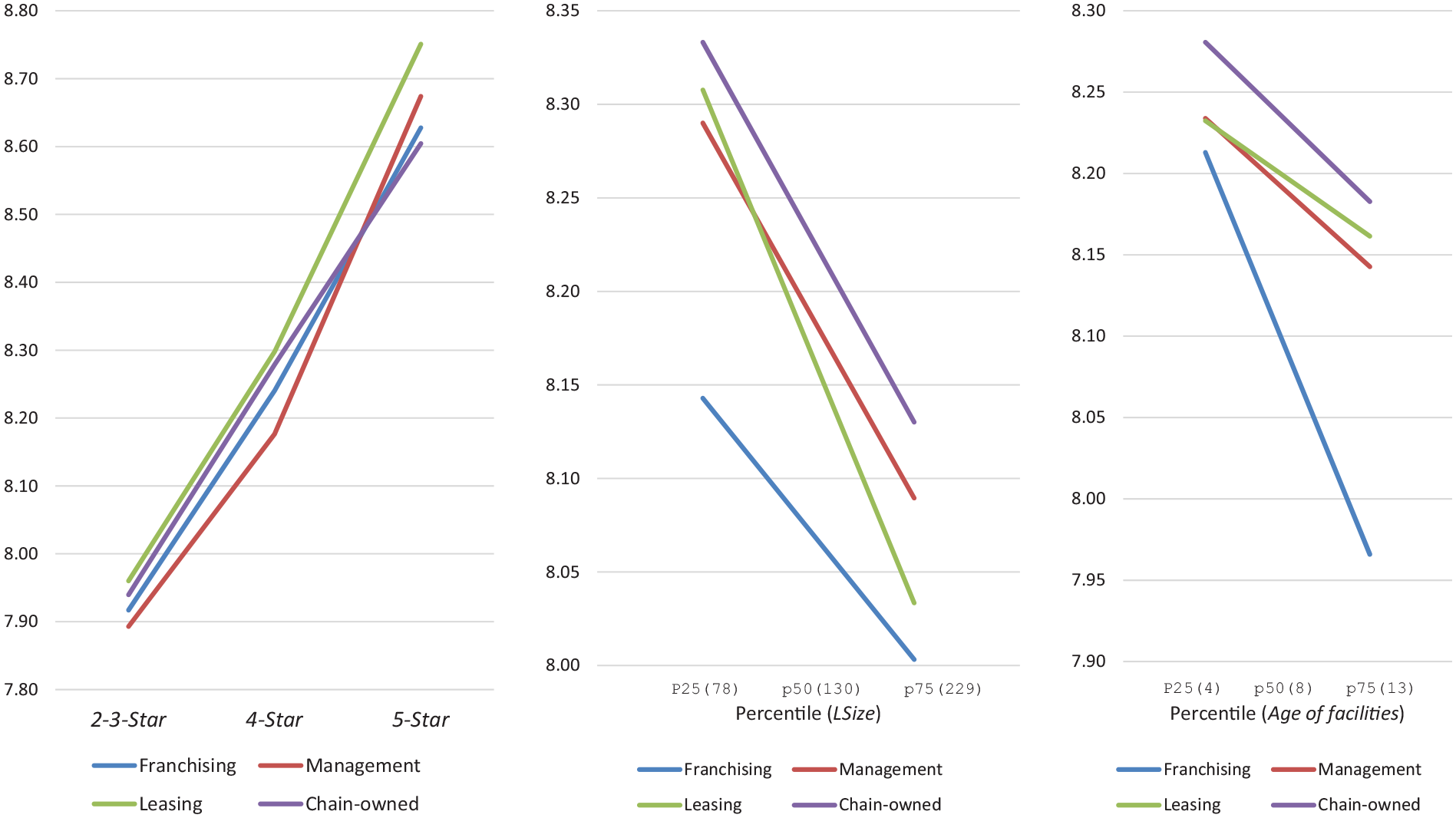
Interaction effects of the governance mode and category, size, and age on online ratings.
The results also show a negative relationship between hotel size and online ratings. Thus, regardless of the form of governance, the coefficients for LSize (β4j) are always negative and significant, indicating that increasing hotel size translates into lower online ratings. Again, the magnitude of these coefficients differs depending on the hotels’ governance mode. Thus, the negative coefficients of LSize are larger for more vertically integrated solutions (β4Leased = |−0.254| > β4Owned = |−0.188|) than for hybrids (β4Franchised = |−0.129| < β4Managed = |−0.186|). Therefore, hybrid governance modes seem to be more useful to prevent the organizational difficulties faced by large hotels for enhancing online ratings, which supports H2. The central graph of Figure 1 plots these results, showing that the smallest slopes are for the franchising line and the largest slope is for the leasing line (and to a lower extent for chain-owned hotels).
Finally, the coefficients for Age of facilities (β5j) are only statistically significant and negative for the franchised (β5Franchised = −0.024) and chain-owned establishments (β5Owned = −0.009). Thus, only when they are franchised or owned, old or not recently refurbished hotels suffer from online ratings shortcomings that are not borne by hotels with other governance modes. This does not support the H3 argument that one of the main problems of lease contracts is potential overuse and under-investment in leased assets (i.e., the building). In addition, these results points to the relative disadvantages of the two extreme governance mechanisms (franchise and chain-owned) for managing building maintenance and its associated problems, which prevents them from obtaining high online ratings. The right-hand graph of Figure 1 plots these results, showing that franchising is the worst governance mode for dealing with aged facilities.
Discussion
A very interesting result to discuss is that higher hotel categories are reflected in higher online ratings, which has also been previously supported by several studies (e.g., Hong et al., 2017; Radojevic et al., 2017). This is not trivial because guests’ expectations (disconfirmation notion) can distort their satisfaction, and it is by no means guaranteed that a higher hotel category always yields better online ratings (Fernández-Barcala et al., 2009). Furthermore, we observe that this online ratings improvement is moderated by the governance mode. Leased and chain-owned hotels (i.e., the most vertically integrated solutions) seem to be more effective if the establishments are 4-Star hotels (i.e., intermediate category) compared to 2- to 3-Star ones. But for 5-Star hotels (the highest category), chain-owned hotels would be outpaced by hotels using any other governance mode. This suggests that ownership does not provide enough incentive intensity to deal with situations, such as those found in 5-Star hotels, in which preventing managerial shirking is key. This finding is consistent with the results of Brown et al. (2014), who found that, in the presence of high monitoring difficulties, chain-owned hotels face more problems of management opportunism. However, it is contrary to the results of Andreu et al. (2020) and Kruesi et al. (2018) that support the opposite hypothesis. Nevertheless, these last two studies do not analyze the four organizational forms separately but in pairs, either eliminating forms or grouping them, so the results are not directly comparable.
The result about leasing contracts is striking because this organizational form is more similar to vertical integration (i.e., the chain is the residual claimant of hotel profits) than to hybrids, which would suggest that it is not the most appropriate solution for providing the highest-powered incentives to managers. However, according to our results, operating a hotel under this type of contract would improve its online rating as much as a management contract if the hotel category were to rise. This suggests that differences between leased and managed hotels should not be so relevant. In this sense, Ginneken et al. (2019) find that these two mechanisms of governance are frequently conflated even by practitioners and industry workers. This might be because the rent in a lease contract can be variable and linked to the gross operating profit of the leased hotel (i.e., lease rent is not always fixed) (Melissen et al., 2016), which is particularly the case in Spain. 9
Furthermore, lease agreements might outperform other organizational forms in 5-Star hotels because they add a behavioral disciplinary effect: the rental payments. This is similar to the debt-disciplinary effect (Jensen, 1986). The hotel chain (the lessee) typically commits to pay the proprietor a long-term rent. Therefore, a significant part of the income is committed to this payment, which forces the hotel manager to generate sufficient revenue (cash-flow) to cover it and prevent losses. This places managers of leased hotels under greater pressure to figure out ways for improving their hotel incomes. Nowadays, improving guests’ perceptions seems to be effective because it rapidly translates into online ratings that now have a critical effect on hotels’ revenues (Cantallops & Salvi, 2014; Kwok et al., 2017; Schuckert et al., 2015; Yang et al., 2018).
A second finding, in line with Radojevic et al. (2017), is that increases in hotel size tend to deteriorate online ratings regardless of the hotel’s governance choice. More interesting is that we also observe that this deterioration is moderated by the governance mode, with franchise and management contracts (to a much lesser extent) being the forms that most moderate this rating drop. These findings suggest that hybrid solutions (which yield high-powered incentives), particularly franchising, outperform vertically integrated ones (which ensure better compliance with standards) in larger hotels where more effective monitoring and management efforts are required because there are more employees and activities to supervise. This is consistent with the argument of Dimou et al. (2003) that hybrid formulas fit better the greater managerial shirking problems of large hotels. Similarly, Lee et al. (2014) found that the potential negative effects of firm size on the financial performance of U.S. hotels are alleviated when they expand through franchising, probably because the latter reduces both capital and entrepreneurial scarcity linked to firm size and improves the self-motivation of their franchisees to generate profits. However, this seems to go against the arguments of Briggs et al. (2007), whereby the goal of lower service variability and standard consistency is a relevant concern in larger hotels, probably because errors in this type of hotels are more visible and harmful. Although this seems to point to to vertical integration to avoid free-riding and deviation from standards (Michael, 2000, 2002), we can argue that owners of large franchised hotels are not prone to this misbehavior either because, as in multi-franchising (Sánchez-Gómez et al., 2010), they would internalize the negative consequences of this behavior to almost the same extent as the franchisor (because of their hotels’ relevance and awareness).
Finally, our results show that a rise in the age of the facilities only reduces online ratings significantly in franchised hotels and, to a lesser extent, in chain-owned hotels. This was not expected. Furthermore, given that in both cases (chain-owned and franchised hotels) the operator (the chain and the franchisee, respectively) is usually also the real estate proprietor, this seems to go against the TCE argument that asset owners do not underinvest in renovation because they fully internalize the consequences of doing so (Allen & Lueck, 2003; Benjamin et al., 1995). In other words, this does not support that the coincidence of residual return and residual control (i.e., the decision rights to use the assets) in the same person is efficient. However, we can accommodate both the TCE argument and our findings if we assume that this low owners’ renovation policy could be more profitable for them (chain-owned and franchisees), even when it might incur a cost in terms of online ratings. Hotel renovation is usually a huge disbursement in the short run, but the effect of low online ratings on financial performance can be attenuated with promotions or price adjustments.
The reason why this effect is not observed in the other two organizational modes (management and lease contracts) might be because the renovation policy is formalized ex ante in written contracts. In these two forms, the residual claimant (proprietor) and the user of the facilities (hotel chain) are two different agents. Hotel chain managers easily anticipate this problem and insist in the ex ante negotiation on very detailed contractual clauses about facility renovation (DeRoos, 2010; Turner & Guilding, 2010). This can force proprietors to renovate facilities more frequently than they would if they were managing the hotels directly.
It is also interesting to note that the greater negative effect on performance of increasing age happens in hotels operated under franchise contracts is consistent with the agency literature. This is because, while the hotel chain appropriates all the return on their investments (i.e., chain-owned hotels), franchisees do so only partially. The latter assume the costs of investments, but the benefits derived from improving the image, service, or brand equity only affect them as long as they have recurrent clientele and they remain in the brand. In addition, any renovation is a partially brand-specific investment since the franchisor’s instructions in terms of decoration and design must be followed. Therefore, it is reasonable to assume that the franchisee will be reluctant to renovate during the term of the contract and will prefer to wait until renewal to reduce the risk of franchisor expropriation (of specific investments).
Conclusion
The key issue raised in this article is whether the governance choice for chain-affiliated hotels affects online ratings. The above results suggest that the answer is affirmative. However, we support the idea that there is no universally superior solution to promote performance. This is because we argue that this superiority varies depending on the fit between the mechanism of governance and the hotel’s characteristics. On the one hand, we argue that franchise and management contracts (i.e., hybrids) solve managerial shirking better than more vertically integrated solutions (leasing and ownership) but are less successful in achieving cooperative adaptation or coordination, in which the latter (leasing and ownership) perform better. So, the key question is what hotel characteristics intensify coordination needs and managerial shirking, determining the most suitable form for each chain-affiliated hotel in terms of online ratings. We hypothesize that hybrids should perform better for top-category or larger hotels because the problems of not solving managerial shirking in such hotels are greater than the problems of free-riding and not reaching the hotel standards. Furthermore, we also argue that the problem of high maintenance in older hotels is solved worse under lease contracts because the user of the facilities is not the residual claimant.
Results point to the superiority of hybrids for running the highest-category establishments (5-Star), situation in which managed and franchised hotels override company-owned hotels. Similarly, franchising is superior for dealing with difficulties linked to hotel size escalation, but does not necessarily outweigh the advantages of vertical integration. Finally, when hotels get older, contrary to expectations, leased hotels do not suffer from maintenance problems as much as franchised and chain-owned hotels.
Managerial implications
The main managerial implication of the article is that governance choice matters in online ratings. Choosing the right mechanism of governance improves the chances of obtaining higher customer scores. The rule for choosing seems to be to pay attention to hotel features, assessing if managerial shirking is more relevant than free-riding and if there is any deviation from hotel chain standards. These seem to be the case for top-category and larger hotels. So vertical integration would be the worst choice for luxury hotels, for which any other mechanism of governance would improve their online ratings. Furthermore, conflictive maintenance issues, frequently attributed to leased hotels, are not insuperable and their online ratings do not necessarily suffer when the hotel becomes older. Conversely, this deterioration of online ratings seems greater in franchising than in any other form, making it unadvisable for old hotels and suggesting that maintenance issues should be taken into account when negotiating the contract.
Limitations
The article has some limitations. The first is that it is an empirical paper based on secondary data, so some measures are not very precise and might give inconclusive results from a theoretical point of view (TCE). Moreover, we do not control how tourism websites review the published comments. Consequently, some risk of bias remains, even though we include many more independent sources of information than previous studies. Therefore, a future line of research is to use a primary source of information to overcome these biases and directly measure coordination problems and managerial opportunism to be able to more accurately assess the advantages of each organizational form. The second is that company-owned hotels are slightly underrepresented in our sample, which might affect the results. The third is that the study is limited to one country. Although Spain is a leading country in the tourism industry—ranking second in the world for both international tourist arrivals and receipts in 2018 (World Tourism Organization, 2019)—and has a mature hotel sector, nothing guarantees that our findings can be extended to other countries whose hotel industries may differ in important ways. Therefore, further research is needed on other territories. It would be particularly interesting to investigate why lease contracts are so widely used in Spain and so little in other territories.
Footnotes
Appendix 1
Pairwise correlation coefficients.
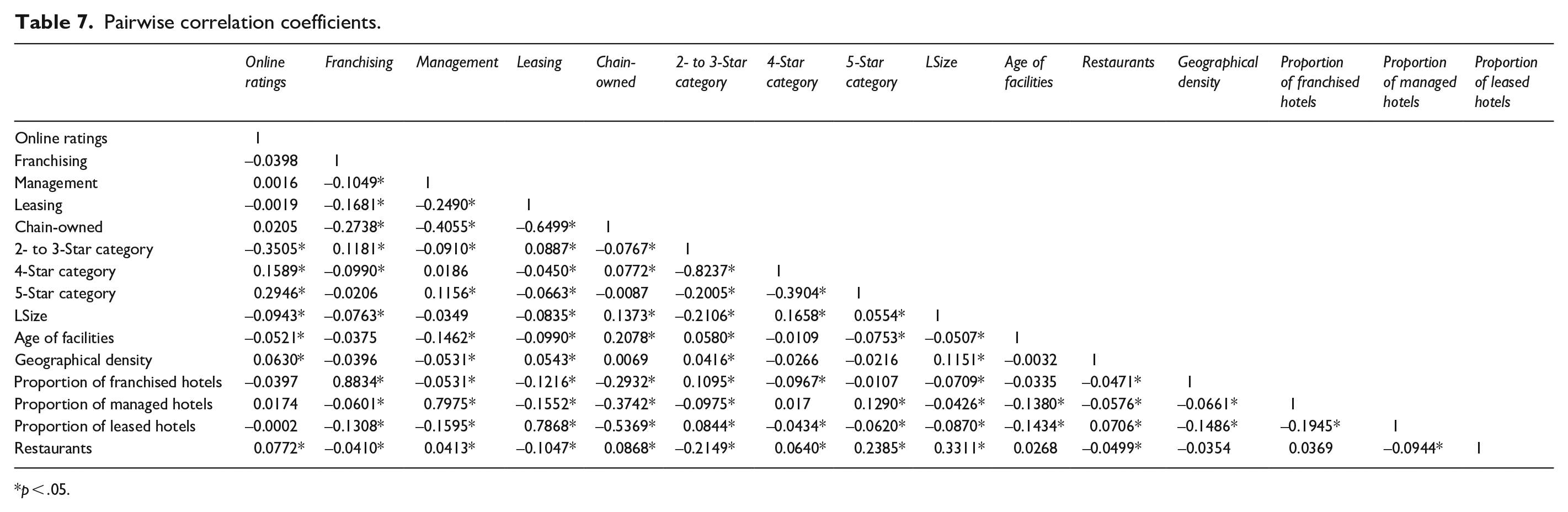
| Online ratings | Franchising | Management | Leasing | Chain-owned | 2- to 3-Star category | 4-Star category | 5-Star category | LSize | Age of facilities | Restaurants | Geographical density | Proportion of franchised hotels | Proportion of managed hotels | Proportion of leased hotels | |
|---|---|---|---|---|---|---|---|---|---|---|---|---|---|---|---|
| Online ratings | 1 | ||||||||||||||
| Franchising | −0.0398 | 1 | |||||||||||||
| Management | 0.0016 | −0.1049* | 1 | ||||||||||||
| Leasing | −0.0019 | −0.1681* | −0.2490* | 1 | |||||||||||
| Chain-owned | 0.0205 | −0.2738* | −0.4055* | −0.6499* | 1 | ||||||||||
| 2- to 3-Star category | −0.3505* | 0.1181* | −0.0910* | 0.0887* | −0.0767* | 1 | |||||||||
| 4-Star category | 0.1589* | −0.0990* | 0.0186 | −0.0450* | 0.0772* | −0.8237* | 1 | ||||||||
| 5-Star category | 0.2946* | −0.0206 | 0.1156* | −0.0663* | −0.0087 | −0.2005* | −0.3904* | 1 | |||||||
| LSize | −0.0943* | −0.0763* | −0.0349 | −0.0835* | 0.1373* | −0.2106* | 0.1658* | 0.0554* | 1 | ||||||
| Age of facilities | −0.0521* | −0.0375 | −0.1462* | −0.0990* | 0.2078* | 0.0580* | −0.0109 | −0.0753* | −0.0507* | 1 | |||||
| Geographical density | 0.0630* | −0.0396 | −0.0531* | 0.0543* | 0.0069 | 0.0416* | −0.0266 | −0.0216 | 0.1151* | −0.0032 | 1 | ||||
| Proportion of franchised hotels | −0.0397 | 0.8834* | −0.0531* | −0.1216* | −0.2932* | 0.1095* | −0.0967* | −0.0107 | −0.0709* | −0.0335 | −0.0471* | 1 | |||
| Proportion of managed hotels | 0.0174 | −0.0601* | 0.7975* | −0.1552* | −0.3742* | −0.0975* | 0.017 | 0.1290* | −0.0426* | −0.1380* | −0.0576* | −0.0661* | 1 | ||
| Proportion of leased hotels | −0.0002 | −0.1308* | −0.1595* | 0.7868* | −0.5369* | 0.0844* | −0.0434* | −0.0620* | −0.0870* | −0.1434* | 0.0706* | −0.1486* | −0.1945* | 1 | |
| Restaurants | 0.0772* | −0.0410* | 0.0413* | −0.1047* | 0.0868* | −0.2149* | 0.0640* | 0.2385* | 0.3311* | 0.0268 | −0.0499* | −0.0354 | 0.0369 | −0.0944* | 1 |
p < .05.
Declaration of conflicting interests
The authors declared no potential conflicts of interest with respect to the research, authorship, and/or publication of this article.
Funding
The authors disclosed receipt of the following financial support for the research, authorship, and/or publication of this article: This work was supported by the Spanish Ministry of Economy, Industry and Competitiveness (Project ECO2017-85704-R).
